Personal Study
Project
Unit 12 Specialist study in creative media production
Personal Study Project
• You will need to produce
1. A research document
• Collection of quotes and summarised information
based around your topic
• This should include research from a wide variety of
sources (not just websites- this is critical to achieving
beyond a Pass)
• An alphabetised bibliography on the final slide
DEADLINE 03/11/22 in Personal Study Section of website
Deadlines
Date w/c Task[s]
Summer Choose your focus topic and basic research of theories
12/09 Research all 4 theories (4 sources minimum)
19/09 Research theory (2 sources minimum)
26/09 Research product/person/studio (secondary research) (3 sources minimum)
03/10 Research product/person/studio (secondary research) (3 sources minimum)
10/10 Analyse a product/scene/specific pages/photographs/levels etc.
17/10 Final additions and upload to PERSONAL STUDY area of website. Start essay.
Half term
CHOSEN TOPIC
Film
Theories
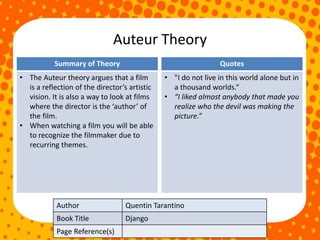
Auteur Theory
Author Quentin Tarantino
Book Title Django
Page Reference(s)
Summary of Theory
• The Auteur theory argues that a film
is a reflection of the director’s artistic
vision. It is also a way to look at films
where the director is the ‘author’ of
the film.
• When watching a film you will be able
to recognize the filmmaker due to
recurring themes.
Quotes
• "I do not live in this world alone but in
a thousand worlds.“
• “I liked almost anybody that made you
realize who the devil was making the
picture.”
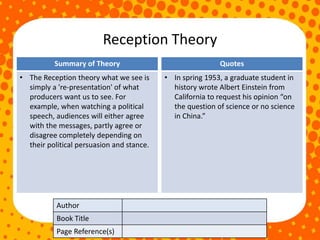
Reception Theory
Author
Book Title
Page Reference(s)
Summary of Theory
• The Reception theory what we see is
simply a 're-presentation' of what
producers want us to see. For
example, when watching a political
speech, audiences will either agree
with the messages, partly agree or
disagree completely depending on
their political persuasion and stance.
Quotes
• In spring 1953, a graduate student in
history wrote Albert Einstein from
California to request his opinion “on
the question of science or no science
in China.”
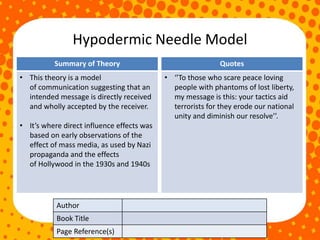
Hypodermic Needle Model
Author
Book Title
Page Reference(s)
Summary of Theory
• This theory is a model
of communication suggesting that an
intended message is directly received
and wholly accepted by the receiver.
• It’s where direct influence effects was
based on early observations of the
effect of mass media, as used by Nazi
propaganda and the effects
of Hollywood in the 1930s and 1940s
Quotes
• ‘’To those who scare peace loving
people with phantoms of lost liberty,
my message is this: your tactics aid
terrorists for they erode our national
unity and diminish our resolve’’.
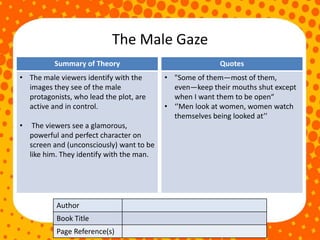
The Male Gaze
Author
Book Title
Page Reference(s)
Summary of Theory
• The male viewers identify with the
images they see of the male
protagonists, who lead the plot, are
active and in control.
• The viewers see a glamorous,
powerful and perfect character on
screen and (unconsciously) want to be
like him. They identify with the man.
Quotes
• "Some of them—most of them,
even—keep their mouths shut except
when I want them to be open“
• ‘’Men look at women, women watch
themselves being looked at’’
CHOSEN THEORY
The Auteur
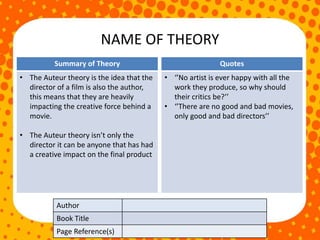
NAME OF THEORY
Author
Book Title
Page Reference(s)
Summary of Theory
• The Auteur theory is the idea that the
director of a film is also the author,
this means that they are heavily
impacting the creative force behind a
movie.
• The Auteur theory isn’t only the
director it can be anyone that has had
a creative impact on the final product
Quotes
• ‘’No artist is ever happy with all the
work they produce, so why should
their critics be?’’
• ‘’There are no good and bad movies,
only good and bad directors’’
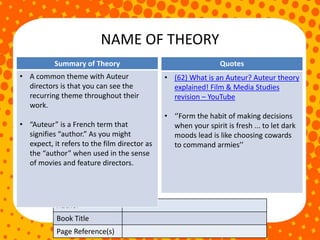
NAME OF THEORY
Author
Book Title
Page Reference(s)
Summary of Theory
• A common theme with Auteur
directors is that you can see the
recurring theme throughout their
work.
• “Auteur” is a French term that
signifies “author.” As you might
expect, it refers to the film director as
the “author” when used in the sense
of movies and feature directors.
Quotes
• (62) What is an Auteur? Auteur theory
explained! Film & Media Studies
revision – YouTube
• ‘’Form the habit of making decisions
when your spirit is fresh ... to let dark
moods lead is like choosing cowards
to command armies’’
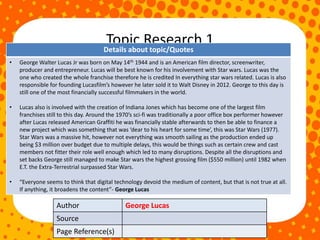
TOPIC
Topic Research 1
Author George Lucas
Source
Page Reference(s)
Details about topic/Quotes
• George Walter Lucas Jr was born on May 14th 1944 and is an American film director, screenwriter,
producer and entrepreneur. Lucas will be best known for his involvement with Star wars. Lucas was the
one who created the whole franchise therefore he is credited In everything star wars related. Lucas is also
responsible for founding Lucasfilm’s however he later sold it to Walt Disney in 2012. George to this day is
still one of the most financially successful filmmakers in the world.
• Lucas also is involved with the creation of Indiana Jones which has become one of the largest film
franchises still to this day. Around the 1970’s sci-fi was traditionally a poor office box performer however
after Lucas released American Graffiti he was financially stable afterwards to then be able to finance a
new project which was something that was ‘dear to his heart for some time’, this was Star Wars (1977).
Star Wars was a massive hit, however not everything was smooth sailing as the production ended up
being $3 million over budget due to multiple delays, this would be things such as certain crew and cast
members not fitter their role well enough which led to many disruptions. Despite all the disruptions and
set backs George still managed to make Star wars the highest grossing film ($550 million) until 1982 when
E.T. the Extra-Terrestrial surpassed Star Wars.
• “Everyone seems to think that digital technology devoid the medium of content, but that is not true at all.
If anything, it broadens the content”- George Lucas
Topic Research 2
Author George Lucas
Source
Page Reference(s)
Details about topic/Quotes
• George Lucas released his debut feature film THX 1138 in 1971 alongside the launch of Lucasfilm's. This
was the first insight of Georges director influence in film, THX 1138 was science fiction film set in a
dystopian future with police that were androids that drugs people to supress their emotions. This film got
mixed reviews and there has been claims that the film suffers from a simple story line, which is something
that is essential in a sci-fi film, however considering this was Georges debut film and was only 25 years old
at the time some would say its impressive.
• George was always interested in the science fiction side of movies and wanted to make his impression on
the genre with the Star Wars franchise. Star Wars is still one of the most successful film franchises to this
day, this could be because of the creative vision behind this masterpiece. Lucas put in so much effort in
the post production of Star Wars which ended up causing him constraints within his marriage with Marcia
which then finally ended after the first trilogy of Star Wars. With the success of Star Wars Lucas had a lot
of attention that he wasn’t used to beforehand, this resulted in both positive and negative comments on
his work and even received threats. This could all be because of how popular he became after Star Wars
and people wanted Lucas’s financial backing.
• “'Star Wars' is fun, its exciting, its inspirational, and people respond to that. It's what they want”- George
Lucas
Topic Research 3
Author George Lucas
Source
Page Reference(s)
Details about topic/Quotes
• George Lucas decided to stop writing on Star Wars as he wanted to focus his life on
his family and spending quality time with them. It is known that George regrets
selling Star Wars off, as we are aware that he had multiple ideas for other movies
that would of changed the world of Star Wars. Before the success from Star Wars
George was worth around $4 million due to his global box office hit American Graffiti
however this $4 million has risen to $5 billion which shoes the huge success of Star
Wars.
• A few of the films that he created was, Star Wars: The Clone Wars (2020), Strange
Magic (2015) and Rouge One: A Star Wars Story (2016)
• A few of the films that he was an Executive Producer was, Red Tails (2012), Willow
(1988) and Star Wars: The Empire Strikes Back (1980)
• “I'm not much of a math and science guy. I spent most of my time in school
daydreaming and managed to turn it into a living”- George Lucas
Topic Research 4
Author George Lucas
Source
Page Reference(s)
Details about topic/Quotes
• George was raised on a walnut ranch in Modesto, California. During his time at High School, he was very
much interested in drag racing and planned to make that his profession. However shortly after he
graduated he was in a ‘terrible’ car accident which changed his view on life and that accident ended his
dream of becoming a professional driver.
• In 1975 Lucas created/founded ILM (Industrial Light % Magic) which was used to create visual effects for
Star Wars. ILM has created visual effects for over 350 feature films. ILM is one of the most advanced
digital effects pipelines in the entertainment industry with creating the likes of completely digital
characters within some of the most popular box office hits, some examples of these characters are Yoda,
Davy Jones, Transformers etc. ILM’s success is partial to its ability to merge live action photos with photo-
realistic digital images, this was something that wasn’t done before George created this company, which
therefore spiralled the company into success.
• “A special effect is a tool, a means of telling a story. A special effect without a story is a pretty boring
thing”- George Lucas
Topic Research 5
Author George Lucas
Source
Page Reference(s)
Details about topic/Quotes
• George Walter Lucas Milestones: (1962) Almost dies after crashing into a walnut tree, (1963) Enrols at
USC’S school of Cinema Television, (1969) Creates production company with Francs Ford Coppola, (1971)
Lucas forms Lucasfilm's and releases American Graffiti, (1977) releases the first Star Wars with a budget of
$11million.
• After Lucas released American Graffiti the profits, he made from the film could of easily kept him from
having to work again however George wanted to make an impact on the entertainment history and make
a difference. His diligence costed him his marriage with his wife and also had affected his overall health
however this didn’t stop him from keeping himself in the industry because he knew how much of an
impact he was making. George was changing the meaning of cinematography however this was not only
visually but mentally, even theatre owners were changing their sound systems, this was because Lucas
was bringing life to sound in his movies and made people change the way they looked at sounds and
visual effects.
• “The sound and music are 50% of the entertainment in a movie”- George Lucas
Topic Research 6
Author George Lucas
Source
Page Reference(s)
Details about topic/Quotes
• Lucas made the other Star Wars films and along with Steven Spielberg created the Indiana Jones series
which made box office records of their own. From 1980 to 1985, Lucas was busy with the construction of
Skywalker Ranch, to accommodate the creative, technical, needs of Lucasfilm. Lucas also revolutionized
movie theatres with the THX system which was created to maintain the highest quality standards in
motion picture viewing.
• The next film by Lucas, an epic space opera entitled Star Wars (1977), went through a problematic
production process; however, it was a surprise blow, becoming the highest grossing film at that time, as
well as winning six Academy Awards and a cultural phenomenon. After the first Star Wars movie, Lucas
produced and co-wrote the following instalments in the trilogy, The Empire Strikes Back (1980) and The
Return of the Jedi (1983). Together with Steven Spielberg, Lucas co-created and helped collaborate with
the stories of the Indiana Jones movies. Raiders of the Lost Ark (1981), Indiana Jones and the Temple of
Doom (1984) and Indiana Jones and the Last Crusade (1989). Lucas also produced and wrote a variety of
films through Lucasfilm in the 1980s and 1990s.
• “Everybody has talent, it's just a matter of moving around until you've discovered what it is”- George
Lucas
Micro Analysis
Source
Analysis
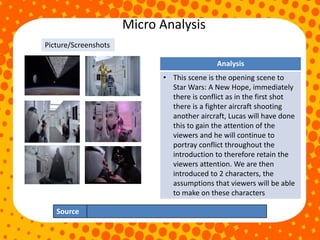
• This scene is the opening scene to
Star Wars: A New Hope, immediately
there is conflict as in the first shot
there is a fighter aircraft shooting
another aircraft, Lucas will have done
this to gain the attention of the
viewers and he will continue to
portray conflict throughout the
introduction to therefore retain the
viewers attention. We are then
introduced to 2 characters, the
assumptions that viewers will be able
to make on these characters
Picture/Screenshots
Personal Research Project
• You need to produce an exploration of an element of media that you are
passionate about and is directly linked to the style of media you will make
in your FMP.
• This could be centred around a specific director, product, specific genre or
a social/historical/cultural context.
• You will need to write a minimum of a 1500 word essay exploring the
topic.
• You will also need to complete a bibliography of sources directly used in
your essay.
• The final section of your essay will focus on how your findings link to your
own work and your intended outcomes on your FMP this year
Essay Title
• Person or Studio Focus
How is [THEORY] relevant when analysing
the work of [PERSON/STUDIO]?
• Specific Product Focus
How is [THEORY] relevant when analysing
[PRODUCT]?
• Choose your person, studio or product that you will
focus on related to what you will make as your FMP
• Choose one of the theories from the
Essay Plan
• Your study should be structured using the following
– Select a director/designer/producer/studio/etc
[dependent on your area of interest] that you consider a
strong influence on your work and that you can do the
necessary analysis and investigations into, both from a
technical focus and academic focus
– Undertake macro analysis, this would be looking at the
wider context of their work [this could be historical
backgrounds, the world they operate in, influences, where
their work is seen, etc]
– Undertake micro analysis, this would focusing on specific
films/scene/levels of a game/photos/graphic designs etc
– Link this investigation to your own work and your intended
outcomes on your FMP
Essay Plan
1. Introduction to your topic (~100 words)
– Who/What did you research? What do you plan to discover through your discussion? How will you go about
doing this (macro, micro and application of theory)?
2. Introduction to your theory (~100 words)
– Explain what your theory is and its origins. What are the main beliefs of the theory? What are the criticisms of
the theory?
3. Macro analysis (400+ words)
– Context of a person: Reference their history with media. What products have they made in the past? What is
their production signature? How are they critically regarded? Any criticisms of their work?
– Context of a product: Reference the production process. Discuss the studio/company that made it and their
history. How is the work critically regarded? Any criticisms of the product?
4. Micro analysis (400+ words)
– Analyse the product/scene/specific pages/photographs/levels etc.
– Discuss the technical construction of what you are analysing (colour, composition, content etc etc) and reference
what impact each aspect discussed on the audience .
5. Application of Theory (400+ words)
– Apply your chosen theory to your chosen product/person/studio with frequent examples.
6. Your own work [~200 words]
– Talk about specific elements of the study that you will incorporate into your FMP this year;
– Link specific research outcomes to elements of your planned FMP, whether it be technical aspects, conceptual
elements or creative inspirations
– Be specific and aim to talk about 3-5 areas that you can link forward into the FMP
7. Conclusion (100 words)
– Reference general theory and your focus statement when making your concluding points
– What have you discovered from your study?
– Answer the question from your title
Academic Media Theories
• You should make specific reference to at least
one of the following media theories:
1. Auteur Theory
2. Reception Theory
3. The Hypodermic Needle Model
4. The Male Gaze
• You may find other relevant theories in your
investigations for your research document
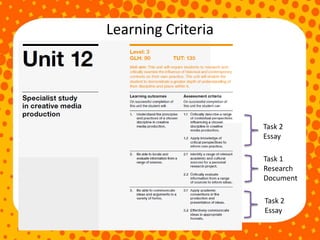
Learning Criteria
Task 2
Essay
Task 1
Research
Document
Task 2
Essay
SUPPORT & GUIDANCE SLIDES
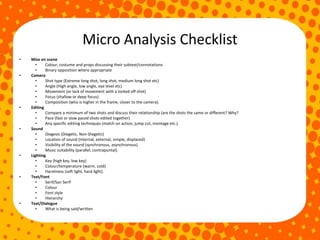
Micro Analysis Checklist
• Mise en scene
• Colour, costume and props discussing their subtext/connotations
• Binary opposition where appropriate
• Camera
• Shot type (Extreme long shot, long shot, medium long shot etc)
• Angle (High angle, low angle, eye level etc)
• Movement (or lack of movement with a locked off shot)
• Focus (shallow or deep focus)
• Composition (who is higher in the frame, closer to the camera).
• Editing
• Compare a minimum of two shots and discuss their relationship (are the shots the same or different? Why?
• Pace (fast or slow paced shots edited together)
• Any specific editing techniques (match on action, jump cut, montage etc.).
• Sound
• Diegesis (Diegetic, Non-Diegetic)
• Location of sound (internal, external, simple, displaced)
• Visibility of the sound (synchronous, asynchronous)
• Music suitability (parallel, contrapuntal).
• Lighting
• Key (high key, low key)
• Colour/temperature (warm, cold)
• Harshness (soft light, hard light).
• Text/Font
• Serif/San Serif
• Colour
• Font style
• Hierarchy
• Text/Dialogue
• What is being said/written
Quotes/Sources
• Reference and foreground your focus
statement regularly.
• Include your sources regularly and throughout
– Quotes, statistics, analysis, film dialogue etc
• Include a referenced source directly in your
discussion every 250 words (as a minimum).
• Update your research document as you
include additional sources (if necessary).
Types of sources
• Chosen products (films, art, magazines, TV shows, games etc)
• Books (written by or about your director/theme) [Google Books]
• Academic articles (Google scholar)
• Interviews
• Documentaries
• DVD extras
• DVD commentaries
• Reviews/Popular Articles
• Journals
• Questionnaires (survey monkey/MS Forms)
• Focus groups
Bibliography STYLES FOR DIFFERENT SOURCES
1. Film Title (YEAR) Directed by DIRECTOR [film] Location of Distributor:
Distributor.
2. “Episode Title” (YEAR) SHOW NAME. Series and Episode numbers.
Channel. Day or broadcast.
3. Game Title (YEAR) Console [game] Studio. Studio Location.
4. Artist surname, artist first initial. (YEAR) Title [details of its materials]
Location where it is. City where it is
5. Artist surname, artist first initial. (YEAR) Title
6. Author surname, author first initial. (YEAR). Title. Publisher Location:
Publisher.
7. Author surname, author first initial. (YEAR). Title. Available:
WEBLINK. Last accessed DATE YOU LAST VISITED SITE.
8. Author surname, author first initial.(YEAR) “Article title”, Magazine
(Issue Number), PAGE REFERENCE
9. In writing
“QUOTE” (INTERVIEWEE cited in AUTHOR, YEAR, PAGE REFERENCE)
In Bibliography
Author. (YEAR) “Article title”, Magazine (Issue Number), PAGE
REFERENCE
10. Anon (n.d.) Title Available: WEBLINK. Last accessed DATE YOU LAST
VISITED SITE.
1. Film
2. TV show
3. Game
4. Art
5. Photography
6. Book
7. Website
8. Magazine article
9. Citation
10.Unknown
author/date
Bibliography STYLE EXAMPLES
1. Jaws (1975) Directed by Francois Truffaut [film] Universal City,
California: Universal Pictures
2. “Gone” (2001) Spaced. Series 2 Episode 5. Channel 4. 30th March
3. The Legend of Zelda: Breath of the Wild (2017) Nintendo Switch
[game] Nintendo. Kyoto.
4. Goya, F. (1819) Saturn Devouring His Son [mixed media mural
transferred to canvas] Museo del Prado. Madrid
5. McCurry, S. (1984) Afghan Girl
6. Greene, N (2007). The French New Wave - A New Look . London:
Wallflower Press.
7. Hitchman, S. (2008). A History of French New Wave Cinema .
Available: http://www.newwavefilm.com/about/history-of-french-
new-wave.shtml. Last accessed 11th Mar 2022.
8. Smith, J. (2014) “French New Wave Cinema”, Total Film (Issue 332),
p34-35
9. In writing
“QUOTE” (Truffaut cited in Smith, 1994, p25)
In Bibliography
Smith, J (1994) “Interview with Truffaut”, Sight and Sound (issue 67),
p24-25
10. Anon (n.d.) The French New Wave Available: www.realwebsite.com
Last accessed 11th Mar 2022.
1. Film
2. TV show
3. Game
4. Art
5. Photography
6. Book
7. Website
8. Magazine article
9. Citation
10.Unknown
author/date
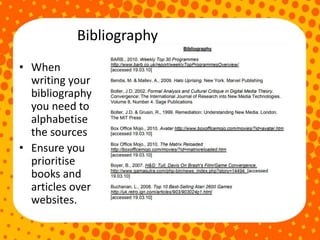
• When
writing your
bibliography
you need to
alphabetise
the sources
• Ensure you
prioritise
books and
articles over
websites.
Bibliography
Z Library
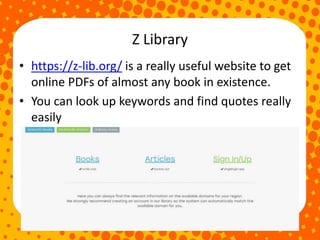
• https://z-lib.org/ is a really useful website to get
online PDFs of almost any book in existence.
• You can look up keywords and find quotes really
easily
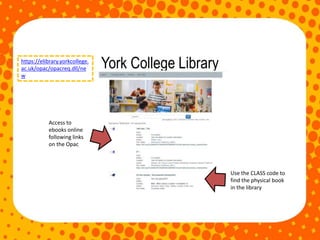
York College Library
Access to
ebooks online
following links
on the Opac
Use the CLASS code to
find the physical book
in the library
https://elibrary.yorkcollege.
ac.uk/opac/opacreq.dll/ne
w
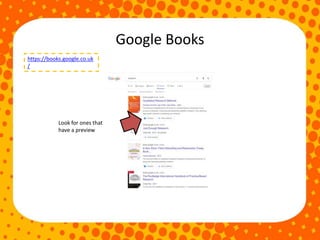
Google Books
https://books.google.co.uk
/
Look for ones that
have a preview
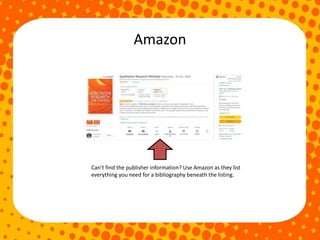
Amazon
Can’t find the publisher information? Use Amazon as they list
everything you need for a bibliography beneath the listing.
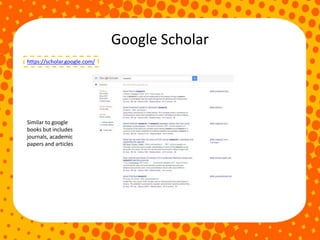
Google Scholar
https://scholar.google.com/
Similar to google
books but includes
journals, academic
papers and articles
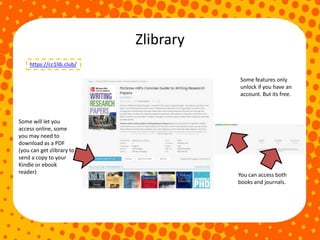
Zlibrary
Some will let you
access online, some
you may need to
download as a PDF
(you can get zlibrary to
send a copy to your
Kindle or ebook
reader)
Some features only
unlock if you have an
account. But its free.
https://cc1lib.club/
You can access both
books and journals.
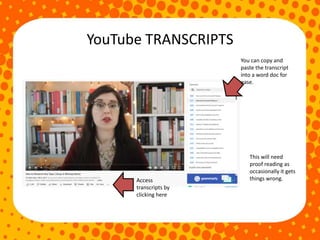
YouTube TRANSCRIPTS
Access
transcripts by
clicking here
You can copy and
paste the transcript
into a word doc for
ease.
This will need
proof reading as
occasionally it gets
things wrong.
MyBib
https://www.mybib.com
/
Stores your
bibliography online
for you to copy and
paste off when your
ready.
Generates a
bibliography from a
URL- no effort
required
You will probably
need to refine this a
bit as author names
don’t always seem to
come across.
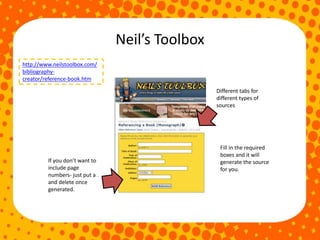
Neil’s Toolbox
http://www.neilstoolbox.com/
bibliography-
creator/reference-book.htm
Fill in the required
boxes and it will
generate the source
for you.
Different tabs for
different types of
sources
If you don’t want to
include page
numbers- just put a .
and delete once
generated.
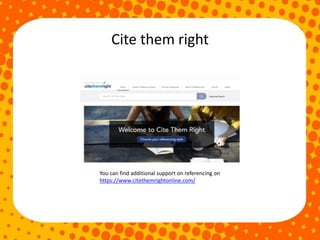
Cite them right
You can find additional support on referencing on
https://www.citethemrightonline.com/
In text references
• Comes in 3 Flavours;
1. Regular
• Include a quote and then out the author’s surname and year of release
– Films such as Spider-Man: Into the Spider-Verse (2018), which employs the post-modern narrative focus
of an oppressed minority and applies modernistic Silver Age comics visual style through “Ben-Day Dots,
hard facial lines, and misaligned color palettes” (Cardenas, 2021),
2. Front-load it
• Mention the author, title of the book/article and year of publication before jumping into the quote
– Luke Turner authored the Metamodernist Manifesto in 2011, formalising his beliefs of the core
principals of the movement. Turner states metamodernity is “an oscillation between positions, with
diametrically opposed ideas operating like the pulsating polarities of a colossal electric machine,
propelling the world into action”.
3. Citation
• If someone was quoted in something else (like someone being interviewed in an article) you “cite”
them
– For it to have been universal across all homo sapien societies (as it is suggested) then “it must have a
social purpose” (de Waal cited in Ambrosino, 2019).
Including sources
• When including a source in your script include brief information from your
bibliography with a page reference where relevant.
Example
Truffaut uses long shot durations throughout the 400 Blows (Truffaut, 1959).
Truffaut references this stating “It was an accident” (Truffaut in Smith, 1994,
p34).
12. Truffaut, F (1959) The 400 Blows
13. Truffaut, F cited in Smith J (1994) Interview with Truffaut (Sight and
Sound, issue 67)
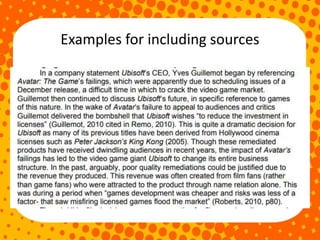
Examples for including sources

Personal Study Essay Research Document Pro Forma.pptx

  • 1.
    Personal Study Project Unit 12Specialist study in creative media production
  • 2.
    Personal Study Project •You will need to produce 1. A research document • Collection of quotes and summarised information based around your topic • This should include research from a wide variety of sources (not just websites- this is critical to achieving beyond a Pass) • An alphabetised bibliography on the final slide DEADLINE 03/11/22 in Personal Study Section of website
  • 3.
    Deadlines Date w/c Task[s] SummerChoose your focus topic and basic research of theories 12/09 Research all 4 theories (4 sources minimum) 19/09 Research theory (2 sources minimum) 26/09 Research product/person/studio (secondary research) (3 sources minimum) 03/10 Research product/person/studio (secondary research) (3 sources minimum) 10/10 Analyse a product/scene/specific pages/photographs/levels etc. 17/10 Final additions and upload to PERSONAL STUDY area of website. Start essay. Half term
  • 4.
  • 5.
  • 6.
    Auteur Theory Author QuentinTarantino Book Title Django Page Reference(s) Summary of Theory • The Auteur theory argues that a film is a reflection of the director’s artistic vision. It is also a way to look at films where the director is the ‘author’ of the film. • When watching a film you will be able to recognize the filmmaker due to recurring themes. Quotes • "I do not live in this world alone but in a thousand worlds.“ • “I liked almost anybody that made you realize who the devil was making the picture.”
  • 7.
    Reception Theory Author Book Title PageReference(s) Summary of Theory • The Reception theory what we see is simply a 're-presentation' of what producers want us to see. For example, when watching a political speech, audiences will either agree with the messages, partly agree or disagree completely depending on their political persuasion and stance. Quotes • In spring 1953, a graduate student in history wrote Albert Einstein from California to request his opinion “on the question of science or no science in China.”
  • 8.
    Hypodermic Needle Model Author BookTitle Page Reference(s) Summary of Theory • This theory is a model of communication suggesting that an intended message is directly received and wholly accepted by the receiver. • It’s where direct influence effects was based on early observations of the effect of mass media, as used by Nazi propaganda and the effects of Hollywood in the 1930s and 1940s Quotes • ‘’To those who scare peace loving people with phantoms of lost liberty, my message is this: your tactics aid terrorists for they erode our national unity and diminish our resolve’’.
  • 9.
    The Male Gaze Author BookTitle Page Reference(s) Summary of Theory • The male viewers identify with the images they see of the male protagonists, who lead the plot, are active and in control. • The viewers see a glamorous, powerful and perfect character on screen and (unconsciously) want to be like him. They identify with the man. Quotes • "Some of them—most of them, even—keep their mouths shut except when I want them to be open“ • ‘’Men look at women, women watch themselves being looked at’’
  • 10.
  • 11.
    NAME OF THEORY Author BookTitle Page Reference(s) Summary of Theory • The Auteur theory is the idea that the director of a film is also the author, this means that they are heavily impacting the creative force behind a movie. • The Auteur theory isn’t only the director it can be anyone that has had a creative impact on the final product Quotes • ‘’No artist is ever happy with all the work they produce, so why should their critics be?’’ • ‘’There are no good and bad movies, only good and bad directors’’
  • 12.
    NAME OF THEORY Author BookTitle Page Reference(s) Summary of Theory • A common theme with Auteur directors is that you can see the recurring theme throughout their work. • “Auteur” is a French term that signifies “author.” As you might expect, it refers to the film director as the “author” when used in the sense of movies and feature directors. Quotes • (62) What is an Auteur? Auteur theory explained! Film & Media Studies revision – YouTube • ‘’Form the habit of making decisions when your spirit is fresh ... to let dark moods lead is like choosing cowards to command armies’’
  • 13.
  • 14.
    Topic Research 1 AuthorGeorge Lucas Source Page Reference(s) Details about topic/Quotes • George Walter Lucas Jr was born on May 14th 1944 and is an American film director, screenwriter, producer and entrepreneur. Lucas will be best known for his involvement with Star wars. Lucas was the one who created the whole franchise therefore he is credited In everything star wars related. Lucas is also responsible for founding Lucasfilm’s however he later sold it to Walt Disney in 2012. George to this day is still one of the most financially successful filmmakers in the world. • Lucas also is involved with the creation of Indiana Jones which has become one of the largest film franchises still to this day. Around the 1970’s sci-fi was traditionally a poor office box performer however after Lucas released American Graffiti he was financially stable afterwards to then be able to finance a new project which was something that was ‘dear to his heart for some time’, this was Star Wars (1977). Star Wars was a massive hit, however not everything was smooth sailing as the production ended up being $3 million over budget due to multiple delays, this would be things such as certain crew and cast members not fitter their role well enough which led to many disruptions. Despite all the disruptions and set backs George still managed to make Star wars the highest grossing film ($550 million) until 1982 when E.T. the Extra-Terrestrial surpassed Star Wars. • “Everyone seems to think that digital technology devoid the medium of content, but that is not true at all. If anything, it broadens the content”- George Lucas
  • 15.
    Topic Research 2 AuthorGeorge Lucas Source Page Reference(s) Details about topic/Quotes • George Lucas released his debut feature film THX 1138 in 1971 alongside the launch of Lucasfilm's. This was the first insight of Georges director influence in film, THX 1138 was science fiction film set in a dystopian future with police that were androids that drugs people to supress their emotions. This film got mixed reviews and there has been claims that the film suffers from a simple story line, which is something that is essential in a sci-fi film, however considering this was Georges debut film and was only 25 years old at the time some would say its impressive. • George was always interested in the science fiction side of movies and wanted to make his impression on the genre with the Star Wars franchise. Star Wars is still one of the most successful film franchises to this day, this could be because of the creative vision behind this masterpiece. Lucas put in so much effort in the post production of Star Wars which ended up causing him constraints within his marriage with Marcia which then finally ended after the first trilogy of Star Wars. With the success of Star Wars Lucas had a lot of attention that he wasn’t used to beforehand, this resulted in both positive and negative comments on his work and even received threats. This could all be because of how popular he became after Star Wars and people wanted Lucas’s financial backing. • “'Star Wars' is fun, its exciting, its inspirational, and people respond to that. It's what they want”- George Lucas
  • 16.
    Topic Research 3 AuthorGeorge Lucas Source Page Reference(s) Details about topic/Quotes • George Lucas decided to stop writing on Star Wars as he wanted to focus his life on his family and spending quality time with them. It is known that George regrets selling Star Wars off, as we are aware that he had multiple ideas for other movies that would of changed the world of Star Wars. Before the success from Star Wars George was worth around $4 million due to his global box office hit American Graffiti however this $4 million has risen to $5 billion which shoes the huge success of Star Wars. • A few of the films that he created was, Star Wars: The Clone Wars (2020), Strange Magic (2015) and Rouge One: A Star Wars Story (2016) • A few of the films that he was an Executive Producer was, Red Tails (2012), Willow (1988) and Star Wars: The Empire Strikes Back (1980) • “I'm not much of a math and science guy. I spent most of my time in school daydreaming and managed to turn it into a living”- George Lucas
  • 17.
    Topic Research 4 AuthorGeorge Lucas Source Page Reference(s) Details about topic/Quotes • George was raised on a walnut ranch in Modesto, California. During his time at High School, he was very much interested in drag racing and planned to make that his profession. However shortly after he graduated he was in a ‘terrible’ car accident which changed his view on life and that accident ended his dream of becoming a professional driver. • In 1975 Lucas created/founded ILM (Industrial Light % Magic) which was used to create visual effects for Star Wars. ILM has created visual effects for over 350 feature films. ILM is one of the most advanced digital effects pipelines in the entertainment industry with creating the likes of completely digital characters within some of the most popular box office hits, some examples of these characters are Yoda, Davy Jones, Transformers etc. ILM’s success is partial to its ability to merge live action photos with photo- realistic digital images, this was something that wasn’t done before George created this company, which therefore spiralled the company into success. • “A special effect is a tool, a means of telling a story. A special effect without a story is a pretty boring thing”- George Lucas
  • 18.
    Topic Research 5 AuthorGeorge Lucas Source Page Reference(s) Details about topic/Quotes • George Walter Lucas Milestones: (1962) Almost dies after crashing into a walnut tree, (1963) Enrols at USC’S school of Cinema Television, (1969) Creates production company with Francs Ford Coppola, (1971) Lucas forms Lucasfilm's and releases American Graffiti, (1977) releases the first Star Wars with a budget of $11million. • After Lucas released American Graffiti the profits, he made from the film could of easily kept him from having to work again however George wanted to make an impact on the entertainment history and make a difference. His diligence costed him his marriage with his wife and also had affected his overall health however this didn’t stop him from keeping himself in the industry because he knew how much of an impact he was making. George was changing the meaning of cinematography however this was not only visually but mentally, even theatre owners were changing their sound systems, this was because Lucas was bringing life to sound in his movies and made people change the way they looked at sounds and visual effects. • “The sound and music are 50% of the entertainment in a movie”- George Lucas
  • 19.
    Topic Research 6 AuthorGeorge Lucas Source Page Reference(s) Details about topic/Quotes • Lucas made the other Star Wars films and along with Steven Spielberg created the Indiana Jones series which made box office records of their own. From 1980 to 1985, Lucas was busy with the construction of Skywalker Ranch, to accommodate the creative, technical, needs of Lucasfilm. Lucas also revolutionized movie theatres with the THX system which was created to maintain the highest quality standards in motion picture viewing. • The next film by Lucas, an epic space opera entitled Star Wars (1977), went through a problematic production process; however, it was a surprise blow, becoming the highest grossing film at that time, as well as winning six Academy Awards and a cultural phenomenon. After the first Star Wars movie, Lucas produced and co-wrote the following instalments in the trilogy, The Empire Strikes Back (1980) and The Return of the Jedi (1983). Together with Steven Spielberg, Lucas co-created and helped collaborate with the stories of the Indiana Jones movies. Raiders of the Lost Ark (1981), Indiana Jones and the Temple of Doom (1984) and Indiana Jones and the Last Crusade (1989). Lucas also produced and wrote a variety of films through Lucasfilm in the 1980s and 1990s. • “Everybody has talent, it's just a matter of moving around until you've discovered what it is”- George Lucas
  • 20.
    Micro Analysis Source Analysis • Thisscene is the opening scene to Star Wars: A New Hope, immediately there is conflict as in the first shot there is a fighter aircraft shooting another aircraft, Lucas will have done this to gain the attention of the viewers and he will continue to portray conflict throughout the introduction to therefore retain the viewers attention. We are then introduced to 2 characters, the assumptions that viewers will be able to make on these characters Picture/Screenshots
  • 21.
    Personal Research Project •You need to produce an exploration of an element of media that you are passionate about and is directly linked to the style of media you will make in your FMP. • This could be centred around a specific director, product, specific genre or a social/historical/cultural context. • You will need to write a minimum of a 1500 word essay exploring the topic. • You will also need to complete a bibliography of sources directly used in your essay. • The final section of your essay will focus on how your findings link to your own work and your intended outcomes on your FMP this year
  • 22.
    Essay Title • Personor Studio Focus How is [THEORY] relevant when analysing the work of [PERSON/STUDIO]? • Specific Product Focus How is [THEORY] relevant when analysing [PRODUCT]? • Choose your person, studio or product that you will focus on related to what you will make as your FMP • Choose one of the theories from the
  • 23.
    Essay Plan • Yourstudy should be structured using the following – Select a director/designer/producer/studio/etc [dependent on your area of interest] that you consider a strong influence on your work and that you can do the necessary analysis and investigations into, both from a technical focus and academic focus – Undertake macro analysis, this would be looking at the wider context of their work [this could be historical backgrounds, the world they operate in, influences, where their work is seen, etc] – Undertake micro analysis, this would focusing on specific films/scene/levels of a game/photos/graphic designs etc – Link this investigation to your own work and your intended outcomes on your FMP
  • 24.
    Essay Plan 1. Introductionto your topic (~100 words) – Who/What did you research? What do you plan to discover through your discussion? How will you go about doing this (macro, micro and application of theory)? 2. Introduction to your theory (~100 words) – Explain what your theory is and its origins. What are the main beliefs of the theory? What are the criticisms of the theory? 3. Macro analysis (400+ words) – Context of a person: Reference their history with media. What products have they made in the past? What is their production signature? How are they critically regarded? Any criticisms of their work? – Context of a product: Reference the production process. Discuss the studio/company that made it and their history. How is the work critically regarded? Any criticisms of the product? 4. Micro analysis (400+ words) – Analyse the product/scene/specific pages/photographs/levels etc. – Discuss the technical construction of what you are analysing (colour, composition, content etc etc) and reference what impact each aspect discussed on the audience . 5. Application of Theory (400+ words) – Apply your chosen theory to your chosen product/person/studio with frequent examples. 6. Your own work [~200 words] – Talk about specific elements of the study that you will incorporate into your FMP this year; – Link specific research outcomes to elements of your planned FMP, whether it be technical aspects, conceptual elements or creative inspirations – Be specific and aim to talk about 3-5 areas that you can link forward into the FMP 7. Conclusion (100 words) – Reference general theory and your focus statement when making your concluding points – What have you discovered from your study? – Answer the question from your title
  • 25.
    Academic Media Theories •You should make specific reference to at least one of the following media theories: 1. Auteur Theory 2. Reception Theory 3. The Hypodermic Needle Model 4. The Male Gaze • You may find other relevant theories in your investigations for your research document
  • 26.
    Learning Criteria Task 2 Essay Task1 Research Document Task 2 Essay
  • 27.
  • 28.
    Micro Analysis Checklist •Mise en scene • Colour, costume and props discussing their subtext/connotations • Binary opposition where appropriate • Camera • Shot type (Extreme long shot, long shot, medium long shot etc) • Angle (High angle, low angle, eye level etc) • Movement (or lack of movement with a locked off shot) • Focus (shallow or deep focus) • Composition (who is higher in the frame, closer to the camera). • Editing • Compare a minimum of two shots and discuss their relationship (are the shots the same or different? Why? • Pace (fast or slow paced shots edited together) • Any specific editing techniques (match on action, jump cut, montage etc.). • Sound • Diegesis (Diegetic, Non-Diegetic) • Location of sound (internal, external, simple, displaced) • Visibility of the sound (synchronous, asynchronous) • Music suitability (parallel, contrapuntal). • Lighting • Key (high key, low key) • Colour/temperature (warm, cold) • Harshness (soft light, hard light). • Text/Font • Serif/San Serif • Colour • Font style • Hierarchy • Text/Dialogue • What is being said/written
  • 29.
    Quotes/Sources • Reference andforeground your focus statement regularly. • Include your sources regularly and throughout – Quotes, statistics, analysis, film dialogue etc • Include a referenced source directly in your discussion every 250 words (as a minimum). • Update your research document as you include additional sources (if necessary).
  • 30.
    Types of sources •Chosen products (films, art, magazines, TV shows, games etc) • Books (written by or about your director/theme) [Google Books] • Academic articles (Google scholar) • Interviews • Documentaries • DVD extras • DVD commentaries • Reviews/Popular Articles • Journals • Questionnaires (survey monkey/MS Forms) • Focus groups
  • 31.
    Bibliography STYLES FORDIFFERENT SOURCES 1. Film Title (YEAR) Directed by DIRECTOR [film] Location of Distributor: Distributor. 2. “Episode Title” (YEAR) SHOW NAME. Series and Episode numbers. Channel. Day or broadcast. 3. Game Title (YEAR) Console [game] Studio. Studio Location. 4. Artist surname, artist first initial. (YEAR) Title [details of its materials] Location where it is. City where it is 5. Artist surname, artist first initial. (YEAR) Title 6. Author surname, author first initial. (YEAR). Title. Publisher Location: Publisher. 7. Author surname, author first initial. (YEAR). Title. Available: WEBLINK. Last accessed DATE YOU LAST VISITED SITE. 8. Author surname, author first initial.(YEAR) “Article title”, Magazine (Issue Number), PAGE REFERENCE 9. In writing “QUOTE” (INTERVIEWEE cited in AUTHOR, YEAR, PAGE REFERENCE) In Bibliography Author. (YEAR) “Article title”, Magazine (Issue Number), PAGE REFERENCE 10. Anon (n.d.) Title Available: WEBLINK. Last accessed DATE YOU LAST VISITED SITE. 1. Film 2. TV show 3. Game 4. Art 5. Photography 6. Book 7. Website 8. Magazine article 9. Citation 10.Unknown author/date
  • 32.
    Bibliography STYLE EXAMPLES 1.Jaws (1975) Directed by Francois Truffaut [film] Universal City, California: Universal Pictures 2. “Gone” (2001) Spaced. Series 2 Episode 5. Channel 4. 30th March 3. The Legend of Zelda: Breath of the Wild (2017) Nintendo Switch [game] Nintendo. Kyoto. 4. Goya, F. (1819) Saturn Devouring His Son [mixed media mural transferred to canvas] Museo del Prado. Madrid 5. McCurry, S. (1984) Afghan Girl 6. Greene, N (2007). The French New Wave - A New Look . London: Wallflower Press. 7. Hitchman, S. (2008). A History of French New Wave Cinema . Available: http://www.newwavefilm.com/about/history-of-french- new-wave.shtml. Last accessed 11th Mar 2022. 8. Smith, J. (2014) “French New Wave Cinema”, Total Film (Issue 332), p34-35 9. In writing “QUOTE” (Truffaut cited in Smith, 1994, p25) In Bibliography Smith, J (1994) “Interview with Truffaut”, Sight and Sound (issue 67), p24-25 10. Anon (n.d.) The French New Wave Available: www.realwebsite.com Last accessed 11th Mar 2022. 1. Film 2. TV show 3. Game 4. Art 5. Photography 6. Book 7. Website 8. Magazine article 9. Citation 10.Unknown author/date
  • 33.
    • When writing your bibliography youneed to alphabetise the sources • Ensure you prioritise books and articles over websites. Bibliography
  • 34.
    Z Library • https://z-lib.org/is a really useful website to get online PDFs of almost any book in existence. • You can look up keywords and find quotes really easily
  • 35.
    York College Library Accessto ebooks online following links on the Opac Use the CLASS code to find the physical book in the library https://elibrary.yorkcollege. ac.uk/opac/opacreq.dll/ne w
  • 36.
  • 37.
    Amazon Can’t find thepublisher information? Use Amazon as they list everything you need for a bibliography beneath the listing.
  • 38.
    Google Scholar https://scholar.google.com/ Similar togoogle books but includes journals, academic papers and articles
  • 39.
    Zlibrary Some will letyou access online, some you may need to download as a PDF (you can get zlibrary to send a copy to your Kindle or ebook reader) Some features only unlock if you have an account. But its free. https://cc1lib.club/ You can access both books and journals.
  • 40.
    YouTube TRANSCRIPTS Access transcripts by clickinghere You can copy and paste the transcript into a word doc for ease. This will need proof reading as occasionally it gets things wrong.
  • 41.
    MyBib https://www.mybib.com / Stores your bibliography online foryou to copy and paste off when your ready. Generates a bibliography from a URL- no effort required You will probably need to refine this a bit as author names don’t always seem to come across.
  • 42.
    Neil’s Toolbox http://www.neilstoolbox.com/ bibliography- creator/reference-book.htm Fill inthe required boxes and it will generate the source for you. Different tabs for different types of sources If you don’t want to include page numbers- just put a . and delete once generated.
  • 43.
    Cite them right Youcan find additional support on referencing on https://www.citethemrightonline.com/
  • 44.
    In text references •Comes in 3 Flavours; 1. Regular • Include a quote and then out the author’s surname and year of release – Films such as Spider-Man: Into the Spider-Verse (2018), which employs the post-modern narrative focus of an oppressed minority and applies modernistic Silver Age comics visual style through “Ben-Day Dots, hard facial lines, and misaligned color palettes” (Cardenas, 2021), 2. Front-load it • Mention the author, title of the book/article and year of publication before jumping into the quote – Luke Turner authored the Metamodernist Manifesto in 2011, formalising his beliefs of the core principals of the movement. Turner states metamodernity is “an oscillation between positions, with diametrically opposed ideas operating like the pulsating polarities of a colossal electric machine, propelling the world into action”. 3. Citation • If someone was quoted in something else (like someone being interviewed in an article) you “cite” them – For it to have been universal across all homo sapien societies (as it is suggested) then “it must have a social purpose” (de Waal cited in Ambrosino, 2019).
  • 45.
    Including sources • Whenincluding a source in your script include brief information from your bibliography with a page reference where relevant. Example Truffaut uses long shot durations throughout the 400 Blows (Truffaut, 1959). Truffaut references this stating “It was an accident” (Truffaut in Smith, 1994, p34). 12. Truffaut, F (1959) The 400 Blows 13. Truffaut, F cited in Smith J (1994) Interview with Truffaut (Sight and Sound, issue 67)
  • 46.

Editor's Notes

  • #31 Google Scholar Google Books Youtube
  • #41 https://www.youtube.com/