Perl 6

                                                An Apocalypse


The Camelia image is copyright 2009 and trademarked by Larry Wall   Matt Follett matt.follett@gmail.com
Instance of Perl 6


          • Pugs - Perl 6 on Haskell
          • Niecza - Perl 6 on the CLR
          • Sprixel - Perl 6 in JavaScript
          • Elf, Mildew
          • Perlito (MiniPerl6) - JVM, Go, Perl 5, JS, Lisp
          • YAPSI - Perl 6 in Perl 6
          • Rakudo - Perl 6 on Parrot


Matt Follett matt.follett@gmail.com
Instance of Perl 6


          • Pugs - Perl 6 on Haskell
          • Niecza - Perl 6 on the CLR
          • Sprixel - Perl 6 in JavaScript
          • Elf, Mildew
          • Perlito (MiniPerl6) - JVM, Go, Perl 5, JS, Lisp
          • YAPSI - Perl 6 in Perl 6
          • Rakudo - Perl 6 on Parrot


Matt Follett matt.follett@gmail.com
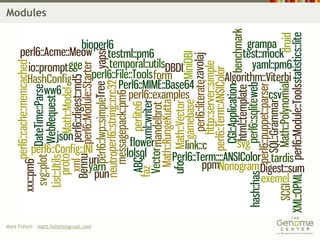
Modules


Matt Follett matt.follett@gmail.com
The Backstory

• Perl 6 announced at Perl Conference in 2000
• Immediate RFCs
• First apocalypse on April 2, 2001
• Twelfth apocalypse April 13, 2004


Matt Follett matt.follett@gmail.com

                             http://www.perlfoundation.org/perl6/index.cgi?timeline
More Backstory

• Parrot April Fool’s Joke 2001
• First commit to Parrot on August 29, 2001
• Audrey Tang publicly releases Pugs in February of 2005


Matt Follett matt.follett@gmail.com
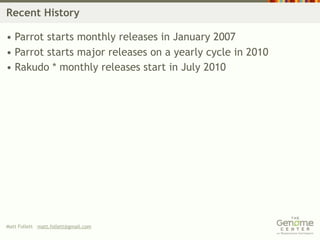
Recent History

• Parrot starts monthly releases in January 2007
• Parrot starts major releases on a yearly cycle in 2010
• Rakudo * monthly releases start in July 2010


Matt Follett matt.follett@gmail.com
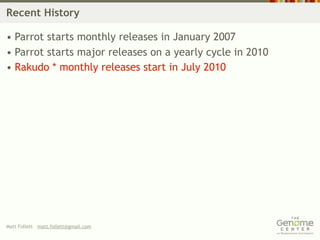
Recent History

• Parrot starts monthly releases in January 2007
• Parrot starts major releases on a yearly cycle in 2010
• Rakudo * monthly releases start in July 2010


Matt Follett matt.follett@gmail.com
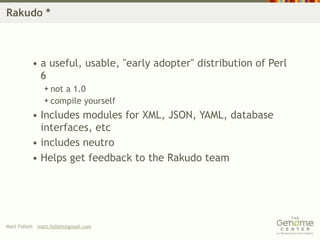
Rakudo *


          • a useful, usable, "early adopter" distribution of Perl
            6
                nota 1.0
                compile yourself

          • Includes modules for XML, JSON, YAML, database
            interfaces, etc
          • includes neutro
          • Helps get feedback to the Rakudo team


Matt Follett matt.follett@gmail.com
Feedback = Improvements


Matt Follett matt.follett@gmail.com
                             http://gil.di.uminho.pt/users/smash/rakudo-bench.html
The Basics


          • Variables are prepended with a sigil to indicate
            their basic type (scalar, array, hash)
          • These sigils are invariant
          • Variables declared with ‘my’ are lexically scoped
          • Perl 6 autoboxes


Matt Follett matt.follett@gmail.com
my @array = 1,2,3;
say(@array[0])

my ($fruit, $jp) = 'apples', JSON.new();
$jp.parse($something_from_somewhere);

my %dictionary = apples => 2, pears => 3;
say("I have %dictionary{$fruit} $fruit");


Matt Follett matt.follett@gmail.com
my @array = 1,2,3;
say(@array[0])

my ($fruit, $jp) = 'apples', JSON.new();
$jp.parse($something_from_somewhere);

my %dictionary = apples => 2, pears => 3;
say("I have %dictionary{$fruit} $fruit");


Matt Follett matt.follett@gmail.com
my @array = 1,2,3;
say(@array[0])

my ($fruit, $jp) = 'apples', JSON.new();
$jp.parse($something_from_somewhere);

my %dictionary = apples => 2, pears => 3;
say("I have %dictionary{$fruit} $fruit");


Matt Follett matt.follett@gmail.com
my @array = 1,2,3;
say(@array[0])

my ($fruit, $jp) = 'apples', JSON.new();
$jp.parse($something_from_somewhere);

my %dictionary = apples => 2, pears => 3;
say("I have %dictionary{$fruit} $fruit");


Matt Follett matt.follett@gmail.com
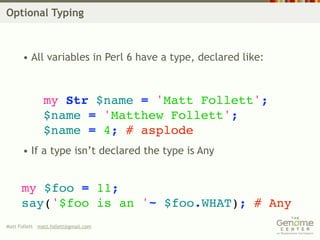
Optional Typing


      • All variables in Perl 6 have a type, declared like:


               my Str $name = 'Matt Follett';
               $name = 'Matthew Follett';
               $name = 4; # asplode
      • If a type isn’t declared the type is Any


      my $foo = 11;
      say('$foo is an '~ $foo.WHAT); # Any
Matt Follett matt.follett@gmail.com
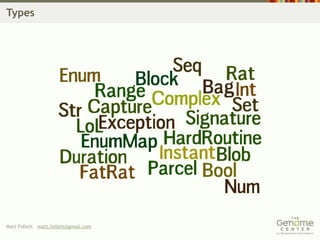
Types


Matt Follett matt.follett@gmail.com
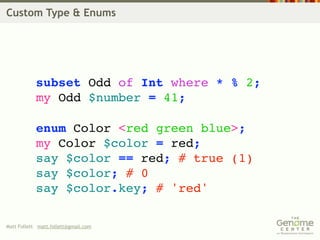
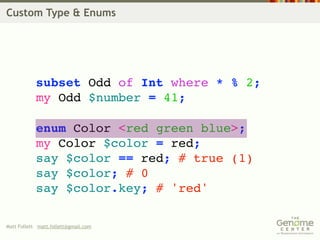
Custom Type & Enums


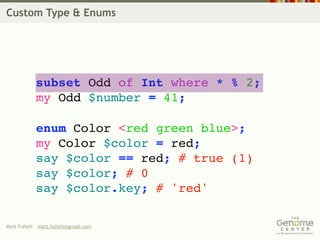
            subset Odd of Int where * % 2;
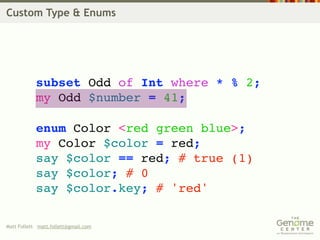
            my Odd $number = 41;

            enum Color <red green blue>;
            my Color $color = red;
            say $color == red; # true (1)
            say $color; # 0
            say $color.key; # 'red'

Matt Follett matt.follett@gmail.com
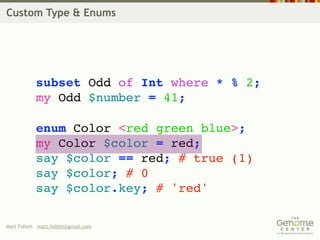
Custom Type & Enums


            subset Odd of Int where * % 2;
            my Odd $number = 41;

            enum Color <red green blue>;
            my Color $color = red;
            say $color == red; # true (1)
            say $color; # 0
            say $color.key; # 'red'

Matt Follett matt.follett@gmail.com
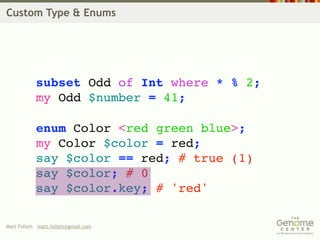
Custom Type & Enums


            subset Odd of Int where * % 2;
            my Odd $number = 41;

            enum Color <red green blue>;
            my Color $color = red;
            say $color == red; # true (1)
            say $color; # 0
            say $color.key; # 'red'

Matt Follett matt.follett@gmail.com
Custom Type & Enums


            subset Odd of Int where * % 2;
            my Odd $number = 41;

            enum Color <red green blue>;
            my Color $color = red;
            say $color == red; # true (1)
            say $color; # 0
            say $color.key; # 'red'

Matt Follett matt.follett@gmail.com
Custom Type & Enums


            subset Odd of Int where * % 2;
            my Odd $number = 41;

            enum Color <red green blue>;
            my Color $color = red;
            say $color == red; # true (1)
            say $color; # 0
            say $color.key; # 'red'

Matt Follett matt.follett@gmail.com
Custom Type & Enums


            subset Odd of Int where * % 2;
            my Odd $number = 41;

            enum Color <red green blue>;
            my Color $color = red;
            say $color == red; # true (1)
            say $color; # 0
            say $color.key; # 'red'

Matt Follett matt.follett@gmail.com
Custom Type & Enums


            subset Odd of Int where * % 2;
            my Odd $number = 41;

            enum Color <red green blue>;
            my Color $color = red;
            say $color == red; # true (1)
            say $color; # 0
            say $color.key; # 'red'

Matt Follett matt.follett@gmail.com
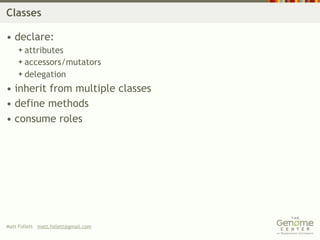
Classes

• declare:
     attributes
     accessors/mutators
     delegation

• inherit from multiple classes
• define methods
• consume roles


Matt Follett matt.follett@gmail.com
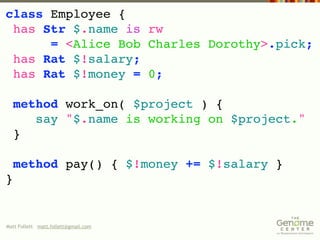
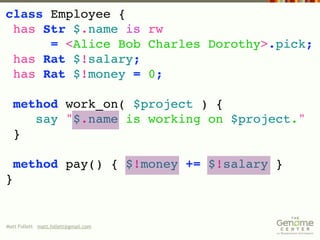
class Employee {
 has Str $.name is rw
      = <Alice Bob Charles Dorothy>.pick;
 has Rat $!salary;
 has Rat $!money = 0;

  method work_on( $project ) {
     say "$.name is working on $project."
  }

    method pay() { $!money += $!salary }
}


Matt Follett matt.follett@gmail.com
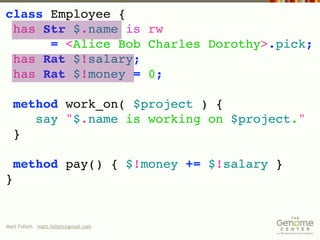
class Employee {
 has Str $.name is rw
      = <Alice Bob Charles Dorothy>.pick;
 has Rat $!salary;
 has Rat $!money = 0;

  method work_on( $project ) {
     say "$.name is working on $project."
  }

    method pay() { $!money += $!salary }
}


Matt Follett matt.follett@gmail.com
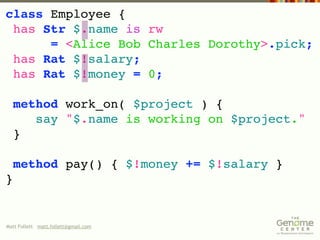
class Employee {
 has Str $.name is rw
      = <Alice Bob Charles Dorothy>.pick;
 has Rat $!salary;
 has Rat $!money = 0;

  method work_on( $project ) {
     say "$.name is working on $project."
  }

    method pay() { $!money += $!salary }
}


Matt Follett matt.follett@gmail.com
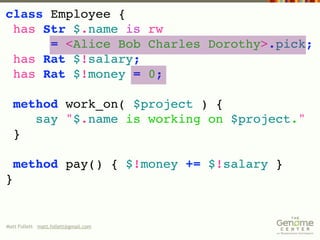
class Employee {
 has Str $.name is rw
      = <Alice Bob Charles Dorothy>.pick;
 has Rat $!salary;
 has Rat $!money = 0;

  method work_on( $project ) {
     say "$.name is working on $project."
  }

    method pay() { $!money += $!salary }
}


Matt Follett matt.follett@gmail.com
class Employee {
 has Str $.name is rw
      = <Alice Bob Charles Dorothy>.pick;
 has Rat $!salary;
 has Rat $!money = 0;

  method work_on( $project ) {
     say "$.name is working on $project."
  }

    method pay() { $!money += $!salary }
}


Matt Follett matt.follett@gmail.com
class Employee {
 has Str $.name is rw
      = <Alice Bob Charles Dorothy>.pick;
 has Rat $!salary;
 has Rat $!money = 0;

  method work_on( $project ) {
     say "$.name is working on $project."
  }

    method pay() { $!money += $!salary }
}


Matt Follett matt.follett@gmail.com
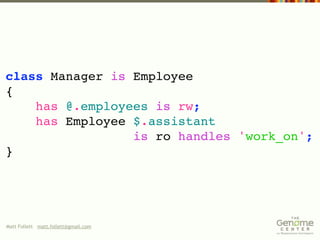
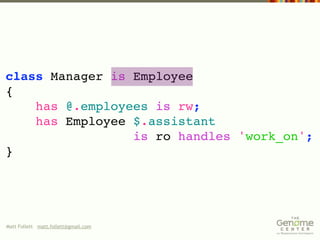
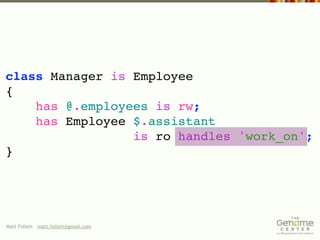
class Manager is Employee
{
    has @.employees is rw;
    has Employee $.assistant
                 is ro handles 'work_on';
}


Matt Follett matt.follett@gmail.com
class Manager is Employee
{
    has @.employees is rw;
    has Employee $.assistant
                 is ro handles 'work_on';
}


Matt Follett matt.follett@gmail.com
class Manager is Employee
{
    has @.employees is rw;
    has Employee $.assistant
                 is ro handles 'work_on';
}


Matt Follett matt.follett@gmail.com
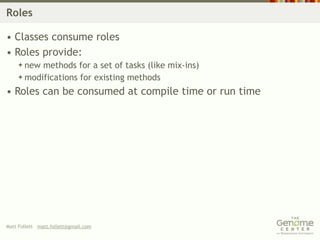
Roles

• Classes consume roles
• Roles provide:
     new methods for a set of tasks (like mix-ins)
     modifications for existing methods

• Roles can be consumed at compile time or run time


Matt Follett matt.follett@gmail.com
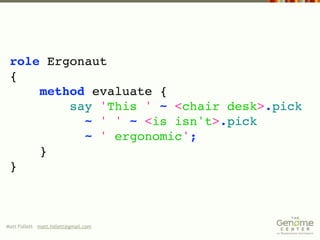
role Ergonaut
 {
     method evaluate {
         say 'This ' ~ <chair desk>.pick
           ~ ' ' ~ <is isn't>.pick
           ~ ' ergonomic';
     }
 }


Matt Follett matt.follett@gmail.com
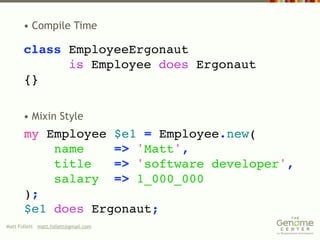
• Compile Time

       class EmployeeErgonaut
             is Employee does Ergonaut
       {}

       • Mixin Style
       my Employee $e1 = Employee.new(
           name    => 'Matt',
           title   => 'software developer',
           salary => 1_000_000
       );
       $e1 does Ergonaut;
Matt Follett matt.follett@gmail.com
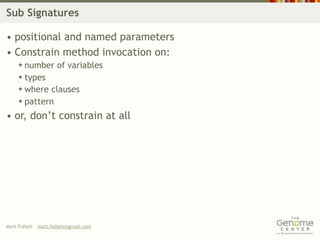
Sub Signatures

• positional and named parameters
• Constrain method invocation on:
     number        of variables
     types
     where clauses
     pattern

• or, don’t constrain at all


Matt Follett matt.follett@gmail.com
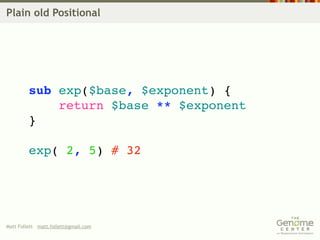
Plain old Positional


         sub exp($base, $exponent) {
             return $base ** $exponent
         }

         exp( 2, 5) # 32


Matt Follett matt.follett@gmail.com
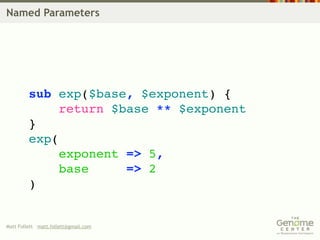
Named Parameters


         sub exp($base, $exponent) {
              return $base ** $exponent
         }
         exp(
              exponent => 5,
              base     => 2
         )


Matt Follett matt.follett@gmail.com
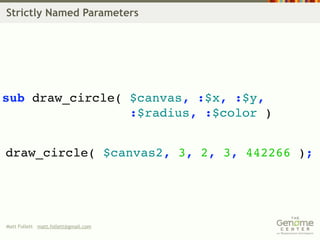
Strictly Named Parameters


sub draw_circle( $canvas, :$x, :$y,
                 :$radius, :$color )


draw_circle( $canvas2, 3, 2, 3, 442266 );


Matt Follett matt.follett@gmail.com
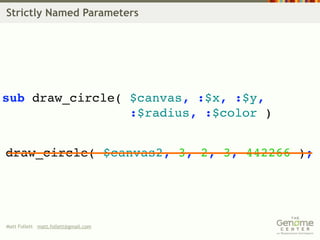
Strictly Named Parameters


sub draw_circle( $canvas, :$x, :$y,
                 :$radius, :$color )


draw_circle( $canvas2, 3, 2, 3, 442266 );


Matt Follett matt.follett@gmail.com
Strictly Named Parameters


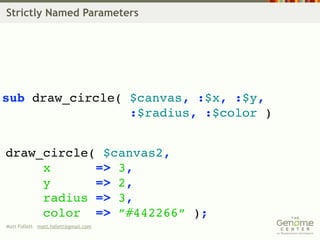
sub draw_circle( $canvas, :$x, :$y,
                 :$radius, :$color )


draw_circle( $canvas2,
     x      => 3,
     y      => 2,
     radius => 3,
     color => ”#442266” );
Matt Follett matt.follett@gmail.com
Constraining Inputs


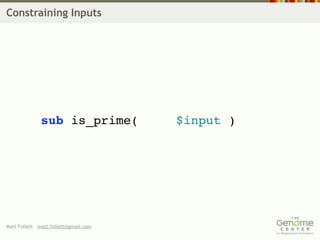
              sub is_prime(           $input )


Matt Follett matt.follett@gmail.com
Constraining Inputs


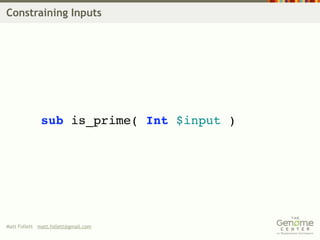
              sub is_prime( Int $input )


Matt Follett matt.follett@gmail.com
Constraining Inputs


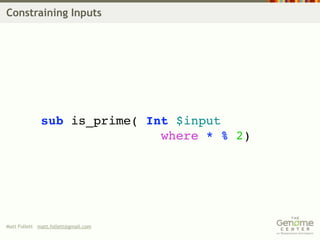
              sub is_prime( Int $input
                              where * % 2)


Matt Follett matt.follett@gmail.com
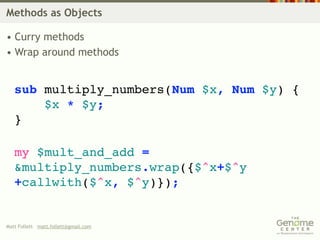
Methods as Objects


Matt Follett matt.follett@gmail.com
Methods as Objects

• Curry methods


   sub multiply_numbers(Num $x, Num $y) {
       $x * $y;
   }

   my $mult_by_four =
   &multiply_numbers.assuming(4);


Matt Follett matt.follett@gmail.com
Methods as Objects

• Curry methods
• Wrap around methods


   sub multiply_numbers(Num $x, Num $y) {
       $x * $y;
   }

   my $mult_and_add =
   &multiply_numbers.wrap({$^x+$^y
   +callwith($^x, $^y)});


Matt Follett matt.follett@gmail.com
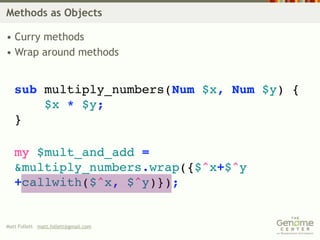
Methods as Objects

• Curry methods
• Wrap around methods


   sub multiply_numbers(Num $x, Num $y) {
       $x * $y;
   }

   my $mult_and_add =
   &multiply_numbers.wrap({$^x+$^y
   +callwith($^x, $^y)});


Matt Follett matt.follett@gmail.com
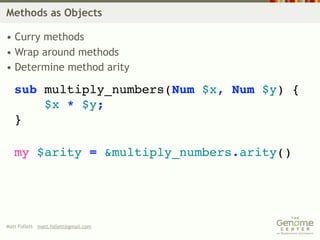
Methods as Objects

• Curry methods
• Wrap around methods
• Determine method arity

   sub multiply_numbers(Num $x, Num $y) {
       $x * $y;
   }

   my $arity = &multiply_numbers.arity()


Matt Follett matt.follett@gmail.com
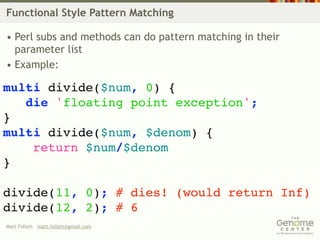
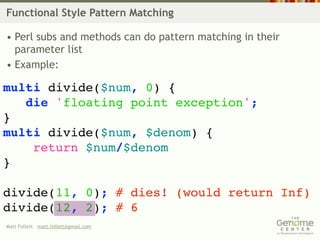
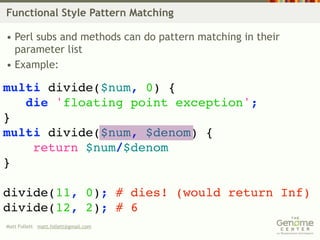
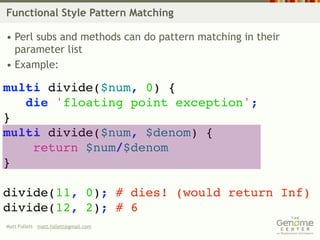
Functional Style Pattern Matching

• Perl subs and methods can do pattern matching in their
  parameter list
• Example:

multi divide($num, 0) {
   die 'floating point exception';
}
multi divide($num, $denom) {
    return $num/$denom
}

divide(11, 0); # dies! (would return Inf)
divide(12, 2); # 6
Matt Follett matt.follett@gmail.com
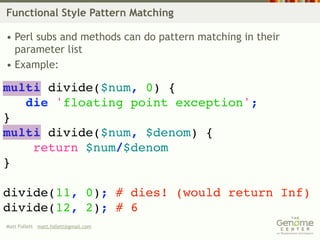
Functional Style Pattern Matching

• Perl subs and methods can do pattern matching in their
  parameter list
• Example:

multi divide($num, 0) {
   die 'floating point exception';
}
multi divide($num, $denom) {
    return $num/$denom
}

divide(11, 0); # dies! (would return Inf)
divide(12, 2); # 6
Matt Follett matt.follett@gmail.com
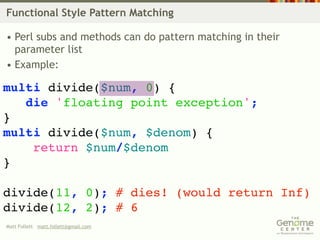
Functional Style Pattern Matching

• Perl subs and methods can do pattern matching in their
  parameter list
• Example:

multi divide($num, 0) {
   die 'floating point exception';
}
multi divide($num, $denom) {
    return $num/$denom
}

divide(11, 0); # dies! (would return Inf)
divide(12, 2); # 6
Matt Follett matt.follett@gmail.com
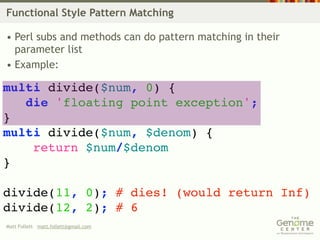
Functional Style Pattern Matching

• Perl subs and methods can do pattern matching in their
  parameter list
• Example:

multi divide($num, 0) {
   die 'floating point exception';
}
multi divide($num, $denom) {
    return $num/$denom
}

divide(11, 0); # dies! (would return Inf)
divide(12, 2); # 6
Matt Follett matt.follett@gmail.com
Functional Style Pattern Matching

• Perl subs and methods can do pattern matching in their
  parameter list
• Example:

multi divide($num, 0) {
   die 'floating point exception';
}
multi divide($num, $denom) {
    return $num/$denom
}

divide(11, 0); # dies! (would return Inf)
divide(12, 2); # 6
Matt Follett matt.follett@gmail.com
Functional Style Pattern Matching

• Perl subs and methods can do pattern matching in their
  parameter list
• Example:

multi divide($num, 0) {
   die 'floating point exception';
}
multi divide($num, $denom) {
    return $num/$denom
}

divide(11, 0); # dies! (would return Inf)
divide(12, 2); # 6
Matt Follett matt.follett@gmail.com
Functional Style Pattern Matching

• Perl subs and methods can do pattern matching in their
  parameter list
• Example:

multi divide($num, 0) {
   die 'floating point exception';
}
multi divide($num, $denom) {
    return $num/$denom
}

divide(11, 0); # dies! (would return Inf)
divide(12, 2); # 6
Matt Follett matt.follett@gmail.com
Functional Style Pattern Matching

• Perl subs and methods can do pattern matching in their
  parameter list
• Example:

multi divide($num, 0) {
   die 'floating point exception';
}
multi divide($num, $denom) {
    return $num/$denom
}

divide(11, 0); # dies! (would return Inf)
divide(12, 2); # 6
Matt Follett matt.follett@gmail.com
λ Functions

• Just as powerful as named functions
• Multiple ways to create
• A building block of the language


Matt Follett matt.follett@gmail.com
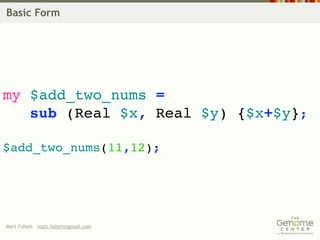
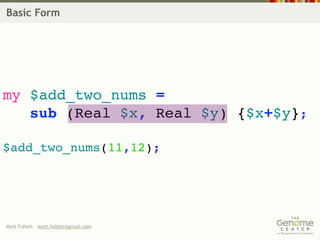
Basic Form


my $add_two_nums =
   sub (Real $x, Real $y) {$x+$y};

$add_two_nums(11,12);


Matt Follett matt.follett@gmail.com
Basic Form


my $add_two_nums =
   sub (Real $x, Real $y) {$x+$y};

$add_two_nums(11,12);


Matt Follett matt.follett@gmail.com
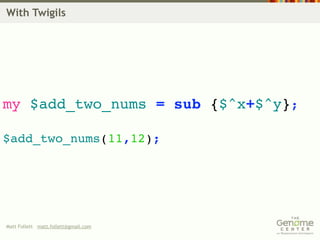
With Twigils


my $add_two_nums = sub {$^x+$^y};

$add_two_nums(11,12);


Matt Follett matt.follett@gmail.com
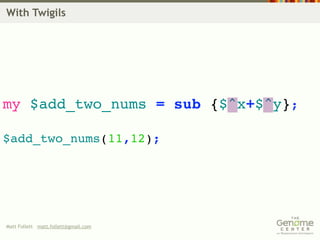
With Twigils


my $add_two_nums = sub {$^x+$^y};

$add_two_nums(11,12);


Matt Follett matt.follett@gmail.com
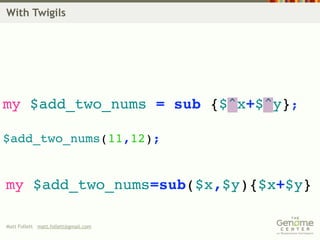
With Twigils


my $add_two_nums = sub {$^x+$^y};

$add_two_nums(11,12);


my $add_two_nums=sub($x,$y){$x+$y}

Matt Follett matt.follett@gmail.com
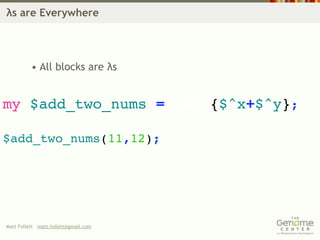
λs are Everywhere


          • All blocks are λs


my $add_two_nums = sub {$^x+$^y};

$add_two_nums(11,12);


Matt Follett matt.follett@gmail.com
λs are Everywhere


          • All blocks are λs


my $add_two_nums = sub {$^x+$^y};

$add_two_nums(11,12);


Matt Follett matt.follett@gmail.com
λs are Everywhere


          • All blocks are λs


my $add_two_nums = sub {$^x+$^y};

$add_two_nums(11,12);

my $add_two_nums = ->$x,$y{$x+$y};
$add_two_nums(11,12);

Matt Follett matt.follett@gmail.com
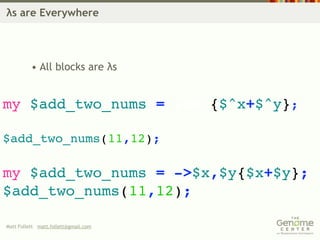
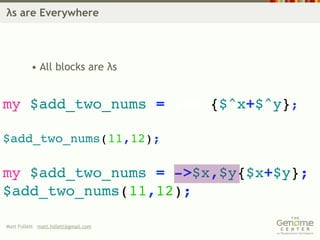
λs are Everywhere


          • All blocks are λs


my $add_two_nums = sub {$^x+$^y};

$add_two_nums(11,12);

my $add_two_nums = ->$x,$y{$x+$y};
$add_two_nums(11,12);

Matt Follett matt.follett@gmail.com
λs are Everywhere


         • All blocks are λs
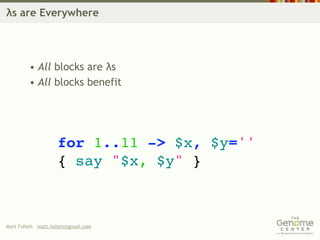
         • All blocks benefit


                     for 1..10 -> $x
                     { say $x }


Matt Follett matt.follett@gmail.com
λs are Everywhere


         • All blocks are λs
         • All blocks benefit


                     for 1..10
                     { say $^x }


Matt Follett matt.follett@gmail.com
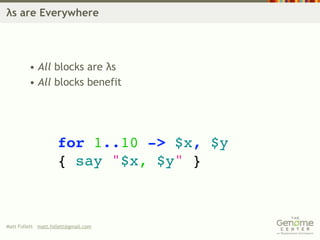
λs are Everywhere


         • All blocks are λs
         • All blocks benefit


                     for 1..10 -> $x, $y
                     { say "$x, $y" }


Matt Follett matt.follett@gmail.com
λs are Everywhere


         • All blocks are λs
         • All blocks benefit


                     for 1..11 -> $x, $y=''
                     { say "$x, $y" }


Matt Follett matt.follett@gmail.com
Simplest Form

• Uses the Whatever term
• Included in a unary or binary operation
• Statement returns a λ
• Examples:
  my $add_two = * + 2;
  $add_two(3); # 5

  my $invoke_method = *.sort;
  $invoke_method(@some_array);


Matt Follett matt.follett@gmail.com
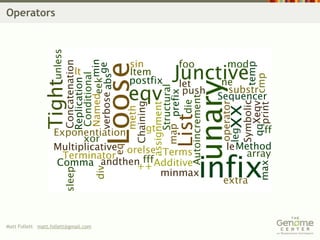
Operators


Matt Follett matt.follett@gmail.com
Operators

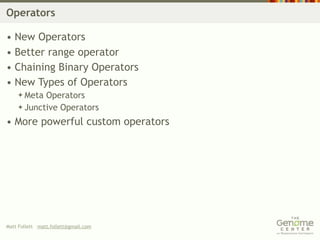
• New Operators
• Better range operator
• Chaining Binary Operators
• New Types of Operators
     Meta Operators
     Junctive Operators

• More powerful custom operators


Matt Follett matt.follett@gmail.com
Range Operator


Matt Follett matt.follett@gmail.com
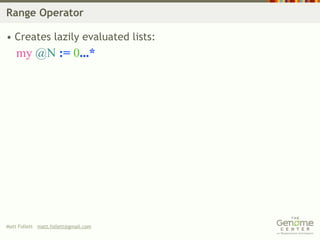
Range Operator

• Creates lazily evaluated lists:
    my @N := 0...*


Matt Follett matt.follett@gmail.com
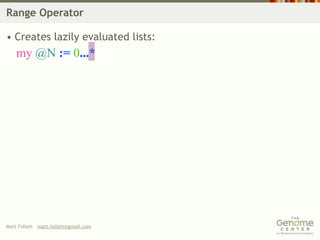
Range Operator

• Creates lazily evaluated lists:
    my @N := 0...*


Matt Follett matt.follett@gmail.com
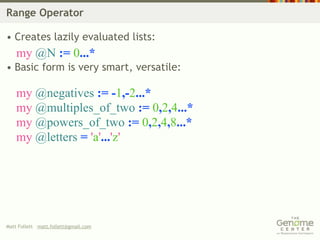
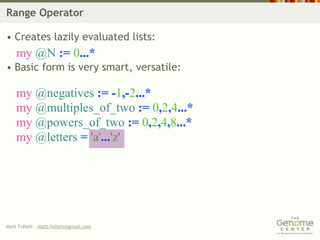
Range Operator

• Creates lazily evaluated lists:
    my @N := 0...*
• Basic form is very smart, versatile:

    my @negatives := -1,-2...*
    my @multiples_of_two := 0,2,4...*
    my @powers_of_two := 0,2,4,8...*
    my @letters = 'a'...'z'


Matt Follett matt.follett@gmail.com
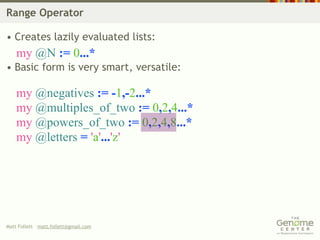
Range Operator

• Creates lazily evaluated lists:
    my @N := 0...*
• Basic form is very smart, versatile:

    my @negatives := -1,-2...*
    my @multiples_of_two := 0,2,4...*
    my @powers_of_two := 0,2,4,8...*
    my @letters = 'a'...'z'


Matt Follett matt.follett@gmail.com
Range Operator

• Creates lazily evaluated lists:
    my @N := 0...*
• Basic form is very smart, versatile:

    my @negatives := -1,-2...*
    my @multiples_of_two := 0,2,4...*
    my @powers_of_two := 0,2,4,8...*
    my @letters = 'a'...'z'


Matt Follett matt.follett@gmail.com
Range Operator

• Creates lazily evaluated lists:
    my @N := 0...*
• Basic form is very smart, versatile:

    my @negatives := -1,-2...*
    my @multiples_of_two := 0,2,4...*
    my @powers_of_two := 0,2,4,8...*
    my @letters = 'a'...'z'


Matt Follett matt.follett@gmail.com
Range Operator

• Creates lazily evaluated lists:
    my @N := 0...*
• Basic form is very smart, versatile:

    my @negatives := -1,-2...*
    my @multiples_of_two := 0,2,4...*
    my @powers_of_two := 0,2,4,8...*
    my @letters = 'a'...'z'


Matt Follett matt.follett@gmail.com
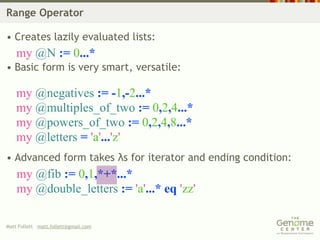
Range Operator

• Creates lazily evaluated lists:
    my @N := 0...*
• Basic form is very smart, versatile:

    my @negatives := -1,-2...*
    my @multiples_of_two := 0,2,4...*
    my @powers_of_two := 0,2,4,8...*
    my @letters = 'a'...'z'
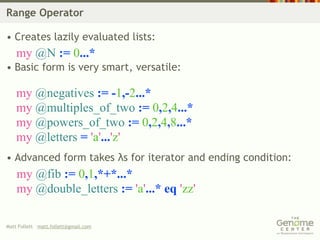
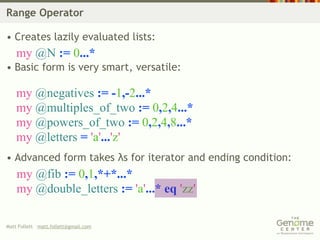
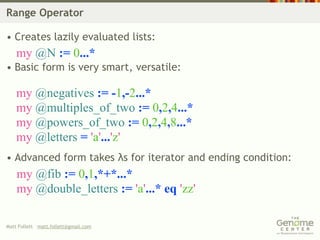
• Advanced form takes λs for iterator and ending condition:
    my @fib := 0,1,*+*...*
    my @double_letters := 'a'...* eq 'zz'

Matt Follett matt.follett@gmail.com
Range Operator

• Creates lazily evaluated lists:
    my @N := 0...*
• Basic form is very smart, versatile:

    my @negatives := -1,-2...*
    my @multiples_of_two := 0,2,4...*
    my @powers_of_two := 0,2,4,8...*
    my @letters = 'a'...'z'
• Advanced form takes λs for iterator and ending condition:
    my @fib := 0,1,*+*...*
    my @double_letters := 'a'...* eq 'zz'

Matt Follett matt.follett@gmail.com
Range Operator

• Creates lazily evaluated lists:
    my @N := 0...*
• Basic form is very smart, versatile:

    my @negatives := -1,-2...*
    my @multiples_of_two := 0,2,4...*
    my @powers_of_two := 0,2,4,8...*
    my @letters = 'a'...'z'
• Advanced form takes λs for iterator and ending condition:
    my @fib := 0,1,*+*...*
    my @double_letters := 'a'...* eq 'zz'

Matt Follett matt.follett@gmail.com
Range Operator

• Creates lazily evaluated lists:
    my @N := 0...*
• Basic form is very smart, versatile:

    my @negatives := -1,-2...*
    my @multiples_of_two := 0,2,4...*
    my @powers_of_two := 0,2,4,8...*
    my @letters = 'a'...'z'
• Advanced form takes λs for iterator and ending condition:
    my @fib := 0,1,*+*...*
    my @double_letters := 'a'...* eq 'zz'

Matt Follett matt.follett@gmail.com
Range Operator

• Creates lazily evaluated lists:
    my @N := 0...*
• Basic form is very smart, versatile:

    my @negatives := -1,-2...*
    my @multiples_of_two := 0,2,4...*
    my @powers_of_two := 0,2,4,8...*
    my @letters = 'a'...'z'
• Advanced form takes λs for iterator and ending condition:
    my @fib := 0,1,*+*...*
    my @double_letters := 'a'...* eq 'zz'

Matt Follett matt.follett@gmail.com
Meta Operators

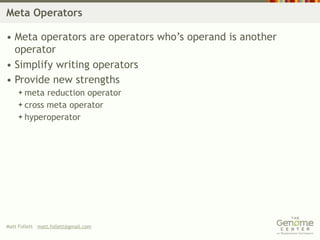
• Meta operators are operators who’s operand is another
  operator
• Simplify writing operators
• Provide new strengths
     meta  reduction operator
     cross meta operator
     hyperoperator


Matt Follett matt.follett@gmail.com
Meta Operators Simplifying Operators

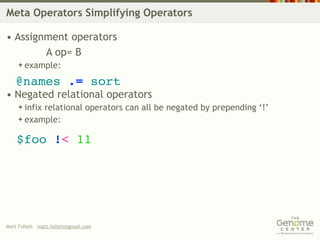
• Assignment operators
        A op= B
     example:

   @names .= sort
• Negated relational operators
     infix
          relational operators can all be negated by prepending ‘!’
     example:


    $foo !< 11


Matt Follett matt.follett@gmail.com
Reduction Meta Operator

• Written as []
• Takes a list and reduces it to a scalar value
• uses a specified infix operator
• like foldl, foldr but respects associativity
• Examples:
   [*] 1..$x
   [**] 1..$x # 1 ** ( 2 ** ( 3 **…$x ) )
   [<] @list or [>] @list


Matt Follett matt.follett@gmail.com
Reduction Meta Operator

• Written as []
• Takes a list and reduces it to a scalar value
• uses a specified infix operator
• like foldl, foldr but respects associativity
• Examples:
   [*] 1..$x
   [**] 1..$x # 1 ** ( 2 ** ( 3 **…$x ) )
   [<] @list or [>] @list


Matt Follett matt.follett@gmail.com
Reduction Meta Operator

• Written as []
• Takes a list and reduces it to a scalar value
• uses a specified infix operator
• like foldl, foldr but respects associativity
• Examples:
   [*] 1..$x
   [**] 1..$x # 1 ** ( 2 ** ( 3 **…$x ) )
   [<] @list or [>] @list


Matt Follett matt.follett@gmail.com
Reduction Meta Operator

• Written as []
• Takes a list and reduces it to a scalar value
• uses a specified infix operator
• like foldl, foldr but respects associativity
• Examples:
   [*] 1..$x
   [**] 1..$x # 1 ** ( 2 ** ( 3 **…$x ) )
   [<] @list or [>] @list


Matt Follett matt.follett@gmail.com
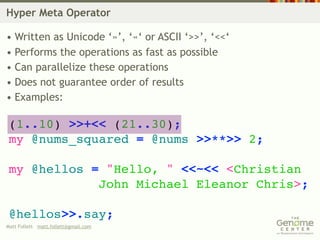
Hyper Meta Operator

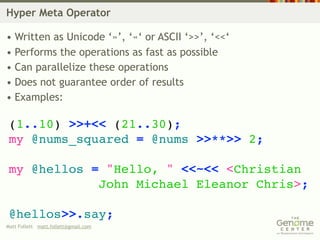
• Written as Unicode ‘»’, ‘«‘ or ASCII ‘>>’, ‘<<‘
• Performs the operations as fast as possible
• Can parallelize these operations
• Does not guarantee order of results
• Examples:

 (1..10) >>+<< (21..30);
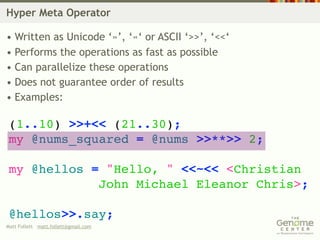
 my @nums_squared = @nums >>**>> 2;

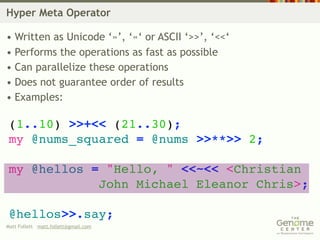
 my @hellos = "Hello, " <<~<< <Christian
             John Michael Eleanor Chris>;

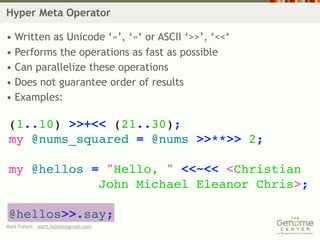
 @hellos>>.say;
Matt Follett matt.follett@gmail.com
Hyper Meta Operator

• Written as Unicode ‘»’, ‘«‘ or ASCII ‘>>’, ‘<<‘
• Performs the operations as fast as possible
• Can parallelize these operations
• Does not guarantee order of results
• Examples:

 (1..10) >>+<< (21..30);
 my @nums_squared = @nums >>**>> 2;

 my @hellos = "Hello, " <<~<< <Christian
             John Michael Eleanor Chris>;

 @hellos>>.say;
Matt Follett matt.follett@gmail.com
Hyper Meta Operator

• Written as Unicode ‘»’, ‘«‘ or ASCII ‘>>’, ‘<<‘
• Performs the operations as fast as possible
• Can parallelize these operations
• Does not guarantee order of results
• Examples:

 (1..10) >>+<< (21..30);
 my @nums_squared = @nums >>**>> 2;

 my @hellos = "Hello, " <<~<< <Christian
             John Michael Eleanor Chris>;

 @hellos>>.say;
Matt Follett matt.follett@gmail.com
Hyper Meta Operator

• Written as Unicode ‘»’, ‘«‘ or ASCII ‘>>’, ‘<<‘
• Performs the operations as fast as possible
• Can parallelize these operations
• Does not guarantee order of results
• Examples:

 (1..10) >>+<< (21..30);
 my @nums_squared = @nums >>**>> 2;

 my @hellos = "Hello, " <<~<< <Christian
             John Michael Eleanor Chris>;

 @hellos>>.say;
Matt Follett matt.follett@gmail.com
Hyper Meta Operator

• Written as Unicode ‘»’, ‘«‘ or ASCII ‘>>’, ‘<<‘
• Performs the operations as fast as possible
• Can parallelize these operations
• Does not guarantee order of results
• Examples:

 (1..10) >>+<< (21..30);
 my @nums_squared = @nums >>**>> 2;

 my @hellos = "Hello, " <<~<< <Christian
             John Michael Eleanor Chris>;

 @hellos>>.say;
Matt Follett matt.follett@gmail.com
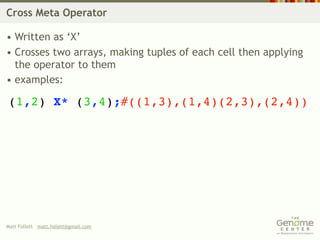
Cross Meta Operator

• Written as ‘X’
• Crosses two arrays, making tuples of each cell then applying
  the operator to them
• examples:

(1,2) X* (3,4);


Matt Follett matt.follett@gmail.com
Cross Meta Operator

• Written as ‘X’
• Crosses two arrays, making tuples of each cell then applying
  the operator to them
• examples:

(1,2) X* (3,4);#((1,3),(1,4)(2,3),(2,4))


Matt Follett matt.follett@gmail.com
Cross Meta Operator

• Written as ‘X’
• Crosses two arrays, making tuples of each cell then applying
  the operator to them
• examples:

(1,2) X* (3,4);#((1*3),(1*4)(2*3),(2*4))


Matt Follett matt.follett@gmail.com
Cross Meta Operator

• Written as ‘X’
• Crosses two arrays, making tuples of each cell then applying
  the operator to them
• examples:

(1,2) X* (3,4);#(3,4,6,8)


Matt Follett matt.follett@gmail.com
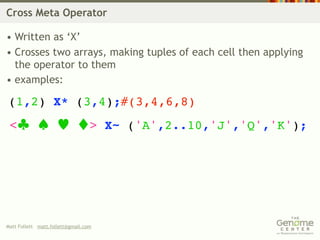
Cross Meta Operator

• Written as ‘X’
• Crosses two arrays, making tuples of each cell then applying
  the operator to them
• examples:

(1,2) X* (3,4);#(3,4,6,8)
 <                                > X~ ('A',2..10,'J','Q','K');


Matt Follett matt.follett@gmail.com
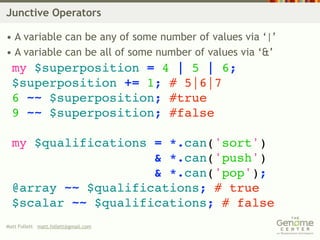
Junctive Operators

• A variable can be any of some number of values via ‘|’
• A variable can be all of some number of values via ‘&’
  my $superposition = 4 | 5 | 6;
  $superposition += 1; # 5|6|7
  6 ~~ $superposition; #true
  9 ~~ $superposition; #false

  my $qualifications = *.can('sort')
                     & *.can('push')
                     & *.can('pop');
  @array ~~ $qualifications; # true
  $scalar ~~ $qualifications; # false
Matt Follett matt.follett@gmail.com
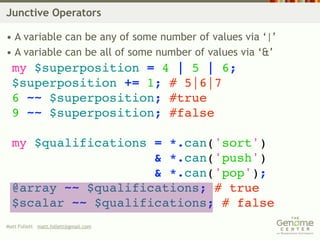
Junctive Operators

• A variable can be any of some number of values via ‘|’
• A variable can be all of some number of values via ‘&’
  my $superposition = 4 | 5 | 6;
  $superposition += 1; # 5|6|7
  6 ~~ $superposition; #true
  9 ~~ $superposition; #false

  my $qualifications = *.can('sort')
                     & *.can('push')
                     & *.can('pop');
  @array ~~ $qualifications; # true
  $scalar ~~ $qualifications; # false
Matt Follett matt.follett@gmail.com
Junctive Operators

• A variable can be any of some number of values via ‘|’
• A variable can be all of some number of values via ‘&’
  my $superposition = 4 | 5 | 6;
  $superposition += 1; # 5|6|7
  6 ~~ $superposition; #true
  9 ~~ $superposition; #false

  my $qualifications = *.can('sort')
                     & *.can('push')
                     & *.can('pop');
  @array ~~ $qualifications; # true
  $scalar ~~ $qualifications; # false
Matt Follett matt.follett@gmail.com
Junctive Operators

• A variable can be any of some number of values via ‘|’
• A variable can be all of some number of values via ‘&’
  my $superposition = 4 | 5 | 6;
  $superposition += 1; # 5|6|7
  6 ~~ $superposition; #true
  9 ~~ $superposition; #false

  my $qualifications = *.can('sort')
                     & *.can('push')
                     & *.can('pop');
  @array ~~ $qualifications; # true
  $scalar ~~ $qualifications; # false
Matt Follett matt.follett@gmail.com
Junctive Operators

• A variable can be any of some number of values via ‘|’
• A variable can be all of some number of values via ‘&’
  my $superposition = 4 | 5 | 6;
  $superposition += 1; # 5|6|7
  6 ~~ $superposition; #true
  9 ~~ $superposition; #false

  my $qualifications = *.can('sort')
                     & *.can('push')
                     & *.can('pop');
  @array ~~ $qualifications; # true
  $scalar ~~ $qualifications; # false
Matt Follett matt.follett@gmail.com
Junctive Operators

• A variable can be any of some number of values via ‘|’
• A variable can be all of some number of values via ‘&’
  my $superposition = 4 | 5 | 6;
  $superposition += 1; # 5|6|7
  6 ~~ $superposition; #true
  9 ~~ $superposition; #false

  my $qualifications = *.can('sort')
                     & *.can('push')
                     & *.can('pop');
  @array ~~ $qualifications; # true
  $scalar ~~ $qualifications; # false
Matt Follett matt.follett@gmail.com
Custom Operators

• Any unicode string
• Define precedence
     ‘is tighter’ - higher precedence than the given operator
     ‘is looser’ - lower precedence
     ‘is equiv’ - same precedence

• Many types
     infix
     postfix
     prefix
     circumfix
     postcircumfix


Matt Follett matt.follett@gmail.com
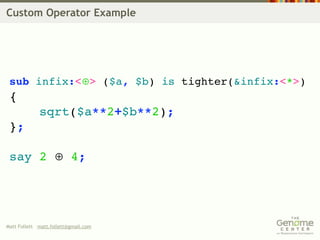
Custom Operator Example


 sub infix:<⊕> ($a, $b) is tighter(&infix:<*>)
 {
             sqrt($a**2+$b**2);
 };

 say 2 ⊕ 4;


Matt Follett matt.follett@gmail.com
Custom Operator Example


 sub infix:<⊕> ($a, $b) is tighter(&infix:<*>)
 {
             sqrt($a**2+$b**2);
 };

 say 2 ⊕ 4;


Matt Follett matt.follett@gmail.com
Grammars

• Composed of rules and tokens
• Reusable through inheritance
• Defined like classes or modules
• starts from the TOP rule


Matt Follett matt.follett@gmail.com
grammar Mercurial::rc {
 rule TOP {^<line>*$};
 rule line {<header>|<assignment>|<comment>};
    rule header {'[' ~ ']' <header_name> };
    rule assignment {<variable>'='<value>};
    rule comment { '#' <message> };

    token           header_name {w<-[]]>+};
    token           variable {<-[=]>+};
    token           value {.*};
    token           message {.*};
}
Matt Follett matt.follett@gmail.com
[ui]
                             username=Matt Follett
                             email=matt.follett@gmail.com

                             [extensions]
                             #best extension ever!
                             hg.cowlog=


Matt Follett matt.follett@gmail.com
Where to go for more

• Try Rakudo: http://try.rakudo.org
• Using Perl 6: http://github.com/perl6/book/downloads
• Get Rakudo: http://rakudo.org/how-to-get-rakudo
• The official Perl 6 site: http://www.perl6.org
• Perl 6 synopses: http://perlcabal.org/syn/
• Planet Perl 6: http://planetsix.perl.org/
• Rosetta Code: http://www.rosettacode.org
• My posts: http://mfollett.com/tag/perl6


Matt Follett matt.follett@gmail.com

Perl 6 talk

  • 1.
    Perl 6 An Apocalypse The Camelia image is copyright 2009 and trademarked by Larry Wall Matt Follett matt.follett@gmail.com
  • 2.
    Instance of Perl6 • Pugs - Perl 6 on Haskell • Niecza - Perl 6 on the CLR • Sprixel - Perl 6 in JavaScript • Elf, Mildew • Perlito (MiniPerl6) - JVM, Go, Perl 5, JS, Lisp • YAPSI - Perl 6 in Perl 6 • Rakudo - Perl 6 on Parrot Matt Follett matt.follett@gmail.com
  • 3.
    Instance of Perl6 • Pugs - Perl 6 on Haskell • Niecza - Perl 6 on the CLR • Sprixel - Perl 6 in JavaScript • Elf, Mildew • Perlito (MiniPerl6) - JVM, Go, Perl 5, JS, Lisp • YAPSI - Perl 6 in Perl 6 • Rakudo - Perl 6 on Parrot Matt Follett matt.follett@gmail.com
  • 4.
  • 5.
    The Backstory • Perl6 announced at Perl Conference in 2000 • Immediate RFCs • First apocalypse on April 2, 2001 • Twelfth apocalypse April 13, 2004 Matt Follett matt.follett@gmail.com http://www.perlfoundation.org/perl6/index.cgi?timeline
  • 6.
    More Backstory • ParrotApril Fool’s Joke 2001 • First commit to Parrot on August 29, 2001 • Audrey Tang publicly releases Pugs in February of 2005 Matt Follett matt.follett@gmail.com
  • 7.
    Recent History • Parrotstarts monthly releases in January 2007 • Parrot starts major releases on a yearly cycle in 2010 • Rakudo * monthly releases start in July 2010 Matt Follett matt.follett@gmail.com
  • 8.
    Recent History • Parrotstarts monthly releases in January 2007 • Parrot starts major releases on a yearly cycle in 2010 • Rakudo * monthly releases start in July 2010 Matt Follett matt.follett@gmail.com
  • 9.
    Rakudo * • a useful, usable, "early adopter" distribution of Perl 6  nota 1.0  compile yourself • Includes modules for XML, JSON, YAML, database interfaces, etc • includes neutro • Helps get feedback to the Rakudo team Matt Follett matt.follett@gmail.com
  • 10.
    Feedback = Improvements MattFollett matt.follett@gmail.com http://gil.di.uminho.pt/users/smash/rakudo-bench.html
  • 11.
    The Basics • Variables are prepended with a sigil to indicate their basic type (scalar, array, hash) • These sigils are invariant • Variables declared with ‘my’ are lexically scoped • Perl 6 autoboxes Matt Follett matt.follett@gmail.com
  • 12.
    my @array =1,2,3; say(@array[0]) my ($fruit, $jp) = 'apples', JSON.new(); $jp.parse($something_from_somewhere); my %dictionary = apples => 2, pears => 3; say("I have %dictionary{$fruit} $fruit"); Matt Follett matt.follett@gmail.com
  • 13.
    my @array =1,2,3; say(@array[0]) my ($fruit, $jp) = 'apples', JSON.new(); $jp.parse($something_from_somewhere); my %dictionary = apples => 2, pears => 3; say("I have %dictionary{$fruit} $fruit"); Matt Follett matt.follett@gmail.com
  • 14.
    my @array =1,2,3; say(@array[0]) my ($fruit, $jp) = 'apples', JSON.new(); $jp.parse($something_from_somewhere); my %dictionary = apples => 2, pears => 3; say("I have %dictionary{$fruit} $fruit"); Matt Follett matt.follett@gmail.com
  • 15.
    my @array =1,2,3; say(@array[0]) my ($fruit, $jp) = 'apples', JSON.new(); $jp.parse($something_from_somewhere); my %dictionary = apples => 2, pears => 3; say("I have %dictionary{$fruit} $fruit"); Matt Follett matt.follett@gmail.com
  • 16.
    Optional Typing • All variables in Perl 6 have a type, declared like: my Str $name = 'Matt Follett'; $name = 'Matthew Follett'; $name = 4; # asplode • If a type isn’t declared the type is Any my $foo = 11; say('$foo is an '~ $foo.WHAT); # Any Matt Follett matt.follett@gmail.com
  • 17.
  • 18.
    Custom Type &Enums subset Odd of Int where * % 2; my Odd $number = 41; enum Color <red green blue>; my Color $color = red; say $color == red; # true (1) say $color; # 0 say $color.key; # 'red' Matt Follett matt.follett@gmail.com
  • 19.
    Custom Type &Enums subset Odd of Int where * % 2; my Odd $number = 41; enum Color <red green blue>; my Color $color = red; say $color == red; # true (1) say $color; # 0 say $color.key; # 'red' Matt Follett matt.follett@gmail.com
  • 20.
    Custom Type &Enums subset Odd of Int where * % 2; my Odd $number = 41; enum Color <red green blue>; my Color $color = red; say $color == red; # true (1) say $color; # 0 say $color.key; # 'red' Matt Follett matt.follett@gmail.com
  • 21.
    Custom Type &Enums subset Odd of Int where * % 2; my Odd $number = 41; enum Color <red green blue>; my Color $color = red; say $color == red; # true (1) say $color; # 0 say $color.key; # 'red' Matt Follett matt.follett@gmail.com
  • 22.
    Custom Type &Enums subset Odd of Int where * % 2; my Odd $number = 41; enum Color <red green blue>; my Color $color = red; say $color == red; # true (1) say $color; # 0 say $color.key; # 'red' Matt Follett matt.follett@gmail.com
  • 23.
    Custom Type &Enums subset Odd of Int where * % 2; my Odd $number = 41; enum Color <red green blue>; my Color $color = red; say $color == red; # true (1) say $color; # 0 say $color.key; # 'red' Matt Follett matt.follett@gmail.com
  • 24.
    Custom Type &Enums subset Odd of Int where * % 2; my Odd $number = 41; enum Color <red green blue>; my Color $color = red; say $color == red; # true (1) say $color; # 0 say $color.key; # 'red' Matt Follett matt.follett@gmail.com
  • 25.
    Classes • declare:  attributes  accessors/mutators  delegation • inherit from multiple classes • define methods • consume roles Matt Follett matt.follett@gmail.com
  • 26.
    class Employee { has Str $.name is rw = <Alice Bob Charles Dorothy>.pick; has Rat $!salary; has Rat $!money = 0; method work_on( $project ) { say "$.name is working on $project." } method pay() { $!money += $!salary } } Matt Follett matt.follett@gmail.com
  • 27.
    class Employee { has Str $.name is rw = <Alice Bob Charles Dorothy>.pick; has Rat $!salary; has Rat $!money = 0; method work_on( $project ) { say "$.name is working on $project." } method pay() { $!money += $!salary } } Matt Follett matt.follett@gmail.com
  • 28.
    class Employee { has Str $.name is rw = <Alice Bob Charles Dorothy>.pick; has Rat $!salary; has Rat $!money = 0; method work_on( $project ) { say "$.name is working on $project." } method pay() { $!money += $!salary } } Matt Follett matt.follett@gmail.com
  • 29.
    class Employee { has Str $.name is rw = <Alice Bob Charles Dorothy>.pick; has Rat $!salary; has Rat $!money = 0; method work_on( $project ) { say "$.name is working on $project." } method pay() { $!money += $!salary } } Matt Follett matt.follett@gmail.com
  • 30.
    class Employee { has Str $.name is rw = <Alice Bob Charles Dorothy>.pick; has Rat $!salary; has Rat $!money = 0; method work_on( $project ) { say "$.name is working on $project." } method pay() { $!money += $!salary } } Matt Follett matt.follett@gmail.com
  • 31.
    class Employee { has Str $.name is rw = <Alice Bob Charles Dorothy>.pick; has Rat $!salary; has Rat $!money = 0; method work_on( $project ) { say "$.name is working on $project." } method pay() { $!money += $!salary } } Matt Follett matt.follett@gmail.com
  • 32.
    class Manager isEmployee { has @.employees is rw; has Employee $.assistant is ro handles 'work_on'; } Matt Follett matt.follett@gmail.com
  • 33.
    class Manager isEmployee { has @.employees is rw; has Employee $.assistant is ro handles 'work_on'; } Matt Follett matt.follett@gmail.com
  • 34.
    class Manager isEmployee { has @.employees is rw; has Employee $.assistant is ro handles 'work_on'; } Matt Follett matt.follett@gmail.com
  • 35.
    Roles • Classes consumeroles • Roles provide:  new methods for a set of tasks (like mix-ins)  modifications for existing methods • Roles can be consumed at compile time or run time Matt Follett matt.follett@gmail.com
  • 36.
    role Ergonaut { method evaluate { say 'This ' ~ <chair desk>.pick ~ ' ' ~ <is isn't>.pick ~ ' ergonomic'; } } Matt Follett matt.follett@gmail.com
  • 37.
    • Compile Time class EmployeeErgonaut is Employee does Ergonaut {} • Mixin Style my Employee $e1 = Employee.new( name => 'Matt', title => 'software developer', salary => 1_000_000 ); $e1 does Ergonaut; Matt Follett matt.follett@gmail.com
  • 38.
    Sub Signatures • positionaland named parameters • Constrain method invocation on:  number of variables  types  where clauses  pattern • or, don’t constrain at all Matt Follett matt.follett@gmail.com
  • 39.
    Plain old Positional sub exp($base, $exponent) { return $base ** $exponent } exp( 2, 5) # 32 Matt Follett matt.follett@gmail.com
  • 40.
    Named Parameters sub exp($base, $exponent) { return $base ** $exponent } exp( exponent => 5, base => 2 ) Matt Follett matt.follett@gmail.com
  • 41.
    Strictly Named Parameters subdraw_circle( $canvas, :$x, :$y, :$radius, :$color ) draw_circle( $canvas2, 3, 2, 3, 442266 ); Matt Follett matt.follett@gmail.com
  • 42.
    Strictly Named Parameters subdraw_circle( $canvas, :$x, :$y, :$radius, :$color ) draw_circle( $canvas2, 3, 2, 3, 442266 ); Matt Follett matt.follett@gmail.com
  • 43.
    Strictly Named Parameters subdraw_circle( $canvas, :$x, :$y, :$radius, :$color ) draw_circle( $canvas2, x => 3, y => 2, radius => 3, color => ”#442266” ); Matt Follett matt.follett@gmail.com
  • 44.
    Constraining Inputs sub is_prime( $input ) Matt Follett matt.follett@gmail.com
  • 45.
    Constraining Inputs sub is_prime( Int $input ) Matt Follett matt.follett@gmail.com
  • 46.
    Constraining Inputs sub is_prime( Int $input where * % 2) Matt Follett matt.follett@gmail.com
  • 47.
    Methods as Objects MattFollett matt.follett@gmail.com
  • 48.
    Methods as Objects •Curry methods sub multiply_numbers(Num $x, Num $y) { $x * $y; } my $mult_by_four = &multiply_numbers.assuming(4); Matt Follett matt.follett@gmail.com
  • 49.
    Methods as Objects •Curry methods • Wrap around methods sub multiply_numbers(Num $x, Num $y) { $x * $y; } my $mult_and_add = &multiply_numbers.wrap({$^x+$^y +callwith($^x, $^y)}); Matt Follett matt.follett@gmail.com
  • 50.
    Methods as Objects •Curry methods • Wrap around methods sub multiply_numbers(Num $x, Num $y) { $x * $y; } my $mult_and_add = &multiply_numbers.wrap({$^x+$^y +callwith($^x, $^y)}); Matt Follett matt.follett@gmail.com
  • 51.
    Methods as Objects •Curry methods • Wrap around methods • Determine method arity sub multiply_numbers(Num $x, Num $y) { $x * $y; } my $arity = &multiply_numbers.arity() Matt Follett matt.follett@gmail.com
  • 52.
    Functional Style PatternMatching • Perl subs and methods can do pattern matching in their parameter list • Example: multi divide($num, 0) { die 'floating point exception'; } multi divide($num, $denom) { return $num/$denom } divide(11, 0); # dies! (would return Inf) divide(12, 2); # 6 Matt Follett matt.follett@gmail.com
  • 53.
    Functional Style PatternMatching • Perl subs and methods can do pattern matching in their parameter list • Example: multi divide($num, 0) { die 'floating point exception'; } multi divide($num, $denom) { return $num/$denom } divide(11, 0); # dies! (would return Inf) divide(12, 2); # 6 Matt Follett matt.follett@gmail.com
  • 54.
    Functional Style PatternMatching • Perl subs and methods can do pattern matching in their parameter list • Example: multi divide($num, 0) { die 'floating point exception'; } multi divide($num, $denom) { return $num/$denom } divide(11, 0); # dies! (would return Inf) divide(12, 2); # 6 Matt Follett matt.follett@gmail.com
  • 55.
    Functional Style PatternMatching • Perl subs and methods can do pattern matching in their parameter list • Example: multi divide($num, 0) { die 'floating point exception'; } multi divide($num, $denom) { return $num/$denom } divide(11, 0); # dies! (would return Inf) divide(12, 2); # 6 Matt Follett matt.follett@gmail.com
  • 56.
    Functional Style PatternMatching • Perl subs and methods can do pattern matching in their parameter list • Example: multi divide($num, 0) { die 'floating point exception'; } multi divide($num, $denom) { return $num/$denom } divide(11, 0); # dies! (would return Inf) divide(12, 2); # 6 Matt Follett matt.follett@gmail.com
  • 57.
    Functional Style PatternMatching • Perl subs and methods can do pattern matching in their parameter list • Example: multi divide($num, 0) { die 'floating point exception'; } multi divide($num, $denom) { return $num/$denom } divide(11, 0); # dies! (would return Inf) divide(12, 2); # 6 Matt Follett matt.follett@gmail.com
  • 58.
    Functional Style PatternMatching • Perl subs and methods can do pattern matching in their parameter list • Example: multi divide($num, 0) { die 'floating point exception'; } multi divide($num, $denom) { return $num/$denom } divide(11, 0); # dies! (would return Inf) divide(12, 2); # 6 Matt Follett matt.follett@gmail.com
  • 59.
    Functional Style PatternMatching • Perl subs and methods can do pattern matching in their parameter list • Example: multi divide($num, 0) { die 'floating point exception'; } multi divide($num, $denom) { return $num/$denom } divide(11, 0); # dies! (would return Inf) divide(12, 2); # 6 Matt Follett matt.follett@gmail.com
  • 60.
    λ Functions • Justas powerful as named functions • Multiple ways to create • A building block of the language Matt Follett matt.follett@gmail.com
  • 61.
    Basic Form my $add_two_nums= sub (Real $x, Real $y) {$x+$y}; $add_two_nums(11,12); Matt Follett matt.follett@gmail.com
  • 62.
    Basic Form my $add_two_nums= sub (Real $x, Real $y) {$x+$y}; $add_two_nums(11,12); Matt Follett matt.follett@gmail.com
  • 63.
    With Twigils my $add_two_nums= sub {$^x+$^y}; $add_two_nums(11,12); Matt Follett matt.follett@gmail.com
  • 64.
    With Twigils my $add_two_nums= sub {$^x+$^y}; $add_two_nums(11,12); Matt Follett matt.follett@gmail.com
  • 65.
    With Twigils my $add_two_nums= sub {$^x+$^y}; $add_two_nums(11,12); my $add_two_nums=sub($x,$y){$x+$y} Matt Follett matt.follett@gmail.com
  • 66.
    λs are Everywhere • All blocks are λs my $add_two_nums = sub {$^x+$^y}; $add_two_nums(11,12); Matt Follett matt.follett@gmail.com
  • 67.
    λs are Everywhere • All blocks are λs my $add_two_nums = sub {$^x+$^y}; $add_two_nums(11,12); Matt Follett matt.follett@gmail.com
  • 68.
    λs are Everywhere • All blocks are λs my $add_two_nums = sub {$^x+$^y}; $add_two_nums(11,12); my $add_two_nums = ->$x,$y{$x+$y}; $add_two_nums(11,12); Matt Follett matt.follett@gmail.com
  • 69.
    λs are Everywhere • All blocks are λs my $add_two_nums = sub {$^x+$^y}; $add_two_nums(11,12); my $add_two_nums = ->$x,$y{$x+$y}; $add_two_nums(11,12); Matt Follett matt.follett@gmail.com
  • 70.
    λs are Everywhere • All blocks are λs • All blocks benefit for 1..10 -> $x { say $x } Matt Follett matt.follett@gmail.com
  • 71.
    λs are Everywhere • All blocks are λs • All blocks benefit for 1..10 { say $^x } Matt Follett matt.follett@gmail.com
  • 72.
    λs are Everywhere • All blocks are λs • All blocks benefit for 1..10 -> $x, $y { say "$x, $y" } Matt Follett matt.follett@gmail.com
  • 73.
    λs are Everywhere • All blocks are λs • All blocks benefit for 1..11 -> $x, $y='' { say "$x, $y" } Matt Follett matt.follett@gmail.com
  • 74.
    Simplest Form • Usesthe Whatever term • Included in a unary or binary operation • Statement returns a λ • Examples: my $add_two = * + 2; $add_two(3); # 5 my $invoke_method = *.sort; $invoke_method(@some_array); Matt Follett matt.follett@gmail.com
  • 75.
  • 76.
    Operators • New Operators •Better range operator • Chaining Binary Operators • New Types of Operators  Meta Operators  Junctive Operators • More powerful custom operators Matt Follett matt.follett@gmail.com
  • 77.
    Range Operator Matt Follettmatt.follett@gmail.com
  • 78.
    Range Operator • Createslazily evaluated lists: my @N := 0...* Matt Follett matt.follett@gmail.com
  • 79.
    Range Operator • Createslazily evaluated lists: my @N := 0...* Matt Follett matt.follett@gmail.com
  • 80.
    Range Operator • Createslazily evaluated lists: my @N := 0...* • Basic form is very smart, versatile: my @negatives := -1,-2...* my @multiples_of_two := 0,2,4...* my @powers_of_two := 0,2,4,8...* my @letters = 'a'...'z' Matt Follett matt.follett@gmail.com
  • 81.
    Range Operator • Createslazily evaluated lists: my @N := 0...* • Basic form is very smart, versatile: my @negatives := -1,-2...* my @multiples_of_two := 0,2,4...* my @powers_of_two := 0,2,4,8...* my @letters = 'a'...'z' Matt Follett matt.follett@gmail.com
  • 82.
    Range Operator • Createslazily evaluated lists: my @N := 0...* • Basic form is very smart, versatile: my @negatives := -1,-2...* my @multiples_of_two := 0,2,4...* my @powers_of_two := 0,2,4,8...* my @letters = 'a'...'z' Matt Follett matt.follett@gmail.com
  • 83.
    Range Operator • Createslazily evaluated lists: my @N := 0...* • Basic form is very smart, versatile: my @negatives := -1,-2...* my @multiples_of_two := 0,2,4...* my @powers_of_two := 0,2,4,8...* my @letters = 'a'...'z' Matt Follett matt.follett@gmail.com
  • 84.
    Range Operator • Createslazily evaluated lists: my @N := 0...* • Basic form is very smart, versatile: my @negatives := -1,-2...* my @multiples_of_two := 0,2,4...* my @powers_of_two := 0,2,4,8...* my @letters = 'a'...'z' Matt Follett matt.follett@gmail.com
  • 85.
    Range Operator • Createslazily evaluated lists: my @N := 0...* • Basic form is very smart, versatile: my @negatives := -1,-2...* my @multiples_of_two := 0,2,4...* my @powers_of_two := 0,2,4,8...* my @letters = 'a'...'z' • Advanced form takes λs for iterator and ending condition: my @fib := 0,1,*+*...* my @double_letters := 'a'...* eq 'zz' Matt Follett matt.follett@gmail.com
  • 86.
    Range Operator • Createslazily evaluated lists: my @N := 0...* • Basic form is very smart, versatile: my @negatives := -1,-2...* my @multiples_of_two := 0,2,4...* my @powers_of_two := 0,2,4,8...* my @letters = 'a'...'z' • Advanced form takes λs for iterator and ending condition: my @fib := 0,1,*+*...* my @double_letters := 'a'...* eq 'zz' Matt Follett matt.follett@gmail.com
  • 87.
    Range Operator • Createslazily evaluated lists: my @N := 0...* • Basic form is very smart, versatile: my @negatives := -1,-2...* my @multiples_of_two := 0,2,4...* my @powers_of_two := 0,2,4,8...* my @letters = 'a'...'z' • Advanced form takes λs for iterator and ending condition: my @fib := 0,1,*+*...* my @double_letters := 'a'...* eq 'zz' Matt Follett matt.follett@gmail.com
  • 88.
    Range Operator • Createslazily evaluated lists: my @N := 0...* • Basic form is very smart, versatile: my @negatives := -1,-2...* my @multiples_of_two := 0,2,4...* my @powers_of_two := 0,2,4,8...* my @letters = 'a'...'z' • Advanced form takes λs for iterator and ending condition: my @fib := 0,1,*+*...* my @double_letters := 'a'...* eq 'zz' Matt Follett matt.follett@gmail.com
  • 89.
    Range Operator • Createslazily evaluated lists: my @N := 0...* • Basic form is very smart, versatile: my @negatives := -1,-2...* my @multiples_of_two := 0,2,4...* my @powers_of_two := 0,2,4,8...* my @letters = 'a'...'z' • Advanced form takes λs for iterator and ending condition: my @fib := 0,1,*+*...* my @double_letters := 'a'...* eq 'zz' Matt Follett matt.follett@gmail.com
  • 90.
    Meta Operators • Metaoperators are operators who’s operand is another operator • Simplify writing operators • Provide new strengths  meta reduction operator  cross meta operator  hyperoperator Matt Follett matt.follett@gmail.com
  • 91.
    Meta Operators SimplifyingOperators • Assignment operators A op= B  example: @names .= sort • Negated relational operators  infix relational operators can all be negated by prepending ‘!’  example: $foo !< 11 Matt Follett matt.follett@gmail.com
  • 92.
    Reduction Meta Operator •Written as [] • Takes a list and reduces it to a scalar value • uses a specified infix operator • like foldl, foldr but respects associativity • Examples: [*] 1..$x [**] 1..$x # 1 ** ( 2 ** ( 3 **…$x ) ) [<] @list or [>] @list Matt Follett matt.follett@gmail.com
  • 93.
    Reduction Meta Operator •Written as [] • Takes a list and reduces it to a scalar value • uses a specified infix operator • like foldl, foldr but respects associativity • Examples: [*] 1..$x [**] 1..$x # 1 ** ( 2 ** ( 3 **…$x ) ) [<] @list or [>] @list Matt Follett matt.follett@gmail.com
  • 94.
    Reduction Meta Operator •Written as [] • Takes a list and reduces it to a scalar value • uses a specified infix operator • like foldl, foldr but respects associativity • Examples: [*] 1..$x [**] 1..$x # 1 ** ( 2 ** ( 3 **…$x ) ) [<] @list or [>] @list Matt Follett matt.follett@gmail.com
  • 95.
    Reduction Meta Operator •Written as [] • Takes a list and reduces it to a scalar value • uses a specified infix operator • like foldl, foldr but respects associativity • Examples: [*] 1..$x [**] 1..$x # 1 ** ( 2 ** ( 3 **…$x ) ) [<] @list or [>] @list Matt Follett matt.follett@gmail.com
  • 96.
    Hyper Meta Operator •Written as Unicode ‘»’, ‘«‘ or ASCII ‘>>’, ‘<<‘ • Performs the operations as fast as possible • Can parallelize these operations • Does not guarantee order of results • Examples: (1..10) >>+<< (21..30); my @nums_squared = @nums >>**>> 2; my @hellos = "Hello, " <<~<< <Christian John Michael Eleanor Chris>; @hellos>>.say; Matt Follett matt.follett@gmail.com
  • 97.
    Hyper Meta Operator •Written as Unicode ‘»’, ‘«‘ or ASCII ‘>>’, ‘<<‘ • Performs the operations as fast as possible • Can parallelize these operations • Does not guarantee order of results • Examples: (1..10) >>+<< (21..30); my @nums_squared = @nums >>**>> 2; my @hellos = "Hello, " <<~<< <Christian John Michael Eleanor Chris>; @hellos>>.say; Matt Follett matt.follett@gmail.com
  • 98.
    Hyper Meta Operator •Written as Unicode ‘»’, ‘«‘ or ASCII ‘>>’, ‘<<‘ • Performs the operations as fast as possible • Can parallelize these operations • Does not guarantee order of results • Examples: (1..10) >>+<< (21..30); my @nums_squared = @nums >>**>> 2; my @hellos = "Hello, " <<~<< <Christian John Michael Eleanor Chris>; @hellos>>.say; Matt Follett matt.follett@gmail.com
  • 99.
    Hyper Meta Operator •Written as Unicode ‘»’, ‘«‘ or ASCII ‘>>’, ‘<<‘ • Performs the operations as fast as possible • Can parallelize these operations • Does not guarantee order of results • Examples: (1..10) >>+<< (21..30); my @nums_squared = @nums >>**>> 2; my @hellos = "Hello, " <<~<< <Christian John Michael Eleanor Chris>; @hellos>>.say; Matt Follett matt.follett@gmail.com
  • 100.
    Hyper Meta Operator •Written as Unicode ‘»’, ‘«‘ or ASCII ‘>>’, ‘<<‘ • Performs the operations as fast as possible • Can parallelize these operations • Does not guarantee order of results • Examples: (1..10) >>+<< (21..30); my @nums_squared = @nums >>**>> 2; my @hellos = "Hello, " <<~<< <Christian John Michael Eleanor Chris>; @hellos>>.say; Matt Follett matt.follett@gmail.com
  • 101.
    Cross Meta Operator •Written as ‘X’ • Crosses two arrays, making tuples of each cell then applying the operator to them • examples: (1,2) X* (3,4); Matt Follett matt.follett@gmail.com
  • 102.
    Cross Meta Operator •Written as ‘X’ • Crosses two arrays, making tuples of each cell then applying the operator to them • examples: (1,2) X* (3,4);#((1,3),(1,4)(2,3),(2,4)) Matt Follett matt.follett@gmail.com
  • 103.
    Cross Meta Operator •Written as ‘X’ • Crosses two arrays, making tuples of each cell then applying the operator to them • examples: (1,2) X* (3,4);#((1*3),(1*4)(2*3),(2*4)) Matt Follett matt.follett@gmail.com
  • 104.
    Cross Meta Operator •Written as ‘X’ • Crosses two arrays, making tuples of each cell then applying the operator to them • examples: (1,2) X* (3,4);#(3,4,6,8) Matt Follett matt.follett@gmail.com
  • 105.
    Cross Meta Operator •Written as ‘X’ • Crosses two arrays, making tuples of each cell then applying the operator to them • examples: (1,2) X* (3,4);#(3,4,6,8) < > X~ ('A',2..10,'J','Q','K'); Matt Follett matt.follett@gmail.com
  • 106.
    Junctive Operators • Avariable can be any of some number of values via ‘|’ • A variable can be all of some number of values via ‘&’ my $superposition = 4 | 5 | 6; $superposition += 1; # 5|6|7 6 ~~ $superposition; #true 9 ~~ $superposition; #false my $qualifications = *.can('sort') & *.can('push') & *.can('pop'); @array ~~ $qualifications; # true $scalar ~~ $qualifications; # false Matt Follett matt.follett@gmail.com
  • 107.
    Junctive Operators • Avariable can be any of some number of values via ‘|’ • A variable can be all of some number of values via ‘&’ my $superposition = 4 | 5 | 6; $superposition += 1; # 5|6|7 6 ~~ $superposition; #true 9 ~~ $superposition; #false my $qualifications = *.can('sort') & *.can('push') & *.can('pop'); @array ~~ $qualifications; # true $scalar ~~ $qualifications; # false Matt Follett matt.follett@gmail.com
  • 108.
    Junctive Operators • Avariable can be any of some number of values via ‘|’ • A variable can be all of some number of values via ‘&’ my $superposition = 4 | 5 | 6; $superposition += 1; # 5|6|7 6 ~~ $superposition; #true 9 ~~ $superposition; #false my $qualifications = *.can('sort') & *.can('push') & *.can('pop'); @array ~~ $qualifications; # true $scalar ~~ $qualifications; # false Matt Follett matt.follett@gmail.com
  • 109.
    Junctive Operators • Avariable can be any of some number of values via ‘|’ • A variable can be all of some number of values via ‘&’ my $superposition = 4 | 5 | 6; $superposition += 1; # 5|6|7 6 ~~ $superposition; #true 9 ~~ $superposition; #false my $qualifications = *.can('sort') & *.can('push') & *.can('pop'); @array ~~ $qualifications; # true $scalar ~~ $qualifications; # false Matt Follett matt.follett@gmail.com
  • 110.
    Junctive Operators • Avariable can be any of some number of values via ‘|’ • A variable can be all of some number of values via ‘&’ my $superposition = 4 | 5 | 6; $superposition += 1; # 5|6|7 6 ~~ $superposition; #true 9 ~~ $superposition; #false my $qualifications = *.can('sort') & *.can('push') & *.can('pop'); @array ~~ $qualifications; # true $scalar ~~ $qualifications; # false Matt Follett matt.follett@gmail.com
  • 111.
    Junctive Operators • Avariable can be any of some number of values via ‘|’ • A variable can be all of some number of values via ‘&’ my $superposition = 4 | 5 | 6; $superposition += 1; # 5|6|7 6 ~~ $superposition; #true 9 ~~ $superposition; #false my $qualifications = *.can('sort') & *.can('push') & *.can('pop'); @array ~~ $qualifications; # true $scalar ~~ $qualifications; # false Matt Follett matt.follett@gmail.com
  • 112.
    Custom Operators • Anyunicode string • Define precedence  ‘is tighter’ - higher precedence than the given operator  ‘is looser’ - lower precedence  ‘is equiv’ - same precedence • Many types  infix  postfix  prefix  circumfix  postcircumfix Matt Follett matt.follett@gmail.com
  • 113.
    Custom Operator Example sub infix:<⊕> ($a, $b) is tighter(&infix:<*>) { sqrt($a**2+$b**2); }; say 2 ⊕ 4; Matt Follett matt.follett@gmail.com
  • 114.
    Custom Operator Example sub infix:<⊕> ($a, $b) is tighter(&infix:<*>) { sqrt($a**2+$b**2); }; say 2 ⊕ 4; Matt Follett matt.follett@gmail.com
  • 115.
    Grammars • Composed ofrules and tokens • Reusable through inheritance • Defined like classes or modules • starts from the TOP rule Matt Follett matt.follett@gmail.com
  • 116.
    grammar Mercurial::rc { rule TOP {^<line>*$}; rule line {<header>|<assignment>|<comment>}; rule header {'[' ~ ']' <header_name> }; rule assignment {<variable>'='<value>}; rule comment { '#' <message> }; token header_name {w<-[]]>+}; token variable {<-[=]>+}; token value {.*}; token message {.*}; } Matt Follett matt.follett@gmail.com
  • 117.
    [ui] username=Matt Follett email=matt.follett@gmail.com [extensions] #best extension ever! hg.cowlog= Matt Follett matt.follett@gmail.com
  • 118.
    Where to gofor more • Try Rakudo: http://try.rakudo.org • Using Perl 6: http://github.com/perl6/book/downloads • Get Rakudo: http://rakudo.org/how-to-get-rakudo • The official Perl 6 site: http://www.perl6.org • Perl 6 synopses: http://perlcabal.org/syn/ • Planet Perl 6: http://planetsix.perl.org/ • Rosetta Code: http://www.rosettacode.org • My posts: http://mfollett.com/tag/perl6 Matt Follett matt.follett@gmail.com