PERIODONTAL
POCKET
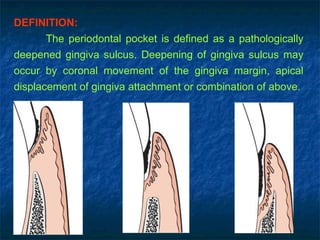
DEFINITION:
The periodontal pocket is defined as a pathologically
deepened gingiva sulcus. Deepening of gingiva sulcus may
occur by coronal movement of the gingiva margin, apical
displacement of gingiva attachment or combination of above.
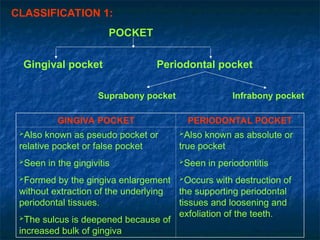
GINGIVA POCKET PERIODONTAL POCKET
Also known as pseudo pocket or
relative pocket or false pocket
Seen in the gingivitis
Formed by the gingiva enlargement
without extraction of the underlying
periodontal tissues.
The sulcus is deepened because of
increased bulk of gingiva
Also known as absolute or
true pocket
Seen in periodontitis
Occurs with destruction of
the supporting periodontal
tissues and loosening and
exfoliation of the teeth.
CLASSIFICATION 1:
POCKET
Gingival pocket Periodontal pocket
Suprabony pocket Infrabony pocket
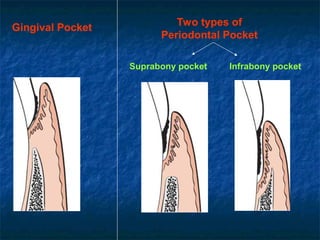
Suprabony pocket
Two types of
Periodontal Pocket
Infrabony pocket
Gingival Pocket
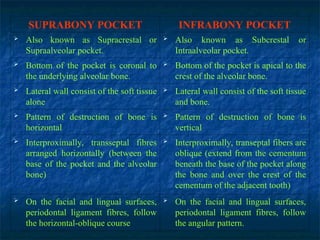
SUPRABONY POCKET INFRABONY POCKET
 Also known as Supracrestal or
Supraalveolar pocket.
 Also known as Subcrestal or
Intraalveolar pocket.
 Bottom of the pocket is coronal to
the underlying alveolar bone.
 Bottom of the pocket is apical to the
crest of the alveolar bone.
 Lateral wall consist of the soft tissue
alone
 Lateral wall consist of the soft tissue
and bone.
 Pattern of destruction of bone is
horizontal
 Pattern of destruction of bone is
vertical
 Interproximally, transseptal fibres
arranged horizontally (between the
base of the pocket and the alveolar
bone)
 Interproximally, transeptal fibers are
oblique (extend from the cementum
beneath the base of the pocket along
the bone and over the crest of the
cementum of the adjacent tooth)
 On the facial and lingual surfaces,
periodontal ligament fibres, follow
the horizontal-oblique course
 On the facial and lingual surfaces,
periodontal ligament fibres, follow
the angular pattern.
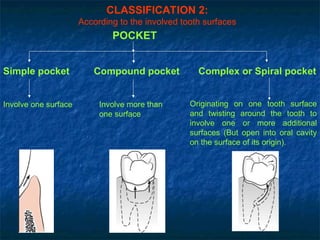
CLASSIFICATION 2:
According to the involved tooth surfaces
Involve one surface Involve more than
one surface
Originating on one tooth surface
and twisting around the tooth to
involve one or more additional
surfaces (But open into oral cavity
on the surface of its origin).
POCKET
Simple pocket Compound pocket Complex or Spiral pocket
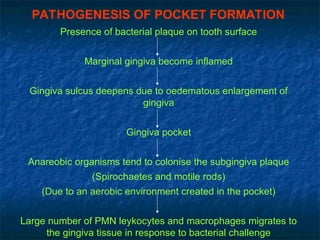
PATHOGENESIS OF POCKET FORMATION
Presence of bacterial plaque on tooth surface
Marginal gingiva become inflamed
Gingiva sulcus deepens due to oedematous enlargement of
gingiva
Gingiva pocket
Anareobic organisms tend to colonise the subgingiva plaque
(Spirochaetes and motile rods)
(Due to an aerobic environment created in the pocket)
Large number of PMN leykocytes and macrophages migrates to
the gingiva tissue in response to bacterial challenge
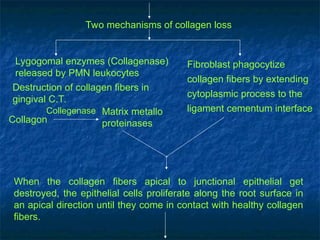
Two mechanisms of collagen loss
Lygogomal enzymes (Collagenase)
released by PMN leukocytes
Fibroblast phagocytize
collagen fibers by extending
cytoplasmic process to the
ligament cementum interface
Destruction of collagen fibers in
gingival C.T.
Collagon
Matrix metallo
proteinases
Collegenase
When the collagen fibers apical to junctional epithelial get
destroyed, the epithelial cells proliferate along the root surface in
an apical direction until they come in contact with healthy collagen
fibers.
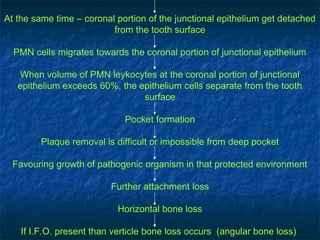
At the same time – coronal portion of the junctional epithelium get detached
from the tooth surface
PMN cells migrates towards the coronal portion of junctional epithelium
When volume of PMN leykocytes at the coronal portion of junctional
epithelium exceeds 60%, the epithelium cells separate from the tooth
surface
Pocket formation
Plaque removal is difficult or impossible from deep pocket
Favouring growth of pathogenic organism in that protected environment
Further attachment loss
Horizontal bone loss
If I.F.O. present than verticle bone loss occurs (angular bone loss)
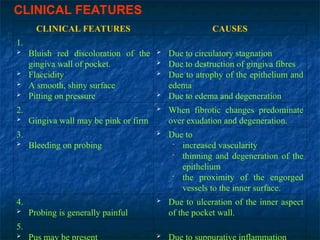
CLINICAL FEATURES
CLINICAL FEATURES CAUSES
1.
 Bluish red discoloration of the
gingiva wall of pocket.
 Flaccidity
 A smooth, shiny surface
 Pitting on pressure
 Due to circulatory stagnation
 Due to destruction of gingiva fibres
 Due to atrophy of the epithelium and
edema
 Due to edema and degeneration
2.
 Gingiva wall may be pink or firm
 When fibrotic changes predominate
over exudation and degeneration.
3.
 Bleeding on probing
 Due to
 increased vascularity
 thinning and degeneration of the
epithelium
 the proximity of the engorged
vessels to the inner surface.
4.
 Probing is generally painful
 Due to ulceration of the inner aspect
of the pocket wall.
5.
 
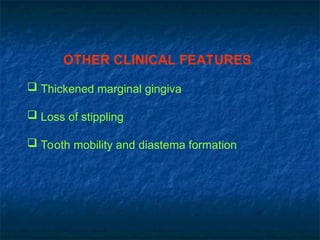
OTHER CLINICAL FEATURES
 Thickened marginal gingiva
 Loss of stippling
 Tooth mobility and diastema formation
HISTOPATHOLOGY
[I] Soft tissue wall/lateral wall
Epithelium:
Shows
1. Epithelial cells proliferate into the underlying connective
tissues forming deep rete pegs
2. Micro ulcerations develops on soft tissue wall
3. Pocket epithelial is infiltrated by PMN’s and oedematons fluid
from inflammed connective tissues.
4. Bacterial invasion in intercellular space of epithelium (eg.
Gram negative organism, porphysomons gingivais, provotella
intermedia, actinobacillus).
Degenerative changes
Proliferative changes
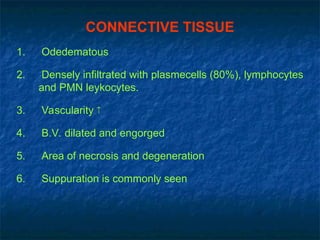
CONNECTIVE TISSUE
1. Odedematous
2. Densely infiltrated with plasmecells (80%), lymphocytes
and PMN leykocytes.
3. Vascularity 
4. B.V. dilated and engorged
5. Area of necrosis and degeneration
6. Suppuration is commonly seen
SCANNING ELECTRON MICROSCOPIC
EXAMINATION OF LATERAL WALL
Seven different types of disease activity have been identified.
1. Areas of relative quiescence
Regions with minor depressions and elevations
2. Areas of Bacterial accumulation
Accumulates in depressions in epithelial surface
3. Areas of emergence of leukocytes
Leukocytes emerging through intercellular spaces
4. Areas of leukocyte bacteria interaction
5. Areas of intense epithelial desquamation
6. Areas of ulceration
7. Areas of haemorrhage.
PERIODONTAL POCKETS AS HEALING
LESIONS
 Periodontal pockets are inflammatory lesions and
constantly undergoing repair.
 Complete healing does not occurs because of persistence
of bacterial attack which continue to stimulate an
inflammatory response causing degeneration of new tissues.
Oedematous pocket wall
When the inflammatory component predominates the
lateral wall appears soft, oedematous friable, with smooth
shiny surface and bluish red discoloration.
Fibrotic pocket wall
When reparative changes predominates, the gingiva
appears fibrotic and pink.
Note: In some case outer surface of soft tissue wall is
fibrotic while inner surface of soft tissue wall is inflamed
and ulcerated.
CONTENTS OF POCKET
1. Micro organisms
2. Bacterial products (enzymes and endotoxins)
3. GCF
4. Remnants of food
5. Salivary mycin
6. Desquamated epithelial cells
7. Leukocytes
8. Purulent exudates may be present (sec. sign)
Eg. deep pocket may have little or no pus and shallow
pocket may have extensive pus formation so pus is not an
indication of the depth of the pocket.
[II] Root surface wall of the pocket
 Root surface forms the medial wall of the pocket.
 The root surface that gets expose to the oral
environment, as a result of periodontal attachment loss,
undergoes following changes.
Structural changes Chemical changes Cytotonic changes
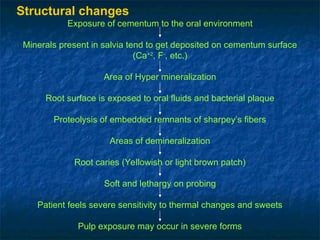
Structural changes
Exposure of cementum to the oral environment
Minerals present in salvia tend to get deposited on cementum surface
(Ca+2
, F-
, etc.)
Area of Hyper mineralization
Root surface is exposed to oral fluids and bacterial plaque
Proteolysis of embedded remnants of sharpey’s fibers
Areas of demineralization
Root caries (Yellowish or light brown patch)
Soft and lethargy on probing
Patient feels severe sensitivity to thermal changes and sweets
Pulp exposure may occur in severe forms
Chemical changes
Cementum exposed to saliva may absorb calcium,
phosphorus, magnesium and fluoride.
Increased mineral content of the root surface alters the
chemical composition of the cementum, making it
resistant to dental caries.
Cytotoxic changes
Histologic studies of periodontally involved cementum
have shown the presence of bacteria in the cementum or
endotonins in the cementum.
Note: Dominant micro organism in root surface caries is
actinomyces viscosus.
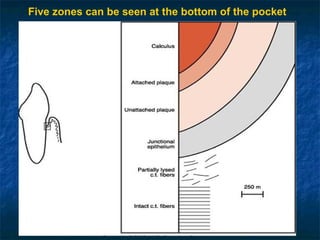
Five zones can be seen at the bottom of the pocket
Also
known
as
Plaque
free
zone
DIAGNOSIS/DETECTION OF POCKETS
1.Careful exploration with a periodontal probe – accurate
method.
2.Radiograph: Pockets are not detected by radiographic
examination because pocket is a soft tissue change.
Disadvantages of radiograph:
 Radiograph indicates areas of bone loss where pocket may be
suspected, they do not show pocket presence or depth.
 Radiograph show no difference before or after pocket elimination
unless bone has been modified
Note: Gutta Percha points or Calibrated Silver points can be
used with radiograph to assist in determining the level of
attachment of periodontal pocket.
POCKET PROBING
Two different pocket depths
Biologic or histologic depth
Distance between gingiva
margin and base of the pocket
Clinical or probing depth
Distance to which a probe
penetrates into the pocket
Note: Standardized force used for penetration of a probe is
25 ponds or 25 grams (0.75 N).
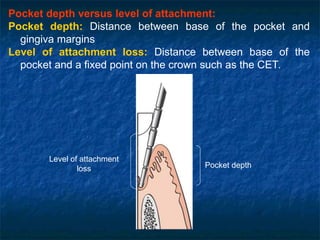
Pocket depth versus level of attachment:
Pocket depth: Distance between base of the pocket and
gingiva margins
Level of attachment loss: Distance between base of the
pocket and a fixed point on the crown such as the CET.
Level of attachment
loss Pocket depth
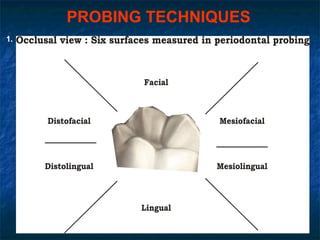
PROBING TECHNIQUES
1.
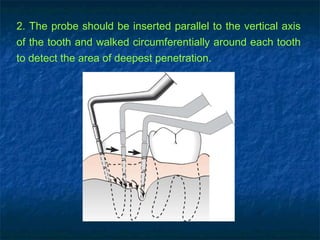
2. The probe should be inserted parallel to the vertical axis
of the tooth and walked circumferentially around each tooth
to detect the area of deepest penetration.
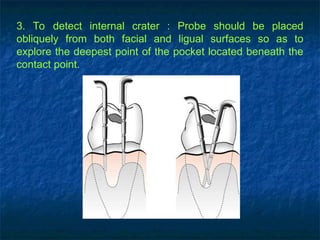
3. To detect internal crater : Probe should be placed
obliquely from both facial and ligual surfaces so as to
explore the deepest point of the pocket located beneath the
contact point.
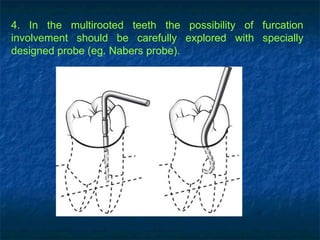
4. In the multirooted teeth the possibility of furcation
involvement should be carefully explored with specially
designed probe (eg. Nabers probe).
BLEEDING ON PROBING
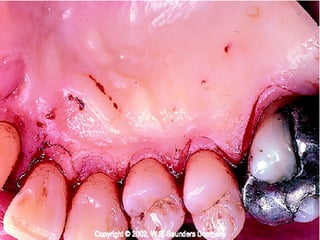
1. If gingiva is inflamed and the pocket epithelium is atrophic or
ulcerated.
2. To test for bleeding after probing, the probe is carefully introduced
to the bottom of the pocket and gently moved laterally along the
pocket wall.
3. Bleeding may appear immediately after removal of the probe or
may be delayed a few seconds.
4. Depending on the severity of inflammation, bleeding can vary from
a tenuous red line along the gingiva sulcus to profuse bleeding.
PROBING AROUND IMPLANTS
Periimplantitis:
 Periimplantitis can create pockets around implants
 Plastic probe should be used instead of the usual steel probes
used for the natural dentition.
To prevent the scratching of the implant surface.
Peridontal-Pocket-Perio study guide exam

Peridontal-Pocket-Perio study guide exam

  • 1.
  • 2.
    DEFINITION: The periodontal pocketis defined as a pathologically deepened gingiva sulcus. Deepening of gingiva sulcus may occur by coronal movement of the gingiva margin, apical displacement of gingiva attachment or combination of above.
  • 3.
    GINGIVA POCKET PERIODONTALPOCKET Also known as pseudo pocket or relative pocket or false pocket Seen in the gingivitis Formed by the gingiva enlargement without extraction of the underlying periodontal tissues. The sulcus is deepened because of increased bulk of gingiva Also known as absolute or true pocket Seen in periodontitis Occurs with destruction of the supporting periodontal tissues and loosening and exfoliation of the teeth. CLASSIFICATION 1: POCKET Gingival pocket Periodontal pocket Suprabony pocket Infrabony pocket
  • 4.
    Suprabony pocket Two typesof Periodontal Pocket Infrabony pocket Gingival Pocket
  • 5.
    SUPRABONY POCKET INFRABONYPOCKET  Also known as Supracrestal or Supraalveolar pocket.  Also known as Subcrestal or Intraalveolar pocket.  Bottom of the pocket is coronal to the underlying alveolar bone.  Bottom of the pocket is apical to the crest of the alveolar bone.  Lateral wall consist of the soft tissue alone  Lateral wall consist of the soft tissue and bone.  Pattern of destruction of bone is horizontal  Pattern of destruction of bone is vertical  Interproximally, transseptal fibres arranged horizontally (between the base of the pocket and the alveolar bone)  Interproximally, transeptal fibers are oblique (extend from the cementum beneath the base of the pocket along the bone and over the crest of the cementum of the adjacent tooth)  On the facial and lingual surfaces, periodontal ligament fibres, follow the horizontal-oblique course  On the facial and lingual surfaces, periodontal ligament fibres, follow the angular pattern.
  • 6.
    CLASSIFICATION 2: According tothe involved tooth surfaces Involve one surface Involve more than one surface Originating on one tooth surface and twisting around the tooth to involve one or more additional surfaces (But open into oral cavity on the surface of its origin). POCKET Simple pocket Compound pocket Complex or Spiral pocket
  • 7.
    PATHOGENESIS OF POCKETFORMATION Presence of bacterial plaque on tooth surface Marginal gingiva become inflamed Gingiva sulcus deepens due to oedematous enlargement of gingiva Gingiva pocket Anareobic organisms tend to colonise the subgingiva plaque (Spirochaetes and motile rods) (Due to an aerobic environment created in the pocket) Large number of PMN leykocytes and macrophages migrates to the gingiva tissue in response to bacterial challenge
  • 8.
    Two mechanisms ofcollagen loss Lygogomal enzymes (Collagenase) released by PMN leukocytes Fibroblast phagocytize collagen fibers by extending cytoplasmic process to the ligament cementum interface Destruction of collagen fibers in gingival C.T. Collagon Matrix metallo proteinases Collegenase When the collagen fibers apical to junctional epithelial get destroyed, the epithelial cells proliferate along the root surface in an apical direction until they come in contact with healthy collagen fibers.
  • 9.
    At the sametime – coronal portion of the junctional epithelium get detached from the tooth surface PMN cells migrates towards the coronal portion of junctional epithelium When volume of PMN leykocytes at the coronal portion of junctional epithelium exceeds 60%, the epithelium cells separate from the tooth surface Pocket formation Plaque removal is difficult or impossible from deep pocket Favouring growth of pathogenic organism in that protected environment Further attachment loss Horizontal bone loss If I.F.O. present than verticle bone loss occurs (angular bone loss)
  • 10.
    CLINICAL FEATURES CLINICAL FEATURESCAUSES 1.  Bluish red discoloration of the gingiva wall of pocket.  Flaccidity  A smooth, shiny surface  Pitting on pressure  Due to circulatory stagnation  Due to destruction of gingiva fibres  Due to atrophy of the epithelium and edema  Due to edema and degeneration 2.  Gingiva wall may be pink or firm  When fibrotic changes predominate over exudation and degeneration. 3.  Bleeding on probing  Due to  increased vascularity  thinning and degeneration of the epithelium  the proximity of the engorged vessels to the inner surface. 4.  Probing is generally painful  Due to ulceration of the inner aspect of the pocket wall. 5.  
  • 11.
    OTHER CLINICAL FEATURES Thickened marginal gingiva  Loss of stippling  Tooth mobility and diastema formation
  • 12.
    HISTOPATHOLOGY [I] Soft tissuewall/lateral wall Epithelium: Shows 1. Epithelial cells proliferate into the underlying connective tissues forming deep rete pegs 2. Micro ulcerations develops on soft tissue wall 3. Pocket epithelial is infiltrated by PMN’s and oedematons fluid from inflammed connective tissues. 4. Bacterial invasion in intercellular space of epithelium (eg. Gram negative organism, porphysomons gingivais, provotella intermedia, actinobacillus). Degenerative changes Proliferative changes
  • 13.
    CONNECTIVE TISSUE 1. Odedematous 2.Densely infiltrated with plasmecells (80%), lymphocytes and PMN leykocytes. 3. Vascularity  4. B.V. dilated and engorged 5. Area of necrosis and degeneration 6. Suppuration is commonly seen
  • 14.
    SCANNING ELECTRON MICROSCOPIC EXAMINATIONOF LATERAL WALL Seven different types of disease activity have been identified. 1. Areas of relative quiescence Regions with minor depressions and elevations 2. Areas of Bacterial accumulation Accumulates in depressions in epithelial surface 3. Areas of emergence of leukocytes Leukocytes emerging through intercellular spaces 4. Areas of leukocyte bacteria interaction 5. Areas of intense epithelial desquamation 6. Areas of ulceration 7. Areas of haemorrhage.
  • 15.
    PERIODONTAL POCKETS ASHEALING LESIONS  Periodontal pockets are inflammatory lesions and constantly undergoing repair.  Complete healing does not occurs because of persistence of bacterial attack which continue to stimulate an inflammatory response causing degeneration of new tissues. Oedematous pocket wall When the inflammatory component predominates the lateral wall appears soft, oedematous friable, with smooth shiny surface and bluish red discoloration. Fibrotic pocket wall When reparative changes predominates, the gingiva appears fibrotic and pink. Note: In some case outer surface of soft tissue wall is fibrotic while inner surface of soft tissue wall is inflamed and ulcerated.
  • 16.
    CONTENTS OF POCKET 1.Micro organisms 2. Bacterial products (enzymes and endotoxins) 3. GCF 4. Remnants of food 5. Salivary mycin 6. Desquamated epithelial cells 7. Leukocytes 8. Purulent exudates may be present (sec. sign) Eg. deep pocket may have little or no pus and shallow pocket may have extensive pus formation so pus is not an indication of the depth of the pocket.
  • 17.
    [II] Root surfacewall of the pocket  Root surface forms the medial wall of the pocket.  The root surface that gets expose to the oral environment, as a result of periodontal attachment loss, undergoes following changes. Structural changes Chemical changes Cytotonic changes
  • 18.
    Structural changes Exposure ofcementum to the oral environment Minerals present in salvia tend to get deposited on cementum surface (Ca+2 , F- , etc.) Area of Hyper mineralization Root surface is exposed to oral fluids and bacterial plaque Proteolysis of embedded remnants of sharpey’s fibers Areas of demineralization Root caries (Yellowish or light brown patch) Soft and lethargy on probing Patient feels severe sensitivity to thermal changes and sweets Pulp exposure may occur in severe forms
  • 19.
    Chemical changes Cementum exposedto saliva may absorb calcium, phosphorus, magnesium and fluoride. Increased mineral content of the root surface alters the chemical composition of the cementum, making it resistant to dental caries. Cytotoxic changes Histologic studies of periodontally involved cementum have shown the presence of bacteria in the cementum or endotonins in the cementum. Note: Dominant micro organism in root surface caries is actinomyces viscosus.
  • 20.
    Five zones canbe seen at the bottom of the pocket Also known as Plaque free zone
  • 21.
    DIAGNOSIS/DETECTION OF POCKETS 1.Carefulexploration with a periodontal probe – accurate method. 2.Radiograph: Pockets are not detected by radiographic examination because pocket is a soft tissue change. Disadvantages of radiograph:  Radiograph indicates areas of bone loss where pocket may be suspected, they do not show pocket presence or depth.  Radiograph show no difference before or after pocket elimination unless bone has been modified Note: Gutta Percha points or Calibrated Silver points can be used with radiograph to assist in determining the level of attachment of periodontal pocket.
  • 22.
    POCKET PROBING Two differentpocket depths Biologic or histologic depth Distance between gingiva margin and base of the pocket Clinical or probing depth Distance to which a probe penetrates into the pocket Note: Standardized force used for penetration of a probe is 25 ponds or 25 grams (0.75 N).
  • 23.
    Pocket depth versuslevel of attachment: Pocket depth: Distance between base of the pocket and gingiva margins Level of attachment loss: Distance between base of the pocket and a fixed point on the crown such as the CET. Level of attachment loss Pocket depth
  • 24.
  • 25.
    2. The probeshould be inserted parallel to the vertical axis of the tooth and walked circumferentially around each tooth to detect the area of deepest penetration.
  • 26.
    3. To detectinternal crater : Probe should be placed obliquely from both facial and ligual surfaces so as to explore the deepest point of the pocket located beneath the contact point.
  • 27.
    4. In themultirooted teeth the possibility of furcation involvement should be carefully explored with specially designed probe (eg. Nabers probe).
  • 28.
    BLEEDING ON PROBING 1.If gingiva is inflamed and the pocket epithelium is atrophic or ulcerated. 2. To test for bleeding after probing, the probe is carefully introduced to the bottom of the pocket and gently moved laterally along the pocket wall. 3. Bleeding may appear immediately after removal of the probe or may be delayed a few seconds. 4. Depending on the severity of inflammation, bleeding can vary from a tenuous red line along the gingiva sulcus to profuse bleeding. PROBING AROUND IMPLANTS Periimplantitis:  Periimplantitis can create pockets around implants  Plastic probe should be used instead of the usual steel probes used for the natural dentition. To prevent the scratching of the implant surface.