DEVELOPING THE WHOLE
PERSON
Quarter 1
Module 2
Human development is a complex process.
It is the development of physical, emotional,
mental, spiritual and all other aspects. And
all these aspects must be given equal
attention to be holistically develop. Holistic
development is where all aspects are in
balanced, work harmoniously and are
given equal attention or importance for
improvement.
A holistic development is not an overnight project
but instead it must be seen as a lifelong project a
person has to undertake. Wholeness is a
transcendental life goal. It is a long life pursuit.
Emeth and Green hut (1991) wrote that we are
on pilgrims on a journey towards wholeness and
fullness of life. It is an ideal human goal given its
good implication to the total functioning of the
individual, as well as meaning to life Are you
ready to begin your journey in this module?
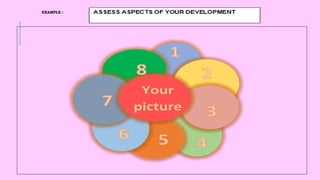
Instruction: Provide your best picture. Create
your graphic organizer or draw a circle on a
blank sheet of paper and divide the circle into
8 segments. Put your picture in the centre. In
each segment write some descriptions of the
different aspects of yourself as follow.
Note: You can create your own designs as long as it has 8
segment or parts.
Activity 2: Me, Myself and I
1. Physical Self
Describe yourself. Try not to censor any thoughts
which come to your mind. Include descriptions of
your height, weight, facial appearance, and
quality of skin, hair and descriptions of body
areas such as your neck, chest, waist, legs.
Activity 2: Me, Myself and I
2. Intellectual/Cognitive / Mental Self
Include here an assessment of how well you
reason and solve problems, your capacity to
learn and create, your general amount of
knowledge, your specific areas of knowledge,
wisdom you have acquired, and insights you
have.
Activity 2: Me, Myself and I
3. Emotional Self
Write as many words or phrase about typical
feelings you have, feelings you seldom have,
feelings you try to avoid, feelings youe specially
enjoy, feelings from your past and present, and
feelings which are associated with each other.
Activity 2: Me, Myself and I
4. Sensual Self
Write how you feel as a sensual person. What
sense do you use most – sight, hearing, speaking,
smelling, touching? How do you feel about the
different ways you take in information - through
the eyes, ears, mouth, nose, and skin. In what ways
do you let information in and out of your body?
Activity 2: Me, Myself and I
5. Interactional/Social Self
Include descriptions of your strengths and
weaknesses in intimate relationships and
relationships to friends, family, classmates and
strangers in social settings. Describe the strengths
and weaknesses which your friends and family
have noticed. Describe what kind of son or
daughter, brother or sister you are.
Activity 2: Me, Myself and I
6. Nutritional Self
How do you nourish yourself? What foods do you like
and dislike? What do you like and dislike about these?
7. Contextual Self
Descriptors could be in the areas of maintenance of
your living environment: reaction to light, temperature,
space, weather, colors, sound and seasons and your
impact on the environment
Activity 2: Me, Myself and I
8. Spiritual Self or Life Force
Write words or phrases which tell about how you feel in
this area. This could include your feelings about yourself
and organized religion, reactions about your spiritual
connections to others, feelings about your spiritual
development and history, and thought about your
metaphysical self. Think about your inner peace and joy.
Think about your spiritual regimen or routine.
Activity 2: Me, Myself and I
EXAMPLE :
ASPECTS OF THE SELF The self-concept is
represented by several aspects of the self. It is
conceived as collection of multiple, context-
dependent selves. This construct believes that
context activates particular regions of self-
knowledge and self-relevant feedback affects
self-evaluations. A deeper look on the different
aspects of self can identify specific areas for self-
regulation, stability and improvement.
THREE BASIC, BUT VERY DIFFERENT ASPECTS
OF THE SELF
In a nutshell, an individual is composed of three
basic, but very different aspects of the self. All
three aspects of the self work together in perfect
harmony when attention is paid to all three
simultaneously.
THREE BASIC, BUT VERY DIFFERENT ASPECTS
OF THE SELF
1. Physical Or Tangible Aspects- relate to the
body (height, weight, facial appearance, and
quality of skin, hair and descriptions of body
areas such as your neck, chest, waist, legs)
THREE BASIC, BUT VERY DIFFERENT ASPECTS
OF THE SELF
1. Physical Or Tangible Aspects
Many individuals put a strong emphasis on the physical aspect
of the self. The body is tangible, obvious, and we respond to it
easily. More time and money is spent on enhancing the physical
component than either of the other two aspects. This does not
mean, however, that the body is healthy or strong. The body
provides a place to house the spirit (often experienced as
feelings) and the mind (often experienced as thought).
2. Intellectual And Conscious Aspects
 relate to the mind (include how well you
reason and solve problems, your capacity to
learn and create, your general amount of
knowledge, your specific areas of
knowledge, wisdom you have acquired, and
insights you have.)
2. Intellectual And Conscious Aspects
It may be important to some that their mind can be prominent
and well educated. The mind is important, as it is the part of the
self that directs the other two aspects. The mind learns what to
do and communicates the information to the body and the
feelings. What the mind believes, the body manifests or acts on,
and the emotions feel, or respond with. People store both
healthy and destructive thoughts and beliefs and responds to
life's circumstances in the most prominent manner. The mind
provides access creativity and serenity which are necessary for
such processes as prayer, forgiveness, acceptance, and passion.
3. Emotional and Intuitive Aspects/ Spiritual Self
or Life Force
 they relate to the spirit and feelings
 Emotional relates to typical feelings you have,
feelings you seldom have, feelings you try to avoid,
feelings you especially enjoy, What is It feelings from
your past and present, and feelings which are
associated with each other. This aspects of self affects
your state of being, and they are very important in
dealing with people and events.
Intuitive Aspects/ Spiritual Self or Life Force
 relates to your faith and relationship with the creator
Creativity relates to your feelings about yourself and
organized religion, reactions about your spiritual
connections to others, feelings about your spiritual
development and history, and thought about your
metaphysical self. Think about your inner peace and
joy. Think about your spiritual regimen or routine.
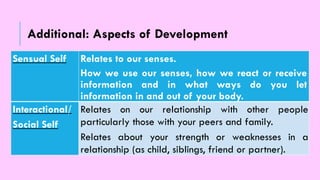
Sensual Self Relates to our senses.
How we use our senses, how we react or receive
information and in what ways do you let
information in and out of your body.
Interactional/
Social Self
Relates on our relationship with other people
particularly those with your peers and family.
Relates about your strength or weaknesses in a
relationship (as child, siblings, friend or partner).
Additional: Aspects of Development
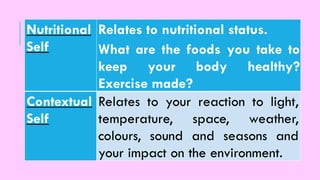
Nutritional
Self
Relates to nutritional status.
What are the foods you take to
keep your body healthy?
Exercise made?
Contextual
Self
Relates to your reaction to light,
temperature, space, weather,
colours, sound and seasons and
your impact on the environment.

Developing The Whole Person_Lesson 2.pptx

  • 1.
  • 2.
    Human development isa complex process. It is the development of physical, emotional, mental, spiritual and all other aspects. And all these aspects must be given equal attention to be holistically develop. Holistic development is where all aspects are in balanced, work harmoniously and are given equal attention or importance for improvement.
  • 3.
    A holistic developmentis not an overnight project but instead it must be seen as a lifelong project a person has to undertake. Wholeness is a transcendental life goal. It is a long life pursuit. Emeth and Green hut (1991) wrote that we are on pilgrims on a journey towards wholeness and fullness of life. It is an ideal human goal given its good implication to the total functioning of the individual, as well as meaning to life Are you ready to begin your journey in this module?
  • 4.
    Instruction: Provide yourbest picture. Create your graphic organizer or draw a circle on a blank sheet of paper and divide the circle into 8 segments. Put your picture in the centre. In each segment write some descriptions of the different aspects of yourself as follow. Note: You can create your own designs as long as it has 8 segment or parts. Activity 2: Me, Myself and I
  • 5.
    1. Physical Self Describeyourself. Try not to censor any thoughts which come to your mind. Include descriptions of your height, weight, facial appearance, and quality of skin, hair and descriptions of body areas such as your neck, chest, waist, legs. Activity 2: Me, Myself and I
  • 6.
    2. Intellectual/Cognitive /Mental Self Include here an assessment of how well you reason and solve problems, your capacity to learn and create, your general amount of knowledge, your specific areas of knowledge, wisdom you have acquired, and insights you have. Activity 2: Me, Myself and I
  • 7.
    3. Emotional Self Writeas many words or phrase about typical feelings you have, feelings you seldom have, feelings you try to avoid, feelings youe specially enjoy, feelings from your past and present, and feelings which are associated with each other. Activity 2: Me, Myself and I
  • 8.
    4. Sensual Self Writehow you feel as a sensual person. What sense do you use most – sight, hearing, speaking, smelling, touching? How do you feel about the different ways you take in information - through the eyes, ears, mouth, nose, and skin. In what ways do you let information in and out of your body? Activity 2: Me, Myself and I
  • 9.
    5. Interactional/Social Self Includedescriptions of your strengths and weaknesses in intimate relationships and relationships to friends, family, classmates and strangers in social settings. Describe the strengths and weaknesses which your friends and family have noticed. Describe what kind of son or daughter, brother or sister you are. Activity 2: Me, Myself and I
  • 10.
    6. Nutritional Self Howdo you nourish yourself? What foods do you like and dislike? What do you like and dislike about these? 7. Contextual Self Descriptors could be in the areas of maintenance of your living environment: reaction to light, temperature, space, weather, colors, sound and seasons and your impact on the environment Activity 2: Me, Myself and I
  • 11.
    8. Spiritual Selfor Life Force Write words or phrases which tell about how you feel in this area. This could include your feelings about yourself and organized religion, reactions about your spiritual connections to others, feelings about your spiritual development and history, and thought about your metaphysical self. Think about your inner peace and joy. Think about your spiritual regimen or routine. Activity 2: Me, Myself and I
  • 12.
  • 13.
    ASPECTS OF THESELF The self-concept is represented by several aspects of the self. It is conceived as collection of multiple, context- dependent selves. This construct believes that context activates particular regions of self- knowledge and self-relevant feedback affects self-evaluations. A deeper look on the different aspects of self can identify specific areas for self- regulation, stability and improvement.
  • 14.
    THREE BASIC, BUTVERY DIFFERENT ASPECTS OF THE SELF In a nutshell, an individual is composed of three basic, but very different aspects of the self. All three aspects of the self work together in perfect harmony when attention is paid to all three simultaneously.
  • 15.
    THREE BASIC, BUTVERY DIFFERENT ASPECTS OF THE SELF 1. Physical Or Tangible Aspects- relate to the body (height, weight, facial appearance, and quality of skin, hair and descriptions of body areas such as your neck, chest, waist, legs)
  • 16.
    THREE BASIC, BUTVERY DIFFERENT ASPECTS OF THE SELF 1. Physical Or Tangible Aspects Many individuals put a strong emphasis on the physical aspect of the self. The body is tangible, obvious, and we respond to it easily. More time and money is spent on enhancing the physical component than either of the other two aspects. This does not mean, however, that the body is healthy or strong. The body provides a place to house the spirit (often experienced as feelings) and the mind (often experienced as thought).
  • 17.
    2. Intellectual AndConscious Aspects  relate to the mind (include how well you reason and solve problems, your capacity to learn and create, your general amount of knowledge, your specific areas of knowledge, wisdom you have acquired, and insights you have.)
  • 18.
    2. Intellectual AndConscious Aspects It may be important to some that their mind can be prominent and well educated. The mind is important, as it is the part of the self that directs the other two aspects. The mind learns what to do and communicates the information to the body and the feelings. What the mind believes, the body manifests or acts on, and the emotions feel, or respond with. People store both healthy and destructive thoughts and beliefs and responds to life's circumstances in the most prominent manner. The mind provides access creativity and serenity which are necessary for such processes as prayer, forgiveness, acceptance, and passion.
  • 19.
    3. Emotional andIntuitive Aspects/ Spiritual Self or Life Force  they relate to the spirit and feelings  Emotional relates to typical feelings you have, feelings you seldom have, feelings you try to avoid, feelings you especially enjoy, What is It feelings from your past and present, and feelings which are associated with each other. This aspects of self affects your state of being, and they are very important in dealing with people and events.
  • 20.
    Intuitive Aspects/ SpiritualSelf or Life Force  relates to your faith and relationship with the creator Creativity relates to your feelings about yourself and organized religion, reactions about your spiritual connections to others, feelings about your spiritual development and history, and thought about your metaphysical self. Think about your inner peace and joy. Think about your spiritual regimen or routine.
  • 21.
    Sensual Self Relatesto our senses. How we use our senses, how we react or receive information and in what ways do you let information in and out of your body. Interactional/ Social Self Relates on our relationship with other people particularly those with your peers and family. Relates about your strength or weaknesses in a relationship (as child, siblings, friend or partner). Additional: Aspects of Development
  • 22.
    Nutritional Self Relates to nutritionalstatus. What are the foods you take to keep your body healthy? Exercise made? Contextual Self Relates to your reaction to light, temperature, space, weather, colours, sound and seasons and your impact on the environment.