Objectives
At the endof the lesson, you should be able to:
A. Discuss the relationship among physiological, cognitive,
psychological, spiritual and social aspects by
understanding the various aspects of holistic development;
B. Demonstrate understanding of the various aspects of
holistic development by evaluating your own thoughts,
feeling and actions;
C. Show the connection of your thoughts, feelings and
action by dealing with actual life situations.
3.
Aspects of theSelf
The self-concept is represented by
several aspects of the self. It is conceived as
collection of multiple, context-dependent
selves. This construct believes that context
activates particular regions of self-knowledge
and self-relevant feedback affects self-
evaluation and affect.
4.
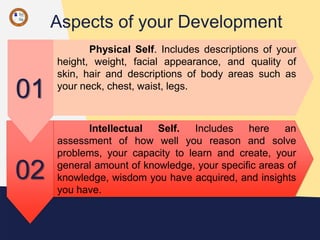
Aspects of yourDevelopment
02
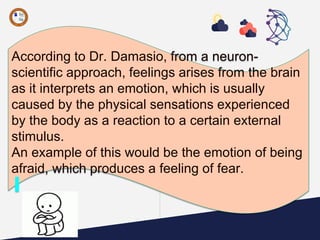
Intellectual Self. Includes here an
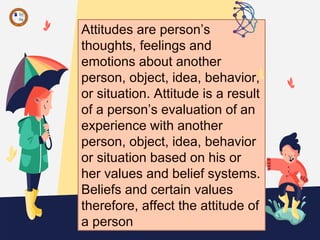
assessment of how well you reason and solve
problems, your capacity to learn and create, your
general amount of knowledge, your specific areas of
knowledge, wisdom you have acquired, and insights
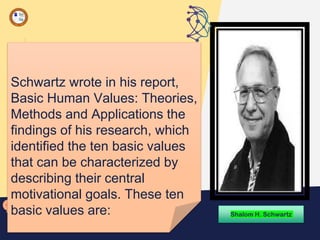
you have.
01
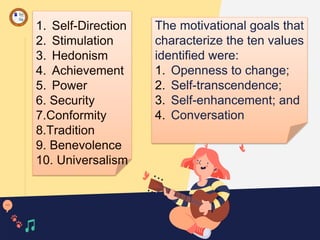
Physical Self. Includes descriptions of your
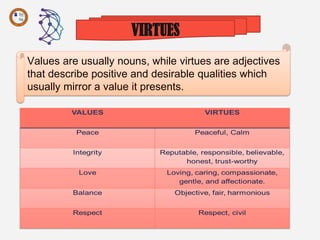
height, weight, facial appearance, and quality of
skin, hair and descriptions of body areas such as
your neck, chest, waist, legs.
5.
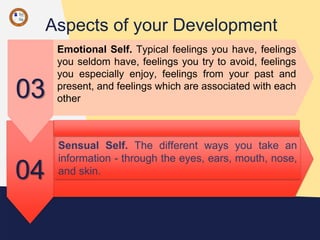
Aspects of yourDevelopment
04
Sensual Self. The different ways you take an
information - through the eyes, ears, mouth, nose,
and skin.
03
Emotional Self. Typical feelings you have, feelings
you seldom have, feelings you try to avoid, feelings
you especially enjoy, feelings from your past and
present, and feelings which are associated with each
other
6.
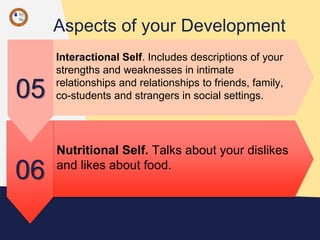
Aspects of yourDevelopment
06
Nutritional Self. Talks about your dislikes
and likes about food.
05
Interactional Self. Includes descriptions of your
strengths and weaknesses in intimate
relationships and relationships to friends, family,
co-students and strangers in social settings.
7.
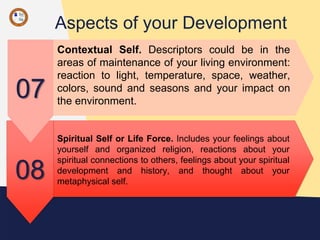
Aspects of yourDevelopment
08
Spiritual Self or Life Force. Includes your feelings about
yourself and organized religion, reactions about your
spiritual connections to others, feelings about your spiritual
development and history, and thought about your
metaphysical self.
07
Contextual Self. Descriptors could be in the
areas of maintenance of your living environment:
reaction to light, temperature, space, weather,
colors, sound and seasons and your impact on
the environment.
8.
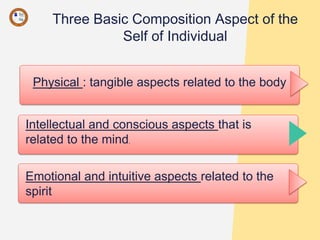
Three Basic CompositionAspect of the
Self of Individual
Physical : tangible aspects related to the body
Intellectual and conscious aspects that is
related to the mind,
Emotional and intuitive aspects related to the
spirit
9.
It may beimportant to some that their mind
be prominent and well educated. The mind is
important, as it is the part of the self that directs the
other two aspects. The mind learns what to do and
communicates the information to the body and the
feelings. What the mind believes, the body
manifests or acts on, and the emotions feel, or
respond with. People store both healthy and
destructive thoughts and beliefs and respond to
life's circumstances in the most prominent manner.
The mind provides access to creativity and serenity
which are necessary for such processes as prayer,
forgiveness, acceptance, and passion.
10.
The human emotionsare the most feared
aspect of the self, as individuals are reluctant and
unprepared to manage them. Managing feelings is
like trying to hold water in the palm of your hand.
They are illusive and deceptive. A decision made
under emotional stress and strain usually impacts
emotions negatively. Negative emotions that are
not managed are stored and repressed. Repression
is destructive to a content self since all feelings, not
only negative ones are stored away. Accessing
feelings when they are needed now becomes
difficult, leaving the individual numb and hopeless.
Source: http://www.innerwisdom.com/aspect-of-the-self.htm
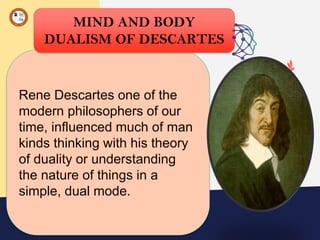
Rene Descartes oneof the
modern philosophers of our
time, influenced much of man
kinds thinking with his theory
of duality or understanding
the nature of things in a
simple, dual mode.
MIND AND BODY
DUALISM OF DESCARTES
13.
HOLISM AND
GESTALT
“
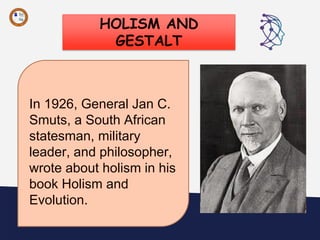
In 1926,General Jan C.
Smuts, a South African
statesman, military
leader, and philosopher,
wrote about holism in his
book Holism and
Evolution.
14.
HOLISM AND
GESTALT
“
He introducedthe academic terminology for
holism as “the tendency in nature to form
wholes which are greater than the sum of
the parts through creative evolution”
15.
“
Earlier in 1890,a German philosopher and psychologist,
Christian von Ehrenfels, and later on supported by
psychologists Max Werheimer, Kurt Koffka and
Wolfgang Kohler of the Berlin School, introduced the
Concept of Gestalt.
16.
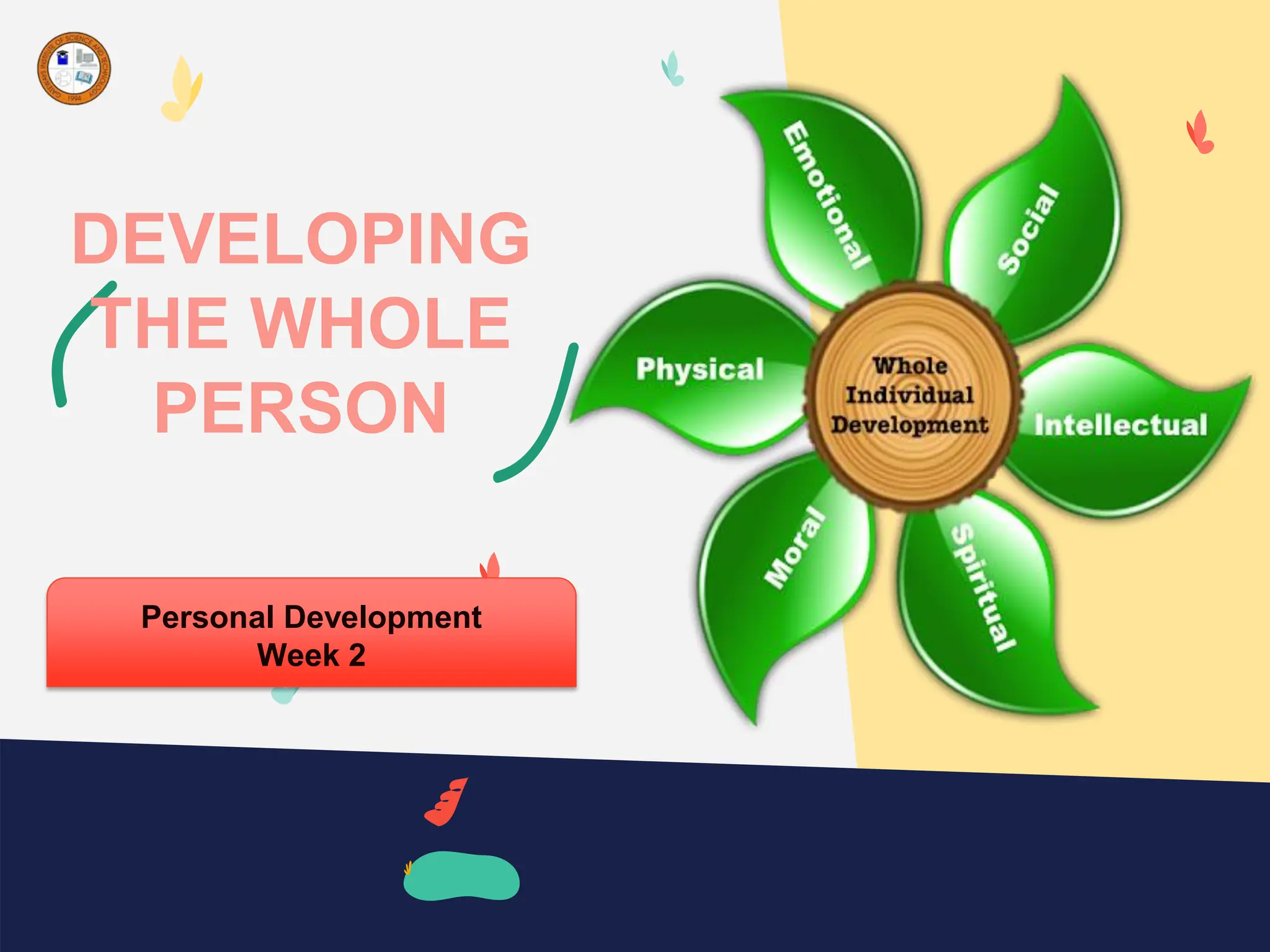
When we considerhuman person and what
various aspects make up this complex
organism, five aspects come to
mind:
• Physiological or the physical attributes
including the five physical senses;
• Cognitive or the intellectual functions of
the mind: thinking, recognizing, reasoning,
analyzing, projecting, synthesizing,
recalling and assessing;
17.
• Psychological orhow thinking, feeling, and
behaving interact and happen in a person;
• Social or the manner by which an individual
interacts with other individuals or groups of
individuals; and
• Spiritual or the attribute of a person’s
consciousness and beliefs, including the
values and virtues that guide and put
meaning into a persons life.
18.
FEELINGS AND EMOTIONS
Feelings,moods, and emotions do
not exactly mean one and the
same. Paul Ekman of the University
of California identified six basic
emotions that human beings
experience: happiness, fear, anger,
surprise, and disgust.
19.
However, a recentresearch study (2014)
conducted by the institute of Neuroscience
and Psychology at the University of Glasgow
and published in a journal, Current Biology,
has conducted that there are only four basic
emotions, these are: happy, sad afraid or
surprised and angry or disgusted.
20.
EMOTIONS
Emotion is takenfrom the Latin verb, movare,
which means to move or be upset or agitated. It
is defined by Smith (1973) as a descriptive term
referring to variations in level of arousal,
affective state or mood, expressive movements,
and attitudes (Sanchez, Abad, and Jao 2012).
21.
In a stateof strong emotion, the person’s physical
responses include faster heartbeat, profuse sweating and
dilation of eye pupils, higher blood pressure, and
muscular tremors, affecting the nervous system in
general.
Are feelings the same as emotions? In an online article of
Scientific American titled Feeling our Emotions, the author
interviewed noted neurologist, Dr. Antonio R. Damasio
(2005) about the distinction between feelings and
emotions.
22.
According to Dr.Damasio, from a neuron-
scientific approach, feelings arises from the brain
as it interprets an emotion, which is usually
caused by the physical sensations experienced
by the body as a reaction to a certain external
stimulus.
An example of this would be the emotion of being
afraid, which produces a feeling of fear.
23.
Attitudes are person’s
thoughts,feelings and
emotions about another
person, object, idea, behavior,
or situation. Attitude is a result
of a person’s evaluation of an
experience with another
person, object, idea, behavior
or situation based on his or
her values and belief systems.
Beliefs and certain values
therefore, affect the attitude of
a person
VALUES AND VIRTUES
Atthe core of every person
lies a system of beliefs that
adheres to the highest ideals
of human existence. These
ideals create meaning and
purpose in a person’s life.
These ideals are called
values.
26.
VALUES AND VIRTUES
TheUnited Nations, for example,
listed the following universal values:
peace, freedom, social progress,
equal rights, and human dignity.
Five Core Values for the Workplace,
Dilenschneider listed the following
corporate values:
• Integrity;
• Accountability;
• Diligence;
• Perseverance ;
• Discipline.
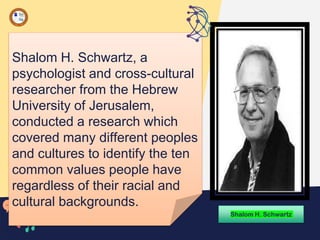
27.
Shalom H. Schwartz,a
psychologist and cross-cultural
researcher from the Hebrew
University of Jerusalem,
conducted a research which
covered many different peoples
and cultures to identify the ten
common values people have
regardless of their racial and
cultural backgrounds.
Shalom H. Schwartz
28.
Schwartz wrote inhis report,
Basic Human Values: Theories,
Methods and Applications the
findings of his research, which
identified the ten basic values
that can be characterized by
describing their central
motivational goals. These ten
basic values are: Shalom H. Schwartz
29.
1. Self-Direction
2. Stimulation
3.Hedonism
4. Achievement
5. Power
6. Security
7.Conformity
8.Tradition
9. Benevolence
10. Universalism
The motivational goals that
characterize the ten values
identified were:
1. Openness to change;
2. Self-transcendence;
3. Self-enhancement; and
4. Conversation
30.
VIRTUES
Values are usuallynouns, while virtues are adjectives
that describe positive and desirable qualities which
usually mirror a value it presents.


![M2-PERDEV - DEVELOPING THE WHOLE PERSON [Autosaved].pptx](https://cdn.slidesharecdn.com/ss_thumbnails/m2-perdev-developingthewholepersonautosaved-221116150644-ad0fbec8-thumbnail.jpg?width=640&height=640&fit=bounds)


