Perception lesson 2

The optic nerve and the brain
Learning Objectives
• To learn about the blind spot
• To understand where visual information is
  used in the brain
The blind spot
• We use the phrase ‘the blind spot’ to mean all
  sorts of things
• I often say I have a blind spot for maths,
  because I cant see how it works
• Drivers use their mirrors to see what is behind
  them, but there is always a blind spot that the
  mirrors don’t cover
• In your eyeballs there is a small area with no
  rods or cones, so it is called the blind spot
Why do we have a blind spot
• Each rod or cone connects to a neurone (a
  nerve cell), and these leave the eyeball via the
  optic nerve (the eyeball stalk)
• At the point where the optic nerve leaves the
  retina there are no rods or cones, so nothing
  can be detected
• This is your blind spot
Blind Spot
• demonstration
Blind Spot
• You may wonder why you don’t see a hole in
  your vision.
• This is because the two blind spots don’t
  overlap, so if you cant see a small area with
  one eye, you can see it with the other
• They ‘fill in’ for each other
The Optic Chiasma
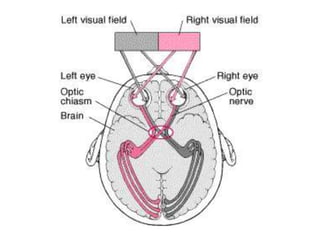
• From the back of the eyeball the optic nerve
  travels to the back of the brain
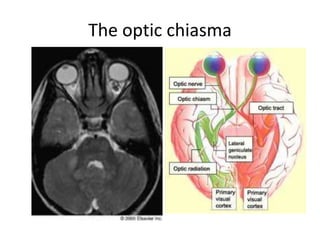
• About half way back the two optic nerves (one
  from each eye) cross over at the optic chiasma
• At the chiasma, fibres from each eye swap to
  the other side
• This means that information from each eye
  goes to both sides of the brain
The optic chiasma
The Visual cortex
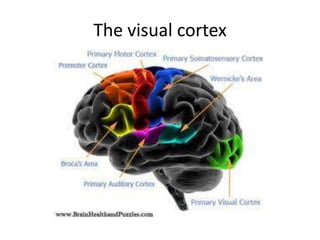
• The part of the brain that receives and
  processes information from the eyes is the
  visual cortex
• It is right at the back about half way up (look
  at the model of the brain)
• The visual cortex uses the information from
  the rods and cones to understand shapes and
  distances
The visual cortex
Perception lesson 2

Perception lesson 2

  • 1.
    Perception lesson 2 Theoptic nerve and the brain
  • 2.
    Learning Objectives • Tolearn about the blind spot • To understand where visual information is used in the brain
  • 3.
    The blind spot •We use the phrase ‘the blind spot’ to mean all sorts of things • I often say I have a blind spot for maths, because I cant see how it works • Drivers use their mirrors to see what is behind them, but there is always a blind spot that the mirrors don’t cover • In your eyeballs there is a small area with no rods or cones, so it is called the blind spot
  • 4.
    Why do wehave a blind spot • Each rod or cone connects to a neurone (a nerve cell), and these leave the eyeball via the optic nerve (the eyeball stalk) • At the point where the optic nerve leaves the retina there are no rods or cones, so nothing can be detected • This is your blind spot
  • 5.
  • 6.
    Blind Spot • Youmay wonder why you don’t see a hole in your vision. • This is because the two blind spots don’t overlap, so if you cant see a small area with one eye, you can see it with the other • They ‘fill in’ for each other
  • 7.
    The Optic Chiasma •From the back of the eyeball the optic nerve travels to the back of the brain • About half way back the two optic nerves (one from each eye) cross over at the optic chiasma • At the chiasma, fibres from each eye swap to the other side • This means that information from each eye goes to both sides of the brain
  • 8.
  • 9.
    The Visual cortex •The part of the brain that receives and processes information from the eyes is the visual cortex • It is right at the back about half way up (look at the model of the brain) • The visual cortex uses the information from the rods and cones to understand shapes and distances
  • 10.