Perception Lesson 1

   How do we see?
Lesson Objectives
• To identify key parts of the eye and to
  understand how they work
What use are our eyes?
• Working in pairs
• Pick something up, your pencil case, anything…
• Close your eyes and describe what you know
  about this object to your partner
• Now open your eyes and say what extra
  information you can access
• Make a note in your book about the information
  that you could only find out using your eyes
Vision and Perception
• Most objects in the world emit (give out) light
• Light from the sun bounces off objects in the
  world and into our eyes
• This causes a reaction in the back of our eyes
  (the retina)
• This causes a signal to be sent along the optic
  nerve to the brain.
• This is vision, what the brain does with that
  signal is perception
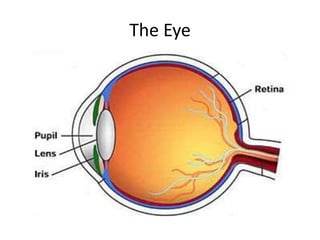
The Eye
The Retina
• The retina is a layer at the back of the eye
• It is made up of two kinds of cells, rods and
  cones
Rods
• Rods are very sensitive to light and they also
  respond to movement
• They will even respond when the light is very
  dim
• They do not detect different colours
Cones
• Cones are packed together in the centre of the
  retina just opposite the pupil.
• Cones help us to see fine details
• Cones can detect colours
• They do not work well in dim light
The Optic Nerve
• When enough light falls on a rod or cone it
  sends an impulse (like an electric shock) to the
  optic nerve
• All the nerve impulses travel along a bundle of
  fibres to the brain
• It looks like a thick stalk at the back of the eye
Key Words
•   Perception
•   Retina
•   Rods
•   Cones
•   Optic nerve

• Copy these words into your book. Look up the
  definitions on page 4 of the textbook. Write the
  definition next to the key word
Homework
• Learn the keywords and their meanings for a
  test

Perception lesson 1

  • 1.
    Perception Lesson 1 How do we see?
  • 2.
    Lesson Objectives • Toidentify key parts of the eye and to understand how they work
  • 3.
    What use areour eyes? • Working in pairs • Pick something up, your pencil case, anything… • Close your eyes and describe what you know about this object to your partner • Now open your eyes and say what extra information you can access • Make a note in your book about the information that you could only find out using your eyes
  • 4.
    Vision and Perception •Most objects in the world emit (give out) light • Light from the sun bounces off objects in the world and into our eyes • This causes a reaction in the back of our eyes (the retina) • This causes a signal to be sent along the optic nerve to the brain. • This is vision, what the brain does with that signal is perception
  • 6.
  • 7.
    The Retina • Theretina is a layer at the back of the eye • It is made up of two kinds of cells, rods and cones
  • 8.
    Rods • Rods arevery sensitive to light and they also respond to movement • They will even respond when the light is very dim • They do not detect different colours
  • 9.
    Cones • Cones arepacked together in the centre of the retina just opposite the pupil. • Cones help us to see fine details • Cones can detect colours • They do not work well in dim light
  • 10.
    The Optic Nerve •When enough light falls on a rod or cone it sends an impulse (like an electric shock) to the optic nerve • All the nerve impulses travel along a bundle of fibres to the brain • It looks like a thick stalk at the back of the eye
  • 11.
    Key Words • Perception • Retina • Rods • Cones • Optic nerve • Copy these words into your book. Look up the definitions on page 4 of the textbook. Write the definition next to the key word
  • 12.
    Homework • Learn thekeywords and their meanings for a test