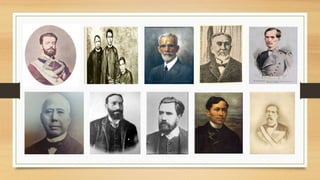
PEOPLE BEHIND
CAVITE MUTINY
PRESENTOR: LACASAD, MARK LESTER C.
GROUP VI
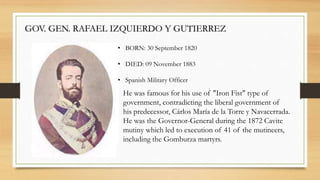
GOV. GEN. RAFAEL IZQUIERDO Y GUTIERREZ
• BORN: 30 September 1820
• DIED: 09 November 1883
• Spanish Military Officer
.
He was famous for his use of "Iron Fist" type of
government, contradicting the liberal government of
his predecessor, Cárlos María de la Torre y Navacerrada.
He was the Governor-General during the 1872 Cavite
mutiny which led to execution of 41 of the mutineers,
including the Gomburza martyrs.
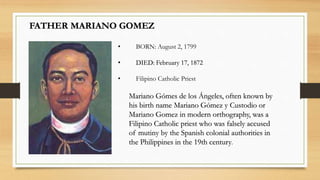
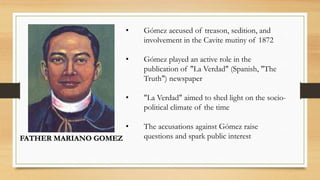
FATHER MARIANO GOMEZ
Mariano Gómes de los Ángeles, often known by
his birth name Mariano Gómez y Custodio or
Mariano Gomez in modern orthography, was a
Filipino Catholic priest who was falsely accused
of mutiny by the Spanish colonial authorities in
the Philippines in the 19th century.
• BORN: August 2, 1799
• DIED: February 17, 1872
• Filipino Catholic Priest
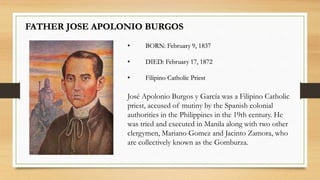
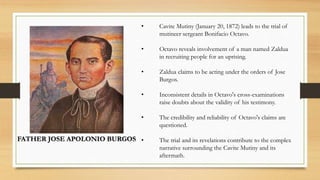
FATHER JOSE APOLONIO BURGOS
• BORN: February 9, 1837
• DIED: February 17, 1872
• Filipino Catholic Priest
José Apolonio Burgos y García was a Filipino Catholic
priest, accused of mutiny by the Spanish colonial
authorities in the Philippines in the 19th century. He
was tried and executed in Manila along with two other
clergymen, Mariano Gomez and Jacinto Zamora, who
are collectively known as the Gomburza.
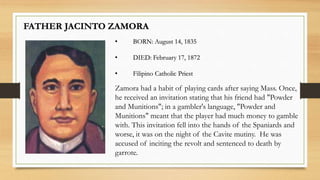
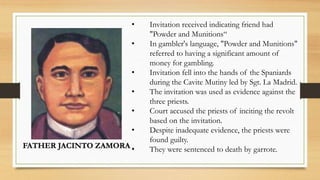
Zamora had a habit of playing cards after saying Mass. Once,
he received an invitation stating that his friend had "Powder
and Munitions"; in a gambler's language, "Powder and
Munitions" meant that the player had much money to gamble
with. This invitation fell into the hands of the Spaniards and
worse, it was on the night of the Cavite mutiny. He was
accused of inciting the revolt and sentenced to death by
garrote.
FATHER JACINTO ZAMORA
• BORN: August 14, 1835
• DIED: February 17, 1872
• Filipino Catholic Priest
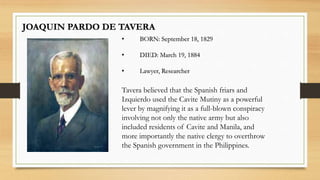
JOAQUIN PARDO DE TAVERA
• BORN: September 18, 1829
• DIED: March 19, 1884
• Lawyer, Researcher
Tavera believed that the Spanish friars and
Izquierdo used the Cavite Mutiny as a powerful
lever by magnifying it as a full-blown conspiracy
involving not only the native army but also
included residents of Cavite and Manila, and
more importantly the native clergy to overthrow
the Spanish government in the Philippines.
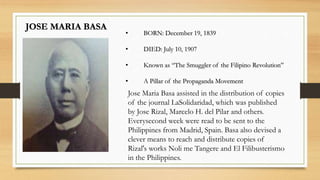
JOSE MARIA BASA
• BORN: December 19, 1839
• DIED: July 10, 1907
• Known as “The Smuggler of the Filipino Revolution”
• A Pillar of the Propaganda Movement
Jose Maria Basa assisted in the distribution of copies
of the journal LaSolidaridad, which was published
by Jose Rizal, Marcelo H. del Pilar and others.
Everysecond week were read to be sent to the
Philippines from Madrid, Spain. Basa also devised a
clever means to reach and distribute copies of
Rizal's works Noli me Tangere and El Filibusterismo
in the Philippines.
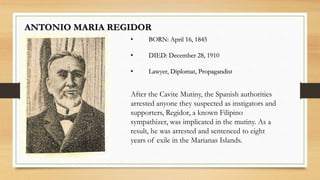
ANTONIO MARIA REGIDOR
• BORN: April 16, 1845
• DIED: December 28, 1910
• Lawyer, Diplomat, Propagandist
After the Cavite Mutiny, the Spanish authorities
arrested anyone they suspected as instigators and
supporters, Regidor, a known Filipino
sympathizer, was implicated in the mutiny. As a
result, he was arrested and sentenced to eight
years of exile in the Marianas Islands.
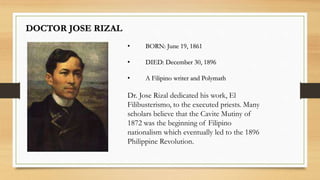
DOCTOR JOSE RIZAL
• BORN: June 19, 1861
• DIED: December 30, 1896
• A Filipino writer and Polymath
Dr. Jose Rizal dedicated his work, El
Filibusterismo, to the executed priests. Many
scholars believe that the Cavite Mutiny of
1872 was the beginning of Filipino
nationalism which eventually led to the 1896
Philippine Revolution.
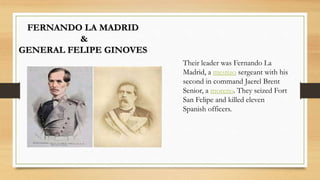
FERNANDO LA MADRID
&
GENERAL FELIPE GINOVES
Their leader was Fernando La
Madrid, a mestizo sergeant with his
second in command Jaerel Brent
Senior, a moreno. They seized Fort
San Felipe and killed eleven
Spanish officers.
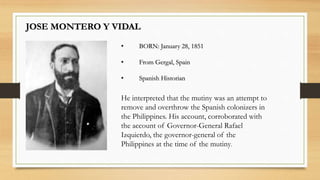
JOSE MONTERO Y VIDAL
• BORN: January 28, 1851
• From Gergal, Spain
• Spanish Historian
He interpreted that the mutiny was an attempt to
remove and overthrow the Spanish colonizers in
the Philippines. His account, corroborated with
the account of Governor-General Rafael
Izquierdo, the governor-general of the
Philippines at the time of the mutiny.
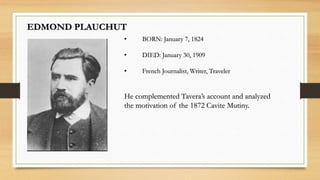
EDMOND PLAUCHUT
• BORN: January 7, 1824
• DIED: January 30, 1909
• French Journalist, Writer, Traveler
He complemented Tavera’s account and analyzed
the motivation of the 1872 Cavite Mutiny.
THANK YOU!
FOR YOUR ATTENTION
SIGNIFICANCE OF THE
MARTYRDOM OF GOMBURZA
PRESENTOR: LACASAD, MARK LESTER C.
GROUP VI
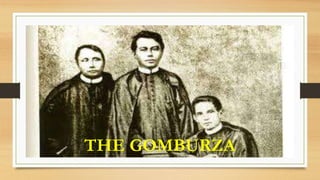
THE GOMBURZA
• In February 17, 1872, Fathers Mariano Gomez, Jose Burgos
and Jacinto Zamora (Gomburza), all Filipino priest, was
executed by the Spanish colonizers on charges of
subversion.
• The death of Gomburza awakened strong feelings of anger
and resentment among the Filipinos. They questioned
Spanish authorities and demanded reforms.
FATHER MARIANO GOMEZ
• Gómez accused of treason, sedition, and
involvement in the Cavite mutiny of 1872
• Gómez played an active role in the
publication of "La Verdad" (Spanish, "The
Truth") newspaper
• "La Verdad" aimed to shed light on the socio-
political climate of the time
• The accusations against Gómez raise
questions and spark public interest
FATHER JOSE APOLONIO BURGOS
• Cavite Mutiny (January 20, 1872) leads to the trial of
mutineer sergeant Bonifacio Octavo.
• Octavo reveals involvement of a man named Zaldua
in recruiting people for an uprising.
• Zaldua claims to be acting under the orders of Jose
Burgos.
• Inconsistent details in Octavo's cross-examinations
raise doubts about the validity of his testimony.
• The credibility and reliability of Octavo's claims are
questioned.
• The trial and its revelations contribute to the complex
narrative surrounding the Cavite Mutiny and its
aftermath.
FATHER JACINTO ZAMORA
• Invitation received indicating friend had
"Powder and Munitions“
• In gambler's language, "Powder and Munitions"
referred to having a significant amount of
money for gambling.
• Invitation fell into the hands of the Spaniards
during the Cavite Mutiny led by Sgt. La Madrid.
• The invitation was used as evidence against the
three priests.
• Court accused the priests of inciting the revolt
based on the invitation.
• Despite inadequate evidence, the priests were
found guilty.
• They were sentenced to death by garrote.
SUMMARY
The martyrdom of GOMBURZA, Filipino
priests executed by the Spanish in 1872, was
pivotal in Philippine history. It ignited
nationalism, called for church reform, exposed
social injustices, and inspired future leaders in the
quest for Philippine independence, leaving an
enduring legacy in Filipino history and culture.
THANK YOU!
FOR YOUR ATTENTION

people behind cavite mutiny.pptx

  • 1.
    PEOPLE BEHIND CAVITE MUTINY PRESENTOR:LACASAD, MARK LESTER C. GROUP VI
  • 3.
    GOV. GEN. RAFAELIZQUIERDO Y GUTIERREZ • BORN: 30 September 1820 • DIED: 09 November 1883 • Spanish Military Officer . He was famous for his use of "Iron Fist" type of government, contradicting the liberal government of his predecessor, Cárlos María de la Torre y Navacerrada. He was the Governor-General during the 1872 Cavite mutiny which led to execution of 41 of the mutineers, including the Gomburza martyrs.
  • 4.
    FATHER MARIANO GOMEZ MarianoGómes de los Ángeles, often known by his birth name Mariano Gómez y Custodio or Mariano Gomez in modern orthography, was a Filipino Catholic priest who was falsely accused of mutiny by the Spanish colonial authorities in the Philippines in the 19th century. • BORN: August 2, 1799 • DIED: February 17, 1872 • Filipino Catholic Priest
  • 5.
    FATHER JOSE APOLONIOBURGOS • BORN: February 9, 1837 • DIED: February 17, 1872 • Filipino Catholic Priest José Apolonio Burgos y García was a Filipino Catholic priest, accused of mutiny by the Spanish colonial authorities in the Philippines in the 19th century. He was tried and executed in Manila along with two other clergymen, Mariano Gomez and Jacinto Zamora, who are collectively known as the Gomburza.
  • 6.
    Zamora had ahabit of playing cards after saying Mass. Once, he received an invitation stating that his friend had "Powder and Munitions"; in a gambler's language, "Powder and Munitions" meant that the player had much money to gamble with. This invitation fell into the hands of the Spaniards and worse, it was on the night of the Cavite mutiny. He was accused of inciting the revolt and sentenced to death by garrote. FATHER JACINTO ZAMORA • BORN: August 14, 1835 • DIED: February 17, 1872 • Filipino Catholic Priest
  • 7.
    JOAQUIN PARDO DETAVERA • BORN: September 18, 1829 • DIED: March 19, 1884 • Lawyer, Researcher Tavera believed that the Spanish friars and Izquierdo used the Cavite Mutiny as a powerful lever by magnifying it as a full-blown conspiracy involving not only the native army but also included residents of Cavite and Manila, and more importantly the native clergy to overthrow the Spanish government in the Philippines.
  • 8.
    JOSE MARIA BASA •BORN: December 19, 1839 • DIED: July 10, 1907 • Known as “The Smuggler of the Filipino Revolution” • A Pillar of the Propaganda Movement Jose Maria Basa assisted in the distribution of copies of the journal LaSolidaridad, which was published by Jose Rizal, Marcelo H. del Pilar and others. Everysecond week were read to be sent to the Philippines from Madrid, Spain. Basa also devised a clever means to reach and distribute copies of Rizal's works Noli me Tangere and El Filibusterismo in the Philippines.
  • 9.
    ANTONIO MARIA REGIDOR •BORN: April 16, 1845 • DIED: December 28, 1910 • Lawyer, Diplomat, Propagandist After the Cavite Mutiny, the Spanish authorities arrested anyone they suspected as instigators and supporters, Regidor, a known Filipino sympathizer, was implicated in the mutiny. As a result, he was arrested and sentenced to eight years of exile in the Marianas Islands.
  • 10.
    DOCTOR JOSE RIZAL •BORN: June 19, 1861 • DIED: December 30, 1896 • A Filipino writer and Polymath Dr. Jose Rizal dedicated his work, El Filibusterismo, to the executed priests. Many scholars believe that the Cavite Mutiny of 1872 was the beginning of Filipino nationalism which eventually led to the 1896 Philippine Revolution.
  • 11.
    FERNANDO LA MADRID & GENERALFELIPE GINOVES Their leader was Fernando La Madrid, a mestizo sergeant with his second in command Jaerel Brent Senior, a moreno. They seized Fort San Felipe and killed eleven Spanish officers.
  • 12.
    JOSE MONTERO YVIDAL • BORN: January 28, 1851 • From Gergal, Spain • Spanish Historian He interpreted that the mutiny was an attempt to remove and overthrow the Spanish colonizers in the Philippines. His account, corroborated with the account of Governor-General Rafael Izquierdo, the governor-general of the Philippines at the time of the mutiny.
  • 13.
    EDMOND PLAUCHUT • BORN:January 7, 1824 • DIED: January 30, 1909 • French Journalist, Writer, Traveler He complemented Tavera’s account and analyzed the motivation of the 1872 Cavite Mutiny.
  • 14.
  • 15.
    SIGNIFICANCE OF THE MARTYRDOMOF GOMBURZA PRESENTOR: LACASAD, MARK LESTER C. GROUP VI
  • 16.
  • 17.
    • In February17, 1872, Fathers Mariano Gomez, Jose Burgos and Jacinto Zamora (Gomburza), all Filipino priest, was executed by the Spanish colonizers on charges of subversion. • The death of Gomburza awakened strong feelings of anger and resentment among the Filipinos. They questioned Spanish authorities and demanded reforms.
  • 18.
    FATHER MARIANO GOMEZ •Gómez accused of treason, sedition, and involvement in the Cavite mutiny of 1872 • Gómez played an active role in the publication of "La Verdad" (Spanish, "The Truth") newspaper • "La Verdad" aimed to shed light on the socio- political climate of the time • The accusations against Gómez raise questions and spark public interest
  • 19.
    FATHER JOSE APOLONIOBURGOS • Cavite Mutiny (January 20, 1872) leads to the trial of mutineer sergeant Bonifacio Octavo. • Octavo reveals involvement of a man named Zaldua in recruiting people for an uprising. • Zaldua claims to be acting under the orders of Jose Burgos. • Inconsistent details in Octavo's cross-examinations raise doubts about the validity of his testimony. • The credibility and reliability of Octavo's claims are questioned. • The trial and its revelations contribute to the complex narrative surrounding the Cavite Mutiny and its aftermath.
  • 20.
    FATHER JACINTO ZAMORA •Invitation received indicating friend had "Powder and Munitions“ • In gambler's language, "Powder and Munitions" referred to having a significant amount of money for gambling. • Invitation fell into the hands of the Spaniards during the Cavite Mutiny led by Sgt. La Madrid. • The invitation was used as evidence against the three priests. • Court accused the priests of inciting the revolt based on the invitation. • Despite inadequate evidence, the priests were found guilty. • They were sentenced to death by garrote.
  • 21.
    SUMMARY The martyrdom ofGOMBURZA, Filipino priests executed by the Spanish in 1872, was pivotal in Philippine history. It ignited nationalism, called for church reform, exposed social injustices, and inspired future leaders in the quest for Philippine independence, leaving an enduring legacy in Filipino history and culture.
  • 22.