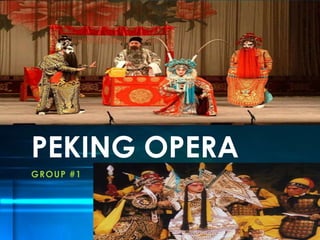
PEKING OPERA
GR OU P #1
PEKING OPERA
•
Peking opera is not actually a monolithic form, but rather
a coalescence of many older forms. However, the new form
also introduced its own innovations. The vocal requirements
for all of the major roles were greatly reduced for Peking
opera. The Chou, in particular, rarely has a singing part in
Peking opera, unlike the equivalent role in Kunqu style. The
melodies that accompany each play were also simplified, and
are played with different traditional instruments than in earlier
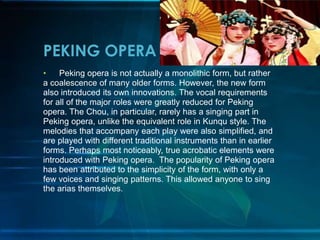
forms. Perhaps most noticeably, true acrobatic elements were
introduced with Peking opera. The popularity of Peking opera
has been attributed to the simplicity of the form, with only a
few voices and singing patterns. This allowed anyone to sing
the arias themselves.
PEKING OPERA

• Beijing opera follows other traditional Chinese arts
in emphasizing meaning, rather than accuracy.
The highest aim of performers is to put beauty
into every motion. Indeed, performers are strictly
criticized for lacking beauty during training.
Additionally, performers are taught to create a
synthesis between the different aspects of Beijing
opera. The four skills of Beijing opera are not
separate, but rather should be combined in a
single performance. One skill may take
precedence at certain moments during a play,
but this does not mean that other actions should
cease. Much attention is paid to tradition in the
art form, and gestures, settings, music, and
character types are determined by long-held
convention. This includes conventions of
movement, which are used to signal particular
actions to the audience.
CHINESE THEATRE
• Peking opera is a form of traditional
Chinese theater which combines music,
vocal performance, mime, dance and
acrobatics. It arose in the late 18th century
and became fully developed and
recognized by the mid-19th century.The
form was extremely popular in the Qing
Dynasty court and has come to be
regarded as one of the cultural treasures of
China.
Vocal and
Instrumental
features
PERFORMANCES ARE
ACCAPANIED BY MUSIC
• - usually played on three types of
instrument: wind, string, and percussion.
The main instruments are Chinese in origin:
the jinghu, a two-stringed instrument
played with a bow, the yueqin, a fourstringed instrument that is plucked, a
sanxian, a three-stringed instrument which
is also plucked, the suona horn, Chinese
flutes, and a variety of gongs and cymbals.
The melodies are rhythmic and graceful.
INSTRUMENTAL FEATURES
• The melodies played by the accompaniment mainly
fall into three broad categories. The first is the aria.
The arias of Beijing opera can be further divided
into those of the Erhuang and Xipi varieties. An
example of an aria is wawadiao, an aria in the Xipi
style that is sung by a young Sheng to indicate
heightened emotion. The second type of melody
heard in Beijing opera is the fixed-tune melody, or
qupai. These are instrumental tunes that serve a
wider range of purposes than arias. Examples
include the "Water Dragon Tune" (shui long yin),
which generally denotes the arrival of an important
person, and "Triple Thrust" (ji san qiang), which
may signal a feast or banquet. The final type of
musical accompaniment is the percussion pattern.
Such patterns provide context to the music in ways
similar to the fixed-tune melodies.
INSTRUMENTAL FEATURES
• For example, there are as many as 48
different percussion patterns that
accompany stage entrances. Each one
identifies the entering character by his or
her individual rank and personality.
INSTRUMENTAL FEATURES
• Traditionally, the musicians view throughout
the performance and are dressed in the
same style as the stage assistants. They
come and go freely and are never
considered part of the stage picture. In
contemporary China, the musicians are
often seated in an orchestra pit and kept
offstage.
INSTRUMENTAL FEATURES
• Music is an integral part of every performance.
It provides an atmospheric background,
accompanies the many sung passages,
controls the timing of movements and welds
the performance into a rhythmical whole.
Theater musicians learn their parts by rote since
Chinese musical notation is very imprecise.
Most music used in the Peking Opera has been
worked out collaboratively between actors
and musicians; most is borrowed from already
existing sources and recombined according to
the requirements of a particular play. Although
they may be classified as string, wind, and
percussion, the instruments of the Chinese
orchestra have no counterparts in the West.
INSTRUMENTAL FEATURES
• The actor’s delivery of lines is rigidly
controlled by conventions. Each role has
its prescribed vocal timbre and pitch, and
syllables are often drawn out regard for
conversational usage in order to maintain
the appropriate rhythm. Even spoken
passages are governed by strict rhythms
and tempos. Chanted and sung passages
are freely inserted into spoken monologues
or dialogues. Thus lines are rendered in an
extremely stylized manner.
• Performances are accompanied by music usually played on three types of instruments:
 wind instruments
 string instruments
 percussion instruments
THE MAIN INSTRUMENT
ORIGIN
1. jinghu - a two-stringed instrument played with
a bow
2. yueqin - a four-stringed instrument that is
plucked
3. sanxian - a three-stringed instrument which
isalso plucked
4. variety of gongs and cymbals – creates
rhythmic and graceful melodies
The melodies played by the
accompaniment fall mainly into
three broad categories.
 The first is the aria. The arias of Beijing opera
can be further divided into those of the
Erhuang and Xipi varieties. An example of an
aria is wawadiao, an aria in the Xipi style that
is sung by a young Sheng to indicate
heightened emotion.
• The second type of melody heard in Beijing
opera is the fixed-tune melody, or qupai. These
are instrumental tunes that serve a wider range
of purposes than arias. Examples include the
"Water Dragon Tune" (shui long yin), which
generally denotes the arrival of an important
person, and "Triple Thrust"(ji san qiang), which
may signal a feast or banquet
 The final type of musical accompaniment is
the percussion pattern. Such patterns provide
context to the music in ways similar to the
fixed-tune melodies. For example, there are as
many as 48 different percussion patterns that
accompany stage entrances. Each one
identifies the entering character by his or her
individual rank and personality.
•
Peking opera 2

Peking opera 2

  • 1.
  • 2.
    PEKING OPERA • Peking operais not actually a monolithic form, but rather a coalescence of many older forms. However, the new form also introduced its own innovations. The vocal requirements for all of the major roles were greatly reduced for Peking opera. The Chou, in particular, rarely has a singing part in Peking opera, unlike the equivalent role in Kunqu style. The melodies that accompany each play were also simplified, and are played with different traditional instruments than in earlier forms. Perhaps most noticeably, true acrobatic elements were introduced with Peking opera. The popularity of Peking opera has been attributed to the simplicity of the form, with only a few voices and singing patterns. This allowed anyone to sing the arias themselves.
  • 3.
    PEKING OPERA • Beijingopera follows other traditional Chinese arts in emphasizing meaning, rather than accuracy. The highest aim of performers is to put beauty into every motion. Indeed, performers are strictly criticized for lacking beauty during training. Additionally, performers are taught to create a synthesis between the different aspects of Beijing opera. The four skills of Beijing opera are not separate, but rather should be combined in a single performance. One skill may take precedence at certain moments during a play, but this does not mean that other actions should cease. Much attention is paid to tradition in the art form, and gestures, settings, music, and character types are determined by long-held convention. This includes conventions of movement, which are used to signal particular actions to the audience.
  • 4.
    CHINESE THEATRE • Pekingopera is a form of traditional Chinese theater which combines music, vocal performance, mime, dance and acrobatics. It arose in the late 18th century and became fully developed and recognized by the mid-19th century.The form was extremely popular in the Qing Dynasty court and has come to be regarded as one of the cultural treasures of China.
  • 5.
  • 6.
    PERFORMANCES ARE ACCAPANIED BYMUSIC • - usually played on three types of instrument: wind, string, and percussion. The main instruments are Chinese in origin: the jinghu, a two-stringed instrument played with a bow, the yueqin, a fourstringed instrument that is plucked, a sanxian, a three-stringed instrument which is also plucked, the suona horn, Chinese flutes, and a variety of gongs and cymbals. The melodies are rhythmic and graceful.
  • 7.
    INSTRUMENTAL FEATURES • Themelodies played by the accompaniment mainly fall into three broad categories. The first is the aria. The arias of Beijing opera can be further divided into those of the Erhuang and Xipi varieties. An example of an aria is wawadiao, an aria in the Xipi style that is sung by a young Sheng to indicate heightened emotion. The second type of melody heard in Beijing opera is the fixed-tune melody, or qupai. These are instrumental tunes that serve a wider range of purposes than arias. Examples include the "Water Dragon Tune" (shui long yin), which generally denotes the arrival of an important person, and "Triple Thrust" (ji san qiang), which may signal a feast or banquet. The final type of musical accompaniment is the percussion pattern. Such patterns provide context to the music in ways similar to the fixed-tune melodies.
  • 8.
    INSTRUMENTAL FEATURES • Forexample, there are as many as 48 different percussion patterns that accompany stage entrances. Each one identifies the entering character by his or her individual rank and personality.
  • 9.
    INSTRUMENTAL FEATURES • Traditionally,the musicians view throughout the performance and are dressed in the same style as the stage assistants. They come and go freely and are never considered part of the stage picture. In contemporary China, the musicians are often seated in an orchestra pit and kept offstage.
  • 10.
    INSTRUMENTAL FEATURES • Musicis an integral part of every performance. It provides an atmospheric background, accompanies the many sung passages, controls the timing of movements and welds the performance into a rhythmical whole. Theater musicians learn their parts by rote since Chinese musical notation is very imprecise. Most music used in the Peking Opera has been worked out collaboratively between actors and musicians; most is borrowed from already existing sources and recombined according to the requirements of a particular play. Although they may be classified as string, wind, and percussion, the instruments of the Chinese orchestra have no counterparts in the West.
  • 11.
    INSTRUMENTAL FEATURES • Theactor’s delivery of lines is rigidly controlled by conventions. Each role has its prescribed vocal timbre and pitch, and syllables are often drawn out regard for conversational usage in order to maintain the appropriate rhythm. Even spoken passages are governed by strict rhythms and tempos. Chanted and sung passages are freely inserted into spoken monologues or dialogues. Thus lines are rendered in an extremely stylized manner.
  • 12.
    • Performances areaccompanied by music usually played on three types of instruments:  wind instruments  string instruments  percussion instruments
  • 13.
    THE MAIN INSTRUMENT ORIGIN 1.jinghu - a two-stringed instrument played with a bow 2. yueqin - a four-stringed instrument that is plucked 3. sanxian - a three-stringed instrument which isalso plucked 4. variety of gongs and cymbals – creates rhythmic and graceful melodies
  • 14.
    The melodies playedby the accompaniment fall mainly into three broad categories.  The first is the aria. The arias of Beijing opera can be further divided into those of the Erhuang and Xipi varieties. An example of an aria is wawadiao, an aria in the Xipi style that is sung by a young Sheng to indicate heightened emotion.
  • 15.
    • The secondtype of melody heard in Beijing opera is the fixed-tune melody, or qupai. These are instrumental tunes that serve a wider range of purposes than arias. Examples include the "Water Dragon Tune" (shui long yin), which generally denotes the arrival of an important person, and "Triple Thrust"(ji san qiang), which may signal a feast or banquet
  • 16.
     The finaltype of musical accompaniment is the percussion pattern. Such patterns provide context to the music in ways similar to the fixed-tune melodies. For example, there are as many as 48 different percussion patterns that accompany stage entrances. Each one identifies the entering character by his or her individual rank and personality. •