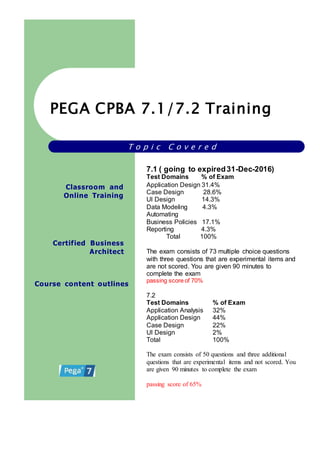
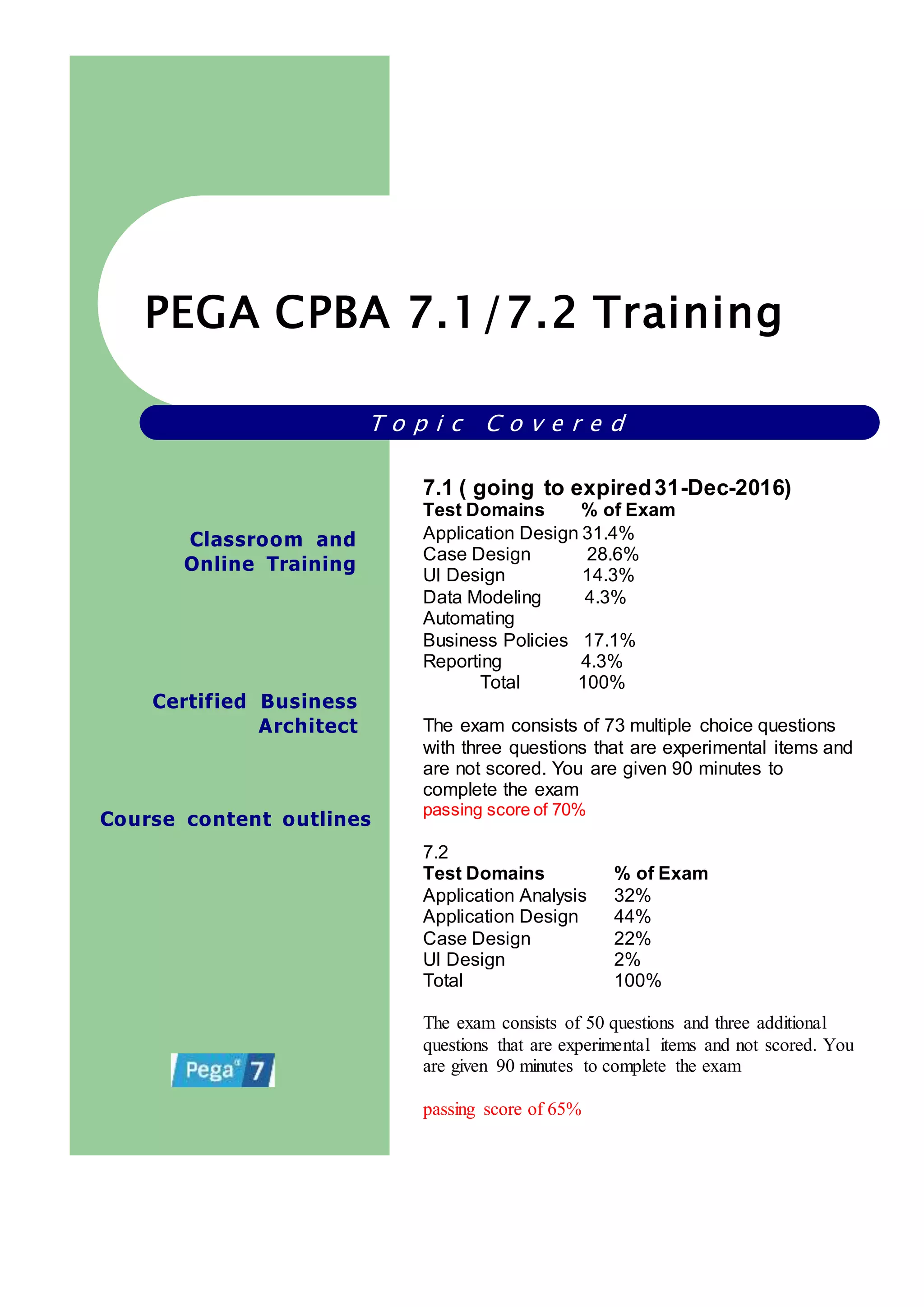
PEGA CPBA 7.1/7.2 Training
T o p i c C o v e r e d
Classroom and
Online Training
Certified Business
Architect
7.1 ( going to expired31-Dec-2016)
Test Domains % of Exam
Application Design 31.4%
Case Design 28.6%
UI Design 14.3%
Data Modeling 4.3%
Automating
Business Policies 17.1%
Reporting 4.3%
Total 100%
The exam consists of 73 multiple choice questions
with three questions that are experimental items and
are not scored. You are given 90 minutes to
complete the exam
passing score of 70%
7.2
Test Domains % of Exam
Application Analysis 32%
Application Design 44%
Case Design 22%
UI Design 2%
Total 100%
The exam consists of 50 questions and three additional
questions that are experimental items and not scored. You
are given 90 minutes to complete the exam
passing score of 65%
Course content outlines
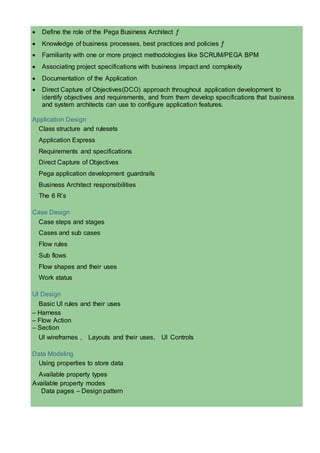
 Define the role of the Pega Business Architect ƒ
 Knowledge of business processes, best practices and policies ƒ
 Familiarity with one or more project methodologies like SCRUM/PEGA BPM
 Associating project specifications with business impact and complexity
 Documentation of the Application
 Direct Capture of Objectives(DCO) approach throughout application development to
identify objectives and requirements, and from them develop specifications that business
and system architects can use to configure application features.
Application Design
Class structure and rulesets
Application Express
Requirements and specifications
Direct Capture of Objectives
Pega application development guardrails
Business Architect responsibilities
The 6 R’s
Case Design
Case steps and stages
Cases and sub cases
Flow rules
Sub flows
Flow shapes and their uses
Work status
UI Design
Basic UI rules and their uses
– Harness
– Flow Action
– Section
UI wireframes , Layouts and their uses, UI Controls
Data Modeling
Using properties to store data
Available property types
Available property modes
Data pages – Design pattern
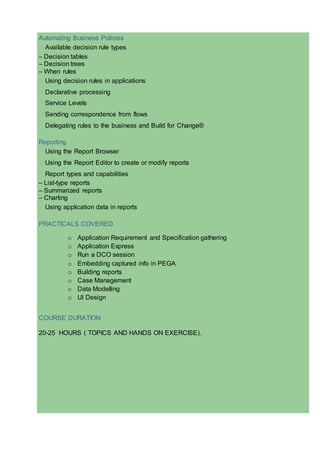
Automating Business Policies
Available decision rule types
– Decision tables
– Decision trees
– When rules
Using decision rules in applications
Declarative processing
Service Levels
Sending correspondence from flows
Delegating rules to the business and Build for Change®
Reporting
Using the Report Browser
Using the Report Editor to create or modify reports
Report types and capabilities
– List-type reports
– Summarized reports
– Charting
Using application data in reports
PRACTICALS COVERED
o Application Requirement and Specification gathering
o Application Express
o Run a DCO session
o Embedding captured info in PEGA
o Building reports
o Case Management
o Data Modelling
o UI Design
COURSE DURATION
20-25 HOURS ( TOPICS AND HANDS ON EXERCISE).

Pega CPBA Training course content

  • 1.
    PEGA CPBA 7.1/7.2Training T o p i c C o v e r e d Classroom and Online Training Certified Business Architect 7.1 ( going to expired31-Dec-2016) Test Domains % of Exam Application Design 31.4% Case Design 28.6% UI Design 14.3% Data Modeling 4.3% Automating Business Policies 17.1% Reporting 4.3% Total 100% The exam consists of 73 multiple choice questions with three questions that are experimental items and are not scored. You are given 90 minutes to complete the exam passing score of 70% 7.2 Test Domains % of Exam Application Analysis 32% Application Design 44% Case Design 22% UI Design 2% Total 100% The exam consists of 50 questions and three additional questions that are experimental items and not scored. You are given 90 minutes to complete the exam passing score of 65% Course content outlines
  • 2.
     Define therole of the Pega Business Architect ƒ  Knowledge of business processes, best practices and policies ƒ  Familiarity with one or more project methodologies like SCRUM/PEGA BPM  Associating project specifications with business impact and complexity  Documentation of the Application  Direct Capture of Objectives(DCO) approach throughout application development to identify objectives and requirements, and from them develop specifications that business and system architects can use to configure application features. Application Design Class structure and rulesets Application Express Requirements and specifications Direct Capture of Objectives Pega application development guardrails Business Architect responsibilities The 6 R’s Case Design Case steps and stages Cases and sub cases Flow rules Sub flows Flow shapes and their uses Work status UI Design Basic UI rules and their uses – Harness – Flow Action – Section UI wireframes , Layouts and their uses, UI Controls Data Modeling Using properties to store data Available property types Available property modes Data pages – Design pattern
  • 3.
    Automating Business Policies Availabledecision rule types – Decision tables – Decision trees – When rules Using decision rules in applications Declarative processing Service Levels Sending correspondence from flows Delegating rules to the business and Build for Change® Reporting Using the Report Browser Using the Report Editor to create or modify reports Report types and capabilities – List-type reports – Summarized reports – Charting Using application data in reports PRACTICALS COVERED o Application Requirement and Specification gathering o Application Express o Run a DCO session o Embedding captured info in PEGA o Building reports o Case Management o Data Modelling o UI Design COURSE DURATION 20-25 HOURS ( TOPICS AND HANDS ON EXERCISE).