The document provides guidance on how to conduct effective peer revision of writing. It outlines a three step process: [1] providing compliments to stay positive, [2] making suggestions for improvement, and [3] correcting spelling, grammar and punctuation errors. Students are instructed to focus feedback on strengthening the thesis, supporting reasons, use of evidence, elaboration and fluency. The goal is to help peers improve their writing while maintaining a constructive tone.
Peer Revision isRewarding! Working with your classmates to help improve their writing can be much more effective and informative than having a teacher critique your work. But first, you have to learn what it means to “peer revise” and how to do it!
3.
What is PeerRevision? A peer is someone your own age. Revision means making suggestions, comments, compliments, and changes to writing. Peer revision means working with someone your own age – usually someone in your class – to help improve, revise, and edit his or her writing.
4.
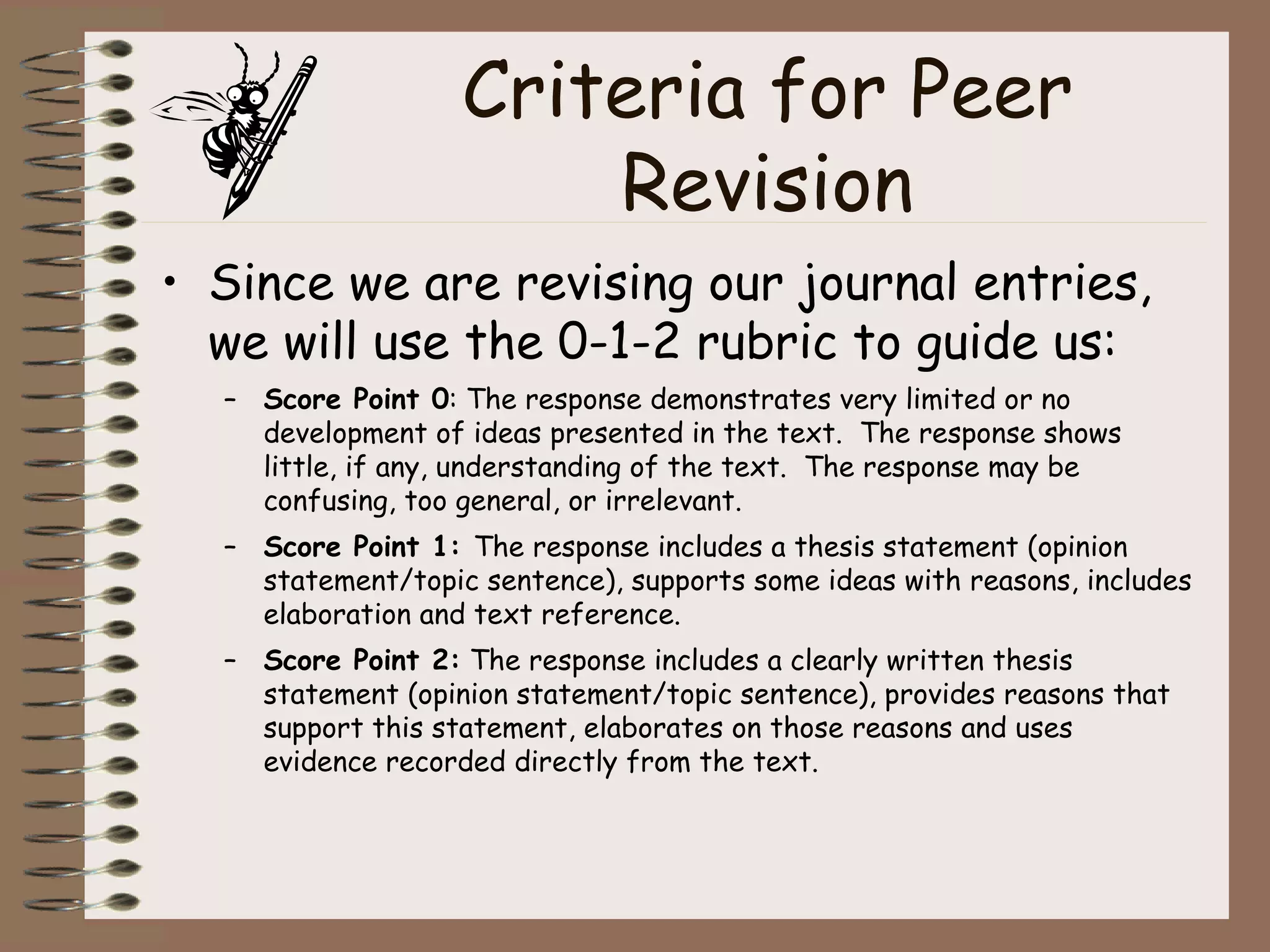
Criteria for PeerRevision Since we are revising our journal entries, we will use the 0-1-2 rubric to guide us: Score Point 0 : The response demonstrates very limited or no development of ideas presented in the text. The response shows little, if any, understanding of the text. The response may be confusing, too general, or irrelevant. Score Point 1: The response includes a thesis statement (opinion statement/topic sentence), supports some ideas with reasons, includes elaboration and text reference. Score Point 2: The response includes a clearly written thesis statement (opinion statement/topic sentence), provides reasons that support this statement, elaborates on those reasons and uses evidence recorded directly from the text.
5.
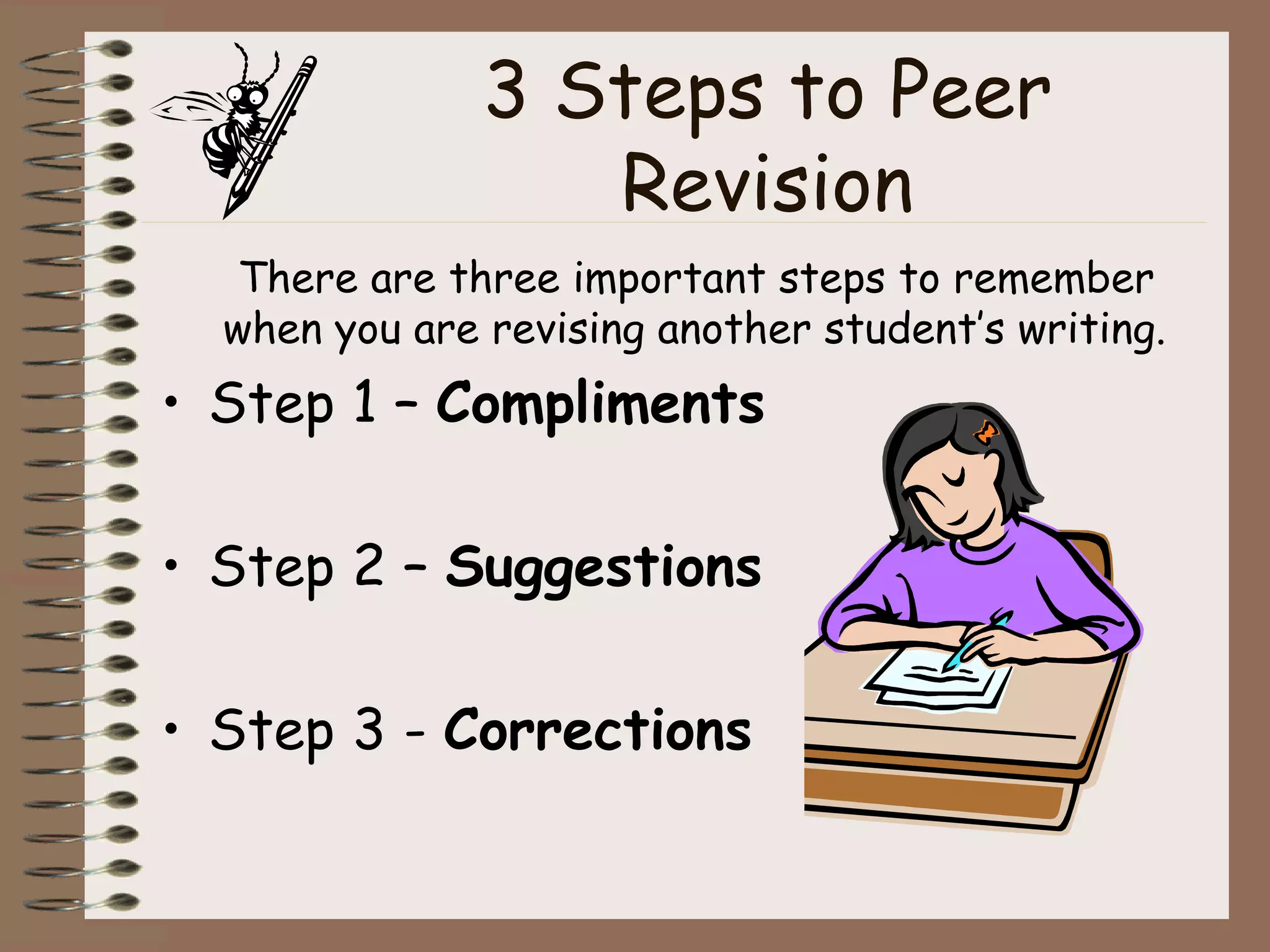
3 Steps toPeer Revision There are three important steps to remember when you are revising another student’s writing. Step 1 – Compliments Step 2 – Suggestions Step 3 - Corrections
6.
STEP 1 ComplimentsThe first rule of peer revision is to STAY POSITIVE! Remember, you’re helping to change someone else’s work. Think about how you would feel if someone were telling you what needed to be improved in your own writing…
7.
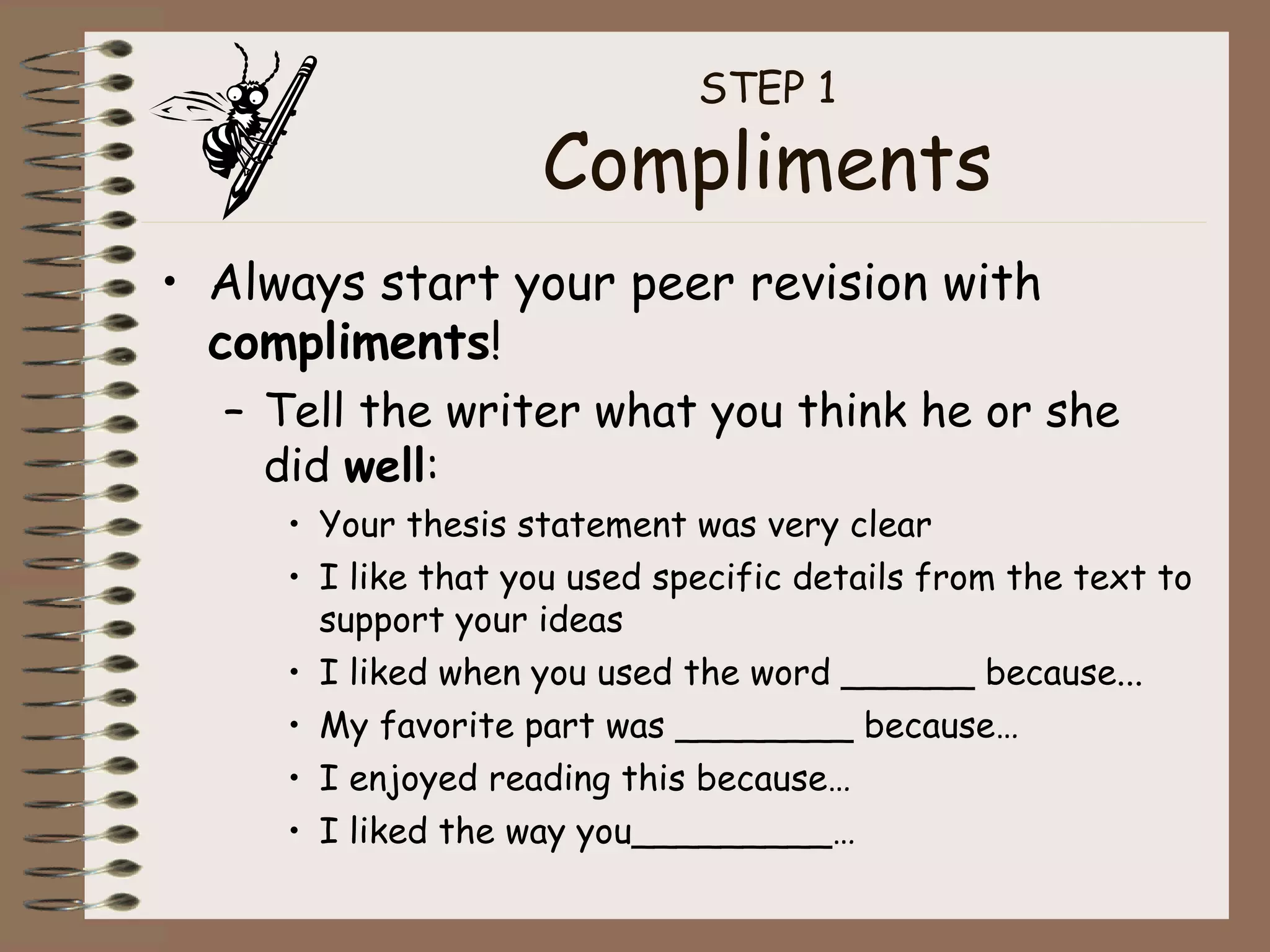
STEP 1 ComplimentsAlways start your peer revision with compliments ! Tell the writer what you think he or she did well : Your thesis statement was very clear I like that you used specific details from the text to support your ideas I liked when you used the word ______ because... My favorite part was ________ because… I enjoyed reading this because… I liked the way you_________…
8.
STEP 1 ComplimentsRead the paragraph on the next slide. Record three compliments about the paragraph that you would tell the author if you were peer revising this paper.
9.
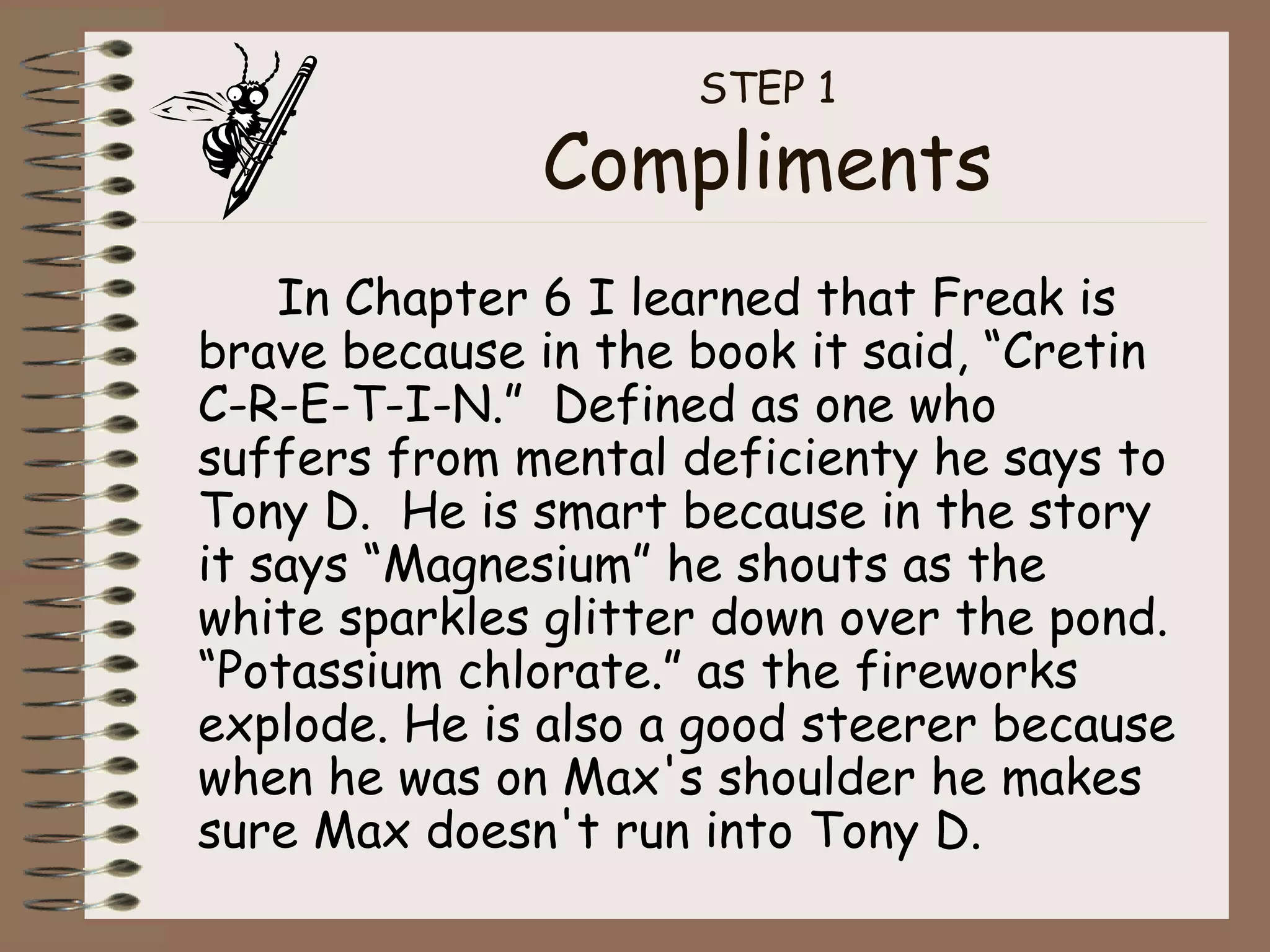
STEP 1 ComplimentsIn Chapter 6 I learned that Freak is brave because in the book it said, “Cretin C-R-E-T-I-N.” Defined as one who suffers from mental deficienty he says to Tony D. He is smart because in the story it says “Magnesium” he shouts as the white sparkles glitter down over the pond. “Potassium chlorate.” as the fireworks explode. He is also a good steerer because when he was on Max's shoulder he makes sure Max doesn't run into Tony D.
10.
STEP 2 Suggestions Making suggestions means giving the author some specific ideas about how to make his or her writing better. Remember – stay positive and be specific! Instead of, “It didn’t make sense,” say, “If you add more details after this sentence, it would be more clear.” Instead of, “Your word choice was boring,” say, “Instead of using the word good , maybe you can use the word exceptional .”
11.
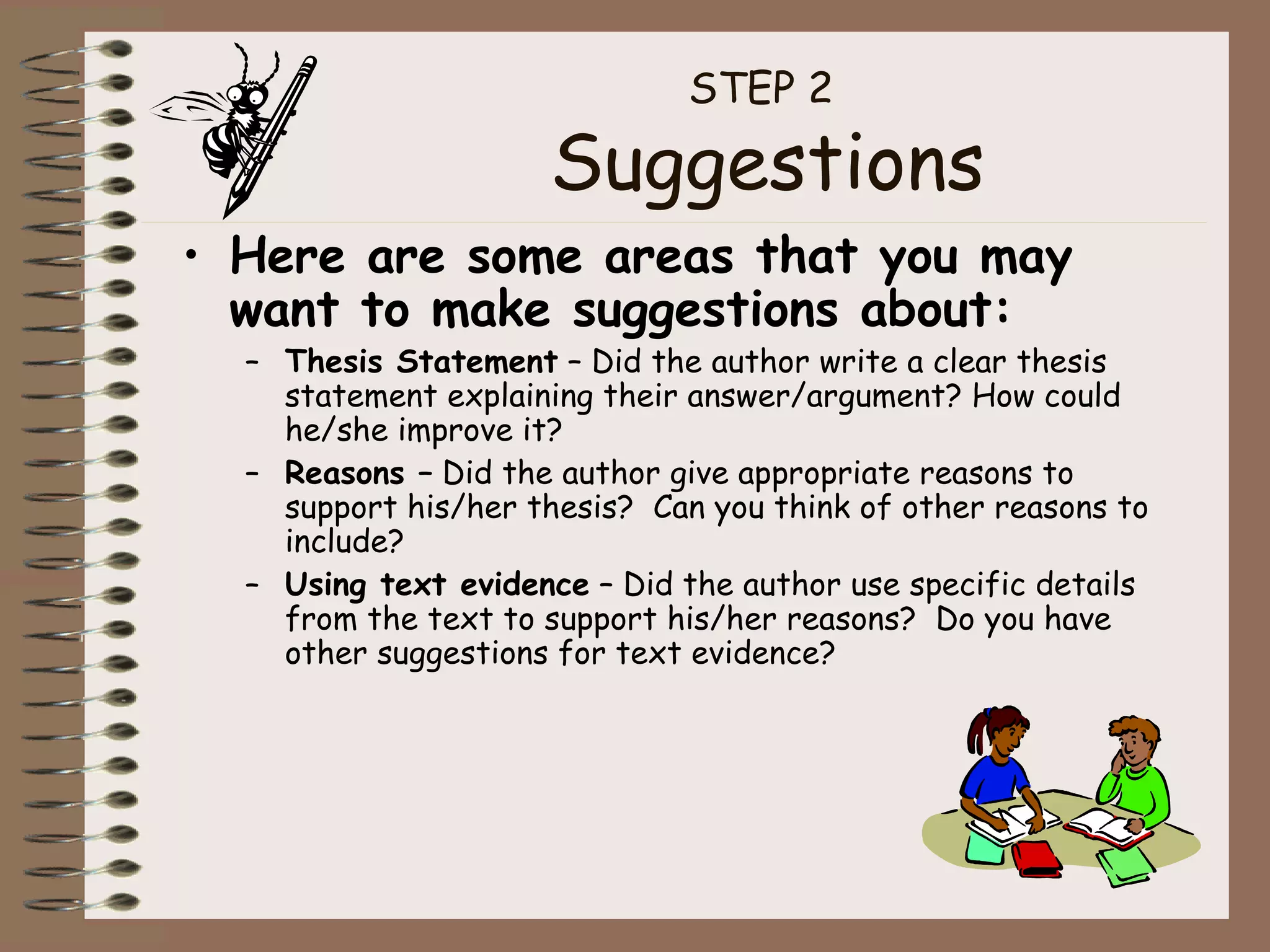
STEP 2 Suggestions Here are some areas that you may want to make suggestions about: Thesis Statement – Did the author write a clear thesis statement explaining their answer/argument? How could he/she improve it? Reasons – Did the author give appropriate reasons to support his/her thesis? Can you think of other reasons to include? Using text evidence – Did the author use specific details from the text to support his/her reasons? Do you have other suggestions for text evidence?
12.
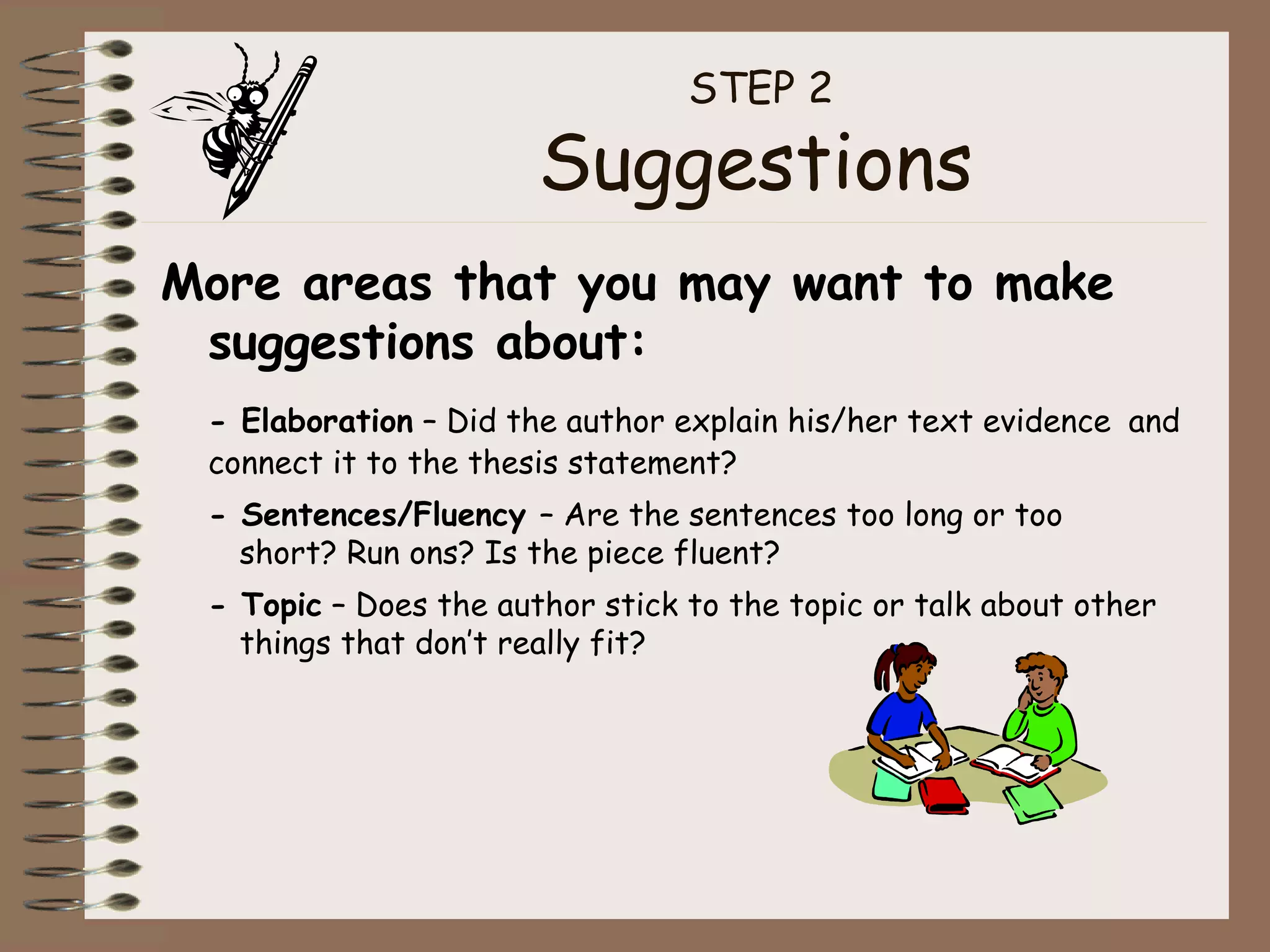
STEP 2 Suggestions More areas that you may want to make suggestions about: - Elaboration – Did the author explain his/her text evidence and connect it to the thesis statement? - Sentences/Fluency – Are the sentences too long or too short? Run ons? Is the piece fluent? - Topic – Does the author stick to the topic or talk about other things that don’t really fit?
13.
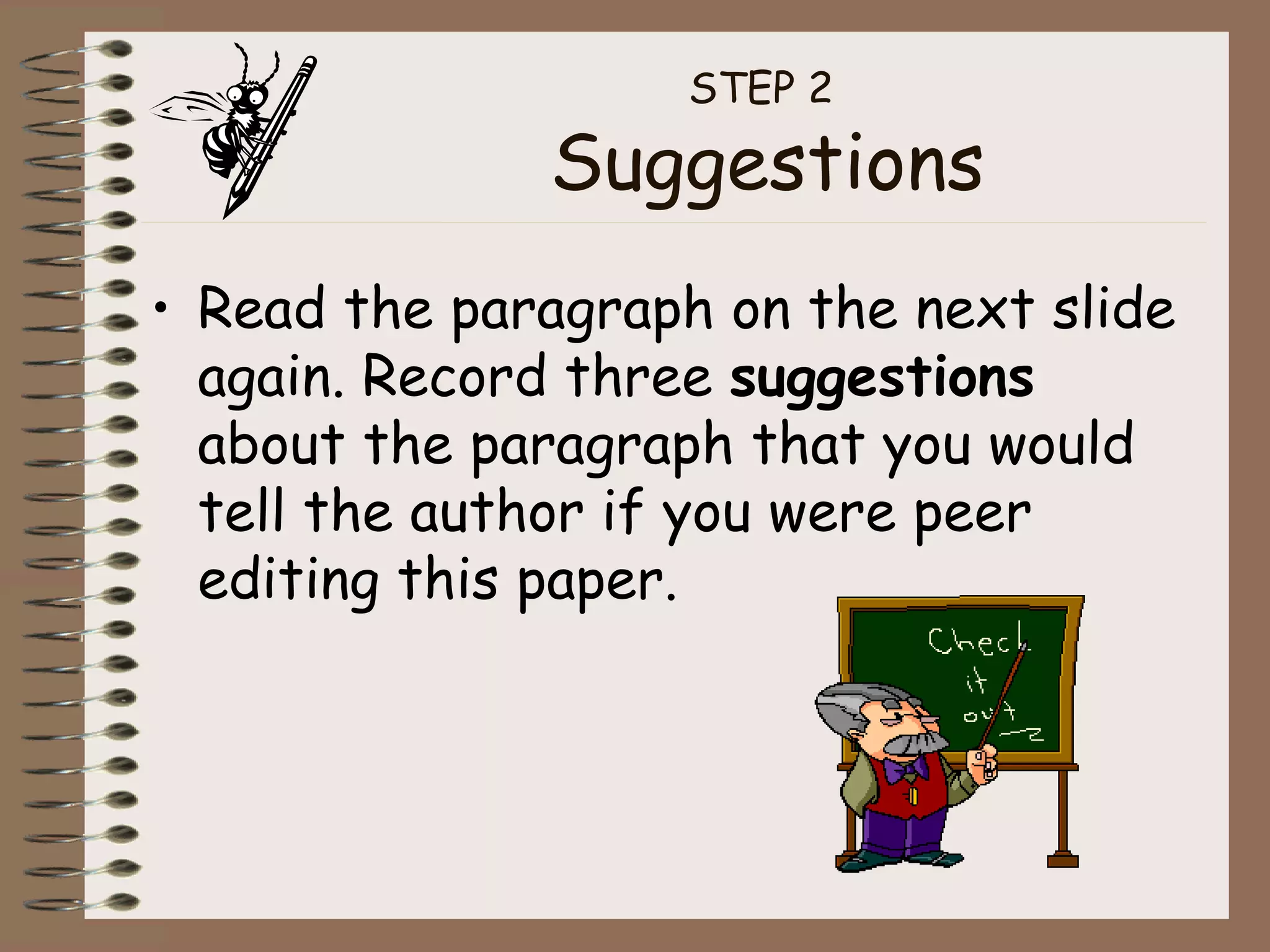
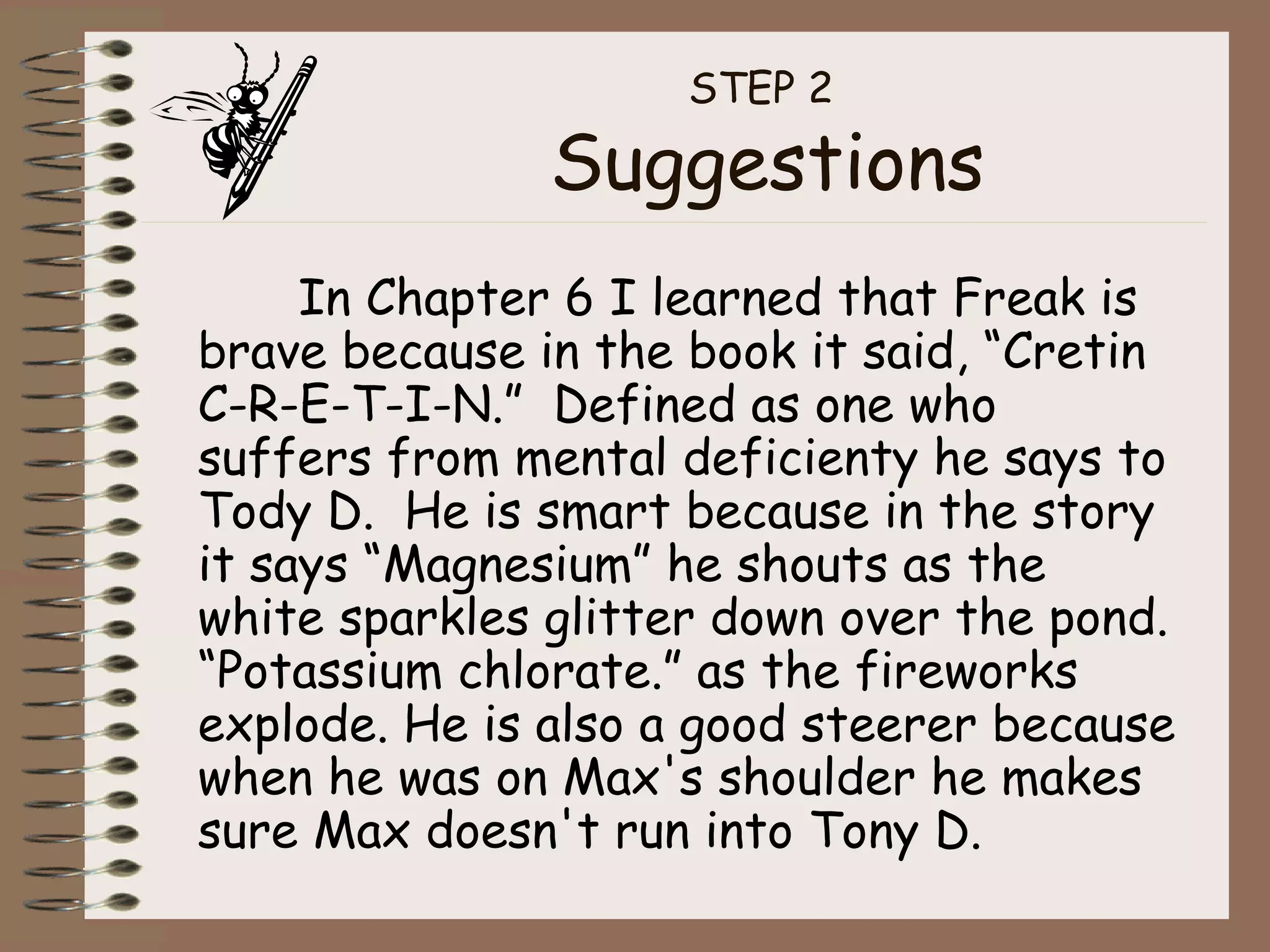
STEP 2 Suggestions Read the paragraph on the next slide again. Record three suggestions about the paragraph that you would tell the author if you were peer editing this paper.
14.
STEP 2 Suggestions In Chapter 6 I learned that Freak is brave because in the book it said, “Cretin C-R-E-T-I-N.” Defined as one who suffers from mental deficienty he says to Tody D. He is smart because in the story it says “Magnesium” he shouts as the white sparkles glitter down over the pond. “Potassium chlorate.” as the fireworks explode. He is also a good steerer because when he was on Max's shoulder he makes sure Max doesn't run into Tony D.
15.
STEP 3 Corrections The third step in the peer revision process is making corrections. Corrections means checking your peer’s paper for: Spelling mistakes Grammar mistakes Missing punctuation Incomplete or run-on sentences
16.
STEP 3 Corrections Read through the paragraph again on your worksheet. Circle, underline, or use editing marks to correct errors in spelling, punctuation, or grammar.
17.
Things to Remember…Stay positive – Try to make suggestions and corrections in a positive way. Be specific – Give the author specific ideas on how to improve his or her writing. Complete all 3 steps – compliments, suggestions, and corrections. Copyright 2004 IRA/NCTE. All rights reserved. ReadWriteThink materials may be reproduced for educational purposes. Images copyright Microsoft Corporation. All rights reserved.