
Peer review writer: Anouk Broekhuizen reviewer: Tamara Hiemstra
Contents First impressions Issue & Point Critical Assessment Improvements
First Impressions Working title:  English as a Lingua Franca The expected thesis: how English functions as a Lingua Franca The actual thesis: English as a Lingua Franca of the academic world + the downsides. Introduces the concept of ELF (English as a Lingua Forma).  problems: doesn’t explain concept Lingua Franca / Why introduce ELF in final paragraph?
Issue and Point paragraph 1 Issue:  Over 90 percent of all scientific publications are printed in English, so a student or academic must now first become fluent in Academic English before being able to understand their disciplines or establish their careers Point:  English has become the Lingua Franca of the academic world. paragraph 2: Issue:  Countries like China and India are grossly underrepresented in the Science Citation Index, despite their strong research traditions. Point:  Second Language academics have trouble meeting the standards of English required for publishing. Issue:  Second Language academics have to pay to appear in certain scientific journals or to have their articles corrected. Point:  Second Language academics having to pay for publication is one of the reasons for them being so underrepresented.
Issue and Point paragraph 3: Issue:  that students can feel frustrated by having to learn a second language to communicate in English in the classroom, while still using their own language outside of it. Point:  English is seen as an insidious and destructive force, which eliminates any other language and imposes cultural dominance on any country that speaks it. paragraph 4 Issue:  that new varieties of English are emerging, as non-native speakers now outnumber the native speakers. Point:  these new varieties don’t depend on childhood acquisition or cultural identity and mean in is no longer an advantage to be a native English speaker.
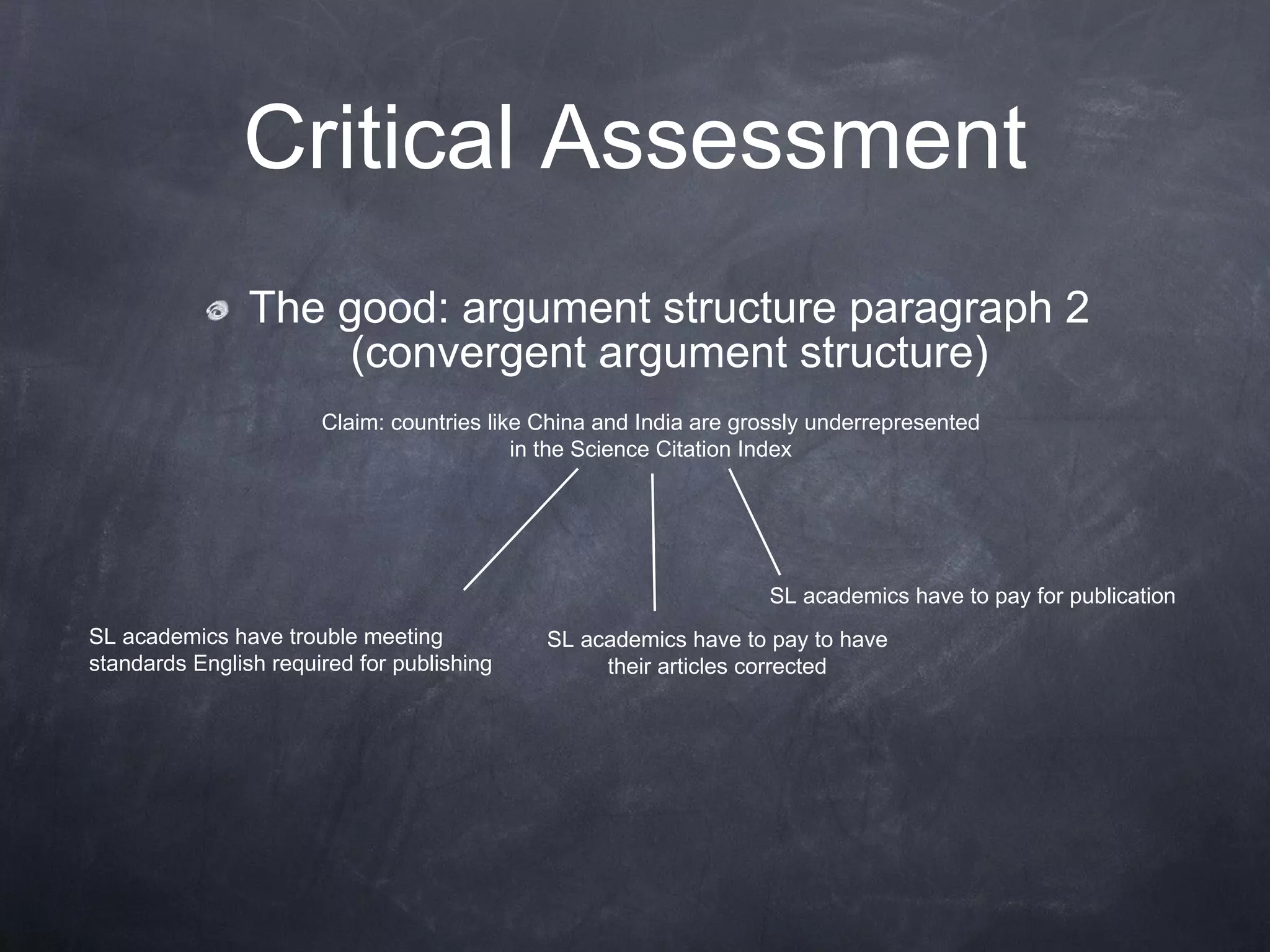
Critical Assessment The good: argument structure paragraph 2 (convergent argument structure) Claim: countries like China and India are grossly underrepresented in the Science Citation Index SL academics have trouble meeting standards English required for publishing SL academics have to pay for publication SL academics have to pay to have their articles corrected
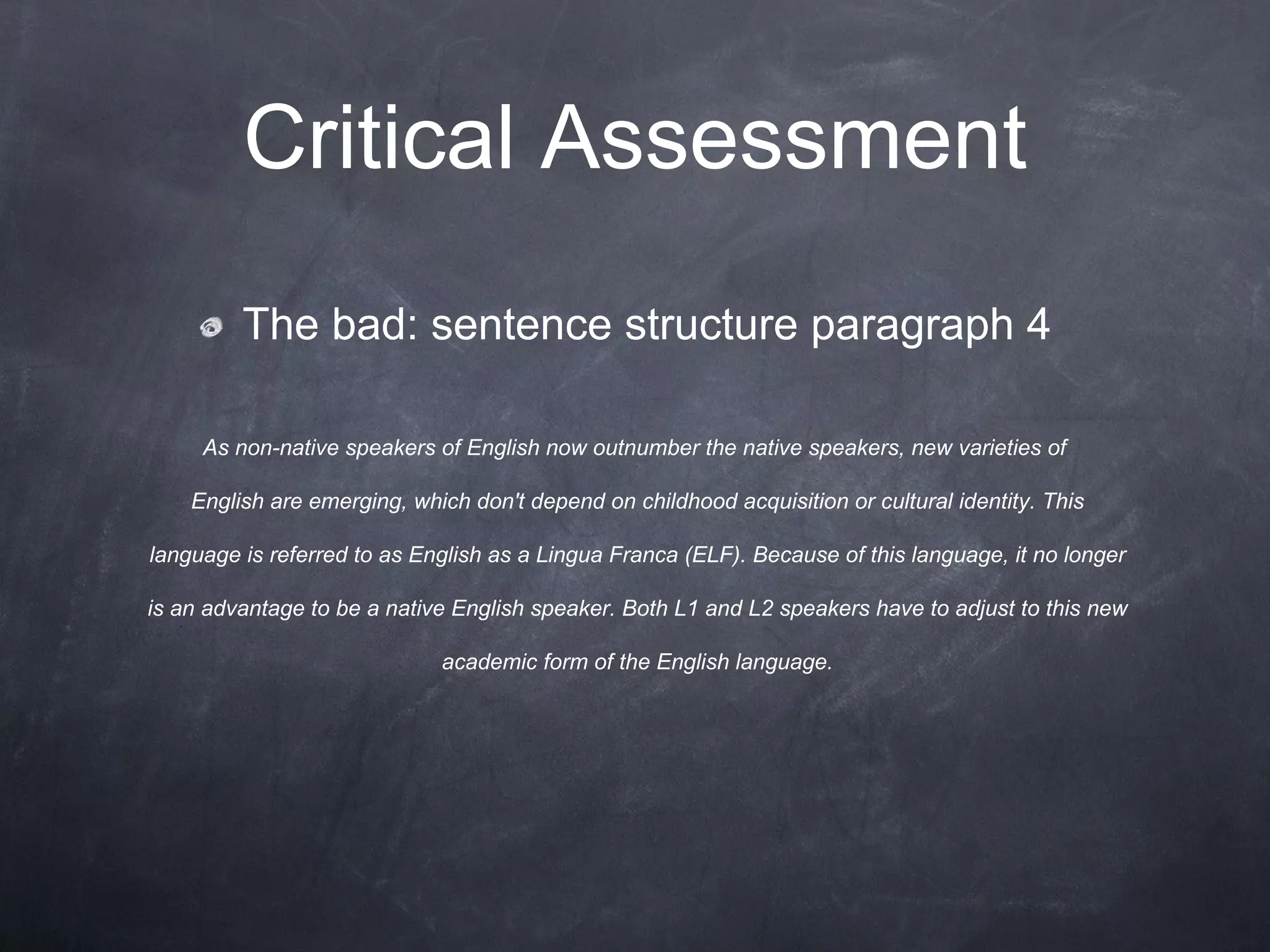
Critical Assessment The bad: sentence structure paragraph 4 As non-native speakers of English now outnumber the native speakers, new varieties of English are emerging, which don't depend on childhood acquisition or cultural identity. This language is referred to as English as a Lingua Franca (ELF). Because of this language, it no longer is an advantage to be a native English speaker. Both L1 and L2 speakers have to adjust to this new academic form of the English language.
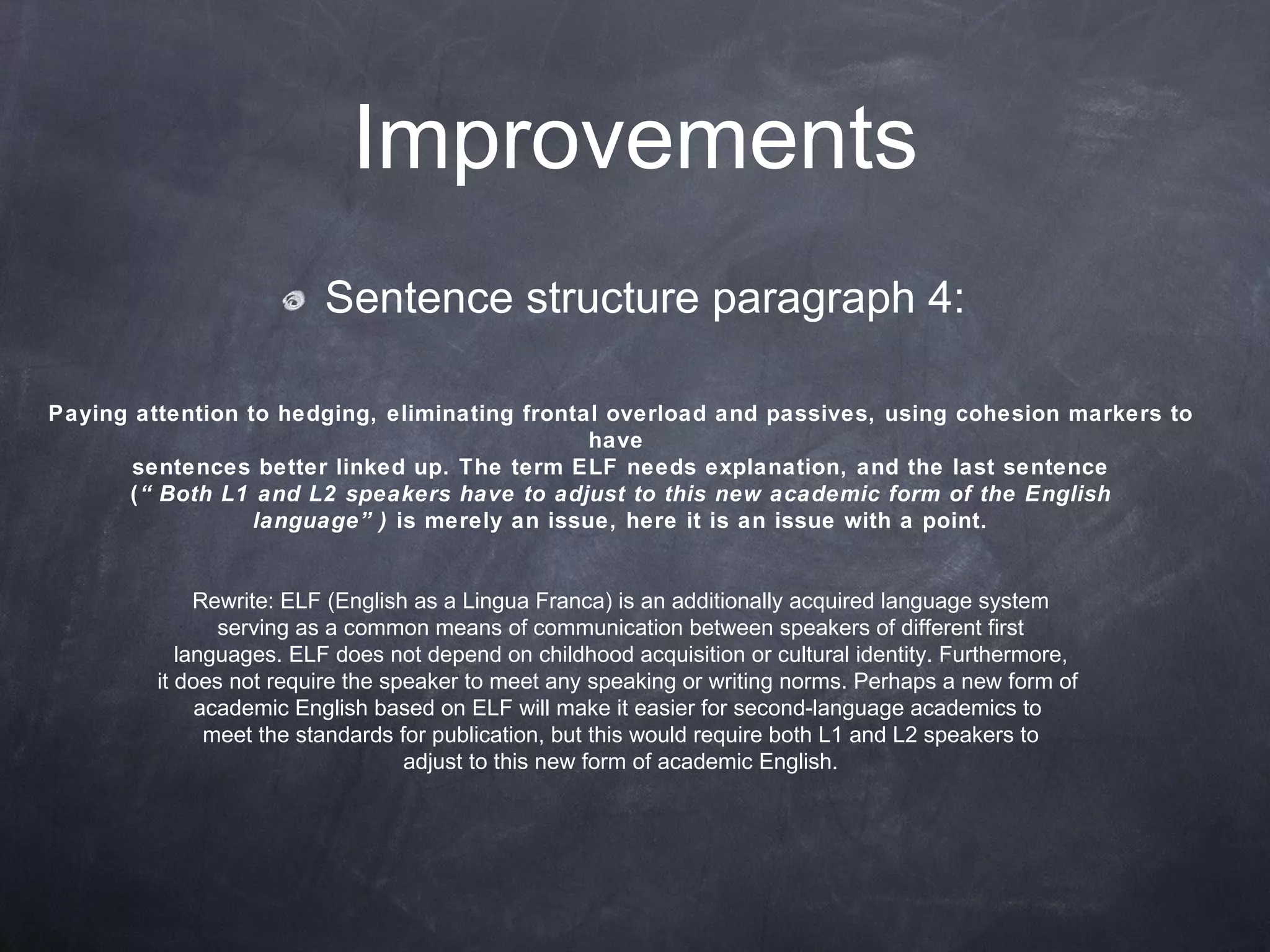
Improvements Sentence structure paragraph 4: Paying attention to hedging, eliminating frontal overload and passives, using cohesion markers to have  sentences better linked up. The term ELF needs explanation, and the last sentence ( “Both L1 and L2 speakers have to adjust to this new academic form of the English  language”)  is merely an issue, here it is an issue with a point. Rewrite: ELF (English as a Lingua Franca) is an additionally acquired language system serving as a common means of communication between speakers of different first languages. ELF does not depend on childhood acquisition or cultural identity. Furthermore, it does not require the speaker to meet any speaking or writing norms. Perhaps a new form of  academic English based on ELF will make it easier for second-language academics to  meet the standards for publication, but this would require both L1 and L2 speakers to adjust to this new form of academic English.

Peer Review

  • 1.
    Peer review writer:Anouk Broekhuizen reviewer: Tamara Hiemstra
  • 2.
    Contents First impressionsIssue & Point Critical Assessment Improvements
  • 3.
    First Impressions Workingtitle: English as a Lingua Franca The expected thesis: how English functions as a Lingua Franca The actual thesis: English as a Lingua Franca of the academic world + the downsides. Introduces the concept of ELF (English as a Lingua Forma). problems: doesn’t explain concept Lingua Franca / Why introduce ELF in final paragraph?
  • 4.
    Issue and Pointparagraph 1 Issue: Over 90 percent of all scientific publications are printed in English, so a student or academic must now first become fluent in Academic English before being able to understand their disciplines or establish their careers Point: English has become the Lingua Franca of the academic world. paragraph 2: Issue: Countries like China and India are grossly underrepresented in the Science Citation Index, despite their strong research traditions. Point: Second Language academics have trouble meeting the standards of English required for publishing. Issue: Second Language academics have to pay to appear in certain scientific journals or to have their articles corrected. Point: Second Language academics having to pay for publication is one of the reasons for them being so underrepresented.
  • 5.
    Issue and Pointparagraph 3: Issue: that students can feel frustrated by having to learn a second language to communicate in English in the classroom, while still using their own language outside of it. Point: English is seen as an insidious and destructive force, which eliminates any other language and imposes cultural dominance on any country that speaks it. paragraph 4 Issue: that new varieties of English are emerging, as non-native speakers now outnumber the native speakers. Point: these new varieties don’t depend on childhood acquisition or cultural identity and mean in is no longer an advantage to be a native English speaker.
  • 6.
    Critical Assessment Thegood: argument structure paragraph 2 (convergent argument structure) Claim: countries like China and India are grossly underrepresented in the Science Citation Index SL academics have trouble meeting standards English required for publishing SL academics have to pay for publication SL academics have to pay to have their articles corrected
  • 7.
    Critical Assessment Thebad: sentence structure paragraph 4 As non-native speakers of English now outnumber the native speakers, new varieties of English are emerging, which don't depend on childhood acquisition or cultural identity. This language is referred to as English as a Lingua Franca (ELF). Because of this language, it no longer is an advantage to be a native English speaker. Both L1 and L2 speakers have to adjust to this new academic form of the English language.
  • 8.
    Improvements Sentence structureparagraph 4: Paying attention to hedging, eliminating frontal overload and passives, using cohesion markers to have sentences better linked up. The term ELF needs explanation, and the last sentence ( “Both L1 and L2 speakers have to adjust to this new academic form of the English language”) is merely an issue, here it is an issue with a point. Rewrite: ELF (English as a Lingua Franca) is an additionally acquired language system serving as a common means of communication between speakers of different first languages. ELF does not depend on childhood acquisition or cultural identity. Furthermore, it does not require the speaker to meet any speaking or writing norms. Perhaps a new form of academic English based on ELF will make it easier for second-language academics to meet the standards for publication, but this would require both L1 and L2 speakers to adjust to this new form of academic English.