Peer Observation
for lasting CPD
Carole Robinson & Maria Heron
An Overview
• Reasons for peer observation
• Background to peer observation at NILE
• Suggestions for more user-friendly peer observations
• Admin in peer observation
www.nile-elt.com
Peer Observation Forum
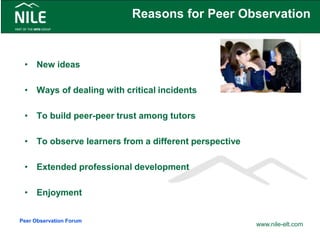
Reasons for Peer Observation
• New ideas
• Ways of dealing with critical incidents
• To build peer-peer trust among tutors
• To observe learners from a different perspective
• Extended professional development
• Enjoyment
www.nile-elt.com
Peer Observation Forum
Background to peer observation at NILE
• Reasons
• Implementation
www.nile-elt.com
Peer Observation Forum
Suggestions for more user-friendly
Peer Observation
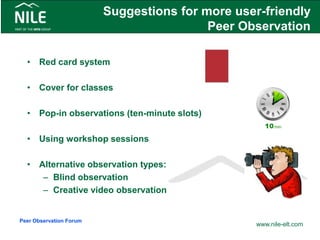
• Red card system
• Cover for classes
• Pop-in observations (ten-minute slots)
• Using workshop sessions
• Alternative observation types:
– Blind observation
– Creative video observation
www.nile-elt.com
Peer Observation Forum
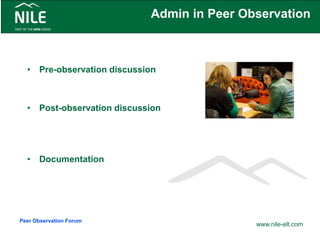
Admin in Peer Observation
• Pre-observation discussion
• Post-observation discussion
• Documentation
www.nile-elt.com
Peer Observation Forum
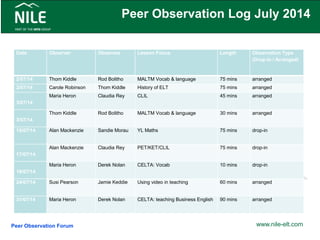
Peer Observation Log July 2014
Date Observer Observee Lesson Focus Length Observation Type
(Drop-in / Arranged)
2/07/14 Thom Kiddle Rod Bolitho MALTM Vocab & language 75 mins arranged
2/07/14 Carole Robinson Thom Kiddle History of ELT 75 mins arranged
3/07/14
Maria Heron Claudia Rey CLIL 45 mins arranged
3/07/14
Thom Kiddle Rod Bolitho MALTM Vocab & language 30 mins arranged
15/07/14 Alan Mackenzie Sandie Morau YL Maths 75 mins drop-in
17/07/14
Alan Mackenzie Claudia Rey PET/KET/CLIL 75 mins drop-in
18/07/14
Maria Heron Derek Nolan CELTA: Vocab 10 mins drop-in
24/07/14 Susi Pearson Jamie Keddie Using video in teaching 60 mins arranged
31/07/14 Maria Heron Derek Nolan CELTA: teaching Business English 90 mins arranged
www.nile-elt.comPeer Observation Forum
Lasting CPD
• Ongoing peer observation
• Reflection through keeping a journal
• Group discussion
• Ownership of peer observation scheme
www.nile-elt.com
Peer Observation Forum
Summary
• Imagination and creativity
• Simplicity
• Here to stay
• Looking forward
www.nile-elt.com
Peer Observation Forum
Useful Resources
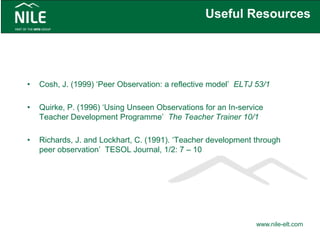
• Cosh, J. (1999) ‘Peer Observation: a reflective model’ ELTJ 53/1
• Quirke, P. (1996) ‘Using Unseen Observations for an In-service
Teacher Development Programme’ The Teacher Trainer 10/1
• Richards, J. and Lockhart, C. (1991). ‘Teacher development through
peer observation’ TESOL Journal, 1/2: 7 – 10
www.nile-elt.com
Thank you
Maria Heron Carole Anne Robinson
maria@nile-elt.com carole@nile-elt.com
www.nile-elt.com

Peer observation for lasting CPD

  • 1.
    Peer Observation for lastingCPD Carole Robinson & Maria Heron
  • 2.
    An Overview • Reasonsfor peer observation • Background to peer observation at NILE • Suggestions for more user-friendly peer observations • Admin in peer observation www.nile-elt.com Peer Observation Forum
  • 3.
    Reasons for PeerObservation • New ideas • Ways of dealing with critical incidents • To build peer-peer trust among tutors • To observe learners from a different perspective • Extended professional development • Enjoyment www.nile-elt.com Peer Observation Forum
  • 4.
    Background to peerobservation at NILE • Reasons • Implementation www.nile-elt.com Peer Observation Forum
  • 5.
    Suggestions for moreuser-friendly Peer Observation • Red card system • Cover for classes • Pop-in observations (ten-minute slots) • Using workshop sessions • Alternative observation types: – Blind observation – Creative video observation www.nile-elt.com Peer Observation Forum
  • 6.
    Admin in PeerObservation • Pre-observation discussion • Post-observation discussion • Documentation www.nile-elt.com Peer Observation Forum
  • 7.
    Peer Observation LogJuly 2014 Date Observer Observee Lesson Focus Length Observation Type (Drop-in / Arranged) 2/07/14 Thom Kiddle Rod Bolitho MALTM Vocab & language 75 mins arranged 2/07/14 Carole Robinson Thom Kiddle History of ELT 75 mins arranged 3/07/14 Maria Heron Claudia Rey CLIL 45 mins arranged 3/07/14 Thom Kiddle Rod Bolitho MALTM Vocab & language 30 mins arranged 15/07/14 Alan Mackenzie Sandie Morau YL Maths 75 mins drop-in 17/07/14 Alan Mackenzie Claudia Rey PET/KET/CLIL 75 mins drop-in 18/07/14 Maria Heron Derek Nolan CELTA: Vocab 10 mins drop-in 24/07/14 Susi Pearson Jamie Keddie Using video in teaching 60 mins arranged 31/07/14 Maria Heron Derek Nolan CELTA: teaching Business English 90 mins arranged www.nile-elt.comPeer Observation Forum
  • 8.
    Lasting CPD • Ongoingpeer observation • Reflection through keeping a journal • Group discussion • Ownership of peer observation scheme www.nile-elt.com Peer Observation Forum
  • 9.
    Summary • Imagination andcreativity • Simplicity • Here to stay • Looking forward www.nile-elt.com Peer Observation Forum
  • 10.
    Useful Resources • Cosh,J. (1999) ‘Peer Observation: a reflective model’ ELTJ 53/1 • Quirke, P. (1996) ‘Using Unseen Observations for an In-service Teacher Development Programme’ The Teacher Trainer 10/1 • Richards, J. and Lockhart, C. (1991). ‘Teacher development through peer observation’ TESOL Journal, 1/2: 7 – 10 www.nile-elt.com
  • 11.
    Thank you Maria HeronCarole Anne Robinson maria@nile-elt.com carole@nile-elt.com www.nile-elt.com

Editor's Notes

  • #2 1 min – who we are and what NILE is. Can also mention creativity here
  • #3 1 min This is what we will be focussing on in our talk. The 3rd point is the main one as that is where it links to lasting CPD: make it clear we will skip through the other points.
  • #4 3 mins Many good reasons for peer observation and the list here is a summary of what some of our trainers/teachers told us when we did a short survey with them about the benefits of peer observation. So this is NILE-specific, but you can probably see things here that you are familiar with too. New ideas – structuring sessions, activities etc.., use of resources; discussion as part of training; different style of teaching Ways of dealing - incidents/difficult trainees/less known contexts/personal issues/learning issues Peer-peer trust: by getting new people to work together and share ideas Different perspective – same learners with different teachers Extended Professional Development – springboard to other things, e.g. action research, discussion groups Enjoyment!
  • #5 3 mins Reasons: Different contexts and wide experience and expertise Little time to exchange ideas – but willingness to share and learn apparent from questionnaire Ad-hoc basis between trainers who had known each other but need for others to get involved Implementation: open door policy – anyone by anyone else at any time (peer observation). Compromise – sign up system – all trainers invited – pop-in or by prior arrangement – most was by prior arrangement. 85% of our trainers agreed to be included. Most of our trainers/teachers are consultants and therefore we cannot force them to participate!
  • #6 6 mins Red card system: glass windows Cover: management cover – may work in some settings but we found people were quite protective of their classes. This would only work if the peer observation (e.g. in Shirley’s example) was obligatory a certain number of times a year. Pop-in observations: more flexibility and cover not such an issue – beginnings/ends of lessons. One activity. Workshop sessions: one afternoon a week or every two weeks is a workshop session which is led by a teacher. Teachers take it in turns, leaving some free to observe sessions on a rota basis. Blind observations: observer not in the room – discussion afterwards Video observation: not watching the whole thing but the observer or observee choose a spec-fic part of the lesson they want to watch and this is watched and discussed. This can easily be set up using a smartphone to record part of the lesson (or all and the decision about what is watched is decided after the lesson). Only the observer and observee watch the lesson and students are talked to about observation and video procedure.
  • #7 3 mins We feel that for peer observation, pre-observation discussions are important. These can allow both teachers to narrow down the focus of the observation and decide on important points, such as involvement, seating, and feedback type. Post-observation discussion is something which can be put off and which is useful to have. In our institution, we feel that this needs to be arranged between the teachers; most of our teachers are trainers with a lot of experience. Documentation: we try to keep it simple, having a log sheet in our staff room, which people fill in (by hand) and which we then transfer for our records. We don’t specify a specific observation form to be handed in; the idea is to make it informal.
  • #9 1 min Ways in which peer observation lasts longer than the observation.
  • #10 1 min Imagination and creativity: we have worked through some of our problems and come up with ways which can make peer observation more user-friendly and which we think encourages reflection and further CPD Simplicity: we have tried to cut back on the bureaucracy of peer observation to make it more user-friendly too. Here to stay: this is a programme at NILE which we want to continue and to develop in different ways Looking forward: making it a part of all of the teachers at NILE, not 85% - get people on board
  • #11 1 min