1.
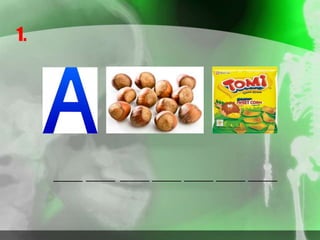
ANATOMY
2.
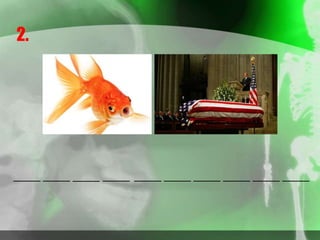
PHYSIOLOGY
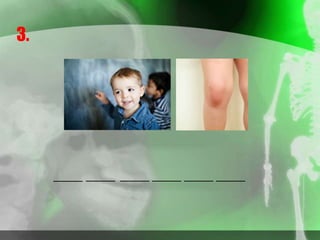
3.
KIDNEY
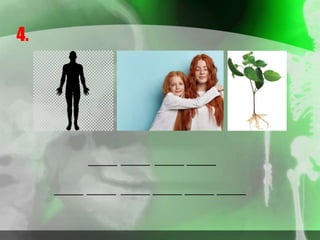
4.
BODY
SYSTEM
5.
ABSORPTION
Introduction to
ANATOMY & PHYSIOLOGY
PART 1
BY JOHN SALADAS
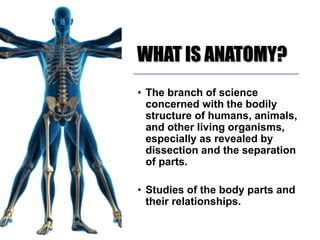
WHAT IS ANATOMY?
• The branch of science
concerned with the bodily
structure of humans, animals,
and other living organisms,
especially as revealed by
dissection and the separation
of parts.
• Studies of the body parts and
their relationships.
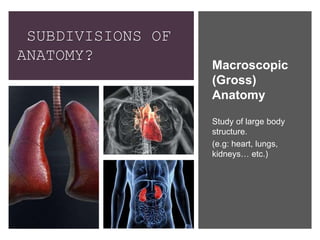
SUBDIVISIONS OF
ANATOMY?
Macroscopic
(Gross)
Anatomy
Study of large body
structure.
(e.g: heart, lungs,
kidneys… etc.)
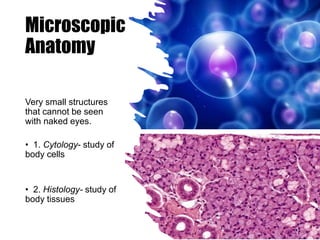
Microscopic
Anatomy
Very small structures
that cannot be seen
with naked eyes.
• 1. Cytology- study of
body cells
• 2. Histology- study of
body tissues
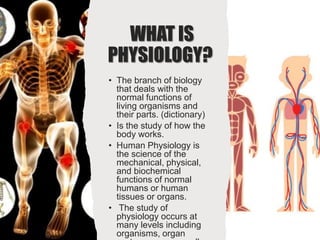
WHAT IS
PHYSIOLOGY?
• The branch of biology
that deals with the
normal functions of
living organisms and
their parts. (dictionary)
• Is the study of how the
body works.
• Human Physiology is
the science of the
mechanical, physical,
and biochemical
functions of normal
humans or human
tissues or organs.
• The study of
physiology occurs at
many levels including
organisms, organ
10 CHARACTERISTICS OF LIFE
1.Responsiveness – ability of
sense change and react
2.Movement – change in
position of an organism
3.Reproduction - process of
making a new organism
4.Respiration - the process of
getting oxygen
5.Growth - an increase in body
size
6. Digestion - complex material
changes into simpler material
7. Absorption - the passage of a
substance through a membrane
8. Assimilation – putting
molecules together to make
more complex substance
9. Circulation – movement of
material
10. Excretion – getting rid of
material
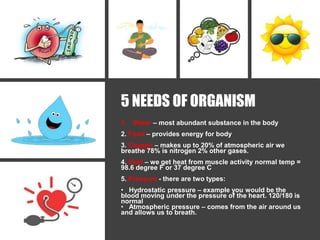
5 NEEDS OF ORGANISM
1. Water – most abundant substance in the body
2. Food – provides energy for body
3. Oxygen – makes up to 20% of atmospheric air we
breathe 78% is nitrogen 2% other gases.
4. Heat – we get heat from muscle activity normal temp =
98.6 degree F or 37 degree C
5. Pressure - there are two types:
• Hydrostatic pressure – example you would be the
blood moving under the pressure of the heart. 120/180 is
normal
• Atmospheric pressure – comes from the air around us
and allows us to breath.
SYSTEM OF THE
BODY
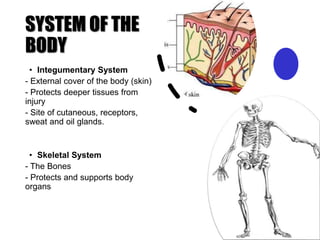
• Integumentary System
- External cover of the body (skin)
- Protects deeper tissues from
injury
- Site of cutaneous, receptors,
sweat and oil glands.
• Skeletal System
- The Bones
- Protects and supports body
organs
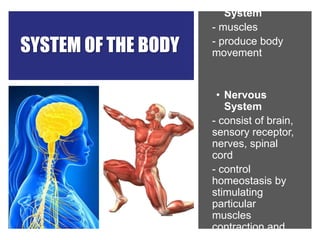
SYSTEM OF THE BODY
• Muscular
System
- muscles
- produce body
movement
• Nervous
System
- consist of brain,
sensory receptor,
nerves, spinal
cord
- control
homeostasis by
stimulating
particular
muscles
contraction and
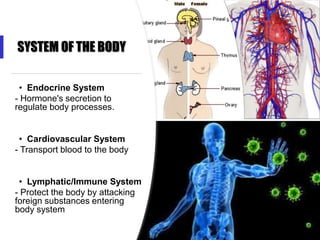
SYSTEM OF THE BODY
• Endocrine System
- Hormone's secretion to
regulate body processes.
• Cardiovascular System
- Transport blood to the body
• Lymphatic/Immune System
- Protect the body by attacking
foreign substances entering
body system
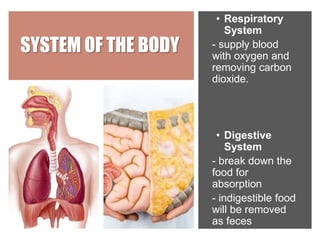
SYSTEM OF THE BODY
• Respiratory
System
- supply blood
with oxygen and
removing carbon
dioxide.
• Digestive
System
- break down the
food for
absorption
- indigestible food
will be removed
as feces
SYSTEM OF THE
BODY
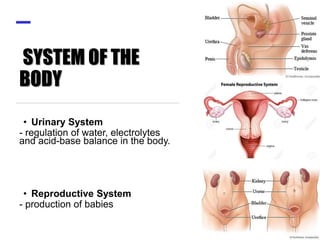
• Urinary System
- regulation of water, electrolytes
and acid-base balance in the body.
• Reproductive System
- production of babies
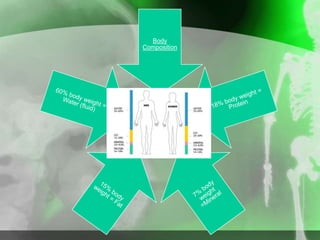
Body
Composition
PART II
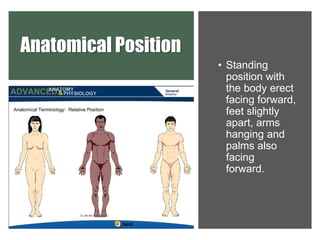
Anatomical Position
• Standing
position with
the body erect
facing forward,
feet slightly
apart, arms
hanging and
palms also
facing
forward.
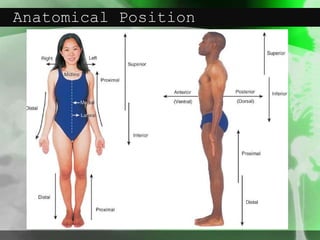
Anatomical Position
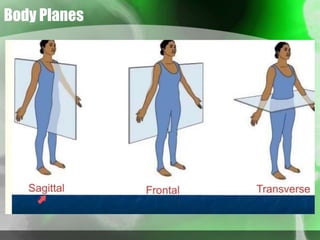
Body Planes
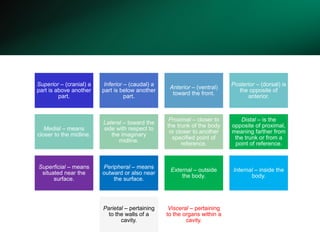
Superior – (cranial) a
part is above another
part.
Inferior – (caudal) a
part is below another
part.
Anterior – (ventral)
toward the front.
Posterior – (dorsal) is
the opposite of
anterior.
Medial – means
closer to the midline.
Lateral – toward the
side with respect to
the imaginary
midline.
Proximal – closer to
the trunk of the body
or closer to another
specified point of
reference.
Distal – is the
opposite of proximal,
meaning farther from
the trunk or from a
point of reference.
Superficial – means
situated near the
surface.
Peripheral – means
outward or also near
the surface.
External – outside
the body.
Internal – inside the
body.
Parietal – pertaining
to the walls of a
cavity.
Visceral – pertaining
to the organs within a
cavity.
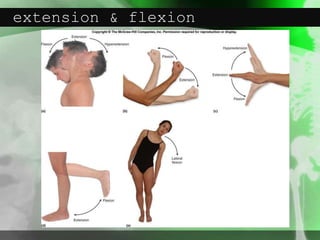
extension & flexion
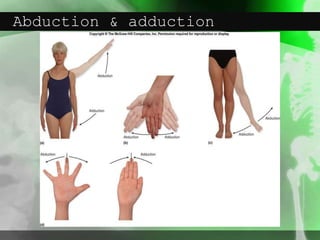
Abduction & adduction
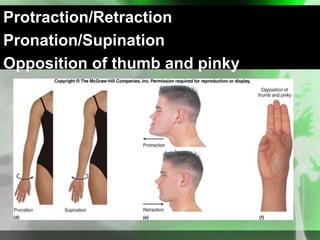
Protraction/Retraction
Pronation/Supination
Opposition of thumb and pinky
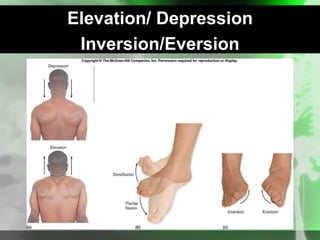
Elevation/ Depression
Inversion/Eversion
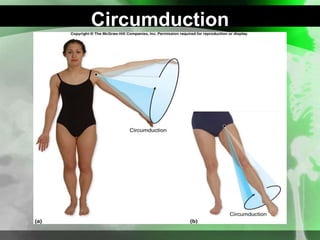
Circumduction
References:
https://www.slideshare.net/linoby/introduction-to-human-
anatomy

PEED101_M2.pptx

  • 2.
  • 3.
  • 4.
  • 5.
  • 6.
  • 7.
  • 8.
  • 9.
  • 10.
  • 11.
  • 12.
    Introduction to ANATOMY &PHYSIOLOGY PART 1 BY JOHN SALADAS
  • 13.
    WHAT IS ANATOMY? •The branch of science concerned with the bodily structure of humans, animals, and other living organisms, especially as revealed by dissection and the separation of parts. • Studies of the body parts and their relationships.
  • 14.
    SUBDIVISIONS OF ANATOMY? Macroscopic (Gross) Anatomy Study oflarge body structure. (e.g: heart, lungs, kidneys… etc.)
  • 15.
    Microscopic Anatomy Very small structures thatcannot be seen with naked eyes. • 1. Cytology- study of body cells • 2. Histology- study of body tissues
  • 16.
    WHAT IS PHYSIOLOGY? • Thebranch of biology that deals with the normal functions of living organisms and their parts. (dictionary) • Is the study of how the body works. • Human Physiology is the science of the mechanical, physical, and biochemical functions of normal humans or human tissues or organs. • The study of physiology occurs at many levels including organisms, organ
  • 17.
    10 CHARACTERISTICS OFLIFE 1.Responsiveness – ability of sense change and react 2.Movement – change in position of an organism 3.Reproduction - process of making a new organism 4.Respiration - the process of getting oxygen 5.Growth - an increase in body size 6. Digestion - complex material changes into simpler material 7. Absorption - the passage of a substance through a membrane 8. Assimilation – putting molecules together to make more complex substance 9. Circulation – movement of material 10. Excretion – getting rid of material
  • 18.
    5 NEEDS OFORGANISM 1. Water – most abundant substance in the body 2. Food – provides energy for body 3. Oxygen – makes up to 20% of atmospheric air we breathe 78% is nitrogen 2% other gases. 4. Heat – we get heat from muscle activity normal temp = 98.6 degree F or 37 degree C 5. Pressure - there are two types: • Hydrostatic pressure – example you would be the blood moving under the pressure of the heart. 120/180 is normal • Atmospheric pressure – comes from the air around us and allows us to breath.
  • 19.
    SYSTEM OF THE BODY •Integumentary System - External cover of the body (skin) - Protects deeper tissues from injury - Site of cutaneous, receptors, sweat and oil glands. • Skeletal System - The Bones - Protects and supports body organs
  • 20.
    SYSTEM OF THEBODY • Muscular System - muscles - produce body movement • Nervous System - consist of brain, sensory receptor, nerves, spinal cord - control homeostasis by stimulating particular muscles contraction and
  • 21.
    SYSTEM OF THEBODY • Endocrine System - Hormone's secretion to regulate body processes. • Cardiovascular System - Transport blood to the body • Lymphatic/Immune System - Protect the body by attacking foreign substances entering body system
  • 22.
    SYSTEM OF THEBODY • Respiratory System - supply blood with oxygen and removing carbon dioxide. • Digestive System - break down the food for absorption - indigestible food will be removed as feces
  • 23.
    SYSTEM OF THE BODY •Urinary System - regulation of water, electrolytes and acid-base balance in the body. • Reproductive System - production of babies
  • 24.
  • 25.
  • 26.
    Anatomical Position • Standing positionwith the body erect facing forward, feet slightly apart, arms hanging and palms also facing forward.
  • 27.
  • 28.
  • 29.
    Superior – (cranial)a part is above another part. Inferior – (caudal) a part is below another part. Anterior – (ventral) toward the front. Posterior – (dorsal) is the opposite of anterior. Medial – means closer to the midline. Lateral – toward the side with respect to the imaginary midline. Proximal – closer to the trunk of the body or closer to another specified point of reference. Distal – is the opposite of proximal, meaning farther from the trunk or from a point of reference. Superficial – means situated near the surface. Peripheral – means outward or also near the surface. External – outside the body. Internal – inside the body. Parietal – pertaining to the walls of a cavity. Visceral – pertaining to the organs within a cavity.
  • 30.
  • 31.
  • 32.
  • 33.
  • 34.
  • 35.