Journal of Machine Learning Research 12 (2011) 2825-2830                           Submitted 3/11; Revised 8/11; Published 10/11


                         Scikit-learn: Machine Learning in Python

Fabian Pedregosa                                                                     FABIAN . PEDREGOSA @ INRIA . FR
Ga¨ l Varoquaux
   e                                                                         GAEL . VAROQUAUX @ NORMALESUP. ORG
Alexandre Gramfort                                                                ALEXANDRE . GRAMFORT @ INRIA . FR
Vincent Michel                                                                       VINCENT. MICHEL @ LOGILAB . FR
Bertrand Thirion                                                                        BERTRAND . THIRION @ INRIA . FR
Parietal, INRIA Saclay
Neurospin, Bˆ t 145, CEA Saclay
             a
91191 Gif sur Yvette – France
Olivier Grisel                                                                              OLIVIER . GRISEL @ ENSTA . FR
Nuxeo
20 rue Soleillet
75 020 Paris – France
Mathieu Blondel                                                                      MBLONDEL @ AI . CS . KOBE - U . AC . JP
Kobe University
1-1 Rokkodai, Nada
Kobe 657-8501 – Japan
Peter Prettenhofer                                                               PETER . PRETTENHOFER @ GMAIL . COM
Bauhaus-Universit¨ t Weimar
                 a
Bauhausstr. 11
99421 Weimar – Germany
Ron Weiss                                                                                       RONWEISS @ GMAIL . COM
Google Inc
76 Ninth Avenue
New York, NY 10011 – USA
Vincent Dubourg                                                                     VINCENT. DUBOURG @ GMAIL . COM
Clermont Universit´ , IFMA, EA 3867, LaMI
                  e
BP 10448, 63000 Clermont-Ferrand – France
Jake Vanderplas                                                            VANDERPLAS @ ASTRO . WASHINGTON . EDU
Astronomy Department
University of Washington, Box 351580
Seattle, WA 98195 – USA
Alexandre Passos                                                                          ALEXANDRE . TP @ GMAIL . COM
IESL Lab
UMass Amherst
Amherst MA 01002 – USA
David Cournapeau                                                                                COURNAPE @ GMAIL . COM
Enthought
21 J.J. Thompson Avenue
Cambridge, CB3 0FA – UK


c 2011 Fabian Pedregosa, Ga¨ l Varoquaux, Alexandre Gramfort, Vincent Michel, Bertrand Thirion, Olivier Grisel, Mathieu Blondel,
                              e
       Peter Prettenhofer, Ron Weiss, Vincent Dubourg, Jake Vanderplas, Alexandre Passos, David Cournapeau, Matthieu Brucher,
                            ´
       Matthieu Perrot and Edouard Duchesnay
P EDREGOSA , VAROQUAUX , G RAMFORT ET AL .


Matthieu Brucher                                                      MATTHIEU . BRUCHER @ GMAIL . COM
Total SA, CSTJF
avenue Larribau
64000 Pau – France
Matthieu Perrot                                                              MATTHIEU . PERROT @ CEA . FR
´
Edouard Duchesnay                                                        EDOUARD . DUCHESNAY @ CEA . FR
LNAO
Neurospin, Bˆ t 145, CEA Saclay
            a
91191 Gif sur Yvette – France


Editor: Mikio Braun


                                               Abstract
    Scikit-learn is a Python module integrating a wide range of state-of-the-art machine learning algo-
    rithms for medium-scale supervised and unsupervised problems. This package focuses on bring-
    ing machine learning to non-specialists using a general-purpose high-level language. Emphasis is
    put on ease of use, performance, documentation, and API consistency. It has minimal dependen-
    cies and is distributed under the simplified BSD license, encouraging its use in both academic
    and commercial settings. Source code, binaries, and documentation can be downloaded from
    http://scikit-learn.sourceforge.net.
    Keywords: Python, supervised learning, unsupervised learning, model selection


1. Introduction
The Python programming language is establishing itself as one of the most popular languages for
scientific computing. Thanks to its high-level interactive nature and its maturing ecosystem of sci-
entific libraries, it is an appealing choice for algorithmic development and exploratory data analysis
(Dubois, 2007; Milmann and Avaizis, 2011). Yet, as a general-purpose language, it is increasingly
used not only in academic settings but also in industry.
    Scikit-learn harnesses this rich environment to provide state-of-the-art implementations of many
well known machine learning algorithms, while maintaining an easy-to-use interface tightly inte-
grated with the Python language. This answers the growing need for statistical data analysis by
non-specialists in the software and web industries, as well as in fields outside of computer-science,
such as biology or physics. Scikit-learn differs from other machine learning toolboxes in Python
for various reasons: i) it is distributed under the BSD license ii) it incorporates compiled code for
efficiency, unlike MDP (Zito et al., 2008) and pybrain (Schaul et al., 2010), iii) it depends only on
numpy and scipy to facilitate easy distribution, unlike pymvpa (Hanke et al., 2009) that has optional
dependencies such as R and shogun, and iv) it focuses on imperative programming, unlike pybrain
which uses a data-flow framework. While the package is mostly written in Python, it incorporates
the C++ libraries LibSVM (Chang and Lin, 2001) and LibLinear (Fan et al., 2008) that provide ref-
erence implementations of SVMs and generalized linear models with compatible licenses. Binary
packages are available on a rich set of platforms including Windows and any POSIX platforms.

                                                  2826
S CIKIT- LEARN : M ACHINE L EARNING IN P YTHON


Furthermore, thanks to its liberal license, it has been widely distributed as part of major free soft-
ware distributions such as Ubuntu, Debian, Mandriva, NetBSD and Macports and in commercial
distributions such as the “Enthought Python Distribution”.

2. Project Vision
Code quality. Rather than providing as many features as possible, the project’s goal has been to
provide solid implementations. Code quality is ensured with unit tests—as of release 0.8, test
coverage is 81%—and the use of static analysis tools such as pyflakes and pep8. Finally, we
strive to use consistent naming for the functions and parameters used throughout a strict adherence
to the Python coding guidelines and numpy style documentation.
BSD licensing. Most of the Python ecosystem is licensed with non-copyleft licenses. While such
policy is beneficial for adoption of these tools by commercial projects, it does impose some restric-
tions: we are unable to use some existing scientific code, such as the GSL.
Bare-bone design and API. To lower the barrier of entry, we avoid framework code and keep the
number of different objects to a minimum, relying on numpy arrays for data containers.
Community-driven development. We base our development on collaborative tools such as git, github
and public mailing lists. External contributions are welcome and encouraged.
Documentation. Scikit-learn provides a ∼300 page user guide including narrative documentation,
class references, a tutorial, installation instructions, as well as more than 60 examples, some fea-
turing real-world applications. We try to minimize the use of machine-learning jargon, while main-
taining precision with regards to the algorithms employed.

3. Underlying Technologies
Numpy: the base data structure used for data and model parameters. Input data is presented as
numpy arrays, thus integrating seamlessly with other scientific Python libraries. Numpy’s view-
based memory model limits copies, even when binding with compiled code (Van der Walt et al.,
2011). It also provides basic arithmetic operations.
Scipy: efficient algorithms for linear algebra, sparse matrix representation, special functions and
basic statistical functions. Scipy has bindings for many Fortran-based standard numerical packages,
such as LAPACK. This is important for ease of installation and portability, as providing libraries
around Fortran code can prove challenging on various platforms.
Cython: a language for combining C in Python. Cython makes it easy to reach the performance
of compiled languages with Python-like syntax and high-level operations. It is also used to bind
compiled libraries, eliminating the boilerplate code of Python/C extensions.

4. Code Design
Objects specified by interface, not by inheritance. To facilitate the use of external objects with
scikit-learn, inheritance is not enforced; instead, code conventions provide a consistent interface.
The central object is an estimator, that implements a fit method, accepting as arguments an input
data array and, optionally, an array of labels for supervised problems. Supervised estimators, such as
SVM classifiers, can implement a predict method. Some estimators, that we call transformers,
for example, PCA, implement a transform method, returning modified input data. Estimators

                                                2827
P EDREGOSA , VAROQUAUX , G RAMFORT ET AL .


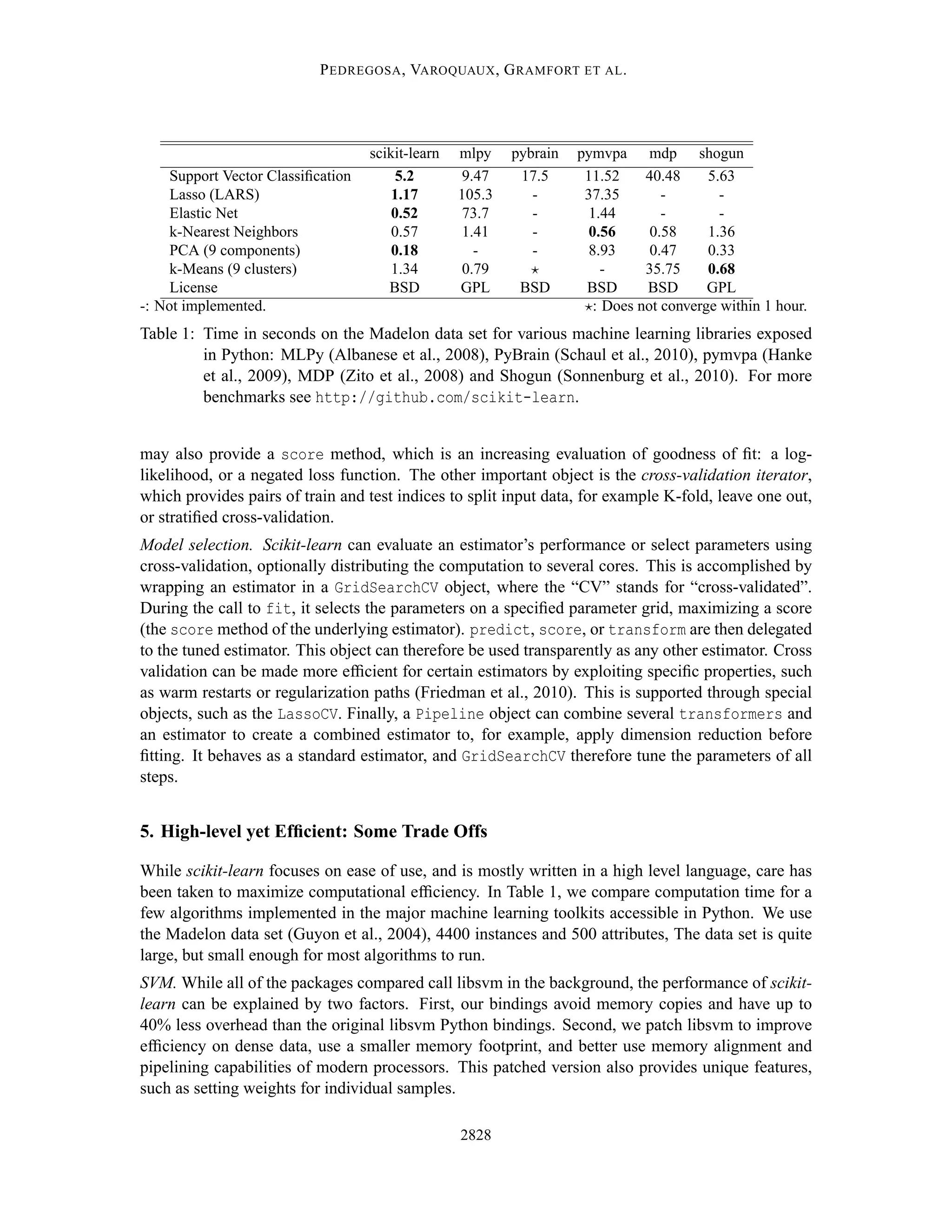
                                    scikit-learn   mlpy    pybrain   pymvpa mdp shogun
     Support Vector Classification       5.2        9.47     17.5      11.52    40.48     5.63
     Lasso (LARS)                       1.17       105.3      -       37.35       -        -
     Elastic Net                        0.52       73.7       -        1.44       -        -
     k-Nearest Neighbors                0.57       1.41       -        0.56     0.58     1.36
     PCA (9 components)                 0.18         -        -        8.93     0.47     0.33
     k-Means (9 clusters)               1.34       0.79       ⋆          -     35.75     0.68
     License                           BSD         GPL      BSD       BSD      BSD       GPL
-: Not implemented.                                                   ⋆: Does not converge within 1 hour.
Table 1: Time in seconds on the Madelon data set for various machine learning libraries exposed
         in Python: MLPy (Albanese et al., 2008), PyBrain (Schaul et al., 2010), pymvpa (Hanke
         et al., 2009), MDP (Zito et al., 2008) and Shogun (Sonnenburg et al., 2010). For more
         benchmarks see http://github.com/scikit-learn.


may also provide a score method, which is an increasing evaluation of goodness of fit: a log-
likelihood, or a negated loss function. The other important object is the cross-validation iterator,
which provides pairs of train and test indices to split input data, for example K-fold, leave one out,
or stratified cross-validation.
Model selection. Scikit-learn can evaluate an estimator’s performance or select parameters using
cross-validation, optionally distributing the computation to several cores. This is accomplished by
wrapping an estimator in a GridSearchCV object, where the “CV” stands for “cross-validated”.
During the call to fit, it selects the parameters on a specified parameter grid, maximizing a score
(the score method of the underlying estimator). predict, score, or transform are then delegated
to the tuned estimator. This object can therefore be used transparently as any other estimator. Cross
validation can be made more efficient for certain estimators by exploiting specific properties, such
as warm restarts or regularization paths (Friedman et al., 2010). This is supported through special
objects, such as the LassoCV. Finally, a Pipeline object can combine several transformers and
an estimator to create a combined estimator to, for example, apply dimension reduction before
fitting. It behaves as a standard estimator, and GridSearchCV therefore tune the parameters of all
steps.


5. High-level yet Efficient: Some Trade Offs

While scikit-learn focuses on ease of use, and is mostly written in a high level language, care has
been taken to maximize computational efficiency. In Table 1, we compare computation time for a
few algorithms implemented in the major machine learning toolkits accessible in Python. We use
the Madelon data set (Guyon et al., 2004), 4400 instances and 500 attributes, The data set is quite
large, but small enough for most algorithms to run.
SVM. While all of the packages compared call libsvm in the background, the performance of scikit-
learn can be explained by two factors. First, our bindings avoid memory copies and have up to
40% less overhead than the original libsvm Python bindings. Second, we patch libsvm to improve
efficiency on dense data, use a smaller memory footprint, and better use memory alignment and
pipelining capabilities of modern processors. This patched version also provides unique features,
such as setting weights for individual samples.

                                                   2828
S CIKIT- LEARN : M ACHINE L EARNING IN P YTHON


LARS. Iteratively refining the residuals instead of recomputing them gives performance gains of
2–10 times over the reference R implementation (Hastie and Efron, 2004). Pymvpa uses this imple-
mentation via the Rpy R bindings and pays a heavy price to memory copies.
Elastic Net. We benchmarked the scikit-learn coordinate descent implementations of Elastic Net. It
achieves the same order of performance as the highly optimized Fortran version glmnet (Friedman
et al., 2010) on medium-scale problems, but performance on very large problems is limited since
we do not use the KKT conditions to define an active set.
kNN. The k-nearest neighbors classifier implementation constructs a ball tree (Omohundro, 1989)
of the samples, but uses a more efficient brute force search in large dimensions.
PCA. For medium to large data sets, scikit-learn provides an implementation of a truncated PCA
based on random projections (Rokhlin et al., 2009).
k-means. scikit-learn’s k-means algorithm is implemented in pure Python. Its performance is lim-
ited by the fact that numpy’s array operations take multiple passes over data.

6. Conclusion
Scikit-learn exposes a wide variety of machine learning algorithms, both supervised and unsuper-
vised, using a consistent, task-oriented interface, thus enabling easy comparison of methods for a
given application. Since it relies on the scientific Python ecosystem, it can easily be integrated into
applications outside the traditional range of statistical data analysis. Importantly, the algorithms,
implemented in a high-level language, can be used as building blocks for approaches specific to
a use case, for example, in medical imaging (Michel et al., 2011). Future work includes online
learning, to scale to large data sets.

References
D. Albanese, G. Merler, S.and Jurman, and R. Visintainer. MLPy: high-performance python pack-
  age for predictive modeling. In NIPS, MLOSS Workshop, 2008.

C.C. Chang and C.J. Lin. LIBSVM: a library for support vector machines. http://www.csie.
  ntu.edu.tw/cjlin/libsvm, 2001.

P.F. Dubois, editor. Python: Batteries Included, volume 9 of Computing in Science & Engineering.
   IEEE/AIP, May 2007.

R.E. Fan, K.W. Chang, C.J. Hsieh, X.R. Wang, and C.J. Lin. LIBLINEAR: a library for large linear
  classification. The Journal of Machine Learning Research, 9:1871–1874, 2008.

J. Friedman, T. Hastie, and R. Tibshirani. Regularization paths for generalized linear models via
   coordinate descent. Journal of Statistical Software, 33(1):1, 2010.

I Guyon, S. R. Gunn, A. Ben-Hur, and G. Dror. Result analysis of the NIPS 2003 feature selection
   challenge, 2004.

M. Hanke, Y.O. Halchenko, P.B. Sederberg, S.J. Hanson, J.V. Haxby, and S. Pollmann. PyMVPA:
 A Python toolbox for multivariate pattern analysis of fMRI data. Neuroinformatics, 7(1):37–53,
 2009.

                                                2829
P EDREGOSA , VAROQUAUX , G RAMFORT ET AL .


T. Hastie and B. Efron. Least Angle Regression, Lasso and Forward Stagewise. http://cran.
   r-project.org/web/packages/lars/lars.pdf, 2004.

V. Michel, A. Gramfort, G. Varoquaux, E. Eger, C. Keribin, and B. Thirion. A supervised clustering
   approach for fMRI-based inference of brain states. Patt Rec, page epub ahead of print, April
   2011. doi: 10.1016/j.patcog.2011.04.006.

K.J. Milmann and M. Avaizis, editors. Scientific Python, volume 11 of Computing in Science &
  Engineering. IEEE/AIP, March 2011.

S.M. Omohundro. Five balltree construction algorithms. ICSI Technical Report TR-89-063, 1989.

V. Rokhlin, A. Szlam, and M. Tygert. A randomized algorithm for principal component analysis.
   SIAM Journal on Matrix Analysis and Applications, 31(3):1100–1124, 2009.

T. Schaul, J. Bayer, D. Wierstra, Y. Sun, M. Felder, F. Sehnke, T. R¨ ckstieß, and J. Schmidhuber.
                                                                    u
   PyBrain. The Journal of Machine Learning Research, 11:743–746, 2010.

S. Sonnenburg, G. R¨ tsch, S. Henschel, C. Widmer, J. Behr, A. Zien, F. de Bona, A. Binder, C. Gehl,
                    a
   and V. Franc. The SHOGUN machine learning toolbox. Journal of Machine Learning Research,
   11:1799–1802, 2010.

S. Van der Walt, S.C Colbert, and G. Varoquaux. The NumPy array: A structure for efficient
   numerical computation. Computing in Science and Engineering, 11, 2011.

T. Zito, N. Wilbert, L. Wiskott, and P. Berkes. Modular toolkit for data processing (MDP): A Python
   data processing framework. Frontiers in Neuroinformatics, 2, 2008.


                                               2830

Scikit-learn : Machine Learning in Python

  • 1.
    Journal of MachineLearning Research 12 (2011) 2825-2830 Submitted 3/11; Revised 8/11; Published 10/11 Scikit-learn: Machine Learning in Python Fabian Pedregosa FABIAN . PEDREGOSA @ INRIA . FR Ga¨ l Varoquaux e GAEL . VAROQUAUX @ NORMALESUP. ORG Alexandre Gramfort ALEXANDRE . GRAMFORT @ INRIA . FR Vincent Michel VINCENT. MICHEL @ LOGILAB . FR Bertrand Thirion BERTRAND . THIRION @ INRIA . FR Parietal, INRIA Saclay Neurospin, Bˆ t 145, CEA Saclay a 91191 Gif sur Yvette – France Olivier Grisel OLIVIER . GRISEL @ ENSTA . FR Nuxeo 20 rue Soleillet 75 020 Paris – France Mathieu Blondel MBLONDEL @ AI . CS . KOBE - U . AC . JP Kobe University 1-1 Rokkodai, Nada Kobe 657-8501 – Japan Peter Prettenhofer PETER . PRETTENHOFER @ GMAIL . COM Bauhaus-Universit¨ t Weimar a Bauhausstr. 11 99421 Weimar – Germany Ron Weiss RONWEISS @ GMAIL . COM Google Inc 76 Ninth Avenue New York, NY 10011 – USA Vincent Dubourg VINCENT. DUBOURG @ GMAIL . COM Clermont Universit´ , IFMA, EA 3867, LaMI e BP 10448, 63000 Clermont-Ferrand – France Jake Vanderplas VANDERPLAS @ ASTRO . WASHINGTON . EDU Astronomy Department University of Washington, Box 351580 Seattle, WA 98195 – USA Alexandre Passos ALEXANDRE . TP @ GMAIL . COM IESL Lab UMass Amherst Amherst MA 01002 – USA David Cournapeau COURNAPE @ GMAIL . COM Enthought 21 J.J. Thompson Avenue Cambridge, CB3 0FA – UK c 2011 Fabian Pedregosa, Ga¨ l Varoquaux, Alexandre Gramfort, Vincent Michel, Bertrand Thirion, Olivier Grisel, Mathieu Blondel, e Peter Prettenhofer, Ron Weiss, Vincent Dubourg, Jake Vanderplas, Alexandre Passos, David Cournapeau, Matthieu Brucher, ´ Matthieu Perrot and Edouard Duchesnay
  • 2.
    P EDREGOSA ,VAROQUAUX , G RAMFORT ET AL . Matthieu Brucher MATTHIEU . BRUCHER @ GMAIL . COM Total SA, CSTJF avenue Larribau 64000 Pau – France Matthieu Perrot MATTHIEU . PERROT @ CEA . FR ´ Edouard Duchesnay EDOUARD . DUCHESNAY @ CEA . FR LNAO Neurospin, Bˆ t 145, CEA Saclay a 91191 Gif sur Yvette – France Editor: Mikio Braun Abstract Scikit-learn is a Python module integrating a wide range of state-of-the-art machine learning algo- rithms for medium-scale supervised and unsupervised problems. This package focuses on bring- ing machine learning to non-specialists using a general-purpose high-level language. Emphasis is put on ease of use, performance, documentation, and API consistency. It has minimal dependen- cies and is distributed under the simplified BSD license, encouraging its use in both academic and commercial settings. Source code, binaries, and documentation can be downloaded from http://scikit-learn.sourceforge.net. Keywords: Python, supervised learning, unsupervised learning, model selection 1. Introduction The Python programming language is establishing itself as one of the most popular languages for scientific computing. Thanks to its high-level interactive nature and its maturing ecosystem of sci- entific libraries, it is an appealing choice for algorithmic development and exploratory data analysis (Dubois, 2007; Milmann and Avaizis, 2011). Yet, as a general-purpose language, it is increasingly used not only in academic settings but also in industry. Scikit-learn harnesses this rich environment to provide state-of-the-art implementations of many well known machine learning algorithms, while maintaining an easy-to-use interface tightly inte- grated with the Python language. This answers the growing need for statistical data analysis by non-specialists in the software and web industries, as well as in fields outside of computer-science, such as biology or physics. Scikit-learn differs from other machine learning toolboxes in Python for various reasons: i) it is distributed under the BSD license ii) it incorporates compiled code for efficiency, unlike MDP (Zito et al., 2008) and pybrain (Schaul et al., 2010), iii) it depends only on numpy and scipy to facilitate easy distribution, unlike pymvpa (Hanke et al., 2009) that has optional dependencies such as R and shogun, and iv) it focuses on imperative programming, unlike pybrain which uses a data-flow framework. While the package is mostly written in Python, it incorporates the C++ libraries LibSVM (Chang and Lin, 2001) and LibLinear (Fan et al., 2008) that provide ref- erence implementations of SVMs and generalized linear models with compatible licenses. Binary packages are available on a rich set of platforms including Windows and any POSIX platforms. 2826
  • 3.
    S CIKIT- LEARN: M ACHINE L EARNING IN P YTHON Furthermore, thanks to its liberal license, it has been widely distributed as part of major free soft- ware distributions such as Ubuntu, Debian, Mandriva, NetBSD and Macports and in commercial distributions such as the “Enthought Python Distribution”. 2. Project Vision Code quality. Rather than providing as many features as possible, the project’s goal has been to provide solid implementations. Code quality is ensured with unit tests—as of release 0.8, test coverage is 81%—and the use of static analysis tools such as pyflakes and pep8. Finally, we strive to use consistent naming for the functions and parameters used throughout a strict adherence to the Python coding guidelines and numpy style documentation. BSD licensing. Most of the Python ecosystem is licensed with non-copyleft licenses. While such policy is beneficial for adoption of these tools by commercial projects, it does impose some restric- tions: we are unable to use some existing scientific code, such as the GSL. Bare-bone design and API. To lower the barrier of entry, we avoid framework code and keep the number of different objects to a minimum, relying on numpy arrays for data containers. Community-driven development. We base our development on collaborative tools such as git, github and public mailing lists. External contributions are welcome and encouraged. Documentation. Scikit-learn provides a ∼300 page user guide including narrative documentation, class references, a tutorial, installation instructions, as well as more than 60 examples, some fea- turing real-world applications. We try to minimize the use of machine-learning jargon, while main- taining precision with regards to the algorithms employed. 3. Underlying Technologies Numpy: the base data structure used for data and model parameters. Input data is presented as numpy arrays, thus integrating seamlessly with other scientific Python libraries. Numpy’s view- based memory model limits copies, even when binding with compiled code (Van der Walt et al., 2011). It also provides basic arithmetic operations. Scipy: efficient algorithms for linear algebra, sparse matrix representation, special functions and basic statistical functions. Scipy has bindings for many Fortran-based standard numerical packages, such as LAPACK. This is important for ease of installation and portability, as providing libraries around Fortran code can prove challenging on various platforms. Cython: a language for combining C in Python. Cython makes it easy to reach the performance of compiled languages with Python-like syntax and high-level operations. It is also used to bind compiled libraries, eliminating the boilerplate code of Python/C extensions. 4. Code Design Objects specified by interface, not by inheritance. To facilitate the use of external objects with scikit-learn, inheritance is not enforced; instead, code conventions provide a consistent interface. The central object is an estimator, that implements a fit method, accepting as arguments an input data array and, optionally, an array of labels for supervised problems. Supervised estimators, such as SVM classifiers, can implement a predict method. Some estimators, that we call transformers, for example, PCA, implement a transform method, returning modified input data. Estimators 2827
  • 4.
    P EDREGOSA ,VAROQUAUX , G RAMFORT ET AL . scikit-learn mlpy pybrain pymvpa mdp shogun Support Vector Classification 5.2 9.47 17.5 11.52 40.48 5.63 Lasso (LARS) 1.17 105.3 - 37.35 - - Elastic Net 0.52 73.7 - 1.44 - - k-Nearest Neighbors 0.57 1.41 - 0.56 0.58 1.36 PCA (9 components) 0.18 - - 8.93 0.47 0.33 k-Means (9 clusters) 1.34 0.79 ⋆ - 35.75 0.68 License BSD GPL BSD BSD BSD GPL -: Not implemented. ⋆: Does not converge within 1 hour. Table 1: Time in seconds on the Madelon data set for various machine learning libraries exposed in Python: MLPy (Albanese et al., 2008), PyBrain (Schaul et al., 2010), pymvpa (Hanke et al., 2009), MDP (Zito et al., 2008) and Shogun (Sonnenburg et al., 2010). For more benchmarks see http://github.com/scikit-learn. may also provide a score method, which is an increasing evaluation of goodness of fit: a log- likelihood, or a negated loss function. The other important object is the cross-validation iterator, which provides pairs of train and test indices to split input data, for example K-fold, leave one out, or stratified cross-validation. Model selection. Scikit-learn can evaluate an estimator’s performance or select parameters using cross-validation, optionally distributing the computation to several cores. This is accomplished by wrapping an estimator in a GridSearchCV object, where the “CV” stands for “cross-validated”. During the call to fit, it selects the parameters on a specified parameter grid, maximizing a score (the score method of the underlying estimator). predict, score, or transform are then delegated to the tuned estimator. This object can therefore be used transparently as any other estimator. Cross validation can be made more efficient for certain estimators by exploiting specific properties, such as warm restarts or regularization paths (Friedman et al., 2010). This is supported through special objects, such as the LassoCV. Finally, a Pipeline object can combine several transformers and an estimator to create a combined estimator to, for example, apply dimension reduction before fitting. It behaves as a standard estimator, and GridSearchCV therefore tune the parameters of all steps. 5. High-level yet Efficient: Some Trade Offs While scikit-learn focuses on ease of use, and is mostly written in a high level language, care has been taken to maximize computational efficiency. In Table 1, we compare computation time for a few algorithms implemented in the major machine learning toolkits accessible in Python. We use the Madelon data set (Guyon et al., 2004), 4400 instances and 500 attributes, The data set is quite large, but small enough for most algorithms to run. SVM. While all of the packages compared call libsvm in the background, the performance of scikit- learn can be explained by two factors. First, our bindings avoid memory copies and have up to 40% less overhead than the original libsvm Python bindings. Second, we patch libsvm to improve efficiency on dense data, use a smaller memory footprint, and better use memory alignment and pipelining capabilities of modern processors. This patched version also provides unique features, such as setting weights for individual samples. 2828
  • 5.
    S CIKIT- LEARN: M ACHINE L EARNING IN P YTHON LARS. Iteratively refining the residuals instead of recomputing them gives performance gains of 2–10 times over the reference R implementation (Hastie and Efron, 2004). Pymvpa uses this imple- mentation via the Rpy R bindings and pays a heavy price to memory copies. Elastic Net. We benchmarked the scikit-learn coordinate descent implementations of Elastic Net. It achieves the same order of performance as the highly optimized Fortran version glmnet (Friedman et al., 2010) on medium-scale problems, but performance on very large problems is limited since we do not use the KKT conditions to define an active set. kNN. The k-nearest neighbors classifier implementation constructs a ball tree (Omohundro, 1989) of the samples, but uses a more efficient brute force search in large dimensions. PCA. For medium to large data sets, scikit-learn provides an implementation of a truncated PCA based on random projections (Rokhlin et al., 2009). k-means. scikit-learn’s k-means algorithm is implemented in pure Python. Its performance is lim- ited by the fact that numpy’s array operations take multiple passes over data. 6. Conclusion Scikit-learn exposes a wide variety of machine learning algorithms, both supervised and unsuper- vised, using a consistent, task-oriented interface, thus enabling easy comparison of methods for a given application. Since it relies on the scientific Python ecosystem, it can easily be integrated into applications outside the traditional range of statistical data analysis. Importantly, the algorithms, implemented in a high-level language, can be used as building blocks for approaches specific to a use case, for example, in medical imaging (Michel et al., 2011). Future work includes online learning, to scale to large data sets. References D. Albanese, G. Merler, S.and Jurman, and R. Visintainer. MLPy: high-performance python pack- age for predictive modeling. In NIPS, MLOSS Workshop, 2008. C.C. Chang and C.J. Lin. LIBSVM: a library for support vector machines. http://www.csie. ntu.edu.tw/cjlin/libsvm, 2001. P.F. Dubois, editor. Python: Batteries Included, volume 9 of Computing in Science & Engineering. IEEE/AIP, May 2007. R.E. Fan, K.W. Chang, C.J. Hsieh, X.R. Wang, and C.J. Lin. LIBLINEAR: a library for large linear classification. The Journal of Machine Learning Research, 9:1871–1874, 2008. J. Friedman, T. Hastie, and R. Tibshirani. Regularization paths for generalized linear models via coordinate descent. Journal of Statistical Software, 33(1):1, 2010. I Guyon, S. R. Gunn, A. Ben-Hur, and G. Dror. Result analysis of the NIPS 2003 feature selection challenge, 2004. M. Hanke, Y.O. Halchenko, P.B. Sederberg, S.J. Hanson, J.V. Haxby, and S. Pollmann. PyMVPA: A Python toolbox for multivariate pattern analysis of fMRI data. Neuroinformatics, 7(1):37–53, 2009. 2829
  • 6.
    P EDREGOSA ,VAROQUAUX , G RAMFORT ET AL . T. Hastie and B. Efron. Least Angle Regression, Lasso and Forward Stagewise. http://cran. r-project.org/web/packages/lars/lars.pdf, 2004. V. Michel, A. Gramfort, G. Varoquaux, E. Eger, C. Keribin, and B. Thirion. A supervised clustering approach for fMRI-based inference of brain states. Patt Rec, page epub ahead of print, April 2011. doi: 10.1016/j.patcog.2011.04.006. K.J. Milmann and M. Avaizis, editors. Scientific Python, volume 11 of Computing in Science & Engineering. IEEE/AIP, March 2011. S.M. Omohundro. Five balltree construction algorithms. ICSI Technical Report TR-89-063, 1989. V. Rokhlin, A. Szlam, and M. Tygert. A randomized algorithm for principal component analysis. SIAM Journal on Matrix Analysis and Applications, 31(3):1100–1124, 2009. T. Schaul, J. Bayer, D. Wierstra, Y. Sun, M. Felder, F. Sehnke, T. R¨ ckstieß, and J. Schmidhuber. u PyBrain. The Journal of Machine Learning Research, 11:743–746, 2010. S. Sonnenburg, G. R¨ tsch, S. Henschel, C. Widmer, J. Behr, A. Zien, F. de Bona, A. Binder, C. Gehl, a and V. Franc. The SHOGUN machine learning toolbox. Journal of Machine Learning Research, 11:1799–1802, 2010. S. Van der Walt, S.C Colbert, and G. Varoquaux. The NumPy array: A structure for efficient numerical computation. Computing in Science and Engineering, 11, 2011. T. Zito, N. Wilbert, L. Wiskott, and P. Berkes. Modular toolkit for data processing (MDP): A Python data processing framework. Frontiers in Neuroinformatics, 2, 2008. 2830