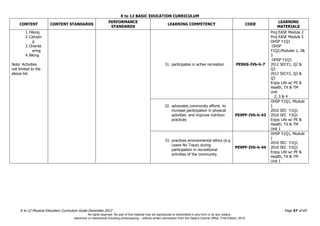
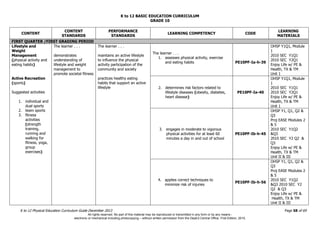
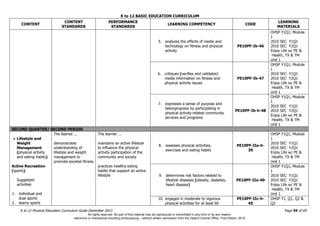
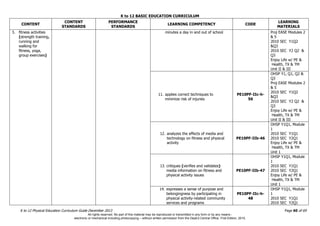
1
DepEd Copy
All rights reserved. No part of this material may be reproduced or transmitted
in any form or by any means--electronic or mechanical including photocopying
without written permission from DepEd Central Office.
Edukasyong
Pangkatawan
3
DepEd Copy
All rights reserved. No part of this material may be reproduced or transmitted
in any form or by any means--electronic or mechanical including photocopying
without written permission from DepEd Central Office.
YUNIT I
Ang Physical Activity Pyramid Guide
para sa Batang Filipino
Laang oras ng pagtuturo: apatnapung (40) minuto
l. Layunin
1.	 Nasusunod ang kahalagahan ng paggawa ng mga gawaing nakabubuti
sa kalusugan.
2.	 Naisasagawa ang mga gawaing pisikal na mas nakabubuti sa kalusugan
ayon sa Physical Activity Pyramid Guide para sa Batang Pilipino.
3.	 Naisasagawa ang mga gawaing nakatutulong sa pagpapaunlad sa
kalusugan.
ll. Nilalaman
Paksa: Physical Activity Pyramid Guide para sa Batang Pilipino
Kasanayan: Paglalarawan sa pamamagitan ng eksena o representasyon
Pagpapahalaga: Disiplina sa sarili, kooperasyon
Sanggunian:
-	Musika, Sining at Edukasyon sa Pagpapalakas ng Katawan
ni Vilma V. Perez., et al. pp.181-182, © 2009
-	The Filipino Pyramid Activity Guide, PASOO 2000
Kagamitan: Physical Activity Pyramid Guide para sa Batang Filipino, manila
paper 	
lll. Pamamaraan
A. Pang araw-araw na Gawain
Pagtsek ng attendance at angkop na kasuotan
B. Panimulang Gawain
1. Pampasiglang Gawain
Ipasagot ang gawaing pampasigla na nasa LM. Banggitin na lapis
lamang ang gamitin sa pagsagot.
ARALIN 1
4
DepEd Copy
All rights reserved. No part of this material may be reproduced or transmitted
in any form or by any means--electronic or mechanical including photocopying
without written permission from DepEd Central Office.
Itanong ang sumusunod:
a.	 Lahat ba ng gawaing na nasa tsart ay ginagawa mo? Ilang beses
sa isang linggo?
b.	 Alin sa mga gawain ang mas madaling gawin? Ang mas mahirap
gawin?
2. Balik-aral
	 Itanong kung ano-anong mga gawaing pisikal ang kanilang natatandaan
at natutuhan sa Ikatlong Baitang. Talakayin ang halaga nang patuloy na
paggawa ng mga gawaing pisikal.
C. Panlinang na Gawain
1.	Ipakita sa mga mag-aaral ang Physical Activity Pyramid Guide para sa
Batang Pilipino at itanong kung ano ang masasabi nila tungkol dito.
2.	Ipaliwanag ang gamit ng Physical Activity Pyramid Guide para sa Batang
Pilipino at kung ano ang maitutulong nito sa kalusugan ng mga mag-aaral
na kasalukuyang aktibo at kasalukuyang hindi gaanong aktibo.
3.	Ipasuri sa mga mag-aaral ang kanilang sagot sa Simulan Natin at itanong
ang mga sumusunod:
-	Aling mga gawain sa tsart ang ginagawa mo na naaayon sa
rekomendasyon ng pyramid?
-	Aling mga gawain ang sa tingin mo ay dapat mong dalasan pa ang
paggawa?Alin ang dapat mong bawasan ang dalas ng paggawa?
Bakit?
D. Paglalapat
Pangkatin ang klase sa apat (pagbibilang ng 1-4).
Ilalarawan sa pamamagitan ng isang eksena o presentasyon ng bawat
grupo ang mga gawain sa araw-araw, 3-5 beses, 2-3 beses, at 1 beses
sa loob ng isang linggo na kanilang ginagawa. Ipaliwanag na kailangang
mag-isip sila ng mga gawaing wala sa pyramid. Ipaliwanag kung papaano
ang paggawa ng eksena o presentasyon.
Unang Grupo: araw-araw na ginagawa
Pangalawang Grupo: 3-5 na beses sa isang linggo	
Pangatlong Grupo: 2-3 beses sa isang linggo
Pang-apat na Grupo: 1 beses sa isang linggo
Tawagin ang bawat grupo para ipakita ang kanilang nabuo at tawagin ang
lider upang ipaliwanag ito. Tulungan ang bawat grupo sa pagpapaliwanag
ng kahalagahan at epekto nito sa kalusugan.
5
DepEd Copy
All rights reserved. No part of this material may be reproduced or transmitted
in any form or by any means--electronic or mechanical including photocopying
without written permission from DepEd Central Office.
Itanong ang mga sumusunod:
-	Sang-ayon ka ba sa mga gawaing ipinakita ng ibang grupo?
Naaayon ba ang mga ito sa dalas ng paggawa na rekomendado ng
pyramid?
-	Kung ikaw ay kabilang sa ibang grupo, ano-ano ang mga gawaing
iyong ipakikita?
E. Pangwakas na Gawain
Ipagawa ang gawain sa LM. Huwag mag-alinlangan na baguhin ang 	
iyong sagot batay sa iyong natutuhan.
IV. Takdang Aralin
Ipagawa ang gawain sa LM.
6
DepEd Copy
All rights reserved. No part of this material may be reproduced or transmitted
in any form or by any means--electronic or mechanical including photocopying
without written permission from DepEd Central Office.
YUNIT I
Ang mga Sangkap ng Physical Fitness
Laang oras ng pagtuturo: apatnapung (40) minuto
l. Layunin
-	Nasusunod ang kahalagahan sa kalusugan ng mga sangkap ng Physical
Fitness.
-	Nasusukat ang mga gawaing pisikal na nagtataglay, tumutugon, at
nakalilinang sa mga sangkap ng Physical Fitness
-	Nakakapagpapamalas ng pakikiisa sa paggawa ng mga gawain.
-	Naisasagawa ng may kaukulang pag-iingat ang mga gawaing pisikal.
ll. Nilalaman
Paksa: Ang mga Sangkap ng Physical Fitness
Kasanayan: Pagtalon, pagtakbo, pagbuhat, paghagis, at pagbalanse.
Pagpapahalaga: Pakikiisa, sariling disiplina, at determinasyon
Sanggunian:
-	Manwal ng Kawanihan ng Eduk.sa PK,1997., pp.283-284
-	MSEP 4 ni Violeta E. Hornilla,et al., pp.20-24
-	The Filipino Pyramid Activity Guide, PASOO 2000
-	Physical Fitness Test Approach ni APARICIO H. MEQUI, Ph.D.’ 2004
-	https://www.youtube.com/watch?v=KyrmbdnCtKc
Kagamitan: iba’t ibang larawan ng mga indibidwal, Physical Activity Pyramid
Guide para sa Batang Pilipino, manila paper, masking tape, pito
lll. Pamamaraan
	
A. Pang araw-araw na Gawain
		
Pagtsek ng attendance at angkop na kasuotan
B. Panimulang Gawain:
1.	Pampasiglang Gawain
		
Ipagawa ang gawaing pampasigla na nasa LM.
ARALIN 2
7
DepEd Copy
All rights reserved. No part of this material may be reproduced or transmitted
in any form or by any means--electronic or mechanical including photocopying
without written permission from DepEd Central Office.
Itanong ang sumusunod:
Ano-anong mga katangian ang kailangang taglayin ng mga indibidwal na
ito para magampanan nang maayos ang kanilang tungkulin? Gaano kahalaga
ang mga katangiang ito sa kanilang trabaho o propesyon?
Ipaliwanag na ang iba’t ibang propesyon ay nangangailangan ng iba’t
ibang kakayanan. Ang epektibong pagganap sa mga inaasahang gawain ng
isang propesyon ay nakasalalay nang malaki sa physical fitness ng isang
indibidwal.
2. Balik-aral
Itanong sa mga mag-aaral kung ano-ano ang kanilang natutuhan sa
Physical Activity Pyramid Guide para sa Batang Pilipino.
C. Panlinang na Gawain
1.	Ipaliwanag ang kahulugan ng physical fitness, ang mga sangkap nito,
mga halimbawa ng gawaing nagtataglay o nangangailangan nito, at mga
paraan sa paglinang nito.
2.	Ipaliwanag ang paggamit ng Physical Activity Pyramid Guide para sa
Batang Pilipino at ang kahalagahan ng mga gawain sa araw-araw sa
pagpapaunlad ng mga sangkap ng physical fitness.
3.	Ipasuri muli sa mga mag-aaral ang mga larawan sa Simulan Natin at
itanong ang mga sumusunod:
Aling sangkap ng physical fitness ang lubos na mahalaga para
magampanan nila nang husto ang kanilang mga tungkulin? para sa
pulis? manlalaro ng basketball? estudyante?
D. Paglalapat
Ipagawa ang gawaing pampasigla.
Pangkatin ang klase sa anim (pagbibilang ng 1-6).
Bawat grupo ay magsisimula sa estasyon na itinalaga para sa kanila.
Ipagawa ang nakatalaga sa estasyon. Ipatukoy ang mga sangkap ng
physical fitness na kaakibat ng gawain. Magbigay ng hudyat kung kailan
lilipat sa susunod na estasyon ang bawat grupo para gawin ang nakatalaga
dito. Ipaliwanag na kailangan nilang ipagpatuloy na gawin ang lahat ng
nakatalaga sa lahat ng estasyon.
8
DepEd Copy
All rights reserved. No part of this material may be reproduced or transmitted
in any form or by any means--electronic or mechanical including photocopying
without written permission from DepEd Central Office.
Itanong ang sumusunod:
-	Aling mga estasyon ang isa lamang ang sangkap ng physical fitness na
kaakibat ng gawain? Ano-anong mga sangkap na ito?
-	Ano-anong komponent ng physical fitness ang kadalasang magkasama
o parehong kaakibat ng isang gawain? Sa aling istasyon ito kaakibat?
	
E. Pangwakas na Gawain
Ipagawa ang gawain sa LM.
IV. Takdang-aralin
Ipagawa ang gawain sa LM.
9
DepEd Copy
All rights reserved. No part of this material may be reproduced or transmitted
in any form or by any means--electronic or mechanical including photocopying
without written permission from DepEd Central Office.
YUNIT I
Ang Pagsubok sa mga Sangkap ng Physical 	
		 Fitness (Pre-test)
Laang oras ng pagtuturo: apatnapung (40) minuto
l. Layunin
1.	Nasusunod ang kahalagahan sa kalusugan ng mga pagsubok sa sangkap
ng physical fitness sa kalusugan
2.	Nagagawa ang kahalagahan ng pagsubaybay sa sariling kakayahan gamit
ang Physical Fitness Passport Card.
3.	Naisasagawa ang mga pagsubok sa sangkap ng physical fitness ayon sa
nararapat na pamamaraan ng mga ito.
4.	Nakapagpapamalas ng pakikiisa sa paggawa ng mga pagsubok.
5.	Naisasagawa ng may kaukulang pag-iingat ang mga pagsubok sa sangkap
ng physical fitness.
ll. Nilalaman
Paksa: Ang Pagsubok sa mga Sangkap ng Physical Fitness (Pre-test)		
Kasanayan: Mga kasanayan na sinusubok ng physical fitness tests
Pagpapahalaga: Pakikiisa, sariling disiplina, at determinasyon
Sanggunian:
-	“Tayo Nang Magpalakas “Batayang Aklat ng Edukasyong Pagpapalakas
ng Katawan, pp. 3-4
-	The Filipino Pyramid Activity Guide, PASOO 2000
-	Musika, Sining at Eduk. Pangkatawan nina Violeta E. Hornilla, et.al.
pp.70-73
-	https://www.youtube.com/watch?v=KyrmbdnCtKc
-	Moving and Learning ni Beverly Nichols PhD.
Kagamitan: Physical Fitness Passport Card, tungtungan/hagdan (8 pulgada/
inches), pito, timer/stopwatch, tape measure, yeso (chalk), 2
piraso ng kahoy/katulad na gamit, masking tape, tennis ball/
baseball/katulad na gamit, dingding, upuan, mesa, ruler/meter
stick, megaphone (kung mayroon), at mga pansapin/floor
mats, manila paper, masking tape
lll. Pamamaraan
A. Pang-araw-araw na Gawain	
ARALIN 3
10
DepEd Copy
All rights reserved. No part of this material may be reproduced or transmitted
in any form or by any means--electronic or mechanical including photocopying
without written permission from DepEd Central Office.
Pagtsek ng attendance at angkop na kasuotan
B. Panimulang Gawain
1.	Pampasiglang Gawain
Ipagawa ang nasa LM. Tiyaking nararamdaman ng mga mag-aaral ang
kanilang pulso.
Itanong ang sumusunod:
-	Mabilis ba ang iyong pulso? Sa tingin mo, bakit kaya mabilis o mabagal
ito?
-	Ano ang maitutulong ng mga physical activity na ginagawa mo para
mapaunlad ang pintig ng iyong puso?
Ibigay ang Physical Fitness Passport Card at ipaliwanag ang kahalagahan
nito. Siguraduhing maitatala nang maayos ng mga mag-aaral ang kanilang
pulso ayon sa iyong pagpapaliwanag.
2.	Balik-aral
Itanong sa mga mag-aaral kung ano-ano ang mga sangkap ng physical
fitness na kanilang naaalala.
C. Panlinang na Gawain
1.	Ipaliwanag ang mga pagsubok ng physical fitness, ang halaga nito sa
kalusugan, kailan ito ginagawa (pre-test at post-test), at paano ito
ginagawa. Ipaliwanag din ang iba’t ibang pagsubok na karaniwang
ginagamit sa partikular na sangkap ng physical fitness. Siguraduhing
naintindihan ng mga mag-aaral kung paano gagawin ang mga pagsubok.
2.	Ipaliwanag kung paano nakatutulong sa pagpapaunlad o paglilinang
ng mga sangkap ng physical fitness ang pakikilahok sa mga gawain sa
Physical Activity Pyramid Guide para sa Batang Pilipino.
D. Paglalapat	
Iayos ang mga estasyon ng pagsubok ayon sa pagkakasunod-sunod
nito (Unang araw at pangalawang araw ng pagsubok). Ihanda ang mga
kagamitang kailangan sa bawat estasyon.
Siguraduhing nakasulat sa bawat estasyon ang mga pamamaraan sa
paggawa ng bawat pagsubok para nasusundan ito nang tama ng mag-aaral.
Sa unang araw ng pagsubok, ipaliwanag ang dahilan kung bakit dapat
mauna ang 3-minute step test sa lahat ng mga pagsubok at dapat namang
mahuli ang 50m run. Ipaliwanag din kung bakit maaaring mag-iba-iba ng
pagkakasunod-sunod ang partial curl-up, push-up, at stork stand test.
11
DepEd Copy
All rights reserved. No part of this material may be reproduced or transmitted
in any form or by any means--electronic or mechanical including photocopying
without written permission from DepEd Central Office.
Mabuti ring ipaliwanag ang kahalagahan ng warm-up at cooldown.
Ipaliwanag nang mabuti ang Talaan ng Iskor sa Pagsubok ng Physical
Fitness. Tiyaking naintindihan ng mga mag-aaral ang paggamit nito.
Ipagpares ang mga mag-aaral at sabihing magsalitan sa paggawa at
pagtala ng mga resulta o iskor sa bawat pagsubok.Tiyaking ayon sa
pamamaraan ng bawat pagsubok ang ginagawa ng magkapares.
Ipaliwanag kung bakit ipagpapaliban ang warm-up sa mga pagsubok
dahil ang pagkapagod ay makakaapekto sa iskor na makukuha lalo na sa
unang araw ng pagsubok.
Umikot sa lahat ng istasyon at gabayan ang mga mag-aaral sa paggawa
ng mga pagsubok at pagtala ng mga resulta o iskor.
Tulungan ang mga mag-aaral na maintindihan ang kahulugan ng mga
iskor na kanilang nakuha. Ipaliwanag sa kanila na ang layunin ng mga
pagsubok ay upang malaman ang kalagayan ng kanilang kalusugan. Sa
“Remarks” sa Talaan ay lalagyan ng mga mag-aaral ng kanilang masasabi
tungkol sa iskor na kanilang nakuha. Ipaunawa sa kanila ang kanilang
maaaring paunlarin base sa iskor na kanilang nakuha.
Ipaliwanag ang kahulugan at kahalagahan ng body composition.
Ipaliwanag ang ibig sabihin ng Body Mass Index (BMI) at kung paano
matutugunan ang resulta nito batay sa taas at timbang.
E. Pangwakas na Gawain
Ipagawa ang gawain sa LM.
IV. Takdang-aralin
Ipagawa ang gawain sa LM.
12
DepEd Copy
All rights reserved. No part of this material may be reproduced or transmitted
in any form or by any means--electronic or mechanical including photocopying
without written permission from DepEd Central Office.
YUNIT I
Ang Pagsubok sa mga Sangkap ng Physical 	
		 Fitness (Pre-test)
Laang oras ng pagtuturo: apatnapung (40) minuto
I. Layunin
1.	Nasusunod ang kahalagan sa kalusugan ng mga pagsubok sa sangkap ng
physical fitness sa kalusugan
2.	Bibigyang pansin ang kahalagahan ng pagsubaybay sa sariling kakayanan
gamit ang Physical Fitness Passport Card
3.	Naisasagawa ang mga pagsubok sa sangkap ng physical fitness ayon sa
nararapat na pamamaraan ng mga ito
4.	Nakapagpamalas ng pakikiisa sa paggawa ng mga pagsubok
5.	Naisasagawa nang may kaukulang pag-iingat ang mga pagsubok sa
sangkap ng physical fitness.
ll. Nilalaman
Paksa: Ang Pagsubok sa mga Sangkap ng Physical Fitness (Pre-test)		
Kasanayan: Mga kasanayan na sinusubok ng physical fitness tests
Pagpapahalaga: Pakikiisa, sariling disiplina, at determinasyon
Sanggunian:
-	 “Tayo Nang Magpalakas” “BatayangAklat ng Edukasyong Pagpapalakas
ng Katawan, pp. 3-4
-	 The Filipino Pyramid Activity Guide, PASOO 2000
-	 Musika, Sining at Eduk. Pangkatawan nina Violeta E. Hornilla, et.al.
pp.70-73
-	 https://www.youtube.com/watch?v=KyrmbdnCtKc
-	 Moving and Learning ni Beverly Nichols PhD
Kagamitan: Physical Fitness Passport Card, tungtungan/hagdan (8 pulgada/
inches), pito, timer/stopwatch, tape measure, yeso (chalk), 2
piraso ng kahoy/katulad na bagay, masking tape, tennis ball/
baseball/katulad na gamit, dingding, upuan, mesa, ruler/meter
stick, megaphone (kung mayroon), at mga pangsapin/floor
mats, manila paper, masking tape.
	
ARALIN 4
13
DepEd Copy
All rights reserved. No part of this material may be reproduced or transmitted
in any form or by any means--electronic or mechanical including photocopying
without written permission from DepEd Central Office.
lll. Pamamaraan
A. Pang araw-araw na Gawain
		
Pagtsek ng attendance at angkop na kasuotan
		
B. Panimulang Gawain
1.	Pampasiglang Gawain
Ipagawa ang nasa LM. Tiyaking nararamdaman ng mga mag-aaral
ang kanilang pulso.
Itanong ang sumusunod:
-	Mabilis ba ang iyong pulso? Bakit kaya mabilis o mabagal?
-	Ano ang maitutulong ng mga gawaing pisikal na ginagawa mo para
mapaunlad ang pintig ng iyong puso?
Ibigay ang Physical Fitness Passport Card. Ipaliwanag ang
kahalagahan nito. Siguraduhing maitatala nang maayos ng mga mag-
aaral ang kanilang pulso ayon sa iyong pagpapaliwanag.
2.	Balik-aral
Itanong sa mga mag-aaral kung ano-ano ang mga sangkap ng physical
fitness na kanilang naalala.
C. Panlinang na Gawain
1.	Ipaliwanag ang mga pagsubok ng physical fitness, ang halaga nito
sa kalusugan, kailan ito ginagawa (pre-test at post-test), at paano ito
ginagawa. Ipaliwanag din ang iba’t ibang pagsubok na karaniwang
ginagamit sa partikular na sangkap ng physical fitness. Siguraduhing
naintindihan ng mga mag-aaral kung paano gagawin ang mga
pagsubok.
2.	Ipaliwanag kung paano nakatutulong sa pagpapaunlad o paglilinang
ng mga sangkap ng physical fitness ang pakikilahok sa mga gawain sa
Gawaing pisikal Pyramid Guide para sa Batang Pilipino.
D. Paglalapat 	
Iayos ang mga estasyon ng pagsubok ayon sa pagkakasunod-sunod
nito (Unang araw at pangalawang araw ng pagsubok). Ihanda ang mga
kagamitang kailangan sa bawat estasyon. Siguraduhing nakasulat sa
bawat estasyon ang pamamaraan ng paggawa sa bawat pagsubok para
nasusundan ito nang tama ng mga mag-aaral.
14
DepEd Copy
All rights reserved. No part of this material may be reproduced or transmitted
in any form or by any means--electronic or mechanical including photocopying
without written permission from DepEd Central Office.
Sa pangalawang araw naman ng pagsubok, gawin ang sumusunod:
	Ipaliwanag kung bakit dapat mauna ang shuttle run sa lahat ng mga
pagsubok at dapat namang mahuli ang vertical jump.
	Ipaliwanag kung bakit maaaring mag-iba-iba ng pagkakasunod-sunod
ang alternate hand wall test, ruler drop test, at sit and reach.
	Ipaliwanag din nang mabuti ang Talaan ng Iskor sa Pagsubok ng Physical
Fitness. Siguraduhing naintindihan ng mga mag-aaral ang paggamit nito.
Ipagpares ang mga mag-aaral at sabihing magsalitan sa paggawa at
pagtala ng mga resulta o iskor sa bawat pagsubok. Tiyaking ayon sa
pamamaraan ng bawat pagsubok ang ginagawa ng magkapares.
Magpagawa ng gawaing maghahanda sa mga pagsubok.
Umikot sa lahat ng estasyon at gabayan ang mga mag-aaral sa paggawa
ng mga pagsubok at pagtala ng mga resulta o iskor.
Ipaliwanag din ang kahulugan at kahalagahan ng body composition.
Ipaliwanag din ang ibig sabihin ng Body Mass Index (BMI) at kung paano
matutugunan ang resulta nito batay sa iyong taas at timbang.
E. Pangwakas na Gawain
Ipagawa ang gawain sa LM.
IV. Takdang-aralin
Ipagawa ang gawain sa LM.
Mga Bumuo ng Patnubay ng Guro
Edukasyong Pangkatawan
Punong Tagapamahala: Jenny Jalandoni Bendal
Konsultant: Salve A. Favila, PhD
Mga Tagasuri ng Nilalaman: Lordinio A.Vergara, Jo-ann G.Grecia, at 			
			Rachelle U. Peneyra
Mga Manunulat: Grace M. Forniz , Ruby TN Jimeno,	Sonny F. Menese Jr.,			
	 	 Teresita T. Evangelista,	 Genia V.Santos PhD, Julia B. Sabas, 		
			Rhodora B.Peña, at Amphy B. Ampong 					
Mga Tagasuri ng Wika: Norbert C. Lartec, PhD, Jane K. Lartec, PhD, at
Crisencia G. Saludez
Mga Gumuhit ng Larawan: Gerardo G. Lacdao, Joselito P. Loresto, Niles S. Arguelles,
Elvin Neal B. Bersamira, at Jason O. Villena
Naglayout: Mark Anthony E. Jalandoni at Mickey C. Acorda
Edukasyong Pangkalusugan
Punong Tagapamahala: Marilou E. Marta R. Benisano, M.A.P.A.
Konsultant: Evelina M. Vicencio, PhD
Mga Tagasuri ng Nilalaman: Rhodora Formento at Cristina Sagum
Mga Tagapag-ambag: Mila Taño, Maria Teresita Garcia-Aguilar, Juvy B. Nitura EdD,
at Marie Fe B. Estilloso
Mga Manunulat: Mark Kenneth Camiling, Minerva David, Aidena Nuesca, Reyette 		
			 Paunan, Jennifer Quinto, at Giselle Ramos
Tagasuri ng Wika: Michael De la Cerna
Mga Gumuhit ng Larawan: Roland Allan Nalazon at Sharlyn Sanclaria
Naglayout: Ester Daso at Mickey C. Acorda
 
Department of Education-Instructional Materials Council Secretariat (DepEd-IMCS)
OfficeAddress:	 5th Floor Mabini Building, DepEd Complex
		 MeralcoAvenue, Pasig City
		Philippines 1600
Telefax:		 (02) 634-1054, 634-1072
E-mailAddress:	 imcsetd@yahoo.com
Edukasyong Pangkatawan at Pangkalusugan – Ikaapat na Baitang
Patnubay ng Guro
Unang Edisyon 2015			
Inilathala ng Kagawaran ng Edukasyon
Kalihim: Br.ArminA. Luistro FSC
Pangalawang Kalihim: Dina S.Ocampo, PhD
Isinasaad ng Batas Republika 8293, seksiyon 176 na “Hindi maaaring magkaroon ng karapatang-
ari (sipi) sa anumang akda ang Pamahalaan ng Pilipinas. Gayunman, kailangan muna ang pahintulot ng
ahensiya o tanggapan ng pamahalaan na naghanda ng akda kung ito’y pagkakakitaan. Kabilang sa mga
maaaring gawin ng nasabing ahensiya o tanggapan ay ang pagtakda ng kaukulang bayad.”
Ang mga akda (kuwento, seleksiyon, tula, awit, larawan, ngalan ng produkto o brand names,
tatak o trademarks, palabas sa telebisyon, pelikula, atbp.) na ginamit sa aklat na ito ay sa nagtataglay ng
karapatang-ari ng mga iyon. Pinagtibay ng isang kasunduan ng Kagawaran ng Edukasyon at Filipinas
Copyright Licensing Society (FILCOLS), Inc. na ang FILCOLS ang kakatawan sa paghiling ng kaukulang
pahintulot sa nagmamay-ari ng mga akdang hiniram at ginamit dito. Pinagsumikapang matunton upang
makuha ang pahintulot sa paggamit ng materyales. Hindi inaangkin ng mga tagapaglathala at mga may-
akda ang karapatang-aring iyon.
Tanging mga institusyon at kompanyang nakipagkontrata sa FILCOLS at yaong nakasaad
lamang sa kasunduan, ang maaaring kumopya mula dito sa Kagamitan ng Mag-aaral. Ang hindi
nakipagkontrata sa FILCOLS ay dapat, kung ninanais makakopya, makipag-ugnay nang tuwiran sa mga
tagapaglathala at sa mga may-akda.
	 Maaaring	tumawag	sa	FILCOLS	sa	telepono		blg.	(02)	439-2204	o	mag-email		sa	filcols@gmail.
com ang mga may-akda at tagapaglathala.
All rights reserved. No part of this material may be reproduced or transmitted in any form or by any means -
electronic or mechanical including photocopying – without written permission from the DepEd Central Office. First Edition, 2015.
iii
Pambungad
				Edukasyong Pangkatawan	
	 Ang Patnubay ng Guro na ito ng Ikaapat na Baitang ng Edukasyong
Pangkatawanaynilalaanparasainyongmgaguronamagtuturoomangangasiwa
ng asignaturang ito. Ang patnubay na ito ay pinapaunlad upang makatulong
sa pagsasakatuparan ang kurikulum ng Ikaapat na Baitang at makapaglaan
ng sapat na competencies sa pagtuturo ng asignatura. Sa pamamagitan ng
patnubay na ito tiyak na magiging panatag sa pagtugon ng mga ninanais na
pamantayan o standards na siyang nakasaad sa kurikulum.
Edukasyong Pangkalusugan
Magandang Buhay mga Guro!
	 Ang aklat na ito ay naglalayong makapag-ambag ng mahahalagang
kaalaman, at kasanayan sa asignaturang Edukasyong Pangkalusugan para
sa ikaapat na baitang, batay sa kasalukuyang balangkas ng kurikulum ng
Kagawaran ng Edukasyon na nakapaloob sa kompetensiya ng K to 12 Health
Curriculum Guide ng K to 12 Enhanced Basic Education Program.
	 Ang pagkakaroon ng maayos at malusog na pangangatawan ay mai-
tuturing na isang kayamanan kung kaya mahalagang maituro at maipaunawa
sa bawat mag-aaral ang kahalagahan nang pagkakaroon ng wastong nutri-
syon upang maging wasto, balanse, at ligtas sa mga sakit. Matiyak na may
kaalaman ang bawat mag-aaral upang maiwasan ang mga posibleng sakit na
makukuha sa mga hindi ligtas na pagkain.
	
	 Gayundin, dapat maituro nang maayos ang tamang paggamit ng gamot
at kung kailan nararapat na gamitin, upang hindi malagay sa kapahamakan
ang kalusugan ng mga bata.
	
	 Sa pabago-bagong panahon dahil sa tinatawag nating Global Warming
na may malaking epekto sa ating klima, kinakailangang maihanda ang bawat
mag-aaral sa kanilang murang edad, ang dapat gawin sa oras ng sakuna upa-
ng mailigtas nila ang kanilang sarili at posibleng makapagligtas rin ng ibang
buhay.
	 Tungkulin ng guro na bigyang pansin ang mga mahahalagang puntos
sa bawat aralin upang matulungan at magabayan ang mga mag-aaral tungo sa
kanilang pagkatuto.
All rights reserved. No part of this material may be reproduced or transmitted in any form or by any means -
electronic or mechanical including photocopying – without written permission from the DepEd Central Office. First Edition, 2015.
iv
TALAAN NG MGA NILALAMAN
Edukasyong Pangkatawan
YUNIT II PAGPAPAYAMAN SA MGA GAWAING MAGPAPAUNLAD
NG PHYSICAL FITNESS
Aralin 1 Pagpapalakas at Pagpapatatag ng Kalamnan………........ 25
Aralin 2 Pagpapalakas at Pagpapatatag ng Kalamnan………........ 27
Aralin 3 Pagpapaunlad ng Liksi...........................…………............ 29
Aralin 4 Paglinang ng Bilis................................………….............. 31
Pahina
Aralin 5 Patintero...................................................………….................34
Aralin 6 Agawang Panyo..........................................…………..............36
Aralin 7 Agawang Base.....................................................………….....39
Aralin 8 Lawin at Sisiw........................................…………....................41
All rights reserved. No part of this material may be reproduced or transmitted in any form or by any means -
electronic or mechanical including photocopying – without written permission from the DepEd Central Office. First Edition, 2015.
Republic of the Philippines
Department of Education
DepEd Complex, Meralco Avenue
Pasig City
December 2013
K to 12 Curriculum Guide
PHYSICAL EDUCATION
(Grade 1 to Grade 10)
All rights reserved. No part of this material may be reproduced or transmitted in any form or by any means -
electronic or mechanical including photocopying – without written permission from the DepEd Central Office. First Edition, 2015.
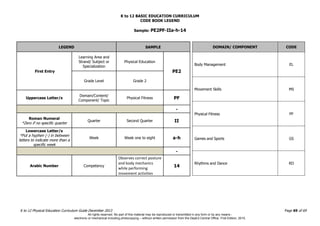
K to 12 BASIC EDUCATION CURRICULUM
K to 12 Physical Education Curriculum Guide December 2013 Page 2 of 69
CURRICULAR FRAMEWORK
K to 12 Basic Education Program: An Overview
Essentially, the K to 12 curriculum proposed in 2011 seeks to develop 21st century skills among its learners. These include the cognitive skills of critical thinking,
problem-solving and creative thinking; the social or interpersonal skills of communication, collaboration, leadership and cross-cultural skills; self- management skills of self-
monitoring and self-direction, as well as task or project management skills, and personal characteristics which are part of ethics, civic responsibility and accountability.
The Curricular Philosophy of the K to 12 PE Curriculum
Fitness and movement education content is the core of the K to 12 PE Curriculum. It includes value, knowledge, skills and experiences in physical activity
participation in order to (1) achieve and maintain health-related fitness (HRF), as well as (2) optimize health. In particular, it hopes to instill an understanding of why HRF is
important so that the learner can translate HRF knowledge into action. Thus, self-management is an important skill. In addition, this curriculum recognizes the view that
fitness and healthy physical activity (PA) behaviors must take the family and other environmental settings (e.g. school, community and larger society) into consideration. This
curricular orientation is a paradigm shift from the previous sports-dominated PE curriculum aimed at athletic achievement.
Move to learn is the context of physical activity as the means for learning, while Learn to move embodies the learning of skills, and techniques and the acquisition of
understanding that are requisites to participation in a variety of physical activities that include exercise, games, sports, dance and recreation.
Learning Outcomes
The K to 12 PE Curriculum develops the students’ skills in accessing, synthesizing and evaluating information, making informed decisions, enhancing and advocating
their own and others’ fitness and health. The knowledge, understanding and skills underpin the competence, confidence and commitment required ofall students to live an
active life for fitness and health.
The K to 12 PE Curriculum prioritizes the following standards:
1. Habitual physical activity participation to achieve and maintain health-enhancing levels of fitness.
2. Competence in movement and motor skills requisite to various physical activity performances.
3. Valuing physical activities for enjoyment, challenge, social interaction and career opportunities.
4. Understanding various movement concepts, principles, strategies and tactics as they apply to the learning of physical activity.
All rights reserved. No part of this material may be reproduced or transmitted in any form or by any means -
electronic or mechanical including photocopying – without written permission from the DepEd Central Office. First Edition, 2015.
K to 12 BASIC EDUCATION CURRICULUM
K to 12 Physical Education Curriculum Guide December 2013 Page 3 of 69
Learning Approaches
Physical literacy is consists of movement, motor- and activity-specific skills. In the early grades the learners are taught the ‘what,’ ‘why’ and ‘how’ of the movement.
This progresses to an understanding of the ‘why’ of the movement which is achieved by developing more mature movement patterns and motor skills in a wide range and
variety of exercise, sports and dance activities to specifically enhance fitness parameters. The learners builds on these knowledge and skills in order to plan, set goals and
monitor their participation in physical activities (exercise, sports and dance) and constantly evaluate how well they have integrated this their personal lifestyle. This implies
the provision of ongoing and developmentally-appropriate activities so that the learners can practice, create, apply and evaluate the knowledge, understanding and skills
necessary to maintain and enhance their own as well as others’ fitness and health through participation in physical activities.
The curriculum also allows for an inclusive approach that understands and respects the diverse range of learners; thus, the program takes into account their needs,
strengths and abilities. This is to ensure that all learners have equivalent opportunities and choices in Physical Education.
The curriculum emphasizes knowing the ‘what’, ‘how’ and ‘why’ of movement. It focuses on developing the learners’ understanding of how the body responds,
adjusts and adapts to physical activities. This will equip the learner to become self-regulated and self-directed as a result of knowing what should be done and actually doing
it; is the learners are equally confident in influencing their peers, family, immediate community, and ultimately, society. These are all valuable 21st century skills which the K
to 12 PE Curriculum aspires for the learners to develop.
Learning Strands
The program has five learning strands:
1. Body management which includes body awareness, space awareness, qualities and relationships of movements and how these are used dynamically in various physical
activities.
2. Movement skills related to the fundamental movement patterns and motor skills that form the basis of all physical activities.
3. Games and sports consisting of simple, lead-up and indigenous games; as well as individual, dual and team sports in competitive and recreational settings.
4. Rhythms and dances include rhythmical movement patterns; the promotion and appreciation of Philippine folk dance, indigenous and traditional dances as well as other
dance forms.
5. Physical fitness includes assessment through fitness tests and records, interpreting, planning and implementing appropriate programs that support fitness and health goals.
The acquisition of physical literacy serves as the foundation for lifelong physical activity participation which is critical to maintaining and promoting health. Thus, the
health strand in the senior high school (SHS) is seamlessly integrated in the PE curriculum. This strand optimizes the learner’s potential for health and wellbeing and
contributes to building healthy, active communities. Thus, the course title, Health-optimizing PE or H.O.P.E.
All rights reserved. No part of this material may be reproduced or transmitted in any form or by any means -
electronic or mechanical including photocopying – without written permission from the DepEd Central Office. First Edition, 2015.
K to 12 BASIC EDUCATION CURRICULUM
K to 12 Physical Education Curriculum Guide December 2013 Page 4 of 69
.
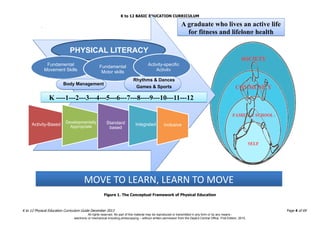
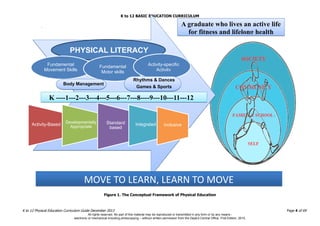
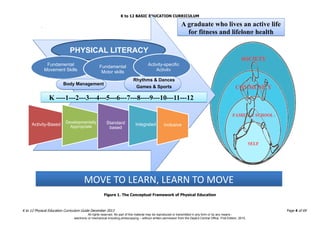
Figure 1. The Conceptual Framework of Physical Education
PHYSICAL LITERACY
Fundamental
Movement Skills
Fundamental
Motor skills
Activity-specific
Activity
Rhythms & Dances
Games & Sports
MOVE TO LEARN, LEARN TO MOVE
A graduate who lives an active life
for fitness and lifelong health
Body Management
K ----1---2---3---4---5---6---7---8----9---10---11---12
Activity-Based
Developmentally
Appropriate
Standard
based
Integrated Inclusive
All rights reserved. No part of this material may be reproduced or transmitted in any form or by any means -
electronic or mechanical including photocopying – without written permission from the DepEd Central Office. First Edition, 2015.
K to 12 BASIC EDUCATION CURRICULUM
K to 12 Physical Education Curriculum Guide December 2013 Page 5 of 69
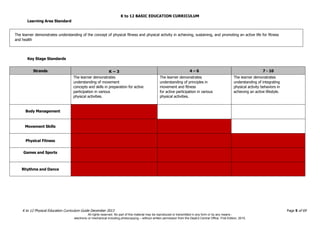
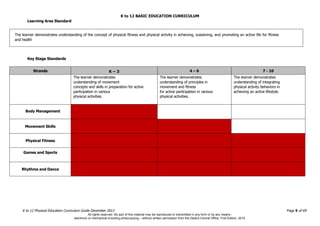
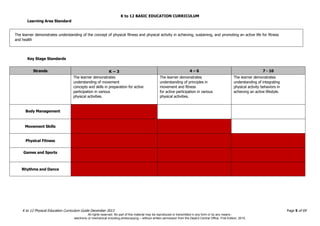
Learning Area Standard
The learner demonstrates understanding of the concept of physical fitness and physical activity in achieving, sustaining, and promoting an active life for fitness
and health
Key Stage Standards
Strands K – 3 4 – 6 7 - 10
The learner demonstrates
understanding of movement
concepts and skills in preparation for active
participation in various
physical activities.
The learner demonstrates
understanding of principles in
movement and fitness
for active participation in various
physical activities.
The learner demonstrates
understanding of integrating
physical activity behaviors in
achieving an active lifestyle.
Body Management
Movement Skills
Physical Fitness
Games and Sports
Rhythms and Dance
All rights reserved. No part of this material may be reproduced or transmitted in any form or by any means -
electronic or mechanical including photocopying – without written permission from the DepEd Central Office. First Edition, 2015.
K to 12 BASIC EDUCATION CURRICULUM
K to 12 Physical Education Curriculum Guide December 2013 Page 6 of 69
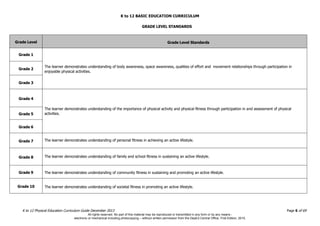
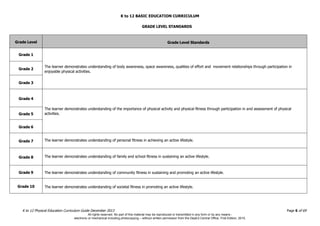
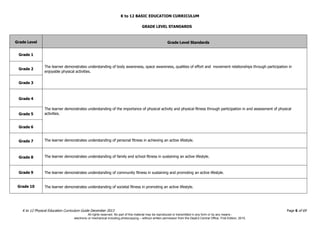
GRADE LEVEL STANDARDS
Grade Level Grade Level Standards
Grade 1
The learner demonstrates understanding of body awareness, space awareness, qualities of effort and movement relationships through participation in
enjoyable physical activities.
Grade 2
Grade 3
Grade 4
The learner demonstrates understanding of the importance of physical activity and physical fitness through participation in and assessment of physical
activities.Grade 5
Grade 6
Grade 7 The learner demonstrates understanding of personal fitness in achieving an active lifestyle.
Grade 8 The learner demonstrates understanding of family and school fitness in sustaining an active lifestyle.
Grade 9 The learner demonstrates understanding of community fitness in sustaining and promoting an active lifestyle.
Grade 10 The learner demonstrates understanding of societal fitness in promoting an active lifestyle.
All rights reserved. No part of this material may be reproduced or transmitted in any form or by any means -
electronic or mechanical including photocopying – without written permission from the DepEd Central Office. First Edition, 2015.
K to 12 BASIC EDUCATION CURRICULUM
K to 12 Physical Education Curriculum Guide December 2013 Page 7 of 69
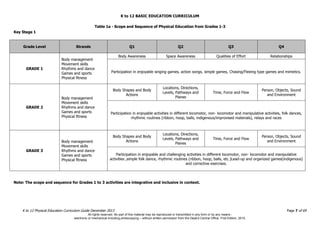
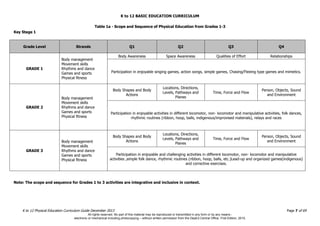
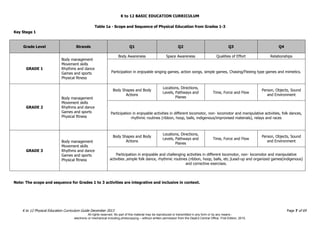
Table 1a - Scope and Sequence of Physical Education from Grades 1-3
Key Stage 1
Grade Level Strands Q1 Q2 Q3 Q4
GRADE 1
Body management
Movement skills
Rhythms and dance
Games and sports
Physical fitness
Body Awareness Space Awareness Qualities of Effort Relationships
Participation in enjoyable singing games, action songs, simple games, Chasing/Fleeing type games and mimetics.
GRADE 2
Body management
Movement skills
Rhythms and dance
Games and sports
Physical fitness
Body Shapes and Body
Actions
Locations, Directions,
Levels, Pathways and
Planes
Time, Force and Flow
Person, Objects, Sound
and Environment
Participation in enjoyable activities in different locomotor, non- locomotor and manipulative activities, folk dances,
rhythmic routines (ribbon, hoop, balls, indigenous/improvised materials), relays and races
GRADE 3
Body management
Movement skills
Rhythms and dance
Games and sports
Physical fitness
Body Shapes and Body
Actions
Locations, Directions,
Levels, Pathways and
Planes
Time, Force and Flow
Person, Objects, Sound
and Environment
Participation in enjoyable and challenging activities in different locomotor, non- locomotor and manipulative
activities ,simple folk dance, rhythmic routines (ribbon, hoop, balls, etc.)Lead-up and organized games(indigenous)
and corrective exercises.
Note: The scope and sequence for Grades 1 to 3 activities are integrative and inclusive in context.
All rights reserved. No part of this material may be reproduced or transmitted in any form or by any means -
electronic or mechanical including photocopying – without written permission from the DepEd Central Office. First Edition, 2015.
K to 12 BASIC EDUCATION CURRICULUM
K to 12 Physical Education Curriculum Guide December 2013 Page 8 of 69
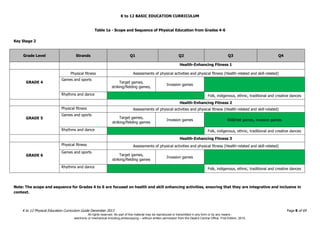
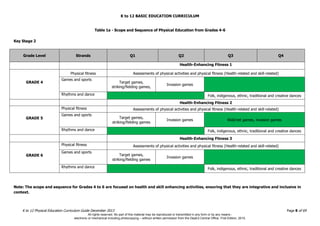
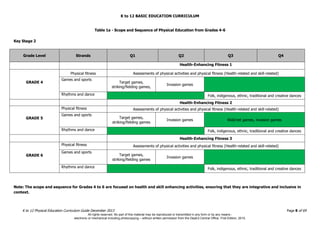
Table 1a - Scope and Sequence of Physical Education from Grades 4-6
Key Stage 2
Grade Level Strands Q1 Q2 Q3 Q4
Health-Enhancing Fitness 1
GRADE 4
Physical fitness Assessments of physical activities and physical fitness (Health-related and skill-related)
Games and sports
Target games,
striking/fielding games,
Invasion games
Rhythms and dance Folk, indigenous, ethnic, traditional and creative dances
Health-Enhancing Fitness 2
GRADE 5
Physical fitness Assessments of physical activities and physical fitness (Health-related and skill-related)
Games and sports
Target games,
striking/fielding games
Invasion games Wall/net games, invasion games
Rhythms and dance Folk, indigenous, ethnic, traditional and creative dances
Health-Enhancing Fitness 3
GRADE 6
Physical fitness Assessments of physical activities and physical fitness (Health-related and skill-related)
Games and sports
Target games,
striking/fielding games
Invasion games
Rhythms and dance Folk, indigenous, ethnic, traditional and creative dances
Note: The scope and sequence for Grades 4 to 6 are focused on health and skill enhancing activities, ensuring that they are integrative and inclusive in
context.
All rights reserved. No part of this material may be reproduced or transmitted in any form or by any means -
electronic or mechanical including photocopying – without written permission from the DepEd Central Office. First Edition, 2015.
K to 12 BASIC EDUCATION CURRICULUM
K to 12 Physical Education Curriculum Guide December 2013 Page 9 of 69
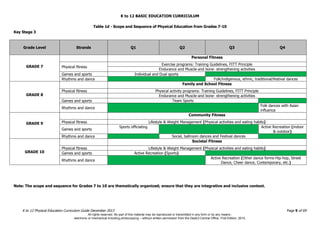
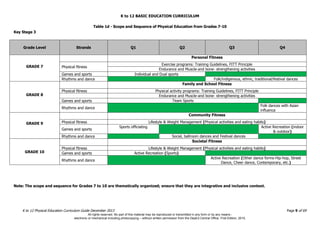
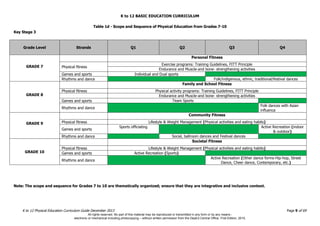
Table 1d - Scope and Sequence of Physical Education from Grades 7-10
Key Stage 3
Grade Level Strands Q1 Q2 Q3 Q4
GRADE 7
Personal Fitness
Physical fitness
Exercise programs: Training Guidelines, FITT Principle
Endurance and Muscle-and bone- strengthening activities
Games and sports Individual and Dual sports
Rhythms and dance Folk/indigenous, ethnic, traditional/festival dances
GRADE 8
Family and School Fitness
Physical fitness Physical activity programs: Training Guidelines, FITT Principle
Endurance and Muscle-and bone- strengthening activities
Games and sports Team Sports
Rhythms and dance
Folk dances with Asian
influence
GRADE 9
Community Fitness
Physical fitness Lifestyle & Weight Management (Physical activities and eating habits)
Games and sports
Sports officiating Active Recreation (indoor
& outdoor)
Rhythms and dance Social, ballroom dances and Festival dances
GRADE 10
Societal Fitness
Physical fitness Lifestyle & Weight Management (Physical activities and eating habits)
Games and sports Active Recreation (Sports)
Rhythms and dance
Active Recreation (Other dance forms-Hip-hop, Street
Dance, Cheer dance, Contemporary, etc.)
Note: The scope and sequence for Grades 7 to 10 are thematically organized; ensure that they are integrative and inclusive context.
All rights reserved. No part of this material may be reproduced or transmitted in any form or by any means -
electronic or mechanical including photocopying – without written permission from the DepEd Central Office. First Edition, 2015.
K to 12 BASIC EDUCATION CURRICULUM
K to 12 Physical Education Curriculum Guide December 2013 Page 10 of 69
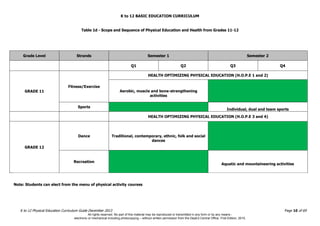
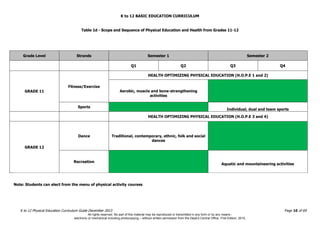
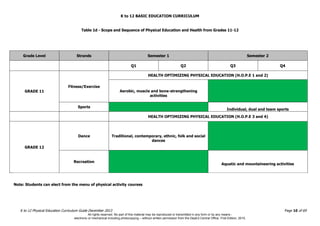
Table 1d - Scope and Sequence of Physical Education and Health from Grades 11-12
Grade Level Strands Semester 1 Semester 2
Q1 Q2 Q3 Q4
GRADE 11
Fitness/Exercise
HEALTH OPTIMIZING PHYSICAL EDUCATION (H.O.P.E 1 and 2)
Aerobic, muscle and bone-strengthening
activities
Sports
Individual, dual and team sports
HEALTH OPTIMIZING PHYSICAL EDUCATION (H.O.P.E 3 and 4)
GRADE 12
Dance Traditional, contemporary, ethnic, folk and social
dances
Recreation
Aquatic and mountaineering activities
Note: Students can elect from the menu of physical activity courses
All rights reserved. No part of this material may be reproduced or transmitted in any form or by any means -
electronic or mechanical including photocopying – without written permission from the DepEd Central Office. First Edition, 2015.
K to 12 BASIC EDUCATION CURRICULUM
K to 12 Physical Education Curriculum Guide December 2013 Page 11 of 69
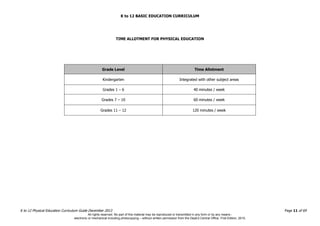
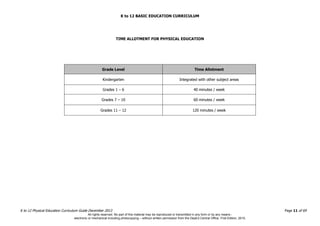
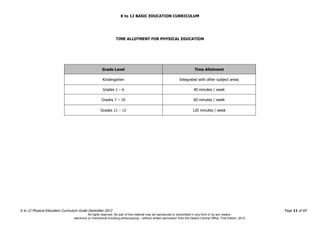
TIME ALLOTMENT FOR PHYSICAL EDUCATION
Grade Level Time Allotment
Kindergarten Integrated with other subject areas
Grades 1 – 6 40 minutes / week
Grades 7 – 10 60 minutes / week
Grades 11 – 12 120 minutes / week
All rights reserved. No part of this material may be reproduced or transmitted in any form or by any means -
electronic or mechanical including photocopying – without written permission from the DepEd Central Office. First Edition, 2015.
K to 12 BASIC EDUCATION CURRICULUM
K to 12 Physical Education Curriculum Guide December 2013 Page 12 of 69
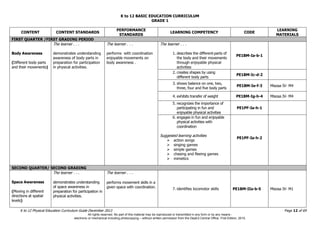
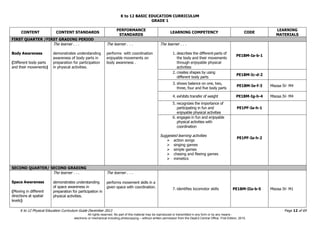
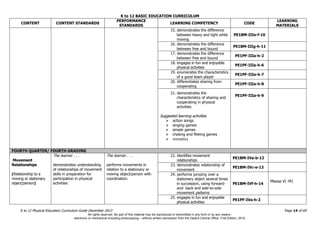
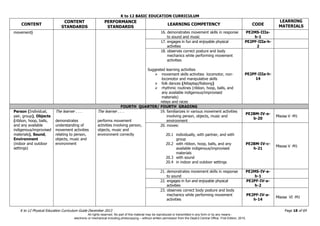
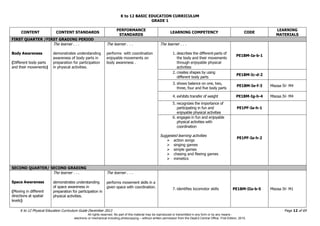
GRADE 1
CONTENT CONTENT STANDARDS
PERFORMANCE
STANDARDS
LEARNING COMPETENCY CODE
LEARNING
MATERIALS
FIRST QUARTER /FIRST GRADING PERIOD
Body Awareness
(Different body parts
and their movements)
The learner . . .
demonstrates understanding
awareness of body parts in
preparation for participation
in physical activities.
The learner . . .
performs with coordination
enjoyable movements on
body awareness .
The learner . . .
1. describes the different parts of
the body and their movements
through enjoyable physical
activities
PE1BM-Ia-b-1
2. creates shapes by using
different body parts
PE1BM-Ic-d-2
3. shows balance on one, two,
three, four and five body parts
PE1BM-Ie-f-3 Misosa IV- M4
4. exhibits transfer of weight PE1BM-Ig-h-4 Misosa IV- M4
5. recognizes the importance of
participating in fun and
enjoyable physical activities
PE1PF-Ia-h-1
6. engages in fun and enjoyable
physical activities with
coordination
Suggested learning activities
 action songs
 singing games
 simple games
 chasing and fleeing games
 mimetics
PE1PF-Ia-h-2
SECOND QUARTER/ SECOND GRADING
Space Awareness
(Moving in different
directions at spatial
levels)
The learner . . .
demonstrates understanding
of space awareness in
preparation for participation in
physical activities.
The learner . . .
performs movement skills in a
given space with coordination. 7. identifies locomotor skills PE1BM-IIa-b-5 Misosa IV- M1
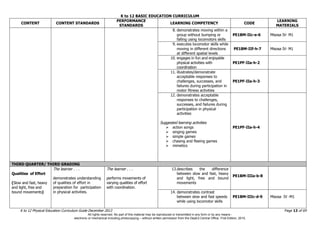
All rights reserved. No part of this material may be reproduced or transmitted in any form or by any means -
electronic or mechanical including photocopying – without written permission from the DepEd Central Office. First Edition, 2015.
K to 12 BASIC EDUCATION CURRICULUM
K to 12 Physical Education Curriculum Guide December 2013 Page 13 of 69
CONTENT CONTENT STANDARDS
PERFORMANCE
STANDARDS
LEARNING COMPETENCY CODE
LEARNING
MATERIALS
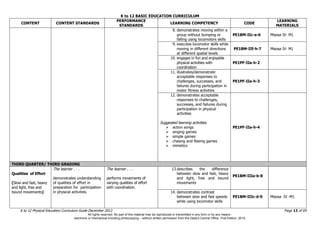
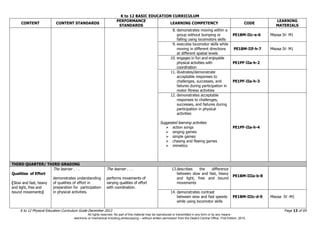
8. demonstrates moving within a
group without bumping or
falling using locomotors skills
PE1BM-IIc-e-6 Misosa IV- M1
9. executes locomotor skills while
moving in different directions
at different spatial levels
PE1BM-IIf-h-7 Misosa IV- M1
10. engages in fun and enjoyable
physical activities with
coordination
PE1PF-IIa-h-2
11. illustrates/demonstrate
acceptable responses to
challenges, successes, and
failures during participation in
motor fitness activities
PE1PF-IIa-h-3
12. demonstrates acceptable
responses to challenges,
successes, and failures during
participation in physical
activities
Suggested learning activities
 action songs
 singing games
 simple games
 chasing and fleeing games
 mimetics
PE1PF-IIa-h-4
THIRD QUARTER/ THIRD GRADING
Qualities of Effort
(Slow and fast, heavy
and light, free and
bound movements)
The learner . . .
demonstrates understanding
of qualities of effort in
preparation for participation
in physical activities.
The learner . . .
performs movements of
varying qualities of effort
with coordination.
13.describes the difference
between slow and fast, heavy
and light, free and bound
movements
PE1BM-IIIa-b-8
14. demonstrates contrast
between slow and fast speeds
while using locomotor skills
PE1BM-IIIc-d-9 Misosa IV -M1
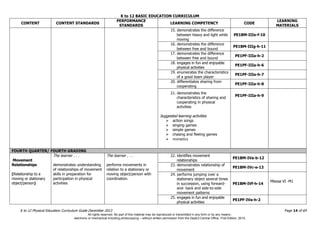
All rights reserved. No part of this material may be reproduced or transmitted in any form or by any means -
electronic or mechanical including photocopying – without written permission from the DepEd Central Office. First Edition, 2015.
K to 12 BASIC EDUCATION CURRICULUM
K to 12 Physical Education Curriculum Guide December 2013 Page 14 of 69
CONTENT CONTENT STANDARDS
PERFORMANCE
STANDARDS
LEARNING COMPETENCY CODE
LEARNING
MATERIALS
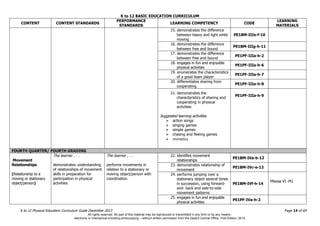
15. demonstrates the difference
between heavy and light while
moving
PE1BM-IIIe-f-10
16. demonstrates the difference
between free and bound
PE1BM-IIIg-h-11
17. demonstrates the difference
between free and bound
PE1PF-IIIa-h-2
18. engages in fun and enjoyable
physical activities
PE1PF-IIIa-h-6
19. enumerates the characteristics
of a good team player
PE1PF-IIIa-h-7
20. differentiates sharing from
cooperating
PE1PF-IIIa-h-8
21. demonstrates the
characteristics of sharing and
cooperating in physical
activities
Suggested learning activities
 action songs
 singing games
 simple games
 chasing and fleeing games
 mimetics
PE1PF-IIIa-h-9
FOURTH QUARTER/ FOURTH GRADING
Movement
Relationships
(Relationship to a
moving or stationary
object/person)
The learner . . .
demonstrates understanding
of relationships of movement
skills in preparation for
participation in physical
activities
The learner . . .
performs movements in
relation to a stationary or
moving object/person with
coordination.
22. identifies movement
relationships
PE1BM-IVa-b-12
23. demonstrates relationship of
movement
PE1BM-IVc-e-13
24. performs jumping over a
stationary object several times
in succession, using forward-
and- back and side-to-side
movement patterns
PE1BM-IVf-h-14
Misosa VI -M1
25. engages in fun and enjoyable
physical activities
PE1PF-IVa-h-2
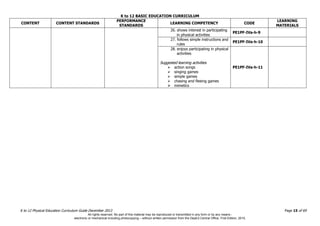
All rights reserved. No part of this material may be reproduced or transmitted in any form or by any means -
electronic or mechanical including photocopying – without written permission from the DepEd Central Office. First Edition, 2015.
K to 12 BASIC EDUCATION CURRICULUM
K to 12 Physical Education Curriculum Guide December 2013 Page 15 of 69
CONTENT CONTENT STANDARDS
PERFORMANCE
STANDARDS
LEARNING COMPETENCY CODE
LEARNING
MATERIALS
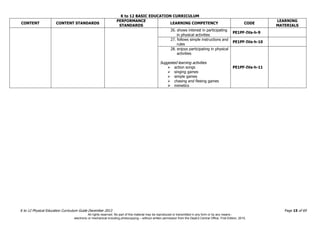
26. shows interest in participating
in physical activities
PE1PF-IVa-h-9
27. follows simple instructions and
rules
PE1PF-IVa-h-10
28. enjoys participating in physical
activities
Suggested learning activities
 action songs
 singing games
 simple games
 chasing and fleeing games
 mimetics
PE1PF-IVa-h-11
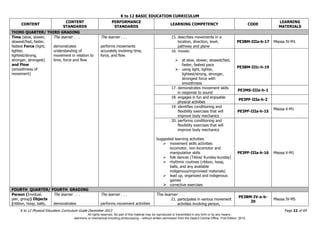
All rights reserved. No part of this material may be reproduced or transmitted in any form or by any means -
electronic or mechanical including photocopying – without written permission from the DepEd Central Office. First Edition, 2015.
K to 12 BASIC EDUCATION CURRICULUM
K to 12 Physical Education Curriculum Guide December 2013 Page 16 of 69
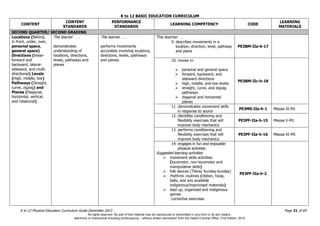
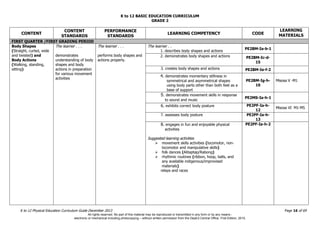
GRADE 2
CONTENT
CONTENT
STANDARDS
PERFORMANCE
STANDARDS
LEARNING COMPETENCY CODE
LEARNING
MATERIALS
FIRST QUARTER /FIRST GRADING PERIOD
Body Shapes
(Straight, curled, wide
and twisted) and
Body Actions
(Walking, standing,
sitting)
The learner . . .
demonstrates
understanding of body
shapes and body
actions in preparation
for various movement
activities
The learner . . .
performs body shapes and
actions properly.
The learner . .
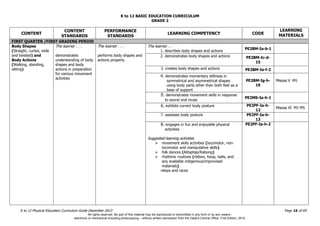
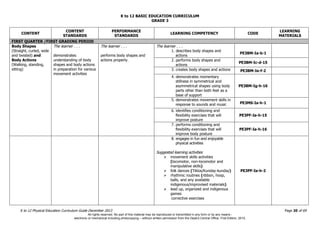
1. describes body shapes and actions
PE2BM-Ia-b-1
2. demonstrates body shapes and actions PE2BM-Ic-d-
15
3. creates body shapes and actions PE2BM-Ie-f-2
4. demonstrates momentary stillness in
symmetrical and asymmetrical shapes
using body parts other than both feet as a
base of support
PE2BM-Ig-h-
16
Misosa V -M1
5. demonstrates movement skills in response
to sound and music
PE2MS-Ia-h-1
6. exhibits correct body posture PE2PF-Ia-h-
12
Misosa VI M1-M5
7. assesses body posture PE2PF-Ia-h-
13
8. engages in fun and enjoyable physical
activities
Suggested learning activities
 movement skills activities (locomotor, non-
locomotor and manipulative skills)
 folk dances (Alitaptap/Rabong)
 rhythmic routines (ribbon, hoop, balls, and
any available indigenous/improvised
materials)
relays and races
PE2PF-Ia-h-2
All rights reserved. No part of this material may be reproduced or transmitted in any form or by any means -
electronic or mechanical including photocopying – without written permission from the DepEd Central Office. First Edition, 2015.
K to 12 BASIC EDUCATION CURRICULUM
K to 12 Physical Education Curriculum Guide December 2013 Page 17 of 69
CONTENT
CONTENT
STANDARDS
PERFORMANCE
STANDARDS
LEARNING COMPETENCY CODE
LEARNING
MATERIALS
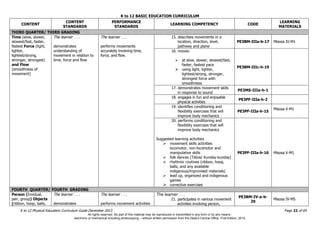
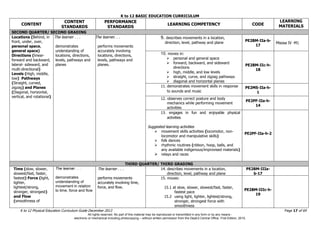
SECOND QUARTER/ SECOND GRADING
Locations (Behind, in
front, under, over,
personal space,
general space)
Directions (linear-
forward and backward,
lateral- sideward, and
multi-directional)
Levels (High, middle,
low) Pathways
(Straight, curved,
zigzag) and Planes
(Diagonal, horizontal,
vertical, and rotational)
Th The learner . . .
demonstrates
understanding of
locations, directions,
levels, pathways and
planes
ThThe learner. . .
performs movements
accurately involving
locations, directions,
levels, pathways and
planes.
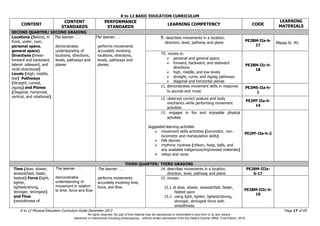
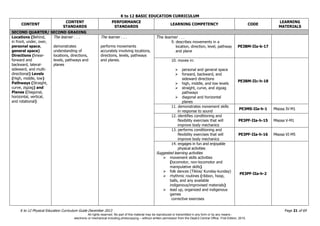
9. describes movements in a location,
direction, level, pathway and plane
PE2BM-IIa-b-
17
Misosa IV -M1
10. moves in:
 personal and general space
 forward, backward, and sideward
directions
 high, middle, and low levels
 straight, curve, and zigzag pathways
 diagonal and horizontal planes
PE2BM-IIc-h-
18
11. demonstrates movement skills in response
to sounds and music
PE2MS-IIa-h-
1
12. observes correct posture and body
mechanics while performing movement
activities
PE2PF-IIa-h-
14
13. engages in fun and enjoyable physical
activities
Suggested learning activities
 movement skills activities (locomotor, non-
locomotor and manipulative skills)
 folk dances
 rhythmic routines (ribbon, hoop, balls, and
any available indigenous/improvised materials)
 relays and races
PE2PF-IIa-h-2
THIRD QUARTER/ THIRD GRADING
Time (slow, slower,
slowest/fast, faster,
fastest) Force (light,
lighter,
lightest/strong,
stronger, strongest)
and Flow
(smoothness of
The learner . . .
demonstrates
understanding of
movement in relation
to time, force and flow
The learner . . .
performs movements
accurately involving time,
force, and flow.
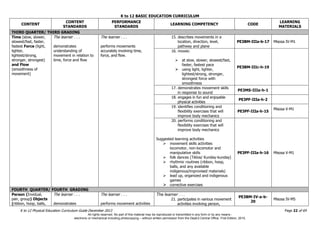
14. describes movements in a location,
direction, level, pathway and plane
PE2BM-IIIa-
b-17
15. moves:
15.1 at slow, slower, slowest/fast, faster,
fastest pace
15.2 using light, lighter, lightest/strong,
stronger, strongest force with
smoothness
PE2BM-IIIc-h-
19
All rights reserved. No part of this material may be reproduced or transmitted in any form or by any means -
electronic or mechanical including photocopying – without written permission from the DepEd Central Office. First Edition, 2015.
K to 12 BASIC EDUCATION CURRICULUM
K to 12 Physical Education Curriculum Guide December 2013 Page 18 of 69
CONTENT
CONTENT
STANDARDS
PERFORMANCE
STANDARDS
LEARNING COMPETENCY CODE
LEARNING
MATERIALS
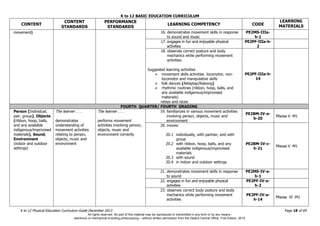
movement) 16. demonstrates movement skills in response
to sound and music
PE2MS-IIIa-
h-1
17. engages in fun and enjoyable physical
activities
PE2PF-IIIa-h-
2
18. observes correct posture and body
mechanics while performing movement
activities
Suggested learning activities
 movement skills activities locomotor, non-
locomotor and manipulative skills
 folk dances (Alitaptap/Rabong)
 rhythmic routines (ribbon, hoop, balls, and
any available indigenous/improvised
materials)
relays and races
PE2PF-IIIa-h-
14
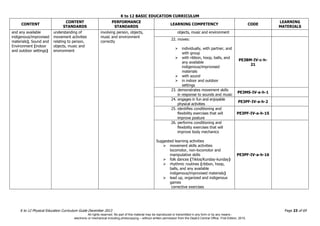
FOURTH QUARTER/ FOURTH GRADING
Person (Individual,
pair, group), Objects
(ribbon, hoop, balls,
and any available
indigenous/improvised
materials), Sound,
Environment
(indoor and outdoor
settings)
The learner . . .
demonstrates
understanding of
movement activities
relating to person,
objects, music and
environment
The learner . . .
performs movement
activities involving person,
objects, music and
environment correctly
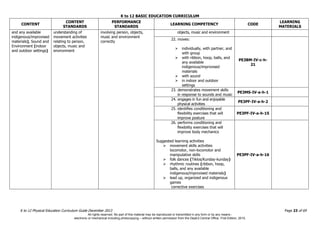
19. familiarizes in various movement activities
involving person, objects, music and
environment
PE2BM-IV-a-
b-20
Misosa V -M1
20. moves:
20.1 individually, with partner, and with
group
20.2 with ribbon, hoop, balls, and any
available indigenous/improvised
materials
20.3 with sound
20.4 in indoor and outdoor settings
PE2BM-IV-c-
h-21
Misosa V -M1
21. demonstrates movement skills in response
to sound
PE2MS-IV-a-
h-1
22. engages in fun and enjoyable physical
activities
PE2PF-IV-a-
h-2
23. observes correct body posture and body
mechanics while performing movement
activities
PE2PF-IV-a-
h-14
Misosa VI -M1
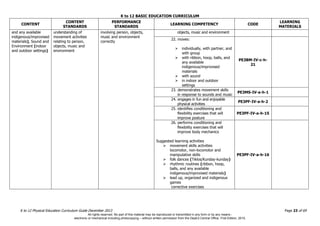
All rights reserved. No part of this material may be reproduced or transmitted in any form or by any means -
electronic or mechanical including photocopying – without written permission from the DepEd Central Office. First Edition, 2015.
K to 12 BASIC EDUCATION CURRICULUM
K to 12 Physical Education Curriculum Guide December 2013 Page 19 of 69
CONTENT
CONTENT
STANDARDS
PERFORMANCE
STANDARDS
LEARNING COMPETENCY CODE
LEARNING
MATERIALS
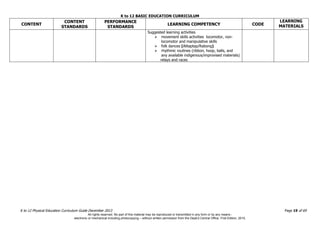
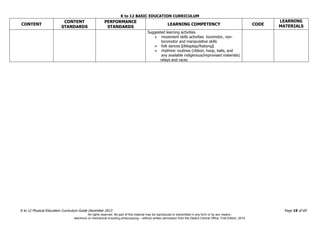
Suggested learning activities
 movement skills activities locomotor, non-
locomotor and manipulative skills
 folk dances (Alitaptap/Rabong)
 rhythmic routines (ribbon, hoop, balls, and
any available indigenous/improvised materials)
relays and races
All rights reserved. No part of this material may be reproduced or transmitted in any form or by any means -
electronic or mechanical including photocopying – without written permission from the DepEd Central Office. First Edition, 2015.
K to 12 BASIC EDUCATION CURRICULUM
K to 12 Physical Education Curriculum Guide December 2013 Page 20 of 69
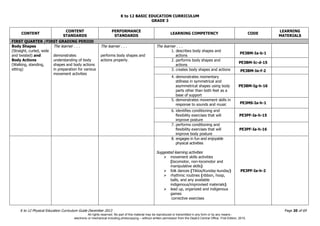
GRADE 3
CONTENT
CONTENT
STANDARDS
PERFORMANCE
STANDARDS
LEARNING COMPETENCY CODE
LEARNING
MATERIALS
FIRST QUARTER /FIRST GRADING PERIOD
Body Shapes
(Straight, curled, wide
and twisted) and
Body Actions
(Walking, standing,
sitting)
The learner . . .
demonstrates
understanding of body
shapes and body actions
in preparation for various
movement activities
The learner . . .
performs body shapes and
actions properly.
The learner . . .
1. describes body shapes and
actions
PE3BM-Ia-b-1
2. performs body shapes and
actions
PE3BM-Ic-d-15
3. creates body shapes and actions PE3BM-Ie-f-2
4. demonstrates momentary
stillness in symmetrical and
asymmetrical shapes using body
parts other than both feet as a
base of support
PE3BM-Ig-h-16
5. demonstrates movement skills in
response to sounds and music PE3MS-Ia-h-1
6. identifies conditioning and
flexibility exercises that will
improve posture
PE3PF-Ia-h-15
7. performs conditioning and
flexibility exercises that will
improve body posture
PE3PF-Ia-h-16
8. engages in fun and enjoyable
physical activities
Suggested learning activities
 movement skills activities
(locomotor, non-locomotor and
manipulative skills)
 folk dances (Tiklos/Kunday-kunday)
 rhythmic routines (ribbon, hoop,
balls, and any available
indigenous/improvised materials)
 lead up, organized and indigenous
games
corrective exercises
PE3PF-Ia-h-2
All rights reserved. No part of this material may be reproduced or transmitted in any form or by any means -
electronic or mechanical including photocopying – without written permission from the DepEd Central Office. First Edition, 2015.
K to 12 BASIC EDUCATION CURRICULUM
K to 12 Physical Education Curriculum Guide December 2013 Page 21 of 69
CONTENT
CONTENT
STANDARDS
PERFORMANCE
STANDARDS
LEARNING COMPETENCY CODE
LEARNING
MATERIALS
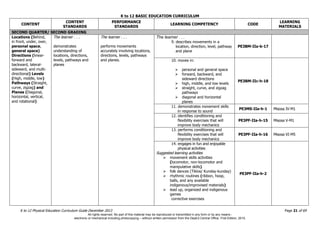
SECOND QUARTER/ SECOND GRADING
Locations (Behind,
in front, under, over,
personal space,
general space)
Directions (linear-
forward and
backward, lateral-
sideward, and multi-
directional) Levels
(High, middle, low)
Pathways (Straight,
curve, zigzag) and
Planes (Diagonal,
horizontal, vertical,
and rotational)
The learner . . .
demonstrates
understanding of
locations, directions,
levels, pathways and
planes
The learner . . .
performs movements
accurately involving locations,
directions, levels, pathways
and planes.
The learner . . .
9. describes movements in a
location, direction, level, pathway
and plane
PE3BM-IIa-b-17
10. moves in:
 personal and general space
 forward, backward, and
sideward directions
 high, middle, and low levels
 straight, curve, and zigzag
pathways
 diagonal and horizontal
planes
PE3BM-IIc-h-18
11. demonstrates movement skills
in response to sound
PE3MS-IIa-h-1 Misosa IV-M1
12. identifies conditioning and
flexibility exercises that will
improve body mechanics
PE3PF-IIa-h-15 Misosa V-M1
13. performs conditioning and
flexibility exercises that will
improve body mechanics
PE3PF-IIa-h-16 Misosa VI-M5
14. engages in fun and enjoyable
physical activities
Suggested learning activities
 movement skills activities
(locomotor, non-locomotor and
manipulative skills)
 folk dances (Tiklos/ Kunday-kunday)
 rhythmic routines (ribbon, hoop,
balls, and any available
indigenous/improvised materials)
 lead up, organized and indigenous
games
corrective exercises
PE3PF-IIa-h-2
All rights reserved. No part of this material may be reproduced or transmitted in any form or by any means -
electronic or mechanical including photocopying – without written permission from the DepEd Central Office. First Edition, 2015.
K to 12 BASIC EDUCATION CURRICULUM
K to 12 Physical Education Curriculum Guide December 2013 Page 22 of 69
CONTENT
CONTENT
STANDARDS
PERFORMANCE
STANDARDS
LEARNING COMPETENCY CODE
LEARNING
MATERIALS
THIRD QUARTER/ THIRD GRADING
Time (slow, slower,
slowest/fast, faster,
fastest Force (light,
lighter,
lightest/strong,
stronger, strongest)
and Flow
(smoothness of
movement)
The learner . . .
demonstrates
understanding of
movement in relation to
time, force and flow
The learner . . .
performs movements
accurately involving time,
force, and flow.
15. describes movements in a
location, direction, level,
pathway and plane
PE3BM-IIIa-b-17 Misosa IV-M1
16. moves:
 at slow, slower, slowest/fast,
faster, fastest pace
 using light, lighter,
lightest/strong, stronger,
strongest force with
smoothness
PE3BM-IIIc-h-19
17. demonstrates movement skills
in response to sound
PE3MS-IIIa-h-1
18. engages in fun and enjoyable
physical activities
PE3PF-IIIa-h-2
19. identifies conditioning and
flexibility exercises that will
improve body mechanics
PE3PF-IIIa-h-15
Misosa V-M1
20. performs conditioning and
flexibility exercises that will
improve body mechanics
Suggested learning activities
 movement skills activities
locomotor, non-locomotor and
manipulative skills
 folk dances (Tiklos/ Kunday-kunday)
 rhythmic routines (ribbon, hoop,
balls, and any available
indigenous/improvised materials)
 lead up, organized and indigenous
games
 corrective exercises
PE3PF-IIIa-h-16 Misosa V-M1
FOURTH QUARTER/ FOURTH GRADING
Person (Invidual,
pair, group) Objects
(ribbon, hoop, balls,
The learner . . .
demonstrates
The learner . . .
performs movement activities
The learner . . .
21. participates in various movement
activities involving person,
PE3BM-IV-a-b-
20
Misosa IV-M5
All rights reserved. No part of this material may be reproduced or transmitted in any form or by any means -
electronic or mechanical including photocopying – without written permission from the DepEd Central Office. First Edition, 2015.
K to 12 BASIC EDUCATION CURRICULUM
K to 12 Physical Education Curriculum Guide December 2013 Page 23 of 69
CONTENT
CONTENT
STANDARDS
PERFORMANCE
STANDARDS
LEARNING COMPETENCY CODE
LEARNING
MATERIALS
and any available
indigenous/improvised
materials), Sound and
Environment (indoor
and outdoor settings)
understanding of
movement activities
relating to person,
objects, music and
environment
involving person, objects,
music and environment
correctly
objects, music and environment
22. moves:
 individually, with partner, and
with group
 with ribbon, hoop, balls, and
any available
indigenous/improvised
materials
 with sound
 in indoor and outdoor
settings
PE3BM-IV-c-h-
21
23. demonstrates movement skills
in response to sounds and music
PE3MS-IV-a-h-1
24. engages in fun and enjoyable
physical activities
PE3PF-IV-a-h-2
25. identifies conditioning and
flexibility exercises that will
improve posture
PE3PF-IV-a-h-15
26. performs conditioning and
flexibility exercises that will
improve body mechanics
Suggested learning activities
 movement skills activities
locomotor, non-locomotor and
manipulative skills
 folk dances (Tiklos/Kunday-kunday)
 rhythmic routines (ribbon, hoop,
balls, and any available
indigenous/improvised materials)
 lead up, organized and indigenous
games
corrective exercises
PE3PF-IV-a-h-16
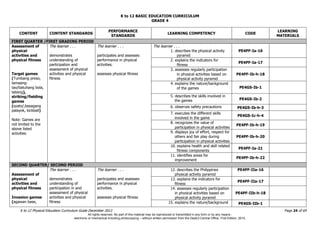
All rights reserved. No part of this material may be reproduced or transmitted in any form or by any means -
electronic or mechanical including photocopying – without written permission from the DepEd Central Office. First Edition, 2015.
K to 12 BASIC EDUCATION CURRICULUM
K to 12 Physical Education Curriculum Guide December 2013 Page 24 of 69
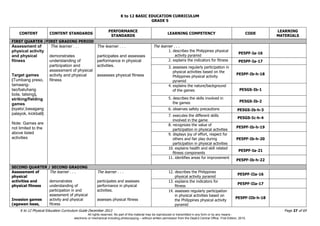
GRADE 4
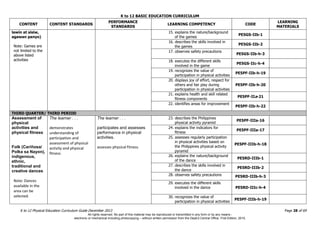
CONTENT CONTENT STANDARDS
PERFORMANCE
STANDARDS
LEARNING COMPETENCY CODE
LEARNING
MATERIALS
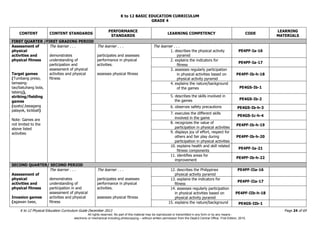
FIRST QUARTER /FIRST GRADING PERIOD
Assessment of
physical
activities and
physical fitness
Target games
(Tumbang preso,
tamaang-
tao/batuhang bola,
tatsing),
striking/fielding
games
(syato/,basagang
palayok, kickball)
Note: Games are
not limited to the
above listed
activities
The learner . . .
demonstrates
understanding of
participation and
assessment of physical
activities and physical
fitness
The learner . . .
participates and assesses
performance in physical
activities.
assesses physical fitness
The learner . . .
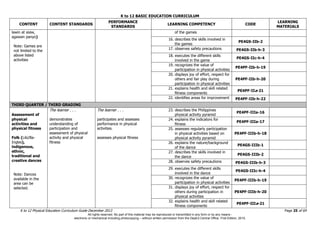
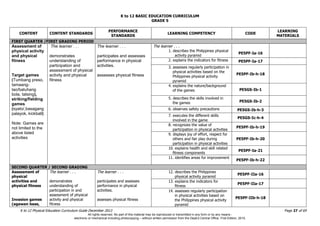
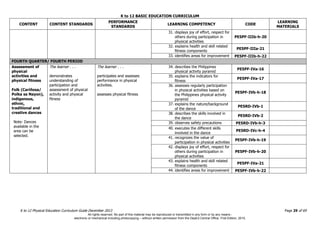
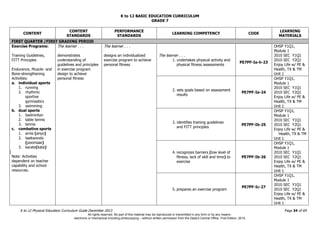
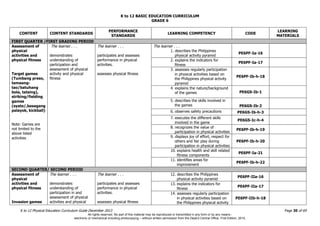
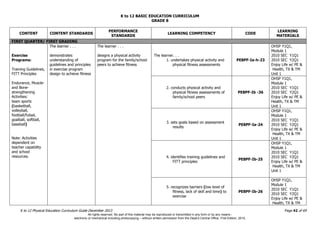
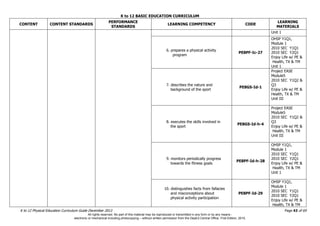
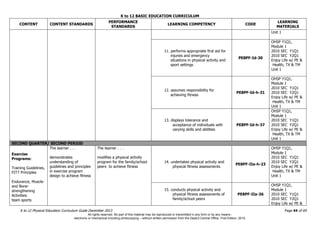
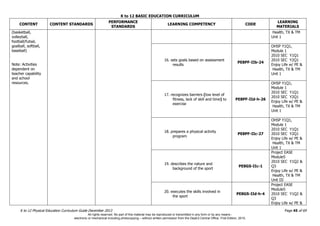
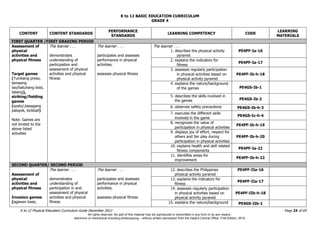
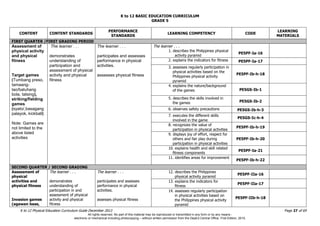
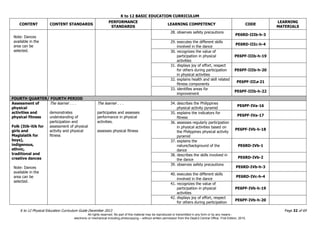
1. describes the physical activity
pyramid
PE4PF-Ia-16
2. explains the indicators for
fitness
PE4PF-Ia-17
3. assesses regularly participation
in physical activities based on
physical activity pyramid
PE4PF-Ib-h-18
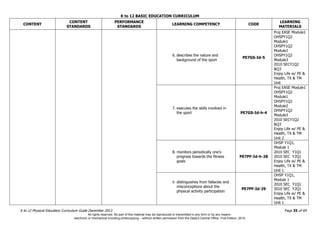
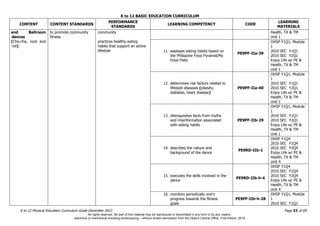
4. explains the nature/background
of the games PE4GS-Ib-1
5. describes the skills involved in
the games PE4GS-Ib-2
6. observes safety precautions PE4GS-Ib-h-3
7. executes the different skills
involved in the game
PE4GS-Ic-h-4
8. recognizes the value of
participation in physical activities
PE4PF-Ib-h-19
9. displays joy of effort, respect for
others and fair play during
participation in physical activities
PE4PF-Ib-h-20
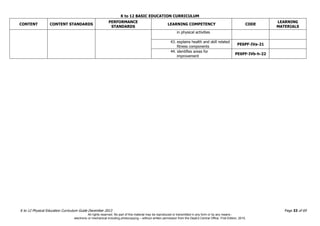
10. explains health and skill related
fitness components
PE4PF-Ia-21
11. identifies areas for
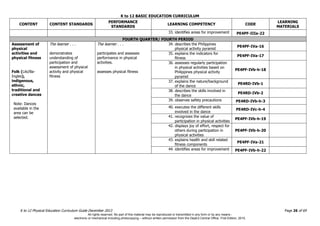
improvement
PE4PF-Ib-h-22
SECOND QUARTER/ SECOND PERIOD
Assessment of
physical
activities and
physical fitness
Invasion games
(agawan base,
The learner . . .
demonstrates
understanding of
participation in and
assessment of physical
activities and physical
fitness
The learner . . .
participates and assesses
performance in physical
activities.
assesses physical fitness
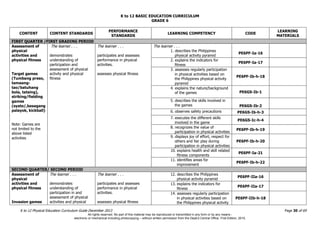
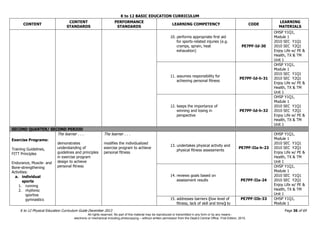
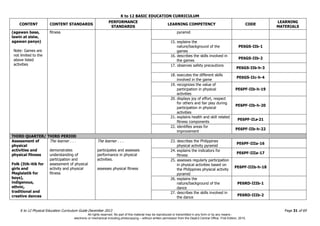
12. describes the Philippines
physical activity pyramid
PE4PF-IIa-16
13. explains the indicators for
fitness
PE4PF-IIa-17
14. assesses regularly participation
in physical activities based on
physical activity pyramid
PE4PF-IIb-h-18
15. explains the nature/background PE4GS-IIb-1
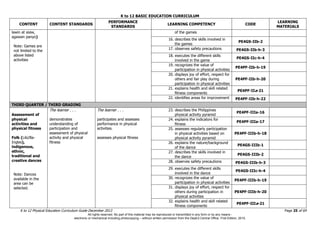
All rights reserved. No part of this material may be reproduced or transmitted in any form or by any means -
electronic or mechanical including photocopying – without written permission from the DepEd Central Office. First Edition, 2015.
K to 12 BASIC EDUCATION CURRICULUM
K to 12 Physical Education Curriculum Guide December 2013 Page 25 of 69
CONTENT CONTENT STANDARDS
PERFORMANCE
STANDARDS
LEARNING COMPETENCY CODE
LEARNING
MATERIALS
lawin at sisiw,
agawan panyo)
Note: Games are
not limited to the
above listed
activities
of the games
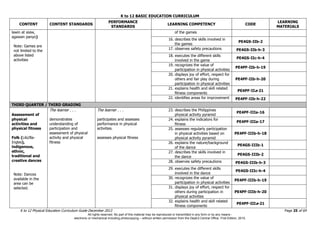
16. describes the skills involved in
the games
PE4GS-IIb-2
17. observes safety precautions PE4GS-IIb-h-3
18. executes the different skills
involved in the game
PE4GS-IIc-h-4
19. recognizes the value of
participation in physical activities
PE4PF-IIb-h-19
20. displays joy of effort, respect for
others and fair play during
participation in physical activities
PE4PF-IIb-h-20
21. explains health and skill related
fitness components
PE4PF-IIa-21
22. identifies areas for improvement PE4PF-IIb-h-22
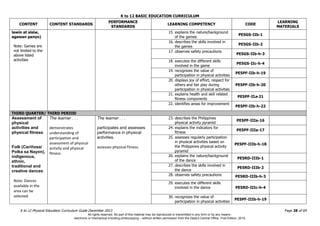
THIRD QUARTER / THIRD GRADING
Assessment of
physical
activities and
physical fitness
Folk (Liki/Ba-
Ingles),
indigenous,
ethnic,
traditional and
creative dances
Note: Dances
available in the
area can be
selected.
The learner . . .
demonstrates
understanding of
participation and
assessment of physical
activity and physical
fitness
The learner . . .
participates and assesses
performance in physical
activities.
assesses physical fitness
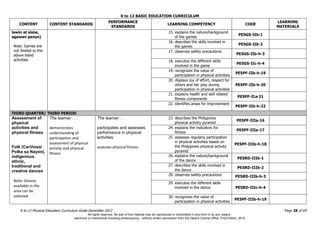
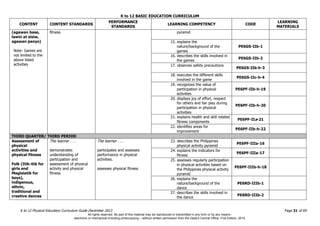
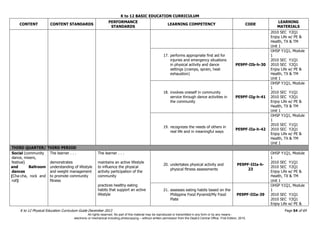
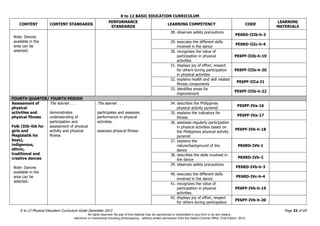
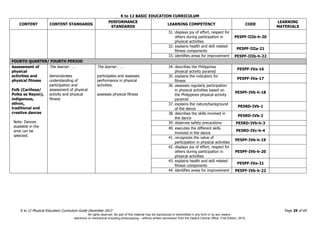
23. describes the Philippines
physical activity pyramid
PE4PF-IIIa-16
24. explains the indicators for
fitness
PE4PF-IIIa-17
25. assesses regularly participation
in physical activities based on
physical activity pyramid
PE4PF-IIIb-h-18
26. explains the nature/background
of the dance
PE4GS-IIIb-1
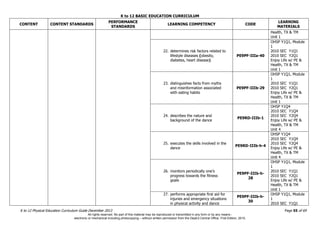
27. describes the skills involved in
the dance
PE4GS-IIIb-2
28. observes safety precautions PE4GS-IIIb-h-3
29. executes the different skills
involved in the dance
PE4GS-IIIc-h-4
30. recognizes the value of
participation in physical activities
PE4PF-IIIb-h-19
31. displays joy of effort, respect for
others during participation in
physical activities
PE4PF-IIIb-h-20
32. explains health and skill related
fitness components
PE4PF-IIIa-21
All rights reserved. No part of this material may be reproduced or transmitted in any form or by any means -
electronic or mechanical including photocopying – without written permission from the DepEd Central Office. First Edition, 2015.
K to 12 BASIC EDUCATION CURRICULUM
K to 12 Physical Education Curriculum Guide December 2013 Page 26 of 69
CONTENT CONTENT STANDARDS
PERFORMANCE
STANDARDS
LEARNING COMPETENCY CODE
LEARNING
MATERIALS
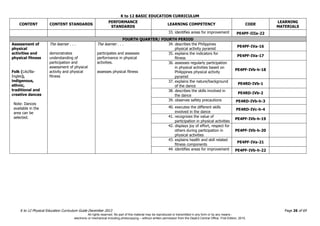
33. identifies areas for improvement PE4PF-IIIa-22
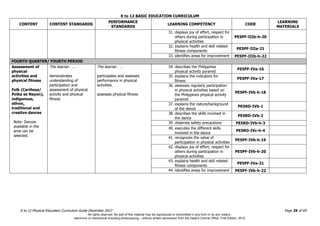
FOURTH QUARTER/ FOURTH PERIOD
Assessment of
physical
activities and
physical fitness
Folk (Liki/Ba-
Ingles),
indigenous,
ethnic,
traditional and
creative dances
Note: Dances
available in the
area can be
selected.
The learner . . .
demonstrates
understanding of
participation and
assessment of physical
activity and physical
fitness
The learner . . .
participates and assesses
performance in physical
activities.
assesses physical fitness
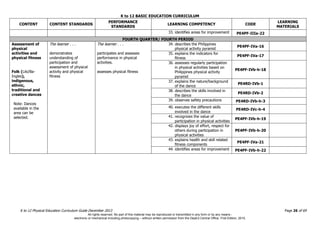
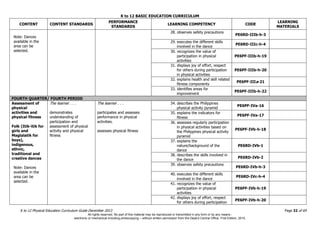
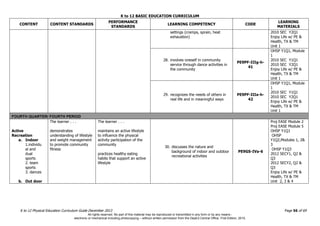
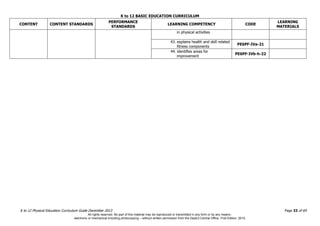
34. describes the Philippines
physical activity pyramid
PE4PF-IVa-16
35. explains the indicators for
fitness
PE4PF-IVa-17
36. assesses regularly participation
in physical activities based on
Philippines physical activity
pyramid
PE4PF-IVb-h-18
37. explains the nature/background
of the dance
PE4RD-IVb-1
38. describes the skills involved in
the dance
PE4RD-IVb-2
39. observes safety precautions PE4RD-IVb-h-3
40. executes the different skills
involved in the dance
PE4RD-IVc-h-4
41. recognizes the value of
participation in physical activities
PE4PF-IVb-h-19
42. displays joy of effort, respect for
others during participation in
physical activities
PE4PF-IVb-h-20
43. explains health and skill related
fitness components
PE4PF-IVa-21
44. identifies areas for improvement PE4PF-IVb-h-22
All rights reserved. No part of this material may be reproduced or transmitted in any form or by any means -
electronic or mechanical including photocopying – without written permission from the DepEd Central Office. First Edition, 2015.
K to 12 BASIC EDUCATION CURRICULUM
K to 12 Physical Education Curriculum Guide December 2013 Page 27 of 69
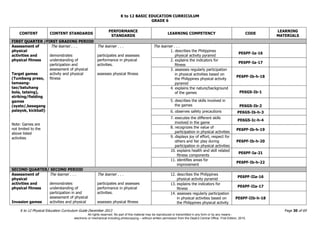
GRADE 5
CONTENT CONTENT STANDARDS
PERFORMANCE
STANDARDS
LEARNING COMPETENCY CODE
LEARNING
MATERIALS
FIRST QUARTER /FIRST GRADING PERIOD
Assessment of
physical activity
and physical
fitness
Target games
(Tumbang preso,
tamaang-
tao/batuhang
bola, tatsing),
striking/fielding
games
(syato/,basagang
palayok, kickball)
Note: Games are
not limited to the
above listed
activities
The learner . . .
demonstrates
understanding of
participation and
assessment of physical
activity and physical
fitness
The learner . . .
participates and assesses
performance in physical
activities.
assesses physical fitness
The learner . . .
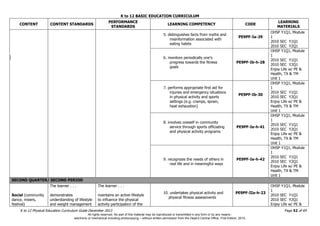
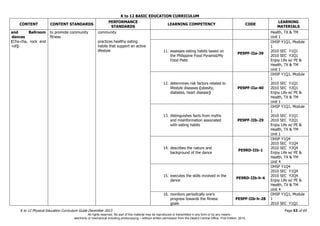
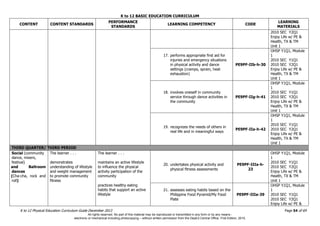
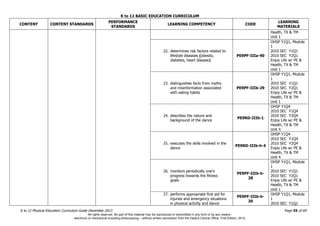
1. describes the Philippines physical
activity pyramid
PE5PF-Ia-16
2. explains the indicators for fitness PE5PF-Ia-17
3. assesses regularly participation in
physical activities based on the
Philippines physical activity
pyramid
PE5PF-Ib-h-18
4. explains the nature/background
of the games PE5GS-Ib-1
5. describes the skills involved in
the games PE5GS-Ib-2
6. observes safety precautions PE5GS-Ib-h-3
7. executes the different skills
involved in the game
PE5GS-Ic-h-4
8. recognizes the value of
participation in physical activities
PE5PF-Ib-h-19
9. displays joy of effort, respect for
others and fair play during
participation in physical activities
PE5PF-Ib-h-20
10. explains health and skill related
fitness components
PE5PF-Ia-21
11. identifies areas for improvement
PE5PF-Ib-h-22
SECOND QUARTER / SECOND GRADING
Assessment of
physical
activities and
physical fitness
Invasion games
(agawan base,
The learner . . .
demonstrates
understanding of
participation in and
assessment of physical
activity and physical
fitness
The learner . . .
participates and assesses
performance in physical
activities.
assesses physical fitness
12. describes the Philippines
physical activity pyramid
PE5PF-IIa-16
13. explains the indicators for
fitness
PE5PF-IIa-17
14. assesses regularly participation
in physical activities based on
the Philippines physical activity
pyramid
PE5PF-IIb-h-18
All rights reserved. No part of this material may be reproduced or transmitted in any form or by any means -
electronic or mechanical including photocopying – without written permission from the DepEd Central Office. First Edition, 2015.
K to 12 BASIC EDUCATION CURRICULUM
K to 12 Physical Education Curriculum Guide December 2013 Page 28 of 69
CONTENT CONTENT STANDARDS
PERFORMANCE
STANDARDS
LEARNING COMPETENCY CODE
LEARNING
MATERIALS
lawin at sisiw,
agawan panyo)
Note: Games are
not limited to the
above listed
activities
15. explains the nature/background
of the games
PE5GS-IIb-1
16. describes the skills involved in
the games
PE5GS-IIb-2
17. observes safety precautions
PE5GS-IIb-h-3
18. executes the different skills
involved in the game
PE5GS-IIc-h-4
19. recognizes the value of
participation in physical activities
PE5PF-IIb-h-19
20. displays joy of effort, respect for
others and fair play during
participation in physical activities
PE5PF-IIb-h-20
21. explains health and skill related
fitness components
PE5PF-IIa-21
22. identifies areas for improvement
PE5PF-IIb-h-22
THIRD QUARTER/ THIRD PERIOD
Assessment of
physical
activities and
physical fitness
Folk (Cariñosa/
Polka sa Nayon),
indigenous,
ethnic,
traditional and
creative dances
Note: Dances
available in the
area can be
selected.
The learner . . .
demonstrates
understanding of
participation and
assessment of physical
activity and physical
fitness
The learner . . .
participates and assesses
performance in physical
activities.
assesses physical fitness
23. describes the Philippines
physical activity pyramid
PE5PF-IIIa-16
24. explains the indicators for
fitness
PE5PF-IIIa-17
25. assesses regularly participation
in physical activities based on
the Philippines physical activity
pyramid
PE5PF-IIIb-h-18
26. explains the nature/background
of the dance
PE5RD-IIIb-1
27. describes the skills involved in
the dance
PE5RD-IIIb-2
28. observes safety precautions PE5RD-IIIb-h-3
29. executes the different skills
involved in the dance PE5RD-IIIc-h-4
30. recognizes the value of
participation in physical activities
PE5PF-IIIb-h-19
All rights reserved. No part of this material may be reproduced or transmitted in any form or by any means -
electronic or mechanical including photocopying – without written permission from the DepEd Central Office. First Edition, 2015.
K to 12 BASIC EDUCATION CURRICULUM
K to 12 Physical Education Curriculum Guide December 2013 Page 29 of 69
CONTENT CONTENT STANDARDS
PERFORMANCE
STANDARDS
LEARNING COMPETENCY CODE
LEARNING
MATERIALS
31. displays joy of effort, respect for
others during participation in
physical activities
PE5PF-IIIb-h-20
32. explains health and skill related
fitness components
PE5PF-IIIa-21
33. identifies areas for improvement PE5PF-IIIb-h-22
FOURTH QUARTER/ FOURTH PERIOD
Assessment of
physical
activities and
physical fitness
Folk (Cariñosa/
Polka sa Nayon),
indigenous,
ethnic,
traditional and
creative dances
Note: Dances
available in the
area can be
selected.
The learner . . .
demonstrates
understanding of
participation and
assessment of physical
activity and physical
fitness
The learner . . .
participates and assesses
performance in physical
activities.
assesses physical fitness
34. describes the Philippines
physical activity pyramid
PE5PF-IVa-16
35. explains the indicators for
fitness
PE5PF-IVa-17
36. assesses regularly participation
in physical activities based on
the Philippines physical activity
pyramid
PE5PF-IVb-h-18
37. explains the nature/background
of the dance
PE5RD-IVb-1
38. describes the skills involved in
the dance
PE5RD-IVb-2
39. observes safety precautions PE5RD-IVb-h-3
40. executes the different skills
involved in the dance
PE5RD-IVc-h-4
41. recognizes the value of
participation in physical activities
PE5PF-IVb-h-19
42. displays joy of effort, respect for
others during participation in
physical activities
PE5PF-IVb-h-20
43. explains health and skill related
fitness components
PE5PF-IVa-21
44. identifies areas for improvement PE5PF-IVb-h-22
All rights reserved. No part of this material may be reproduced or transmitted in any form or by any means -
electronic or mechanical including photocopying – without written permission from the DepEd Central Office. First Edition, 2015.
K to 12 BASIC EDUCATION CURRICULUM
K to 12 Physical Education Curriculum Guide December 2013 Page 30 of 69
GRADE 6
CONTENT CONTENT STANDARDS
PERFORMANCE
STANDARDS
LEARNING COMPETENCY CODE
LEARNING
MATERIALS
FIRST QUARTER /FIRST GRADING PERIOD
Assessment of
physical
activities and
physical fitness
Target games
(Tumbang preso,
tamaang-
tao/batuhang
bola, tatsing),
striking/fielding
games
(syato/,basagang
palayok, kickball)
Note: Games are
not limited to the
above listed
activities
The learner . . .
demonstrates
understanding of
participation and
assessment of physical
activity and physical
fitness
The learner . . .
participates and assesses
performance in physical
activities.
assesses physical fitness
The learner . . .
1. describes the Philippines
physical activity pyramid
PE6PF-Ia-16
2. explains the indicators for
fitness
PE6PF-Ia-17
3. assesses regularly participation
in physical activities based on
the Philippines physical activity
pyramid
PE6PF-Ib-h-18
4. explains the nature/background
of the games PE6GS-Ib-1
5. describes the skills involved in
the games PE6GS-Ib-2
6. observes safety precautions PE6GS-Ib-h-3
7. executes the different skills
involved in the game
PE6GS-Ic-h-4
8. recognizes the value of
participation in physical activities
PE6PF-Ib-h-19
9. displays joy of effort, respect for
others and fair play during
participation in physical activities
PE6PF-Ib-h-20
10. explains health and skill related
fitness components
PE6PF-Ia-21
11. identifies areas for
improvement
PE6PF-Ib-h-22
SECOND QUARTER/ SECOND PERIOD
Assessment of
physical
activities and
physical fitness
Invasion games
The learner . . .
demonstrates
understanding of
participation in and
assessment of physical
activities and physical
The learner . . .
participates and assesses
performance in physical
activities.
assesses physical fitness
12. describes the Philippines
physical activity pyramid
PE6PF-IIa-16
13. explains the indicators for
fitness
PE6PF-IIa-17
14. assesses regularly participation
in physical activities based on
the Philippines physical activity
PE6PF-IIb-h-18
All rights reserved. No part of this material may be reproduced or transmitted in any form or by any means -
electronic or mechanical including photocopying – without written permission from the DepEd Central Office. First Edition, 2015.
K to 12 BASIC EDUCATION CURRICULUM
K to 12 Physical Education Curriculum Guide December 2013 Page 31 of 69
CONTENT CONTENT STANDARDS
PERFORMANCE
STANDARDS
LEARNING COMPETENCY CODE
LEARNING
MATERIALS
(agawan base,
lawin at sisiw,
agawan panyo)
Note: Games are
not limited to the
above listed
activities
fitness pyramid
15. explains the
nature/background of the
games
PE6GS-IIb-1
16. describes the skills involved in
the games
PE6GS-IIb-2
17. observes safety precautions
PE6GS-IIb-h-3
18. executes the different skills
involved in the game
PE6GS-IIc-h-4
19. recognizes the value of
participation in physical
activities
PE6PF-IIb-h-19
20. displays joy of effort, respect
for others and fair play during
participation in physical
activities
PE6PF-IIb-h-20
21. explains health and skill related
fitness components
PE6PF-IIa-21
22. identifies areas for
improvement
PE6PF-IIb-h-22
THIRD QUARTER/ THIRD PERIOD
Assessment of
physical
activities and
physical fitness
Folk (Itik-itik for
girls and
Maglalatik for
boys),
indigenous,
ethnic,
traditional and
creative dances
The learner . . .
demonstrates
understanding of
participation and
assessment of physical
activity and physical
fitness
The learner . . .
participates and assesses
performance in physical
activities.
assesses physical fitness
23. describes the Philippines
physical activity pyramid
PE6PF-IIIa-16
24. explains the indicators for
fitness
PE6PF-IIIa-17
25. assesses regularly participation
in physical activities based on
the Philippines physical activity
pyramid
PE6PF-IIIb-h-18
26. explains the
nature/background of the
dance
PE6RD-IIIb-1
27. describes the skills involved in
the dance
PE6RD-IIIb-2
All rights reserved. No part of this material may be reproduced or transmitted in any form or by any means -
electronic or mechanical including photocopying – without written permission from the DepEd Central Office. First Edition, 2015.
K to 12 BASIC EDUCATION CURRICULUM
K to 12 Physical Education Curriculum Guide December 2013 Page 32 of 69
CONTENT CONTENT STANDARDS
PERFORMANCE
STANDARDS
LEARNING COMPETENCY CODE
LEARNING
MATERIALS
Note: Dances
available in the
area can be
selected.
28. observes safety precautions
PE6RD-IIIb-h-3
29. executes the different skills
involved in the dance
PE6RD-IIIc-h-4
30. recognizes the value of
participation in physical
activities
PE6PF-IIIb-h-19
31. displays joy of effort, respect
for others during participation
in physical activities
PE6PF-IIIb-h-20
32. explains health and skill related
fitness components
PE6PF-IIIa-21
33. identifies areas for
improvement
PE6PF-IIIb-h-22
FOURTH QUARTER/ FOURTH PERIOD
Assessment of
physical
activities and
physical fitness
Folk (Itik-itik for
girls and
Maglalatik for
boys),
indigenous,
ethnic,
traditional and
creative dances
Note: Dances
available in the
area can be
selected.
The learner . . .
demonstrates
understanding of
participation and
assessment of physical
activity and physical
fitness
The learner . . .
participates and assesses
performance in physical
activities.
assesses physical fitness
34. describes the Philippines
physical activity pyramid
PE6PF-IVa-16
35. explains the indicators for
fitness
PE6PF-IVa-17
36. assesses regularly participation
in physical activities based on
the Philippines physical activity
pyramid
PE6PF-IVb-h-18
37. explains the
nature/background of the
dance
PE6RD-IVb-1
38. describes the skills involved in
the dance
PE6RD-IVb-2
39. observes safety precautions
PE6RD-IVb-h-3
40. executes the different skills
involved in the dance
PE6RD-IVc-h-4
41. recognizes the value of
participation in physical
activities
PE6PF-IVb-h-19
42. displays joy of effort, respect
for others during participation
PE6PF-IVb-h-20
All rights reserved. No part of this material may be reproduced or transmitted in any form or by any means -
electronic or mechanical including photocopying – without written permission from the DepEd Central Office. First Edition, 2015.
K to 12 BASIC EDUCATION CURRICULUM
K to 12 Physical Education Curriculum Guide December 2013 Page 33 of 69
CONTENT CONTENT STANDARDS
PERFORMANCE
STANDARDS
LEARNING COMPETENCY CODE
LEARNING
MATERIALS
in physical activities
43. explains health and skill related
fitness components
PE6PF-IVa-21
44. identifies areas for
improvement
PE6PF-IVb-h-22
All rights reserved. No part of this material may be reproduced or transmitted in any form or by any means -
electronic or mechanical including photocopying – without written permission from the DepEd Central Office. First Edition, 2015.
K to 12 BASIC EDUCATION CURRICULUM
K to 12 Physical Education Curriculum Guide December 2013 Page 34 of 69
GRADE 7
CONTENT
CONTENT
STANDARDS
PERFORMANCE
STANDARDS
LEARNING COMPETENCY CODE
LEARNING
MATERIALS
FIRST QUARTER /FIRST GRADING PERIOD
Exercise Programs:
Training Guidelines,
FITT Principles
Endurance, Muscle- and
Bone-strengthening
Activities:
a. individual sports
1. running
2. rhythmic
sportive
gymnastics
3. swimming
b. dual sports
1. badminton
2. table tennis
3. tennis
c. combative sports
1. arnis (anyo)
2. taekwondo
(poomsae)
3. karate(kata)
Note: Activities
dependent on teacher
capability and school
resources.
The learner . . .
demonstrates
understanding of
guidelines and principles
in exercise program
design to achieve
personal fitness
The learner . . .
designs an individualized
exercise program to achieve
personal fitness
The learner . . .
1. undertakes physical activity and
physical fitness assessments
PE7PF-Ia-h-23
OHSP Y1Q1,
Module 1
2010 SEC Y1Q1
2010 SEC Y2Q1
Enjoy Life w/ PE &
Health, TX & TM
Unit 1
2. sets goals based on assessment
results
PE7PF-Ia-24
OHSP Y1Q1,
Module 1
2010 SEC Y1Q1
2010 SEC Y2Q1
Enjoy Life w/ PE &
Health, TX & TM
Unit 1
3. identifies training guidelines
and FITT principles
PE7PF-Ib-25
OHSP Y1Q1,
Module 1
2010 SEC Y1Q1
2010 SEC Y2Q1
Enjoy Life w/ PE &
Health, TX & TM
Unit 1
4. recognizes barriers (low level of
fitness, lack of skill and time) to
exercise
PE7PF-Ib-26
OHSP Y1Q1,
Module 1
2010 SEC Y1Q1
2010 SEC Y2Q1
Enjoy Life w/ PE &
Health, TX & TM
Unit 1
5. prepares an exercise program
PE7PF-Ic-27
OHSP Y1Q1,
Module 1
2010 SEC Y1Q1
2010 SEC Y2Q1
Enjoy Life w/ PE &
Health, TX & TM
Unit 1
All rights reserved. No part of this material may be reproduced or transmitted in any form or by any means -
electronic or mechanical including photocopying – without written permission from the DepEd Central Office. First Edition, 2015.
K to 12 BASIC EDUCATION CURRICULUM
K to 12 Physical Education Curriculum Guide December 2013 Page 35 of 69
CONTENT
CONTENT
STANDARDS
PERFORMANCE
STANDARDS
LEARNING COMPETENCY CODE
LEARNING
MATERIALS
6. describes the nature and
background of the sport
PE7GS-Id-5
Proj EASE Module1
OHSPY1Q2
Module1
OHSPY1Q2
Module2
OHSPY1Q2
Module3
2010 SECY1Q2
&Q3
Enjoy Life w/ PE &
Health, TX & TM
Unit
7. executes the skills involved in
the sport PE7GS-Id-h-4
Proj EASE Module1
OHSPY1Q2
Module1
OHSPY1Q2
Module2
OHSPY1Q2
Module3
2010 SECY1Q2
&Q3
Enjoy Life w/ PE &
Health, TX & TM
Unit 2
8. monitors periodically one’s
progress towards the fitness
goals
PE7PF-Id-h-28
OHSP Y1Q1,
Module 1
2010 SEC Y1Q1
2010 SEC Y2Q1
Enjoy Life w/ PE &
Health, TX & TM
Unit 1
9. distinguishes from fallacies and
misconceptions about the
physical activity participation
PE7PF-Id-29
OHSP Y1Q1,
Module 1
2010 SEC Y1Q1
2010 SEC Y2Q1
Enjoy Life w/ PE &
Health, TX & TM
Unit 1
All rights reserved. No part of this material may be reproduced or transmitted in any form or by any means -
electronic or mechanical including photocopying – without written permission from the DepEd Central Office. First Edition, 2015.
K to 12 BASIC EDUCATION CURRICULUM
K to 12 Physical Education Curriculum Guide December 2013 Page 36 of 69
CONTENT
CONTENT
STANDARDS
PERFORMANCE
STANDARDS
LEARNING COMPETENCY CODE
LEARNING
MATERIALS
10. performs appropriate first aid
for sports-related injuries (e.g.
cramps, sprain, heat
exhaustion)
PE7PF-Id-30
OHSP Y1Q1,
Module 1
2010 SEC Y1Q1
2010 SEC Y2Q1
Enjoy Life w/ PE &
Health, TX & TM
Unit 1
11. assumes responsibility for
achieving personal fitness
PE7PF-Id-h-31
OHSP Y1Q1,
Module 1
2010 SEC Y1Q1
2010 SEC Y2Q1
Enjoy Life w/ PE &
Health, TX & TM
Unit 1
12. keeps the importance of
winning and losing in
perspective
PE7PF-Id-h-32
OHSP Y1Q1,
Module 1
2010 SEC Y1Q1
2010 SEC Y2Q1
Enjoy Life w/ PE &
Health, TX & TM
Unit 1
SECOND QUARTER/ SECOND PERIOD
Exercise Programs:
Training Guidelines,
FITT Principles
Endurance, Muscle- and
Bone-strengthening
Activities:
a. individual
sports
1. running
2. rhythmic
sportive
gymnastics
The learner . . .
demonstrates
understanding of
guidelines and principles
in exercise program
design to achieve
personal fitness
The learner . . .
modifies the individualized
exercise program to achieve
personal fitness
13. undertakes physical activity and
physical fitness assessments
PE7PF-IIa-h-23
OHSP Y1Q1,
Module 1
2010 SEC Y1Q1
2010 SEC Y2Q1
Enjoy Life w/ PE &
Health, TX & TM
Unit 1
14. reviews goals based on
assessment results PE7PF-IIa-24
OHSP Y1Q1,
Module 1
2010 SEC Y1Q1
2010 SEC Y2Q1
Enjoy Life w/ PE &
Health, TX & TM
Unit 1
15. addresses barriers (low level of
fitness, lack of skill and time) to
PE7PF-IIb-33 OHSP Y1Q1,
Module 1
All rights reserved. No part of this material may be reproduced or transmitted in any form or by any means -
electronic or mechanical including photocopying – without written permission from the DepEd Central Office. First Edition, 2015.
K to 12 BASIC EDUCATION CURRICULUM
K to 12 Physical Education Curriculum Guide December 2013 Page 37 of 69
CONTENT
CONTENT
STANDARDS
PERFORMANCE
STANDARDS
LEARNING COMPETENCY CODE
LEARNING
MATERIALS
3. swimming
b. dual sports
1. badminton
2. table tennis
3. tennis
c. combative sports
1. arnis (anyo)
2. taekwondo
(poomsae)
3. karate (kata)
Note: Activities
dependent on teacher
capability and school
resources.
exercise 2010 SEC Y1Q1
2010 SEC Y2Q1
Enjoy Life w/ PE &
Health, TX & TM
Unit 1
16. describes the nature and
background of the sport
PE7GS-IId-5
Proj EASE Module1
OHSPY1Q2
Module1
OHSPY1Q2
Module2
OHSPY1Q2
Module3
2010 SECY1Q2
&Q3
Enjoy Life w/ PE &
Health, TX & TM
Unit 2
17. executes the skills involved in
the sport
PE7GS-IId-h-4
Proj EASE Module1
OHSPY1Q2
Module1
OHSPY1Q2
Module2
OHSPY1Q2
Module3
2010 SECY1Q2
&Q3
Enjoy Life w/ PE &
Health, TX & TM
Unit 2
18. monitors periodically one’s
progress towards the fitness
goals
PE7PF-IId-h-28
OHSP Y1Q1,
Module 1
2010 SEC Y1Q1
2010 SEC Y2Q1
Enjoy Life w/ PE &
Health, TX & TM
Unit 1
19. performs appropriate first aid
for sports-related injuries (e.g.
PE7PF-IId-30 OHSP Y1Q1,
Module 1
All rights reserved. No part of this material may be reproduced or transmitted in any form or by any means -
electronic or mechanical including photocopying – without written permission from the DepEd Central Office. First Edition, 2015.
K to 12 BASIC EDUCATION CURRICULUM
K to 12 Physical Education Curriculum Guide December 2013 Page 38 of 69
CONTENT
CONTENT
STANDARDS
PERFORMANCE
STANDARDS
LEARNING COMPETENCY CODE
LEARNING
MATERIALS
cramps, sprain, heat
exhaustion)
2010 SEC Y1Q1
2010 SEC Y2Q1
Enjoy Life w/ PE &
Health, TX & TM
Unit 1
20. assumes responsibility for
achieving personal fitness
PE7PF-IId-h-31
OHSP Y1Q1,
Module 1
2010 SEC Y1Q1
2010 SEC Y2Q1
Enjoy Life w/ PE &
Health, TX &
TM Unit 1
21. keeps the importance of
winning and losing in
perspective
PE7PF-IId-h-32
OHSP Y1Q1,
Module 1
2010 SEC Y1Q1
2010 SEC Y2Q1
Enjoy Life w/ PE &
Health, TX & TM
Unit 1
THIRD QUARTER/ THIRD PERIOD
Exercise Programs:
Training Guidelines,
FITT Principles
Endurance, Muscle- and
Bone-strengthening
Activities:
Folk (Tinikling)/
indigenous, ethnic,
traditional/ festival
dance
Note: Dances
available in the
The learner . . .
demonstrates
understanding of
guidelines and principles
in exercise program
design to achieve
personal fitness
The learner . . .
demonstrates understanding
of guidelines and principles in
exercise program design to
achieve personal fitness
22. undertakes physical activity and
physical fitness assessments
PE7PF-IIIa-h-23
OHSP Y1Q1,
Module 1
2010 SEC Y1Q1
2010 SEC Y2Q1
Enjoy Life w/ PE &
Health, TX & TM
Unit 1
23. reviews goals based on
assessment results
PE7PF-IIIa-34
OHSP Y1Q1,
Module 1
2010 SEC Y1Q1
2010 SEC Y2Q1
Enjoy Life w/ PE &
Health, TX & TM
Unit 1
24. addresses barriers (low level of
fitness, lack of skill and time) to
exercise
PE7PF-IIIb-33
OHSP Y1Q1,
Module 1
2010 SEC Y1Q1
2010 SEC Y2Q1
All rights reserved. No part of this material may be reproduced or transmitted in any form or by any means -
electronic or mechanical including photocopying – without written permission from the DepEd Central Office. First Edition, 2015.
K to 12 BASIC EDUCATION CURRICULUM
K to 12 Physical Education Curriculum Guide December 2013 Page 39 of 69
CONTENT
CONTENT
STANDARDS
PERFORMANCE
STANDARDS
LEARNING COMPETENCY CODE
LEARNING
MATERIALS
area can be
selected.
Enjoy Life w/ PE &
Health, TX & TM
Unit 1
25. describes the nature and
background of the dance
PE7RD-IIId-1
OHSP Y1Q4
2010 SEC Y1Q4
2010 SEC Y2Q4
Enjoy Life w/ PE &
Health, TX & TM
Unit 4
26. executes the skills involved in
the dance
PE7RD-IIId-h-4
OHSP Y1Q4
2010 SEC Y1Q4
2010 SEC Y2Q4
Enjoy Life w/ PE &
Health, TX & TM
Unit 4
27. monitors periodically one’s
progress towards the fitness
goals
PE7PF-IIId-h-28
OHSP Y1Q1,
Module 1
2010 SEC Y1Q1
2010 SEC Y2Q1
Enjoy Life w/ PE &
Health, TX & TM
Unit 1
28. performs appropriate first aid
for dance-related injuries (e.g.
cramps, sprain, heat
exhaustion)
PE7PF-IIId-30
OHSP Y1Q1,
Module 1
2010 SEC Y1Q1
2010 SEC Y2Q1
Enjoy Life w/ PE &
Health, TX & TM
Unit 1
29. assumes responsibility for
achieving personal fitness
PE7PF-IIId-h-31
OHSP Y1Q1,
Module 1
2010 SEC Y1Q1
2010 SEC Y2Q1
Enjoy Life w/ PE &
Health, TX & TM
Unit 1
30. keeps the importance of
winning and losing in
PE7PF-IIId-h-32 OHSP Y1Q1,
Module 1
All rights reserved. No part of this material may be reproduced or transmitted in any form or by any means -
electronic or mechanical including photocopying – without written permission from the DepEd Central Office. First Edition, 2015.
K to 12 BASIC EDUCATION CURRICULUM
K to 12 Physical Education Curriculum Guide December 2013 Page 40 of 69
CONTENT
CONTENT
STANDARDS
PERFORMANCE
STANDARDS
LEARNING COMPETENCY CODE
LEARNING
MATERIALS
perspective 2010 SEC Y1Q1
2010 SEC Y2Q1
Enjoy Life w/ PE &
Health, TX & TM
Unit 1
FOURTH QUARTER/ FOURTH PERIOD
Exercise Programs:
Training Guidelines,
FITT Principles
Endurance, Muscle- and
Bone-strengthening
Activities:
Folk (Tinikling)/
indigenous, ethnic,
traditional/ festival
dance
Note: Dances
available in the
area can be
selected.
The learner . . .
demonstrates
understanding of
guidelines and principles
in exercise program
design to achieve
personal fitness
The learner . . .
modifies the individualized
exercise program to achieve
personal fitness
31. undertakes physical activity and
physical fitness assessments
PE7PF-IVa-h-23
OHSP Y1Q1,
Module 1
2010 SEC Y1Q1
2010 SEC Y2Q1
Enjoy Life w/ PE &
Health, TX & TM
Unit 1
32. reviews goals based on
assessment results
PE7PF-IVa-34
OHSP Y1Q1,
Module 1
2010 SEC Y1Q1
2010 SEC Y2Q1
Enjoy Life w/ PE &
Health, TX & TM
Unit 1
33. addresses barriers (low level of
fitness, lack of skill and time) to
exercise
PE7PF-IVb-33
OHSP Y1Q1,
Module 1
2010 SEC Y1Q1
2010 SEC Y2Q1
Enjoy Life w/ PE &
Health, TX & TM
Unit 1
34. describes the nature and
background of the dance
PE7RD-IVc-1
OHSP Y1Q4
2010 SEC Y1Q4
2010 SEC Y2Q4
Enjoy Life w/ PE &
Health, TX & TM
Unit 4
35. executes the skills involved in
the dance
PE7RD-IVd-h-4
OHSP Y1Q4
2010 SEC Y1Q4
2010 SEC Y2Q4
Enjoy Life w/ PE &
Health, TX & TM
All rights reserved. No part of this material may be reproduced or transmitted in any form or by any means -
electronic or mechanical including photocopying – without written permission from the DepEd Central Office. First Edition, 2015.
K to 12 BASIC EDUCATION CURRICULUM
K to 12 Physical Education Curriculum Guide December 2013 Page 41 of 69
CONTENT
CONTENT
STANDARDS
PERFORMANCE
STANDARDS
LEARNING COMPETENCY CODE
LEARNING
MATERIALS
Unit 4
36. monitors periodically one’s
progress towards the fitness
goals
PE7PF-IVd-h-28
OHSP Y1Q1,
Module 1
2010 SEC Y1Q1
2010 SEC Y2Q1
Enjoy Life w/ PE &
Health, TX & TM
Unit 1
37. performs appropriate first aid
for dance-related injuries (e.g.
cramps, sprain, heat
exhaustion)
PE7PF-IVd-30
OHSP Y1Q1,
Module 1
2010 SEC Y1Q1
2010 SEC Y2Q1
Enjoy Life w/ PE &
Health, TX & TM
Unit 1
38. analyzes the effect of exercise
and physical activity
participation on fitness
PE7PF-IVh-35
OHSP Y1Q1,
Module 1
2010 SEC Y1Q1
2010 SEC Y2Q1
Enjoy Life w/ PE &
Health, TX & TM
Unit 1
39. assumes responsibility for
achieving personal fitness
PE7PF-IVd-h-31
OHSP Y1Q1,
Module 1
2010 SEC Y1Q1
2010 SEC Y2Q1
Enjoy Life w/ PE &
Health, TX & TM
Unit 1
40. keeps the importance of winning
and losing in perspective
PE7PF-IVd-h-32
OHSP Y1Q1,
Module 1
2010 SEC Y1Q1
2010 SEC Y2Q1
Enjoy Life w/ PE &
Health, TX & TM
Unit 1
All rights reserved. No part of this material may be reproduced or transmitted in any form or by any means -
electronic or mechanical including photocopying – without written permission from the DepEd Central Office. First Edition, 2015.
K to 12 BASIC EDUCATION CURRICULUM
K to 12 Physical Education Curriculum Guide December 2013 Page 42 of 69
GRADE 8
CONTENT CONTENT STANDARDS
PERFORMANCE
STANDARDS
LEARNING COMPETENCY CODE
LEARNING
MATERIALS
FIRST QUARTER/ FIRST GRADING
Exercise
Programs:
Training Guidelines,
FITT Principles
Endurance, Muscle-
and Bone-
strengthening
Activities:
team sports
(basketball,
volleyball,
football/futsal,
goalball, softball,
baseball)
Note: Activities
dependent on
teacher capability
and school
resources.
The learner . . .
demonstrates
understanding of
guidelines and principles
in exercise program
design to achieve fitness
The learner . . .
designs a physical activity
program for the family/school
peers to achieve fitness
The learner. . .
1. undertakes physical activity and
physical fitness assessments
PE8PF-Ia-h-23
OHSP Y1Q1,
Module 1
2010 SEC Y1Q1
2010 SEC Y2Q1
Enjoy Life w/ PE &
Health, TX & TM
Unit 1
2. conducts physical activity and
physical fitness assessments of
family/school peers
PE8PF-Ib -36
OHSP Y1Q1,
Module 1
2010 SEC Y1Q1
2010 SEC Y2Q1
Enjoy Life w/ PE &
Health, TX & TM
Unit 1
3. sets goals based on assessment
results
PE8PF-Ia-24
OHSP Y1Q1,
Module 1
2010 SEC Y1Q1
2010 SEC Y2Q1
Enjoy Life w/ PE &
Health, TX & TM
Unit 1
4. identifies training guidelines and
FITT principles
PE8PF-Ib-25
OHSP Y1Q1,
Module 1
2010 SEC Y1Q1
2010 SEC Y2Q1
Enjoy Life w/ PE &
Health, TX & TM
Unit 1
5. recognizes barriers (low level of
fitness, lack of skill and time) to
exercise
PE8PF-Ib-26
OHSP Y1Q1,
Module 1
2010 SEC Y1Q1
2010 SEC Y2Q1
Enjoy Life w/ PE &
Health, TX & TM
All rights reserved. No part of this material may be reproduced or transmitted in any form or by any means -
electronic or mechanical including photocopying – without written permission from the DepEd Central Office. First Edition, 2015.
K to 12 BASIC EDUCATION CURRICULUM
K to 12 Physical Education Curriculum Guide December 2013 Page 43 of 69
CONTENT CONTENT STANDARDS
PERFORMANCE
STANDARDS
LEARNING COMPETENCY CODE
LEARNING
MATERIALS
Unit 1
6. prepares a physical activity
program
PE8PF-Ic-27
OHSP Y1Q1,
Module 1
2010 SEC Y1Q1
2010 SEC Y2Q1
Enjoy Life w/ PE &
Health, TX & TM
Unit 1
7. describes the nature and
background of the sport
PE8GS-Id-1
Project EASE
Module5
2010 SEC Y1Q2 &
Q3
Enjoy Life w/ PE &
Health, TX & TM
Unit III
8. executes the skills involved in
the sport
PE8GS-Id-h-4
Project EASE
Module5
2010 SEC Y1Q2 &
Q3
Enjoy Life w/ PE &
Health, TX & TM
Unit III
9. monitors periodically progress
towards the fitness goals
PE8PF-Id-h-28
OHSP Y1Q1,
Module 1
2010 SEC Y1Q1
2010 SEC Y2Q1
Enjoy Life w/ PE &
Health, TX & TM
Unit 1
10. distinguishes facts from fallacies
and misconceptions about
physical activity participation
PE8PF-Id-29
OHSP Y1Q1,
Module 1
2010 SEC Y1Q1
2010 SEC Y2Q1
Enjoy Life w/ PE &
Health, TX & TM
All rights reserved. No part of this material may be reproduced or transmitted in any form or by any means -
electronic or mechanical including photocopying – without written permission from the DepEd Central Office. First Edition, 2015.
K to 12 BASIC EDUCATION CURRICULUM
K to 12 Physical Education Curriculum Guide December 2013 Page 44 of 69
CONTENT CONTENT STANDARDS
PERFORMANCE
STANDARDS
LEARNING COMPETENCY CODE
LEARNING
MATERIALS
Unit 1
11. performs appropriate first aid for
injuries and emergency
situations in physical activity and
sport settings
PE8PF-Id-30
OHSP Y1Q1,
Module 1
2010 SEC Y1Q1
2010 SEC Y2Q1
Enjoy Life w/ PE &
Health, TX & TM
Unit 1
12. assumes responsibility for
achieving fitness
PE8PF-Id-h-31
OHSP Y1Q1,
Module 1
2010 SEC Y1Q1
2010 SEC Y2Q1
Enjoy Life w/ PE &
Health, TX & TM
Unit 1
13. displays tolerance and
acceptance of individuals with
varying skills and abilities
PE8PF-Id-h-37
OHSP Y1Q1,
Module 1
2010 SEC Y1Q1
2010 SEC Y2Q1
Enjoy Life w/ PE &
Health, TX & TM
Unit 1
SECOND QUARTER/ SECOND PERIOD
Exercise
Programs:
Training Guidelines,
FITT Principles
Endurance, Muscle-
and Bone-
strengthening
Activities:
team sports
The learner . . .
demonstrates
understanding of
guidelines and principles
in exercise program
design to achieve fitness
The learner . . .
modifies a physical activity
program for the family/school
peers to achieve fitness
14. undertakes physical activity and
physical fitness assessments
PE8PF-IIa-h-23
OHSP Y1Q1,
Module 1
2010 SEC Y1Q1
2010 SEC Y2Q1
Enjoy Life w/ PE &
Health, TX & TM
Unit 1
15. conducts physical activity and
physical fitness assessments of
family/school peers
PE8PF-IIa-36
OHSP Y1Q1,
Module 1
2010 SEC Y1Q1
2010 SEC Y2Q1
Enjoy Life w/ PE &
All rights reserved. No part of this material may be reproduced or transmitted in any form or by any means -
electronic or mechanical including photocopying – without written permission from the DepEd Central Office. First Edition, 2015.
K to 12 BASIC EDUCATION CURRICULUM
K to 12 Physical Education Curriculum Guide December 2013 Page 45 of 69
CONTENT CONTENT STANDARDS
PERFORMANCE
STANDARDS
LEARNING COMPETENCY CODE
LEARNING
MATERIALS
(basketball,
volleyball,
football/futsal,
goalball, softball,
baseball)
Note: Activities
dependent on
teacher capability
and school
resources.
Health, TX & TM
Unit 1
16. sets goals based on assessment
results
PE8PF-IIb-24
OHSP Y1Q1,
Module 1
2010 SEC Y1Q1
2010 SEC Y2Q1
Enjoy Life w/ PE &
Health, TX & TM
Unit 1
17. recognizes barriers (low level of
fitness, lack of skill and time) to
exercise
PE8PF-IId-h-26
OHSP Y1Q1,
Module 1
2010 SEC Y1Q1
2010 SEC Y2Q1
Enjoy Life w/ PE &
Health, TX & TM
Unit 1
18. prepares a physical activity
program
PE8PF-IIc-27
OHSP Y1Q1,
Module 1
2010 SEC Y1Q1
2010 SEC Y2Q1
Enjoy Life w/ PE &
Health, TX & TM
Unit 1
19. describes the nature and
background of the sport
PE8GS-IIc-1
Project EASE
Module5
2010 SEC Y1Q2 &
Q3
Enjoy Life w/ PE &
Health, TX & TM
Unit III
20. executes the skills involved in
the sport
PE8GS-IId-h-4
Project EASE
Module5
2010 SEC Y1Q2 &
Q3
Enjoy Life w/ PE &
All rights reserved. No part of this material may be reproduced or transmitted in any form or by any means -
electronic or mechanical including photocopying – without written permission from the DepEd Central Office. First Edition, 2015.
K to 12 BASIC EDUCATION CURRICULUM
K to 12 Physical Education Curriculum Guide December 2013 Page 46 of 69
CONTENT CONTENT STANDARDS
PERFORMANCE
STANDARDS
LEARNING COMPETENCY CODE
LEARNING
MATERIALS
Health, TX & TM
Unit III
21. monitors periodically progress
towards the fitness goals
PE8PF-IId-h-28
OHSP Y1Q1,
Module 1
2010 SEC Y1Q1
2010 SEC Y2Q1
Enjoy Life w/ PE &
Health, TX & TM
Unit 1
22. distinguishes facts from fallacies
and misconceptions about
physical activity participation
PE8PF-IId-29
OHSP Y1Q1,
Module 1
2010 SEC Y1Q1
2010 SEC Y2Q1
Enjoy Life w/ PE &
Health, TX & TM
Unit 1
23. performs appropriate first aid for
injuries and emergency
situations in physical activity
and sport settings
PE8PF-IId-30
OHSP Y1Q1,
Module 1
2010 SEC Y1Q1
2010 SEC Y2Q1
Enjoy Life w/ PE &
Health, TX & TM
Unit 1
24. assumes responsibility for
achieving fitness
PE8PF-IId-h-31
OHSP Y1Q1,
Module 1
2010 SEC Y1Q1
2010 SEC Y2Q1
Enjoy Life w/ PE &
Health, TX & TM
Unit 1
25. displays tolerance and
acceptance of individuals with
varying skills and abilities
PE8PF-IId-h-37
OHSP Y1Q1,
Module 1
2010 SEC Y1Q1
2010 SEC Y2Q1
All rights reserved. No part of this material may be reproduced or transmitted in any form or by any means -
electronic or mechanical including photocopying – without written permission from the DepEd Central Office. First Edition, 2015.
K to 12 BASIC EDUCATION CURRICULUM
K to 12 Physical Education Curriculum Guide December 2013 Page 47 of 69
CONTENT CONTENT STANDARDS
PERFORMANCE
STANDARDS
LEARNING COMPETENCY CODE
LEARNING
MATERIALS
Enjoy Life w/ PE &
Health, TX & TM
Unit 1
THIRD QUARTER/ THIRD PERIOD
Exercise
Programs:
Training Guidelines,
FITT Principles
Endurance, Muscle-
and Bone-
strengthening
Activities:
team sports
(basketball,
volleyball,
football/futsal,
goalball, softball,
baseball)
Note: Activities
dependent on
teacher capability
and school
resources.
The learner . . .
demonstrates
understanding of
guidelines and principles
in exercise program
design to achieve fitness
The learner . . .
Modifies a physical activity
program for the family/school
peers to achieve fitness
26. undertakes physical activity and
physical fitness assessments
PE8PF-IIIa-h-23
OHSP Y1Q1,
Module 1
2010 SEC Y1Q1
2010 SEC Y2Q1
Enjoy Life w/ PE &
Health, TX & TM
Unit 1
27. reviews goals based on
assessment results
PE8PF-IIIa-34
OHSP Y1Q1,
Module 1
2010 SEC Y1Q1
2010 SEC Y2Q1
Enjoy Life w/ PE &
Health, TX & TM
Unit 1
28. addresses barriers (low level of
fitness, lack of skill and time) to
exercise
PE8PF-IIIb-33
OHSP Y1Q1,
Module 1
2010 SEC Y1Q1
2010 SEC Y2Q1
Enjoy Life w/ PE &
Health, TX & TM
Unit 1
29. describes the nature and
background of the sport
PE8GS-IIIc-1
Project EASE
Module5
2010 SEC Y1Q2 &
Q3
Enjoy Life w/ PE &
Health, TX & TM
Unit III
30. executes the skills involved in
the sport
PE8GS-IIId-h-4
Project EASE
Module5
2010 SEC Y1Q2 &
Q3
Enjoy Life w/ PE &
All rights reserved. No part of this material may be reproduced or transmitted in any form or by any means -
electronic or mechanical including photocopying – without written permission from the DepEd Central Office. First Edition, 2015.
K to 12 BASIC EDUCATION CURRICULUM
K to 12 Physical Education Curriculum Guide December 2013 Page 48 of 69
CONTENT CONTENT STANDARDS
PERFORMANCE
STANDARDS
LEARNING COMPETENCY CODE
LEARNING
MATERIALS
Health, TX & TM
Unit III
31. monitors periodically one’s
progress towards the fitness
goals
PE8PF-IIId-h-28
OHSP Y1Q1,
Module 1
2010 SEC Y1Q1
2010 SEC Y2Q1
Enjoy Life w/ PE &
Health, TX & TM
Unit 1
32. performs appropriate first aid for
sport-related injuries (cramps,
sprain, heat exhaustion)
PE8PF-IIId-30
OHSP Y1Q1,
Module 1
2010 SEC Y1Q1
2010 SEC Y2Q1
Enjoy Life w/ PE &
Health, TX & TM
Unit 1
33. assumes responsibility for
achieving fitness
PE8PF-IIId-h-31
OHSP Y1Q1,
Module 1
2010 SEC Y1Q1
2010 SEC Y2Q1
Enjoy Life w/ PE &
Health, TX & TM
Unit 1
34. displays tolerance and
acceptance of individuals with
varying skills and abilities
PE8PF-IIId-h-37
OHSP Y1Q1,
Module 1
2010 SEC Y1Q1
2010 SEC Y2Q1
Enjoy Life w/ PE &
Health, TX & TM
Unit 1
FOURTH QUARTER/ FOURTH PERIOD
Exercise
Programs:
Training Guidelines,
The learner . . .
demonstrates
understanding of
guidelines and principles
in exercise program
The learner . . .
modifies a physical activity
program for the family/school
peers to achieve fitness
35. undertakes physical activity and
physical fitness assessments
PE8PF-IVa-h-23 OHSP Y1Q1,
Module 1
2010 SEC Y1Q1
2010 SEC Y2Q1
Enjoy Life w/ PE &
Health, TX & TM
All rights reserved. No part of this material may be reproduced or transmitted in any form or by any means -
electronic or mechanical including photocopying – without written permission from the DepEd Central Office. First Edition, 2015.
K to 12 BASIC EDUCATION CURRICULUM
K to 12 Physical Education Curriculum Guide December 2013 Page 49 of 69
CONTENT CONTENT STANDARDS
PERFORMANCE
STANDARDS
LEARNING COMPETENCY CODE
LEARNING
MATERIALS
FITT Principles
Endurance, Muscle-
and Bone-
strengthening
Activities:
Folk Dances with
Asian Influences
(Pangalay,
Sakuting, Sua-ku-
sua, Binislakan)
Note:
Dances
available in
the area
can be
selected.
design to achieve fitness Unit 1
36. reviews goals based on
assessment results
PE8PF-IVa-34
OHSP Y1Q1,
Module 1
2010 SEC Y1Q1
2010 SEC Y2Q1
Enjoy Life w/ PE &
Health, TX & TM
Unit 1
37. addresses barriers (low level of
fitness, lack of skill and time) to
exercise
PE8PF-IVb-33
OHSP Y1Q1,
Module 1
2010 SEC Y1Q1
2010 SEC Y2Q1
Enjoy Life w/ PE &
Health, TX & TM
Unit 1
38. describes the nature and
background of the dance
PE8RD-IVc-1
OHSP Y1Q4
2010 SEC Y1Q4
2010 SEC Y2Q4
Enjoy Life w/ PE &
Health, TX & TM
Unit IV
39. executes the skills involved in
the dance
PE8RD-IVd-h-4
OHSP Y1Q4
2010 SEC Y1Q4
2010 SEC Y2Q4
Enjoy Life w/ PE &
Health, TX & TM
Unit IV
40. monitors periodically one’s
progress towards the fitness
goals
PE8PF-IVd-h-28
OHSP Y1Q1,
Module 1
2010 SEC Y1Q1
2010 SEC Y2Q1
Enjoy Life w/ PE &
Health, TX & TM
Unit 1
41. performs appropriate first aid for
injuries and emergency
situations in dance(cramps,
PE8PF-IVd-30
OHSP Y1Q1,
Module 1
2010 SEC Y1Q1
All rights reserved. No part of this material may be reproduced or transmitted in any form or by any means -
electronic or mechanical including photocopying – without written permission from the DepEd Central Office. First Edition, 2015.
K to 12 BASIC EDUCATION CURRICULUM
K to 12 Physical Education Curriculum Guide December 2013 Page 50 of 69
CONTENT CONTENT STANDARDS
PERFORMANCE
STANDARDS
LEARNING COMPETENCY CODE
LEARNING
MATERIALS
sprain, heat exhaustion,
dehydration)
2010 SEC Y2Q1
Enjoy Life w/ PE &
Health, TX & TM
Unit 1
42. analyzes the effect of exercise
and physical activity participation
on fitness
PE8PF-IVh-35
OHSP Y1Q1,
Module 1
2010 SEC Y1Q1
2010 SEC Y2Q1
Enjoy Life w/ PE &
Health, TX & TM
Unit 1
43. assumes responsibility for
achieving fitness
PE8PF-IVd-h-31
OHSP Y1Q1,
Module 1
2010 SEC Y1Q1
2010 SEC Y2Q1
Enjoy Life w/ PE &
Health, TX & TM
Unit 1
44. exerts best effort to achieve
positive feeling about self and
others
PE8PF-IVd-h-38
OHSP Y1Q1,
Module 1
2010 SEC Y1Q1
2010 SEC Y2Q1
Enjoy Life w/ PE &
Health, TX & TM
Unit 1
All rights reserved. No part of this material may be reproduced or transmitted in any form or by any means -
electronic or mechanical including photocopying – without written permission from the DepEd Central Office. First Edition, 2015.
K to 12 BASIC EDUCATION CURRICULUM
K to 12 Physical Education Curriculum Guide December 2013 Page 51 of 69
GRADE 9
CONTENT CONTENT STANDARDS
PERFORMANCE
STANDARDS
LEARNING COMPETENCY CODE
LEARNING
MATERIALS
FIRST QUARTER /FIRST GRADING PERIOD
Lifestyle and
Weight
Management
(physical activity
and eating habits)
Sports Officiating
The learner . . .
demonstrates
understanding of lifestyle
and weight management
to promote community
fitness
The learner . . .
maintains an active lifestyle
to influence the physical
activity participation of the
community
practices healthy eating
habits that support an active
lifestyle
The learner . . .
1. undertakes physical activity and
physical fitness assessments
PE9PF-Ia-h-23
OHSP Y1Q1, Module
1
2010 SEC Y1Q1
2010 SEC Y2Q1
Enjoy Life w/ PE &
Health, TX & TM
Unit 1
2. assesses eating habits based on
the Philippine Food Pyramid/My
Food Plate
PE9PF-Ia-39 OHSP Y1Q1, Module
1
2010 SEC Y1Q1
2010 SEC Y2Q1
Enjoy Life w/ PE &
Health, TX & TM
Unit 1
3. determines risk factors(obesity,
physical inactivity, poor nutrition,
smoking) for major non-
communicable diseases lifestyle-
related(e.g. diabetes, heart
disease, stroke, cancer)
PE9PF-Ia-40 OHSP Y1Q1, Module
1
2010 SEC Y1Q1
2010 SEC Y2Q1
Enjoy Life w/ PE &
Health, TX & TM
Unit 1
4. officiates pratice and competitive
games
PE9GS-Ib-h-5 Proj EASE Module 2
Proj EASE Module 5
OHSP Y1Q1
OHSP
Y1Q2,Modules 1, 2&
3
OHSP Y1Q3
2012 SECY1, Q2 &
Q3
2012 SECY2, Q2 &
Q3
Enjoy Life w/ PE &
Health, TX & TM
Unit II & III
All rights reserved. No part of this material may be reproduced or transmitted in any form or by any means -
electronic or mechanical including photocopying – without written permission from the DepEd Central Office. First Edition, 2015.
K to 12 BASIC EDUCATION CURRICULUM
K to 12 Physical Education Curriculum Guide December 2013 Page 52 of 69
CONTENT CONTENT STANDARDS
PERFORMANCE
STANDARDS
LEARNING COMPETENCY CODE
LEARNING
MATERIALS
5. distinguishes facts from myths and
misinformation associated with
eating habits
PE9PF-Ia-29
OHSP Y1Q1, Module
1
2010 SEC Y1Q1
2010 SEC Y2Q1
6. monitors periodically one’s
progress towards the fitness
goals
PE9PF-Ib-h-28
OHSP Y1Q1, Module
1
2010 SEC Y1Q1
2010 SEC Y2Q1
Enjoy Life w/ PE &
Health, TX & TM
Unit 1
7. performs appropriate first aid for
injuries and emergency situations
in physical activity and sports
settings (e.g. cramps, sprain,
heat exhaustion)
PE9PF-Ib-30
OHSP Y1Q1, Module
1
2010 SEC Y1Q1
2010 SEC Y2Q1
Enjoy Life w/ PE &
Health, TX & TM
Unit 1
8. involves oneself in community
service through sports officiating
and physical activity programs
PE9PF-Ie-h-41
OHSP Y1Q1, Module
1
2010 SEC Y1Q1
2010 SEC Y2Q1
Enjoy Life w/ PE &
Health, TX & TM
Unit 1
9. recognizes the needs of others in
real life and in meaningful ways
PE9PF-Ie-h-42
OHSP Y1Q1, Module
1
2010 SEC Y1Q1
2010 SEC Y2Q1
Enjoy Life w/ PE &
Health, TX & TM
Unit 1
SECOND QUARTER/ SECOND PERIOD
Social (community
dance, mixers,
festival)
The learner . . .
demonstrates
understanding of lifestyle
and weight management
The learner . . .
maintains an active lifestyle
to influence the physical
activity participation of the
10. undertakes physical activity and
physical fitness assessments
PE9PF-IIa-h-23
OHSP Y1Q1, Module
1
2010 SEC Y1Q1
2010 SEC Y2Q1
Enjoy Life w/ PE &
All rights reserved. No part of this material may be reproduced or transmitted in any form or by any means -
electronic or mechanical including photocopying – without written permission from the DepEd Central Office. First Edition, 2015.
K to 12 BASIC EDUCATION CURRICULUM
K to 12 Physical Education Curriculum Guide December 2013 Page 53 of 69
CONTENT CONTENT STANDARDS
PERFORMANCE
STANDARDS
LEARNING COMPETENCY CODE
LEARNING
MATERIALS
and Ballroom
dances
(Cha-cha, rock and
roll)
to promote community
fitness
community
practices healthy eating
habits that support an active
lifestyle
Health, TX & TM
Unit 1
11. assesses eating habits based on
the Philippine Food Pyramid/My
Food Plate
PE9PF-IIa-39
OHSP Y1Q1, Module
1
2010 SEC Y1Q1
2010 SEC Y2Q1
Enjoy Life w/ PE &
Health, TX & TM
Unit 1
12. determines risk factors related to
lifestyle diseases (obesity,
diabetes, heart disease)
PE9PF-IIa-40
OHSP Y1Q1, Module
1
2010 SEC Y1Q1
2010 SEC Y2Q1
Enjoy Life w/ PE &
Health, TX & TM
Unit 1
13. distinguishes facts from myths
and misinformation associated
with eating habits
PE9PF-IIb-29
OHSP Y1Q1, Module
1
2010 SEC Y1Q1
2010 SEC Y2Q1
Enjoy Life w/ PE &
Health, TX & TM
Unit 1
14. describes the nature and
background of the dance
PE9RD-IIb-1
OHSP Y1Q4
2010 SEC Y1Q4
2010 SEC Y2Q4
Enjoy Life w/ PE &
Health, TX & TM
Unit 4
15. executes the skills involved in the
dance
PE9RD-IIb-h-4
OHSP Y1Q4
2010 SEC Y1Q4
2010 SEC Y2Q4
Enjoy Life w/ PE &
Health, TX & TM
Unit 4
16. monitors periodically one’s
progress towards the fitness
goals
PE9PF-IIb-h-28
OHSP Y1Q1, Module
1
2010 SEC Y1Q1
All rights reserved. No part of this material may be reproduced or transmitted in any form or by any means -
electronic or mechanical including photocopying – without written permission from the DepEd Central Office. First Edition, 2015.
K to 12 BASIC EDUCATION CURRICULUM
K to 12 Physical Education Curriculum Guide December 2013 Page 54 of 69
CONTENT CONTENT STANDARDS
PERFORMANCE
STANDARDS
LEARNING COMPETENCY CODE
LEARNING
MATERIALS
2010 SEC Y2Q1
Enjoy Life w/ PE &
Health, TX & TM
Unit 1
17. performs appropriate first aid for
injuries and emergency situations
in physical activity and dance
settings (cramps, sprain, heat
exhaustion)
PE9PF-IIb-h-30
OHSP Y1Q1, Module
1
2010 SEC Y1Q1
2010 SEC Y2Q1
Enjoy Life w/ PE &
Health, TX & TM
Unit 1
18. involves oneself in community
service through dance activities in
the community
PE9PF-IIg-h-41
OHSP Y1Q1, Module
1
2010 SEC Y1Q1
2010 SEC Y2Q1
Enjoy Life w/ PE &
Health, TX & TM
Unit 1
19. recognizes the needs of others in
real life and in meaningful ways
PE9PF-IIa-h-42
OHSP Y1Q1, Module
1
2010 SEC Y1Q1
2010 SEC Y2Q1
Enjoy Life w/ PE &
Health, TX & TM
Unit 1
THIRD QUARTER/ THIRD PERIOD
Social (community
dance, mixers,
festival)
and Ballroom
dances
(Cha-cha, rock and
roll)
The learner . . .
demonstrates
understanding of lifestyle
and weight management
to promote community
fitness
The learner . . .
maintains an active lifestyle
to influence the physical
activity participation of the
community
practices healthy eating
habits that support an active
lifestyle
20. undertakes physical activity and
physical fitness assessments
PE9PF-IIIa-h-
23
OHSP Y1Q1, Module
1
2010 SEC Y1Q1
2010 SEC Y2Q1
Enjoy Life w/ PE &
Health, TX & TM
Unit 1
21. assesses eating habits based on the
Philippine Food Pyramid/My Food
Plate
PE9PF-IIIa-39
OHSP Y1Q1, Module
1
2010 SEC Y1Q1
2010 SEC Y2Q1
Enjoy Life w/ PE &
All rights reserved. No part of this material may be reproduced or transmitted in any form or by any means -
electronic or mechanical including photocopying – without written permission from the DepEd Central Office. First Edition, 2015.
K to 12 BASIC EDUCATION CURRICULUM
K to 12 Physical Education Curriculum Guide December 2013 Page 55 of 69
CONTENT CONTENT STANDARDS
PERFORMANCE
STANDARDS
LEARNING COMPETENCY CODE
LEARNING
MATERIALS
Health, TX & TM
Unit 1
22. determines risk factors related to
lifestyle diseases (obesity,
diabetes, heart disease)
PE9PF-IIIa-40
OHSP Y1Q1, Module
1
2010 SEC Y1Q1
2010 SEC Y2Q1
Enjoy Life w/ PE &
Health, TX & TM
Unit 1
23. distinguishes facts from myths
and misinformation associated
with eating habits
PE9PF-IIIb-29
OHSP Y1Q1, Module
1
2010 SEC Y1Q1
2010 SEC Y2Q1
Enjoy Life w/ PE &
Health, TX & TM
Unit 1
24. describes the nature and
background of the dance
PE9RD-IIIb-1
OHSP Y1Q4
2010 SEC Y1Q4
2010 SEC Y2Q4
Enjoy Life w/ PE &
Health, TX & TM
Unit 4
25. executes the skills involved in the
dance
PE9RD-IIIb-h-4
OHSP Y1Q4
2010 SEC Y1Q4
2010 SEC Y2Q4
Enjoy Life w/ PE &
Health, TX & TM
Unit 4
26. monitors periodically one’s
progress towards the fitness
goals
PE9PF-IIIb-h-
28
OHSP Y1Q1, Module
1
2010 SEC Y1Q1
2010 SEC Y2Q1
Enjoy Life w/ PE &
Health, TX & TM
Unit 1
27. performs appropriate first aid for
injuries and emergency situations
in physical activity and dance
PE9PF-IIIb-h-
30
OHSP Y1Q1, Module
1
2010 SEC Y1Q1
All rights reserved. No part of this material may be reproduced or transmitted in any form or by any means -
electronic or mechanical including photocopying – without written permission from the DepEd Central Office. First Edition, 2015.
K to 12 BASIC EDUCATION CURRICULUM
K to 12 Physical Education Curriculum Guide December 2013 Page 56 of 69
CONTENT CONTENT STANDARDS
PERFORMANCE
STANDARDS
LEARNING COMPETENCY CODE
LEARNING
MATERIALS
settings (cramps, sprain, heat
exhaustion)
2010 SEC Y2Q1
Enjoy Life w/ PE &
Health, TX & TM
Unit 1
28. involves oneself in community
service through dance activities in
the community
PE9PF-IIIg-h-
41
OHSP Y1Q1, Module
1
2010 SEC Y1Q1
2010 SEC Y2Q1
Enjoy Life w/ PE &
Health, TX & TM
Unit 1
29. recognizes the needs of others in
real life and in meaningful ways
PE9PF-IIIa-h-
42
OHSP Y1Q1, Module
1
2010 SEC Y1Q1
2010 SEC Y2Q1
Enjoy Life w/ PE &
Health, TX & TM
Unit 1
FOURTH QUARTER/ FOURTH PERIOD
Active
Recreation
a. Indoor
1.individu
al and
dual
sports
2. team
sports
3. dances
b. Out door
The learner . . .
demonstrates
understanding of lifestyle
and weight management
to promote community
fitness
The learner . . .
maintains an active lifestyle
to influence the physical
activity participation of the
community
practices healthy eating
habits that support an active
lifestyle
30. discusses the nature and
background of indoor and outdoor
recreational activities
PE9GS-IVa-6
Proj EASE Module 2
Proj EASE Module 5
OHSP Y1Q1
OHSP
Y1Q2,Modules 1, 2&
3
OHSP Y1Q3
2012 SECY1, Q2 &
Q3
2012 SECY2, Q2 &
Q3
Enjoy Life w/ PE &
Health, TX & TM
Unit 2, 3 & 4
All rights reserved. No part of this material may be reproduced or transmitted in any form or by any means -
electronic or mechanical including photocopying – without written permission from the DepEd Central Office. First Edition, 2015.
K to 12 BASIC EDUCATION CURRICULUM
K to 12 Physical Education Curriculum Guide December 2013 Page 57 of 69
CONTENT CONTENT STANDARDS
PERFORMANCE
STANDARDS
LEARNING COMPETENCY CODE
LEARNING
MATERIALS
1.Hiking
2.Campin
g
3.Oriente
ering
4.Biking
Note: Activities
not limited to the
above list
31. participates in active recreation PE9GS-IVb-h-7
Proj EASE Module 2
Proj EASE Module 5
OHSP Y1Q1
OHSP
Y1Q2,Modules 1, 2&
3
OHSP Y1Q3
2012 SECY1, Q2 &
Q3
2012 SECY2, Q2 &
Q3
Enjoy Life w/ PE &
Health, TX & TM
Unit
2, 3 & 4
32. advocates community efforts to
increase participation in physical
activities and improve nutrition
practices
PE9PF-IVb-h-43
OHSP Y1Q1, Module
1
2010 SEC Y1Q1
2010 SEC Y2Q1
Enjoy Life w/ PE &
Health, TX & TM
Unit 1
33. practices environmental ethics (e.g
Leave No Trace) during
participation in recreational
activities of the community
PE9PF-IVb-h-44
OHSP Y1Q1, Module
1
2010 SEC Y1Q1
2010 SEC Y2Q1
Enjoy Life w/ PE &
Health, TX & TM
Unit 1
All rights reserved. No part of this material may be reproduced or transmitted in any form or by any means -
electronic or mechanical including photocopying – without written permission from the DepEd Central Office. First Edition, 2015.
K to 12 BASIC EDUCATION CURRICULUM
K to 12 Physical Education Curriculum Guide December 2013 Page 58 of 69
GRADE 10
CONTENT
CONTENT
STANDARDS
PERFORMANCE
STANDARDS
LEARNING COMPETENCY CODE
LEARNING
MATERIALS
FIRST QUARTER /FIRST GRADING PERIOD
Lifestyle and
Weight
Management
(physical activity and
eating habits)
Active Recreation
(sports)
Suggested activities
1. individual and
dual sports
2. team sports
3. fitness
activities
(strength
training,
running and
walking for
fitness, yoga,
group
exercises)
The learner . . .
demonstrates
understanding of
lifestyle and weight
management to
promote societal fitness
The learner . . .
maintains an active lifestyle
to influence the physical
activity participation of the
community and society
practices healthy eating
habits that support an active
lifestyle
The learner . . .
1. assesses physical activity, exercise
and eating habits PE10PF-Ia-h-39
OHSP Y1Q1, Module
1
2010 SEC Y1Q1
2010 SEC Y2Q1
Enjoy Life w/ PE &
Health, TX & TM
Unit 1
2. determines risk factors related to
lifestyle diseases (obesity, diabetes,
heart disease)
PE10PF-Ia-40
OHSP Y1Q1, Module
1
2010 SEC Y1Q1
2010 SEC Y2Q1
Enjoy Life w/ PE &
Health, TX & TM
Unit 1
3. engages in moderate to vigorous
physical activities for at least 60
minutes a day in and out of school
PE10PF-Ib-h-45
OHSP Y1, Q1, Q2 &
Q3
Proj EASE Modules 2
& 5
2010 SEC Y1Q2
&Q3
2010 SEC Y2 Q2 &
Q3
Enjoy Life w/ PE &
Health, TX & TM
Unit II & III
4. applies correct techniques to
minimize risk of injuries
PE10PF-Ib-h-56
OHSP Y1, Q1, Q2 &
Q3
Proj EASE Modules 2
& 5
2010 SEC Y1Q2
&Q3 2010 SEC Y2
Q2 & Q3
Enjoy Life w/ PE &
Health, TX & TM
Unit II & III
All rights reserved. No part of this material may be reproduced or transmitted in any form or by any means -
electronic or mechanical including photocopying – without written permission from the DepEd Central Office. First Edition, 2015.
K to 12 BASIC EDUCATION CURRICULUM
K to 12 Physical Education Curriculum Guide December 2013 Page 59 of 69
CONTENT
CONTENT
STANDARDS
PERFORMANCE
STANDARDS
LEARNING COMPETENCY CODE
LEARNING
MATERIALS
5. analyzes the effects of media and
technology on fitness and physical
activity
PE10PF-Ib-46
OHSP Y1Q1, Module
1
2010 SEC Y1Q1
2010 SEC Y2Q1
Enjoy Life w/ PE &
Health, TX & TM
Unit 1
6. critiques (verifies and validates)
media information on fitness and
physical activity issues
PE10PF-Ib-47
OHSP Y1Q1, Module
1
2010 SEC Y1Q1
2010 SEC Y2Q1
Enjoy Life w/ PE &
Health, TX & TM
Unit 1
7. expresses a sense of purpose and
belongingness by participating in
physical activity-related community
services and programs
PE10PF-Ib-h-48
OHSP Y1Q1, Module
1
2010 SEC Y1Q1
2010 SEC Y2Q1
Enjoy Life w/ PE &
Health, TX & TM
Unit 1
SECOND QUARTER/ SECOND PERIOD
 Lifestyle and
Weight
Management
(physical activity
and eating habits)
Active Recreation
(sports)
Suggested
activities
1. individual and
dual sports
2. teams sports
The learner ...
demonstrates
understanding of
lifestyle and weight
management to
promote societal fitness
The learner ...
maintains an active lifestyle
to influence the physical
activity participation of the
community and society
practices healthy eating
habits that support an active
lifestyle
8. assesses physical activities,
exercises and eating habits
PE10PF-IIa-h-
39
OHSP Y1Q1, Module
1
2010 SEC Y1Q1
2010 SEC Y2Q1
Enjoy Life w/ PE &
Health, TX & TM
Unit 1
9. determines risk factors related to
lifestyle diseases (obesity, diabetes,
heart disease)
PE10PF-IIa-40
OHSP Y1Q1, Module
1
2010 SEC Y1Q1
2010 SEC Y2Q1
Enjoy Life w/ PE &
Health, TX & TM
Unit 1
10. engages in moderate to vigorous
physical activities for at least 60
PE10PF-IIc-h-
45
OHSP Y1, Q1, Q2 &
Q3
All rights reserved. No part of this material may be reproduced or transmitted in any form or by any means -
electronic or mechanical including photocopying – without written permission from the DepEd Central Office. First Edition, 2015.
K to 12 BASIC EDUCATION CURRICULUM
K to 12 Physical Education Curriculum Guide December 2013 Page 60 of 69
CONTENT
CONTENT
STANDARDS
PERFORMANCE
STANDARDS
LEARNING COMPETENCY CODE
LEARNING
MATERIALS
3. fitness activities
(strength training,
running and
walking for
fitness, yoga,
group exercises)
minutes a day in and out of school Proj EASE Modules 2
& 5
2010 SEC Y1Q2
&Q3
2010 SEC Y2 Q2 &
Q3
Enjoy Life w/ PE &
Health, TX & TM
Unit II & III
11. applies correct techniques to
minimize risk of injuries
PE10PF-IIc-h-
56
OHSP Y1, Q1, Q2 &
Q3
Proj EASE Modules 2
& 5
2010 SEC Y1Q2
&Q3
2010 SEC Y2 Q2 &
Q3
Enjoy Life w/ PE &
Health, TX & TM
Unit II & III
12. analyzes the effects of media and
technology on fitness and physical
activity
PE10PF-IIb-46
OHSP Y1Q1, Module
1
2010 SEC Y1Q1
2010 SEC Y2Q1
Enjoy Life w/ PE &
Health, TX & TM
Unit 1
13. critiques (verifies and validates)
media information on fitness and
physical activity issues
PE10PF-IIb-47
OHSP Y1Q1, Module
1
2010 SEC Y1Q1
2010 SEC Y2Q1
Enjoy Life w/ PE &
Health, TX & TM
Unit 1
14. expresses a sense of purpose and
belongingness by participating in
physical activity-related community
services and programs
PE10PF-IIc-h-
48
OHSP Y1Q1, Module
1
2010 SEC Y1Q1
2010 SEC Y2Q1
All rights reserved. No part of this material may be reproduced or transmitted in any form or by any means -
electronic or mechanical including photocopying – without written permission from the DepEd Central Office. First Edition, 2015.
K to 12 BASIC EDUCATION CURRICULUM
K to 12 Physical Education Curriculum Guide December 2013 Page 61 of 69
CONTENT
CONTENT
STANDARDS
PERFORMANCE
STANDARDS
LEARNING COMPETENCY CODE
LEARNING
MATERIALS
Enjoy Life w/ PE &
Health, TX & TM
Unit 1
THIRD QUARTER/ THIRD PERIOD
Other Dance
Forms(Hip-hop,
Street dance,
Cheer dance,
Contemporary
dance)
The learner ...
demonstrates
understanding of
lifestyle and weight
management to
promote societal fitness
The learner ...
maintains an active lifestyle
to influence the physical
activity participation of the
community and society
practices healthy eating
habits that support an active
lifestyle
15. assesses physical activities,
exercises and eating habits
PE10PF-IIIa-h-
39
OHSP Y1Q1, Module
1
2010 SEC Y1Q1
2010 SEC Y2Q1
Enjoy Life w/ PE &
Health, TX & TM
Unit 1
16. determines risk factors related to
lifestyle diseases (obesity, diabetes,
heart disease)
PE10PF-IIIa-40
OHSP Y1Q1, Module
1
2010 SEC Y1Q1
2010 SEC Y2Q1
Enjoy Life w/ PE &
Health, TX & TM
Unit 1
17. engages in moderate to vigorous
physical activities for at least 60
minutes a day in and out of school
PE10PF-IIIc-h-
45
OHSP Y1, Q4
2010 SEC Y1Q4
2010 SEC Y2 Q4
Enjoy Life w/ PE &
Health, TX & TM
Unit IV
18. applies correct techniques to
minimize risk of injuries
PE10PF-IIIc-h-
56
OHSP Y1, Q4
2010 SEC Y1Q4
2010 SEC Y2 Q4
Enjoy Life w/ PE &
Health, TX & TM
Unit IV
19. analyzes the effects of media and
technology on fitness and physical
activity
PE10PF-IIIb-46
OHSP Y1Q1, Module
1
2010 SEC Y1Q1
2010 SEC Y2Q1
Enjoy Life w/ PE &
Health, TX & TM
Unit 1
All rights reserved. No part of this material may be reproduced or transmitted in any form or by any means -
electronic or mechanical including photocopying – without written permission from the DepEd Central Office. First Edition, 2015.
K to 12 BASIC EDUCATION CURRICULUM
K to 12 Physical Education Curriculum Guide December 2013 Page 62 of 69
CONTENT
CONTENT
STANDARDS
PERFORMANCE
STANDARDS
LEARNING COMPETENCY CODE
LEARNING
MATERIALS
20. critiques (verifies and validates)
media information on fitness and
physical activity issues
PE10PF-IIIb-47
OHSP Y1Q1, Module
1
2010 SEC Y1Q1
2010 SEC Y2Q1
Enjoy Life w/ PE &
Health, TX & TM
Unit 1
21. expresses a sense of purpose and
belongingness by participating in
physical activity-related community
services and programs
PE10PF-IIIc-h-
48
OHSP Y1Q1, Module
1
2010 SEC Y1Q1
2010 SEC Y2Q1
Enjoy Life w/ PE &
Health, TX & TM
Unit 1
22. recognizes the needs of others in
real life and in meaningful ways
PE10PF-IIIc-h-
49
OHSP Y1Q1, Module
1
2010 SEC Y1Q1
2010 SEC Y2Q1
Enjoy Life w/ PE &
Health, TX & TM
Unit 1
FOURTH QUARTER/ FOURTH PERIOD
Other Dance
Forms(Hip-hop,
Street dance,
Cheer dance,
Contemporary
dance)
The learner ...
demonstrates
understanding of
lifestyle and weight
management to
promote societal fitness
The learner ...
maintains an active lifestyle
to influence the physical
activity participation of the
community and society
practices healthy eating
habits that support an active
lifestyle
23. assesses physical activities,
exercises and eating habits
PE10PF-IVa-h-
39
OHSP Y1Q1, Module
1
2010 SEC Y1Q1
2010 SEC Y2Q1
Enjoy Life w/ PE &
Health, TX & TM
Unit 1
24. determines risk factors related to
lifestyle diseases (obesity,
diabetes, heart disease)
PE10PF-IVa-40
OHSP Y1Q1, Module
1
2010 SEC Y1Q1
2010 SEC Y2Q1
Enjoy Life w/ PE &
Health, TX & TM
Unit 1
25. engages in moderate to vigorous
physical activities for at least 60
PE10PF-IVc-h-
45
OHSP Y1, Q4
2010 SEC Y1Q4
All rights reserved. No part of this material may be reproduced or transmitted in any form or by any means -
electronic or mechanical including photocopying – without written permission from the DepEd Central Office. First Edition, 2015.
K to 12 BASIC EDUCATION CURRICULUM
K to 12 Physical Education Curriculum Guide December 2013 Page 63 of 69
CONTENT
CONTENT
STANDARDS
PERFORMANCE
STANDARDS
LEARNING COMPETENCY CODE
LEARNING
MATERIALS
minutes a day in and out of
school
2010 SEC Y2 Q4
Enjoy Life w/ PE &
Health, TX & TM
Unit IV
26. applies correct techniques to
minimize risk of injuries
PE10PF-IVc-h-
56
OHSP Y1, Q4
2010 SEC Y1Q4
2010 SEC Y2 Q4
Enjoy Life w/ PE &
Health, TX & TM
Unit IV
27. analyzes the effects of media and
technology on fitness and
physical activity
PE10PF-IVb-46
OHSP Y1Q1, Module
1
2010 SEC Y1Q1
2010 SEC Y2Q1
Enjoy Life w/ PE &
Health, TX & TM
Unit 1
28. critiques (verifies and validates)
media information on fitness and
physical activity issues
PE10PF-IVb-47
OHSP Y1Q1, Module
1
2010 SEC Y1Q1
2010 SEC Y2Q1
Enjoy Life w/ PE &
Health, TX & TM
Unit 1
29. expresses a sense of purpose and
belongingness by participating in
physical activity-related
PE10PF-IVc-h-
48
OHSP Y1Q1, Module
1
2010 SEC Y1Q1
2010 SEC Y2Q1
Enjoy Life w/ PE &
Health, TX & TM
Unit 1
30. recognizes the needs of others in
real life and in meaningful ways
PE10PF-IIIc-h-
49
OHSP Y1Q1, Module
1
2010 SEC Y1Q1
2010 SEC Y2Q1
Enjoy Life w/ PE &
Health, TX & TM
Unit 1
All rights reserved. No part of this material may be reproduced or transmitted in any form or by any means -
electronic or mechanical including photocopying – without written permission from the DepEd Central Office. First Edition, 2015.
K to 12 BASIC EDUCATION CURRICULUM
K to 12 Physical Education Curriculum Guide December 2013 Page 64 of 69
GLOSSARY
Adherence Voluntary, self-regulated and sustained regular participation in exercise program
Anxiety
Negative state of arousal characterized by physical, mental and behavioural manifestations such unpleasant feeling, negative thoughts, excessive
sweating, biting of nails and fidgeting
Apparently healthy
individual
Adults 18-65 years of age with no noticeable symptoms and have no significant disease or physical condition that prevents them from engaging
in physical activities.
Children, adolescents, men less than 45 years, and women less than 55 years who have no symptoms of or known presence of heart disease or
major cardiovascular disease (CVD) risk factors.
Men 45 years or older and women 55 years or older who have no symptoms or known presence of heart disease and with less than two major
CVD risk factors.
Men 45 years or older and women 55 years or older who have no symptoms or known presence of heart disease and with two or more CVD risk
factors.
Arousal A state of being awake ranging from relaxed to frenzy.
Basic Life Support
(BLS)
An emergency procedure that consists of recognizing respiratory or cardiac arrest or both and the proper application of CPR to maintain life until
rescuer or advanced life support is available
Bend Movement that causes the formation of a curve.
Burnout Exhaustion and diminished interest resulting from long term-stress
Cohesion The tendency of a group to stick together and remain united in pursuit of a goal.
Collapse To fall down
Competition
environment
This comprises of individuals and material resources where competition is held
Competition
environment
management
Managing aspect of sports setting where competition is held (athletes and spectators, facilities and equipment, others)
Conflict
management
The process of limiting the negative aspects of conflict while increasing the positive aspects of conflict thereby enhancing learning and outcomes
or performance.
Handling conflict (formal protest, verbal disagreements, physical altercation, etc.) among athletes, parents, spectators and others before, during
or after the competition=
Cueing Verbal or physical signal provided in anticipation of a movement.
Dance Mixers
Is a kind of participation dance in a social dance setting that involves changing partners as an integral part. It allows dancer to meet new
partners and allow beginners to dance with more advanced dancers.
Deconditioning To lose fitness
All rights reserved. No part of this material may be reproduced or transmitted in any form or by any means -
electronic or mechanical including photocopying – without written permission from the DepEd Central Office. First Edition, 2015.
K to 12 BASIC EDUCATION CURRICULUM
K to 12 Physical Education Curriculum Guide December 2013 Page 65 of 69
GLOSSARY
Dehydration Excessive loss of body water with an accompanying disruption of metabolic processes
Directions refer to linear-forward and backward, lateral sideward and multi- directional movement
Disaster A sudden or serious disruption of life caused by nature or humans that creates or threatens to create injuries to a number of person or properties
Dynamic Flexibility is doing flexibility exercises while moving
Ethical behaviour Acting in ways that are consistent with one’s personal values and commonly held norms of the society.
Ethical standards Principles that promote values such as trust, good behaviour, fairness and kindness
Exercise program A carefully designed plan for improving health or fitness.
Feasibility
assessment
Assessment of how beneficial or practical the development of a particular system will be to an event.
First aid An immediate and temporary care given to a person who suddenly gets ill or injured
Flexibility Is the ability of a person to bend or stretch without hurting themselves.
Flow Refers to smoothness of movement
Force Refers to light, lighter, lightest/strong, stronger and strongest
Gallop Feet face forward, step forward & close with the trail foot, step & close… (Same foot always leads).
Game statistics A metric of one’s game or competition performance in specific sports terms such as game point average, assists, errors, home runs, etc.
General space Is an unlimited area where you move from one place to another.
Group dynamics Behavioural and psychological processes which occur within a group
Head level dribbling It is dribbling the balloon the head level/head and waist in between.
Heat fatigue A heat exhaustion which is a milder form of heat-related illness that can occur after prolonged exposure to high temperature.
Heat stroke A life threatening condition with symptoms of high body temperature, rapid pulse and difficulty of breathing.
Hop Push off 1 foot, land on same foot. Vertical or horizontal
Hyperthermia An elevated body temperature due to failed thermoregulation that occurs when the body produces or absorbs more heat that it dissipates
Hypothermia A condition in which core temperature drops below the required temperature (370
C)for normal metabolism and body functions
Implements An instrument, tool, or utensil for accomplishing work.
All rights reserved. No part of this material may be reproduced or transmitted in any form or by any means -
electronic or mechanical including photocopying – without written permission from the DepEd Central Office. First Edition, 2015.
K to 12 BASIC EDUCATION CURRICULUM
K to 12 Physical Education Curriculum Guide December 2013 Page 66 of 69
GLOSSARY
Inclusion The principle of ensuring participation of all learners.
Indigenous game Is a native game in one place specially in a region or country
Jump Take off 1 or 2 feet, land on 2 feet. Vertical or horizontal
Knee level dribbling Is dribbling the ball on the knee level/below.
Kunday Literary means move the hands gracefully somewhat like a kumintang
Lead-up games Is an organize game that can be used to improve the locomotor skills like catching and throwing/passing.
Leap Take off 1 foot, cover a large distance. Land on other foot. Use several running steps to lead into the leap
Levels Refer to high, Middle, and Low movements
Life skills Behaviours used appropriately and responsibly in the management of personal affairs
Location Refer to behind, infront, under, over, personal space, and general space
Luksong tinik Is an indigenous/native game played by three or more players using hand as tinik.
Manipulative skills Are done with the use of light implements. It is also a combination of locomotor and non-locomotor movements.
Motivational
strategies
Techniques or exercises used to improve a participant’s drive and persistence toward his/her goal.
Motor control
The process by which the central nervous system produces purposeful and coordinated movement in its interaction with the rest of the body and
the environment
Motor learning A set of internal processes associated with practice or experience leading to relatively permanent changes and the capability for skilled behaviour
Movement screen An assessment technique for identifying imbalances in mobility and stability during the performance of fundamental movement patterns. The
assessment results can be used for the prevention of non-contact injuries and optimization of performance.
Movements Is a change of position of body or body parts in space
Objects Refers to ribbons, hoops, balls, and any available indigenous/improvised materials
Parameter A measurable factor of a set that defines a system.
PAR-Q Physical Activity Readiness Questionnaire
Performance
enhancement
Measures taken to perform better in sports or exercise.
Performance goal Specific personal standard unaffected by the performance of others
All rights reserved. No part of this material may be reproduced or transmitted in any form or by any means -
electronic or mechanical including photocopying – without written permission from the DepEd Central Office. First Edition, 2015.
K to 12 BASIC EDUCATION CURRICULUM
K to 12 Physical Education Curriculum Guide December 2013 Page 67 of 69
GLOSSARY
Person Refers to individual partners, group.
Personal best The highest performance achieved by an athlete expressed in quantitative terms (time, score, distance, etc.).
Personal or self-
space
Is a given space when you move in your fixed position.
Physical activity
Any bodily activity that enhances or maintains physical fitness, health and wellness
Any bodily movement produced by skeletal muscles that requires energy expenditure
Physical fitness A state of good health and well-being of an individual
Planes Refer to a diagonal, horizontal, vertical, rotational
Preventive activities Activities that help avoid injuries
Promotional
strategies
A careful plan for spreading the word about a product or service to stakeholders and the broader public.
Psychological
impact
Mental, emotional, or behavioural consequence.
Psychosocial Individual and social factors influencing participation, performance, adherence and well-being in sports and exercise
Pull Exert force on object to move it towards source of force
Punch Use forceful actions with various body parts – hands, feet knees, elbows.
Push Try to move away by pressure.
Recreation
instruction
Teaching sports and other related activities as leisure pursuits.
Rehabilitative
activities
Activities designed to restore something to its former condition.
Rhythmic routine Is an activity that helps us express our feeling to a person and the objects used.
Ring Is one of the many implements that can be used in rhythmic routines.
Risk assessment Assessment of threats, problems and other concerns that may arise in an event.
Run Move fast by using the feet, with one foot off the ground at any given time
Safety awareness Knowledge of safety issues and of potential hazards to reduce risk and threat to life
Self-efficacy Belief in one’s ability to complete a task or reach one’s goal.
Simulation The act of imitating the behaviour of some situation or process by means of something similar for the purpose of studying and training
All rights reserved. No part of this material may be reproduced or transmitted in any form or by any means -
electronic or mechanical including photocopying – without written permission from the DepEd Central Office. First Edition, 2015.
K to 12 BASIC EDUCATION CURRICULUM
K to 12 Physical Education Curriculum Guide December 2013 Page 68 of 69
GLOSSARY
Skip Step forward, hop on that foot while bringing other foot forward to step and hop and switch. Slide
Slash Longer movements but powerful like punches (picture a slashing sword)
Slide Step to the side, close with other foot, step to the side again, close with other…
Sport-life balance
The need to equip the learner with skills to manage the demands of one’s study and training through integral formation. This is significant to an
athlete’s performance, longevity in the sport and preparation for life after sport.
Static Flexibility Is doing flexibility exercises on a stationary position.
Stress Anything that poses threat or challenge to body and/or mind.
Stretch Extend the limbs or muscles, or the entire body.
Stretching
Is a form of physical exercise in which a specific muscle or tendon (or muscle group) is deliberately fixed or stretched in order to improve the
muscle’s felt elasticity and achieve comfortable muscle tone.
Sway Swing unsteadily; rock by moving back and forth sideways.
Swing Move or walk in a to and fro or swaying manner.
Tiklos
Is a dance which refers to a group of peasants who agree to work for each other one day each week to clear the forest, prepare the soil for
planting
Time Refers to slow, slower, slowest/fast, faster, fastest.
Tumbang Preso Is the game that will test your skills in running, walking, and dodging in slow and fast pace in varying directions.
Turn Partial or full rotation of the body while shifting the base of support (spin to make yourself dizzy)
Twist Rotate body or body parts around a stationary base (twist upper body back and forth, keep feet still)
Waist level Is dribbling the ball on the waist level/waist and knee in between. Waist level
Walk Using the feet to advance the steps.
All rights reserved. No part of this material may be reproduced or transmitted in any form or by any means -
electronic or mechanical including photocopying – without written permission from the DepEd Central Office. First Edition, 2015.
K to 12 BASIC EDUCATION CURRICULUM
K to 12 Physical Education Curriculum Guide December 2013 Page 69 of 69
CODE BOOK LEGEND
Sample: PE2PF-IIa-h-14
LEGEND SAMPLE
First Entry
Learning Area and
Strand/ Subject or
Specialization
Physical Education
PE2
Grade Level Grade 2
Uppercase Letter/s
Domain/Content/
Component/ Topic
Physical Fitness PF
-
Roman Numeral
*Zero if no specific quarter
Quarter Second Quarter II
Lowercase Letter/s
*Put a hyphen (-) in between
letters to indicate more than a
specific week
Week Week one to eight a-h
-
Arabic Number Competency
Observes correct posture
and body mechanics
while performing
movement activities
14
DOMAIN/ COMPONENT CODE
Body Management EL
Movement Skills MS
Physical Fitness PF
Games and Sports GS
Rhythms and Dance RD
All rights reserved. No part of this material may be reproduced or transmitted in any form or by any means -
electronic or mechanical including photocopying – without written permission from the DepEd Central Office. First Edition, 2015.
1
Edukasyong
Pangkatawan
All rights reserved. No part of this material may be reproduced or transmitted in any form or by any means -
electronic or mechanical including photocopying – without written permission from the DepEd Central Office. First Edition, 2015.
25
YUNIT 2
PAGPAPAYAMAN SA MGA GAWAING
MAGPAPAUNLAD NG PHYSICAL FITNESS
`
Pagpapalakas at Pagpapatatag ng Kalamnan
I. Layunin
1. Natutukoy ang mga gawaing pisikal na nagdudulot ng muscular strength
at muscular endurance at nasusunod ang mga gabay sa Physical Activity
Pyramid Guide para sa Batang Pilipino.
2. Naipaliliwanag ang pagkakaiba ng lakas ng kalamnan at tatag ng
kalamnan.
3. Naisasagawa nang wasto ang mga gawaing pisikal na nakapaloob sa
aralin.
4. Naipakikita ang kasiyahan at pag-iingat sa pagsasagawa ng mga gawain.
II. Nilalaman
Paksa: Physical Activity Pyramid Guide para sa Batang Pilipino
Mga physical activity na nagdudulot ng muscular strength at muscular
endurance
Kasanayan: Lakas at Tatag ng Kalamnan
Pagpapahalaga: Kalusugan na dulot ng malakas na katawan
Sangggunian: Curriculum Guide
Kagamitan: Larawan ng Physical Activity Pyramid Guide para sa Batang
Pilipino
Lubidomahabangtela(siguraduhinnaangtelaaydinakakasugat
kapag hinila ng mga bata)
Pito
Mesa na may bigat na kayang itulak ng mga bata
Sako o bag na may pampabigat na damit o libro (Siguraduhin na
ang bigat ng sako ay kakayaning dalhin ng mga bata)
III. Pamamaraan
A. Pang araw–araw na Gawain
1. Pagtsek ng attendance at angkop na kasuotan
Pagtsek sa takdang-aralin
2. Pampasiglang Gawain
Ipagawa sa mga bata ang pampasiglang gawain na ginawa sa mga
nakaraang aralin.
ARALIN 1
All rights reserved. No part of this material may be reproduced or transmitted in any form or by any means -
electronic or mechanical including photocopying – without written permission from the DepEd Central Office. First Edition, 2015.
26
3. Balik-Aral
Tanungin kung paano nilalaro ang Syato.
Tanungin din kung anong kasanayan ang pinahuhusay nito at anong
tulong ang maidudulot sa katawan.
B. Panimulang Gawain
C. Panlinang na Gawain
Magkaroon ng talakayan sa ginawang gawain. Ipasagot sa mga bata ang
mga tanong sa “Ipagpatuloy Natin” at ipaliwanag ito.
D. Paglalapat
Ipagawa ang nasa LM na “Gawin Natin”. Gabayan ang mga bata sa
pagsasagawa at ipaalala ang mga pag-iingat na dapat gawin.Talakayin
ang ginawang gawain.
E. Paglalagom
Gabayan ang mga bata upang makabuo ng paglalahat. Maaaring
magtanong upang makabuo ng kaisipan na dapat tandaan.
IV. Pagtataya
Ipasagot sa mga bata ang mga tanong sa Suriin Natin.
Sagot: 1. Tama 2. Mali 3. Tama 4.Tama
V. Takdang-aralin
Itala ang mga ginagawa ninyo sa araw-araw na nangangailangan ng lakas at
tatag ng kalamnan. Ugaliing gawin ang mga ito sa tuwina upang mapalakas
ang inyong katawan.
Itanong sa mga bata ang mga tanong sa LM. Talakayin ang
Physical Activity Pyramid Guide para sa Batang Pilipino at
kung paano ito masusunod. Ipagawa ang Gawain I.
Bumuo ng apat na pangkat. Ihanda ang bawat estasyon na iikutan
ng bawat pangkat. Ipaalala ang mga pag-iingat na dapat gawin.
Ipakita ang tamang paraan sa paggawa ng mga nakalaan sa
bawat estasyon.Ipagawa ang mga gawaing nakalaan sa bawat
pangkat. Magtala ng 30 segundo hanggang isang minuto lamang
para sa bawat estasyon.
All rights reserved. No part of this material may be reproduced or transmitted in any form or by any means -
electronic or mechanical including photocopying – without written permission from the DepEd Central Office. First Edition, 2015.
27
YUNIT 2
Pagpapalakas at Pagpapatatag ng Kalamnan
I. Layunin
1.	Naisasagawa ang mga gawaing sumusubok sa lakas at tatag ng
kalamnan.
2.	 Nabibigyang halaga ang lakas at tatag ng kalamnan sa pakikilahok sa
mga gawain sa klase.
3.	 Naisasagawa nang maayos at tama ang mga gawaing nakalilinang sa
lakas at tatag ng kalamnan.
4.	 Naipaliliwanag ang pagkakaiba ng lakas at tatag ng kalamnan.
5.	 Naipakikita ang kasiyahan na puno ng enerhiya at tiyaga sa pagsasagawa
ng mga gawaing pisikal.
II. Nilalaman
Paksa:	 Mga gawaing sumusubok sa lakas at tatag ng kalamnan
Pag-unawa sa pagkakaiba ng lakas at tatag ng kalamnan 	
Kasanayan: Lakas at tatag ng kalamnan
Pagpapahalaga: Pagtitiyaga sa mga gawain gaano man kahirap
Sanggunian:Grade 4 P.E. Curriculum Guide
Kagamitan: Larawan, bag, mga aklat
III. Pamamaraan
A. Pang araw-araw na Gawain
1. Pagtsek ng attendance at angkop na kasuotan
2. Pampasiglang Gawain
•	 Ipagawa sa mga bata ang gawaing pampasigla na nasa LM sa
Yunit I.
•	 Ipaalala sa mga bata ang pag-iingat sa pagsasagawa.
3. Balik–aral: Balik-aralan ang nakaraang aralin.
B. Panimulang Gawain
Ipakita ang mga larawang nasa LM. Maaaring may nakahanda ang guro
na malalaking larawan. Ipagawa ang gawaing isinasaad sa LM.
ARALIN 2
All rights reserved. No part of this material may be reproduced or transmitted in any form or by any means -
electronic or mechanical including photocopying – without written permission from the DepEd Central Office. First Edition, 2015.
28
Talakayin at magtanong sa mga bata kung ano ang nakita nila sa larawan.
Itanong kung ang larawan ay nagpapakita ng gawaing magpapalakas at
magpapatatag ng kalamnan.
C. Panlinang na Gawain
Ipagawa ang gawain na sumusubok sa lakas at tatag ng kalamnan na
makikita sa LM.
Pagkatapos ng gawain, ipasagot ang tanong sa LM.
Talakayin at ipaliwanag ang pagkakaiba ng may lakas at tatag ng
kalamnan.
Ipaliwanag ang kahalagahan ng pagkakaroon ng lakas at tatag ng
kalamnan.
D. Paglalapat
Ipagawa sa mga bata ang pangkatang gawain sa LM “Gawin Natin”.
Ipaliwanag kung paano nagamit ang muscular endurance sa laro dito.
Linawin ang pagkakaiba ng lakas at tatag ng kalamnan.
E. Paglalagom
Tulungan ang mga bata na makabuo ng isang paglalahat na dapat
nilang tandaan. Linawin ang pagkakaiba ng konsepto ng lakas at
tatag ng kalamnan at kung anong mga pang-araw-araw na gawain na
nangangailangan nito
IV. Pagtataya
Ipasagot ang mga sumusunod ng OO o HINDI.
OO HINDI
1. Naisagawa mo ba nang tama ang mga gawaing
sumusubok sa tatag at lakas ng kalamnan.
2. Nauunawaan mo na ba ang pagkakaiba ng tatag
at lakas ng kalamnan.
3. Nasisiyahan ka ba kapag pinagagawa ka ng
mga gawain sa bahay at paaralan?
V. Takdang-aralin
Ipagawa ang nasa LM. “Isabuhay Natin.”
Ipaliwanag ang paggawa ng Fitness diary.
All rights reserved. No part of this material may be reproduced or transmitted in any form or by any means -
electronic or mechanical including photocopying – without written permission from the DepEd Central Office. First Edition, 2015.
29
I. Layunin
1. Naipaliliwanag ang kahalagahan ng agility (liksi) bilang sangkap ng
Physical Fitness.
2. Nasasabi ang kahalagahan ng pakikilahok sa mga gawaing pisikal.
3. Naipapakita ang liksi sa pakikilahok sa obstacle relay.
II. Nilalaman
Paksa: Kasanayan ng Kaliksihan
Kasanayan: Agility (Liksi)
Pagpapahalaga: Pagiging maingat sa sarili at kapwa
Sangggunian: PE Curriculm Guide,
Kagamitan: Tsart ng mga gawain, pito, cone, buklod o hulahoop
III. Pamamaraan
A. Pang araw–araw na gawain
1. Pagtsek ng attendance at angkop na kasuotan
2. Pampasiglang Gawain
Ipagawa sa mga bata ang pampasiglang gawain na ginawa sa mga
nakaraang aralin.
3. Balik Aral
Punan ang patlang.
	 Ang pagkakaroon ng lakas at tatag ng kalamnan ay mahalaga
dahil______________________________. Ang ilan sa mga gawaing
nagpapahusay ng kasanayang ito ay ang______,
B. Panimulang Gawain
1. Pahanayin ang mga bata.
2. Paghudyat gamit ang pito, ituro kung ang mga bata ay hahakbang
pakaliwa o pakanan.Isaalang-alang ang konsepto ng mirror-image
para sa mga bata. (Hal. Kung papupuntahin sa kanan, ituro ang
pakaliwa.)
3. Ulit-ulitin ito sa loob ng limang minuto. Tingnan kung nakasusunod
ang mga bata.
YUNIT 2
Pagpapaunlad ng Liksi
ARALIN 3
All rights reserved. No part of this material may be reproduced or transmitted in any form or by any means -
electronic or mechanical including photocopying – without written permission from the DepEd Central Office. First Edition, 2015.
30
4. Magkaroon ng talakayan na may kaugnayan sa mga kilos na
nagpapakita ng agility (liksi).
C. Panlinang na Gawain
Ipagawa ang gawain na nasa LM na “Gawin Natin”.
Pagkatapos ng gawain, magkaroon ng talakayan o pag-uusap sa
isinagawa.Ipaliwanag ang kasanayang ginamit sa pagsasagawa ng
mga gawain.
Ipatukoy ang mga kasanayang nililinang sa gawain at itanong ang
kahalagahan ng pakikilahok sa mga gawaing katulad nito.
Palawakin ang mga sagot ng mga bata.
D. Paglalapat
Ipagawa ang larong nasa LM.
Ipaliwanag ang pamamaraan ng paglaro. Ipaalala ang mga pag-iingat
na dapat gawin sa tuwing maglalaro.
Pagkatapos ng gawain, pag-usapan ang naging karanasan at talakayin
ang kasanayan na ginamit sa laro.
E. Paglalagom
Gabayan ang mga bata sa pagbuo ng konsepto
Maaaring magbigay ng mga gabay na tanong.
IV. Pagtataya
Ipasagot ang tanong sa LM na “Suriin Natin”.
Sagot: 1. A	 2. D	 3. A	 4. C	 5. C
V. Takdang-aralin
Pasulatan ang Fitness diary. Ipasulat ang kahalagahan ng ginawang gawain
na may kaugnayan sa kaliksihan ng katawan.
All rights reserved. No part of this material may be reproduced or transmitted in any form or by any means -
electronic or mechanical including photocopying – without written permission from the DepEd Central Office. First Edition, 2015.
31
YUNIT 2
Paglinang ng Bilis
I. Layunin
1. Nakasusunod sa alintunin ng laro.
2. Natutukoy ang kahalagahan ng bilis sa pagkapanalo sa laro.
3. Nakakikilos nang mabilis at may direksyon ayon sa tuntunin.
II. Nilalaman
Paksa: Mga gawaing pisikal na nagpapakita ng bilis
Kasanayan: Bilis
Pagpapahalaga: Sportsmanship; may pag-iingat at kasiyahan sa pagsa-
sagawa ng mga gawaing pisikal.
Sangggunian: P.E 4 Curriculum Guide, tsart ng mga gawain
Kagamitan: tsart ng mga gawain
III. Pamamaraan
A. Pang-araw–araw na gawain
1. Pagtsek ng attendance at angkop na kasuotan
2. Pampasiglang Gawain:
Ipagawa sa mga bata ang pampasiglang gawain na ginawa sa mga
nakaraang aralin.
Maaaring magbigay ang guro ng ibang pampasiglang gawain.
3. Balik-aral
Ipagawa sa mga bata.
1.
2
3.
4
5.
Isulat ang mga pang-araw-araw na kilos o gawaing ginagawa sa
paaralan o sa bahay na nagpapahusay ng kaliksihan
ARALIN 4
All rights reserved. No part of this material may be reproduced or transmitted in any form or by any means -
electronic or mechanical including photocopying – without written permission from the DepEd Central Office. First Edition, 2015.
32
B. Panimulang Gawain
Sabihin sa mga bata na magkakaroon sila ng paligsahan sa pag-aabot ng
mga bagay. Maghanda ang guro ng mga premyo sa mga batang mabilis
magbigay ng bagay na sasabihin ng guro. (Halimbawa: “Bigyan ako ng isang
puting panyo, isang pares ng itim na sapatos at iba pa.)
Pag-usapan ang ginawang gawain.
Ipaalala sa mga bata ang mga dapat tandaang pag-iingat kapag naglalaro.
C. Panlinang na Gawain
Ipaliwanag sa mga bata ang ibang kaalaman tungkol sa larong “Tapikan ng
Tuhod”. Ipaalala muli ang mga pag-iingat na dapat gawin.
Ihanda ang paglalaruan ng mga bata at gabayan ang mga bata sa paglalaro.
Pagkatapos ng pagsasagawa, itanong sa mga bata kung ano ang kanilang
pakiramdam. Pag-usapan ang mga naging karanasan sa paglalaro.
Talakayin at ipaliwanag ang kasanayang nililinang sa pagsasagawa ng laro.
D. Paglalapat
Talakayin ang pamamaraan sa larong Circle Chase. Ipaliwanag sa mga bata
ang dapat gawin.
Pagkatapos ng gawain, magkaroon ng talakayan kung paano isinagawa
ang laro at mga kasanayang nililinang nito. Maaaring itanong ang nasa LM.
E. Paglalagom
Magbigay ng mga gabay na tanong sa mga bata upang makabuo ng
paglalahat.
All rights reserved. No part of this material may be reproduced or transmitted in any form or by any means -
electronic or mechanical including photocopying – without written permission from the DepEd Central Office. First Edition, 2015.
33
IV. Pagtataya
Ipasagot sa mga bata ang mga tanong ng OO o HINDI sa 	
pamamagitan ng paglagay ng tsek sa kolum ng kanilang sagot.
Mga tanong OO HINDI
1. Nakasunod ka ba ng may pag-
iingat sa alituntunin ng laro?
2. Pinahalagahan mo ba ang mga
gawaing tumutulong upang
malinang ang kasanayan sa
bilis?
3. Nagsisikap ka ba na sanayin
ang iyong sarili na kumilos
nang mabilis?
V. Takdang-aralin
Ipatala sa mga bata sa kanilang kuwaderno ang mga gawain sa bahay o sa
paaralan na tumutulong upang mapahusay ang kanilang bilis. Alamin ang
mga paraan sa paglalaro ng Patintero para sa susunod na aralin.
All rights reserved. No part of this material may be reproduced or transmitted in any form or by any means -
electronic or mechanical including photocopying – without written permission from the DepEd Central Office. First Edition, 2015.
34
YUNIT 2
Patintero
I. Layunin
1. Nakasusunod sa mga alintunin ng laro.
2. Natutukoy ang kahalagahan ng laro sa pagpapaunlad ng mga sangkap
ng Physical fitness.
3. Nakakakilos nang mabilis at maliksi habang naglalaro.
II. Nilalaman
Paksa: Paglaro ng Patintero
Kasanayan: Bilis at Liksi
Pagpapahalaga: Sportsmanship; may kasiyahan sa paglalaro ng invasion
games
Sangggunian: P.E 4 Curriculum Guide
Kagamitan: chalk, pito
III. Pamamaraan
A. Pang araw–araw na gawain
1. Pagtsek ng attendance at angkop na kasuotan
2. Pampasiglang Gawain:
Ipagawa sa mga bata ang pampasiglang gawain na ginawa sa mga
nakaraang aralin.
Maaaring magbigay ang guro ng ibang pampasiglang gawain.
B. Panimulang Gawain
1. Ipasagot sa mga bata ang mga tanong sa LM.
2. Pag-usapan ang mga sagot.
3. Ipaalala sa mga bata ang mga dapat tandaang mga sangkap ng
Physical fitness.
	
C. Panlinang na Gawain:
1. Ipaliwanag sa mga bata ang ibang kaalaman tungkol sa larong
“Patintero” at mga halimbawa ng invasion games.
2. Linawin ang mga tuntunin ng laro.
ARALIN 5
All rights reserved. No part of this material may be reproduced or transmitted in any form or by any means -
electronic or mechanical including photocopying – without written permission from the DepEd Central Office. First Edition, 2015.
35
D. Paglalapat
Ihanda ang paglalaruan ng mga bata para sa Patintero.
Pagkatapos ng laro, itanong sa mga bata kung anong mga skill-
related components ang ginamit sa laro. Pag-usapan ang mga naging
karanasan sa paglalaro.
Talakayin at ipaliwanag ang sportsmanship sa paglalaro.
E. Paglalagom
Magbigay ng mga gabay na tanong sa mga bata upang makabuo ng
paglalahat.
IV. Pagtataya
Ipasagot ang mga tanong sa pamamagitan ng pagguhit ng sa
wastong hanay.	
Napakahusay Mahusay Kailangan
pang
husayin
Liksi sa pag-iwas sa
pagtatayasalarongPatintero
Bilis ng pagtakbo sa larong
Patintero
Magalang na pakikipaglaro
Nauunawaan ang konsepto
ng invasion games
V. Takdang-aralin
Ipasulat sa kanilang Fitness Diary ang mga natutuhan tungkol sa
pagpapalakas at pagpapatatag ng kalamnan. Ipasiyasat ang tungkol sa
larong Agawang Panyo.
All rights reserved. No part of this material may be reproduced or transmitted in any form or by any means -
electronic or mechanical including photocopying – without written permission from the DepEd Central Office. First Edition, 2015.
36
YUNIT 2
Agawang Panyo
I. Layunin
1. Nakikilala ang mga larong lumilinang sa kasanayan ng bilis at liksi.
2. Naisasagawa nang may pag-unawa ang iba’t ibang gawain o laro na may
liksi at bilis.
3. Naipakikita ang kasiyahan, pag-iingat at patas na pakikipaglaro sa kamag-
aral.
II. Nilalaman
Paksa: Mga larong lumilinang sa kasanayan ng bilis at liksi
Kasanayan: Bilis, liksi
Pagpapahalaga: Pagiging masaya , pag-iingat sa sarili at pagiging isports
Sangggunian: PE4 Curriculum Guide
Kagamitan: Bola
III. Pamamaraan
A. Pang araw–araw na Gawain
1. Pagtsek ng attendance at angkop na kasuotang pampisikal na gawain
2. Pampasiglang Gawain:
Ipagawa sa mga bata ang sumusunod:
Jumping rope....……………………….16 na bilang
Paekis-ekis na pagtakbo……………..16 na bilang
3.Balik Aral: Ipakumpleto ang nakasulat sa kahon. Maaaring isulat sa
pisara o manila paper.
Kahapon kami ay naglaro ng
________________________. Natutuhan
ko na ang mga larong ito ay nagpapaunlad
ng__________________________. Nalaman ko
na dapat palang gawin_____________ ang mga
gawaing pisikal upang laging ___________ ang
katawan.
ARALIN 6
All rights reserved. No part of this material may be reproduced or transmitted in any form or by any means -
electronic or mechanical including photocopying – without written permission from the DepEd Central Office. First Edition, 2015.
37
B. Panimulang Gawain
Ipakita sa mga mag-aaral ang mga gawaing pisikal na nasa larawan (ang
larawan ay makikita sa LM)
Itanong ang sumusunod:
Ano ang ginawa sa mga bata? Nagagawa mo rin ba ito?
Anong kakayahang pisikal ang kailangan mong gawin upang magawa mo
ito?
Ipagawa sa mga mga-aaral ang Gawain I (Pagbabalik tanaw)
Itanong kung ano ang palagian nilang ginagawa sa nabanggit na laro.
Itanong kung anong bahagi ng katawan ang ginamit at anong kasanayan
ang nalinang nito.
C. Panlinang na Gawain
Ilahad sa mga mag-aaral ang kahalagahan ng bilis at liksi na mabasa sa LM.
Pag-usapan ang mga dapat tandaan kung nagsasagawa ng mga gawaing
pisikal.
Ilahad ang kasunod na laro. Ihanda ang palaruan at mga kagamitan sa laro
Ipabasa ang pamamaraan ng larong nasa LM na “Ipagpatuloy Natin”.
Ipaliwanag ito sa mga bata at ipaalala ang mga pag-iingat na dapat gawin
sa paglalaro.
Pagkatapos ng laro talakayin ang kasanayan na nilinang sa larong isinagawa
Maaring pasagutan sa mga bata ang mga tanong na nasa LM.
D. Paglalapat
Ilahad ang larong Agawang Panyo. Ihanda ang mga kagamitan at ang
palaruan.
Ipabasa ang pamamaraan ng laro na makikita sa LM.
Ipaliwanag ito sa mga bata at ipaalaala ang pagiging isport sa pakikipaglaro.
Ipalaro ang Agawang Panyo sa Gabay Mo.
Pagkatapos ng paglaro, talakayin ang kasanayan na nalinang sa
larong isinasagawa.
E. Paglalagom
Gabayan ang mga bata upang makabuo ng paglalahat. Maaaring magtanong
upang makabuo ng kaisipan na dapat tandaan.
All rights reserved. No part of this material may be reproduced or transmitted in any form or by any means -
electronic or mechanical including photocopying – without written permission from the DepEd Central Office. First Edition, 2015.
38
IV. Pagtataya
Ipasagot sa mga mag-aaral ang Gawain na nasa LM “Suriin Natin”
V. Takdang-aralin
Ipagawa ang gawain sa LM.
All rights reserved. No part of this material may be reproduced or transmitted in any form or by any means -
electronic or mechanical including photocopying – without written permission from the DepEd Central Office. First Edition, 2015.
39
YUNIT 2
		 Agawang Base
I. Layunin
1. Natatalakay ang larong Agawang Base at natutukoy ang kahalagahan ng
laro sa pagpapaunlad ng mga sangkap ng physical fitness
2. Naisasagawa nang maingat ang mga gawaing pisikal sa paglalaro ng
habulan
3. Naipakikita ang kasiyahan na puno ng enerhiya at tiyaga, paggalang sa
kapwa at patas na pakikipaglaro
II. Nilalaman
Paksa: Invasion Game naAgawang Base
Kasanayan: Bilis at Liksi
Pagpapahalaga: Masiglang pakikilahok sa laro na may pag-iingat at tapat sa kapwa
kalaro.
Sanggunian: PE 4 Curriculum Guide,Aklat sa PE
Kagamitan: Puno, Upuan, Palaruan
III. Pamamaraan
A. Pang-araw-araw na Gawain
1. Pag tsek ng attendance at angkop na kasuotan
2. Pampasiglang Gawain
Ipagawa sa mga bata ang mga pampasiglang gawain na ginawa sa mga
nakaraang aralin.
B. Panimulang Gawain
1. Hikayatin ang mga bata na magbigay ng mga gawaing-bahay na nagpapakita
ng bilis at liksi.
2. Itanong sa mga mag-aaral kung bakit kailangang isagawa nang palagian ang
mga gawaing pisikal.
		
C. Panlinang na Gawain
1. Ipabasa at talakayin ang mga pamamaraan ng paglaro ngAgawang Base.
2. Pag-usapan ang mga dapat tandaan kung nagsasagawa ng mga gawaing
pisikal.
ARALIN 7
All rights reserved. No part of this material may be reproduced or transmitted in any form or by any means -
electronic or mechanical including photocopying – without written permission from the DepEd Central Office. First Edition, 2015.
40
3. Ipagawa sa mga mag-aaral ang mabilisang pagtakbo na paekis-ekis at pabalik-
balik.
4. Itama ng guro ang mga galaw ng mga mag-aaral kung may mali sa
isinasagawa.
5. Itanong sa mga mag-aaral kung nasisiyahan sila sa pagsasagawa ng
kilos at bakit.
6. Itanong sa mga mag-aaral kung anong bahagi ng katawan ang ginamit sa
isinagawang laro.
D. Paglalapat
Ipalaro sa mga mag-aaral ang Agawang Base.
Ipaalala na mas mabuti na bago magsimula sa pagsasagawa ng anumang
gawaing pisikal, isagawa muna ang warm-up upang maiwasang mapinsala
ang kalamnan.
E. Paglalagom
Tanungin ang mga mag-aaral kung ano ang mga sangkap ng physical fitness
na nagamit sa Agawang Base.
IV. Pagtataya
Palagyan ng tsek (P) ang bawat kolum kung nagawa nila ang mga ito.
	
Mahina Katamtaman Mabilis
Pagtakbo nang mabilis
Maliksing pag-iwas na mataya
Paghuli ng kalaban
Pagligtas ng kakampi
V. Takdang-aralin
Ipasanay sa mga mag-aaral ang larong Agawang Base para sa paligsahan.
Ipagawa ang Gawain sa LM.
All rights reserved. No part of this material may be reproduced or transmitted in any form or by any means -
electronic or mechanical including photocopying – without written permission from the DepEd Central Office. First Edition, 2015.
41
YUNIT 2
	 Lawin at Sisiw
I. Layunin
1.	 Natatalakay ang pinanggalingan ng larong Lawin at Sisiw at ang mga
alintuntunin at mga kasanayan nito.
2.	 Nakapaglalarawan ng mga alituntunin at kasanayan sa laro ayon sa
pamantayan.
3.	 Nakasusunod sa wastong paraan ng laro na may pag-iingat at naipakikita
ang sportsmanship sa paglalaro.
II. Nilalaman
Paksa: Invasion Game – Larong Lawin at Sisiw
Kasanayan: Paggalaw nang mabilis at maliksi, koordinasyon ng pangkat
Pagpapahalaga: Determinasyon at disiplina sa sarili
Sanggunian: PE 4 Curriculum Guide, Aklat sa PE
Kagamitan sa pagtuturo: Mga larawan, panyo
			
III. Pamamaraan
A. Pang-araw-araw na Gawain
1. Pagtsek ng attendance at angkop na kasuotan
2. Pampasiglang Gawain
Ipagawa ang pampasiglang gawain na ibinigay sa mga unang aralin.
Maaaring baguhin o dagdagan.
3. Balik-aral: Itanong sa mga mag-aaral ang sumusunod:
Nasisiyahan ba kayo sa mga ginawa natin noong nakaraan?
Ano-anong mga sangkap ng physical fitness ang iyong napaunlad?
Dapat bang panatilihing malakas ang katawan? Bakit?
Naisulat mo ba sa iyong Fitness Diary ang natutuhang kasanayan sa
larong Agawang Base?
B. Panimulang Gawain
Ang gawaing ito ay nakapagpapaalala sa mga bata sa mga nakikita o
naranasang mga gawain.
ARALIN 8
All rights reserved. No part of this material may be reproduced or transmitted in any form or by any means -
electronic or mechanical including photocopying – without written permission from the DepEd Central Office. First Edition, 2015.
42
Word Puzzle Game
Ipakita ang mga larawan ng iba’t ibang laro at mga kagamitan nito. Invasion
games tulad ng Lawin at Sisiw, Araw at Gabi, Agawang panyo, Zigzag relay,
Agawang Base at iba pa.
Itanong sa mga bata kung anong mga laro ang nasa larawan.
Ipahanap at pabilugan ang mga salita na tumutugma sa mga laro at mga
sangkap ng physical fitness.
C. Paglinang na Gawain
Gawin ang talakayan sa pamamagitan ng pagpapakita ng sunod-sunod
na larawan na nagpapaliwanag sa pinagmulan ng larong lawin at sisiw.
Pahalagahan din ang wastong pagsunod sa mga alituntunin at kasanayan
nito.
Tatalakayin ang mga kaisipan tungkol sa larong Lawin at Sisiw at ang mga
alituntunin nito.
Ilarawan kung bakit dinagit ng Lawin ang Sisiw.
D. Paglalapat
Pahanayin ang mga mag-aaral sa anim na hanay.
Maglaban-laban ang pangkat 1 at 2, pangkat 3 at 4, pangkat 5 at 6.
Sa iyong pangangasiwa, ipasanay sa mga bata ang wastong paraan sa
paghawak ng baywang ng kasunod na manlalaro, pag-ilag at paekis-ekis
habang naglaro.
Ipasubok ang laro para masanay sa pagsunod sa mga alituntunin ng laro.
E. Paglalagom
Itatanong ng guro ang mga sumusunod:
Ano-anong mga kasanayan ang malilinang sa larong ginawa?
Ano ang dapat tandaan kapag naglalaro.
Sa kasaysayan ng larong Lawin at Sisiw, ano ang ginawa ng Inahing Manok
upang mabantayan ang kanyang mga sisiw?
All rights reserved. No part of this material may be reproduced or transmitted in any form or by any means -
electronic or mechanical including photocopying – without written permission from the DepEd Central Office. First Edition, 2015.
43
Anong mga estratehiya ang ginamit upang hindi mahablot ng kalaban ang
buntot?
Batay sa mga naitala ninyong mga kasanayan sa inyong Fitness Diary,
may pagbabago ba o mas naipauunlad ba ang mga sangkap ng physical
fitness sa larong Lawin at Sisiw? Paano ito nakatulong sa inyo?
IV. Pagtataya
Ipagawa ang Gawain sa LM na “Suriin Natin.”
Palagyan ng tsek ang kolum na naglalarawan ng sagot ng bata.
V. Takdang-aralin
Isulat sa inyong Fitness Diary ang iyong mga natutuhan na mga kasanayan
sa paglaro ng Lawin at Sisiw.
All rights reserved. No part of this material may be reproduced or transmitted in any form or by any means -
electronic or mechanical including photocopying – without written permission from the DepEd Central Office. First Edition, 2015.
Mga Bumuo ng Patnubay ng Guro
Edukasyong Pangkatawan
Punong Tagapamahala: Jenny Jalandoni Bendal
Konsultant: Salve A. Favila, PhD
Mga Tagasuri ng Nilalaman: Lordinio A.Vergara, Jo-ann G.Grecia, at 			
			Rachelle U. Peneyra
Mga Manunulat: Grace M. Forniz , Ruby TN Jimeno,	Sonny F. Menese Jr.,			
	 	 Teresita T. Evangelista,	 Genia V.Santos PhD, Julia B. Sabas, 		
			Rhodora B.Peña, at Amphy B. Ampong 					
Mga Tagasuri ng Wika: Norbert C. Lartec, PhD, Jane K. Lartec, PhD, at
Crisencia G. Saludez
Mga Gumuhit ng Larawan: Gerardo G. Lacdao, Joselito P. Loresto, Niles S. Arguelles,
Elvin Neal B. Bersamira, at Jason O. Villena
Naglayout: Mark Anthony E. Jalandoni at Mickey C. Acorda
Edukasyong Pangkalusugan
Punong Tagapamahala: Marilou E. Marta R. Benisano, M.A.P.A.
Konsultant: Evelina M. Vicencio, PhD
Mga Tagasuri ng Nilalaman: Rhodora Formento at Cristina Sagum
Mga Tagapag-ambag: Mila Taño, Maria Teresita Garcia-Aguilar, Juvy B. Nitura EdD,
at Marie Fe B. Estilloso
Mga Manunulat: Mark Kenneth Camiling, Minerva David, Aidena Nuesca, Reyette 		
			 Paunan, Jennifer Quinto, at Giselle Ramos
Tagasuri ng Wika: Michael De la Cerna
Mga Gumuhit ng Larawan: Roland Allan Nalazon at Sharlyn Sanclaria
Naglayout: Ester Daso at Mickey C. Acorda
 
Department of Education-Instructional Materials Council Secretariat (DepEd-IMCS)
OfficeAddress:	 5th Floor Mabini Building, DepEd Complex
		 MeralcoAvenue, Pasig City
		Philippines 1600
Telefax:		 (02) 634-1054, 634-1072
E-mailAddress:	 imcsetd@yahoo.com
Edukasyong Pangkatawan at Pangkalusugan – Ikaapat na Baitang
Patnubay ng Guro
Unang Edisyon 2015			
Inilathala ng Kagawaran ng Edukasyon
Kalihim: Br.ArminA. Luistro FSC
Pangalawang Kalihim: Dina S.Ocampo, PhD
Isinasaad ng Batas Republika 8293, seksiyon 176 na “Hindi maaaring magkaroon ng karapatang-
ari (sipi) sa anumang akda ang Pamahalaan ng Pilipinas. Gayunman, kailangan muna ang pahintulot ng
ahensiya o tanggapan ng pamahalaan na naghanda ng akda kung ito’y pagkakakitaan. Kabilang sa mga
maaaring gawin ng nasabing ahensiya o tanggapan ay ang pagtakda ng kaukulang bayad.”
Ang mga akda (kuwento, seleksiyon, tula, awit, larawan, ngalan ng produkto o brand names,
tatak o trademarks, palabas sa telebisyon, pelikula, atbp.) na ginamit sa aklat na ito ay sa nagtataglay ng
karapatang-ari ng mga iyon. Pinagtibay ng isang kasunduan ng Kagawaran ng Edukasyon at Filipinas
Copyright Licensing Society (FILCOLS), Inc. na ang FILCOLS ang kakatawan sa paghiling ng kaukulang
pahintulot sa nagmamay-ari ng mga akdang hiniram at ginamit dito. Pinagsumikapang matunton upang
makuha ang pahintulot sa paggamit ng materyales. Hindi inaangkin ng mga tagapaglathala at mga may-
akda ang karapatang-aring iyon.
Tanging mga institusyon at kompanyang nakipagkontrata sa FILCOLS at yaong nakasaad
lamang sa kasunduan, ang maaaring kumopya mula dito sa Kagamitan ng Mag-aaral. Ang hindi
nakipagkontrata sa FILCOLS ay dapat, kung ninanais makakopya, makipag-ugnay nang tuwiran sa mga
tagapaglathala at sa mga may-akda.
	 Maaaring	tumawag	sa	FILCOLS	sa	telepono		blg.	(02)	439-2204	o	mag-email		sa	filcols@gmail.
com ang mga may-akda at tagapaglathala.
All rights reserved. No part of this material may be reproduced or transmitted in any form or by any means -
electronic or mechanical including photocopying – without written permission from the DepEd Central Office. First Edition, 2015.
iii
Pambungad
				Edukasyong Pangkatawan	
	 Ang Patnubay ng Guro na ito ng Ikaapat na Baitang ng Edukasyong
Pangkatawanaynilalaanparasainyongmgaguronamagtuturoomangangasiwa
ng asignaturang ito. Ang patnubay na ito ay pinapaunlad upang makatulong
sa pagsasakatuparan ang kurikulum ng Ikaapat na Baitang at makapaglaan
ng sapat na competencies sa pagtuturo ng asignatura. Sa pamamagitan ng
patnubay na ito tiyak na magiging panatag sa pagtugon ng mga ninanais na
pamantayan o standards na siyang nakasaad sa kurikulum.
Edukasyong Pangkalusugan
Magandang Buhay mga Guro!
	 Ang aklat na ito ay naglalayong makapag-ambag ng mahahalagang
kaalaman, at kasanayan sa asignaturang Edukasyong Pangkalusugan para
sa ikaapat na baitang, batay sa kasalukuyang balangkas ng kurikulum ng
Kagawaran ng Edukasyon na nakapaloob sa kompetensiya ng K to 12 Health
Curriculum Guide ng K to 12 Enhanced Basic Education Program.
	 Ang pagkakaroon ng maayos at malusog na pangangatawan ay mai-
tuturing na isang kayamanan kung kaya mahalagang maituro at maipaunawa
sa bawat mag-aaral ang kahalagahan nang pagkakaroon ng wastong nutri-
syon upang maging wasto, balanse, at ligtas sa mga sakit. Matiyak na may
kaalaman ang bawat mag-aaral upang maiwasan ang mga posibleng sakit na
makukuha sa mga hindi ligtas na pagkain.
	
	 Gayundin, dapat maituro nang maayos ang tamang paggamit ng gamot
at kung kailan nararapat na gamitin, upang hindi malagay sa kapahamakan
ang kalusugan ng mga bata.
	
	 Sa pabago-bagong panahon dahil sa tinatawag nating Global Warming
na may malaking epekto sa ating klima, kinakailangang maihanda ang bawat
mag-aaral sa kanilang murang edad, ang dapat gawin sa oras ng sakuna upa-
ng mailigtas nila ang kanilang sarili at posibleng makapagligtas rin ng ibang
buhay.
	 Tungkulin ng guro na bigyang pansin ang mga mahahalagang puntos
sa bawat aralin upang matulungan at magabayan ang mga mag-aaral tungo sa
kanilang pagkatuto.
All rights reserved. No part of this material may be reproduced or transmitted in any form or by any means -
electronic or mechanical including photocopying – without written permission from the DepEd Central Office. First Edition, 2015.
v
YUNIT III PAGPAPATULOY SA PAGPAPAUNLAD NG PHYSICAL FITNESS
Aralin 1 Balik-tanaw sa mga Sangkap ng
Physical Fitness.....................………….................................. 44
Aralin 2 Paglinang ng Flexibility..............................…………............... 47
Aralin 3 Paglinang ng Koordinasyon..........................……................... 50
Aralin 4 Rhythmic Interpretation...................................................……. 53
Aralin 5 Likhang Sayaw....................................................….……........ 56
Aralin 6 Pangunahing Kaalaman sa Sayaw na Liki.............………...... 59
Aralin 7 Kasanayan sa Pasayaw ng Liki.............................................. 62
Aralin 8 Liki: Ang Katutubong Sayaw
Mula sa Negros Occidental..................................................... 66
Pahina
TALAAN NG MGA NILALAMAN
Edukasyong Pangkatawan
All rights reserved. No part of this material may be reproduced or transmitted in any form or by any means -
electronic or mechanical including photocopying – without written permission from the DepEd Central Office. First Edition, 2015.
Republic of the Philippines
Department of Education
DepEd Complex, Meralco Avenue
Pasig City
December 2013
K to 12 Curriculum Guide
PHYSICAL EDUCATION
(Grade 1 to Grade 10)
All rights reserved. No part of this material may be reproduced or transmitted in any form or by any means -
electronic or mechanical including photocopying – without written permission from the DepEd Central Office. First Edition, 2015.
K to 12 BASIC EDUCATION CURRICULUM
K to 12 Physical Education Curriculum Guide December 2013 Page 2 of 69
CURRICULAR FRAMEWORK
K to 12 Basic Education Program: An Overview
Essentially, the K to 12 curriculum proposed in 2011 seeks to develop 21st century skills among its learners. These include the cognitive skills of critical thinking,
problem-solving and creative thinking; the social or interpersonal skills of communication, collaboration, leadership and cross-cultural skills; self- management skills of self-
monitoring and self-direction, as well as task or project management skills, and personal characteristics which are part of ethics, civic responsibility and accountability.
The Curricular Philosophy of the K to 12 PE Curriculum
Fitness and movement education content is the core of the K to 12 PE Curriculum. It includes value, knowledge, skills and experiences in physical activity
participation in order to (1) achieve and maintain health-related fitness (HRF), as well as (2) optimize health. In particular, it hopes to instill an understanding of why HRF is
important so that the learner can translate HRF knowledge into action. Thus, self-management is an important skill. In addition, this curriculum recognizes the view that
fitness and healthy physical activity (PA) behaviors must take the family and other environmental settings (e.g. school, community and larger society) into consideration. This
curricular orientation is a paradigm shift from the previous sports-dominated PE curriculum aimed at athletic achievement.
Move to learn is the context of physical activity as the means for learning, while Learn to move embodies the learning of skills, and techniques and the acquisition of
understanding that are requisites to participation in a variety of physical activities that include exercise, games, sports, dance and recreation.
Learning Outcomes
The K to 12 PE Curriculum develops the students’ skills in accessing, synthesizing and evaluating information, making informed decisions, enhancing and advocating
their own and others’ fitness and health. The knowledge, understanding and skills underpin the competence, confidence and commitment required ofall students to live an
active life for fitness and health.
The K to 12 PE Curriculum prioritizes the following standards:
1. Habitual physical activity participation to achieve and maintain health-enhancing levels of fitness.
2. Competence in movement and motor skills requisite to various physical activity performances.
3. Valuing physical activities for enjoyment, challenge, social interaction and career opportunities.
4. Understanding various movement concepts, principles, strategies and tactics as they apply to the learning of physical activity.
All rights reserved. No part of this material may be reproduced or transmitted in any form or by any means -
electronic or mechanical including photocopying – without written permission from the DepEd Central Office. First Edition, 2015.
K to 12 BASIC EDUCATION CURRICULUM
K to 12 Physical Education Curriculum Guide December 2013 Page 3 of 69
Learning Approaches
Physical literacy is consists of movement, motor- and activity-specific skills. In the early grades the learners are taught the ‘what,’ ‘why’ and ‘how’ of the movement.
This progresses to an understanding of the ‘why’ of the movement which is achieved by developing more mature movement patterns and motor skills in a wide range and
variety of exercise, sports and dance activities to specifically enhance fitness parameters. The learners builds on these knowledge and skills in order to plan, set goals and
monitor their participation in physical activities (exercise, sports and dance) and constantly evaluate how well they have integrated this their personal lifestyle. This implies
the provision of ongoing and developmentally-appropriate activities so that the learners can practice, create, apply and evaluate the knowledge, understanding and skills
necessary to maintain and enhance their own as well as others’ fitness and health through participation in physical activities.
The curriculum also allows for an inclusive approach that understands and respects the diverse range of learners; thus, the program takes into account their needs,
strengths and abilities. This is to ensure that all learners have equivalent opportunities and choices in Physical Education.
The curriculum emphasizes knowing the ‘what’, ‘how’ and ‘why’ of movement. It focuses on developing the learners’ understanding of how the body responds,
adjusts and adapts to physical activities. This will equip the learner to become self-regulated and self-directed as a result of knowing what should be done and actually doing
it; is the learners are equally confident in influencing their peers, family, immediate community, and ultimately, society. These are all valuable 21st century skills which the K
to 12 PE Curriculum aspires for the learners to develop.
Learning Strands
The program has five learning strands:
1. Body management which includes body awareness, space awareness, qualities and relationships of movements and how these are used dynamically in various physical
activities.
2. Movement skills related to the fundamental movement patterns and motor skills that form the basis of all physical activities.
3. Games and sports consisting of simple, lead-up and indigenous games; as well as individual, dual and team sports in competitive and recreational settings.
4. Rhythms and dances include rhythmical movement patterns; the promotion and appreciation of Philippine folk dance, indigenous and traditional dances as well as other
dance forms.
5. Physical fitness includes assessment through fitness tests and records, interpreting, planning and implementing appropriate programs that support fitness and health goals.
The acquisition of physical literacy serves as the foundation for lifelong physical activity participation which is critical to maintaining and promoting health. Thus, the
health strand in the senior high school (SHS) is seamlessly integrated in the PE curriculum. This strand optimizes the learner’s potential for health and wellbeing and
contributes to building healthy, active communities. Thus, the course title, Health-optimizing PE or H.O.P.E.
All rights reserved. No part of this material may be reproduced or transmitted in any form or by any means -
electronic or mechanical including photocopying – without written permission from the DepEd Central Office. First Edition, 2015.
K to 12 BASIC EDUCATION CURRICULUM
K to 12 Physical Education Curriculum Guide December 2013 Page 4 of 69
.
Figure 1. The Conceptual Framework of Physical Education
PHYSICAL LITERACY
Fundamental
Movement Skills
Fundamental
Motor skills
Activity-specific
Activity
Rhythms & Dances
Games & Sports
MOVE TO LEARN, LEARN TO MOVE
A graduate who lives an active life
for fitness and lifelong health
Body Management
K ----1---2---3---4---5---6---7---8----9---10---11---12
Activity-Based
Developmentally
Appropriate
Standard
based
Integrated Inclusive
All rights reserved. No part of this material may be reproduced or transmitted in any form or by any means -
electronic or mechanical including photocopying – without written permission from the DepEd Central Office. First Edition, 2015.
K to 12 BASIC EDUCATION CURRICULUM
K to 12 Physical Education Curriculum Guide December 2013 Page 5 of 69
Learning Area Standard
The learner demonstrates understanding of the concept of physical fitness and physical activity in achieving, sustaining, and promoting an active life for fitness
and health
Key Stage Standards
Strands K – 3 4 – 6 7 - 10
The learner demonstrates
understanding of movement
concepts and skills in preparation for active
participation in various
physical activities.
The learner demonstrates
understanding of principles in
movement and fitness
for active participation in various
physical activities.
The learner demonstrates
understanding of integrating
physical activity behaviors in
achieving an active lifestyle.
Body Management
Movement Skills
Physical Fitness
Games and Sports
Rhythms and Dance
All rights reserved. No part of this material may be reproduced or transmitted in any form or by any means -
electronic or mechanical including photocopying – without written permission from the DepEd Central Office. First Edition, 2015.
K to 12 BASIC EDUCATION CURRICULUM
K to 12 Physical Education Curriculum Guide December 2013 Page 6 of 69
GRADE LEVEL STANDARDS
Grade Level Grade Level Standards
Grade 1
The learner demonstrates understanding of body awareness, space awareness, qualities of effort and movement relationships through participation in
enjoyable physical activities.
Grade 2
Grade 3
Grade 4
The learner demonstrates understanding of the importance of physical activity and physical fitness through participation in and assessment of physical
activities.Grade 5
Grade 6
Grade 7 The learner demonstrates understanding of personal fitness in achieving an active lifestyle.
Grade 8 The learner demonstrates understanding of family and school fitness in sustaining an active lifestyle.
Grade 9 The learner demonstrates understanding of community fitness in sustaining and promoting an active lifestyle.
Grade 10 The learner demonstrates understanding of societal fitness in promoting an active lifestyle.
All rights reserved. No part of this material may be reproduced or transmitted in any form or by any means -
electronic or mechanical including photocopying – without written permission from the DepEd Central Office. First Edition, 2015.
K to 12 BASIC EDUCATION CURRICULUM
K to 12 Physical Education Curriculum Guide December 2013 Page 7 of 69
Table 1a - Scope and Sequence of Physical Education from Grades 1-3
Key Stage 1
Grade Level Strands Q1 Q2 Q3 Q4
GRADE 1
Body management
Movement skills
Rhythms and dance
Games and sports
Physical fitness
Body Awareness Space Awareness Qualities of Effort Relationships
Participation in enjoyable singing games, action songs, simple games, Chasing/Fleeing type games and mimetics.
GRADE 2
Body management
Movement skills
Rhythms and dance
Games and sports
Physical fitness
Body Shapes and Body
Actions
Locations, Directions,
Levels, Pathways and
Planes
Time, Force and Flow
Person, Objects, Sound
and Environment
Participation in enjoyable activities in different locomotor, non- locomotor and manipulative activities, folk dances,
rhythmic routines (ribbon, hoop, balls, indigenous/improvised materials), relays and races
GRADE 3
Body management
Movement skills
Rhythms and dance
Games and sports
Physical fitness
Body Shapes and Body
Actions
Locations, Directions,
Levels, Pathways and
Planes
Time, Force and Flow
Person, Objects, Sound
and Environment
Participation in enjoyable and challenging activities in different locomotor, non- locomotor and manipulative
activities ,simple folk dance, rhythmic routines (ribbon, hoop, balls, etc.)Lead-up and organized games(indigenous)
and corrective exercises.
Note: The scope and sequence for Grades 1 to 3 activities are integrative and inclusive in context.
All rights reserved. No part of this material may be reproduced or transmitted in any form or by any means -
electronic or mechanical including photocopying – without written permission from the DepEd Central Office. First Edition, 2015.
K to 12 BASIC EDUCATION CURRICULUM
K to 12 Physical Education Curriculum Guide December 2013 Page 8 of 69
Table 1a - Scope and Sequence of Physical Education from Grades 4-6
Key Stage 2
Grade Level Strands Q1 Q2 Q3 Q4
Health-Enhancing Fitness 1
GRADE 4
Physical fitness Assessments of physical activities and physical fitness (Health-related and skill-related)
Games and sports
Target games,
striking/fielding games,
Invasion games
Rhythms and dance Folk, indigenous, ethnic, traditional and creative dances
Health-Enhancing Fitness 2
GRADE 5
Physical fitness Assessments of physical activities and physical fitness (Health-related and skill-related)
Games and sports
Target games,
striking/fielding games
Invasion games Wall/net games, invasion games
Rhythms and dance Folk, indigenous, ethnic, traditional and creative dances
Health-Enhancing Fitness 3
GRADE 6
Physical fitness Assessments of physical activities and physical fitness (Health-related and skill-related)
Games and sports
Target games,
striking/fielding games
Invasion games
Rhythms and dance Folk, indigenous, ethnic, traditional and creative dances
Note: The scope and sequence for Grades 4 to 6 are focused on health and skill enhancing activities, ensuring that they are integrative and inclusive in
context.
All rights reserved. No part of this material may be reproduced or transmitted in any form or by any means -
electronic or mechanical including photocopying – without written permission from the DepEd Central Office. First Edition, 2015.
K to 12 BASIC EDUCATION CURRICULUM
K to 12 Physical Education Curriculum Guide December 2013 Page 9 of 69
Table 1d - Scope and Sequence of Physical Education from Grades 7-10
Key Stage 3
Grade Level Strands Q1 Q2 Q3 Q4
GRADE 7
Personal Fitness
Physical fitness
Exercise programs: Training Guidelines, FITT Principle
Endurance and Muscle-and bone- strengthening activities
Games and sports Individual and Dual sports
Rhythms and dance Folk/indigenous, ethnic, traditional/festival dances
GRADE 8
Family and School Fitness
Physical fitness Physical activity programs: Training Guidelines, FITT Principle
Endurance and Muscle-and bone- strengthening activities
Games and sports Team Sports
Rhythms and dance
Folk dances with Asian
influence
GRADE 9
Community Fitness
Physical fitness Lifestyle & Weight Management (Physical activities and eating habits)
Games and sports
Sports officiating Active Recreation (indoor
& outdoor)
Rhythms and dance Social, ballroom dances and Festival dances
GRADE 10
Societal Fitness
Physical fitness Lifestyle & Weight Management (Physical activities and eating habits)
Games and sports Active Recreation (Sports)
Rhythms and dance
Active Recreation (Other dance forms-Hip-hop, Street
Dance, Cheer dance, Contemporary, etc.)
Note: The scope and sequence for Grades 7 to 10 are thematically organized; ensure that they are integrative and inclusive context.
All rights reserved. No part of this material may be reproduced or transmitted in any form or by any means -
electronic or mechanical including photocopying – without written permission from the DepEd Central Office. First Edition, 2015.
K to 12 BASIC EDUCATION CURRICULUM
K to 12 Physical Education Curriculum Guide December 2013 Page 10 of 69
Table 1d - Scope and Sequence of Physical Education and Health from Grades 11-12
Grade Level Strands Semester 1 Semester 2
Q1 Q2 Q3 Q4
GRADE 11
Fitness/Exercise
HEALTH OPTIMIZING PHYSICAL EDUCATION (H.O.P.E 1 and 2)
Aerobic, muscle and bone-strengthening
activities
Sports
Individual, dual and team sports
HEALTH OPTIMIZING PHYSICAL EDUCATION (H.O.P.E 3 and 4)
GRADE 12
Dance Traditional, contemporary, ethnic, folk and social
dances
Recreation
Aquatic and mountaineering activities
Note: Students can elect from the menu of physical activity courses
All rights reserved. No part of this material may be reproduced or transmitted in any form or by any means -
electronic or mechanical including photocopying – without written permission from the DepEd Central Office. First Edition, 2015.
K to 12 BASIC EDUCATION CURRICULUM
K to 12 Physical Education Curriculum Guide December 2013 Page 11 of 69
TIME ALLOTMENT FOR PHYSICAL EDUCATION
Grade Level Time Allotment
Kindergarten Integrated with other subject areas
Grades 1 – 6 40 minutes / week
Grades 7 – 10 60 minutes / week
Grades 11 – 12 120 minutes / week
All rights reserved. No part of this material may be reproduced or transmitted in any form or by any means -
electronic or mechanical including photocopying – without written permission from the DepEd Central Office. First Edition, 2015.
K to 12 BASIC EDUCATION CURRICULUM
K to 12 Physical Education Curriculum Guide December 2013 Page 12 of 69
GRADE 1
CONTENT CONTENT STANDARDS
PERFORMANCE
STANDARDS
LEARNING COMPETENCY CODE
LEARNING
MATERIALS
FIRST QUARTER /FIRST GRADING PERIOD
Body Awareness
(Different body parts
and their movements)
The learner . . .
demonstrates understanding
awareness of body parts in
preparation for participation
in physical activities.
The learner . . .
performs with coordination
enjoyable movements on
body awareness .
The learner . . .
1. describes the different parts of
the body and their movements
through enjoyable physical
activities
PE1BM-Ia-b-1
2. creates shapes by using
different body parts
PE1BM-Ic-d-2
3. shows balance on one, two,
three, four and five body parts
PE1BM-Ie-f-3 Misosa IV- M4
4. exhibits transfer of weight PE1BM-Ig-h-4 Misosa IV- M4
5. recognizes the importance of
participating in fun and
enjoyable physical activities
PE1PF-Ia-h-1
6. engages in fun and enjoyable
physical activities with
coordination
Suggested learning activities
 action songs
 singing games
 simple games
 chasing and fleeing games
 mimetics
PE1PF-Ia-h-2
SECOND QUARTER/ SECOND GRADING
Space Awareness
(Moving in different
directions at spatial
levels)
The learner . . .
demonstrates understanding
of space awareness in
preparation for participation in
physical activities.
The learner . . .
performs movement skills in a
given space with coordination. 7. identifies locomotor skills PE1BM-IIa-b-5 Misosa IV- M1
All rights reserved. No part of this material may be reproduced or transmitted in any form or by any means -
electronic or mechanical including photocopying – without written permission from the DepEd Central Office. First Edition, 2015.
K to 12 BASIC EDUCATION CURRICULUM
K to 12 Physical Education Curriculum Guide December 2013 Page 13 of 69
CONTENT CONTENT STANDARDS
PERFORMANCE
STANDARDS
LEARNING COMPETENCY CODE
LEARNING
MATERIALS
8. demonstrates moving within a
group without bumping or
falling using locomotors skills
PE1BM-IIc-e-6 Misosa IV- M1
9. executes locomotor skills while
moving in different directions
at different spatial levels
PE1BM-IIf-h-7 Misosa IV- M1
10. engages in fun and enjoyable
physical activities with
coordination
PE1PF-IIa-h-2
11. illustrates/demonstrate
acceptable responses to
challenges, successes, and
failures during participation in
motor fitness activities
PE1PF-IIa-h-3
12. demonstrates acceptable
responses to challenges,
successes, and failures during
participation in physical
activities
Suggested learning activities
 action songs
 singing games
 simple games
 chasing and fleeing games
 mimetics
PE1PF-IIa-h-4
THIRD QUARTER/ THIRD GRADING
Qualities of Effort
(Slow and fast, heavy
and light, free and
bound movements)
The learner . . .
demonstrates understanding
of qualities of effort in
preparation for participation
in physical activities.
The learner . . .
performs movements of
varying qualities of effort
with coordination.
13.describes the difference
between slow and fast, heavy
and light, free and bound
movements
PE1BM-IIIa-b-8
14. demonstrates contrast
between slow and fast speeds
while using locomotor skills
PE1BM-IIIc-d-9 Misosa IV -M1
All rights reserved. No part of this material may be reproduced or transmitted in any form or by any means -
electronic or mechanical including photocopying – without written permission from the DepEd Central Office. First Edition, 2015.
K to 12 BASIC EDUCATION CURRICULUM
K to 12 Physical Education Curriculum Guide December 2013 Page 14 of 69
CONTENT CONTENT STANDARDS
PERFORMANCE
STANDARDS
LEARNING COMPETENCY CODE
LEARNING
MATERIALS
15. demonstrates the difference
between heavy and light while
moving
PE1BM-IIIe-f-10
16. demonstrates the difference
between free and bound
PE1BM-IIIg-h-11
17. demonstrates the difference
between free and bound
PE1PF-IIIa-h-2
18. engages in fun and enjoyable
physical activities
PE1PF-IIIa-h-6
19. enumerates the characteristics
of a good team player
PE1PF-IIIa-h-7
20. differentiates sharing from
cooperating
PE1PF-IIIa-h-8
21. demonstrates the
characteristics of sharing and
cooperating in physical
activities
Suggested learning activities
 action songs
 singing games
 simple games
 chasing and fleeing games
 mimetics
PE1PF-IIIa-h-9
FOURTH QUARTER/ FOURTH GRADING
Movement
Relationships
(Relationship to a
moving or stationary
object/person)
The learner . . .
demonstrates understanding
of relationships of movement
skills in preparation for
participation in physical
activities
The learner . . .
performs movements in
relation to a stationary or
moving object/person with
coordination.
22. identifies movement
relationships
PE1BM-IVa-b-12
23. demonstrates relationship of
movement
PE1BM-IVc-e-13
24. performs jumping over a
stationary object several times
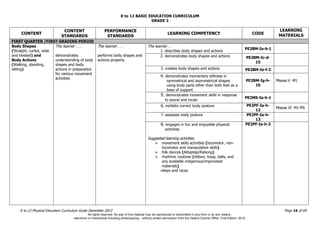
in succession, using forward-
and- back and side-to-side
movement patterns
PE1BM-IVf-h-14
Misosa VI -M1
25. engages in fun and enjoyable
physical activities
PE1PF-IVa-h-2
All rights reserved. No part of this material may be reproduced or transmitted in any form or by any means -
electronic or mechanical including photocopying – without written permission from the DepEd Central Office. First Edition, 2015.
K to 12 BASIC EDUCATION CURRICULUM
K to 12 Physical Education Curriculum Guide December 2013 Page 15 of 69
CONTENT CONTENT STANDARDS
PERFORMANCE
STANDARDS
LEARNING COMPETENCY CODE
LEARNING
MATERIALS
26. shows interest in participating
in physical activities
PE1PF-IVa-h-9
27. follows simple instructions and
rules
PE1PF-IVa-h-10
28. enjoys participating in physical
activities
Suggested learning activities
 action songs
 singing games
 simple games
 chasing and fleeing games
 mimetics
PE1PF-IVa-h-11
All rights reserved. No part of this material may be reproduced or transmitted in any form or by any means -
electronic or mechanical including photocopying – without written permission from the DepEd Central Office. First Edition, 2015.
K to 12 BASIC EDUCATION CURRICULUM
K to 12 Physical Education Curriculum Guide December 2013 Page 16 of 69
GRADE 2
CONTENT
CONTENT
STANDARDS
PERFORMANCE
STANDARDS
LEARNING COMPETENCY CODE
LEARNING
MATERIALS
FIRST QUARTER /FIRST GRADING PERIOD
Body Shapes
(Straight, curled, wide
and twisted) and
Body Actions
(Walking, standing,
sitting)
The learner . . .
demonstrates
understanding of body
shapes and body
actions in preparation
for various movement
activities
The learner . . .
performs body shapes and
actions properly.
The learner . .
1. describes body shapes and actions
PE2BM-Ia-b-1
2. demonstrates body shapes and actions PE2BM-Ic-d-
15
3. creates body shapes and actions PE2BM-Ie-f-2
4. demonstrates momentary stillness in
symmetrical and asymmetrical shapes
using body parts other than both feet as a
base of support
PE2BM-Ig-h-
16
Misosa V -M1
5. demonstrates movement skills in response
to sound and music
PE2MS-Ia-h-1
6. exhibits correct body posture PE2PF-Ia-h-
12
Misosa VI M1-M5
7. assesses body posture PE2PF-Ia-h-
13
8. engages in fun and enjoyable physical
activities
Suggested learning activities
 movement skills activities (locomotor, non-
locomotor and manipulative skills)
 folk dances (Alitaptap/Rabong)
 rhythmic routines (ribbon, hoop, balls, and
any available indigenous/improvised
materials)
relays and races
PE2PF-Ia-h-2
All rights reserved. No part of this material may be reproduced or transmitted in any form or by any means -
electronic or mechanical including photocopying – without written permission from the DepEd Central Office. First Edition, 2015.
K to 12 BASIC EDUCATION CURRICULUM
K to 12 Physical Education Curriculum Guide December 2013 Page 17 of 69
CONTENT
CONTENT
STANDARDS
PERFORMANCE
STANDARDS
LEARNING COMPETENCY CODE
LEARNING
MATERIALS
SECOND QUARTER/ SECOND GRADING
Locations (Behind, in
front, under, over,
personal space,
general space)
Directions (linear-
forward and backward,
lateral- sideward, and
multi-directional)
Levels (High, middle,
low) Pathways
(Straight, curved,
zigzag) and Planes
(Diagonal, horizontal,
vertical, and rotational)
Th The learner . . .
demonstrates
understanding of
locations, directions,
levels, pathways and
planes
ThThe learner. . .
performs movements
accurately involving
locations, directions,
levels, pathways and
planes.
9. describes movements in a location,
direction, level, pathway and plane
PE2BM-IIa-b-
17
Misosa IV -M1
10. moves in:
 personal and general space
 forward, backward, and sideward
directions
 high, middle, and low levels
 straight, curve, and zigzag pathways
 diagonal and horizontal planes
PE2BM-IIc-h-
18
11. demonstrates movement skills in response
to sounds and music
PE2MS-IIa-h-
1
12. observes correct posture and body
mechanics while performing movement
activities
PE2PF-IIa-h-
14
13. engages in fun and enjoyable physical
activities
Suggested learning activities
 movement skills activities (locomotor, non-
locomotor and manipulative skills)
 folk dances
 rhythmic routines (ribbon, hoop, balls, and
any available indigenous/improvised materials)
 relays and races
PE2PF-IIa-h-2
THIRD QUARTER/ THIRD GRADING
Time (slow, slower,
slowest/fast, faster,
fastest) Force (light,
lighter,
lightest/strong,
stronger, strongest)
and Flow
(smoothness of
The learner . . .
demonstrates
understanding of
movement in relation
to time, force and flow
The learner . . .
performs movements
accurately involving time,
force, and flow.
14. describes movements in a location,
direction, level, pathway and plane
PE2BM-IIIa-
b-17
15. moves:
15.1 at slow, slower, slowest/fast, faster,
fastest pace
15.2 using light, lighter, lightest/strong,
stronger, strongest force with
smoothness
PE2BM-IIIc-h-
19
All rights reserved. No part of this material may be reproduced or transmitted in any form or by any means -
electronic or mechanical including photocopying – without written permission from the DepEd Central Office. First Edition, 2015.
K to 12 BASIC EDUCATION CURRICULUM
K to 12 Physical Education Curriculum Guide December 2013 Page 18 of 69
CONTENT
CONTENT
STANDARDS
PERFORMANCE
STANDARDS
LEARNING COMPETENCY CODE
LEARNING
MATERIALS
movement) 16. demonstrates movement skills in response
to sound and music
PE2MS-IIIa-
h-1
17. engages in fun and enjoyable physical
activities
PE2PF-IIIa-h-
2
18. observes correct posture and body
mechanics while performing movement
activities
Suggested learning activities
 movement skills activities locomotor, non-
locomotor and manipulative skills
 folk dances (Alitaptap/Rabong)
 rhythmic routines (ribbon, hoop, balls, and
any available indigenous/improvised
materials)
relays and races
PE2PF-IIIa-h-
14
FOURTH QUARTER/ FOURTH GRADING
Person (Individual,
pair, group), Objects
(ribbon, hoop, balls,
and any available
indigenous/improvised
materials), Sound,
Environment
(indoor and outdoor
settings)
The learner . . .
demonstrates
understanding of
movement activities
relating to person,
objects, music and
environment
The learner . . .
performs movement
activities involving person,
objects, music and
environment correctly
19. familiarizes in various movement activities
involving person, objects, music and
environment
PE2BM-IV-a-
b-20
Misosa V -M1
20. moves:
20.1 individually, with partner, and with
group
20.2 with ribbon, hoop, balls, and any
available indigenous/improvised
materials
20.3 with sound
20.4 in indoor and outdoor settings
PE2BM-IV-c-
h-21
Misosa V -M1
21. demonstrates movement skills in response
to sound
PE2MS-IV-a-
h-1
22. engages in fun and enjoyable physical
activities
PE2PF-IV-a-
h-2
23. observes correct body posture and body
mechanics while performing movement
activities
PE2PF-IV-a-
h-14
Misosa VI -M1
All rights reserved. No part of this material may be reproduced or transmitted in any form or by any means -
electronic or mechanical including photocopying – without written permission from the DepEd Central Office. First Edition, 2015.
K to 12 BASIC EDUCATION CURRICULUM
K to 12 Physical Education Curriculum Guide December 2013 Page 19 of 69
CONTENT
CONTENT
STANDARDS
PERFORMANCE
STANDARDS
LEARNING COMPETENCY CODE
LEARNING
MATERIALS
Suggested learning activities
 movement skills activities locomotor, non-
locomotor and manipulative skills
 folk dances (Alitaptap/Rabong)
 rhythmic routines (ribbon, hoop, balls, and
any available indigenous/improvised materials)
relays and races
All rights reserved. No part of this material may be reproduced or transmitted in any form or by any means -
electronic or mechanical including photocopying – without written permission from the DepEd Central Office. First Edition, 2015.
K to 12 BASIC EDUCATION CURRICULUM
K to 12 Physical Education Curriculum Guide December 2013 Page 20 of 69
GRADE 3
CONTENT
CONTENT
STANDARDS
PERFORMANCE
STANDARDS
LEARNING COMPETENCY CODE
LEARNING
MATERIALS
FIRST QUARTER /FIRST GRADING PERIOD
Body Shapes
(Straight, curled, wide
and twisted) and
Body Actions
(Walking, standing,
sitting)
The learner . . .
demonstrates
understanding of body
shapes and body actions
in preparation for various
movement activities
The learner . . .
performs body shapes and
actions properly.
The learner . . .
1. describes body shapes and
actions
PE3BM-Ia-b-1
2. performs body shapes and
actions
PE3BM-Ic-d-15
3. creates body shapes and actions PE3BM-Ie-f-2
4. demonstrates momentary
stillness in symmetrical and
asymmetrical shapes using body
parts other than both feet as a
base of support
PE3BM-Ig-h-16
5. demonstrates movement skills in
response to sounds and music PE3MS-Ia-h-1
6. identifies conditioning and
flexibility exercises that will
improve posture
PE3PF-Ia-h-15
7. performs conditioning and
flexibility exercises that will
improve body posture
PE3PF-Ia-h-16
8. engages in fun and enjoyable
physical activities
Suggested learning activities
 movement skills activities
(locomotor, non-locomotor and
manipulative skills)
 folk dances (Tiklos/Kunday-kunday)
 rhythmic routines (ribbon, hoop,
balls, and any available
indigenous/improvised materials)
 lead up, organized and indigenous
games
corrective exercises
PE3PF-Ia-h-2
All rights reserved. No part of this material may be reproduced or transmitted in any form or by any means -
electronic or mechanical including photocopying – without written permission from the DepEd Central Office. First Edition, 2015.
K to 12 BASIC EDUCATION CURRICULUM
K to 12 Physical Education Curriculum Guide December 2013 Page 21 of 69
CONTENT
CONTENT
STANDARDS
PERFORMANCE
STANDARDS
LEARNING COMPETENCY CODE
LEARNING
MATERIALS
SECOND QUARTER/ SECOND GRADING
Locations (Behind,
in front, under, over,
personal space,
general space)
Directions (linear-
forward and
backward, lateral-
sideward, and multi-
directional) Levels
(High, middle, low)
Pathways (Straight,
curve, zigzag) and
Planes (Diagonal,
horizontal, vertical,
and rotational)
The learner . . .
demonstrates
understanding of
locations, directions,
levels, pathways and
planes
The learner . . .
performs movements
accurately involving locations,
directions, levels, pathways
and planes.
The learner . . .
9. describes movements in a
location, direction, level, pathway
and plane
PE3BM-IIa-b-17
10. moves in:
 personal and general space
 forward, backward, and
sideward directions
 high, middle, and low levels
 straight, curve, and zigzag
pathways
 diagonal and horizontal
planes
PE3BM-IIc-h-18
11. demonstrates movement skills
in response to sound
PE3MS-IIa-h-1 Misosa IV-M1
12. identifies conditioning and
flexibility exercises that will
improve body mechanics
PE3PF-IIa-h-15 Misosa V-M1
13. performs conditioning and
flexibility exercises that will
improve body mechanics
PE3PF-IIa-h-16 Misosa VI-M5
14. engages in fun and enjoyable
physical activities
Suggested learning activities
 movement skills activities
(locomotor, non-locomotor and
manipulative skills)
 folk dances (Tiklos/ Kunday-kunday)
 rhythmic routines (ribbon, hoop,
balls, and any available
indigenous/improvised materials)
 lead up, organized and indigenous
games
corrective exercises
PE3PF-IIa-h-2
All rights reserved. No part of this material may be reproduced or transmitted in any form or by any means -
electronic or mechanical including photocopying – without written permission from the DepEd Central Office. First Edition, 2015.
K to 12 BASIC EDUCATION CURRICULUM
K to 12 Physical Education Curriculum Guide December 2013 Page 22 of 69
CONTENT
CONTENT
STANDARDS
PERFORMANCE
STANDARDS
LEARNING COMPETENCY CODE
LEARNING
MATERIALS
THIRD QUARTER/ THIRD GRADING
Time (slow, slower,
slowest/fast, faster,
fastest Force (light,
lighter,
lightest/strong,
stronger, strongest)
and Flow
(smoothness of
movement)
The learner . . .
demonstrates
understanding of
movement in relation to
time, force and flow
The learner . . .
performs movements
accurately involving time,
force, and flow.
15. describes movements in a
location, direction, level,
pathway and plane
PE3BM-IIIa-b-17 Misosa IV-M1
16. moves:
 at slow, slower, slowest/fast,
faster, fastest pace
 using light, lighter,
lightest/strong, stronger,
strongest force with
smoothness
PE3BM-IIIc-h-19
17. demonstrates movement skills
in response to sound
PE3MS-IIIa-h-1
18. engages in fun and enjoyable
physical activities
PE3PF-IIIa-h-2
19. identifies conditioning and
flexibility exercises that will
improve body mechanics
PE3PF-IIIa-h-15
Misosa V-M1
20. performs conditioning and
flexibility exercises that will
improve body mechanics
Suggested learning activities
 movement skills activities
locomotor, non-locomotor and
manipulative skills
 folk dances (Tiklos/ Kunday-kunday)
 rhythmic routines (ribbon, hoop,
balls, and any available
indigenous/improvised materials)
 lead up, organized and indigenous
games
 corrective exercises
PE3PF-IIIa-h-16 Misosa V-M1
FOURTH QUARTER/ FOURTH GRADING
Person (Invidual,
pair, group) Objects
(ribbon, hoop, balls,
The learner . . .
demonstrates
The learner . . .
performs movement activities
The learner . . .
21. participates in various movement
activities involving person,
PE3BM-IV-a-b-
20
Misosa IV-M5
All rights reserved. No part of this material may be reproduced or transmitted in any form or by any means -
electronic or mechanical including photocopying – without written permission from the DepEd Central Office. First Edition, 2015.
K to 12 BASIC EDUCATION CURRICULUM
K to 12 Physical Education Curriculum Guide December 2013 Page 23 of 69
CONTENT
CONTENT
STANDARDS
PERFORMANCE
STANDARDS
LEARNING COMPETENCY CODE
LEARNING
MATERIALS
and any available
indigenous/improvised
materials), Sound and
Environment (indoor
and outdoor settings)
understanding of
movement activities
relating to person,
objects, music and
environment
involving person, objects,
music and environment
correctly
objects, music and environment
22. moves:
 individually, with partner, and
with group
 with ribbon, hoop, balls, and
any available
indigenous/improvised
materials
 with sound
 in indoor and outdoor
settings
PE3BM-IV-c-h-
21
23. demonstrates movement skills
in response to sounds and music
PE3MS-IV-a-h-1
24. engages in fun and enjoyable
physical activities
PE3PF-IV-a-h-2
25. identifies conditioning and
flexibility exercises that will
improve posture
PE3PF-IV-a-h-15
26. performs conditioning and
flexibility exercises that will
improve body mechanics
Suggested learning activities
 movement skills activities
locomotor, non-locomotor and
manipulative skills
 folk dances (Tiklos/Kunday-kunday)
 rhythmic routines (ribbon, hoop,
balls, and any available
indigenous/improvised materials)
 lead up, organized and indigenous
games
corrective exercises
PE3PF-IV-a-h-16
All rights reserved. No part of this material may be reproduced or transmitted in any form or by any means -
electronic or mechanical including photocopying – without written permission from the DepEd Central Office. First Edition, 2015.
K to 12 BASIC EDUCATION CURRICULUM
K to 12 Physical Education Curriculum Guide December 2013 Page 24 of 69
GRADE 4
CONTENT CONTENT STANDARDS
PERFORMANCE
STANDARDS
LEARNING COMPETENCY CODE
LEARNING
MATERIALS
FIRST QUARTER /FIRST GRADING PERIOD
Assessment of
physical
activities and
physical fitness
Target games
(Tumbang preso,
tamaang-
tao/batuhang bola,
tatsing),
striking/fielding
games
(syato/,basagang
palayok, kickball)
Note: Games are
not limited to the
above listed
activities
The learner . . .
demonstrates
understanding of
participation and
assessment of physical
activities and physical
fitness
The learner . . .
participates and assesses
performance in physical
activities.
assesses physical fitness
The learner . . .
1. describes the physical activity
pyramid
PE4PF-Ia-16
2. explains the indicators for
fitness
PE4PF-Ia-17
3. assesses regularly participation
in physical activities based on
physical activity pyramid
PE4PF-Ib-h-18
4. explains the nature/background
of the games PE4GS-Ib-1
5. describes the skills involved in
the games PE4GS-Ib-2
6. observes safety precautions PE4GS-Ib-h-3
7. executes the different skills
involved in the game
PE4GS-Ic-h-4
8. recognizes the value of
participation in physical activities
PE4PF-Ib-h-19
9. displays joy of effort, respect for
others and fair play during
participation in physical activities
PE4PF-Ib-h-20
10. explains health and skill related
fitness components
PE4PF-Ia-21
11. identifies areas for
improvement
PE4PF-Ib-h-22
SECOND QUARTER/ SECOND PERIOD
Assessment of
physical
activities and
physical fitness
Invasion games
(agawan base,
The learner . . .
demonstrates
understanding of
participation in and
assessment of physical
activities and physical
fitness
The learner . . .
participates and assesses
performance in physical
activities.
assesses physical fitness
12. describes the Philippines
physical activity pyramid
PE4PF-IIa-16
13. explains the indicators for
fitness
PE4PF-IIa-17
14. assesses regularly participation
in physical activities based on
physical activity pyramid
PE4PF-IIb-h-18
15. explains the nature/background PE4GS-IIb-1
All rights reserved. No part of this material may be reproduced or transmitted in any form or by any means -
electronic or mechanical including photocopying – without written permission from the DepEd Central Office. First Edition, 2015.
K to 12 BASIC EDUCATION CURRICULUM
K to 12 Physical Education Curriculum Guide December 2013 Page 25 of 69
CONTENT CONTENT STANDARDS
PERFORMANCE
STANDARDS
LEARNING COMPETENCY CODE
LEARNING
MATERIALS
lawin at sisiw,
agawan panyo)
Note: Games are
not limited to the
above listed
activities
of the games
16. describes the skills involved in
the games
PE4GS-IIb-2
17. observes safety precautions PE4GS-IIb-h-3
18. executes the different skills
involved in the game
PE4GS-IIc-h-4
19. recognizes the value of
participation in physical activities
PE4PF-IIb-h-19
20. displays joy of effort, respect for
others and fair play during
participation in physical activities
PE4PF-IIb-h-20
21. explains health and skill related
fitness components
PE4PF-IIa-21
22. identifies areas for improvement PE4PF-IIb-h-22
THIRD QUARTER / THIRD GRADING
Assessment of
physical
activities and
physical fitness
Folk (Liki/Ba-
Ingles),
indigenous,
ethnic,
traditional and
creative dances
Note: Dances
available in the
area can be
selected.
The learner . . .
demonstrates
understanding of
participation and
assessment of physical
activity and physical
fitness
The learner . . .
participates and assesses
performance in physical
activities.
assesses physical fitness
23. describes the Philippines
physical activity pyramid
PE4PF-IIIa-16
24. explains the indicators for
fitness
PE4PF-IIIa-17
25. assesses regularly participation
in physical activities based on
physical activity pyramid
PE4PF-IIIb-h-18
26. explains the nature/background
of the dance
PE4GS-IIIb-1
27. describes the skills involved in
the dance
PE4GS-IIIb-2
28. observes safety precautions PE4GS-IIIb-h-3
29. executes the different skills
involved in the dance
PE4GS-IIIc-h-4
30. recognizes the value of
participation in physical activities
PE4PF-IIIb-h-19
31. displays joy of effort, respect for
others during participation in
physical activities
PE4PF-IIIb-h-20
32. explains health and skill related
fitness components
PE4PF-IIIa-21
All rights reserved. No part of this material may be reproduced or transmitted in any form or by any means -
electronic or mechanical including photocopying – without written permission from the DepEd Central Office. First Edition, 2015.
K to 12 BASIC EDUCATION CURRICULUM
K to 12 Physical Education Curriculum Guide December 2013 Page 26 of 69
CONTENT CONTENT STANDARDS
PERFORMANCE
STANDARDS
LEARNING COMPETENCY CODE
LEARNING
MATERIALS
33. identifies areas for improvement PE4PF-IIIa-22
FOURTH QUARTER/ FOURTH PERIOD
Assessment of
physical
activities and
physical fitness
Folk (Liki/Ba-
Ingles),
indigenous,
ethnic,
traditional and
creative dances
Note: Dances
available in the
area can be
selected.
The learner . . .
demonstrates
understanding of
participation and
assessment of physical
activity and physical
fitness
The learner . . .
participates and assesses
performance in physical
activities.
assesses physical fitness
34. describes the Philippines
physical activity pyramid
PE4PF-IVa-16
35. explains the indicators for
fitness
PE4PF-IVa-17
36. assesses regularly participation
in physical activities based on
Philippines physical activity
pyramid
PE4PF-IVb-h-18
37. explains the nature/background
of the dance
PE4RD-IVb-1
38. describes the skills involved in
the dance
PE4RD-IVb-2
39. observes safety precautions PE4RD-IVb-h-3
40. executes the different skills
involved in the dance
PE4RD-IVc-h-4
41. recognizes the value of
participation in physical activities
PE4PF-IVb-h-19
42. displays joy of effort, respect for
others during participation in
physical activities
PE4PF-IVb-h-20
43. explains health and skill related
fitness components
PE4PF-IVa-21
44. identifies areas for improvement PE4PF-IVb-h-22
All rights reserved. No part of this material may be reproduced or transmitted in any form or by any means -
electronic or mechanical including photocopying – without written permission from the DepEd Central Office. First Edition, 2015.
K to 12 BASIC EDUCATION CURRICULUM
K to 12 Physical Education Curriculum Guide December 2013 Page 27 of 69
GRADE 5
CONTENT CONTENT STANDARDS
PERFORMANCE
STANDARDS
LEARNING COMPETENCY CODE
LEARNING
MATERIALS
FIRST QUARTER /FIRST GRADING PERIOD
Assessment of
physical activity
and physical
fitness
Target games
(Tumbang preso,
tamaang-
tao/batuhang
bola, tatsing),
striking/fielding
games
(syato/,basagang
palayok, kickball)
Note: Games are
not limited to the
above listed
activities
The learner . . .
demonstrates
understanding of
participation and
assessment of physical
activity and physical
fitness
The learner . . .
participates and assesses
performance in physical
activities.
assesses physical fitness
The learner . . .
1. describes the Philippines physical
activity pyramid
PE5PF-Ia-16
2. explains the indicators for fitness PE5PF-Ia-17
3. assesses regularly participation in
physical activities based on the
Philippines physical activity
pyramid
PE5PF-Ib-h-18
4. explains the nature/background
of the games PE5GS-Ib-1
5. describes the skills involved in
the games PE5GS-Ib-2
6. observes safety precautions PE5GS-Ib-h-3
7. executes the different skills
involved in the game
PE5GS-Ic-h-4
8. recognizes the value of
participation in physical activities
PE5PF-Ib-h-19
9. displays joy of effort, respect for
others and fair play during
participation in physical activities
PE5PF-Ib-h-20
10. explains health and skill related
fitness components
PE5PF-Ia-21
11. identifies areas for improvement
PE5PF-Ib-h-22
SECOND QUARTER / SECOND GRADING
Assessment of
physical
activities and
physical fitness
Invasion games
(agawan base,
The learner . . .
demonstrates
understanding of
participation in and
assessment of physical
activity and physical
fitness
The learner . . .
participates and assesses
performance in physical
activities.
assesses physical fitness
12. describes the Philippines
physical activity pyramid
PE5PF-IIa-16
13. explains the indicators for
fitness
PE5PF-IIa-17
14. assesses regularly participation
in physical activities based on
the Philippines physical activity
pyramid
PE5PF-IIb-h-18
All rights reserved. No part of this material may be reproduced or transmitted in any form or by any means -
electronic or mechanical including photocopying – without written permission from the DepEd Central Office. First Edition, 2015.
K to 12 BASIC EDUCATION CURRICULUM
K to 12 Physical Education Curriculum Guide December 2013 Page 28 of 69
CONTENT CONTENT STANDARDS
PERFORMANCE
STANDARDS
LEARNING COMPETENCY CODE
LEARNING
MATERIALS
lawin at sisiw,
agawan panyo)
Note: Games are
not limited to the
above listed
activities
15. explains the nature/background
of the games
PE5GS-IIb-1
16. describes the skills involved in
the games
PE5GS-IIb-2
17. observes safety precautions
PE5GS-IIb-h-3
18. executes the different skills
involved in the game
PE5GS-IIc-h-4
19. recognizes the value of
participation in physical activities
PE5PF-IIb-h-19
20. displays joy of effort, respect for
others and fair play during
participation in physical activities
PE5PF-IIb-h-20
21. explains health and skill related
fitness components
PE5PF-IIa-21
22. identifies areas for improvement
PE5PF-IIb-h-22
THIRD QUARTER/ THIRD PERIOD
Assessment of
physical
activities and
physical fitness
Folk (Cariñosa/
Polka sa Nayon),
indigenous,
ethnic,
traditional and
creative dances
Note: Dances
available in the
area can be
selected.
The learner . . .
demonstrates
understanding of
participation and
assessment of physical
activity and physical
fitness
The learner . . .
participates and assesses
performance in physical
activities.
assesses physical fitness
23. describes the Philippines
physical activity pyramid
PE5PF-IIIa-16
24. explains the indicators for
fitness
PE5PF-IIIa-17
25. assesses regularly participation
in physical activities based on
the Philippines physical activity
pyramid
PE5PF-IIIb-h-18
26. explains the nature/background
of the dance
PE5RD-IIIb-1
27. describes the skills involved in
the dance
PE5RD-IIIb-2
28. observes safety precautions PE5RD-IIIb-h-3
29. executes the different skills
involved in the dance PE5RD-IIIc-h-4
30. recognizes the value of
participation in physical activities
PE5PF-IIIb-h-19
All rights reserved. No part of this material may be reproduced or transmitted in any form or by any means -
electronic or mechanical including photocopying – without written permission from the DepEd Central Office. First Edition, 2015.
K to 12 BASIC EDUCATION CURRICULUM
K to 12 Physical Education Curriculum Guide December 2013 Page 29 of 69
CONTENT CONTENT STANDARDS
PERFORMANCE
STANDARDS
LEARNING COMPETENCY CODE
LEARNING
MATERIALS
31. displays joy of effort, respect for
others during participation in
physical activities
PE5PF-IIIb-h-20
32. explains health and skill related
fitness components
PE5PF-IIIa-21
33. identifies areas for improvement PE5PF-IIIb-h-22
FOURTH QUARTER/ FOURTH PERIOD
Assessment of
physical
activities and
physical fitness
Folk (Cariñosa/
Polka sa Nayon),
indigenous,
ethnic,
traditional and
creative dances
Note: Dances
available in the
area can be
selected.
The learner . . .
demonstrates
understanding of
participation and
assessment of physical
activity and physical
fitness
The learner . . .
participates and assesses
performance in physical
activities.
assesses physical fitness
34. describes the Philippines
physical activity pyramid
PE5PF-IVa-16
35. explains the indicators for
fitness
PE5PF-IVa-17
36. assesses regularly participation
in physical activities based on
the Philippines physical activity
pyramid
PE5PF-IVb-h-18
37. explains the nature/background
of the dance
PE5RD-IVb-1
38. describes the skills involved in
the dance
PE5RD-IVb-2
39. observes safety precautions PE5RD-IVb-h-3
40. executes the different skills
involved in the dance
PE5RD-IVc-h-4
41. recognizes the value of
participation in physical activities
PE5PF-IVb-h-19
42. displays joy of effort, respect for
others during participation in
physical activities
PE5PF-IVb-h-20
43. explains health and skill related
fitness components
PE5PF-IVa-21
44. identifies areas for improvement PE5PF-IVb-h-22
All rights reserved. No part of this material may be reproduced or transmitted in any form or by any means -
electronic or mechanical including photocopying – without written permission from the DepEd Central Office. First Edition, 2015.
K to 12 BASIC EDUCATION CURRICULUM
K to 12 Physical Education Curriculum Guide December 2013 Page 30 of 69
GRADE 6
CONTENT CONTENT STANDARDS
PERFORMANCE
STANDARDS
LEARNING COMPETENCY CODE
LEARNING
MATERIALS
FIRST QUARTER /FIRST GRADING PERIOD
Assessment of
physical
activities and
physical fitness
Target games
(Tumbang preso,
tamaang-
tao/batuhang
bola, tatsing),
striking/fielding
games
(syato/,basagang
palayok, kickball)
Note: Games are
not limited to the
above listed
activities
The learner . . .
demonstrates
understanding of
participation and
assessment of physical
activity and physical
fitness
The learner . . .
participates and assesses
performance in physical
activities.
assesses physical fitness
The learner . . .
1. describes the Philippines
physical activity pyramid
PE6PF-Ia-16
2. explains the indicators for
fitness
PE6PF-Ia-17
3. assesses regularly participation
in physical activities based on
the Philippines physical activity
pyramid
PE6PF-Ib-h-18
4. explains the nature/background
of the games PE6GS-Ib-1
5. describes the skills involved in
the games PE6GS-Ib-2
6. observes safety precautions PE6GS-Ib-h-3
7. executes the different skills
involved in the game
PE6GS-Ic-h-4
8. recognizes the value of
participation in physical activities
PE6PF-Ib-h-19
9. displays joy of effort, respect for
others and fair play during
participation in physical activities
PE6PF-Ib-h-20
10. explains health and skill related
fitness components
PE6PF-Ia-21
11. identifies areas for
improvement
PE6PF-Ib-h-22
SECOND QUARTER/ SECOND PERIOD
Assessment of
physical
activities and
physical fitness
Invasion games
The learner . . .
demonstrates
understanding of
participation in and
assessment of physical
activities and physical
The learner . . .
participates and assesses
performance in physical
activities.
assesses physical fitness
12. describes the Philippines
physical activity pyramid
PE6PF-IIa-16
13. explains the indicators for
fitness
PE6PF-IIa-17
14. assesses regularly participation
in physical activities based on
the Philippines physical activity
PE6PF-IIb-h-18
All rights reserved. No part of this material may be reproduced or transmitted in any form or by any means -
electronic or mechanical including photocopying – without written permission from the DepEd Central Office. First Edition, 2015.
K to 12 BASIC EDUCATION CURRICULUM
K to 12 Physical Education Curriculum Guide December 2013 Page 31 of 69
CONTENT CONTENT STANDARDS
PERFORMANCE
STANDARDS
LEARNING COMPETENCY CODE
LEARNING
MATERIALS
(agawan base,
lawin at sisiw,
agawan panyo)
Note: Games are
not limited to the
above listed
activities
fitness pyramid
15. explains the
nature/background of the
games
PE6GS-IIb-1
16. describes the skills involved in
the games
PE6GS-IIb-2
17. observes safety precautions
PE6GS-IIb-h-3
18. executes the different skills
involved in the game
PE6GS-IIc-h-4
19. recognizes the value of
participation in physical
activities
PE6PF-IIb-h-19
20. displays joy of effort, respect
for others and fair play during
participation in physical
activities
PE6PF-IIb-h-20
21. explains health and skill related
fitness components
PE6PF-IIa-21
22. identifies areas for
improvement
PE6PF-IIb-h-22
THIRD QUARTER/ THIRD PERIOD
Assessment of
physical
activities and
physical fitness
Folk (Itik-itik for
girls and
Maglalatik for
boys),
indigenous,
ethnic,
traditional and
creative dances
The learner . . .
demonstrates
understanding of
participation and
assessment of physical
activity and physical
fitness
The learner . . .
participates and assesses
performance in physical
activities.
assesses physical fitness
23. describes the Philippines
physical activity pyramid
PE6PF-IIIa-16
24. explains the indicators for
fitness
PE6PF-IIIa-17
25. assesses regularly participation
in physical activities based on
the Philippines physical activity
pyramid
PE6PF-IIIb-h-18
26. explains the
nature/background of the
dance
PE6RD-IIIb-1
27. describes the skills involved in
the dance
PE6RD-IIIb-2
All rights reserved. No part of this material may be reproduced or transmitted in any form or by any means -
electronic or mechanical including photocopying – without written permission from the DepEd Central Office. First Edition, 2015.
K to 12 BASIC EDUCATION CURRICULUM
K to 12 Physical Education Curriculum Guide December 2013 Page 32 of 69
CONTENT CONTENT STANDARDS
PERFORMANCE
STANDARDS
LEARNING COMPETENCY CODE
LEARNING
MATERIALS
Note: Dances
available in the
area can be
selected.
28. observes safety precautions
PE6RD-IIIb-h-3
29. executes the different skills
involved in the dance
PE6RD-IIIc-h-4
30. recognizes the value of
participation in physical
activities
PE6PF-IIIb-h-19
31. displays joy of effort, respect
for others during participation
in physical activities
PE6PF-IIIb-h-20
32. explains health and skill related
fitness components
PE6PF-IIIa-21
33. identifies areas for
improvement
PE6PF-IIIb-h-22
FOURTH QUARTER/ FOURTH PERIOD
Assessment of
physical
activities and
physical fitness
Folk (Itik-itik for
girls and
Maglalatik for
boys),
indigenous,
ethnic,
traditional and
creative dances
Note: Dances
available in the
area can be
selected.
The learner . . .
demonstrates
understanding of
participation and
assessment of physical
activity and physical
fitness
The learner . . .
participates and assesses
performance in physical
activities.
assesses physical fitness
34. describes the Philippines
physical activity pyramid
PE6PF-IVa-16
35. explains the indicators for
fitness
PE6PF-IVa-17
36. assesses regularly participation
in physical activities based on
the Philippines physical activity
pyramid
PE6PF-IVb-h-18
37. explains the
nature/background of the
dance
PE6RD-IVb-1
38. describes the skills involved in
the dance
PE6RD-IVb-2
39. observes safety precautions
PE6RD-IVb-h-3
40. executes the different skills
involved in the dance
PE6RD-IVc-h-4
41. recognizes the value of
participation in physical
activities
PE6PF-IVb-h-19
42. displays joy of effort, respect
for others during participation
PE6PF-IVb-h-20
All rights reserved. No part of this material may be reproduced or transmitted in any form or by any means -
electronic or mechanical including photocopying – without written permission from the DepEd Central Office. First Edition, 2015.
K to 12 BASIC EDUCATION CURRICULUM
K to 12 Physical Education Curriculum Guide December 2013 Page 33 of 69
CONTENT CONTENT STANDARDS
PERFORMANCE
STANDARDS
LEARNING COMPETENCY CODE
LEARNING
MATERIALS
in physical activities
43. explains health and skill related
fitness components
PE6PF-IVa-21
44. identifies areas for
improvement
PE6PF-IVb-h-22
All rights reserved. No part of this material may be reproduced or transmitted in any form or by any means -
electronic or mechanical including photocopying – without written permission from the DepEd Central Office. First Edition, 2015.
K to 12 BASIC EDUCATION CURRICULUM
K to 12 Physical Education Curriculum Guide December 2013 Page 34 of 69
GRADE 7
CONTENT
CONTENT
STANDARDS
PERFORMANCE
STANDARDS
LEARNING COMPETENCY CODE
LEARNING
MATERIALS
FIRST QUARTER /FIRST GRADING PERIOD
Exercise Programs:
Training Guidelines,
FITT Principles
Endurance, Muscle- and
Bone-strengthening
Activities:
a. individual sports
1. running
2. rhythmic
sportive
gymnastics
3. swimming
b. dual sports
1. badminton
2. table tennis
3. tennis
c. combative sports
1. arnis (anyo)
2. taekwondo
(poomsae)
3. karate(kata)
Note: Activities
dependent on teacher
capability and school
resources.
The learner . . .
demonstrates
understanding of
guidelines and principles
in exercise program
design to achieve
personal fitness
The learner . . .
designs an individualized
exercise program to achieve
personal fitness
The learner . . .
1. undertakes physical activity and
physical fitness assessments
PE7PF-Ia-h-23
OHSP Y1Q1,
Module 1
2010 SEC Y1Q1
2010 SEC Y2Q1
Enjoy Life w/ PE &
Health, TX & TM
Unit 1
2. sets goals based on assessment
results
PE7PF-Ia-24
OHSP Y1Q1,
Module 1
2010 SEC Y1Q1
2010 SEC Y2Q1
Enjoy Life w/ PE &
Health, TX & TM
Unit 1
3. identifies training guidelines
and FITT principles
PE7PF-Ib-25
OHSP Y1Q1,
Module 1
2010 SEC Y1Q1
2010 SEC Y2Q1
Enjoy Life w/ PE &
Health, TX & TM
Unit 1
4. recognizes barriers (low level of
fitness, lack of skill and time) to
exercise
PE7PF-Ib-26
OHSP Y1Q1,
Module 1
2010 SEC Y1Q1
2010 SEC Y2Q1
Enjoy Life w/ PE &
Health, TX & TM
Unit 1
5. prepares an exercise program
PE7PF-Ic-27
OHSP Y1Q1,
Module 1
2010 SEC Y1Q1
2010 SEC Y2Q1
Enjoy Life w/ PE &
Health, TX & TM
Unit 1
All rights reserved. No part of this material may be reproduced or transmitted in any form or by any means -
electronic or mechanical including photocopying – without written permission from the DepEd Central Office. First Edition, 2015.
K to 12 BASIC EDUCATION CURRICULUM
K to 12 Physical Education Curriculum Guide December 2013 Page 35 of 69
CONTENT
CONTENT
STANDARDS
PERFORMANCE
STANDARDS
LEARNING COMPETENCY CODE
LEARNING
MATERIALS
6. describes the nature and
background of the sport
PE7GS-Id-5
Proj EASE Module1
OHSPY1Q2
Module1
OHSPY1Q2
Module2
OHSPY1Q2
Module3
2010 SECY1Q2
&Q3
Enjoy Life w/ PE &
Health, TX & TM
Unit
7. executes the skills involved in
the sport PE7GS-Id-h-4
Proj EASE Module1
OHSPY1Q2
Module1
OHSPY1Q2
Module2
OHSPY1Q2
Module3
2010 SECY1Q2
&Q3
Enjoy Life w/ PE &
Health, TX & TM
Unit 2
8. monitors periodically one’s
progress towards the fitness
goals
PE7PF-Id-h-28
OHSP Y1Q1,
Module 1
2010 SEC Y1Q1
2010 SEC Y2Q1
Enjoy Life w/ PE &
Health, TX & TM
Unit 1
9. distinguishes from fallacies and
misconceptions about the
physical activity participation
PE7PF-Id-29
OHSP Y1Q1,
Module 1
2010 SEC Y1Q1
2010 SEC Y2Q1
Enjoy Life w/ PE &
Health, TX & TM
Unit 1
All rights reserved. No part of this material may be reproduced or transmitted in any form or by any means -
electronic or mechanical including photocopying – without written permission from the DepEd Central Office. First Edition, 2015.
K to 12 BASIC EDUCATION CURRICULUM
K to 12 Physical Education Curriculum Guide December 2013 Page 36 of 69
CONTENT
CONTENT
STANDARDS
PERFORMANCE
STANDARDS
LEARNING COMPETENCY CODE
LEARNING
MATERIALS
10. performs appropriate first aid
for sports-related injuries (e.g.
cramps, sprain, heat
exhaustion)
PE7PF-Id-30
OHSP Y1Q1,
Module 1
2010 SEC Y1Q1
2010 SEC Y2Q1
Enjoy Life w/ PE &
Health, TX & TM
Unit 1
11. assumes responsibility for
achieving personal fitness
PE7PF-Id-h-31
OHSP Y1Q1,
Module 1
2010 SEC Y1Q1
2010 SEC Y2Q1
Enjoy Life w/ PE &
Health, TX & TM
Unit 1
12. keeps the importance of
winning and losing in
perspective
PE7PF-Id-h-32
OHSP Y1Q1,
Module 1
2010 SEC Y1Q1
2010 SEC Y2Q1
Enjoy Life w/ PE &
Health, TX & TM
Unit 1
SECOND QUARTER/ SECOND PERIOD
Exercise Programs:
Training Guidelines,
FITT Principles
Endurance, Muscle- and
Bone-strengthening
Activities:
a. individual
sports
1. running
2. rhythmic
sportive
gymnastics
The learner . . .
demonstrates
understanding of
guidelines and principles
in exercise program
design to achieve
personal fitness
The learner . . .
modifies the individualized
exercise program to achieve
personal fitness
13. undertakes physical activity and
physical fitness assessments
PE7PF-IIa-h-23
OHSP Y1Q1,
Module 1
2010 SEC Y1Q1
2010 SEC Y2Q1
Enjoy Life w/ PE &
Health, TX & TM
Unit 1
14. reviews goals based on
assessment results PE7PF-IIa-24
OHSP Y1Q1,
Module 1
2010 SEC Y1Q1
2010 SEC Y2Q1
Enjoy Life w/ PE &
Health, TX & TM
Unit 1
15. addresses barriers (low level of
fitness, lack of skill and time) to
PE7PF-IIb-33 OHSP Y1Q1,
Module 1
All rights reserved. No part of this material may be reproduced or transmitted in any form or by any means -
electronic or mechanical including photocopying – without written permission from the DepEd Central Office. First Edition, 2015.
K to 12 BASIC EDUCATION CURRICULUM
K to 12 Physical Education Curriculum Guide December 2013 Page 37 of 69
CONTENT
CONTENT
STANDARDS
PERFORMANCE
STANDARDS
LEARNING COMPETENCY CODE
LEARNING
MATERIALS
3. swimming
b. dual sports
1. badminton
2. table tennis
3. tennis
c. combative sports
1. arnis (anyo)
2. taekwondo
(poomsae)
3. karate (kata)
Note: Activities
dependent on teacher
capability and school
resources.
exercise 2010 SEC Y1Q1
2010 SEC Y2Q1
Enjoy Life w/ PE &
Health, TX & TM
Unit 1
16. describes the nature and
background of the sport
PE7GS-IId-5
Proj EASE Module1
OHSPY1Q2
Module1
OHSPY1Q2
Module2
OHSPY1Q2
Module3
2010 SECY1Q2
&Q3
Enjoy Life w/ PE &
Health, TX & TM
Unit 2
17. executes the skills involved in
the sport
PE7GS-IId-h-4
Proj EASE Module1
OHSPY1Q2
Module1
OHSPY1Q2
Module2
OHSPY1Q2
Module3
2010 SECY1Q2
&Q3
Enjoy Life w/ PE &
Health, TX & TM
Unit 2
18. monitors periodically one’s
progress towards the fitness
goals
PE7PF-IId-h-28
OHSP Y1Q1,
Module 1
2010 SEC Y1Q1
2010 SEC Y2Q1
Enjoy Life w/ PE &
Health, TX & TM
Unit 1
19. performs appropriate first aid
for sports-related injuries (e.g.
PE7PF-IId-30 OHSP Y1Q1,
Module 1
All rights reserved. No part of this material may be reproduced or transmitted in any form or by any means -
electronic or mechanical including photocopying – without written permission from the DepEd Central Office. First Edition, 2015.
K to 12 BASIC EDUCATION CURRICULUM
K to 12 Physical Education Curriculum Guide December 2013 Page 38 of 69
CONTENT
CONTENT
STANDARDS
PERFORMANCE
STANDARDS
LEARNING COMPETENCY CODE
LEARNING
MATERIALS
cramps, sprain, heat
exhaustion)
2010 SEC Y1Q1
2010 SEC Y2Q1
Enjoy Life w/ PE &
Health, TX & TM
Unit 1
20. assumes responsibility for
achieving personal fitness
PE7PF-IId-h-31
OHSP Y1Q1,
Module 1
2010 SEC Y1Q1
2010 SEC Y2Q1
Enjoy Life w/ PE &
Health, TX &
TM Unit 1
21. keeps the importance of
winning and losing in
perspective
PE7PF-IId-h-32
OHSP Y1Q1,
Module 1
2010 SEC Y1Q1
2010 SEC Y2Q1
Enjoy Life w/ PE &
Health, TX & TM
Unit 1
THIRD QUARTER/ THIRD PERIOD
Exercise Programs:
Training Guidelines,
FITT Principles
Endurance, Muscle- and
Bone-strengthening
Activities:
Folk (Tinikling)/
indigenous, ethnic,
traditional/ festival
dance
Note: Dances
available in the
The learner . . .
demonstrates
understanding of
guidelines and principles
in exercise program
design to achieve
personal fitness
The learner . . .
demonstrates understanding
of guidelines and principles in
exercise program design to
achieve personal fitness
22. undertakes physical activity and
physical fitness assessments
PE7PF-IIIa-h-23
OHSP Y1Q1,
Module 1
2010 SEC Y1Q1
2010 SEC Y2Q1
Enjoy Life w/ PE &
Health, TX & TM
Unit 1
23. reviews goals based on
assessment results
PE7PF-IIIa-34
OHSP Y1Q1,
Module 1
2010 SEC Y1Q1
2010 SEC Y2Q1
Enjoy Life w/ PE &
Health, TX & TM
Unit 1
24. addresses barriers (low level of
fitness, lack of skill and time) to
exercise
PE7PF-IIIb-33
OHSP Y1Q1,
Module 1
2010 SEC Y1Q1
2010 SEC Y2Q1
All rights reserved. No part of this material may be reproduced or transmitted in any form or by any means -
electronic or mechanical including photocopying – without written permission from the DepEd Central Office. First Edition, 2015.
K to 12 BASIC EDUCATION CURRICULUM
K to 12 Physical Education Curriculum Guide December 2013 Page 39 of 69
CONTENT
CONTENT
STANDARDS
PERFORMANCE
STANDARDS
LEARNING COMPETENCY CODE
LEARNING
MATERIALS
area can be
selected.
Enjoy Life w/ PE &
Health, TX & TM
Unit 1
25. describes the nature and
background of the dance
PE7RD-IIId-1
OHSP Y1Q4
2010 SEC Y1Q4
2010 SEC Y2Q4
Enjoy Life w/ PE &
Health, TX & TM
Unit 4
26. executes the skills involved in
the dance
PE7RD-IIId-h-4
OHSP Y1Q4
2010 SEC Y1Q4
2010 SEC Y2Q4
Enjoy Life w/ PE &
Health, TX & TM
Unit 4
27. monitors periodically one’s
progress towards the fitness
goals
PE7PF-IIId-h-28
OHSP Y1Q1,
Module 1
2010 SEC Y1Q1
2010 SEC Y2Q1
Enjoy Life w/ PE &
Health, TX & TM
Unit 1
28. performs appropriate first aid
for dance-related injuries (e.g.
cramps, sprain, heat
exhaustion)
PE7PF-IIId-30
OHSP Y1Q1,
Module 1
2010 SEC Y1Q1
2010 SEC Y2Q1
Enjoy Life w/ PE &
Health, TX & TM
Unit 1
29. assumes responsibility for
achieving personal fitness
PE7PF-IIId-h-31
OHSP Y1Q1,
Module 1
2010 SEC Y1Q1
2010 SEC Y2Q1
Enjoy Life w/ PE &
Health, TX & TM
Unit 1
30. keeps the importance of
winning and losing in
PE7PF-IIId-h-32 OHSP Y1Q1,
Module 1
All rights reserved. No part of this material may be reproduced or transmitted in any form or by any means -
electronic or mechanical including photocopying – without written permission from the DepEd Central Office. First Edition, 2015.
K to 12 BASIC EDUCATION CURRICULUM
K to 12 Physical Education Curriculum Guide December 2013 Page 40 of 69
CONTENT
CONTENT
STANDARDS
PERFORMANCE
STANDARDS
LEARNING COMPETENCY CODE
LEARNING
MATERIALS
perspective 2010 SEC Y1Q1
2010 SEC Y2Q1
Enjoy Life w/ PE &
Health, TX & TM
Unit 1
FOURTH QUARTER/ FOURTH PERIOD
Exercise Programs:
Training Guidelines,
FITT Principles
Endurance, Muscle- and
Bone-strengthening
Activities:
Folk (Tinikling)/
indigenous, ethnic,
traditional/ festival
dance
Note: Dances
available in the
area can be
selected.
The learner . . .
demonstrates
understanding of
guidelines and principles
in exercise program
design to achieve
personal fitness
The learner . . .
modifies the individualized
exercise program to achieve
personal fitness
31. undertakes physical activity and
physical fitness assessments
PE7PF-IVa-h-23
OHSP Y1Q1,
Module 1
2010 SEC Y1Q1
2010 SEC Y2Q1
Enjoy Life w/ PE &
Health, TX & TM
Unit 1
32. reviews goals based on
assessment results
PE7PF-IVa-34
OHSP Y1Q1,
Module 1
2010 SEC Y1Q1
2010 SEC Y2Q1
Enjoy Life w/ PE &
Health, TX & TM
Unit 1
33. addresses barriers (low level of
fitness, lack of skill and time) to
exercise
PE7PF-IVb-33
OHSP Y1Q1,
Module 1
2010 SEC Y1Q1
2010 SEC Y2Q1
Enjoy Life w/ PE &
Health, TX & TM
Unit 1
34. describes the nature and
background of the dance
PE7RD-IVc-1
OHSP Y1Q4
2010 SEC Y1Q4
2010 SEC Y2Q4
Enjoy Life w/ PE &
Health, TX & TM
Unit 4
35. executes the skills involved in
the dance
PE7RD-IVd-h-4
OHSP Y1Q4
2010 SEC Y1Q4
2010 SEC Y2Q4
Enjoy Life w/ PE &
Health, TX & TM
All rights reserved. No part of this material may be reproduced or transmitted in any form or by any means -
electronic or mechanical including photocopying – without written permission from the DepEd Central Office. First Edition, 2015.
K to 12 BASIC EDUCATION CURRICULUM
K to 12 Physical Education Curriculum Guide December 2013 Page 41 of 69
CONTENT
CONTENT
STANDARDS
PERFORMANCE
STANDARDS
LEARNING COMPETENCY CODE
LEARNING
MATERIALS
Unit 4
36. monitors periodically one’s
progress towards the fitness
goals
PE7PF-IVd-h-28
OHSP Y1Q1,
Module 1
2010 SEC Y1Q1
2010 SEC Y2Q1
Enjoy Life w/ PE &
Health, TX & TM
Unit 1
37. performs appropriate first aid
for dance-related injuries (e.g.
cramps, sprain, heat
exhaustion)
PE7PF-IVd-30
OHSP Y1Q1,
Module 1
2010 SEC Y1Q1
2010 SEC Y2Q1
Enjoy Life w/ PE &
Health, TX & TM
Unit 1
38. analyzes the effect of exercise
and physical activity
participation on fitness
PE7PF-IVh-35
OHSP Y1Q1,
Module 1
2010 SEC Y1Q1
2010 SEC Y2Q1
Enjoy Life w/ PE &
Health, TX & TM
Unit 1
39. assumes responsibility for
achieving personal fitness
PE7PF-IVd-h-31
OHSP Y1Q1,
Module 1
2010 SEC Y1Q1
2010 SEC Y2Q1
Enjoy Life w/ PE &
Health, TX & TM
Unit 1
40. keeps the importance of winning
and losing in perspective
PE7PF-IVd-h-32
OHSP Y1Q1,
Module 1
2010 SEC Y1Q1
2010 SEC Y2Q1
Enjoy Life w/ PE &
Health, TX & TM
Unit 1
All rights reserved. No part of this material may be reproduced or transmitted in any form or by any means -
electronic or mechanical including photocopying – without written permission from the DepEd Central Office. First Edition, 2015.
K to 12 BASIC EDUCATION CURRICULUM
K to 12 Physical Education Curriculum Guide December 2013 Page 42 of 69
GRADE 8
CONTENT CONTENT STANDARDS
PERFORMANCE
STANDARDS
LEARNING COMPETENCY CODE
LEARNING
MATERIALS
FIRST QUARTER/ FIRST GRADING
Exercise
Programs:
Training Guidelines,
FITT Principles
Endurance, Muscle-
and Bone-
strengthening
Activities:
team sports
(basketball,
volleyball,
football/futsal,
goalball, softball,
baseball)
Note: Activities
dependent on
teacher capability
and school
resources.
The learner . . .
demonstrates
understanding of
guidelines and principles
in exercise program
design to achieve fitness
The learner . . .
designs a physical activity
program for the family/school
peers to achieve fitness
The learner. . .
1. undertakes physical activity and
physical fitness assessments
PE8PF-Ia-h-23
OHSP Y1Q1,
Module 1
2010 SEC Y1Q1
2010 SEC Y2Q1
Enjoy Life w/ PE &
Health, TX & TM
Unit 1
2. conducts physical activity and
physical fitness assessments of
family/school peers
PE8PF-Ib -36
OHSP Y1Q1,
Module 1
2010 SEC Y1Q1
2010 SEC Y2Q1
Enjoy Life w/ PE &
Health, TX & TM
Unit 1
3. sets goals based on assessment
results
PE8PF-Ia-24
OHSP Y1Q1,
Module 1
2010 SEC Y1Q1
2010 SEC Y2Q1
Enjoy Life w/ PE &
Health, TX & TM
Unit 1
4. identifies training guidelines and
FITT principles
PE8PF-Ib-25
OHSP Y1Q1,
Module 1
2010 SEC Y1Q1
2010 SEC Y2Q1
Enjoy Life w/ PE &
Health, TX & TM
Unit 1
5. recognizes barriers (low level of
fitness, lack of skill and time) to
exercise
PE8PF-Ib-26
OHSP Y1Q1,
Module 1
2010 SEC Y1Q1
2010 SEC Y2Q1
Enjoy Life w/ PE &
Health, TX & TM
All rights reserved. No part of this material may be reproduced or transmitted in any form or by any means -
electronic or mechanical including photocopying – without written permission from the DepEd Central Office. First Edition, 2015.
K to 12 BASIC EDUCATION CURRICULUM
K to 12 Physical Education Curriculum Guide December 2013 Page 43 of 69
CONTENT CONTENT STANDARDS
PERFORMANCE
STANDARDS
LEARNING COMPETENCY CODE
LEARNING
MATERIALS
Unit 1
6. prepares a physical activity
program
PE8PF-Ic-27
OHSP Y1Q1,
Module 1
2010 SEC Y1Q1
2010 SEC Y2Q1
Enjoy Life w/ PE &
Health, TX & TM
Unit 1
7. describes the nature and
background of the sport
PE8GS-Id-1
Project EASE
Module5
2010 SEC Y1Q2 &
Q3
Enjoy Life w/ PE &
Health, TX & TM
Unit III
8. executes the skills involved in
the sport
PE8GS-Id-h-4
Project EASE
Module5
2010 SEC Y1Q2 &
Q3
Enjoy Life w/ PE &
Health, TX & TM
Unit III
9. monitors periodically progress
towards the fitness goals
PE8PF-Id-h-28
OHSP Y1Q1,
Module 1
2010 SEC Y1Q1
2010 SEC Y2Q1
Enjoy Life w/ PE &
Health, TX & TM
Unit 1
10. distinguishes facts from fallacies
and misconceptions about
physical activity participation
PE8PF-Id-29
OHSP Y1Q1,
Module 1
2010 SEC Y1Q1
2010 SEC Y2Q1
Enjoy Life w/ PE &
Health, TX & TM
All rights reserved. No part of this material may be reproduced or transmitted in any form or by any means -
electronic or mechanical including photocopying – without written permission from the DepEd Central Office. First Edition, 2015.
K to 12 BASIC EDUCATION CURRICULUM
K to 12 Physical Education Curriculum Guide December 2013 Page 44 of 69
CONTENT CONTENT STANDARDS
PERFORMANCE
STANDARDS
LEARNING COMPETENCY CODE
LEARNING
MATERIALS
Unit 1
11. performs appropriate first aid for
injuries and emergency
situations in physical activity and
sport settings
PE8PF-Id-30
OHSP Y1Q1,
Module 1
2010 SEC Y1Q1
2010 SEC Y2Q1
Enjoy Life w/ PE &
Health, TX & TM
Unit 1
12. assumes responsibility for
achieving fitness
PE8PF-Id-h-31
OHSP Y1Q1,
Module 1
2010 SEC Y1Q1
2010 SEC Y2Q1
Enjoy Life w/ PE &
Health, TX & TM
Unit 1
13. displays tolerance and
acceptance of individuals with
varying skills and abilities
PE8PF-Id-h-37
OHSP Y1Q1,
Module 1
2010 SEC Y1Q1
2010 SEC Y2Q1
Enjoy Life w/ PE &
Health, TX & TM
Unit 1
SECOND QUARTER/ SECOND PERIOD
Exercise
Programs:
Training Guidelines,
FITT Principles
Endurance, Muscle-
and Bone-
strengthening
Activities:
team sports
The learner . . .
demonstrates
understanding of
guidelines and principles
in exercise program
design to achieve fitness
The learner . . .
modifies a physical activity
program for the family/school
peers to achieve fitness
14. undertakes physical activity and
physical fitness assessments
PE8PF-IIa-h-23
OHSP Y1Q1,
Module 1
2010 SEC Y1Q1
2010 SEC Y2Q1
Enjoy Life w/ PE &
Health, TX & TM
Unit 1
15. conducts physical activity and
physical fitness assessments of
family/school peers
PE8PF-IIa-36
OHSP Y1Q1,
Module 1
2010 SEC Y1Q1
2010 SEC Y2Q1
Enjoy Life w/ PE &
All rights reserved. No part of this material may be reproduced or transmitted in any form or by any means -
electronic or mechanical including photocopying – without written permission from the DepEd Central Office. First Edition, 2015.
K to 12 BASIC EDUCATION CURRICULUM
K to 12 Physical Education Curriculum Guide December 2013 Page 45 of 69
CONTENT CONTENT STANDARDS
PERFORMANCE
STANDARDS
LEARNING COMPETENCY CODE
LEARNING
MATERIALS
(basketball,
volleyball,
football/futsal,
goalball, softball,
baseball)
Note: Activities
dependent on
teacher capability
and school
resources.
Health, TX & TM
Unit 1
16. sets goals based on assessment
results
PE8PF-IIb-24
OHSP Y1Q1,
Module 1
2010 SEC Y1Q1
2010 SEC Y2Q1
Enjoy Life w/ PE &
Health, TX & TM
Unit 1
17. recognizes barriers (low level of
fitness, lack of skill and time) to
exercise
PE8PF-IId-h-26
OHSP Y1Q1,
Module 1
2010 SEC Y1Q1
2010 SEC Y2Q1
Enjoy Life w/ PE &
Health, TX & TM
Unit 1
18. prepares a physical activity
program
PE8PF-IIc-27
OHSP Y1Q1,
Module 1
2010 SEC Y1Q1
2010 SEC Y2Q1
Enjoy Life w/ PE &
Health, TX & TM
Unit 1
19. describes the nature and
background of the sport
PE8GS-IIc-1
Project EASE
Module5
2010 SEC Y1Q2 &
Q3
Enjoy Life w/ PE &
Health, TX & TM
Unit III
20. executes the skills involved in
the sport
PE8GS-IId-h-4
Project EASE
Module5
2010 SEC Y1Q2 &
Q3
Enjoy Life w/ PE &
All rights reserved. No part of this material may be reproduced or transmitted in any form or by any means -
electronic or mechanical including photocopying – without written permission from the DepEd Central Office. First Edition, 2015.
K to 12 BASIC EDUCATION CURRICULUM
K to 12 Physical Education Curriculum Guide December 2013 Page 46 of 69
CONTENT CONTENT STANDARDS
PERFORMANCE
STANDARDS
LEARNING COMPETENCY CODE
LEARNING
MATERIALS
Health, TX & TM
Unit III
21. monitors periodically progress
towards the fitness goals
PE8PF-IId-h-28
OHSP Y1Q1,
Module 1
2010 SEC Y1Q1
2010 SEC Y2Q1
Enjoy Life w/ PE &
Health, TX & TM
Unit 1
22. distinguishes facts from fallacies
and misconceptions about
physical activity participation
PE8PF-IId-29
OHSP Y1Q1,
Module 1
2010 SEC Y1Q1
2010 SEC Y2Q1
Enjoy Life w/ PE &
Health, TX & TM
Unit 1
23. performs appropriate first aid for
injuries and emergency
situations in physical activity
and sport settings
PE8PF-IId-30
OHSP Y1Q1,
Module 1
2010 SEC Y1Q1
2010 SEC Y2Q1
Enjoy Life w/ PE &
Health, TX & TM
Unit 1
24. assumes responsibility for
achieving fitness
PE8PF-IId-h-31
OHSP Y1Q1,
Module 1
2010 SEC Y1Q1
2010 SEC Y2Q1
Enjoy Life w/ PE &
Health, TX & TM
Unit 1
25. displays tolerance and
acceptance of individuals with
varying skills and abilities
PE8PF-IId-h-37
OHSP Y1Q1,
Module 1
2010 SEC Y1Q1
2010 SEC Y2Q1
All rights reserved. No part of this material may be reproduced or transmitted in any form or by any means -
electronic or mechanical including photocopying – without written permission from the DepEd Central Office. First Edition, 2015.
K to 12 BASIC EDUCATION CURRICULUM
K to 12 Physical Education Curriculum Guide December 2013 Page 47 of 69
CONTENT CONTENT STANDARDS
PERFORMANCE
STANDARDS
LEARNING COMPETENCY CODE
LEARNING
MATERIALS
Enjoy Life w/ PE &
Health, TX & TM
Unit 1
THIRD QUARTER/ THIRD PERIOD
Exercise
Programs:
Training Guidelines,
FITT Principles
Endurance, Muscle-
and Bone-
strengthening
Activities:
team sports
(basketball,
volleyball,
football/futsal,
goalball, softball,
baseball)
Note: Activities
dependent on
teacher capability
and school
resources.
The learner . . .
demonstrates
understanding of
guidelines and principles
in exercise program
design to achieve fitness
The learner . . .
Modifies a physical activity
program for the family/school
peers to achieve fitness
26. undertakes physical activity and
physical fitness assessments
PE8PF-IIIa-h-23
OHSP Y1Q1,
Module 1
2010 SEC Y1Q1
2010 SEC Y2Q1
Enjoy Life w/ PE &
Health, TX & TM
Unit 1
27. reviews goals based on
assessment results
PE8PF-IIIa-34
OHSP Y1Q1,
Module 1
2010 SEC Y1Q1
2010 SEC Y2Q1
Enjoy Life w/ PE &
Health, TX & TM
Unit 1
28. addresses barriers (low level of
fitness, lack of skill and time) to
exercise
PE8PF-IIIb-33
OHSP Y1Q1,
Module 1
2010 SEC Y1Q1
2010 SEC Y2Q1
Enjoy Life w/ PE &
Health, TX & TM
Unit 1
29. describes the nature and
background of the sport
PE8GS-IIIc-1
Project EASE
Module5
2010 SEC Y1Q2 &
Q3
Enjoy Life w/ PE &
Health, TX & TM
Unit III
30. executes the skills involved in
the sport
PE8GS-IIId-h-4
Project EASE
Module5
2010 SEC Y1Q2 &
Q3
Enjoy Life w/ PE &
All rights reserved. No part of this material may be reproduced or transmitted in any form or by any means -
electronic or mechanical including photocopying – without written permission from the DepEd Central Office. First Edition, 2015.
K to 12 BASIC EDUCATION CURRICULUM
K to 12 Physical Education Curriculum Guide December 2013 Page 48 of 69
CONTENT CONTENT STANDARDS
PERFORMANCE
STANDARDS
LEARNING COMPETENCY CODE
LEARNING
MATERIALS
Health, TX & TM
Unit III
31. monitors periodically one’s
progress towards the fitness
goals
PE8PF-IIId-h-28
OHSP Y1Q1,
Module 1
2010 SEC Y1Q1
2010 SEC Y2Q1
Enjoy Life w/ PE &
Health, TX & TM
Unit 1
32. performs appropriate first aid for
sport-related injuries (cramps,
sprain, heat exhaustion)
PE8PF-IIId-30
OHSP Y1Q1,
Module 1
2010 SEC Y1Q1
2010 SEC Y2Q1
Enjoy Life w/ PE &
Health, TX & TM
Unit 1
33. assumes responsibility for
achieving fitness
PE8PF-IIId-h-31
OHSP Y1Q1,
Module 1
2010 SEC Y1Q1
2010 SEC Y2Q1
Enjoy Life w/ PE &
Health, TX & TM
Unit 1
34. displays tolerance and
acceptance of individuals with
varying skills and abilities
PE8PF-IIId-h-37
OHSP Y1Q1,
Module 1
2010 SEC Y1Q1
2010 SEC Y2Q1
Enjoy Life w/ PE &
Health, TX & TM
Unit 1
FOURTH QUARTER/ FOURTH PERIOD
Exercise
Programs:
Training Guidelines,
The learner . . .
demonstrates
understanding of
guidelines and principles
in exercise program
The learner . . .
modifies a physical activity
program for the family/school
peers to achieve fitness
35. undertakes physical activity and
physical fitness assessments
PE8PF-IVa-h-23 OHSP Y1Q1,
Module 1
2010 SEC Y1Q1
2010 SEC Y2Q1
Enjoy Life w/ PE &
Health, TX & TM
All rights reserved. No part of this material may be reproduced or transmitted in any form or by any means -
electronic or mechanical including photocopying – without written permission from the DepEd Central Office. First Edition, 2015.
K to 12 BASIC EDUCATION CURRICULUM
K to 12 Physical Education Curriculum Guide December 2013 Page 49 of 69
CONTENT CONTENT STANDARDS
PERFORMANCE
STANDARDS
LEARNING COMPETENCY CODE
LEARNING
MATERIALS
FITT Principles
Endurance, Muscle-
and Bone-
strengthening
Activities:
Folk Dances with
Asian Influences
(Pangalay,
Sakuting, Sua-ku-
sua, Binislakan)
Note:
Dances
available in
the area
can be
selected.
design to achieve fitness Unit 1
36. reviews goals based on
assessment results
PE8PF-IVa-34
OHSP Y1Q1,
Module 1
2010 SEC Y1Q1
2010 SEC Y2Q1
Enjoy Life w/ PE &
Health, TX & TM
Unit 1
37. addresses barriers (low level of
fitness, lack of skill and time) to
exercise
PE8PF-IVb-33
OHSP Y1Q1,
Module 1
2010 SEC Y1Q1
2010 SEC Y2Q1
Enjoy Life w/ PE &
Health, TX & TM
Unit 1
38. describes the nature and
background of the dance
PE8RD-IVc-1
OHSP Y1Q4
2010 SEC Y1Q4
2010 SEC Y2Q4
Enjoy Life w/ PE &
Health, TX & TM
Unit IV
39. executes the skills involved in
the dance
PE8RD-IVd-h-4
OHSP Y1Q4
2010 SEC Y1Q4
2010 SEC Y2Q4
Enjoy Life w/ PE &
Health, TX & TM
Unit IV
40. monitors periodically one’s
progress towards the fitness
goals
PE8PF-IVd-h-28
OHSP Y1Q1,
Module 1
2010 SEC Y1Q1
2010 SEC Y2Q1
Enjoy Life w/ PE &
Health, TX & TM
Unit 1
41. performs appropriate first aid for
injuries and emergency
situations in dance(cramps,
PE8PF-IVd-30
OHSP Y1Q1,
Module 1
2010 SEC Y1Q1
All rights reserved. No part of this material may be reproduced or transmitted in any form or by any means -
electronic or mechanical including photocopying – without written permission from the DepEd Central Office. First Edition, 2015.
K to 12 BASIC EDUCATION CURRICULUM
K to 12 Physical Education Curriculum Guide December 2013 Page 50 of 69
CONTENT CONTENT STANDARDS
PERFORMANCE
STANDARDS
LEARNING COMPETENCY CODE
LEARNING
MATERIALS
sprain, heat exhaustion,
dehydration)
2010 SEC Y2Q1
Enjoy Life w/ PE &
Health, TX & TM
Unit 1
42. analyzes the effect of exercise
and physical activity participation
on fitness
PE8PF-IVh-35
OHSP Y1Q1,
Module 1
2010 SEC Y1Q1
2010 SEC Y2Q1
Enjoy Life w/ PE &
Health, TX & TM
Unit 1
43. assumes responsibility for
achieving fitness
PE8PF-IVd-h-31
OHSP Y1Q1,
Module 1
2010 SEC Y1Q1
2010 SEC Y2Q1
Enjoy Life w/ PE &
Health, TX & TM
Unit 1
44. exerts best effort to achieve
positive feeling about self and
others
PE8PF-IVd-h-38
OHSP Y1Q1,
Module 1
2010 SEC Y1Q1
2010 SEC Y2Q1
Enjoy Life w/ PE &
Health, TX & TM
Unit 1
All rights reserved. No part of this material may be reproduced or transmitted in any form or by any means -
electronic or mechanical including photocopying – without written permission from the DepEd Central Office. First Edition, 2015.
K to 12 BASIC EDUCATION CURRICULUM
K to 12 Physical Education Curriculum Guide December 2013 Page 51 of 69
GRADE 9
CONTENT CONTENT STANDARDS
PERFORMANCE
STANDARDS
LEARNING COMPETENCY CODE
LEARNING
MATERIALS
FIRST QUARTER /FIRST GRADING PERIOD
Lifestyle and
Weight
Management
(physical activity
and eating habits)
Sports Officiating
The learner . . .
demonstrates
understanding of lifestyle
and weight management
to promote community
fitness
The learner . . .
maintains an active lifestyle
to influence the physical
activity participation of the
community
practices healthy eating
habits that support an active
lifestyle
The learner . . .
1. undertakes physical activity and
physical fitness assessments
PE9PF-Ia-h-23
OHSP Y1Q1, Module
1
2010 SEC Y1Q1
2010 SEC Y2Q1
Enjoy Life w/ PE &
Health, TX & TM
Unit 1
2. assesses eating habits based on
the Philippine Food Pyramid/My
Food Plate
PE9PF-Ia-39 OHSP Y1Q1, Module
1
2010 SEC Y1Q1
2010 SEC Y2Q1
Enjoy Life w/ PE &
Health, TX & TM
Unit 1
3. determines risk factors(obesity,
physical inactivity, poor nutrition,
smoking) for major non-
communicable diseases lifestyle-
related(e.g. diabetes, heart
disease, stroke, cancer)
PE9PF-Ia-40 OHSP Y1Q1, Module
1
2010 SEC Y1Q1
2010 SEC Y2Q1
Enjoy Life w/ PE &
Health, TX & TM
Unit 1
4. officiates pratice and competitive
games
PE9GS-Ib-h-5 Proj EASE Module 2
Proj EASE Module 5
OHSP Y1Q1
OHSP
Y1Q2,Modules 1, 2&
3
OHSP Y1Q3
2012 SECY1, Q2 &
Q3
2012 SECY2, Q2 &
Q3
Enjoy Life w/ PE &
Health, TX & TM
Unit II & III
All rights reserved. No part of this material may be reproduced or transmitted in any form or by any means -
electronic or mechanical including photocopying – without written permission from the DepEd Central Office. First Edition, 2015.
K to 12 BASIC EDUCATION CURRICULUM
K to 12 Physical Education Curriculum Guide December 2013 Page 52 of 69
CONTENT CONTENT STANDARDS
PERFORMANCE
STANDARDS
LEARNING COMPETENCY CODE
LEARNING
MATERIALS
5. distinguishes facts from myths and
misinformation associated with
eating habits
PE9PF-Ia-29
OHSP Y1Q1, Module
1
2010 SEC Y1Q1
2010 SEC Y2Q1
6. monitors periodically one’s
progress towards the fitness
goals
PE9PF-Ib-h-28
OHSP Y1Q1, Module
1
2010 SEC Y1Q1
2010 SEC Y2Q1
Enjoy Life w/ PE &
Health, TX & TM
Unit 1
7. performs appropriate first aid for
injuries and emergency situations
in physical activity and sports
settings (e.g. cramps, sprain,
heat exhaustion)
PE9PF-Ib-30
OHSP Y1Q1, Module
1
2010 SEC Y1Q1
2010 SEC Y2Q1
Enjoy Life w/ PE &
Health, TX & TM
Unit 1
8. involves oneself in community
service through sports officiating
and physical activity programs
PE9PF-Ie-h-41
OHSP Y1Q1, Module
1
2010 SEC Y1Q1
2010 SEC Y2Q1
Enjoy Life w/ PE &
Health, TX & TM
Unit 1
9. recognizes the needs of others in
real life and in meaningful ways
PE9PF-Ie-h-42
OHSP Y1Q1, Module
1
2010 SEC Y1Q1
2010 SEC Y2Q1
Enjoy Life w/ PE &
Health, TX & TM
Unit 1
SECOND QUARTER/ SECOND PERIOD
Social (community
dance, mixers,
festival)
The learner . . .
demonstrates
understanding of lifestyle
and weight management
The learner . . .
maintains an active lifestyle
to influence the physical
activity participation of the
10. undertakes physical activity and
physical fitness assessments
PE9PF-IIa-h-23
OHSP Y1Q1, Module
1
2010 SEC Y1Q1
2010 SEC Y2Q1
Enjoy Life w/ PE &
All rights reserved. No part of this material may be reproduced or transmitted in any form or by any means -
electronic or mechanical including photocopying – without written permission from the DepEd Central Office. First Edition, 2015.
K to 12 BASIC EDUCATION CURRICULUM
K to 12 Physical Education Curriculum Guide December 2013 Page 53 of 69
CONTENT CONTENT STANDARDS
PERFORMANCE
STANDARDS
LEARNING COMPETENCY CODE
LEARNING
MATERIALS
and Ballroom
dances
(Cha-cha, rock and
roll)
to promote community
fitness
community
practices healthy eating
habits that support an active
lifestyle
Health, TX & TM
Unit 1
11. assesses eating habits based on
the Philippine Food Pyramid/My
Food Plate
PE9PF-IIa-39
OHSP Y1Q1, Module
1
2010 SEC Y1Q1
2010 SEC Y2Q1
Enjoy Life w/ PE &
Health, TX & TM
Unit 1
12. determines risk factors related to
lifestyle diseases (obesity,
diabetes, heart disease)
PE9PF-IIa-40
OHSP Y1Q1, Module
1
2010 SEC Y1Q1
2010 SEC Y2Q1
Enjoy Life w/ PE &
Health, TX & TM
Unit 1
13. distinguishes facts from myths
and misinformation associated
with eating habits
PE9PF-IIb-29
OHSP Y1Q1, Module
1
2010 SEC Y1Q1
2010 SEC Y2Q1
Enjoy Life w/ PE &
Health, TX & TM
Unit 1
14. describes the nature and
background of the dance
PE9RD-IIb-1
OHSP Y1Q4
2010 SEC Y1Q4
2010 SEC Y2Q4
Enjoy Life w/ PE &
Health, TX & TM
Unit 4
15. executes the skills involved in the
dance
PE9RD-IIb-h-4
OHSP Y1Q4
2010 SEC Y1Q4
2010 SEC Y2Q4
Enjoy Life w/ PE &
Health, TX & TM
Unit 4
16. monitors periodically one’s
progress towards the fitness
goals
PE9PF-IIb-h-28
OHSP Y1Q1, Module
1
2010 SEC Y1Q1
All rights reserved. No part of this material may be reproduced or transmitted in any form or by any means -
electronic or mechanical including photocopying – without written permission from the DepEd Central Office. First Edition, 2015.
K to 12 BASIC EDUCATION CURRICULUM
K to 12 Physical Education Curriculum Guide December 2013 Page 54 of 69
CONTENT CONTENT STANDARDS
PERFORMANCE
STANDARDS
LEARNING COMPETENCY CODE
LEARNING
MATERIALS
2010 SEC Y2Q1
Enjoy Life w/ PE &
Health, TX & TM
Unit 1
17. performs appropriate first aid for
injuries and emergency situations
in physical activity and dance
settings (cramps, sprain, heat
exhaustion)
PE9PF-IIb-h-30
OHSP Y1Q1, Module
1
2010 SEC Y1Q1
2010 SEC Y2Q1
Enjoy Life w/ PE &
Health, TX & TM
Unit 1
18. involves oneself in community
service through dance activities in
the community
PE9PF-IIg-h-41
OHSP Y1Q1, Module
1
2010 SEC Y1Q1
2010 SEC Y2Q1
Enjoy Life w/ PE &
Health, TX & TM
Unit 1
19. recognizes the needs of others in
real life and in meaningful ways
PE9PF-IIa-h-42
OHSP Y1Q1, Module
1
2010 SEC Y1Q1
2010 SEC Y2Q1
Enjoy Life w/ PE &
Health, TX & TM
Unit 1
THIRD QUARTER/ THIRD PERIOD
Social (community
dance, mixers,
festival)
and Ballroom
dances
(Cha-cha, rock and
roll)
The learner . . .
demonstrates
understanding of lifestyle
and weight management
to promote community
fitness
The learner . . .
maintains an active lifestyle
to influence the physical
activity participation of the
community
practices healthy eating
habits that support an active
lifestyle
20. undertakes physical activity and
physical fitness assessments
PE9PF-IIIa-h-
23
OHSP Y1Q1, Module
1
2010 SEC Y1Q1
2010 SEC Y2Q1
Enjoy Life w/ PE &
Health, TX & TM
Unit 1
21. assesses eating habits based on the
Philippine Food Pyramid/My Food
Plate
PE9PF-IIIa-39
OHSP Y1Q1, Module
1
2010 SEC Y1Q1
2010 SEC Y2Q1
Enjoy Life w/ PE &
All rights reserved. No part of this material may be reproduced or transmitted in any form or by any means -
electronic or mechanical including photocopying – without written permission from the DepEd Central Office. First Edition, 2015.
K to 12 BASIC EDUCATION CURRICULUM
K to 12 Physical Education Curriculum Guide December 2013 Page 55 of 69
CONTENT CONTENT STANDARDS
PERFORMANCE
STANDARDS
LEARNING COMPETENCY CODE
LEARNING
MATERIALS
Health, TX & TM
Unit 1
22. determines risk factors related to
lifestyle diseases (obesity,
diabetes, heart disease)
PE9PF-IIIa-40
OHSP Y1Q1, Module
1
2010 SEC Y1Q1
2010 SEC Y2Q1
Enjoy Life w/ PE &
Health, TX & TM
Unit 1
23. distinguishes facts from myths
and misinformation associated
with eating habits
PE9PF-IIIb-29
OHSP Y1Q1, Module
1
2010 SEC Y1Q1
2010 SEC Y2Q1
Enjoy Life w/ PE &
Health, TX & TM
Unit 1
24. describes the nature and
background of the dance
PE9RD-IIIb-1
OHSP Y1Q4
2010 SEC Y1Q4
2010 SEC Y2Q4
Enjoy Life w/ PE &
Health, TX & TM
Unit 4
25. executes the skills involved in the
dance
PE9RD-IIIb-h-4
OHSP Y1Q4
2010 SEC Y1Q4
2010 SEC Y2Q4
Enjoy Life w/ PE &
Health, TX & TM
Unit 4
26. monitors periodically one’s
progress towards the fitness
goals
PE9PF-IIIb-h-
28
OHSP Y1Q1, Module
1
2010 SEC Y1Q1
2010 SEC Y2Q1
Enjoy Life w/ PE &
Health, TX & TM
Unit 1
27. performs appropriate first aid for
injuries and emergency situations
in physical activity and dance
PE9PF-IIIb-h-
30
OHSP Y1Q1, Module
1
2010 SEC Y1Q1
All rights reserved. No part of this material may be reproduced or transmitted in any form or by any means -
electronic or mechanical including photocopying – without written permission from the DepEd Central Office. First Edition, 2015.
K to 12 BASIC EDUCATION CURRICULUM
K to 12 Physical Education Curriculum Guide December 2013 Page 56 of 69
CONTENT CONTENT STANDARDS
PERFORMANCE
STANDARDS
LEARNING COMPETENCY CODE
LEARNING
MATERIALS
settings (cramps, sprain, heat
exhaustion)
2010 SEC Y2Q1
Enjoy Life w/ PE &
Health, TX & TM
Unit 1
28. involves oneself in community
service through dance activities in
the community
PE9PF-IIIg-h-
41
OHSP Y1Q1, Module
1
2010 SEC Y1Q1
2010 SEC Y2Q1
Enjoy Life w/ PE &
Health, TX & TM
Unit 1
29. recognizes the needs of others in
real life and in meaningful ways
PE9PF-IIIa-h-
42
OHSP Y1Q1, Module
1
2010 SEC Y1Q1
2010 SEC Y2Q1
Enjoy Life w/ PE &
Health, TX & TM
Unit 1
FOURTH QUARTER/ FOURTH PERIOD
Active
Recreation
a. Indoor
1.individu
al and
dual
sports
2. team
sports
3. dances
b. Out door
The learner . . .
demonstrates
understanding of lifestyle
and weight management
to promote community
fitness
The learner . . .
maintains an active lifestyle
to influence the physical
activity participation of the
community
practices healthy eating
habits that support an active
lifestyle
30. discusses the nature and
background of indoor and outdoor
recreational activities
PE9GS-IVa-6
Proj EASE Module 2
Proj EASE Module 5
OHSP Y1Q1
OHSP
Y1Q2,Modules 1, 2&
3
OHSP Y1Q3
2012 SECY1, Q2 &
Q3
2012 SECY2, Q2 &
Q3
Enjoy Life w/ PE &
Health, TX & TM
Unit 2, 3 & 4
All rights reserved. No part of this material may be reproduced or transmitted in any form or by any means -
electronic or mechanical including photocopying – without written permission from the DepEd Central Office. First Edition, 2015.
K to 12 BASIC EDUCATION CURRICULUM
K to 12 Physical Education Curriculum Guide December 2013 Page 57 of 69
CONTENT CONTENT STANDARDS
PERFORMANCE
STANDARDS
LEARNING COMPETENCY CODE
LEARNING
MATERIALS
1.Hiking
2.Campin
g
3.Oriente
ering
4.Biking
Note: Activities
not limited to the
above list
31. participates in active recreation PE9GS-IVb-h-7
Proj EASE Module 2
Proj EASE Module 5
OHSP Y1Q1
OHSP
Y1Q2,Modules 1, 2&
3
OHSP Y1Q3
2012 SECY1, Q2 &
Q3
2012 SECY2, Q2 &
Q3
Enjoy Life w/ PE &
Health, TX & TM
Unit
2, 3 & 4
32. advocates community efforts to
increase participation in physical
activities and improve nutrition
practices
PE9PF-IVb-h-43
OHSP Y1Q1, Module
1
2010 SEC Y1Q1
2010 SEC Y2Q1
Enjoy Life w/ PE &
Health, TX & TM
Unit 1
33. practices environmental ethics (e.g
Leave No Trace) during
participation in recreational
activities of the community
PE9PF-IVb-h-44
OHSP Y1Q1, Module
1
2010 SEC Y1Q1
2010 SEC Y2Q1
Enjoy Life w/ PE &
Health, TX & TM
Unit 1
All rights reserved. No part of this material may be reproduced or transmitted in any form or by any means -
electronic or mechanical including photocopying – without written permission from the DepEd Central Office. First Edition, 2015.
K to 12 BASIC EDUCATION CURRICULUM
K to 12 Physical Education Curriculum Guide December 2013 Page 58 of 69
GRADE 10
CONTENT
CONTENT
STANDARDS
PERFORMANCE
STANDARDS
LEARNING COMPETENCY CODE
LEARNING
MATERIALS
FIRST QUARTER /FIRST GRADING PERIOD
Lifestyle and
Weight
Management
(physical activity and
eating habits)
Active Recreation
(sports)
Suggested activities
1. individual and
dual sports
2. team sports
3. fitness
activities
(strength
training,
running and
walking for
fitness, yoga,
group
exercises)
The learner . . .
demonstrates
understanding of
lifestyle and weight
management to
promote societal fitness
The learner . . .
maintains an active lifestyle
to influence the physical
activity participation of the
community and society
practices healthy eating
habits that support an active
lifestyle
The learner . . .
1. assesses physical activity, exercise
and eating habits PE10PF-Ia-h-39
OHSP Y1Q1, Module
1
2010 SEC Y1Q1
2010 SEC Y2Q1
Enjoy Life w/ PE &
Health, TX & TM
Unit 1
2. determines risk factors related to
lifestyle diseases (obesity, diabetes,
heart disease)
PE10PF-Ia-40
OHSP Y1Q1, Module
1
2010 SEC Y1Q1
2010 SEC Y2Q1
Enjoy Life w/ PE &
Health, TX & TM
Unit 1
3. engages in moderate to vigorous
physical activities for at least 60
minutes a day in and out of school
PE10PF-Ib-h-45
OHSP Y1, Q1, Q2 &
Q3
Proj EASE Modules 2
& 5
2010 SEC Y1Q2
&Q3
2010 SEC Y2 Q2 &
Q3
Enjoy Life w/ PE &
Health, TX & TM
Unit II & III
4. applies correct techniques to
minimize risk of injuries
PE10PF-Ib-h-56
OHSP Y1, Q1, Q2 &
Q3
Proj EASE Modules 2
& 5
2010 SEC Y1Q2
&Q3 2010 SEC Y2
Q2 & Q3
Enjoy Life w/ PE &
Health, TX & TM
Unit II & III
All rights reserved. No part of this material may be reproduced or transmitted in any form or by any means -
electronic or mechanical including photocopying – without written permission from the DepEd Central Office. First Edition, 2015.
K to 12 BASIC EDUCATION CURRICULUM
K to 12 Physical Education Curriculum Guide December 2013 Page 59 of 69
CONTENT
CONTENT
STANDARDS
PERFORMANCE
STANDARDS
LEARNING COMPETENCY CODE
LEARNING
MATERIALS
5. analyzes the effects of media and
technology on fitness and physical
activity
PE10PF-Ib-46
OHSP Y1Q1, Module
1
2010 SEC Y1Q1
2010 SEC Y2Q1
Enjoy Life w/ PE &
Health, TX & TM
Unit 1
6. critiques (verifies and validates)
media information on fitness and
physical activity issues
PE10PF-Ib-47
OHSP Y1Q1, Module
1
2010 SEC Y1Q1
2010 SEC Y2Q1
Enjoy Life w/ PE &
Health, TX & TM
Unit 1
7. expresses a sense of purpose and
belongingness by participating in
physical activity-related community
services and programs
PE10PF-Ib-h-48
OHSP Y1Q1, Module
1
2010 SEC Y1Q1
2010 SEC Y2Q1
Enjoy Life w/ PE &
Health, TX & TM
Unit 1
SECOND QUARTER/ SECOND PERIOD
 Lifestyle and
Weight
Management
(physical activity
and eating habits)
Active Recreation
(sports)
Suggested
activities
1. individual and
dual sports
2. teams sports
The learner ...
demonstrates
understanding of
lifestyle and weight
management to
promote societal fitness
The learner ...
maintains an active lifestyle
to influence the physical
activity participation of the
community and society
practices healthy eating
habits that support an active
lifestyle
8. assesses physical activities,
exercises and eating habits
PE10PF-IIa-h-
39
OHSP Y1Q1, Module
1
2010 SEC Y1Q1
2010 SEC Y2Q1
Enjoy Life w/ PE &
Health, TX & TM
Unit 1
9. determines risk factors related to
lifestyle diseases (obesity, diabetes,
heart disease)
PE10PF-IIa-40
OHSP Y1Q1, Module
1
2010 SEC Y1Q1
2010 SEC Y2Q1
Enjoy Life w/ PE &
Health, TX & TM
Unit 1
10. engages in moderate to vigorous
physical activities for at least 60
PE10PF-IIc-h-
45
OHSP Y1, Q1, Q2 &
Q3
All rights reserved. No part of this material may be reproduced or transmitted in any form or by any means -
electronic or mechanical including photocopying – without written permission from the DepEd Central Office. First Edition, 2015.
K to 12 BASIC EDUCATION CURRICULUM
K to 12 Physical Education Curriculum Guide December 2013 Page 60 of 69
CONTENT
CONTENT
STANDARDS
PERFORMANCE
STANDARDS
LEARNING COMPETENCY CODE
LEARNING
MATERIALS
3. fitness activities
(strength training,
running and
walking for
fitness, yoga,
group exercises)
minutes a day in and out of school Proj EASE Modules 2
& 5
2010 SEC Y1Q2
&Q3
2010 SEC Y2 Q2 &
Q3
Enjoy Life w/ PE &
Health, TX & TM
Unit II & III
11. applies correct techniques to
minimize risk of injuries
PE10PF-IIc-h-
56
OHSP Y1, Q1, Q2 &
Q3
Proj EASE Modules 2
& 5
2010 SEC Y1Q2
&Q3
2010 SEC Y2 Q2 &
Q3
Enjoy Life w/ PE &
Health, TX & TM
Unit II & III
12. analyzes the effects of media and
technology on fitness and physical
activity
PE10PF-IIb-46
OHSP Y1Q1, Module
1
2010 SEC Y1Q1
2010 SEC Y2Q1
Enjoy Life w/ PE &
Health, TX & TM
Unit 1
13. critiques (verifies and validates)
media information on fitness and
physical activity issues
PE10PF-IIb-47
OHSP Y1Q1, Module
1
2010 SEC Y1Q1
2010 SEC Y2Q1
Enjoy Life w/ PE &
Health, TX & TM
Unit 1
14. expresses a sense of purpose and
belongingness by participating in
physical activity-related community
services and programs
PE10PF-IIc-h-
48
OHSP Y1Q1, Module
1
2010 SEC Y1Q1
2010 SEC Y2Q1
All rights reserved. No part of this material may be reproduced or transmitted in any form or by any means -
electronic or mechanical including photocopying – without written permission from the DepEd Central Office. First Edition, 2015.
K to 12 BASIC EDUCATION CURRICULUM
K to 12 Physical Education Curriculum Guide December 2013 Page 61 of 69
CONTENT
CONTENT
STANDARDS
PERFORMANCE
STANDARDS
LEARNING COMPETENCY CODE
LEARNING
MATERIALS
Enjoy Life w/ PE &
Health, TX & TM
Unit 1
THIRD QUARTER/ THIRD PERIOD
Other Dance
Forms(Hip-hop,
Street dance,
Cheer dance,
Contemporary
dance)
The learner ...
demonstrates
understanding of
lifestyle and weight
management to
promote societal fitness
The learner ...
maintains an active lifestyle
to influence the physical
activity participation of the
community and society
practices healthy eating
habits that support an active
lifestyle
15. assesses physical activities,
exercises and eating habits
PE10PF-IIIa-h-
39
OHSP Y1Q1, Module
1
2010 SEC Y1Q1
2010 SEC Y2Q1
Enjoy Life w/ PE &
Health, TX & TM
Unit 1
16. determines risk factors related to
lifestyle diseases (obesity, diabetes,
heart disease)
PE10PF-IIIa-40
OHSP Y1Q1, Module
1
2010 SEC Y1Q1
2010 SEC Y2Q1
Enjoy Life w/ PE &
Health, TX & TM
Unit 1
17. engages in moderate to vigorous
physical activities for at least 60
minutes a day in and out of school
PE10PF-IIIc-h-
45
OHSP Y1, Q4
2010 SEC Y1Q4
2010 SEC Y2 Q4
Enjoy Life w/ PE &
Health, TX & TM
Unit IV
18. applies correct techniques to
minimize risk of injuries
PE10PF-IIIc-h-
56
OHSP Y1, Q4
2010 SEC Y1Q4
2010 SEC Y2 Q4
Enjoy Life w/ PE &
Health, TX & TM
Unit IV
19. analyzes the effects of media and
technology on fitness and physical
activity
PE10PF-IIIb-46
OHSP Y1Q1, Module
1
2010 SEC Y1Q1
2010 SEC Y2Q1
Enjoy Life w/ PE &
Health, TX & TM
Unit 1
All rights reserved. No part of this material may be reproduced or transmitted in any form or by any means -
electronic or mechanical including photocopying – without written permission from the DepEd Central Office. First Edition, 2015.
K to 12 BASIC EDUCATION CURRICULUM
K to 12 Physical Education Curriculum Guide December 2013 Page 62 of 69
CONTENT
CONTENT
STANDARDS
PERFORMANCE
STANDARDS
LEARNING COMPETENCY CODE
LEARNING
MATERIALS
20. critiques (verifies and validates)
media information on fitness and
physical activity issues
PE10PF-IIIb-47
OHSP Y1Q1, Module
1
2010 SEC Y1Q1
2010 SEC Y2Q1
Enjoy Life w/ PE &
Health, TX & TM
Unit 1
21. expresses a sense of purpose and
belongingness by participating in
physical activity-related community
services and programs
PE10PF-IIIc-h-
48
OHSP Y1Q1, Module
1
2010 SEC Y1Q1
2010 SEC Y2Q1
Enjoy Life w/ PE &
Health, TX & TM
Unit 1
22. recognizes the needs of others in
real life and in meaningful ways
PE10PF-IIIc-h-
49
OHSP Y1Q1, Module
1
2010 SEC Y1Q1
2010 SEC Y2Q1
Enjoy Life w/ PE &
Health, TX & TM
Unit 1
FOURTH QUARTER/ FOURTH PERIOD
Other Dance
Forms(Hip-hop,
Street dance,
Cheer dance,
Contemporary
dance)
The learner ...
demonstrates
understanding of
lifestyle and weight
management to
promote societal fitness
The learner ...
maintains an active lifestyle
to influence the physical
activity participation of the
community and society
practices healthy eating
habits that support an active
lifestyle
23. assesses physical activities,
exercises and eating habits
PE10PF-IVa-h-
39
OHSP Y1Q1, Module
1
2010 SEC Y1Q1
2010 SEC Y2Q1
Enjoy Life w/ PE &
Health, TX & TM
Unit 1
24. determines risk factors related to
lifestyle diseases (obesity,
diabetes, heart disease)
PE10PF-IVa-40
OHSP Y1Q1, Module
1
2010 SEC Y1Q1
2010 SEC Y2Q1
Enjoy Life w/ PE &
Health, TX & TM
Unit 1
25. engages in moderate to vigorous
physical activities for at least 60
PE10PF-IVc-h-
45
OHSP Y1, Q4
2010 SEC Y1Q4
All rights reserved. No part of this material may be reproduced or transmitted in any form or by any means -
electronic or mechanical including photocopying – without written permission from the DepEd Central Office. First Edition, 2015.
K to 12 BASIC EDUCATION CURRICULUM
K to 12 Physical Education Curriculum Guide December 2013 Page 63 of 69
CONTENT
CONTENT
STANDARDS
PERFORMANCE
STANDARDS
LEARNING COMPETENCY CODE
LEARNING
MATERIALS
minutes a day in and out of
school
2010 SEC Y2 Q4
Enjoy Life w/ PE &
Health, TX & TM
Unit IV
26. applies correct techniques to
minimize risk of injuries
PE10PF-IVc-h-
56
OHSP Y1, Q4
2010 SEC Y1Q4
2010 SEC Y2 Q4
Enjoy Life w/ PE &
Health, TX & TM
Unit IV
27. analyzes the effects of media and
technology on fitness and
physical activity
PE10PF-IVb-46
OHSP Y1Q1, Module
1
2010 SEC Y1Q1
2010 SEC Y2Q1
Enjoy Life w/ PE &
Health, TX & TM
Unit 1
28. critiques (verifies and validates)
media information on fitness and
physical activity issues
PE10PF-IVb-47
OHSP Y1Q1, Module
1
2010 SEC Y1Q1
2010 SEC Y2Q1
Enjoy Life w/ PE &
Health, TX & TM
Unit 1
29. expresses a sense of purpose and
belongingness by participating in
physical activity-related
PE10PF-IVc-h-
48
OHSP Y1Q1, Module
1
2010 SEC Y1Q1
2010 SEC Y2Q1
Enjoy Life w/ PE &
Health, TX & TM
Unit 1
30. recognizes the needs of others in
real life and in meaningful ways
PE10PF-IIIc-h-
49
OHSP Y1Q1, Module
1
2010 SEC Y1Q1
2010 SEC Y2Q1
Enjoy Life w/ PE &
Health, TX & TM
Unit 1
All rights reserved. No part of this material may be reproduced or transmitted in any form or by any means -
electronic or mechanical including photocopying – without written permission from the DepEd Central Office. First Edition, 2015.
K to 12 BASIC EDUCATION CURRICULUM
K to 12 Physical Education Curriculum Guide December 2013 Page 64 of 69
GLOSSARY
Adherence Voluntary, self-regulated and sustained regular participation in exercise program
Anxiety
Negative state of arousal characterized by physical, mental and behavioural manifestations such unpleasant feeling, negative thoughts, excessive
sweating, biting of nails and fidgeting
Apparently healthy
individual
Adults 18-65 years of age with no noticeable symptoms and have no significant disease or physical condition that prevents them from engaging
in physical activities.
Children, adolescents, men less than 45 years, and women less than 55 years who have no symptoms of or known presence of heart disease or
major cardiovascular disease (CVD) risk factors.
Men 45 years or older and women 55 years or older who have no symptoms or known presence of heart disease and with less than two major
CVD risk factors.
Men 45 years or older and women 55 years or older who have no symptoms or known presence of heart disease and with two or more CVD risk
factors.
Arousal A state of being awake ranging from relaxed to frenzy.
Basic Life Support
(BLS)
An emergency procedure that consists of recognizing respiratory or cardiac arrest or both and the proper application of CPR to maintain life until
rescuer or advanced life support is available
Bend Movement that causes the formation of a curve.
Burnout Exhaustion and diminished interest resulting from long term-stress
Cohesion The tendency of a group to stick together and remain united in pursuit of a goal.
Collapse To fall down
Competition
environment
This comprises of individuals and material resources where competition is held
Competition
environment
management
Managing aspect of sports setting where competition is held (athletes and spectators, facilities and equipment, others)
Conflict
management
The process of limiting the negative aspects of conflict while increasing the positive aspects of conflict thereby enhancing learning and outcomes
or performance.
Handling conflict (formal protest, verbal disagreements, physical altercation, etc.) among athletes, parents, spectators and others before, during
or after the competition=
Cueing Verbal or physical signal provided in anticipation of a movement.
Dance Mixers
Is a kind of participation dance in a social dance setting that involves changing partners as an integral part. It allows dancer to meet new
partners and allow beginners to dance with more advanced dancers.
Deconditioning To lose fitness
All rights reserved. No part of this material may be reproduced or transmitted in any form or by any means -
electronic or mechanical including photocopying – without written permission from the DepEd Central Office. First Edition, 2015.
K to 12 BASIC EDUCATION CURRICULUM
K to 12 Physical Education Curriculum Guide December 2013 Page 65 of 69
GLOSSARY
Dehydration Excessive loss of body water with an accompanying disruption of metabolic processes
Directions refer to linear-forward and backward, lateral sideward and multi- directional movement
Disaster A sudden or serious disruption of life caused by nature or humans that creates or threatens to create injuries to a number of person or properties
Dynamic Flexibility is doing flexibility exercises while moving
Ethical behaviour Acting in ways that are consistent with one’s personal values and commonly held norms of the society.
Ethical standards Principles that promote values such as trust, good behaviour, fairness and kindness
Exercise program A carefully designed plan for improving health or fitness.
Feasibility
assessment
Assessment of how beneficial or practical the development of a particular system will be to an event.
First aid An immediate and temporary care given to a person who suddenly gets ill or injured
Flexibility Is the ability of a person to bend or stretch without hurting themselves.
Flow Refers to smoothness of movement
Force Refers to light, lighter, lightest/strong, stronger and strongest
Gallop Feet face forward, step forward & close with the trail foot, step & close… (Same foot always leads).
Game statistics A metric of one’s game or competition performance in specific sports terms such as game point average, assists, errors, home runs, etc.
General space Is an unlimited area where you move from one place to another.
Group dynamics Behavioural and psychological processes which occur within a group
Head level dribbling It is dribbling the balloon the head level/head and waist in between.
Heat fatigue A heat exhaustion which is a milder form of heat-related illness that can occur after prolonged exposure to high temperature.
Heat stroke A life threatening condition with symptoms of high body temperature, rapid pulse and difficulty of breathing.
Hop Push off 1 foot, land on same foot. Vertical or horizontal
Hyperthermia An elevated body temperature due to failed thermoregulation that occurs when the body produces or absorbs more heat that it dissipates
Hypothermia A condition in which core temperature drops below the required temperature (370
C)for normal metabolism and body functions
Implements An instrument, tool, or utensil for accomplishing work.
All rights reserved. No part of this material may be reproduced or transmitted in any form or by any means -
electronic or mechanical including photocopying – without written permission from the DepEd Central Office. First Edition, 2015.
K to 12 BASIC EDUCATION CURRICULUM
K to 12 Physical Education Curriculum Guide December 2013 Page 66 of 69
GLOSSARY
Inclusion The principle of ensuring participation of all learners.
Indigenous game Is a native game in one place specially in a region or country
Jump Take off 1 or 2 feet, land on 2 feet. Vertical or horizontal
Knee level dribbling Is dribbling the ball on the knee level/below.
Kunday Literary means move the hands gracefully somewhat like a kumintang
Lead-up games Is an organize game that can be used to improve the locomotor skills like catching and throwing/passing.
Leap Take off 1 foot, cover a large distance. Land on other foot. Use several running steps to lead into the leap
Levels Refer to high, Middle, and Low movements
Life skills Behaviours used appropriately and responsibly in the management of personal affairs
Location Refer to behind, infront, under, over, personal space, and general space
Luksong tinik Is an indigenous/native game played by three or more players using hand as tinik.
Manipulative skills Are done with the use of light implements. It is also a combination of locomotor and non-locomotor movements.
Motivational
strategies
Techniques or exercises used to improve a participant’s drive and persistence toward his/her goal.
Motor control
The process by which the central nervous system produces purposeful and coordinated movement in its interaction with the rest of the body and
the environment
Motor learning A set of internal processes associated with practice or experience leading to relatively permanent changes and the capability for skilled behaviour
Movement screen An assessment technique for identifying imbalances in mobility and stability during the performance of fundamental movement patterns. The
assessment results can be used for the prevention of non-contact injuries and optimization of performance.
Movements Is a change of position of body or body parts in space
Objects Refers to ribbons, hoops, balls, and any available indigenous/improvised materials
Parameter A measurable factor of a set that defines a system.
PAR-Q Physical Activity Readiness Questionnaire
Performance
enhancement
Measures taken to perform better in sports or exercise.
Performance goal Specific personal standard unaffected by the performance of others
All rights reserved. No part of this material may be reproduced or transmitted in any form or by any means -
electronic or mechanical including photocopying – without written permission from the DepEd Central Office. First Edition, 2015.
K to 12 BASIC EDUCATION CURRICULUM
K to 12 Physical Education Curriculum Guide December 2013 Page 67 of 69
GLOSSARY
Person Refers to individual partners, group.
Personal best The highest performance achieved by an athlete expressed in quantitative terms (time, score, distance, etc.).
Personal or self-
space
Is a given space when you move in your fixed position.
Physical activity
Any bodily activity that enhances or maintains physical fitness, health and wellness
Any bodily movement produced by skeletal muscles that requires energy expenditure
Physical fitness A state of good health and well-being of an individual
Planes Refer to a diagonal, horizontal, vertical, rotational
Preventive activities Activities that help avoid injuries
Promotional
strategies
A careful plan for spreading the word about a product or service to stakeholders and the broader public.
Psychological
impact
Mental, emotional, or behavioural consequence.
Psychosocial Individual and social factors influencing participation, performance, adherence and well-being in sports and exercise
Pull Exert force on object to move it towards source of force
Punch Use forceful actions with various body parts – hands, feet knees, elbows.
Push Try to move away by pressure.
Recreation
instruction
Teaching sports and other related activities as leisure pursuits.
Rehabilitative
activities
Activities designed to restore something to its former condition.
Rhythmic routine Is an activity that helps us express our feeling to a person and the objects used.
Ring Is one of the many implements that can be used in rhythmic routines.
Risk assessment Assessment of threats, problems and other concerns that may arise in an event.
Run Move fast by using the feet, with one foot off the ground at any given time
Safety awareness Knowledge of safety issues and of potential hazards to reduce risk and threat to life
Self-efficacy Belief in one’s ability to complete a task or reach one’s goal.
Simulation The act of imitating the behaviour of some situation or process by means of something similar for the purpose of studying and training
All rights reserved. No part of this material may be reproduced or transmitted in any form or by any means -
electronic or mechanical including photocopying – without written permission from the DepEd Central Office. First Edition, 2015.
K to 12 BASIC EDUCATION CURRICULUM
K to 12 Physical Education Curriculum Guide December 2013 Page 68 of 69
GLOSSARY
Skip Step forward, hop on that foot while bringing other foot forward to step and hop and switch. Slide
Slash Longer movements but powerful like punches (picture a slashing sword)
Slide Step to the side, close with other foot, step to the side again, close with other…
Sport-life balance
The need to equip the learner with skills to manage the demands of one’s study and training through integral formation. This is significant to an
athlete’s performance, longevity in the sport and preparation for life after sport.
Static Flexibility Is doing flexibility exercises on a stationary position.
Stress Anything that poses threat or challenge to body and/or mind.
Stretch Extend the limbs or muscles, or the entire body.
Stretching
Is a form of physical exercise in which a specific muscle or tendon (or muscle group) is deliberately fixed or stretched in order to improve the
muscle’s felt elasticity and achieve comfortable muscle tone.
Sway Swing unsteadily; rock by moving back and forth sideways.
Swing Move or walk in a to and fro or swaying manner.
Tiklos
Is a dance which refers to a group of peasants who agree to work for each other one day each week to clear the forest, prepare the soil for
planting
Time Refers to slow, slower, slowest/fast, faster, fastest.
Tumbang Preso Is the game that will test your skills in running, walking, and dodging in slow and fast pace in varying directions.
Turn Partial or full rotation of the body while shifting the base of support (spin to make yourself dizzy)
Twist Rotate body or body parts around a stationary base (twist upper body back and forth, keep feet still)
Waist level Is dribbling the ball on the waist level/waist and knee in between. Waist level
Walk Using the feet to advance the steps.
All rights reserved. No part of this material may be reproduced or transmitted in any form or by any means -
electronic or mechanical including photocopying – without written permission from the DepEd Central Office. First Edition, 2015.
K to 12 BASIC EDUCATION CURRICULUM
K to 12 Physical Education Curriculum Guide December 2013 Page 69 of 69
CODE BOOK LEGEND
Sample: PE2PF-IIa-h-14
LEGEND SAMPLE
First Entry
Learning Area and
Strand/ Subject or
Specialization
Physical Education
PE2
Grade Level Grade 2
Uppercase Letter/s
Domain/Content/
Component/ Topic
Physical Fitness PF
-
Roman Numeral
*Zero if no specific quarter
Quarter Second Quarter II
Lowercase Letter/s
*Put a hyphen (-) in between
letters to indicate more than a
specific week
Week Week one to eight a-h
-
Arabic Number Competency
Observes correct posture
and body mechanics
while performing
movement activities
14
DOMAIN/ COMPONENT CODE
Body Management EL
Movement Skills MS
Physical Fitness PF
Games and Sports GS
Rhythms and Dance RD
All rights reserved. No part of this material may be reproduced or transmitted in any form or by any means -
electronic or mechanical including photocopying – without written permission from the DepEd Central Office. First Edition, 2015.
1
Edukasyong
Pangkatawan
All rights reserved. No part of this material may be reproduced or transmitted in any form or by any means -
electronic or mechanical including photocopying – without written permission from the DepEd Central Office. First Edition, 2015.
44
Yunit 3
PAGPAPATULOY SA PAGPAPAUNLAD NG
PHYSICAL FITNESS
Balik-tanaw sa mga Sangkap ng Physical Fitness
(Cardiovascular Endurance, Lakas ng Kalamnan,
Tatag ng Kalamnan, at Flexibility)
Laang Oras ng Pagtuturo: apatnapung (40) minuto
I. Layunin
1. Naiisa-isa sa Filipino Pyramid Activity Guide ang mga sangkap ng Physical
Fitness na nalilinang/napapaunlad ng mga gawaing pisikal.
2. Naisasagawa ang mga gawaing pisikal na nakapaloob sa aralin.
3. Naipakikita ang kasiyahan na puno ng enerhiya at tiyaga, paggalang sa
kapwa at patas na pakikipaglaro.
II. Nilalaman
a. Paksa: (1) Filipino Pyramid Activity Guide(2) Fitness Challenge
b. Kasanayan: Balik-Tanaw sa mga Sangkap ng Physical Fitness,
Cardiovascular Endurance, Lakas ng Kalamnan,Tatag ng
Kalamnan, Kahutukan (Flexibility)
c. Pagpapahalaga: Masiglang pakikilahok; pagiging maingat
d. Sanggunian: Curriculum Guide; www.obesity.org.ph/
e. Kagamitan: hula hoop, lubid, baton, palaruan
III. Pamamaraan
A. Pang- araw-araw na Gawain
1. Pag-tsek ng attendance at angkop na kasuotan.
2. Pampasiglang Gawain:
Ipagawa sa mga bata ang mga pampasiglang gawain na ginawa sa
mga nakaraang mga aralin.
3. Balik-aral
Ilahad sa mga bata na naisagawa na nila ang iba’t ibang pagsubok sa
physical fitness nang nakaraang unang markahan.
ARALIN 1
All rights reserved. No part of this material may be reproduced or transmitted in any form or by any means -
electronic or mechanical including photocopying – without written permission from the DepEd Central Office. First Edition, 2015.
45
Sabihin din sa mga bata na sa Ikatlong Yunit, patuloy na pauunlarin ang
kanilang physical fitness.
Ilahad ang Filipino Activity Pyramid Guide.
Ipabasa sa mga bata ang talata tungkol sa Aralin 1 at pag-usapan ito.
B. Panimulang Gawain
Ipakita sa mga bata ang mga nakatalang gawaing pisikal sa bahay, sa
paaralan at sa labas ng tahanan. Ipatukoy rin kung gaano nila kadalas na
ginagawa ang mga ito at ang fitness component na napapaunlad ng gawain.
Ipasagot ang “Simulan Natin” na nasa LM.
Itanong kung ilang puntos ang kanilang natamo sa gawain.
Ipaliwanag ang kahulugan ng kanilang puntos na nakatala sa kasunod na
pahina.
C. Panlinang na Gawain
Magkaroon ng talakayan sa ginawang gawain.
Ipabasa ang “Ipagpatuloy Natin” at hikayatin ang mga bata na
pagtuunan ang pagpapaangat ng antas ng gawaing pisikal at
fitness.
Itanong kung ano-anong mga gawaing pisikal ang dapat isagawa
upang mapataas ang antas ng physical fitness.
D. Paglalapat
Ipagawa ang nasa LM “Gawin Natin”. Gabayan ang mga bata sa
pagsasagawa at ipaalala ang mga pag-iingat na dapat gawin.
Magkaroon ng talakayan sa ginawa.
Ipasagot ang checklist upang maitala ang kanilang ipinakitang
galing sa Fitness Challenge.
E. Paglalagom
Gabayan ang mga bata upang makabuo ng paglalahat. Maaaring magtanong
upang makabuo ng kaisipan na dapat tandaan.
Itanong kung paano malilinang ang mga sangkap ng fitness.
All rights reserved. No part of this material may be reproduced or transmitted in any form or by any means -
electronic or mechanical including photocopying – without written permission from the DepEd Central Office. First Edition, 2015.
46
IV. Pagtataya
Ipasagot sa mga bata ang “Suriin Natin” upang mataya ang antas ng
pagkilos sa kanilang pakikilahok sa gawaing pisikal.
V. Takdang Aralin
Ipakopya sa isang malinis na papel o bond paper ang Talaan ng Isang
Linggong Physical Activity na nasa LM. Ipasulat o ipalarawan sa mga bata
ang kanilang paboritong gawaing pisikal sa loob ng isang linggo at lagdaan
ito. Ipapasa ang talaan sa susunod na pagkikita sa PE.
		
All rights reserved. No part of this material may be reproduced or transmitted in any form or by any means -
electronic or mechanical including photocopying – without written permission from the DepEd Central Office. First Edition, 2015.
47
Yunit 3
PAGPAPATULOY SA PAGPAPAUNLAD NG
PHYSICAL FITNESS
Paglinang ng Flexibility
Laang Oras ng Pagtuturo: apatnapung (40) minuto
I . Layunin
1. Nasusubok ang kaangkupang pisikal sa pamamagitan ng pagsasagawa
ng mga gawaing nagpapaunlad sa kahutukan (flexibility) ng katawan.
2. Natutukoy ang kahalagahan ng pakikilahok sa mga gawaing pisikal katulad
ng mga gawaing nagpapaunlad sa kahutukan (flexibility) ng katawan.
3. Naipapakita ang kasiyahan na puno ng enerhiya at tiyaga, paggalang sa
kapwa at patas na pakikipaglaro.
II . Nilalaman
Paksa: (1) Filipino Pyramid Activity Guide
(2) Two-Hand Ankle Grip
Kasanayan: Pagpapaunlad ng flexibility ng katawan
Pagpapahalaga: Masiglang pakikilahok, pagiging maingat,
paggalang sa kapuwa
Sanggunian: Curriculum Guide, www.obesity.org.ph/
Kagamitan: Palaruan
III. Pamamaraan
A. Pang araw-araw na Gawain
1. Pag-tsek ng attendance at angkop na kasuotan.
2. Pampasiglang Gawain:
Ipagawa sa mga bata ang mga pampasiglang gawain na ginawa sa
mga nakaraang mga aralin.
3. Balik-aral
Itanong kung naisagawa nila nang maayos ang Fitness Challenge
noong nakaraang aralin.
Itanong kung paano pa malilinang ang mga fitness components.
ARALIN 2
All rights reserved. No part of this material may be reproduced or transmitted in any form or by any means -
electronic or mechanical including photocopying – without written permission from the DepEd Central Office. First Edition, 2015.
48
Sabihin na sa araling ito, patuloy na pauunlarin ang kanilang flexibility kaya
ihanda ang katawan sa mga gawain.
Ipabasa sa mga bata ang talata tungkol sa Aralin 2 at pag-usapan ito.
B. Panimulang Gawain
Ipakitang muli ang Filipino Physical Activity Pyramid Guide sa “Simulan
Natin”.
Ipatukoy ang bahagi nito na may kaugnayan sa pagpapaunlad ng flexibility
ng katawan.
Ipasagot ang tanong at talakayin. Ano ang kaugnayan ng bawat bahagi ng
pyramid sa pagpapaunlad ng iba’t ibang bahagi ng katawan? Gaano kadalas
ang pagsasagawa ng mga gawaing makapagpapaunlad ng flexibility ng
katawan?
C. Panlinang na Gawain
Ipabasa ang Ipagpatuloy Natin.
Itanong kung ano ang flexibility at sabihin ang mga gawain sa araw-araw na
nangangailangan ng flexibility.
Ipakita ang mga larawan sa LM at ipatukoy kung alin sa mga larawan ang
nagpapakita ng flexibility ng katawan. Ipatukoy rin kung ito ay gawaing pang
araw-araw, ehersisyo, laro, o sayaw.
D. Paglalapat
Sabihin na kailangang masubok ang kanilang kakayahan sa flexibility.
Ipagawa ang nasa LM na “Gawin Natin”. Gabayan ang mga bata sa
pagsasagawa at ipaalala ang mga pag-iingat na dapat gawin.
Magkaroon ng talakayan sa ginawa.
E. Paglalagom
Gabayan ang mga bata upang makabuo ng paglalahat. Maaaring magtanong
upang makabuo ng kaisipang dapat tandaan.
Itanong kung bakit kailangang mapaunlad ang kahutukan (flexibility).
All rights reserved. No part of this material may be reproduced or transmitted in any form or by any means -
electronic or mechanical including photocopying – without written permission from the DepEd Central Office. First Edition, 2015.
49
IV. Pagtataya
Ipakita ang talaan sa “Suriin Natin” sa LM at ipatukoy sa pamamagitan
ng paglagay ng tsek sa kolum kung alin ang mga makapagpapaunlad ng
kanilang flexibility. Ipakopya sa kwaderno ang talaan at ipasagot ito.
Itanong kung ilan sa talaan ang nilagyan ng tsek.
Magtanong din kung ano pang mga gawain ang makatutulong upang
mapaunlad ang flexibility.
Ipapuno ang talaan sa LM at ibabahagi nila sa kanilang kamag-aral ang
ginawang talaan.
	
V . Takdang-aralin
	
Sabihin na gawing madalas ang mga gawain o ehersisyong nakakatulong
sa pagpapaunlad ng flexibility ng katawan upang maiwasan ang pagkaka-
roon ng sakuna o pananakit ng katawan.
Sabihin din na sa tulong ng isang kontrata sa LM gagawa ang mga bata
ng personal na kontrata para sa patuloy na paglinang ng flexibility. Ipapa-
sa ang kontrata sa susunod na pagkikita.
All rights reserved. No part of this material may be reproduced or transmitted in any form or by any means -
electronic or mechanical including photocopying – without written permission from the DepEd Central Office. First Edition, 2015.
50
Yunit 3
	 PAGPAPATULOY SA PAGPAPAUNLAD NG PHYSICAL FITNESS
Paglinang ng Koordinasyon
Laang Oras ng Pagtuturo: apatnapung (40) minuto
I. Layunin
1. Nasusubok ang physical fitness sa pamamagitan ng pagsasagawa ng
mga gawaing nagpapaunlad sa koordinasyon ng katawan.
2. Natutukoy ang kahalagahan ng pakikilahok sa mga gawaing pisikal katu-
lad ng mga gawaing nagpapaunlad sa koordinasyon ng katawan.
3. Naipakikita ang kasiyahan na puno ng enerhiya at tiyaga, paggalang sa
kapwa at patas na pakikipaglaro.
II. Nilalaman
a. Paksa: Coordinated Walk
b. Kasanayan: Pagpapaunlad ng Koordinasyon ng Katawan (Coordination)
c. Pagpapahalaga: Masiglang pakikilahok; pagiging maingat; paggalang sa
kapwa
d. Sanggunian: Curriculum Guide; Teaching Physical Education
e. Kagamitan: palaruan; hula hoop
III. Pamamaraan
A. Pang- araw-araw na Gawain
1. Pag-tsek ng attendance at angkop na kasuotan.
2. Pampasiglang Gawain
Ipagawa sa mga bata ang mga pampasiglang gawain na ginawa sa mga
nakaraang mga aralin.
3. Balik-aral
Itanong kung naisagawa nila nang maayos ang Two-Hand Ankle Grip
noong nakaraang aralin
Itanong kung paano pa malilinang ang flexibility ng katawan.
Ipakita ang larawan. Itanong kung ano ang ginagawa ng mga bata.
Pag-usapan ito.
B. Panimulang Gawain
Ipabasa ang “Simulan Natin”.
Pag-usapan ito.
ARALIN 3
All rights reserved. No part of this material may be reproduced or transmitted in any form or by any means -
electronic or mechanical including photocopying – without written permission from the DepEd Central Office. First Edition, 2015.
51
C. Panlinang na Gawain
Ipabasa ang “Ipagpatuloy Natin”.
Itanong kung ano ang koordinasyon (coordination) at itanong din kung
bakit kailangan itong malinang.
Hikayatin ang mga bata na magbigay ng halimbawa ng mga gawaing
pisikal na nagpapaunlad ng koordinasyon.
D. Paglalapat
Sabihin na kailangang masubok ang kanilang kakayahan sa koordinasyon
(coordination).
Ipagawa ang nasa LM Gawain 1 - Coordinated Walk. Gabayan ang mga
bata sa pagsasagawa at ipaalala ang mga pag-iingat na dapat gawin.
Magkaroon ng talakayan sa ginawa.
Ipagawa ang Gawain 2 - Gamit ng Hula Hoop.
Magkaroon ng talakayan sa ginawa.
Ipasagot ang mga tanong: (a) Mahirap bang gawin ang coordinated
walk? Ang paggamit ng hula hoop? Bakit? (b) Paano makatutulong ang
mga gawaing ito sa pagpapaunlad ng iyong koordinasyon?
(c) Sa isinagawang gawain, maaari mo bang sabihin kung ano ang
kahalagahan ng pagtaya ng iyong koordinasyon?
E. Paglalagom
Gabayan ang mga bata upang makabuo ng paglalahat. Maaaring
magtanong upang makabuo ng kaisipan na dapat tandaan.
Itanong kung bakit kailangang mapaunlad o malinang ang koordinasyon
ng katawan (coordination).
IV. Pagtataya
Ipabasa ang talaan sa “Suriin Natin” sa LM at ipatukoy sa pamamagitan
ng paglagay ng tsek sa kolum kung alin ang mga makapagpapaunlad ng
kanilang koordinasyon. Ipakopya sa kwaderno ang talaan at ipasagot ito.
Itanong kung ilan sa talaan ang nilagyan ng tsek.
Itanong din kung ano pang mga gawain ang makatutulong upang mapaun-
lad ang koordinasyon.
(Muling balikan ang talaang ginawa makalipas ang isang linggo at muling
ipakita kung talagang nagawa nila nang maayos ang mga pagsubok.)
	
All rights reserved. No part of this material may be reproduced or transmitted in any form or by any means -
electronic or mechanical including photocopying – without written permission from the DepEd Central Office. First Edition, 2015.
52
V. Takdang-aralin
Sabihin na gawing madalas ang mga gawain o ehersisyong nakatutulong sa
pagpapaunlad ng koordinasyon (coordination) ng katawan.
Sabihin din na sa tulong ng isang kontrata sa LM, gagawa ang mga bata ng
personal na kontrata para sa patuloy na paglinang ng koordinasyon. Ipapasa
ang konrata sa susunod na pagkikita.
All rights reserved. No part of this material may be reproduced or transmitted in any form or by any means -
electronic or mechanical including photocopying – without written permission from the DepEd Central Office. First Edition, 2015.
53
Yunit 3
PAGPAPATULOY SA PAGPAPAUNLAD NG
PHYSICAL FITNESS
Rhythmic Interpretation
Laang Oras ng Pagtuturo: apatnapung (40) minuto
I. Layunin
1. Nakalilikha ng mga kombinasyon ng kilos na ginagamitan ng dalawa o
higit pang kilos.
2. Naisasagawa nang wasto ang mga nilikhang kilos nang may tiwala sa
sarili.
3. Naisasagawa ang mga hakbang na gumagamit ng mga nilikhang kilos.
4. Naipakikita ang kasiyahan sa pakikilahok at wastong pag-iingat sa likhang-
galaw.
II. Nilalaman
Paksa: Likhang galaw Ayon sa Tema at Ritmo
Kasanayan: Pagpapaunlad ng PagkamalikhainAyon sa Ritmo at Tema
Pagpapahalaga: Masiglang pakikilahok, pagiging maingat, paggalang sa
kapwa
Sanggunian: P.E Curriculum Guide, Teaching Physical Education
Kagamitan: palaruan, mga tugtog o musika na may iba’t ibang tempo o bilis.
III. Pamamaraan
A. Pang-araw-araw na Gawain
1. Pag-tsek ng attendance at angkop na kasuotan.
2. Pampasiglang Gawain
Ipagawa sa mga bata ang mga pampasiglang gawain na ginawa sa
mga nakaraang mga aralin.
3. Balik-aral
Itanong kung naisagawa nila nang maayos ang Coordinated Walk at
gawain sa hula hoop noong nakaraang aralin.
Itanong kung paano pa malilinang ang koordinasyon (coordination) ng
katawan.
ARALIN 4
All rights reserved. No part of this material may be reproduced or transmitted in any form or by any means -
electronic or mechanical including photocopying – without written permission from the DepEd Central Office. First Edition, 2015.
54
Ipakita ang larawan sa LM sa Aralin 4.
Ipabasa ang talata. Pag-usapan ito.
B. Panimulang Gawain
Ipasuri ang larawan sa “Simulan Natin”. Itanong kung ano ang ginagawa ng
mga bata.
Ipabasa ang talata. Pag-usapan ito.
Ipagawa ang nasa larawan sa parehas na pahina. Itanong kung ano ang
tempo ng tugtog kung lalapatan ng musika ang kanilang galaw.
C. Panlinang na Gawain
Ipabasa ang “Ipagpatuloy Natin”.
Itanong kung ano ang rhythmic interpretation. Itanong kung paano ito
ipakikita sa mga nanonood.
Pag-usapan ang mga inilahad na halimbawa ng interpretation.
Itanong kung paano maipahihiwatig ang mensahe ng lilikhaing galaw.
Itanong din kung paano ito maiintindihan ng mga manonood.
D. Paglalapat
Maghanda ng apat na tema na gagawan ng interpretasyon ng bawat pang-
kat.
(Pipili ang guro o maaaring gumawa ng sariling ideya.)
Ilan sa mga halimbawa ng interpretasyon ay ang mga sumusunod:
Kalikasan - panahon, hayop, halaman
Likhang-isip na bagay - higante o duwende,engkantada, awiting
pambata
Mga gawain/hanapbuhay ng tao - guro, driver, ballet dancer, paglala-
ba, pagmamaneho
Mga sasakyan - eroplano, tren, bus, barko, bisekleta
Machinery - orasan, elevator, crane, forklift
Moods/feelings - masaya, malungkot, galit
All rights reserved. No part of this material may be reproduced or transmitted in any form or by any means -
electronic or mechanical including photocopying – without written permission from the DepEd Central Office. First Edition, 2015.
55
Hatiin sa apat na pangkat ang klase. Papiliin ang mga bata ng lider sa
bawat pangkat.
Ipabasa ang nasa loob ng kahon sa “Gawin Natin”.
Sabihin na kailangang masubok ang kanilang kakayahan sa
pagkamalikhain upang masanay nang husto.
E. Paglalagom
Gabayan ang mga bata upang makabuo ng paglalahat. Maaring
magtanong upang makabuo ng kaisipan na dapat tandaan.
Itanong kung ano ang rhythmic interpretation. Itanong din kung ano ang
mga dapat gawin upang maipahayag ang mensahe ng likhang galaw.
IV. Pagtataya
Ipakita at ipapuno ang talaan sa “Suriin Natin” sa LM at ipatukoy sa pam-
amagitan ng paglalagay ng tsek sa kolum na naglalarawan ng kanilang sa-
ma-samang pagganap bilang isang pangkat. Ipakopya sa kuwaderno ang
talaan at ipasagot ito.
Itanong kung ano ang temang nabunot ng bawat pangkat.
Magtanong din kung ano ang kanilang pakiramdam pagkatapos ng ga-
wain.
	
V. Takdang-aralin
Ipabasa ang talata sa “Pagbutihin Natin”.
Ipagawa ang mungkahing gawain sa LM upang lubos na malinang ang
kanilang pagkamalikhain .
Ipapuno ang talaan sa mga kapamilya batay sa pagtataya ng ipinakitang
galing ng bata.
Ipapasa ang iskor kard sa sunod na pagkikita.
All rights reserved. No part of this material may be reproduced or transmitted in any form or by any means -
electronic or mechanical including photocopying – without written permission from the DepEd Central Office. First Edition, 2015.
56
Yunit 3
PAGPAPATULOY SA PAGPAPAUNLAD NG PHYSICAL FI
NESS
		 Likhang Sayaw
Laang Oras ng Pagtuturo: apatnapung (40) minuto
I. Layunin
1. Natutukoy at naisasagawa ang mga batayang posisyon ng kamay at paa
sa pagsasayaw.
2. Naisasagawa ang mga hakbang pansayaw sa rhythm na na
gumagamit ng mga batayang kilos ng mga bisig sa pagsasayaw.
3. Naipakikita ang kasiyahan sa pakikilahok at wastong pag-iingat sa
pagsasayaw.
II. Nilalaman
Paksa: Likhang Galaw Ayon sa Tema at Ritmo
Kasanayan: Pagpapaunlad ng Pagkamalikhain ayon sa Ritmo at Tema
Pagpapahalaga: Masiglang pakikilahok, pagiging maingat, paggalang sa
kapwa
Sanggunian: Curriculum Guide, Teaching Physical Education
Kagamitan: palaruan; mga tugtog o musika na may iba’t ibang tempo o
bilis, tugtugin na kinagigiliwan ng mga bata, usong kanta,
patalastas sa radyo at telebisyon.
III. Pamamaraan
A. Pang araw-araw na Gawain
1. Pag-tsek ng attendance at angkop na kasuotan.
2. Pampasiglang Gawain:
Ipagawa sa mga bata ang mga pampasiglang gawain na ginawa sa
nakaraang mga aralin.
3. Balik-aral
Itanong kung ano ang rhythmic interpretation? Itanong din kung ano
ang dapat gawin upang lubos na maintindihan ng manonood ang
mensahe ng likhang galaw.
Pansinin ang larawan sa LM sa Aralin 5.
Ipabasa ang talata. Pag-usapan ito.
Yunit 3
PAGPAPATULOY SA PAGPAPAUNLAD NG PHYSICAL FITNESS
ARALIN 5
3
4
All rights reserved. No part of this material may be reproduced or transmitted in any form or by any means -
electronic or mechanical including photocopying – without written permission from the DepEd Central Office. First Edition, 2015.
57
B. Panimulang Gawain
Ipabasa ang unang talata sa “Simulan Natin”.
Magparinig ng iba’t ibang tugtugin. (Maglaan ng 2 o 3 musika na kinagigiliwan
ng mga bata: usong kanta, patalastas sa radyo at telebisyon, atbp.
Itanong kung sila ay gagawa ng sayaw ayon sa tugtugin, anong mga hak-
bang ang nais nilang ilapat.
C. Panlinang na Gawain
Ipabasa ang “Ipagpatuloy Natin” sa LM
Pag-usapan ito.
Ipagawa ang mga kilos lokomotor at kilos di-lokomotor upang maigalaw ito
nang maayos.
D. Paglalapat
Patayuin ang mga bata na medyo bahagyang magkakalayo. Maaari ding
humarap sa timog, hilaga, kanluran, o silangan.
Magpatugtog ng musika at iparinig sa mga bata. Palikhain sila ng mga galaw
gamit ang mga kilos lokomotor at di-lokomotor. Pagalawin sila patungo sa
iba’t ibang direksiyon nang walang nasasagi o nababanggang kaklase.
Itanong kung nakasunod sila sa bilis o bagal ng tugtog. Itanong ang mga
galaw na nagawa nila. Itanong din kung anong direksiyon ang kanilang tina-
hak.
Ipagawa ang Gawain 1 na nasa LM; Gawain 2 at 3 na nasa LM . Pag-usapan
ang ginawang kilos.
E. Paglalagom
Gabayan ang mga bata upang makabuo ng paglalahat. Maaaring magta-
nong upang makabuo ng kaisipan na dapat tandaan.
Itanong kung paano makatutulong ang likhang sayaw sa pagpapaunlad ng
physical fitness.
All rights reserved. No part of this material may be reproduced or transmitted in any form or by any means -
electronic or mechanical including photocopying – without written permission from the DepEd Central Office. First Edition, 2015.
58
IV. Pagtataya
Palagyan ng tsek ang kolum na makapaglalarawan ng kanilang kasagutan.
Sumangguni sa LM
V. Takdang-aralin
Ipabasa ang “Pagbutihin Natin”.
Gawin nang pangkatan ang nakatalagang gawain upang lubos na malinang
ang pagkamalikhain.
All rights reserved. No part of this material may be reproduced or transmitted in any form or by any means -
electronic or mechanical including photocopying – without written permission from the DepEd Central Office. First Edition, 2015.
59
			 Yunit 3
PAGPAPATULOY SA PAGPAPAUNLAD NG
PHYSICAL FITNESS
Pangunahing Kaalaman sa Sayaw na Liki
Laang Oras ng Pagtuturo: apatnapung (40) minuto
I. Layunin
1. Naipaliliwanag ang batayang kaalaman ng sayaw.
2. Nailalarawan ang mga kasanayang gamit sa sayaw.
3. Naipamamalas ang wastong pag-iingat sa pagsasayaw.
4. Natutukoy ang kahalagahan ng pakikilahok sa gawaing pagsasayaw.
5. Naipakikita ang katuwaan at paggalang sa pakikilahok sa gawaing 	
pagsasayaw.
II. Nilalaman
Paksa: 		 Batayang Hakbang at Posisyon ng Kamay sa Sayaw na 	
			Liki
Kasanayan: 	 Mga Batayang Kasanayan at Kaalaman sa Pagsayaw
Pagpapahalaga: 	Kooperasyon at Pagkamatiyaga
Sanggunian: 	 Visayan Folkdance Vol. 1
Kagamitan: 	 Larawan, tsart, mapa ng Negros Occidental, tugtugin ng 	
			Liki, cassette/CD player
III. Pamamaraan
A. Pang-araw-araw na Gawain
1. Pag-tsek ng attendance at angkop na kasuotan.
2. Pampasiglang Gawain/Balik-aral
Magpatugtog ng musikang kinagigiliwan ng mga bata.Hayaan silang
gumalaw batay sa tempo ng tugtog at sa kilos lokomotor at di-
lokomotor na sasabihin ng guro. (apat na minuto)
Itanong kung paano nabubuo ang mga likhang sayaw. Itanong din
kung ano ang kabutihang dulot ng pagsasayaw.
ARALIN 6
All rights reserved. No part of this material may be reproduced or transmitted in any form or by any means -
electronic or mechanical including photocopying – without written permission from the DepEd Central Office. First Edition, 2015.
60
B. Panimulang Gawain
Ipakita sa mga bata ang mapa ng Negros Occidental.
Magbigay ng karagdagang kaalaman tungkol sa lugar.
Sabihin din nasa Bago, Negros Occidental ay may popular na sayaw na Liki na
pagtutuunan ng pansin sa susunod na mga aralin sa PE.
Ipabasa ang talata sa ibaba ng larawan. Pag-usapan ito.
Sabihin na higit na mapahahalagahan ang sayaw na Liki kung aalamin
muna ang mga batayang galaw nito tulad ng hakbang-sayaw at galaw ng
kamay at katawan.
C. Panlinang na Gawain
(Note: Kabisaduhin ng guro ang mga hakbang pansayaw at posisyon ng
kamay bago ituro sa mga bata.)
Ipakitang-turo ang mga hakbang sa pagsasayaw at posisyon ng kamay sa
sayaw na Liki.
Tingnan ang LM.
Ipaalala sa mga bata na ang mga batayang hakbang sa pagsasayaw ay
dapat sanayin upang mapadali ang pagkatuto nito habang isinasaalang-
alang ang wastong pag-iingat.
Itanong kung masaya ang mga bata habang isinasagawa ang mga hak-
bang sa pagsasayaw.
D. Paglalapat
Ihanda ang mga bata nang may kaniya kaniyang kapareha. Ipagawa ang
Gawin Natin sa LM
E. Paglalagom
Gabayanangmgabataupangmakabuongpaglalahat.Maaaringmagtanong
upang makabuo ng kaisipan na dapat tandaan.
Itanong kung bakit kailangang isagawa nang tama ang mga hakbang sa
pagsasayaw. Itanong din kung ano ang kahalagahan ng pagsasayaw.
All rights reserved. No part of this material may be reproduced or transmitted in any form or by any means -
electronic or mechanical including photocopying – without written permission from the DepEd Central Office. First Edition, 2015.
61
IV. Pagtataya
A. Gawaing May Kapareha
Papiliin ang mga bata ng kani-kaniyang kapareha.
Ipagawa ang mga hakbang ng may 16 na bilang pakanan at pakaliwa
ayon sa saliw ng tugtugin. Gamitin ang tugtog ng Liki para masanay ang
mga bata sa tempo ng musika.
Close step		 -	 balse (waltz step)
Brush step		 -	 arms in lateral position
Point step		 - 	 arms in forward bend 		
				position
Tukuyin kung wasto o mali ang pagkakagawa ng kilos.
Ipagamit ang talaan ng puntos na nasa LM upang magbigayan ng puntos
ang magkapareha batay sa pagsasagawa ng kasanayan sa sayaw na Liki.
	 B. Panlahat
Ipagawa nang sabay-sabay ang bawat hakbang sa pagsasayaw na
sasabihin ng guro.
V . Takdang-aralin
Isaulo ang mga hakbang sa pagsasayaw na natutuhan at pagsanayin pa
bilang paghahanda sa sayaw na “Liki”.
All rights reserved. No part of this material may be reproduced or transmitted in any form or by any means -
electronic or mechanical including photocopying – without written permission from the DepEd Central Office. First Edition, 2015.
62
Yunit 3
PAGPAPATULOY SA PAGPAPAUNLAD NG PHYSICAL FITNESS
Kasanayan sa Pagsayaw ng Liki
		 Laang oras ng pagtuturo: apatnapung (40) minuto
I. Layunin
1. Naisasagawa ang iba’t ibang hakbang sa pagsayaw ng “Liki”.
2. Natutukoy ang kahalagahan ng pakikilahok sa gawaing pagsasayaw.
3. Naipakikita ang katuwaan at paggalang sa pakikilahok sa gawaing pag-
sasayaw.
II. Nilalaman
Paksa:	 Pambayang Sayaw - “Liki”
Kasanayan: Mga Batayang Kasanayan at Kaalaman sa Pagsayaw
Pagpapahalaga: Kooperasyon at Pagtitiyaga; Pagkamakabayan
Sanggunian: Visayan Folkdance Vol. 1
Kagamitan: larawan, tsart, tugtugin ng “Liki”, cassette/CD player
III. Pamamaraan
A. Pang araw-araw na Gawain
	 1. Pagtsek ng attendance at angkop na kasuotan.
	 2. Pampasiglang Gawain/Balik-aral
		 Itanong kung ano ang sayaw na pinag-aralan ng nakaraang ling-
go. Itanong din sa mga bata kung saan nagmula ang sayaw, ano ang
katangian nito, ano ang kasuotan ng mananayaw at kung natatandaan
pa nila ang mga pagsasanay na isinagawa hinggil sa mga hakbang sa
pagsasagawa ng Liki. Itanong din kung nagsanay sila sa mga hakbang
ng sayaw.
	 (Sumangguni sa LM)
B. Panimulang Gawain
Iparinig ang buong musika ng “Liki”.
Pasabayan ng palakpak ang tugtog upang madama ang wastong
palakumpasan nito.
ARALIN 7
All rights reserved. No part of this material may be reproduced or transmitted in any form or by any means -
electronic or mechanical including photocopying – without written permission from the DepEd Central Office. First Edition, 2015.
63
C. Panlinang na Gawain
INTRODUCTION
Music Introduction.
	 Three-step turn right in place (1M), bow to audience (1M)
	 Pause (1M). Girl holds skirt, Boy’s hand on waist.			 3M
Music A.
	 Partners face each other.
a.	 Brush R foot and step on it immediately forward (ct. 1),
	 step L foot backward (ct. 2), step R foot sideward right (ct. 3)
	 Girl holds skirt swaying it in time with the music, Boy’s hand
	on waist.									1M
b.	 Point L foot in front (cts. 1, 2, 3). Hands as in (a).			 1M
c.	 Repeat (a) and (b) starting with L foot				 2M
d.	 Starting with R foot, take two close steps forward to partner’s
	 place, passing by R shoulders. Hands as in (a).			 2M
e.	 Three-step turn right about, hands as in (a), finish facing	
	partner.									2M
									
Repeat all (a-e), finish in proper places.				 8M
II
Music B.
	 Partners face each other.
a.	 Step R foot forward (ct. 1), step L foot close to R (ct. 2)
	 step R foot backward (ct. 3), hands as in Fig. 1 (a)			 1M
								
b.	 Point L foot in front (cts. 1, 2, 3) Arms in fourth position,
	R arm high								1M	
										
c.	 Repeat (a) and (b) starting with L foot. Reverse the position
	of hands in (b)								2M	
										
d.	 Two waltz steps forward (R,L) to partner’s place, passing
	 by R shoulders. Arms in lateral position moving sideward
	R and sideward L							2M	
									
e.	 Waltz turn R about, arms in forward bend position with a
	 forearm turn R and L. Finish facing each other.			 2M
	 Repeat all (a-e). Finish in proper places.				 8M
All rights reserved. No part of this material may be reproduced or transmitted in any form or by any means -
electronic or mechanical including photocopying – without written permission from the DepEd Central Office. First Edition, 2015.
64
III
Music A.
	 Partners face away from each other.
a.	Repeat Fig. I (a-c)							4M
b.	 Take two close steps backward (R,L) going to partner’s
	 place passing by R shoulders. Girl holds skirt swaying it
	 in time with the music. Boy’s hands on waist.			 2M
c.	 Three step turn R about, hands as in (b), finish facing away
	from each other.								2M
	 Repeat (a-c). Finish facing audience.					 8M
IV
Music B.
	 Partners face each other.	
a.	 Repeat Fig. II (a-c), moving forward little by little.			 4M
	 partners face each other.
b.	 Repeat Fig. II (d) and (e). Finish in partner’s place.			 4M
										
c.	 Repeat (a) and (b). Finish in proper places. Execute the		 8M
	 last turn slowly, bow to partner or audience.					
										
Ipakita ang tamang pagsasayaw.
Ipakitang-turo ang sayaw.
Ipasanay na may tugtog.
Ulitin hanggang matutuhan nang maayos ang buong sayaw na Liki.
D. Paglalapat
Sabihin sa mga bata na sanayin ang pagsasagawa ng mga hak-
bang sa sayaw na Liki upang mas mapaunlad ang kakayahan sa
pagsasayaw.
Ipasayaw muli ang buong sayaw na Liki na may saliw ng musika.
Ipasayaw sa buong klase ang Liki; nang may kapareha at ng
pangkatan.
All rights reserved. No part of this material may be reproduced or transmitted in any form or by any means -
electronic or mechanical including photocopying – without written permission from the DepEd Central Office. First Edition, 2015.
65
E. Paglalagom
Gabayan ang mga bata upang makabuo ng paglalahat. Maaaring
magtanong upang makabuo ng kaisipan na dapat tandaan.
Itanong kung bakit kailangang tama ang pagsasagawa ng mga
hakbang sa pagsasayaw lalo sa pambayang sayaw na Liki.
Sabihin sa mga bata na maipakikita ang pagiging makabayan sa
pamamagitan ng pagsasayaw ng mga katutubong sayaw mula sa
iba’t ibang parte ng Pilipinas.
IV . Pagtataya
	 Ipamarka ang kanilang ipinakitang performance.
Hakbang Galaw Napakagaling Magaling
Di-gaanong
Magaling
Close step
Brush step
Point step
3-Step Turn
Waltz (Balse)
Arms in Lateral
Position
V. Takdang-aralin
	 Itanong kung ano ang saloobin ng mga bata sa natutuhang sayaw
na Liki na nagmula sa Bago, Negros Occidental. Ipasulat ang sagot sa
kanilang PE Journal.
All rights reserved. No part of this material may be reproduced or transmitted in any form or by any means -
electronic or mechanical including photocopying – without written permission from the DepEd Central Office. First Edition, 2015.
66
Yunit 3
PAGPAPATULOY SA PAGPAPAUNLAD NG PHYSICAL FITNESS
Liki: Ang Katutubong Sayaw Mula sa Negros Occidental
Laang Oras ng Pagtuturo: apatnapung (40) minuto
	
I . Layunin
1. Naisasagawa ang pangwakas na gawain (culminating activity) ng 		
	 yunit.
2. Naipakikita ang iba’t ibang kasanayan sa pagsasagawa ng mga
	 hakbang sa pagsasayaw.
3. Naipamamalas ang kasiyahan sa pagsasayaw na may wastong kilos,
	 galaw at hakbang.
II . Nilalaman
Paksa:		 Pangkatapusang Gawain (Culminating Activity)
Kasanayan: 	 Katutubong Sayaw - Liki
Pagpapahalaga: Kooperasyon at Pagkamatiyaga, malikhain
Sanggunian: 	 Visayan Folkdance Vol. 1
Kagamitan: cassette/CD player, tugtugin ng Liki
III . Pamamaraan
A. Pang araw-araw na Gawain
	 1. Pagtsek ng attendance at angkop na kasuotan.
	 2. Pampasiglang Gawain/Balik-Aral
Itanong: Anong sayaw ang pinag-aralan natin? Saan ito nagmula?
	 Ano-anong mga hakbang sa pagsasayaw at posisyon ng
kamay ang bumubuo rito?
ARALIN 8
All rights reserved. No part of this material may be reproduced or transmitted in any form or by any means -
electronic or mechanical including photocopying – without written permission from the DepEd Central Office. First Edition, 2015.
67
	 B. Panimulang Gawain
Sabihin na sa araling ito, masusukat ang kanilang kasanayan sa
pagsasayaw ng Liki suot ang kanilang damit pansayaw.
Itanong kung ano ang kanilang pakiramdam habang may suot na
Visayan costume?
Sabihin din na dapat nilang maisagawa ang mga gawain nang may
pag-iingat.
	 C. Panlinang na Gawain
Hatiin sa apat na pangkat ang buong klase. Ipakita kung saan ang
nakatalagang lugar para sa kanila. Sumangguni sa LM para sa
diagram.
	 D. Paglalapat
Ipabasa ang “Gawin Natin”.
Ipaintindi sa mga bata ang kanilang gagawin upang maayos ang
pagkakasunod-sunod sa pagsasayaw.
Gamit ang 3-point scale sa LM magmamarkahan ang magkapareha
na sinusunod ang pamantayan.
	 E. Paglalagom
Gabayan ang mga bata upang makabuo ng paglalahat. Maaaring
magtanong upang makabuo ng kaisipan na dapat tandaan.
Itanong kung paano makatutulong ang katutubong sayaw sa
pagpapaunlad ng physical fitness.
Itanong din kung ano ang kabutihang maidudulot ng pakikilahok sa
sayaw?
IV. Pagtataya
A. Pansariling Ebalwasyon
Palagyan ng tamang smiley ang inyong performance gamit ang talaan
na nasa LM.
V . Takdang-aralin
Pagawain ang mga bata ng poster ng mga katutubong sayaw sa
kanilang lugar.
Itanong kung paano makatutulong ang pagsasayaw sa pagpapaunlad
ng kanilang physical fitness. Isama na rin ang paglalarawan ng
saloobin. Ipasulat ito sa kanilang PE journal.
All rights reserved. No part of this material may be reproduced or transmitted in any form or by any means -
electronic or mechanical including photocopying – without written permission from the DepEd Central Office. First Edition, 2015.
Mga Bumuo ng Patnubay ng Guro
Edukasyong Pangkatawan
Punong Tagapamahala: Jenny Jalandoni Bendal
Konsultant: Salve A. Favila, PhD
Mga Tagasuri ng Nilalaman: Lordinio A.Vergara, Jo-ann G.Grecia, at 			
			Rachelle U. Peneyra
Mga Manunulat: Grace M. Forniz , Ruby TN Jimeno,	Sonny F. Menese Jr.,			
	 	 Teresita T. Evangelista,	 Genia V.Santos PhD, Julia B. Sabas, 		
			Rhodora B.Peña, at Amphy B. Ampong 					
Mga Tagasuri ng Wika: Norbert C. Lartec, PhD, Jane K. Lartec, PhD, at
Crisencia G. Saludez
Mga Gumuhit ng Larawan: Gerardo G. Lacdao, Joselito P. Loresto, Niles S. Arguelles,
Elvin Neal B. Bersamira, at Jason O. Villena
Naglayout: Mark Anthony E. Jalandoni at Mickey C. Acorda
Edukasyong Pangkalusugan
Punong Tagapamahala: Marilou E. Marta R. Benisano, M.A.P.A.
Konsultant: Evelina M. Vicencio, PhD
Mga Tagasuri ng Nilalaman: Rhodora Formento at Cristina Sagum
Mga Tagapag-ambag: Mila Taño, Maria Teresita Garcia-Aguilar, Juvy B. Nitura EdD,
at Marie Fe B. Estilloso
Mga Manunulat: Mark Kenneth Camiling, Minerva David, Aidena Nuesca, Reyette 		
			 Paunan, Jennifer Quinto, at Giselle Ramos
Tagasuri ng Wika: Michael De la Cerna
Mga Gumuhit ng Larawan: Roland Allan Nalazon at Sharlyn Sanclaria
Naglayout: Ester Daso at Mickey C. Acorda
 
Department of Education-Instructional Materials Council Secretariat (DepEd-IMCS)
OfficeAddress:	 5th Floor Mabini Building, DepEd Complex
		 MeralcoAvenue, Pasig City
		Philippines 1600
Telefax:		 (02) 634-1054, 634-1072
E-mailAddress:	 imcsetd@yahoo.com
Edukasyong Pangkatawan at Pangkalusugan – Ikaapat na Baitang
Patnubay ng Guro
Unang Edisyon 2015			
Inilathala ng Kagawaran ng Edukasyon
Kalihim: Br.ArminA. Luistro FSC
Pangalawang Kalihim: Dina S.Ocampo, PhD
Isinasaad ng Batas Republika 8293, seksiyon 176 na “Hindi maaaring magkaroon ng karapatang-
ari (sipi) sa anumang akda ang Pamahalaan ng Pilipinas. Gayunman, kailangan muna ang pahintulot ng
ahensiya o tanggapan ng pamahalaan na naghanda ng akda kung ito’y pagkakakitaan. Kabilang sa mga
maaaring gawin ng nasabing ahensiya o tanggapan ay ang pagtakda ng kaukulang bayad.”
Ang mga akda (kuwento, seleksiyon, tula, awit, larawan, ngalan ng produkto o brand names,
tatak o trademarks, palabas sa telebisyon, pelikula, atbp.) na ginamit sa aklat na ito ay sa nagtataglay ng
karapatang-ari ng mga iyon. Pinagtibay ng isang kasunduan ng Kagawaran ng Edukasyon at Filipinas
Copyright Licensing Society (FILCOLS), Inc. na ang FILCOLS ang kakatawan sa paghiling ng kaukulang
pahintulot sa nagmamay-ari ng mga akdang hiniram at ginamit dito. Pinagsumikapang matunton upang
makuha ang pahintulot sa paggamit ng materyales. Hindi inaangkin ng mga tagapaglathala at mga may-
akda ang karapatang-aring iyon.
Tanging mga institusyon at kompanyang nakipagkontrata sa FILCOLS at yaong nakasaad
lamang sa kasunduan, ang maaaring kumopya mula dito sa Kagamitan ng Mag-aaral. Ang hindi
nakipagkontrata sa FILCOLS ay dapat, kung ninanais makakopya, makipag-ugnay nang tuwiran sa mga
tagapaglathala at sa mga may-akda.
	 Maaaring	tumawag	sa	FILCOLS	sa	telepono		blg.	(02)	439-2204	o	mag-email		sa	filcols@gmail.
com ang mga may-akda at tagapaglathala.
All rights reserved. No part of this material may be reproduced or transmitted in any form or by any means -
electronic or mechanical including photocopying – without written permission from the DepEd Central Office. First Edition, 2015.
iii
Pambungad
				Edukasyong Pangkatawan	
	 Ang Patnubay ng Guro na ito ng Ikaapat na Baitang ng Edukasyong
Pangkatawanaynilalaanparasainyongmgaguronamagtuturoomangangasiwa
ng asignaturang ito. Ang patnubay na ito ay pinapaunlad upang makatulong
sa pagsasakatuparan ang kurikulum ng Ikaapat na Baitang at makapaglaan
ng sapat na competencies sa pagtuturo ng asignatura. Sa pamamagitan ng
patnubay na ito tiyak na magiging panatag sa pagtugon ng mga ninanais na
pamantayan o standards na siyang nakasaad sa kurikulum.
Edukasyong Pangkalusugan
Magandang Buhay mga Guro!
	 Ang aklat na ito ay naglalayong makapag-ambag ng mahahalagang
kaalaman, at kasanayan sa asignaturang Edukasyong Pangkalusugan para
sa ikaapat na baitang, batay sa kasalukuyang balangkas ng kurikulum ng
Kagawaran ng Edukasyon na nakapaloob sa kompetensiya ng K to 12 Health
Curriculum Guide ng K to 12 Enhanced Basic Education Program.
	 Ang pagkakaroon ng maayos at malusog na pangangatawan ay mai-
tuturing na isang kayamanan kung kaya mahalagang maituro at maipaunawa
sa bawat mag-aaral ang kahalagahan nang pagkakaroon ng wastong nutri-
syon upang maging wasto, balanse, at ligtas sa mga sakit. Matiyak na may
kaalaman ang bawat mag-aaral upang maiwasan ang mga posibleng sakit na
makukuha sa mga hindi ligtas na pagkain.
	
	 Gayundin, dapat maituro nang maayos ang tamang paggamit ng gamot
at kung kailan nararapat na gamitin, upang hindi malagay sa kapahamakan
ang kalusugan ng mga bata.
	
	 Sa pabago-bagong panahon dahil sa tinatawag nating Global Warming
na may malaking epekto sa ating klima, kinakailangang maihanda ang bawat
mag-aaral sa kanilang murang edad, ang dapat gawin sa oras ng sakuna upa-
ng mailigtas nila ang kanilang sarili at posibleng makapagligtas rin ng ibang
buhay.
	 Tungkulin ng guro na bigyang pansin ang mga mahahalagang puntos
sa bawat aralin upang matulungan at magabayan ang mga mag-aaral tungo sa
kanilang pagkatuto.
All rights reserved. No part of this material may be reproduced or transmitted in any form or by any means -
electronic or mechanical including photocopying – without written permission from the DepEd Central Office. First Edition, 2015.
vi
Aralin 3 Paglinang ng Reaction Time....................................................73
Aralin 4 Pangunahing Kaalaman sa Sayaw na Ba-Ingles.................... 75
Aralin 5 Kasanayan sa Pagsayaw ng Ba-Ingles...................................77
Aralin 6 Malikhaing Pagsayaw..............................................................82
Aralin 7 Ang Pagsubok sa mga Sangkap
ng Physical Fitness (Post Test)................................................84
Aralin 8 Ang Pagsubok sa mga Sangkap
ng Physical Fitness (Post Test)................................................86
TALAAN NG MGA NILALAMAN
Edukasyong Pangkatawan
YUNIT IV PAGPAPANATILI SA PAGPAPAUNLAD NG PHYSICAL FITNESS
Aralin 1 Balik-tanaw sa mga Sangkap ng
Skill Related Fitness................…………..................................68
Aralin 2 Paglinang ng Balanse..............................................................71
Pahina
All rights reserved. No part of this material may be reproduced or transmitted in any form or by any means -
electronic or mechanical including photocopying – without written permission from the DepEd Central Office. First Edition, 2015.
Republic of the Philippines
Department of Education
DepEd Complex, Meralco Avenue
Pasig City
December 2013
K to 12 Curriculum Guide
PHYSICAL EDUCATION
(Grade 1 to Grade 10)
All rights reserved. No part of this material may be reproduced or transmitted in any form or by any means -
electronic or mechanical including photocopying – without written permission from the DepEd Central Office. First Edition, 2015.
K to 12 BASIC EDUCATION CURRICULUM
K to 12 Physical Education Curriculum Guide December 2013 Page 2 of 69
CURRICULAR FRAMEWORK
K to 12 Basic Education Program: An Overview
Essentially, the K to 12 curriculum proposed in 2011 seeks to develop 21st century skills among its learners. These include the cognitive skills of critical thinking,
problem-solving and creative thinking; the social or interpersonal skills of communication, collaboration, leadership and cross-cultural skills; self- management skills of self-
monitoring and self-direction, as well as task or project management skills, and personal characteristics which are part of ethics, civic responsibility and accountability.
The Curricular Philosophy of the K to 12 PE Curriculum
Fitness and movement education content is the core of the K to 12 PE Curriculum. It includes value, knowledge, skills and experiences in physical activity
participation in order to (1) achieve and maintain health-related fitness (HRF), as well as (2) optimize health. In particular, it hopes to instill an understanding of why HRF is
important so that the learner can translate HRF knowledge into action. Thus, self-management is an important skill. In addition, this curriculum recognizes the view that
fitness and healthy physical activity (PA) behaviors must take the family and other environmental settings (e.g. school, community and larger society) into consideration. This
curricular orientation is a paradigm shift from the previous sports-dominated PE curriculum aimed at athletic achievement.
Move to learn is the context of physical activity as the means for learning, while Learn to move embodies the learning of skills, and techniques and the acquisition of
understanding that are requisites to participation in a variety of physical activities that include exercise, games, sports, dance and recreation.
Learning Outcomes
The K to 12 PE Curriculum develops the students’ skills in accessing, synthesizing and evaluating information, making informed decisions, enhancing and advocating
their own and others’ fitness and health. The knowledge, understanding and skills underpin the competence, confidence and commitment required ofall students to live an
active life for fitness and health.
The K to 12 PE Curriculum prioritizes the following standards:
1. Habitual physical activity participation to achieve and maintain health-enhancing levels of fitness.
2. Competence in movement and motor skills requisite to various physical activity performances.
3. Valuing physical activities for enjoyment, challenge, social interaction and career opportunities.
4. Understanding various movement concepts, principles, strategies and tactics as they apply to the learning of physical activity.
All rights reserved. No part of this material may be reproduced or transmitted in any form or by any means -
electronic or mechanical including photocopying – without written permission from the DepEd Central Office. First Edition, 2015.
K to 12 BASIC EDUCATION CURRICULUM
K to 12 Physical Education Curriculum Guide December 2013 Page 3 of 69
Learning Approaches
Physical literacy is consists of movement, motor- and activity-specific skills. In the early grades the learners are taught the ‘what,’ ‘why’ and ‘how’ of the movement.
This progresses to an understanding of the ‘why’ of the movement which is achieved by developing more mature movement patterns and motor skills in a wide range and
variety of exercise, sports and dance activities to specifically enhance fitness parameters. The learners builds on these knowledge and skills in order to plan, set goals and
monitor their participation in physical activities (exercise, sports and dance) and constantly evaluate how well they have integrated this their personal lifestyle. This implies
the provision of ongoing and developmentally-appropriate activities so that the learners can practice, create, apply and evaluate the knowledge, understanding and skills
necessary to maintain and enhance their own as well as others’ fitness and health through participation in physical activities.
The curriculum also allows for an inclusive approach that understands and respects the diverse range of learners; thus, the program takes into account their needs,
strengths and abilities. This is to ensure that all learners have equivalent opportunities and choices in Physical Education.
The curriculum emphasizes knowing the ‘what’, ‘how’ and ‘why’ of movement. It focuses on developing the learners’ understanding of how the body responds,
adjusts and adapts to physical activities. This will equip the learner to become self-regulated and self-directed as a result of knowing what should be done and actually doing
it; is the learners are equally confident in influencing their peers, family, immediate community, and ultimately, society. These are all valuable 21st century skills which the K
to 12 PE Curriculum aspires for the learners to develop.
Learning Strands
The program has five learning strands:
1. Body management which includes body awareness, space awareness, qualities and relationships of movements and how these are used dynamically in various physical
activities.
2. Movement skills related to the fundamental movement patterns and motor skills that form the basis of all physical activities.
3. Games and sports consisting of simple, lead-up and indigenous games; as well as individual, dual and team sports in competitive and recreational settings.
4. Rhythms and dances include rhythmical movement patterns; the promotion and appreciation of Philippine folk dance, indigenous and traditional dances as well as other
dance forms.
5. Physical fitness includes assessment through fitness tests and records, interpreting, planning and implementing appropriate programs that support fitness and health goals.
The acquisition of physical literacy serves as the foundation for lifelong physical activity participation which is critical to maintaining and promoting health. Thus, the
health strand in the senior high school (SHS) is seamlessly integrated in the PE curriculum. This strand optimizes the learner’s potential for health and wellbeing and
contributes to building healthy, active communities. Thus, the course title, Health-optimizing PE or H.O.P.E.
All rights reserved. No part of this material may be reproduced or transmitted in any form or by any means -
electronic or mechanical including photocopying – without written permission from the DepEd Central Office. First Edition, 2015.
K to 12 BASIC EDUCATION CURRICULUM
K to 12 Physical Education Curriculum Guide December 2013 Page 4 of 69
.
Figure 1. The Conceptual Framework of Physical Education
PHYSICAL LITERACY
Fundamental
Movement Skills
Fundamental
Motor skills
Activity-specific
Activity
Rhythms & Dances
Games & Sports
MOVE TO LEARN, LEARN TO MOVE
A graduate who lives an active life
for fitness and lifelong health
Body Management
K ----1---2---3---4---5---6---7---8----9---10---11---12
Activity-Based
Developmentally
Appropriate
Standard
based
Integrated Inclusive
All rights reserved. No part of this material may be reproduced or transmitted in any form or by any means -
electronic or mechanical including photocopying – without written permission from the DepEd Central Office. First Edition, 2015.
K to 12 BASIC EDUCATION CURRICULUM
K to 12 Physical Education Curriculum Guide December 2013 Page 5 of 69
Learning Area Standard
The learner demonstrates understanding of the concept of physical fitness and physical activity in achieving, sustaining, and promoting an active life for fitness
and health
Key Stage Standards
Strands K – 3 4 – 6 7 - 10
The learner demonstrates
understanding of movement
concepts and skills in preparation for active
participation in various
physical activities.
The learner demonstrates
understanding of principles in
movement and fitness
for active participation in various
physical activities.
The learner demonstrates
understanding of integrating
physical activity behaviors in
achieving an active lifestyle.
Body Management
Movement Skills
Physical Fitness
Games and Sports
Rhythms and Dance
All rights reserved. No part of this material may be reproduced or transmitted in any form or by any means -
electronic or mechanical including photocopying – without written permission from the DepEd Central Office. First Edition, 2015.
K to 12 BASIC EDUCATION CURRICULUM
K to 12 Physical Education Curriculum Guide December 2013 Page 6 of 69
GRADE LEVEL STANDARDS
Grade Level Grade Level Standards
Grade 1
The learner demonstrates understanding of body awareness, space awareness, qualities of effort and movement relationships through participation in
enjoyable physical activities.
Grade 2
Grade 3
Grade 4
The learner demonstrates understanding of the importance of physical activity and physical fitness through participation in and assessment of physical
activities.Grade 5
Grade 6
Grade 7 The learner demonstrates understanding of personal fitness in achieving an active lifestyle.
Grade 8 The learner demonstrates understanding of family and school fitness in sustaining an active lifestyle.
Grade 9 The learner demonstrates understanding of community fitness in sustaining and promoting an active lifestyle.
Grade 10 The learner demonstrates understanding of societal fitness in promoting an active lifestyle.
All rights reserved. No part of this material may be reproduced or transmitted in any form or by any means -
electronic or mechanical including photocopying – without written permission from the DepEd Central Office. First Edition, 2015.
K to 12 BASIC EDUCATION CURRICULUM
K to 12 Physical Education Curriculum Guide December 2013 Page 7 of 69
Table 1a - Scope and Sequence of Physical Education from Grades 1-3
Key Stage 1
Grade Level Strands Q1 Q2 Q3 Q4
GRADE 1
Body management
Movement skills
Rhythms and dance
Games and sports
Physical fitness
Body Awareness Space Awareness Qualities of Effort Relationships
Participation in enjoyable singing games, action songs, simple games, Chasing/Fleeing type games and mimetics.
GRADE 2
Body management
Movement skills
Rhythms and dance
Games and sports
Physical fitness
Body Shapes and Body
Actions
Locations, Directions,
Levels, Pathways and
Planes
Time, Force and Flow
Person, Objects, Sound
and Environment
Participation in enjoyable activities in different locomotor, non- locomotor and manipulative activities, folk dances,
rhythmic routines (ribbon, hoop, balls, indigenous/improvised materials), relays and races
GRADE 3
Body management
Movement skills
Rhythms and dance
Games and sports
Physical fitness
Body Shapes and Body
Actions
Locations, Directions,
Levels, Pathways and
Planes
Time, Force and Flow
Person, Objects, Sound
and Environment
Participation in enjoyable and challenging activities in different locomotor, non- locomotor and manipulative
activities ,simple folk dance, rhythmic routines (ribbon, hoop, balls, etc.)Lead-up and organized games(indigenous)
and corrective exercises.
Note: The scope and sequence for Grades 1 to 3 activities are integrative and inclusive in context.
All rights reserved. No part of this material may be reproduced or transmitted in any form or by any means -
electronic or mechanical including photocopying – without written permission from the DepEd Central Office. First Edition, 2015.
K to 12 BASIC EDUCATION CURRICULUM
K to 12 Physical Education Curriculum Guide December 2013 Page 8 of 69
Table 1a - Scope and Sequence of Physical Education from Grades 4-6
Key Stage 2
Grade Level Strands Q1 Q2 Q3 Q4
Health-Enhancing Fitness 1
GRADE 4
Physical fitness Assessments of physical activities and physical fitness (Health-related and skill-related)
Games and sports
Target games,
striking/fielding games,
Invasion games
Rhythms and dance Folk, indigenous, ethnic, traditional and creative dances
Health-Enhancing Fitness 2
GRADE 5
Physical fitness Assessments of physical activities and physical fitness (Health-related and skill-related)
Games and sports
Target games,
striking/fielding games
Invasion games Wall/net games, invasion games
Rhythms and dance Folk, indigenous, ethnic, traditional and creative dances
Health-Enhancing Fitness 3
GRADE 6
Physical fitness Assessments of physical activities and physical fitness (Health-related and skill-related)
Games and sports
Target games,
striking/fielding games
Invasion games
Rhythms and dance Folk, indigenous, ethnic, traditional and creative dances
Note: The scope and sequence for Grades 4 to 6 are focused on health and skill enhancing activities, ensuring that they are integrative and inclusive in
context.
All rights reserved. No part of this material may be reproduced or transmitted in any form or by any means -
electronic or mechanical including photocopying – without written permission from the DepEd Central Office. First Edition, 2015.
K to 12 BASIC EDUCATION CURRICULUM
K to 12 Physical Education Curriculum Guide December 2013 Page 9 of 69
Table 1d - Scope and Sequence of Physical Education from Grades 7-10
Key Stage 3
Grade Level Strands Q1 Q2 Q3 Q4
GRADE 7
Personal Fitness
Physical fitness
Exercise programs: Training Guidelines, FITT Principle
Endurance and Muscle-and bone- strengthening activities
Games and sports Individual and Dual sports
Rhythms and dance Folk/indigenous, ethnic, traditional/festival dances
GRADE 8
Family and School Fitness
Physical fitness Physical activity programs: Training Guidelines, FITT Principle
Endurance and Muscle-and bone- strengthening activities
Games and sports Team Sports
Rhythms and dance
Folk dances with Asian
influence
GRADE 9
Community Fitness
Physical fitness Lifestyle & Weight Management (Physical activities and eating habits)
Games and sports
Sports officiating Active Recreation (indoor
& outdoor)
Rhythms and dance Social, ballroom dances and Festival dances
GRADE 10
Societal Fitness
Physical fitness Lifestyle & Weight Management (Physical activities and eating habits)
Games and sports Active Recreation (Sports)
Rhythms and dance
Active Recreation (Other dance forms-Hip-hop, Street
Dance, Cheer dance, Contemporary, etc.)
Note: The scope and sequence for Grades 7 to 10 are thematically organized; ensure that they are integrative and inclusive context.
All rights reserved. No part of this material may be reproduced or transmitted in any form or by any means -
electronic or mechanical including photocopying – without written permission from the DepEd Central Office. First Edition, 2015.
K to 12 BASIC EDUCATION CURRICULUM
K to 12 Physical Education Curriculum Guide December 2013 Page 10 of 69
Table 1d - Scope and Sequence of Physical Education and Health from Grades 11-12
Grade Level Strands Semester 1 Semester 2
Q1 Q2 Q3 Q4
GRADE 11
Fitness/Exercise
HEALTH OPTIMIZING PHYSICAL EDUCATION (H.O.P.E 1 and 2)
Aerobic, muscle and bone-strengthening
activities
Sports
Individual, dual and team sports
HEALTH OPTIMIZING PHYSICAL EDUCATION (H.O.P.E 3 and 4)
GRADE 12
Dance Traditional, contemporary, ethnic, folk and social
dances
Recreation
Aquatic and mountaineering activities
Note: Students can elect from the menu of physical activity courses
All rights reserved. No part of this material may be reproduced or transmitted in any form or by any means -
electronic or mechanical including photocopying – without written permission from the DepEd Central Office. First Edition, 2015.
K to 12 BASIC EDUCATION CURRICULUM
K to 12 Physical Education Curriculum Guide December 2013 Page 11 of 69
TIME ALLOTMENT FOR PHYSICAL EDUCATION
Grade Level Time Allotment
Kindergarten Integrated with other subject areas
Grades 1 – 6 40 minutes / week
Grades 7 – 10 60 minutes / week
Grades 11 – 12 120 minutes / week
All rights reserved. No part of this material may be reproduced or transmitted in any form or by any means -
electronic or mechanical including photocopying – without written permission from the DepEd Central Office. First Edition, 2015.
K to 12 BASIC EDUCATION CURRICULUM
K to 12 Physical Education Curriculum Guide December 2013 Page 12 of 69
GRADE 1
CONTENT CONTENT STANDARDS
PERFORMANCE
STANDARDS
LEARNING COMPETENCY CODE
LEARNING
MATERIALS
FIRST QUARTER /FIRST GRADING PERIOD
Body Awareness
(Different body parts
and their movements)
The learner . . .
demonstrates understanding
awareness of body parts in
preparation for participation
in physical activities.
The learner . . .
performs with coordination
enjoyable movements on
body awareness .
The learner . . .
1. describes the different parts of
the body and their movements
through enjoyable physical
activities
PE1BM-Ia-b-1
2. creates shapes by using
different body parts
PE1BM-Ic-d-2
3. shows balance on one, two,
three, four and five body parts
PE1BM-Ie-f-3 Misosa IV- M4
4. exhibits transfer of weight PE1BM-Ig-h-4 Misosa IV- M4
5. recognizes the importance of
participating in fun and
enjoyable physical activities
PE1PF-Ia-h-1
6. engages in fun and enjoyable
physical activities with
coordination
Suggested learning activities
 action songs
 singing games
 simple games
 chasing and fleeing games
 mimetics
PE1PF-Ia-h-2
SECOND QUARTER/ SECOND GRADING
Space Awareness
(Moving in different
directions at spatial
levels)
The learner . . .
demonstrates understanding
of space awareness in
preparation for participation in
physical activities.
The learner . . .
performs movement skills in a
given space with coordination. 7. identifies locomotor skills PE1BM-IIa-b-5 Misosa IV- M1
All rights reserved. No part of this material may be reproduced or transmitted in any form or by any means -
electronic or mechanical including photocopying – without written permission from the DepEd Central Office. First Edition, 2015.
K to 12 BASIC EDUCATION CURRICULUM
K to 12 Physical Education Curriculum Guide December 2013 Page 13 of 69
CONTENT CONTENT STANDARDS
PERFORMANCE
STANDARDS
LEARNING COMPETENCY CODE
LEARNING
MATERIALS
8. demonstrates moving within a
group without bumping or
falling using locomotors skills
PE1BM-IIc-e-6 Misosa IV- M1
9. executes locomotor skills while
moving in different directions
at different spatial levels
PE1BM-IIf-h-7 Misosa IV- M1
10. engages in fun and enjoyable
physical activities with
coordination
PE1PF-IIa-h-2
11. illustrates/demonstrate
acceptable responses to
challenges, successes, and
failures during participation in
motor fitness activities
PE1PF-IIa-h-3
12. demonstrates acceptable
responses to challenges,
successes, and failures during
participation in physical
activities
Suggested learning activities
 action songs
 singing games
 simple games
 chasing and fleeing games
 mimetics
PE1PF-IIa-h-4
THIRD QUARTER/ THIRD GRADING
Qualities of Effort
(Slow and fast, heavy
and light, free and
bound movements)
The learner . . .
demonstrates understanding
of qualities of effort in
preparation for participation
in physical activities.
The learner . . .
performs movements of
varying qualities of effort
with coordination.
13.describes the difference
between slow and fast, heavy
and light, free and bound
movements
PE1BM-IIIa-b-8
14. demonstrates contrast
between slow and fast speeds
while using locomotor skills
PE1BM-IIIc-d-9 Misosa IV -M1
All rights reserved. No part of this material may be reproduced or transmitted in any form or by any means -
electronic or mechanical including photocopying – without written permission from the DepEd Central Office. First Edition, 2015.
K to 12 BASIC EDUCATION CURRICULUM
K to 12 Physical Education Curriculum Guide December 2013 Page 14 of 69
CONTENT CONTENT STANDARDS
PERFORMANCE
STANDARDS
LEARNING COMPETENCY CODE
LEARNING
MATERIALS
15. demonstrates the difference
between heavy and light while
moving
PE1BM-IIIe-f-10
16. demonstrates the difference
between free and bound
PE1BM-IIIg-h-11
17. demonstrates the difference
between free and bound
PE1PF-IIIa-h-2
18. engages in fun and enjoyable
physical activities
PE1PF-IIIa-h-6
19. enumerates the characteristics
of a good team player
PE1PF-IIIa-h-7
20. differentiates sharing from
cooperating
PE1PF-IIIa-h-8
21. demonstrates the
characteristics of sharing and
cooperating in physical
activities
Suggested learning activities
 action songs
 singing games
 simple games
 chasing and fleeing games
 mimetics
PE1PF-IIIa-h-9
FOURTH QUARTER/ FOURTH GRADING
Movement
Relationships
(Relationship to a
moving or stationary
object/person)
The learner . . .
demonstrates understanding
of relationships of movement
skills in preparation for
participation in physical
activities
The learner . . .
performs movements in
relation to a stationary or
moving object/person with
coordination.
22. identifies movement
relationships
PE1BM-IVa-b-12
23. demonstrates relationship of
movement
PE1BM-IVc-e-13
24. performs jumping over a
stationary object several times
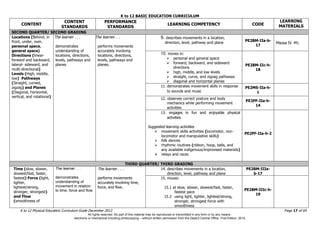
in succession, using forward-
and- back and side-to-side
movement patterns
PE1BM-IVf-h-14
Misosa VI -M1
25. engages in fun and enjoyable
physical activities
PE1PF-IVa-h-2
All rights reserved. No part of this material may be reproduced or transmitted in any form or by any means -
electronic or mechanical including photocopying – without written permission from the DepEd Central Office. First Edition, 2015.
K to 12 BASIC EDUCATION CURRICULUM
K to 12 Physical Education Curriculum Guide December 2013 Page 15 of 69
CONTENT CONTENT STANDARDS
PERFORMANCE
STANDARDS
LEARNING COMPETENCY CODE
LEARNING
MATERIALS
26. shows interest in participating
in physical activities
PE1PF-IVa-h-9
27. follows simple instructions and
rules
PE1PF-IVa-h-10
28. enjoys participating in physical
activities
Suggested learning activities
 action songs
 singing games
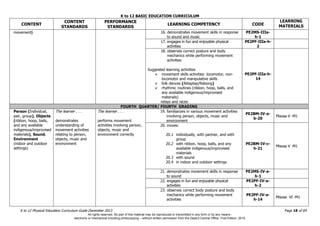
 simple games
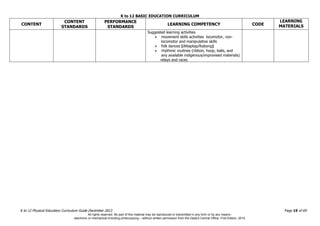
 chasing and fleeing games
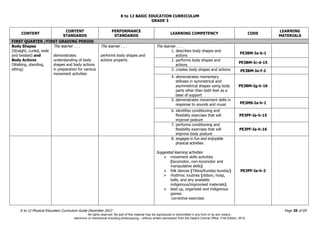
 mimetics
PE1PF-IVa-h-11
All rights reserved. No part of this material may be reproduced or transmitted in any form or by any means -
electronic or mechanical including photocopying – without written permission from the DepEd Central Office. First Edition, 2015.
K to 12 BASIC EDUCATION CURRICULUM
K to 12 Physical Education Curriculum Guide December 2013 Page 16 of 69
GRADE 2
CONTENT
CONTENT
STANDARDS
PERFORMANCE
STANDARDS
LEARNING COMPETENCY CODE
LEARNING
MATERIALS
FIRST QUARTER /FIRST GRADING PERIOD
Body Shapes
(Straight, curled, wide
and twisted) and
Body Actions
(Walking, standing,
sitting)
The learner . . .
demonstrates
understanding of body
shapes and body
actions in preparation
for various movement
activities
The learner . . .
performs body shapes and
actions properly.
The learner . .
1. describes body shapes and actions
PE2BM-Ia-b-1
2. demonstrates body shapes and actions PE2BM-Ic-d-
15
3. creates body shapes and actions PE2BM-Ie-f-2
4. demonstrates momentary stillness in
symmetrical and asymmetrical shapes
using body parts other than both feet as a
base of support
PE2BM-Ig-h-
16
Misosa V -M1
5. demonstrates movement skills in response
to sound and music
PE2MS-Ia-h-1
6. exhibits correct body posture PE2PF-Ia-h-
12
Misosa VI M1-M5
7. assesses body posture PE2PF-Ia-h-
13
8. engages in fun and enjoyable physical
activities
Suggested learning activities
 movement skills activities (locomotor, non-
locomotor and manipulative skills)
 folk dances (Alitaptap/Rabong)
 rhythmic routines (ribbon, hoop, balls, and
any available indigenous/improvised
materials)
relays and races
PE2PF-Ia-h-2
All rights reserved. No part of this material may be reproduced or transmitted in any form or by any means -
electronic or mechanical including photocopying – without written permission from the DepEd Central Office. First Edition, 2015.
K to 12 BASIC EDUCATION CURRICULUM
K to 12 Physical Education Curriculum Guide December 2013 Page 17 of 69
CONTENT
CONTENT
STANDARDS
PERFORMANCE
STANDARDS
LEARNING COMPETENCY CODE
LEARNING
MATERIALS
SECOND QUARTER/ SECOND GRADING
Locations (Behind, in
front, under, over,
personal space,
general space)
Directions (linear-
forward and backward,
lateral- sideward, and
multi-directional)
Levels (High, middle,
low) Pathways
(Straight, curved,
zigzag) and Planes
(Diagonal, horizontal,
vertical, and rotational)
Th The learner . . .
demonstrates
understanding of
locations, directions,
levels, pathways and
planes
ThThe learner. . .
performs movements
accurately involving
locations, directions,
levels, pathways and
planes.
9. describes movements in a location,
direction, level, pathway and plane
PE2BM-IIa-b-
17
Misosa IV -M1
10. moves in:
 personal and general space
 forward, backward, and sideward
directions
 high, middle, and low levels
 straight, curve, and zigzag pathways
 diagonal and horizontal planes
PE2BM-IIc-h-
18
11. demonstrates movement skills in response
to sounds and music
PE2MS-IIa-h-
1
12. observes correct posture and body
mechanics while performing movement
activities
PE2PF-IIa-h-
14
13. engages in fun and enjoyable physical
activities
Suggested learning activities
 movement skills activities (locomotor, non-
locomotor and manipulative skills)
 folk dances
 rhythmic routines (ribbon, hoop, balls, and
any available indigenous/improvised materials)
 relays and races
PE2PF-IIa-h-2
THIRD QUARTER/ THIRD GRADING
Time (slow, slower,
slowest/fast, faster,
fastest) Force (light,
lighter,
lightest/strong,
stronger, strongest)
and Flow
(smoothness of
The learner . . .
demonstrates
understanding of
movement in relation
to time, force and flow
The learner . . .
performs movements
accurately involving time,
force, and flow.
14. describes movements in a location,
direction, level, pathway and plane
PE2BM-IIIa-
b-17
15. moves:
15.1 at slow, slower, slowest/fast, faster,
fastest pace
15.2 using light, lighter, lightest/strong,
stronger, strongest force with
smoothness
PE2BM-IIIc-h-
19
All rights reserved. No part of this material may be reproduced or transmitted in any form or by any means -
electronic or mechanical including photocopying – without written permission from the DepEd Central Office. First Edition, 2015.
K to 12 BASIC EDUCATION CURRICULUM
K to 12 Physical Education Curriculum Guide December 2013 Page 18 of 69
CONTENT
CONTENT
STANDARDS
PERFORMANCE
STANDARDS
LEARNING COMPETENCY CODE
LEARNING
MATERIALS
movement) 16. demonstrates movement skills in response
to sound and music
PE2MS-IIIa-
h-1
17. engages in fun and enjoyable physical
activities
PE2PF-IIIa-h-
2
18. observes correct posture and body
mechanics while performing movement
activities
Suggested learning activities
 movement skills activities locomotor, non-
locomotor and manipulative skills
 folk dances (Alitaptap/Rabong)
 rhythmic routines (ribbon, hoop, balls, and
any available indigenous/improvised
materials)
relays and races
PE2PF-IIIa-h-
14
FOURTH QUARTER/ FOURTH GRADING
Person (Individual,
pair, group), Objects
(ribbon, hoop, balls,
and any available
indigenous/improvised
materials), Sound,
Environment
(indoor and outdoor
settings)
The learner . . .
demonstrates
understanding of
movement activities
relating to person,
objects, music and
environment
The learner . . .
performs movement
activities involving person,
objects, music and
environment correctly
19. familiarizes in various movement activities
involving person, objects, music and
environment
PE2BM-IV-a-
b-20
Misosa V -M1
20. moves:
20.1 individually, with partner, and with
group
20.2 with ribbon, hoop, balls, and any
available indigenous/improvised
materials
20.3 with sound
20.4 in indoor and outdoor settings
PE2BM-IV-c-
h-21
Misosa V -M1
21. demonstrates movement skills in response
to sound
PE2MS-IV-a-
h-1
22. engages in fun and enjoyable physical
activities
PE2PF-IV-a-
h-2
23. observes correct body posture and body
mechanics while performing movement
activities
PE2PF-IV-a-
h-14
Misosa VI -M1
All rights reserved. No part of this material may be reproduced or transmitted in any form or by any means -
electronic or mechanical including photocopying – without written permission from the DepEd Central Office. First Edition, 2015.
K to 12 BASIC EDUCATION CURRICULUM
K to 12 Physical Education Curriculum Guide December 2013 Page 19 of 69
CONTENT
CONTENT
STANDARDS
PERFORMANCE
STANDARDS
LEARNING COMPETENCY CODE
LEARNING
MATERIALS
Suggested learning activities
 movement skills activities locomotor, non-
locomotor and manipulative skills
 folk dances (Alitaptap/Rabong)
 rhythmic routines (ribbon, hoop, balls, and
any available indigenous/improvised materials)
relays and races
All rights reserved. No part of this material may be reproduced or transmitted in any form or by any means -
electronic or mechanical including photocopying – without written permission from the DepEd Central Office. First Edition, 2015.
K to 12 BASIC EDUCATION CURRICULUM
K to 12 Physical Education Curriculum Guide December 2013 Page 20 of 69
GRADE 3
CONTENT
CONTENT
STANDARDS
PERFORMANCE
STANDARDS
LEARNING COMPETENCY CODE
LEARNING
MATERIALS
FIRST QUARTER /FIRST GRADING PERIOD
Body Shapes
(Straight, curled, wide
and twisted) and
Body Actions
(Walking, standing,
sitting)
The learner . . .
demonstrates
understanding of body
shapes and body actions
in preparation for various
movement activities
The learner . . .
performs body shapes and
actions properly.
The learner . . .
1. describes body shapes and
actions
PE3BM-Ia-b-1
2. performs body shapes and
actions
PE3BM-Ic-d-15
3. creates body shapes and actions PE3BM-Ie-f-2
4. demonstrates momentary
stillness in symmetrical and
asymmetrical shapes using body
parts other than both feet as a
base of support
PE3BM-Ig-h-16
5. demonstrates movement skills in
response to sounds and music PE3MS-Ia-h-1
6. identifies conditioning and
flexibility exercises that will
improve posture
PE3PF-Ia-h-15
7. performs conditioning and
flexibility exercises that will
improve body posture
PE3PF-Ia-h-16
8. engages in fun and enjoyable
physical activities
Suggested learning activities
 movement skills activities
(locomotor, non-locomotor and
manipulative skills)
 folk dances (Tiklos/Kunday-kunday)
 rhythmic routines (ribbon, hoop,
balls, and any available
indigenous/improvised materials)
 lead up, organized and indigenous
games
corrective exercises
PE3PF-Ia-h-2
All rights reserved. No part of this material may be reproduced or transmitted in any form or by any means -
electronic or mechanical including photocopying – without written permission from the DepEd Central Office. First Edition, 2015.
K to 12 BASIC EDUCATION CURRICULUM
K to 12 Physical Education Curriculum Guide December 2013 Page 21 of 69
CONTENT
CONTENT
STANDARDS
PERFORMANCE
STANDARDS
LEARNING COMPETENCY CODE
LEARNING
MATERIALS
SECOND QUARTER/ SECOND GRADING
Locations (Behind,
in front, under, over,
personal space,
general space)
Directions (linear-
forward and
backward, lateral-
sideward, and multi-
directional) Levels
(High, middle, low)
Pathways (Straight,
curve, zigzag) and
Planes (Diagonal,
horizontal, vertical,
and rotational)
The learner . . .
demonstrates
understanding of
locations, directions,
levels, pathways and
planes
The learner . . .
performs movements
accurately involving locations,
directions, levels, pathways
and planes.
The learner . . .
9. describes movements in a
location, direction, level, pathway
and plane
PE3BM-IIa-b-17
10. moves in:
 personal and general space
 forward, backward, and
sideward directions
 high, middle, and low levels
 straight, curve, and zigzag
pathways
 diagonal and horizontal
planes
PE3BM-IIc-h-18
11. demonstrates movement skills
in response to sound
PE3MS-IIa-h-1 Misosa IV-M1
12. identifies conditioning and
flexibility exercises that will
improve body mechanics
PE3PF-IIa-h-15 Misosa V-M1
13. performs conditioning and
flexibility exercises that will
improve body mechanics
PE3PF-IIa-h-16 Misosa VI-M5
14. engages in fun and enjoyable
physical activities
Suggested learning activities
 movement skills activities
(locomotor, non-locomotor and
manipulative skills)
 folk dances (Tiklos/ Kunday-kunday)
 rhythmic routines (ribbon, hoop,
balls, and any available
indigenous/improvised materials)
 lead up, organized and indigenous
games
corrective exercises
PE3PF-IIa-h-2
All rights reserved. No part of this material may be reproduced or transmitted in any form or by any means -
electronic or mechanical including photocopying – without written permission from the DepEd Central Office. First Edition, 2015.
K to 12 BASIC EDUCATION CURRICULUM
K to 12 Physical Education Curriculum Guide December 2013 Page 22 of 69
CONTENT
CONTENT
STANDARDS
PERFORMANCE
STANDARDS
LEARNING COMPETENCY CODE
LEARNING
MATERIALS
THIRD QUARTER/ THIRD GRADING
Time (slow, slower,
slowest/fast, faster,
fastest Force (light,
lighter,
lightest/strong,
stronger, strongest)
and Flow
(smoothness of
movement)
The learner . . .
demonstrates
understanding of
movement in relation to
time, force and flow
The learner . . .
performs movements
accurately involving time,
force, and flow.
15. describes movements in a
location, direction, level,
pathway and plane
PE3BM-IIIa-b-17 Misosa IV-M1
16. moves:
 at slow, slower, slowest/fast,
faster, fastest pace
 using light, lighter,
lightest/strong, stronger,
strongest force with
smoothness
PE3BM-IIIc-h-19
17. demonstrates movement skills
in response to sound
PE3MS-IIIa-h-1
18. engages in fun and enjoyable
physical activities
PE3PF-IIIa-h-2
19. identifies conditioning and
flexibility exercises that will
improve body mechanics
PE3PF-IIIa-h-15
Misosa V-M1
20. performs conditioning and
flexibility exercises that will
improve body mechanics
Suggested learning activities
 movement skills activities
locomotor, non-locomotor and
manipulative skills
 folk dances (Tiklos/ Kunday-kunday)
 rhythmic routines (ribbon, hoop,
balls, and any available
indigenous/improvised materials)
 lead up, organized and indigenous
games
 corrective exercises
PE3PF-IIIa-h-16 Misosa V-M1
FOURTH QUARTER/ FOURTH GRADING
Person (Invidual,
pair, group) Objects
(ribbon, hoop, balls,
The learner . . .
demonstrates
The learner . . .
performs movement activities
The learner . . .
21. participates in various movement
activities involving person,
PE3BM-IV-a-b-
20
Misosa IV-M5
All rights reserved. No part of this material may be reproduced or transmitted in any form or by any means -
electronic or mechanical including photocopying – without written permission from the DepEd Central Office. First Edition, 2015.
K to 12 BASIC EDUCATION CURRICULUM
K to 12 Physical Education Curriculum Guide December 2013 Page 23 of 69
CONTENT
CONTENT
STANDARDS
PERFORMANCE
STANDARDS
LEARNING COMPETENCY CODE
LEARNING
MATERIALS
and any available
indigenous/improvised
materials), Sound and
Environment (indoor
and outdoor settings)
understanding of
movement activities
relating to person,
objects, music and
environment
involving person, objects,
music and environment
correctly
objects, music and environment
22. moves:
 individually, with partner, and
with group
 with ribbon, hoop, balls, and
any available
indigenous/improvised
materials
 with sound
 in indoor and outdoor
settings
PE3BM-IV-c-h-
21
23. demonstrates movement skills
in response to sounds and music
PE3MS-IV-a-h-1
24. engages in fun and enjoyable
physical activities
PE3PF-IV-a-h-2
25. identifies conditioning and
flexibility exercises that will
improve posture
PE3PF-IV-a-h-15
26. performs conditioning and
flexibility exercises that will
improve body mechanics
Suggested learning activities
 movement skills activities
locomotor, non-locomotor and
manipulative skills
 folk dances (Tiklos/Kunday-kunday)
 rhythmic routines (ribbon, hoop,
balls, and any available
indigenous/improvised materials)
 lead up, organized and indigenous
games
corrective exercises
PE3PF-IV-a-h-16
All rights reserved. No part of this material may be reproduced or transmitted in any form or by any means -
electronic or mechanical including photocopying – without written permission from the DepEd Central Office. First Edition, 2015.
K to 12 BASIC EDUCATION CURRICULUM
K to 12 Physical Education Curriculum Guide December 2013 Page 24 of 69
GRADE 4
CONTENT CONTENT STANDARDS
PERFORMANCE
STANDARDS
LEARNING COMPETENCY CODE
LEARNING
MATERIALS
FIRST QUARTER /FIRST GRADING PERIOD
Assessment of
physical
activities and
physical fitness
Target games
(Tumbang preso,
tamaang-
tao/batuhang bola,
tatsing),
striking/fielding
games
(syato/,basagang
palayok, kickball)
Note: Games are
not limited to the
above listed
activities
The learner . . .
demonstrates
understanding of
participation and
assessment of physical
activities and physical
fitness
The learner . . .
participates and assesses
performance in physical
activities.
assesses physical fitness
The learner . . .
1. describes the physical activity
pyramid
PE4PF-Ia-16
2. explains the indicators for
fitness
PE4PF-Ia-17
3. assesses regularly participation
in physical activities based on
physical activity pyramid
PE4PF-Ib-h-18
4. explains the nature/background
of the games PE4GS-Ib-1
5. describes the skills involved in
the games PE4GS-Ib-2
6. observes safety precautions PE4GS-Ib-h-3
7. executes the different skills
involved in the game
PE4GS-Ic-h-4
8. recognizes the value of
participation in physical activities
PE4PF-Ib-h-19
9. displays joy of effort, respect for
others and fair play during
participation in physical activities
PE4PF-Ib-h-20
10. explains health and skill related
fitness components
PE4PF-Ia-21
11. identifies areas for
improvement
PE4PF-Ib-h-22
SECOND QUARTER/ SECOND PERIOD
Assessment of
physical
activities and
physical fitness
Invasion games
(agawan base,
The learner . . .
demonstrates
understanding of
participation in and
assessment of physical
activities and physical
fitness
The learner . . .
participates and assesses
performance in physical
activities.
assesses physical fitness
12. describes the Philippines
physical activity pyramid
PE4PF-IIa-16
13. explains the indicators for
fitness
PE4PF-IIa-17
14. assesses regularly participation
in physical activities based on
physical activity pyramid
PE4PF-IIb-h-18
15. explains the nature/background PE4GS-IIb-1
All rights reserved. No part of this material may be reproduced or transmitted in any form or by any means -
electronic or mechanical including photocopying – without written permission from the DepEd Central Office. First Edition, 2015.
K to 12 BASIC EDUCATION CURRICULUM
K to 12 Physical Education Curriculum Guide December 2013 Page 25 of 69
CONTENT CONTENT STANDARDS
PERFORMANCE
STANDARDS
LEARNING COMPETENCY CODE
LEARNING
MATERIALS
lawin at sisiw,
agawan panyo)
Note: Games are
not limited to the
above listed
activities
of the games
16. describes the skills involved in
the games
PE4GS-IIb-2
17. observes safety precautions PE4GS-IIb-h-3
18. executes the different skills
involved in the game
PE4GS-IIc-h-4
19. recognizes the value of
participation in physical activities
PE4PF-IIb-h-19
20. displays joy of effort, respect for
others and fair play during
participation in physical activities
PE4PF-IIb-h-20
21. explains health and skill related
fitness components
PE4PF-IIa-21
22. identifies areas for improvement PE4PF-IIb-h-22
THIRD QUARTER / THIRD GRADING
Assessment of
physical
activities and
physical fitness
Folk (Liki/Ba-
Ingles),
indigenous,
ethnic,
traditional and
creative dances
Note: Dances
available in the
area can be
selected.
The learner . . .
demonstrates
understanding of
participation and
assessment of physical
activity and physical
fitness
The learner . . .
participates and assesses
performance in physical
activities.
assesses physical fitness
23. describes the Philippines
physical activity pyramid
PE4PF-IIIa-16
24. explains the indicators for
fitness
PE4PF-IIIa-17
25. assesses regularly participation
in physical activities based on
physical activity pyramid
PE4PF-IIIb-h-18
26. explains the nature/background
of the dance
PE4GS-IIIb-1
27. describes the skills involved in
the dance
PE4GS-IIIb-2
28. observes safety precautions PE4GS-IIIb-h-3
29. executes the different skills
involved in the dance
PE4GS-IIIc-h-4
30. recognizes the value of
participation in physical activities
PE4PF-IIIb-h-19
31. displays joy of effort, respect for
others during participation in
physical activities
PE4PF-IIIb-h-20
32. explains health and skill related
fitness components
PE4PF-IIIa-21
All rights reserved. No part of this material may be reproduced or transmitted in any form or by any means -
electronic or mechanical including photocopying – without written permission from the DepEd Central Office. First Edition, 2015.
K to 12 BASIC EDUCATION CURRICULUM
K to 12 Physical Education Curriculum Guide December 2013 Page 26 of 69
CONTENT CONTENT STANDARDS
PERFORMANCE
STANDARDS
LEARNING COMPETENCY CODE
LEARNING
MATERIALS
33. identifies areas for improvement PE4PF-IIIa-22
FOURTH QUARTER/ FOURTH PERIOD
Assessment of
physical
activities and
physical fitness
Folk (Liki/Ba-
Ingles),
indigenous,
ethnic,
traditional and
creative dances
Note: Dances
available in the
area can be
selected.
The learner . . .
demonstrates
understanding of
participation and
assessment of physical
activity and physical
fitness
The learner . . .
participates and assesses
performance in physical
activities.
assesses physical fitness
34. describes the Philippines
physical activity pyramid
PE4PF-IVa-16
35. explains the indicators for
fitness
PE4PF-IVa-17
36. assesses regularly participation
in physical activities based on
Philippines physical activity
pyramid
PE4PF-IVb-h-18
37. explains the nature/background
of the dance
PE4RD-IVb-1
38. describes the skills involved in
the dance
PE4RD-IVb-2
39. observes safety precautions PE4RD-IVb-h-3
40. executes the different skills
involved in the dance
PE4RD-IVc-h-4
41. recognizes the value of
participation in physical activities
PE4PF-IVb-h-19
42. displays joy of effort, respect for
others during participation in
physical activities
PE4PF-IVb-h-20
43. explains health and skill related
fitness components
PE4PF-IVa-21
44. identifies areas for improvement PE4PF-IVb-h-22
All rights reserved. No part of this material may be reproduced or transmitted in any form or by any means -
electronic or mechanical including photocopying – without written permission from the DepEd Central Office. First Edition, 2015.
K to 12 BASIC EDUCATION CURRICULUM
K to 12 Physical Education Curriculum Guide December 2013 Page 27 of 69
GRADE 5
CONTENT CONTENT STANDARDS
PERFORMANCE
STANDARDS
LEARNING COMPETENCY CODE
LEARNING
MATERIALS
FIRST QUARTER /FIRST GRADING PERIOD
Assessment of
physical activity
and physical
fitness
Target games
(Tumbang preso,
tamaang-
tao/batuhang
bola, tatsing),
striking/fielding
games
(syato/,basagang
palayok, kickball)
Note: Games are
not limited to the
above listed
activities
The learner . . .
demonstrates
understanding of
participation and
assessment of physical
activity and physical
fitness
The learner . . .
participates and assesses
performance in physical
activities.
assesses physical fitness
The learner . . .
1. describes the Philippines physical
activity pyramid
PE5PF-Ia-16
2. explains the indicators for fitness PE5PF-Ia-17
3. assesses regularly participation in
physical activities based on the
Philippines physical activity
pyramid
PE5PF-Ib-h-18
4. explains the nature/background
of the games PE5GS-Ib-1
5. describes the skills involved in
the games PE5GS-Ib-2
6. observes safety precautions PE5GS-Ib-h-3
7. executes the different skills
involved in the game
PE5GS-Ic-h-4
8. recognizes the value of
participation in physical activities
PE5PF-Ib-h-19
9. displays joy of effort, respect for
others and fair play during
participation in physical activities
PE5PF-Ib-h-20
10. explains health and skill related
fitness components
PE5PF-Ia-21
11. identifies areas for improvement
PE5PF-Ib-h-22
SECOND QUARTER / SECOND GRADING
Assessment of
physical
activities and
physical fitness
Invasion games
(agawan base,
The learner . . .
demonstrates
understanding of
participation in and
assessment of physical
activity and physical
fitness
The learner . . .
participates and assesses
performance in physical
activities.
assesses physical fitness
12. describes the Philippines
physical activity pyramid
PE5PF-IIa-16
13. explains the indicators for
fitness
PE5PF-IIa-17
14. assesses regularly participation
in physical activities based on
the Philippines physical activity
pyramid
PE5PF-IIb-h-18
All rights reserved. No part of this material may be reproduced or transmitted in any form or by any means -
electronic or mechanical including photocopying – without written permission from the DepEd Central Office. First Edition, 2015.
K to 12 BASIC EDUCATION CURRICULUM
K to 12 Physical Education Curriculum Guide December 2013 Page 28 of 69
CONTENT CONTENT STANDARDS
PERFORMANCE
STANDARDS
LEARNING COMPETENCY CODE
LEARNING
MATERIALS
lawin at sisiw,
agawan panyo)
Note: Games are
not limited to the
above listed
activities
15. explains the nature/background
of the games
PE5GS-IIb-1
16. describes the skills involved in
the games
PE5GS-IIb-2
17. observes safety precautions
PE5GS-IIb-h-3
18. executes the different skills
involved in the game
PE5GS-IIc-h-4
19. recognizes the value of
participation in physical activities
PE5PF-IIb-h-19
20. displays joy of effort, respect for
others and fair play during
participation in physical activities
PE5PF-IIb-h-20
21. explains health and skill related
fitness components
PE5PF-IIa-21
22. identifies areas for improvement
PE5PF-IIb-h-22
THIRD QUARTER/ THIRD PERIOD
Assessment of
physical
activities and
physical fitness
Folk (Cariñosa/
Polka sa Nayon),
indigenous,
ethnic,
traditional and
creative dances
Note: Dances
available in the
area can be
selected.
The learner . . .
demonstrates
understanding of
participation and
assessment of physical
activity and physical
fitness
The learner . . .
participates and assesses
performance in physical
activities.
assesses physical fitness
23. describes the Philippines
physical activity pyramid
PE5PF-IIIa-16
24. explains the indicators for
fitness
PE5PF-IIIa-17
25. assesses regularly participation
in physical activities based on
the Philippines physical activity
pyramid
PE5PF-IIIb-h-18
26. explains the nature/background
of the dance
PE5RD-IIIb-1
27. describes the skills involved in
the dance
PE5RD-IIIb-2
28. observes safety precautions PE5RD-IIIb-h-3
29. executes the different skills
involved in the dance PE5RD-IIIc-h-4
30. recognizes the value of
participation in physical activities
PE5PF-IIIb-h-19
All rights reserved. No part of this material may be reproduced or transmitted in any form or by any means -
electronic or mechanical including photocopying – without written permission from the DepEd Central Office. First Edition, 2015.
K to 12 BASIC EDUCATION CURRICULUM
K to 12 Physical Education Curriculum Guide December 2013 Page 29 of 69
CONTENT CONTENT STANDARDS
PERFORMANCE
STANDARDS
LEARNING COMPETENCY CODE
LEARNING
MATERIALS
31. displays joy of effort, respect for
others during participation in
physical activities
PE5PF-IIIb-h-20
32. explains health and skill related
fitness components
PE5PF-IIIa-21
33. identifies areas for improvement PE5PF-IIIb-h-22
FOURTH QUARTER/ FOURTH PERIOD
Assessment of
physical
activities and
physical fitness
Folk (Cariñosa/
Polka sa Nayon),
indigenous,
ethnic,
traditional and
creative dances
Note: Dances
available in the
area can be
selected.
The learner . . .
demonstrates
understanding of
participation and
assessment of physical
activity and physical
fitness
The learner . . .
participates and assesses
performance in physical
activities.
assesses physical fitness
34. describes the Philippines
physical activity pyramid
PE5PF-IVa-16
35. explains the indicators for
fitness
PE5PF-IVa-17
36. assesses regularly participation
in physical activities based on
the Philippines physical activity
pyramid
PE5PF-IVb-h-18
37. explains the nature/background
of the dance
PE5RD-IVb-1
38. describes the skills involved in
the dance
PE5RD-IVb-2
39. observes safety precautions PE5RD-IVb-h-3
40. executes the different skills
involved in the dance
PE5RD-IVc-h-4
41. recognizes the value of
participation in physical activities
PE5PF-IVb-h-19
42. displays joy of effort, respect for
others during participation in
physical activities
PE5PF-IVb-h-20
43. explains health and skill related
fitness components
PE5PF-IVa-21
44. identifies areas for improvement PE5PF-IVb-h-22
All rights reserved. No part of this material may be reproduced or transmitted in any form or by any means -
electronic or mechanical including photocopying – without written permission from the DepEd Central Office. First Edition, 2015.
K to 12 BASIC EDUCATION CURRICULUM
K to 12 Physical Education Curriculum Guide December 2013 Page 30 of 69
GRADE 6
CONTENT CONTENT STANDARDS
PERFORMANCE
STANDARDS
LEARNING COMPETENCY CODE
LEARNING
MATERIALS
FIRST QUARTER /FIRST GRADING PERIOD
Assessment of
physical
activities and
physical fitness
Target games
(Tumbang preso,
tamaang-
tao/batuhang
bola, tatsing),
striking/fielding
games
(syato/,basagang
palayok, kickball)
Note: Games are
not limited to the
above listed
activities
The learner . . .
demonstrates
understanding of
participation and
assessment of physical
activity and physical
fitness
The learner . . .
participates and assesses
performance in physical
activities.
assesses physical fitness
The learner . . .
1. describes the Philippines
physical activity pyramid
PE6PF-Ia-16
2. explains the indicators for
fitness
PE6PF-Ia-17
3. assesses regularly participation
in physical activities based on
the Philippines physical activity
pyramid
PE6PF-Ib-h-18
4. explains the nature/background
of the games PE6GS-Ib-1
5. describes the skills involved in
the games PE6GS-Ib-2
6. observes safety precautions PE6GS-Ib-h-3
7. executes the different skills
involved in the game
PE6GS-Ic-h-4
8. recognizes the value of
participation in physical activities
PE6PF-Ib-h-19
9. displays joy of effort, respect for
others and fair play during
participation in physical activities
PE6PF-Ib-h-20
10. explains health and skill related
fitness components
PE6PF-Ia-21
11. identifies areas for
improvement
PE6PF-Ib-h-22
SECOND QUARTER/ SECOND PERIOD
Assessment of
physical
activities and
physical fitness
Invasion games
The learner . . .
demonstrates
understanding of
participation in and
assessment of physical
activities and physical
The learner . . .
participates and assesses
performance in physical
activities.
assesses physical fitness
12. describes the Philippines
physical activity pyramid
PE6PF-IIa-16
13. explains the indicators for
fitness
PE6PF-IIa-17
14. assesses regularly participation
in physical activities based on
the Philippines physical activity
PE6PF-IIb-h-18
All rights reserved. No part of this material may be reproduced or transmitted in any form or by any means -
electronic or mechanical including photocopying – without written permission from the DepEd Central Office. First Edition, 2015.
K to 12 BASIC EDUCATION CURRICULUM
K to 12 Physical Education Curriculum Guide December 2013 Page 31 of 69
CONTENT CONTENT STANDARDS
PERFORMANCE
STANDARDS
LEARNING COMPETENCY CODE
LEARNING
MATERIALS
(agawan base,
lawin at sisiw,
agawan panyo)
Note: Games are
not limited to the
above listed
activities
fitness pyramid
15. explains the
nature/background of the
games
PE6GS-IIb-1
16. describes the skills involved in
the games
PE6GS-IIb-2
17. observes safety precautions
PE6GS-IIb-h-3
18. executes the different skills
involved in the game
PE6GS-IIc-h-4
19. recognizes the value of
participation in physical
activities
PE6PF-IIb-h-19
20. displays joy of effort, respect
for others and fair play during
participation in physical
activities
PE6PF-IIb-h-20
21. explains health and skill related
fitness components
PE6PF-IIa-21
22. identifies areas for
improvement
PE6PF-IIb-h-22
THIRD QUARTER/ THIRD PERIOD
Assessment of
physical
activities and
physical fitness
Folk (Itik-itik for
girls and
Maglalatik for
boys),
indigenous,
ethnic,
traditional and
creative dances
The learner . . .
demonstrates
understanding of
participation and
assessment of physical
activity and physical
fitness
The learner . . .
participates and assesses
performance in physical
activities.
assesses physical fitness
23. describes the Philippines
physical activity pyramid
PE6PF-IIIa-16
24. explains the indicators for
fitness
PE6PF-IIIa-17
25. assesses regularly participation
in physical activities based on
the Philippines physical activity
pyramid
PE6PF-IIIb-h-18
26. explains the
nature/background of the
dance
PE6RD-IIIb-1
27. describes the skills involved in
the dance
PE6RD-IIIb-2
All rights reserved. No part of this material may be reproduced or transmitted in any form or by any means -
electronic or mechanical including photocopying – without written permission from the DepEd Central Office. First Edition, 2015.
K to 12 BASIC EDUCATION CURRICULUM
K to 12 Physical Education Curriculum Guide December 2013 Page 32 of 69
CONTENT CONTENT STANDARDS
PERFORMANCE
STANDARDS
LEARNING COMPETENCY CODE
LEARNING
MATERIALS
Note: Dances
available in the
area can be
selected.
28. observes safety precautions
PE6RD-IIIb-h-3
29. executes the different skills
involved in the dance
PE6RD-IIIc-h-4
30. recognizes the value of
participation in physical
activities
PE6PF-IIIb-h-19
31. displays joy of effort, respect
for others during participation
in physical activities
PE6PF-IIIb-h-20
32. explains health and skill related
fitness components
PE6PF-IIIa-21
33. identifies areas for
improvement
PE6PF-IIIb-h-22
FOURTH QUARTER/ FOURTH PERIOD
Assessment of
physical
activities and
physical fitness
Folk (Itik-itik for
girls and
Maglalatik for
boys),
indigenous,
ethnic,
traditional and
creative dances
Note: Dances
available in the
area can be
selected.
The learner . . .
demonstrates
understanding of
participation and
assessment of physical
activity and physical
fitness
The learner . . .
participates and assesses
performance in physical
activities.
assesses physical fitness
34. describes the Philippines
physical activity pyramid
PE6PF-IVa-16
35. explains the indicators for
fitness
PE6PF-IVa-17
36. assesses regularly participation
in physical activities based on
the Philippines physical activity
pyramid
PE6PF-IVb-h-18
37. explains the
nature/background of the
dance
PE6RD-IVb-1
38. describes the skills involved in
the dance
PE6RD-IVb-2
39. observes safety precautions
PE6RD-IVb-h-3
40. executes the different skills
involved in the dance
PE6RD-IVc-h-4
41. recognizes the value of
participation in physical
activities
PE6PF-IVb-h-19
42. displays joy of effort, respect
for others during participation
PE6PF-IVb-h-20
All rights reserved. No part of this material may be reproduced or transmitted in any form or by any means -
electronic or mechanical including photocopying – without written permission from the DepEd Central Office. First Edition, 2015.
K to 12 BASIC EDUCATION CURRICULUM
K to 12 Physical Education Curriculum Guide December 2013 Page 33 of 69
CONTENT CONTENT STANDARDS
PERFORMANCE
STANDARDS
LEARNING COMPETENCY CODE
LEARNING
MATERIALS
in physical activities
43. explains health and skill related
fitness components
PE6PF-IVa-21
44. identifies areas for
improvement
PE6PF-IVb-h-22
All rights reserved. No part of this material may be reproduced or transmitted in any form or by any means -
electronic or mechanical including photocopying – without written permission from the DepEd Central Office. First Edition, 2015.
K to 12 BASIC EDUCATION CURRICULUM
K to 12 Physical Education Curriculum Guide December 2013 Page 34 of 69
GRADE 7
CONTENT
CONTENT
STANDARDS
PERFORMANCE
STANDARDS
LEARNING COMPETENCY CODE
LEARNING
MATERIALS
FIRST QUARTER /FIRST GRADING PERIOD
Exercise Programs:
Training Guidelines,
FITT Principles
Endurance, Muscle- and
Bone-strengthening
Activities:
a. individual sports
1. running
2. rhythmic
sportive
gymnastics
3. swimming
b. dual sports
1. badminton
2. table tennis
3. tennis
c. combative sports
1. arnis (anyo)
2. taekwondo
(poomsae)
3. karate(kata)
Note: Activities
dependent on teacher
capability and school
resources.
The learner . . .
demonstrates
understanding of
guidelines and principles
in exercise program
design to achieve
personal fitness
The learner . . .
designs an individualized
exercise program to achieve
personal fitness
The learner . . .
1. undertakes physical activity and
physical fitness assessments
PE7PF-Ia-h-23
OHSP Y1Q1,
Module 1
2010 SEC Y1Q1
2010 SEC Y2Q1
Enjoy Life w/ PE &
Health, TX & TM
Unit 1
2. sets goals based on assessment
results
PE7PF-Ia-24
OHSP Y1Q1,
Module 1
2010 SEC Y1Q1
2010 SEC Y2Q1
Enjoy Life w/ PE &
Health, TX & TM
Unit 1
3. identifies training guidelines
and FITT principles
PE7PF-Ib-25
OHSP Y1Q1,
Module 1
2010 SEC Y1Q1
2010 SEC Y2Q1
Enjoy Life w/ PE &
Health, TX & TM
Unit 1
4. recognizes barriers (low level of
fitness, lack of skill and time) to
exercise
PE7PF-Ib-26
OHSP Y1Q1,
Module 1
2010 SEC Y1Q1
2010 SEC Y2Q1
Enjoy Life w/ PE &
Health, TX & TM
Unit 1
5. prepares an exercise program
PE7PF-Ic-27
OHSP Y1Q1,
Module 1
2010 SEC Y1Q1
2010 SEC Y2Q1
Enjoy Life w/ PE &
Health, TX & TM
Unit 1
All rights reserved. No part of this material may be reproduced or transmitted in any form or by any means -
electronic or mechanical including photocopying – without written permission from the DepEd Central Office. First Edition, 2015.
K to 12 BASIC EDUCATION CURRICULUM
K to 12 Physical Education Curriculum Guide December 2013 Page 35 of 69
CONTENT
CONTENT
STANDARDS
PERFORMANCE
STANDARDS
LEARNING COMPETENCY CODE
LEARNING
MATERIALS
6. describes the nature and
background of the sport
PE7GS-Id-5
Proj EASE Module1
OHSPY1Q2
Module1
OHSPY1Q2
Module2
OHSPY1Q2
Module3
2010 SECY1Q2
&Q3
Enjoy Life w/ PE &
Health, TX & TM
Unit
7. executes the skills involved in
the sport PE7GS-Id-h-4
Proj EASE Module1
OHSPY1Q2
Module1
OHSPY1Q2
Module2
OHSPY1Q2
Module3
2010 SECY1Q2
&Q3
Enjoy Life w/ PE &
Health, TX & TM
Unit 2
8. monitors periodically one’s
progress towards the fitness
goals
PE7PF-Id-h-28
OHSP Y1Q1,
Module 1
2010 SEC Y1Q1
2010 SEC Y2Q1
Enjoy Life w/ PE &
Health, TX & TM
Unit 1
9. distinguishes from fallacies and
misconceptions about the
physical activity participation
PE7PF-Id-29
OHSP Y1Q1,
Module 1
2010 SEC Y1Q1
2010 SEC Y2Q1
Enjoy Life w/ PE &
Health, TX & TM
Unit 1
All rights reserved. No part of this material may be reproduced or transmitted in any form or by any means -
electronic or mechanical including photocopying – without written permission from the DepEd Central Office. First Edition, 2015.
K to 12 BASIC EDUCATION CURRICULUM
K to 12 Physical Education Curriculum Guide December 2013 Page 36 of 69
CONTENT
CONTENT
STANDARDS
PERFORMANCE
STANDARDS
LEARNING COMPETENCY CODE
LEARNING
MATERIALS
10. performs appropriate first aid
for sports-related injuries (e.g.
cramps, sprain, heat
exhaustion)
PE7PF-Id-30
OHSP Y1Q1,
Module 1
2010 SEC Y1Q1
2010 SEC Y2Q1
Enjoy Life w/ PE &
Health, TX & TM
Unit 1
11. assumes responsibility for
achieving personal fitness
PE7PF-Id-h-31
OHSP Y1Q1,
Module 1
2010 SEC Y1Q1
2010 SEC Y2Q1
Enjoy Life w/ PE &
Health, TX & TM
Unit 1
12. keeps the importance of
winning and losing in
perspective
PE7PF-Id-h-32
OHSP Y1Q1,
Module 1
2010 SEC Y1Q1
2010 SEC Y2Q1
Enjoy Life w/ PE &
Health, TX & TM
Unit 1
SECOND QUARTER/ SECOND PERIOD
Exercise Programs:
Training Guidelines,
FITT Principles
Endurance, Muscle- and
Bone-strengthening
Activities:
a. individual
sports
1. running
2. rhythmic
sportive
gymnastics
The learner . . .
demonstrates
understanding of
guidelines and principles
in exercise program
design to achieve
personal fitness
The learner . . .
modifies the individualized
exercise program to achieve
personal fitness
13. undertakes physical activity and
physical fitness assessments
PE7PF-IIa-h-23
OHSP Y1Q1,
Module 1
2010 SEC Y1Q1
2010 SEC Y2Q1
Enjoy Life w/ PE &
Health, TX & TM
Unit 1
14. reviews goals based on
assessment results PE7PF-IIa-24
OHSP Y1Q1,
Module 1
2010 SEC Y1Q1
2010 SEC Y2Q1
Enjoy Life w/ PE &
Health, TX & TM
Unit 1
15. addresses barriers (low level of
fitness, lack of skill and time) to
PE7PF-IIb-33 OHSP Y1Q1,
Module 1
All rights reserved. No part of this material may be reproduced or transmitted in any form or by any means -
electronic or mechanical including photocopying – without written permission from the DepEd Central Office. First Edition, 2015.
K to 12 BASIC EDUCATION CURRICULUM
K to 12 Physical Education Curriculum Guide December 2013 Page 37 of 69
CONTENT
CONTENT
STANDARDS
PERFORMANCE
STANDARDS
LEARNING COMPETENCY CODE
LEARNING
MATERIALS
3. swimming
b. dual sports
1. badminton
2. table tennis
3. tennis
c. combative sports
1. arnis (anyo)
2. taekwondo
(poomsae)
3. karate (kata)
Note: Activities
dependent on teacher
capability and school
resources.
exercise 2010 SEC Y1Q1
2010 SEC Y2Q1
Enjoy Life w/ PE &
Health, TX & TM
Unit 1
16. describes the nature and
background of the sport
PE7GS-IId-5
Proj EASE Module1
OHSPY1Q2
Module1
OHSPY1Q2
Module2
OHSPY1Q2
Module3
2010 SECY1Q2
&Q3
Enjoy Life w/ PE &
Health, TX & TM
Unit 2
17. executes the skills involved in
the sport
PE7GS-IId-h-4
Proj EASE Module1
OHSPY1Q2
Module1
OHSPY1Q2
Module2
OHSPY1Q2
Module3
2010 SECY1Q2
&Q3
Enjoy Life w/ PE &
Health, TX & TM
Unit 2
18. monitors periodically one’s
progress towards the fitness
goals
PE7PF-IId-h-28
OHSP Y1Q1,
Module 1
2010 SEC Y1Q1
2010 SEC Y2Q1
Enjoy Life w/ PE &
Health, TX & TM
Unit 1
19. performs appropriate first aid
for sports-related injuries (e.g.
PE7PF-IId-30 OHSP Y1Q1,
Module 1
All rights reserved. No part of this material may be reproduced or transmitted in any form or by any means -
electronic or mechanical including photocopying – without written permission from the DepEd Central Office. First Edition, 2015.
K to 12 BASIC EDUCATION CURRICULUM
K to 12 Physical Education Curriculum Guide December 2013 Page 38 of 69
CONTENT
CONTENT
STANDARDS
PERFORMANCE
STANDARDS
LEARNING COMPETENCY CODE
LEARNING
MATERIALS
cramps, sprain, heat
exhaustion)
2010 SEC Y1Q1
2010 SEC Y2Q1
Enjoy Life w/ PE &
Health, TX & TM
Unit 1
20. assumes responsibility for
achieving personal fitness
PE7PF-IId-h-31
OHSP Y1Q1,
Module 1
2010 SEC Y1Q1
2010 SEC Y2Q1
Enjoy Life w/ PE &
Health, TX &
TM Unit 1
21. keeps the importance of
winning and losing in
perspective
PE7PF-IId-h-32
OHSP Y1Q1,
Module 1
2010 SEC Y1Q1
2010 SEC Y2Q1
Enjoy Life w/ PE &
Health, TX & TM
Unit 1
THIRD QUARTER/ THIRD PERIOD
Exercise Programs:
Training Guidelines,
FITT Principles
Endurance, Muscle- and
Bone-strengthening
Activities:
Folk (Tinikling)/
indigenous, ethnic,
traditional/ festival
dance
Note: Dances
available in the
The learner . . .
demonstrates
understanding of
guidelines and principles
in exercise program
design to achieve
personal fitness
The learner . . .
demonstrates understanding
of guidelines and principles in
exercise program design to
achieve personal fitness
22. undertakes physical activity and
physical fitness assessments
PE7PF-IIIa-h-23
OHSP Y1Q1,
Module 1
2010 SEC Y1Q1
2010 SEC Y2Q1
Enjoy Life w/ PE &
Health, TX & TM
Unit 1
23. reviews goals based on
assessment results
PE7PF-IIIa-34
OHSP Y1Q1,
Module 1
2010 SEC Y1Q1
2010 SEC Y2Q1
Enjoy Life w/ PE &
Health, TX & TM
Unit 1
24. addresses barriers (low level of
fitness, lack of skill and time) to
exercise
PE7PF-IIIb-33
OHSP Y1Q1,
Module 1
2010 SEC Y1Q1
2010 SEC Y2Q1
All rights reserved. No part of this material may be reproduced or transmitted in any form or by any means -
electronic or mechanical including photocopying – without written permission from the DepEd Central Office. First Edition, 2015.
K to 12 BASIC EDUCATION CURRICULUM
K to 12 Physical Education Curriculum Guide December 2013 Page 39 of 69
CONTENT
CONTENT
STANDARDS
PERFORMANCE
STANDARDS
LEARNING COMPETENCY CODE
LEARNING
MATERIALS
area can be
selected.
Enjoy Life w/ PE &
Health, TX & TM
Unit 1
25. describes the nature and
background of the dance
PE7RD-IIId-1
OHSP Y1Q4
2010 SEC Y1Q4
2010 SEC Y2Q4
Enjoy Life w/ PE &
Health, TX & TM
Unit 4
26. executes the skills involved in
the dance
PE7RD-IIId-h-4
OHSP Y1Q4
2010 SEC Y1Q4
2010 SEC Y2Q4
Enjoy Life w/ PE &
Health, TX & TM
Unit 4
27. monitors periodically one’s
progress towards the fitness
goals
PE7PF-IIId-h-28
OHSP Y1Q1,
Module 1
2010 SEC Y1Q1
2010 SEC Y2Q1
Enjoy Life w/ PE &
Health, TX & TM
Unit 1
28. performs appropriate first aid
for dance-related injuries (e.g.
cramps, sprain, heat
exhaustion)
PE7PF-IIId-30
OHSP Y1Q1,
Module 1
2010 SEC Y1Q1
2010 SEC Y2Q1
Enjoy Life w/ PE &
Health, TX & TM
Unit 1
29. assumes responsibility for
achieving personal fitness
PE7PF-IIId-h-31
OHSP Y1Q1,
Module 1
2010 SEC Y1Q1
2010 SEC Y2Q1
Enjoy Life w/ PE &
Health, TX & TM
Unit 1
30. keeps the importance of
winning and losing in
PE7PF-IIId-h-32 OHSP Y1Q1,
Module 1
All rights reserved. No part of this material may be reproduced or transmitted in any form or by any means -
electronic or mechanical including photocopying – without written permission from the DepEd Central Office. First Edition, 2015.
K to 12 BASIC EDUCATION CURRICULUM
K to 12 Physical Education Curriculum Guide December 2013 Page 40 of 69
CONTENT
CONTENT
STANDARDS
PERFORMANCE
STANDARDS
LEARNING COMPETENCY CODE
LEARNING
MATERIALS
perspective 2010 SEC Y1Q1
2010 SEC Y2Q1
Enjoy Life w/ PE &
Health, TX & TM
Unit 1
FOURTH QUARTER/ FOURTH PERIOD
Exercise Programs:
Training Guidelines,
FITT Principles
Endurance, Muscle- and
Bone-strengthening
Activities:
Folk (Tinikling)/
indigenous, ethnic,
traditional/ festival
dance
Note: Dances
available in the
area can be
selected.
The learner . . .
demonstrates
understanding of
guidelines and principles
in exercise program
design to achieve
personal fitness
The learner . . .
modifies the individualized
exercise program to achieve
personal fitness
31. undertakes physical activity and
physical fitness assessments
PE7PF-IVa-h-23
OHSP Y1Q1,
Module 1
2010 SEC Y1Q1
2010 SEC Y2Q1
Enjoy Life w/ PE &
Health, TX & TM
Unit 1
32. reviews goals based on
assessment results
PE7PF-IVa-34
OHSP Y1Q1,
Module 1
2010 SEC Y1Q1
2010 SEC Y2Q1
Enjoy Life w/ PE &
Health, TX & TM
Unit 1
33. addresses barriers (low level of
fitness, lack of skill and time) to
exercise
PE7PF-IVb-33
OHSP Y1Q1,
Module 1
2010 SEC Y1Q1
2010 SEC Y2Q1
Enjoy Life w/ PE &
Health, TX & TM
Unit 1
34. describes the nature and
background of the dance
PE7RD-IVc-1
OHSP Y1Q4
2010 SEC Y1Q4
2010 SEC Y2Q4
Enjoy Life w/ PE &
Health, TX & TM
Unit 4
35. executes the skills involved in
the dance
PE7RD-IVd-h-4
OHSP Y1Q4
2010 SEC Y1Q4
2010 SEC Y2Q4
Enjoy Life w/ PE &
Health, TX & TM
All rights reserved. No part of this material may be reproduced or transmitted in any form or by any means -
electronic or mechanical including photocopying – without written permission from the DepEd Central Office. First Edition, 2015.
K to 12 BASIC EDUCATION CURRICULUM
K to 12 Physical Education Curriculum Guide December 2013 Page 41 of 69
CONTENT
CONTENT
STANDARDS
PERFORMANCE
STANDARDS
LEARNING COMPETENCY CODE
LEARNING
MATERIALS
Unit 4
36. monitors periodically one’s
progress towards the fitness
goals
PE7PF-IVd-h-28
OHSP Y1Q1,
Module 1
2010 SEC Y1Q1
2010 SEC Y2Q1
Enjoy Life w/ PE &
Health, TX & TM
Unit 1
37. performs appropriate first aid
for dance-related injuries (e.g.
cramps, sprain, heat
exhaustion)
PE7PF-IVd-30
OHSP Y1Q1,
Module 1
2010 SEC Y1Q1
2010 SEC Y2Q1
Enjoy Life w/ PE &
Health, TX & TM
Unit 1
38. analyzes the effect of exercise
and physical activity
participation on fitness
PE7PF-IVh-35
OHSP Y1Q1,
Module 1
2010 SEC Y1Q1
2010 SEC Y2Q1
Enjoy Life w/ PE &
Health, TX & TM
Unit 1
39. assumes responsibility for
achieving personal fitness
PE7PF-IVd-h-31
OHSP Y1Q1,
Module 1
2010 SEC Y1Q1
2010 SEC Y2Q1
Enjoy Life w/ PE &
Health, TX & TM
Unit 1
40. keeps the importance of winning
and losing in perspective
PE7PF-IVd-h-32
OHSP Y1Q1,
Module 1
2010 SEC Y1Q1
2010 SEC Y2Q1
Enjoy Life w/ PE &
Health, TX & TM
Unit 1
All rights reserved. No part of this material may be reproduced or transmitted in any form or by any means -
electronic or mechanical including photocopying – without written permission from the DepEd Central Office. First Edition, 2015.
K to 12 BASIC EDUCATION CURRICULUM
K to 12 Physical Education Curriculum Guide December 2013 Page 42 of 69
GRADE 8
CONTENT CONTENT STANDARDS
PERFORMANCE
STANDARDS
LEARNING COMPETENCY CODE
LEARNING
MATERIALS
FIRST QUARTER/ FIRST GRADING
Exercise
Programs:
Training Guidelines,
FITT Principles
Endurance, Muscle-
and Bone-
strengthening
Activities:
team sports
(basketball,
volleyball,
football/futsal,
goalball, softball,
baseball)
Note: Activities
dependent on
teacher capability
and school
resources.
The learner . . .
demonstrates
understanding of
guidelines and principles
in exercise program
design to achieve fitness
The learner . . .
designs a physical activity
program for the family/school
peers to achieve fitness
The learner. . .
1. undertakes physical activity and
physical fitness assessments
PE8PF-Ia-h-23
OHSP Y1Q1,
Module 1
2010 SEC Y1Q1
2010 SEC Y2Q1
Enjoy Life w/ PE &
Health, TX & TM
Unit 1
2. conducts physical activity and
physical fitness assessments of
family/school peers
PE8PF-Ib -36
OHSP Y1Q1,
Module 1
2010 SEC Y1Q1
2010 SEC Y2Q1
Enjoy Life w/ PE &
Health, TX & TM
Unit 1
3. sets goals based on assessment
results
PE8PF-Ia-24
OHSP Y1Q1,
Module 1
2010 SEC Y1Q1
2010 SEC Y2Q1
Enjoy Life w/ PE &
Health, TX & TM
Unit 1
4. identifies training guidelines and
FITT principles
PE8PF-Ib-25
OHSP Y1Q1,
Module 1
2010 SEC Y1Q1
2010 SEC Y2Q1
Enjoy Life w/ PE &
Health, TX & TM
Unit 1
5. recognizes barriers (low level of
fitness, lack of skill and time) to
exercise
PE8PF-Ib-26
OHSP Y1Q1,
Module 1
2010 SEC Y1Q1
2010 SEC Y2Q1
Enjoy Life w/ PE &
Health, TX & TM
All rights reserved. No part of this material may be reproduced or transmitted in any form or by any means -
electronic or mechanical including photocopying – without written permission from the DepEd Central Office. First Edition, 2015.
K to 12 BASIC EDUCATION CURRICULUM
K to 12 Physical Education Curriculum Guide December 2013 Page 43 of 69
CONTENT CONTENT STANDARDS
PERFORMANCE
STANDARDS
LEARNING COMPETENCY CODE
LEARNING
MATERIALS
Unit 1
6. prepares a physical activity
program
PE8PF-Ic-27
OHSP Y1Q1,
Module 1
2010 SEC Y1Q1
2010 SEC Y2Q1
Enjoy Life w/ PE &
Health, TX & TM
Unit 1
7. describes the nature and
background of the sport
PE8GS-Id-1
Project EASE
Module5
2010 SEC Y1Q2 &
Q3
Enjoy Life w/ PE &
Health, TX & TM
Unit III
8. executes the skills involved in
the sport
PE8GS-Id-h-4
Project EASE
Module5
2010 SEC Y1Q2 &
Q3
Enjoy Life w/ PE &
Health, TX & TM
Unit III
9. monitors periodically progress
towards the fitness goals
PE8PF-Id-h-28
OHSP Y1Q1,
Module 1
2010 SEC Y1Q1
2010 SEC Y2Q1
Enjoy Life w/ PE &
Health, TX & TM
Unit 1
10. distinguishes facts from fallacies
and misconceptions about
physical activity participation
PE8PF-Id-29
OHSP Y1Q1,
Module 1
2010 SEC Y1Q1
2010 SEC Y2Q1
Enjoy Life w/ PE &
Health, TX & TM
All rights reserved. No part of this material may be reproduced or transmitted in any form or by any means -
electronic or mechanical including photocopying – without written permission from the DepEd Central Office. First Edition, 2015.
K to 12 BASIC EDUCATION CURRICULUM
K to 12 Physical Education Curriculum Guide December 2013 Page 44 of 69
CONTENT CONTENT STANDARDS
PERFORMANCE
STANDARDS
LEARNING COMPETENCY CODE
LEARNING
MATERIALS
Unit 1
11. performs appropriate first aid for
injuries and emergency
situations in physical activity and
sport settings
PE8PF-Id-30
OHSP Y1Q1,
Module 1
2010 SEC Y1Q1
2010 SEC Y2Q1
Enjoy Life w/ PE &
Health, TX & TM
Unit 1
12. assumes responsibility for
achieving fitness
PE8PF-Id-h-31
OHSP Y1Q1,
Module 1
2010 SEC Y1Q1
2010 SEC Y2Q1
Enjoy Life w/ PE &
Health, TX & TM
Unit 1
13. displays tolerance and
acceptance of individuals with
varying skills and abilities
PE8PF-Id-h-37
OHSP Y1Q1,
Module 1
2010 SEC Y1Q1
2010 SEC Y2Q1
Enjoy Life w/ PE &
Health, TX & TM
Unit 1
SECOND QUARTER/ SECOND PERIOD
Exercise
Programs:
Training Guidelines,
FITT Principles
Endurance, Muscle-
and Bone-
strengthening
Activities:
team sports
The learner . . .
demonstrates
understanding of
guidelines and principles
in exercise program
design to achieve fitness
The learner . . .
modifies a physical activity
program for the family/school
peers to achieve fitness
14. undertakes physical activity and
physical fitness assessments
PE8PF-IIa-h-23
OHSP Y1Q1,
Module 1
2010 SEC Y1Q1
2010 SEC Y2Q1
Enjoy Life w/ PE &
Health, TX & TM
Unit 1
15. conducts physical activity and
physical fitness assessments of
family/school peers
PE8PF-IIa-36
OHSP Y1Q1,
Module 1
2010 SEC Y1Q1
2010 SEC Y2Q1
Enjoy Life w/ PE &
All rights reserved. No part of this material may be reproduced or transmitted in any form or by any means -
electronic or mechanical including photocopying – without written permission from the DepEd Central Office. First Edition, 2015.
K to 12 BASIC EDUCATION CURRICULUM
K to 12 Physical Education Curriculum Guide December 2013 Page 45 of 69
CONTENT CONTENT STANDARDS
PERFORMANCE
STANDARDS
LEARNING COMPETENCY CODE
LEARNING
MATERIALS
(basketball,
volleyball,
football/futsal,
goalball, softball,
baseball)
Note: Activities
dependent on
teacher capability
and school
resources.
Health, TX & TM
Unit 1
16. sets goals based on assessment
results
PE8PF-IIb-24
OHSP Y1Q1,
Module 1
2010 SEC Y1Q1
2010 SEC Y2Q1
Enjoy Life w/ PE &
Health, TX & TM
Unit 1
17. recognizes barriers (low level of
fitness, lack of skill and time) to
exercise
PE8PF-IId-h-26
OHSP Y1Q1,
Module 1
2010 SEC Y1Q1
2010 SEC Y2Q1
Enjoy Life w/ PE &
Health, TX & TM
Unit 1
18. prepares a physical activity
program
PE8PF-IIc-27
OHSP Y1Q1,
Module 1
2010 SEC Y1Q1
2010 SEC Y2Q1
Enjoy Life w/ PE &
Health, TX & TM
Unit 1
19. describes the nature and
background of the sport
PE8GS-IIc-1
Project EASE
Module5
2010 SEC Y1Q2 &
Q3
Enjoy Life w/ PE &
Health, TX & TM
Unit III
20. executes the skills involved in
the sport
PE8GS-IId-h-4
Project EASE
Module5
2010 SEC Y1Q2 &
Q3
Enjoy Life w/ PE &
All rights reserved. No part of this material may be reproduced or transmitted in any form or by any means -
electronic or mechanical including photocopying – without written permission from the DepEd Central Office. First Edition, 2015.
K to 12 BASIC EDUCATION CURRICULUM
K to 12 Physical Education Curriculum Guide December 2013 Page 46 of 69
CONTENT CONTENT STANDARDS
PERFORMANCE
STANDARDS
LEARNING COMPETENCY CODE
LEARNING
MATERIALS
Health, TX & TM
Unit III
21. monitors periodically progress
towards the fitness goals
PE8PF-IId-h-28
OHSP Y1Q1,
Module 1
2010 SEC Y1Q1
2010 SEC Y2Q1
Enjoy Life w/ PE &
Health, TX & TM
Unit 1
22. distinguishes facts from fallacies
and misconceptions about
physical activity participation
PE8PF-IId-29
OHSP Y1Q1,
Module 1
2010 SEC Y1Q1
2010 SEC Y2Q1
Enjoy Life w/ PE &
Health, TX & TM
Unit 1
23. performs appropriate first aid for
injuries and emergency
situations in physical activity
and sport settings
PE8PF-IId-30
OHSP Y1Q1,
Module 1
2010 SEC Y1Q1
2010 SEC Y2Q1
Enjoy Life w/ PE &
Health, TX & TM
Unit 1
24. assumes responsibility for
achieving fitness
PE8PF-IId-h-31
OHSP Y1Q1,
Module 1
2010 SEC Y1Q1
2010 SEC Y2Q1
Enjoy Life w/ PE &
Health, TX & TM
Unit 1
25. displays tolerance and
acceptance of individuals with
varying skills and abilities
PE8PF-IId-h-37
OHSP Y1Q1,
Module 1
2010 SEC Y1Q1
2010 SEC Y2Q1
All rights reserved. No part of this material may be reproduced or transmitted in any form or by any means -
electronic or mechanical including photocopying – without written permission from the DepEd Central Office. First Edition, 2015.
K to 12 BASIC EDUCATION CURRICULUM
K to 12 Physical Education Curriculum Guide December 2013 Page 47 of 69
CONTENT CONTENT STANDARDS
PERFORMANCE
STANDARDS
LEARNING COMPETENCY CODE
LEARNING
MATERIALS
Enjoy Life w/ PE &
Health, TX & TM
Unit 1
THIRD QUARTER/ THIRD PERIOD
Exercise
Programs:
Training Guidelines,
FITT Principles
Endurance, Muscle-
and Bone-
strengthening
Activities:
team sports
(basketball,
volleyball,
football/futsal,
goalball, softball,
baseball)
Note: Activities
dependent on
teacher capability
and school
resources.
The learner . . .
demonstrates
understanding of
guidelines and principles
in exercise program
design to achieve fitness
The learner . . .
Modifies a physical activity
program for the family/school
peers to achieve fitness
26. undertakes physical activity and
physical fitness assessments
PE8PF-IIIa-h-23
OHSP Y1Q1,
Module 1
2010 SEC Y1Q1
2010 SEC Y2Q1
Enjoy Life w/ PE &
Health, TX & TM
Unit 1
27. reviews goals based on
assessment results
PE8PF-IIIa-34
OHSP Y1Q1,
Module 1
2010 SEC Y1Q1
2010 SEC Y2Q1
Enjoy Life w/ PE &
Health, TX & TM
Unit 1
28. addresses barriers (low level of
fitness, lack of skill and time) to
exercise
PE8PF-IIIb-33
OHSP Y1Q1,
Module 1
2010 SEC Y1Q1
2010 SEC Y2Q1
Enjoy Life w/ PE &
Health, TX & TM
Unit 1
29. describes the nature and
background of the sport
PE8GS-IIIc-1
Project EASE
Module5
2010 SEC Y1Q2 &
Q3
Enjoy Life w/ PE &
Health, TX & TM
Unit III
30. executes the skills involved in
the sport
PE8GS-IIId-h-4
Project EASE
Module5
2010 SEC Y1Q2 &
Q3
Enjoy Life w/ PE &
All rights reserved. No part of this material may be reproduced or transmitted in any form or by any means -
electronic or mechanical including photocopying – without written permission from the DepEd Central Office. First Edition, 2015.
K to 12 BASIC EDUCATION CURRICULUM
K to 12 Physical Education Curriculum Guide December 2013 Page 48 of 69
CONTENT CONTENT STANDARDS
PERFORMANCE
STANDARDS
LEARNING COMPETENCY CODE
LEARNING
MATERIALS
Health, TX & TM
Unit III
31. monitors periodically one’s
progress towards the fitness
goals
PE8PF-IIId-h-28
OHSP Y1Q1,
Module 1
2010 SEC Y1Q1
2010 SEC Y2Q1
Enjoy Life w/ PE &
Health, TX & TM
Unit 1
32. performs appropriate first aid for
sport-related injuries (cramps,
sprain, heat exhaustion)
PE8PF-IIId-30
OHSP Y1Q1,
Module 1
2010 SEC Y1Q1
2010 SEC Y2Q1
Enjoy Life w/ PE &
Health, TX & TM
Unit 1
33. assumes responsibility for
achieving fitness
PE8PF-IIId-h-31
OHSP Y1Q1,
Module 1
2010 SEC Y1Q1
2010 SEC Y2Q1
Enjoy Life w/ PE &
Health, TX & TM
Unit 1
34. displays tolerance and
acceptance of individuals with
varying skills and abilities
PE8PF-IIId-h-37
OHSP Y1Q1,
Module 1
2010 SEC Y1Q1
2010 SEC Y2Q1
Enjoy Life w/ PE &
Health, TX & TM
Unit 1
FOURTH QUARTER/ FOURTH PERIOD
Exercise
Programs:
Training Guidelines,
The learner . . .
demonstrates
understanding of
guidelines and principles
in exercise program
The learner . . .
modifies a physical activity
program for the family/school
peers to achieve fitness
35. undertakes physical activity and
physical fitness assessments
PE8PF-IVa-h-23 OHSP Y1Q1,
Module 1
2010 SEC Y1Q1
2010 SEC Y2Q1
Enjoy Life w/ PE &
Health, TX & TM
All rights reserved. No part of this material may be reproduced or transmitted in any form or by any means -
electronic or mechanical including photocopying – without written permission from the DepEd Central Office. First Edition, 2015.
K to 12 BASIC EDUCATION CURRICULUM
K to 12 Physical Education Curriculum Guide December 2013 Page 49 of 69
CONTENT CONTENT STANDARDS
PERFORMANCE
STANDARDS
LEARNING COMPETENCY CODE
LEARNING
MATERIALS
FITT Principles
Endurance, Muscle-
and Bone-
strengthening
Activities:
Folk Dances with
Asian Influences
(Pangalay,
Sakuting, Sua-ku-
sua, Binislakan)
Note:
Dances
available in
the area
can be
selected.
design to achieve fitness Unit 1
36. reviews goals based on
assessment results
PE8PF-IVa-34
OHSP Y1Q1,
Module 1
2010 SEC Y1Q1
2010 SEC Y2Q1
Enjoy Life w/ PE &
Health, TX & TM
Unit 1
37. addresses barriers (low level of
fitness, lack of skill and time) to
exercise
PE8PF-IVb-33
OHSP Y1Q1,
Module 1
2010 SEC Y1Q1
2010 SEC Y2Q1
Enjoy Life w/ PE &
Health, TX & TM
Unit 1
38. describes the nature and
background of the dance
PE8RD-IVc-1
OHSP Y1Q4
2010 SEC Y1Q4
2010 SEC Y2Q4
Enjoy Life w/ PE &
Health, TX & TM
Unit IV
39. executes the skills involved in
the dance
PE8RD-IVd-h-4
OHSP Y1Q4
2010 SEC Y1Q4
2010 SEC Y2Q4
Enjoy Life w/ PE &
Health, TX & TM
Unit IV
40. monitors periodically one’s
progress towards the fitness
goals
PE8PF-IVd-h-28
OHSP Y1Q1,
Module 1
2010 SEC Y1Q1
2010 SEC Y2Q1
Enjoy Life w/ PE &
Health, TX & TM
Unit 1
41. performs appropriate first aid for
injuries and emergency
situations in dance(cramps,
PE8PF-IVd-30
OHSP Y1Q1,
Module 1
2010 SEC Y1Q1
All rights reserved. No part of this material may be reproduced or transmitted in any form or by any means -
electronic or mechanical including photocopying – without written permission from the DepEd Central Office. First Edition, 2015.
K to 12 BASIC EDUCATION CURRICULUM
K to 12 Physical Education Curriculum Guide December 2013 Page 50 of 69
CONTENT CONTENT STANDARDS
PERFORMANCE
STANDARDS
LEARNING COMPETENCY CODE
LEARNING
MATERIALS
sprain, heat exhaustion,
dehydration)
2010 SEC Y2Q1
Enjoy Life w/ PE &
Health, TX & TM
Unit 1
42. analyzes the effect of exercise
and physical activity participation
on fitness
PE8PF-IVh-35
OHSP Y1Q1,
Module 1
2010 SEC Y1Q1
2010 SEC Y2Q1
Enjoy Life w/ PE &
Health, TX & TM
Unit 1
43. assumes responsibility for
achieving fitness
PE8PF-IVd-h-31
OHSP Y1Q1,
Module 1
2010 SEC Y1Q1
2010 SEC Y2Q1
Enjoy Life w/ PE &
Health, TX & TM
Unit 1
44. exerts best effort to achieve
positive feeling about self and
others
PE8PF-IVd-h-38
OHSP Y1Q1,
Module 1
2010 SEC Y1Q1
2010 SEC Y2Q1
Enjoy Life w/ PE &
Health, TX & TM
Unit 1
All rights reserved. No part of this material may be reproduced or transmitted in any form or by any means -
electronic or mechanical including photocopying – without written permission from the DepEd Central Office. First Edition, 2015.
K to 12 BASIC EDUCATION CURRICULUM
K to 12 Physical Education Curriculum Guide December 2013 Page 51 of 69
GRADE 9
CONTENT CONTENT STANDARDS
PERFORMANCE
STANDARDS
LEARNING COMPETENCY CODE
LEARNING
MATERIALS
FIRST QUARTER /FIRST GRADING PERIOD
Lifestyle and
Weight
Management
(physical activity
and eating habits)
Sports Officiating
The learner . . .
demonstrates
understanding of lifestyle
and weight management
to promote community
fitness
The learner . . .
maintains an active lifestyle
to influence the physical
activity participation of the
community
practices healthy eating
habits that support an active
lifestyle
The learner . . .
1. undertakes physical activity and
physical fitness assessments
PE9PF-Ia-h-23
OHSP Y1Q1, Module
1
2010 SEC Y1Q1
2010 SEC Y2Q1
Enjoy Life w/ PE &
Health, TX & TM
Unit 1
2. assesses eating habits based on
the Philippine Food Pyramid/My
Food Plate
PE9PF-Ia-39 OHSP Y1Q1, Module
1
2010 SEC Y1Q1
2010 SEC Y2Q1
Enjoy Life w/ PE &
Health, TX & TM
Unit 1
3. determines risk factors(obesity,
physical inactivity, poor nutrition,
smoking) for major non-
communicable diseases lifestyle-
related(e.g. diabetes, heart
disease, stroke, cancer)
PE9PF-Ia-40 OHSP Y1Q1, Module
1
2010 SEC Y1Q1
2010 SEC Y2Q1
Enjoy Life w/ PE &
Health, TX & TM
Unit 1
4. officiates pratice and competitive
games
PE9GS-Ib-h-5 Proj EASE Module 2
Proj EASE Module 5
OHSP Y1Q1
OHSP
Y1Q2,Modules 1, 2&
3
OHSP Y1Q3
2012 SECY1, Q2 &
Q3
2012 SECY2, Q2 &
Q3
Enjoy Life w/ PE &
Health, TX & TM
Unit II & III
All rights reserved. No part of this material may be reproduced or transmitted in any form or by any means -
electronic or mechanical including photocopying – without written permission from the DepEd Central Office. First Edition, 2015.
K to 12 BASIC EDUCATION CURRICULUM
K to 12 Physical Education Curriculum Guide December 2013 Page 52 of 69
CONTENT CONTENT STANDARDS
PERFORMANCE
STANDARDS
LEARNING COMPETENCY CODE
LEARNING
MATERIALS
5. distinguishes facts from myths and
misinformation associated with
eating habits
PE9PF-Ia-29
OHSP Y1Q1, Module
1
2010 SEC Y1Q1
2010 SEC Y2Q1
6. monitors periodically one’s
progress towards the fitness
goals
PE9PF-Ib-h-28
OHSP Y1Q1, Module
1
2010 SEC Y1Q1
2010 SEC Y2Q1
Enjoy Life w/ PE &
Health, TX & TM
Unit 1
7. performs appropriate first aid for
injuries and emergency situations
in physical activity and sports
settings (e.g. cramps, sprain,
heat exhaustion)
PE9PF-Ib-30
OHSP Y1Q1, Module
1
2010 SEC Y1Q1
2010 SEC Y2Q1
Enjoy Life w/ PE &
Health, TX & TM
Unit 1
8. involves oneself in community
service through sports officiating
and physical activity programs
PE9PF-Ie-h-41
OHSP Y1Q1, Module
1
2010 SEC Y1Q1
2010 SEC Y2Q1
Enjoy Life w/ PE &
Health, TX & TM
Unit 1
9. recognizes the needs of others in
real life and in meaningful ways
PE9PF-Ie-h-42
OHSP Y1Q1, Module
1
2010 SEC Y1Q1
2010 SEC Y2Q1
Enjoy Life w/ PE &
Health, TX & TM
Unit 1
SECOND QUARTER/ SECOND PERIOD
Social (community
dance, mixers,
festival)
The learner . . .
demonstrates
understanding of lifestyle
and weight management
The learner . . .
maintains an active lifestyle
to influence the physical
activity participation of the
10. undertakes physical activity and
physical fitness assessments
PE9PF-IIa-h-23
OHSP Y1Q1, Module
1
2010 SEC Y1Q1
2010 SEC Y2Q1
Enjoy Life w/ PE &
All rights reserved. No part of this material may be reproduced or transmitted in any form or by any means -
electronic or mechanical including photocopying – without written permission from the DepEd Central Office. First Edition, 2015.
K to 12 BASIC EDUCATION CURRICULUM
K to 12 Physical Education Curriculum Guide December 2013 Page 53 of 69
CONTENT CONTENT STANDARDS
PERFORMANCE
STANDARDS
LEARNING COMPETENCY CODE
LEARNING
MATERIALS
and Ballroom
dances
(Cha-cha, rock and
roll)
to promote community
fitness
community
practices healthy eating
habits that support an active
lifestyle
Health, TX & TM
Unit 1
11. assesses eating habits based on
the Philippine Food Pyramid/My
Food Plate
PE9PF-IIa-39
OHSP Y1Q1, Module
1
2010 SEC Y1Q1
2010 SEC Y2Q1
Enjoy Life w/ PE &
Health, TX & TM
Unit 1
12. determines risk factors related to
lifestyle diseases (obesity,
diabetes, heart disease)
PE9PF-IIa-40
OHSP Y1Q1, Module
1
2010 SEC Y1Q1
2010 SEC Y2Q1
Enjoy Life w/ PE &
Health, TX & TM
Unit 1
13. distinguishes facts from myths
and misinformation associated
with eating habits
PE9PF-IIb-29
OHSP Y1Q1, Module
1
2010 SEC Y1Q1
2010 SEC Y2Q1
Enjoy Life w/ PE &
Health, TX & TM
Unit 1
14. describes the nature and
background of the dance
PE9RD-IIb-1
OHSP Y1Q4
2010 SEC Y1Q4
2010 SEC Y2Q4
Enjoy Life w/ PE &
Health, TX & TM
Unit 4
15. executes the skills involved in the
dance
PE9RD-IIb-h-4
OHSP Y1Q4
2010 SEC Y1Q4
2010 SEC Y2Q4
Enjoy Life w/ PE &
Health, TX & TM
Unit 4
16. monitors periodically one’s
progress towards the fitness
goals
PE9PF-IIb-h-28
OHSP Y1Q1, Module
1
2010 SEC Y1Q1
All rights reserved. No part of this material may be reproduced or transmitted in any form or by any means -
electronic or mechanical including photocopying – without written permission from the DepEd Central Office. First Edition, 2015.
K to 12 BASIC EDUCATION CURRICULUM
K to 12 Physical Education Curriculum Guide December 2013 Page 54 of 69
CONTENT CONTENT STANDARDS
PERFORMANCE
STANDARDS
LEARNING COMPETENCY CODE
LEARNING
MATERIALS
2010 SEC Y2Q1
Enjoy Life w/ PE &
Health, TX & TM
Unit 1
17. performs appropriate first aid for
injuries and emergency situations
in physical activity and dance
settings (cramps, sprain, heat
exhaustion)
PE9PF-IIb-h-30
OHSP Y1Q1, Module
1
2010 SEC Y1Q1
2010 SEC Y2Q1
Enjoy Life w/ PE &
Health, TX & TM
Unit 1
18. involves oneself in community
service through dance activities in
the community
PE9PF-IIg-h-41
OHSP Y1Q1, Module
1
2010 SEC Y1Q1
2010 SEC Y2Q1
Enjoy Life w/ PE &
Health, TX & TM
Unit 1
19. recognizes the needs of others in
real life and in meaningful ways
PE9PF-IIa-h-42
OHSP Y1Q1, Module
1
2010 SEC Y1Q1
2010 SEC Y2Q1
Enjoy Life w/ PE &
Health, TX & TM
Unit 1
THIRD QUARTER/ THIRD PERIOD
Social (community
dance, mixers,
festival)
and Ballroom
dances
(Cha-cha, rock and
roll)
The learner . . .
demonstrates
understanding of lifestyle
and weight management
to promote community
fitness
The learner . . .
maintains an active lifestyle
to influence the physical
activity participation of the
community
practices healthy eating
habits that support an active
lifestyle
20. undertakes physical activity and
physical fitness assessments
PE9PF-IIIa-h-
23
OHSP Y1Q1, Module
1
2010 SEC Y1Q1
2010 SEC Y2Q1
Enjoy Life w/ PE &
Health, TX & TM
Unit 1
21. assesses eating habits based on the
Philippine Food Pyramid/My Food
Plate
PE9PF-IIIa-39
OHSP Y1Q1, Module
1
2010 SEC Y1Q1
2010 SEC Y2Q1
Enjoy Life w/ PE &
All rights reserved. No part of this material may be reproduced or transmitted in any form or by any means -
electronic or mechanical including photocopying – without written permission from the DepEd Central Office. First Edition, 2015.
K to 12 BASIC EDUCATION CURRICULUM
K to 12 Physical Education Curriculum Guide December 2013 Page 55 of 69
CONTENT CONTENT STANDARDS
PERFORMANCE
STANDARDS
LEARNING COMPETENCY CODE
LEARNING
MATERIALS
Health, TX & TM
Unit 1
22. determines risk factors related to
lifestyle diseases (obesity,
diabetes, heart disease)
PE9PF-IIIa-40
OHSP Y1Q1, Module
1
2010 SEC Y1Q1
2010 SEC Y2Q1
Enjoy Life w/ PE &
Health, TX & TM
Unit 1
23. distinguishes facts from myths
and misinformation associated
with eating habits
PE9PF-IIIb-29
OHSP Y1Q1, Module
1
2010 SEC Y1Q1
2010 SEC Y2Q1
Enjoy Life w/ PE &
Health, TX & TM
Unit 1
24. describes the nature and
background of the dance
PE9RD-IIIb-1
OHSP Y1Q4
2010 SEC Y1Q4
2010 SEC Y2Q4
Enjoy Life w/ PE &
Health, TX & TM
Unit 4
25. executes the skills involved in the
dance
PE9RD-IIIb-h-4
OHSP Y1Q4
2010 SEC Y1Q4
2010 SEC Y2Q4
Enjoy Life w/ PE &
Health, TX & TM
Unit 4
26. monitors periodically one’s
progress towards the fitness
goals
PE9PF-IIIb-h-
28
OHSP Y1Q1, Module
1
2010 SEC Y1Q1
2010 SEC Y2Q1
Enjoy Life w/ PE &
Health, TX & TM
Unit 1
27. performs appropriate first aid for
injuries and emergency situations
in physical activity and dance
PE9PF-IIIb-h-
30
OHSP Y1Q1, Module
1
2010 SEC Y1Q1
All rights reserved. No part of this material may be reproduced or transmitted in any form or by any means -
electronic or mechanical including photocopying – without written permission from the DepEd Central Office. First Edition, 2015.
K to 12 BASIC EDUCATION CURRICULUM
K to 12 Physical Education Curriculum Guide December 2013 Page 56 of 69
CONTENT CONTENT STANDARDS
PERFORMANCE
STANDARDS
LEARNING COMPETENCY CODE
LEARNING
MATERIALS
settings (cramps, sprain, heat
exhaustion)
2010 SEC Y2Q1
Enjoy Life w/ PE &
Health, TX & TM
Unit 1
28. involves oneself in community
service through dance activities in
the community
PE9PF-IIIg-h-
41
OHSP Y1Q1, Module
1
2010 SEC Y1Q1
2010 SEC Y2Q1
Enjoy Life w/ PE &
Health, TX & TM
Unit 1
29. recognizes the needs of others in
real life and in meaningful ways
PE9PF-IIIa-h-
42
OHSP Y1Q1, Module
1
2010 SEC Y1Q1
2010 SEC Y2Q1
Enjoy Life w/ PE &
Health, TX & TM
Unit 1
FOURTH QUARTER/ FOURTH PERIOD
Active
Recreation
a. Indoor
1.individu
al and
dual
sports
2. team
sports
3. dances
b. Out door
The learner . . .
demonstrates
understanding of lifestyle
and weight management
to promote community
fitness
The learner . . .
maintains an active lifestyle
to influence the physical
activity participation of the
community
practices healthy eating
habits that support an active
lifestyle
30. discusses the nature and
background of indoor and outdoor
recreational activities
PE9GS-IVa-6
Proj EASE Module 2
Proj EASE Module 5
OHSP Y1Q1
OHSP
Y1Q2,Modules 1, 2&
3
OHSP Y1Q3
2012 SECY1, Q2 &
Q3
2012 SECY2, Q2 &
Q3
Enjoy Life w/ PE &
Health, TX & TM
Unit 2, 3 & 4
All rights reserved. No part of this material may be reproduced or transmitted in any form or by any means -
electronic or mechanical including photocopying – without written permission from the DepEd Central Office. First Edition, 2015.
K to 12 BASIC EDUCATION CURRICULUM
K to 12 Physical Education Curriculum Guide December 2013 Page 57 of 69
CONTENT CONTENT STANDARDS
PERFORMANCE
STANDARDS
LEARNING COMPETENCY CODE
LEARNING
MATERIALS
1.Hiking
2.Campin
g
3.Oriente
ering
4.Biking
Note: Activities
not limited to the
above list
31. participates in active recreation PE9GS-IVb-h-7
Proj EASE Module 2
Proj EASE Module 5
OHSP Y1Q1
OHSP
Y1Q2,Modules 1, 2&
3
OHSP Y1Q3
2012 SECY1, Q2 &
Q3
2012 SECY2, Q2 &
Q3
Enjoy Life w/ PE &
Health, TX & TM
Unit
2, 3 & 4
32. advocates community efforts to
increase participation in physical
activities and improve nutrition
practices
PE9PF-IVb-h-43
OHSP Y1Q1, Module
1
2010 SEC Y1Q1
2010 SEC Y2Q1
Enjoy Life w/ PE &
Health, TX & TM
Unit 1
33. practices environmental ethics (e.g
Leave No Trace) during
participation in recreational
activities of the community
PE9PF-IVb-h-44
OHSP Y1Q1, Module
1
2010 SEC Y1Q1
2010 SEC Y2Q1
Enjoy Life w/ PE &
Health, TX & TM
Unit 1
All rights reserved. No part of this material may be reproduced or transmitted in any form or by any means -
electronic or mechanical including photocopying – without written permission from the DepEd Central Office. First Edition, 2015.
K to 12 BASIC EDUCATION CURRICULUM
K to 12 Physical Education Curriculum Guide December 2013 Page 58 of 69
GRADE 10
CONTENT
CONTENT
STANDARDS
PERFORMANCE
STANDARDS
LEARNING COMPETENCY CODE
LEARNING
MATERIALS
FIRST QUARTER /FIRST GRADING PERIOD
Lifestyle and
Weight
Management
(physical activity and
eating habits)
Active Recreation
(sports)
Suggested activities
1. individual and
dual sports
2. team sports
3. fitness
activities
(strength
training,
running and
walking for
fitness, yoga,
group
exercises)
The learner . . .
demonstrates
understanding of
lifestyle and weight
management to
promote societal fitness
The learner . . .
maintains an active lifestyle
to influence the physical
activity participation of the
community and society
practices healthy eating
habits that support an active
lifestyle
The learner . . .
1. assesses physical activity, exercise
and eating habits PE10PF-Ia-h-39
OHSP Y1Q1, Module
1
2010 SEC Y1Q1
2010 SEC Y2Q1
Enjoy Life w/ PE &
Health, TX & TM
Unit 1
2. determines risk factors related to
lifestyle diseases (obesity, diabetes,
heart disease)
PE10PF-Ia-40
OHSP Y1Q1, Module
1
2010 SEC Y1Q1
2010 SEC Y2Q1
Enjoy Life w/ PE &
Health, TX & TM
Unit 1
3. engages in moderate to vigorous
physical activities for at least 60
minutes a day in and out of school
PE10PF-Ib-h-45
OHSP Y1, Q1, Q2 &
Q3
Proj EASE Modules 2
& 5
2010 SEC Y1Q2
&Q3
2010 SEC Y2 Q2 &
Q3
Enjoy Life w/ PE &
Health, TX & TM
Unit II & III
4. applies correct techniques to
minimize risk of injuries
PE10PF-Ib-h-56
OHSP Y1, Q1, Q2 &
Q3
Proj EASE Modules 2
& 5
2010 SEC Y1Q2
&Q3 2010 SEC Y2
Q2 & Q3
Enjoy Life w/ PE &
Health, TX & TM
Unit II & III
All rights reserved. No part of this material may be reproduced or transmitted in any form or by any means -
electronic or mechanical including photocopying – without written permission from the DepEd Central Office. First Edition, 2015.
K to 12 BASIC EDUCATION CURRICULUM
K to 12 Physical Education Curriculum Guide December 2013 Page 59 of 69
CONTENT
CONTENT
STANDARDS
PERFORMANCE
STANDARDS
LEARNING COMPETENCY CODE
LEARNING
MATERIALS
5. analyzes the effects of media and
technology on fitness and physical
activity
PE10PF-Ib-46
OHSP Y1Q1, Module
1
2010 SEC Y1Q1
2010 SEC Y2Q1
Enjoy Life w/ PE &
Health, TX & TM
Unit 1
6. critiques (verifies and validates)
media information on fitness and
physical activity issues
PE10PF-Ib-47
OHSP Y1Q1, Module
1
2010 SEC Y1Q1
2010 SEC Y2Q1
Enjoy Life w/ PE &
Health, TX & TM
Unit 1
7. expresses a sense of purpose and
belongingness by participating in
physical activity-related community
services and programs
PE10PF-Ib-h-48
OHSP Y1Q1, Module
1
2010 SEC Y1Q1
2010 SEC Y2Q1
Enjoy Life w/ PE &
Health, TX & TM
Unit 1
SECOND QUARTER/ SECOND PERIOD
 Lifestyle and
Weight
Management
(physical activity
and eating habits)
Active Recreation
(sports)
Suggested
activities
1. individual and
dual sports
2. teams sports
The learner ...
demonstrates
understanding of
lifestyle and weight
management to
promote societal fitness
The learner ...
maintains an active lifestyle
to influence the physical
activity participation of the
community and society
practices healthy eating
habits that support an active
lifestyle
8. assesses physical activities,
exercises and eating habits
PE10PF-IIa-h-
39
OHSP Y1Q1, Module
1
2010 SEC Y1Q1
2010 SEC Y2Q1
Enjoy Life w/ PE &
Health, TX & TM
Unit 1
9. determines risk factors related to
lifestyle diseases (obesity, diabetes,
heart disease)
PE10PF-IIa-40
OHSP Y1Q1, Module
1
2010 SEC Y1Q1
2010 SEC Y2Q1
Enjoy Life w/ PE &
Health, TX & TM
Unit 1
10. engages in moderate to vigorous
physical activities for at least 60
PE10PF-IIc-h-
45
OHSP Y1, Q1, Q2 &
Q3
All rights reserved. No part of this material may be reproduced or transmitted in any form or by any means -
electronic or mechanical including photocopying – without written permission from the DepEd Central Office. First Edition, 2015.
K to 12 BASIC EDUCATION CURRICULUM
K to 12 Physical Education Curriculum Guide December 2013 Page 60 of 69
CONTENT
CONTENT
STANDARDS
PERFORMANCE
STANDARDS
LEARNING COMPETENCY CODE
LEARNING
MATERIALS
3. fitness activities
(strength training,
running and
walking for
fitness, yoga,
group exercises)
minutes a day in and out of school Proj EASE Modules 2
& 5
2010 SEC Y1Q2
&Q3
2010 SEC Y2 Q2 &
Q3
Enjoy Life w/ PE &
Health, TX & TM
Unit II & III
11. applies correct techniques to
minimize risk of injuries
PE10PF-IIc-h-
56
OHSP Y1, Q1, Q2 &
Q3
Proj EASE Modules 2
& 5
2010 SEC Y1Q2
&Q3
2010 SEC Y2 Q2 &
Q3
Enjoy Life w/ PE &
Health, TX & TM
Unit II & III
12. analyzes the effects of media and
technology on fitness and physical
activity
PE10PF-IIb-46
OHSP Y1Q1, Module
1
2010 SEC Y1Q1
2010 SEC Y2Q1
Enjoy Life w/ PE &
Health, TX & TM
Unit 1
13. critiques (verifies and validates)
media information on fitness and
physical activity issues
PE10PF-IIb-47
OHSP Y1Q1, Module
1
2010 SEC Y1Q1
2010 SEC Y2Q1
Enjoy Life w/ PE &
Health, TX & TM
Unit 1
14. expresses a sense of purpose and
belongingness by participating in
physical activity-related community
services and programs
PE10PF-IIc-h-
48
OHSP Y1Q1, Module
1
2010 SEC Y1Q1
2010 SEC Y2Q1
All rights reserved. No part of this material may be reproduced or transmitted in any form or by any means -
electronic or mechanical including photocopying – without written permission from the DepEd Central Office. First Edition, 2015.
K to 12 BASIC EDUCATION CURRICULUM
K to 12 Physical Education Curriculum Guide December 2013 Page 61 of 69
CONTENT
CONTENT
STANDARDS
PERFORMANCE
STANDARDS
LEARNING COMPETENCY CODE
LEARNING
MATERIALS
Enjoy Life w/ PE &
Health, TX & TM
Unit 1
THIRD QUARTER/ THIRD PERIOD
Other Dance
Forms(Hip-hop,
Street dance,
Cheer dance,
Contemporary
dance)
The learner ...
demonstrates
understanding of
lifestyle and weight
management to
promote societal fitness
The learner ...
maintains an active lifestyle
to influence the physical
activity participation of the
community and society
practices healthy eating
habits that support an active
lifestyle
15. assesses physical activities,
exercises and eating habits
PE10PF-IIIa-h-
39
OHSP Y1Q1, Module
1
2010 SEC Y1Q1
2010 SEC Y2Q1
Enjoy Life w/ PE &
Health, TX & TM
Unit 1
16. determines risk factors related to
lifestyle diseases (obesity, diabetes,
heart disease)
PE10PF-IIIa-40
OHSP Y1Q1, Module
1
2010 SEC Y1Q1
2010 SEC Y2Q1
Enjoy Life w/ PE &
Health, TX & TM
Unit 1
17. engages in moderate to vigorous
physical activities for at least 60
minutes a day in and out of school
PE10PF-IIIc-h-
45
OHSP Y1, Q4
2010 SEC Y1Q4
2010 SEC Y2 Q4
Enjoy Life w/ PE &
Health, TX & TM
Unit IV
18. applies correct techniques to
minimize risk of injuries
PE10PF-IIIc-h-
56
OHSP Y1, Q4
2010 SEC Y1Q4
2010 SEC Y2 Q4
Enjoy Life w/ PE &
Health, TX & TM
Unit IV
19. analyzes the effects of media and
technology on fitness and physical
activity
PE10PF-IIIb-46
OHSP Y1Q1, Module
1
2010 SEC Y1Q1
2010 SEC Y2Q1
Enjoy Life w/ PE &
Health, TX & TM
Unit 1
All rights reserved. No part of this material may be reproduced or transmitted in any form or by any means -
electronic or mechanical including photocopying – without written permission from the DepEd Central Office. First Edition, 2015.
K to 12 BASIC EDUCATION CURRICULUM
K to 12 Physical Education Curriculum Guide December 2013 Page 62 of 69
CONTENT
CONTENT
STANDARDS
PERFORMANCE
STANDARDS
LEARNING COMPETENCY CODE
LEARNING
MATERIALS
20. critiques (verifies and validates)
media information on fitness and
physical activity issues
PE10PF-IIIb-47
OHSP Y1Q1, Module
1
2010 SEC Y1Q1
2010 SEC Y2Q1
Enjoy Life w/ PE &
Health, TX & TM
Unit 1
21. expresses a sense of purpose and
belongingness by participating in
physical activity-related community
services and programs
PE10PF-IIIc-h-
48
OHSP Y1Q1, Module
1
2010 SEC Y1Q1
2010 SEC Y2Q1
Enjoy Life w/ PE &
Health, TX & TM
Unit 1
22. recognizes the needs of others in
real life and in meaningful ways
PE10PF-IIIc-h-
49
OHSP Y1Q1, Module
1
2010 SEC Y1Q1
2010 SEC Y2Q1
Enjoy Life w/ PE &
Health, TX & TM
Unit 1
FOURTH QUARTER/ FOURTH PERIOD
Other Dance
Forms(Hip-hop,
Street dance,
Cheer dance,
Contemporary
dance)
The learner ...
demonstrates
understanding of
lifestyle and weight
management to
promote societal fitness
The learner ...
maintains an active lifestyle
to influence the physical
activity participation of the
community and society
practices healthy eating
habits that support an active
lifestyle
23. assesses physical activities,
exercises and eating habits
PE10PF-IVa-h-
39
OHSP Y1Q1, Module
1
2010 SEC Y1Q1
2010 SEC Y2Q1
Enjoy Life w/ PE &
Health, TX & TM
Unit 1
24. determines risk factors related to
lifestyle diseases (obesity,
diabetes, heart disease)
PE10PF-IVa-40
OHSP Y1Q1, Module
1
2010 SEC Y1Q1
2010 SEC Y2Q1
Enjoy Life w/ PE &
Health, TX & TM
Unit 1
25. engages in moderate to vigorous
physical activities for at least 60
PE10PF-IVc-h-
45
OHSP Y1, Q4
2010 SEC Y1Q4
All rights reserved. No part of this material may be reproduced or transmitted in any form or by any means -
electronic or mechanical including photocopying – without written permission from the DepEd Central Office. First Edition, 2015.
K to 12 BASIC EDUCATION CURRICULUM
K to 12 Physical Education Curriculum Guide December 2013 Page 63 of 69
CONTENT
CONTENT
STANDARDS
PERFORMANCE
STANDARDS
LEARNING COMPETENCY CODE
LEARNING
MATERIALS
minutes a day in and out of
school
2010 SEC Y2 Q4
Enjoy Life w/ PE &
Health, TX & TM
Unit IV
26. applies correct techniques to
minimize risk of injuries
PE10PF-IVc-h-
56
OHSP Y1, Q4
2010 SEC Y1Q4
2010 SEC Y2 Q4
Enjoy Life w/ PE &
Health, TX & TM
Unit IV
27. analyzes the effects of media and
technology on fitness and
physical activity
PE10PF-IVb-46
OHSP Y1Q1, Module
1
2010 SEC Y1Q1
2010 SEC Y2Q1
Enjoy Life w/ PE &
Health, TX & TM
Unit 1
28. critiques (verifies and validates)
media information on fitness and
physical activity issues
PE10PF-IVb-47
OHSP Y1Q1, Module
1
2010 SEC Y1Q1
2010 SEC Y2Q1
Enjoy Life w/ PE &
Health, TX & TM
Unit 1
29. expresses a sense of purpose and
belongingness by participating in
physical activity-related
PE10PF-IVc-h-
48
OHSP Y1Q1, Module
1
2010 SEC Y1Q1
2010 SEC Y2Q1
Enjoy Life w/ PE &
Health, TX & TM
Unit 1
30. recognizes the needs of others in
real life and in meaningful ways
PE10PF-IIIc-h-
49
OHSP Y1Q1, Module
1
2010 SEC Y1Q1
2010 SEC Y2Q1
Enjoy Life w/ PE &
Health, TX & TM
Unit 1
All rights reserved. No part of this material may be reproduced or transmitted in any form or by any means -
electronic or mechanical including photocopying – without written permission from the DepEd Central Office. First Edition, 2015.
K to 12 BASIC EDUCATION CURRICULUM
K to 12 Physical Education Curriculum Guide December 2013 Page 64 of 69
GLOSSARY
Adherence Voluntary, self-regulated and sustained regular participation in exercise program
Anxiety
Negative state of arousal characterized by physical, mental and behavioural manifestations such unpleasant feeling, negative thoughts, excessive
sweating, biting of nails and fidgeting
Apparently healthy
individual
Adults 18-65 years of age with no noticeable symptoms and have no significant disease or physical condition that prevents them from engaging
in physical activities.
Children, adolescents, men less than 45 years, and women less than 55 years who have no symptoms of or known presence of heart disease or
major cardiovascular disease (CVD) risk factors.
Men 45 years or older and women 55 years or older who have no symptoms or known presence of heart disease and with less than two major
CVD risk factors.
Men 45 years or older and women 55 years or older who have no symptoms or known presence of heart disease and with two or more CVD risk
factors.
Arousal A state of being awake ranging from relaxed to frenzy.
Basic Life Support
(BLS)
An emergency procedure that consists of recognizing respiratory or cardiac arrest or both and the proper application of CPR to maintain life until
rescuer or advanced life support is available
Bend Movement that causes the formation of a curve.
Burnout Exhaustion and diminished interest resulting from long term-stress
Cohesion The tendency of a group to stick together and remain united in pursuit of a goal.
Collapse To fall down
Competition
environment
This comprises of individuals and material resources where competition is held
Competition
environment
management
Managing aspect of sports setting where competition is held (athletes and spectators, facilities and equipment, others)
Conflict
management
The process of limiting the negative aspects of conflict while increasing the positive aspects of conflict thereby enhancing learning and outcomes
or performance.
Handling conflict (formal protest, verbal disagreements, physical altercation, etc.) among athletes, parents, spectators and others before, during
or after the competition=
Cueing Verbal or physical signal provided in anticipation of a movement.
Dance Mixers
Is a kind of participation dance in a social dance setting that involves changing partners as an integral part. It allows dancer to meet new
partners and allow beginners to dance with more advanced dancers.
Deconditioning To lose fitness
All rights reserved. No part of this material may be reproduced or transmitted in any form or by any means -
electronic or mechanical including photocopying – without written permission from the DepEd Central Office. First Edition, 2015.
K to 12 BASIC EDUCATION CURRICULUM
K to 12 Physical Education Curriculum Guide December 2013 Page 65 of 69
GLOSSARY
Dehydration Excessive loss of body water with an accompanying disruption of metabolic processes
Directions refer to linear-forward and backward, lateral sideward and multi- directional movement
Disaster A sudden or serious disruption of life caused by nature or humans that creates or threatens to create injuries to a number of person or properties
Dynamic Flexibility is doing flexibility exercises while moving
Ethical behaviour Acting in ways that are consistent with one’s personal values and commonly held norms of the society.
Ethical standards Principles that promote values such as trust, good behaviour, fairness and kindness
Exercise program A carefully designed plan for improving health or fitness.
Feasibility
assessment
Assessment of how beneficial or practical the development of a particular system will be to an event.
First aid An immediate and temporary care given to a person who suddenly gets ill or injured
Flexibility Is the ability of a person to bend or stretch without hurting themselves.
Flow Refers to smoothness of movement
Force Refers to light, lighter, lightest/strong, stronger and strongest
Gallop Feet face forward, step forward & close with the trail foot, step & close… (Same foot always leads).
Game statistics A metric of one’s game or competition performance in specific sports terms such as game point average, assists, errors, home runs, etc.
General space Is an unlimited area where you move from one place to another.
Group dynamics Behavioural and psychological processes which occur within a group
Head level dribbling It is dribbling the balloon the head level/head and waist in between.
Heat fatigue A heat exhaustion which is a milder form of heat-related illness that can occur after prolonged exposure to high temperature.
Heat stroke A life threatening condition with symptoms of high body temperature, rapid pulse and difficulty of breathing.
Hop Push off 1 foot, land on same foot. Vertical or horizontal
Hyperthermia An elevated body temperature due to failed thermoregulation that occurs when the body produces or absorbs more heat that it dissipates
Hypothermia A condition in which core temperature drops below the required temperature (370
C)for normal metabolism and body functions
Implements An instrument, tool, or utensil for accomplishing work.
All rights reserved. No part of this material may be reproduced or transmitted in any form or by any means -
electronic or mechanical including photocopying – without written permission from the DepEd Central Office. First Edition, 2015.
K to 12 BASIC EDUCATION CURRICULUM
K to 12 Physical Education Curriculum Guide December 2013 Page 66 of 69
GLOSSARY
Inclusion The principle of ensuring participation of all learners.
Indigenous game Is a native game in one place specially in a region or country
Jump Take off 1 or 2 feet, land on 2 feet. Vertical or horizontal
Knee level dribbling Is dribbling the ball on the knee level/below.
Kunday Literary means move the hands gracefully somewhat like a kumintang
Lead-up games Is an organize game that can be used to improve the locomotor skills like catching and throwing/passing.
Leap Take off 1 foot, cover a large distance. Land on other foot. Use several running steps to lead into the leap
Levels Refer to high, Middle, and Low movements
Life skills Behaviours used appropriately and responsibly in the management of personal affairs
Location Refer to behind, infront, under, over, personal space, and general space
Luksong tinik Is an indigenous/native game played by three or more players using hand as tinik.
Manipulative skills Are done with the use of light implements. It is also a combination of locomotor and non-locomotor movements.
Motivational
strategies
Techniques or exercises used to improve a participant’s drive and persistence toward his/her goal.
Motor control
The process by which the central nervous system produces purposeful and coordinated movement in its interaction with the rest of the body and
the environment
Motor learning A set of internal processes associated with practice or experience leading to relatively permanent changes and the capability for skilled behaviour
Movement screen An assessment technique for identifying imbalances in mobility and stability during the performance of fundamental movement patterns. The
assessment results can be used for the prevention of non-contact injuries and optimization of performance.
Movements Is a change of position of body or body parts in space
Objects Refers to ribbons, hoops, balls, and any available indigenous/improvised materials
Parameter A measurable factor of a set that defines a system.
PAR-Q Physical Activity Readiness Questionnaire
Performance
enhancement
Measures taken to perform better in sports or exercise.
Performance goal Specific personal standard unaffected by the performance of others
All rights reserved. No part of this material may be reproduced or transmitted in any form or by any means -
electronic or mechanical including photocopying – without written permission from the DepEd Central Office. First Edition, 2015.
K to 12 BASIC EDUCATION CURRICULUM
K to 12 Physical Education Curriculum Guide December 2013 Page 67 of 69
GLOSSARY
Person Refers to individual partners, group.
Personal best The highest performance achieved by an athlete expressed in quantitative terms (time, score, distance, etc.).
Personal or self-
space
Is a given space when you move in your fixed position.
Physical activity
Any bodily activity that enhances or maintains physical fitness, health and wellness
Any bodily movement produced by skeletal muscles that requires energy expenditure
Physical fitness A state of good health and well-being of an individual
Planes Refer to a diagonal, horizontal, vertical, rotational
Preventive activities Activities that help avoid injuries
Promotional
strategies
A careful plan for spreading the word about a product or service to stakeholders and the broader public.
Psychological
impact
Mental, emotional, or behavioural consequence.
Psychosocial Individual and social factors influencing participation, performance, adherence and well-being in sports and exercise
Pull Exert force on object to move it towards source of force
Punch Use forceful actions with various body parts – hands, feet knees, elbows.
Push Try to move away by pressure.
Recreation
instruction
Teaching sports and other related activities as leisure pursuits.
Rehabilitative
activities
Activities designed to restore something to its former condition.
Rhythmic routine Is an activity that helps us express our feeling to a person and the objects used.
Ring Is one of the many implements that can be used in rhythmic routines.
Risk assessment Assessment of threats, problems and other concerns that may arise in an event.
Run Move fast by using the feet, with one foot off the ground at any given time
Safety awareness Knowledge of safety issues and of potential hazards to reduce risk and threat to life
Self-efficacy Belief in one’s ability to complete a task or reach one’s goal.
Simulation The act of imitating the behaviour of some situation or process by means of something similar for the purpose of studying and training
All rights reserved. No part of this material may be reproduced or transmitted in any form or by any means -
electronic or mechanical including photocopying – without written permission from the DepEd Central Office. First Edition, 2015.
K to 12 BASIC EDUCATION CURRICULUM
K to 12 Physical Education Curriculum Guide December 2013 Page 68 of 69
GLOSSARY
Skip Step forward, hop on that foot while bringing other foot forward to step and hop and switch. Slide
Slash Longer movements but powerful like punches (picture a slashing sword)
Slide Step to the side, close with other foot, step to the side again, close with other…
Sport-life balance
The need to equip the learner with skills to manage the demands of one’s study and training through integral formation. This is significant to an
athlete’s performance, longevity in the sport and preparation for life after sport.
Static Flexibility Is doing flexibility exercises on a stationary position.
Stress Anything that poses threat or challenge to body and/or mind.
Stretch Extend the limbs or muscles, or the entire body.
Stretching
Is a form of physical exercise in which a specific muscle or tendon (or muscle group) is deliberately fixed or stretched in order to improve the
muscle’s felt elasticity and achieve comfortable muscle tone.
Sway Swing unsteadily; rock by moving back and forth sideways.
Swing Move or walk in a to and fro or swaying manner.
Tiklos
Is a dance which refers to a group of peasants who agree to work for each other one day each week to clear the forest, prepare the soil for
planting
Time Refers to slow, slower, slowest/fast, faster, fastest.
Tumbang Preso Is the game that will test your skills in running, walking, and dodging in slow and fast pace in varying directions.
Turn Partial or full rotation of the body while shifting the base of support (spin to make yourself dizzy)
Twist Rotate body or body parts around a stationary base (twist upper body back and forth, keep feet still)
Waist level Is dribbling the ball on the waist level/waist and knee in between. Waist level
Walk Using the feet to advance the steps.
All rights reserved. No part of this material may be reproduced or transmitted in any form or by any means -
electronic or mechanical including photocopying – without written permission from the DepEd Central Office. First Edition, 2015.
K to 12 BASIC EDUCATION CURRICULUM
K to 12 Physical Education Curriculum Guide December 2013 Page 69 of 69
CODE BOOK LEGEND
Sample: PE2PF-IIa-h-14
LEGEND SAMPLE
First Entry
Learning Area and
Strand/ Subject or
Specialization
Physical Education
PE2
Grade Level Grade 2
Uppercase Letter/s
Domain/Content/
Component/ Topic
Physical Fitness PF
-
Roman Numeral
*Zero if no specific quarter
Quarter Second Quarter II
Lowercase Letter/s
*Put a hyphen (-) in between
letters to indicate more than a
specific week
Week Week one to eight a-h
-
Arabic Number Competency
Observes correct posture
and body mechanics
while performing
movement activities
14
DOMAIN/ COMPONENT CODE
Body Management EL
Movement Skills MS
Physical Fitness PF
Games and Sports GS
Rhythms and Dance RD
All rights reserved. No part of this material may be reproduced or transmitted in any form or by any means -
electronic or mechanical including photocopying – without written permission from the DepEd Central Office. First Edition, 2015.
1
Edukasyong
Pangkatawan
All rights reserved. No part of this material may be reproduced or transmitted in any form or by any means -
electronic or mechanical including photocopying – without written permission from the DepEd Central Office. First Edition, 2015.
68
Yunit 4
	 PAGPAPANATILI SA PAGPAPAUNLAD NG PHYSICAL FITNESS
Balik-tanaw sa mga Sangkap ng Skill-Related Fitness
	 Laang oras ng pagtuturo: apatnapung (40) minuto
I. Layunin
1.	 Natutukoy ang mga sangkap ng skill-related fitness.
2.	 Naipaliliwanag ang kahalagahan ng pagpapanatili ang kasiglahan at
kalakasan ng ating katawan.
3.	 Napahahalagahan ang mga sangkap ng skill-related fitness upang
lubos na maunawaan ang kahalagahan ng mga ito sa pagpapanatili
at pagpapaunlad ng ating physical fitness.
II. Nilalaman
Paksa: Balik-tanaw sa mga Sangkap ng Skill-RelatedFitness
Kasanayan: Skill-Related Fitness
Pagpapahalaga: kabutihang dulot ng skill-related fitness sa katawan
Sanggunian: MAPEH 4
Kagamitan: Filipino Physical Activity Pyramid Guide
III. Pamamaraan
A.	 Pang –araw-araw na gawain 							
1. Pagtsek ng attendance at angkop na kasuotan.			
2. Pampasiglang Gawain: sumangguni sa MAPEH 4 			
3. Balik-aral: Tanungin ang mga bata sa mga natutuhan sa mga 	
	 nakaraang aralin tungkol sa sangkap ng skill-related fitness.
ARALIN 1
All rights reserved. No part of this material may be reproduced or transmitted in any form or by any means -
electronic or mechanical including photocopying – without written permission from the DepEd Central Office. First Edition, 2015.
69
B. Panimulang Gawain
1.	 Ipabasa ang talaan at lagyan ng tsek ang kolum kung ang mga
gawaing pisikal (physical activity) na nabanggit ay lumilinang sa
mga sangkap ng skill-related fitness. Kopyahin nila ang talaan
at sagutan sa kuwaderno.
2. Sagutin ang mga katanungan.
	
	 C. Panlinang na Gawain
	 Muling bigyan ng pansin ang anim na sangkap skill-related fitness.
	 D. Paglalapat
	 Ang klase ay hahatiin sa anim na pangkat. Bawat pangkat ay
bibigyan ng isang sangkap ng skill-related fitness. Bibigyan ng laang
oras ang bawat pangkat upang umisip ng isang gawain, laro/isports,
at sayaw na lumilinang sa ibinigay na sangkap sa grupo.
	 Sa pamamagitan ng malikhaing presentasyon, ipakikita ng
bawat pangkat sa buong klase ang naisip na gawain, laro/isports, at
sayaw. Huhulaan ito ng iba pang pangkat. Ang sinumang makahula ay
bibigyan ng karampatang puntos..
	 E. Paglalagom
Ang agility (liksi), balance (balanse), coordination (koordinasyon),
power, speed (bilis), at reaction time ay mga sangkap ng skill-related
fitness na dapat linangin upang magawa nang buong husay ang mga
kasanayan sa paglalaro, pagsasayaw, o mga gawaing pang-araw-araw.
IV. Pagtataya
	 1. Basahin ang mga sumusunod na pangungusap na nasa
kahon at sagutin ang tanong.
2. Gumuhit ng mga gawaing nakalilinang ng mga sumusunod na
sangkap ng skill-related fitness. Gumawa ng isang islogan na 	
naaayon kung paano ito mapauunlad:
a. Agility (liksi)
b. Speed (bilis)
c. Power
All rights reserved. No part of this material may be reproduced or transmitted in any form or by any means -
electronic or mechanical including photocopying – without written permission from the DepEd Central Office. First Edition, 2015.
70
V. Takdang- aralin
	 Laging isaisip na sa lahat ng ating pang-araw-araw na gawain ay
ginagamit natin ang mga sangkap ng skill-related fitness upang mas maging
madali at ligtas ang mga gawain.
	 Gumawa ng personal na kontrata para sa paglinang ng mga sangkap
na nabanggit. Ipasa ang kontrata sa susunod na pagkikita.
All rights reserved. No part of this material may be reproduced or transmitted in any form or by any means -
electronic or mechanical including photocopying – without written permission from the DepEd Central Office. First Edition, 2015.
71
Yunit 4
PAGPAPANATILI SA PAGPAPAUNLAD NG PHYSICAL FITNESS
Paglinang ng Balanse
	 Laang oras ng pagtuturo: apatnapung (40) minuto
I. Layunin
1. Naipaliliwanag ang mga kabutihang idunudulot ng likhang sayaw sa
paglilinang ng balanse sa kalusugan ng katawan.
2. Naisasagawa nang tama ang mga hakbang sa pagsasayaw .
3. Nabibigyang-halaga ang mga kabutihang idinudulot ng likhang 		
sayaw sa paglilinang ng balanse sa kalusugan ng katawan.
II. Nilalaman
	 Paksa: Paglinang ng Balanse
	 Kasanayan: balanse, koordinasyon, at flexibility
	 Pagpapahalaga: Mabibigyang-halaga ang mga kabutihang dulot ng
likhang sayaw sa kalusugan ng katawan.
	 Sanggunian: MAPEH 4
	Kagamitan: CD player, cds, 2 pirasong patpat o 2 piraso ng bao 		
		 (ikalawang pwedeng gamitin upang magbigay ng tunog sa 	
		 mga bata upang masundan ang kumpas kung walang CD 	
		 player.)
III. Pamamaraan
	 A. Pang-araw-araw na Gawain
	 1. Pag-tsek ng attendance at angkop na kasuotan.
	 2. Pampasiglang Gawain: sumangguni sa LM Grade 4
	 3. Balik-aral: Balik-aral sa gawaing lokomotor
	 B. Panimulang Gawain (Simulan Natin)
		 Ipakita sa mga bata ang larawan. Tanungin kung alin sa mga
larawan ang nasubukan nilang gawin?
C. Panlinang na Gawain
		 Ipaliwanag kung ano ang balanse.
ARALIN 2
All rights reserved. No part of this material may be reproduced or transmitted in any form or by any means -
electronic or mechanical including photocopying – without written permission from the DepEd Central Office. First Edition, 2015.
72
	 D. Paglalapat
		 Ipasagawa sa mga mag-aaral ang Balanse Backward Hop.
E. Paglalagom
Ipaliwanag sa klase na ang balanse ay mahalagang physical fitness 	
	components.
IV. Pagtataya
Tanungin ang mga bata tungkol sa isinagawang Backward Hop.
	 Ipasagot ang mga tanong sa Suriin Natin.
V. Takdang-aralin
	 Ipagawa sa mga mag-aaral ang personal na kontrata para sa 	
	 paglinang ng balanse. Ipasa ang kontrata sa susunod na pagkikita.
	
All rights reserved. No part of this material may be reproduced or transmitted in any form or by any means -
electronic or mechanical including photocopying – without written permission from the DepEd Central Office. First Edition, 2015.
73
Yunit 4
PAGPAPANATILI SA PAGPAPAUNLAD NG PHYSICAL FITNESS
Paglinang ng Reaction Time
	 Laang oras ng pagtuturo: apatnapung (40) minuto
I . Layunin
1.	 Nalilinang ang kaalaman at kasanayan sa reaction time.
2.	 Nabibigyang-halaga ang mga kahalagahan ng kasanayan na
maging alisto at may sapat na kakayahan sa reaction time.
		
II . Nilalaman
	 Paksa: Paglinang ng Reaction Time
	 Kasanayan: koordinasyon, reaction time, at flexibility.
Pagpapahalaga: kabutihang dulot ng likhang sayaw sa kalusugan ng 	
			 katawan.
	 Sanggunian: MAPEH 4
	 Kagamitan: CD player, cds, dalawang pirasong patpat o dalawang 		
			 piraso ng bao (ikalawa pwedeng gamitin upang magbigay
			 ng tunog sa mga bata upang masundan ang kumpas 	
			kung walang CD player.)
III. Pamamaraan
	 A. Pang-araw-araw na Gawain
		 1. Pagtsek ng attendance at angkop na kasuotang
pampisikal na gawain
		 2. Pampasiglang Gawain: Sumangguni sa LM Grade 4
		 3. Balik-aral: Balik-aral tungkol sa paglinang ng balanse
	 B. Panimulang Gawain
		 Ipakita sa mga mag-aaral ang larawan at tanungin sila kung
naranasan na ba nilang tumugon sa isang pangyayari na mabilis
nilang naisagawa ang kanilang reaksyon.
ARALIN 3
All rights reserved. No part of this material may be reproduced or transmitted in any form or by any means -
electronic or mechanical including photocopying – without written permission from the DepEd Central Office. First Edition, 2015.
74
C. Panlinang na Gawain
		 Pagpapaliwanag tungkol sa reaction time.
	
	 D. Paglalapat
		 Ipapakita ng guro ang tamang pagsasagawa ng Coin
Catch. Pagkatapos ng pagsasagawa ng alituntunin ng Coin Catch
hahatiin ang klase sa apat na pangkat. Isasagawa nang ilang ulit ng
bawat pangkat ang Coin Catch B upang ito ay maisagawa nang
tama at malinang ang kasanayan.
E. Paglalagom
	 Sabihin na ang reaction time ay mahalagang physical fitness
components upang lubos na makagawa nang mahusay na gawain.
IV. Pagtataya
Ipasagot sa mga bata ang mga katanungan ukol sa nararamdaman
sa katatapos na gawaing Coin Catch.
V. Takdang-aralin
		Ipagawa sa mga mag-aaral ang personal na kontrata para sa 	
	 paglinang ng reaction time. Ipasa ang kontrata sa susunod na pagkikita.
All rights reserved. No part of this material may be reproduced or transmitted in any form or by any means -
electronic or mechanical including photocopying – without written permission from the DepEd Central Office. First Edition, 2015.
75
Yunit 4
	 PANGUNAHING KAALAMAN SA SAYAW NA BA-INGLES
I . Layunin
1.	 Naiisa-isa ang mga katawagan sa sayaw.
2.	 Nasusuri ang pagganap ng mga mag-aaral sa mga pangunahing
hakbang.
3.	 Naipakikita ang kamalayan sa kahalagahan ng sayaw. 	
II . Nilalaman
	 Paksa: Ba-Ingles
	 Kasanayan: balanse, koordinasyon, at flexibility
	 Pagpapahalaga: kabutihang dulot ng sayaw sa katawan.
	 Sanggunian: MAPEH 4
	Kagamitan: CD player, cds, dalawang pirasong patpat o dalawang
piraso ng bao (ikalawang pwedeng gamitin upang magbigay
ng tunog sa mga bata upang masundan ang kumpas kung
walang CD player.)
III. Pamamaraan
	 A. Pang-araw-araw na Gawain
		 1. Pag-tsek ng attendance at angkop na kasuotan			
		 2. Pampasiglang Gawain: Sumangguni sa LM Grade 4
		 3. Balik-aral: Magtanong tungkol sa sayaw na Liki.
	 B. Panimulang Gawain
		 Talakayin ang tungkol sa pinagmulan ng sayaw, ang isinusuot
ng mga sasayaw, at mga kagamitan na gagamitin sa pagsayaw.
C. Panlinang na Gawain
		 Talakayin at isagawa ang mga katawagan ukol sa sayaw: point
step, walking step, change step, 3-step turn, bow, paano
pumalakpak para masundan ang rhythm, kumintang, girls holding
skirt, boys hands on waist, passing by right to right shoulder, touch
step, curtsy, stand side by side, 4 steps in place, facing each
other, towards the partner and away from the partner.
ARALIN 4
All rights reserved. No part of this material may be reproduced or transmitted in any form or by any means -
electronic or mechanical including photocopying – without written permission from the DepEd Central Office. First Edition, 2015.
76
	 D. Paglalapat
	 1. Sanayin nang paulit-ulit ang mga isinasakilos na mga
katawagan sa sayaw at lapatan ng musika.
2. Ulitin hanggang matutuhan nang lubusan ng mga mag- aaral.
E. Paglalagom
1. Pangkatin ang mga bata at ipagawa sa kanila
ang natutuhang mga galaw sa pagsayaw sa pama-
magitan ng:
a.	 bilang o palakpak o paggamit ng patpat;
b.	musika.
F. Pangwakas na Gawain
Pasayawin nang pangkat-pangkat ang mga bata sa saliw ng
musika.
IV. Pagtataya
	 Gamitin ang Performance Rubrics na naaayon sa layunin ng aralin.
Pangkat Napakahusay Mahusay Di-gaanong mahusay
Naisasagawa
nang walang
pagkakamali
at magiliw ang
mga hakbang ng
sayaw.
Naisasagawa
nang walang
pagkakamali ang
mga hakbang ng
sayaw.
Naisasagawa ng
hindi wasto ang mga
hakbang ng sayaw.
V. Takdang-aralin
	 Sabihan ang mga bata na magsanay sa bahay sa mga
hakbang ng pagsayaw at ipasaulo ito.
All rights reserved. No part of this material may be reproduced or transmitted in any form or by any means -
electronic or mechanical including photocopying – without written permission from the DepEd Central Office. First Edition, 2015.
77
Yunit 4
			PANGUNAHING KAALAMAN SA PAGSAYAW
					NG BA-INGLES
Laang oras ng pagtuturo: apatnapung (40) minuto
I. Layunin
1.	 Nagagamit ang rubric o checklist sa pagsusuri ng pagsasakilos
ng mga mag-aaral sa mga hakbang ng sayaw.
2.	 Naisasakilos ang galaw bilang pagsunod sa oral instruction.
3.	 Naipapakita ang kamalayan sa kahalagahan ng sayaw na Ba-
Ingles.
		
II. Nilalaman
	 Paksa: Ba-Ingles
	 Kasanayan: balanse, koordinasyon, at flexibility
	 Pagpapahalaga: kabutihang dulot ng sayaw sa katawan.
	 Sanggunian: MAPEH 4
	Kagamitan: CD player, cds, dalawang pirasong patpat o dalawang
piraso ng bao (ikalawang puwedeng gamitin upang magbigay
ng tunog sa mga bata upang masundan ang kumpas kung
walang CD player.)
III. Pamamaraan
	 A. Pang-araw-araw na Gawain
		 1. Pag-tsek ng atendans at angkop na kasuotan.			
		 2. Pampasiglang Gawain: Sumangguni sa LM Grade 4		
		 3. Balik-aral: Magtanong tungkol sa terminolohiya na may
kaugnayan sa sayaw na Ba-Ingles.
	 B. Panimulang Gawain
		 Talakayin ang mga hakbang sa pagsayaw ng Ba-Ingles.
ARALIN 5
All rights reserved. No part of this material may be reproduced or transmitted in any form or by any means -
electronic or mechanical including photocopying – without written permission from the DepEd Central Office. First Edition, 2015.
78
PANIMULA
Music Introduction
	 Three-step right in place and bow to partner or audience,
	 Girl holding skirt, Boys hands on waist. . . . . . . . . . .. . . . . . . . . . . . 2 M
I
Music A
(a)	 Starting with R foot, take four change steps forward to meet partner
at center. Kumintang R and L alternately, free hand on waist. . . . 4 M
(b)	 Turn right about and repeat (a) going to proper places. Finish facing
partner, turning right about . . .. . . . . . . . . . . . 		 4 M
(c)	 Repeat (a) and (b). . . . . . . . . . . . . . . . . . . . . 	 8 M
II
Music
	 The movements of Boy and Girl are done simultaneously.
	Boy
(a)	 Starting with R foot take four change steps forward to partner’s right
side (take bigger steps to reach partner’s side), kumintang hands as
in figure I(a) . . . . . . . . . . . . . . . . .				 4 M
(b) Turn right about and repeat (a) going to proper places. 		 	
	 Finish facing partner, turning right about... . . . . . . . . . . . . . . 4 M
(c) Repeat (a) to partner’s left side. . . . . . . . . . . . . . . . . . 	 4 M
	 (d) Repeat (b). . . . . . . . . . . . . . . . . . . . . . . . . . . . . . . . . . . 	 4 M
	
Girl
	 Clap hands three times to measure (cts. 1, and, 2)				
	 throughout this figure. . . . . . . . . . . . . . . . . . . . . . . . . . . .	 16 M
III
Music B
	 Throughout this figure kumintang R and L alternately as in 			
	 figure I (a).
	 (a)Partners take two change steps forward, starting with R 		 	
	 foot, to meet at center.. . . . . . . .. . . . . . . . . . . . . . . . . 		 2 M
All rights reserved. No part of this material may be reproduced or transmitted in any form or by any means -
electronic or mechanical including photocopying – without written permission from the DepEd Central Office. First Edition, 2015.
79
(b) Change-step turn right (use two change steps) in place. 		 	
	 Finish the turn in front of partner, facing each other. . . 	 2 M
	 (c)Two change steps forward, passing by each other’s R 			
	 shoulder, going to partner’s place. . . . . . . . . . . . . . 		 2 M
	 (d)Change-step turn right about (use two change steps). 			
	 Finish facing each other. . . . . . . . . . . . . . . . . . 		 2 M
	 (e)Repeat all (a-d) finishing in proper places. . . . . . . . . . .	 8 M
IV
Music C. Play slowly.
(a)	 Starting with R foot, take four steps forward to meet at center, Girl
holding skirt, Boys hands on waist. . . . . . . 		 2 M
(b)	 Face left and step R foot sideward (ct.1), point L foot across R in
rear and bend knees slightly, kumintang R hand, L hand on waist
(ct.2). Partners stand side by side by the R shoulders and looking at
each other. . . . . . . . . . . . . . . . . . . . . . . . . . . . . . . . . 	 1 M
(c)	 Step L foot sideward (ct.1), turn right about and point R across the L
in rear. Bend the knees slightly, kumintang L hand, R hand on waist
(ct.2). Partners stand side by side by L shoulders and looking at
each other. . . . . .. . . 					 1 M
(d)	 Facing each other and starting with R foot, take four steps backward
to proper places. Hands as in (a). . . . . . . . 2 M
(e)	 Four steps in place, starting with R foot. Hands as in (a). . . . 2 M
(f)	 Repeat all (a-e). . . . . . . . . . . . . . . . . . . . . . . . . . . . . 	 8 M
V
Music A
Repeat figure I. . . . . . . . . . . . . . . . . . . . . . . . . . . . . . . . 	 16 M
VI
Music B
Repeat figure II. This time Girl goes to the right and then to the left side
of partner, Boy claps hands. . . . . . . . . . . . . . . . . . . 		 16 M
	
All rights reserved. No part of this material may be reproduced or transmitted in any form or by any means -
electronic or mechanical including photocopying – without written permission from the DepEd Central Office. First Edition, 2015.
80
VII
Music B
Repeat figure III. . . . . . . . . . . . . . . . . . . . . . 	 16 M
VIII
Music C
Repeat figure IV. . . . . . . . . . . . . . . . . . . . . . . . . . . . . .16 M
SALUDO
Music Finale
Three-step right in place and bow to partner or audience, Girls holding
skirt, Boys hands on waist. . . . . . . . . . . . . . . . . . . . . . . . . . . . . 2 M
C. Panlinang na Gawain
Isasagawa ang mga pagsayaw ng Ba-Ingles.
	 D. Paglalapat
	 1.Sanayin nang paulit-ulit ang mga hakbang sa pagsayaw ng Ba-
Ingles at lapatan ng musika.
2. Ulitin hanggang matutuhan nang lubusan ng mga mag- aaral.
E. Paglalagom
1. Pangkatin ang mga bata at ipasasagawa sa kanila
ang natutuhang mga galaw sa pagsayaw sa pama-
magitan ng:
a.	 bilang o palakpak o paggamit ng patpat
b.	musika
F. Pangwakas na Gawain
		 Pasayawin nang pangkat-pangkat ang mga bata sa saliw ng
musika.
All rights reserved. No part of this material may be reproduced or transmitted in any form or by any means -
electronic or mechanical including photocopying – without written permission from the DepEd Central Office. First Edition, 2015.
81
IV. Pagtataya
	 Gamitin ang Performance Rubrics na naaayon sa layunin ng aralin.
Pangkat Napakahusay Mahusay Di-gaanong
mahusay
Naisasagawa
nang walang
pagkakamali
at magiliw ang
mga hakbang ng
sayaw.
Naisasagawa
nang walang
pagkakamali ang
mga hakbang ng
sayaw.
Naisasagawa ng
hindi wasto ang
mga hakbang ng
sayaw.
V. Takdang-aralin
	 Sabihan ang mga bata na magsanay sa bahay ng mga hakbang sa pag-
sayaw at ipasaulo ito.
All rights reserved. No part of this material may be reproduced or transmitted in any form or by any means -
electronic or mechanical including photocopying – without written permission from the DepEd Central Office. First Edition, 2015.
82
Yunit 4
MALIKHAING PAGSAYAW
Laang oras ng pagtuturo: apatnapung (40) minuto
I. Layunin
1.	 Naiisa-isa ang mga katawagan sa sayaw.
2.	 Nasusuri ang pagganap ng mga mag-aaral sa mga pangunahing
hakbang.
3.	 Naipakikita ang kamalayan sa kahalagahan ng sayaw.
		
II. Nilalaman
	 Paksa: Katutubong Galaw sa Makabagong Sayaw
	 Kasanayan: balanse, koordinasyon, at flexibility
	 Pagpapahalaga: Mabibigyang-halaga ang mga kabutihang
dulot ng sayaw sa katawan.
	 Sanggunian: MAPEH 4
Kagamitan: CD player, cds, dalawang pirasong patpat o dalawang
piraso ng bao (ikalawang pwedeng gamitin upang magbigay
ng tunog sa mga bata upang masundan ang kumpas kung
walang CD player.)
III. Pamamaraan
	 A. Pang-araw-araw na Gawain
		 1. Pag-tsek ng attendance at angkop na kasuotang
pampisikal na gawain
		 2. Pampasiglang Gawain: sumangguni sa LM Grade 4
		 3. Balik-aral: Magtanong tungkol sa sayaw na Ba-Ingles.
	 B. Panimulang Gawain
		 Ipagawa sa mga bata ang talaan ng mga hakbang na ginamit sa
katatapos na aralin, sa Ba-Ingles at sa Liki .
C. Panlinang na Gawain
		 Balik- aralan at ipasakilos sa mga bata ang naitala nila. Paalala-
hanan ang mga bata na isiping maigi ang bawat hakbang at bilang.
ARALIN 6
All rights reserved. No part of this material may be reproduced or transmitted in any form or by any means -
electronic or mechanical including photocopying – without written permission from the DepEd Central Office. First Edition, 2015.
83
	 D. Paglalapat
	 Ipasubok sa mga bata na gawin ang mga hakbang sa pagsayaw sa
	 makabagong tugtugin.
E. Paglalagom
1.Gabayan ang mga bata sa pagbuo ng paglalahat
F. Pangwakas na Gawain
	 Ipasayaw na muli sa mga bata ang lahat ng bahagi ng sayaw.
IV. Pagtataya
	 Sa tulong ng inihandang checklist, lagyan ng tsek (/) ang paraan ng
pagsasagawa ng mga batayang hakbang.
			Paraan ng Pagsasagawa
Mga Batayang
Posisyon
1
Hindi
Naisagawa
2
Bahagyang
Naisagawa
3
Lubos na
Naisagawa
4
Kahanga-hanga
ang
Pagsasagawa
Hop Step
Close Step
Touch Step
Change Step
Waltz
Waltz Turn
Three Step
Turn
Change Step
Turn
V. Takdang-aralin/Pagbibigay-halaga sa Aralin (Pagbutihin Natin)
Sabihan ang mga bata na sanayin ang mga hakbang sa pagsayaw at
humanda sa sariling paglikha.
All rights reserved. No part of this material may be reproduced or transmitted in any form or by any means -
electronic or mechanical including photocopying – without written permission from the DepEd Central Office. First Edition, 2015.
84
Yunit 4
PAGPAPANATILI SA PAGPAPAUNLAD NG
PHYSICAL FITNESS
	
Ang Pagsubok sa mga Sangkap ng Physical
Fitness (Post-test)
Laang oras ng pagtuturo: apatnapung (40) minuto
I . Layunin
1.	 Nasusubukang muli ang antas ng physical fitness.
2.	 Natutukoy kung ano ang estado ng physical fitness kumpara sa
naunang pagsubok o pre-test.
3.	 Naisasagawa ang pagsubok sa mga sangkap ng physical fitness
o physical fitness test.
		
II . Nilalaman
	Paksa: Physical Fitness (Post-test)
	 Kasanayan: balanse, koordinasyon, at flexibility
	 Pagpapahalaga: Kabutihang dulot ng physical fitness.
	 Sanggunian: MAPEH 4
	Kagamitan: Physical Fitness Passport Card, tungtungan o hagdan
III. Pamamaraan
	 A. Pang-araw-araw na Gawain
		 1. Pag-tsek ng attendance at angkop na kasuotan.			
		 2. Pampasiglang Gawain: sumangguni sa LM Grade 4
		 3. Balik-aral: Magtanong tungkol sa katutubong galaw sa
makabagong sayaw.
	 B. Panimulang Gawain
Sabihan ang mga mag-aaral na muling pag-aralan ang Physical Fitness
Passport Card na siyang naging talaan ng mga Pre-test scores.
Tanungin ang mga bata kung anong sangkap o component sila o
malakas. Tanungin sila kung ano-anong mga gawaing pisikal (physical
activity)angkanilangmgaginawaparamapaunladangmgasangkapnaito.
ARALIN 7
All rights reserved. No part of this material may be reproduced or transmitted in any form or by any means -
electronic or mechanical including photocopying – without written permission from the DepEd Central Office. First Edition, 2015.
85
C. Panlinang na Gawain
		 Sa patnubay at gabay ng guro, ipasagawa sa mga mag-aaral 	
	 ang mga pagsubok nang naaayon sa tamang alituntunin at kaligtasan.
	
D. Paglalapat
Ipagawa sa mga bata ang iba’t ibang pagsubok.
E. Paglalagom
Gabayan ang mga bata upang makabuo ng wastong kaisipan sa
iba’t ibang pagsubok. Itanong kung aling gawaing pagsubok ang dapat
mauna at dapat mahuli.
IV. Pagtataya
		Muling ipagawa sa mga mag-aaral ang mga pagsubok
upang malaman kung ano ang estado ng kanilang physical fitness
kumpara sa paunang pagsubok o pre-test.
V . Takdang-aralin
	 Sabihan ang mga bata na bago nila itaya ang kanilang sarili sa
mga pagsubok ng mga sangkap ng physical fitness, nararapat lamang
na muli nilang tandaan ang mga alituntunin para sa wastong pagsa-
sagawa ng mga ito.
All rights reserved. No part of this material may be reproduced or transmitted in any form or by any means -
electronic or mechanical including photocopying – without written permission from the DepEd Central Office. First Edition, 2015.
86
Yunit 4
ANG PAGSUBOK SA MGA SANGKAP NG PHYSICAL FITNESS
Pangangasiwa ng Katawan
Laang oras ng pagtuturo: apatnapung (40) minuto
I. Layunin
1.	 Nasasagutan ang fitness passport card at post-test.
2.	 Naisasagawa ang mga gawaing nasa talaan ng iskor sa mga pag-
subok ng physical fitness
II. Nilalaman
Paksa : Pangangasiwa ng Katawan
Kasanayan: Health-related at Skill-related Physical Fitness 			
	 Components
Pagpapahalaga: Mabibigyang-halaga ang mga 				
		 kabutihang dulot ng fitness level ng mga mag-aaral.
Sanggunian: MAPEH 4
Kagamitan: fitness passport card, talaan ng iskor sa mga pagsubok 	
		 ng physical fitness
III. Pamamaraan
	 A. Pang-araw-araw na Gawain
		 1. Pag-tsek ng attendance at angkop na kasuotang pampisikal 	
	 	 na gawain.
		 2. Pampasiglang Gawain: sumangguni sa MAPEH 4; pp.
		3. Balik-aral : Tanungin ang mga bata sa mga
natutuhan sa mga nakaraang aralin tungkol sa
Filipino Pyramid Activity gaya ng kahutukan, bilis,
lakas ng kalamnan, puwersa at liksi.
B. Panimulang Gawain (Simulan Natin)
Gabayan at ipaliwanag sa mga bata ang pagsasagawa ng mga ga-
wain sa “Simulan Natin”.
ARALIN 8
All rights reserved. No part of this material may be reproduced or transmitted in any form or by any means -
electronic or mechanical including photocopying – without written permission from the DepEd Central Office. First Edition, 2015.
87
C.	Panlinang na Gawain (Ipagpatuloy Natin)
		 Ipabasa sa mga bata ang “Ipagpatuloy Natin” at ipaliwanag ito
sa kanila.
D. Paglalapat: (Gawin Natin)
		 Ipalabas sa mga bata ang kanilang Talaan ng Iskor sa mga
	 Pagsubok ng Physical Fitness at ipagawa ang “Gawin Natin”
E. Paglalagom (Tandaan Natin)
		
		 Gabayan ang mga bata sa pagbuo ng kaisipan na nauukol sa 	
	 mga pagsubok sa mga sangkap ng physical fitness
		
	 F. Pangwakas na Gawain
Sabihin sa mga bata na mag-cool down at kaunting stretching.
IV. Pagtataya (Suriin Natin)
Ipagawa sa mga bata ang gawain sa “Suriin Natin”.
V. Takdang-aralin/Pagbibigay-halaga sa Aralin (Pagbutihin Natin)
	
	 Ipagawa ang nasa LM “Pagbutihin Natin”
All rights reserved. No part of this material may be reproduced or transmitted in any form or by any means -
electronic or mechanical including photocopying – without written permission from the DepEd Central Office. First Edition, 2015.

K TO 12 GRADE 4 TEACHER’S GUIDE IN PE (Q1-Q4)

  • 2.
    1 DepEd Copy All rightsreserved. No part of this material may be reproduced or transmitted in any form or by any means--electronic or mechanical including photocopying without written permission from DepEd Central Office. Edukasyong Pangkatawan
  • 3.
    3 DepEd Copy All rightsreserved. No part of this material may be reproduced or transmitted in any form or by any means--electronic or mechanical including photocopying without written permission from DepEd Central Office. YUNIT I Ang Physical Activity Pyramid Guide para sa Batang Filipino Laang oras ng pagtuturo: apatnapung (40) minuto l. Layunin 1. Nasusunod ang kahalagahan ng paggawa ng mga gawaing nakabubuti sa kalusugan. 2. Naisasagawa ang mga gawaing pisikal na mas nakabubuti sa kalusugan ayon sa Physical Activity Pyramid Guide para sa Batang Pilipino. 3. Naisasagawa ang mga gawaing nakatutulong sa pagpapaunlad sa kalusugan. ll. Nilalaman Paksa: Physical Activity Pyramid Guide para sa Batang Pilipino Kasanayan: Paglalarawan sa pamamagitan ng eksena o representasyon Pagpapahalaga: Disiplina sa sarili, kooperasyon Sanggunian: - Musika, Sining at Edukasyon sa Pagpapalakas ng Katawan ni Vilma V. Perez., et al. pp.181-182, © 2009 - The Filipino Pyramid Activity Guide, PASOO 2000 Kagamitan: Physical Activity Pyramid Guide para sa Batang Filipino, manila paper lll. Pamamaraan A. Pang araw-araw na Gawain Pagtsek ng attendance at angkop na kasuotan B. Panimulang Gawain 1. Pampasiglang Gawain Ipasagot ang gawaing pampasigla na nasa LM. Banggitin na lapis lamang ang gamitin sa pagsagot. ARALIN 1
  • 4.
    4 DepEd Copy All rightsreserved. No part of this material may be reproduced or transmitted in any form or by any means--electronic or mechanical including photocopying without written permission from DepEd Central Office. Itanong ang sumusunod: a. Lahat ba ng gawaing na nasa tsart ay ginagawa mo? Ilang beses sa isang linggo? b. Alin sa mga gawain ang mas madaling gawin? Ang mas mahirap gawin? 2. Balik-aral Itanong kung ano-anong mga gawaing pisikal ang kanilang natatandaan at natutuhan sa Ikatlong Baitang. Talakayin ang halaga nang patuloy na paggawa ng mga gawaing pisikal. C. Panlinang na Gawain 1. Ipakita sa mga mag-aaral ang Physical Activity Pyramid Guide para sa Batang Pilipino at itanong kung ano ang masasabi nila tungkol dito. 2. Ipaliwanag ang gamit ng Physical Activity Pyramid Guide para sa Batang Pilipino at kung ano ang maitutulong nito sa kalusugan ng mga mag-aaral na kasalukuyang aktibo at kasalukuyang hindi gaanong aktibo. 3. Ipasuri sa mga mag-aaral ang kanilang sagot sa Simulan Natin at itanong ang mga sumusunod: - Aling mga gawain sa tsart ang ginagawa mo na naaayon sa rekomendasyon ng pyramid? - Aling mga gawain ang sa tingin mo ay dapat mong dalasan pa ang paggawa?Alin ang dapat mong bawasan ang dalas ng paggawa? Bakit? D. Paglalapat Pangkatin ang klase sa apat (pagbibilang ng 1-4). Ilalarawan sa pamamagitan ng isang eksena o presentasyon ng bawat grupo ang mga gawain sa araw-araw, 3-5 beses, 2-3 beses, at 1 beses sa loob ng isang linggo na kanilang ginagawa. Ipaliwanag na kailangang mag-isip sila ng mga gawaing wala sa pyramid. Ipaliwanag kung papaano ang paggawa ng eksena o presentasyon. Unang Grupo: araw-araw na ginagawa Pangalawang Grupo: 3-5 na beses sa isang linggo Pangatlong Grupo: 2-3 beses sa isang linggo Pang-apat na Grupo: 1 beses sa isang linggo Tawagin ang bawat grupo para ipakita ang kanilang nabuo at tawagin ang lider upang ipaliwanag ito. Tulungan ang bawat grupo sa pagpapaliwanag ng kahalagahan at epekto nito sa kalusugan.
  • 5.
    5 DepEd Copy All rightsreserved. No part of this material may be reproduced or transmitted in any form or by any means--electronic or mechanical including photocopying without written permission from DepEd Central Office. Itanong ang mga sumusunod: - Sang-ayon ka ba sa mga gawaing ipinakita ng ibang grupo? Naaayon ba ang mga ito sa dalas ng paggawa na rekomendado ng pyramid? - Kung ikaw ay kabilang sa ibang grupo, ano-ano ang mga gawaing iyong ipakikita? E. Pangwakas na Gawain Ipagawa ang gawain sa LM. Huwag mag-alinlangan na baguhin ang iyong sagot batay sa iyong natutuhan. IV. Takdang Aralin Ipagawa ang gawain sa LM.
  • 6.
    6 DepEd Copy All rightsreserved. No part of this material may be reproduced or transmitted in any form or by any means--electronic or mechanical including photocopying without written permission from DepEd Central Office. YUNIT I Ang mga Sangkap ng Physical Fitness Laang oras ng pagtuturo: apatnapung (40) minuto l. Layunin - Nasusunod ang kahalagahan sa kalusugan ng mga sangkap ng Physical Fitness. - Nasusukat ang mga gawaing pisikal na nagtataglay, tumutugon, at nakalilinang sa mga sangkap ng Physical Fitness - Nakakapagpapamalas ng pakikiisa sa paggawa ng mga gawain. - Naisasagawa ng may kaukulang pag-iingat ang mga gawaing pisikal. ll. Nilalaman Paksa: Ang mga Sangkap ng Physical Fitness Kasanayan: Pagtalon, pagtakbo, pagbuhat, paghagis, at pagbalanse. Pagpapahalaga: Pakikiisa, sariling disiplina, at determinasyon Sanggunian: - Manwal ng Kawanihan ng Eduk.sa PK,1997., pp.283-284 - MSEP 4 ni Violeta E. Hornilla,et al., pp.20-24 - The Filipino Pyramid Activity Guide, PASOO 2000 - Physical Fitness Test Approach ni APARICIO H. MEQUI, Ph.D.’ 2004 - https://www.youtube.com/watch?v=KyrmbdnCtKc Kagamitan: iba’t ibang larawan ng mga indibidwal, Physical Activity Pyramid Guide para sa Batang Pilipino, manila paper, masking tape, pito lll. Pamamaraan A. Pang araw-araw na Gawain Pagtsek ng attendance at angkop na kasuotan B. Panimulang Gawain: 1. Pampasiglang Gawain Ipagawa ang gawaing pampasigla na nasa LM. ARALIN 2
  • 7.
    7 DepEd Copy All rightsreserved. No part of this material may be reproduced or transmitted in any form or by any means--electronic or mechanical including photocopying without written permission from DepEd Central Office. Itanong ang sumusunod: Ano-anong mga katangian ang kailangang taglayin ng mga indibidwal na ito para magampanan nang maayos ang kanilang tungkulin? Gaano kahalaga ang mga katangiang ito sa kanilang trabaho o propesyon? Ipaliwanag na ang iba’t ibang propesyon ay nangangailangan ng iba’t ibang kakayanan. Ang epektibong pagganap sa mga inaasahang gawain ng isang propesyon ay nakasalalay nang malaki sa physical fitness ng isang indibidwal. 2. Balik-aral Itanong sa mga mag-aaral kung ano-ano ang kanilang natutuhan sa Physical Activity Pyramid Guide para sa Batang Pilipino. C. Panlinang na Gawain 1. Ipaliwanag ang kahulugan ng physical fitness, ang mga sangkap nito, mga halimbawa ng gawaing nagtataglay o nangangailangan nito, at mga paraan sa paglinang nito. 2. Ipaliwanag ang paggamit ng Physical Activity Pyramid Guide para sa Batang Pilipino at ang kahalagahan ng mga gawain sa araw-araw sa pagpapaunlad ng mga sangkap ng physical fitness. 3. Ipasuri muli sa mga mag-aaral ang mga larawan sa Simulan Natin at itanong ang mga sumusunod: Aling sangkap ng physical fitness ang lubos na mahalaga para magampanan nila nang husto ang kanilang mga tungkulin? para sa pulis? manlalaro ng basketball? estudyante? D. Paglalapat Ipagawa ang gawaing pampasigla. Pangkatin ang klase sa anim (pagbibilang ng 1-6). Bawat grupo ay magsisimula sa estasyon na itinalaga para sa kanila. Ipagawa ang nakatalaga sa estasyon. Ipatukoy ang mga sangkap ng physical fitness na kaakibat ng gawain. Magbigay ng hudyat kung kailan lilipat sa susunod na estasyon ang bawat grupo para gawin ang nakatalaga dito. Ipaliwanag na kailangan nilang ipagpatuloy na gawin ang lahat ng nakatalaga sa lahat ng estasyon.
  • 8.
    8 DepEd Copy All rightsreserved. No part of this material may be reproduced or transmitted in any form or by any means--electronic or mechanical including photocopying without written permission from DepEd Central Office. Itanong ang sumusunod: - Aling mga estasyon ang isa lamang ang sangkap ng physical fitness na kaakibat ng gawain? Ano-anong mga sangkap na ito? - Ano-anong komponent ng physical fitness ang kadalasang magkasama o parehong kaakibat ng isang gawain? Sa aling istasyon ito kaakibat? E. Pangwakas na Gawain Ipagawa ang gawain sa LM. IV. Takdang-aralin Ipagawa ang gawain sa LM.
  • 9.
    9 DepEd Copy All rightsreserved. No part of this material may be reproduced or transmitted in any form or by any means--electronic or mechanical including photocopying without written permission from DepEd Central Office. YUNIT I Ang Pagsubok sa mga Sangkap ng Physical Fitness (Pre-test) Laang oras ng pagtuturo: apatnapung (40) minuto l. Layunin 1. Nasusunod ang kahalagahan sa kalusugan ng mga pagsubok sa sangkap ng physical fitness sa kalusugan 2. Nagagawa ang kahalagahan ng pagsubaybay sa sariling kakayahan gamit ang Physical Fitness Passport Card. 3. Naisasagawa ang mga pagsubok sa sangkap ng physical fitness ayon sa nararapat na pamamaraan ng mga ito. 4. Nakapagpapamalas ng pakikiisa sa paggawa ng mga pagsubok. 5. Naisasagawa ng may kaukulang pag-iingat ang mga pagsubok sa sangkap ng physical fitness. ll. Nilalaman Paksa: Ang Pagsubok sa mga Sangkap ng Physical Fitness (Pre-test) Kasanayan: Mga kasanayan na sinusubok ng physical fitness tests Pagpapahalaga: Pakikiisa, sariling disiplina, at determinasyon Sanggunian: - “Tayo Nang Magpalakas “Batayang Aklat ng Edukasyong Pagpapalakas ng Katawan, pp. 3-4 - The Filipino Pyramid Activity Guide, PASOO 2000 - Musika, Sining at Eduk. Pangkatawan nina Violeta E. Hornilla, et.al. pp.70-73 - https://www.youtube.com/watch?v=KyrmbdnCtKc - Moving and Learning ni Beverly Nichols PhD. Kagamitan: Physical Fitness Passport Card, tungtungan/hagdan (8 pulgada/ inches), pito, timer/stopwatch, tape measure, yeso (chalk), 2 piraso ng kahoy/katulad na gamit, masking tape, tennis ball/ baseball/katulad na gamit, dingding, upuan, mesa, ruler/meter stick, megaphone (kung mayroon), at mga pansapin/floor mats, manila paper, masking tape lll. Pamamaraan A. Pang-araw-araw na Gawain ARALIN 3
  • 10.
    10 DepEd Copy All rightsreserved. No part of this material may be reproduced or transmitted in any form or by any means--electronic or mechanical including photocopying without written permission from DepEd Central Office. Pagtsek ng attendance at angkop na kasuotan B. Panimulang Gawain 1. Pampasiglang Gawain Ipagawa ang nasa LM. Tiyaking nararamdaman ng mga mag-aaral ang kanilang pulso. Itanong ang sumusunod: - Mabilis ba ang iyong pulso? Sa tingin mo, bakit kaya mabilis o mabagal ito? - Ano ang maitutulong ng mga physical activity na ginagawa mo para mapaunlad ang pintig ng iyong puso? Ibigay ang Physical Fitness Passport Card at ipaliwanag ang kahalagahan nito. Siguraduhing maitatala nang maayos ng mga mag-aaral ang kanilang pulso ayon sa iyong pagpapaliwanag. 2. Balik-aral Itanong sa mga mag-aaral kung ano-ano ang mga sangkap ng physical fitness na kanilang naaalala. C. Panlinang na Gawain 1. Ipaliwanag ang mga pagsubok ng physical fitness, ang halaga nito sa kalusugan, kailan ito ginagawa (pre-test at post-test), at paano ito ginagawa. Ipaliwanag din ang iba’t ibang pagsubok na karaniwang ginagamit sa partikular na sangkap ng physical fitness. Siguraduhing naintindihan ng mga mag-aaral kung paano gagawin ang mga pagsubok. 2. Ipaliwanag kung paano nakatutulong sa pagpapaunlad o paglilinang ng mga sangkap ng physical fitness ang pakikilahok sa mga gawain sa Physical Activity Pyramid Guide para sa Batang Pilipino. D. Paglalapat Iayos ang mga estasyon ng pagsubok ayon sa pagkakasunod-sunod nito (Unang araw at pangalawang araw ng pagsubok). Ihanda ang mga kagamitang kailangan sa bawat estasyon. Siguraduhing nakasulat sa bawat estasyon ang mga pamamaraan sa paggawa ng bawat pagsubok para nasusundan ito nang tama ng mag-aaral. Sa unang araw ng pagsubok, ipaliwanag ang dahilan kung bakit dapat mauna ang 3-minute step test sa lahat ng mga pagsubok at dapat namang mahuli ang 50m run. Ipaliwanag din kung bakit maaaring mag-iba-iba ng pagkakasunod-sunod ang partial curl-up, push-up, at stork stand test.
  • 11.
    11 DepEd Copy All rightsreserved. No part of this material may be reproduced or transmitted in any form or by any means--electronic or mechanical including photocopying without written permission from DepEd Central Office. Mabuti ring ipaliwanag ang kahalagahan ng warm-up at cooldown. Ipaliwanag nang mabuti ang Talaan ng Iskor sa Pagsubok ng Physical Fitness. Tiyaking naintindihan ng mga mag-aaral ang paggamit nito. Ipagpares ang mga mag-aaral at sabihing magsalitan sa paggawa at pagtala ng mga resulta o iskor sa bawat pagsubok.Tiyaking ayon sa pamamaraan ng bawat pagsubok ang ginagawa ng magkapares. Ipaliwanag kung bakit ipagpapaliban ang warm-up sa mga pagsubok dahil ang pagkapagod ay makakaapekto sa iskor na makukuha lalo na sa unang araw ng pagsubok. Umikot sa lahat ng istasyon at gabayan ang mga mag-aaral sa paggawa ng mga pagsubok at pagtala ng mga resulta o iskor. Tulungan ang mga mag-aaral na maintindihan ang kahulugan ng mga iskor na kanilang nakuha. Ipaliwanag sa kanila na ang layunin ng mga pagsubok ay upang malaman ang kalagayan ng kanilang kalusugan. Sa “Remarks” sa Talaan ay lalagyan ng mga mag-aaral ng kanilang masasabi tungkol sa iskor na kanilang nakuha. Ipaunawa sa kanila ang kanilang maaaring paunlarin base sa iskor na kanilang nakuha. Ipaliwanag ang kahulugan at kahalagahan ng body composition. Ipaliwanag ang ibig sabihin ng Body Mass Index (BMI) at kung paano matutugunan ang resulta nito batay sa taas at timbang. E. Pangwakas na Gawain Ipagawa ang gawain sa LM. IV. Takdang-aralin Ipagawa ang gawain sa LM.
  • 12.
    12 DepEd Copy All rightsreserved. No part of this material may be reproduced or transmitted in any form or by any means--electronic or mechanical including photocopying without written permission from DepEd Central Office. YUNIT I Ang Pagsubok sa mga Sangkap ng Physical Fitness (Pre-test) Laang oras ng pagtuturo: apatnapung (40) minuto I. Layunin 1. Nasusunod ang kahalagan sa kalusugan ng mga pagsubok sa sangkap ng physical fitness sa kalusugan 2. Bibigyang pansin ang kahalagahan ng pagsubaybay sa sariling kakayanan gamit ang Physical Fitness Passport Card 3. Naisasagawa ang mga pagsubok sa sangkap ng physical fitness ayon sa nararapat na pamamaraan ng mga ito 4. Nakapagpamalas ng pakikiisa sa paggawa ng mga pagsubok 5. Naisasagawa nang may kaukulang pag-iingat ang mga pagsubok sa sangkap ng physical fitness. ll. Nilalaman Paksa: Ang Pagsubok sa mga Sangkap ng Physical Fitness (Pre-test) Kasanayan: Mga kasanayan na sinusubok ng physical fitness tests Pagpapahalaga: Pakikiisa, sariling disiplina, at determinasyon Sanggunian: - “Tayo Nang Magpalakas” “BatayangAklat ng Edukasyong Pagpapalakas ng Katawan, pp. 3-4 - The Filipino Pyramid Activity Guide, PASOO 2000 - Musika, Sining at Eduk. Pangkatawan nina Violeta E. Hornilla, et.al. pp.70-73 - https://www.youtube.com/watch?v=KyrmbdnCtKc - Moving and Learning ni Beverly Nichols PhD Kagamitan: Physical Fitness Passport Card, tungtungan/hagdan (8 pulgada/ inches), pito, timer/stopwatch, tape measure, yeso (chalk), 2 piraso ng kahoy/katulad na bagay, masking tape, tennis ball/ baseball/katulad na gamit, dingding, upuan, mesa, ruler/meter stick, megaphone (kung mayroon), at mga pangsapin/floor mats, manila paper, masking tape. ARALIN 4
  • 13.
    13 DepEd Copy All rightsreserved. No part of this material may be reproduced or transmitted in any form or by any means--electronic or mechanical including photocopying without written permission from DepEd Central Office. lll. Pamamaraan A. Pang araw-araw na Gawain Pagtsek ng attendance at angkop na kasuotan B. Panimulang Gawain 1. Pampasiglang Gawain Ipagawa ang nasa LM. Tiyaking nararamdaman ng mga mag-aaral ang kanilang pulso. Itanong ang sumusunod: - Mabilis ba ang iyong pulso? Bakit kaya mabilis o mabagal? - Ano ang maitutulong ng mga gawaing pisikal na ginagawa mo para mapaunlad ang pintig ng iyong puso? Ibigay ang Physical Fitness Passport Card. Ipaliwanag ang kahalagahan nito. Siguraduhing maitatala nang maayos ng mga mag- aaral ang kanilang pulso ayon sa iyong pagpapaliwanag. 2. Balik-aral Itanong sa mga mag-aaral kung ano-ano ang mga sangkap ng physical fitness na kanilang naalala. C. Panlinang na Gawain 1. Ipaliwanag ang mga pagsubok ng physical fitness, ang halaga nito sa kalusugan, kailan ito ginagawa (pre-test at post-test), at paano ito ginagawa. Ipaliwanag din ang iba’t ibang pagsubok na karaniwang ginagamit sa partikular na sangkap ng physical fitness. Siguraduhing naintindihan ng mga mag-aaral kung paano gagawin ang mga pagsubok. 2. Ipaliwanag kung paano nakatutulong sa pagpapaunlad o paglilinang ng mga sangkap ng physical fitness ang pakikilahok sa mga gawain sa Gawaing pisikal Pyramid Guide para sa Batang Pilipino. D. Paglalapat Iayos ang mga estasyon ng pagsubok ayon sa pagkakasunod-sunod nito (Unang araw at pangalawang araw ng pagsubok). Ihanda ang mga kagamitang kailangan sa bawat estasyon. Siguraduhing nakasulat sa bawat estasyon ang pamamaraan ng paggawa sa bawat pagsubok para nasusundan ito nang tama ng mga mag-aaral.
  • 14.
    14 DepEd Copy All rightsreserved. No part of this material may be reproduced or transmitted in any form or by any means--electronic or mechanical including photocopying without written permission from DepEd Central Office. Sa pangalawang araw naman ng pagsubok, gawin ang sumusunod:  Ipaliwanag kung bakit dapat mauna ang shuttle run sa lahat ng mga pagsubok at dapat namang mahuli ang vertical jump.  Ipaliwanag kung bakit maaaring mag-iba-iba ng pagkakasunod-sunod ang alternate hand wall test, ruler drop test, at sit and reach.  Ipaliwanag din nang mabuti ang Talaan ng Iskor sa Pagsubok ng Physical Fitness. Siguraduhing naintindihan ng mga mag-aaral ang paggamit nito. Ipagpares ang mga mag-aaral at sabihing magsalitan sa paggawa at pagtala ng mga resulta o iskor sa bawat pagsubok. Tiyaking ayon sa pamamaraan ng bawat pagsubok ang ginagawa ng magkapares. Magpagawa ng gawaing maghahanda sa mga pagsubok. Umikot sa lahat ng estasyon at gabayan ang mga mag-aaral sa paggawa ng mga pagsubok at pagtala ng mga resulta o iskor. Ipaliwanag din ang kahulugan at kahalagahan ng body composition. Ipaliwanag din ang ibig sabihin ng Body Mass Index (BMI) at kung paano matutugunan ang resulta nito batay sa iyong taas at timbang. E. Pangwakas na Gawain Ipagawa ang gawain sa LM. IV. Takdang-aralin Ipagawa ang gawain sa LM.
  • 16.
    Mga Bumuo ngPatnubay ng Guro Edukasyong Pangkatawan Punong Tagapamahala: Jenny Jalandoni Bendal Konsultant: Salve A. Favila, PhD Mga Tagasuri ng Nilalaman: Lordinio A.Vergara, Jo-ann G.Grecia, at Rachelle U. Peneyra Mga Manunulat: Grace M. Forniz , Ruby TN Jimeno, Sonny F. Menese Jr., Teresita T. Evangelista, Genia V.Santos PhD, Julia B. Sabas, Rhodora B.Peña, at Amphy B. Ampong Mga Tagasuri ng Wika: Norbert C. Lartec, PhD, Jane K. Lartec, PhD, at Crisencia G. Saludez Mga Gumuhit ng Larawan: Gerardo G. Lacdao, Joselito P. Loresto, Niles S. Arguelles, Elvin Neal B. Bersamira, at Jason O. Villena Naglayout: Mark Anthony E. Jalandoni at Mickey C. Acorda Edukasyong Pangkalusugan Punong Tagapamahala: Marilou E. Marta R. Benisano, M.A.P.A. Konsultant: Evelina M. Vicencio, PhD Mga Tagasuri ng Nilalaman: Rhodora Formento at Cristina Sagum Mga Tagapag-ambag: Mila Taño, Maria Teresita Garcia-Aguilar, Juvy B. Nitura EdD, at Marie Fe B. Estilloso Mga Manunulat: Mark Kenneth Camiling, Minerva David, Aidena Nuesca, Reyette Paunan, Jennifer Quinto, at Giselle Ramos Tagasuri ng Wika: Michael De la Cerna Mga Gumuhit ng Larawan: Roland Allan Nalazon at Sharlyn Sanclaria Naglayout: Ester Daso at Mickey C. Acorda   Department of Education-Instructional Materials Council Secretariat (DepEd-IMCS) OfficeAddress: 5th Floor Mabini Building, DepEd Complex MeralcoAvenue, Pasig City Philippines 1600 Telefax: (02) 634-1054, 634-1072 E-mailAddress: imcsetd@yahoo.com Edukasyong Pangkatawan at Pangkalusugan – Ikaapat na Baitang Patnubay ng Guro Unang Edisyon 2015 Inilathala ng Kagawaran ng Edukasyon Kalihim: Br.ArminA. Luistro FSC Pangalawang Kalihim: Dina S.Ocampo, PhD Isinasaad ng Batas Republika 8293, seksiyon 176 na “Hindi maaaring magkaroon ng karapatang- ari (sipi) sa anumang akda ang Pamahalaan ng Pilipinas. Gayunman, kailangan muna ang pahintulot ng ahensiya o tanggapan ng pamahalaan na naghanda ng akda kung ito’y pagkakakitaan. Kabilang sa mga maaaring gawin ng nasabing ahensiya o tanggapan ay ang pagtakda ng kaukulang bayad.” Ang mga akda (kuwento, seleksiyon, tula, awit, larawan, ngalan ng produkto o brand names, tatak o trademarks, palabas sa telebisyon, pelikula, atbp.) na ginamit sa aklat na ito ay sa nagtataglay ng karapatang-ari ng mga iyon. Pinagtibay ng isang kasunduan ng Kagawaran ng Edukasyon at Filipinas Copyright Licensing Society (FILCOLS), Inc. na ang FILCOLS ang kakatawan sa paghiling ng kaukulang pahintulot sa nagmamay-ari ng mga akdang hiniram at ginamit dito. Pinagsumikapang matunton upang makuha ang pahintulot sa paggamit ng materyales. Hindi inaangkin ng mga tagapaglathala at mga may- akda ang karapatang-aring iyon. Tanging mga institusyon at kompanyang nakipagkontrata sa FILCOLS at yaong nakasaad lamang sa kasunduan, ang maaaring kumopya mula dito sa Kagamitan ng Mag-aaral. Ang hindi nakipagkontrata sa FILCOLS ay dapat, kung ninanais makakopya, makipag-ugnay nang tuwiran sa mga tagapaglathala at sa mga may-akda. Maaaring tumawag sa FILCOLS sa telepono blg. (02) 439-2204 o mag-email sa filcols@gmail. com ang mga may-akda at tagapaglathala. All rights reserved. No part of this material may be reproduced or transmitted in any form or by any means - electronic or mechanical including photocopying – without written permission from the DepEd Central Office. First Edition, 2015.
  • 17.
    iii Pambungad Edukasyong Pangkatawan AngPatnubay ng Guro na ito ng Ikaapat na Baitang ng Edukasyong Pangkatawanaynilalaanparasainyongmgaguronamagtuturoomangangasiwa ng asignaturang ito. Ang patnubay na ito ay pinapaunlad upang makatulong sa pagsasakatuparan ang kurikulum ng Ikaapat na Baitang at makapaglaan ng sapat na competencies sa pagtuturo ng asignatura. Sa pamamagitan ng patnubay na ito tiyak na magiging panatag sa pagtugon ng mga ninanais na pamantayan o standards na siyang nakasaad sa kurikulum. Edukasyong Pangkalusugan Magandang Buhay mga Guro! Ang aklat na ito ay naglalayong makapag-ambag ng mahahalagang kaalaman, at kasanayan sa asignaturang Edukasyong Pangkalusugan para sa ikaapat na baitang, batay sa kasalukuyang balangkas ng kurikulum ng Kagawaran ng Edukasyon na nakapaloob sa kompetensiya ng K to 12 Health Curriculum Guide ng K to 12 Enhanced Basic Education Program. Ang pagkakaroon ng maayos at malusog na pangangatawan ay mai- tuturing na isang kayamanan kung kaya mahalagang maituro at maipaunawa sa bawat mag-aaral ang kahalagahan nang pagkakaroon ng wastong nutri- syon upang maging wasto, balanse, at ligtas sa mga sakit. Matiyak na may kaalaman ang bawat mag-aaral upang maiwasan ang mga posibleng sakit na makukuha sa mga hindi ligtas na pagkain. Gayundin, dapat maituro nang maayos ang tamang paggamit ng gamot at kung kailan nararapat na gamitin, upang hindi malagay sa kapahamakan ang kalusugan ng mga bata. Sa pabago-bagong panahon dahil sa tinatawag nating Global Warming na may malaking epekto sa ating klima, kinakailangang maihanda ang bawat mag-aaral sa kanilang murang edad, ang dapat gawin sa oras ng sakuna upa- ng mailigtas nila ang kanilang sarili at posibleng makapagligtas rin ng ibang buhay. Tungkulin ng guro na bigyang pansin ang mga mahahalagang puntos sa bawat aralin upang matulungan at magabayan ang mga mag-aaral tungo sa kanilang pagkatuto. All rights reserved. No part of this material may be reproduced or transmitted in any form or by any means - electronic or mechanical including photocopying – without written permission from the DepEd Central Office. First Edition, 2015.
  • 18.
    iv TALAAN NG MGANILALAMAN Edukasyong Pangkatawan YUNIT II PAGPAPAYAMAN SA MGA GAWAING MAGPAPAUNLAD NG PHYSICAL FITNESS Aralin 1 Pagpapalakas at Pagpapatatag ng Kalamnan………........ 25 Aralin 2 Pagpapalakas at Pagpapatatag ng Kalamnan………........ 27 Aralin 3 Pagpapaunlad ng Liksi...........................…………............ 29 Aralin 4 Paglinang ng Bilis................................………….............. 31 Pahina Aralin 5 Patintero...................................................………….................34 Aralin 6 Agawang Panyo..........................................…………..............36 Aralin 7 Agawang Base.....................................................………….....39 Aralin 8 Lawin at Sisiw........................................…………....................41 All rights reserved. No part of this material may be reproduced or transmitted in any form or by any means - electronic or mechanical including photocopying – without written permission from the DepEd Central Office. First Edition, 2015.
  • 19.
    Republic of thePhilippines Department of Education DepEd Complex, Meralco Avenue Pasig City December 2013 K to 12 Curriculum Guide PHYSICAL EDUCATION (Grade 1 to Grade 10) All rights reserved. No part of this material may be reproduced or transmitted in any form or by any means - electronic or mechanical including photocopying – without written permission from the DepEd Central Office. First Edition, 2015.
  • 20.
    K to 12BASIC EDUCATION CURRICULUM K to 12 Physical Education Curriculum Guide December 2013 Page 2 of 69 CURRICULAR FRAMEWORK K to 12 Basic Education Program: An Overview Essentially, the K to 12 curriculum proposed in 2011 seeks to develop 21st century skills among its learners. These include the cognitive skills of critical thinking, problem-solving and creative thinking; the social or interpersonal skills of communication, collaboration, leadership and cross-cultural skills; self- management skills of self- monitoring and self-direction, as well as task or project management skills, and personal characteristics which are part of ethics, civic responsibility and accountability. The Curricular Philosophy of the K to 12 PE Curriculum Fitness and movement education content is the core of the K to 12 PE Curriculum. It includes value, knowledge, skills and experiences in physical activity participation in order to (1) achieve and maintain health-related fitness (HRF), as well as (2) optimize health. In particular, it hopes to instill an understanding of why HRF is important so that the learner can translate HRF knowledge into action. Thus, self-management is an important skill. In addition, this curriculum recognizes the view that fitness and healthy physical activity (PA) behaviors must take the family and other environmental settings (e.g. school, community and larger society) into consideration. This curricular orientation is a paradigm shift from the previous sports-dominated PE curriculum aimed at athletic achievement. Move to learn is the context of physical activity as the means for learning, while Learn to move embodies the learning of skills, and techniques and the acquisition of understanding that are requisites to participation in a variety of physical activities that include exercise, games, sports, dance and recreation. Learning Outcomes The K to 12 PE Curriculum develops the students’ skills in accessing, synthesizing and evaluating information, making informed decisions, enhancing and advocating their own and others’ fitness and health. The knowledge, understanding and skills underpin the competence, confidence and commitment required ofall students to live an active life for fitness and health. The K to 12 PE Curriculum prioritizes the following standards: 1. Habitual physical activity participation to achieve and maintain health-enhancing levels of fitness. 2. Competence in movement and motor skills requisite to various physical activity performances. 3. Valuing physical activities for enjoyment, challenge, social interaction and career opportunities. 4. Understanding various movement concepts, principles, strategies and tactics as they apply to the learning of physical activity. All rights reserved. No part of this material may be reproduced or transmitted in any form or by any means - electronic or mechanical including photocopying – without written permission from the DepEd Central Office. First Edition, 2015.
  • 21.
    K to 12BASIC EDUCATION CURRICULUM K to 12 Physical Education Curriculum Guide December 2013 Page 3 of 69 Learning Approaches Physical literacy is consists of movement, motor- and activity-specific skills. In the early grades the learners are taught the ‘what,’ ‘why’ and ‘how’ of the movement. This progresses to an understanding of the ‘why’ of the movement which is achieved by developing more mature movement patterns and motor skills in a wide range and variety of exercise, sports and dance activities to specifically enhance fitness parameters. The learners builds on these knowledge and skills in order to plan, set goals and monitor their participation in physical activities (exercise, sports and dance) and constantly evaluate how well they have integrated this their personal lifestyle. This implies the provision of ongoing and developmentally-appropriate activities so that the learners can practice, create, apply and evaluate the knowledge, understanding and skills necessary to maintain and enhance their own as well as others’ fitness and health through participation in physical activities. The curriculum also allows for an inclusive approach that understands and respects the diverse range of learners; thus, the program takes into account their needs, strengths and abilities. This is to ensure that all learners have equivalent opportunities and choices in Physical Education. The curriculum emphasizes knowing the ‘what’, ‘how’ and ‘why’ of movement. It focuses on developing the learners’ understanding of how the body responds, adjusts and adapts to physical activities. This will equip the learner to become self-regulated and self-directed as a result of knowing what should be done and actually doing it; is the learners are equally confident in influencing their peers, family, immediate community, and ultimately, society. These are all valuable 21st century skills which the K to 12 PE Curriculum aspires for the learners to develop. Learning Strands The program has five learning strands: 1. Body management which includes body awareness, space awareness, qualities and relationships of movements and how these are used dynamically in various physical activities. 2. Movement skills related to the fundamental movement patterns and motor skills that form the basis of all physical activities. 3. Games and sports consisting of simple, lead-up and indigenous games; as well as individual, dual and team sports in competitive and recreational settings. 4. Rhythms and dances include rhythmical movement patterns; the promotion and appreciation of Philippine folk dance, indigenous and traditional dances as well as other dance forms. 5. Physical fitness includes assessment through fitness tests and records, interpreting, planning and implementing appropriate programs that support fitness and health goals. The acquisition of physical literacy serves as the foundation for lifelong physical activity participation which is critical to maintaining and promoting health. Thus, the health strand in the senior high school (SHS) is seamlessly integrated in the PE curriculum. This strand optimizes the learner’s potential for health and wellbeing and contributes to building healthy, active communities. Thus, the course title, Health-optimizing PE or H.O.P.E. All rights reserved. No part of this material may be reproduced or transmitted in any form or by any means - electronic or mechanical including photocopying – without written permission from the DepEd Central Office. First Edition, 2015.
  • 22.
    K to 12BASIC EDUCATION CURRICULUM K to 12 Physical Education Curriculum Guide December 2013 Page 4 of 69 . Figure 1. The Conceptual Framework of Physical Education PHYSICAL LITERACY Fundamental Movement Skills Fundamental Motor skills Activity-specific Activity Rhythms & Dances Games & Sports MOVE TO LEARN, LEARN TO MOVE A graduate who lives an active life for fitness and lifelong health Body Management K ----1---2---3---4---5---6---7---8----9---10---11---12 Activity-Based Developmentally Appropriate Standard based Integrated Inclusive All rights reserved. No part of this material may be reproduced or transmitted in any form or by any means - electronic or mechanical including photocopying – without written permission from the DepEd Central Office. First Edition, 2015.
  • 23.
    K to 12BASIC EDUCATION CURRICULUM K to 12 Physical Education Curriculum Guide December 2013 Page 5 of 69 Learning Area Standard The learner demonstrates understanding of the concept of physical fitness and physical activity in achieving, sustaining, and promoting an active life for fitness and health Key Stage Standards Strands K – 3 4 – 6 7 - 10 The learner demonstrates understanding of movement concepts and skills in preparation for active participation in various physical activities. The learner demonstrates understanding of principles in movement and fitness for active participation in various physical activities. The learner demonstrates understanding of integrating physical activity behaviors in achieving an active lifestyle. Body Management Movement Skills Physical Fitness Games and Sports Rhythms and Dance All rights reserved. No part of this material may be reproduced or transmitted in any form or by any means - electronic or mechanical including photocopying – without written permission from the DepEd Central Office. First Edition, 2015.
  • 24.
    K to 12BASIC EDUCATION CURRICULUM K to 12 Physical Education Curriculum Guide December 2013 Page 6 of 69 GRADE LEVEL STANDARDS Grade Level Grade Level Standards Grade 1 The learner demonstrates understanding of body awareness, space awareness, qualities of effort and movement relationships through participation in enjoyable physical activities. Grade 2 Grade 3 Grade 4 The learner demonstrates understanding of the importance of physical activity and physical fitness through participation in and assessment of physical activities.Grade 5 Grade 6 Grade 7 The learner demonstrates understanding of personal fitness in achieving an active lifestyle. Grade 8 The learner demonstrates understanding of family and school fitness in sustaining an active lifestyle. Grade 9 The learner demonstrates understanding of community fitness in sustaining and promoting an active lifestyle. Grade 10 The learner demonstrates understanding of societal fitness in promoting an active lifestyle. All rights reserved. No part of this material may be reproduced or transmitted in any form or by any means - electronic or mechanical including photocopying – without written permission from the DepEd Central Office. First Edition, 2015.
  • 25.
    K to 12BASIC EDUCATION CURRICULUM K to 12 Physical Education Curriculum Guide December 2013 Page 7 of 69 Table 1a - Scope and Sequence of Physical Education from Grades 1-3 Key Stage 1 Grade Level Strands Q1 Q2 Q3 Q4 GRADE 1 Body management Movement skills Rhythms and dance Games and sports Physical fitness Body Awareness Space Awareness Qualities of Effort Relationships Participation in enjoyable singing games, action songs, simple games, Chasing/Fleeing type games and mimetics. GRADE 2 Body management Movement skills Rhythms and dance Games and sports Physical fitness Body Shapes and Body Actions Locations, Directions, Levels, Pathways and Planes Time, Force and Flow Person, Objects, Sound and Environment Participation in enjoyable activities in different locomotor, non- locomotor and manipulative activities, folk dances, rhythmic routines (ribbon, hoop, balls, indigenous/improvised materials), relays and races GRADE 3 Body management Movement skills Rhythms and dance Games and sports Physical fitness Body Shapes and Body Actions Locations, Directions, Levels, Pathways and Planes Time, Force and Flow Person, Objects, Sound and Environment Participation in enjoyable and challenging activities in different locomotor, non- locomotor and manipulative activities ,simple folk dance, rhythmic routines (ribbon, hoop, balls, etc.)Lead-up and organized games(indigenous) and corrective exercises. Note: The scope and sequence for Grades 1 to 3 activities are integrative and inclusive in context. All rights reserved. No part of this material may be reproduced or transmitted in any form or by any means - electronic or mechanical including photocopying – without written permission from the DepEd Central Office. First Edition, 2015.
  • 26.
    K to 12BASIC EDUCATION CURRICULUM K to 12 Physical Education Curriculum Guide December 2013 Page 8 of 69 Table 1a - Scope and Sequence of Physical Education from Grades 4-6 Key Stage 2 Grade Level Strands Q1 Q2 Q3 Q4 Health-Enhancing Fitness 1 GRADE 4 Physical fitness Assessments of physical activities and physical fitness (Health-related and skill-related) Games and sports Target games, striking/fielding games, Invasion games Rhythms and dance Folk, indigenous, ethnic, traditional and creative dances Health-Enhancing Fitness 2 GRADE 5 Physical fitness Assessments of physical activities and physical fitness (Health-related and skill-related) Games and sports Target games, striking/fielding games Invasion games Wall/net games, invasion games Rhythms and dance Folk, indigenous, ethnic, traditional and creative dances Health-Enhancing Fitness 3 GRADE 6 Physical fitness Assessments of physical activities and physical fitness (Health-related and skill-related) Games and sports Target games, striking/fielding games Invasion games Rhythms and dance Folk, indigenous, ethnic, traditional and creative dances Note: The scope and sequence for Grades 4 to 6 are focused on health and skill enhancing activities, ensuring that they are integrative and inclusive in context. All rights reserved. No part of this material may be reproduced or transmitted in any form or by any means - electronic or mechanical including photocopying – without written permission from the DepEd Central Office. First Edition, 2015.
  • 27.
    K to 12BASIC EDUCATION CURRICULUM K to 12 Physical Education Curriculum Guide December 2013 Page 9 of 69 Table 1d - Scope and Sequence of Physical Education from Grades 7-10 Key Stage 3 Grade Level Strands Q1 Q2 Q3 Q4 GRADE 7 Personal Fitness Physical fitness Exercise programs: Training Guidelines, FITT Principle Endurance and Muscle-and bone- strengthening activities Games and sports Individual and Dual sports Rhythms and dance Folk/indigenous, ethnic, traditional/festival dances GRADE 8 Family and School Fitness Physical fitness Physical activity programs: Training Guidelines, FITT Principle Endurance and Muscle-and bone- strengthening activities Games and sports Team Sports Rhythms and dance Folk dances with Asian influence GRADE 9 Community Fitness Physical fitness Lifestyle & Weight Management (Physical activities and eating habits) Games and sports Sports officiating Active Recreation (indoor & outdoor) Rhythms and dance Social, ballroom dances and Festival dances GRADE 10 Societal Fitness Physical fitness Lifestyle & Weight Management (Physical activities and eating habits) Games and sports Active Recreation (Sports) Rhythms and dance Active Recreation (Other dance forms-Hip-hop, Street Dance, Cheer dance, Contemporary, etc.) Note: The scope and sequence for Grades 7 to 10 are thematically organized; ensure that they are integrative and inclusive context. All rights reserved. No part of this material may be reproduced or transmitted in any form or by any means - electronic or mechanical including photocopying – without written permission from the DepEd Central Office. First Edition, 2015.
  • 28.
    K to 12BASIC EDUCATION CURRICULUM K to 12 Physical Education Curriculum Guide December 2013 Page 10 of 69 Table 1d - Scope and Sequence of Physical Education and Health from Grades 11-12 Grade Level Strands Semester 1 Semester 2 Q1 Q2 Q3 Q4 GRADE 11 Fitness/Exercise HEALTH OPTIMIZING PHYSICAL EDUCATION (H.O.P.E 1 and 2) Aerobic, muscle and bone-strengthening activities Sports Individual, dual and team sports HEALTH OPTIMIZING PHYSICAL EDUCATION (H.O.P.E 3 and 4) GRADE 12 Dance Traditional, contemporary, ethnic, folk and social dances Recreation Aquatic and mountaineering activities Note: Students can elect from the menu of physical activity courses All rights reserved. No part of this material may be reproduced or transmitted in any form or by any means - electronic or mechanical including photocopying – without written permission from the DepEd Central Office. First Edition, 2015.
  • 29.
    K to 12BASIC EDUCATION CURRICULUM K to 12 Physical Education Curriculum Guide December 2013 Page 11 of 69 TIME ALLOTMENT FOR PHYSICAL EDUCATION Grade Level Time Allotment Kindergarten Integrated with other subject areas Grades 1 – 6 40 minutes / week Grades 7 – 10 60 minutes / week Grades 11 – 12 120 minutes / week All rights reserved. No part of this material may be reproduced or transmitted in any form or by any means - electronic or mechanical including photocopying – without written permission from the DepEd Central Office. First Edition, 2015.
  • 30.
    K to 12BASIC EDUCATION CURRICULUM K to 12 Physical Education Curriculum Guide December 2013 Page 12 of 69 GRADE 1 CONTENT CONTENT STANDARDS PERFORMANCE STANDARDS LEARNING COMPETENCY CODE LEARNING MATERIALS FIRST QUARTER /FIRST GRADING PERIOD Body Awareness (Different body parts and their movements) The learner . . . demonstrates understanding awareness of body parts in preparation for participation in physical activities. The learner . . . performs with coordination enjoyable movements on body awareness . The learner . . . 1. describes the different parts of the body and their movements through enjoyable physical activities PE1BM-Ia-b-1 2. creates shapes by using different body parts PE1BM-Ic-d-2 3. shows balance on one, two, three, four and five body parts PE1BM-Ie-f-3 Misosa IV- M4 4. exhibits transfer of weight PE1BM-Ig-h-4 Misosa IV- M4 5. recognizes the importance of participating in fun and enjoyable physical activities PE1PF-Ia-h-1 6. engages in fun and enjoyable physical activities with coordination Suggested learning activities  action songs  singing games  simple games  chasing and fleeing games  mimetics PE1PF-Ia-h-2 SECOND QUARTER/ SECOND GRADING Space Awareness (Moving in different directions at spatial levels) The learner . . . demonstrates understanding of space awareness in preparation for participation in physical activities. The learner . . . performs movement skills in a given space with coordination. 7. identifies locomotor skills PE1BM-IIa-b-5 Misosa IV- M1 All rights reserved. No part of this material may be reproduced or transmitted in any form or by any means - electronic or mechanical including photocopying – without written permission from the DepEd Central Office. First Edition, 2015.
  • 31.
    K to 12BASIC EDUCATION CURRICULUM K to 12 Physical Education Curriculum Guide December 2013 Page 13 of 69 CONTENT CONTENT STANDARDS PERFORMANCE STANDARDS LEARNING COMPETENCY CODE LEARNING MATERIALS 8. demonstrates moving within a group without bumping or falling using locomotors skills PE1BM-IIc-e-6 Misosa IV- M1 9. executes locomotor skills while moving in different directions at different spatial levels PE1BM-IIf-h-7 Misosa IV- M1 10. engages in fun and enjoyable physical activities with coordination PE1PF-IIa-h-2 11. illustrates/demonstrate acceptable responses to challenges, successes, and failures during participation in motor fitness activities PE1PF-IIa-h-3 12. demonstrates acceptable responses to challenges, successes, and failures during participation in physical activities Suggested learning activities  action songs  singing games  simple games  chasing and fleeing games  mimetics PE1PF-IIa-h-4 THIRD QUARTER/ THIRD GRADING Qualities of Effort (Slow and fast, heavy and light, free and bound movements) The learner . . . demonstrates understanding of qualities of effort in preparation for participation in physical activities. The learner . . . performs movements of varying qualities of effort with coordination. 13.describes the difference between slow and fast, heavy and light, free and bound movements PE1BM-IIIa-b-8 14. demonstrates contrast between slow and fast speeds while using locomotor skills PE1BM-IIIc-d-9 Misosa IV -M1 All rights reserved. No part of this material may be reproduced or transmitted in any form or by any means - electronic or mechanical including photocopying – without written permission from the DepEd Central Office. First Edition, 2015.
  • 32.
    K to 12BASIC EDUCATION CURRICULUM K to 12 Physical Education Curriculum Guide December 2013 Page 14 of 69 CONTENT CONTENT STANDARDS PERFORMANCE STANDARDS LEARNING COMPETENCY CODE LEARNING MATERIALS 15. demonstrates the difference between heavy and light while moving PE1BM-IIIe-f-10 16. demonstrates the difference between free and bound PE1BM-IIIg-h-11 17. demonstrates the difference between free and bound PE1PF-IIIa-h-2 18. engages in fun and enjoyable physical activities PE1PF-IIIa-h-6 19. enumerates the characteristics of a good team player PE1PF-IIIa-h-7 20. differentiates sharing from cooperating PE1PF-IIIa-h-8 21. demonstrates the characteristics of sharing and cooperating in physical activities Suggested learning activities  action songs  singing games  simple games  chasing and fleeing games  mimetics PE1PF-IIIa-h-9 FOURTH QUARTER/ FOURTH GRADING Movement Relationships (Relationship to a moving or stationary object/person) The learner . . . demonstrates understanding of relationships of movement skills in preparation for participation in physical activities The learner . . . performs movements in relation to a stationary or moving object/person with coordination. 22. identifies movement relationships PE1BM-IVa-b-12 23. demonstrates relationship of movement PE1BM-IVc-e-13 24. performs jumping over a stationary object several times in succession, using forward- and- back and side-to-side movement patterns PE1BM-IVf-h-14 Misosa VI -M1 25. engages in fun and enjoyable physical activities PE1PF-IVa-h-2 All rights reserved. No part of this material may be reproduced or transmitted in any form or by any means - electronic or mechanical including photocopying – without written permission from the DepEd Central Office. First Edition, 2015.
  • 33.
    K to 12BASIC EDUCATION CURRICULUM K to 12 Physical Education Curriculum Guide December 2013 Page 15 of 69 CONTENT CONTENT STANDARDS PERFORMANCE STANDARDS LEARNING COMPETENCY CODE LEARNING MATERIALS 26. shows interest in participating in physical activities PE1PF-IVa-h-9 27. follows simple instructions and rules PE1PF-IVa-h-10 28. enjoys participating in physical activities Suggested learning activities  action songs  singing games  simple games  chasing and fleeing games  mimetics PE1PF-IVa-h-11 All rights reserved. No part of this material may be reproduced or transmitted in any form or by any means - electronic or mechanical including photocopying – without written permission from the DepEd Central Office. First Edition, 2015.
  • 34.
    K to 12BASIC EDUCATION CURRICULUM K to 12 Physical Education Curriculum Guide December 2013 Page 16 of 69 GRADE 2 CONTENT CONTENT STANDARDS PERFORMANCE STANDARDS LEARNING COMPETENCY CODE LEARNING MATERIALS FIRST QUARTER /FIRST GRADING PERIOD Body Shapes (Straight, curled, wide and twisted) and Body Actions (Walking, standing, sitting) The learner . . . demonstrates understanding of body shapes and body actions in preparation for various movement activities The learner . . . performs body shapes and actions properly. The learner . . 1. describes body shapes and actions PE2BM-Ia-b-1 2. demonstrates body shapes and actions PE2BM-Ic-d- 15 3. creates body shapes and actions PE2BM-Ie-f-2 4. demonstrates momentary stillness in symmetrical and asymmetrical shapes using body parts other than both feet as a base of support PE2BM-Ig-h- 16 Misosa V -M1 5. demonstrates movement skills in response to sound and music PE2MS-Ia-h-1 6. exhibits correct body posture PE2PF-Ia-h- 12 Misosa VI M1-M5 7. assesses body posture PE2PF-Ia-h- 13 8. engages in fun and enjoyable physical activities Suggested learning activities  movement skills activities (locomotor, non- locomotor and manipulative skills)  folk dances (Alitaptap/Rabong)  rhythmic routines (ribbon, hoop, balls, and any available indigenous/improvised materials) relays and races PE2PF-Ia-h-2 All rights reserved. No part of this material may be reproduced or transmitted in any form or by any means - electronic or mechanical including photocopying – without written permission from the DepEd Central Office. First Edition, 2015.
  • 35.
    K to 12BASIC EDUCATION CURRICULUM K to 12 Physical Education Curriculum Guide December 2013 Page 17 of 69 CONTENT CONTENT STANDARDS PERFORMANCE STANDARDS LEARNING COMPETENCY CODE LEARNING MATERIALS SECOND QUARTER/ SECOND GRADING Locations (Behind, in front, under, over, personal space, general space) Directions (linear- forward and backward, lateral- sideward, and multi-directional) Levels (High, middle, low) Pathways (Straight, curved, zigzag) and Planes (Diagonal, horizontal, vertical, and rotational) Th The learner . . . demonstrates understanding of locations, directions, levels, pathways and planes ThThe learner. . . performs movements accurately involving locations, directions, levels, pathways and planes. 9. describes movements in a location, direction, level, pathway and plane PE2BM-IIa-b- 17 Misosa IV -M1 10. moves in:  personal and general space  forward, backward, and sideward directions  high, middle, and low levels  straight, curve, and zigzag pathways  diagonal and horizontal planes PE2BM-IIc-h- 18 11. demonstrates movement skills in response to sounds and music PE2MS-IIa-h- 1 12. observes correct posture and body mechanics while performing movement activities PE2PF-IIa-h- 14 13. engages in fun and enjoyable physical activities Suggested learning activities  movement skills activities (locomotor, non- locomotor and manipulative skills)  folk dances  rhythmic routines (ribbon, hoop, balls, and any available indigenous/improvised materials)  relays and races PE2PF-IIa-h-2 THIRD QUARTER/ THIRD GRADING Time (slow, slower, slowest/fast, faster, fastest) Force (light, lighter, lightest/strong, stronger, strongest) and Flow (smoothness of The learner . . . demonstrates understanding of movement in relation to time, force and flow The learner . . . performs movements accurately involving time, force, and flow. 14. describes movements in a location, direction, level, pathway and plane PE2BM-IIIa- b-17 15. moves: 15.1 at slow, slower, slowest/fast, faster, fastest pace 15.2 using light, lighter, lightest/strong, stronger, strongest force with smoothness PE2BM-IIIc-h- 19 All rights reserved. No part of this material may be reproduced or transmitted in any form or by any means - electronic or mechanical including photocopying – without written permission from the DepEd Central Office. First Edition, 2015.
  • 36.
    K to 12BASIC EDUCATION CURRICULUM K to 12 Physical Education Curriculum Guide December 2013 Page 18 of 69 CONTENT CONTENT STANDARDS PERFORMANCE STANDARDS LEARNING COMPETENCY CODE LEARNING MATERIALS movement) 16. demonstrates movement skills in response to sound and music PE2MS-IIIa- h-1 17. engages in fun and enjoyable physical activities PE2PF-IIIa-h- 2 18. observes correct posture and body mechanics while performing movement activities Suggested learning activities  movement skills activities locomotor, non- locomotor and manipulative skills  folk dances (Alitaptap/Rabong)  rhythmic routines (ribbon, hoop, balls, and any available indigenous/improvised materials) relays and races PE2PF-IIIa-h- 14 FOURTH QUARTER/ FOURTH GRADING Person (Individual, pair, group), Objects (ribbon, hoop, balls, and any available indigenous/improvised materials), Sound, Environment (indoor and outdoor settings) The learner . . . demonstrates understanding of movement activities relating to person, objects, music and environment The learner . . . performs movement activities involving person, objects, music and environment correctly 19. familiarizes in various movement activities involving person, objects, music and environment PE2BM-IV-a- b-20 Misosa V -M1 20. moves: 20.1 individually, with partner, and with group 20.2 with ribbon, hoop, balls, and any available indigenous/improvised materials 20.3 with sound 20.4 in indoor and outdoor settings PE2BM-IV-c- h-21 Misosa V -M1 21. demonstrates movement skills in response to sound PE2MS-IV-a- h-1 22. engages in fun and enjoyable physical activities PE2PF-IV-a- h-2 23. observes correct body posture and body mechanics while performing movement activities PE2PF-IV-a- h-14 Misosa VI -M1 All rights reserved. No part of this material may be reproduced or transmitted in any form or by any means - electronic or mechanical including photocopying – without written permission from the DepEd Central Office. First Edition, 2015.
  • 37.
    K to 12BASIC EDUCATION CURRICULUM K to 12 Physical Education Curriculum Guide December 2013 Page 19 of 69 CONTENT CONTENT STANDARDS PERFORMANCE STANDARDS LEARNING COMPETENCY CODE LEARNING MATERIALS Suggested learning activities  movement skills activities locomotor, non- locomotor and manipulative skills  folk dances (Alitaptap/Rabong)  rhythmic routines (ribbon, hoop, balls, and any available indigenous/improvised materials) relays and races All rights reserved. No part of this material may be reproduced or transmitted in any form or by any means - electronic or mechanical including photocopying – without written permission from the DepEd Central Office. First Edition, 2015.
  • 38.
    K to 12BASIC EDUCATION CURRICULUM K to 12 Physical Education Curriculum Guide December 2013 Page 20 of 69 GRADE 3 CONTENT CONTENT STANDARDS PERFORMANCE STANDARDS LEARNING COMPETENCY CODE LEARNING MATERIALS FIRST QUARTER /FIRST GRADING PERIOD Body Shapes (Straight, curled, wide and twisted) and Body Actions (Walking, standing, sitting) The learner . . . demonstrates understanding of body shapes and body actions in preparation for various movement activities The learner . . . performs body shapes and actions properly. The learner . . . 1. describes body shapes and actions PE3BM-Ia-b-1 2. performs body shapes and actions PE3BM-Ic-d-15 3. creates body shapes and actions PE3BM-Ie-f-2 4. demonstrates momentary stillness in symmetrical and asymmetrical shapes using body parts other than both feet as a base of support PE3BM-Ig-h-16 5. demonstrates movement skills in response to sounds and music PE3MS-Ia-h-1 6. identifies conditioning and flexibility exercises that will improve posture PE3PF-Ia-h-15 7. performs conditioning and flexibility exercises that will improve body posture PE3PF-Ia-h-16 8. engages in fun and enjoyable physical activities Suggested learning activities  movement skills activities (locomotor, non-locomotor and manipulative skills)  folk dances (Tiklos/Kunday-kunday)  rhythmic routines (ribbon, hoop, balls, and any available indigenous/improvised materials)  lead up, organized and indigenous games corrective exercises PE3PF-Ia-h-2 All rights reserved. No part of this material may be reproduced or transmitted in any form or by any means - electronic or mechanical including photocopying – without written permission from the DepEd Central Office. First Edition, 2015.
  • 39.
    K to 12BASIC EDUCATION CURRICULUM K to 12 Physical Education Curriculum Guide December 2013 Page 21 of 69 CONTENT CONTENT STANDARDS PERFORMANCE STANDARDS LEARNING COMPETENCY CODE LEARNING MATERIALS SECOND QUARTER/ SECOND GRADING Locations (Behind, in front, under, over, personal space, general space) Directions (linear- forward and backward, lateral- sideward, and multi- directional) Levels (High, middle, low) Pathways (Straight, curve, zigzag) and Planes (Diagonal, horizontal, vertical, and rotational) The learner . . . demonstrates understanding of locations, directions, levels, pathways and planes The learner . . . performs movements accurately involving locations, directions, levels, pathways and planes. The learner . . . 9. describes movements in a location, direction, level, pathway and plane PE3BM-IIa-b-17 10. moves in:  personal and general space  forward, backward, and sideward directions  high, middle, and low levels  straight, curve, and zigzag pathways  diagonal and horizontal planes PE3BM-IIc-h-18 11. demonstrates movement skills in response to sound PE3MS-IIa-h-1 Misosa IV-M1 12. identifies conditioning and flexibility exercises that will improve body mechanics PE3PF-IIa-h-15 Misosa V-M1 13. performs conditioning and flexibility exercises that will improve body mechanics PE3PF-IIa-h-16 Misosa VI-M5 14. engages in fun and enjoyable physical activities Suggested learning activities  movement skills activities (locomotor, non-locomotor and manipulative skills)  folk dances (Tiklos/ Kunday-kunday)  rhythmic routines (ribbon, hoop, balls, and any available indigenous/improvised materials)  lead up, organized and indigenous games corrective exercises PE3PF-IIa-h-2 All rights reserved. No part of this material may be reproduced or transmitted in any form or by any means - electronic or mechanical including photocopying – without written permission from the DepEd Central Office. First Edition, 2015.
  • 40.
    K to 12BASIC EDUCATION CURRICULUM K to 12 Physical Education Curriculum Guide December 2013 Page 22 of 69 CONTENT CONTENT STANDARDS PERFORMANCE STANDARDS LEARNING COMPETENCY CODE LEARNING MATERIALS THIRD QUARTER/ THIRD GRADING Time (slow, slower, slowest/fast, faster, fastest Force (light, lighter, lightest/strong, stronger, strongest) and Flow (smoothness of movement) The learner . . . demonstrates understanding of movement in relation to time, force and flow The learner . . . performs movements accurately involving time, force, and flow. 15. describes movements in a location, direction, level, pathway and plane PE3BM-IIIa-b-17 Misosa IV-M1 16. moves:  at slow, slower, slowest/fast, faster, fastest pace  using light, lighter, lightest/strong, stronger, strongest force with smoothness PE3BM-IIIc-h-19 17. demonstrates movement skills in response to sound PE3MS-IIIa-h-1 18. engages in fun and enjoyable physical activities PE3PF-IIIa-h-2 19. identifies conditioning and flexibility exercises that will improve body mechanics PE3PF-IIIa-h-15 Misosa V-M1 20. performs conditioning and flexibility exercises that will improve body mechanics Suggested learning activities  movement skills activities locomotor, non-locomotor and manipulative skills  folk dances (Tiklos/ Kunday-kunday)  rhythmic routines (ribbon, hoop, balls, and any available indigenous/improvised materials)  lead up, organized and indigenous games  corrective exercises PE3PF-IIIa-h-16 Misosa V-M1 FOURTH QUARTER/ FOURTH GRADING Person (Invidual, pair, group) Objects (ribbon, hoop, balls, The learner . . . demonstrates The learner . . . performs movement activities The learner . . . 21. participates in various movement activities involving person, PE3BM-IV-a-b- 20 Misosa IV-M5 All rights reserved. No part of this material may be reproduced or transmitted in any form or by any means - electronic or mechanical including photocopying – without written permission from the DepEd Central Office. First Edition, 2015.
  • 41.
    K to 12BASIC EDUCATION CURRICULUM K to 12 Physical Education Curriculum Guide December 2013 Page 23 of 69 CONTENT CONTENT STANDARDS PERFORMANCE STANDARDS LEARNING COMPETENCY CODE LEARNING MATERIALS and any available indigenous/improvised materials), Sound and Environment (indoor and outdoor settings) understanding of movement activities relating to person, objects, music and environment involving person, objects, music and environment correctly objects, music and environment 22. moves:  individually, with partner, and with group  with ribbon, hoop, balls, and any available indigenous/improvised materials  with sound  in indoor and outdoor settings PE3BM-IV-c-h- 21 23. demonstrates movement skills in response to sounds and music PE3MS-IV-a-h-1 24. engages in fun and enjoyable physical activities PE3PF-IV-a-h-2 25. identifies conditioning and flexibility exercises that will improve posture PE3PF-IV-a-h-15 26. performs conditioning and flexibility exercises that will improve body mechanics Suggested learning activities  movement skills activities locomotor, non-locomotor and manipulative skills  folk dances (Tiklos/Kunday-kunday)  rhythmic routines (ribbon, hoop, balls, and any available indigenous/improvised materials)  lead up, organized and indigenous games corrective exercises PE3PF-IV-a-h-16 All rights reserved. No part of this material may be reproduced or transmitted in any form or by any means - electronic or mechanical including photocopying – without written permission from the DepEd Central Office. First Edition, 2015.
  • 42.
    K to 12BASIC EDUCATION CURRICULUM K to 12 Physical Education Curriculum Guide December 2013 Page 24 of 69 GRADE 4 CONTENT CONTENT STANDARDS PERFORMANCE STANDARDS LEARNING COMPETENCY CODE LEARNING MATERIALS FIRST QUARTER /FIRST GRADING PERIOD Assessment of physical activities and physical fitness Target games (Tumbang preso, tamaang- tao/batuhang bola, tatsing), striking/fielding games (syato/,basagang palayok, kickball) Note: Games are not limited to the above listed activities The learner . . . demonstrates understanding of participation and assessment of physical activities and physical fitness The learner . . . participates and assesses performance in physical activities. assesses physical fitness The learner . . . 1. describes the physical activity pyramid PE4PF-Ia-16 2. explains the indicators for fitness PE4PF-Ia-17 3. assesses regularly participation in physical activities based on physical activity pyramid PE4PF-Ib-h-18 4. explains the nature/background of the games PE4GS-Ib-1 5. describes the skills involved in the games PE4GS-Ib-2 6. observes safety precautions PE4GS-Ib-h-3 7. executes the different skills involved in the game PE4GS-Ic-h-4 8. recognizes the value of participation in physical activities PE4PF-Ib-h-19 9. displays joy of effort, respect for others and fair play during participation in physical activities PE4PF-Ib-h-20 10. explains health and skill related fitness components PE4PF-Ia-21 11. identifies areas for improvement PE4PF-Ib-h-22 SECOND QUARTER/ SECOND PERIOD Assessment of physical activities and physical fitness Invasion games (agawan base, The learner . . . demonstrates understanding of participation in and assessment of physical activities and physical fitness The learner . . . participates and assesses performance in physical activities. assesses physical fitness 12. describes the Philippines physical activity pyramid PE4PF-IIa-16 13. explains the indicators for fitness PE4PF-IIa-17 14. assesses regularly participation in physical activities based on physical activity pyramid PE4PF-IIb-h-18 15. explains the nature/background PE4GS-IIb-1 All rights reserved. No part of this material may be reproduced or transmitted in any form or by any means - electronic or mechanical including photocopying – without written permission from the DepEd Central Office. First Edition, 2015.
  • 43.
    K to 12BASIC EDUCATION CURRICULUM K to 12 Physical Education Curriculum Guide December 2013 Page 25 of 69 CONTENT CONTENT STANDARDS PERFORMANCE STANDARDS LEARNING COMPETENCY CODE LEARNING MATERIALS lawin at sisiw, agawan panyo) Note: Games are not limited to the above listed activities of the games 16. describes the skills involved in the games PE4GS-IIb-2 17. observes safety precautions PE4GS-IIb-h-3 18. executes the different skills involved in the game PE4GS-IIc-h-4 19. recognizes the value of participation in physical activities PE4PF-IIb-h-19 20. displays joy of effort, respect for others and fair play during participation in physical activities PE4PF-IIb-h-20 21. explains health and skill related fitness components PE4PF-IIa-21 22. identifies areas for improvement PE4PF-IIb-h-22 THIRD QUARTER / THIRD GRADING Assessment of physical activities and physical fitness Folk (Liki/Ba- Ingles), indigenous, ethnic, traditional and creative dances Note: Dances available in the area can be selected. The learner . . . demonstrates understanding of participation and assessment of physical activity and physical fitness The learner . . . participates and assesses performance in physical activities. assesses physical fitness 23. describes the Philippines physical activity pyramid PE4PF-IIIa-16 24. explains the indicators for fitness PE4PF-IIIa-17 25. assesses regularly participation in physical activities based on physical activity pyramid PE4PF-IIIb-h-18 26. explains the nature/background of the dance PE4GS-IIIb-1 27. describes the skills involved in the dance PE4GS-IIIb-2 28. observes safety precautions PE4GS-IIIb-h-3 29. executes the different skills involved in the dance PE4GS-IIIc-h-4 30. recognizes the value of participation in physical activities PE4PF-IIIb-h-19 31. displays joy of effort, respect for others during participation in physical activities PE4PF-IIIb-h-20 32. explains health and skill related fitness components PE4PF-IIIa-21 All rights reserved. No part of this material may be reproduced or transmitted in any form or by any means - electronic or mechanical including photocopying – without written permission from the DepEd Central Office. First Edition, 2015.
  • 44.
    K to 12BASIC EDUCATION CURRICULUM K to 12 Physical Education Curriculum Guide December 2013 Page 26 of 69 CONTENT CONTENT STANDARDS PERFORMANCE STANDARDS LEARNING COMPETENCY CODE LEARNING MATERIALS 33. identifies areas for improvement PE4PF-IIIa-22 FOURTH QUARTER/ FOURTH PERIOD Assessment of physical activities and physical fitness Folk (Liki/Ba- Ingles), indigenous, ethnic, traditional and creative dances Note: Dances available in the area can be selected. The learner . . . demonstrates understanding of participation and assessment of physical activity and physical fitness The learner . . . participates and assesses performance in physical activities. assesses physical fitness 34. describes the Philippines physical activity pyramid PE4PF-IVa-16 35. explains the indicators for fitness PE4PF-IVa-17 36. assesses regularly participation in physical activities based on Philippines physical activity pyramid PE4PF-IVb-h-18 37. explains the nature/background of the dance PE4RD-IVb-1 38. describes the skills involved in the dance PE4RD-IVb-2 39. observes safety precautions PE4RD-IVb-h-3 40. executes the different skills involved in the dance PE4RD-IVc-h-4 41. recognizes the value of participation in physical activities PE4PF-IVb-h-19 42. displays joy of effort, respect for others during participation in physical activities PE4PF-IVb-h-20 43. explains health and skill related fitness components PE4PF-IVa-21 44. identifies areas for improvement PE4PF-IVb-h-22 All rights reserved. No part of this material may be reproduced or transmitted in any form or by any means - electronic or mechanical including photocopying – without written permission from the DepEd Central Office. First Edition, 2015.
  • 45.
    K to 12BASIC EDUCATION CURRICULUM K to 12 Physical Education Curriculum Guide December 2013 Page 27 of 69 GRADE 5 CONTENT CONTENT STANDARDS PERFORMANCE STANDARDS LEARNING COMPETENCY CODE LEARNING MATERIALS FIRST QUARTER /FIRST GRADING PERIOD Assessment of physical activity and physical fitness Target games (Tumbang preso, tamaang- tao/batuhang bola, tatsing), striking/fielding games (syato/,basagang palayok, kickball) Note: Games are not limited to the above listed activities The learner . . . demonstrates understanding of participation and assessment of physical activity and physical fitness The learner . . . participates and assesses performance in physical activities. assesses physical fitness The learner . . . 1. describes the Philippines physical activity pyramid PE5PF-Ia-16 2. explains the indicators for fitness PE5PF-Ia-17 3. assesses regularly participation in physical activities based on the Philippines physical activity pyramid PE5PF-Ib-h-18 4. explains the nature/background of the games PE5GS-Ib-1 5. describes the skills involved in the games PE5GS-Ib-2 6. observes safety precautions PE5GS-Ib-h-3 7. executes the different skills involved in the game PE5GS-Ic-h-4 8. recognizes the value of participation in physical activities PE5PF-Ib-h-19 9. displays joy of effort, respect for others and fair play during participation in physical activities PE5PF-Ib-h-20 10. explains health and skill related fitness components PE5PF-Ia-21 11. identifies areas for improvement PE5PF-Ib-h-22 SECOND QUARTER / SECOND GRADING Assessment of physical activities and physical fitness Invasion games (agawan base, The learner . . . demonstrates understanding of participation in and assessment of physical activity and physical fitness The learner . . . participates and assesses performance in physical activities. assesses physical fitness 12. describes the Philippines physical activity pyramid PE5PF-IIa-16 13. explains the indicators for fitness PE5PF-IIa-17 14. assesses regularly participation in physical activities based on the Philippines physical activity pyramid PE5PF-IIb-h-18 All rights reserved. No part of this material may be reproduced or transmitted in any form or by any means - electronic or mechanical including photocopying – without written permission from the DepEd Central Office. First Edition, 2015.
  • 46.
    K to 12BASIC EDUCATION CURRICULUM K to 12 Physical Education Curriculum Guide December 2013 Page 28 of 69 CONTENT CONTENT STANDARDS PERFORMANCE STANDARDS LEARNING COMPETENCY CODE LEARNING MATERIALS lawin at sisiw, agawan panyo) Note: Games are not limited to the above listed activities 15. explains the nature/background of the games PE5GS-IIb-1 16. describes the skills involved in the games PE5GS-IIb-2 17. observes safety precautions PE5GS-IIb-h-3 18. executes the different skills involved in the game PE5GS-IIc-h-4 19. recognizes the value of participation in physical activities PE5PF-IIb-h-19 20. displays joy of effort, respect for others and fair play during participation in physical activities PE5PF-IIb-h-20 21. explains health and skill related fitness components PE5PF-IIa-21 22. identifies areas for improvement PE5PF-IIb-h-22 THIRD QUARTER/ THIRD PERIOD Assessment of physical activities and physical fitness Folk (Cariñosa/ Polka sa Nayon), indigenous, ethnic, traditional and creative dances Note: Dances available in the area can be selected. The learner . . . demonstrates understanding of participation and assessment of physical activity and physical fitness The learner . . . participates and assesses performance in physical activities. assesses physical fitness 23. describes the Philippines physical activity pyramid PE5PF-IIIa-16 24. explains the indicators for fitness PE5PF-IIIa-17 25. assesses regularly participation in physical activities based on the Philippines physical activity pyramid PE5PF-IIIb-h-18 26. explains the nature/background of the dance PE5RD-IIIb-1 27. describes the skills involved in the dance PE5RD-IIIb-2 28. observes safety precautions PE5RD-IIIb-h-3 29. executes the different skills involved in the dance PE5RD-IIIc-h-4 30. recognizes the value of participation in physical activities PE5PF-IIIb-h-19 All rights reserved. No part of this material may be reproduced or transmitted in any form or by any means - electronic or mechanical including photocopying – without written permission from the DepEd Central Office. First Edition, 2015.
  • 47.
    K to 12BASIC EDUCATION CURRICULUM K to 12 Physical Education Curriculum Guide December 2013 Page 29 of 69 CONTENT CONTENT STANDARDS PERFORMANCE STANDARDS LEARNING COMPETENCY CODE LEARNING MATERIALS 31. displays joy of effort, respect for others during participation in physical activities PE5PF-IIIb-h-20 32. explains health and skill related fitness components PE5PF-IIIa-21 33. identifies areas for improvement PE5PF-IIIb-h-22 FOURTH QUARTER/ FOURTH PERIOD Assessment of physical activities and physical fitness Folk (Cariñosa/ Polka sa Nayon), indigenous, ethnic, traditional and creative dances Note: Dances available in the area can be selected. The learner . . . demonstrates understanding of participation and assessment of physical activity and physical fitness The learner . . . participates and assesses performance in physical activities. assesses physical fitness 34. describes the Philippines physical activity pyramid PE5PF-IVa-16 35. explains the indicators for fitness PE5PF-IVa-17 36. assesses regularly participation in physical activities based on the Philippines physical activity pyramid PE5PF-IVb-h-18 37. explains the nature/background of the dance PE5RD-IVb-1 38. describes the skills involved in the dance PE5RD-IVb-2 39. observes safety precautions PE5RD-IVb-h-3 40. executes the different skills involved in the dance PE5RD-IVc-h-4 41. recognizes the value of participation in physical activities PE5PF-IVb-h-19 42. displays joy of effort, respect for others during participation in physical activities PE5PF-IVb-h-20 43. explains health and skill related fitness components PE5PF-IVa-21 44. identifies areas for improvement PE5PF-IVb-h-22 All rights reserved. No part of this material may be reproduced or transmitted in any form or by any means - electronic or mechanical including photocopying – without written permission from the DepEd Central Office. First Edition, 2015.
  • 48.
    K to 12BASIC EDUCATION CURRICULUM K to 12 Physical Education Curriculum Guide December 2013 Page 30 of 69 GRADE 6 CONTENT CONTENT STANDARDS PERFORMANCE STANDARDS LEARNING COMPETENCY CODE LEARNING MATERIALS FIRST QUARTER /FIRST GRADING PERIOD Assessment of physical activities and physical fitness Target games (Tumbang preso, tamaang- tao/batuhang bola, tatsing), striking/fielding games (syato/,basagang palayok, kickball) Note: Games are not limited to the above listed activities The learner . . . demonstrates understanding of participation and assessment of physical activity and physical fitness The learner . . . participates and assesses performance in physical activities. assesses physical fitness The learner . . . 1. describes the Philippines physical activity pyramid PE6PF-Ia-16 2. explains the indicators for fitness PE6PF-Ia-17 3. assesses regularly participation in physical activities based on the Philippines physical activity pyramid PE6PF-Ib-h-18 4. explains the nature/background of the games PE6GS-Ib-1 5. describes the skills involved in the games PE6GS-Ib-2 6. observes safety precautions PE6GS-Ib-h-3 7. executes the different skills involved in the game PE6GS-Ic-h-4 8. recognizes the value of participation in physical activities PE6PF-Ib-h-19 9. displays joy of effort, respect for others and fair play during participation in physical activities PE6PF-Ib-h-20 10. explains health and skill related fitness components PE6PF-Ia-21 11. identifies areas for improvement PE6PF-Ib-h-22 SECOND QUARTER/ SECOND PERIOD Assessment of physical activities and physical fitness Invasion games The learner . . . demonstrates understanding of participation in and assessment of physical activities and physical The learner . . . participates and assesses performance in physical activities. assesses physical fitness 12. describes the Philippines physical activity pyramid PE6PF-IIa-16 13. explains the indicators for fitness PE6PF-IIa-17 14. assesses regularly participation in physical activities based on the Philippines physical activity PE6PF-IIb-h-18 All rights reserved. No part of this material may be reproduced or transmitted in any form or by any means - electronic or mechanical including photocopying – without written permission from the DepEd Central Office. First Edition, 2015.
  • 49.
    K to 12BASIC EDUCATION CURRICULUM K to 12 Physical Education Curriculum Guide December 2013 Page 31 of 69 CONTENT CONTENT STANDARDS PERFORMANCE STANDARDS LEARNING COMPETENCY CODE LEARNING MATERIALS (agawan base, lawin at sisiw, agawan panyo) Note: Games are not limited to the above listed activities fitness pyramid 15. explains the nature/background of the games PE6GS-IIb-1 16. describes the skills involved in the games PE6GS-IIb-2 17. observes safety precautions PE6GS-IIb-h-3 18. executes the different skills involved in the game PE6GS-IIc-h-4 19. recognizes the value of participation in physical activities PE6PF-IIb-h-19 20. displays joy of effort, respect for others and fair play during participation in physical activities PE6PF-IIb-h-20 21. explains health and skill related fitness components PE6PF-IIa-21 22. identifies areas for improvement PE6PF-IIb-h-22 THIRD QUARTER/ THIRD PERIOD Assessment of physical activities and physical fitness Folk (Itik-itik for girls and Maglalatik for boys), indigenous, ethnic, traditional and creative dances The learner . . . demonstrates understanding of participation and assessment of physical activity and physical fitness The learner . . . participates and assesses performance in physical activities. assesses physical fitness 23. describes the Philippines physical activity pyramid PE6PF-IIIa-16 24. explains the indicators for fitness PE6PF-IIIa-17 25. assesses regularly participation in physical activities based on the Philippines physical activity pyramid PE6PF-IIIb-h-18 26. explains the nature/background of the dance PE6RD-IIIb-1 27. describes the skills involved in the dance PE6RD-IIIb-2 All rights reserved. No part of this material may be reproduced or transmitted in any form or by any means - electronic or mechanical including photocopying – without written permission from the DepEd Central Office. First Edition, 2015.
  • 50.
    K to 12BASIC EDUCATION CURRICULUM K to 12 Physical Education Curriculum Guide December 2013 Page 32 of 69 CONTENT CONTENT STANDARDS PERFORMANCE STANDARDS LEARNING COMPETENCY CODE LEARNING MATERIALS Note: Dances available in the area can be selected. 28. observes safety precautions PE6RD-IIIb-h-3 29. executes the different skills involved in the dance PE6RD-IIIc-h-4 30. recognizes the value of participation in physical activities PE6PF-IIIb-h-19 31. displays joy of effort, respect for others during participation in physical activities PE6PF-IIIb-h-20 32. explains health and skill related fitness components PE6PF-IIIa-21 33. identifies areas for improvement PE6PF-IIIb-h-22 FOURTH QUARTER/ FOURTH PERIOD Assessment of physical activities and physical fitness Folk (Itik-itik for girls and Maglalatik for boys), indigenous, ethnic, traditional and creative dances Note: Dances available in the area can be selected. The learner . . . demonstrates understanding of participation and assessment of physical activity and physical fitness The learner . . . participates and assesses performance in physical activities. assesses physical fitness 34. describes the Philippines physical activity pyramid PE6PF-IVa-16 35. explains the indicators for fitness PE6PF-IVa-17 36. assesses regularly participation in physical activities based on the Philippines physical activity pyramid PE6PF-IVb-h-18 37. explains the nature/background of the dance PE6RD-IVb-1 38. describes the skills involved in the dance PE6RD-IVb-2 39. observes safety precautions PE6RD-IVb-h-3 40. executes the different skills involved in the dance PE6RD-IVc-h-4 41. recognizes the value of participation in physical activities PE6PF-IVb-h-19 42. displays joy of effort, respect for others during participation PE6PF-IVb-h-20 All rights reserved. No part of this material may be reproduced or transmitted in any form or by any means - electronic or mechanical including photocopying – without written permission from the DepEd Central Office. First Edition, 2015.
  • 51.
    K to 12BASIC EDUCATION CURRICULUM K to 12 Physical Education Curriculum Guide December 2013 Page 33 of 69 CONTENT CONTENT STANDARDS PERFORMANCE STANDARDS LEARNING COMPETENCY CODE LEARNING MATERIALS in physical activities 43. explains health and skill related fitness components PE6PF-IVa-21 44. identifies areas for improvement PE6PF-IVb-h-22 All rights reserved. No part of this material may be reproduced or transmitted in any form or by any means - electronic or mechanical including photocopying – without written permission from the DepEd Central Office. First Edition, 2015.
  • 52.
    K to 12BASIC EDUCATION CURRICULUM K to 12 Physical Education Curriculum Guide December 2013 Page 34 of 69 GRADE 7 CONTENT CONTENT STANDARDS PERFORMANCE STANDARDS LEARNING COMPETENCY CODE LEARNING MATERIALS FIRST QUARTER /FIRST GRADING PERIOD Exercise Programs: Training Guidelines, FITT Principles Endurance, Muscle- and Bone-strengthening Activities: a. individual sports 1. running 2. rhythmic sportive gymnastics 3. swimming b. dual sports 1. badminton 2. table tennis 3. tennis c. combative sports 1. arnis (anyo) 2. taekwondo (poomsae) 3. karate(kata) Note: Activities dependent on teacher capability and school resources. The learner . . . demonstrates understanding of guidelines and principles in exercise program design to achieve personal fitness The learner . . . designs an individualized exercise program to achieve personal fitness The learner . . . 1. undertakes physical activity and physical fitness assessments PE7PF-Ia-h-23 OHSP Y1Q1, Module 1 2010 SEC Y1Q1 2010 SEC Y2Q1 Enjoy Life w/ PE & Health, TX & TM Unit 1 2. sets goals based on assessment results PE7PF-Ia-24 OHSP Y1Q1, Module 1 2010 SEC Y1Q1 2010 SEC Y2Q1 Enjoy Life w/ PE & Health, TX & TM Unit 1 3. identifies training guidelines and FITT principles PE7PF-Ib-25 OHSP Y1Q1, Module 1 2010 SEC Y1Q1 2010 SEC Y2Q1 Enjoy Life w/ PE & Health, TX & TM Unit 1 4. recognizes barriers (low level of fitness, lack of skill and time) to exercise PE7PF-Ib-26 OHSP Y1Q1, Module 1 2010 SEC Y1Q1 2010 SEC Y2Q1 Enjoy Life w/ PE & Health, TX & TM Unit 1 5. prepares an exercise program PE7PF-Ic-27 OHSP Y1Q1, Module 1 2010 SEC Y1Q1 2010 SEC Y2Q1 Enjoy Life w/ PE & Health, TX & TM Unit 1 All rights reserved. No part of this material may be reproduced or transmitted in any form or by any means - electronic or mechanical including photocopying – without written permission from the DepEd Central Office. First Edition, 2015.
  • 53.
    K to 12BASIC EDUCATION CURRICULUM K to 12 Physical Education Curriculum Guide December 2013 Page 35 of 69 CONTENT CONTENT STANDARDS PERFORMANCE STANDARDS LEARNING COMPETENCY CODE LEARNING MATERIALS 6. describes the nature and background of the sport PE7GS-Id-5 Proj EASE Module1 OHSPY1Q2 Module1 OHSPY1Q2 Module2 OHSPY1Q2 Module3 2010 SECY1Q2 &Q3 Enjoy Life w/ PE & Health, TX & TM Unit 7. executes the skills involved in the sport PE7GS-Id-h-4 Proj EASE Module1 OHSPY1Q2 Module1 OHSPY1Q2 Module2 OHSPY1Q2 Module3 2010 SECY1Q2 &Q3 Enjoy Life w/ PE & Health, TX & TM Unit 2 8. monitors periodically one’s progress towards the fitness goals PE7PF-Id-h-28 OHSP Y1Q1, Module 1 2010 SEC Y1Q1 2010 SEC Y2Q1 Enjoy Life w/ PE & Health, TX & TM Unit 1 9. distinguishes from fallacies and misconceptions about the physical activity participation PE7PF-Id-29 OHSP Y1Q1, Module 1 2010 SEC Y1Q1 2010 SEC Y2Q1 Enjoy Life w/ PE & Health, TX & TM Unit 1 All rights reserved. No part of this material may be reproduced or transmitted in any form or by any means - electronic or mechanical including photocopying – without written permission from the DepEd Central Office. First Edition, 2015.
  • 54.
    K to 12BASIC EDUCATION CURRICULUM K to 12 Physical Education Curriculum Guide December 2013 Page 36 of 69 CONTENT CONTENT STANDARDS PERFORMANCE STANDARDS LEARNING COMPETENCY CODE LEARNING MATERIALS 10. performs appropriate first aid for sports-related injuries (e.g. cramps, sprain, heat exhaustion) PE7PF-Id-30 OHSP Y1Q1, Module 1 2010 SEC Y1Q1 2010 SEC Y2Q1 Enjoy Life w/ PE & Health, TX & TM Unit 1 11. assumes responsibility for achieving personal fitness PE7PF-Id-h-31 OHSP Y1Q1, Module 1 2010 SEC Y1Q1 2010 SEC Y2Q1 Enjoy Life w/ PE & Health, TX & TM Unit 1 12. keeps the importance of winning and losing in perspective PE7PF-Id-h-32 OHSP Y1Q1, Module 1 2010 SEC Y1Q1 2010 SEC Y2Q1 Enjoy Life w/ PE & Health, TX & TM Unit 1 SECOND QUARTER/ SECOND PERIOD Exercise Programs: Training Guidelines, FITT Principles Endurance, Muscle- and Bone-strengthening Activities: a. individual sports 1. running 2. rhythmic sportive gymnastics The learner . . . demonstrates understanding of guidelines and principles in exercise program design to achieve personal fitness The learner . . . modifies the individualized exercise program to achieve personal fitness 13. undertakes physical activity and physical fitness assessments PE7PF-IIa-h-23 OHSP Y1Q1, Module 1 2010 SEC Y1Q1 2010 SEC Y2Q1 Enjoy Life w/ PE & Health, TX & TM Unit 1 14. reviews goals based on assessment results PE7PF-IIa-24 OHSP Y1Q1, Module 1 2010 SEC Y1Q1 2010 SEC Y2Q1 Enjoy Life w/ PE & Health, TX & TM Unit 1 15. addresses barriers (low level of fitness, lack of skill and time) to PE7PF-IIb-33 OHSP Y1Q1, Module 1 All rights reserved. No part of this material may be reproduced or transmitted in any form or by any means - electronic or mechanical including photocopying – without written permission from the DepEd Central Office. First Edition, 2015.
  • 55.
    K to 12BASIC EDUCATION CURRICULUM K to 12 Physical Education Curriculum Guide December 2013 Page 37 of 69 CONTENT CONTENT STANDARDS PERFORMANCE STANDARDS LEARNING COMPETENCY CODE LEARNING MATERIALS 3. swimming b. dual sports 1. badminton 2. table tennis 3. tennis c. combative sports 1. arnis (anyo) 2. taekwondo (poomsae) 3. karate (kata) Note: Activities dependent on teacher capability and school resources. exercise 2010 SEC Y1Q1 2010 SEC Y2Q1 Enjoy Life w/ PE & Health, TX & TM Unit 1 16. describes the nature and background of the sport PE7GS-IId-5 Proj EASE Module1 OHSPY1Q2 Module1 OHSPY1Q2 Module2 OHSPY1Q2 Module3 2010 SECY1Q2 &Q3 Enjoy Life w/ PE & Health, TX & TM Unit 2 17. executes the skills involved in the sport PE7GS-IId-h-4 Proj EASE Module1 OHSPY1Q2 Module1 OHSPY1Q2 Module2 OHSPY1Q2 Module3 2010 SECY1Q2 &Q3 Enjoy Life w/ PE & Health, TX & TM Unit 2 18. monitors periodically one’s progress towards the fitness goals PE7PF-IId-h-28 OHSP Y1Q1, Module 1 2010 SEC Y1Q1 2010 SEC Y2Q1 Enjoy Life w/ PE & Health, TX & TM Unit 1 19. performs appropriate first aid for sports-related injuries (e.g. PE7PF-IId-30 OHSP Y1Q1, Module 1 All rights reserved. No part of this material may be reproduced or transmitted in any form or by any means - electronic or mechanical including photocopying – without written permission from the DepEd Central Office. First Edition, 2015.
  • 56.
    K to 12BASIC EDUCATION CURRICULUM K to 12 Physical Education Curriculum Guide December 2013 Page 38 of 69 CONTENT CONTENT STANDARDS PERFORMANCE STANDARDS LEARNING COMPETENCY CODE LEARNING MATERIALS cramps, sprain, heat exhaustion) 2010 SEC Y1Q1 2010 SEC Y2Q1 Enjoy Life w/ PE & Health, TX & TM Unit 1 20. assumes responsibility for achieving personal fitness PE7PF-IId-h-31 OHSP Y1Q1, Module 1 2010 SEC Y1Q1 2010 SEC Y2Q1 Enjoy Life w/ PE & Health, TX & TM Unit 1 21. keeps the importance of winning and losing in perspective PE7PF-IId-h-32 OHSP Y1Q1, Module 1 2010 SEC Y1Q1 2010 SEC Y2Q1 Enjoy Life w/ PE & Health, TX & TM Unit 1 THIRD QUARTER/ THIRD PERIOD Exercise Programs: Training Guidelines, FITT Principles Endurance, Muscle- and Bone-strengthening Activities: Folk (Tinikling)/ indigenous, ethnic, traditional/ festival dance Note: Dances available in the The learner . . . demonstrates understanding of guidelines and principles in exercise program design to achieve personal fitness The learner . . . demonstrates understanding of guidelines and principles in exercise program design to achieve personal fitness 22. undertakes physical activity and physical fitness assessments PE7PF-IIIa-h-23 OHSP Y1Q1, Module 1 2010 SEC Y1Q1 2010 SEC Y2Q1 Enjoy Life w/ PE & Health, TX & TM Unit 1 23. reviews goals based on assessment results PE7PF-IIIa-34 OHSP Y1Q1, Module 1 2010 SEC Y1Q1 2010 SEC Y2Q1 Enjoy Life w/ PE & Health, TX & TM Unit 1 24. addresses barriers (low level of fitness, lack of skill and time) to exercise PE7PF-IIIb-33 OHSP Y1Q1, Module 1 2010 SEC Y1Q1 2010 SEC Y2Q1 All rights reserved. No part of this material may be reproduced or transmitted in any form or by any means - electronic or mechanical including photocopying – without written permission from the DepEd Central Office. First Edition, 2015.
  • 57.
    K to 12BASIC EDUCATION CURRICULUM K to 12 Physical Education Curriculum Guide December 2013 Page 39 of 69 CONTENT CONTENT STANDARDS PERFORMANCE STANDARDS LEARNING COMPETENCY CODE LEARNING MATERIALS area can be selected. Enjoy Life w/ PE & Health, TX & TM Unit 1 25. describes the nature and background of the dance PE7RD-IIId-1 OHSP Y1Q4 2010 SEC Y1Q4 2010 SEC Y2Q4 Enjoy Life w/ PE & Health, TX & TM Unit 4 26. executes the skills involved in the dance PE7RD-IIId-h-4 OHSP Y1Q4 2010 SEC Y1Q4 2010 SEC Y2Q4 Enjoy Life w/ PE & Health, TX & TM Unit 4 27. monitors periodically one’s progress towards the fitness goals PE7PF-IIId-h-28 OHSP Y1Q1, Module 1 2010 SEC Y1Q1 2010 SEC Y2Q1 Enjoy Life w/ PE & Health, TX & TM Unit 1 28. performs appropriate first aid for dance-related injuries (e.g. cramps, sprain, heat exhaustion) PE7PF-IIId-30 OHSP Y1Q1, Module 1 2010 SEC Y1Q1 2010 SEC Y2Q1 Enjoy Life w/ PE & Health, TX & TM Unit 1 29. assumes responsibility for achieving personal fitness PE7PF-IIId-h-31 OHSP Y1Q1, Module 1 2010 SEC Y1Q1 2010 SEC Y2Q1 Enjoy Life w/ PE & Health, TX & TM Unit 1 30. keeps the importance of winning and losing in PE7PF-IIId-h-32 OHSP Y1Q1, Module 1 All rights reserved. No part of this material may be reproduced or transmitted in any form or by any means - electronic or mechanical including photocopying – without written permission from the DepEd Central Office. First Edition, 2015.
  • 58.
    K to 12BASIC EDUCATION CURRICULUM K to 12 Physical Education Curriculum Guide December 2013 Page 40 of 69 CONTENT CONTENT STANDARDS PERFORMANCE STANDARDS LEARNING COMPETENCY CODE LEARNING MATERIALS perspective 2010 SEC Y1Q1 2010 SEC Y2Q1 Enjoy Life w/ PE & Health, TX & TM Unit 1 FOURTH QUARTER/ FOURTH PERIOD Exercise Programs: Training Guidelines, FITT Principles Endurance, Muscle- and Bone-strengthening Activities: Folk (Tinikling)/ indigenous, ethnic, traditional/ festival dance Note: Dances available in the area can be selected. The learner . . . demonstrates understanding of guidelines and principles in exercise program design to achieve personal fitness The learner . . . modifies the individualized exercise program to achieve personal fitness 31. undertakes physical activity and physical fitness assessments PE7PF-IVa-h-23 OHSP Y1Q1, Module 1 2010 SEC Y1Q1 2010 SEC Y2Q1 Enjoy Life w/ PE & Health, TX & TM Unit 1 32. reviews goals based on assessment results PE7PF-IVa-34 OHSP Y1Q1, Module 1 2010 SEC Y1Q1 2010 SEC Y2Q1 Enjoy Life w/ PE & Health, TX & TM Unit 1 33. addresses barriers (low level of fitness, lack of skill and time) to exercise PE7PF-IVb-33 OHSP Y1Q1, Module 1 2010 SEC Y1Q1 2010 SEC Y2Q1 Enjoy Life w/ PE & Health, TX & TM Unit 1 34. describes the nature and background of the dance PE7RD-IVc-1 OHSP Y1Q4 2010 SEC Y1Q4 2010 SEC Y2Q4 Enjoy Life w/ PE & Health, TX & TM Unit 4 35. executes the skills involved in the dance PE7RD-IVd-h-4 OHSP Y1Q4 2010 SEC Y1Q4 2010 SEC Y2Q4 Enjoy Life w/ PE & Health, TX & TM All rights reserved. No part of this material may be reproduced or transmitted in any form or by any means - electronic or mechanical including photocopying – without written permission from the DepEd Central Office. First Edition, 2015.
  • 59.
    K to 12BASIC EDUCATION CURRICULUM K to 12 Physical Education Curriculum Guide December 2013 Page 41 of 69 CONTENT CONTENT STANDARDS PERFORMANCE STANDARDS LEARNING COMPETENCY CODE LEARNING MATERIALS Unit 4 36. monitors periodically one’s progress towards the fitness goals PE7PF-IVd-h-28 OHSP Y1Q1, Module 1 2010 SEC Y1Q1 2010 SEC Y2Q1 Enjoy Life w/ PE & Health, TX & TM Unit 1 37. performs appropriate first aid for dance-related injuries (e.g. cramps, sprain, heat exhaustion) PE7PF-IVd-30 OHSP Y1Q1, Module 1 2010 SEC Y1Q1 2010 SEC Y2Q1 Enjoy Life w/ PE & Health, TX & TM Unit 1 38. analyzes the effect of exercise and physical activity participation on fitness PE7PF-IVh-35 OHSP Y1Q1, Module 1 2010 SEC Y1Q1 2010 SEC Y2Q1 Enjoy Life w/ PE & Health, TX & TM Unit 1 39. assumes responsibility for achieving personal fitness PE7PF-IVd-h-31 OHSP Y1Q1, Module 1 2010 SEC Y1Q1 2010 SEC Y2Q1 Enjoy Life w/ PE & Health, TX & TM Unit 1 40. keeps the importance of winning and losing in perspective PE7PF-IVd-h-32 OHSP Y1Q1, Module 1 2010 SEC Y1Q1 2010 SEC Y2Q1 Enjoy Life w/ PE & Health, TX & TM Unit 1 All rights reserved. No part of this material may be reproduced or transmitted in any form or by any means - electronic or mechanical including photocopying – without written permission from the DepEd Central Office. First Edition, 2015.
  • 60.
    K to 12BASIC EDUCATION CURRICULUM K to 12 Physical Education Curriculum Guide December 2013 Page 42 of 69 GRADE 8 CONTENT CONTENT STANDARDS PERFORMANCE STANDARDS LEARNING COMPETENCY CODE LEARNING MATERIALS FIRST QUARTER/ FIRST GRADING Exercise Programs: Training Guidelines, FITT Principles Endurance, Muscle- and Bone- strengthening Activities: team sports (basketball, volleyball, football/futsal, goalball, softball, baseball) Note: Activities dependent on teacher capability and school resources. The learner . . . demonstrates understanding of guidelines and principles in exercise program design to achieve fitness The learner . . . designs a physical activity program for the family/school peers to achieve fitness The learner. . . 1. undertakes physical activity and physical fitness assessments PE8PF-Ia-h-23 OHSP Y1Q1, Module 1 2010 SEC Y1Q1 2010 SEC Y2Q1 Enjoy Life w/ PE & Health, TX & TM Unit 1 2. conducts physical activity and physical fitness assessments of family/school peers PE8PF-Ib -36 OHSP Y1Q1, Module 1 2010 SEC Y1Q1 2010 SEC Y2Q1 Enjoy Life w/ PE & Health, TX & TM Unit 1 3. sets goals based on assessment results PE8PF-Ia-24 OHSP Y1Q1, Module 1 2010 SEC Y1Q1 2010 SEC Y2Q1 Enjoy Life w/ PE & Health, TX & TM Unit 1 4. identifies training guidelines and FITT principles PE8PF-Ib-25 OHSP Y1Q1, Module 1 2010 SEC Y1Q1 2010 SEC Y2Q1 Enjoy Life w/ PE & Health, TX & TM Unit 1 5. recognizes barriers (low level of fitness, lack of skill and time) to exercise PE8PF-Ib-26 OHSP Y1Q1, Module 1 2010 SEC Y1Q1 2010 SEC Y2Q1 Enjoy Life w/ PE & Health, TX & TM All rights reserved. No part of this material may be reproduced or transmitted in any form or by any means - electronic or mechanical including photocopying – without written permission from the DepEd Central Office. First Edition, 2015.
  • 61.
    K to 12BASIC EDUCATION CURRICULUM K to 12 Physical Education Curriculum Guide December 2013 Page 43 of 69 CONTENT CONTENT STANDARDS PERFORMANCE STANDARDS LEARNING COMPETENCY CODE LEARNING MATERIALS Unit 1 6. prepares a physical activity program PE8PF-Ic-27 OHSP Y1Q1, Module 1 2010 SEC Y1Q1 2010 SEC Y2Q1 Enjoy Life w/ PE & Health, TX & TM Unit 1 7. describes the nature and background of the sport PE8GS-Id-1 Project EASE Module5 2010 SEC Y1Q2 & Q3 Enjoy Life w/ PE & Health, TX & TM Unit III 8. executes the skills involved in the sport PE8GS-Id-h-4 Project EASE Module5 2010 SEC Y1Q2 & Q3 Enjoy Life w/ PE & Health, TX & TM Unit III 9. monitors periodically progress towards the fitness goals PE8PF-Id-h-28 OHSP Y1Q1, Module 1 2010 SEC Y1Q1 2010 SEC Y2Q1 Enjoy Life w/ PE & Health, TX & TM Unit 1 10. distinguishes facts from fallacies and misconceptions about physical activity participation PE8PF-Id-29 OHSP Y1Q1, Module 1 2010 SEC Y1Q1 2010 SEC Y2Q1 Enjoy Life w/ PE & Health, TX & TM All rights reserved. No part of this material may be reproduced or transmitted in any form or by any means - electronic or mechanical including photocopying – without written permission from the DepEd Central Office. First Edition, 2015.
  • 62.
    K to 12BASIC EDUCATION CURRICULUM K to 12 Physical Education Curriculum Guide December 2013 Page 44 of 69 CONTENT CONTENT STANDARDS PERFORMANCE STANDARDS LEARNING COMPETENCY CODE LEARNING MATERIALS Unit 1 11. performs appropriate first aid for injuries and emergency situations in physical activity and sport settings PE8PF-Id-30 OHSP Y1Q1, Module 1 2010 SEC Y1Q1 2010 SEC Y2Q1 Enjoy Life w/ PE & Health, TX & TM Unit 1 12. assumes responsibility for achieving fitness PE8PF-Id-h-31 OHSP Y1Q1, Module 1 2010 SEC Y1Q1 2010 SEC Y2Q1 Enjoy Life w/ PE & Health, TX & TM Unit 1 13. displays tolerance and acceptance of individuals with varying skills and abilities PE8PF-Id-h-37 OHSP Y1Q1, Module 1 2010 SEC Y1Q1 2010 SEC Y2Q1 Enjoy Life w/ PE & Health, TX & TM Unit 1 SECOND QUARTER/ SECOND PERIOD Exercise Programs: Training Guidelines, FITT Principles Endurance, Muscle- and Bone- strengthening Activities: team sports The learner . . . demonstrates understanding of guidelines and principles in exercise program design to achieve fitness The learner . . . modifies a physical activity program for the family/school peers to achieve fitness 14. undertakes physical activity and physical fitness assessments PE8PF-IIa-h-23 OHSP Y1Q1, Module 1 2010 SEC Y1Q1 2010 SEC Y2Q1 Enjoy Life w/ PE & Health, TX & TM Unit 1 15. conducts physical activity and physical fitness assessments of family/school peers PE8PF-IIa-36 OHSP Y1Q1, Module 1 2010 SEC Y1Q1 2010 SEC Y2Q1 Enjoy Life w/ PE & All rights reserved. No part of this material may be reproduced or transmitted in any form or by any means - electronic or mechanical including photocopying – without written permission from the DepEd Central Office. First Edition, 2015.
  • 63.
    K to 12BASIC EDUCATION CURRICULUM K to 12 Physical Education Curriculum Guide December 2013 Page 45 of 69 CONTENT CONTENT STANDARDS PERFORMANCE STANDARDS LEARNING COMPETENCY CODE LEARNING MATERIALS (basketball, volleyball, football/futsal, goalball, softball, baseball) Note: Activities dependent on teacher capability and school resources. Health, TX & TM Unit 1 16. sets goals based on assessment results PE8PF-IIb-24 OHSP Y1Q1, Module 1 2010 SEC Y1Q1 2010 SEC Y2Q1 Enjoy Life w/ PE & Health, TX & TM Unit 1 17. recognizes barriers (low level of fitness, lack of skill and time) to exercise PE8PF-IId-h-26 OHSP Y1Q1, Module 1 2010 SEC Y1Q1 2010 SEC Y2Q1 Enjoy Life w/ PE & Health, TX & TM Unit 1 18. prepares a physical activity program PE8PF-IIc-27 OHSP Y1Q1, Module 1 2010 SEC Y1Q1 2010 SEC Y2Q1 Enjoy Life w/ PE & Health, TX & TM Unit 1 19. describes the nature and background of the sport PE8GS-IIc-1 Project EASE Module5 2010 SEC Y1Q2 & Q3 Enjoy Life w/ PE & Health, TX & TM Unit III 20. executes the skills involved in the sport PE8GS-IId-h-4 Project EASE Module5 2010 SEC Y1Q2 & Q3 Enjoy Life w/ PE & All rights reserved. No part of this material may be reproduced or transmitted in any form or by any means - electronic or mechanical including photocopying – without written permission from the DepEd Central Office. First Edition, 2015.
  • 64.
    K to 12BASIC EDUCATION CURRICULUM K to 12 Physical Education Curriculum Guide December 2013 Page 46 of 69 CONTENT CONTENT STANDARDS PERFORMANCE STANDARDS LEARNING COMPETENCY CODE LEARNING MATERIALS Health, TX & TM Unit III 21. monitors periodically progress towards the fitness goals PE8PF-IId-h-28 OHSP Y1Q1, Module 1 2010 SEC Y1Q1 2010 SEC Y2Q1 Enjoy Life w/ PE & Health, TX & TM Unit 1 22. distinguishes facts from fallacies and misconceptions about physical activity participation PE8PF-IId-29 OHSP Y1Q1, Module 1 2010 SEC Y1Q1 2010 SEC Y2Q1 Enjoy Life w/ PE & Health, TX & TM Unit 1 23. performs appropriate first aid for injuries and emergency situations in physical activity and sport settings PE8PF-IId-30 OHSP Y1Q1, Module 1 2010 SEC Y1Q1 2010 SEC Y2Q1 Enjoy Life w/ PE & Health, TX & TM Unit 1 24. assumes responsibility for achieving fitness PE8PF-IId-h-31 OHSP Y1Q1, Module 1 2010 SEC Y1Q1 2010 SEC Y2Q1 Enjoy Life w/ PE & Health, TX & TM Unit 1 25. displays tolerance and acceptance of individuals with varying skills and abilities PE8PF-IId-h-37 OHSP Y1Q1, Module 1 2010 SEC Y1Q1 2010 SEC Y2Q1 All rights reserved. No part of this material may be reproduced or transmitted in any form or by any means - electronic or mechanical including photocopying – without written permission from the DepEd Central Office. First Edition, 2015.
  • 65.
    K to 12BASIC EDUCATION CURRICULUM K to 12 Physical Education Curriculum Guide December 2013 Page 47 of 69 CONTENT CONTENT STANDARDS PERFORMANCE STANDARDS LEARNING COMPETENCY CODE LEARNING MATERIALS Enjoy Life w/ PE & Health, TX & TM Unit 1 THIRD QUARTER/ THIRD PERIOD Exercise Programs: Training Guidelines, FITT Principles Endurance, Muscle- and Bone- strengthening Activities: team sports (basketball, volleyball, football/futsal, goalball, softball, baseball) Note: Activities dependent on teacher capability and school resources. The learner . . . demonstrates understanding of guidelines and principles in exercise program design to achieve fitness The learner . . . Modifies a physical activity program for the family/school peers to achieve fitness 26. undertakes physical activity and physical fitness assessments PE8PF-IIIa-h-23 OHSP Y1Q1, Module 1 2010 SEC Y1Q1 2010 SEC Y2Q1 Enjoy Life w/ PE & Health, TX & TM Unit 1 27. reviews goals based on assessment results PE8PF-IIIa-34 OHSP Y1Q1, Module 1 2010 SEC Y1Q1 2010 SEC Y2Q1 Enjoy Life w/ PE & Health, TX & TM Unit 1 28. addresses barriers (low level of fitness, lack of skill and time) to exercise PE8PF-IIIb-33 OHSP Y1Q1, Module 1 2010 SEC Y1Q1 2010 SEC Y2Q1 Enjoy Life w/ PE & Health, TX & TM Unit 1 29. describes the nature and background of the sport PE8GS-IIIc-1 Project EASE Module5 2010 SEC Y1Q2 & Q3 Enjoy Life w/ PE & Health, TX & TM Unit III 30. executes the skills involved in the sport PE8GS-IIId-h-4 Project EASE Module5 2010 SEC Y1Q2 & Q3 Enjoy Life w/ PE & All rights reserved. No part of this material may be reproduced or transmitted in any form or by any means - electronic or mechanical including photocopying – without written permission from the DepEd Central Office. First Edition, 2015.
  • 66.
    K to 12BASIC EDUCATION CURRICULUM K to 12 Physical Education Curriculum Guide December 2013 Page 48 of 69 CONTENT CONTENT STANDARDS PERFORMANCE STANDARDS LEARNING COMPETENCY CODE LEARNING MATERIALS Health, TX & TM Unit III 31. monitors periodically one’s progress towards the fitness goals PE8PF-IIId-h-28 OHSP Y1Q1, Module 1 2010 SEC Y1Q1 2010 SEC Y2Q1 Enjoy Life w/ PE & Health, TX & TM Unit 1 32. performs appropriate first aid for sport-related injuries (cramps, sprain, heat exhaustion) PE8PF-IIId-30 OHSP Y1Q1, Module 1 2010 SEC Y1Q1 2010 SEC Y2Q1 Enjoy Life w/ PE & Health, TX & TM Unit 1 33. assumes responsibility for achieving fitness PE8PF-IIId-h-31 OHSP Y1Q1, Module 1 2010 SEC Y1Q1 2010 SEC Y2Q1 Enjoy Life w/ PE & Health, TX & TM Unit 1 34. displays tolerance and acceptance of individuals with varying skills and abilities PE8PF-IIId-h-37 OHSP Y1Q1, Module 1 2010 SEC Y1Q1 2010 SEC Y2Q1 Enjoy Life w/ PE & Health, TX & TM Unit 1 FOURTH QUARTER/ FOURTH PERIOD Exercise Programs: Training Guidelines, The learner . . . demonstrates understanding of guidelines and principles in exercise program The learner . . . modifies a physical activity program for the family/school peers to achieve fitness 35. undertakes physical activity and physical fitness assessments PE8PF-IVa-h-23 OHSP Y1Q1, Module 1 2010 SEC Y1Q1 2010 SEC Y2Q1 Enjoy Life w/ PE & Health, TX & TM All rights reserved. No part of this material may be reproduced or transmitted in any form or by any means - electronic or mechanical including photocopying – without written permission from the DepEd Central Office. First Edition, 2015.
  • 67.
    K to 12BASIC EDUCATION CURRICULUM K to 12 Physical Education Curriculum Guide December 2013 Page 49 of 69 CONTENT CONTENT STANDARDS PERFORMANCE STANDARDS LEARNING COMPETENCY CODE LEARNING MATERIALS FITT Principles Endurance, Muscle- and Bone- strengthening Activities: Folk Dances with Asian Influences (Pangalay, Sakuting, Sua-ku- sua, Binislakan) Note: Dances available in the area can be selected. design to achieve fitness Unit 1 36. reviews goals based on assessment results PE8PF-IVa-34 OHSP Y1Q1, Module 1 2010 SEC Y1Q1 2010 SEC Y2Q1 Enjoy Life w/ PE & Health, TX & TM Unit 1 37. addresses barriers (low level of fitness, lack of skill and time) to exercise PE8PF-IVb-33 OHSP Y1Q1, Module 1 2010 SEC Y1Q1 2010 SEC Y2Q1 Enjoy Life w/ PE & Health, TX & TM Unit 1 38. describes the nature and background of the dance PE8RD-IVc-1 OHSP Y1Q4 2010 SEC Y1Q4 2010 SEC Y2Q4 Enjoy Life w/ PE & Health, TX & TM Unit IV 39. executes the skills involved in the dance PE8RD-IVd-h-4 OHSP Y1Q4 2010 SEC Y1Q4 2010 SEC Y2Q4 Enjoy Life w/ PE & Health, TX & TM Unit IV 40. monitors periodically one’s progress towards the fitness goals PE8PF-IVd-h-28 OHSP Y1Q1, Module 1 2010 SEC Y1Q1 2010 SEC Y2Q1 Enjoy Life w/ PE & Health, TX & TM Unit 1 41. performs appropriate first aid for injuries and emergency situations in dance(cramps, PE8PF-IVd-30 OHSP Y1Q1, Module 1 2010 SEC Y1Q1 All rights reserved. No part of this material may be reproduced or transmitted in any form or by any means - electronic or mechanical including photocopying – without written permission from the DepEd Central Office. First Edition, 2015.
  • 68.
    K to 12BASIC EDUCATION CURRICULUM K to 12 Physical Education Curriculum Guide December 2013 Page 50 of 69 CONTENT CONTENT STANDARDS PERFORMANCE STANDARDS LEARNING COMPETENCY CODE LEARNING MATERIALS sprain, heat exhaustion, dehydration) 2010 SEC Y2Q1 Enjoy Life w/ PE & Health, TX & TM Unit 1 42. analyzes the effect of exercise and physical activity participation on fitness PE8PF-IVh-35 OHSP Y1Q1, Module 1 2010 SEC Y1Q1 2010 SEC Y2Q1 Enjoy Life w/ PE & Health, TX & TM Unit 1 43. assumes responsibility for achieving fitness PE8PF-IVd-h-31 OHSP Y1Q1, Module 1 2010 SEC Y1Q1 2010 SEC Y2Q1 Enjoy Life w/ PE & Health, TX & TM Unit 1 44. exerts best effort to achieve positive feeling about self and others PE8PF-IVd-h-38 OHSP Y1Q1, Module 1 2010 SEC Y1Q1 2010 SEC Y2Q1 Enjoy Life w/ PE & Health, TX & TM Unit 1 All rights reserved. No part of this material may be reproduced or transmitted in any form or by any means - electronic or mechanical including photocopying – without written permission from the DepEd Central Office. First Edition, 2015.
  • 69.
    K to 12BASIC EDUCATION CURRICULUM K to 12 Physical Education Curriculum Guide December 2013 Page 51 of 69 GRADE 9 CONTENT CONTENT STANDARDS PERFORMANCE STANDARDS LEARNING COMPETENCY CODE LEARNING MATERIALS FIRST QUARTER /FIRST GRADING PERIOD Lifestyle and Weight Management (physical activity and eating habits) Sports Officiating The learner . . . demonstrates understanding of lifestyle and weight management to promote community fitness The learner . . . maintains an active lifestyle to influence the physical activity participation of the community practices healthy eating habits that support an active lifestyle The learner . . . 1. undertakes physical activity and physical fitness assessments PE9PF-Ia-h-23 OHSP Y1Q1, Module 1 2010 SEC Y1Q1 2010 SEC Y2Q1 Enjoy Life w/ PE & Health, TX & TM Unit 1 2. assesses eating habits based on the Philippine Food Pyramid/My Food Plate PE9PF-Ia-39 OHSP Y1Q1, Module 1 2010 SEC Y1Q1 2010 SEC Y2Q1 Enjoy Life w/ PE & Health, TX & TM Unit 1 3. determines risk factors(obesity, physical inactivity, poor nutrition, smoking) for major non- communicable diseases lifestyle- related(e.g. diabetes, heart disease, stroke, cancer) PE9PF-Ia-40 OHSP Y1Q1, Module 1 2010 SEC Y1Q1 2010 SEC Y2Q1 Enjoy Life w/ PE & Health, TX & TM Unit 1 4. officiates pratice and competitive games PE9GS-Ib-h-5 Proj EASE Module 2 Proj EASE Module 5 OHSP Y1Q1 OHSP Y1Q2,Modules 1, 2& 3 OHSP Y1Q3 2012 SECY1, Q2 & Q3 2012 SECY2, Q2 & Q3 Enjoy Life w/ PE & Health, TX & TM Unit II & III All rights reserved. No part of this material may be reproduced or transmitted in any form or by any means - electronic or mechanical including photocopying – without written permission from the DepEd Central Office. First Edition, 2015.
  • 70.
    K to 12BASIC EDUCATION CURRICULUM K to 12 Physical Education Curriculum Guide December 2013 Page 52 of 69 CONTENT CONTENT STANDARDS PERFORMANCE STANDARDS LEARNING COMPETENCY CODE LEARNING MATERIALS 5. distinguishes facts from myths and misinformation associated with eating habits PE9PF-Ia-29 OHSP Y1Q1, Module 1 2010 SEC Y1Q1 2010 SEC Y2Q1 6. monitors periodically one’s progress towards the fitness goals PE9PF-Ib-h-28 OHSP Y1Q1, Module 1 2010 SEC Y1Q1 2010 SEC Y2Q1 Enjoy Life w/ PE & Health, TX & TM Unit 1 7. performs appropriate first aid for injuries and emergency situations in physical activity and sports settings (e.g. cramps, sprain, heat exhaustion) PE9PF-Ib-30 OHSP Y1Q1, Module 1 2010 SEC Y1Q1 2010 SEC Y2Q1 Enjoy Life w/ PE & Health, TX & TM Unit 1 8. involves oneself in community service through sports officiating and physical activity programs PE9PF-Ie-h-41 OHSP Y1Q1, Module 1 2010 SEC Y1Q1 2010 SEC Y2Q1 Enjoy Life w/ PE & Health, TX & TM Unit 1 9. recognizes the needs of others in real life and in meaningful ways PE9PF-Ie-h-42 OHSP Y1Q1, Module 1 2010 SEC Y1Q1 2010 SEC Y2Q1 Enjoy Life w/ PE & Health, TX & TM Unit 1 SECOND QUARTER/ SECOND PERIOD Social (community dance, mixers, festival) The learner . . . demonstrates understanding of lifestyle and weight management The learner . . . maintains an active lifestyle to influence the physical activity participation of the 10. undertakes physical activity and physical fitness assessments PE9PF-IIa-h-23 OHSP Y1Q1, Module 1 2010 SEC Y1Q1 2010 SEC Y2Q1 Enjoy Life w/ PE & All rights reserved. No part of this material may be reproduced or transmitted in any form or by any means - electronic or mechanical including photocopying – without written permission from the DepEd Central Office. First Edition, 2015.
  • 71.
    K to 12BASIC EDUCATION CURRICULUM K to 12 Physical Education Curriculum Guide December 2013 Page 53 of 69 CONTENT CONTENT STANDARDS PERFORMANCE STANDARDS LEARNING COMPETENCY CODE LEARNING MATERIALS and Ballroom dances (Cha-cha, rock and roll) to promote community fitness community practices healthy eating habits that support an active lifestyle Health, TX & TM Unit 1 11. assesses eating habits based on the Philippine Food Pyramid/My Food Plate PE9PF-IIa-39 OHSP Y1Q1, Module 1 2010 SEC Y1Q1 2010 SEC Y2Q1 Enjoy Life w/ PE & Health, TX & TM Unit 1 12. determines risk factors related to lifestyle diseases (obesity, diabetes, heart disease) PE9PF-IIa-40 OHSP Y1Q1, Module 1 2010 SEC Y1Q1 2010 SEC Y2Q1 Enjoy Life w/ PE & Health, TX & TM Unit 1 13. distinguishes facts from myths and misinformation associated with eating habits PE9PF-IIb-29 OHSP Y1Q1, Module 1 2010 SEC Y1Q1 2010 SEC Y2Q1 Enjoy Life w/ PE & Health, TX & TM Unit 1 14. describes the nature and background of the dance PE9RD-IIb-1 OHSP Y1Q4 2010 SEC Y1Q4 2010 SEC Y2Q4 Enjoy Life w/ PE & Health, TX & TM Unit 4 15. executes the skills involved in the dance PE9RD-IIb-h-4 OHSP Y1Q4 2010 SEC Y1Q4 2010 SEC Y2Q4 Enjoy Life w/ PE & Health, TX & TM Unit 4 16. monitors periodically one’s progress towards the fitness goals PE9PF-IIb-h-28 OHSP Y1Q1, Module 1 2010 SEC Y1Q1 All rights reserved. No part of this material may be reproduced or transmitted in any form or by any means - electronic or mechanical including photocopying – without written permission from the DepEd Central Office. First Edition, 2015.
  • 72.
    K to 12BASIC EDUCATION CURRICULUM K to 12 Physical Education Curriculum Guide December 2013 Page 54 of 69 CONTENT CONTENT STANDARDS PERFORMANCE STANDARDS LEARNING COMPETENCY CODE LEARNING MATERIALS 2010 SEC Y2Q1 Enjoy Life w/ PE & Health, TX & TM Unit 1 17. performs appropriate first aid for injuries and emergency situations in physical activity and dance settings (cramps, sprain, heat exhaustion) PE9PF-IIb-h-30 OHSP Y1Q1, Module 1 2010 SEC Y1Q1 2010 SEC Y2Q1 Enjoy Life w/ PE & Health, TX & TM Unit 1 18. involves oneself in community service through dance activities in the community PE9PF-IIg-h-41 OHSP Y1Q1, Module 1 2010 SEC Y1Q1 2010 SEC Y2Q1 Enjoy Life w/ PE & Health, TX & TM Unit 1 19. recognizes the needs of others in real life and in meaningful ways PE9PF-IIa-h-42 OHSP Y1Q1, Module 1 2010 SEC Y1Q1 2010 SEC Y2Q1 Enjoy Life w/ PE & Health, TX & TM Unit 1 THIRD QUARTER/ THIRD PERIOD Social (community dance, mixers, festival) and Ballroom dances (Cha-cha, rock and roll) The learner . . . demonstrates understanding of lifestyle and weight management to promote community fitness The learner . . . maintains an active lifestyle to influence the physical activity participation of the community practices healthy eating habits that support an active lifestyle 20. undertakes physical activity and physical fitness assessments PE9PF-IIIa-h- 23 OHSP Y1Q1, Module 1 2010 SEC Y1Q1 2010 SEC Y2Q1 Enjoy Life w/ PE & Health, TX & TM Unit 1 21. assesses eating habits based on the Philippine Food Pyramid/My Food Plate PE9PF-IIIa-39 OHSP Y1Q1, Module 1 2010 SEC Y1Q1 2010 SEC Y2Q1 Enjoy Life w/ PE & All rights reserved. No part of this material may be reproduced or transmitted in any form or by any means - electronic or mechanical including photocopying – without written permission from the DepEd Central Office. First Edition, 2015.
  • 73.
    K to 12BASIC EDUCATION CURRICULUM K to 12 Physical Education Curriculum Guide December 2013 Page 55 of 69 CONTENT CONTENT STANDARDS PERFORMANCE STANDARDS LEARNING COMPETENCY CODE LEARNING MATERIALS Health, TX & TM Unit 1 22. determines risk factors related to lifestyle diseases (obesity, diabetes, heart disease) PE9PF-IIIa-40 OHSP Y1Q1, Module 1 2010 SEC Y1Q1 2010 SEC Y2Q1 Enjoy Life w/ PE & Health, TX & TM Unit 1 23. distinguishes facts from myths and misinformation associated with eating habits PE9PF-IIIb-29 OHSP Y1Q1, Module 1 2010 SEC Y1Q1 2010 SEC Y2Q1 Enjoy Life w/ PE & Health, TX & TM Unit 1 24. describes the nature and background of the dance PE9RD-IIIb-1 OHSP Y1Q4 2010 SEC Y1Q4 2010 SEC Y2Q4 Enjoy Life w/ PE & Health, TX & TM Unit 4 25. executes the skills involved in the dance PE9RD-IIIb-h-4 OHSP Y1Q4 2010 SEC Y1Q4 2010 SEC Y2Q4 Enjoy Life w/ PE & Health, TX & TM Unit 4 26. monitors periodically one’s progress towards the fitness goals PE9PF-IIIb-h- 28 OHSP Y1Q1, Module 1 2010 SEC Y1Q1 2010 SEC Y2Q1 Enjoy Life w/ PE & Health, TX & TM Unit 1 27. performs appropriate first aid for injuries and emergency situations in physical activity and dance PE9PF-IIIb-h- 30 OHSP Y1Q1, Module 1 2010 SEC Y1Q1 All rights reserved. No part of this material may be reproduced or transmitted in any form or by any means - electronic or mechanical including photocopying – without written permission from the DepEd Central Office. First Edition, 2015.
  • 74.
    K to 12BASIC EDUCATION CURRICULUM K to 12 Physical Education Curriculum Guide December 2013 Page 56 of 69 CONTENT CONTENT STANDARDS PERFORMANCE STANDARDS LEARNING COMPETENCY CODE LEARNING MATERIALS settings (cramps, sprain, heat exhaustion) 2010 SEC Y2Q1 Enjoy Life w/ PE & Health, TX & TM Unit 1 28. involves oneself in community service through dance activities in the community PE9PF-IIIg-h- 41 OHSP Y1Q1, Module 1 2010 SEC Y1Q1 2010 SEC Y2Q1 Enjoy Life w/ PE & Health, TX & TM Unit 1 29. recognizes the needs of others in real life and in meaningful ways PE9PF-IIIa-h- 42 OHSP Y1Q1, Module 1 2010 SEC Y1Q1 2010 SEC Y2Q1 Enjoy Life w/ PE & Health, TX & TM Unit 1 FOURTH QUARTER/ FOURTH PERIOD Active Recreation a. Indoor 1.individu al and dual sports 2. team sports 3. dances b. Out door The learner . . . demonstrates understanding of lifestyle and weight management to promote community fitness The learner . . . maintains an active lifestyle to influence the physical activity participation of the community practices healthy eating habits that support an active lifestyle 30. discusses the nature and background of indoor and outdoor recreational activities PE9GS-IVa-6 Proj EASE Module 2 Proj EASE Module 5 OHSP Y1Q1 OHSP Y1Q2,Modules 1, 2& 3 OHSP Y1Q3 2012 SECY1, Q2 & Q3 2012 SECY2, Q2 & Q3 Enjoy Life w/ PE & Health, TX & TM Unit 2, 3 & 4 All rights reserved. No part of this material may be reproduced or transmitted in any form or by any means - electronic or mechanical including photocopying – without written permission from the DepEd Central Office. First Edition, 2015.
  • 75.
    K to 12BASIC EDUCATION CURRICULUM K to 12 Physical Education Curriculum Guide December 2013 Page 57 of 69 CONTENT CONTENT STANDARDS PERFORMANCE STANDARDS LEARNING COMPETENCY CODE LEARNING MATERIALS 1.Hiking 2.Campin g 3.Oriente ering 4.Biking Note: Activities not limited to the above list 31. participates in active recreation PE9GS-IVb-h-7 Proj EASE Module 2 Proj EASE Module 5 OHSP Y1Q1 OHSP Y1Q2,Modules 1, 2& 3 OHSP Y1Q3 2012 SECY1, Q2 & Q3 2012 SECY2, Q2 & Q3 Enjoy Life w/ PE & Health, TX & TM Unit 2, 3 & 4 32. advocates community efforts to increase participation in physical activities and improve nutrition practices PE9PF-IVb-h-43 OHSP Y1Q1, Module 1 2010 SEC Y1Q1 2010 SEC Y2Q1 Enjoy Life w/ PE & Health, TX & TM Unit 1 33. practices environmental ethics (e.g Leave No Trace) during participation in recreational activities of the community PE9PF-IVb-h-44 OHSP Y1Q1, Module 1 2010 SEC Y1Q1 2010 SEC Y2Q1 Enjoy Life w/ PE & Health, TX & TM Unit 1 All rights reserved. No part of this material may be reproduced or transmitted in any form or by any means - electronic or mechanical including photocopying – without written permission from the DepEd Central Office. First Edition, 2015.
  • 76.
    K to 12BASIC EDUCATION CURRICULUM K to 12 Physical Education Curriculum Guide December 2013 Page 58 of 69 GRADE 10 CONTENT CONTENT STANDARDS PERFORMANCE STANDARDS LEARNING COMPETENCY CODE LEARNING MATERIALS FIRST QUARTER /FIRST GRADING PERIOD Lifestyle and Weight Management (physical activity and eating habits) Active Recreation (sports) Suggested activities 1. individual and dual sports 2. team sports 3. fitness activities (strength training, running and walking for fitness, yoga, group exercises) The learner . . . demonstrates understanding of lifestyle and weight management to promote societal fitness The learner . . . maintains an active lifestyle to influence the physical activity participation of the community and society practices healthy eating habits that support an active lifestyle The learner . . . 1. assesses physical activity, exercise and eating habits PE10PF-Ia-h-39 OHSP Y1Q1, Module 1 2010 SEC Y1Q1 2010 SEC Y2Q1 Enjoy Life w/ PE & Health, TX & TM Unit 1 2. determines risk factors related to lifestyle diseases (obesity, diabetes, heart disease) PE10PF-Ia-40 OHSP Y1Q1, Module 1 2010 SEC Y1Q1 2010 SEC Y2Q1 Enjoy Life w/ PE & Health, TX & TM Unit 1 3. engages in moderate to vigorous physical activities for at least 60 minutes a day in and out of school PE10PF-Ib-h-45 OHSP Y1, Q1, Q2 & Q3 Proj EASE Modules 2 & 5 2010 SEC Y1Q2 &Q3 2010 SEC Y2 Q2 & Q3 Enjoy Life w/ PE & Health, TX & TM Unit II & III 4. applies correct techniques to minimize risk of injuries PE10PF-Ib-h-56 OHSP Y1, Q1, Q2 & Q3 Proj EASE Modules 2 & 5 2010 SEC Y1Q2 &Q3 2010 SEC Y2 Q2 & Q3 Enjoy Life w/ PE & Health, TX & TM Unit II & III All rights reserved. No part of this material may be reproduced or transmitted in any form or by any means - electronic or mechanical including photocopying – without written permission from the DepEd Central Office. First Edition, 2015.
  • 77.
    K to 12BASIC EDUCATION CURRICULUM K to 12 Physical Education Curriculum Guide December 2013 Page 59 of 69 CONTENT CONTENT STANDARDS PERFORMANCE STANDARDS LEARNING COMPETENCY CODE LEARNING MATERIALS 5. analyzes the effects of media and technology on fitness and physical activity PE10PF-Ib-46 OHSP Y1Q1, Module 1 2010 SEC Y1Q1 2010 SEC Y2Q1 Enjoy Life w/ PE & Health, TX & TM Unit 1 6. critiques (verifies and validates) media information on fitness and physical activity issues PE10PF-Ib-47 OHSP Y1Q1, Module 1 2010 SEC Y1Q1 2010 SEC Y2Q1 Enjoy Life w/ PE & Health, TX & TM Unit 1 7. expresses a sense of purpose and belongingness by participating in physical activity-related community services and programs PE10PF-Ib-h-48 OHSP Y1Q1, Module 1 2010 SEC Y1Q1 2010 SEC Y2Q1 Enjoy Life w/ PE & Health, TX & TM Unit 1 SECOND QUARTER/ SECOND PERIOD  Lifestyle and Weight Management (physical activity and eating habits) Active Recreation (sports) Suggested activities 1. individual and dual sports 2. teams sports The learner ... demonstrates understanding of lifestyle and weight management to promote societal fitness The learner ... maintains an active lifestyle to influence the physical activity participation of the community and society practices healthy eating habits that support an active lifestyle 8. assesses physical activities, exercises and eating habits PE10PF-IIa-h- 39 OHSP Y1Q1, Module 1 2010 SEC Y1Q1 2010 SEC Y2Q1 Enjoy Life w/ PE & Health, TX & TM Unit 1 9. determines risk factors related to lifestyle diseases (obesity, diabetes, heart disease) PE10PF-IIa-40 OHSP Y1Q1, Module 1 2010 SEC Y1Q1 2010 SEC Y2Q1 Enjoy Life w/ PE & Health, TX & TM Unit 1 10. engages in moderate to vigorous physical activities for at least 60 PE10PF-IIc-h- 45 OHSP Y1, Q1, Q2 & Q3 All rights reserved. No part of this material may be reproduced or transmitted in any form or by any means - electronic or mechanical including photocopying – without written permission from the DepEd Central Office. First Edition, 2015.
  • 78.
    K to 12BASIC EDUCATION CURRICULUM K to 12 Physical Education Curriculum Guide December 2013 Page 60 of 69 CONTENT CONTENT STANDARDS PERFORMANCE STANDARDS LEARNING COMPETENCY CODE LEARNING MATERIALS 3. fitness activities (strength training, running and walking for fitness, yoga, group exercises) minutes a day in and out of school Proj EASE Modules 2 & 5 2010 SEC Y1Q2 &Q3 2010 SEC Y2 Q2 & Q3 Enjoy Life w/ PE & Health, TX & TM Unit II & III 11. applies correct techniques to minimize risk of injuries PE10PF-IIc-h- 56 OHSP Y1, Q1, Q2 & Q3 Proj EASE Modules 2 & 5 2010 SEC Y1Q2 &Q3 2010 SEC Y2 Q2 & Q3 Enjoy Life w/ PE & Health, TX & TM Unit II & III 12. analyzes the effects of media and technology on fitness and physical activity PE10PF-IIb-46 OHSP Y1Q1, Module 1 2010 SEC Y1Q1 2010 SEC Y2Q1 Enjoy Life w/ PE & Health, TX & TM Unit 1 13. critiques (verifies and validates) media information on fitness and physical activity issues PE10PF-IIb-47 OHSP Y1Q1, Module 1 2010 SEC Y1Q1 2010 SEC Y2Q1 Enjoy Life w/ PE & Health, TX & TM Unit 1 14. expresses a sense of purpose and belongingness by participating in physical activity-related community services and programs PE10PF-IIc-h- 48 OHSP Y1Q1, Module 1 2010 SEC Y1Q1 2010 SEC Y2Q1 All rights reserved. No part of this material may be reproduced or transmitted in any form or by any means - electronic or mechanical including photocopying – without written permission from the DepEd Central Office. First Edition, 2015.
  • 79.
    K to 12BASIC EDUCATION CURRICULUM K to 12 Physical Education Curriculum Guide December 2013 Page 61 of 69 CONTENT CONTENT STANDARDS PERFORMANCE STANDARDS LEARNING COMPETENCY CODE LEARNING MATERIALS Enjoy Life w/ PE & Health, TX & TM Unit 1 THIRD QUARTER/ THIRD PERIOD Other Dance Forms(Hip-hop, Street dance, Cheer dance, Contemporary dance) The learner ... demonstrates understanding of lifestyle and weight management to promote societal fitness The learner ... maintains an active lifestyle to influence the physical activity participation of the community and society practices healthy eating habits that support an active lifestyle 15. assesses physical activities, exercises and eating habits PE10PF-IIIa-h- 39 OHSP Y1Q1, Module 1 2010 SEC Y1Q1 2010 SEC Y2Q1 Enjoy Life w/ PE & Health, TX & TM Unit 1 16. determines risk factors related to lifestyle diseases (obesity, diabetes, heart disease) PE10PF-IIIa-40 OHSP Y1Q1, Module 1 2010 SEC Y1Q1 2010 SEC Y2Q1 Enjoy Life w/ PE & Health, TX & TM Unit 1 17. engages in moderate to vigorous physical activities for at least 60 minutes a day in and out of school PE10PF-IIIc-h- 45 OHSP Y1, Q4 2010 SEC Y1Q4 2010 SEC Y2 Q4 Enjoy Life w/ PE & Health, TX & TM Unit IV 18. applies correct techniques to minimize risk of injuries PE10PF-IIIc-h- 56 OHSP Y1, Q4 2010 SEC Y1Q4 2010 SEC Y2 Q4 Enjoy Life w/ PE & Health, TX & TM Unit IV 19. analyzes the effects of media and technology on fitness and physical activity PE10PF-IIIb-46 OHSP Y1Q1, Module 1 2010 SEC Y1Q1 2010 SEC Y2Q1 Enjoy Life w/ PE & Health, TX & TM Unit 1 All rights reserved. No part of this material may be reproduced or transmitted in any form or by any means - electronic or mechanical including photocopying – without written permission from the DepEd Central Office. First Edition, 2015.
  • 80.
    K to 12BASIC EDUCATION CURRICULUM K to 12 Physical Education Curriculum Guide December 2013 Page 62 of 69 CONTENT CONTENT STANDARDS PERFORMANCE STANDARDS LEARNING COMPETENCY CODE LEARNING MATERIALS 20. critiques (verifies and validates) media information on fitness and physical activity issues PE10PF-IIIb-47 OHSP Y1Q1, Module 1 2010 SEC Y1Q1 2010 SEC Y2Q1 Enjoy Life w/ PE & Health, TX & TM Unit 1 21. expresses a sense of purpose and belongingness by participating in physical activity-related community services and programs PE10PF-IIIc-h- 48 OHSP Y1Q1, Module 1 2010 SEC Y1Q1 2010 SEC Y2Q1 Enjoy Life w/ PE & Health, TX & TM Unit 1 22. recognizes the needs of others in real life and in meaningful ways PE10PF-IIIc-h- 49 OHSP Y1Q1, Module 1 2010 SEC Y1Q1 2010 SEC Y2Q1 Enjoy Life w/ PE & Health, TX & TM Unit 1 FOURTH QUARTER/ FOURTH PERIOD Other Dance Forms(Hip-hop, Street dance, Cheer dance, Contemporary dance) The learner ... demonstrates understanding of lifestyle and weight management to promote societal fitness The learner ... maintains an active lifestyle to influence the physical activity participation of the community and society practices healthy eating habits that support an active lifestyle 23. assesses physical activities, exercises and eating habits PE10PF-IVa-h- 39 OHSP Y1Q1, Module 1 2010 SEC Y1Q1 2010 SEC Y2Q1 Enjoy Life w/ PE & Health, TX & TM Unit 1 24. determines risk factors related to lifestyle diseases (obesity, diabetes, heart disease) PE10PF-IVa-40 OHSP Y1Q1, Module 1 2010 SEC Y1Q1 2010 SEC Y2Q1 Enjoy Life w/ PE & Health, TX & TM Unit 1 25. engages in moderate to vigorous physical activities for at least 60 PE10PF-IVc-h- 45 OHSP Y1, Q4 2010 SEC Y1Q4 All rights reserved. No part of this material may be reproduced or transmitted in any form or by any means - electronic or mechanical including photocopying – without written permission from the DepEd Central Office. First Edition, 2015.
  • 81.
    K to 12BASIC EDUCATION CURRICULUM K to 12 Physical Education Curriculum Guide December 2013 Page 63 of 69 CONTENT CONTENT STANDARDS PERFORMANCE STANDARDS LEARNING COMPETENCY CODE LEARNING MATERIALS minutes a day in and out of school 2010 SEC Y2 Q4 Enjoy Life w/ PE & Health, TX & TM Unit IV 26. applies correct techniques to minimize risk of injuries PE10PF-IVc-h- 56 OHSP Y1, Q4 2010 SEC Y1Q4 2010 SEC Y2 Q4 Enjoy Life w/ PE & Health, TX & TM Unit IV 27. analyzes the effects of media and technology on fitness and physical activity PE10PF-IVb-46 OHSP Y1Q1, Module 1 2010 SEC Y1Q1 2010 SEC Y2Q1 Enjoy Life w/ PE & Health, TX & TM Unit 1 28. critiques (verifies and validates) media information on fitness and physical activity issues PE10PF-IVb-47 OHSP Y1Q1, Module 1 2010 SEC Y1Q1 2010 SEC Y2Q1 Enjoy Life w/ PE & Health, TX & TM Unit 1 29. expresses a sense of purpose and belongingness by participating in physical activity-related PE10PF-IVc-h- 48 OHSP Y1Q1, Module 1 2010 SEC Y1Q1 2010 SEC Y2Q1 Enjoy Life w/ PE & Health, TX & TM Unit 1 30. recognizes the needs of others in real life and in meaningful ways PE10PF-IIIc-h- 49 OHSP Y1Q1, Module 1 2010 SEC Y1Q1 2010 SEC Y2Q1 Enjoy Life w/ PE & Health, TX & TM Unit 1 All rights reserved. No part of this material may be reproduced or transmitted in any form or by any means - electronic or mechanical including photocopying – without written permission from the DepEd Central Office. First Edition, 2015.
  • 82.
    K to 12BASIC EDUCATION CURRICULUM K to 12 Physical Education Curriculum Guide December 2013 Page 64 of 69 GLOSSARY Adherence Voluntary, self-regulated and sustained regular participation in exercise program Anxiety Negative state of arousal characterized by physical, mental and behavioural manifestations such unpleasant feeling, negative thoughts, excessive sweating, biting of nails and fidgeting Apparently healthy individual Adults 18-65 years of age with no noticeable symptoms and have no significant disease or physical condition that prevents them from engaging in physical activities. Children, adolescents, men less than 45 years, and women less than 55 years who have no symptoms of or known presence of heart disease or major cardiovascular disease (CVD) risk factors. Men 45 years or older and women 55 years or older who have no symptoms or known presence of heart disease and with less than two major CVD risk factors. Men 45 years or older and women 55 years or older who have no symptoms or known presence of heart disease and with two or more CVD risk factors. Arousal A state of being awake ranging from relaxed to frenzy. Basic Life Support (BLS) An emergency procedure that consists of recognizing respiratory or cardiac arrest or both and the proper application of CPR to maintain life until rescuer or advanced life support is available Bend Movement that causes the formation of a curve. Burnout Exhaustion and diminished interest resulting from long term-stress Cohesion The tendency of a group to stick together and remain united in pursuit of a goal. Collapse To fall down Competition environment This comprises of individuals and material resources where competition is held Competition environment management Managing aspect of sports setting where competition is held (athletes and spectators, facilities and equipment, others) Conflict management The process of limiting the negative aspects of conflict while increasing the positive aspects of conflict thereby enhancing learning and outcomes or performance. Handling conflict (formal protest, verbal disagreements, physical altercation, etc.) among athletes, parents, spectators and others before, during or after the competition= Cueing Verbal or physical signal provided in anticipation of a movement. Dance Mixers Is a kind of participation dance in a social dance setting that involves changing partners as an integral part. It allows dancer to meet new partners and allow beginners to dance with more advanced dancers. Deconditioning To lose fitness All rights reserved. No part of this material may be reproduced or transmitted in any form or by any means - electronic or mechanical including photocopying – without written permission from the DepEd Central Office. First Edition, 2015.
  • 83.
    K to 12BASIC EDUCATION CURRICULUM K to 12 Physical Education Curriculum Guide December 2013 Page 65 of 69 GLOSSARY Dehydration Excessive loss of body water with an accompanying disruption of metabolic processes Directions refer to linear-forward and backward, lateral sideward and multi- directional movement Disaster A sudden or serious disruption of life caused by nature or humans that creates or threatens to create injuries to a number of person or properties Dynamic Flexibility is doing flexibility exercises while moving Ethical behaviour Acting in ways that are consistent with one’s personal values and commonly held norms of the society. Ethical standards Principles that promote values such as trust, good behaviour, fairness and kindness Exercise program A carefully designed plan for improving health or fitness. Feasibility assessment Assessment of how beneficial or practical the development of a particular system will be to an event. First aid An immediate and temporary care given to a person who suddenly gets ill or injured Flexibility Is the ability of a person to bend or stretch without hurting themselves. Flow Refers to smoothness of movement Force Refers to light, lighter, lightest/strong, stronger and strongest Gallop Feet face forward, step forward & close with the trail foot, step & close… (Same foot always leads). Game statistics A metric of one’s game or competition performance in specific sports terms such as game point average, assists, errors, home runs, etc. General space Is an unlimited area where you move from one place to another. Group dynamics Behavioural and psychological processes which occur within a group Head level dribbling It is dribbling the balloon the head level/head and waist in between. Heat fatigue A heat exhaustion which is a milder form of heat-related illness that can occur after prolonged exposure to high temperature. Heat stroke A life threatening condition with symptoms of high body temperature, rapid pulse and difficulty of breathing. Hop Push off 1 foot, land on same foot. Vertical or horizontal Hyperthermia An elevated body temperature due to failed thermoregulation that occurs when the body produces or absorbs more heat that it dissipates Hypothermia A condition in which core temperature drops below the required temperature (370 C)for normal metabolism and body functions Implements An instrument, tool, or utensil for accomplishing work. All rights reserved. No part of this material may be reproduced or transmitted in any form or by any means - electronic or mechanical including photocopying – without written permission from the DepEd Central Office. First Edition, 2015.
  • 84.
    K to 12BASIC EDUCATION CURRICULUM K to 12 Physical Education Curriculum Guide December 2013 Page 66 of 69 GLOSSARY Inclusion The principle of ensuring participation of all learners. Indigenous game Is a native game in one place specially in a region or country Jump Take off 1 or 2 feet, land on 2 feet. Vertical or horizontal Knee level dribbling Is dribbling the ball on the knee level/below. Kunday Literary means move the hands gracefully somewhat like a kumintang Lead-up games Is an organize game that can be used to improve the locomotor skills like catching and throwing/passing. Leap Take off 1 foot, cover a large distance. Land on other foot. Use several running steps to lead into the leap Levels Refer to high, Middle, and Low movements Life skills Behaviours used appropriately and responsibly in the management of personal affairs Location Refer to behind, infront, under, over, personal space, and general space Luksong tinik Is an indigenous/native game played by three or more players using hand as tinik. Manipulative skills Are done with the use of light implements. It is also a combination of locomotor and non-locomotor movements. Motivational strategies Techniques or exercises used to improve a participant’s drive and persistence toward his/her goal. Motor control The process by which the central nervous system produces purposeful and coordinated movement in its interaction with the rest of the body and the environment Motor learning A set of internal processes associated with practice or experience leading to relatively permanent changes and the capability for skilled behaviour Movement screen An assessment technique for identifying imbalances in mobility and stability during the performance of fundamental movement patterns. The assessment results can be used for the prevention of non-contact injuries and optimization of performance. Movements Is a change of position of body or body parts in space Objects Refers to ribbons, hoops, balls, and any available indigenous/improvised materials Parameter A measurable factor of a set that defines a system. PAR-Q Physical Activity Readiness Questionnaire Performance enhancement Measures taken to perform better in sports or exercise. Performance goal Specific personal standard unaffected by the performance of others All rights reserved. No part of this material may be reproduced or transmitted in any form or by any means - electronic or mechanical including photocopying – without written permission from the DepEd Central Office. First Edition, 2015.
  • 85.
    K to 12BASIC EDUCATION CURRICULUM K to 12 Physical Education Curriculum Guide December 2013 Page 67 of 69 GLOSSARY Person Refers to individual partners, group. Personal best The highest performance achieved by an athlete expressed in quantitative terms (time, score, distance, etc.). Personal or self- space Is a given space when you move in your fixed position. Physical activity Any bodily activity that enhances or maintains physical fitness, health and wellness Any bodily movement produced by skeletal muscles that requires energy expenditure Physical fitness A state of good health and well-being of an individual Planes Refer to a diagonal, horizontal, vertical, rotational Preventive activities Activities that help avoid injuries Promotional strategies A careful plan for spreading the word about a product or service to stakeholders and the broader public. Psychological impact Mental, emotional, or behavioural consequence. Psychosocial Individual and social factors influencing participation, performance, adherence and well-being in sports and exercise Pull Exert force on object to move it towards source of force Punch Use forceful actions with various body parts – hands, feet knees, elbows. Push Try to move away by pressure. Recreation instruction Teaching sports and other related activities as leisure pursuits. Rehabilitative activities Activities designed to restore something to its former condition. Rhythmic routine Is an activity that helps us express our feeling to a person and the objects used. Ring Is one of the many implements that can be used in rhythmic routines. Risk assessment Assessment of threats, problems and other concerns that may arise in an event. Run Move fast by using the feet, with one foot off the ground at any given time Safety awareness Knowledge of safety issues and of potential hazards to reduce risk and threat to life Self-efficacy Belief in one’s ability to complete a task or reach one’s goal. Simulation The act of imitating the behaviour of some situation or process by means of something similar for the purpose of studying and training All rights reserved. No part of this material may be reproduced or transmitted in any form or by any means - electronic or mechanical including photocopying – without written permission from the DepEd Central Office. First Edition, 2015.
  • 86.
    K to 12BASIC EDUCATION CURRICULUM K to 12 Physical Education Curriculum Guide December 2013 Page 68 of 69 GLOSSARY Skip Step forward, hop on that foot while bringing other foot forward to step and hop and switch. Slide Slash Longer movements but powerful like punches (picture a slashing sword) Slide Step to the side, close with other foot, step to the side again, close with other… Sport-life balance The need to equip the learner with skills to manage the demands of one’s study and training through integral formation. This is significant to an athlete’s performance, longevity in the sport and preparation for life after sport. Static Flexibility Is doing flexibility exercises on a stationary position. Stress Anything that poses threat or challenge to body and/or mind. Stretch Extend the limbs or muscles, or the entire body. Stretching Is a form of physical exercise in which a specific muscle or tendon (or muscle group) is deliberately fixed or stretched in order to improve the muscle’s felt elasticity and achieve comfortable muscle tone. Sway Swing unsteadily; rock by moving back and forth sideways. Swing Move or walk in a to and fro or swaying manner. Tiklos Is a dance which refers to a group of peasants who agree to work for each other one day each week to clear the forest, prepare the soil for planting Time Refers to slow, slower, slowest/fast, faster, fastest. Tumbang Preso Is the game that will test your skills in running, walking, and dodging in slow and fast pace in varying directions. Turn Partial or full rotation of the body while shifting the base of support (spin to make yourself dizzy) Twist Rotate body or body parts around a stationary base (twist upper body back and forth, keep feet still) Waist level Is dribbling the ball on the waist level/waist and knee in between. Waist level Walk Using the feet to advance the steps. All rights reserved. No part of this material may be reproduced or transmitted in any form or by any means - electronic or mechanical including photocopying – without written permission from the DepEd Central Office. First Edition, 2015.
  • 87.
    K to 12BASIC EDUCATION CURRICULUM K to 12 Physical Education Curriculum Guide December 2013 Page 69 of 69 CODE BOOK LEGEND Sample: PE2PF-IIa-h-14 LEGEND SAMPLE First Entry Learning Area and Strand/ Subject or Specialization Physical Education PE2 Grade Level Grade 2 Uppercase Letter/s Domain/Content/ Component/ Topic Physical Fitness PF - Roman Numeral *Zero if no specific quarter Quarter Second Quarter II Lowercase Letter/s *Put a hyphen (-) in between letters to indicate more than a specific week Week Week one to eight a-h - Arabic Number Competency Observes correct posture and body mechanics while performing movement activities 14 DOMAIN/ COMPONENT CODE Body Management EL Movement Skills MS Physical Fitness PF Games and Sports GS Rhythms and Dance RD All rights reserved. No part of this material may be reproduced or transmitted in any form or by any means - electronic or mechanical including photocopying – without written permission from the DepEd Central Office. First Edition, 2015.
  • 88.
    1 Edukasyong Pangkatawan All rights reserved.No part of this material may be reproduced or transmitted in any form or by any means - electronic or mechanical including photocopying – without written permission from the DepEd Central Office. First Edition, 2015.
  • 89.
    25 YUNIT 2 PAGPAPAYAMAN SAMGA GAWAING MAGPAPAUNLAD NG PHYSICAL FITNESS ` Pagpapalakas at Pagpapatatag ng Kalamnan I. Layunin 1. Natutukoy ang mga gawaing pisikal na nagdudulot ng muscular strength at muscular endurance at nasusunod ang mga gabay sa Physical Activity Pyramid Guide para sa Batang Pilipino. 2. Naipaliliwanag ang pagkakaiba ng lakas ng kalamnan at tatag ng kalamnan. 3. Naisasagawa nang wasto ang mga gawaing pisikal na nakapaloob sa aralin. 4. Naipakikita ang kasiyahan at pag-iingat sa pagsasagawa ng mga gawain. II. Nilalaman Paksa: Physical Activity Pyramid Guide para sa Batang Pilipino Mga physical activity na nagdudulot ng muscular strength at muscular endurance Kasanayan: Lakas at Tatag ng Kalamnan Pagpapahalaga: Kalusugan na dulot ng malakas na katawan Sangggunian: Curriculum Guide Kagamitan: Larawan ng Physical Activity Pyramid Guide para sa Batang Pilipino Lubidomahabangtela(siguraduhinnaangtelaaydinakakasugat kapag hinila ng mga bata) Pito Mesa na may bigat na kayang itulak ng mga bata Sako o bag na may pampabigat na damit o libro (Siguraduhin na ang bigat ng sako ay kakayaning dalhin ng mga bata) III. Pamamaraan A. Pang araw–araw na Gawain 1. Pagtsek ng attendance at angkop na kasuotan Pagtsek sa takdang-aralin 2. Pampasiglang Gawain Ipagawa sa mga bata ang pampasiglang gawain na ginawa sa mga nakaraang aralin. ARALIN 1 All rights reserved. No part of this material may be reproduced or transmitted in any form or by any means - electronic or mechanical including photocopying – without written permission from the DepEd Central Office. First Edition, 2015.
  • 90.
    26 3. Balik-Aral Tanungin kungpaano nilalaro ang Syato. Tanungin din kung anong kasanayan ang pinahuhusay nito at anong tulong ang maidudulot sa katawan. B. Panimulang Gawain C. Panlinang na Gawain Magkaroon ng talakayan sa ginawang gawain. Ipasagot sa mga bata ang mga tanong sa “Ipagpatuloy Natin” at ipaliwanag ito. D. Paglalapat Ipagawa ang nasa LM na “Gawin Natin”. Gabayan ang mga bata sa pagsasagawa at ipaalala ang mga pag-iingat na dapat gawin.Talakayin ang ginawang gawain. E. Paglalagom Gabayan ang mga bata upang makabuo ng paglalahat. Maaaring magtanong upang makabuo ng kaisipan na dapat tandaan. IV. Pagtataya Ipasagot sa mga bata ang mga tanong sa Suriin Natin. Sagot: 1. Tama 2. Mali 3. Tama 4.Tama V. Takdang-aralin Itala ang mga ginagawa ninyo sa araw-araw na nangangailangan ng lakas at tatag ng kalamnan. Ugaliing gawin ang mga ito sa tuwina upang mapalakas ang inyong katawan. Itanong sa mga bata ang mga tanong sa LM. Talakayin ang Physical Activity Pyramid Guide para sa Batang Pilipino at kung paano ito masusunod. Ipagawa ang Gawain I. Bumuo ng apat na pangkat. Ihanda ang bawat estasyon na iikutan ng bawat pangkat. Ipaalala ang mga pag-iingat na dapat gawin. Ipakita ang tamang paraan sa paggawa ng mga nakalaan sa bawat estasyon.Ipagawa ang mga gawaing nakalaan sa bawat pangkat. Magtala ng 30 segundo hanggang isang minuto lamang para sa bawat estasyon. All rights reserved. No part of this material may be reproduced or transmitted in any form or by any means - electronic or mechanical including photocopying – without written permission from the DepEd Central Office. First Edition, 2015.
  • 91.
    27 YUNIT 2 Pagpapalakas atPagpapatatag ng Kalamnan I. Layunin 1. Naisasagawa ang mga gawaing sumusubok sa lakas at tatag ng kalamnan. 2. Nabibigyang halaga ang lakas at tatag ng kalamnan sa pakikilahok sa mga gawain sa klase. 3. Naisasagawa nang maayos at tama ang mga gawaing nakalilinang sa lakas at tatag ng kalamnan. 4. Naipaliliwanag ang pagkakaiba ng lakas at tatag ng kalamnan. 5. Naipakikita ang kasiyahan na puno ng enerhiya at tiyaga sa pagsasagawa ng mga gawaing pisikal. II. Nilalaman Paksa: Mga gawaing sumusubok sa lakas at tatag ng kalamnan Pag-unawa sa pagkakaiba ng lakas at tatag ng kalamnan Kasanayan: Lakas at tatag ng kalamnan Pagpapahalaga: Pagtitiyaga sa mga gawain gaano man kahirap Sanggunian:Grade 4 P.E. Curriculum Guide Kagamitan: Larawan, bag, mga aklat III. Pamamaraan A. Pang araw-araw na Gawain 1. Pagtsek ng attendance at angkop na kasuotan 2. Pampasiglang Gawain • Ipagawa sa mga bata ang gawaing pampasigla na nasa LM sa Yunit I. • Ipaalala sa mga bata ang pag-iingat sa pagsasagawa. 3. Balik–aral: Balik-aralan ang nakaraang aralin. B. Panimulang Gawain Ipakita ang mga larawang nasa LM. Maaaring may nakahanda ang guro na malalaking larawan. Ipagawa ang gawaing isinasaad sa LM. ARALIN 2 All rights reserved. No part of this material may be reproduced or transmitted in any form or by any means - electronic or mechanical including photocopying – without written permission from the DepEd Central Office. First Edition, 2015.
  • 92.
    28 Talakayin at magtanongsa mga bata kung ano ang nakita nila sa larawan. Itanong kung ang larawan ay nagpapakita ng gawaing magpapalakas at magpapatatag ng kalamnan. C. Panlinang na Gawain Ipagawa ang gawain na sumusubok sa lakas at tatag ng kalamnan na makikita sa LM. Pagkatapos ng gawain, ipasagot ang tanong sa LM. Talakayin at ipaliwanag ang pagkakaiba ng may lakas at tatag ng kalamnan. Ipaliwanag ang kahalagahan ng pagkakaroon ng lakas at tatag ng kalamnan. D. Paglalapat Ipagawa sa mga bata ang pangkatang gawain sa LM “Gawin Natin”. Ipaliwanag kung paano nagamit ang muscular endurance sa laro dito. Linawin ang pagkakaiba ng lakas at tatag ng kalamnan. E. Paglalagom Tulungan ang mga bata na makabuo ng isang paglalahat na dapat nilang tandaan. Linawin ang pagkakaiba ng konsepto ng lakas at tatag ng kalamnan at kung anong mga pang-araw-araw na gawain na nangangailangan nito IV. Pagtataya Ipasagot ang mga sumusunod ng OO o HINDI. OO HINDI 1. Naisagawa mo ba nang tama ang mga gawaing sumusubok sa tatag at lakas ng kalamnan. 2. Nauunawaan mo na ba ang pagkakaiba ng tatag at lakas ng kalamnan. 3. Nasisiyahan ka ba kapag pinagagawa ka ng mga gawain sa bahay at paaralan? V. Takdang-aralin Ipagawa ang nasa LM. “Isabuhay Natin.” Ipaliwanag ang paggawa ng Fitness diary. All rights reserved. No part of this material may be reproduced or transmitted in any form or by any means - electronic or mechanical including photocopying – without written permission from the DepEd Central Office. First Edition, 2015.
  • 93.
    29 I. Layunin 1. Naipaliliwanagang kahalagahan ng agility (liksi) bilang sangkap ng Physical Fitness. 2. Nasasabi ang kahalagahan ng pakikilahok sa mga gawaing pisikal. 3. Naipapakita ang liksi sa pakikilahok sa obstacle relay. II. Nilalaman Paksa: Kasanayan ng Kaliksihan Kasanayan: Agility (Liksi) Pagpapahalaga: Pagiging maingat sa sarili at kapwa Sangggunian: PE Curriculm Guide, Kagamitan: Tsart ng mga gawain, pito, cone, buklod o hulahoop III. Pamamaraan A. Pang araw–araw na gawain 1. Pagtsek ng attendance at angkop na kasuotan 2. Pampasiglang Gawain Ipagawa sa mga bata ang pampasiglang gawain na ginawa sa mga nakaraang aralin. 3. Balik Aral Punan ang patlang. Ang pagkakaroon ng lakas at tatag ng kalamnan ay mahalaga dahil______________________________. Ang ilan sa mga gawaing nagpapahusay ng kasanayang ito ay ang______, B. Panimulang Gawain 1. Pahanayin ang mga bata. 2. Paghudyat gamit ang pito, ituro kung ang mga bata ay hahakbang pakaliwa o pakanan.Isaalang-alang ang konsepto ng mirror-image para sa mga bata. (Hal. Kung papupuntahin sa kanan, ituro ang pakaliwa.) 3. Ulit-ulitin ito sa loob ng limang minuto. Tingnan kung nakasusunod ang mga bata. YUNIT 2 Pagpapaunlad ng Liksi ARALIN 3 All rights reserved. No part of this material may be reproduced or transmitted in any form or by any means - electronic or mechanical including photocopying – without written permission from the DepEd Central Office. First Edition, 2015.
  • 94.
    30 4. Magkaroon ngtalakayan na may kaugnayan sa mga kilos na nagpapakita ng agility (liksi). C. Panlinang na Gawain Ipagawa ang gawain na nasa LM na “Gawin Natin”. Pagkatapos ng gawain, magkaroon ng talakayan o pag-uusap sa isinagawa.Ipaliwanag ang kasanayang ginamit sa pagsasagawa ng mga gawain. Ipatukoy ang mga kasanayang nililinang sa gawain at itanong ang kahalagahan ng pakikilahok sa mga gawaing katulad nito. Palawakin ang mga sagot ng mga bata. D. Paglalapat Ipagawa ang larong nasa LM. Ipaliwanag ang pamamaraan ng paglaro. Ipaalala ang mga pag-iingat na dapat gawin sa tuwing maglalaro. Pagkatapos ng gawain, pag-usapan ang naging karanasan at talakayin ang kasanayan na ginamit sa laro. E. Paglalagom Gabayan ang mga bata sa pagbuo ng konsepto Maaaring magbigay ng mga gabay na tanong. IV. Pagtataya Ipasagot ang tanong sa LM na “Suriin Natin”. Sagot: 1. A 2. D 3. A 4. C 5. C V. Takdang-aralin Pasulatan ang Fitness diary. Ipasulat ang kahalagahan ng ginawang gawain na may kaugnayan sa kaliksihan ng katawan. All rights reserved. No part of this material may be reproduced or transmitted in any form or by any means - electronic or mechanical including photocopying – without written permission from the DepEd Central Office. First Edition, 2015.
  • 95.
    31 YUNIT 2 Paglinang ngBilis I. Layunin 1. Nakasusunod sa alintunin ng laro. 2. Natutukoy ang kahalagahan ng bilis sa pagkapanalo sa laro. 3. Nakakikilos nang mabilis at may direksyon ayon sa tuntunin. II. Nilalaman Paksa: Mga gawaing pisikal na nagpapakita ng bilis Kasanayan: Bilis Pagpapahalaga: Sportsmanship; may pag-iingat at kasiyahan sa pagsa- sagawa ng mga gawaing pisikal. Sangggunian: P.E 4 Curriculum Guide, tsart ng mga gawain Kagamitan: tsart ng mga gawain III. Pamamaraan A. Pang-araw–araw na gawain 1. Pagtsek ng attendance at angkop na kasuotan 2. Pampasiglang Gawain: Ipagawa sa mga bata ang pampasiglang gawain na ginawa sa mga nakaraang aralin. Maaaring magbigay ang guro ng ibang pampasiglang gawain. 3. Balik-aral Ipagawa sa mga bata. 1. 2 3. 4 5. Isulat ang mga pang-araw-araw na kilos o gawaing ginagawa sa paaralan o sa bahay na nagpapahusay ng kaliksihan ARALIN 4 All rights reserved. No part of this material may be reproduced or transmitted in any form or by any means - electronic or mechanical including photocopying – without written permission from the DepEd Central Office. First Edition, 2015.
  • 96.
    32 B. Panimulang Gawain Sabihinsa mga bata na magkakaroon sila ng paligsahan sa pag-aabot ng mga bagay. Maghanda ang guro ng mga premyo sa mga batang mabilis magbigay ng bagay na sasabihin ng guro. (Halimbawa: “Bigyan ako ng isang puting panyo, isang pares ng itim na sapatos at iba pa.) Pag-usapan ang ginawang gawain. Ipaalala sa mga bata ang mga dapat tandaang pag-iingat kapag naglalaro. C. Panlinang na Gawain Ipaliwanag sa mga bata ang ibang kaalaman tungkol sa larong “Tapikan ng Tuhod”. Ipaalala muli ang mga pag-iingat na dapat gawin. Ihanda ang paglalaruan ng mga bata at gabayan ang mga bata sa paglalaro. Pagkatapos ng pagsasagawa, itanong sa mga bata kung ano ang kanilang pakiramdam. Pag-usapan ang mga naging karanasan sa paglalaro. Talakayin at ipaliwanag ang kasanayang nililinang sa pagsasagawa ng laro. D. Paglalapat Talakayin ang pamamaraan sa larong Circle Chase. Ipaliwanag sa mga bata ang dapat gawin. Pagkatapos ng gawain, magkaroon ng talakayan kung paano isinagawa ang laro at mga kasanayang nililinang nito. Maaaring itanong ang nasa LM. E. Paglalagom Magbigay ng mga gabay na tanong sa mga bata upang makabuo ng paglalahat. All rights reserved. No part of this material may be reproduced or transmitted in any form or by any means - electronic or mechanical including photocopying – without written permission from the DepEd Central Office. First Edition, 2015.
  • 97.
    33 IV. Pagtataya Ipasagot samga bata ang mga tanong ng OO o HINDI sa pamamagitan ng paglagay ng tsek sa kolum ng kanilang sagot. Mga tanong OO HINDI 1. Nakasunod ka ba ng may pag- iingat sa alituntunin ng laro? 2. Pinahalagahan mo ba ang mga gawaing tumutulong upang malinang ang kasanayan sa bilis? 3. Nagsisikap ka ba na sanayin ang iyong sarili na kumilos nang mabilis? V. Takdang-aralin Ipatala sa mga bata sa kanilang kuwaderno ang mga gawain sa bahay o sa paaralan na tumutulong upang mapahusay ang kanilang bilis. Alamin ang mga paraan sa paglalaro ng Patintero para sa susunod na aralin. All rights reserved. No part of this material may be reproduced or transmitted in any form or by any means - electronic or mechanical including photocopying – without written permission from the DepEd Central Office. First Edition, 2015.
  • 98.
    34 YUNIT 2 Patintero I. Layunin 1.Nakasusunod sa mga alintunin ng laro. 2. Natutukoy ang kahalagahan ng laro sa pagpapaunlad ng mga sangkap ng Physical fitness. 3. Nakakakilos nang mabilis at maliksi habang naglalaro. II. Nilalaman Paksa: Paglaro ng Patintero Kasanayan: Bilis at Liksi Pagpapahalaga: Sportsmanship; may kasiyahan sa paglalaro ng invasion games Sangggunian: P.E 4 Curriculum Guide Kagamitan: chalk, pito III. Pamamaraan A. Pang araw–araw na gawain 1. Pagtsek ng attendance at angkop na kasuotan 2. Pampasiglang Gawain: Ipagawa sa mga bata ang pampasiglang gawain na ginawa sa mga nakaraang aralin. Maaaring magbigay ang guro ng ibang pampasiglang gawain. B. Panimulang Gawain 1. Ipasagot sa mga bata ang mga tanong sa LM. 2. Pag-usapan ang mga sagot. 3. Ipaalala sa mga bata ang mga dapat tandaang mga sangkap ng Physical fitness. C. Panlinang na Gawain: 1. Ipaliwanag sa mga bata ang ibang kaalaman tungkol sa larong “Patintero” at mga halimbawa ng invasion games. 2. Linawin ang mga tuntunin ng laro. ARALIN 5 All rights reserved. No part of this material may be reproduced or transmitted in any form or by any means - electronic or mechanical including photocopying – without written permission from the DepEd Central Office. First Edition, 2015.
  • 99.
    35 D. Paglalapat Ihanda angpaglalaruan ng mga bata para sa Patintero. Pagkatapos ng laro, itanong sa mga bata kung anong mga skill- related components ang ginamit sa laro. Pag-usapan ang mga naging karanasan sa paglalaro. Talakayin at ipaliwanag ang sportsmanship sa paglalaro. E. Paglalagom Magbigay ng mga gabay na tanong sa mga bata upang makabuo ng paglalahat. IV. Pagtataya Ipasagot ang mga tanong sa pamamagitan ng pagguhit ng sa wastong hanay. Napakahusay Mahusay Kailangan pang husayin Liksi sa pag-iwas sa pagtatayasalarongPatintero Bilis ng pagtakbo sa larong Patintero Magalang na pakikipaglaro Nauunawaan ang konsepto ng invasion games V. Takdang-aralin Ipasulat sa kanilang Fitness Diary ang mga natutuhan tungkol sa pagpapalakas at pagpapatatag ng kalamnan. Ipasiyasat ang tungkol sa larong Agawang Panyo. All rights reserved. No part of this material may be reproduced or transmitted in any form or by any means - electronic or mechanical including photocopying – without written permission from the DepEd Central Office. First Edition, 2015.
  • 100.
    36 YUNIT 2 Agawang Panyo I.Layunin 1. Nakikilala ang mga larong lumilinang sa kasanayan ng bilis at liksi. 2. Naisasagawa nang may pag-unawa ang iba’t ibang gawain o laro na may liksi at bilis. 3. Naipakikita ang kasiyahan, pag-iingat at patas na pakikipaglaro sa kamag- aral. II. Nilalaman Paksa: Mga larong lumilinang sa kasanayan ng bilis at liksi Kasanayan: Bilis, liksi Pagpapahalaga: Pagiging masaya , pag-iingat sa sarili at pagiging isports Sangggunian: PE4 Curriculum Guide Kagamitan: Bola III. Pamamaraan A. Pang araw–araw na Gawain 1. Pagtsek ng attendance at angkop na kasuotang pampisikal na gawain 2. Pampasiglang Gawain: Ipagawa sa mga bata ang sumusunod: Jumping rope....……………………….16 na bilang Paekis-ekis na pagtakbo……………..16 na bilang 3.Balik Aral: Ipakumpleto ang nakasulat sa kahon. Maaaring isulat sa pisara o manila paper. Kahapon kami ay naglaro ng ________________________. Natutuhan ko na ang mga larong ito ay nagpapaunlad ng__________________________. Nalaman ko na dapat palang gawin_____________ ang mga gawaing pisikal upang laging ___________ ang katawan. ARALIN 6 All rights reserved. No part of this material may be reproduced or transmitted in any form or by any means - electronic or mechanical including photocopying – without written permission from the DepEd Central Office. First Edition, 2015.
  • 101.
    37 B. Panimulang Gawain Ipakitasa mga mag-aaral ang mga gawaing pisikal na nasa larawan (ang larawan ay makikita sa LM) Itanong ang sumusunod: Ano ang ginawa sa mga bata? Nagagawa mo rin ba ito? Anong kakayahang pisikal ang kailangan mong gawin upang magawa mo ito? Ipagawa sa mga mga-aaral ang Gawain I (Pagbabalik tanaw) Itanong kung ano ang palagian nilang ginagawa sa nabanggit na laro. Itanong kung anong bahagi ng katawan ang ginamit at anong kasanayan ang nalinang nito. C. Panlinang na Gawain Ilahad sa mga mag-aaral ang kahalagahan ng bilis at liksi na mabasa sa LM. Pag-usapan ang mga dapat tandaan kung nagsasagawa ng mga gawaing pisikal. Ilahad ang kasunod na laro. Ihanda ang palaruan at mga kagamitan sa laro Ipabasa ang pamamaraan ng larong nasa LM na “Ipagpatuloy Natin”. Ipaliwanag ito sa mga bata at ipaalala ang mga pag-iingat na dapat gawin sa paglalaro. Pagkatapos ng laro talakayin ang kasanayan na nilinang sa larong isinagawa Maaring pasagutan sa mga bata ang mga tanong na nasa LM. D. Paglalapat Ilahad ang larong Agawang Panyo. Ihanda ang mga kagamitan at ang palaruan. Ipabasa ang pamamaraan ng laro na makikita sa LM. Ipaliwanag ito sa mga bata at ipaalaala ang pagiging isport sa pakikipaglaro. Ipalaro ang Agawang Panyo sa Gabay Mo. Pagkatapos ng paglaro, talakayin ang kasanayan na nalinang sa larong isinasagawa. E. Paglalagom Gabayan ang mga bata upang makabuo ng paglalahat. Maaaring magtanong upang makabuo ng kaisipan na dapat tandaan. All rights reserved. No part of this material may be reproduced or transmitted in any form or by any means - electronic or mechanical including photocopying – without written permission from the DepEd Central Office. First Edition, 2015.
  • 102.
    38 IV. Pagtataya Ipasagot samga mag-aaral ang Gawain na nasa LM “Suriin Natin” V. Takdang-aralin Ipagawa ang gawain sa LM. All rights reserved. No part of this material may be reproduced or transmitted in any form or by any means - electronic or mechanical including photocopying – without written permission from the DepEd Central Office. First Edition, 2015.
  • 103.
    39 YUNIT 2 AgawangBase I. Layunin 1. Natatalakay ang larong Agawang Base at natutukoy ang kahalagahan ng laro sa pagpapaunlad ng mga sangkap ng physical fitness 2. Naisasagawa nang maingat ang mga gawaing pisikal sa paglalaro ng habulan 3. Naipakikita ang kasiyahan na puno ng enerhiya at tiyaga, paggalang sa kapwa at patas na pakikipaglaro II. Nilalaman Paksa: Invasion Game naAgawang Base Kasanayan: Bilis at Liksi Pagpapahalaga: Masiglang pakikilahok sa laro na may pag-iingat at tapat sa kapwa kalaro. Sanggunian: PE 4 Curriculum Guide,Aklat sa PE Kagamitan: Puno, Upuan, Palaruan III. Pamamaraan A. Pang-araw-araw na Gawain 1. Pag tsek ng attendance at angkop na kasuotan 2. Pampasiglang Gawain Ipagawa sa mga bata ang mga pampasiglang gawain na ginawa sa mga nakaraang aralin. B. Panimulang Gawain 1. Hikayatin ang mga bata na magbigay ng mga gawaing-bahay na nagpapakita ng bilis at liksi. 2. Itanong sa mga mag-aaral kung bakit kailangang isagawa nang palagian ang mga gawaing pisikal. C. Panlinang na Gawain 1. Ipabasa at talakayin ang mga pamamaraan ng paglaro ngAgawang Base. 2. Pag-usapan ang mga dapat tandaan kung nagsasagawa ng mga gawaing pisikal. ARALIN 7 All rights reserved. No part of this material may be reproduced or transmitted in any form or by any means - electronic or mechanical including photocopying – without written permission from the DepEd Central Office. First Edition, 2015.
  • 104.
    40 3. Ipagawa samga mag-aaral ang mabilisang pagtakbo na paekis-ekis at pabalik- balik. 4. Itama ng guro ang mga galaw ng mga mag-aaral kung may mali sa isinasagawa. 5. Itanong sa mga mag-aaral kung nasisiyahan sila sa pagsasagawa ng kilos at bakit. 6. Itanong sa mga mag-aaral kung anong bahagi ng katawan ang ginamit sa isinagawang laro. D. Paglalapat Ipalaro sa mga mag-aaral ang Agawang Base. Ipaalala na mas mabuti na bago magsimula sa pagsasagawa ng anumang gawaing pisikal, isagawa muna ang warm-up upang maiwasang mapinsala ang kalamnan. E. Paglalagom Tanungin ang mga mag-aaral kung ano ang mga sangkap ng physical fitness na nagamit sa Agawang Base. IV. Pagtataya Palagyan ng tsek (P) ang bawat kolum kung nagawa nila ang mga ito. Mahina Katamtaman Mabilis Pagtakbo nang mabilis Maliksing pag-iwas na mataya Paghuli ng kalaban Pagligtas ng kakampi V. Takdang-aralin Ipasanay sa mga mag-aaral ang larong Agawang Base para sa paligsahan. Ipagawa ang Gawain sa LM. All rights reserved. No part of this material may be reproduced or transmitted in any form or by any means - electronic or mechanical including photocopying – without written permission from the DepEd Central Office. First Edition, 2015.
  • 105.
    41 YUNIT 2 Lawinat Sisiw I. Layunin 1. Natatalakay ang pinanggalingan ng larong Lawin at Sisiw at ang mga alintuntunin at mga kasanayan nito. 2. Nakapaglalarawan ng mga alituntunin at kasanayan sa laro ayon sa pamantayan. 3. Nakasusunod sa wastong paraan ng laro na may pag-iingat at naipakikita ang sportsmanship sa paglalaro. II. Nilalaman Paksa: Invasion Game – Larong Lawin at Sisiw Kasanayan: Paggalaw nang mabilis at maliksi, koordinasyon ng pangkat Pagpapahalaga: Determinasyon at disiplina sa sarili Sanggunian: PE 4 Curriculum Guide, Aklat sa PE Kagamitan sa pagtuturo: Mga larawan, panyo III. Pamamaraan A. Pang-araw-araw na Gawain 1. Pagtsek ng attendance at angkop na kasuotan 2. Pampasiglang Gawain Ipagawa ang pampasiglang gawain na ibinigay sa mga unang aralin. Maaaring baguhin o dagdagan. 3. Balik-aral: Itanong sa mga mag-aaral ang sumusunod: Nasisiyahan ba kayo sa mga ginawa natin noong nakaraan? Ano-anong mga sangkap ng physical fitness ang iyong napaunlad? Dapat bang panatilihing malakas ang katawan? Bakit? Naisulat mo ba sa iyong Fitness Diary ang natutuhang kasanayan sa larong Agawang Base? B. Panimulang Gawain Ang gawaing ito ay nakapagpapaalala sa mga bata sa mga nakikita o naranasang mga gawain. ARALIN 8 All rights reserved. No part of this material may be reproduced or transmitted in any form or by any means - electronic or mechanical including photocopying – without written permission from the DepEd Central Office. First Edition, 2015.
  • 106.
    42 Word Puzzle Game Ipakitaang mga larawan ng iba’t ibang laro at mga kagamitan nito. Invasion games tulad ng Lawin at Sisiw, Araw at Gabi, Agawang panyo, Zigzag relay, Agawang Base at iba pa. Itanong sa mga bata kung anong mga laro ang nasa larawan. Ipahanap at pabilugan ang mga salita na tumutugma sa mga laro at mga sangkap ng physical fitness. C. Paglinang na Gawain Gawin ang talakayan sa pamamagitan ng pagpapakita ng sunod-sunod na larawan na nagpapaliwanag sa pinagmulan ng larong lawin at sisiw. Pahalagahan din ang wastong pagsunod sa mga alituntunin at kasanayan nito. Tatalakayin ang mga kaisipan tungkol sa larong Lawin at Sisiw at ang mga alituntunin nito. Ilarawan kung bakit dinagit ng Lawin ang Sisiw. D. Paglalapat Pahanayin ang mga mag-aaral sa anim na hanay. Maglaban-laban ang pangkat 1 at 2, pangkat 3 at 4, pangkat 5 at 6. Sa iyong pangangasiwa, ipasanay sa mga bata ang wastong paraan sa paghawak ng baywang ng kasunod na manlalaro, pag-ilag at paekis-ekis habang naglaro. Ipasubok ang laro para masanay sa pagsunod sa mga alituntunin ng laro. E. Paglalagom Itatanong ng guro ang mga sumusunod: Ano-anong mga kasanayan ang malilinang sa larong ginawa? Ano ang dapat tandaan kapag naglalaro. Sa kasaysayan ng larong Lawin at Sisiw, ano ang ginawa ng Inahing Manok upang mabantayan ang kanyang mga sisiw? All rights reserved. No part of this material may be reproduced or transmitted in any form or by any means - electronic or mechanical including photocopying – without written permission from the DepEd Central Office. First Edition, 2015.
  • 107.
    43 Anong mga estratehiyaang ginamit upang hindi mahablot ng kalaban ang buntot? Batay sa mga naitala ninyong mga kasanayan sa inyong Fitness Diary, may pagbabago ba o mas naipauunlad ba ang mga sangkap ng physical fitness sa larong Lawin at Sisiw? Paano ito nakatulong sa inyo? IV. Pagtataya Ipagawa ang Gawain sa LM na “Suriin Natin.” Palagyan ng tsek ang kolum na naglalarawan ng sagot ng bata. V. Takdang-aralin Isulat sa inyong Fitness Diary ang iyong mga natutuhan na mga kasanayan sa paglaro ng Lawin at Sisiw. All rights reserved. No part of this material may be reproduced or transmitted in any form or by any means - electronic or mechanical including photocopying – without written permission from the DepEd Central Office. First Edition, 2015.
  • 109.
    Mga Bumuo ngPatnubay ng Guro Edukasyong Pangkatawan Punong Tagapamahala: Jenny Jalandoni Bendal Konsultant: Salve A. Favila, PhD Mga Tagasuri ng Nilalaman: Lordinio A.Vergara, Jo-ann G.Grecia, at Rachelle U. Peneyra Mga Manunulat: Grace M. Forniz , Ruby TN Jimeno, Sonny F. Menese Jr., Teresita T. Evangelista, Genia V.Santos PhD, Julia B. Sabas, Rhodora B.Peña, at Amphy B. Ampong Mga Tagasuri ng Wika: Norbert C. Lartec, PhD, Jane K. Lartec, PhD, at Crisencia G. Saludez Mga Gumuhit ng Larawan: Gerardo G. Lacdao, Joselito P. Loresto, Niles S. Arguelles, Elvin Neal B. Bersamira, at Jason O. Villena Naglayout: Mark Anthony E. Jalandoni at Mickey C. Acorda Edukasyong Pangkalusugan Punong Tagapamahala: Marilou E. Marta R. Benisano, M.A.P.A. Konsultant: Evelina M. Vicencio, PhD Mga Tagasuri ng Nilalaman: Rhodora Formento at Cristina Sagum Mga Tagapag-ambag: Mila Taño, Maria Teresita Garcia-Aguilar, Juvy B. Nitura EdD, at Marie Fe B. Estilloso Mga Manunulat: Mark Kenneth Camiling, Minerva David, Aidena Nuesca, Reyette Paunan, Jennifer Quinto, at Giselle Ramos Tagasuri ng Wika: Michael De la Cerna Mga Gumuhit ng Larawan: Roland Allan Nalazon at Sharlyn Sanclaria Naglayout: Ester Daso at Mickey C. Acorda   Department of Education-Instructional Materials Council Secretariat (DepEd-IMCS) OfficeAddress: 5th Floor Mabini Building, DepEd Complex MeralcoAvenue, Pasig City Philippines 1600 Telefax: (02) 634-1054, 634-1072 E-mailAddress: imcsetd@yahoo.com Edukasyong Pangkatawan at Pangkalusugan – Ikaapat na Baitang Patnubay ng Guro Unang Edisyon 2015 Inilathala ng Kagawaran ng Edukasyon Kalihim: Br.ArminA. Luistro FSC Pangalawang Kalihim: Dina S.Ocampo, PhD Isinasaad ng Batas Republika 8293, seksiyon 176 na “Hindi maaaring magkaroon ng karapatang- ari (sipi) sa anumang akda ang Pamahalaan ng Pilipinas. Gayunman, kailangan muna ang pahintulot ng ahensiya o tanggapan ng pamahalaan na naghanda ng akda kung ito’y pagkakakitaan. Kabilang sa mga maaaring gawin ng nasabing ahensiya o tanggapan ay ang pagtakda ng kaukulang bayad.” Ang mga akda (kuwento, seleksiyon, tula, awit, larawan, ngalan ng produkto o brand names, tatak o trademarks, palabas sa telebisyon, pelikula, atbp.) na ginamit sa aklat na ito ay sa nagtataglay ng karapatang-ari ng mga iyon. Pinagtibay ng isang kasunduan ng Kagawaran ng Edukasyon at Filipinas Copyright Licensing Society (FILCOLS), Inc. na ang FILCOLS ang kakatawan sa paghiling ng kaukulang pahintulot sa nagmamay-ari ng mga akdang hiniram at ginamit dito. Pinagsumikapang matunton upang makuha ang pahintulot sa paggamit ng materyales. Hindi inaangkin ng mga tagapaglathala at mga may- akda ang karapatang-aring iyon. Tanging mga institusyon at kompanyang nakipagkontrata sa FILCOLS at yaong nakasaad lamang sa kasunduan, ang maaaring kumopya mula dito sa Kagamitan ng Mag-aaral. Ang hindi nakipagkontrata sa FILCOLS ay dapat, kung ninanais makakopya, makipag-ugnay nang tuwiran sa mga tagapaglathala at sa mga may-akda. Maaaring tumawag sa FILCOLS sa telepono blg. (02) 439-2204 o mag-email sa filcols@gmail. com ang mga may-akda at tagapaglathala. All rights reserved. No part of this material may be reproduced or transmitted in any form or by any means - electronic or mechanical including photocopying – without written permission from the DepEd Central Office. First Edition, 2015.
  • 110.
    iii Pambungad Edukasyong Pangkatawan AngPatnubay ng Guro na ito ng Ikaapat na Baitang ng Edukasyong Pangkatawanaynilalaanparasainyongmgaguronamagtuturoomangangasiwa ng asignaturang ito. Ang patnubay na ito ay pinapaunlad upang makatulong sa pagsasakatuparan ang kurikulum ng Ikaapat na Baitang at makapaglaan ng sapat na competencies sa pagtuturo ng asignatura. Sa pamamagitan ng patnubay na ito tiyak na magiging panatag sa pagtugon ng mga ninanais na pamantayan o standards na siyang nakasaad sa kurikulum. Edukasyong Pangkalusugan Magandang Buhay mga Guro! Ang aklat na ito ay naglalayong makapag-ambag ng mahahalagang kaalaman, at kasanayan sa asignaturang Edukasyong Pangkalusugan para sa ikaapat na baitang, batay sa kasalukuyang balangkas ng kurikulum ng Kagawaran ng Edukasyon na nakapaloob sa kompetensiya ng K to 12 Health Curriculum Guide ng K to 12 Enhanced Basic Education Program. Ang pagkakaroon ng maayos at malusog na pangangatawan ay mai- tuturing na isang kayamanan kung kaya mahalagang maituro at maipaunawa sa bawat mag-aaral ang kahalagahan nang pagkakaroon ng wastong nutri- syon upang maging wasto, balanse, at ligtas sa mga sakit. Matiyak na may kaalaman ang bawat mag-aaral upang maiwasan ang mga posibleng sakit na makukuha sa mga hindi ligtas na pagkain. Gayundin, dapat maituro nang maayos ang tamang paggamit ng gamot at kung kailan nararapat na gamitin, upang hindi malagay sa kapahamakan ang kalusugan ng mga bata. Sa pabago-bagong panahon dahil sa tinatawag nating Global Warming na may malaking epekto sa ating klima, kinakailangang maihanda ang bawat mag-aaral sa kanilang murang edad, ang dapat gawin sa oras ng sakuna upa- ng mailigtas nila ang kanilang sarili at posibleng makapagligtas rin ng ibang buhay. Tungkulin ng guro na bigyang pansin ang mga mahahalagang puntos sa bawat aralin upang matulungan at magabayan ang mga mag-aaral tungo sa kanilang pagkatuto. All rights reserved. No part of this material may be reproduced or transmitted in any form or by any means - electronic or mechanical including photocopying – without written permission from the DepEd Central Office. First Edition, 2015.
  • 111.
    v YUNIT III PAGPAPATULOYSA PAGPAPAUNLAD NG PHYSICAL FITNESS Aralin 1 Balik-tanaw sa mga Sangkap ng Physical Fitness.....................………….................................. 44 Aralin 2 Paglinang ng Flexibility..............................…………............... 47 Aralin 3 Paglinang ng Koordinasyon..........................……................... 50 Aralin 4 Rhythmic Interpretation...................................................……. 53 Aralin 5 Likhang Sayaw....................................................….……........ 56 Aralin 6 Pangunahing Kaalaman sa Sayaw na Liki.............………...... 59 Aralin 7 Kasanayan sa Pasayaw ng Liki.............................................. 62 Aralin 8 Liki: Ang Katutubong Sayaw Mula sa Negros Occidental..................................................... 66 Pahina TALAAN NG MGA NILALAMAN Edukasyong Pangkatawan All rights reserved. No part of this material may be reproduced or transmitted in any form or by any means - electronic or mechanical including photocopying – without written permission from the DepEd Central Office. First Edition, 2015.
  • 112.
    Republic of thePhilippines Department of Education DepEd Complex, Meralco Avenue Pasig City December 2013 K to 12 Curriculum Guide PHYSICAL EDUCATION (Grade 1 to Grade 10) All rights reserved. No part of this material may be reproduced or transmitted in any form or by any means - electronic or mechanical including photocopying – without written permission from the DepEd Central Office. First Edition, 2015.
  • 113.
    K to 12BASIC EDUCATION CURRICULUM K to 12 Physical Education Curriculum Guide December 2013 Page 2 of 69 CURRICULAR FRAMEWORK K to 12 Basic Education Program: An Overview Essentially, the K to 12 curriculum proposed in 2011 seeks to develop 21st century skills among its learners. These include the cognitive skills of critical thinking, problem-solving and creative thinking; the social or interpersonal skills of communication, collaboration, leadership and cross-cultural skills; self- management skills of self- monitoring and self-direction, as well as task or project management skills, and personal characteristics which are part of ethics, civic responsibility and accountability. The Curricular Philosophy of the K to 12 PE Curriculum Fitness and movement education content is the core of the K to 12 PE Curriculum. It includes value, knowledge, skills and experiences in physical activity participation in order to (1) achieve and maintain health-related fitness (HRF), as well as (2) optimize health. In particular, it hopes to instill an understanding of why HRF is important so that the learner can translate HRF knowledge into action. Thus, self-management is an important skill. In addition, this curriculum recognizes the view that fitness and healthy physical activity (PA) behaviors must take the family and other environmental settings (e.g. school, community and larger society) into consideration. This curricular orientation is a paradigm shift from the previous sports-dominated PE curriculum aimed at athletic achievement. Move to learn is the context of physical activity as the means for learning, while Learn to move embodies the learning of skills, and techniques and the acquisition of understanding that are requisites to participation in a variety of physical activities that include exercise, games, sports, dance and recreation. Learning Outcomes The K to 12 PE Curriculum develops the students’ skills in accessing, synthesizing and evaluating information, making informed decisions, enhancing and advocating their own and others’ fitness and health. The knowledge, understanding and skills underpin the competence, confidence and commitment required ofall students to live an active life for fitness and health. The K to 12 PE Curriculum prioritizes the following standards: 1. Habitual physical activity participation to achieve and maintain health-enhancing levels of fitness. 2. Competence in movement and motor skills requisite to various physical activity performances. 3. Valuing physical activities for enjoyment, challenge, social interaction and career opportunities. 4. Understanding various movement concepts, principles, strategies and tactics as they apply to the learning of physical activity. All rights reserved. No part of this material may be reproduced or transmitted in any form or by any means - electronic or mechanical including photocopying – without written permission from the DepEd Central Office. First Edition, 2015.
  • 114.
    K to 12BASIC EDUCATION CURRICULUM K to 12 Physical Education Curriculum Guide December 2013 Page 3 of 69 Learning Approaches Physical literacy is consists of movement, motor- and activity-specific skills. In the early grades the learners are taught the ‘what,’ ‘why’ and ‘how’ of the movement. This progresses to an understanding of the ‘why’ of the movement which is achieved by developing more mature movement patterns and motor skills in a wide range and variety of exercise, sports and dance activities to specifically enhance fitness parameters. The learners builds on these knowledge and skills in order to plan, set goals and monitor their participation in physical activities (exercise, sports and dance) and constantly evaluate how well they have integrated this their personal lifestyle. This implies the provision of ongoing and developmentally-appropriate activities so that the learners can practice, create, apply and evaluate the knowledge, understanding and skills necessary to maintain and enhance their own as well as others’ fitness and health through participation in physical activities. The curriculum also allows for an inclusive approach that understands and respects the diverse range of learners; thus, the program takes into account their needs, strengths and abilities. This is to ensure that all learners have equivalent opportunities and choices in Physical Education. The curriculum emphasizes knowing the ‘what’, ‘how’ and ‘why’ of movement. It focuses on developing the learners’ understanding of how the body responds, adjusts and adapts to physical activities. This will equip the learner to become self-regulated and self-directed as a result of knowing what should be done and actually doing it; is the learners are equally confident in influencing their peers, family, immediate community, and ultimately, society. These are all valuable 21st century skills which the K to 12 PE Curriculum aspires for the learners to develop. Learning Strands The program has five learning strands: 1. Body management which includes body awareness, space awareness, qualities and relationships of movements and how these are used dynamically in various physical activities. 2. Movement skills related to the fundamental movement patterns and motor skills that form the basis of all physical activities. 3. Games and sports consisting of simple, lead-up and indigenous games; as well as individual, dual and team sports in competitive and recreational settings. 4. Rhythms and dances include rhythmical movement patterns; the promotion and appreciation of Philippine folk dance, indigenous and traditional dances as well as other dance forms. 5. Physical fitness includes assessment through fitness tests and records, interpreting, planning and implementing appropriate programs that support fitness and health goals. The acquisition of physical literacy serves as the foundation for lifelong physical activity participation which is critical to maintaining and promoting health. Thus, the health strand in the senior high school (SHS) is seamlessly integrated in the PE curriculum. This strand optimizes the learner’s potential for health and wellbeing and contributes to building healthy, active communities. Thus, the course title, Health-optimizing PE or H.O.P.E. All rights reserved. No part of this material may be reproduced or transmitted in any form or by any means - electronic or mechanical including photocopying – without written permission from the DepEd Central Office. First Edition, 2015.
  • 115.
    K to 12BASIC EDUCATION CURRICULUM K to 12 Physical Education Curriculum Guide December 2013 Page 4 of 69 . Figure 1. The Conceptual Framework of Physical Education PHYSICAL LITERACY Fundamental Movement Skills Fundamental Motor skills Activity-specific Activity Rhythms & Dances Games & Sports MOVE TO LEARN, LEARN TO MOVE A graduate who lives an active life for fitness and lifelong health Body Management K ----1---2---3---4---5---6---7---8----9---10---11---12 Activity-Based Developmentally Appropriate Standard based Integrated Inclusive All rights reserved. No part of this material may be reproduced or transmitted in any form or by any means - electronic or mechanical including photocopying – without written permission from the DepEd Central Office. First Edition, 2015.
  • 116.
    K to 12BASIC EDUCATION CURRICULUM K to 12 Physical Education Curriculum Guide December 2013 Page 5 of 69 Learning Area Standard The learner demonstrates understanding of the concept of physical fitness and physical activity in achieving, sustaining, and promoting an active life for fitness and health Key Stage Standards Strands K – 3 4 – 6 7 - 10 The learner demonstrates understanding of movement concepts and skills in preparation for active participation in various physical activities. The learner demonstrates understanding of principles in movement and fitness for active participation in various physical activities. The learner demonstrates understanding of integrating physical activity behaviors in achieving an active lifestyle. Body Management Movement Skills Physical Fitness Games and Sports Rhythms and Dance All rights reserved. No part of this material may be reproduced or transmitted in any form or by any means - electronic or mechanical including photocopying – without written permission from the DepEd Central Office. First Edition, 2015.
  • 117.
    K to 12BASIC EDUCATION CURRICULUM K to 12 Physical Education Curriculum Guide December 2013 Page 6 of 69 GRADE LEVEL STANDARDS Grade Level Grade Level Standards Grade 1 The learner demonstrates understanding of body awareness, space awareness, qualities of effort and movement relationships through participation in enjoyable physical activities. Grade 2 Grade 3 Grade 4 The learner demonstrates understanding of the importance of physical activity and physical fitness through participation in and assessment of physical activities.Grade 5 Grade 6 Grade 7 The learner demonstrates understanding of personal fitness in achieving an active lifestyle. Grade 8 The learner demonstrates understanding of family and school fitness in sustaining an active lifestyle. Grade 9 The learner demonstrates understanding of community fitness in sustaining and promoting an active lifestyle. Grade 10 The learner demonstrates understanding of societal fitness in promoting an active lifestyle. All rights reserved. No part of this material may be reproduced or transmitted in any form or by any means - electronic or mechanical including photocopying – without written permission from the DepEd Central Office. First Edition, 2015.
  • 118.
    K to 12BASIC EDUCATION CURRICULUM K to 12 Physical Education Curriculum Guide December 2013 Page 7 of 69 Table 1a - Scope and Sequence of Physical Education from Grades 1-3 Key Stage 1 Grade Level Strands Q1 Q2 Q3 Q4 GRADE 1 Body management Movement skills Rhythms and dance Games and sports Physical fitness Body Awareness Space Awareness Qualities of Effort Relationships Participation in enjoyable singing games, action songs, simple games, Chasing/Fleeing type games and mimetics. GRADE 2 Body management Movement skills Rhythms and dance Games and sports Physical fitness Body Shapes and Body Actions Locations, Directions, Levels, Pathways and Planes Time, Force and Flow Person, Objects, Sound and Environment Participation in enjoyable activities in different locomotor, non- locomotor and manipulative activities, folk dances, rhythmic routines (ribbon, hoop, balls, indigenous/improvised materials), relays and races GRADE 3 Body management Movement skills Rhythms and dance Games and sports Physical fitness Body Shapes and Body Actions Locations, Directions, Levels, Pathways and Planes Time, Force and Flow Person, Objects, Sound and Environment Participation in enjoyable and challenging activities in different locomotor, non- locomotor and manipulative activities ,simple folk dance, rhythmic routines (ribbon, hoop, balls, etc.)Lead-up and organized games(indigenous) and corrective exercises. Note: The scope and sequence for Grades 1 to 3 activities are integrative and inclusive in context. All rights reserved. No part of this material may be reproduced or transmitted in any form or by any means - electronic or mechanical including photocopying – without written permission from the DepEd Central Office. First Edition, 2015.
  • 119.
    K to 12BASIC EDUCATION CURRICULUM K to 12 Physical Education Curriculum Guide December 2013 Page 8 of 69 Table 1a - Scope and Sequence of Physical Education from Grades 4-6 Key Stage 2 Grade Level Strands Q1 Q2 Q3 Q4 Health-Enhancing Fitness 1 GRADE 4 Physical fitness Assessments of physical activities and physical fitness (Health-related and skill-related) Games and sports Target games, striking/fielding games, Invasion games Rhythms and dance Folk, indigenous, ethnic, traditional and creative dances Health-Enhancing Fitness 2 GRADE 5 Physical fitness Assessments of physical activities and physical fitness (Health-related and skill-related) Games and sports Target games, striking/fielding games Invasion games Wall/net games, invasion games Rhythms and dance Folk, indigenous, ethnic, traditional and creative dances Health-Enhancing Fitness 3 GRADE 6 Physical fitness Assessments of physical activities and physical fitness (Health-related and skill-related) Games and sports Target games, striking/fielding games Invasion games Rhythms and dance Folk, indigenous, ethnic, traditional and creative dances Note: The scope and sequence for Grades 4 to 6 are focused on health and skill enhancing activities, ensuring that they are integrative and inclusive in context. All rights reserved. No part of this material may be reproduced or transmitted in any form or by any means - electronic or mechanical including photocopying – without written permission from the DepEd Central Office. First Edition, 2015.
  • 120.
    K to 12BASIC EDUCATION CURRICULUM K to 12 Physical Education Curriculum Guide December 2013 Page 9 of 69 Table 1d - Scope and Sequence of Physical Education from Grades 7-10 Key Stage 3 Grade Level Strands Q1 Q2 Q3 Q4 GRADE 7 Personal Fitness Physical fitness Exercise programs: Training Guidelines, FITT Principle Endurance and Muscle-and bone- strengthening activities Games and sports Individual and Dual sports Rhythms and dance Folk/indigenous, ethnic, traditional/festival dances GRADE 8 Family and School Fitness Physical fitness Physical activity programs: Training Guidelines, FITT Principle Endurance and Muscle-and bone- strengthening activities Games and sports Team Sports Rhythms and dance Folk dances with Asian influence GRADE 9 Community Fitness Physical fitness Lifestyle & Weight Management (Physical activities and eating habits) Games and sports Sports officiating Active Recreation (indoor & outdoor) Rhythms and dance Social, ballroom dances and Festival dances GRADE 10 Societal Fitness Physical fitness Lifestyle & Weight Management (Physical activities and eating habits) Games and sports Active Recreation (Sports) Rhythms and dance Active Recreation (Other dance forms-Hip-hop, Street Dance, Cheer dance, Contemporary, etc.) Note: The scope and sequence for Grades 7 to 10 are thematically organized; ensure that they are integrative and inclusive context. All rights reserved. No part of this material may be reproduced or transmitted in any form or by any means - electronic or mechanical including photocopying – without written permission from the DepEd Central Office. First Edition, 2015.
  • 121.
    K to 12BASIC EDUCATION CURRICULUM K to 12 Physical Education Curriculum Guide December 2013 Page 10 of 69 Table 1d - Scope and Sequence of Physical Education and Health from Grades 11-12 Grade Level Strands Semester 1 Semester 2 Q1 Q2 Q3 Q4 GRADE 11 Fitness/Exercise HEALTH OPTIMIZING PHYSICAL EDUCATION (H.O.P.E 1 and 2) Aerobic, muscle and bone-strengthening activities Sports Individual, dual and team sports HEALTH OPTIMIZING PHYSICAL EDUCATION (H.O.P.E 3 and 4) GRADE 12 Dance Traditional, contemporary, ethnic, folk and social dances Recreation Aquatic and mountaineering activities Note: Students can elect from the menu of physical activity courses All rights reserved. No part of this material may be reproduced or transmitted in any form or by any means - electronic or mechanical including photocopying – without written permission from the DepEd Central Office. First Edition, 2015.
  • 122.
    K to 12BASIC EDUCATION CURRICULUM K to 12 Physical Education Curriculum Guide December 2013 Page 11 of 69 TIME ALLOTMENT FOR PHYSICAL EDUCATION Grade Level Time Allotment Kindergarten Integrated with other subject areas Grades 1 – 6 40 minutes / week Grades 7 – 10 60 minutes / week Grades 11 – 12 120 minutes / week All rights reserved. No part of this material may be reproduced or transmitted in any form or by any means - electronic or mechanical including photocopying – without written permission from the DepEd Central Office. First Edition, 2015.
  • 123.
    K to 12BASIC EDUCATION CURRICULUM K to 12 Physical Education Curriculum Guide December 2013 Page 12 of 69 GRADE 1 CONTENT CONTENT STANDARDS PERFORMANCE STANDARDS LEARNING COMPETENCY CODE LEARNING MATERIALS FIRST QUARTER /FIRST GRADING PERIOD Body Awareness (Different body parts and their movements) The learner . . . demonstrates understanding awareness of body parts in preparation for participation in physical activities. The learner . . . performs with coordination enjoyable movements on body awareness . The learner . . . 1. describes the different parts of the body and their movements through enjoyable physical activities PE1BM-Ia-b-1 2. creates shapes by using different body parts PE1BM-Ic-d-2 3. shows balance on one, two, three, four and five body parts PE1BM-Ie-f-3 Misosa IV- M4 4. exhibits transfer of weight PE1BM-Ig-h-4 Misosa IV- M4 5. recognizes the importance of participating in fun and enjoyable physical activities PE1PF-Ia-h-1 6. engages in fun and enjoyable physical activities with coordination Suggested learning activities  action songs  singing games  simple games  chasing and fleeing games  mimetics PE1PF-Ia-h-2 SECOND QUARTER/ SECOND GRADING Space Awareness (Moving in different directions at spatial levels) The learner . . . demonstrates understanding of space awareness in preparation for participation in physical activities. The learner . . . performs movement skills in a given space with coordination. 7. identifies locomotor skills PE1BM-IIa-b-5 Misosa IV- M1 All rights reserved. No part of this material may be reproduced or transmitted in any form or by any means - electronic or mechanical including photocopying – without written permission from the DepEd Central Office. First Edition, 2015.
  • 124.
    K to 12BASIC EDUCATION CURRICULUM K to 12 Physical Education Curriculum Guide December 2013 Page 13 of 69 CONTENT CONTENT STANDARDS PERFORMANCE STANDARDS LEARNING COMPETENCY CODE LEARNING MATERIALS 8. demonstrates moving within a group without bumping or falling using locomotors skills PE1BM-IIc-e-6 Misosa IV- M1 9. executes locomotor skills while moving in different directions at different spatial levels PE1BM-IIf-h-7 Misosa IV- M1 10. engages in fun and enjoyable physical activities with coordination PE1PF-IIa-h-2 11. illustrates/demonstrate acceptable responses to challenges, successes, and failures during participation in motor fitness activities PE1PF-IIa-h-3 12. demonstrates acceptable responses to challenges, successes, and failures during participation in physical activities Suggested learning activities  action songs  singing games  simple games  chasing and fleeing games  mimetics PE1PF-IIa-h-4 THIRD QUARTER/ THIRD GRADING Qualities of Effort (Slow and fast, heavy and light, free and bound movements) The learner . . . demonstrates understanding of qualities of effort in preparation for participation in physical activities. The learner . . . performs movements of varying qualities of effort with coordination. 13.describes the difference between slow and fast, heavy and light, free and bound movements PE1BM-IIIa-b-8 14. demonstrates contrast between slow and fast speeds while using locomotor skills PE1BM-IIIc-d-9 Misosa IV -M1 All rights reserved. No part of this material may be reproduced or transmitted in any form or by any means - electronic or mechanical including photocopying – without written permission from the DepEd Central Office. First Edition, 2015.
  • 125.
    K to 12BASIC EDUCATION CURRICULUM K to 12 Physical Education Curriculum Guide December 2013 Page 14 of 69 CONTENT CONTENT STANDARDS PERFORMANCE STANDARDS LEARNING COMPETENCY CODE LEARNING MATERIALS 15. demonstrates the difference between heavy and light while moving PE1BM-IIIe-f-10 16. demonstrates the difference between free and bound PE1BM-IIIg-h-11 17. demonstrates the difference between free and bound PE1PF-IIIa-h-2 18. engages in fun and enjoyable physical activities PE1PF-IIIa-h-6 19. enumerates the characteristics of a good team player PE1PF-IIIa-h-7 20. differentiates sharing from cooperating PE1PF-IIIa-h-8 21. demonstrates the characteristics of sharing and cooperating in physical activities Suggested learning activities  action songs  singing games  simple games  chasing and fleeing games  mimetics PE1PF-IIIa-h-9 FOURTH QUARTER/ FOURTH GRADING Movement Relationships (Relationship to a moving or stationary object/person) The learner . . . demonstrates understanding of relationships of movement skills in preparation for participation in physical activities The learner . . . performs movements in relation to a stationary or moving object/person with coordination. 22. identifies movement relationships PE1BM-IVa-b-12 23. demonstrates relationship of movement PE1BM-IVc-e-13 24. performs jumping over a stationary object several times in succession, using forward- and- back and side-to-side movement patterns PE1BM-IVf-h-14 Misosa VI -M1 25. engages in fun and enjoyable physical activities PE1PF-IVa-h-2 All rights reserved. No part of this material may be reproduced or transmitted in any form or by any means - electronic or mechanical including photocopying – without written permission from the DepEd Central Office. First Edition, 2015.
  • 126.
    K to 12BASIC EDUCATION CURRICULUM K to 12 Physical Education Curriculum Guide December 2013 Page 15 of 69 CONTENT CONTENT STANDARDS PERFORMANCE STANDARDS LEARNING COMPETENCY CODE LEARNING MATERIALS 26. shows interest in participating in physical activities PE1PF-IVa-h-9 27. follows simple instructions and rules PE1PF-IVa-h-10 28. enjoys participating in physical activities Suggested learning activities  action songs  singing games  simple games  chasing and fleeing games  mimetics PE1PF-IVa-h-11 All rights reserved. No part of this material may be reproduced or transmitted in any form or by any means - electronic or mechanical including photocopying – without written permission from the DepEd Central Office. First Edition, 2015.
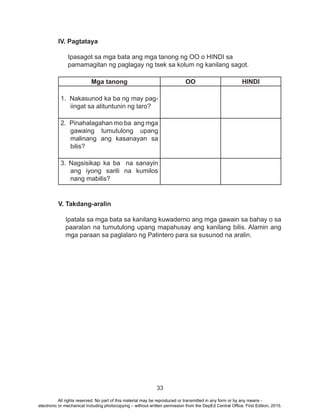
  • 127.
    K to 12BASIC EDUCATION CURRICULUM K to 12 Physical Education Curriculum Guide December 2013 Page 16 of 69 GRADE 2 CONTENT CONTENT STANDARDS PERFORMANCE STANDARDS LEARNING COMPETENCY CODE LEARNING MATERIALS FIRST QUARTER /FIRST GRADING PERIOD Body Shapes (Straight, curled, wide and twisted) and Body Actions (Walking, standing, sitting) The learner . . . demonstrates understanding of body shapes and body actions in preparation for various movement activities The learner . . . performs body shapes and actions properly. The learner . . 1. describes body shapes and actions PE2BM-Ia-b-1 2. demonstrates body shapes and actions PE2BM-Ic-d- 15 3. creates body shapes and actions PE2BM-Ie-f-2 4. demonstrates momentary stillness in symmetrical and asymmetrical shapes using body parts other than both feet as a base of support PE2BM-Ig-h- 16 Misosa V -M1 5. demonstrates movement skills in response to sound and music PE2MS-Ia-h-1 6. exhibits correct body posture PE2PF-Ia-h- 12 Misosa VI M1-M5 7. assesses body posture PE2PF-Ia-h- 13 8. engages in fun and enjoyable physical activities Suggested learning activities  movement skills activities (locomotor, non- locomotor and manipulative skills)  folk dances (Alitaptap/Rabong)  rhythmic routines (ribbon, hoop, balls, and any available indigenous/improvised materials) relays and races PE2PF-Ia-h-2 All rights reserved. No part of this material may be reproduced or transmitted in any form or by any means - electronic or mechanical including photocopying – without written permission from the DepEd Central Office. First Edition, 2015.
  • 128.
    K to 12BASIC EDUCATION CURRICULUM K to 12 Physical Education Curriculum Guide December 2013 Page 17 of 69 CONTENT CONTENT STANDARDS PERFORMANCE STANDARDS LEARNING COMPETENCY CODE LEARNING MATERIALS SECOND QUARTER/ SECOND GRADING Locations (Behind, in front, under, over, personal space, general space) Directions (linear- forward and backward, lateral- sideward, and multi-directional) Levels (High, middle, low) Pathways (Straight, curved, zigzag) and Planes (Diagonal, horizontal, vertical, and rotational) Th The learner . . . demonstrates understanding of locations, directions, levels, pathways and planes ThThe learner. . . performs movements accurately involving locations, directions, levels, pathways and planes. 9. describes movements in a location, direction, level, pathway and plane PE2BM-IIa-b- 17 Misosa IV -M1 10. moves in:  personal and general space  forward, backward, and sideward directions  high, middle, and low levels  straight, curve, and zigzag pathways  diagonal and horizontal planes PE2BM-IIc-h- 18 11. demonstrates movement skills in response to sounds and music PE2MS-IIa-h- 1 12. observes correct posture and body mechanics while performing movement activities PE2PF-IIa-h- 14 13. engages in fun and enjoyable physical activities Suggested learning activities  movement skills activities (locomotor, non- locomotor and manipulative skills)  folk dances  rhythmic routines (ribbon, hoop, balls, and any available indigenous/improvised materials)  relays and races PE2PF-IIa-h-2 THIRD QUARTER/ THIRD GRADING Time (slow, slower, slowest/fast, faster, fastest) Force (light, lighter, lightest/strong, stronger, strongest) and Flow (smoothness of The learner . . . demonstrates understanding of movement in relation to time, force and flow The learner . . . performs movements accurately involving time, force, and flow. 14. describes movements in a location, direction, level, pathway and plane PE2BM-IIIa- b-17 15. moves: 15.1 at slow, slower, slowest/fast, faster, fastest pace 15.2 using light, lighter, lightest/strong, stronger, strongest force with smoothness PE2BM-IIIc-h- 19 All rights reserved. No part of this material may be reproduced or transmitted in any form or by any means - electronic or mechanical including photocopying – without written permission from the DepEd Central Office. First Edition, 2015.
  • 129.
    K to 12BASIC EDUCATION CURRICULUM K to 12 Physical Education Curriculum Guide December 2013 Page 18 of 69 CONTENT CONTENT STANDARDS PERFORMANCE STANDARDS LEARNING COMPETENCY CODE LEARNING MATERIALS movement) 16. demonstrates movement skills in response to sound and music PE2MS-IIIa- h-1 17. engages in fun and enjoyable physical activities PE2PF-IIIa-h- 2 18. observes correct posture and body mechanics while performing movement activities Suggested learning activities  movement skills activities locomotor, non- locomotor and manipulative skills  folk dances (Alitaptap/Rabong)  rhythmic routines (ribbon, hoop, balls, and any available indigenous/improvised materials) relays and races PE2PF-IIIa-h- 14 FOURTH QUARTER/ FOURTH GRADING Person (Individual, pair, group), Objects (ribbon, hoop, balls, and any available indigenous/improvised materials), Sound, Environment (indoor and outdoor settings) The learner . . . demonstrates understanding of movement activities relating to person, objects, music and environment The learner . . . performs movement activities involving person, objects, music and environment correctly 19. familiarizes in various movement activities involving person, objects, music and environment PE2BM-IV-a- b-20 Misosa V -M1 20. moves: 20.1 individually, with partner, and with group 20.2 with ribbon, hoop, balls, and any available indigenous/improvised materials 20.3 with sound 20.4 in indoor and outdoor settings PE2BM-IV-c- h-21 Misosa V -M1 21. demonstrates movement skills in response to sound PE2MS-IV-a- h-1 22. engages in fun and enjoyable physical activities PE2PF-IV-a- h-2 23. observes correct body posture and body mechanics while performing movement activities PE2PF-IV-a- h-14 Misosa VI -M1 All rights reserved. No part of this material may be reproduced or transmitted in any form or by any means - electronic or mechanical including photocopying – without written permission from the DepEd Central Office. First Edition, 2015.
  • 130.
    K to 12BASIC EDUCATION CURRICULUM K to 12 Physical Education Curriculum Guide December 2013 Page 19 of 69 CONTENT CONTENT STANDARDS PERFORMANCE STANDARDS LEARNING COMPETENCY CODE LEARNING MATERIALS Suggested learning activities  movement skills activities locomotor, non- locomotor and manipulative skills  folk dances (Alitaptap/Rabong)  rhythmic routines (ribbon, hoop, balls, and any available indigenous/improvised materials) relays and races All rights reserved. No part of this material may be reproduced or transmitted in any form or by any means - electronic or mechanical including photocopying – without written permission from the DepEd Central Office. First Edition, 2015.
  • 131.
    K to 12BASIC EDUCATION CURRICULUM K to 12 Physical Education Curriculum Guide December 2013 Page 20 of 69 GRADE 3 CONTENT CONTENT STANDARDS PERFORMANCE STANDARDS LEARNING COMPETENCY CODE LEARNING MATERIALS FIRST QUARTER /FIRST GRADING PERIOD Body Shapes (Straight, curled, wide and twisted) and Body Actions (Walking, standing, sitting) The learner . . . demonstrates understanding of body shapes and body actions in preparation for various movement activities The learner . . . performs body shapes and actions properly. The learner . . . 1. describes body shapes and actions PE3BM-Ia-b-1 2. performs body shapes and actions PE3BM-Ic-d-15 3. creates body shapes and actions PE3BM-Ie-f-2 4. demonstrates momentary stillness in symmetrical and asymmetrical shapes using body parts other than both feet as a base of support PE3BM-Ig-h-16 5. demonstrates movement skills in response to sounds and music PE3MS-Ia-h-1 6. identifies conditioning and flexibility exercises that will improve posture PE3PF-Ia-h-15 7. performs conditioning and flexibility exercises that will improve body posture PE3PF-Ia-h-16 8. engages in fun and enjoyable physical activities Suggested learning activities  movement skills activities (locomotor, non-locomotor and manipulative skills)  folk dances (Tiklos/Kunday-kunday)  rhythmic routines (ribbon, hoop, balls, and any available indigenous/improvised materials)  lead up, organized and indigenous games corrective exercises PE3PF-Ia-h-2 All rights reserved. No part of this material may be reproduced or transmitted in any form or by any means - electronic or mechanical including photocopying – without written permission from the DepEd Central Office. First Edition, 2015.
  • 132.
    K to 12BASIC EDUCATION CURRICULUM K to 12 Physical Education Curriculum Guide December 2013 Page 21 of 69 CONTENT CONTENT STANDARDS PERFORMANCE STANDARDS LEARNING COMPETENCY CODE LEARNING MATERIALS SECOND QUARTER/ SECOND GRADING Locations (Behind, in front, under, over, personal space, general space) Directions (linear- forward and backward, lateral- sideward, and multi- directional) Levels (High, middle, low) Pathways (Straight, curve, zigzag) and Planes (Diagonal, horizontal, vertical, and rotational) The learner . . . demonstrates understanding of locations, directions, levels, pathways and planes The learner . . . performs movements accurately involving locations, directions, levels, pathways and planes. The learner . . . 9. describes movements in a location, direction, level, pathway and plane PE3BM-IIa-b-17 10. moves in:  personal and general space  forward, backward, and sideward directions  high, middle, and low levels  straight, curve, and zigzag pathways  diagonal and horizontal planes PE3BM-IIc-h-18 11. demonstrates movement skills in response to sound PE3MS-IIa-h-1 Misosa IV-M1 12. identifies conditioning and flexibility exercises that will improve body mechanics PE3PF-IIa-h-15 Misosa V-M1 13. performs conditioning and flexibility exercises that will improve body mechanics PE3PF-IIa-h-16 Misosa VI-M5 14. engages in fun and enjoyable physical activities Suggested learning activities  movement skills activities (locomotor, non-locomotor and manipulative skills)  folk dances (Tiklos/ Kunday-kunday)  rhythmic routines (ribbon, hoop, balls, and any available indigenous/improvised materials)  lead up, organized and indigenous games corrective exercises PE3PF-IIa-h-2 All rights reserved. No part of this material may be reproduced or transmitted in any form or by any means - electronic or mechanical including photocopying – without written permission from the DepEd Central Office. First Edition, 2015.
  • 133.
    K to 12BASIC EDUCATION CURRICULUM K to 12 Physical Education Curriculum Guide December 2013 Page 22 of 69 CONTENT CONTENT STANDARDS PERFORMANCE STANDARDS LEARNING COMPETENCY CODE LEARNING MATERIALS THIRD QUARTER/ THIRD GRADING Time (slow, slower, slowest/fast, faster, fastest Force (light, lighter, lightest/strong, stronger, strongest) and Flow (smoothness of movement) The learner . . . demonstrates understanding of movement in relation to time, force and flow The learner . . . performs movements accurately involving time, force, and flow. 15. describes movements in a location, direction, level, pathway and plane PE3BM-IIIa-b-17 Misosa IV-M1 16. moves:  at slow, slower, slowest/fast, faster, fastest pace  using light, lighter, lightest/strong, stronger, strongest force with smoothness PE3BM-IIIc-h-19 17. demonstrates movement skills in response to sound PE3MS-IIIa-h-1 18. engages in fun and enjoyable physical activities PE3PF-IIIa-h-2 19. identifies conditioning and flexibility exercises that will improve body mechanics PE3PF-IIIa-h-15 Misosa V-M1 20. performs conditioning and flexibility exercises that will improve body mechanics Suggested learning activities  movement skills activities locomotor, non-locomotor and manipulative skills  folk dances (Tiklos/ Kunday-kunday)  rhythmic routines (ribbon, hoop, balls, and any available indigenous/improvised materials)  lead up, organized and indigenous games  corrective exercises PE3PF-IIIa-h-16 Misosa V-M1 FOURTH QUARTER/ FOURTH GRADING Person (Invidual, pair, group) Objects (ribbon, hoop, balls, The learner . . . demonstrates The learner . . . performs movement activities The learner . . . 21. participates in various movement activities involving person, PE3BM-IV-a-b- 20 Misosa IV-M5 All rights reserved. No part of this material may be reproduced or transmitted in any form or by any means - electronic or mechanical including photocopying – without written permission from the DepEd Central Office. First Edition, 2015.
  • 134.
    K to 12BASIC EDUCATION CURRICULUM K to 12 Physical Education Curriculum Guide December 2013 Page 23 of 69 CONTENT CONTENT STANDARDS PERFORMANCE STANDARDS LEARNING COMPETENCY CODE LEARNING MATERIALS and any available indigenous/improvised materials), Sound and Environment (indoor and outdoor settings) understanding of movement activities relating to person, objects, music and environment involving person, objects, music and environment correctly objects, music and environment 22. moves:  individually, with partner, and with group  with ribbon, hoop, balls, and any available indigenous/improvised materials  with sound  in indoor and outdoor settings PE3BM-IV-c-h- 21 23. demonstrates movement skills in response to sounds and music PE3MS-IV-a-h-1 24. engages in fun and enjoyable physical activities PE3PF-IV-a-h-2 25. identifies conditioning and flexibility exercises that will improve posture PE3PF-IV-a-h-15 26. performs conditioning and flexibility exercises that will improve body mechanics Suggested learning activities  movement skills activities locomotor, non-locomotor and manipulative skills  folk dances (Tiklos/Kunday-kunday)  rhythmic routines (ribbon, hoop, balls, and any available indigenous/improvised materials)  lead up, organized and indigenous games corrective exercises PE3PF-IV-a-h-16 All rights reserved. No part of this material may be reproduced or transmitted in any form or by any means - electronic or mechanical including photocopying – without written permission from the DepEd Central Office. First Edition, 2015.
  • 135.
    K to 12BASIC EDUCATION CURRICULUM K to 12 Physical Education Curriculum Guide December 2013 Page 24 of 69 GRADE 4 CONTENT CONTENT STANDARDS PERFORMANCE STANDARDS LEARNING COMPETENCY CODE LEARNING MATERIALS FIRST QUARTER /FIRST GRADING PERIOD Assessment of physical activities and physical fitness Target games (Tumbang preso, tamaang- tao/batuhang bola, tatsing), striking/fielding games (syato/,basagang palayok, kickball) Note: Games are not limited to the above listed activities The learner . . . demonstrates understanding of participation and assessment of physical activities and physical fitness The learner . . . participates and assesses performance in physical activities. assesses physical fitness The learner . . . 1. describes the physical activity pyramid PE4PF-Ia-16 2. explains the indicators for fitness PE4PF-Ia-17 3. assesses regularly participation in physical activities based on physical activity pyramid PE4PF-Ib-h-18 4. explains the nature/background of the games PE4GS-Ib-1 5. describes the skills involved in the games PE4GS-Ib-2 6. observes safety precautions PE4GS-Ib-h-3 7. executes the different skills involved in the game PE4GS-Ic-h-4 8. recognizes the value of participation in physical activities PE4PF-Ib-h-19 9. displays joy of effort, respect for others and fair play during participation in physical activities PE4PF-Ib-h-20 10. explains health and skill related fitness components PE4PF-Ia-21 11. identifies areas for improvement PE4PF-Ib-h-22 SECOND QUARTER/ SECOND PERIOD Assessment of physical activities and physical fitness Invasion games (agawan base, The learner . . . demonstrates understanding of participation in and assessment of physical activities and physical fitness The learner . . . participates and assesses performance in physical activities. assesses physical fitness 12. describes the Philippines physical activity pyramid PE4PF-IIa-16 13. explains the indicators for fitness PE4PF-IIa-17 14. assesses regularly participation in physical activities based on physical activity pyramid PE4PF-IIb-h-18 15. explains the nature/background PE4GS-IIb-1 All rights reserved. No part of this material may be reproduced or transmitted in any form or by any means - electronic or mechanical including photocopying – without written permission from the DepEd Central Office. First Edition, 2015.
  • 136.
    K to 12BASIC EDUCATION CURRICULUM K to 12 Physical Education Curriculum Guide December 2013 Page 25 of 69 CONTENT CONTENT STANDARDS PERFORMANCE STANDARDS LEARNING COMPETENCY CODE LEARNING MATERIALS lawin at sisiw, agawan panyo) Note: Games are not limited to the above listed activities of the games 16. describes the skills involved in the games PE4GS-IIb-2 17. observes safety precautions PE4GS-IIb-h-3 18. executes the different skills involved in the game PE4GS-IIc-h-4 19. recognizes the value of participation in physical activities PE4PF-IIb-h-19 20. displays joy of effort, respect for others and fair play during participation in physical activities PE4PF-IIb-h-20 21. explains health and skill related fitness components PE4PF-IIa-21 22. identifies areas for improvement PE4PF-IIb-h-22 THIRD QUARTER / THIRD GRADING Assessment of physical activities and physical fitness Folk (Liki/Ba- Ingles), indigenous, ethnic, traditional and creative dances Note: Dances available in the area can be selected. The learner . . . demonstrates understanding of participation and assessment of physical activity and physical fitness The learner . . . participates and assesses performance in physical activities. assesses physical fitness 23. describes the Philippines physical activity pyramid PE4PF-IIIa-16 24. explains the indicators for fitness PE4PF-IIIa-17 25. assesses regularly participation in physical activities based on physical activity pyramid PE4PF-IIIb-h-18 26. explains the nature/background of the dance PE4GS-IIIb-1 27. describes the skills involved in the dance PE4GS-IIIb-2 28. observes safety precautions PE4GS-IIIb-h-3 29. executes the different skills involved in the dance PE4GS-IIIc-h-4 30. recognizes the value of participation in physical activities PE4PF-IIIb-h-19 31. displays joy of effort, respect for others during participation in physical activities PE4PF-IIIb-h-20 32. explains health and skill related fitness components PE4PF-IIIa-21 All rights reserved. No part of this material may be reproduced or transmitted in any form or by any means - electronic or mechanical including photocopying – without written permission from the DepEd Central Office. First Edition, 2015.
  • 137.
    K to 12BASIC EDUCATION CURRICULUM K to 12 Physical Education Curriculum Guide December 2013 Page 26 of 69 CONTENT CONTENT STANDARDS PERFORMANCE STANDARDS LEARNING COMPETENCY CODE LEARNING MATERIALS 33. identifies areas for improvement PE4PF-IIIa-22 FOURTH QUARTER/ FOURTH PERIOD Assessment of physical activities and physical fitness Folk (Liki/Ba- Ingles), indigenous, ethnic, traditional and creative dances Note: Dances available in the area can be selected. The learner . . . demonstrates understanding of participation and assessment of physical activity and physical fitness The learner . . . participates and assesses performance in physical activities. assesses physical fitness 34. describes the Philippines physical activity pyramid PE4PF-IVa-16 35. explains the indicators for fitness PE4PF-IVa-17 36. assesses regularly participation in physical activities based on Philippines physical activity pyramid PE4PF-IVb-h-18 37. explains the nature/background of the dance PE4RD-IVb-1 38. describes the skills involved in the dance PE4RD-IVb-2 39. observes safety precautions PE4RD-IVb-h-3 40. executes the different skills involved in the dance PE4RD-IVc-h-4 41. recognizes the value of participation in physical activities PE4PF-IVb-h-19 42. displays joy of effort, respect for others during participation in physical activities PE4PF-IVb-h-20 43. explains health and skill related fitness components PE4PF-IVa-21 44. identifies areas for improvement PE4PF-IVb-h-22 All rights reserved. No part of this material may be reproduced or transmitted in any form or by any means - electronic or mechanical including photocopying – without written permission from the DepEd Central Office. First Edition, 2015.
  • 138.
    K to 12BASIC EDUCATION CURRICULUM K to 12 Physical Education Curriculum Guide December 2013 Page 27 of 69 GRADE 5 CONTENT CONTENT STANDARDS PERFORMANCE STANDARDS LEARNING COMPETENCY CODE LEARNING MATERIALS FIRST QUARTER /FIRST GRADING PERIOD Assessment of physical activity and physical fitness Target games (Tumbang preso, tamaang- tao/batuhang bola, tatsing), striking/fielding games (syato/,basagang palayok, kickball) Note: Games are not limited to the above listed activities The learner . . . demonstrates understanding of participation and assessment of physical activity and physical fitness The learner . . . participates and assesses performance in physical activities. assesses physical fitness The learner . . . 1. describes the Philippines physical activity pyramid PE5PF-Ia-16 2. explains the indicators for fitness PE5PF-Ia-17 3. assesses regularly participation in physical activities based on the Philippines physical activity pyramid PE5PF-Ib-h-18 4. explains the nature/background of the games PE5GS-Ib-1 5. describes the skills involved in the games PE5GS-Ib-2 6. observes safety precautions PE5GS-Ib-h-3 7. executes the different skills involved in the game PE5GS-Ic-h-4 8. recognizes the value of participation in physical activities PE5PF-Ib-h-19 9. displays joy of effort, respect for others and fair play during participation in physical activities PE5PF-Ib-h-20 10. explains health and skill related fitness components PE5PF-Ia-21 11. identifies areas for improvement PE5PF-Ib-h-22 SECOND QUARTER / SECOND GRADING Assessment of physical activities and physical fitness Invasion games (agawan base, The learner . . . demonstrates understanding of participation in and assessment of physical activity and physical fitness The learner . . . participates and assesses performance in physical activities. assesses physical fitness 12. describes the Philippines physical activity pyramid PE5PF-IIa-16 13. explains the indicators for fitness PE5PF-IIa-17 14. assesses regularly participation in physical activities based on the Philippines physical activity pyramid PE5PF-IIb-h-18 All rights reserved. No part of this material may be reproduced or transmitted in any form or by any means - electronic or mechanical including photocopying – without written permission from the DepEd Central Office. First Edition, 2015.
  • 139.
    K to 12BASIC EDUCATION CURRICULUM K to 12 Physical Education Curriculum Guide December 2013 Page 28 of 69 CONTENT CONTENT STANDARDS PERFORMANCE STANDARDS LEARNING COMPETENCY CODE LEARNING MATERIALS lawin at sisiw, agawan panyo) Note: Games are not limited to the above listed activities 15. explains the nature/background of the games PE5GS-IIb-1 16. describes the skills involved in the games PE5GS-IIb-2 17. observes safety precautions PE5GS-IIb-h-3 18. executes the different skills involved in the game PE5GS-IIc-h-4 19. recognizes the value of participation in physical activities PE5PF-IIb-h-19 20. displays joy of effort, respect for others and fair play during participation in physical activities PE5PF-IIb-h-20 21. explains health and skill related fitness components PE5PF-IIa-21 22. identifies areas for improvement PE5PF-IIb-h-22 THIRD QUARTER/ THIRD PERIOD Assessment of physical activities and physical fitness Folk (Cariñosa/ Polka sa Nayon), indigenous, ethnic, traditional and creative dances Note: Dances available in the area can be selected. The learner . . . demonstrates understanding of participation and assessment of physical activity and physical fitness The learner . . . participates and assesses performance in physical activities. assesses physical fitness 23. describes the Philippines physical activity pyramid PE5PF-IIIa-16 24. explains the indicators for fitness PE5PF-IIIa-17 25. assesses regularly participation in physical activities based on the Philippines physical activity pyramid PE5PF-IIIb-h-18 26. explains the nature/background of the dance PE5RD-IIIb-1 27. describes the skills involved in the dance PE5RD-IIIb-2 28. observes safety precautions PE5RD-IIIb-h-3 29. executes the different skills involved in the dance PE5RD-IIIc-h-4 30. recognizes the value of participation in physical activities PE5PF-IIIb-h-19 All rights reserved. No part of this material may be reproduced or transmitted in any form or by any means - electronic or mechanical including photocopying – without written permission from the DepEd Central Office. First Edition, 2015.
  • 140.
    K to 12BASIC EDUCATION CURRICULUM K to 12 Physical Education Curriculum Guide December 2013 Page 29 of 69 CONTENT CONTENT STANDARDS PERFORMANCE STANDARDS LEARNING COMPETENCY CODE LEARNING MATERIALS 31. displays joy of effort, respect for others during participation in physical activities PE5PF-IIIb-h-20 32. explains health and skill related fitness components PE5PF-IIIa-21 33. identifies areas for improvement PE5PF-IIIb-h-22 FOURTH QUARTER/ FOURTH PERIOD Assessment of physical activities and physical fitness Folk (Cariñosa/ Polka sa Nayon), indigenous, ethnic, traditional and creative dances Note: Dances available in the area can be selected. The learner . . . demonstrates understanding of participation and assessment of physical activity and physical fitness The learner . . . participates and assesses performance in physical activities. assesses physical fitness 34. describes the Philippines physical activity pyramid PE5PF-IVa-16 35. explains the indicators for fitness PE5PF-IVa-17 36. assesses regularly participation in physical activities based on the Philippines physical activity pyramid PE5PF-IVb-h-18 37. explains the nature/background of the dance PE5RD-IVb-1 38. describes the skills involved in the dance PE5RD-IVb-2 39. observes safety precautions PE5RD-IVb-h-3 40. executes the different skills involved in the dance PE5RD-IVc-h-4 41. recognizes the value of participation in physical activities PE5PF-IVb-h-19 42. displays joy of effort, respect for others during participation in physical activities PE5PF-IVb-h-20 43. explains health and skill related fitness components PE5PF-IVa-21 44. identifies areas for improvement PE5PF-IVb-h-22 All rights reserved. No part of this material may be reproduced or transmitted in any form or by any means - electronic or mechanical including photocopying – without written permission from the DepEd Central Office. First Edition, 2015.
  • 141.
    K to 12BASIC EDUCATION CURRICULUM K to 12 Physical Education Curriculum Guide December 2013 Page 30 of 69 GRADE 6 CONTENT CONTENT STANDARDS PERFORMANCE STANDARDS LEARNING COMPETENCY CODE LEARNING MATERIALS FIRST QUARTER /FIRST GRADING PERIOD Assessment of physical activities and physical fitness Target games (Tumbang preso, tamaang- tao/batuhang bola, tatsing), striking/fielding games (syato/,basagang palayok, kickball) Note: Games are not limited to the above listed activities The learner . . . demonstrates understanding of participation and assessment of physical activity and physical fitness The learner . . . participates and assesses performance in physical activities. assesses physical fitness The learner . . . 1. describes the Philippines physical activity pyramid PE6PF-Ia-16 2. explains the indicators for fitness PE6PF-Ia-17 3. assesses regularly participation in physical activities based on the Philippines physical activity pyramid PE6PF-Ib-h-18 4. explains the nature/background of the games PE6GS-Ib-1 5. describes the skills involved in the games PE6GS-Ib-2 6. observes safety precautions PE6GS-Ib-h-3 7. executes the different skills involved in the game PE6GS-Ic-h-4 8. recognizes the value of participation in physical activities PE6PF-Ib-h-19 9. displays joy of effort, respect for others and fair play during participation in physical activities PE6PF-Ib-h-20 10. explains health and skill related fitness components PE6PF-Ia-21 11. identifies areas for improvement PE6PF-Ib-h-22 SECOND QUARTER/ SECOND PERIOD Assessment of physical activities and physical fitness Invasion games The learner . . . demonstrates understanding of participation in and assessment of physical activities and physical The learner . . . participates and assesses performance in physical activities. assesses physical fitness 12. describes the Philippines physical activity pyramid PE6PF-IIa-16 13. explains the indicators for fitness PE6PF-IIa-17 14. assesses regularly participation in physical activities based on the Philippines physical activity PE6PF-IIb-h-18 All rights reserved. No part of this material may be reproduced or transmitted in any form or by any means - electronic or mechanical including photocopying – without written permission from the DepEd Central Office. First Edition, 2015.
  • 142.
    K to 12BASIC EDUCATION CURRICULUM K to 12 Physical Education Curriculum Guide December 2013 Page 31 of 69 CONTENT CONTENT STANDARDS PERFORMANCE STANDARDS LEARNING COMPETENCY CODE LEARNING MATERIALS (agawan base, lawin at sisiw, agawan panyo) Note: Games are not limited to the above listed activities fitness pyramid 15. explains the nature/background of the games PE6GS-IIb-1 16. describes the skills involved in the games PE6GS-IIb-2 17. observes safety precautions PE6GS-IIb-h-3 18. executes the different skills involved in the game PE6GS-IIc-h-4 19. recognizes the value of participation in physical activities PE6PF-IIb-h-19 20. displays joy of effort, respect for others and fair play during participation in physical activities PE6PF-IIb-h-20 21. explains health and skill related fitness components PE6PF-IIa-21 22. identifies areas for improvement PE6PF-IIb-h-22 THIRD QUARTER/ THIRD PERIOD Assessment of physical activities and physical fitness Folk (Itik-itik for girls and Maglalatik for boys), indigenous, ethnic, traditional and creative dances The learner . . . demonstrates understanding of participation and assessment of physical activity and physical fitness The learner . . . participates and assesses performance in physical activities. assesses physical fitness 23. describes the Philippines physical activity pyramid PE6PF-IIIa-16 24. explains the indicators for fitness PE6PF-IIIa-17 25. assesses regularly participation in physical activities based on the Philippines physical activity pyramid PE6PF-IIIb-h-18 26. explains the nature/background of the dance PE6RD-IIIb-1 27. describes the skills involved in the dance PE6RD-IIIb-2 All rights reserved. No part of this material may be reproduced or transmitted in any form or by any means - electronic or mechanical including photocopying – without written permission from the DepEd Central Office. First Edition, 2015.
  • 143.
    K to 12BASIC EDUCATION CURRICULUM K to 12 Physical Education Curriculum Guide December 2013 Page 32 of 69 CONTENT CONTENT STANDARDS PERFORMANCE STANDARDS LEARNING COMPETENCY CODE LEARNING MATERIALS Note: Dances available in the area can be selected. 28. observes safety precautions PE6RD-IIIb-h-3 29. executes the different skills involved in the dance PE6RD-IIIc-h-4 30. recognizes the value of participation in physical activities PE6PF-IIIb-h-19 31. displays joy of effort, respect for others during participation in physical activities PE6PF-IIIb-h-20 32. explains health and skill related fitness components PE6PF-IIIa-21 33. identifies areas for improvement PE6PF-IIIb-h-22 FOURTH QUARTER/ FOURTH PERIOD Assessment of physical activities and physical fitness Folk (Itik-itik for girls and Maglalatik for boys), indigenous, ethnic, traditional and creative dances Note: Dances available in the area can be selected. The learner . . . demonstrates understanding of participation and assessment of physical activity and physical fitness The learner . . . participates and assesses performance in physical activities. assesses physical fitness 34. describes the Philippines physical activity pyramid PE6PF-IVa-16 35. explains the indicators for fitness PE6PF-IVa-17 36. assesses regularly participation in physical activities based on the Philippines physical activity pyramid PE6PF-IVb-h-18 37. explains the nature/background of the dance PE6RD-IVb-1 38. describes the skills involved in the dance PE6RD-IVb-2 39. observes safety precautions PE6RD-IVb-h-3 40. executes the different skills involved in the dance PE6RD-IVc-h-4 41. recognizes the value of participation in physical activities PE6PF-IVb-h-19 42. displays joy of effort, respect for others during participation PE6PF-IVb-h-20 All rights reserved. No part of this material may be reproduced or transmitted in any form or by any means - electronic or mechanical including photocopying – without written permission from the DepEd Central Office. First Edition, 2015.
  • 144.
    K to 12BASIC EDUCATION CURRICULUM K to 12 Physical Education Curriculum Guide December 2013 Page 33 of 69 CONTENT CONTENT STANDARDS PERFORMANCE STANDARDS LEARNING COMPETENCY CODE LEARNING MATERIALS in physical activities 43. explains health and skill related fitness components PE6PF-IVa-21 44. identifies areas for improvement PE6PF-IVb-h-22 All rights reserved. No part of this material may be reproduced or transmitted in any form or by any means - electronic or mechanical including photocopying – without written permission from the DepEd Central Office. First Edition, 2015.
  • 145.
    K to 12BASIC EDUCATION CURRICULUM K to 12 Physical Education Curriculum Guide December 2013 Page 34 of 69 GRADE 7 CONTENT CONTENT STANDARDS PERFORMANCE STANDARDS LEARNING COMPETENCY CODE LEARNING MATERIALS FIRST QUARTER /FIRST GRADING PERIOD Exercise Programs: Training Guidelines, FITT Principles Endurance, Muscle- and Bone-strengthening Activities: a. individual sports 1. running 2. rhythmic sportive gymnastics 3. swimming b. dual sports 1. badminton 2. table tennis 3. tennis c. combative sports 1. arnis (anyo) 2. taekwondo (poomsae) 3. karate(kata) Note: Activities dependent on teacher capability and school resources. The learner . . . demonstrates understanding of guidelines and principles in exercise program design to achieve personal fitness The learner . . . designs an individualized exercise program to achieve personal fitness The learner . . . 1. undertakes physical activity and physical fitness assessments PE7PF-Ia-h-23 OHSP Y1Q1, Module 1 2010 SEC Y1Q1 2010 SEC Y2Q1 Enjoy Life w/ PE & Health, TX & TM Unit 1 2. sets goals based on assessment results PE7PF-Ia-24 OHSP Y1Q1, Module 1 2010 SEC Y1Q1 2010 SEC Y2Q1 Enjoy Life w/ PE & Health, TX & TM Unit 1 3. identifies training guidelines and FITT principles PE7PF-Ib-25 OHSP Y1Q1, Module 1 2010 SEC Y1Q1 2010 SEC Y2Q1 Enjoy Life w/ PE & Health, TX & TM Unit 1 4. recognizes barriers (low level of fitness, lack of skill and time) to exercise PE7PF-Ib-26 OHSP Y1Q1, Module 1 2010 SEC Y1Q1 2010 SEC Y2Q1 Enjoy Life w/ PE & Health, TX & TM Unit 1 5. prepares an exercise program PE7PF-Ic-27 OHSP Y1Q1, Module 1 2010 SEC Y1Q1 2010 SEC Y2Q1 Enjoy Life w/ PE & Health, TX & TM Unit 1 All rights reserved. No part of this material may be reproduced or transmitted in any form or by any means - electronic or mechanical including photocopying – without written permission from the DepEd Central Office. First Edition, 2015.
  • 146.
    K to 12BASIC EDUCATION CURRICULUM K to 12 Physical Education Curriculum Guide December 2013 Page 35 of 69 CONTENT CONTENT STANDARDS PERFORMANCE STANDARDS LEARNING COMPETENCY CODE LEARNING MATERIALS 6. describes the nature and background of the sport PE7GS-Id-5 Proj EASE Module1 OHSPY1Q2 Module1 OHSPY1Q2 Module2 OHSPY1Q2 Module3 2010 SECY1Q2 &Q3 Enjoy Life w/ PE & Health, TX & TM Unit 7. executes the skills involved in the sport PE7GS-Id-h-4 Proj EASE Module1 OHSPY1Q2 Module1 OHSPY1Q2 Module2 OHSPY1Q2 Module3 2010 SECY1Q2 &Q3 Enjoy Life w/ PE & Health, TX & TM Unit 2 8. monitors periodically one’s progress towards the fitness goals PE7PF-Id-h-28 OHSP Y1Q1, Module 1 2010 SEC Y1Q1 2010 SEC Y2Q1 Enjoy Life w/ PE & Health, TX & TM Unit 1 9. distinguishes from fallacies and misconceptions about the physical activity participation PE7PF-Id-29 OHSP Y1Q1, Module 1 2010 SEC Y1Q1 2010 SEC Y2Q1 Enjoy Life w/ PE & Health, TX & TM Unit 1 All rights reserved. No part of this material may be reproduced or transmitted in any form or by any means - electronic or mechanical including photocopying – without written permission from the DepEd Central Office. First Edition, 2015.
  • 147.
    K to 12BASIC EDUCATION CURRICULUM K to 12 Physical Education Curriculum Guide December 2013 Page 36 of 69 CONTENT CONTENT STANDARDS PERFORMANCE STANDARDS LEARNING COMPETENCY CODE LEARNING MATERIALS 10. performs appropriate first aid for sports-related injuries (e.g. cramps, sprain, heat exhaustion) PE7PF-Id-30 OHSP Y1Q1, Module 1 2010 SEC Y1Q1 2010 SEC Y2Q1 Enjoy Life w/ PE & Health, TX & TM Unit 1 11. assumes responsibility for achieving personal fitness PE7PF-Id-h-31 OHSP Y1Q1, Module 1 2010 SEC Y1Q1 2010 SEC Y2Q1 Enjoy Life w/ PE & Health, TX & TM Unit 1 12. keeps the importance of winning and losing in perspective PE7PF-Id-h-32 OHSP Y1Q1, Module 1 2010 SEC Y1Q1 2010 SEC Y2Q1 Enjoy Life w/ PE & Health, TX & TM Unit 1 SECOND QUARTER/ SECOND PERIOD Exercise Programs: Training Guidelines, FITT Principles Endurance, Muscle- and Bone-strengthening Activities: a. individual sports 1. running 2. rhythmic sportive gymnastics The learner . . . demonstrates understanding of guidelines and principles in exercise program design to achieve personal fitness The learner . . . modifies the individualized exercise program to achieve personal fitness 13. undertakes physical activity and physical fitness assessments PE7PF-IIa-h-23 OHSP Y1Q1, Module 1 2010 SEC Y1Q1 2010 SEC Y2Q1 Enjoy Life w/ PE & Health, TX & TM Unit 1 14. reviews goals based on assessment results PE7PF-IIa-24 OHSP Y1Q1, Module 1 2010 SEC Y1Q1 2010 SEC Y2Q1 Enjoy Life w/ PE & Health, TX & TM Unit 1 15. addresses barriers (low level of fitness, lack of skill and time) to PE7PF-IIb-33 OHSP Y1Q1, Module 1 All rights reserved. No part of this material may be reproduced or transmitted in any form or by any means - electronic or mechanical including photocopying – without written permission from the DepEd Central Office. First Edition, 2015.
  • 148.
    K to 12BASIC EDUCATION CURRICULUM K to 12 Physical Education Curriculum Guide December 2013 Page 37 of 69 CONTENT CONTENT STANDARDS PERFORMANCE STANDARDS LEARNING COMPETENCY CODE LEARNING MATERIALS 3. swimming b. dual sports 1. badminton 2. table tennis 3. tennis c. combative sports 1. arnis (anyo) 2. taekwondo (poomsae) 3. karate (kata) Note: Activities dependent on teacher capability and school resources. exercise 2010 SEC Y1Q1 2010 SEC Y2Q1 Enjoy Life w/ PE & Health, TX & TM Unit 1 16. describes the nature and background of the sport PE7GS-IId-5 Proj EASE Module1 OHSPY1Q2 Module1 OHSPY1Q2 Module2 OHSPY1Q2 Module3 2010 SECY1Q2 &Q3 Enjoy Life w/ PE & Health, TX & TM Unit 2 17. executes the skills involved in the sport PE7GS-IId-h-4 Proj EASE Module1 OHSPY1Q2 Module1 OHSPY1Q2 Module2 OHSPY1Q2 Module3 2010 SECY1Q2 &Q3 Enjoy Life w/ PE & Health, TX & TM Unit 2 18. monitors periodically one’s progress towards the fitness goals PE7PF-IId-h-28 OHSP Y1Q1, Module 1 2010 SEC Y1Q1 2010 SEC Y2Q1 Enjoy Life w/ PE & Health, TX & TM Unit 1 19. performs appropriate first aid for sports-related injuries (e.g. PE7PF-IId-30 OHSP Y1Q1, Module 1 All rights reserved. No part of this material may be reproduced or transmitted in any form or by any means - electronic or mechanical including photocopying – without written permission from the DepEd Central Office. First Edition, 2015.
  • 149.
    K to 12BASIC EDUCATION CURRICULUM K to 12 Physical Education Curriculum Guide December 2013 Page 38 of 69 CONTENT CONTENT STANDARDS PERFORMANCE STANDARDS LEARNING COMPETENCY CODE LEARNING MATERIALS cramps, sprain, heat exhaustion) 2010 SEC Y1Q1 2010 SEC Y2Q1 Enjoy Life w/ PE & Health, TX & TM Unit 1 20. assumes responsibility for achieving personal fitness PE7PF-IId-h-31 OHSP Y1Q1, Module 1 2010 SEC Y1Q1 2010 SEC Y2Q1 Enjoy Life w/ PE & Health, TX & TM Unit 1 21. keeps the importance of winning and losing in perspective PE7PF-IId-h-32 OHSP Y1Q1, Module 1 2010 SEC Y1Q1 2010 SEC Y2Q1 Enjoy Life w/ PE & Health, TX & TM Unit 1 THIRD QUARTER/ THIRD PERIOD Exercise Programs: Training Guidelines, FITT Principles Endurance, Muscle- and Bone-strengthening Activities: Folk (Tinikling)/ indigenous, ethnic, traditional/ festival dance Note: Dances available in the The learner . . . demonstrates understanding of guidelines and principles in exercise program design to achieve personal fitness The learner . . . demonstrates understanding of guidelines and principles in exercise program design to achieve personal fitness 22. undertakes physical activity and physical fitness assessments PE7PF-IIIa-h-23 OHSP Y1Q1, Module 1 2010 SEC Y1Q1 2010 SEC Y2Q1 Enjoy Life w/ PE & Health, TX & TM Unit 1 23. reviews goals based on assessment results PE7PF-IIIa-34 OHSP Y1Q1, Module 1 2010 SEC Y1Q1 2010 SEC Y2Q1 Enjoy Life w/ PE & Health, TX & TM Unit 1 24. addresses barriers (low level of fitness, lack of skill and time) to exercise PE7PF-IIIb-33 OHSP Y1Q1, Module 1 2010 SEC Y1Q1 2010 SEC Y2Q1 All rights reserved. No part of this material may be reproduced or transmitted in any form or by any means - electronic or mechanical including photocopying – without written permission from the DepEd Central Office. First Edition, 2015.
  • 150.
    K to 12BASIC EDUCATION CURRICULUM K to 12 Physical Education Curriculum Guide December 2013 Page 39 of 69 CONTENT CONTENT STANDARDS PERFORMANCE STANDARDS LEARNING COMPETENCY CODE LEARNING MATERIALS area can be selected. Enjoy Life w/ PE & Health, TX & TM Unit 1 25. describes the nature and background of the dance PE7RD-IIId-1 OHSP Y1Q4 2010 SEC Y1Q4 2010 SEC Y2Q4 Enjoy Life w/ PE & Health, TX & TM Unit 4 26. executes the skills involved in the dance PE7RD-IIId-h-4 OHSP Y1Q4 2010 SEC Y1Q4 2010 SEC Y2Q4 Enjoy Life w/ PE & Health, TX & TM Unit 4 27. monitors periodically one’s progress towards the fitness goals PE7PF-IIId-h-28 OHSP Y1Q1, Module 1 2010 SEC Y1Q1 2010 SEC Y2Q1 Enjoy Life w/ PE & Health, TX & TM Unit 1 28. performs appropriate first aid for dance-related injuries (e.g. cramps, sprain, heat exhaustion) PE7PF-IIId-30 OHSP Y1Q1, Module 1 2010 SEC Y1Q1 2010 SEC Y2Q1 Enjoy Life w/ PE & Health, TX & TM Unit 1 29. assumes responsibility for achieving personal fitness PE7PF-IIId-h-31 OHSP Y1Q1, Module 1 2010 SEC Y1Q1 2010 SEC Y2Q1 Enjoy Life w/ PE & Health, TX & TM Unit 1 30. keeps the importance of winning and losing in PE7PF-IIId-h-32 OHSP Y1Q1, Module 1 All rights reserved. No part of this material may be reproduced or transmitted in any form or by any means - electronic or mechanical including photocopying – without written permission from the DepEd Central Office. First Edition, 2015.
  • 151.
    K to 12BASIC EDUCATION CURRICULUM K to 12 Physical Education Curriculum Guide December 2013 Page 40 of 69 CONTENT CONTENT STANDARDS PERFORMANCE STANDARDS LEARNING COMPETENCY CODE LEARNING MATERIALS perspective 2010 SEC Y1Q1 2010 SEC Y2Q1 Enjoy Life w/ PE & Health, TX & TM Unit 1 FOURTH QUARTER/ FOURTH PERIOD Exercise Programs: Training Guidelines, FITT Principles Endurance, Muscle- and Bone-strengthening Activities: Folk (Tinikling)/ indigenous, ethnic, traditional/ festival dance Note: Dances available in the area can be selected. The learner . . . demonstrates understanding of guidelines and principles in exercise program design to achieve personal fitness The learner . . . modifies the individualized exercise program to achieve personal fitness 31. undertakes physical activity and physical fitness assessments PE7PF-IVa-h-23 OHSP Y1Q1, Module 1 2010 SEC Y1Q1 2010 SEC Y2Q1 Enjoy Life w/ PE & Health, TX & TM Unit 1 32. reviews goals based on assessment results PE7PF-IVa-34 OHSP Y1Q1, Module 1 2010 SEC Y1Q1 2010 SEC Y2Q1 Enjoy Life w/ PE & Health, TX & TM Unit 1 33. addresses barriers (low level of fitness, lack of skill and time) to exercise PE7PF-IVb-33 OHSP Y1Q1, Module 1 2010 SEC Y1Q1 2010 SEC Y2Q1 Enjoy Life w/ PE & Health, TX & TM Unit 1 34. describes the nature and background of the dance PE7RD-IVc-1 OHSP Y1Q4 2010 SEC Y1Q4 2010 SEC Y2Q4 Enjoy Life w/ PE & Health, TX & TM Unit 4 35. executes the skills involved in the dance PE7RD-IVd-h-4 OHSP Y1Q4 2010 SEC Y1Q4 2010 SEC Y2Q4 Enjoy Life w/ PE & Health, TX & TM All rights reserved. No part of this material may be reproduced or transmitted in any form or by any means - electronic or mechanical including photocopying – without written permission from the DepEd Central Office. First Edition, 2015.
  • 152.
    K to 12BASIC EDUCATION CURRICULUM K to 12 Physical Education Curriculum Guide December 2013 Page 41 of 69 CONTENT CONTENT STANDARDS PERFORMANCE STANDARDS LEARNING COMPETENCY CODE LEARNING MATERIALS Unit 4 36. monitors periodically one’s progress towards the fitness goals PE7PF-IVd-h-28 OHSP Y1Q1, Module 1 2010 SEC Y1Q1 2010 SEC Y2Q1 Enjoy Life w/ PE & Health, TX & TM Unit 1 37. performs appropriate first aid for dance-related injuries (e.g. cramps, sprain, heat exhaustion) PE7PF-IVd-30 OHSP Y1Q1, Module 1 2010 SEC Y1Q1 2010 SEC Y2Q1 Enjoy Life w/ PE & Health, TX & TM Unit 1 38. analyzes the effect of exercise and physical activity participation on fitness PE7PF-IVh-35 OHSP Y1Q1, Module 1 2010 SEC Y1Q1 2010 SEC Y2Q1 Enjoy Life w/ PE & Health, TX & TM Unit 1 39. assumes responsibility for achieving personal fitness PE7PF-IVd-h-31 OHSP Y1Q1, Module 1 2010 SEC Y1Q1 2010 SEC Y2Q1 Enjoy Life w/ PE & Health, TX & TM Unit 1 40. keeps the importance of winning and losing in perspective PE7PF-IVd-h-32 OHSP Y1Q1, Module 1 2010 SEC Y1Q1 2010 SEC Y2Q1 Enjoy Life w/ PE & Health, TX & TM Unit 1 All rights reserved. No part of this material may be reproduced or transmitted in any form or by any means - electronic or mechanical including photocopying – without written permission from the DepEd Central Office. First Edition, 2015.
  • 153.
    K to 12BASIC EDUCATION CURRICULUM K to 12 Physical Education Curriculum Guide December 2013 Page 42 of 69 GRADE 8 CONTENT CONTENT STANDARDS PERFORMANCE STANDARDS LEARNING COMPETENCY CODE LEARNING MATERIALS FIRST QUARTER/ FIRST GRADING Exercise Programs: Training Guidelines, FITT Principles Endurance, Muscle- and Bone- strengthening Activities: team sports (basketball, volleyball, football/futsal, goalball, softball, baseball) Note: Activities dependent on teacher capability and school resources. The learner . . . demonstrates understanding of guidelines and principles in exercise program design to achieve fitness The learner . . . designs a physical activity program for the family/school peers to achieve fitness The learner. . . 1. undertakes physical activity and physical fitness assessments PE8PF-Ia-h-23 OHSP Y1Q1, Module 1 2010 SEC Y1Q1 2010 SEC Y2Q1 Enjoy Life w/ PE & Health, TX & TM Unit 1 2. conducts physical activity and physical fitness assessments of family/school peers PE8PF-Ib -36 OHSP Y1Q1, Module 1 2010 SEC Y1Q1 2010 SEC Y2Q1 Enjoy Life w/ PE & Health, TX & TM Unit 1 3. sets goals based on assessment results PE8PF-Ia-24 OHSP Y1Q1, Module 1 2010 SEC Y1Q1 2010 SEC Y2Q1 Enjoy Life w/ PE & Health, TX & TM Unit 1 4. identifies training guidelines and FITT principles PE8PF-Ib-25 OHSP Y1Q1, Module 1 2010 SEC Y1Q1 2010 SEC Y2Q1 Enjoy Life w/ PE & Health, TX & TM Unit 1 5. recognizes barriers (low level of fitness, lack of skill and time) to exercise PE8PF-Ib-26 OHSP Y1Q1, Module 1 2010 SEC Y1Q1 2010 SEC Y2Q1 Enjoy Life w/ PE & Health, TX & TM All rights reserved. No part of this material may be reproduced or transmitted in any form or by any means - electronic or mechanical including photocopying – without written permission from the DepEd Central Office. First Edition, 2015.
  • 154.
    K to 12BASIC EDUCATION CURRICULUM K to 12 Physical Education Curriculum Guide December 2013 Page 43 of 69 CONTENT CONTENT STANDARDS PERFORMANCE STANDARDS LEARNING COMPETENCY CODE LEARNING MATERIALS Unit 1 6. prepares a physical activity program PE8PF-Ic-27 OHSP Y1Q1, Module 1 2010 SEC Y1Q1 2010 SEC Y2Q1 Enjoy Life w/ PE & Health, TX & TM Unit 1 7. describes the nature and background of the sport PE8GS-Id-1 Project EASE Module5 2010 SEC Y1Q2 & Q3 Enjoy Life w/ PE & Health, TX & TM Unit III 8. executes the skills involved in the sport PE8GS-Id-h-4 Project EASE Module5 2010 SEC Y1Q2 & Q3 Enjoy Life w/ PE & Health, TX & TM Unit III 9. monitors periodically progress towards the fitness goals PE8PF-Id-h-28 OHSP Y1Q1, Module 1 2010 SEC Y1Q1 2010 SEC Y2Q1 Enjoy Life w/ PE & Health, TX & TM Unit 1 10. distinguishes facts from fallacies and misconceptions about physical activity participation PE8PF-Id-29 OHSP Y1Q1, Module 1 2010 SEC Y1Q1 2010 SEC Y2Q1 Enjoy Life w/ PE & Health, TX & TM All rights reserved. No part of this material may be reproduced or transmitted in any form or by any means - electronic or mechanical including photocopying – without written permission from the DepEd Central Office. First Edition, 2015.
  • 155.
    K to 12BASIC EDUCATION CURRICULUM K to 12 Physical Education Curriculum Guide December 2013 Page 44 of 69 CONTENT CONTENT STANDARDS PERFORMANCE STANDARDS LEARNING COMPETENCY CODE LEARNING MATERIALS Unit 1 11. performs appropriate first aid for injuries and emergency situations in physical activity and sport settings PE8PF-Id-30 OHSP Y1Q1, Module 1 2010 SEC Y1Q1 2010 SEC Y2Q1 Enjoy Life w/ PE & Health, TX & TM Unit 1 12. assumes responsibility for achieving fitness PE8PF-Id-h-31 OHSP Y1Q1, Module 1 2010 SEC Y1Q1 2010 SEC Y2Q1 Enjoy Life w/ PE & Health, TX & TM Unit 1 13. displays tolerance and acceptance of individuals with varying skills and abilities PE8PF-Id-h-37 OHSP Y1Q1, Module 1 2010 SEC Y1Q1 2010 SEC Y2Q1 Enjoy Life w/ PE & Health, TX & TM Unit 1 SECOND QUARTER/ SECOND PERIOD Exercise Programs: Training Guidelines, FITT Principles Endurance, Muscle- and Bone- strengthening Activities: team sports The learner . . . demonstrates understanding of guidelines and principles in exercise program design to achieve fitness The learner . . . modifies a physical activity program for the family/school peers to achieve fitness 14. undertakes physical activity and physical fitness assessments PE8PF-IIa-h-23 OHSP Y1Q1, Module 1 2010 SEC Y1Q1 2010 SEC Y2Q1 Enjoy Life w/ PE & Health, TX & TM Unit 1 15. conducts physical activity and physical fitness assessments of family/school peers PE8PF-IIa-36 OHSP Y1Q1, Module 1 2010 SEC Y1Q1 2010 SEC Y2Q1 Enjoy Life w/ PE & All rights reserved. No part of this material may be reproduced or transmitted in any form or by any means - electronic or mechanical including photocopying – without written permission from the DepEd Central Office. First Edition, 2015.
  • 156.
    K to 12BASIC EDUCATION CURRICULUM K to 12 Physical Education Curriculum Guide December 2013 Page 45 of 69 CONTENT CONTENT STANDARDS PERFORMANCE STANDARDS LEARNING COMPETENCY CODE LEARNING MATERIALS (basketball, volleyball, football/futsal, goalball, softball, baseball) Note: Activities dependent on teacher capability and school resources. Health, TX & TM Unit 1 16. sets goals based on assessment results PE8PF-IIb-24 OHSP Y1Q1, Module 1 2010 SEC Y1Q1 2010 SEC Y2Q1 Enjoy Life w/ PE & Health, TX & TM Unit 1 17. recognizes barriers (low level of fitness, lack of skill and time) to exercise PE8PF-IId-h-26 OHSP Y1Q1, Module 1 2010 SEC Y1Q1 2010 SEC Y2Q1 Enjoy Life w/ PE & Health, TX & TM Unit 1 18. prepares a physical activity program PE8PF-IIc-27 OHSP Y1Q1, Module 1 2010 SEC Y1Q1 2010 SEC Y2Q1 Enjoy Life w/ PE & Health, TX & TM Unit 1 19. describes the nature and background of the sport PE8GS-IIc-1 Project EASE Module5 2010 SEC Y1Q2 & Q3 Enjoy Life w/ PE & Health, TX & TM Unit III 20. executes the skills involved in the sport PE8GS-IId-h-4 Project EASE Module5 2010 SEC Y1Q2 & Q3 Enjoy Life w/ PE & All rights reserved. No part of this material may be reproduced or transmitted in any form or by any means - electronic or mechanical including photocopying – without written permission from the DepEd Central Office. First Edition, 2015.
  • 157.
    K to 12BASIC EDUCATION CURRICULUM K to 12 Physical Education Curriculum Guide December 2013 Page 46 of 69 CONTENT CONTENT STANDARDS PERFORMANCE STANDARDS LEARNING COMPETENCY CODE LEARNING MATERIALS Health, TX & TM Unit III 21. monitors periodically progress towards the fitness goals PE8PF-IId-h-28 OHSP Y1Q1, Module 1 2010 SEC Y1Q1 2010 SEC Y2Q1 Enjoy Life w/ PE & Health, TX & TM Unit 1 22. distinguishes facts from fallacies and misconceptions about physical activity participation PE8PF-IId-29 OHSP Y1Q1, Module 1 2010 SEC Y1Q1 2010 SEC Y2Q1 Enjoy Life w/ PE & Health, TX & TM Unit 1 23. performs appropriate first aid for injuries and emergency situations in physical activity and sport settings PE8PF-IId-30 OHSP Y1Q1, Module 1 2010 SEC Y1Q1 2010 SEC Y2Q1 Enjoy Life w/ PE & Health, TX & TM Unit 1 24. assumes responsibility for achieving fitness PE8PF-IId-h-31 OHSP Y1Q1, Module 1 2010 SEC Y1Q1 2010 SEC Y2Q1 Enjoy Life w/ PE & Health, TX & TM Unit 1 25. displays tolerance and acceptance of individuals with varying skills and abilities PE8PF-IId-h-37 OHSP Y1Q1, Module 1 2010 SEC Y1Q1 2010 SEC Y2Q1 All rights reserved. No part of this material may be reproduced or transmitted in any form or by any means - electronic or mechanical including photocopying – without written permission from the DepEd Central Office. First Edition, 2015.
  • 158.
    K to 12BASIC EDUCATION CURRICULUM K to 12 Physical Education Curriculum Guide December 2013 Page 47 of 69 CONTENT CONTENT STANDARDS PERFORMANCE STANDARDS LEARNING COMPETENCY CODE LEARNING MATERIALS Enjoy Life w/ PE & Health, TX & TM Unit 1 THIRD QUARTER/ THIRD PERIOD Exercise Programs: Training Guidelines, FITT Principles Endurance, Muscle- and Bone- strengthening Activities: team sports (basketball, volleyball, football/futsal, goalball, softball, baseball) Note: Activities dependent on teacher capability and school resources. The learner . . . demonstrates understanding of guidelines and principles in exercise program design to achieve fitness The learner . . . Modifies a physical activity program for the family/school peers to achieve fitness 26. undertakes physical activity and physical fitness assessments PE8PF-IIIa-h-23 OHSP Y1Q1, Module 1 2010 SEC Y1Q1 2010 SEC Y2Q1 Enjoy Life w/ PE & Health, TX & TM Unit 1 27. reviews goals based on assessment results PE8PF-IIIa-34 OHSP Y1Q1, Module 1 2010 SEC Y1Q1 2010 SEC Y2Q1 Enjoy Life w/ PE & Health, TX & TM Unit 1 28. addresses barriers (low level of fitness, lack of skill and time) to exercise PE8PF-IIIb-33 OHSP Y1Q1, Module 1 2010 SEC Y1Q1 2010 SEC Y2Q1 Enjoy Life w/ PE & Health, TX & TM Unit 1 29. describes the nature and background of the sport PE8GS-IIIc-1 Project EASE Module5 2010 SEC Y1Q2 & Q3 Enjoy Life w/ PE & Health, TX & TM Unit III 30. executes the skills involved in the sport PE8GS-IIId-h-4 Project EASE Module5 2010 SEC Y1Q2 & Q3 Enjoy Life w/ PE & All rights reserved. No part of this material may be reproduced or transmitted in any form or by any means - electronic or mechanical including photocopying – without written permission from the DepEd Central Office. First Edition, 2015.
  • 159.
    K to 12BASIC EDUCATION CURRICULUM K to 12 Physical Education Curriculum Guide December 2013 Page 48 of 69 CONTENT CONTENT STANDARDS PERFORMANCE STANDARDS LEARNING COMPETENCY CODE LEARNING MATERIALS Health, TX & TM Unit III 31. monitors periodically one’s progress towards the fitness goals PE8PF-IIId-h-28 OHSP Y1Q1, Module 1 2010 SEC Y1Q1 2010 SEC Y2Q1 Enjoy Life w/ PE & Health, TX & TM Unit 1 32. performs appropriate first aid for sport-related injuries (cramps, sprain, heat exhaustion) PE8PF-IIId-30 OHSP Y1Q1, Module 1 2010 SEC Y1Q1 2010 SEC Y2Q1 Enjoy Life w/ PE & Health, TX & TM Unit 1 33. assumes responsibility for achieving fitness PE8PF-IIId-h-31 OHSP Y1Q1, Module 1 2010 SEC Y1Q1 2010 SEC Y2Q1 Enjoy Life w/ PE & Health, TX & TM Unit 1 34. displays tolerance and acceptance of individuals with varying skills and abilities PE8PF-IIId-h-37 OHSP Y1Q1, Module 1 2010 SEC Y1Q1 2010 SEC Y2Q1 Enjoy Life w/ PE & Health, TX & TM Unit 1 FOURTH QUARTER/ FOURTH PERIOD Exercise Programs: Training Guidelines, The learner . . . demonstrates understanding of guidelines and principles in exercise program The learner . . . modifies a physical activity program for the family/school peers to achieve fitness 35. undertakes physical activity and physical fitness assessments PE8PF-IVa-h-23 OHSP Y1Q1, Module 1 2010 SEC Y1Q1 2010 SEC Y2Q1 Enjoy Life w/ PE & Health, TX & TM All rights reserved. No part of this material may be reproduced or transmitted in any form or by any means - electronic or mechanical including photocopying – without written permission from the DepEd Central Office. First Edition, 2015.
  • 160.
    K to 12BASIC EDUCATION CURRICULUM K to 12 Physical Education Curriculum Guide December 2013 Page 49 of 69 CONTENT CONTENT STANDARDS PERFORMANCE STANDARDS LEARNING COMPETENCY CODE LEARNING MATERIALS FITT Principles Endurance, Muscle- and Bone- strengthening Activities: Folk Dances with Asian Influences (Pangalay, Sakuting, Sua-ku- sua, Binislakan) Note: Dances available in the area can be selected. design to achieve fitness Unit 1 36. reviews goals based on assessment results PE8PF-IVa-34 OHSP Y1Q1, Module 1 2010 SEC Y1Q1 2010 SEC Y2Q1 Enjoy Life w/ PE & Health, TX & TM Unit 1 37. addresses barriers (low level of fitness, lack of skill and time) to exercise PE8PF-IVb-33 OHSP Y1Q1, Module 1 2010 SEC Y1Q1 2010 SEC Y2Q1 Enjoy Life w/ PE & Health, TX & TM Unit 1 38. describes the nature and background of the dance PE8RD-IVc-1 OHSP Y1Q4 2010 SEC Y1Q4 2010 SEC Y2Q4 Enjoy Life w/ PE & Health, TX & TM Unit IV 39. executes the skills involved in the dance PE8RD-IVd-h-4 OHSP Y1Q4 2010 SEC Y1Q4 2010 SEC Y2Q4 Enjoy Life w/ PE & Health, TX & TM Unit IV 40. monitors periodically one’s progress towards the fitness goals PE8PF-IVd-h-28 OHSP Y1Q1, Module 1 2010 SEC Y1Q1 2010 SEC Y2Q1 Enjoy Life w/ PE & Health, TX & TM Unit 1 41. performs appropriate first aid for injuries and emergency situations in dance(cramps, PE8PF-IVd-30 OHSP Y1Q1, Module 1 2010 SEC Y1Q1 All rights reserved. No part of this material may be reproduced or transmitted in any form or by any means - electronic or mechanical including photocopying – without written permission from the DepEd Central Office. First Edition, 2015.
  • 161.
    K to 12BASIC EDUCATION CURRICULUM K to 12 Physical Education Curriculum Guide December 2013 Page 50 of 69 CONTENT CONTENT STANDARDS PERFORMANCE STANDARDS LEARNING COMPETENCY CODE LEARNING MATERIALS sprain, heat exhaustion, dehydration) 2010 SEC Y2Q1 Enjoy Life w/ PE & Health, TX & TM Unit 1 42. analyzes the effect of exercise and physical activity participation on fitness PE8PF-IVh-35 OHSP Y1Q1, Module 1 2010 SEC Y1Q1 2010 SEC Y2Q1 Enjoy Life w/ PE & Health, TX & TM Unit 1 43. assumes responsibility for achieving fitness PE8PF-IVd-h-31 OHSP Y1Q1, Module 1 2010 SEC Y1Q1 2010 SEC Y2Q1 Enjoy Life w/ PE & Health, TX & TM Unit 1 44. exerts best effort to achieve positive feeling about self and others PE8PF-IVd-h-38 OHSP Y1Q1, Module 1 2010 SEC Y1Q1 2010 SEC Y2Q1 Enjoy Life w/ PE & Health, TX & TM Unit 1 All rights reserved. No part of this material may be reproduced or transmitted in any form or by any means - electronic or mechanical including photocopying – without written permission from the DepEd Central Office. First Edition, 2015.
  • 162.
    K to 12BASIC EDUCATION CURRICULUM K to 12 Physical Education Curriculum Guide December 2013 Page 51 of 69 GRADE 9 CONTENT CONTENT STANDARDS PERFORMANCE STANDARDS LEARNING COMPETENCY CODE LEARNING MATERIALS FIRST QUARTER /FIRST GRADING PERIOD Lifestyle and Weight Management (physical activity and eating habits) Sports Officiating The learner . . . demonstrates understanding of lifestyle and weight management to promote community fitness The learner . . . maintains an active lifestyle to influence the physical activity participation of the community practices healthy eating habits that support an active lifestyle The learner . . . 1. undertakes physical activity and physical fitness assessments PE9PF-Ia-h-23 OHSP Y1Q1, Module 1 2010 SEC Y1Q1 2010 SEC Y2Q1 Enjoy Life w/ PE & Health, TX & TM Unit 1 2. assesses eating habits based on the Philippine Food Pyramid/My Food Plate PE9PF-Ia-39 OHSP Y1Q1, Module 1 2010 SEC Y1Q1 2010 SEC Y2Q1 Enjoy Life w/ PE & Health, TX & TM Unit 1 3. determines risk factors(obesity, physical inactivity, poor nutrition, smoking) for major non- communicable diseases lifestyle- related(e.g. diabetes, heart disease, stroke, cancer) PE9PF-Ia-40 OHSP Y1Q1, Module 1 2010 SEC Y1Q1 2010 SEC Y2Q1 Enjoy Life w/ PE & Health, TX & TM Unit 1 4. officiates pratice and competitive games PE9GS-Ib-h-5 Proj EASE Module 2 Proj EASE Module 5 OHSP Y1Q1 OHSP Y1Q2,Modules 1, 2& 3 OHSP Y1Q3 2012 SECY1, Q2 & Q3 2012 SECY2, Q2 & Q3 Enjoy Life w/ PE & Health, TX & TM Unit II & III All rights reserved. No part of this material may be reproduced or transmitted in any form or by any means - electronic or mechanical including photocopying – without written permission from the DepEd Central Office. First Edition, 2015.
  • 163.
    K to 12BASIC EDUCATION CURRICULUM K to 12 Physical Education Curriculum Guide December 2013 Page 52 of 69 CONTENT CONTENT STANDARDS PERFORMANCE STANDARDS LEARNING COMPETENCY CODE LEARNING MATERIALS 5. distinguishes facts from myths and misinformation associated with eating habits PE9PF-Ia-29 OHSP Y1Q1, Module 1 2010 SEC Y1Q1 2010 SEC Y2Q1 6. monitors periodically one’s progress towards the fitness goals PE9PF-Ib-h-28 OHSP Y1Q1, Module 1 2010 SEC Y1Q1 2010 SEC Y2Q1 Enjoy Life w/ PE & Health, TX & TM Unit 1 7. performs appropriate first aid for injuries and emergency situations in physical activity and sports settings (e.g. cramps, sprain, heat exhaustion) PE9PF-Ib-30 OHSP Y1Q1, Module 1 2010 SEC Y1Q1 2010 SEC Y2Q1 Enjoy Life w/ PE & Health, TX & TM Unit 1 8. involves oneself in community service through sports officiating and physical activity programs PE9PF-Ie-h-41 OHSP Y1Q1, Module 1 2010 SEC Y1Q1 2010 SEC Y2Q1 Enjoy Life w/ PE & Health, TX & TM Unit 1 9. recognizes the needs of others in real life and in meaningful ways PE9PF-Ie-h-42 OHSP Y1Q1, Module 1 2010 SEC Y1Q1 2010 SEC Y2Q1 Enjoy Life w/ PE & Health, TX & TM Unit 1 SECOND QUARTER/ SECOND PERIOD Social (community dance, mixers, festival) The learner . . . demonstrates understanding of lifestyle and weight management The learner . . . maintains an active lifestyle to influence the physical activity participation of the 10. undertakes physical activity and physical fitness assessments PE9PF-IIa-h-23 OHSP Y1Q1, Module 1 2010 SEC Y1Q1 2010 SEC Y2Q1 Enjoy Life w/ PE & All rights reserved. No part of this material may be reproduced or transmitted in any form or by any means - electronic or mechanical including photocopying – without written permission from the DepEd Central Office. First Edition, 2015.
  • 164.
    K to 12BASIC EDUCATION CURRICULUM K to 12 Physical Education Curriculum Guide December 2013 Page 53 of 69 CONTENT CONTENT STANDARDS PERFORMANCE STANDARDS LEARNING COMPETENCY CODE LEARNING MATERIALS and Ballroom dances (Cha-cha, rock and roll) to promote community fitness community practices healthy eating habits that support an active lifestyle Health, TX & TM Unit 1 11. assesses eating habits based on the Philippine Food Pyramid/My Food Plate PE9PF-IIa-39 OHSP Y1Q1, Module 1 2010 SEC Y1Q1 2010 SEC Y2Q1 Enjoy Life w/ PE & Health, TX & TM Unit 1 12. determines risk factors related to lifestyle diseases (obesity, diabetes, heart disease) PE9PF-IIa-40 OHSP Y1Q1, Module 1 2010 SEC Y1Q1 2010 SEC Y2Q1 Enjoy Life w/ PE & Health, TX & TM Unit 1 13. distinguishes facts from myths and misinformation associated with eating habits PE9PF-IIb-29 OHSP Y1Q1, Module 1 2010 SEC Y1Q1 2010 SEC Y2Q1 Enjoy Life w/ PE & Health, TX & TM Unit 1 14. describes the nature and background of the dance PE9RD-IIb-1 OHSP Y1Q4 2010 SEC Y1Q4 2010 SEC Y2Q4 Enjoy Life w/ PE & Health, TX & TM Unit 4 15. executes the skills involved in the dance PE9RD-IIb-h-4 OHSP Y1Q4 2010 SEC Y1Q4 2010 SEC Y2Q4 Enjoy Life w/ PE & Health, TX & TM Unit 4 16. monitors periodically one’s progress towards the fitness goals PE9PF-IIb-h-28 OHSP Y1Q1, Module 1 2010 SEC Y1Q1 All rights reserved. No part of this material may be reproduced or transmitted in any form or by any means - electronic or mechanical including photocopying – without written permission from the DepEd Central Office. First Edition, 2015.
  • 165.
    K to 12BASIC EDUCATION CURRICULUM K to 12 Physical Education Curriculum Guide December 2013 Page 54 of 69 CONTENT CONTENT STANDARDS PERFORMANCE STANDARDS LEARNING COMPETENCY CODE LEARNING MATERIALS 2010 SEC Y2Q1 Enjoy Life w/ PE & Health, TX & TM Unit 1 17. performs appropriate first aid for injuries and emergency situations in physical activity and dance settings (cramps, sprain, heat exhaustion) PE9PF-IIb-h-30 OHSP Y1Q1, Module 1 2010 SEC Y1Q1 2010 SEC Y2Q1 Enjoy Life w/ PE & Health, TX & TM Unit 1 18. involves oneself in community service through dance activities in the community PE9PF-IIg-h-41 OHSP Y1Q1, Module 1 2010 SEC Y1Q1 2010 SEC Y2Q1 Enjoy Life w/ PE & Health, TX & TM Unit 1 19. recognizes the needs of others in real life and in meaningful ways PE9PF-IIa-h-42 OHSP Y1Q1, Module 1 2010 SEC Y1Q1 2010 SEC Y2Q1 Enjoy Life w/ PE & Health, TX & TM Unit 1 THIRD QUARTER/ THIRD PERIOD Social (community dance, mixers, festival) and Ballroom dances (Cha-cha, rock and roll) The learner . . . demonstrates understanding of lifestyle and weight management to promote community fitness The learner . . . maintains an active lifestyle to influence the physical activity participation of the community practices healthy eating habits that support an active lifestyle 20. undertakes physical activity and physical fitness assessments PE9PF-IIIa-h- 23 OHSP Y1Q1, Module 1 2010 SEC Y1Q1 2010 SEC Y2Q1 Enjoy Life w/ PE & Health, TX & TM Unit 1 21. assesses eating habits based on the Philippine Food Pyramid/My Food Plate PE9PF-IIIa-39 OHSP Y1Q1, Module 1 2010 SEC Y1Q1 2010 SEC Y2Q1 Enjoy Life w/ PE & All rights reserved. No part of this material may be reproduced or transmitted in any form or by any means - electronic or mechanical including photocopying – without written permission from the DepEd Central Office. First Edition, 2015.
  • 166.
    K to 12BASIC EDUCATION CURRICULUM K to 12 Physical Education Curriculum Guide December 2013 Page 55 of 69 CONTENT CONTENT STANDARDS PERFORMANCE STANDARDS LEARNING COMPETENCY CODE LEARNING MATERIALS Health, TX & TM Unit 1 22. determines risk factors related to lifestyle diseases (obesity, diabetes, heart disease) PE9PF-IIIa-40 OHSP Y1Q1, Module 1 2010 SEC Y1Q1 2010 SEC Y2Q1 Enjoy Life w/ PE & Health, TX & TM Unit 1 23. distinguishes facts from myths and misinformation associated with eating habits PE9PF-IIIb-29 OHSP Y1Q1, Module 1 2010 SEC Y1Q1 2010 SEC Y2Q1 Enjoy Life w/ PE & Health, TX & TM Unit 1 24. describes the nature and background of the dance PE9RD-IIIb-1 OHSP Y1Q4 2010 SEC Y1Q4 2010 SEC Y2Q4 Enjoy Life w/ PE & Health, TX & TM Unit 4 25. executes the skills involved in the dance PE9RD-IIIb-h-4 OHSP Y1Q4 2010 SEC Y1Q4 2010 SEC Y2Q4 Enjoy Life w/ PE & Health, TX & TM Unit 4 26. monitors periodically one’s progress towards the fitness goals PE9PF-IIIb-h- 28 OHSP Y1Q1, Module 1 2010 SEC Y1Q1 2010 SEC Y2Q1 Enjoy Life w/ PE & Health, TX & TM Unit 1 27. performs appropriate first aid for injuries and emergency situations in physical activity and dance PE9PF-IIIb-h- 30 OHSP Y1Q1, Module 1 2010 SEC Y1Q1 All rights reserved. No part of this material may be reproduced or transmitted in any form or by any means - electronic or mechanical including photocopying – without written permission from the DepEd Central Office. First Edition, 2015.
  • 167.
    K to 12BASIC EDUCATION CURRICULUM K to 12 Physical Education Curriculum Guide December 2013 Page 56 of 69 CONTENT CONTENT STANDARDS PERFORMANCE STANDARDS LEARNING COMPETENCY CODE LEARNING MATERIALS settings (cramps, sprain, heat exhaustion) 2010 SEC Y2Q1 Enjoy Life w/ PE & Health, TX & TM Unit 1 28. involves oneself in community service through dance activities in the community PE9PF-IIIg-h- 41 OHSP Y1Q1, Module 1 2010 SEC Y1Q1 2010 SEC Y2Q1 Enjoy Life w/ PE & Health, TX & TM Unit 1 29. recognizes the needs of others in real life and in meaningful ways PE9PF-IIIa-h- 42 OHSP Y1Q1, Module 1 2010 SEC Y1Q1 2010 SEC Y2Q1 Enjoy Life w/ PE & Health, TX & TM Unit 1 FOURTH QUARTER/ FOURTH PERIOD Active Recreation a. Indoor 1.individu al and dual sports 2. team sports 3. dances b. Out door The learner . . . demonstrates understanding of lifestyle and weight management to promote community fitness The learner . . . maintains an active lifestyle to influence the physical activity participation of the community practices healthy eating habits that support an active lifestyle 30. discusses the nature and background of indoor and outdoor recreational activities PE9GS-IVa-6 Proj EASE Module 2 Proj EASE Module 5 OHSP Y1Q1 OHSP Y1Q2,Modules 1, 2& 3 OHSP Y1Q3 2012 SECY1, Q2 & Q3 2012 SECY2, Q2 & Q3 Enjoy Life w/ PE & Health, TX & TM Unit 2, 3 & 4 All rights reserved. No part of this material may be reproduced or transmitted in any form or by any means - electronic or mechanical including photocopying – without written permission from the DepEd Central Office. First Edition, 2015.
  • 168.
    K to 12BASIC EDUCATION CURRICULUM K to 12 Physical Education Curriculum Guide December 2013 Page 57 of 69 CONTENT CONTENT STANDARDS PERFORMANCE STANDARDS LEARNING COMPETENCY CODE LEARNING MATERIALS 1.Hiking 2.Campin g 3.Oriente ering 4.Biking Note: Activities not limited to the above list 31. participates in active recreation PE9GS-IVb-h-7 Proj EASE Module 2 Proj EASE Module 5 OHSP Y1Q1 OHSP Y1Q2,Modules 1, 2& 3 OHSP Y1Q3 2012 SECY1, Q2 & Q3 2012 SECY2, Q2 & Q3 Enjoy Life w/ PE & Health, TX & TM Unit 2, 3 & 4 32. advocates community efforts to increase participation in physical activities and improve nutrition practices PE9PF-IVb-h-43 OHSP Y1Q1, Module 1 2010 SEC Y1Q1 2010 SEC Y2Q1 Enjoy Life w/ PE & Health, TX & TM Unit 1 33. practices environmental ethics (e.g Leave No Trace) during participation in recreational activities of the community PE9PF-IVb-h-44 OHSP Y1Q1, Module 1 2010 SEC Y1Q1 2010 SEC Y2Q1 Enjoy Life w/ PE & Health, TX & TM Unit 1 All rights reserved. No part of this material may be reproduced or transmitted in any form or by any means - electronic or mechanical including photocopying – without written permission from the DepEd Central Office. First Edition, 2015.
  • 169.
    K to 12BASIC EDUCATION CURRICULUM K to 12 Physical Education Curriculum Guide December 2013 Page 58 of 69 GRADE 10 CONTENT CONTENT STANDARDS PERFORMANCE STANDARDS LEARNING COMPETENCY CODE LEARNING MATERIALS FIRST QUARTER /FIRST GRADING PERIOD Lifestyle and Weight Management (physical activity and eating habits) Active Recreation (sports) Suggested activities 1. individual and dual sports 2. team sports 3. fitness activities (strength training, running and walking for fitness, yoga, group exercises) The learner . . . demonstrates understanding of lifestyle and weight management to promote societal fitness The learner . . . maintains an active lifestyle to influence the physical activity participation of the community and society practices healthy eating habits that support an active lifestyle The learner . . . 1. assesses physical activity, exercise and eating habits PE10PF-Ia-h-39 OHSP Y1Q1, Module 1 2010 SEC Y1Q1 2010 SEC Y2Q1 Enjoy Life w/ PE & Health, TX & TM Unit 1 2. determines risk factors related to lifestyle diseases (obesity, diabetes, heart disease) PE10PF-Ia-40 OHSP Y1Q1, Module 1 2010 SEC Y1Q1 2010 SEC Y2Q1 Enjoy Life w/ PE & Health, TX & TM Unit 1 3. engages in moderate to vigorous physical activities for at least 60 minutes a day in and out of school PE10PF-Ib-h-45 OHSP Y1, Q1, Q2 & Q3 Proj EASE Modules 2 & 5 2010 SEC Y1Q2 &Q3 2010 SEC Y2 Q2 & Q3 Enjoy Life w/ PE & Health, TX & TM Unit II & III 4. applies correct techniques to minimize risk of injuries PE10PF-Ib-h-56 OHSP Y1, Q1, Q2 & Q3 Proj EASE Modules 2 & 5 2010 SEC Y1Q2 &Q3 2010 SEC Y2 Q2 & Q3 Enjoy Life w/ PE & Health, TX & TM Unit II & III All rights reserved. No part of this material may be reproduced or transmitted in any form or by any means - electronic or mechanical including photocopying – without written permission from the DepEd Central Office. First Edition, 2015.
  • 170.
    K to 12BASIC EDUCATION CURRICULUM K to 12 Physical Education Curriculum Guide December 2013 Page 59 of 69 CONTENT CONTENT STANDARDS PERFORMANCE STANDARDS LEARNING COMPETENCY CODE LEARNING MATERIALS 5. analyzes the effects of media and technology on fitness and physical activity PE10PF-Ib-46 OHSP Y1Q1, Module 1 2010 SEC Y1Q1 2010 SEC Y2Q1 Enjoy Life w/ PE & Health, TX & TM Unit 1 6. critiques (verifies and validates) media information on fitness and physical activity issues PE10PF-Ib-47 OHSP Y1Q1, Module 1 2010 SEC Y1Q1 2010 SEC Y2Q1 Enjoy Life w/ PE & Health, TX & TM Unit 1 7. expresses a sense of purpose and belongingness by participating in physical activity-related community services and programs PE10PF-Ib-h-48 OHSP Y1Q1, Module 1 2010 SEC Y1Q1 2010 SEC Y2Q1 Enjoy Life w/ PE & Health, TX & TM Unit 1 SECOND QUARTER/ SECOND PERIOD  Lifestyle and Weight Management (physical activity and eating habits) Active Recreation (sports) Suggested activities 1. individual and dual sports 2. teams sports The learner ... demonstrates understanding of lifestyle and weight management to promote societal fitness The learner ... maintains an active lifestyle to influence the physical activity participation of the community and society practices healthy eating habits that support an active lifestyle 8. assesses physical activities, exercises and eating habits PE10PF-IIa-h- 39 OHSP Y1Q1, Module 1 2010 SEC Y1Q1 2010 SEC Y2Q1 Enjoy Life w/ PE & Health, TX & TM Unit 1 9. determines risk factors related to lifestyle diseases (obesity, diabetes, heart disease) PE10PF-IIa-40 OHSP Y1Q1, Module 1 2010 SEC Y1Q1 2010 SEC Y2Q1 Enjoy Life w/ PE & Health, TX & TM Unit 1 10. engages in moderate to vigorous physical activities for at least 60 PE10PF-IIc-h- 45 OHSP Y1, Q1, Q2 & Q3 All rights reserved. No part of this material may be reproduced or transmitted in any form or by any means - electronic or mechanical including photocopying – without written permission from the DepEd Central Office. First Edition, 2015.
  • 171.
    K to 12BASIC EDUCATION CURRICULUM K to 12 Physical Education Curriculum Guide December 2013 Page 60 of 69 CONTENT CONTENT STANDARDS PERFORMANCE STANDARDS LEARNING COMPETENCY CODE LEARNING MATERIALS 3. fitness activities (strength training, running and walking for fitness, yoga, group exercises) minutes a day in and out of school Proj EASE Modules 2 & 5 2010 SEC Y1Q2 &Q3 2010 SEC Y2 Q2 & Q3 Enjoy Life w/ PE & Health, TX & TM Unit II & III 11. applies correct techniques to minimize risk of injuries PE10PF-IIc-h- 56 OHSP Y1, Q1, Q2 & Q3 Proj EASE Modules 2 & 5 2010 SEC Y1Q2 &Q3 2010 SEC Y2 Q2 & Q3 Enjoy Life w/ PE & Health, TX & TM Unit II & III 12. analyzes the effects of media and technology on fitness and physical activity PE10PF-IIb-46 OHSP Y1Q1, Module 1 2010 SEC Y1Q1 2010 SEC Y2Q1 Enjoy Life w/ PE & Health, TX & TM Unit 1 13. critiques (verifies and validates) media information on fitness and physical activity issues PE10PF-IIb-47 OHSP Y1Q1, Module 1 2010 SEC Y1Q1 2010 SEC Y2Q1 Enjoy Life w/ PE & Health, TX & TM Unit 1 14. expresses a sense of purpose and belongingness by participating in physical activity-related community services and programs PE10PF-IIc-h- 48 OHSP Y1Q1, Module 1 2010 SEC Y1Q1 2010 SEC Y2Q1 All rights reserved. No part of this material may be reproduced or transmitted in any form or by any means - electronic or mechanical including photocopying – without written permission from the DepEd Central Office. First Edition, 2015.
  • 172.
    K to 12BASIC EDUCATION CURRICULUM K to 12 Physical Education Curriculum Guide December 2013 Page 61 of 69 CONTENT CONTENT STANDARDS PERFORMANCE STANDARDS LEARNING COMPETENCY CODE LEARNING MATERIALS Enjoy Life w/ PE & Health, TX & TM Unit 1 THIRD QUARTER/ THIRD PERIOD Other Dance Forms(Hip-hop, Street dance, Cheer dance, Contemporary dance) The learner ... demonstrates understanding of lifestyle and weight management to promote societal fitness The learner ... maintains an active lifestyle to influence the physical activity participation of the community and society practices healthy eating habits that support an active lifestyle 15. assesses physical activities, exercises and eating habits PE10PF-IIIa-h- 39 OHSP Y1Q1, Module 1 2010 SEC Y1Q1 2010 SEC Y2Q1 Enjoy Life w/ PE & Health, TX & TM Unit 1 16. determines risk factors related to lifestyle diseases (obesity, diabetes, heart disease) PE10PF-IIIa-40 OHSP Y1Q1, Module 1 2010 SEC Y1Q1 2010 SEC Y2Q1 Enjoy Life w/ PE & Health, TX & TM Unit 1 17. engages in moderate to vigorous physical activities for at least 60 minutes a day in and out of school PE10PF-IIIc-h- 45 OHSP Y1, Q4 2010 SEC Y1Q4 2010 SEC Y2 Q4 Enjoy Life w/ PE & Health, TX & TM Unit IV 18. applies correct techniques to minimize risk of injuries PE10PF-IIIc-h- 56 OHSP Y1, Q4 2010 SEC Y1Q4 2010 SEC Y2 Q4 Enjoy Life w/ PE & Health, TX & TM Unit IV 19. analyzes the effects of media and technology on fitness and physical activity PE10PF-IIIb-46 OHSP Y1Q1, Module 1 2010 SEC Y1Q1 2010 SEC Y2Q1 Enjoy Life w/ PE & Health, TX & TM Unit 1 All rights reserved. No part of this material may be reproduced or transmitted in any form or by any means - electronic or mechanical including photocopying – without written permission from the DepEd Central Office. First Edition, 2015.
  • 173.
    K to 12BASIC EDUCATION CURRICULUM K to 12 Physical Education Curriculum Guide December 2013 Page 62 of 69 CONTENT CONTENT STANDARDS PERFORMANCE STANDARDS LEARNING COMPETENCY CODE LEARNING MATERIALS 20. critiques (verifies and validates) media information on fitness and physical activity issues PE10PF-IIIb-47 OHSP Y1Q1, Module 1 2010 SEC Y1Q1 2010 SEC Y2Q1 Enjoy Life w/ PE & Health, TX & TM Unit 1 21. expresses a sense of purpose and belongingness by participating in physical activity-related community services and programs PE10PF-IIIc-h- 48 OHSP Y1Q1, Module 1 2010 SEC Y1Q1 2010 SEC Y2Q1 Enjoy Life w/ PE & Health, TX & TM Unit 1 22. recognizes the needs of others in real life and in meaningful ways PE10PF-IIIc-h- 49 OHSP Y1Q1, Module 1 2010 SEC Y1Q1 2010 SEC Y2Q1 Enjoy Life w/ PE & Health, TX & TM Unit 1 FOURTH QUARTER/ FOURTH PERIOD Other Dance Forms(Hip-hop, Street dance, Cheer dance, Contemporary dance) The learner ... demonstrates understanding of lifestyle and weight management to promote societal fitness The learner ... maintains an active lifestyle to influence the physical activity participation of the community and society practices healthy eating habits that support an active lifestyle 23. assesses physical activities, exercises and eating habits PE10PF-IVa-h- 39 OHSP Y1Q1, Module 1 2010 SEC Y1Q1 2010 SEC Y2Q1 Enjoy Life w/ PE & Health, TX & TM Unit 1 24. determines risk factors related to lifestyle diseases (obesity, diabetes, heart disease) PE10PF-IVa-40 OHSP Y1Q1, Module 1 2010 SEC Y1Q1 2010 SEC Y2Q1 Enjoy Life w/ PE & Health, TX & TM Unit 1 25. engages in moderate to vigorous physical activities for at least 60 PE10PF-IVc-h- 45 OHSP Y1, Q4 2010 SEC Y1Q4 All rights reserved. No part of this material may be reproduced or transmitted in any form or by any means - electronic or mechanical including photocopying – without written permission from the DepEd Central Office. First Edition, 2015.
  • 174.
    K to 12BASIC EDUCATION CURRICULUM K to 12 Physical Education Curriculum Guide December 2013 Page 63 of 69 CONTENT CONTENT STANDARDS PERFORMANCE STANDARDS LEARNING COMPETENCY CODE LEARNING MATERIALS minutes a day in and out of school 2010 SEC Y2 Q4 Enjoy Life w/ PE & Health, TX & TM Unit IV 26. applies correct techniques to minimize risk of injuries PE10PF-IVc-h- 56 OHSP Y1, Q4 2010 SEC Y1Q4 2010 SEC Y2 Q4 Enjoy Life w/ PE & Health, TX & TM Unit IV 27. analyzes the effects of media and technology on fitness and physical activity PE10PF-IVb-46 OHSP Y1Q1, Module 1 2010 SEC Y1Q1 2010 SEC Y2Q1 Enjoy Life w/ PE & Health, TX & TM Unit 1 28. critiques (verifies and validates) media information on fitness and physical activity issues PE10PF-IVb-47 OHSP Y1Q1, Module 1 2010 SEC Y1Q1 2010 SEC Y2Q1 Enjoy Life w/ PE & Health, TX & TM Unit 1 29. expresses a sense of purpose and belongingness by participating in physical activity-related PE10PF-IVc-h- 48 OHSP Y1Q1, Module 1 2010 SEC Y1Q1 2010 SEC Y2Q1 Enjoy Life w/ PE & Health, TX & TM Unit 1 30. recognizes the needs of others in real life and in meaningful ways PE10PF-IIIc-h- 49 OHSP Y1Q1, Module 1 2010 SEC Y1Q1 2010 SEC Y2Q1 Enjoy Life w/ PE & Health, TX & TM Unit 1 All rights reserved. No part of this material may be reproduced or transmitted in any form or by any means - electronic or mechanical including photocopying – without written permission from the DepEd Central Office. First Edition, 2015.
  • 175.
    K to 12BASIC EDUCATION CURRICULUM K to 12 Physical Education Curriculum Guide December 2013 Page 64 of 69 GLOSSARY Adherence Voluntary, self-regulated and sustained regular participation in exercise program Anxiety Negative state of arousal characterized by physical, mental and behavioural manifestations such unpleasant feeling, negative thoughts, excessive sweating, biting of nails and fidgeting Apparently healthy individual Adults 18-65 years of age with no noticeable symptoms and have no significant disease or physical condition that prevents them from engaging in physical activities. Children, adolescents, men less than 45 years, and women less than 55 years who have no symptoms of or known presence of heart disease or major cardiovascular disease (CVD) risk factors. Men 45 years or older and women 55 years or older who have no symptoms or known presence of heart disease and with less than two major CVD risk factors. Men 45 years or older and women 55 years or older who have no symptoms or known presence of heart disease and with two or more CVD risk factors. Arousal A state of being awake ranging from relaxed to frenzy. Basic Life Support (BLS) An emergency procedure that consists of recognizing respiratory or cardiac arrest or both and the proper application of CPR to maintain life until rescuer or advanced life support is available Bend Movement that causes the formation of a curve. Burnout Exhaustion and diminished interest resulting from long term-stress Cohesion The tendency of a group to stick together and remain united in pursuit of a goal. Collapse To fall down Competition environment This comprises of individuals and material resources where competition is held Competition environment management Managing aspect of sports setting where competition is held (athletes and spectators, facilities and equipment, others) Conflict management The process of limiting the negative aspects of conflict while increasing the positive aspects of conflict thereby enhancing learning and outcomes or performance. Handling conflict (formal protest, verbal disagreements, physical altercation, etc.) among athletes, parents, spectators and others before, during or after the competition= Cueing Verbal or physical signal provided in anticipation of a movement. Dance Mixers Is a kind of participation dance in a social dance setting that involves changing partners as an integral part. It allows dancer to meet new partners and allow beginners to dance with more advanced dancers. Deconditioning To lose fitness All rights reserved. No part of this material may be reproduced or transmitted in any form or by any means - electronic or mechanical including photocopying – without written permission from the DepEd Central Office. First Edition, 2015.
  • 176.
    K to 12BASIC EDUCATION CURRICULUM K to 12 Physical Education Curriculum Guide December 2013 Page 65 of 69 GLOSSARY Dehydration Excessive loss of body water with an accompanying disruption of metabolic processes Directions refer to linear-forward and backward, lateral sideward and multi- directional movement Disaster A sudden or serious disruption of life caused by nature or humans that creates or threatens to create injuries to a number of person or properties Dynamic Flexibility is doing flexibility exercises while moving Ethical behaviour Acting in ways that are consistent with one’s personal values and commonly held norms of the society. Ethical standards Principles that promote values such as trust, good behaviour, fairness and kindness Exercise program A carefully designed plan for improving health or fitness. Feasibility assessment Assessment of how beneficial or practical the development of a particular system will be to an event. First aid An immediate and temporary care given to a person who suddenly gets ill or injured Flexibility Is the ability of a person to bend or stretch without hurting themselves. Flow Refers to smoothness of movement Force Refers to light, lighter, lightest/strong, stronger and strongest Gallop Feet face forward, step forward & close with the trail foot, step & close… (Same foot always leads). Game statistics A metric of one’s game or competition performance in specific sports terms such as game point average, assists, errors, home runs, etc. General space Is an unlimited area where you move from one place to another. Group dynamics Behavioural and psychological processes which occur within a group Head level dribbling It is dribbling the balloon the head level/head and waist in between. Heat fatigue A heat exhaustion which is a milder form of heat-related illness that can occur after prolonged exposure to high temperature. Heat stroke A life threatening condition with symptoms of high body temperature, rapid pulse and difficulty of breathing. Hop Push off 1 foot, land on same foot. Vertical or horizontal Hyperthermia An elevated body temperature due to failed thermoregulation that occurs when the body produces or absorbs more heat that it dissipates Hypothermia A condition in which core temperature drops below the required temperature (370 C)for normal metabolism and body functions Implements An instrument, tool, or utensil for accomplishing work. All rights reserved. No part of this material may be reproduced or transmitted in any form or by any means - electronic or mechanical including photocopying – without written permission from the DepEd Central Office. First Edition, 2015.
  • 177.
    K to 12BASIC EDUCATION CURRICULUM K to 12 Physical Education Curriculum Guide December 2013 Page 66 of 69 GLOSSARY Inclusion The principle of ensuring participation of all learners. Indigenous game Is a native game in one place specially in a region or country Jump Take off 1 or 2 feet, land on 2 feet. Vertical or horizontal Knee level dribbling Is dribbling the ball on the knee level/below. Kunday Literary means move the hands gracefully somewhat like a kumintang Lead-up games Is an organize game that can be used to improve the locomotor skills like catching and throwing/passing. Leap Take off 1 foot, cover a large distance. Land on other foot. Use several running steps to lead into the leap Levels Refer to high, Middle, and Low movements Life skills Behaviours used appropriately and responsibly in the management of personal affairs Location Refer to behind, infront, under, over, personal space, and general space Luksong tinik Is an indigenous/native game played by three or more players using hand as tinik. Manipulative skills Are done with the use of light implements. It is also a combination of locomotor and non-locomotor movements. Motivational strategies Techniques or exercises used to improve a participant’s drive and persistence toward his/her goal. Motor control The process by which the central nervous system produces purposeful and coordinated movement in its interaction with the rest of the body and the environment Motor learning A set of internal processes associated with practice or experience leading to relatively permanent changes and the capability for skilled behaviour Movement screen An assessment technique for identifying imbalances in mobility and stability during the performance of fundamental movement patterns. The assessment results can be used for the prevention of non-contact injuries and optimization of performance. Movements Is a change of position of body or body parts in space Objects Refers to ribbons, hoops, balls, and any available indigenous/improvised materials Parameter A measurable factor of a set that defines a system. PAR-Q Physical Activity Readiness Questionnaire Performance enhancement Measures taken to perform better in sports or exercise. Performance goal Specific personal standard unaffected by the performance of others All rights reserved. No part of this material may be reproduced or transmitted in any form or by any means - electronic or mechanical including photocopying – without written permission from the DepEd Central Office. First Edition, 2015.
  • 178.
    K to 12BASIC EDUCATION CURRICULUM K to 12 Physical Education Curriculum Guide December 2013 Page 67 of 69 GLOSSARY Person Refers to individual partners, group. Personal best The highest performance achieved by an athlete expressed in quantitative terms (time, score, distance, etc.). Personal or self- space Is a given space when you move in your fixed position. Physical activity Any bodily activity that enhances or maintains physical fitness, health and wellness Any bodily movement produced by skeletal muscles that requires energy expenditure Physical fitness A state of good health and well-being of an individual Planes Refer to a diagonal, horizontal, vertical, rotational Preventive activities Activities that help avoid injuries Promotional strategies A careful plan for spreading the word about a product or service to stakeholders and the broader public. Psychological impact Mental, emotional, or behavioural consequence. Psychosocial Individual and social factors influencing participation, performance, adherence and well-being in sports and exercise Pull Exert force on object to move it towards source of force Punch Use forceful actions with various body parts – hands, feet knees, elbows. Push Try to move away by pressure. Recreation instruction Teaching sports and other related activities as leisure pursuits. Rehabilitative activities Activities designed to restore something to its former condition. Rhythmic routine Is an activity that helps us express our feeling to a person and the objects used. Ring Is one of the many implements that can be used in rhythmic routines. Risk assessment Assessment of threats, problems and other concerns that may arise in an event. Run Move fast by using the feet, with one foot off the ground at any given time Safety awareness Knowledge of safety issues and of potential hazards to reduce risk and threat to life Self-efficacy Belief in one’s ability to complete a task or reach one’s goal. Simulation The act of imitating the behaviour of some situation or process by means of something similar for the purpose of studying and training All rights reserved. No part of this material may be reproduced or transmitted in any form or by any means - electronic or mechanical including photocopying – without written permission from the DepEd Central Office. First Edition, 2015.
  • 179.
    K to 12BASIC EDUCATION CURRICULUM K to 12 Physical Education Curriculum Guide December 2013 Page 68 of 69 GLOSSARY Skip Step forward, hop on that foot while bringing other foot forward to step and hop and switch. Slide Slash Longer movements but powerful like punches (picture a slashing sword) Slide Step to the side, close with other foot, step to the side again, close with other… Sport-life balance The need to equip the learner with skills to manage the demands of one’s study and training through integral formation. This is significant to an athlete’s performance, longevity in the sport and preparation for life after sport. Static Flexibility Is doing flexibility exercises on a stationary position. Stress Anything that poses threat or challenge to body and/or mind. Stretch Extend the limbs or muscles, or the entire body. Stretching Is a form of physical exercise in which a specific muscle or tendon (or muscle group) is deliberately fixed or stretched in order to improve the muscle’s felt elasticity and achieve comfortable muscle tone. Sway Swing unsteadily; rock by moving back and forth sideways. Swing Move or walk in a to and fro or swaying manner. Tiklos Is a dance which refers to a group of peasants who agree to work for each other one day each week to clear the forest, prepare the soil for planting Time Refers to slow, slower, slowest/fast, faster, fastest. Tumbang Preso Is the game that will test your skills in running, walking, and dodging in slow and fast pace in varying directions. Turn Partial or full rotation of the body while shifting the base of support (spin to make yourself dizzy) Twist Rotate body or body parts around a stationary base (twist upper body back and forth, keep feet still) Waist level Is dribbling the ball on the waist level/waist and knee in between. Waist level Walk Using the feet to advance the steps. All rights reserved. No part of this material may be reproduced or transmitted in any form or by any means - electronic or mechanical including photocopying – without written permission from the DepEd Central Office. First Edition, 2015.
  • 180.
    K to 12BASIC EDUCATION CURRICULUM K to 12 Physical Education Curriculum Guide December 2013 Page 69 of 69 CODE BOOK LEGEND Sample: PE2PF-IIa-h-14 LEGEND SAMPLE First Entry Learning Area and Strand/ Subject or Specialization Physical Education PE2 Grade Level Grade 2 Uppercase Letter/s Domain/Content/ Component/ Topic Physical Fitness PF - Roman Numeral *Zero if no specific quarter Quarter Second Quarter II Lowercase Letter/s *Put a hyphen (-) in between letters to indicate more than a specific week Week Week one to eight a-h - Arabic Number Competency Observes correct posture and body mechanics while performing movement activities 14 DOMAIN/ COMPONENT CODE Body Management EL Movement Skills MS Physical Fitness PF Games and Sports GS Rhythms and Dance RD All rights reserved. No part of this material may be reproduced or transmitted in any form or by any means - electronic or mechanical including photocopying – without written permission from the DepEd Central Office. First Edition, 2015.
  • 181.
    1 Edukasyong Pangkatawan All rights reserved.No part of this material may be reproduced or transmitted in any form or by any means - electronic or mechanical including photocopying – without written permission from the DepEd Central Office. First Edition, 2015.
  • 182.
    44 Yunit 3 PAGPAPATULOY SAPAGPAPAUNLAD NG PHYSICAL FITNESS Balik-tanaw sa mga Sangkap ng Physical Fitness (Cardiovascular Endurance, Lakas ng Kalamnan, Tatag ng Kalamnan, at Flexibility) Laang Oras ng Pagtuturo: apatnapung (40) minuto I. Layunin 1. Naiisa-isa sa Filipino Pyramid Activity Guide ang mga sangkap ng Physical Fitness na nalilinang/napapaunlad ng mga gawaing pisikal. 2. Naisasagawa ang mga gawaing pisikal na nakapaloob sa aralin. 3. Naipakikita ang kasiyahan na puno ng enerhiya at tiyaga, paggalang sa kapwa at patas na pakikipaglaro. II. Nilalaman a. Paksa: (1) Filipino Pyramid Activity Guide(2) Fitness Challenge b. Kasanayan: Balik-Tanaw sa mga Sangkap ng Physical Fitness, Cardiovascular Endurance, Lakas ng Kalamnan,Tatag ng Kalamnan, Kahutukan (Flexibility) c. Pagpapahalaga: Masiglang pakikilahok; pagiging maingat d. Sanggunian: Curriculum Guide; www.obesity.org.ph/ e. Kagamitan: hula hoop, lubid, baton, palaruan III. Pamamaraan A. Pang- araw-araw na Gawain 1. Pag-tsek ng attendance at angkop na kasuotan. 2. Pampasiglang Gawain: Ipagawa sa mga bata ang mga pampasiglang gawain na ginawa sa mga nakaraang mga aralin. 3. Balik-aral Ilahad sa mga bata na naisagawa na nila ang iba’t ibang pagsubok sa physical fitness nang nakaraang unang markahan. ARALIN 1 All rights reserved. No part of this material may be reproduced or transmitted in any form or by any means - electronic or mechanical including photocopying – without written permission from the DepEd Central Office. First Edition, 2015.
  • 183.
    45 Sabihin din samga bata na sa Ikatlong Yunit, patuloy na pauunlarin ang kanilang physical fitness. Ilahad ang Filipino Activity Pyramid Guide. Ipabasa sa mga bata ang talata tungkol sa Aralin 1 at pag-usapan ito. B. Panimulang Gawain Ipakita sa mga bata ang mga nakatalang gawaing pisikal sa bahay, sa paaralan at sa labas ng tahanan. Ipatukoy rin kung gaano nila kadalas na ginagawa ang mga ito at ang fitness component na napapaunlad ng gawain. Ipasagot ang “Simulan Natin” na nasa LM. Itanong kung ilang puntos ang kanilang natamo sa gawain. Ipaliwanag ang kahulugan ng kanilang puntos na nakatala sa kasunod na pahina. C. Panlinang na Gawain Magkaroon ng talakayan sa ginawang gawain. Ipabasa ang “Ipagpatuloy Natin” at hikayatin ang mga bata na pagtuunan ang pagpapaangat ng antas ng gawaing pisikal at fitness. Itanong kung ano-anong mga gawaing pisikal ang dapat isagawa upang mapataas ang antas ng physical fitness. D. Paglalapat Ipagawa ang nasa LM “Gawin Natin”. Gabayan ang mga bata sa pagsasagawa at ipaalala ang mga pag-iingat na dapat gawin. Magkaroon ng talakayan sa ginawa. Ipasagot ang checklist upang maitala ang kanilang ipinakitang galing sa Fitness Challenge. E. Paglalagom Gabayan ang mga bata upang makabuo ng paglalahat. Maaaring magtanong upang makabuo ng kaisipan na dapat tandaan. Itanong kung paano malilinang ang mga sangkap ng fitness. All rights reserved. No part of this material may be reproduced or transmitted in any form or by any means - electronic or mechanical including photocopying – without written permission from the DepEd Central Office. First Edition, 2015.
  • 184.
    46 IV. Pagtataya Ipasagot samga bata ang “Suriin Natin” upang mataya ang antas ng pagkilos sa kanilang pakikilahok sa gawaing pisikal. V. Takdang Aralin Ipakopya sa isang malinis na papel o bond paper ang Talaan ng Isang Linggong Physical Activity na nasa LM. Ipasulat o ipalarawan sa mga bata ang kanilang paboritong gawaing pisikal sa loob ng isang linggo at lagdaan ito. Ipapasa ang talaan sa susunod na pagkikita sa PE. All rights reserved. No part of this material may be reproduced or transmitted in any form or by any means - electronic or mechanical including photocopying – without written permission from the DepEd Central Office. First Edition, 2015.
  • 185.
    47 Yunit 3 PAGPAPATULOY SAPAGPAPAUNLAD NG PHYSICAL FITNESS Paglinang ng Flexibility Laang Oras ng Pagtuturo: apatnapung (40) minuto I . Layunin 1. Nasusubok ang kaangkupang pisikal sa pamamagitan ng pagsasagawa ng mga gawaing nagpapaunlad sa kahutukan (flexibility) ng katawan. 2. Natutukoy ang kahalagahan ng pakikilahok sa mga gawaing pisikal katulad ng mga gawaing nagpapaunlad sa kahutukan (flexibility) ng katawan. 3. Naipapakita ang kasiyahan na puno ng enerhiya at tiyaga, paggalang sa kapwa at patas na pakikipaglaro. II . Nilalaman Paksa: (1) Filipino Pyramid Activity Guide (2) Two-Hand Ankle Grip Kasanayan: Pagpapaunlad ng flexibility ng katawan Pagpapahalaga: Masiglang pakikilahok, pagiging maingat, paggalang sa kapuwa Sanggunian: Curriculum Guide, www.obesity.org.ph/ Kagamitan: Palaruan III. Pamamaraan A. Pang araw-araw na Gawain 1. Pag-tsek ng attendance at angkop na kasuotan. 2. Pampasiglang Gawain: Ipagawa sa mga bata ang mga pampasiglang gawain na ginawa sa mga nakaraang mga aralin. 3. Balik-aral Itanong kung naisagawa nila nang maayos ang Fitness Challenge noong nakaraang aralin. Itanong kung paano pa malilinang ang mga fitness components. ARALIN 2 All rights reserved. No part of this material may be reproduced or transmitted in any form or by any means - electronic or mechanical including photocopying – without written permission from the DepEd Central Office. First Edition, 2015.
  • 186.
    48 Sabihin na saaraling ito, patuloy na pauunlarin ang kanilang flexibility kaya ihanda ang katawan sa mga gawain. Ipabasa sa mga bata ang talata tungkol sa Aralin 2 at pag-usapan ito. B. Panimulang Gawain Ipakitang muli ang Filipino Physical Activity Pyramid Guide sa “Simulan Natin”. Ipatukoy ang bahagi nito na may kaugnayan sa pagpapaunlad ng flexibility ng katawan. Ipasagot ang tanong at talakayin. Ano ang kaugnayan ng bawat bahagi ng pyramid sa pagpapaunlad ng iba’t ibang bahagi ng katawan? Gaano kadalas ang pagsasagawa ng mga gawaing makapagpapaunlad ng flexibility ng katawan? C. Panlinang na Gawain Ipabasa ang Ipagpatuloy Natin. Itanong kung ano ang flexibility at sabihin ang mga gawain sa araw-araw na nangangailangan ng flexibility. Ipakita ang mga larawan sa LM at ipatukoy kung alin sa mga larawan ang nagpapakita ng flexibility ng katawan. Ipatukoy rin kung ito ay gawaing pang araw-araw, ehersisyo, laro, o sayaw. D. Paglalapat Sabihin na kailangang masubok ang kanilang kakayahan sa flexibility. Ipagawa ang nasa LM na “Gawin Natin”. Gabayan ang mga bata sa pagsasagawa at ipaalala ang mga pag-iingat na dapat gawin. Magkaroon ng talakayan sa ginawa. E. Paglalagom Gabayan ang mga bata upang makabuo ng paglalahat. Maaaring magtanong upang makabuo ng kaisipang dapat tandaan. Itanong kung bakit kailangang mapaunlad ang kahutukan (flexibility). All rights reserved. No part of this material may be reproduced or transmitted in any form or by any means - electronic or mechanical including photocopying – without written permission from the DepEd Central Office. First Edition, 2015.
  • 187.
    49 IV. Pagtataya Ipakita angtalaan sa “Suriin Natin” sa LM at ipatukoy sa pamamagitan ng paglagay ng tsek sa kolum kung alin ang mga makapagpapaunlad ng kanilang flexibility. Ipakopya sa kwaderno ang talaan at ipasagot ito. Itanong kung ilan sa talaan ang nilagyan ng tsek. Magtanong din kung ano pang mga gawain ang makatutulong upang mapaunlad ang flexibility. Ipapuno ang talaan sa LM at ibabahagi nila sa kanilang kamag-aral ang ginawang talaan. V . Takdang-aralin Sabihin na gawing madalas ang mga gawain o ehersisyong nakakatulong sa pagpapaunlad ng flexibility ng katawan upang maiwasan ang pagkaka- roon ng sakuna o pananakit ng katawan. Sabihin din na sa tulong ng isang kontrata sa LM gagawa ang mga bata ng personal na kontrata para sa patuloy na paglinang ng flexibility. Ipapa- sa ang kontrata sa susunod na pagkikita. All rights reserved. No part of this material may be reproduced or transmitted in any form or by any means - electronic or mechanical including photocopying – without written permission from the DepEd Central Office. First Edition, 2015.
  • 188.
    50 Yunit 3 PAGPAPATULOYSA PAGPAPAUNLAD NG PHYSICAL FITNESS Paglinang ng Koordinasyon Laang Oras ng Pagtuturo: apatnapung (40) minuto I. Layunin 1. Nasusubok ang physical fitness sa pamamagitan ng pagsasagawa ng mga gawaing nagpapaunlad sa koordinasyon ng katawan. 2. Natutukoy ang kahalagahan ng pakikilahok sa mga gawaing pisikal katu- lad ng mga gawaing nagpapaunlad sa koordinasyon ng katawan. 3. Naipakikita ang kasiyahan na puno ng enerhiya at tiyaga, paggalang sa kapwa at patas na pakikipaglaro. II. Nilalaman a. Paksa: Coordinated Walk b. Kasanayan: Pagpapaunlad ng Koordinasyon ng Katawan (Coordination) c. Pagpapahalaga: Masiglang pakikilahok; pagiging maingat; paggalang sa kapwa d. Sanggunian: Curriculum Guide; Teaching Physical Education e. Kagamitan: palaruan; hula hoop III. Pamamaraan A. Pang- araw-araw na Gawain 1. Pag-tsek ng attendance at angkop na kasuotan. 2. Pampasiglang Gawain Ipagawa sa mga bata ang mga pampasiglang gawain na ginawa sa mga nakaraang mga aralin. 3. Balik-aral Itanong kung naisagawa nila nang maayos ang Two-Hand Ankle Grip noong nakaraang aralin Itanong kung paano pa malilinang ang flexibility ng katawan. Ipakita ang larawan. Itanong kung ano ang ginagawa ng mga bata. Pag-usapan ito. B. Panimulang Gawain Ipabasa ang “Simulan Natin”. Pag-usapan ito. ARALIN 3 All rights reserved. No part of this material may be reproduced or transmitted in any form or by any means - electronic or mechanical including photocopying – without written permission from the DepEd Central Office. First Edition, 2015.
  • 189.
    51 C. Panlinang naGawain Ipabasa ang “Ipagpatuloy Natin”. Itanong kung ano ang koordinasyon (coordination) at itanong din kung bakit kailangan itong malinang. Hikayatin ang mga bata na magbigay ng halimbawa ng mga gawaing pisikal na nagpapaunlad ng koordinasyon. D. Paglalapat Sabihin na kailangang masubok ang kanilang kakayahan sa koordinasyon (coordination). Ipagawa ang nasa LM Gawain 1 - Coordinated Walk. Gabayan ang mga bata sa pagsasagawa at ipaalala ang mga pag-iingat na dapat gawin. Magkaroon ng talakayan sa ginawa. Ipagawa ang Gawain 2 - Gamit ng Hula Hoop. Magkaroon ng talakayan sa ginawa. Ipasagot ang mga tanong: (a) Mahirap bang gawin ang coordinated walk? Ang paggamit ng hula hoop? Bakit? (b) Paano makatutulong ang mga gawaing ito sa pagpapaunlad ng iyong koordinasyon? (c) Sa isinagawang gawain, maaari mo bang sabihin kung ano ang kahalagahan ng pagtaya ng iyong koordinasyon? E. Paglalagom Gabayan ang mga bata upang makabuo ng paglalahat. Maaaring magtanong upang makabuo ng kaisipan na dapat tandaan. Itanong kung bakit kailangang mapaunlad o malinang ang koordinasyon ng katawan (coordination). IV. Pagtataya Ipabasa ang talaan sa “Suriin Natin” sa LM at ipatukoy sa pamamagitan ng paglagay ng tsek sa kolum kung alin ang mga makapagpapaunlad ng kanilang koordinasyon. Ipakopya sa kwaderno ang talaan at ipasagot ito. Itanong kung ilan sa talaan ang nilagyan ng tsek. Itanong din kung ano pang mga gawain ang makatutulong upang mapaun- lad ang koordinasyon. (Muling balikan ang talaang ginawa makalipas ang isang linggo at muling ipakita kung talagang nagawa nila nang maayos ang mga pagsubok.) All rights reserved. No part of this material may be reproduced or transmitted in any form or by any means - electronic or mechanical including photocopying – without written permission from the DepEd Central Office. First Edition, 2015.
  • 190.
    52 V. Takdang-aralin Sabihin nagawing madalas ang mga gawain o ehersisyong nakatutulong sa pagpapaunlad ng koordinasyon (coordination) ng katawan. Sabihin din na sa tulong ng isang kontrata sa LM, gagawa ang mga bata ng personal na kontrata para sa patuloy na paglinang ng koordinasyon. Ipapasa ang konrata sa susunod na pagkikita. All rights reserved. No part of this material may be reproduced or transmitted in any form or by any means - electronic or mechanical including photocopying – without written permission from the DepEd Central Office. First Edition, 2015.
  • 191.
    53 Yunit 3 PAGPAPATULOY SAPAGPAPAUNLAD NG PHYSICAL FITNESS Rhythmic Interpretation Laang Oras ng Pagtuturo: apatnapung (40) minuto I. Layunin 1. Nakalilikha ng mga kombinasyon ng kilos na ginagamitan ng dalawa o higit pang kilos. 2. Naisasagawa nang wasto ang mga nilikhang kilos nang may tiwala sa sarili. 3. Naisasagawa ang mga hakbang na gumagamit ng mga nilikhang kilos. 4. Naipakikita ang kasiyahan sa pakikilahok at wastong pag-iingat sa likhang- galaw. II. Nilalaman Paksa: Likhang galaw Ayon sa Tema at Ritmo Kasanayan: Pagpapaunlad ng PagkamalikhainAyon sa Ritmo at Tema Pagpapahalaga: Masiglang pakikilahok, pagiging maingat, paggalang sa kapwa Sanggunian: P.E Curriculum Guide, Teaching Physical Education Kagamitan: palaruan, mga tugtog o musika na may iba’t ibang tempo o bilis. III. Pamamaraan A. Pang-araw-araw na Gawain 1. Pag-tsek ng attendance at angkop na kasuotan. 2. Pampasiglang Gawain Ipagawa sa mga bata ang mga pampasiglang gawain na ginawa sa mga nakaraang mga aralin. 3. Balik-aral Itanong kung naisagawa nila nang maayos ang Coordinated Walk at gawain sa hula hoop noong nakaraang aralin. Itanong kung paano pa malilinang ang koordinasyon (coordination) ng katawan. ARALIN 4 All rights reserved. No part of this material may be reproduced or transmitted in any form or by any means - electronic or mechanical including photocopying – without written permission from the DepEd Central Office. First Edition, 2015.
  • 192.
    54 Ipakita ang larawansa LM sa Aralin 4. Ipabasa ang talata. Pag-usapan ito. B. Panimulang Gawain Ipasuri ang larawan sa “Simulan Natin”. Itanong kung ano ang ginagawa ng mga bata. Ipabasa ang talata. Pag-usapan ito. Ipagawa ang nasa larawan sa parehas na pahina. Itanong kung ano ang tempo ng tugtog kung lalapatan ng musika ang kanilang galaw. C. Panlinang na Gawain Ipabasa ang “Ipagpatuloy Natin”. Itanong kung ano ang rhythmic interpretation. Itanong kung paano ito ipakikita sa mga nanonood. Pag-usapan ang mga inilahad na halimbawa ng interpretation. Itanong kung paano maipahihiwatig ang mensahe ng lilikhaing galaw. Itanong din kung paano ito maiintindihan ng mga manonood. D. Paglalapat Maghanda ng apat na tema na gagawan ng interpretasyon ng bawat pang- kat. (Pipili ang guro o maaaring gumawa ng sariling ideya.) Ilan sa mga halimbawa ng interpretasyon ay ang mga sumusunod: Kalikasan - panahon, hayop, halaman Likhang-isip na bagay - higante o duwende,engkantada, awiting pambata Mga gawain/hanapbuhay ng tao - guro, driver, ballet dancer, paglala- ba, pagmamaneho Mga sasakyan - eroplano, tren, bus, barko, bisekleta Machinery - orasan, elevator, crane, forklift Moods/feelings - masaya, malungkot, galit All rights reserved. No part of this material may be reproduced or transmitted in any form or by any means - electronic or mechanical including photocopying – without written permission from the DepEd Central Office. First Edition, 2015.
  • 193.
    55 Hatiin sa apatna pangkat ang klase. Papiliin ang mga bata ng lider sa bawat pangkat. Ipabasa ang nasa loob ng kahon sa “Gawin Natin”. Sabihin na kailangang masubok ang kanilang kakayahan sa pagkamalikhain upang masanay nang husto. E. Paglalagom Gabayan ang mga bata upang makabuo ng paglalahat. Maaring magtanong upang makabuo ng kaisipan na dapat tandaan. Itanong kung ano ang rhythmic interpretation. Itanong din kung ano ang mga dapat gawin upang maipahayag ang mensahe ng likhang galaw. IV. Pagtataya Ipakita at ipapuno ang talaan sa “Suriin Natin” sa LM at ipatukoy sa pam- amagitan ng paglalagay ng tsek sa kolum na naglalarawan ng kanilang sa- ma-samang pagganap bilang isang pangkat. Ipakopya sa kuwaderno ang talaan at ipasagot ito. Itanong kung ano ang temang nabunot ng bawat pangkat. Magtanong din kung ano ang kanilang pakiramdam pagkatapos ng ga- wain. V. Takdang-aralin Ipabasa ang talata sa “Pagbutihin Natin”. Ipagawa ang mungkahing gawain sa LM upang lubos na malinang ang kanilang pagkamalikhain . Ipapuno ang talaan sa mga kapamilya batay sa pagtataya ng ipinakitang galing ng bata. Ipapasa ang iskor kard sa sunod na pagkikita. All rights reserved. No part of this material may be reproduced or transmitted in any form or by any means - electronic or mechanical including photocopying – without written permission from the DepEd Central Office. First Edition, 2015.
  • 194.
    56 Yunit 3 PAGPAPATULOY SAPAGPAPAUNLAD NG PHYSICAL FI NESS Likhang Sayaw Laang Oras ng Pagtuturo: apatnapung (40) minuto I. Layunin 1. Natutukoy at naisasagawa ang mga batayang posisyon ng kamay at paa sa pagsasayaw. 2. Naisasagawa ang mga hakbang pansayaw sa rhythm na na gumagamit ng mga batayang kilos ng mga bisig sa pagsasayaw. 3. Naipakikita ang kasiyahan sa pakikilahok at wastong pag-iingat sa pagsasayaw. II. Nilalaman Paksa: Likhang Galaw Ayon sa Tema at Ritmo Kasanayan: Pagpapaunlad ng Pagkamalikhain ayon sa Ritmo at Tema Pagpapahalaga: Masiglang pakikilahok, pagiging maingat, paggalang sa kapwa Sanggunian: Curriculum Guide, Teaching Physical Education Kagamitan: palaruan; mga tugtog o musika na may iba’t ibang tempo o bilis, tugtugin na kinagigiliwan ng mga bata, usong kanta, patalastas sa radyo at telebisyon. III. Pamamaraan A. Pang araw-araw na Gawain 1. Pag-tsek ng attendance at angkop na kasuotan. 2. Pampasiglang Gawain: Ipagawa sa mga bata ang mga pampasiglang gawain na ginawa sa nakaraang mga aralin. 3. Balik-aral Itanong kung ano ang rhythmic interpretation? Itanong din kung ano ang dapat gawin upang lubos na maintindihan ng manonood ang mensahe ng likhang galaw. Pansinin ang larawan sa LM sa Aralin 5. Ipabasa ang talata. Pag-usapan ito. Yunit 3 PAGPAPATULOY SA PAGPAPAUNLAD NG PHYSICAL FITNESS ARALIN 5 3 4 All rights reserved. No part of this material may be reproduced or transmitted in any form or by any means - electronic or mechanical including photocopying – without written permission from the DepEd Central Office. First Edition, 2015.
  • 195.
    57 B. Panimulang Gawain Ipabasaang unang talata sa “Simulan Natin”. Magparinig ng iba’t ibang tugtugin. (Maglaan ng 2 o 3 musika na kinagigiliwan ng mga bata: usong kanta, patalastas sa radyo at telebisyon, atbp. Itanong kung sila ay gagawa ng sayaw ayon sa tugtugin, anong mga hak- bang ang nais nilang ilapat. C. Panlinang na Gawain Ipabasa ang “Ipagpatuloy Natin” sa LM Pag-usapan ito. Ipagawa ang mga kilos lokomotor at kilos di-lokomotor upang maigalaw ito nang maayos. D. Paglalapat Patayuin ang mga bata na medyo bahagyang magkakalayo. Maaari ding humarap sa timog, hilaga, kanluran, o silangan. Magpatugtog ng musika at iparinig sa mga bata. Palikhain sila ng mga galaw gamit ang mga kilos lokomotor at di-lokomotor. Pagalawin sila patungo sa iba’t ibang direksiyon nang walang nasasagi o nababanggang kaklase. Itanong kung nakasunod sila sa bilis o bagal ng tugtog. Itanong ang mga galaw na nagawa nila. Itanong din kung anong direksiyon ang kanilang tina- hak. Ipagawa ang Gawain 1 na nasa LM; Gawain 2 at 3 na nasa LM . Pag-usapan ang ginawang kilos. E. Paglalagom Gabayan ang mga bata upang makabuo ng paglalahat. Maaaring magta- nong upang makabuo ng kaisipan na dapat tandaan. Itanong kung paano makatutulong ang likhang sayaw sa pagpapaunlad ng physical fitness. All rights reserved. No part of this material may be reproduced or transmitted in any form or by any means - electronic or mechanical including photocopying – without written permission from the DepEd Central Office. First Edition, 2015.
  • 196.
    58 IV. Pagtataya Palagyan ngtsek ang kolum na makapaglalarawan ng kanilang kasagutan. Sumangguni sa LM V. Takdang-aralin Ipabasa ang “Pagbutihin Natin”. Gawin nang pangkatan ang nakatalagang gawain upang lubos na malinang ang pagkamalikhain. All rights reserved. No part of this material may be reproduced or transmitted in any form or by any means - electronic or mechanical including photocopying – without written permission from the DepEd Central Office. First Edition, 2015.
  • 197.
    59 Yunit 3 PAGPAPATULOYSA PAGPAPAUNLAD NG PHYSICAL FITNESS Pangunahing Kaalaman sa Sayaw na Liki Laang Oras ng Pagtuturo: apatnapung (40) minuto I. Layunin 1. Naipaliliwanag ang batayang kaalaman ng sayaw. 2. Nailalarawan ang mga kasanayang gamit sa sayaw. 3. Naipamamalas ang wastong pag-iingat sa pagsasayaw. 4. Natutukoy ang kahalagahan ng pakikilahok sa gawaing pagsasayaw. 5. Naipakikita ang katuwaan at paggalang sa pakikilahok sa gawaing pagsasayaw. II. Nilalaman Paksa: Batayang Hakbang at Posisyon ng Kamay sa Sayaw na Liki Kasanayan: Mga Batayang Kasanayan at Kaalaman sa Pagsayaw Pagpapahalaga: Kooperasyon at Pagkamatiyaga Sanggunian: Visayan Folkdance Vol. 1 Kagamitan: Larawan, tsart, mapa ng Negros Occidental, tugtugin ng Liki, cassette/CD player III. Pamamaraan A. Pang-araw-araw na Gawain 1. Pag-tsek ng attendance at angkop na kasuotan. 2. Pampasiglang Gawain/Balik-aral Magpatugtog ng musikang kinagigiliwan ng mga bata.Hayaan silang gumalaw batay sa tempo ng tugtog at sa kilos lokomotor at di- lokomotor na sasabihin ng guro. (apat na minuto) Itanong kung paano nabubuo ang mga likhang sayaw. Itanong din kung ano ang kabutihang dulot ng pagsasayaw. ARALIN 6 All rights reserved. No part of this material may be reproduced or transmitted in any form or by any means - electronic or mechanical including photocopying – without written permission from the DepEd Central Office. First Edition, 2015.
  • 198.
    60 B. Panimulang Gawain Ipakitasa mga bata ang mapa ng Negros Occidental. Magbigay ng karagdagang kaalaman tungkol sa lugar. Sabihin din nasa Bago, Negros Occidental ay may popular na sayaw na Liki na pagtutuunan ng pansin sa susunod na mga aralin sa PE. Ipabasa ang talata sa ibaba ng larawan. Pag-usapan ito. Sabihin na higit na mapahahalagahan ang sayaw na Liki kung aalamin muna ang mga batayang galaw nito tulad ng hakbang-sayaw at galaw ng kamay at katawan. C. Panlinang na Gawain (Note: Kabisaduhin ng guro ang mga hakbang pansayaw at posisyon ng kamay bago ituro sa mga bata.) Ipakitang-turo ang mga hakbang sa pagsasayaw at posisyon ng kamay sa sayaw na Liki. Tingnan ang LM. Ipaalala sa mga bata na ang mga batayang hakbang sa pagsasayaw ay dapat sanayin upang mapadali ang pagkatuto nito habang isinasaalang- alang ang wastong pag-iingat. Itanong kung masaya ang mga bata habang isinasagawa ang mga hak- bang sa pagsasayaw. D. Paglalapat Ihanda ang mga bata nang may kaniya kaniyang kapareha. Ipagawa ang Gawin Natin sa LM E. Paglalagom Gabayanangmgabataupangmakabuongpaglalahat.Maaaringmagtanong upang makabuo ng kaisipan na dapat tandaan. Itanong kung bakit kailangang isagawa nang tama ang mga hakbang sa pagsasayaw. Itanong din kung ano ang kahalagahan ng pagsasayaw. All rights reserved. No part of this material may be reproduced or transmitted in any form or by any means - electronic or mechanical including photocopying – without written permission from the DepEd Central Office. First Edition, 2015.
  • 199.
    61 IV. Pagtataya A. GawaingMay Kapareha Papiliin ang mga bata ng kani-kaniyang kapareha. Ipagawa ang mga hakbang ng may 16 na bilang pakanan at pakaliwa ayon sa saliw ng tugtugin. Gamitin ang tugtog ng Liki para masanay ang mga bata sa tempo ng musika. Close step - balse (waltz step) Brush step - arms in lateral position Point step - arms in forward bend position Tukuyin kung wasto o mali ang pagkakagawa ng kilos. Ipagamit ang talaan ng puntos na nasa LM upang magbigayan ng puntos ang magkapareha batay sa pagsasagawa ng kasanayan sa sayaw na Liki. B. Panlahat Ipagawa nang sabay-sabay ang bawat hakbang sa pagsasayaw na sasabihin ng guro. V . Takdang-aralin Isaulo ang mga hakbang sa pagsasayaw na natutuhan at pagsanayin pa bilang paghahanda sa sayaw na “Liki”. All rights reserved. No part of this material may be reproduced or transmitted in any form or by any means - electronic or mechanical including photocopying – without written permission from the DepEd Central Office. First Edition, 2015.
  • 200.
    62 Yunit 3 PAGPAPATULOY SAPAGPAPAUNLAD NG PHYSICAL FITNESS Kasanayan sa Pagsayaw ng Liki Laang oras ng pagtuturo: apatnapung (40) minuto I. Layunin 1. Naisasagawa ang iba’t ibang hakbang sa pagsayaw ng “Liki”. 2. Natutukoy ang kahalagahan ng pakikilahok sa gawaing pagsasayaw. 3. Naipakikita ang katuwaan at paggalang sa pakikilahok sa gawaing pag- sasayaw. II. Nilalaman Paksa: Pambayang Sayaw - “Liki” Kasanayan: Mga Batayang Kasanayan at Kaalaman sa Pagsayaw Pagpapahalaga: Kooperasyon at Pagtitiyaga; Pagkamakabayan Sanggunian: Visayan Folkdance Vol. 1 Kagamitan: larawan, tsart, tugtugin ng “Liki”, cassette/CD player III. Pamamaraan A. Pang araw-araw na Gawain 1. Pagtsek ng attendance at angkop na kasuotan. 2. Pampasiglang Gawain/Balik-aral Itanong kung ano ang sayaw na pinag-aralan ng nakaraang ling- go. Itanong din sa mga bata kung saan nagmula ang sayaw, ano ang katangian nito, ano ang kasuotan ng mananayaw at kung natatandaan pa nila ang mga pagsasanay na isinagawa hinggil sa mga hakbang sa pagsasagawa ng Liki. Itanong din kung nagsanay sila sa mga hakbang ng sayaw. (Sumangguni sa LM) B. Panimulang Gawain Iparinig ang buong musika ng “Liki”. Pasabayan ng palakpak ang tugtog upang madama ang wastong palakumpasan nito. ARALIN 7 All rights reserved. No part of this material may be reproduced or transmitted in any form or by any means - electronic or mechanical including photocopying – without written permission from the DepEd Central Office. First Edition, 2015.
  • 201.
    63 C. Panlinang naGawain INTRODUCTION Music Introduction. Three-step turn right in place (1M), bow to audience (1M) Pause (1M). Girl holds skirt, Boy’s hand on waist. 3M Music A. Partners face each other. a. Brush R foot and step on it immediately forward (ct. 1), step L foot backward (ct. 2), step R foot sideward right (ct. 3) Girl holds skirt swaying it in time with the music, Boy’s hand on waist. 1M b. Point L foot in front (cts. 1, 2, 3). Hands as in (a). 1M c. Repeat (a) and (b) starting with L foot 2M d. Starting with R foot, take two close steps forward to partner’s place, passing by R shoulders. Hands as in (a). 2M e. Three-step turn right about, hands as in (a), finish facing partner. 2M Repeat all (a-e), finish in proper places. 8M II Music B. Partners face each other. a. Step R foot forward (ct. 1), step L foot close to R (ct. 2) step R foot backward (ct. 3), hands as in Fig. 1 (a) 1M b. Point L foot in front (cts. 1, 2, 3) Arms in fourth position, R arm high 1M c. Repeat (a) and (b) starting with L foot. Reverse the position of hands in (b) 2M d. Two waltz steps forward (R,L) to partner’s place, passing by R shoulders. Arms in lateral position moving sideward R and sideward L 2M e. Waltz turn R about, arms in forward bend position with a forearm turn R and L. Finish facing each other. 2M Repeat all (a-e). Finish in proper places. 8M All rights reserved. No part of this material may be reproduced or transmitted in any form or by any means - electronic or mechanical including photocopying – without written permission from the DepEd Central Office. First Edition, 2015.
  • 202.
    64 III Music A. Partnersface away from each other. a. Repeat Fig. I (a-c) 4M b. Take two close steps backward (R,L) going to partner’s place passing by R shoulders. Girl holds skirt swaying it in time with the music. Boy’s hands on waist. 2M c. Three step turn R about, hands as in (b), finish facing away from each other. 2M Repeat (a-c). Finish facing audience. 8M IV Music B. Partners face each other. a. Repeat Fig. II (a-c), moving forward little by little. 4M partners face each other. b. Repeat Fig. II (d) and (e). Finish in partner’s place. 4M c. Repeat (a) and (b). Finish in proper places. Execute the 8M last turn slowly, bow to partner or audience. Ipakita ang tamang pagsasayaw. Ipakitang-turo ang sayaw. Ipasanay na may tugtog. Ulitin hanggang matutuhan nang maayos ang buong sayaw na Liki. D. Paglalapat Sabihin sa mga bata na sanayin ang pagsasagawa ng mga hak- bang sa sayaw na Liki upang mas mapaunlad ang kakayahan sa pagsasayaw. Ipasayaw muli ang buong sayaw na Liki na may saliw ng musika. Ipasayaw sa buong klase ang Liki; nang may kapareha at ng pangkatan. All rights reserved. No part of this material may be reproduced or transmitted in any form or by any means - electronic or mechanical including photocopying – without written permission from the DepEd Central Office. First Edition, 2015.
  • 203.
    65 E. Paglalagom Gabayan angmga bata upang makabuo ng paglalahat. Maaaring magtanong upang makabuo ng kaisipan na dapat tandaan. Itanong kung bakit kailangang tama ang pagsasagawa ng mga hakbang sa pagsasayaw lalo sa pambayang sayaw na Liki. Sabihin sa mga bata na maipakikita ang pagiging makabayan sa pamamagitan ng pagsasayaw ng mga katutubong sayaw mula sa iba’t ibang parte ng Pilipinas. IV . Pagtataya Ipamarka ang kanilang ipinakitang performance. Hakbang Galaw Napakagaling Magaling Di-gaanong Magaling Close step Brush step Point step 3-Step Turn Waltz (Balse) Arms in Lateral Position V. Takdang-aralin Itanong kung ano ang saloobin ng mga bata sa natutuhang sayaw na Liki na nagmula sa Bago, Negros Occidental. Ipasulat ang sagot sa kanilang PE Journal. All rights reserved. No part of this material may be reproduced or transmitted in any form or by any means - electronic or mechanical including photocopying – without written permission from the DepEd Central Office. First Edition, 2015.
  • 204.
    66 Yunit 3 PAGPAPATULOY SAPAGPAPAUNLAD NG PHYSICAL FITNESS Liki: Ang Katutubong Sayaw Mula sa Negros Occidental Laang Oras ng Pagtuturo: apatnapung (40) minuto I . Layunin 1. Naisasagawa ang pangwakas na gawain (culminating activity) ng yunit. 2. Naipakikita ang iba’t ibang kasanayan sa pagsasagawa ng mga hakbang sa pagsasayaw. 3. Naipamamalas ang kasiyahan sa pagsasayaw na may wastong kilos, galaw at hakbang. II . Nilalaman Paksa: Pangkatapusang Gawain (Culminating Activity) Kasanayan: Katutubong Sayaw - Liki Pagpapahalaga: Kooperasyon at Pagkamatiyaga, malikhain Sanggunian: Visayan Folkdance Vol. 1 Kagamitan: cassette/CD player, tugtugin ng Liki III . Pamamaraan A. Pang araw-araw na Gawain 1. Pagtsek ng attendance at angkop na kasuotan. 2. Pampasiglang Gawain/Balik-Aral Itanong: Anong sayaw ang pinag-aralan natin? Saan ito nagmula? Ano-anong mga hakbang sa pagsasayaw at posisyon ng kamay ang bumubuo rito? ARALIN 8 All rights reserved. No part of this material may be reproduced or transmitted in any form or by any means - electronic or mechanical including photocopying – without written permission from the DepEd Central Office. First Edition, 2015.
  • 205.
    67 B. PanimulangGawain Sabihin na sa araling ito, masusukat ang kanilang kasanayan sa pagsasayaw ng Liki suot ang kanilang damit pansayaw. Itanong kung ano ang kanilang pakiramdam habang may suot na Visayan costume? Sabihin din na dapat nilang maisagawa ang mga gawain nang may pag-iingat. C. Panlinang na Gawain Hatiin sa apat na pangkat ang buong klase. Ipakita kung saan ang nakatalagang lugar para sa kanila. Sumangguni sa LM para sa diagram. D. Paglalapat Ipabasa ang “Gawin Natin”. Ipaintindi sa mga bata ang kanilang gagawin upang maayos ang pagkakasunod-sunod sa pagsasayaw. Gamit ang 3-point scale sa LM magmamarkahan ang magkapareha na sinusunod ang pamantayan. E. Paglalagom Gabayan ang mga bata upang makabuo ng paglalahat. Maaaring magtanong upang makabuo ng kaisipan na dapat tandaan. Itanong kung paano makatutulong ang katutubong sayaw sa pagpapaunlad ng physical fitness. Itanong din kung ano ang kabutihang maidudulot ng pakikilahok sa sayaw? IV. Pagtataya A. Pansariling Ebalwasyon Palagyan ng tamang smiley ang inyong performance gamit ang talaan na nasa LM. V . Takdang-aralin Pagawain ang mga bata ng poster ng mga katutubong sayaw sa kanilang lugar. Itanong kung paano makatutulong ang pagsasayaw sa pagpapaunlad ng kanilang physical fitness. Isama na rin ang paglalarawan ng saloobin. Ipasulat ito sa kanilang PE journal. All rights reserved. No part of this material may be reproduced or transmitted in any form or by any means - electronic or mechanical including photocopying – without written permission from the DepEd Central Office. First Edition, 2015.
  • 207.
    Mga Bumuo ngPatnubay ng Guro Edukasyong Pangkatawan Punong Tagapamahala: Jenny Jalandoni Bendal Konsultant: Salve A. Favila, PhD Mga Tagasuri ng Nilalaman: Lordinio A.Vergara, Jo-ann G.Grecia, at Rachelle U. Peneyra Mga Manunulat: Grace M. Forniz , Ruby TN Jimeno, Sonny F. Menese Jr., Teresita T. Evangelista, Genia V.Santos PhD, Julia B. Sabas, Rhodora B.Peña, at Amphy B. Ampong Mga Tagasuri ng Wika: Norbert C. Lartec, PhD, Jane K. Lartec, PhD, at Crisencia G. Saludez Mga Gumuhit ng Larawan: Gerardo G. Lacdao, Joselito P. Loresto, Niles S. Arguelles, Elvin Neal B. Bersamira, at Jason O. Villena Naglayout: Mark Anthony E. Jalandoni at Mickey C. Acorda Edukasyong Pangkalusugan Punong Tagapamahala: Marilou E. Marta R. Benisano, M.A.P.A. Konsultant: Evelina M. Vicencio, PhD Mga Tagasuri ng Nilalaman: Rhodora Formento at Cristina Sagum Mga Tagapag-ambag: Mila Taño, Maria Teresita Garcia-Aguilar, Juvy B. Nitura EdD, at Marie Fe B. Estilloso Mga Manunulat: Mark Kenneth Camiling, Minerva David, Aidena Nuesca, Reyette Paunan, Jennifer Quinto, at Giselle Ramos Tagasuri ng Wika: Michael De la Cerna Mga Gumuhit ng Larawan: Roland Allan Nalazon at Sharlyn Sanclaria Naglayout: Ester Daso at Mickey C. Acorda   Department of Education-Instructional Materials Council Secretariat (DepEd-IMCS) OfficeAddress: 5th Floor Mabini Building, DepEd Complex MeralcoAvenue, Pasig City Philippines 1600 Telefax: (02) 634-1054, 634-1072 E-mailAddress: imcsetd@yahoo.com Edukasyong Pangkatawan at Pangkalusugan – Ikaapat na Baitang Patnubay ng Guro Unang Edisyon 2015 Inilathala ng Kagawaran ng Edukasyon Kalihim: Br.ArminA. Luistro FSC Pangalawang Kalihim: Dina S.Ocampo, PhD Isinasaad ng Batas Republika 8293, seksiyon 176 na “Hindi maaaring magkaroon ng karapatang- ari (sipi) sa anumang akda ang Pamahalaan ng Pilipinas. Gayunman, kailangan muna ang pahintulot ng ahensiya o tanggapan ng pamahalaan na naghanda ng akda kung ito’y pagkakakitaan. Kabilang sa mga maaaring gawin ng nasabing ahensiya o tanggapan ay ang pagtakda ng kaukulang bayad.” Ang mga akda (kuwento, seleksiyon, tula, awit, larawan, ngalan ng produkto o brand names, tatak o trademarks, palabas sa telebisyon, pelikula, atbp.) na ginamit sa aklat na ito ay sa nagtataglay ng karapatang-ari ng mga iyon. Pinagtibay ng isang kasunduan ng Kagawaran ng Edukasyon at Filipinas Copyright Licensing Society (FILCOLS), Inc. na ang FILCOLS ang kakatawan sa paghiling ng kaukulang pahintulot sa nagmamay-ari ng mga akdang hiniram at ginamit dito. Pinagsumikapang matunton upang makuha ang pahintulot sa paggamit ng materyales. Hindi inaangkin ng mga tagapaglathala at mga may- akda ang karapatang-aring iyon. Tanging mga institusyon at kompanyang nakipagkontrata sa FILCOLS at yaong nakasaad lamang sa kasunduan, ang maaaring kumopya mula dito sa Kagamitan ng Mag-aaral. Ang hindi nakipagkontrata sa FILCOLS ay dapat, kung ninanais makakopya, makipag-ugnay nang tuwiran sa mga tagapaglathala at sa mga may-akda. Maaaring tumawag sa FILCOLS sa telepono blg. (02) 439-2204 o mag-email sa filcols@gmail. com ang mga may-akda at tagapaglathala. All rights reserved. No part of this material may be reproduced or transmitted in any form or by any means - electronic or mechanical including photocopying – without written permission from the DepEd Central Office. First Edition, 2015.
  • 208.
    iii Pambungad Edukasyong Pangkatawan AngPatnubay ng Guro na ito ng Ikaapat na Baitang ng Edukasyong Pangkatawanaynilalaanparasainyongmgaguronamagtuturoomangangasiwa ng asignaturang ito. Ang patnubay na ito ay pinapaunlad upang makatulong sa pagsasakatuparan ang kurikulum ng Ikaapat na Baitang at makapaglaan ng sapat na competencies sa pagtuturo ng asignatura. Sa pamamagitan ng patnubay na ito tiyak na magiging panatag sa pagtugon ng mga ninanais na pamantayan o standards na siyang nakasaad sa kurikulum. Edukasyong Pangkalusugan Magandang Buhay mga Guro! Ang aklat na ito ay naglalayong makapag-ambag ng mahahalagang kaalaman, at kasanayan sa asignaturang Edukasyong Pangkalusugan para sa ikaapat na baitang, batay sa kasalukuyang balangkas ng kurikulum ng Kagawaran ng Edukasyon na nakapaloob sa kompetensiya ng K to 12 Health Curriculum Guide ng K to 12 Enhanced Basic Education Program. Ang pagkakaroon ng maayos at malusog na pangangatawan ay mai- tuturing na isang kayamanan kung kaya mahalagang maituro at maipaunawa sa bawat mag-aaral ang kahalagahan nang pagkakaroon ng wastong nutri- syon upang maging wasto, balanse, at ligtas sa mga sakit. Matiyak na may kaalaman ang bawat mag-aaral upang maiwasan ang mga posibleng sakit na makukuha sa mga hindi ligtas na pagkain. Gayundin, dapat maituro nang maayos ang tamang paggamit ng gamot at kung kailan nararapat na gamitin, upang hindi malagay sa kapahamakan ang kalusugan ng mga bata. Sa pabago-bagong panahon dahil sa tinatawag nating Global Warming na may malaking epekto sa ating klima, kinakailangang maihanda ang bawat mag-aaral sa kanilang murang edad, ang dapat gawin sa oras ng sakuna upa- ng mailigtas nila ang kanilang sarili at posibleng makapagligtas rin ng ibang buhay. Tungkulin ng guro na bigyang pansin ang mga mahahalagang puntos sa bawat aralin upang matulungan at magabayan ang mga mag-aaral tungo sa kanilang pagkatuto. All rights reserved. No part of this material may be reproduced or transmitted in any form or by any means - electronic or mechanical including photocopying – without written permission from the DepEd Central Office. First Edition, 2015.
  • 209.
    vi Aralin 3 Paglinangng Reaction Time....................................................73 Aralin 4 Pangunahing Kaalaman sa Sayaw na Ba-Ingles.................... 75 Aralin 5 Kasanayan sa Pagsayaw ng Ba-Ingles...................................77 Aralin 6 Malikhaing Pagsayaw..............................................................82 Aralin 7 Ang Pagsubok sa mga Sangkap ng Physical Fitness (Post Test)................................................84 Aralin 8 Ang Pagsubok sa mga Sangkap ng Physical Fitness (Post Test)................................................86 TALAAN NG MGA NILALAMAN Edukasyong Pangkatawan YUNIT IV PAGPAPANATILI SA PAGPAPAUNLAD NG PHYSICAL FITNESS Aralin 1 Balik-tanaw sa mga Sangkap ng Skill Related Fitness................…………..................................68 Aralin 2 Paglinang ng Balanse..............................................................71 Pahina All rights reserved. No part of this material may be reproduced or transmitted in any form or by any means - electronic or mechanical including photocopying – without written permission from the DepEd Central Office. First Edition, 2015.
  • 210.
    Republic of thePhilippines Department of Education DepEd Complex, Meralco Avenue Pasig City December 2013 K to 12 Curriculum Guide PHYSICAL EDUCATION (Grade 1 to Grade 10) All rights reserved. No part of this material may be reproduced or transmitted in any form or by any means - electronic or mechanical including photocopying – without written permission from the DepEd Central Office. First Edition, 2015.
  • 211.
    K to 12BASIC EDUCATION CURRICULUM K to 12 Physical Education Curriculum Guide December 2013 Page 2 of 69 CURRICULAR FRAMEWORK K to 12 Basic Education Program: An Overview Essentially, the K to 12 curriculum proposed in 2011 seeks to develop 21st century skills among its learners. These include the cognitive skills of critical thinking, problem-solving and creative thinking; the social or interpersonal skills of communication, collaboration, leadership and cross-cultural skills; self- management skills of self- monitoring and self-direction, as well as task or project management skills, and personal characteristics which are part of ethics, civic responsibility and accountability. The Curricular Philosophy of the K to 12 PE Curriculum Fitness and movement education content is the core of the K to 12 PE Curriculum. It includes value, knowledge, skills and experiences in physical activity participation in order to (1) achieve and maintain health-related fitness (HRF), as well as (2) optimize health. In particular, it hopes to instill an understanding of why HRF is important so that the learner can translate HRF knowledge into action. Thus, self-management is an important skill. In addition, this curriculum recognizes the view that fitness and healthy physical activity (PA) behaviors must take the family and other environmental settings (e.g. school, community and larger society) into consideration. This curricular orientation is a paradigm shift from the previous sports-dominated PE curriculum aimed at athletic achievement. Move to learn is the context of physical activity as the means for learning, while Learn to move embodies the learning of skills, and techniques and the acquisition of understanding that are requisites to participation in a variety of physical activities that include exercise, games, sports, dance and recreation. Learning Outcomes The K to 12 PE Curriculum develops the students’ skills in accessing, synthesizing and evaluating information, making informed decisions, enhancing and advocating their own and others’ fitness and health. The knowledge, understanding and skills underpin the competence, confidence and commitment required ofall students to live an active life for fitness and health. The K to 12 PE Curriculum prioritizes the following standards: 1. Habitual physical activity participation to achieve and maintain health-enhancing levels of fitness. 2. Competence in movement and motor skills requisite to various physical activity performances. 3. Valuing physical activities for enjoyment, challenge, social interaction and career opportunities. 4. Understanding various movement concepts, principles, strategies and tactics as they apply to the learning of physical activity. All rights reserved. No part of this material may be reproduced or transmitted in any form or by any means - electronic or mechanical including photocopying – without written permission from the DepEd Central Office. First Edition, 2015.
  • 212.
    K to 12BASIC EDUCATION CURRICULUM K to 12 Physical Education Curriculum Guide December 2013 Page 3 of 69 Learning Approaches Physical literacy is consists of movement, motor- and activity-specific skills. In the early grades the learners are taught the ‘what,’ ‘why’ and ‘how’ of the movement. This progresses to an understanding of the ‘why’ of the movement which is achieved by developing more mature movement patterns and motor skills in a wide range and variety of exercise, sports and dance activities to specifically enhance fitness parameters. The learners builds on these knowledge and skills in order to plan, set goals and monitor their participation in physical activities (exercise, sports and dance) and constantly evaluate how well they have integrated this their personal lifestyle. This implies the provision of ongoing and developmentally-appropriate activities so that the learners can practice, create, apply and evaluate the knowledge, understanding and skills necessary to maintain and enhance their own as well as others’ fitness and health through participation in physical activities. The curriculum also allows for an inclusive approach that understands and respects the diverse range of learners; thus, the program takes into account their needs, strengths and abilities. This is to ensure that all learners have equivalent opportunities and choices in Physical Education. The curriculum emphasizes knowing the ‘what’, ‘how’ and ‘why’ of movement. It focuses on developing the learners’ understanding of how the body responds, adjusts and adapts to physical activities. This will equip the learner to become self-regulated and self-directed as a result of knowing what should be done and actually doing it; is the learners are equally confident in influencing their peers, family, immediate community, and ultimately, society. These are all valuable 21st century skills which the K to 12 PE Curriculum aspires for the learners to develop. Learning Strands The program has five learning strands: 1. Body management which includes body awareness, space awareness, qualities and relationships of movements and how these are used dynamically in various physical activities. 2. Movement skills related to the fundamental movement patterns and motor skills that form the basis of all physical activities. 3. Games and sports consisting of simple, lead-up and indigenous games; as well as individual, dual and team sports in competitive and recreational settings. 4. Rhythms and dances include rhythmical movement patterns; the promotion and appreciation of Philippine folk dance, indigenous and traditional dances as well as other dance forms. 5. Physical fitness includes assessment through fitness tests and records, interpreting, planning and implementing appropriate programs that support fitness and health goals. The acquisition of physical literacy serves as the foundation for lifelong physical activity participation which is critical to maintaining and promoting health. Thus, the health strand in the senior high school (SHS) is seamlessly integrated in the PE curriculum. This strand optimizes the learner’s potential for health and wellbeing and contributes to building healthy, active communities. Thus, the course title, Health-optimizing PE or H.O.P.E. All rights reserved. No part of this material may be reproduced or transmitted in any form or by any means - electronic or mechanical including photocopying – without written permission from the DepEd Central Office. First Edition, 2015.
  • 213.
    K to 12BASIC EDUCATION CURRICULUM K to 12 Physical Education Curriculum Guide December 2013 Page 4 of 69 . Figure 1. The Conceptual Framework of Physical Education PHYSICAL LITERACY Fundamental Movement Skills Fundamental Motor skills Activity-specific Activity Rhythms & Dances Games & Sports MOVE TO LEARN, LEARN TO MOVE A graduate who lives an active life for fitness and lifelong health Body Management K ----1---2---3---4---5---6---7---8----9---10---11---12 Activity-Based Developmentally Appropriate Standard based Integrated Inclusive All rights reserved. No part of this material may be reproduced or transmitted in any form or by any means - electronic or mechanical including photocopying – without written permission from the DepEd Central Office. First Edition, 2015.
  • 214.
    K to 12BASIC EDUCATION CURRICULUM K to 12 Physical Education Curriculum Guide December 2013 Page 5 of 69 Learning Area Standard The learner demonstrates understanding of the concept of physical fitness and physical activity in achieving, sustaining, and promoting an active life for fitness and health Key Stage Standards Strands K – 3 4 – 6 7 - 10 The learner demonstrates understanding of movement concepts and skills in preparation for active participation in various physical activities. The learner demonstrates understanding of principles in movement and fitness for active participation in various physical activities. The learner demonstrates understanding of integrating physical activity behaviors in achieving an active lifestyle. Body Management Movement Skills Physical Fitness Games and Sports Rhythms and Dance All rights reserved. No part of this material may be reproduced or transmitted in any form or by any means - electronic or mechanical including photocopying – without written permission from the DepEd Central Office. First Edition, 2015.
  • 215.
    K to 12BASIC EDUCATION CURRICULUM K to 12 Physical Education Curriculum Guide December 2013 Page 6 of 69 GRADE LEVEL STANDARDS Grade Level Grade Level Standards Grade 1 The learner demonstrates understanding of body awareness, space awareness, qualities of effort and movement relationships through participation in enjoyable physical activities. Grade 2 Grade 3 Grade 4 The learner demonstrates understanding of the importance of physical activity and physical fitness through participation in and assessment of physical activities.Grade 5 Grade 6 Grade 7 The learner demonstrates understanding of personal fitness in achieving an active lifestyle. Grade 8 The learner demonstrates understanding of family and school fitness in sustaining an active lifestyle. Grade 9 The learner demonstrates understanding of community fitness in sustaining and promoting an active lifestyle. Grade 10 The learner demonstrates understanding of societal fitness in promoting an active lifestyle. All rights reserved. No part of this material may be reproduced or transmitted in any form or by any means - electronic or mechanical including photocopying – without written permission from the DepEd Central Office. First Edition, 2015.
  • 216.
    K to 12BASIC EDUCATION CURRICULUM K to 12 Physical Education Curriculum Guide December 2013 Page 7 of 69 Table 1a - Scope and Sequence of Physical Education from Grades 1-3 Key Stage 1 Grade Level Strands Q1 Q2 Q3 Q4 GRADE 1 Body management Movement skills Rhythms and dance Games and sports Physical fitness Body Awareness Space Awareness Qualities of Effort Relationships Participation in enjoyable singing games, action songs, simple games, Chasing/Fleeing type games and mimetics. GRADE 2 Body management Movement skills Rhythms and dance Games and sports Physical fitness Body Shapes and Body Actions Locations, Directions, Levels, Pathways and Planes Time, Force and Flow Person, Objects, Sound and Environment Participation in enjoyable activities in different locomotor, non- locomotor and manipulative activities, folk dances, rhythmic routines (ribbon, hoop, balls, indigenous/improvised materials), relays and races GRADE 3 Body management Movement skills Rhythms and dance Games and sports Physical fitness Body Shapes and Body Actions Locations, Directions, Levels, Pathways and Planes Time, Force and Flow Person, Objects, Sound and Environment Participation in enjoyable and challenging activities in different locomotor, non- locomotor and manipulative activities ,simple folk dance, rhythmic routines (ribbon, hoop, balls, etc.)Lead-up and organized games(indigenous) and corrective exercises. Note: The scope and sequence for Grades 1 to 3 activities are integrative and inclusive in context. All rights reserved. No part of this material may be reproduced or transmitted in any form or by any means - electronic or mechanical including photocopying – without written permission from the DepEd Central Office. First Edition, 2015.
  • 217.
    K to 12BASIC EDUCATION CURRICULUM K to 12 Physical Education Curriculum Guide December 2013 Page 8 of 69 Table 1a - Scope and Sequence of Physical Education from Grades 4-6 Key Stage 2 Grade Level Strands Q1 Q2 Q3 Q4 Health-Enhancing Fitness 1 GRADE 4 Physical fitness Assessments of physical activities and physical fitness (Health-related and skill-related) Games and sports Target games, striking/fielding games, Invasion games Rhythms and dance Folk, indigenous, ethnic, traditional and creative dances Health-Enhancing Fitness 2 GRADE 5 Physical fitness Assessments of physical activities and physical fitness (Health-related and skill-related) Games and sports Target games, striking/fielding games Invasion games Wall/net games, invasion games Rhythms and dance Folk, indigenous, ethnic, traditional and creative dances Health-Enhancing Fitness 3 GRADE 6 Physical fitness Assessments of physical activities and physical fitness (Health-related and skill-related) Games and sports Target games, striking/fielding games Invasion games Rhythms and dance Folk, indigenous, ethnic, traditional and creative dances Note: The scope and sequence for Grades 4 to 6 are focused on health and skill enhancing activities, ensuring that they are integrative and inclusive in context. All rights reserved. No part of this material may be reproduced or transmitted in any form or by any means - electronic or mechanical including photocopying – without written permission from the DepEd Central Office. First Edition, 2015.
  • 218.
    K to 12BASIC EDUCATION CURRICULUM K to 12 Physical Education Curriculum Guide December 2013 Page 9 of 69 Table 1d - Scope and Sequence of Physical Education from Grades 7-10 Key Stage 3 Grade Level Strands Q1 Q2 Q3 Q4 GRADE 7 Personal Fitness Physical fitness Exercise programs: Training Guidelines, FITT Principle Endurance and Muscle-and bone- strengthening activities Games and sports Individual and Dual sports Rhythms and dance Folk/indigenous, ethnic, traditional/festival dances GRADE 8 Family and School Fitness Physical fitness Physical activity programs: Training Guidelines, FITT Principle Endurance and Muscle-and bone- strengthening activities Games and sports Team Sports Rhythms and dance Folk dances with Asian influence GRADE 9 Community Fitness Physical fitness Lifestyle & Weight Management (Physical activities and eating habits) Games and sports Sports officiating Active Recreation (indoor & outdoor) Rhythms and dance Social, ballroom dances and Festival dances GRADE 10 Societal Fitness Physical fitness Lifestyle & Weight Management (Physical activities and eating habits) Games and sports Active Recreation (Sports) Rhythms and dance Active Recreation (Other dance forms-Hip-hop, Street Dance, Cheer dance, Contemporary, etc.) Note: The scope and sequence for Grades 7 to 10 are thematically organized; ensure that they are integrative and inclusive context. All rights reserved. No part of this material may be reproduced or transmitted in any form or by any means - electronic or mechanical including photocopying – without written permission from the DepEd Central Office. First Edition, 2015.
  • 219.
    K to 12BASIC EDUCATION CURRICULUM K to 12 Physical Education Curriculum Guide December 2013 Page 10 of 69 Table 1d - Scope and Sequence of Physical Education and Health from Grades 11-12 Grade Level Strands Semester 1 Semester 2 Q1 Q2 Q3 Q4 GRADE 11 Fitness/Exercise HEALTH OPTIMIZING PHYSICAL EDUCATION (H.O.P.E 1 and 2) Aerobic, muscle and bone-strengthening activities Sports Individual, dual and team sports HEALTH OPTIMIZING PHYSICAL EDUCATION (H.O.P.E 3 and 4) GRADE 12 Dance Traditional, contemporary, ethnic, folk and social dances Recreation Aquatic and mountaineering activities Note: Students can elect from the menu of physical activity courses All rights reserved. No part of this material may be reproduced or transmitted in any form or by any means - electronic or mechanical including photocopying – without written permission from the DepEd Central Office. First Edition, 2015.
  • 220.
    K to 12BASIC EDUCATION CURRICULUM K to 12 Physical Education Curriculum Guide December 2013 Page 11 of 69 TIME ALLOTMENT FOR PHYSICAL EDUCATION Grade Level Time Allotment Kindergarten Integrated with other subject areas Grades 1 – 6 40 minutes / week Grades 7 – 10 60 minutes / week Grades 11 – 12 120 minutes / week All rights reserved. No part of this material may be reproduced or transmitted in any form or by any means - electronic or mechanical including photocopying – without written permission from the DepEd Central Office. First Edition, 2015.
  • 221.
    K to 12BASIC EDUCATION CURRICULUM K to 12 Physical Education Curriculum Guide December 2013 Page 12 of 69 GRADE 1 CONTENT CONTENT STANDARDS PERFORMANCE STANDARDS LEARNING COMPETENCY CODE LEARNING MATERIALS FIRST QUARTER /FIRST GRADING PERIOD Body Awareness (Different body parts and their movements) The learner . . . demonstrates understanding awareness of body parts in preparation for participation in physical activities. The learner . . . performs with coordination enjoyable movements on body awareness . The learner . . . 1. describes the different parts of the body and their movements through enjoyable physical activities PE1BM-Ia-b-1 2. creates shapes by using different body parts PE1BM-Ic-d-2 3. shows balance on one, two, three, four and five body parts PE1BM-Ie-f-3 Misosa IV- M4 4. exhibits transfer of weight PE1BM-Ig-h-4 Misosa IV- M4 5. recognizes the importance of participating in fun and enjoyable physical activities PE1PF-Ia-h-1 6. engages in fun and enjoyable physical activities with coordination Suggested learning activities  action songs  singing games  simple games  chasing and fleeing games  mimetics PE1PF-Ia-h-2 SECOND QUARTER/ SECOND GRADING Space Awareness (Moving in different directions at spatial levels) The learner . . . demonstrates understanding of space awareness in preparation for participation in physical activities. The learner . . . performs movement skills in a given space with coordination. 7. identifies locomotor skills PE1BM-IIa-b-5 Misosa IV- M1 All rights reserved. No part of this material may be reproduced or transmitted in any form or by any means - electronic or mechanical including photocopying – without written permission from the DepEd Central Office. First Edition, 2015.
  • 222.
    K to 12BASIC EDUCATION CURRICULUM K to 12 Physical Education Curriculum Guide December 2013 Page 13 of 69 CONTENT CONTENT STANDARDS PERFORMANCE STANDARDS LEARNING COMPETENCY CODE LEARNING MATERIALS 8. demonstrates moving within a group without bumping or falling using locomotors skills PE1BM-IIc-e-6 Misosa IV- M1 9. executes locomotor skills while moving in different directions at different spatial levels PE1BM-IIf-h-7 Misosa IV- M1 10. engages in fun and enjoyable physical activities with coordination PE1PF-IIa-h-2 11. illustrates/demonstrate acceptable responses to challenges, successes, and failures during participation in motor fitness activities PE1PF-IIa-h-3 12. demonstrates acceptable responses to challenges, successes, and failures during participation in physical activities Suggested learning activities  action songs  singing games  simple games  chasing and fleeing games  mimetics PE1PF-IIa-h-4 THIRD QUARTER/ THIRD GRADING Qualities of Effort (Slow and fast, heavy and light, free and bound movements) The learner . . . demonstrates understanding of qualities of effort in preparation for participation in physical activities. The learner . . . performs movements of varying qualities of effort with coordination. 13.describes the difference between slow and fast, heavy and light, free and bound movements PE1BM-IIIa-b-8 14. demonstrates contrast between slow and fast speeds while using locomotor skills PE1BM-IIIc-d-9 Misosa IV -M1 All rights reserved. No part of this material may be reproduced or transmitted in any form or by any means - electronic or mechanical including photocopying – without written permission from the DepEd Central Office. First Edition, 2015.
  • 223.
    K to 12BASIC EDUCATION CURRICULUM K to 12 Physical Education Curriculum Guide December 2013 Page 14 of 69 CONTENT CONTENT STANDARDS PERFORMANCE STANDARDS LEARNING COMPETENCY CODE LEARNING MATERIALS 15. demonstrates the difference between heavy and light while moving PE1BM-IIIe-f-10 16. demonstrates the difference between free and bound PE1BM-IIIg-h-11 17. demonstrates the difference between free and bound PE1PF-IIIa-h-2 18. engages in fun and enjoyable physical activities PE1PF-IIIa-h-6 19. enumerates the characteristics of a good team player PE1PF-IIIa-h-7 20. differentiates sharing from cooperating PE1PF-IIIa-h-8 21. demonstrates the characteristics of sharing and cooperating in physical activities Suggested learning activities  action songs  singing games  simple games  chasing and fleeing games  mimetics PE1PF-IIIa-h-9 FOURTH QUARTER/ FOURTH GRADING Movement Relationships (Relationship to a moving or stationary object/person) The learner . . . demonstrates understanding of relationships of movement skills in preparation for participation in physical activities The learner . . . performs movements in relation to a stationary or moving object/person with coordination. 22. identifies movement relationships PE1BM-IVa-b-12 23. demonstrates relationship of movement PE1BM-IVc-e-13 24. performs jumping over a stationary object several times in succession, using forward- and- back and side-to-side movement patterns PE1BM-IVf-h-14 Misosa VI -M1 25. engages in fun and enjoyable physical activities PE1PF-IVa-h-2 All rights reserved. No part of this material may be reproduced or transmitted in any form or by any means - electronic or mechanical including photocopying – without written permission from the DepEd Central Office. First Edition, 2015.
  • 224.
    K to 12BASIC EDUCATION CURRICULUM K to 12 Physical Education Curriculum Guide December 2013 Page 15 of 69 CONTENT CONTENT STANDARDS PERFORMANCE STANDARDS LEARNING COMPETENCY CODE LEARNING MATERIALS 26. shows interest in participating in physical activities PE1PF-IVa-h-9 27. follows simple instructions and rules PE1PF-IVa-h-10 28. enjoys participating in physical activities Suggested learning activities  action songs  singing games  simple games  chasing and fleeing games  mimetics PE1PF-IVa-h-11 All rights reserved. No part of this material may be reproduced or transmitted in any form or by any means - electronic or mechanical including photocopying – without written permission from the DepEd Central Office. First Edition, 2015.
  • 225.
    K to 12BASIC EDUCATION CURRICULUM K to 12 Physical Education Curriculum Guide December 2013 Page 16 of 69 GRADE 2 CONTENT CONTENT STANDARDS PERFORMANCE STANDARDS LEARNING COMPETENCY CODE LEARNING MATERIALS FIRST QUARTER /FIRST GRADING PERIOD Body Shapes (Straight, curled, wide and twisted) and Body Actions (Walking, standing, sitting) The learner . . . demonstrates understanding of body shapes and body actions in preparation for various movement activities The learner . . . performs body shapes and actions properly. The learner . . 1. describes body shapes and actions PE2BM-Ia-b-1 2. demonstrates body shapes and actions PE2BM-Ic-d- 15 3. creates body shapes and actions PE2BM-Ie-f-2 4. demonstrates momentary stillness in symmetrical and asymmetrical shapes using body parts other than both feet as a base of support PE2BM-Ig-h- 16 Misosa V -M1 5. demonstrates movement skills in response to sound and music PE2MS-Ia-h-1 6. exhibits correct body posture PE2PF-Ia-h- 12 Misosa VI M1-M5 7. assesses body posture PE2PF-Ia-h- 13 8. engages in fun and enjoyable physical activities Suggested learning activities  movement skills activities (locomotor, non- locomotor and manipulative skills)  folk dances (Alitaptap/Rabong)  rhythmic routines (ribbon, hoop, balls, and any available indigenous/improvised materials) relays and races PE2PF-Ia-h-2 All rights reserved. No part of this material may be reproduced or transmitted in any form or by any means - electronic or mechanical including photocopying – without written permission from the DepEd Central Office. First Edition, 2015.
  • 226.
    K to 12BASIC EDUCATION CURRICULUM K to 12 Physical Education Curriculum Guide December 2013 Page 17 of 69 CONTENT CONTENT STANDARDS PERFORMANCE STANDARDS LEARNING COMPETENCY CODE LEARNING MATERIALS SECOND QUARTER/ SECOND GRADING Locations (Behind, in front, under, over, personal space, general space) Directions (linear- forward and backward, lateral- sideward, and multi-directional) Levels (High, middle, low) Pathways (Straight, curved, zigzag) and Planes (Diagonal, horizontal, vertical, and rotational) Th The learner . . . demonstrates understanding of locations, directions, levels, pathways and planes ThThe learner. . . performs movements accurately involving locations, directions, levels, pathways and planes. 9. describes movements in a location, direction, level, pathway and plane PE2BM-IIa-b- 17 Misosa IV -M1 10. moves in:  personal and general space  forward, backward, and sideward directions  high, middle, and low levels  straight, curve, and zigzag pathways  diagonal and horizontal planes PE2BM-IIc-h- 18 11. demonstrates movement skills in response to sounds and music PE2MS-IIa-h- 1 12. observes correct posture and body mechanics while performing movement activities PE2PF-IIa-h- 14 13. engages in fun and enjoyable physical activities Suggested learning activities  movement skills activities (locomotor, non- locomotor and manipulative skills)  folk dances  rhythmic routines (ribbon, hoop, balls, and any available indigenous/improvised materials)  relays and races PE2PF-IIa-h-2 THIRD QUARTER/ THIRD GRADING Time (slow, slower, slowest/fast, faster, fastest) Force (light, lighter, lightest/strong, stronger, strongest) and Flow (smoothness of The learner . . . demonstrates understanding of movement in relation to time, force and flow The learner . . . performs movements accurately involving time, force, and flow. 14. describes movements in a location, direction, level, pathway and plane PE2BM-IIIa- b-17 15. moves: 15.1 at slow, slower, slowest/fast, faster, fastest pace 15.2 using light, lighter, lightest/strong, stronger, strongest force with smoothness PE2BM-IIIc-h- 19 All rights reserved. No part of this material may be reproduced or transmitted in any form or by any means - electronic or mechanical including photocopying – without written permission from the DepEd Central Office. First Edition, 2015.
  • 227.
    K to 12BASIC EDUCATION CURRICULUM K to 12 Physical Education Curriculum Guide December 2013 Page 18 of 69 CONTENT CONTENT STANDARDS PERFORMANCE STANDARDS LEARNING COMPETENCY CODE LEARNING MATERIALS movement) 16. demonstrates movement skills in response to sound and music PE2MS-IIIa- h-1 17. engages in fun and enjoyable physical activities PE2PF-IIIa-h- 2 18. observes correct posture and body mechanics while performing movement activities Suggested learning activities  movement skills activities locomotor, non- locomotor and manipulative skills  folk dances (Alitaptap/Rabong)  rhythmic routines (ribbon, hoop, balls, and any available indigenous/improvised materials) relays and races PE2PF-IIIa-h- 14 FOURTH QUARTER/ FOURTH GRADING Person (Individual, pair, group), Objects (ribbon, hoop, balls, and any available indigenous/improvised materials), Sound, Environment (indoor and outdoor settings) The learner . . . demonstrates understanding of movement activities relating to person, objects, music and environment The learner . . . performs movement activities involving person, objects, music and environment correctly 19. familiarizes in various movement activities involving person, objects, music and environment PE2BM-IV-a- b-20 Misosa V -M1 20. moves: 20.1 individually, with partner, and with group 20.2 with ribbon, hoop, balls, and any available indigenous/improvised materials 20.3 with sound 20.4 in indoor and outdoor settings PE2BM-IV-c- h-21 Misosa V -M1 21. demonstrates movement skills in response to sound PE2MS-IV-a- h-1 22. engages in fun and enjoyable physical activities PE2PF-IV-a- h-2 23. observes correct body posture and body mechanics while performing movement activities PE2PF-IV-a- h-14 Misosa VI -M1 All rights reserved. No part of this material may be reproduced or transmitted in any form or by any means - electronic or mechanical including photocopying – without written permission from the DepEd Central Office. First Edition, 2015.
  • 228.
    K to 12BASIC EDUCATION CURRICULUM K to 12 Physical Education Curriculum Guide December 2013 Page 19 of 69 CONTENT CONTENT STANDARDS PERFORMANCE STANDARDS LEARNING COMPETENCY CODE LEARNING MATERIALS Suggested learning activities  movement skills activities locomotor, non- locomotor and manipulative skills  folk dances (Alitaptap/Rabong)  rhythmic routines (ribbon, hoop, balls, and any available indigenous/improvised materials) relays and races All rights reserved. No part of this material may be reproduced or transmitted in any form or by any means - electronic or mechanical including photocopying – without written permission from the DepEd Central Office. First Edition, 2015.
  • 229.
    K to 12BASIC EDUCATION CURRICULUM K to 12 Physical Education Curriculum Guide December 2013 Page 20 of 69 GRADE 3 CONTENT CONTENT STANDARDS PERFORMANCE STANDARDS LEARNING COMPETENCY CODE LEARNING MATERIALS FIRST QUARTER /FIRST GRADING PERIOD Body Shapes (Straight, curled, wide and twisted) and Body Actions (Walking, standing, sitting) The learner . . . demonstrates understanding of body shapes and body actions in preparation for various movement activities The learner . . . performs body shapes and actions properly. The learner . . . 1. describes body shapes and actions PE3BM-Ia-b-1 2. performs body shapes and actions PE3BM-Ic-d-15 3. creates body shapes and actions PE3BM-Ie-f-2 4. demonstrates momentary stillness in symmetrical and asymmetrical shapes using body parts other than both feet as a base of support PE3BM-Ig-h-16 5. demonstrates movement skills in response to sounds and music PE3MS-Ia-h-1 6. identifies conditioning and flexibility exercises that will improve posture PE3PF-Ia-h-15 7. performs conditioning and flexibility exercises that will improve body posture PE3PF-Ia-h-16 8. engages in fun and enjoyable physical activities Suggested learning activities  movement skills activities (locomotor, non-locomotor and manipulative skills)  folk dances (Tiklos/Kunday-kunday)  rhythmic routines (ribbon, hoop, balls, and any available indigenous/improvised materials)  lead up, organized and indigenous games corrective exercises PE3PF-Ia-h-2 All rights reserved. No part of this material may be reproduced or transmitted in any form or by any means - electronic or mechanical including photocopying – without written permission from the DepEd Central Office. First Edition, 2015.
  • 230.
    K to 12BASIC EDUCATION CURRICULUM K to 12 Physical Education Curriculum Guide December 2013 Page 21 of 69 CONTENT CONTENT STANDARDS PERFORMANCE STANDARDS LEARNING COMPETENCY CODE LEARNING MATERIALS SECOND QUARTER/ SECOND GRADING Locations (Behind, in front, under, over, personal space, general space) Directions (linear- forward and backward, lateral- sideward, and multi- directional) Levels (High, middle, low) Pathways (Straight, curve, zigzag) and Planes (Diagonal, horizontal, vertical, and rotational) The learner . . . demonstrates understanding of locations, directions, levels, pathways and planes The learner . . . performs movements accurately involving locations, directions, levels, pathways and planes. The learner . . . 9. describes movements in a location, direction, level, pathway and plane PE3BM-IIa-b-17 10. moves in:  personal and general space  forward, backward, and sideward directions  high, middle, and low levels  straight, curve, and zigzag pathways  diagonal and horizontal planes PE3BM-IIc-h-18 11. demonstrates movement skills in response to sound PE3MS-IIa-h-1 Misosa IV-M1 12. identifies conditioning and flexibility exercises that will improve body mechanics PE3PF-IIa-h-15 Misosa V-M1 13. performs conditioning and flexibility exercises that will improve body mechanics PE3PF-IIa-h-16 Misosa VI-M5 14. engages in fun and enjoyable physical activities Suggested learning activities  movement skills activities (locomotor, non-locomotor and manipulative skills)  folk dances (Tiklos/ Kunday-kunday)  rhythmic routines (ribbon, hoop, balls, and any available indigenous/improvised materials)  lead up, organized and indigenous games corrective exercises PE3PF-IIa-h-2 All rights reserved. No part of this material may be reproduced or transmitted in any form or by any means - electronic or mechanical including photocopying – without written permission from the DepEd Central Office. First Edition, 2015.
  • 231.
    K to 12BASIC EDUCATION CURRICULUM K to 12 Physical Education Curriculum Guide December 2013 Page 22 of 69 CONTENT CONTENT STANDARDS PERFORMANCE STANDARDS LEARNING COMPETENCY CODE LEARNING MATERIALS THIRD QUARTER/ THIRD GRADING Time (slow, slower, slowest/fast, faster, fastest Force (light, lighter, lightest/strong, stronger, strongest) and Flow (smoothness of movement) The learner . . . demonstrates understanding of movement in relation to time, force and flow The learner . . . performs movements accurately involving time, force, and flow. 15. describes movements in a location, direction, level, pathway and plane PE3BM-IIIa-b-17 Misosa IV-M1 16. moves:  at slow, slower, slowest/fast, faster, fastest pace  using light, lighter, lightest/strong, stronger, strongest force with smoothness PE3BM-IIIc-h-19 17. demonstrates movement skills in response to sound PE3MS-IIIa-h-1 18. engages in fun and enjoyable physical activities PE3PF-IIIa-h-2 19. identifies conditioning and flexibility exercises that will improve body mechanics PE3PF-IIIa-h-15 Misosa V-M1 20. performs conditioning and flexibility exercises that will improve body mechanics Suggested learning activities  movement skills activities locomotor, non-locomotor and manipulative skills  folk dances (Tiklos/ Kunday-kunday)  rhythmic routines (ribbon, hoop, balls, and any available indigenous/improvised materials)  lead up, organized and indigenous games  corrective exercises PE3PF-IIIa-h-16 Misosa V-M1 FOURTH QUARTER/ FOURTH GRADING Person (Invidual, pair, group) Objects (ribbon, hoop, balls, The learner . . . demonstrates The learner . . . performs movement activities The learner . . . 21. participates in various movement activities involving person, PE3BM-IV-a-b- 20 Misosa IV-M5 All rights reserved. No part of this material may be reproduced or transmitted in any form or by any means - electronic or mechanical including photocopying – without written permission from the DepEd Central Office. First Edition, 2015.
  • 232.
    K to 12BASIC EDUCATION CURRICULUM K to 12 Physical Education Curriculum Guide December 2013 Page 23 of 69 CONTENT CONTENT STANDARDS PERFORMANCE STANDARDS LEARNING COMPETENCY CODE LEARNING MATERIALS and any available indigenous/improvised materials), Sound and Environment (indoor and outdoor settings) understanding of movement activities relating to person, objects, music and environment involving person, objects, music and environment correctly objects, music and environment 22. moves:  individually, with partner, and with group  with ribbon, hoop, balls, and any available indigenous/improvised materials  with sound  in indoor and outdoor settings PE3BM-IV-c-h- 21 23. demonstrates movement skills in response to sounds and music PE3MS-IV-a-h-1 24. engages in fun and enjoyable physical activities PE3PF-IV-a-h-2 25. identifies conditioning and flexibility exercises that will improve posture PE3PF-IV-a-h-15 26. performs conditioning and flexibility exercises that will improve body mechanics Suggested learning activities  movement skills activities locomotor, non-locomotor and manipulative skills  folk dances (Tiklos/Kunday-kunday)  rhythmic routines (ribbon, hoop, balls, and any available indigenous/improvised materials)  lead up, organized and indigenous games corrective exercises PE3PF-IV-a-h-16 All rights reserved. No part of this material may be reproduced or transmitted in any form or by any means - electronic or mechanical including photocopying – without written permission from the DepEd Central Office. First Edition, 2015.
  • 233.
    K to 12BASIC EDUCATION CURRICULUM K to 12 Physical Education Curriculum Guide December 2013 Page 24 of 69 GRADE 4 CONTENT CONTENT STANDARDS PERFORMANCE STANDARDS LEARNING COMPETENCY CODE LEARNING MATERIALS FIRST QUARTER /FIRST GRADING PERIOD Assessment of physical activities and physical fitness Target games (Tumbang preso, tamaang- tao/batuhang bola, tatsing), striking/fielding games (syato/,basagang palayok, kickball) Note: Games are not limited to the above listed activities The learner . . . demonstrates understanding of participation and assessment of physical activities and physical fitness The learner . . . participates and assesses performance in physical activities. assesses physical fitness The learner . . . 1. describes the physical activity pyramid PE4PF-Ia-16 2. explains the indicators for fitness PE4PF-Ia-17 3. assesses regularly participation in physical activities based on physical activity pyramid PE4PF-Ib-h-18 4. explains the nature/background of the games PE4GS-Ib-1 5. describes the skills involved in the games PE4GS-Ib-2 6. observes safety precautions PE4GS-Ib-h-3 7. executes the different skills involved in the game PE4GS-Ic-h-4 8. recognizes the value of participation in physical activities PE4PF-Ib-h-19 9. displays joy of effort, respect for others and fair play during participation in physical activities PE4PF-Ib-h-20 10. explains health and skill related fitness components PE4PF-Ia-21 11. identifies areas for improvement PE4PF-Ib-h-22 SECOND QUARTER/ SECOND PERIOD Assessment of physical activities and physical fitness Invasion games (agawan base, The learner . . . demonstrates understanding of participation in and assessment of physical activities and physical fitness The learner . . . participates and assesses performance in physical activities. assesses physical fitness 12. describes the Philippines physical activity pyramid PE4PF-IIa-16 13. explains the indicators for fitness PE4PF-IIa-17 14. assesses regularly participation in physical activities based on physical activity pyramid PE4PF-IIb-h-18 15. explains the nature/background PE4GS-IIb-1 All rights reserved. No part of this material may be reproduced or transmitted in any form or by any means - electronic or mechanical including photocopying – without written permission from the DepEd Central Office. First Edition, 2015.
  • 234.
    K to 12BASIC EDUCATION CURRICULUM K to 12 Physical Education Curriculum Guide December 2013 Page 25 of 69 CONTENT CONTENT STANDARDS PERFORMANCE STANDARDS LEARNING COMPETENCY CODE LEARNING MATERIALS lawin at sisiw, agawan panyo) Note: Games are not limited to the above listed activities of the games 16. describes the skills involved in the games PE4GS-IIb-2 17. observes safety precautions PE4GS-IIb-h-3 18. executes the different skills involved in the game PE4GS-IIc-h-4 19. recognizes the value of participation in physical activities PE4PF-IIb-h-19 20. displays joy of effort, respect for others and fair play during participation in physical activities PE4PF-IIb-h-20 21. explains health and skill related fitness components PE4PF-IIa-21 22. identifies areas for improvement PE4PF-IIb-h-22 THIRD QUARTER / THIRD GRADING Assessment of physical activities and physical fitness Folk (Liki/Ba- Ingles), indigenous, ethnic, traditional and creative dances Note: Dances available in the area can be selected. The learner . . . demonstrates understanding of participation and assessment of physical activity and physical fitness The learner . . . participates and assesses performance in physical activities. assesses physical fitness 23. describes the Philippines physical activity pyramid PE4PF-IIIa-16 24. explains the indicators for fitness PE4PF-IIIa-17 25. assesses regularly participation in physical activities based on physical activity pyramid PE4PF-IIIb-h-18 26. explains the nature/background of the dance PE4GS-IIIb-1 27. describes the skills involved in the dance PE4GS-IIIb-2 28. observes safety precautions PE4GS-IIIb-h-3 29. executes the different skills involved in the dance PE4GS-IIIc-h-4 30. recognizes the value of participation in physical activities PE4PF-IIIb-h-19 31. displays joy of effort, respect for others during participation in physical activities PE4PF-IIIb-h-20 32. explains health and skill related fitness components PE4PF-IIIa-21 All rights reserved. No part of this material may be reproduced or transmitted in any form or by any means - electronic or mechanical including photocopying – without written permission from the DepEd Central Office. First Edition, 2015.
  • 235.
    K to 12BASIC EDUCATION CURRICULUM K to 12 Physical Education Curriculum Guide December 2013 Page 26 of 69 CONTENT CONTENT STANDARDS PERFORMANCE STANDARDS LEARNING COMPETENCY CODE LEARNING MATERIALS 33. identifies areas for improvement PE4PF-IIIa-22 FOURTH QUARTER/ FOURTH PERIOD Assessment of physical activities and physical fitness Folk (Liki/Ba- Ingles), indigenous, ethnic, traditional and creative dances Note: Dances available in the area can be selected. The learner . . . demonstrates understanding of participation and assessment of physical activity and physical fitness The learner . . . participates and assesses performance in physical activities. assesses physical fitness 34. describes the Philippines physical activity pyramid PE4PF-IVa-16 35. explains the indicators for fitness PE4PF-IVa-17 36. assesses regularly participation in physical activities based on Philippines physical activity pyramid PE4PF-IVb-h-18 37. explains the nature/background of the dance PE4RD-IVb-1 38. describes the skills involved in the dance PE4RD-IVb-2 39. observes safety precautions PE4RD-IVb-h-3 40. executes the different skills involved in the dance PE4RD-IVc-h-4 41. recognizes the value of participation in physical activities PE4PF-IVb-h-19 42. displays joy of effort, respect for others during participation in physical activities PE4PF-IVb-h-20 43. explains health and skill related fitness components PE4PF-IVa-21 44. identifies areas for improvement PE4PF-IVb-h-22 All rights reserved. No part of this material may be reproduced or transmitted in any form or by any means - electronic or mechanical including photocopying – without written permission from the DepEd Central Office. First Edition, 2015.
  • 236.
    K to 12BASIC EDUCATION CURRICULUM K to 12 Physical Education Curriculum Guide December 2013 Page 27 of 69 GRADE 5 CONTENT CONTENT STANDARDS PERFORMANCE STANDARDS LEARNING COMPETENCY CODE LEARNING MATERIALS FIRST QUARTER /FIRST GRADING PERIOD Assessment of physical activity and physical fitness Target games (Tumbang preso, tamaang- tao/batuhang bola, tatsing), striking/fielding games (syato/,basagang palayok, kickball) Note: Games are not limited to the above listed activities The learner . . . demonstrates understanding of participation and assessment of physical activity and physical fitness The learner . . . participates and assesses performance in physical activities. assesses physical fitness The learner . . . 1. describes the Philippines physical activity pyramid PE5PF-Ia-16 2. explains the indicators for fitness PE5PF-Ia-17 3. assesses regularly participation in physical activities based on the Philippines physical activity pyramid PE5PF-Ib-h-18 4. explains the nature/background of the games PE5GS-Ib-1 5. describes the skills involved in the games PE5GS-Ib-2 6. observes safety precautions PE5GS-Ib-h-3 7. executes the different skills involved in the game PE5GS-Ic-h-4 8. recognizes the value of participation in physical activities PE5PF-Ib-h-19 9. displays joy of effort, respect for others and fair play during participation in physical activities PE5PF-Ib-h-20 10. explains health and skill related fitness components PE5PF-Ia-21 11. identifies areas for improvement PE5PF-Ib-h-22 SECOND QUARTER / SECOND GRADING Assessment of physical activities and physical fitness Invasion games (agawan base, The learner . . . demonstrates understanding of participation in and assessment of physical activity and physical fitness The learner . . . participates and assesses performance in physical activities. assesses physical fitness 12. describes the Philippines physical activity pyramid PE5PF-IIa-16 13. explains the indicators for fitness PE5PF-IIa-17 14. assesses regularly participation in physical activities based on the Philippines physical activity pyramid PE5PF-IIb-h-18 All rights reserved. No part of this material may be reproduced or transmitted in any form or by any means - electronic or mechanical including photocopying – without written permission from the DepEd Central Office. First Edition, 2015.
  • 237.
    K to 12BASIC EDUCATION CURRICULUM K to 12 Physical Education Curriculum Guide December 2013 Page 28 of 69 CONTENT CONTENT STANDARDS PERFORMANCE STANDARDS LEARNING COMPETENCY CODE LEARNING MATERIALS lawin at sisiw, agawan panyo) Note: Games are not limited to the above listed activities 15. explains the nature/background of the games PE5GS-IIb-1 16. describes the skills involved in the games PE5GS-IIb-2 17. observes safety precautions PE5GS-IIb-h-3 18. executes the different skills involved in the game PE5GS-IIc-h-4 19. recognizes the value of participation in physical activities PE5PF-IIb-h-19 20. displays joy of effort, respect for others and fair play during participation in physical activities PE5PF-IIb-h-20 21. explains health and skill related fitness components PE5PF-IIa-21 22. identifies areas for improvement PE5PF-IIb-h-22 THIRD QUARTER/ THIRD PERIOD Assessment of physical activities and physical fitness Folk (Cariñosa/ Polka sa Nayon), indigenous, ethnic, traditional and creative dances Note: Dances available in the area can be selected. The learner . . . demonstrates understanding of participation and assessment of physical activity and physical fitness The learner . . . participates and assesses performance in physical activities. assesses physical fitness 23. describes the Philippines physical activity pyramid PE5PF-IIIa-16 24. explains the indicators for fitness PE5PF-IIIa-17 25. assesses regularly participation in physical activities based on the Philippines physical activity pyramid PE5PF-IIIb-h-18 26. explains the nature/background of the dance PE5RD-IIIb-1 27. describes the skills involved in the dance PE5RD-IIIb-2 28. observes safety precautions PE5RD-IIIb-h-3 29. executes the different skills involved in the dance PE5RD-IIIc-h-4 30. recognizes the value of participation in physical activities PE5PF-IIIb-h-19 All rights reserved. No part of this material may be reproduced or transmitted in any form or by any means - electronic or mechanical including photocopying – without written permission from the DepEd Central Office. First Edition, 2015.
  • 238.
    K to 12BASIC EDUCATION CURRICULUM K to 12 Physical Education Curriculum Guide December 2013 Page 29 of 69 CONTENT CONTENT STANDARDS PERFORMANCE STANDARDS LEARNING COMPETENCY CODE LEARNING MATERIALS 31. displays joy of effort, respect for others during participation in physical activities PE5PF-IIIb-h-20 32. explains health and skill related fitness components PE5PF-IIIa-21 33. identifies areas for improvement PE5PF-IIIb-h-22 FOURTH QUARTER/ FOURTH PERIOD Assessment of physical activities and physical fitness Folk (Cariñosa/ Polka sa Nayon), indigenous, ethnic, traditional and creative dances Note: Dances available in the area can be selected. The learner . . . demonstrates understanding of participation and assessment of physical activity and physical fitness The learner . . . participates and assesses performance in physical activities. assesses physical fitness 34. describes the Philippines physical activity pyramid PE5PF-IVa-16 35. explains the indicators for fitness PE5PF-IVa-17 36. assesses regularly participation in physical activities based on the Philippines physical activity pyramid PE5PF-IVb-h-18 37. explains the nature/background of the dance PE5RD-IVb-1 38. describes the skills involved in the dance PE5RD-IVb-2 39. observes safety precautions PE5RD-IVb-h-3 40. executes the different skills involved in the dance PE5RD-IVc-h-4 41. recognizes the value of participation in physical activities PE5PF-IVb-h-19 42. displays joy of effort, respect for others during participation in physical activities PE5PF-IVb-h-20 43. explains health and skill related fitness components PE5PF-IVa-21 44. identifies areas for improvement PE5PF-IVb-h-22 All rights reserved. No part of this material may be reproduced or transmitted in any form or by any means - electronic or mechanical including photocopying – without written permission from the DepEd Central Office. First Edition, 2015.
  • 239.
    K to 12BASIC EDUCATION CURRICULUM K to 12 Physical Education Curriculum Guide December 2013 Page 30 of 69 GRADE 6 CONTENT CONTENT STANDARDS PERFORMANCE STANDARDS LEARNING COMPETENCY CODE LEARNING MATERIALS FIRST QUARTER /FIRST GRADING PERIOD Assessment of physical activities and physical fitness Target games (Tumbang preso, tamaang- tao/batuhang bola, tatsing), striking/fielding games (syato/,basagang palayok, kickball) Note: Games are not limited to the above listed activities The learner . . . demonstrates understanding of participation and assessment of physical activity and physical fitness The learner . . . participates and assesses performance in physical activities. assesses physical fitness The learner . . . 1. describes the Philippines physical activity pyramid PE6PF-Ia-16 2. explains the indicators for fitness PE6PF-Ia-17 3. assesses regularly participation in physical activities based on the Philippines physical activity pyramid PE6PF-Ib-h-18 4. explains the nature/background of the games PE6GS-Ib-1 5. describes the skills involved in the games PE6GS-Ib-2 6. observes safety precautions PE6GS-Ib-h-3 7. executes the different skills involved in the game PE6GS-Ic-h-4 8. recognizes the value of participation in physical activities PE6PF-Ib-h-19 9. displays joy of effort, respect for others and fair play during participation in physical activities PE6PF-Ib-h-20 10. explains health and skill related fitness components PE6PF-Ia-21 11. identifies areas for improvement PE6PF-Ib-h-22 SECOND QUARTER/ SECOND PERIOD Assessment of physical activities and physical fitness Invasion games The learner . . . demonstrates understanding of participation in and assessment of physical activities and physical The learner . . . participates and assesses performance in physical activities. assesses physical fitness 12. describes the Philippines physical activity pyramid PE6PF-IIa-16 13. explains the indicators for fitness PE6PF-IIa-17 14. assesses regularly participation in physical activities based on the Philippines physical activity PE6PF-IIb-h-18 All rights reserved. No part of this material may be reproduced or transmitted in any form or by any means - electronic or mechanical including photocopying – without written permission from the DepEd Central Office. First Edition, 2015.
  • 240.
    K to 12BASIC EDUCATION CURRICULUM K to 12 Physical Education Curriculum Guide December 2013 Page 31 of 69 CONTENT CONTENT STANDARDS PERFORMANCE STANDARDS LEARNING COMPETENCY CODE LEARNING MATERIALS (agawan base, lawin at sisiw, agawan panyo) Note: Games are not limited to the above listed activities fitness pyramid 15. explains the nature/background of the games PE6GS-IIb-1 16. describes the skills involved in the games PE6GS-IIb-2 17. observes safety precautions PE6GS-IIb-h-3 18. executes the different skills involved in the game PE6GS-IIc-h-4 19. recognizes the value of participation in physical activities PE6PF-IIb-h-19 20. displays joy of effort, respect for others and fair play during participation in physical activities PE6PF-IIb-h-20 21. explains health and skill related fitness components PE6PF-IIa-21 22. identifies areas for improvement PE6PF-IIb-h-22 THIRD QUARTER/ THIRD PERIOD Assessment of physical activities and physical fitness Folk (Itik-itik for girls and Maglalatik for boys), indigenous, ethnic, traditional and creative dances The learner . . . demonstrates understanding of participation and assessment of physical activity and physical fitness The learner . . . participates and assesses performance in physical activities. assesses physical fitness 23. describes the Philippines physical activity pyramid PE6PF-IIIa-16 24. explains the indicators for fitness PE6PF-IIIa-17 25. assesses regularly participation in physical activities based on the Philippines physical activity pyramid PE6PF-IIIb-h-18 26. explains the nature/background of the dance PE6RD-IIIb-1 27. describes the skills involved in the dance PE6RD-IIIb-2 All rights reserved. No part of this material may be reproduced or transmitted in any form or by any means - electronic or mechanical including photocopying – without written permission from the DepEd Central Office. First Edition, 2015.
  • 241.
    K to 12BASIC EDUCATION CURRICULUM K to 12 Physical Education Curriculum Guide December 2013 Page 32 of 69 CONTENT CONTENT STANDARDS PERFORMANCE STANDARDS LEARNING COMPETENCY CODE LEARNING MATERIALS Note: Dances available in the area can be selected. 28. observes safety precautions PE6RD-IIIb-h-3 29. executes the different skills involved in the dance PE6RD-IIIc-h-4 30. recognizes the value of participation in physical activities PE6PF-IIIb-h-19 31. displays joy of effort, respect for others during participation in physical activities PE6PF-IIIb-h-20 32. explains health and skill related fitness components PE6PF-IIIa-21 33. identifies areas for improvement PE6PF-IIIb-h-22 FOURTH QUARTER/ FOURTH PERIOD Assessment of physical activities and physical fitness Folk (Itik-itik for girls and Maglalatik for boys), indigenous, ethnic, traditional and creative dances Note: Dances available in the area can be selected. The learner . . . demonstrates understanding of participation and assessment of physical activity and physical fitness The learner . . . participates and assesses performance in physical activities. assesses physical fitness 34. describes the Philippines physical activity pyramid PE6PF-IVa-16 35. explains the indicators for fitness PE6PF-IVa-17 36. assesses regularly participation in physical activities based on the Philippines physical activity pyramid PE6PF-IVb-h-18 37. explains the nature/background of the dance PE6RD-IVb-1 38. describes the skills involved in the dance PE6RD-IVb-2 39. observes safety precautions PE6RD-IVb-h-3 40. executes the different skills involved in the dance PE6RD-IVc-h-4 41. recognizes the value of participation in physical activities PE6PF-IVb-h-19 42. displays joy of effort, respect for others during participation PE6PF-IVb-h-20 All rights reserved. No part of this material may be reproduced or transmitted in any form or by any means - electronic or mechanical including photocopying – without written permission from the DepEd Central Office. First Edition, 2015.
  • 242.
    K to 12BASIC EDUCATION CURRICULUM K to 12 Physical Education Curriculum Guide December 2013 Page 33 of 69 CONTENT CONTENT STANDARDS PERFORMANCE STANDARDS LEARNING COMPETENCY CODE LEARNING MATERIALS in physical activities 43. explains health and skill related fitness components PE6PF-IVa-21 44. identifies areas for improvement PE6PF-IVb-h-22 All rights reserved. No part of this material may be reproduced or transmitted in any form or by any means - electronic or mechanical including photocopying – without written permission from the DepEd Central Office. First Edition, 2015.
  • 243.
    K to 12BASIC EDUCATION CURRICULUM K to 12 Physical Education Curriculum Guide December 2013 Page 34 of 69 GRADE 7 CONTENT CONTENT STANDARDS PERFORMANCE STANDARDS LEARNING COMPETENCY CODE LEARNING MATERIALS FIRST QUARTER /FIRST GRADING PERIOD Exercise Programs: Training Guidelines, FITT Principles Endurance, Muscle- and Bone-strengthening Activities: a. individual sports 1. running 2. rhythmic sportive gymnastics 3. swimming b. dual sports 1. badminton 2. table tennis 3. tennis c. combative sports 1. arnis (anyo) 2. taekwondo (poomsae) 3. karate(kata) Note: Activities dependent on teacher capability and school resources. The learner . . . demonstrates understanding of guidelines and principles in exercise program design to achieve personal fitness The learner . . . designs an individualized exercise program to achieve personal fitness The learner . . . 1. undertakes physical activity and physical fitness assessments PE7PF-Ia-h-23 OHSP Y1Q1, Module 1 2010 SEC Y1Q1 2010 SEC Y2Q1 Enjoy Life w/ PE & Health, TX & TM Unit 1 2. sets goals based on assessment results PE7PF-Ia-24 OHSP Y1Q1, Module 1 2010 SEC Y1Q1 2010 SEC Y2Q1 Enjoy Life w/ PE & Health, TX & TM Unit 1 3. identifies training guidelines and FITT principles PE7PF-Ib-25 OHSP Y1Q1, Module 1 2010 SEC Y1Q1 2010 SEC Y2Q1 Enjoy Life w/ PE & Health, TX & TM Unit 1 4. recognizes barriers (low level of fitness, lack of skill and time) to exercise PE7PF-Ib-26 OHSP Y1Q1, Module 1 2010 SEC Y1Q1 2010 SEC Y2Q1 Enjoy Life w/ PE & Health, TX & TM Unit 1 5. prepares an exercise program PE7PF-Ic-27 OHSP Y1Q1, Module 1 2010 SEC Y1Q1 2010 SEC Y2Q1 Enjoy Life w/ PE & Health, TX & TM Unit 1 All rights reserved. No part of this material may be reproduced or transmitted in any form or by any means - electronic or mechanical including photocopying – without written permission from the DepEd Central Office. First Edition, 2015.
  • 244.
    K to 12BASIC EDUCATION CURRICULUM K to 12 Physical Education Curriculum Guide December 2013 Page 35 of 69 CONTENT CONTENT STANDARDS PERFORMANCE STANDARDS LEARNING COMPETENCY CODE LEARNING MATERIALS 6. describes the nature and background of the sport PE7GS-Id-5 Proj EASE Module1 OHSPY1Q2 Module1 OHSPY1Q2 Module2 OHSPY1Q2 Module3 2010 SECY1Q2 &Q3 Enjoy Life w/ PE & Health, TX & TM Unit 7. executes the skills involved in the sport PE7GS-Id-h-4 Proj EASE Module1 OHSPY1Q2 Module1 OHSPY1Q2 Module2 OHSPY1Q2 Module3 2010 SECY1Q2 &Q3 Enjoy Life w/ PE & Health, TX & TM Unit 2 8. monitors periodically one’s progress towards the fitness goals PE7PF-Id-h-28 OHSP Y1Q1, Module 1 2010 SEC Y1Q1 2010 SEC Y2Q1 Enjoy Life w/ PE & Health, TX & TM Unit 1 9. distinguishes from fallacies and misconceptions about the physical activity participation PE7PF-Id-29 OHSP Y1Q1, Module 1 2010 SEC Y1Q1 2010 SEC Y2Q1 Enjoy Life w/ PE & Health, TX & TM Unit 1 All rights reserved. No part of this material may be reproduced or transmitted in any form or by any means - electronic or mechanical including photocopying – without written permission from the DepEd Central Office. First Edition, 2015.
  • 245.
    K to 12BASIC EDUCATION CURRICULUM K to 12 Physical Education Curriculum Guide December 2013 Page 36 of 69 CONTENT CONTENT STANDARDS PERFORMANCE STANDARDS LEARNING COMPETENCY CODE LEARNING MATERIALS 10. performs appropriate first aid for sports-related injuries (e.g. cramps, sprain, heat exhaustion) PE7PF-Id-30 OHSP Y1Q1, Module 1 2010 SEC Y1Q1 2010 SEC Y2Q1 Enjoy Life w/ PE & Health, TX & TM Unit 1 11. assumes responsibility for achieving personal fitness PE7PF-Id-h-31 OHSP Y1Q1, Module 1 2010 SEC Y1Q1 2010 SEC Y2Q1 Enjoy Life w/ PE & Health, TX & TM Unit 1 12. keeps the importance of winning and losing in perspective PE7PF-Id-h-32 OHSP Y1Q1, Module 1 2010 SEC Y1Q1 2010 SEC Y2Q1 Enjoy Life w/ PE & Health, TX & TM Unit 1 SECOND QUARTER/ SECOND PERIOD Exercise Programs: Training Guidelines, FITT Principles Endurance, Muscle- and Bone-strengthening Activities: a. individual sports 1. running 2. rhythmic sportive gymnastics The learner . . . demonstrates understanding of guidelines and principles in exercise program design to achieve personal fitness The learner . . . modifies the individualized exercise program to achieve personal fitness 13. undertakes physical activity and physical fitness assessments PE7PF-IIa-h-23 OHSP Y1Q1, Module 1 2010 SEC Y1Q1 2010 SEC Y2Q1 Enjoy Life w/ PE & Health, TX & TM Unit 1 14. reviews goals based on assessment results PE7PF-IIa-24 OHSP Y1Q1, Module 1 2010 SEC Y1Q1 2010 SEC Y2Q1 Enjoy Life w/ PE & Health, TX & TM Unit 1 15. addresses barriers (low level of fitness, lack of skill and time) to PE7PF-IIb-33 OHSP Y1Q1, Module 1 All rights reserved. No part of this material may be reproduced or transmitted in any form or by any means - electronic or mechanical including photocopying – without written permission from the DepEd Central Office. First Edition, 2015.
  • 246.
    K to 12BASIC EDUCATION CURRICULUM K to 12 Physical Education Curriculum Guide December 2013 Page 37 of 69 CONTENT CONTENT STANDARDS PERFORMANCE STANDARDS LEARNING COMPETENCY CODE LEARNING MATERIALS 3. swimming b. dual sports 1. badminton 2. table tennis 3. tennis c. combative sports 1. arnis (anyo) 2. taekwondo (poomsae) 3. karate (kata) Note: Activities dependent on teacher capability and school resources. exercise 2010 SEC Y1Q1 2010 SEC Y2Q1 Enjoy Life w/ PE & Health, TX & TM Unit 1 16. describes the nature and background of the sport PE7GS-IId-5 Proj EASE Module1 OHSPY1Q2 Module1 OHSPY1Q2 Module2 OHSPY1Q2 Module3 2010 SECY1Q2 &Q3 Enjoy Life w/ PE & Health, TX & TM Unit 2 17. executes the skills involved in the sport PE7GS-IId-h-4 Proj EASE Module1 OHSPY1Q2 Module1 OHSPY1Q2 Module2 OHSPY1Q2 Module3 2010 SECY1Q2 &Q3 Enjoy Life w/ PE & Health, TX & TM Unit 2 18. monitors periodically one’s progress towards the fitness goals PE7PF-IId-h-28 OHSP Y1Q1, Module 1 2010 SEC Y1Q1 2010 SEC Y2Q1 Enjoy Life w/ PE & Health, TX & TM Unit 1 19. performs appropriate first aid for sports-related injuries (e.g. PE7PF-IId-30 OHSP Y1Q1, Module 1 All rights reserved. No part of this material may be reproduced or transmitted in any form or by any means - electronic or mechanical including photocopying – without written permission from the DepEd Central Office. First Edition, 2015.
  • 247.
    K to 12BASIC EDUCATION CURRICULUM K to 12 Physical Education Curriculum Guide December 2013 Page 38 of 69 CONTENT CONTENT STANDARDS PERFORMANCE STANDARDS LEARNING COMPETENCY CODE LEARNING MATERIALS cramps, sprain, heat exhaustion) 2010 SEC Y1Q1 2010 SEC Y2Q1 Enjoy Life w/ PE & Health, TX & TM Unit 1 20. assumes responsibility for achieving personal fitness PE7PF-IId-h-31 OHSP Y1Q1, Module 1 2010 SEC Y1Q1 2010 SEC Y2Q1 Enjoy Life w/ PE & Health, TX & TM Unit 1 21. keeps the importance of winning and losing in perspective PE7PF-IId-h-32 OHSP Y1Q1, Module 1 2010 SEC Y1Q1 2010 SEC Y2Q1 Enjoy Life w/ PE & Health, TX & TM Unit 1 THIRD QUARTER/ THIRD PERIOD Exercise Programs: Training Guidelines, FITT Principles Endurance, Muscle- and Bone-strengthening Activities: Folk (Tinikling)/ indigenous, ethnic, traditional/ festival dance Note: Dances available in the The learner . . . demonstrates understanding of guidelines and principles in exercise program design to achieve personal fitness The learner . . . demonstrates understanding of guidelines and principles in exercise program design to achieve personal fitness 22. undertakes physical activity and physical fitness assessments PE7PF-IIIa-h-23 OHSP Y1Q1, Module 1 2010 SEC Y1Q1 2010 SEC Y2Q1 Enjoy Life w/ PE & Health, TX & TM Unit 1 23. reviews goals based on assessment results PE7PF-IIIa-34 OHSP Y1Q1, Module 1 2010 SEC Y1Q1 2010 SEC Y2Q1 Enjoy Life w/ PE & Health, TX & TM Unit 1 24. addresses barriers (low level of fitness, lack of skill and time) to exercise PE7PF-IIIb-33 OHSP Y1Q1, Module 1 2010 SEC Y1Q1 2010 SEC Y2Q1 All rights reserved. No part of this material may be reproduced or transmitted in any form or by any means - electronic or mechanical including photocopying – without written permission from the DepEd Central Office. First Edition, 2015.
  • 248.
    K to 12BASIC EDUCATION CURRICULUM K to 12 Physical Education Curriculum Guide December 2013 Page 39 of 69 CONTENT CONTENT STANDARDS PERFORMANCE STANDARDS LEARNING COMPETENCY CODE LEARNING MATERIALS area can be selected. Enjoy Life w/ PE & Health, TX & TM Unit 1 25. describes the nature and background of the dance PE7RD-IIId-1 OHSP Y1Q4 2010 SEC Y1Q4 2010 SEC Y2Q4 Enjoy Life w/ PE & Health, TX & TM Unit 4 26. executes the skills involved in the dance PE7RD-IIId-h-4 OHSP Y1Q4 2010 SEC Y1Q4 2010 SEC Y2Q4 Enjoy Life w/ PE & Health, TX & TM Unit 4 27. monitors periodically one’s progress towards the fitness goals PE7PF-IIId-h-28 OHSP Y1Q1, Module 1 2010 SEC Y1Q1 2010 SEC Y2Q1 Enjoy Life w/ PE & Health, TX & TM Unit 1 28. performs appropriate first aid for dance-related injuries (e.g. cramps, sprain, heat exhaustion) PE7PF-IIId-30 OHSP Y1Q1, Module 1 2010 SEC Y1Q1 2010 SEC Y2Q1 Enjoy Life w/ PE & Health, TX & TM Unit 1 29. assumes responsibility for achieving personal fitness PE7PF-IIId-h-31 OHSP Y1Q1, Module 1 2010 SEC Y1Q1 2010 SEC Y2Q1 Enjoy Life w/ PE & Health, TX & TM Unit 1 30. keeps the importance of winning and losing in PE7PF-IIId-h-32 OHSP Y1Q1, Module 1 All rights reserved. No part of this material may be reproduced or transmitted in any form or by any means - electronic or mechanical including photocopying – without written permission from the DepEd Central Office. First Edition, 2015.
  • 249.
    K to 12BASIC EDUCATION CURRICULUM K to 12 Physical Education Curriculum Guide December 2013 Page 40 of 69 CONTENT CONTENT STANDARDS PERFORMANCE STANDARDS LEARNING COMPETENCY CODE LEARNING MATERIALS perspective 2010 SEC Y1Q1 2010 SEC Y2Q1 Enjoy Life w/ PE & Health, TX & TM Unit 1 FOURTH QUARTER/ FOURTH PERIOD Exercise Programs: Training Guidelines, FITT Principles Endurance, Muscle- and Bone-strengthening Activities: Folk (Tinikling)/ indigenous, ethnic, traditional/ festival dance Note: Dances available in the area can be selected. The learner . . . demonstrates understanding of guidelines and principles in exercise program design to achieve personal fitness The learner . . . modifies the individualized exercise program to achieve personal fitness 31. undertakes physical activity and physical fitness assessments PE7PF-IVa-h-23 OHSP Y1Q1, Module 1 2010 SEC Y1Q1 2010 SEC Y2Q1 Enjoy Life w/ PE & Health, TX & TM Unit 1 32. reviews goals based on assessment results PE7PF-IVa-34 OHSP Y1Q1, Module 1 2010 SEC Y1Q1 2010 SEC Y2Q1 Enjoy Life w/ PE & Health, TX & TM Unit 1 33. addresses barriers (low level of fitness, lack of skill and time) to exercise PE7PF-IVb-33 OHSP Y1Q1, Module 1 2010 SEC Y1Q1 2010 SEC Y2Q1 Enjoy Life w/ PE & Health, TX & TM Unit 1 34. describes the nature and background of the dance PE7RD-IVc-1 OHSP Y1Q4 2010 SEC Y1Q4 2010 SEC Y2Q4 Enjoy Life w/ PE & Health, TX & TM Unit 4 35. executes the skills involved in the dance PE7RD-IVd-h-4 OHSP Y1Q4 2010 SEC Y1Q4 2010 SEC Y2Q4 Enjoy Life w/ PE & Health, TX & TM All rights reserved. No part of this material may be reproduced or transmitted in any form or by any means - electronic or mechanical including photocopying – without written permission from the DepEd Central Office. First Edition, 2015.
  • 250.
    K to 12BASIC EDUCATION CURRICULUM K to 12 Physical Education Curriculum Guide December 2013 Page 41 of 69 CONTENT CONTENT STANDARDS PERFORMANCE STANDARDS LEARNING COMPETENCY CODE LEARNING MATERIALS Unit 4 36. monitors periodically one’s progress towards the fitness goals PE7PF-IVd-h-28 OHSP Y1Q1, Module 1 2010 SEC Y1Q1 2010 SEC Y2Q1 Enjoy Life w/ PE & Health, TX & TM Unit 1 37. performs appropriate first aid for dance-related injuries (e.g. cramps, sprain, heat exhaustion) PE7PF-IVd-30 OHSP Y1Q1, Module 1 2010 SEC Y1Q1 2010 SEC Y2Q1 Enjoy Life w/ PE & Health, TX & TM Unit 1 38. analyzes the effect of exercise and physical activity participation on fitness PE7PF-IVh-35 OHSP Y1Q1, Module 1 2010 SEC Y1Q1 2010 SEC Y2Q1 Enjoy Life w/ PE & Health, TX & TM Unit 1 39. assumes responsibility for achieving personal fitness PE7PF-IVd-h-31 OHSP Y1Q1, Module 1 2010 SEC Y1Q1 2010 SEC Y2Q1 Enjoy Life w/ PE & Health, TX & TM Unit 1 40. keeps the importance of winning and losing in perspective PE7PF-IVd-h-32 OHSP Y1Q1, Module 1 2010 SEC Y1Q1 2010 SEC Y2Q1 Enjoy Life w/ PE & Health, TX & TM Unit 1 All rights reserved. No part of this material may be reproduced or transmitted in any form or by any means - electronic or mechanical including photocopying – without written permission from the DepEd Central Office. First Edition, 2015.
  • 251.
    K to 12BASIC EDUCATION CURRICULUM K to 12 Physical Education Curriculum Guide December 2013 Page 42 of 69 GRADE 8 CONTENT CONTENT STANDARDS PERFORMANCE STANDARDS LEARNING COMPETENCY CODE LEARNING MATERIALS FIRST QUARTER/ FIRST GRADING Exercise Programs: Training Guidelines, FITT Principles Endurance, Muscle- and Bone- strengthening Activities: team sports (basketball, volleyball, football/futsal, goalball, softball, baseball) Note: Activities dependent on teacher capability and school resources. The learner . . . demonstrates understanding of guidelines and principles in exercise program design to achieve fitness The learner . . . designs a physical activity program for the family/school peers to achieve fitness The learner. . . 1. undertakes physical activity and physical fitness assessments PE8PF-Ia-h-23 OHSP Y1Q1, Module 1 2010 SEC Y1Q1 2010 SEC Y2Q1 Enjoy Life w/ PE & Health, TX & TM Unit 1 2. conducts physical activity and physical fitness assessments of family/school peers PE8PF-Ib -36 OHSP Y1Q1, Module 1 2010 SEC Y1Q1 2010 SEC Y2Q1 Enjoy Life w/ PE & Health, TX & TM Unit 1 3. sets goals based on assessment results PE8PF-Ia-24 OHSP Y1Q1, Module 1 2010 SEC Y1Q1 2010 SEC Y2Q1 Enjoy Life w/ PE & Health, TX & TM Unit 1 4. identifies training guidelines and FITT principles PE8PF-Ib-25 OHSP Y1Q1, Module 1 2010 SEC Y1Q1 2010 SEC Y2Q1 Enjoy Life w/ PE & Health, TX & TM Unit 1 5. recognizes barriers (low level of fitness, lack of skill and time) to exercise PE8PF-Ib-26 OHSP Y1Q1, Module 1 2010 SEC Y1Q1 2010 SEC Y2Q1 Enjoy Life w/ PE & Health, TX & TM All rights reserved. No part of this material may be reproduced or transmitted in any form or by any means - electronic or mechanical including photocopying – without written permission from the DepEd Central Office. First Edition, 2015.
  • 252.
    K to 12BASIC EDUCATION CURRICULUM K to 12 Physical Education Curriculum Guide December 2013 Page 43 of 69 CONTENT CONTENT STANDARDS PERFORMANCE STANDARDS LEARNING COMPETENCY CODE LEARNING MATERIALS Unit 1 6. prepares a physical activity program PE8PF-Ic-27 OHSP Y1Q1, Module 1 2010 SEC Y1Q1 2010 SEC Y2Q1 Enjoy Life w/ PE & Health, TX & TM Unit 1 7. describes the nature and background of the sport PE8GS-Id-1 Project EASE Module5 2010 SEC Y1Q2 & Q3 Enjoy Life w/ PE & Health, TX & TM Unit III 8. executes the skills involved in the sport PE8GS-Id-h-4 Project EASE Module5 2010 SEC Y1Q2 & Q3 Enjoy Life w/ PE & Health, TX & TM Unit III 9. monitors periodically progress towards the fitness goals PE8PF-Id-h-28 OHSP Y1Q1, Module 1 2010 SEC Y1Q1 2010 SEC Y2Q1 Enjoy Life w/ PE & Health, TX & TM Unit 1 10. distinguishes facts from fallacies and misconceptions about physical activity participation PE8PF-Id-29 OHSP Y1Q1, Module 1 2010 SEC Y1Q1 2010 SEC Y2Q1 Enjoy Life w/ PE & Health, TX & TM All rights reserved. No part of this material may be reproduced or transmitted in any form or by any means - electronic or mechanical including photocopying – without written permission from the DepEd Central Office. First Edition, 2015.
  • 253.
    K to 12BASIC EDUCATION CURRICULUM K to 12 Physical Education Curriculum Guide December 2013 Page 44 of 69 CONTENT CONTENT STANDARDS PERFORMANCE STANDARDS LEARNING COMPETENCY CODE LEARNING MATERIALS Unit 1 11. performs appropriate first aid for injuries and emergency situations in physical activity and sport settings PE8PF-Id-30 OHSP Y1Q1, Module 1 2010 SEC Y1Q1 2010 SEC Y2Q1 Enjoy Life w/ PE & Health, TX & TM Unit 1 12. assumes responsibility for achieving fitness PE8PF-Id-h-31 OHSP Y1Q1, Module 1 2010 SEC Y1Q1 2010 SEC Y2Q1 Enjoy Life w/ PE & Health, TX & TM Unit 1 13. displays tolerance and acceptance of individuals with varying skills and abilities PE8PF-Id-h-37 OHSP Y1Q1, Module 1 2010 SEC Y1Q1 2010 SEC Y2Q1 Enjoy Life w/ PE & Health, TX & TM Unit 1 SECOND QUARTER/ SECOND PERIOD Exercise Programs: Training Guidelines, FITT Principles Endurance, Muscle- and Bone- strengthening Activities: team sports The learner . . . demonstrates understanding of guidelines and principles in exercise program design to achieve fitness The learner . . . modifies a physical activity program for the family/school peers to achieve fitness 14. undertakes physical activity and physical fitness assessments PE8PF-IIa-h-23 OHSP Y1Q1, Module 1 2010 SEC Y1Q1 2010 SEC Y2Q1 Enjoy Life w/ PE & Health, TX & TM Unit 1 15. conducts physical activity and physical fitness assessments of family/school peers PE8PF-IIa-36 OHSP Y1Q1, Module 1 2010 SEC Y1Q1 2010 SEC Y2Q1 Enjoy Life w/ PE & All rights reserved. No part of this material may be reproduced or transmitted in any form or by any means - electronic or mechanical including photocopying – without written permission from the DepEd Central Office. First Edition, 2015.
  • 254.
    K to 12BASIC EDUCATION CURRICULUM K to 12 Physical Education Curriculum Guide December 2013 Page 45 of 69 CONTENT CONTENT STANDARDS PERFORMANCE STANDARDS LEARNING COMPETENCY CODE LEARNING MATERIALS (basketball, volleyball, football/futsal, goalball, softball, baseball) Note: Activities dependent on teacher capability and school resources. Health, TX & TM Unit 1 16. sets goals based on assessment results PE8PF-IIb-24 OHSP Y1Q1, Module 1 2010 SEC Y1Q1 2010 SEC Y2Q1 Enjoy Life w/ PE & Health, TX & TM Unit 1 17. recognizes barriers (low level of fitness, lack of skill and time) to exercise PE8PF-IId-h-26 OHSP Y1Q1, Module 1 2010 SEC Y1Q1 2010 SEC Y2Q1 Enjoy Life w/ PE & Health, TX & TM Unit 1 18. prepares a physical activity program PE8PF-IIc-27 OHSP Y1Q1, Module 1 2010 SEC Y1Q1 2010 SEC Y2Q1 Enjoy Life w/ PE & Health, TX & TM Unit 1 19. describes the nature and background of the sport PE8GS-IIc-1 Project EASE Module5 2010 SEC Y1Q2 & Q3 Enjoy Life w/ PE & Health, TX & TM Unit III 20. executes the skills involved in the sport PE8GS-IId-h-4 Project EASE Module5 2010 SEC Y1Q2 & Q3 Enjoy Life w/ PE & All rights reserved. No part of this material may be reproduced or transmitted in any form or by any means - electronic or mechanical including photocopying – without written permission from the DepEd Central Office. First Edition, 2015.
  • 255.
    K to 12BASIC EDUCATION CURRICULUM K to 12 Physical Education Curriculum Guide December 2013 Page 46 of 69 CONTENT CONTENT STANDARDS PERFORMANCE STANDARDS LEARNING COMPETENCY CODE LEARNING MATERIALS Health, TX & TM Unit III 21. monitors periodically progress towards the fitness goals PE8PF-IId-h-28 OHSP Y1Q1, Module 1 2010 SEC Y1Q1 2010 SEC Y2Q1 Enjoy Life w/ PE & Health, TX & TM Unit 1 22. distinguishes facts from fallacies and misconceptions about physical activity participation PE8PF-IId-29 OHSP Y1Q1, Module 1 2010 SEC Y1Q1 2010 SEC Y2Q1 Enjoy Life w/ PE & Health, TX & TM Unit 1 23. performs appropriate first aid for injuries and emergency situations in physical activity and sport settings PE8PF-IId-30 OHSP Y1Q1, Module 1 2010 SEC Y1Q1 2010 SEC Y2Q1 Enjoy Life w/ PE & Health, TX & TM Unit 1 24. assumes responsibility for achieving fitness PE8PF-IId-h-31 OHSP Y1Q1, Module 1 2010 SEC Y1Q1 2010 SEC Y2Q1 Enjoy Life w/ PE & Health, TX & TM Unit 1 25. displays tolerance and acceptance of individuals with varying skills and abilities PE8PF-IId-h-37 OHSP Y1Q1, Module 1 2010 SEC Y1Q1 2010 SEC Y2Q1 All rights reserved. No part of this material may be reproduced or transmitted in any form or by any means - electronic or mechanical including photocopying – without written permission from the DepEd Central Office. First Edition, 2015.
  • 256.
    K to 12BASIC EDUCATION CURRICULUM K to 12 Physical Education Curriculum Guide December 2013 Page 47 of 69 CONTENT CONTENT STANDARDS PERFORMANCE STANDARDS LEARNING COMPETENCY CODE LEARNING MATERIALS Enjoy Life w/ PE & Health, TX & TM Unit 1 THIRD QUARTER/ THIRD PERIOD Exercise Programs: Training Guidelines, FITT Principles Endurance, Muscle- and Bone- strengthening Activities: team sports (basketball, volleyball, football/futsal, goalball, softball, baseball) Note: Activities dependent on teacher capability and school resources. The learner . . . demonstrates understanding of guidelines and principles in exercise program design to achieve fitness The learner . . . Modifies a physical activity program for the family/school peers to achieve fitness 26. undertakes physical activity and physical fitness assessments PE8PF-IIIa-h-23 OHSP Y1Q1, Module 1 2010 SEC Y1Q1 2010 SEC Y2Q1 Enjoy Life w/ PE & Health, TX & TM Unit 1 27. reviews goals based on assessment results PE8PF-IIIa-34 OHSP Y1Q1, Module 1 2010 SEC Y1Q1 2010 SEC Y2Q1 Enjoy Life w/ PE & Health, TX & TM Unit 1 28. addresses barriers (low level of fitness, lack of skill and time) to exercise PE8PF-IIIb-33 OHSP Y1Q1, Module 1 2010 SEC Y1Q1 2010 SEC Y2Q1 Enjoy Life w/ PE & Health, TX & TM Unit 1 29. describes the nature and background of the sport PE8GS-IIIc-1 Project EASE Module5 2010 SEC Y1Q2 & Q3 Enjoy Life w/ PE & Health, TX & TM Unit III 30. executes the skills involved in the sport PE8GS-IIId-h-4 Project EASE Module5 2010 SEC Y1Q2 & Q3 Enjoy Life w/ PE & All rights reserved. No part of this material may be reproduced or transmitted in any form or by any means - electronic or mechanical including photocopying – without written permission from the DepEd Central Office. First Edition, 2015.
  • 257.
    K to 12BASIC EDUCATION CURRICULUM K to 12 Physical Education Curriculum Guide December 2013 Page 48 of 69 CONTENT CONTENT STANDARDS PERFORMANCE STANDARDS LEARNING COMPETENCY CODE LEARNING MATERIALS Health, TX & TM Unit III 31. monitors periodically one’s progress towards the fitness goals PE8PF-IIId-h-28 OHSP Y1Q1, Module 1 2010 SEC Y1Q1 2010 SEC Y2Q1 Enjoy Life w/ PE & Health, TX & TM Unit 1 32. performs appropriate first aid for sport-related injuries (cramps, sprain, heat exhaustion) PE8PF-IIId-30 OHSP Y1Q1, Module 1 2010 SEC Y1Q1 2010 SEC Y2Q1 Enjoy Life w/ PE & Health, TX & TM Unit 1 33. assumes responsibility for achieving fitness PE8PF-IIId-h-31 OHSP Y1Q1, Module 1 2010 SEC Y1Q1 2010 SEC Y2Q1 Enjoy Life w/ PE & Health, TX & TM Unit 1 34. displays tolerance and acceptance of individuals with varying skills and abilities PE8PF-IIId-h-37 OHSP Y1Q1, Module 1 2010 SEC Y1Q1 2010 SEC Y2Q1 Enjoy Life w/ PE & Health, TX & TM Unit 1 FOURTH QUARTER/ FOURTH PERIOD Exercise Programs: Training Guidelines, The learner . . . demonstrates understanding of guidelines and principles in exercise program The learner . . . modifies a physical activity program for the family/school peers to achieve fitness 35. undertakes physical activity and physical fitness assessments PE8PF-IVa-h-23 OHSP Y1Q1, Module 1 2010 SEC Y1Q1 2010 SEC Y2Q1 Enjoy Life w/ PE & Health, TX & TM All rights reserved. No part of this material may be reproduced or transmitted in any form or by any means - electronic or mechanical including photocopying – without written permission from the DepEd Central Office. First Edition, 2015.
  • 258.
    K to 12BASIC EDUCATION CURRICULUM K to 12 Physical Education Curriculum Guide December 2013 Page 49 of 69 CONTENT CONTENT STANDARDS PERFORMANCE STANDARDS LEARNING COMPETENCY CODE LEARNING MATERIALS FITT Principles Endurance, Muscle- and Bone- strengthening Activities: Folk Dances with Asian Influences (Pangalay, Sakuting, Sua-ku- sua, Binislakan) Note: Dances available in the area can be selected. design to achieve fitness Unit 1 36. reviews goals based on assessment results PE8PF-IVa-34 OHSP Y1Q1, Module 1 2010 SEC Y1Q1 2010 SEC Y2Q1 Enjoy Life w/ PE & Health, TX & TM Unit 1 37. addresses barriers (low level of fitness, lack of skill and time) to exercise PE8PF-IVb-33 OHSP Y1Q1, Module 1 2010 SEC Y1Q1 2010 SEC Y2Q1 Enjoy Life w/ PE & Health, TX & TM Unit 1 38. describes the nature and background of the dance PE8RD-IVc-1 OHSP Y1Q4 2010 SEC Y1Q4 2010 SEC Y2Q4 Enjoy Life w/ PE & Health, TX & TM Unit IV 39. executes the skills involved in the dance PE8RD-IVd-h-4 OHSP Y1Q4 2010 SEC Y1Q4 2010 SEC Y2Q4 Enjoy Life w/ PE & Health, TX & TM Unit IV 40. monitors periodically one’s progress towards the fitness goals PE8PF-IVd-h-28 OHSP Y1Q1, Module 1 2010 SEC Y1Q1 2010 SEC Y2Q1 Enjoy Life w/ PE & Health, TX & TM Unit 1 41. performs appropriate first aid for injuries and emergency situations in dance(cramps, PE8PF-IVd-30 OHSP Y1Q1, Module 1 2010 SEC Y1Q1 All rights reserved. No part of this material may be reproduced or transmitted in any form or by any means - electronic or mechanical including photocopying – without written permission from the DepEd Central Office. First Edition, 2015.
  • 259.
    K to 12BASIC EDUCATION CURRICULUM K to 12 Physical Education Curriculum Guide December 2013 Page 50 of 69 CONTENT CONTENT STANDARDS PERFORMANCE STANDARDS LEARNING COMPETENCY CODE LEARNING MATERIALS sprain, heat exhaustion, dehydration) 2010 SEC Y2Q1 Enjoy Life w/ PE & Health, TX & TM Unit 1 42. analyzes the effect of exercise and physical activity participation on fitness PE8PF-IVh-35 OHSP Y1Q1, Module 1 2010 SEC Y1Q1 2010 SEC Y2Q1 Enjoy Life w/ PE & Health, TX & TM Unit 1 43. assumes responsibility for achieving fitness PE8PF-IVd-h-31 OHSP Y1Q1, Module 1 2010 SEC Y1Q1 2010 SEC Y2Q1 Enjoy Life w/ PE & Health, TX & TM Unit 1 44. exerts best effort to achieve positive feeling about self and others PE8PF-IVd-h-38 OHSP Y1Q1, Module 1 2010 SEC Y1Q1 2010 SEC Y2Q1 Enjoy Life w/ PE & Health, TX & TM Unit 1 All rights reserved. No part of this material may be reproduced or transmitted in any form or by any means - electronic or mechanical including photocopying – without written permission from the DepEd Central Office. First Edition, 2015.
  • 260.
    K to 12BASIC EDUCATION CURRICULUM K to 12 Physical Education Curriculum Guide December 2013 Page 51 of 69 GRADE 9 CONTENT CONTENT STANDARDS PERFORMANCE STANDARDS LEARNING COMPETENCY CODE LEARNING MATERIALS FIRST QUARTER /FIRST GRADING PERIOD Lifestyle and Weight Management (physical activity and eating habits) Sports Officiating The learner . . . demonstrates understanding of lifestyle and weight management to promote community fitness The learner . . . maintains an active lifestyle to influence the physical activity participation of the community practices healthy eating habits that support an active lifestyle The learner . . . 1. undertakes physical activity and physical fitness assessments PE9PF-Ia-h-23 OHSP Y1Q1, Module 1 2010 SEC Y1Q1 2010 SEC Y2Q1 Enjoy Life w/ PE & Health, TX & TM Unit 1 2. assesses eating habits based on the Philippine Food Pyramid/My Food Plate PE9PF-Ia-39 OHSP Y1Q1, Module 1 2010 SEC Y1Q1 2010 SEC Y2Q1 Enjoy Life w/ PE & Health, TX & TM Unit 1 3. determines risk factors(obesity, physical inactivity, poor nutrition, smoking) for major non- communicable diseases lifestyle- related(e.g. diabetes, heart disease, stroke, cancer) PE9PF-Ia-40 OHSP Y1Q1, Module 1 2010 SEC Y1Q1 2010 SEC Y2Q1 Enjoy Life w/ PE & Health, TX & TM Unit 1 4. officiates pratice and competitive games PE9GS-Ib-h-5 Proj EASE Module 2 Proj EASE Module 5 OHSP Y1Q1 OHSP Y1Q2,Modules 1, 2& 3 OHSP Y1Q3 2012 SECY1, Q2 & Q3 2012 SECY2, Q2 & Q3 Enjoy Life w/ PE & Health, TX & TM Unit II & III All rights reserved. No part of this material may be reproduced or transmitted in any form or by any means - electronic or mechanical including photocopying – without written permission from the DepEd Central Office. First Edition, 2015.
  • 261.
    K to 12BASIC EDUCATION CURRICULUM K to 12 Physical Education Curriculum Guide December 2013 Page 52 of 69 CONTENT CONTENT STANDARDS PERFORMANCE STANDARDS LEARNING COMPETENCY CODE LEARNING MATERIALS 5. distinguishes facts from myths and misinformation associated with eating habits PE9PF-Ia-29 OHSP Y1Q1, Module 1 2010 SEC Y1Q1 2010 SEC Y2Q1 6. monitors periodically one’s progress towards the fitness goals PE9PF-Ib-h-28 OHSP Y1Q1, Module 1 2010 SEC Y1Q1 2010 SEC Y2Q1 Enjoy Life w/ PE & Health, TX & TM Unit 1 7. performs appropriate first aid for injuries and emergency situations in physical activity and sports settings (e.g. cramps, sprain, heat exhaustion) PE9PF-Ib-30 OHSP Y1Q1, Module 1 2010 SEC Y1Q1 2010 SEC Y2Q1 Enjoy Life w/ PE & Health, TX & TM Unit 1 8. involves oneself in community service through sports officiating and physical activity programs PE9PF-Ie-h-41 OHSP Y1Q1, Module 1 2010 SEC Y1Q1 2010 SEC Y2Q1 Enjoy Life w/ PE & Health, TX & TM Unit 1 9. recognizes the needs of others in real life and in meaningful ways PE9PF-Ie-h-42 OHSP Y1Q1, Module 1 2010 SEC Y1Q1 2010 SEC Y2Q1 Enjoy Life w/ PE & Health, TX & TM Unit 1 SECOND QUARTER/ SECOND PERIOD Social (community dance, mixers, festival) The learner . . . demonstrates understanding of lifestyle and weight management The learner . . . maintains an active lifestyle to influence the physical activity participation of the 10. undertakes physical activity and physical fitness assessments PE9PF-IIa-h-23 OHSP Y1Q1, Module 1 2010 SEC Y1Q1 2010 SEC Y2Q1 Enjoy Life w/ PE & All rights reserved. No part of this material may be reproduced or transmitted in any form or by any means - electronic or mechanical including photocopying – without written permission from the DepEd Central Office. First Edition, 2015.
  • 262.
    K to 12BASIC EDUCATION CURRICULUM K to 12 Physical Education Curriculum Guide December 2013 Page 53 of 69 CONTENT CONTENT STANDARDS PERFORMANCE STANDARDS LEARNING COMPETENCY CODE LEARNING MATERIALS and Ballroom dances (Cha-cha, rock and roll) to promote community fitness community practices healthy eating habits that support an active lifestyle Health, TX & TM Unit 1 11. assesses eating habits based on the Philippine Food Pyramid/My Food Plate PE9PF-IIa-39 OHSP Y1Q1, Module 1 2010 SEC Y1Q1 2010 SEC Y2Q1 Enjoy Life w/ PE & Health, TX & TM Unit 1 12. determines risk factors related to lifestyle diseases (obesity, diabetes, heart disease) PE9PF-IIa-40 OHSP Y1Q1, Module 1 2010 SEC Y1Q1 2010 SEC Y2Q1 Enjoy Life w/ PE & Health, TX & TM Unit 1 13. distinguishes facts from myths and misinformation associated with eating habits PE9PF-IIb-29 OHSP Y1Q1, Module 1 2010 SEC Y1Q1 2010 SEC Y2Q1 Enjoy Life w/ PE & Health, TX & TM Unit 1 14. describes the nature and background of the dance PE9RD-IIb-1 OHSP Y1Q4 2010 SEC Y1Q4 2010 SEC Y2Q4 Enjoy Life w/ PE & Health, TX & TM Unit 4 15. executes the skills involved in the dance PE9RD-IIb-h-4 OHSP Y1Q4 2010 SEC Y1Q4 2010 SEC Y2Q4 Enjoy Life w/ PE & Health, TX & TM Unit 4 16. monitors periodically one’s progress towards the fitness goals PE9PF-IIb-h-28 OHSP Y1Q1, Module 1 2010 SEC Y1Q1 All rights reserved. No part of this material may be reproduced or transmitted in any form or by any means - electronic or mechanical including photocopying – without written permission from the DepEd Central Office. First Edition, 2015.
  • 263.
    K to 12BASIC EDUCATION CURRICULUM K to 12 Physical Education Curriculum Guide December 2013 Page 54 of 69 CONTENT CONTENT STANDARDS PERFORMANCE STANDARDS LEARNING COMPETENCY CODE LEARNING MATERIALS 2010 SEC Y2Q1 Enjoy Life w/ PE & Health, TX & TM Unit 1 17. performs appropriate first aid for injuries and emergency situations in physical activity and dance settings (cramps, sprain, heat exhaustion) PE9PF-IIb-h-30 OHSP Y1Q1, Module 1 2010 SEC Y1Q1 2010 SEC Y2Q1 Enjoy Life w/ PE & Health, TX & TM Unit 1 18. involves oneself in community service through dance activities in the community PE9PF-IIg-h-41 OHSP Y1Q1, Module 1 2010 SEC Y1Q1 2010 SEC Y2Q1 Enjoy Life w/ PE & Health, TX & TM Unit 1 19. recognizes the needs of others in real life and in meaningful ways PE9PF-IIa-h-42 OHSP Y1Q1, Module 1 2010 SEC Y1Q1 2010 SEC Y2Q1 Enjoy Life w/ PE & Health, TX & TM Unit 1 THIRD QUARTER/ THIRD PERIOD Social (community dance, mixers, festival) and Ballroom dances (Cha-cha, rock and roll) The learner . . . demonstrates understanding of lifestyle and weight management to promote community fitness The learner . . . maintains an active lifestyle to influence the physical activity participation of the community practices healthy eating habits that support an active lifestyle 20. undertakes physical activity and physical fitness assessments PE9PF-IIIa-h- 23 OHSP Y1Q1, Module 1 2010 SEC Y1Q1 2010 SEC Y2Q1 Enjoy Life w/ PE & Health, TX & TM Unit 1 21. assesses eating habits based on the Philippine Food Pyramid/My Food Plate PE9PF-IIIa-39 OHSP Y1Q1, Module 1 2010 SEC Y1Q1 2010 SEC Y2Q1 Enjoy Life w/ PE & All rights reserved. No part of this material may be reproduced or transmitted in any form or by any means - electronic or mechanical including photocopying – without written permission from the DepEd Central Office. First Edition, 2015.
  • 264.
    K to 12BASIC EDUCATION CURRICULUM K to 12 Physical Education Curriculum Guide December 2013 Page 55 of 69 CONTENT CONTENT STANDARDS PERFORMANCE STANDARDS LEARNING COMPETENCY CODE LEARNING MATERIALS Health, TX & TM Unit 1 22. determines risk factors related to lifestyle diseases (obesity, diabetes, heart disease) PE9PF-IIIa-40 OHSP Y1Q1, Module 1 2010 SEC Y1Q1 2010 SEC Y2Q1 Enjoy Life w/ PE & Health, TX & TM Unit 1 23. distinguishes facts from myths and misinformation associated with eating habits PE9PF-IIIb-29 OHSP Y1Q1, Module 1 2010 SEC Y1Q1 2010 SEC Y2Q1 Enjoy Life w/ PE & Health, TX & TM Unit 1 24. describes the nature and background of the dance PE9RD-IIIb-1 OHSP Y1Q4 2010 SEC Y1Q4 2010 SEC Y2Q4 Enjoy Life w/ PE & Health, TX & TM Unit 4 25. executes the skills involved in the dance PE9RD-IIIb-h-4 OHSP Y1Q4 2010 SEC Y1Q4 2010 SEC Y2Q4 Enjoy Life w/ PE & Health, TX & TM Unit 4 26. monitors periodically one’s progress towards the fitness goals PE9PF-IIIb-h- 28 OHSP Y1Q1, Module 1 2010 SEC Y1Q1 2010 SEC Y2Q1 Enjoy Life w/ PE & Health, TX & TM Unit 1 27. performs appropriate first aid for injuries and emergency situations in physical activity and dance PE9PF-IIIb-h- 30 OHSP Y1Q1, Module 1 2010 SEC Y1Q1 All rights reserved. No part of this material may be reproduced or transmitted in any form or by any means - electronic or mechanical including photocopying – without written permission from the DepEd Central Office. First Edition, 2015.
  • 265.
    K to 12BASIC EDUCATION CURRICULUM K to 12 Physical Education Curriculum Guide December 2013 Page 56 of 69 CONTENT CONTENT STANDARDS PERFORMANCE STANDARDS LEARNING COMPETENCY CODE LEARNING MATERIALS settings (cramps, sprain, heat exhaustion) 2010 SEC Y2Q1 Enjoy Life w/ PE & Health, TX & TM Unit 1 28. involves oneself in community service through dance activities in the community PE9PF-IIIg-h- 41 OHSP Y1Q1, Module 1 2010 SEC Y1Q1 2010 SEC Y2Q1 Enjoy Life w/ PE & Health, TX & TM Unit 1 29. recognizes the needs of others in real life and in meaningful ways PE9PF-IIIa-h- 42 OHSP Y1Q1, Module 1 2010 SEC Y1Q1 2010 SEC Y2Q1 Enjoy Life w/ PE & Health, TX & TM Unit 1 FOURTH QUARTER/ FOURTH PERIOD Active Recreation a. Indoor 1.individu al and dual sports 2. team sports 3. dances b. Out door The learner . . . demonstrates understanding of lifestyle and weight management to promote community fitness The learner . . . maintains an active lifestyle to influence the physical activity participation of the community practices healthy eating habits that support an active lifestyle 30. discusses the nature and background of indoor and outdoor recreational activities PE9GS-IVa-6 Proj EASE Module 2 Proj EASE Module 5 OHSP Y1Q1 OHSP Y1Q2,Modules 1, 2& 3 OHSP Y1Q3 2012 SECY1, Q2 & Q3 2012 SECY2, Q2 & Q3 Enjoy Life w/ PE & Health, TX & TM Unit 2, 3 & 4 All rights reserved. No part of this material may be reproduced or transmitted in any form or by any means - electronic or mechanical including photocopying – without written permission from the DepEd Central Office. First Edition, 2015.
  • 266.
    K to 12BASIC EDUCATION CURRICULUM K to 12 Physical Education Curriculum Guide December 2013 Page 57 of 69 CONTENT CONTENT STANDARDS PERFORMANCE STANDARDS LEARNING COMPETENCY CODE LEARNING MATERIALS 1.Hiking 2.Campin g 3.Oriente ering 4.Biking Note: Activities not limited to the above list 31. participates in active recreation PE9GS-IVb-h-7 Proj EASE Module 2 Proj EASE Module 5 OHSP Y1Q1 OHSP Y1Q2,Modules 1, 2& 3 OHSP Y1Q3 2012 SECY1, Q2 & Q3 2012 SECY2, Q2 & Q3 Enjoy Life w/ PE & Health, TX & TM Unit 2, 3 & 4 32. advocates community efforts to increase participation in physical activities and improve nutrition practices PE9PF-IVb-h-43 OHSP Y1Q1, Module 1 2010 SEC Y1Q1 2010 SEC Y2Q1 Enjoy Life w/ PE & Health, TX & TM Unit 1 33. practices environmental ethics (e.g Leave No Trace) during participation in recreational activities of the community PE9PF-IVb-h-44 OHSP Y1Q1, Module 1 2010 SEC Y1Q1 2010 SEC Y2Q1 Enjoy Life w/ PE & Health, TX & TM Unit 1 All rights reserved. No part of this material may be reproduced or transmitted in any form or by any means - electronic or mechanical including photocopying – without written permission from the DepEd Central Office. First Edition, 2015.
  • 267.
    K to 12BASIC EDUCATION CURRICULUM K to 12 Physical Education Curriculum Guide December 2013 Page 58 of 69 GRADE 10 CONTENT CONTENT STANDARDS PERFORMANCE STANDARDS LEARNING COMPETENCY CODE LEARNING MATERIALS FIRST QUARTER /FIRST GRADING PERIOD Lifestyle and Weight Management (physical activity and eating habits) Active Recreation (sports) Suggested activities 1. individual and dual sports 2. team sports 3. fitness activities (strength training, running and walking for fitness, yoga, group exercises) The learner . . . demonstrates understanding of lifestyle and weight management to promote societal fitness The learner . . . maintains an active lifestyle to influence the physical activity participation of the community and society practices healthy eating habits that support an active lifestyle The learner . . . 1. assesses physical activity, exercise and eating habits PE10PF-Ia-h-39 OHSP Y1Q1, Module 1 2010 SEC Y1Q1 2010 SEC Y2Q1 Enjoy Life w/ PE & Health, TX & TM Unit 1 2. determines risk factors related to lifestyle diseases (obesity, diabetes, heart disease) PE10PF-Ia-40 OHSP Y1Q1, Module 1 2010 SEC Y1Q1 2010 SEC Y2Q1 Enjoy Life w/ PE & Health, TX & TM Unit 1 3. engages in moderate to vigorous physical activities for at least 60 minutes a day in and out of school PE10PF-Ib-h-45 OHSP Y1, Q1, Q2 & Q3 Proj EASE Modules 2 & 5 2010 SEC Y1Q2 &Q3 2010 SEC Y2 Q2 & Q3 Enjoy Life w/ PE & Health, TX & TM Unit II & III 4. applies correct techniques to minimize risk of injuries PE10PF-Ib-h-56 OHSP Y1, Q1, Q2 & Q3 Proj EASE Modules 2 & 5 2010 SEC Y1Q2 &Q3 2010 SEC Y2 Q2 & Q3 Enjoy Life w/ PE & Health, TX & TM Unit II & III All rights reserved. No part of this material may be reproduced or transmitted in any form or by any means - electronic or mechanical including photocopying – without written permission from the DepEd Central Office. First Edition, 2015.
  • 268.
    K to 12BASIC EDUCATION CURRICULUM K to 12 Physical Education Curriculum Guide December 2013 Page 59 of 69 CONTENT CONTENT STANDARDS PERFORMANCE STANDARDS LEARNING COMPETENCY CODE LEARNING MATERIALS 5. analyzes the effects of media and technology on fitness and physical activity PE10PF-Ib-46 OHSP Y1Q1, Module 1 2010 SEC Y1Q1 2010 SEC Y2Q1 Enjoy Life w/ PE & Health, TX & TM Unit 1 6. critiques (verifies and validates) media information on fitness and physical activity issues PE10PF-Ib-47 OHSP Y1Q1, Module 1 2010 SEC Y1Q1 2010 SEC Y2Q1 Enjoy Life w/ PE & Health, TX & TM Unit 1 7. expresses a sense of purpose and belongingness by participating in physical activity-related community services and programs PE10PF-Ib-h-48 OHSP Y1Q1, Module 1 2010 SEC Y1Q1 2010 SEC Y2Q1 Enjoy Life w/ PE & Health, TX & TM Unit 1 SECOND QUARTER/ SECOND PERIOD  Lifestyle and Weight Management (physical activity and eating habits) Active Recreation (sports) Suggested activities 1. individual and dual sports 2. teams sports The learner ... demonstrates understanding of lifestyle and weight management to promote societal fitness The learner ... maintains an active lifestyle to influence the physical activity participation of the community and society practices healthy eating habits that support an active lifestyle 8. assesses physical activities, exercises and eating habits PE10PF-IIa-h- 39 OHSP Y1Q1, Module 1 2010 SEC Y1Q1 2010 SEC Y2Q1 Enjoy Life w/ PE & Health, TX & TM Unit 1 9. determines risk factors related to lifestyle diseases (obesity, diabetes, heart disease) PE10PF-IIa-40 OHSP Y1Q1, Module 1 2010 SEC Y1Q1 2010 SEC Y2Q1 Enjoy Life w/ PE & Health, TX & TM Unit 1 10. engages in moderate to vigorous physical activities for at least 60 PE10PF-IIc-h- 45 OHSP Y1, Q1, Q2 & Q3 All rights reserved. No part of this material may be reproduced or transmitted in any form or by any means - electronic or mechanical including photocopying – without written permission from the DepEd Central Office. First Edition, 2015.
  • 269.
    K to 12BASIC EDUCATION CURRICULUM K to 12 Physical Education Curriculum Guide December 2013 Page 60 of 69 CONTENT CONTENT STANDARDS PERFORMANCE STANDARDS LEARNING COMPETENCY CODE LEARNING MATERIALS 3. fitness activities (strength training, running and walking for fitness, yoga, group exercises) minutes a day in and out of school Proj EASE Modules 2 & 5 2010 SEC Y1Q2 &Q3 2010 SEC Y2 Q2 & Q3 Enjoy Life w/ PE & Health, TX & TM Unit II & III 11. applies correct techniques to minimize risk of injuries PE10PF-IIc-h- 56 OHSP Y1, Q1, Q2 & Q3 Proj EASE Modules 2 & 5 2010 SEC Y1Q2 &Q3 2010 SEC Y2 Q2 & Q3 Enjoy Life w/ PE & Health, TX & TM Unit II & III 12. analyzes the effects of media and technology on fitness and physical activity PE10PF-IIb-46 OHSP Y1Q1, Module 1 2010 SEC Y1Q1 2010 SEC Y2Q1 Enjoy Life w/ PE & Health, TX & TM Unit 1 13. critiques (verifies and validates) media information on fitness and physical activity issues PE10PF-IIb-47 OHSP Y1Q1, Module 1 2010 SEC Y1Q1 2010 SEC Y2Q1 Enjoy Life w/ PE & Health, TX & TM Unit 1 14. expresses a sense of purpose and belongingness by participating in physical activity-related community services and programs PE10PF-IIc-h- 48 OHSP Y1Q1, Module 1 2010 SEC Y1Q1 2010 SEC Y2Q1 All rights reserved. No part of this material may be reproduced or transmitted in any form or by any means - electronic or mechanical including photocopying – without written permission from the DepEd Central Office. First Edition, 2015.
  • 270.
    K to 12BASIC EDUCATION CURRICULUM K to 12 Physical Education Curriculum Guide December 2013 Page 61 of 69 CONTENT CONTENT STANDARDS PERFORMANCE STANDARDS LEARNING COMPETENCY CODE LEARNING MATERIALS Enjoy Life w/ PE & Health, TX & TM Unit 1 THIRD QUARTER/ THIRD PERIOD Other Dance Forms(Hip-hop, Street dance, Cheer dance, Contemporary dance) The learner ... demonstrates understanding of lifestyle and weight management to promote societal fitness The learner ... maintains an active lifestyle to influence the physical activity participation of the community and society practices healthy eating habits that support an active lifestyle 15. assesses physical activities, exercises and eating habits PE10PF-IIIa-h- 39 OHSP Y1Q1, Module 1 2010 SEC Y1Q1 2010 SEC Y2Q1 Enjoy Life w/ PE & Health, TX & TM Unit 1 16. determines risk factors related to lifestyle diseases (obesity, diabetes, heart disease) PE10PF-IIIa-40 OHSP Y1Q1, Module 1 2010 SEC Y1Q1 2010 SEC Y2Q1 Enjoy Life w/ PE & Health, TX & TM Unit 1 17. engages in moderate to vigorous physical activities for at least 60 minutes a day in and out of school PE10PF-IIIc-h- 45 OHSP Y1, Q4 2010 SEC Y1Q4 2010 SEC Y2 Q4 Enjoy Life w/ PE & Health, TX & TM Unit IV 18. applies correct techniques to minimize risk of injuries PE10PF-IIIc-h- 56 OHSP Y1, Q4 2010 SEC Y1Q4 2010 SEC Y2 Q4 Enjoy Life w/ PE & Health, TX & TM Unit IV 19. analyzes the effects of media and technology on fitness and physical activity PE10PF-IIIb-46 OHSP Y1Q1, Module 1 2010 SEC Y1Q1 2010 SEC Y2Q1 Enjoy Life w/ PE & Health, TX & TM Unit 1 All rights reserved. No part of this material may be reproduced or transmitted in any form or by any means - electronic or mechanical including photocopying – without written permission from the DepEd Central Office. First Edition, 2015.
  • 271.
    K to 12BASIC EDUCATION CURRICULUM K to 12 Physical Education Curriculum Guide December 2013 Page 62 of 69 CONTENT CONTENT STANDARDS PERFORMANCE STANDARDS LEARNING COMPETENCY CODE LEARNING MATERIALS 20. critiques (verifies and validates) media information on fitness and physical activity issues PE10PF-IIIb-47 OHSP Y1Q1, Module 1 2010 SEC Y1Q1 2010 SEC Y2Q1 Enjoy Life w/ PE & Health, TX & TM Unit 1 21. expresses a sense of purpose and belongingness by participating in physical activity-related community services and programs PE10PF-IIIc-h- 48 OHSP Y1Q1, Module 1 2010 SEC Y1Q1 2010 SEC Y2Q1 Enjoy Life w/ PE & Health, TX & TM Unit 1 22. recognizes the needs of others in real life and in meaningful ways PE10PF-IIIc-h- 49 OHSP Y1Q1, Module 1 2010 SEC Y1Q1 2010 SEC Y2Q1 Enjoy Life w/ PE & Health, TX & TM Unit 1 FOURTH QUARTER/ FOURTH PERIOD Other Dance Forms(Hip-hop, Street dance, Cheer dance, Contemporary dance) The learner ... demonstrates understanding of lifestyle and weight management to promote societal fitness The learner ... maintains an active lifestyle to influence the physical activity participation of the community and society practices healthy eating habits that support an active lifestyle 23. assesses physical activities, exercises and eating habits PE10PF-IVa-h- 39 OHSP Y1Q1, Module 1 2010 SEC Y1Q1 2010 SEC Y2Q1 Enjoy Life w/ PE & Health, TX & TM Unit 1 24. determines risk factors related to lifestyle diseases (obesity, diabetes, heart disease) PE10PF-IVa-40 OHSP Y1Q1, Module 1 2010 SEC Y1Q1 2010 SEC Y2Q1 Enjoy Life w/ PE & Health, TX & TM Unit 1 25. engages in moderate to vigorous physical activities for at least 60 PE10PF-IVc-h- 45 OHSP Y1, Q4 2010 SEC Y1Q4 All rights reserved. No part of this material may be reproduced or transmitted in any form or by any means - electronic or mechanical including photocopying – without written permission from the DepEd Central Office. First Edition, 2015.
  • 272.
    K to 12BASIC EDUCATION CURRICULUM K to 12 Physical Education Curriculum Guide December 2013 Page 63 of 69 CONTENT CONTENT STANDARDS PERFORMANCE STANDARDS LEARNING COMPETENCY CODE LEARNING MATERIALS minutes a day in and out of school 2010 SEC Y2 Q4 Enjoy Life w/ PE & Health, TX & TM Unit IV 26. applies correct techniques to minimize risk of injuries PE10PF-IVc-h- 56 OHSP Y1, Q4 2010 SEC Y1Q4 2010 SEC Y2 Q4 Enjoy Life w/ PE & Health, TX & TM Unit IV 27. analyzes the effects of media and technology on fitness and physical activity PE10PF-IVb-46 OHSP Y1Q1, Module 1 2010 SEC Y1Q1 2010 SEC Y2Q1 Enjoy Life w/ PE & Health, TX & TM Unit 1 28. critiques (verifies and validates) media information on fitness and physical activity issues PE10PF-IVb-47 OHSP Y1Q1, Module 1 2010 SEC Y1Q1 2010 SEC Y2Q1 Enjoy Life w/ PE & Health, TX & TM Unit 1 29. expresses a sense of purpose and belongingness by participating in physical activity-related PE10PF-IVc-h- 48 OHSP Y1Q1, Module 1 2010 SEC Y1Q1 2010 SEC Y2Q1 Enjoy Life w/ PE & Health, TX & TM Unit 1 30. recognizes the needs of others in real life and in meaningful ways PE10PF-IIIc-h- 49 OHSP Y1Q1, Module 1 2010 SEC Y1Q1 2010 SEC Y2Q1 Enjoy Life w/ PE & Health, TX & TM Unit 1 All rights reserved. No part of this material may be reproduced or transmitted in any form or by any means - electronic or mechanical including photocopying – without written permission from the DepEd Central Office. First Edition, 2015.
  • 273.
    K to 12BASIC EDUCATION CURRICULUM K to 12 Physical Education Curriculum Guide December 2013 Page 64 of 69 GLOSSARY Adherence Voluntary, self-regulated and sustained regular participation in exercise program Anxiety Negative state of arousal characterized by physical, mental and behavioural manifestations such unpleasant feeling, negative thoughts, excessive sweating, biting of nails and fidgeting Apparently healthy individual Adults 18-65 years of age with no noticeable symptoms and have no significant disease or physical condition that prevents them from engaging in physical activities. Children, adolescents, men less than 45 years, and women less than 55 years who have no symptoms of or known presence of heart disease or major cardiovascular disease (CVD) risk factors. Men 45 years or older and women 55 years or older who have no symptoms or known presence of heart disease and with less than two major CVD risk factors. Men 45 years or older and women 55 years or older who have no symptoms or known presence of heart disease and with two or more CVD risk factors. Arousal A state of being awake ranging from relaxed to frenzy. Basic Life Support (BLS) An emergency procedure that consists of recognizing respiratory or cardiac arrest or both and the proper application of CPR to maintain life until rescuer or advanced life support is available Bend Movement that causes the formation of a curve. Burnout Exhaustion and diminished interest resulting from long term-stress Cohesion The tendency of a group to stick together and remain united in pursuit of a goal. Collapse To fall down Competition environment This comprises of individuals and material resources where competition is held Competition environment management Managing aspect of sports setting where competition is held (athletes and spectators, facilities and equipment, others) Conflict management The process of limiting the negative aspects of conflict while increasing the positive aspects of conflict thereby enhancing learning and outcomes or performance. Handling conflict (formal protest, verbal disagreements, physical altercation, etc.) among athletes, parents, spectators and others before, during or after the competition= Cueing Verbal or physical signal provided in anticipation of a movement. Dance Mixers Is a kind of participation dance in a social dance setting that involves changing partners as an integral part. It allows dancer to meet new partners and allow beginners to dance with more advanced dancers. Deconditioning To lose fitness All rights reserved. No part of this material may be reproduced or transmitted in any form or by any means - electronic or mechanical including photocopying – without written permission from the DepEd Central Office. First Edition, 2015.
  • 274.
    K to 12BASIC EDUCATION CURRICULUM K to 12 Physical Education Curriculum Guide December 2013 Page 65 of 69 GLOSSARY Dehydration Excessive loss of body water with an accompanying disruption of metabolic processes Directions refer to linear-forward and backward, lateral sideward and multi- directional movement Disaster A sudden or serious disruption of life caused by nature or humans that creates or threatens to create injuries to a number of person or properties Dynamic Flexibility is doing flexibility exercises while moving Ethical behaviour Acting in ways that are consistent with one’s personal values and commonly held norms of the society. Ethical standards Principles that promote values such as trust, good behaviour, fairness and kindness Exercise program A carefully designed plan for improving health or fitness. Feasibility assessment Assessment of how beneficial or practical the development of a particular system will be to an event. First aid An immediate and temporary care given to a person who suddenly gets ill or injured Flexibility Is the ability of a person to bend or stretch without hurting themselves. Flow Refers to smoothness of movement Force Refers to light, lighter, lightest/strong, stronger and strongest Gallop Feet face forward, step forward & close with the trail foot, step & close… (Same foot always leads). Game statistics A metric of one’s game or competition performance in specific sports terms such as game point average, assists, errors, home runs, etc. General space Is an unlimited area where you move from one place to another. Group dynamics Behavioural and psychological processes which occur within a group Head level dribbling It is dribbling the balloon the head level/head and waist in between. Heat fatigue A heat exhaustion which is a milder form of heat-related illness that can occur after prolonged exposure to high temperature. Heat stroke A life threatening condition with symptoms of high body temperature, rapid pulse and difficulty of breathing. Hop Push off 1 foot, land on same foot. Vertical or horizontal Hyperthermia An elevated body temperature due to failed thermoregulation that occurs when the body produces or absorbs more heat that it dissipates Hypothermia A condition in which core temperature drops below the required temperature (370 C)for normal metabolism and body functions Implements An instrument, tool, or utensil for accomplishing work. All rights reserved. No part of this material may be reproduced or transmitted in any form or by any means - electronic or mechanical including photocopying – without written permission from the DepEd Central Office. First Edition, 2015.
  • 275.
    K to 12BASIC EDUCATION CURRICULUM K to 12 Physical Education Curriculum Guide December 2013 Page 66 of 69 GLOSSARY Inclusion The principle of ensuring participation of all learners. Indigenous game Is a native game in one place specially in a region or country Jump Take off 1 or 2 feet, land on 2 feet. Vertical or horizontal Knee level dribbling Is dribbling the ball on the knee level/below. Kunday Literary means move the hands gracefully somewhat like a kumintang Lead-up games Is an organize game that can be used to improve the locomotor skills like catching and throwing/passing. Leap Take off 1 foot, cover a large distance. Land on other foot. Use several running steps to lead into the leap Levels Refer to high, Middle, and Low movements Life skills Behaviours used appropriately and responsibly in the management of personal affairs Location Refer to behind, infront, under, over, personal space, and general space Luksong tinik Is an indigenous/native game played by three or more players using hand as tinik. Manipulative skills Are done with the use of light implements. It is also a combination of locomotor and non-locomotor movements. Motivational strategies Techniques or exercises used to improve a participant’s drive and persistence toward his/her goal. Motor control The process by which the central nervous system produces purposeful and coordinated movement in its interaction with the rest of the body and the environment Motor learning A set of internal processes associated with practice or experience leading to relatively permanent changes and the capability for skilled behaviour Movement screen An assessment technique for identifying imbalances in mobility and stability during the performance of fundamental movement patterns. The assessment results can be used for the prevention of non-contact injuries and optimization of performance. Movements Is a change of position of body or body parts in space Objects Refers to ribbons, hoops, balls, and any available indigenous/improvised materials Parameter A measurable factor of a set that defines a system. PAR-Q Physical Activity Readiness Questionnaire Performance enhancement Measures taken to perform better in sports or exercise. Performance goal Specific personal standard unaffected by the performance of others All rights reserved. No part of this material may be reproduced or transmitted in any form or by any means - electronic or mechanical including photocopying – without written permission from the DepEd Central Office. First Edition, 2015.
  • 276.
    K to 12BASIC EDUCATION CURRICULUM K to 12 Physical Education Curriculum Guide December 2013 Page 67 of 69 GLOSSARY Person Refers to individual partners, group. Personal best The highest performance achieved by an athlete expressed in quantitative terms (time, score, distance, etc.). Personal or self- space Is a given space when you move in your fixed position. Physical activity Any bodily activity that enhances or maintains physical fitness, health and wellness Any bodily movement produced by skeletal muscles that requires energy expenditure Physical fitness A state of good health and well-being of an individual Planes Refer to a diagonal, horizontal, vertical, rotational Preventive activities Activities that help avoid injuries Promotional strategies A careful plan for spreading the word about a product or service to stakeholders and the broader public. Psychological impact Mental, emotional, or behavioural consequence. Psychosocial Individual and social factors influencing participation, performance, adherence and well-being in sports and exercise Pull Exert force on object to move it towards source of force Punch Use forceful actions with various body parts – hands, feet knees, elbows. Push Try to move away by pressure. Recreation instruction Teaching sports and other related activities as leisure pursuits. Rehabilitative activities Activities designed to restore something to its former condition. Rhythmic routine Is an activity that helps us express our feeling to a person and the objects used. Ring Is one of the many implements that can be used in rhythmic routines. Risk assessment Assessment of threats, problems and other concerns that may arise in an event. Run Move fast by using the feet, with one foot off the ground at any given time Safety awareness Knowledge of safety issues and of potential hazards to reduce risk and threat to life Self-efficacy Belief in one’s ability to complete a task or reach one’s goal. Simulation The act of imitating the behaviour of some situation or process by means of something similar for the purpose of studying and training All rights reserved. No part of this material may be reproduced or transmitted in any form or by any means - electronic or mechanical including photocopying – without written permission from the DepEd Central Office. First Edition, 2015.
  • 277.
    K to 12BASIC EDUCATION CURRICULUM K to 12 Physical Education Curriculum Guide December 2013 Page 68 of 69 GLOSSARY Skip Step forward, hop on that foot while bringing other foot forward to step and hop and switch. Slide Slash Longer movements but powerful like punches (picture a slashing sword) Slide Step to the side, close with other foot, step to the side again, close with other… Sport-life balance The need to equip the learner with skills to manage the demands of one’s study and training through integral formation. This is significant to an athlete’s performance, longevity in the sport and preparation for life after sport. Static Flexibility Is doing flexibility exercises on a stationary position. Stress Anything that poses threat or challenge to body and/or mind. Stretch Extend the limbs or muscles, or the entire body. Stretching Is a form of physical exercise in which a specific muscle or tendon (or muscle group) is deliberately fixed or stretched in order to improve the muscle’s felt elasticity and achieve comfortable muscle tone. Sway Swing unsteadily; rock by moving back and forth sideways. Swing Move or walk in a to and fro or swaying manner. Tiklos Is a dance which refers to a group of peasants who agree to work for each other one day each week to clear the forest, prepare the soil for planting Time Refers to slow, slower, slowest/fast, faster, fastest. Tumbang Preso Is the game that will test your skills in running, walking, and dodging in slow and fast pace in varying directions. Turn Partial or full rotation of the body while shifting the base of support (spin to make yourself dizzy) Twist Rotate body or body parts around a stationary base (twist upper body back and forth, keep feet still) Waist level Is dribbling the ball on the waist level/waist and knee in between. Waist level Walk Using the feet to advance the steps. All rights reserved. No part of this material may be reproduced or transmitted in any form or by any means - electronic or mechanical including photocopying – without written permission from the DepEd Central Office. First Edition, 2015.
  • 278.
    K to 12BASIC EDUCATION CURRICULUM K to 12 Physical Education Curriculum Guide December 2013 Page 69 of 69 CODE BOOK LEGEND Sample: PE2PF-IIa-h-14 LEGEND SAMPLE First Entry Learning Area and Strand/ Subject or Specialization Physical Education PE2 Grade Level Grade 2 Uppercase Letter/s Domain/Content/ Component/ Topic Physical Fitness PF - Roman Numeral *Zero if no specific quarter Quarter Second Quarter II Lowercase Letter/s *Put a hyphen (-) in between letters to indicate more than a specific week Week Week one to eight a-h - Arabic Number Competency Observes correct posture and body mechanics while performing movement activities 14 DOMAIN/ COMPONENT CODE Body Management EL Movement Skills MS Physical Fitness PF Games and Sports GS Rhythms and Dance RD All rights reserved. No part of this material may be reproduced or transmitted in any form or by any means - electronic or mechanical including photocopying – without written permission from the DepEd Central Office. First Edition, 2015.
  • 279.
    1 Edukasyong Pangkatawan All rights reserved.No part of this material may be reproduced or transmitted in any form or by any means - electronic or mechanical including photocopying – without written permission from the DepEd Central Office. First Edition, 2015.
  • 280.
    68 Yunit 4 PAGPAPANATILISA PAGPAPAUNLAD NG PHYSICAL FITNESS Balik-tanaw sa mga Sangkap ng Skill-Related Fitness Laang oras ng pagtuturo: apatnapung (40) minuto I. Layunin 1. Natutukoy ang mga sangkap ng skill-related fitness. 2. Naipaliliwanag ang kahalagahan ng pagpapanatili ang kasiglahan at kalakasan ng ating katawan. 3. Napahahalagahan ang mga sangkap ng skill-related fitness upang lubos na maunawaan ang kahalagahan ng mga ito sa pagpapanatili at pagpapaunlad ng ating physical fitness. II. Nilalaman Paksa: Balik-tanaw sa mga Sangkap ng Skill-RelatedFitness Kasanayan: Skill-Related Fitness Pagpapahalaga: kabutihang dulot ng skill-related fitness sa katawan Sanggunian: MAPEH 4 Kagamitan: Filipino Physical Activity Pyramid Guide III. Pamamaraan A. Pang –araw-araw na gawain 1. Pagtsek ng attendance at angkop na kasuotan. 2. Pampasiglang Gawain: sumangguni sa MAPEH 4 3. Balik-aral: Tanungin ang mga bata sa mga natutuhan sa mga nakaraang aralin tungkol sa sangkap ng skill-related fitness. ARALIN 1 All rights reserved. No part of this material may be reproduced or transmitted in any form or by any means - electronic or mechanical including photocopying – without written permission from the DepEd Central Office. First Edition, 2015.
  • 281.
    69 B. Panimulang Gawain 1. Ipabasa ang talaan at lagyan ng tsek ang kolum kung ang mga gawaing pisikal (physical activity) na nabanggit ay lumilinang sa mga sangkap ng skill-related fitness. Kopyahin nila ang talaan at sagutan sa kuwaderno. 2. Sagutin ang mga katanungan. C. Panlinang na Gawain Muling bigyan ng pansin ang anim na sangkap skill-related fitness. D. Paglalapat Ang klase ay hahatiin sa anim na pangkat. Bawat pangkat ay bibigyan ng isang sangkap ng skill-related fitness. Bibigyan ng laang oras ang bawat pangkat upang umisip ng isang gawain, laro/isports, at sayaw na lumilinang sa ibinigay na sangkap sa grupo. Sa pamamagitan ng malikhaing presentasyon, ipakikita ng bawat pangkat sa buong klase ang naisip na gawain, laro/isports, at sayaw. Huhulaan ito ng iba pang pangkat. Ang sinumang makahula ay bibigyan ng karampatang puntos.. E. Paglalagom Ang agility (liksi), balance (balanse), coordination (koordinasyon), power, speed (bilis), at reaction time ay mga sangkap ng skill-related fitness na dapat linangin upang magawa nang buong husay ang mga kasanayan sa paglalaro, pagsasayaw, o mga gawaing pang-araw-araw. IV. Pagtataya 1. Basahin ang mga sumusunod na pangungusap na nasa kahon at sagutin ang tanong. 2. Gumuhit ng mga gawaing nakalilinang ng mga sumusunod na sangkap ng skill-related fitness. Gumawa ng isang islogan na naaayon kung paano ito mapauunlad: a. Agility (liksi) b. Speed (bilis) c. Power All rights reserved. No part of this material may be reproduced or transmitted in any form or by any means - electronic or mechanical including photocopying – without written permission from the DepEd Central Office. First Edition, 2015.
  • 282.
    70 V. Takdang- aralin Laging isaisip na sa lahat ng ating pang-araw-araw na gawain ay ginagamit natin ang mga sangkap ng skill-related fitness upang mas maging madali at ligtas ang mga gawain. Gumawa ng personal na kontrata para sa paglinang ng mga sangkap na nabanggit. Ipasa ang kontrata sa susunod na pagkikita. All rights reserved. No part of this material may be reproduced or transmitted in any form or by any means - electronic or mechanical including photocopying – without written permission from the DepEd Central Office. First Edition, 2015.
  • 283.
    71 Yunit 4 PAGPAPANATILI SAPAGPAPAUNLAD NG PHYSICAL FITNESS Paglinang ng Balanse Laang oras ng pagtuturo: apatnapung (40) minuto I. Layunin 1. Naipaliliwanag ang mga kabutihang idunudulot ng likhang sayaw sa paglilinang ng balanse sa kalusugan ng katawan. 2. Naisasagawa nang tama ang mga hakbang sa pagsasayaw . 3. Nabibigyang-halaga ang mga kabutihang idinudulot ng likhang sayaw sa paglilinang ng balanse sa kalusugan ng katawan. II. Nilalaman Paksa: Paglinang ng Balanse Kasanayan: balanse, koordinasyon, at flexibility Pagpapahalaga: Mabibigyang-halaga ang mga kabutihang dulot ng likhang sayaw sa kalusugan ng katawan. Sanggunian: MAPEH 4 Kagamitan: CD player, cds, 2 pirasong patpat o 2 piraso ng bao (ikalawang pwedeng gamitin upang magbigay ng tunog sa mga bata upang masundan ang kumpas kung walang CD player.) III. Pamamaraan A. Pang-araw-araw na Gawain 1. Pag-tsek ng attendance at angkop na kasuotan. 2. Pampasiglang Gawain: sumangguni sa LM Grade 4 3. Balik-aral: Balik-aral sa gawaing lokomotor B. Panimulang Gawain (Simulan Natin) Ipakita sa mga bata ang larawan. Tanungin kung alin sa mga larawan ang nasubukan nilang gawin? C. Panlinang na Gawain Ipaliwanag kung ano ang balanse. ARALIN 2 All rights reserved. No part of this material may be reproduced or transmitted in any form or by any means - electronic or mechanical including photocopying – without written permission from the DepEd Central Office. First Edition, 2015.
  • 284.
    72 D. Paglalapat Ipasagawa sa mga mag-aaral ang Balanse Backward Hop. E. Paglalagom Ipaliwanag sa klase na ang balanse ay mahalagang physical fitness components. IV. Pagtataya Tanungin ang mga bata tungkol sa isinagawang Backward Hop. Ipasagot ang mga tanong sa Suriin Natin. V. Takdang-aralin Ipagawa sa mga mag-aaral ang personal na kontrata para sa paglinang ng balanse. Ipasa ang kontrata sa susunod na pagkikita. All rights reserved. No part of this material may be reproduced or transmitted in any form or by any means - electronic or mechanical including photocopying – without written permission from the DepEd Central Office. First Edition, 2015.
  • 285.
    73 Yunit 4 PAGPAPANATILI SAPAGPAPAUNLAD NG PHYSICAL FITNESS Paglinang ng Reaction Time Laang oras ng pagtuturo: apatnapung (40) minuto I . Layunin 1. Nalilinang ang kaalaman at kasanayan sa reaction time. 2. Nabibigyang-halaga ang mga kahalagahan ng kasanayan na maging alisto at may sapat na kakayahan sa reaction time. II . Nilalaman Paksa: Paglinang ng Reaction Time Kasanayan: koordinasyon, reaction time, at flexibility. Pagpapahalaga: kabutihang dulot ng likhang sayaw sa kalusugan ng katawan. Sanggunian: MAPEH 4 Kagamitan: CD player, cds, dalawang pirasong patpat o dalawang piraso ng bao (ikalawa pwedeng gamitin upang magbigay ng tunog sa mga bata upang masundan ang kumpas kung walang CD player.) III. Pamamaraan A. Pang-araw-araw na Gawain 1. Pagtsek ng attendance at angkop na kasuotang pampisikal na gawain 2. Pampasiglang Gawain: Sumangguni sa LM Grade 4 3. Balik-aral: Balik-aral tungkol sa paglinang ng balanse B. Panimulang Gawain Ipakita sa mga mag-aaral ang larawan at tanungin sila kung naranasan na ba nilang tumugon sa isang pangyayari na mabilis nilang naisagawa ang kanilang reaksyon. ARALIN 3 All rights reserved. No part of this material may be reproduced or transmitted in any form or by any means - electronic or mechanical including photocopying – without written permission from the DepEd Central Office. First Edition, 2015.
  • 286.
    74 C. Panlinang naGawain Pagpapaliwanag tungkol sa reaction time. D. Paglalapat Ipapakita ng guro ang tamang pagsasagawa ng Coin Catch. Pagkatapos ng pagsasagawa ng alituntunin ng Coin Catch hahatiin ang klase sa apat na pangkat. Isasagawa nang ilang ulit ng bawat pangkat ang Coin Catch B upang ito ay maisagawa nang tama at malinang ang kasanayan. E. Paglalagom Sabihin na ang reaction time ay mahalagang physical fitness components upang lubos na makagawa nang mahusay na gawain. IV. Pagtataya Ipasagot sa mga bata ang mga katanungan ukol sa nararamdaman sa katatapos na gawaing Coin Catch. V. Takdang-aralin Ipagawa sa mga mag-aaral ang personal na kontrata para sa paglinang ng reaction time. Ipasa ang kontrata sa susunod na pagkikita. All rights reserved. No part of this material may be reproduced or transmitted in any form or by any means - electronic or mechanical including photocopying – without written permission from the DepEd Central Office. First Edition, 2015.
  • 287.
    75 Yunit 4 PANGUNAHINGKAALAMAN SA SAYAW NA BA-INGLES I . Layunin 1. Naiisa-isa ang mga katawagan sa sayaw. 2. Nasusuri ang pagganap ng mga mag-aaral sa mga pangunahing hakbang. 3. Naipakikita ang kamalayan sa kahalagahan ng sayaw. II . Nilalaman Paksa: Ba-Ingles Kasanayan: balanse, koordinasyon, at flexibility Pagpapahalaga: kabutihang dulot ng sayaw sa katawan. Sanggunian: MAPEH 4 Kagamitan: CD player, cds, dalawang pirasong patpat o dalawang piraso ng bao (ikalawang pwedeng gamitin upang magbigay ng tunog sa mga bata upang masundan ang kumpas kung walang CD player.) III. Pamamaraan A. Pang-araw-araw na Gawain 1. Pag-tsek ng attendance at angkop na kasuotan 2. Pampasiglang Gawain: Sumangguni sa LM Grade 4 3. Balik-aral: Magtanong tungkol sa sayaw na Liki. B. Panimulang Gawain Talakayin ang tungkol sa pinagmulan ng sayaw, ang isinusuot ng mga sasayaw, at mga kagamitan na gagamitin sa pagsayaw. C. Panlinang na Gawain Talakayin at isagawa ang mga katawagan ukol sa sayaw: point step, walking step, change step, 3-step turn, bow, paano pumalakpak para masundan ang rhythm, kumintang, girls holding skirt, boys hands on waist, passing by right to right shoulder, touch step, curtsy, stand side by side, 4 steps in place, facing each other, towards the partner and away from the partner. ARALIN 4 All rights reserved. No part of this material may be reproduced or transmitted in any form or by any means - electronic or mechanical including photocopying – without written permission from the DepEd Central Office. First Edition, 2015.
  • 288.
    76 D. Paglalapat 1. Sanayin nang paulit-ulit ang mga isinasakilos na mga katawagan sa sayaw at lapatan ng musika. 2. Ulitin hanggang matutuhan nang lubusan ng mga mag- aaral. E. Paglalagom 1. Pangkatin ang mga bata at ipagawa sa kanila ang natutuhang mga galaw sa pagsayaw sa pama- magitan ng: a. bilang o palakpak o paggamit ng patpat; b. musika. F. Pangwakas na Gawain Pasayawin nang pangkat-pangkat ang mga bata sa saliw ng musika. IV. Pagtataya Gamitin ang Performance Rubrics na naaayon sa layunin ng aralin. Pangkat Napakahusay Mahusay Di-gaanong mahusay Naisasagawa nang walang pagkakamali at magiliw ang mga hakbang ng sayaw. Naisasagawa nang walang pagkakamali ang mga hakbang ng sayaw. Naisasagawa ng hindi wasto ang mga hakbang ng sayaw. V. Takdang-aralin Sabihan ang mga bata na magsanay sa bahay sa mga hakbang ng pagsayaw at ipasaulo ito. All rights reserved. No part of this material may be reproduced or transmitted in any form or by any means - electronic or mechanical including photocopying – without written permission from the DepEd Central Office. First Edition, 2015.
  • 289.
    77 Yunit 4 PANGUNAHING KAALAMANSA PAGSAYAW NG BA-INGLES Laang oras ng pagtuturo: apatnapung (40) minuto I. Layunin 1. Nagagamit ang rubric o checklist sa pagsusuri ng pagsasakilos ng mga mag-aaral sa mga hakbang ng sayaw. 2. Naisasakilos ang galaw bilang pagsunod sa oral instruction. 3. Naipapakita ang kamalayan sa kahalagahan ng sayaw na Ba- Ingles. II. Nilalaman Paksa: Ba-Ingles Kasanayan: balanse, koordinasyon, at flexibility Pagpapahalaga: kabutihang dulot ng sayaw sa katawan. Sanggunian: MAPEH 4 Kagamitan: CD player, cds, dalawang pirasong patpat o dalawang piraso ng bao (ikalawang puwedeng gamitin upang magbigay ng tunog sa mga bata upang masundan ang kumpas kung walang CD player.) III. Pamamaraan A. Pang-araw-araw na Gawain 1. Pag-tsek ng atendans at angkop na kasuotan. 2. Pampasiglang Gawain: Sumangguni sa LM Grade 4 3. Balik-aral: Magtanong tungkol sa terminolohiya na may kaugnayan sa sayaw na Ba-Ingles. B. Panimulang Gawain Talakayin ang mga hakbang sa pagsayaw ng Ba-Ingles. ARALIN 5 All rights reserved. No part of this material may be reproduced or transmitted in any form or by any means - electronic or mechanical including photocopying – without written permission from the DepEd Central Office. First Edition, 2015.
  • 290.
    78 PANIMULA Music Introduction Three-stepright in place and bow to partner or audience, Girl holding skirt, Boys hands on waist. . . . . . . . . . .. . . . . . . . . . . . 2 M I Music A (a) Starting with R foot, take four change steps forward to meet partner at center. Kumintang R and L alternately, free hand on waist. . . . 4 M (b) Turn right about and repeat (a) going to proper places. Finish facing partner, turning right about . . .. . . . . . . . . . . . 4 M (c) Repeat (a) and (b). . . . . . . . . . . . . . . . . . . . . 8 M II Music The movements of Boy and Girl are done simultaneously. Boy (a) Starting with R foot take four change steps forward to partner’s right side (take bigger steps to reach partner’s side), kumintang hands as in figure I(a) . . . . . . . . . . . . . . . . . 4 M (b) Turn right about and repeat (a) going to proper places. Finish facing partner, turning right about... . . . . . . . . . . . . . . 4 M (c) Repeat (a) to partner’s left side. . . . . . . . . . . . . . . . . . 4 M (d) Repeat (b). . . . . . . . . . . . . . . . . . . . . . . . . . . . . . . . . . . 4 M Girl Clap hands three times to measure (cts. 1, and, 2) throughout this figure. . . . . . . . . . . . . . . . . . . . . . . . . . . . 16 M III Music B Throughout this figure kumintang R and L alternately as in figure I (a). (a)Partners take two change steps forward, starting with R foot, to meet at center.. . . . . . . .. . . . . . . . . . . . . . . . . 2 M All rights reserved. No part of this material may be reproduced or transmitted in any form or by any means - electronic or mechanical including photocopying – without written permission from the DepEd Central Office. First Edition, 2015.
  • 291.
    79 (b) Change-step turnright (use two change steps) in place. Finish the turn in front of partner, facing each other. . . 2 M (c)Two change steps forward, passing by each other’s R shoulder, going to partner’s place. . . . . . . . . . . . . . 2 M (d)Change-step turn right about (use two change steps). Finish facing each other. . . . . . . . . . . . . . . . . . 2 M (e)Repeat all (a-d) finishing in proper places. . . . . . . . . . . 8 M IV Music C. Play slowly. (a) Starting with R foot, take four steps forward to meet at center, Girl holding skirt, Boys hands on waist. . . . . . . 2 M (b) Face left and step R foot sideward (ct.1), point L foot across R in rear and bend knees slightly, kumintang R hand, L hand on waist (ct.2). Partners stand side by side by the R shoulders and looking at each other. . . . . . . . . . . . . . . . . . . . . . . . . . . . . . . . . 1 M (c) Step L foot sideward (ct.1), turn right about and point R across the L in rear. Bend the knees slightly, kumintang L hand, R hand on waist (ct.2). Partners stand side by side by L shoulders and looking at each other. . . . . .. . . 1 M (d) Facing each other and starting with R foot, take four steps backward to proper places. Hands as in (a). . . . . . . . 2 M (e) Four steps in place, starting with R foot. Hands as in (a). . . . 2 M (f) Repeat all (a-e). . . . . . . . . . . . . . . . . . . . . . . . . . . . . 8 M V Music A Repeat figure I. . . . . . . . . . . . . . . . . . . . . . . . . . . . . . . . 16 M VI Music B Repeat figure II. This time Girl goes to the right and then to the left side of partner, Boy claps hands. . . . . . . . . . . . . . . . . . . 16 M All rights reserved. No part of this material may be reproduced or transmitted in any form or by any means - electronic or mechanical including photocopying – without written permission from the DepEd Central Office. First Edition, 2015.
  • 292.
    80 VII Music B Repeat figureIII. . . . . . . . . . . . . . . . . . . . . . 16 M VIII Music C Repeat figure IV. . . . . . . . . . . . . . . . . . . . . . . . . . . . . .16 M SALUDO Music Finale Three-step right in place and bow to partner or audience, Girls holding skirt, Boys hands on waist. . . . . . . . . . . . . . . . . . . . . . . . . . . . . 2 M C. Panlinang na Gawain Isasagawa ang mga pagsayaw ng Ba-Ingles. D. Paglalapat 1.Sanayin nang paulit-ulit ang mga hakbang sa pagsayaw ng Ba- Ingles at lapatan ng musika. 2. Ulitin hanggang matutuhan nang lubusan ng mga mag- aaral. E. Paglalagom 1. Pangkatin ang mga bata at ipasasagawa sa kanila ang natutuhang mga galaw sa pagsayaw sa pama- magitan ng: a. bilang o palakpak o paggamit ng patpat b. musika F. Pangwakas na Gawain Pasayawin nang pangkat-pangkat ang mga bata sa saliw ng musika. All rights reserved. No part of this material may be reproduced or transmitted in any form or by any means - electronic or mechanical including photocopying – without written permission from the DepEd Central Office. First Edition, 2015.
  • 293.
    81 IV. Pagtataya Gamitinang Performance Rubrics na naaayon sa layunin ng aralin. Pangkat Napakahusay Mahusay Di-gaanong mahusay Naisasagawa nang walang pagkakamali at magiliw ang mga hakbang ng sayaw. Naisasagawa nang walang pagkakamali ang mga hakbang ng sayaw. Naisasagawa ng hindi wasto ang mga hakbang ng sayaw. V. Takdang-aralin Sabihan ang mga bata na magsanay sa bahay ng mga hakbang sa pag- sayaw at ipasaulo ito. All rights reserved. No part of this material may be reproduced or transmitted in any form or by any means - electronic or mechanical including photocopying – without written permission from the DepEd Central Office. First Edition, 2015.
  • 294.
    82 Yunit 4 MALIKHAING PAGSAYAW Laangoras ng pagtuturo: apatnapung (40) minuto I. Layunin 1. Naiisa-isa ang mga katawagan sa sayaw. 2. Nasusuri ang pagganap ng mga mag-aaral sa mga pangunahing hakbang. 3. Naipakikita ang kamalayan sa kahalagahan ng sayaw. II. Nilalaman Paksa: Katutubong Galaw sa Makabagong Sayaw Kasanayan: balanse, koordinasyon, at flexibility Pagpapahalaga: Mabibigyang-halaga ang mga kabutihang dulot ng sayaw sa katawan. Sanggunian: MAPEH 4 Kagamitan: CD player, cds, dalawang pirasong patpat o dalawang piraso ng bao (ikalawang pwedeng gamitin upang magbigay ng tunog sa mga bata upang masundan ang kumpas kung walang CD player.) III. Pamamaraan A. Pang-araw-araw na Gawain 1. Pag-tsek ng attendance at angkop na kasuotang pampisikal na gawain 2. Pampasiglang Gawain: sumangguni sa LM Grade 4 3. Balik-aral: Magtanong tungkol sa sayaw na Ba-Ingles. B. Panimulang Gawain Ipagawa sa mga bata ang talaan ng mga hakbang na ginamit sa katatapos na aralin, sa Ba-Ingles at sa Liki . C. Panlinang na Gawain Balik- aralan at ipasakilos sa mga bata ang naitala nila. Paalala- hanan ang mga bata na isiping maigi ang bawat hakbang at bilang. ARALIN 6 All rights reserved. No part of this material may be reproduced or transmitted in any form or by any means - electronic or mechanical including photocopying – without written permission from the DepEd Central Office. First Edition, 2015.
  • 295.
    83 D. Paglalapat Ipasubok sa mga bata na gawin ang mga hakbang sa pagsayaw sa makabagong tugtugin. E. Paglalagom 1.Gabayan ang mga bata sa pagbuo ng paglalahat F. Pangwakas na Gawain Ipasayaw na muli sa mga bata ang lahat ng bahagi ng sayaw. IV. Pagtataya Sa tulong ng inihandang checklist, lagyan ng tsek (/) ang paraan ng pagsasagawa ng mga batayang hakbang. Paraan ng Pagsasagawa Mga Batayang Posisyon 1 Hindi Naisagawa 2 Bahagyang Naisagawa 3 Lubos na Naisagawa 4 Kahanga-hanga ang Pagsasagawa Hop Step Close Step Touch Step Change Step Waltz Waltz Turn Three Step Turn Change Step Turn V. Takdang-aralin/Pagbibigay-halaga sa Aralin (Pagbutihin Natin) Sabihan ang mga bata na sanayin ang mga hakbang sa pagsayaw at humanda sa sariling paglikha. All rights reserved. No part of this material may be reproduced or transmitted in any form or by any means - electronic or mechanical including photocopying – without written permission from the DepEd Central Office. First Edition, 2015.
  • 296.
    84 Yunit 4 PAGPAPANATILI SAPAGPAPAUNLAD NG PHYSICAL FITNESS Ang Pagsubok sa mga Sangkap ng Physical Fitness (Post-test) Laang oras ng pagtuturo: apatnapung (40) minuto I . Layunin 1. Nasusubukang muli ang antas ng physical fitness. 2. Natutukoy kung ano ang estado ng physical fitness kumpara sa naunang pagsubok o pre-test. 3. Naisasagawa ang pagsubok sa mga sangkap ng physical fitness o physical fitness test. II . Nilalaman Paksa: Physical Fitness (Post-test) Kasanayan: balanse, koordinasyon, at flexibility Pagpapahalaga: Kabutihang dulot ng physical fitness. Sanggunian: MAPEH 4 Kagamitan: Physical Fitness Passport Card, tungtungan o hagdan III. Pamamaraan A. Pang-araw-araw na Gawain 1. Pag-tsek ng attendance at angkop na kasuotan. 2. Pampasiglang Gawain: sumangguni sa LM Grade 4 3. Balik-aral: Magtanong tungkol sa katutubong galaw sa makabagong sayaw. B. Panimulang Gawain Sabihan ang mga mag-aaral na muling pag-aralan ang Physical Fitness Passport Card na siyang naging talaan ng mga Pre-test scores. Tanungin ang mga bata kung anong sangkap o component sila o malakas. Tanungin sila kung ano-anong mga gawaing pisikal (physical activity)angkanilangmgaginawaparamapaunladangmgasangkapnaito. ARALIN 7 All rights reserved. No part of this material may be reproduced or transmitted in any form or by any means - electronic or mechanical including photocopying – without written permission from the DepEd Central Office. First Edition, 2015.
  • 297.
    85 C. Panlinang naGawain Sa patnubay at gabay ng guro, ipasagawa sa mga mag-aaral ang mga pagsubok nang naaayon sa tamang alituntunin at kaligtasan. D. Paglalapat Ipagawa sa mga bata ang iba’t ibang pagsubok. E. Paglalagom Gabayan ang mga bata upang makabuo ng wastong kaisipan sa iba’t ibang pagsubok. Itanong kung aling gawaing pagsubok ang dapat mauna at dapat mahuli. IV. Pagtataya Muling ipagawa sa mga mag-aaral ang mga pagsubok upang malaman kung ano ang estado ng kanilang physical fitness kumpara sa paunang pagsubok o pre-test. V . Takdang-aralin Sabihan ang mga bata na bago nila itaya ang kanilang sarili sa mga pagsubok ng mga sangkap ng physical fitness, nararapat lamang na muli nilang tandaan ang mga alituntunin para sa wastong pagsa- sagawa ng mga ito. All rights reserved. No part of this material may be reproduced or transmitted in any form or by any means - electronic or mechanical including photocopying – without written permission from the DepEd Central Office. First Edition, 2015.
  • 298.
    86 Yunit 4 ANG PAGSUBOKSA MGA SANGKAP NG PHYSICAL FITNESS Pangangasiwa ng Katawan Laang oras ng pagtuturo: apatnapung (40) minuto I. Layunin 1. Nasasagutan ang fitness passport card at post-test. 2. Naisasagawa ang mga gawaing nasa talaan ng iskor sa mga pag- subok ng physical fitness II. Nilalaman Paksa : Pangangasiwa ng Katawan Kasanayan: Health-related at Skill-related Physical Fitness Components Pagpapahalaga: Mabibigyang-halaga ang mga kabutihang dulot ng fitness level ng mga mag-aaral. Sanggunian: MAPEH 4 Kagamitan: fitness passport card, talaan ng iskor sa mga pagsubok ng physical fitness III. Pamamaraan A. Pang-araw-araw na Gawain 1. Pag-tsek ng attendance at angkop na kasuotang pampisikal na gawain. 2. Pampasiglang Gawain: sumangguni sa MAPEH 4; pp. 3. Balik-aral : Tanungin ang mga bata sa mga natutuhan sa mga nakaraang aralin tungkol sa Filipino Pyramid Activity gaya ng kahutukan, bilis, lakas ng kalamnan, puwersa at liksi. B. Panimulang Gawain (Simulan Natin) Gabayan at ipaliwanag sa mga bata ang pagsasagawa ng mga ga- wain sa “Simulan Natin”. ARALIN 8 All rights reserved. No part of this material may be reproduced or transmitted in any form or by any means - electronic or mechanical including photocopying – without written permission from the DepEd Central Office. First Edition, 2015.
  • 299.
    87 C. Panlinang na Gawain(Ipagpatuloy Natin) Ipabasa sa mga bata ang “Ipagpatuloy Natin” at ipaliwanag ito sa kanila. D. Paglalapat: (Gawin Natin) Ipalabas sa mga bata ang kanilang Talaan ng Iskor sa mga Pagsubok ng Physical Fitness at ipagawa ang “Gawin Natin” E. Paglalagom (Tandaan Natin) Gabayan ang mga bata sa pagbuo ng kaisipan na nauukol sa mga pagsubok sa mga sangkap ng physical fitness F. Pangwakas na Gawain Sabihin sa mga bata na mag-cool down at kaunting stretching. IV. Pagtataya (Suriin Natin) Ipagawa sa mga bata ang gawain sa “Suriin Natin”. V. Takdang-aralin/Pagbibigay-halaga sa Aralin (Pagbutihin Natin) Ipagawa ang nasa LM “Pagbutihin Natin” All rights reserved. No part of this material may be reproduced or transmitted in any form or by any means - electronic or mechanical including photocopying – without written permission from the DepEd Central Office. First Edition, 2015.