2010 © Nokia Siemens Networks Futurecom Brazil, October 2010 01/29/15
Hossein Moiin
CTO, Nokia Siemens Networks
Broadband from today to 2015 and beyond
Challenges and Opportunities
2010 © Nokia Siemens Networks
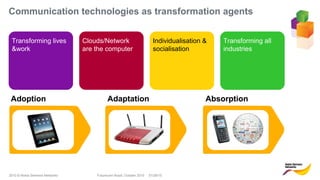
Transforming lives
&work
Individualisation &
socialisation
Clouds/Network
are the computer
Transforming all
industries
Adoption
Communication technologies as transformation agents
Adaptation Absorption
Futurecom Brazil, October 2010 01/29/15
2010 © Nokia Siemens Networks Futurecom Brazil, October 2010 01/29/15
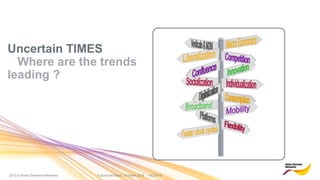
Uncertain TIMES
Where are the trends
leading ?
2010 © Nokia Siemens Networks
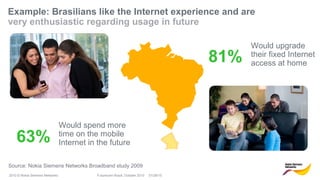
Example: Brasilians like the Internet experience and are
very enthusiastic regarding usage in future
Futurecom Brazil, October 2010 01/29/15
Would upgrade
their fixed Internet
access at home
Would spend more
time on the mobile
Internet in the future
Source: Nokia Siemens Networks Broadband study 2009
81%
63%
2010 © Nokia Siemens Networks Futurecom Brazil, October 2010 01/29/15
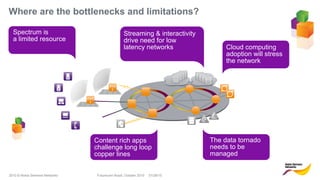
Where are the bottlenecks and limitations?
Spectrum is
a limited resource
The data tornado
needs to be
managed
Content rich apps
challenge long loop
copper lines
Streaming & interactivity
drive need for low
latency networks Cloud computing
adoption will stress
the network
2010 © Nokia Siemens Networks Futurecom Brazil, October 2010 01/29/15
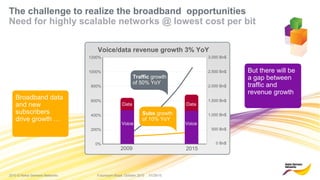
The challenge to realize the broadband opportunities
Need for highly scalable networks @ lowest cost per bit
Voice/data revenue growth 3% YoY
0%
200%
400%
600%
800%
1000%
1200%
2015
0 Bn$
500 Bn$
1.000 Bn$
1.500 Bn$
2.000 Bn$
2.500 Bn$
3.000 Bn$
Broadband data
and new
subscribers
drive growth …
2009
Voice
Data
Voice
Data
But there will be
a gap between
traffic and
revenue growth
Traffic growth
of 50% YoY
Subs growth
of 10% YoY
2010 © Nokia Siemens Networks Futurecom Brazil, October 2010 01/29/15
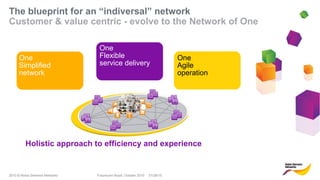
The blueprint for an “indiversal” network
Customer & value centric - evolve to the Network of One
One
Agile
operation
One
Simplified
network
One
Flexible
service delivery
Holistic approach to efficiency and experience
2010 © Nokia Siemens Networks Futurecom Brazil, October 2010 01/29/15
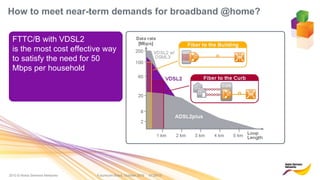
How to meet near-term demands for broadband @home?
FTTC/B with VDSL2
is the most cost effective way
to satisfy the need for 50
Mbps per household
2010 © Nokia Siemens Networks Futurecom Brazil, October 2010 01/29/15
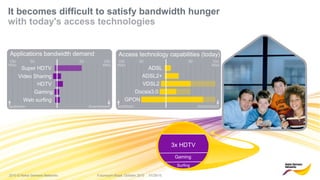
It becomes difficult to satisfy bandwidth hunger
with today's access technologies
upstream downstream
50 50 100
Mbps
Web surfing
HDTV
Video Sharing
Super HDTV
Gaming
Applications bandwidth demand
100
Mbps
ADSL
ADSL2+
upstream downstream
GPON
Docsis3.0
VDSL2
50 50
Access technology capabilities (today)
100
Mbps
100
Mbps
3x HDTV
Surfing
Gaming
2010 © Nokia Siemens Networks Futurecom Brazil, October 2010 01/29/15
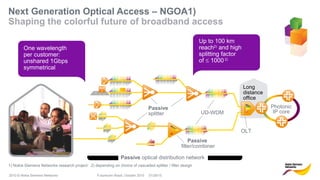
Next Generation Optical Access – NGOA1)
Shaping the colorful future of broadband access
Photonic
IP core
Passive
splitter
Long
distance
office
UD-WDM
OLT
1) Nokia Siemens Networks research project 2) depending on choice of cascaded splitter / filter design
Passive optical distribution network
One wavelength
per customer:
unshared 1Gbps
symmetrical
Passive
filter/combiner
Up to 100 km
reach2)
and high
splitting factor
of ≤ 1000 2)
2010 © Nokia Siemens Networks
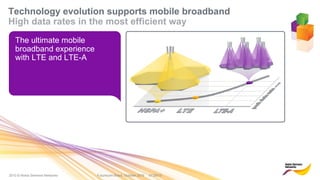
Technology evolution supports mobile broadband
High data rates in the most efficient way
The ultimate mobile
broadband experience
with LTE and LTE-A
Futurecom Brazil, October 2010 01/29/15
2010 © Nokia Siemens Networks Futurecom Brazil, October 2010 01/29/15
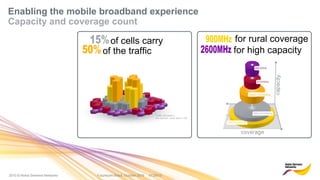
Enabling the mobile broadband experience
Capacity and coverage count
of cells carry
of the traffic
for rural coverage
for high capacity
2010 © Nokia Siemens Networks Futurecom Brazil, October 2010 01/29/15
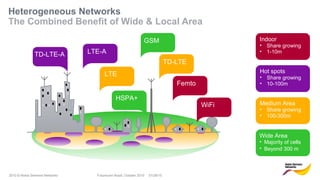
Heterogeneous Networks
The Combined Benefit of Wide & Local Area
Wide Area
• Majority of cells
• Beyond 300 m
Medium Area
• Share growing
• 100-300m
Hot spots
• Share growing
• 10-100m
Indoor
• Share growing
• 1-10m
Femto
LTE
TD-LTE
LTE-ATD-LTE-A
GSM
HSPA+
WiFi
2010 © Nokia Siemens Networks Futurecom Brazil, October 2010 01/29/15
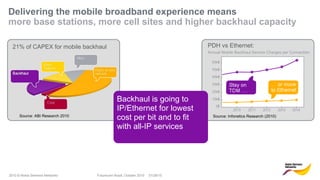
Delivering the mobile broadband experience means
more base stations, more cell sites and higher backhaul capacity
PDH vs Ethernet:
Annual Mobile Backhaul Service Charges per Connection
Source: Infonetics Research (2010)Source: ABI Research 2010
21% of CAPEX for mobile backhaul
Backhaul is going to
IP/Ethernet for lowest
cost per bit and to fit
with all-IP services
2010 © Nokia Siemens Networks Futurecom Brazil, October 2010 01/29/15
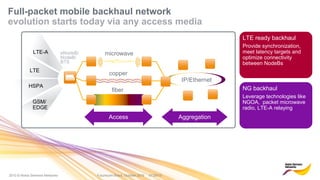
Full-packet mobile backhaul network
evolution starts today via any access media
LTE ready backhaul
Provide synchronization,
meet latency targets and
optimize connectivity
between NodeBs
eNodeB/
NodeB/
BTS
HSPA
LTE
LTE-A
GSM/
EDGE
copper
fiber
microwave
IP/Ethernet
Access Aggregation
NG backhaul
Leverage technologies like
NGOA, packet microwave
radio, LTE-A relaying
2010 © Nokia Siemens Networks
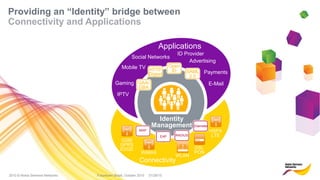
Providing an “Identity” bridge between
Connectivity and Applications
Applications
Connectivity
GSM
GPRS
EDGE
HSPA
LTE
WLAN
WiMAX
DSL
PON
Mobile TV
Advertising
E-Mail
Payments
Social Networks
IPTV
Gaming
ID Provider
HTTP
Digest
GAA/
GBA
Open
ID SAML
2.0
MAP
EAP RADIUS
Diameter
Identity
Management
Futurecom Brazil, October 2010 01/29/15
2010 © Nokia Siemens Networks
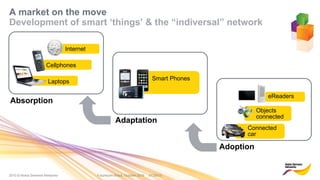
Internet
Cellphones
Laptops
Adoption
Adaptation
Absorption
Smart Phones
eReaders
Objects
connected
Connected
car
A market on the move
Development of smart ‘things’ & the “indiversal” network
Futurecom Brazil, October 2010 01/29/15
2010 © Nokia Siemens Networks Futurecom Brazil, October 2010 01/29/15
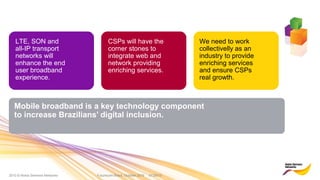
We need to work
collectivelly as an
industry to provide
enriching services
and ensure CSPs
real growth.
LTE, SON and
all-IP transport
networks will
enhance the end
user broadband
experience.
CSPs will have the
corner stones to
integrate web and
network providing
enriching services.
Mobile broadband is a key technology component
to increase Brazilians’ digital inclusion.
2010 © Nokia Siemens Networks
Thank you
Futurecom Brazil, October 2010 01/29/15

Futurecom brazil october_hossein_final_v1

  • 1.
    2010 © NokiaSiemens Networks Futurecom Brazil, October 2010 01/29/15 Hossein Moiin CTO, Nokia Siemens Networks Broadband from today to 2015 and beyond Challenges and Opportunities
  • 2.
    2010 © NokiaSiemens Networks Transforming lives &work Individualisation & socialisation Clouds/Network are the computer Transforming all industries Adoption Communication technologies as transformation agents Adaptation Absorption Futurecom Brazil, October 2010 01/29/15
  • 3.
    2010 © NokiaSiemens Networks Futurecom Brazil, October 2010 01/29/15 Uncertain TIMES Where are the trends leading ?
  • 4.
    2010 © NokiaSiemens Networks Example: Brasilians like the Internet experience and are very enthusiastic regarding usage in future Futurecom Brazil, October 2010 01/29/15 Would upgrade their fixed Internet access at home Would spend more time on the mobile Internet in the future Source: Nokia Siemens Networks Broadband study 2009 81% 63%
  • 5.
    2010 © NokiaSiemens Networks Futurecom Brazil, October 2010 01/29/15 Where are the bottlenecks and limitations? Spectrum is a limited resource The data tornado needs to be managed Content rich apps challenge long loop copper lines Streaming & interactivity drive need for low latency networks Cloud computing adoption will stress the network
  • 6.
    2010 © NokiaSiemens Networks Futurecom Brazil, October 2010 01/29/15 The challenge to realize the broadband opportunities Need for highly scalable networks @ lowest cost per bit Voice/data revenue growth 3% YoY 0% 200% 400% 600% 800% 1000% 1200% 2015 0 Bn$ 500 Bn$ 1.000 Bn$ 1.500 Bn$ 2.000 Bn$ 2.500 Bn$ 3.000 Bn$ Broadband data and new subscribers drive growth … 2009 Voice Data Voice Data But there will be a gap between traffic and revenue growth Traffic growth of 50% YoY Subs growth of 10% YoY
  • 7.
    2010 © NokiaSiemens Networks Futurecom Brazil, October 2010 01/29/15 The blueprint for an “indiversal” network Customer & value centric - evolve to the Network of One One Agile operation One Simplified network One Flexible service delivery Holistic approach to efficiency and experience
  • 8.
    2010 © NokiaSiemens Networks Futurecom Brazil, October 2010 01/29/15 How to meet near-term demands for broadband @home? FTTC/B with VDSL2 is the most cost effective way to satisfy the need for 50 Mbps per household
  • 9.
    2010 © NokiaSiemens Networks Futurecom Brazil, October 2010 01/29/15 It becomes difficult to satisfy bandwidth hunger with today's access technologies upstream downstream 50 50 100 Mbps Web surfing HDTV Video Sharing Super HDTV Gaming Applications bandwidth demand 100 Mbps ADSL ADSL2+ upstream downstream GPON Docsis3.0 VDSL2 50 50 Access technology capabilities (today) 100 Mbps 100 Mbps 3x HDTV Surfing Gaming
  • 10.
    2010 © NokiaSiemens Networks Futurecom Brazil, October 2010 01/29/15 Next Generation Optical Access – NGOA1) Shaping the colorful future of broadband access Photonic IP core Passive splitter Long distance office UD-WDM OLT 1) Nokia Siemens Networks research project 2) depending on choice of cascaded splitter / filter design Passive optical distribution network One wavelength per customer: unshared 1Gbps symmetrical Passive filter/combiner Up to 100 km reach2) and high splitting factor of ≤ 1000 2)
  • 11.
    2010 © NokiaSiemens Networks Technology evolution supports mobile broadband High data rates in the most efficient way The ultimate mobile broadband experience with LTE and LTE-A Futurecom Brazil, October 2010 01/29/15
  • 12.
    2010 © NokiaSiemens Networks Futurecom Brazil, October 2010 01/29/15 Enabling the mobile broadband experience Capacity and coverage count of cells carry of the traffic for rural coverage for high capacity
  • 13.
    2010 © NokiaSiemens Networks Futurecom Brazil, October 2010 01/29/15 Heterogeneous Networks The Combined Benefit of Wide & Local Area Wide Area • Majority of cells • Beyond 300 m Medium Area • Share growing • 100-300m Hot spots • Share growing • 10-100m Indoor • Share growing • 1-10m Femto LTE TD-LTE LTE-ATD-LTE-A GSM HSPA+ WiFi
  • 14.
    2010 © NokiaSiemens Networks Futurecom Brazil, October 2010 01/29/15 Delivering the mobile broadband experience means more base stations, more cell sites and higher backhaul capacity PDH vs Ethernet: Annual Mobile Backhaul Service Charges per Connection Source: Infonetics Research (2010)Source: ABI Research 2010 21% of CAPEX for mobile backhaul Backhaul is going to IP/Ethernet for lowest cost per bit and to fit with all-IP services
  • 15.
    2010 © NokiaSiemens Networks Futurecom Brazil, October 2010 01/29/15 Full-packet mobile backhaul network evolution starts today via any access media LTE ready backhaul Provide synchronization, meet latency targets and optimize connectivity between NodeBs eNodeB/ NodeB/ BTS HSPA LTE LTE-A GSM/ EDGE copper fiber microwave IP/Ethernet Access Aggregation NG backhaul Leverage technologies like NGOA, packet microwave radio, LTE-A relaying
  • 16.
    2010 © NokiaSiemens Networks Providing an “Identity” bridge between Connectivity and Applications Applications Connectivity GSM GPRS EDGE HSPA LTE WLAN WiMAX DSL PON Mobile TV Advertising E-Mail Payments Social Networks IPTV Gaming ID Provider HTTP Digest GAA/ GBA Open ID SAML 2.0 MAP EAP RADIUS Diameter Identity Management Futurecom Brazil, October 2010 01/29/15
  • 17.
    2010 © NokiaSiemens Networks Internet Cellphones Laptops Adoption Adaptation Absorption Smart Phones eReaders Objects connected Connected car A market on the move Development of smart ‘things’ & the “indiversal” network Futurecom Brazil, October 2010 01/29/15
  • 18.
    2010 © NokiaSiemens Networks Futurecom Brazil, October 2010 01/29/15 We need to work collectivelly as an industry to provide enriching services and ensure CSPs real growth. LTE, SON and all-IP transport networks will enhance the end user broadband experience. CSPs will have the corner stones to integrate web and network providing enriching services. Mobile broadband is a key technology component to increase Brazilians’ digital inclusion.
  • 19.
    2010 © NokiaSiemens Networks Thank you Futurecom Brazil, October 2010 01/29/15