I. Introduction:
For many years the process of leading a child through a dental
appointment had been termed behavior management.
In 2003 the American Academy of Pediatric Dentistry (AAPD) sponsored a
national symposium on behavior management that focused on clinical
techniques and the changing environment of and trends in contemporary
pediatric dental practices.
Following this conference, AAPD introduced the term( behavior guidance )
in its clinical guidelines to emphasize that the goals are not to “deal with” a
child’s behavior but rather to enhance communication and cooperation with
the child and parent to promote a positive attitude and good oral health
Behavior: It is an observable act, which can be described in
similar ways by more than one person.
Behavior management: Is the means by which the dental health
team effectively performs treatment for a child and, at the same
time, instills a positive dental attitude.
Effectively in this definition refers to providing high quality dental
care.
Child dental management: It is a clinical art form and still built on
a foundation of science.
which can be defined as the means by which a course of
treatment for a young patient can be completed in the shortest
possible period, while at the same time ensuring hat he will
return for the next course willingly.
VARIABLES INFLUENCING CHILDREN’S DENTAL BEHAVIORS
The responses of children to the dental environment are diverse and
complex. Children present for treatment with differences in age, maturity,
temperament, experience, family background, culture, and oral health
status .
Klingberg and Broberg, in a review of literature from 1982 to 2006
,
tnemeganam roivaheb latned dna yteixna/raef latned taht detroper
hcae ,stnetiap latned cirtaidep rof nommoc ylevtialer erew smelborp
gnticeffa
9% of children and adolescents .
Girls exhibited more dental anxiety and dental behavior management
problems than did boys. Dental fear / anxiety was more closely associated
with temperamental traits such as shyness, inhibition, and negative
emotionality, whereas behavioral problems were connected with activity
and impulsivity
General Behavior Problems and Effect Dental Behavior Management:
Klingberg and Broberg found some support for a relationship between
general behavioral problems and dental behavior management
problems.
Children who have difficulty focusing attention and/or adjusting activities in
their general environment have increased problems complying with
behavioral expectations in the dental environment.
General fears can be important etiologic factors in the development of
dental fears.
Some children, however, have behavioral problems only in the dental
environment; this may be due to previous negative experiences with dental
care.
CHILDREN’S COOPERATIVE BEHAVIOR
Numerous systems have been developed for classifying children’s behavior in
the dental environment. An understanding of these systems holds more than
academic interest. Such knowledge can be an asset to the dentist in several
ways: assisting in directing the behavior guidance approach, providing a
means for the systematic recording of behaviors, and assisting in evaluating
the validity of current research.
Wright’s clinical classification places children in one of three
categories :
1- Cooperative
2- Lacking in cooperative ability
3- Potentially cooperative
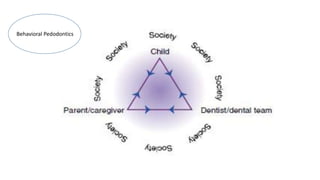
Behavioral Pedodontics
Definition of Autism
Autism, or Autism Spectrum Disorder (ASD), is:
A complex neurodevelopmental disorder that usually appears
in early childhood, characterized by difficulties in social
communication and interaction, along with restricted o
Main Causes and Contributing Factors of
Autism Spectrum Disorder (ASD)
1. Genetic Factors
• Autism is highly heritable, with twin and family studies showing a strong genetic contribution.
• Hundreds of gene mutations and variations have been associated with an increased risk of ASD.
2. Neurological and Brain-related Factors
• Differences in brain structure (e.g., cerebellum size, white matter volume).
• Abnormalities in neural connectivity and brain networks.
3. Environmental Factors (Prenatal and Perinatal)
• Maternal exposure to infections, toxins, or metabolic conditions during pregnancy.
• Birth complications, such as oxygen deprivation.
4. Gene–Environment Interaction
• Most research suggests that ASD results not from a single cause, but from an interaction between genetic
predisposition and environmental influences.
Main Symptoms of Autism Spectrum
Disorder (ASD)
1. Difficulties in Social Communication and Interaction
2. Repetitive or Restrictive Behaviors
3. Sensory Issues
• Over- or under-reactivity to sensory stimuli (sound, light, touch).
• Extreme sensitivity to noise or aversion to certain clothes or foods.
4. Cognitive and Behavioral Differences
5. Medical Evaluation to Rule Out Other Conditions
6. Early Diagnosis
The Relationship Between Dentistry and Autism Spectrum Disorder (ASD)
1. Communication and Interaction Difficulties
• Many individuals with ASD have difficulty expressing pain or discomfort.
• Following instructions during dental treatment can be challenging, requiring specialized communication
approaches.
2. Sensory Sensitivities
• Some children or adults with ASD are hypersensitive to sounds, lights, textures, or smells in the dental clinic.
• This can make treatment stressful or difficult, necessitating adjustments to the clinic environment.
3. Repetitive Behaviors or Distress with Change
• Changes in routine or exposure to unfamiliar dental instruments can cause anxiety or refusal of treatment.
4. Need for Specialized Treatment Approaches
• Behavioral guidance techniques or sensory modifications can facilitate dental care.
• Some patients may require sedation or special anesthesia for certain procedures.
5. Prevention and Home Care
• Due to difficulty with regular dental visits, preventive care and daily oral hygiene become especially important.
Dental Management for Patients with
Autism Spectrum Disorder (ASD)
1. Communication and Preparation
2. Environmental Modifications
3. Scheduling Visits
4. Behavioral Techniques
5. Sedation or Anesthesia if Needed
6. Prevention and Home Care
Attention Deficit Hyperactivity Disorder (ADHD)
is a neurodevelopmental disorder characterized by inattention, hyperactivity, and impulsivity.
Attention deficit hyperactivity disorder (ADHD) is among the most common neurodevelopmental
disorders in childhood with a worldwide prevalence of 7.2%.
Factors:
A-Genetics factors: plays a significant role in ADHD .
B-Environmental factors:
1-Prenatal:
 Low birth weight.
 Exposure to lead, alcohol, or nicotine during pregnancy.
 Complications during birth.
2-Postnatal:
• Exposure to lead.
• Severe deprivation in early childhood.
C-Other:
imbalance in neurotransmitters in the sixth month.
ADHD symptom:
They must be persistent for ≥ 6 months AND occur in ≥2 Settings.
Inattention
•Often makes careless mistakes or misses details in schoolwork/work.
•Sustained attention is hard (tasks, lectures, reading).
•Doesn’t seem to listen when spoken to directly.
•Doesn’t follow through on instructions; leaves tasks unfinished.
•Disorganized
•Avoids/dislikes tasks requiring prolonged mental effort.
•Loses things needed for tasks (e.g., tools, books, glasses, keys).
•Easily distracted by other stimuli.
•Forgetful in daily activities
Hyperactivity-Impulsivity
 Fidgets, taps hands/feet, or squirms in seat.
•Leaves seat when expected to remain seated.
•Runs/climbs inappropriately
 Unable to play or engage in leisure quietly.
 Is often “on the go” or acts “driven by a motor.”
 Talks excessively.
 Blurts out answers; finishes others’ sentences.
 Difficulty waiting one’s turn.
 Interrupts/intrudes on others
How ADHD is Diagnosed
1. Clinical Evaluation
clinical evaluation including.
• Medical history and interviews with the patient and caregivers/teachers.
• Behavioral observations.
• Use of standardized rating scales (e.g., Conners, Vanderbilt).
2. Diagnostic Criteria
Fifth Edition :
a. Core Symptoms
• Inattention: difficulty sustaining focus, forgetfulness, distractibility.
• Hyperactivity-Impulsivity: restlessness, excessive talking, difficulty waiting turn.
b- Onset:
c- Settings:
d- Impairment
3. ADHD Presentations :
Based on symptoms, ADHD can be diagnosed as:
• Predominantly Inattentive Presentation
• Predominantly Hyperactive-Impulsive Presentation
• Combined Presentation
4. Diagnostic Tools :
• Children: Vanderbilt ADHD Diagnostic Rating Scale, Conners Rating Scale.
• Adults: Adult ADHD Self-Report Scale (ASRS), DIVA
Common Comorbidities (Diseases) that Affect Dental Care:
• Anxiety and Depression
•Cardiovascular conditions (e.g., hypertension, arrhythmias)
•Seizure disorders
ADHD Medications and Dental Implications:
a) Stimulants (Methylphenidate, Amphetamines):
• Side effects: xerostomia (dry mouth).
• Can cause bruxism (teeth grinding).
• May increase heart rate and blood pressure .
• Possible interaction with sedatives (reduced effect of benzodiazepines).
b) Non-stimulants (Atomoxetine, Guanfacine, Clonidine)
c) Antidepressants (Tricyclics):
d) Antipsychotics
Clinical Considerations in Dentistry for Patients with ADHD:
1. Appointment Scheduling:
• Short, morning appointments are preferred when the child is less fatigued.
• Frequent recall visits may be required.
2. Behavior Management:
• Use of tell-show-do, positive reinforcement, and clear, simple instructions.
• Avoid long waiting times in the clinic.
3- Oral Health Risks:
• Higher risk of dental caries.
• Possible trauma to teeth due to hyperactivity.
4. Parental Involvement:
• Parents should supervise daily oral hygiene and diet control.
• Emphasize preventive care such as fluoride and sealants.
Treatment
1. Medication:
• Stimulants:
methylphenidate and amphetamine. They work by boosting and balancing neurotransmitters in the
brain, helping to reduce inattention and hyperactivity.
• Non-stimulants:
Atomoxetine and bupropion can also be used, particularly if stimulants are not suitable.
2. Psychotherapy and Behavioral Interventions:
• Cognitive Behavioral Therapy (CBT)
• Behavioral Parent Training:
• Classroom Management Strategies:
• Organizational Skills Training:
• Social Skills Training:
Dental Management of Children with Attention Deficit Hyperactivity Disorder
(ADHD)
Attention Deficit Hyperactivity Disorder (ADHD) presents unique challenges in pediatric dental care. Children
with ADHD have higher caries prevalence, increased risk of dental trauma, and often exhibit uncooperative
behavior during dental visits .Pathophysiology and Oral Health Impact Children
with ADHD are more likely to develop dental caries due to inconsistent oral
hygiene, high sugar intake, and medication-induced xerostomia. They also have
higher rates of dental trauma due to impulsivity and hyperactivity. Bruxism and
periodontal problems are not uncommon.
Managing children with ADHD in pediatric dentistry
requires a combination of preventive strategies, behavior
guidance, pharmacological aids, and treatment
modifications. Including caregiver perspectives through
structured questionnaires can help tailor care and improve
outcomes.
Preventive Dental Care
1.Frequent recall visits: Every 3–4 months for professional cleaning
2. Oral hygiene training using timers, apps, and visual schedules.
3. Dietary counseling to reduce sugary snacks and drinks.
4. Sealants: Apply to newly erupted permanent molars to prevent occlusal caries.
5. Topical fluoride varnish: Use more frequently due to higher caries risk
Behavior Guidance
. Tell–Show–Do method
. Positive reinforcement
. Short appointments
. Distraction techniques
· Parental presence
Pharmacological Support
. Nitrous Oxide–Oxygen sedation
. General anesthesia
. Coordination with pediatrician for medication interactions
Treatment Modifications
1. Restorative care
2. Endodontics in primary teeth
3. Trauma management
4. Moisture contro
Dental management of pediatric patients with autism in dental clinics
Behavioral management approaches
1. presence of parents,
2. the use of tell-show-do technique,
3. short, clear commands, and differential verbal reinforcement
4. Application of the visual pedagogy concept
5. For a child with restricted receptive skills and lack of joint attention
6. Younger autistic children may respond better to certain management techniques
such as positive reinforcement
BEHAVIOR GUIDANCE TECHNIQUES
Non pharmacological management
1.Communication
2. Tell-Show-Do (TSD)
3. Restraints/Deep Pressure Touch
4. Desensitization
5. Voice Control
6. Positive Reinforcement

مصلح سيارات لتكوين السايارات واصلاحها.pdf

  • 2.
    I. Introduction: For manyyears the process of leading a child through a dental appointment had been termed behavior management. In 2003 the American Academy of Pediatric Dentistry (AAPD) sponsored a national symposium on behavior management that focused on clinical techniques and the changing environment of and trends in contemporary pediatric dental practices. Following this conference, AAPD introduced the term( behavior guidance ) in its clinical guidelines to emphasize that the goals are not to “deal with” a child’s behavior but rather to enhance communication and cooperation with the child and parent to promote a positive attitude and good oral health
  • 3.
    Behavior: It isan observable act, which can be described in similar ways by more than one person. Behavior management: Is the means by which the dental health team effectively performs treatment for a child and, at the same time, instills a positive dental attitude. Effectively in this definition refers to providing high quality dental care.
  • 4.
    Child dental management:It is a clinical art form and still built on a foundation of science. which can be defined as the means by which a course of treatment for a young patient can be completed in the shortest possible period, while at the same time ensuring hat he will return for the next course willingly.
  • 5.
    VARIABLES INFLUENCING CHILDREN’SDENTAL BEHAVIORS The responses of children to the dental environment are diverse and complex. Children present for treatment with differences in age, maturity, temperament, experience, family background, culture, and oral health status . Klingberg and Broberg, in a review of literature from 1982 to 2006 , tnemeganam roivaheb latned dna yteixna/raef latned taht detroper hcae ,stnetiap latned cirtaidep rof nommoc ylevtialer erew smelborp gnticeffa 9% of children and adolescents . Girls exhibited more dental anxiety and dental behavior management problems than did boys. Dental fear / anxiety was more closely associated with temperamental traits such as shyness, inhibition, and negative emotionality, whereas behavioral problems were connected with activity and impulsivity
  • 6.
    General Behavior Problemsand Effect Dental Behavior Management: Klingberg and Broberg found some support for a relationship between general behavioral problems and dental behavior management problems. Children who have difficulty focusing attention and/or adjusting activities in their general environment have increased problems complying with behavioral expectations in the dental environment. General fears can be important etiologic factors in the development of dental fears. Some children, however, have behavioral problems only in the dental environment; this may be due to previous negative experiences with dental care.
  • 7.
    CHILDREN’S COOPERATIVE BEHAVIOR Numeroussystems have been developed for classifying children’s behavior in the dental environment. An understanding of these systems holds more than academic interest. Such knowledge can be an asset to the dentist in several ways: assisting in directing the behavior guidance approach, providing a means for the systematic recording of behaviors, and assisting in evaluating the validity of current research. Wright’s clinical classification places children in one of three categories : 1- Cooperative 2- Lacking in cooperative ability 3- Potentially cooperative
  • 8.
  • 9.
    Definition of Autism Autism,or Autism Spectrum Disorder (ASD), is: A complex neurodevelopmental disorder that usually appears in early childhood, characterized by difficulties in social communication and interaction, along with restricted o
  • 10.
    Main Causes andContributing Factors of Autism Spectrum Disorder (ASD) 1. Genetic Factors • Autism is highly heritable, with twin and family studies showing a strong genetic contribution. • Hundreds of gene mutations and variations have been associated with an increased risk of ASD. 2. Neurological and Brain-related Factors • Differences in brain structure (e.g., cerebellum size, white matter volume). • Abnormalities in neural connectivity and brain networks. 3. Environmental Factors (Prenatal and Perinatal) • Maternal exposure to infections, toxins, or metabolic conditions during pregnancy. • Birth complications, such as oxygen deprivation. 4. Gene–Environment Interaction • Most research suggests that ASD results not from a single cause, but from an interaction between genetic predisposition and environmental influences.
  • 11.
    Main Symptoms ofAutism Spectrum Disorder (ASD) 1. Difficulties in Social Communication and Interaction 2. Repetitive or Restrictive Behaviors 3. Sensory Issues • Over- or under-reactivity to sensory stimuli (sound, light, touch). • Extreme sensitivity to noise or aversion to certain clothes or foods. 4. Cognitive and Behavioral Differences 5. Medical Evaluation to Rule Out Other Conditions 6. Early Diagnosis
  • 12.
    The Relationship BetweenDentistry and Autism Spectrum Disorder (ASD) 1. Communication and Interaction Difficulties • Many individuals with ASD have difficulty expressing pain or discomfort. • Following instructions during dental treatment can be challenging, requiring specialized communication approaches. 2. Sensory Sensitivities • Some children or adults with ASD are hypersensitive to sounds, lights, textures, or smells in the dental clinic. • This can make treatment stressful or difficult, necessitating adjustments to the clinic environment. 3. Repetitive Behaviors or Distress with Change • Changes in routine or exposure to unfamiliar dental instruments can cause anxiety or refusal of treatment. 4. Need for Specialized Treatment Approaches • Behavioral guidance techniques or sensory modifications can facilitate dental care. • Some patients may require sedation or special anesthesia for certain procedures. 5. Prevention and Home Care • Due to difficulty with regular dental visits, preventive care and daily oral hygiene become especially important.
  • 13.
    Dental Management forPatients with Autism Spectrum Disorder (ASD) 1. Communication and Preparation 2. Environmental Modifications 3. Scheduling Visits 4. Behavioral Techniques 5. Sedation or Anesthesia if Needed 6. Prevention and Home Care
  • 14.
    Attention Deficit HyperactivityDisorder (ADHD) is a neurodevelopmental disorder characterized by inattention, hyperactivity, and impulsivity. Attention deficit hyperactivity disorder (ADHD) is among the most common neurodevelopmental disorders in childhood with a worldwide prevalence of 7.2%.
  • 15.
    Factors: A-Genetics factors: playsa significant role in ADHD . B-Environmental factors: 1-Prenatal:  Low birth weight.  Exposure to lead, alcohol, or nicotine during pregnancy.  Complications during birth. 2-Postnatal: • Exposure to lead. • Severe deprivation in early childhood. C-Other: imbalance in neurotransmitters in the sixth month.
  • 16.
    ADHD symptom: They mustbe persistent for ≥ 6 months AND occur in ≥2 Settings. Inattention •Often makes careless mistakes or misses details in schoolwork/work. •Sustained attention is hard (tasks, lectures, reading). •Doesn’t seem to listen when spoken to directly. •Doesn’t follow through on instructions; leaves tasks unfinished. •Disorganized •Avoids/dislikes tasks requiring prolonged mental effort. •Loses things needed for tasks (e.g., tools, books, glasses, keys). •Easily distracted by other stimuli. •Forgetful in daily activities
  • 17.
    Hyperactivity-Impulsivity  Fidgets, tapshands/feet, or squirms in seat. •Leaves seat when expected to remain seated. •Runs/climbs inappropriately  Unable to play or engage in leisure quietly.  Is often “on the go” or acts “driven by a motor.”  Talks excessively.  Blurts out answers; finishes others’ sentences.  Difficulty waiting one’s turn.  Interrupts/intrudes on others
  • 18.
    How ADHD isDiagnosed 1. Clinical Evaluation clinical evaluation including. • Medical history and interviews with the patient and caregivers/teachers. • Behavioral observations. • Use of standardized rating scales (e.g., Conners, Vanderbilt). 2. Diagnostic Criteria Fifth Edition : a. Core Symptoms • Inattention: difficulty sustaining focus, forgetfulness, distractibility. • Hyperactivity-Impulsivity: restlessness, excessive talking, difficulty waiting turn. b- Onset: c- Settings: d- Impairment
  • 19.
    3. ADHD Presentations: Based on symptoms, ADHD can be diagnosed as: • Predominantly Inattentive Presentation • Predominantly Hyperactive-Impulsive Presentation • Combined Presentation 4. Diagnostic Tools : • Children: Vanderbilt ADHD Diagnostic Rating Scale, Conners Rating Scale. • Adults: Adult ADHD Self-Report Scale (ASRS), DIVA
  • 20.
    Common Comorbidities (Diseases)that Affect Dental Care: • Anxiety and Depression •Cardiovascular conditions (e.g., hypertension, arrhythmias) •Seizure disorders ADHD Medications and Dental Implications: a) Stimulants (Methylphenidate, Amphetamines): • Side effects: xerostomia (dry mouth). • Can cause bruxism (teeth grinding). • May increase heart rate and blood pressure . • Possible interaction with sedatives (reduced effect of benzodiazepines).
  • 21.
    b) Non-stimulants (Atomoxetine,Guanfacine, Clonidine) c) Antidepressants (Tricyclics): d) Antipsychotics
  • 22.
    Clinical Considerations inDentistry for Patients with ADHD: 1. Appointment Scheduling: • Short, morning appointments are preferred when the child is less fatigued. • Frequent recall visits may be required. 2. Behavior Management: • Use of tell-show-do, positive reinforcement, and clear, simple instructions. • Avoid long waiting times in the clinic. 3- Oral Health Risks: • Higher risk of dental caries. • Possible trauma to teeth due to hyperactivity. 4. Parental Involvement: • Parents should supervise daily oral hygiene and diet control. • Emphasize preventive care such as fluoride and sealants.
  • 23.
    Treatment 1. Medication: • Stimulants: methylphenidateand amphetamine. They work by boosting and balancing neurotransmitters in the brain, helping to reduce inattention and hyperactivity. • Non-stimulants: Atomoxetine and bupropion can also be used, particularly if stimulants are not suitable. 2. Psychotherapy and Behavioral Interventions: • Cognitive Behavioral Therapy (CBT) • Behavioral Parent Training: • Classroom Management Strategies: • Organizational Skills Training: • Social Skills Training:
  • 24.
    Dental Management ofChildren with Attention Deficit Hyperactivity Disorder (ADHD) Attention Deficit Hyperactivity Disorder (ADHD) presents unique challenges in pediatric dental care. Children with ADHD have higher caries prevalence, increased risk of dental trauma, and often exhibit uncooperative behavior during dental visits .Pathophysiology and Oral Health Impact Children with ADHD are more likely to develop dental caries due to inconsistent oral hygiene, high sugar intake, and medication-induced xerostomia. They also have higher rates of dental trauma due to impulsivity and hyperactivity. Bruxism and periodontal problems are not uncommon.
  • 25.
    Managing children withADHD in pediatric dentistry requires a combination of preventive strategies, behavior guidance, pharmacological aids, and treatment modifications. Including caregiver perspectives through structured questionnaires can help tailor care and improve outcomes.
  • 26.
    Preventive Dental Care 1.Frequentrecall visits: Every 3–4 months for professional cleaning 2. Oral hygiene training using timers, apps, and visual schedules. 3. Dietary counseling to reduce sugary snacks and drinks. 4. Sealants: Apply to newly erupted permanent molars to prevent occlusal caries. 5. Topical fluoride varnish: Use more frequently due to higher caries risk
  • 27.
    Behavior Guidance . Tell–Show–Domethod . Positive reinforcement . Short appointments . Distraction techniques · Parental presence
  • 28.
    Pharmacological Support . NitrousOxide–Oxygen sedation . General anesthesia . Coordination with pediatrician for medication interactions
  • 29.
    Treatment Modifications 1. Restorativecare 2. Endodontics in primary teeth 3. Trauma management 4. Moisture contro
  • 30.
    Dental management ofpediatric patients with autism in dental clinics Behavioral management approaches 1. presence of parents, 2. the use of tell-show-do technique, 3. short, clear commands, and differential verbal reinforcement 4. Application of the visual pedagogy concept 5. For a child with restricted receptive skills and lack of joint attention 6. Younger autistic children may respond better to certain management techniques such as positive reinforcement
  • 31.
    BEHAVIOR GUIDANCE TECHNIQUES Nonpharmacological management 1.Communication 2. Tell-Show-Do (TSD) 3. Restraints/Deep Pressure Touch 4. Desensitization 5. Voice Control 6. Positive Reinforcement