PCSM Changes per the New Chapter 102
Presented By: Jason Bailey, E.I.T.
Overview
• General PCSM
Changes
• PCSM Plans
• PCSM Report
• Analysis
• Implementation for
Special Protection
Waters
• Long Term
Operations and
Maintenance
• Certification Criteria
General PCSM
• As of November 19th, 2010
– All projects greater than 1 acre will
require an NPDES Permit
Application
– Permits considered
administratively complete as of
November 19th, 2010 are
grandfathered from Long Term
O&M and buffer requirements
– Renewals considered
administratively complete by
January 1st, 2013 are also
grandfathered from Long Term
O&M and buffer requirements
PCSM Plans
• PCSM Plans must be consistent with and separate
from E&S Plans
• PCSM Plans must be prepared by a person with
experience in PCSM and projects of applicable size
and scope
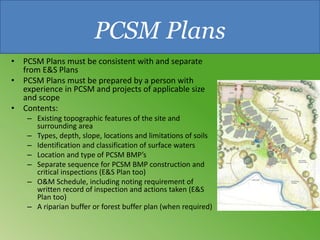
• Contents:
– Existing topographic features of the site and
surrounding area
– Types, depth, slope, locations and limitations of soils
– Identification and classification of surface waters
– Location and type of PCSM BMP’s
– Separate sequence for PCSM BMP construction and
critical inspections (E&S Plan too)
– O&M Schedule, including noting requirement of
written record of inspection and actions taken (E&S
Plan too)
– A riparian buffer or forest buffer plan (when required)
PCSM Report
• Characteristics of the site including land use (up to
50 years ago) and proposed alterations
• Net change pre. vs. post. in volume and rate
• Identification of thermal impacts and prevention
and mitigation measures
• Infiltration and geo-technical studies
• Supporting Calculations
– Demonstration that PCSM BMP’s meet rate reductions,
volume reductions and water quality
– 2-year through 100-year event analysis
Analysis
• Existing pre-development non-forested
pervious areas must be considered meadow
in good condition
– Repair, reconstruction and restoration
of roadways, rail lines and utility
infrastructure are exempt from this
criteria.
Analysis Continued
• Existing pre-development non-
forested pervious areas must be
considered meadow in good
condition
– Repair, reconstruction and
restoration of roadways, rail lines
and utility infrastructure are
exempt from this criteria.
Implementation for Special
Protection Waters
• Any project in HQ, EV or
discharging to EV Wetlands
must perform anti-
degradation analysis
– Must evaluate for non-
discharge alternatives
– If no non-discharge
alternatives exist, the project
must demonstration meeting
ABACT criteria
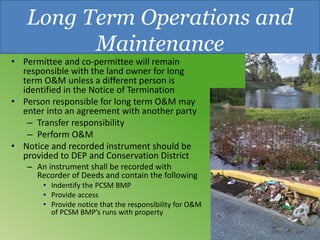
Long Term Operations and
Maintenance
• Permittee and co-permittee will remain
responsible with the land owner for long
term O&M unless a different person is
identified in the Notice of Termination
• Person responsible for long term O&M may
enter into an agreement with another party
– Transfer responsibility
– Perform O&M
• Notice and recorded instrument should be
provided to DEP and Conservation District
– An instrument shall be recorded with
Recorder of Deeds and contain the following
• Indentify the PCSM BMP
• Provide access
• Provide notice that the responsibility for O&M
of PCSM BMP’s runs with property
Certification Criteria
• Licensed professional (designer or delegated person)
must be on-site during critical stages
– Critical stages include:
• Installation of underground storage or treatment BMP’s
• Installation of structurally engineered BMP’s
• Installation of other BMP’s deemed appropriate by DEP or
Conservation District.
• Inspection schedule must be provided on E&S and PCSM Plans
• Three copies of record drawings must be submitted
– One copy for the District
– One for the permittee
– One for the party responsible for Long Term O&M
Certification Criteria Cont.
• Certification
– ‘‘I (name) do hereby certify pursuant to the penalties of 18
Pa. C.S.A. § 4904 to the best of my knowledge, information
and belief, that the accompanying record drawings
accurately reflect the as-built conditions, are true and
correct, and are in conformance with Chapter 102 of the
rules and regulations of the Department of Environmental
Protection and that the project site was constructed in
accordance with the approved PCSM Plan, all approved
plan changes and accepted construction practices.’’
– This language is to be stamped and signed by the licensed
professional
Questions

Pcsm requirements copy

  • 1.
    PCSM Changes perthe New Chapter 102 Presented By: Jason Bailey, E.I.T.
  • 2.
    Overview • General PCSM Changes •PCSM Plans • PCSM Report • Analysis • Implementation for Special Protection Waters • Long Term Operations and Maintenance • Certification Criteria
  • 3.
    General PCSM • Asof November 19th, 2010 – All projects greater than 1 acre will require an NPDES Permit Application – Permits considered administratively complete as of November 19th, 2010 are grandfathered from Long Term O&M and buffer requirements – Renewals considered administratively complete by January 1st, 2013 are also grandfathered from Long Term O&M and buffer requirements
  • 4.
    PCSM Plans • PCSMPlans must be consistent with and separate from E&S Plans • PCSM Plans must be prepared by a person with experience in PCSM and projects of applicable size and scope • Contents: – Existing topographic features of the site and surrounding area – Types, depth, slope, locations and limitations of soils – Identification and classification of surface waters – Location and type of PCSM BMP’s – Separate sequence for PCSM BMP construction and critical inspections (E&S Plan too) – O&M Schedule, including noting requirement of written record of inspection and actions taken (E&S Plan too) – A riparian buffer or forest buffer plan (when required)
  • 5.
    PCSM Report • Characteristicsof the site including land use (up to 50 years ago) and proposed alterations • Net change pre. vs. post. in volume and rate • Identification of thermal impacts and prevention and mitigation measures • Infiltration and geo-technical studies • Supporting Calculations – Demonstration that PCSM BMP’s meet rate reductions, volume reductions and water quality – 2-year through 100-year event analysis
  • 6.
    Analysis • Existing pre-developmentnon-forested pervious areas must be considered meadow in good condition – Repair, reconstruction and restoration of roadways, rail lines and utility infrastructure are exempt from this criteria.
  • 7.
    Analysis Continued • Existingpre-development non- forested pervious areas must be considered meadow in good condition – Repair, reconstruction and restoration of roadways, rail lines and utility infrastructure are exempt from this criteria.
  • 8.
    Implementation for Special ProtectionWaters • Any project in HQ, EV or discharging to EV Wetlands must perform anti- degradation analysis – Must evaluate for non- discharge alternatives – If no non-discharge alternatives exist, the project must demonstration meeting ABACT criteria
  • 9.
    Long Term Operationsand Maintenance • Permittee and co-permittee will remain responsible with the land owner for long term O&M unless a different person is identified in the Notice of Termination • Person responsible for long term O&M may enter into an agreement with another party – Transfer responsibility – Perform O&M • Notice and recorded instrument should be provided to DEP and Conservation District – An instrument shall be recorded with Recorder of Deeds and contain the following • Indentify the PCSM BMP • Provide access • Provide notice that the responsibility for O&M of PCSM BMP’s runs with property
  • 10.
    Certification Criteria • Licensedprofessional (designer or delegated person) must be on-site during critical stages – Critical stages include: • Installation of underground storage or treatment BMP’s • Installation of structurally engineered BMP’s • Installation of other BMP’s deemed appropriate by DEP or Conservation District. • Inspection schedule must be provided on E&S and PCSM Plans • Three copies of record drawings must be submitted – One copy for the District – One for the permittee – One for the party responsible for Long Term O&M
  • 11.
    Certification Criteria Cont. •Certification – ‘‘I (name) do hereby certify pursuant to the penalties of 18 Pa. C.S.A. § 4904 to the best of my knowledge, information and belief, that the accompanying record drawings accurately reflect the as-built conditions, are true and correct, and are in conformance with Chapter 102 of the rules and regulations of the Department of Environmental Protection and that the project site was constructed in accordance with the approved PCSM Plan, all approved plan changes and accepted construction practices.’’ – This language is to be stamped and signed by the licensed professional
  • 12.