GROUP MEMBERS:
â—¦Fiza Bibi
â—¦Muhammad hamza
â—¦Huma Rehman
â—¦Zunaira Naseem
â—¦Anosh Tanweer
â—¦Syeda Farah Hussain
â—¦Hijab Fatima
â—¦Areeba Shafique
â—¦Sabreen ali
â—¦Muhammad waqas
Clinical Scenario:
Patient Presentation
1. Age and Sex: 35-year-old woman.
2. Symptoms: Fatigue, muscle weakness, and occasional
bone pain.
Clinical Findings
3. Neck Examination: Neck appears slightly swollen.
4. Blood Tests:
- Elevated calcium levels.
- Low phosphate levels.
- Increased parathyroid hormone (PTH) levels.
Diagnosis and Suspected Cause
â—¦5. Suspected Condition: Primary
hyperparathyroidism.
6. Possible Cause: Parathyroid adenoma as
revealed by an ultrasound showing an
enlarged parathyroid gland.
LEARNING OBJECTIVES:
â—¦ 1_ANATOMY OF PARATHYROID GLAND
â—¦ 2_DEVELOPMENT OF PARATHYROID GLAND
â—¦ 3_MICROSCOPIC ANATOMY OF PARATHYROID GLAND
â—¦ 4_PATHOPHYSIOLOGY OF PRIMARY HYPERPARATHYROIDISM
â—¦ 5_TYPES OF PRIMARY HYPERPARATHYROIDISM
â—¦ 6_SYMPTOMS
â—¦ 7_CAUSES
â—¦ 8_LAB INVESTIGATIONS
â—¦ 9_MANAGEMENT STRATEGIES
ANATOMY OF PARATHYROID
GLAND:
. Location:
- Usually 4 small glands(can be 2–6)
- Located on the posterior surface of the thyroid gland
Divided into:
- 2 superior parathyroid glands
- 2 inferior parathyroid glands
*
2. Size & Shape:
Small, oval or bean-shaped
Size: ~6 mm long, 3–4 mm wide
Weight: ~30–50 mg each
3. Blood Supply:
- Arterial supply:
- Mainly from the inferior thyroid artery
- May also get branches from superior thyroid artery or
thyroid ima artery
3- Venous drainage:
- Into the thyroid venous plexus
4. Nerve Supply:
- From sympathetic fibers via cervical ganglia
â—¦- No parasympathetic innervation
DEVELOPMENT OF PARATHYROID
GLAND:
The parathyroid glands develop from the epithelium of the
pharyngeal (branchial) pouches, specifically:
Origin:
3rd
Pharyngeal Pouch → Inferior Parathyroid Glands
4th
Pharyngeal Pouch → Superior Parathyroid Glands
â—¦Developmental Process:
Structure Derivative
3rd
Pharyngeal Pouch
Dorsal part → Inferior parathyroid glands
Ventral part → Thymus
4th
Pharyngeal Pouch
Dorsal part → Superior parathyroid glands
Ventral part → Ultimobranchial body (forms C-cells
of thyroid)
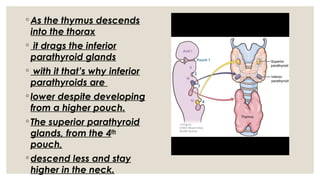
â—¦ As the thymus descends
into the thorax
â—¦ it drags the inferior
parathyroid glands
◦ with it that’s why inferior
parathyroids are
â—¦ lower despite developing
from a higher pouch.
â—¦ The superior parathyroid
glands, from the 4th
pouch,
â—¦ descend less and stay
higher in the neck.
HISTOLOGY:
Parathyroid Gland Structure and Cell Types
- Chief Cells:
- More numerous than oxyphil cells
- Small, polygonal cells (6-8 µm in diameter)
- Cytoplasm contains organelles, ŘŚglycogen granules,
lipid droplets, and secretory granules
- Lightly acidophilic staining
â—¦ - Secrete parathyroid hormone (PTH)
â—¦ Oxyphil Cells
â—¦
â—¦ - Appear around puberty; number increases with age
â—¦ - Larger than chief cells, roughly polygonal
â—¦ - Occur in small clusters
â—¦ - Intensely acidophilic staining due to numerous
mitochondria
- No secretory granules present; function unknown
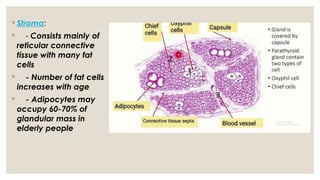
â—¦ Stroma:
â—¦ - Consists mainly of
reticular connective
tissue with many fat
cells
â—¦ - Number of fat cells
increases with age
â—¦ - Adipocytes may
occupy 60-70% of
glandular mass in
elderly people
Pathophysiology of primary
hyperthyroidism:
Parathyroid gland dysfunction:
â—¦Adenoma, hyperplasia, or carcinoma leads to
excessive parathyroid hormone (PTH) production
â—¦ Increased PTH secretion:
â—¦Elevated PTH levels stimulate:
â—¦ - Bone resorption (calcium release from bones)
â—¦ - Increased calcium absorption in the gut
â—¦ - Enhanced calcium reabsorption in the
kidneys.
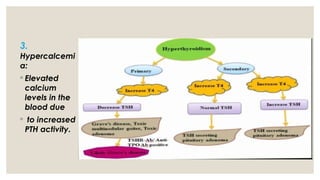
3.
Hypercalcemi
a:
â—¦ Elevated
calcium
levels in the
blood due
â—¦ to increased
PTH activity.
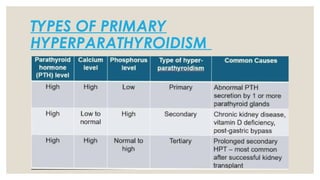
TYPES OF PRIMARY
HYPERPARATHYROIDISM
Causes:
1.Parathyroid Adenoma: A benign tumor on one of
the parathyroid glands, leading to excessive
parathyroid hormone (PTH) production.
2. Parathyroid Hyperplasia: Enlargement of multiple
parathyroid glands, resulting in overproduction of PTH.
3.Parathyroid Carcinoma:A rare malignant tumor of
the parathyroid gland that can cause excessive PTH
production.
SYMPTOMS:
1. Bone pain or tenderness
2. Kidney stones
3. Fatigue
4. Depression
5. Abdominal pain
6. Constipation
7. Frequent urination
8. Thirst
Asymptomatic Cases
Some individuals may not experience noticeable symptoms, and the condition is
discovered during routine blood tests.
Complications
Untreated primary hyperparathyroidism can lead to complications
such as osteoporosis, kidney damage, and cardiovascular disease.
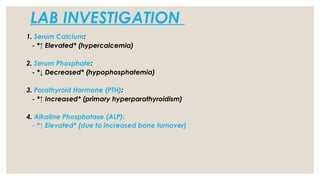
LAB INVESTIGATION
1. Serum Calcium:
- *↑ Elevated* (hypercalcemia)
2. Serum Phosphate:
- *↓ Decreased* (hypophosphatemia)
3. Parathyroid Hormone (PTH):
- *↑ Increased* (primary hyperparathyroidism)
4. Alkaline Phosphatase (ALP):
- *↑ Elevated* (due to increased bone turnover)
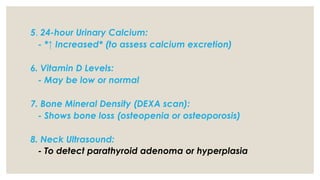
5. 24-hour Urinary Calcium:
- *↑ Increased* (to assess calcium excretion)
6. Vitamin D Levels:
- May be low or normal
7. Bone Mineral Density (DEXA scan):
- Shows bone loss (osteopenia or osteoporosis)
8. Neck Ultrasound:
- To detect parathyroid adenoma or hyperplasia
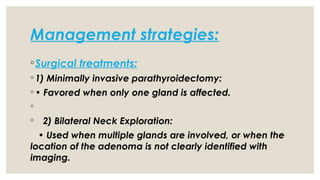
Management strategies:
â—¦Surgical treatments:
â—¦ 1) Minimally invasive parathyroidectomy:
◦ • Favored when only one gland is affected.
â—¦
â—¦ 2) Bilateral Neck Exploration:
• Used when multiple glands are involved, or when the
location of the adenoma is not clearly identified with
imaging.
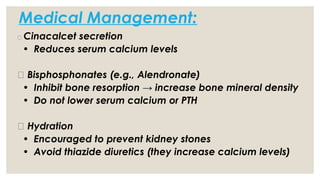
Medical Management:
t
🔹 Cinacalcet secretion
• Reduces serum calcium levels
🔹 Bisphosphonates (e.g., Alendronate)
• Inhibit bone resorption → increase bone mineral density
• Do not lower serum calcium or PTH
🔹 Hydration
• Encouraged to prevent kidney stones
• Avoid thiazide diuretics (they increase calcium levels)
Monitoring (in asymptomatic patients)
• Serum calcium and creatinine: annually
• Bone mineral density: every 1–2 years
• 24-hour urinary calcium (to assess stone
risk)
◦• Maintaining calcium and vitamin D levels
pbl group parathyroid gland.. .....7.pptx

pbl group parathyroid gland.. .....7.pptx

  • 2.
    GROUP MEMBERS: â—¦Fiza Bibi â—¦Muhammadhamza â—¦Huma Rehman â—¦Zunaira Naseem â—¦Anosh Tanweer â—¦Syeda Farah Hussain â—¦Hijab Fatima â—¦Areeba Shafique â—¦Sabreen ali â—¦Muhammad waqas
  • 3.
    Clinical Scenario: Patient Presentation 1.Age and Sex: 35-year-old woman. 2. Symptoms: Fatigue, muscle weakness, and occasional bone pain. Clinical Findings 3. Neck Examination: Neck appears slightly swollen. 4. Blood Tests: - Elevated calcium levels. - Low phosphate levels. - Increased parathyroid hormone (PTH) levels.
  • 4.
    Diagnosis and SuspectedCause â—¦5. Suspected Condition: Primary hyperparathyroidism. 6. Possible Cause: Parathyroid adenoma as revealed by an ultrasound showing an enlarged parathyroid gland.
  • 5.
    LEARNING OBJECTIVES: â—¦ 1_ANATOMYOF PARATHYROID GLAND â—¦ 2_DEVELOPMENT OF PARATHYROID GLAND â—¦ 3_MICROSCOPIC ANATOMY OF PARATHYROID GLAND â—¦ 4_PATHOPHYSIOLOGY OF PRIMARY HYPERPARATHYROIDISM â—¦ 5_TYPES OF PRIMARY HYPERPARATHYROIDISM â—¦ 6_SYMPTOMS â—¦ 7_CAUSES â—¦ 8_LAB INVESTIGATIONS â—¦ 9_MANAGEMENT STRATEGIES
  • 6.
    ANATOMY OF PARATHYROID GLAND: .Location: - Usually 4 small glands(can be 2–6) - Located on the posterior surface of the thyroid gland Divided into: - 2 superior parathyroid glands - 2 inferior parathyroid glands
  • 7.
    * 2. Size &Shape: Small, oval or bean-shaped Size: ~6 mm long, 3–4 mm wide Weight: ~30–50 mg each 3. Blood Supply: - Arterial supply: - Mainly from the inferior thyroid artery - May also get branches from superior thyroid artery or thyroid ima artery 3- Venous drainage: - Into the thyroid venous plexus 4. Nerve Supply: - From sympathetic fibers via cervical ganglia ◦- No parasympathetic innervation
  • 8.
    DEVELOPMENT OF PARATHYROID GLAND: Theparathyroid glands develop from the epithelium of the pharyngeal (branchial) pouches, specifically: Origin: 3rd Pharyngeal Pouch → Inferior Parathyroid Glands 4th Pharyngeal Pouch → Superior Parathyroid Glands
  • 9.
    ◦Developmental Process: Structure Derivative 3rd PharyngealPouch Dorsal part → Inferior parathyroid glands Ventral part → Thymus 4th Pharyngeal Pouch Dorsal part → Superior parathyroid glands Ventral part → Ultimobranchial body (forms C-cells of thyroid)
  • 10.
    ◦ As thethymus descends into the thorax ◦ it drags the inferior parathyroid glands ◦ with it that’s why inferior parathyroids are ◦ lower despite developing from a higher pouch. ◦ The superior parathyroid glands, from the 4th pouch, ◦ descend less and stay higher in the neck.
  • 11.
    HISTOLOGY: Parathyroid Gland Structureand Cell Types - Chief Cells: - More numerous than oxyphil cells - Small, polygonal cells (6-8 µm in diameter) - Cytoplasm contains organelles, ،glycogen granules, lipid droplets, and secretory granules - Lightly acidophilic staining ◦ - Secrete parathyroid hormone (PTH)
  • 12.
    â—¦ Oxyphil Cells â—¦ â—¦- Appear around puberty; number increases with age â—¦ - Larger than chief cells, roughly polygonal â—¦ - Occur in small clusters â—¦ - Intensely acidophilic staining due to numerous mitochondria - No secretory granules present; function unknown
  • 13.
    â—¦ Stroma: â—¦ -Consists mainly of reticular connective tissue with many fat cells â—¦ - Number of fat cells increases with age â—¦ - Adipocytes may occupy 60-70% of glandular mass in elderly people
  • 14.
    Pathophysiology of primary hyperthyroidism: Parathyroidgland dysfunction: â—¦Adenoma, hyperplasia, or carcinoma leads to excessive parathyroid hormone (PTH) production â—¦ Increased PTH secretion: â—¦Elevated PTH levels stimulate: â—¦ - Bone resorption (calcium release from bones) â—¦ - Increased calcium absorption in the gut â—¦ - Enhanced calcium reabsorption in the kidneys.
  • 15.
    3. Hypercalcemi a: â—¦ Elevated calcium levels inthe blood due â—¦ to increased PTH activity.
  • 16.
  • 17.
    Causes: 1.Parathyroid Adenoma: Abenign tumor on one of the parathyroid glands, leading to excessive parathyroid hormone (PTH) production. 2. Parathyroid Hyperplasia: Enlargement of multiple parathyroid glands, resulting in overproduction of PTH. 3.Parathyroid Carcinoma:A rare malignant tumor of the parathyroid gland that can cause excessive PTH production.
  • 18.
    SYMPTOMS: 1. Bone painor tenderness 2. Kidney stones 3. Fatigue 4. Depression 5. Abdominal pain 6. Constipation 7. Frequent urination 8. Thirst Asymptomatic Cases Some individuals may not experience noticeable symptoms, and the condition is discovered during routine blood tests. Complications Untreated primary hyperparathyroidism can lead to complications such as osteoporosis, kidney damage, and cardiovascular disease.
  • 19.
    LAB INVESTIGATION 1. SerumCalcium: - *↑ Elevated* (hypercalcemia) 2. Serum Phosphate: - *↓ Decreased* (hypophosphatemia) 3. Parathyroid Hormone (PTH): - *↑ Increased* (primary hyperparathyroidism) 4. Alkaline Phosphatase (ALP): - *↑ Elevated* (due to increased bone turnover)
  • 20.
    5. 24-hour UrinaryCalcium: - *↑ Increased* (to assess calcium excretion) 6. Vitamin D Levels: - May be low or normal 7. Bone Mineral Density (DEXA scan): - Shows bone loss (osteopenia or osteoporosis) 8. Neck Ultrasound: - To detect parathyroid adenoma or hyperplasia
  • 21.
    Management strategies: ◦Surgical treatments: ◦1) Minimally invasive parathyroidectomy: ◦ • Favored when only one gland is affected. ◦ ◦ 2) Bilateral Neck Exploration: • Used when multiple glands are involved, or when the location of the adenoma is not clearly identified with imaging.
  • 22.
    Medical Management: t 🔹 Cinacalcetsecretion • Reduces serum calcium levels 🔹 Bisphosphonates (e.g., Alendronate) • Inhibit bone resorption → increase bone mineral density • Do not lower serum calcium or PTH 🔹 Hydration • Encouraged to prevent kidney stones • Avoid thiazide diuretics (they increase calcium levels)
  • 23.
    Monitoring (in asymptomaticpatients) • Serum calcium and creatinine: annually • Bone mineral density: every 1–2 years • 24-hour urinary calcium (to assess stone risk) ◦• Maintaining calcium and vitamin D levels