Role of Agriculture in INDIA

      B.PAVAN SRI SAI
      3rd class B section
    NARAYANA E TECHNO
   SCHOOL Kothapet Guntur,
              India
Contents of the presentation

   Introduction and background ,
   Performance of Agriculture
   Role of small holding agriculture for food
   security and livelihoods
--Technological innovations
--institutional innovations
Introduction and background on
             Indian Agriculture
India ‘s population is 1.21 billion in 2011. 67% are
rural. Majority are in agriculture.
Importance of agriculture in Indian economy. Although
it contributes only 15% of GDP, the share of workers
is about 55%.
Major crops are rice, wheat, maize, coarse cereals,
groundnut, cotton, sugarcane, fruits and vegetables
60% of cultivated area is rainfed as only 40% of area
is under irrigation.
Rural poverty is 41%in 2004-05.
Agriculture is a ‘State Subject’. In other words, the
policies of provinces are also important
Performance of Agriculture
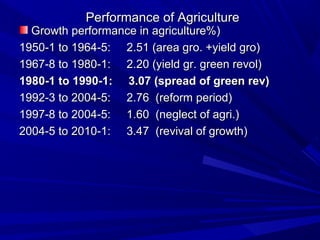
  Growth performance in agriculture%)
1950-1 to 1964-5: 2.51 (area gro. +yield gro)
1967-8 to 1980-1: 2.20 (yield gr. green revol)
1980-1 to 1990-1: 3.07 (spread of green rev)
1992-3 to 2004-5: 2.76 (reform period)
1997-8 to 2004-5: 1.60 (neglect of agri.)
2004-5 to 2010-1: 3.47 (revival of growth)
Agriculture GDP growth
7.00
            5-Year Average Growth Rate
6.00

5.00

4.00

3.00

2.00

1.00

0.00

-1.00
        5
        6
        9
        1

            7
            6
            9
            1

                6
                9
                1

                    7
                    9
                    1

                        3
                        7
                        9
                        1

                            5
                            7
                            9
                            1

                                7
                                9
                                1

                                    7
                                    9
                                    1

                                        8
                                        9
                                        1

                                            3
                                            8
                                            9
                                            1

                                                5
                                                8
                                                9
                                                1

                                                    7
                                                    8
                                                    9
                                                    1

                                                        8
                                                        9
                                                        1

                                                            9
                                                            1

                                                                3
                                                                9
                                                                1

                                                                    5
                                                                    9
                                                                    1

                                                                        7
                                                                        9
                                                                        1

                                                                            9
                                                                            1

                                                                                1
                                                                                0
                                                                                2

                                                                                    3
                                                                                    0
                                                                                    2

                                                                                        5
                                                                                        0
                                                                                        2

                                                                                            7
                                                                                            0
                                                                                            2

                                                                                                9
                                                                                                0
                                                                                                2

                                                                                                    1
                                                                                                    0
                                                                                                    2
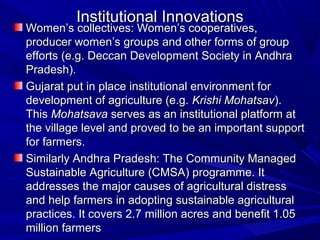
Institutional Innovations
Women’s collectives: Women’s cooperatives,
producer women’s groups and other forms of group
efforts (e.g. Deccan Development Society in Andhra
Pradesh).
Gujarat put in place institutional environment for
development of agriculture (e.g. Krishi Mohatsav).
This Mohatsava serves as an institutional platform at
the village level and proved to be an important support
for farmers.
Similarly Andhra Pradesh: The Community Managed
Sustainable Agriculture (CMSA) programme. It
addresses the major causes of agricultural distress
and help farmers in adopting sustainable agricultural
practices. It covers 2.7 million acres and benefit 1.05
million farmers
Institutional Innovations
  Institutions for Marketing of Small holders
--There are several models: Contract farming, self
  help group model, co-operative model and
  producer co-operatives
--One of the most successful producer
  organization is dairy cooperative with 12.3
  million members.
--Contract farming is also successful in some
  cases
--Some examples of group approach are: Apni
  Mandi in Punjab and Rytu Bazar in Andhra
  Pradesh
Small farmers, value chains and
              Supermarkets
Wholesale, processing and retail segments are
growing in India.
In India, super market revolution is also catching
up. Average annual growth rate of top 10
retailers during 2000-06 in India was 50%.
Linking small farmers to super markets. Linking
farmers with input suppliers, logistic suppliers,
agro-processors and retailers
In those cases where small producers have
been able to integrate into the supplying chains,
supermarkets have offered enhanced security
and considerably higher margins than the
traditional clients, such as wholesales and
groceries
Institutions
New institutional approaches are needed to help
the farmers e.g. formation of producer groups.
One of the important policy issue is how to link
small farmers to high value agriculture.
There has been diversification of Indian
agriculture away from foodgrains to pulses, edible
oils and to high value products like vegetables,
fruits, milk, eggs, fish and meat products.
Although foodgrains are important, future sources
of growth and incomes are going to come from
high value agriculture.
Being perishable, it needs fast moving
infrastructure and institutions.
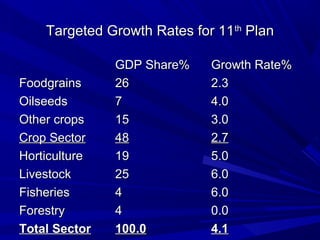
Targeted Growth Rates for 11 th Plan

               GDP Share%     Growth Rate%
Foodgrains     26             2.3
Oilseeds       7              4.0
Other crops    15             3.0
Crop Sector    48             2.7
Horticulture   19             5.0
Livestock      25             6.0
Fisheries      4              6.0
Forestry       4              0.0
Total Sector   100.0          4.1
Special Programmes for Farmers
  National Commission for Enterprises in the
  Unorganized sector (NCEUS) has advocated a special
  programme for marginal and small farmers.
  Objectives are: (1) to improve income prospects; (2) to
  improve the skill base; (3) provide income earning
  opportunities in the non-farm sector; (4) to ensure the
  needs of small farmers and adequately reflected in
  other agricultural and development programmes for
  livelihood security
  Principal activities proposed under the special
  programme are
(a) Promotion of group approach to small farmers: It
  proposes setting up of Marginal and Small farmers’
  development society (MSFDS) for the promotion,
  capacity building and coordination of development of
Conclusions
There are six deficits in agriculture. These are: (a)
investment, credit, infrastructure (b) research,
extension (technology) (c) Market (d) diversification
(e) institutions (f) education/skill
Food security has been an overriding priority in India’
since the 1960s. The focus paid off with attaining food
grain security and poverty reduction.
The strategy concentrated on rice and wheat in
irrigated areas.
The future growth will need to rely on a dual strategy of
diversification into non-cereal high value crops and
rainfed areas with focus on small farms.
Basically investment and institution strategies have to
focus on small and marginal farmers, women farmers,
rainfed areas, environmental stress, rural non-farm
sector for sustainable agri-transformation.
AGRICULTURE GALARY
B.PAVAN SRE SAI


 THANK YOU

Pavan sri sai 340 0642 pavan project work

  • 1.
    Role of Agriculturein INDIA B.PAVAN SRI SAI 3rd class B section NARAYANA E TECHNO SCHOOL Kothapet Guntur, India
  • 2.
    Contents of thepresentation Introduction and background , Performance of Agriculture Role of small holding agriculture for food security and livelihoods --Technological innovations --institutional innovations
  • 3.
    Introduction and backgroundon Indian Agriculture India ‘s population is 1.21 billion in 2011. 67% are rural. Majority are in agriculture. Importance of agriculture in Indian economy. Although it contributes only 15% of GDP, the share of workers is about 55%. Major crops are rice, wheat, maize, coarse cereals, groundnut, cotton, sugarcane, fruits and vegetables 60% of cultivated area is rainfed as only 40% of area is under irrigation. Rural poverty is 41%in 2004-05. Agriculture is a ‘State Subject’. In other words, the policies of provinces are also important
  • 4.
    Performance of Agriculture Growth performance in agriculture%) 1950-1 to 1964-5: 2.51 (area gro. +yield gro) 1967-8 to 1980-1: 2.20 (yield gr. green revol) 1980-1 to 1990-1: 3.07 (spread of green rev) 1992-3 to 2004-5: 2.76 (reform period) 1997-8 to 2004-5: 1.60 (neglect of agri.) 2004-5 to 2010-1: 3.47 (revival of growth)
  • 5.
    Agriculture GDP growth 7.00 5-Year Average Growth Rate 6.00 5.00 4.00 3.00 2.00 1.00 0.00 -1.00 5 6 9 1 7 6 9 1 6 9 1 7 9 1 3 7 9 1 5 7 9 1 7 9 1 7 9 1 8 9 1 3 8 9 1 5 8 9 1 7 8 9 1 8 9 1 9 1 3 9 1 5 9 1 7 9 1 9 1 1 0 2 3 0 2 5 0 2 7 0 2 9 0 2 1 0 2
  • 7.
    Institutional Innovations Women’s collectives:Women’s cooperatives, producer women’s groups and other forms of group efforts (e.g. Deccan Development Society in Andhra Pradesh). Gujarat put in place institutional environment for development of agriculture (e.g. Krishi Mohatsav). This Mohatsava serves as an institutional platform at the village level and proved to be an important support for farmers. Similarly Andhra Pradesh: The Community Managed Sustainable Agriculture (CMSA) programme. It addresses the major causes of agricultural distress and help farmers in adopting sustainable agricultural practices. It covers 2.7 million acres and benefit 1.05 million farmers
  • 8.
    Institutional Innovations Institutions for Marketing of Small holders --There are several models: Contract farming, self help group model, co-operative model and producer co-operatives --One of the most successful producer organization is dairy cooperative with 12.3 million members. --Contract farming is also successful in some cases --Some examples of group approach are: Apni Mandi in Punjab and Rytu Bazar in Andhra Pradesh
  • 9.
    Small farmers, valuechains and Supermarkets Wholesale, processing and retail segments are growing in India. In India, super market revolution is also catching up. Average annual growth rate of top 10 retailers during 2000-06 in India was 50%. Linking small farmers to super markets. Linking farmers with input suppliers, logistic suppliers, agro-processors and retailers In those cases where small producers have been able to integrate into the supplying chains, supermarkets have offered enhanced security and considerably higher margins than the traditional clients, such as wholesales and groceries
  • 10.
    Institutions New institutional approachesare needed to help the farmers e.g. formation of producer groups. One of the important policy issue is how to link small farmers to high value agriculture. There has been diversification of Indian agriculture away from foodgrains to pulses, edible oils and to high value products like vegetables, fruits, milk, eggs, fish and meat products. Although foodgrains are important, future sources of growth and incomes are going to come from high value agriculture. Being perishable, it needs fast moving infrastructure and institutions.
  • 11.
    Targeted Growth Ratesfor 11 th Plan GDP Share% Growth Rate% Foodgrains 26 2.3 Oilseeds 7 4.0 Other crops 15 3.0 Crop Sector 48 2.7 Horticulture 19 5.0 Livestock 25 6.0 Fisheries 4 6.0 Forestry 4 0.0 Total Sector 100.0 4.1
  • 12.
    Special Programmes forFarmers National Commission for Enterprises in the Unorganized sector (NCEUS) has advocated a special programme for marginal and small farmers. Objectives are: (1) to improve income prospects; (2) to improve the skill base; (3) provide income earning opportunities in the non-farm sector; (4) to ensure the needs of small farmers and adequately reflected in other agricultural and development programmes for livelihood security Principal activities proposed under the special programme are (a) Promotion of group approach to small farmers: It proposes setting up of Marginal and Small farmers’ development society (MSFDS) for the promotion, capacity building and coordination of development of
  • 13.
    Conclusions There are sixdeficits in agriculture. These are: (a) investment, credit, infrastructure (b) research, extension (technology) (c) Market (d) diversification (e) institutions (f) education/skill Food security has been an overriding priority in India’ since the 1960s. The focus paid off with attaining food grain security and poverty reduction. The strategy concentrated on rice and wheat in irrigated areas. The future growth will need to rely on a dual strategy of diversification into non-cereal high value crops and rainfed areas with focus on small farms. Basically investment and institution strategies have to focus on small and marginal farmers, women farmers, rainfed areas, environmental stress, rural non-farm sector for sustainable agri-transformation.
  • 14.
  • 20.