Detailed Study on The Book Of Acts
COACH Institute of Intercultural Studies
Hyderabad
Book of Acts
Chapter 16
3
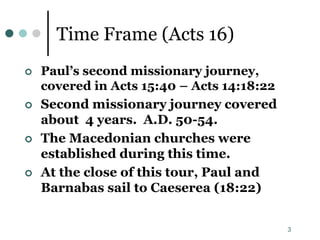
Time Frame (Acts 16)
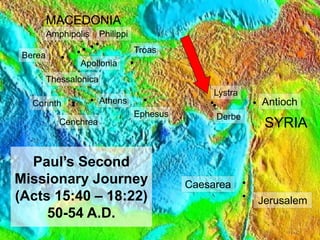
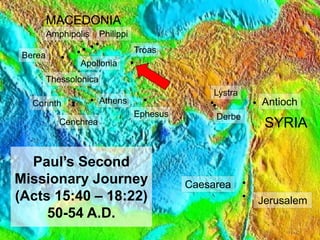
 Paul’s second missionary journey,
covered in Acts 15:40 – Acts 14:18:22
 Second missionary journey covered
about 4 years. A.D. 50-54.
 The Macedonian churches were
established during this time.
 At the close of this tour, Paul and
Barnabas sail to Caeserea (18:22)
4
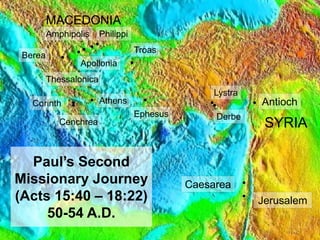
Paul’s Second
Missionary Journey
(Acts 15:40 – 18:22)
50-54 A.D.
Antioch
Troas
Lystra
Derbe
SYRIA
MACEDONIA
Jerusalem
Amphipolis
Apollonia
Philippi
Thessalonica
Berea
Athens
Corinth
Cenchrea
Ephesus
Caesarea
5
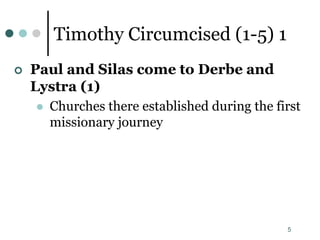
Timothy Circumcised (1-5) 1
 Paul and Silas come to Derbe and
Lystra (1)
 Churches there established during the first
missionary journey
6
Paul’s Second
Missionary Journey
(Acts 15:40 – 18:22)
50-54 A.D.
Antioch
Troas
Lystra
Derbe
SYRIA
MACEDONIA
Jerusalem
Amphipolis
Apollonia
Philippi
Thessalonica
Berea
Athens
Corinth
Cenchrea
Ephesus
Caesarea
7
Timothy Circumcised (1-5) 1
 Paul and Silas come to Derbe and
Lystra (1)
 Churches there established during the first
missionary journey
 Paul meets up with Timothy, a young
disciple, whose mother is Jewish (Eunice, 2
Tim. 1:5), and whose father is Greek
 Timothy had a good reputation (2) Note
that he had been educated well by his
mother and grandmother (cf. 2 Tim. 1:5)
8
Timothy Circumcised (1-5) 2
 Paul desired Timothy to accompany
them on their journey (3-5)
 Had him circumcised (part Jew) to appease
the Jews in the region (3)
 Note: circumcision had nothing to do with
his salvation. Only to solidify Timothy’s
standing as a Jew, among the Jews.
 Passed through the cities, taking the decree
(15:23-29) and strengthening the churches.
(those established on first journey)
9
The Macedonian Call (6-10) 1
 The Holy Spirit directed Paul’s
company to Macedonia (1-2)
 Forbidden to preach the gospel in Asia (6)
 Not permitted to go into Bithynia (7)
 Note: Even today, God’s providence has a
hand in our opportunities to preach the
truth of the gospel (cf. Acts 8, Phillip).
 They traveled to Troas, where Paul received
a vision from God, in the night. (8-9)
10
Paul’s Second
Missionary Journey
(Acts 15:40 – 18:22)
50-54 A.D.
Antioch
Troas
Lystra
Derbe
SYRIA
MACEDONIA
Jerusalem
Amphipolis
Apollonia
Philippi
Thessolonica
Berea
Athens
Corinth
Cenchrea
Ephesus
Caesarea
11
The Macedonian Call (6-10) 2
 The Vision in Troas (9-10)
 A man of Macedonia pleads with Paul to
come there to help (9)
 The conclusion of Paul and his companions,
“the Lord had called us to preach the gospel
to them” (10)
 They did not hesitate, and immediately
made provisions to sail from Troas to the
region of Macedonia
12
The Conversion of Lydia
(11-15) 1
 Paul travels to Philippi (11-12)
 Lands in Samothrace, then to Neapolis,
then to Philippi.
13
Paul’s Second
Missionary Journey
(Acts 15:40 – 18:22)
50-54 A.D.
Antioch
Troas
Lystra
Derbe
SYRIA
MACEDONIA
Jerusalem
Amphipolis
Apollonia
Philippi
Thessolonica
Berea
Athens
Corinth
Cenchrea
Ephesus
Caesarea
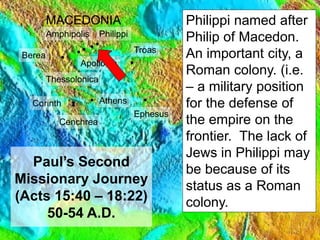
Philippi named after
Philip of Macedon.
An important city, a
Roman colony. (i.e.
– a military position
for the defense of
the empire on the
frontier. The lack of
Jews in Philippi may
be because of its
status as a Roman
colony.
14
The Conversion of Lydia
(11-15) 1
 Paul travels to Philippi (11-12)
 Lands in Samothrace, then to Neapolis,
then to Philippi.
 Paul goes to preach at the riverside
outside of the city (13)
 The fact that prayer was made there
indicates that there was no synagogue
 If less than 10 Jewish men in a community,
no synagogue was allowed by Jewish
custom.
15
The Conversion of Lydia
(11-15) 2
 Paul speaks to the women at the place
of prayer, and meets Lydia (13-14)
 Lydia a seller of purple from Thyatira (14)
 Probable that Lydia was a proselyte, and
may have tried to remain true to her new
faith even as the Jews were expelled from
the city by the decree of Claudius (49 A.D.).
 The Lord opened Lydia’s Heart (14)
 Note: It has been clearly established that
the Lord works through the Word to open
the hearts of men! (cf. Romans 1:16)
16
The Conversion of Lydia
(11-15) 3
 Lydia and her household were
baptized (15)
 Note: Servants and family, not necessarily
infants.
 Baptism is for believers (cf. Mark 16:16),
this text in no way authorizes or intimates
infant baptism
 Lydia prevailed upon Paul and his
companions to say with her (15)
17
The Conversion of the Jailor
(16-34) 1
 Paul continues to go to the river for
prayer. (16)
 Slave girl (demon possessed)
 “Python Spirit” (Oracle at Delphi)
 Brought her masters great profit by her
fortune telling
 Note: God consistently condemns anything
associated with the occult (cf. Gal. 5:20)
 Her proclamation was not faith sustaining,
though the words may have been accurate.
18
The Conversion of the Jailor
(16-34) 2
 Paul cast out the demon from the girl
(18)
 Paul was ‘greatly annoyed’ at the
persistence of the demon (18)
 “in the name of Jesus Christ” (by His
authority) resulting in instant expulsion
 The masters of the slave girl were angry at
their loss of income (19). Note: Two
examples of Gentile persecution (cf.
19:23ff), both motivated by greed
19
The Conversion of the Jailor
(16-34) 3
 Accusations of the Slave owners (20)
 Paul and Silas were dragged before the
magistrates.
 Called Jews (possibly to disparage them
before the magistrates).
 Accused of troubling city
 Accused of proselytizing (both maybe true)
 Paul and Silas were stripped, and
beaten with rods (cf. 1 Thess. 2:2)
20
The Conversion of the Jailor
(16-34) 4
 Charge given to the Jailor (23)
 Keep them securely. (Note: The jailor could
pay with his life for letting such prisoners
escape)
 He put their feet in stocks, and put them
into the inner prison
 Paul and Silas in the inner prison (25)
 Singing and Praying (despite the difficult
circumstances)
 Prisoners listened (gk. indicates eagerly)
21
The Conversion of the Jailor
(16-34) 5
 A Great Earthquake (26)
 Indicates God’s power over creation
 Doors opened (would be common during an
earthquake)
 Chains loosed (obviously a miracle)
 The Jailor’s Dilemma (27)
 Awoke, supposed the prisoners escaped
(reasonable assumption)
 Determined to kill himself with a sword
22
The Conversion of the Jailor
(16-34) 6
 Paul’s Sermon (26-32)
 First, assured the jailor that the prisoners
had not escaped (28)
 Jailor recognized the significance of the
event, kneeling before Paul and Silas (29)
 The Jailor’s question was a reference to his
spiritual salvation (30-31)
 Faith is necessary to salvation (cf. John
3:16)
 Paul and Silas preached (32)
(cf. Romans 10:17)
23
The Conversion of the Jailor
(16-34) 7
 Response to the Gospel (33-34)
 Washing of stripes the act of a penitent (33)
 Response in faith includes Baptism (33) (cf.
Acts 8:35-38)
 Note: The baptisms were done
“immediately”
 Note: The rejoicing commenced AFTER the
baptisms
24
Paul Refuses to Leave Philippi
in Secret (35-40) 1
 Jailor related the magistrates
decision to release Paul and Silas (35-
36)
 Paul objects to his treatment, based
upon his Roman citizenship (37-39)
 It was unlawful to beat and imprison a
Roman citizen without due process
 Paul made this same appeal to the
centurion in Jerusalem (cf. 22:25-29)
25
Paul Refuses to Leave Philippi
in Secret (35-40) 2
 Paul and Silas released from prison
(40)
 Went back to the house of Lydia
 Encouraged the brethren before departing
(to Thessalonica, cf. 17:1)

Acts; Chapter 16

  • 1.
    Detailed Study onThe Book Of Acts COACH Institute of Intercultural Studies Hyderabad
  • 2.
  • 3.
    3 Time Frame (Acts16)  Paul’s second missionary journey, covered in Acts 15:40 – Acts 14:18:22  Second missionary journey covered about 4 years. A.D. 50-54.  The Macedonian churches were established during this time.  At the close of this tour, Paul and Barnabas sail to Caeserea (18:22)
  • 4.
    4 Paul’s Second Missionary Journey (Acts15:40 – 18:22) 50-54 A.D. Antioch Troas Lystra Derbe SYRIA MACEDONIA Jerusalem Amphipolis Apollonia Philippi Thessalonica Berea Athens Corinth Cenchrea Ephesus Caesarea
  • 5.
    5 Timothy Circumcised (1-5)1  Paul and Silas come to Derbe and Lystra (1)  Churches there established during the first missionary journey
  • 6.
    6 Paul’s Second Missionary Journey (Acts15:40 – 18:22) 50-54 A.D. Antioch Troas Lystra Derbe SYRIA MACEDONIA Jerusalem Amphipolis Apollonia Philippi Thessalonica Berea Athens Corinth Cenchrea Ephesus Caesarea
  • 7.
    7 Timothy Circumcised (1-5)1  Paul and Silas come to Derbe and Lystra (1)  Churches there established during the first missionary journey  Paul meets up with Timothy, a young disciple, whose mother is Jewish (Eunice, 2 Tim. 1:5), and whose father is Greek  Timothy had a good reputation (2) Note that he had been educated well by his mother and grandmother (cf. 2 Tim. 1:5)
  • 8.
    8 Timothy Circumcised (1-5)2  Paul desired Timothy to accompany them on their journey (3-5)  Had him circumcised (part Jew) to appease the Jews in the region (3)  Note: circumcision had nothing to do with his salvation. Only to solidify Timothy’s standing as a Jew, among the Jews.  Passed through the cities, taking the decree (15:23-29) and strengthening the churches. (those established on first journey)
  • 9.
    9 The Macedonian Call(6-10) 1  The Holy Spirit directed Paul’s company to Macedonia (1-2)  Forbidden to preach the gospel in Asia (6)  Not permitted to go into Bithynia (7)  Note: Even today, God’s providence has a hand in our opportunities to preach the truth of the gospel (cf. Acts 8, Phillip).  They traveled to Troas, where Paul received a vision from God, in the night. (8-9)
  • 10.
    10 Paul’s Second Missionary Journey (Acts15:40 – 18:22) 50-54 A.D. Antioch Troas Lystra Derbe SYRIA MACEDONIA Jerusalem Amphipolis Apollonia Philippi Thessolonica Berea Athens Corinth Cenchrea Ephesus Caesarea
  • 11.
    11 The Macedonian Call(6-10) 2  The Vision in Troas (9-10)  A man of Macedonia pleads with Paul to come there to help (9)  The conclusion of Paul and his companions, “the Lord had called us to preach the gospel to them” (10)  They did not hesitate, and immediately made provisions to sail from Troas to the region of Macedonia
  • 12.
    12 The Conversion ofLydia (11-15) 1  Paul travels to Philippi (11-12)  Lands in Samothrace, then to Neapolis, then to Philippi.
  • 13.
    13 Paul’s Second Missionary Journey (Acts15:40 – 18:22) 50-54 A.D. Antioch Troas Lystra Derbe SYRIA MACEDONIA Jerusalem Amphipolis Apollonia Philippi Thessolonica Berea Athens Corinth Cenchrea Ephesus Caesarea Philippi named after Philip of Macedon. An important city, a Roman colony. (i.e. – a military position for the defense of the empire on the frontier. The lack of Jews in Philippi may be because of its status as a Roman colony.
  • 14.
    14 The Conversion ofLydia (11-15) 1  Paul travels to Philippi (11-12)  Lands in Samothrace, then to Neapolis, then to Philippi.  Paul goes to preach at the riverside outside of the city (13)  The fact that prayer was made there indicates that there was no synagogue  If less than 10 Jewish men in a community, no synagogue was allowed by Jewish custom.
  • 15.
    15 The Conversion ofLydia (11-15) 2  Paul speaks to the women at the place of prayer, and meets Lydia (13-14)  Lydia a seller of purple from Thyatira (14)  Probable that Lydia was a proselyte, and may have tried to remain true to her new faith even as the Jews were expelled from the city by the decree of Claudius (49 A.D.).  The Lord opened Lydia’s Heart (14)  Note: It has been clearly established that the Lord works through the Word to open the hearts of men! (cf. Romans 1:16)
  • 16.
    16 The Conversion ofLydia (11-15) 3  Lydia and her household were baptized (15)  Note: Servants and family, not necessarily infants.  Baptism is for believers (cf. Mark 16:16), this text in no way authorizes or intimates infant baptism  Lydia prevailed upon Paul and his companions to say with her (15)
  • 17.
    17 The Conversion ofthe Jailor (16-34) 1  Paul continues to go to the river for prayer. (16)  Slave girl (demon possessed)  “Python Spirit” (Oracle at Delphi)  Brought her masters great profit by her fortune telling  Note: God consistently condemns anything associated with the occult (cf. Gal. 5:20)  Her proclamation was not faith sustaining, though the words may have been accurate.
  • 18.
    18 The Conversion ofthe Jailor (16-34) 2  Paul cast out the demon from the girl (18)  Paul was ‘greatly annoyed’ at the persistence of the demon (18)  “in the name of Jesus Christ” (by His authority) resulting in instant expulsion  The masters of the slave girl were angry at their loss of income (19). Note: Two examples of Gentile persecution (cf. 19:23ff), both motivated by greed
  • 19.
    19 The Conversion ofthe Jailor (16-34) 3  Accusations of the Slave owners (20)  Paul and Silas were dragged before the magistrates.  Called Jews (possibly to disparage them before the magistrates).  Accused of troubling city  Accused of proselytizing (both maybe true)  Paul and Silas were stripped, and beaten with rods (cf. 1 Thess. 2:2)
  • 20.
    20 The Conversion ofthe Jailor (16-34) 4  Charge given to the Jailor (23)  Keep them securely. (Note: The jailor could pay with his life for letting such prisoners escape)  He put their feet in stocks, and put them into the inner prison  Paul and Silas in the inner prison (25)  Singing and Praying (despite the difficult circumstances)  Prisoners listened (gk. indicates eagerly)
  • 21.
    21 The Conversion ofthe Jailor (16-34) 5  A Great Earthquake (26)  Indicates God’s power over creation  Doors opened (would be common during an earthquake)  Chains loosed (obviously a miracle)  The Jailor’s Dilemma (27)  Awoke, supposed the prisoners escaped (reasonable assumption)  Determined to kill himself with a sword
  • 22.
    22 The Conversion ofthe Jailor (16-34) 6  Paul’s Sermon (26-32)  First, assured the jailor that the prisoners had not escaped (28)  Jailor recognized the significance of the event, kneeling before Paul and Silas (29)  The Jailor’s question was a reference to his spiritual salvation (30-31)  Faith is necessary to salvation (cf. John 3:16)  Paul and Silas preached (32) (cf. Romans 10:17)
  • 23.
    23 The Conversion ofthe Jailor (16-34) 7  Response to the Gospel (33-34)  Washing of stripes the act of a penitent (33)  Response in faith includes Baptism (33) (cf. Acts 8:35-38)  Note: The baptisms were done “immediately”  Note: The rejoicing commenced AFTER the baptisms
  • 24.
    24 Paul Refuses toLeave Philippi in Secret (35-40) 1  Jailor related the magistrates decision to release Paul and Silas (35- 36)  Paul objects to his treatment, based upon his Roman citizenship (37-39)  It was unlawful to beat and imprison a Roman citizen without due process  Paul made this same appeal to the centurion in Jerusalem (cf. 22:25-29)
  • 25.
    25 Paul Refuses toLeave Philippi in Secret (35-40) 2  Paul and Silas released from prison (40)  Went back to the house of Lydia  Encouraged the brethren before departing (to Thessalonica, cf. 17:1)