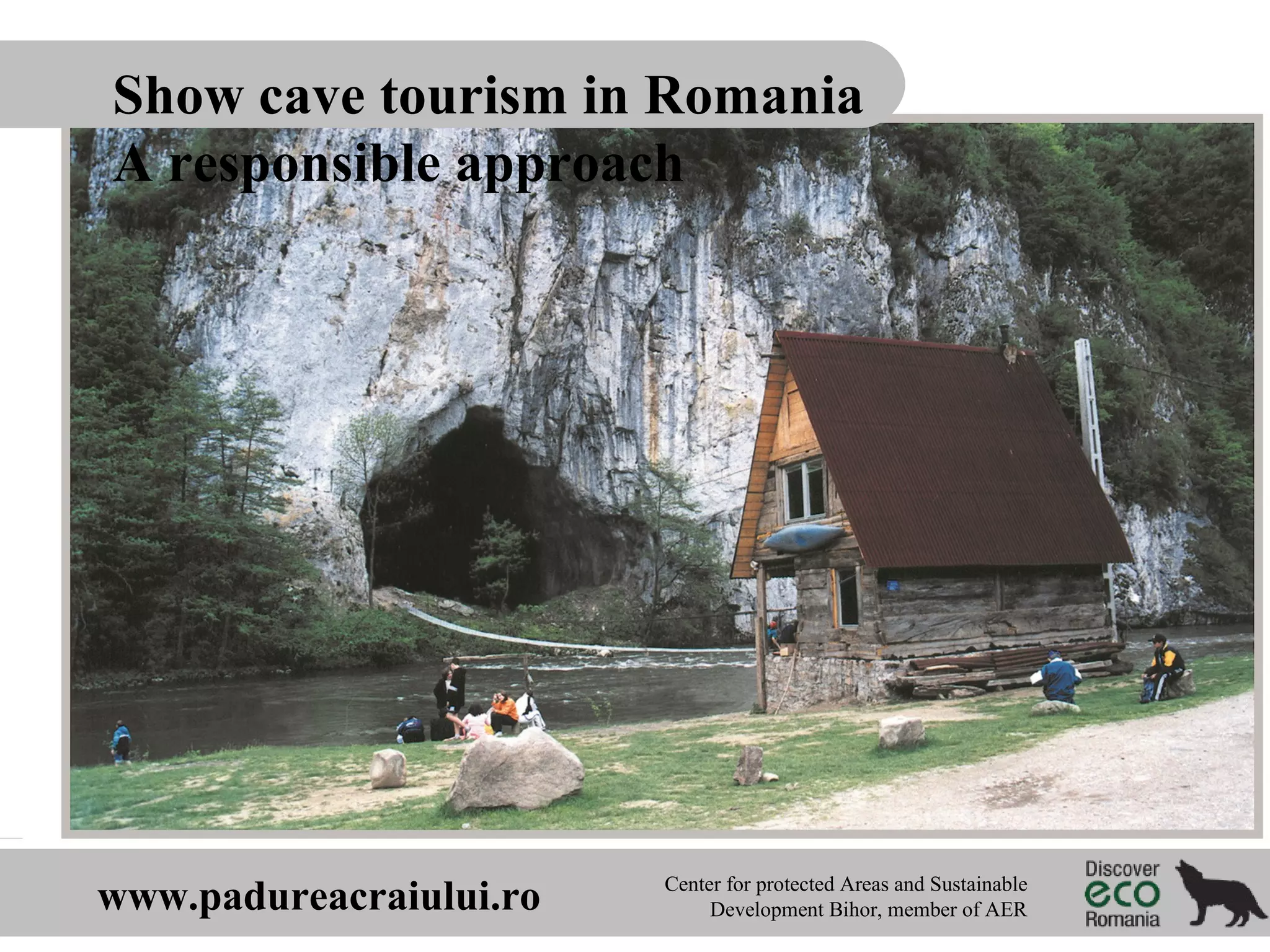
Show cave tourism in Romania
A responsible approach

www.padureacraiului.ro

Center for protected Areas and Sustainable
Development Bihor, member of AER
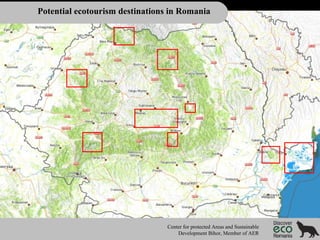
Potential ecotourism destinations in Romania

Center for protected Areas and Sustainable
Development Bihor, Member of AER
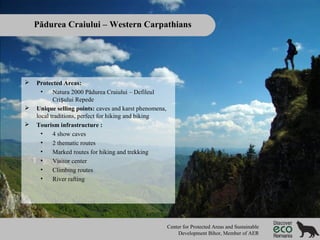
Pădurea Craiului – Western Carpathians






Protected Areas:
•
Natura 2000 Pădurea Craiului – Defileul
Crișului Repede
Unique selling points: caves and karst phenomena,
local traditions, perfect for hiking and biking
Tourism infrastructure :
•
4 show caves
•
2 thematic routes
•
Marked routes for hiking and trekking
•
Visitor center
•
Climbing routes
•
River rafting

Center for Protected Areas and Sustainable
Development Bihor, Member of AER
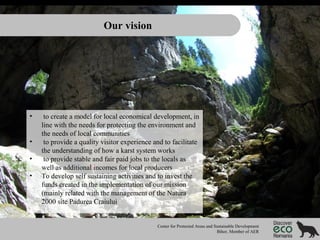
Our vision

•
•
•
•

to create a model for local economical development, in
line with the needs for protecting the environment and
the needs of local communities
to provide a quality visitor experience and to facilitate
the understanding of how a karst system works
to provide stable and fair paid jobs to the locals as
well as additional incomes for local producers
To develop self sustaining activities and to invest the
funds created in the implementation of our mission
(mainly related with the management of the Natura
2000 site Padurea Craiului

Center for Protected Areas and Sustainable Development
Bihor, Member of AER
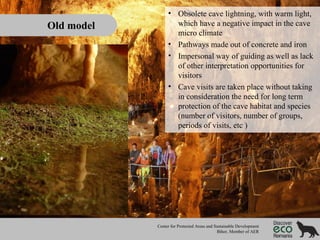
Old model

• Obsolete cave lightning, with warm light,
which have a negative impact in the cave
micro climate
• Pathways made out of concrete and iron
• Impersonal way of guiding as well as lack
of other interpretation opportunities for
visitors
• Cave visits are taken place without taking
in consideration the need for long term
protection of the cave habitat and species
(number of visitors, number of groups,
periods of visits, etc )

Center for Protected Areas and Sustainable Development
Bihor, Member of AER
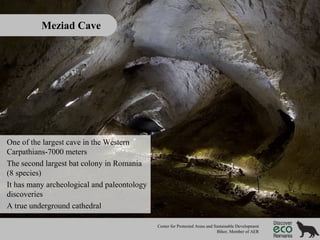
Meziad Cave

One of the largest cave in the Western
Carpathians-7000 meters
The second largest bat colony in Romania
(8 species)
It has many archeological and paleontology
discoveries
A true underground cathedral
Center for Protected Areas and Sustainable Development
Bihor, Member of AER
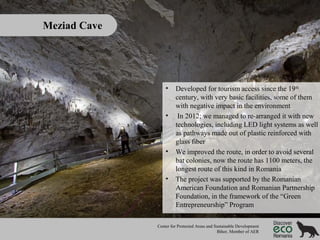
Meziad Cave

•

•

•

•

Developed for tourism access since the 19th
century, with very basic facilities, some of them
with negative impact in the environment
In 2012; we managed to re-arranged it with new
technologies, including LED light systems as well
as pathways made out of plastic reinforced with
glass fiber
We improved the route, in order to avoid several
bat colonies, now the route has 1100 meters, the
longest route of this kind in Romania
The project was supported by the Romanian
American Foundation and Romanian Partnership
Foundation, in the framework of the “Green
Entrepreneurship” Program

Center for Protected Areas and Sustainable Development
Bihor, Member of AER
Crystal Cave from Farcu Mine

•
•
•
•
•

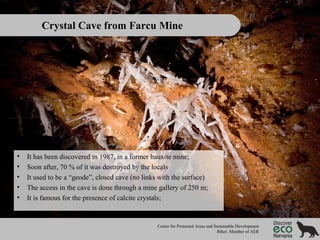
It has been discovered in 1987, in a former bauxite mine;
Soon after, 70 % of it was destroyed by the locals
It used to be a “geode”, closed cave (no links with the surface)
The access in the cave is done through a mine gallery of 250 m;
It is famous for the presence of calcite crystals;

Center for Protected Areas and Sustainable Development
Bihor, Member of AER
Crystal Cave from Farcu Mine

•

•
•

•
•

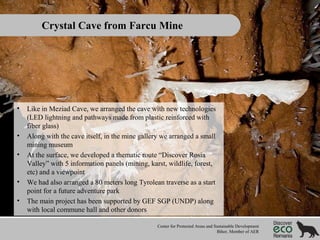
Like in Meziad Cave, we arranged the cave with new technologies
(LED lightning and pathways made from plastic reinforced with
fiber glass)
Along with the cave itself, in the mine gallery we arranged a small
mining museum
At the surface, we developed a thematic route “Discover Rosia
Valley” with 5 information panels (mining, karst, wildlife, forest,
etc) and a viewpoint
We had also arranged a 80 meters long Tyrolean traverse as a start
point for a future adventure park
The main project has been supported by GEF SGP (UNDP) along
with local commune hall and other donors
Center for Protected Areas and Sustainable Development
Bihor, Member of AER
Results and
outcomes

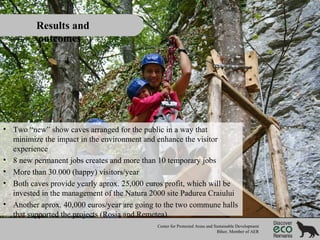
• Two “new” show caves arranged for the public in a way that
minimize the impact in the environment and enhance the visitor
experience
• 8 new permanent jobs creates and more than 10 temporary jobs
• More than 30.000 (happy) visitors/year
• Both caves provide yearly aprox. 25,000 euros profit, which will be
invested in the management of the Natura 2000 site Padurea Craiului
• Another aprox. 40,000 euros/year are going to the two commune halls
that supported the projects (Rosia and Remetea)
Center for Protected Areas and Sustainable Development
Bihor, Member of AER
Challenges

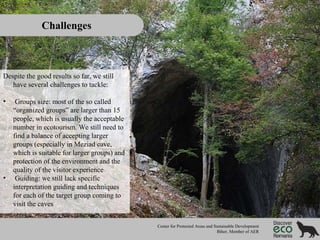
Despite the good results so far, we still
have several challenges to tackle:
•

•

Groups size: most of the so called
“organized groups” are larger than 15
people, which is usually the acceptable
number in ecotourism. We still need to
find a balance of accepting larger
groups (especially in Meziad cave,
which is suitable for larger groups) and
protection of the environment and the
quality of the visitor experience
Guiding: we still lack specific
interpretation guiding and techniques
for each of the target group coming to
visit the caves
Center for Protected Areas and Sustainable Development
Bihor, Member of AER
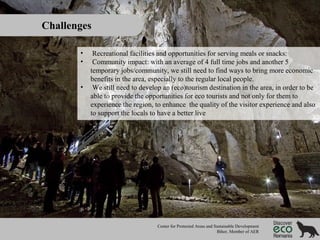
Challenges
•
•
•

Recreational facilities and opportunities for serving meals or snacks:
Community impact: with an average of 4 full time jobs and another 5
temporary jobs/community, we still need to find ways to bring more economic
benefits in the area, especially to the regular local people.
We still need to develop an (eco)tourism destination in the area, in order to be
able to provide the opportunities for eco tourists and not only for them to
experience the region, to enhance the quality of the visitor experience and also
to support the locals to have a better live

Center for Protected Areas and Sustainable Development
Bihor, Member of AER
THANK YOU!

Show cave tourism in Romania: A responsible approach

  • 1.
    Show cave tourismin Romania A responsible approach www.padureacraiului.ro Center for protected Areas and Sustainable Development Bihor, member of AER
  • 2.
    Potential ecotourism destinationsin Romania Center for protected Areas and Sustainable Development Bihor, Member of AER
  • 3.
    Pădurea Craiului –Western Carpathians    Protected Areas: • Natura 2000 Pădurea Craiului – Defileul Crișului Repede Unique selling points: caves and karst phenomena, local traditions, perfect for hiking and biking Tourism infrastructure : • 4 show caves • 2 thematic routes • Marked routes for hiking and trekking • Visitor center • Climbing routes • River rafting Center for Protected Areas and Sustainable Development Bihor, Member of AER
  • 4.
    Our vision • • • • to createa model for local economical development, in line with the needs for protecting the environment and the needs of local communities to provide a quality visitor experience and to facilitate the understanding of how a karst system works to provide stable and fair paid jobs to the locals as well as additional incomes for local producers To develop self sustaining activities and to invest the funds created in the implementation of our mission (mainly related with the management of the Natura 2000 site Padurea Craiului Center for Protected Areas and Sustainable Development Bihor, Member of AER
  • 5.
    Old model • Obsoletecave lightning, with warm light, which have a negative impact in the cave micro climate • Pathways made out of concrete and iron • Impersonal way of guiding as well as lack of other interpretation opportunities for visitors • Cave visits are taken place without taking in consideration the need for long term protection of the cave habitat and species (number of visitors, number of groups, periods of visits, etc ) Center for Protected Areas and Sustainable Development Bihor, Member of AER
  • 6.
    Meziad Cave One ofthe largest cave in the Western Carpathians-7000 meters The second largest bat colony in Romania (8 species) It has many archeological and paleontology discoveries A true underground cathedral Center for Protected Areas and Sustainable Development Bihor, Member of AER
  • 7.
    Meziad Cave • • • • Developed fortourism access since the 19th century, with very basic facilities, some of them with negative impact in the environment In 2012; we managed to re-arranged it with new technologies, including LED light systems as well as pathways made out of plastic reinforced with glass fiber We improved the route, in order to avoid several bat colonies, now the route has 1100 meters, the longest route of this kind in Romania The project was supported by the Romanian American Foundation and Romanian Partnership Foundation, in the framework of the “Green Entrepreneurship” Program Center for Protected Areas and Sustainable Development Bihor, Member of AER
  • 8.
    Crystal Cave fromFarcu Mine • • • • • It has been discovered in 1987, in a former bauxite mine; Soon after, 70 % of it was destroyed by the locals It used to be a “geode”, closed cave (no links with the surface) The access in the cave is done through a mine gallery of 250 m; It is famous for the presence of calcite crystals; Center for Protected Areas and Sustainable Development Bihor, Member of AER
  • 9.
    Crystal Cave fromFarcu Mine • • • • • Like in Meziad Cave, we arranged the cave with new technologies (LED lightning and pathways made from plastic reinforced with fiber glass) Along with the cave itself, in the mine gallery we arranged a small mining museum At the surface, we developed a thematic route “Discover Rosia Valley” with 5 information panels (mining, karst, wildlife, forest, etc) and a viewpoint We had also arranged a 80 meters long Tyrolean traverse as a start point for a future adventure park The main project has been supported by GEF SGP (UNDP) along with local commune hall and other donors Center for Protected Areas and Sustainable Development Bihor, Member of AER
  • 10.
    Results and outcomes • Two“new” show caves arranged for the public in a way that minimize the impact in the environment and enhance the visitor experience • 8 new permanent jobs creates and more than 10 temporary jobs • More than 30.000 (happy) visitors/year • Both caves provide yearly aprox. 25,000 euros profit, which will be invested in the management of the Natura 2000 site Padurea Craiului • Another aprox. 40,000 euros/year are going to the two commune halls that supported the projects (Rosia and Remetea) Center for Protected Areas and Sustainable Development Bihor, Member of AER
  • 11.
    Challenges Despite the goodresults so far, we still have several challenges to tackle: • • Groups size: most of the so called “organized groups” are larger than 15 people, which is usually the acceptable number in ecotourism. We still need to find a balance of accepting larger groups (especially in Meziad cave, which is suitable for larger groups) and protection of the environment and the quality of the visitor experience Guiding: we still lack specific interpretation guiding and techniques for each of the target group coming to visit the caves Center for Protected Areas and Sustainable Development Bihor, Member of AER
  • 12.
    Challenges • • • Recreational facilities andopportunities for serving meals or snacks: Community impact: with an average of 4 full time jobs and another 5 temporary jobs/community, we still need to find ways to bring more economic benefits in the area, especially to the regular local people. We still need to develop an (eco)tourism destination in the area, in order to be able to provide the opportunities for eco tourists and not only for them to experience the region, to enhance the quality of the visitor experience and also to support the locals to have a better live Center for Protected Areas and Sustainable Development Bihor, Member of AER
  • 13.