Patterns and Sequences
Henrico County Public School
Mathematics Teachers
Patterns and Sequences
• Patterns refer to usual types of procedures or rules
that can be followed.
• Patterns are useful to predict what came before or
what might come after a set a numbers that are
arranged in a particular order.
• This arrangement of numbers is called a sequence.
For example: 3,6,9,12 and 15 are numbers that
form a pattern called a sequence.
• The numbers that are in the sequence are called
terms.
Patterns and Sequences
Arithmetic sequence (arithmetic
progression) – a sequence of numbers in
which the difference between any two
consecutive numbers or expressions is the
same
Geometric sequence – a sequence of
numbers in which each term is formed by
multiplying the previous term by the same
number or expression
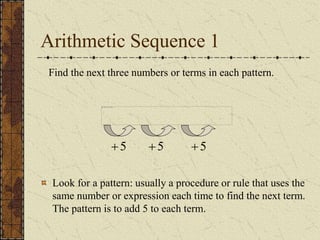
Arithmetic Sequence 1
Find the next three numbers or terms in each pattern.
5
 5

5

Look for a pattern: usually a procedure or rule that uses the
same number or expression each time to find the next term.
The pattern is to add 5 to each term.
The Next Three Numbers
Add five to the last term
The next three terms are:
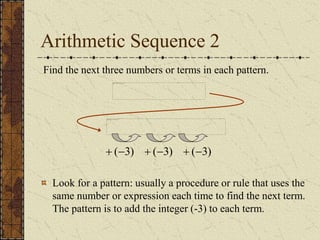
Arithmetic Sequence 2
Find the next three numbers or terms in each pattern.
)
3
(

Look for a pattern: usually a procedure or rule that uses the
same number or expression each time to find the next term.
The pattern is to add the integer (-3) to each term.
)
3
(

)
3
(

The Next Three Numbers 2
Add the integer (-3) to each term
The next three terms are:
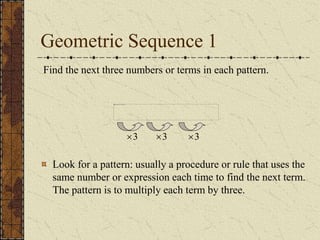
Geometric Sequence 1
Find the next three numbers or terms in each pattern.
3
 3
 3

Look for a pattern: usually a procedure or rule that uses the
same number or expression each time to find the next term.
The pattern is to multiply each term by three.
The Next Three 1
Multiply each term by three
The next three terms are:
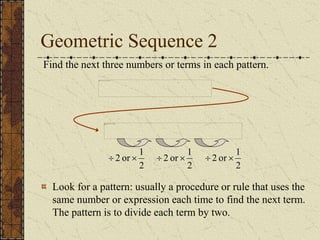
Geometric Sequence 2
Find the next three numbers or terms in each pattern.
2
1
or
2 

Look for a pattern: usually a procedure or rule that uses the
same number or expression each time to find the next term.
The pattern is to divide each term by two.
2
1
or
2 

2
1
or
2 

The Next Three 2
Divide each term by two
The next three terms are:
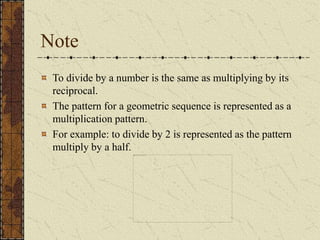
Note
To divide by a number is the same as multiplying by its
reciprocal.
The pattern for a geometric sequence is represented as a
multiplication pattern.
For example: to divide by 2 is represented as the pattern
multiply by a half.
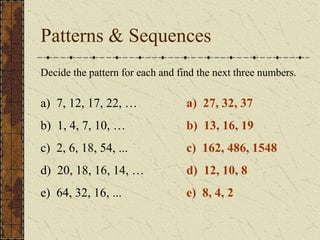
Patterns & Sequences
Decide the pattern for each and find the next three numbers.
a) 7, 12, 17, 22, …
b) 1, 4, 7, 10, …
c) 2, 6, 18, 54, ...
d) 20, 18, 16, 14, …
e) 64, 32, 16, ...
a) 27, 32, 37
b) 13, 16, 19
c) 162, 486, 1548
d) 12, 10, 8
e) 8, 4, 2

patterns_notes2.ppt

  • 1.
    Patterns and Sequences HenricoCounty Public School Mathematics Teachers
  • 2.
    Patterns and Sequences •Patterns refer to usual types of procedures or rules that can be followed. • Patterns are useful to predict what came before or what might come after a set a numbers that are arranged in a particular order. • This arrangement of numbers is called a sequence. For example: 3,6,9,12 and 15 are numbers that form a pattern called a sequence. • The numbers that are in the sequence are called terms.
  • 3.
    Patterns and Sequences Arithmeticsequence (arithmetic progression) – a sequence of numbers in which the difference between any two consecutive numbers or expressions is the same Geometric sequence – a sequence of numbers in which each term is formed by multiplying the previous term by the same number or expression
  • 4.
    Arithmetic Sequence 1 Findthe next three numbers or terms in each pattern. 5  5  5  Look for a pattern: usually a procedure or rule that uses the same number or expression each time to find the next term. The pattern is to add 5 to each term.
  • 5.
    The Next ThreeNumbers Add five to the last term The next three terms are:
  • 6.
    Arithmetic Sequence 2 Findthe next three numbers or terms in each pattern. ) 3 (  Look for a pattern: usually a procedure or rule that uses the same number or expression each time to find the next term. The pattern is to add the integer (-3) to each term. ) 3 (  ) 3 ( 
  • 7.
    The Next ThreeNumbers 2 Add the integer (-3) to each term The next three terms are:
  • 8.
    Geometric Sequence 1 Findthe next three numbers or terms in each pattern. 3  3  3  Look for a pattern: usually a procedure or rule that uses the same number or expression each time to find the next term. The pattern is to multiply each term by three.
  • 9.
    The Next Three1 Multiply each term by three The next three terms are:
  • 10.
    Geometric Sequence 2 Findthe next three numbers or terms in each pattern. 2 1 or 2   Look for a pattern: usually a procedure or rule that uses the same number or expression each time to find the next term. The pattern is to divide each term by two. 2 1 or 2   2 1 or 2  
  • 11.
    The Next Three2 Divide each term by two The next three terms are:
  • 12.
    Note To divide bya number is the same as multiplying by its reciprocal. The pattern for a geometric sequence is represented as a multiplication pattern. For example: to divide by 2 is represented as the pattern multiply by a half.
  • 13.
    Patterns & Sequences Decidethe pattern for each and find the next three numbers. a) 7, 12, 17, 22, … b) 1, 4, 7, 10, … c) 2, 6, 18, 54, ... d) 20, 18, 16, 14, … e) 64, 32, 16, ... a) 27, 32, 37 b) 13, 16, 19 c) 162, 486, 1548 d) 12, 10, 8 e) 8, 4, 2