Matthias Lübken
Container Patterns
@luebken
github.com/openshift/origin
projectatomic.io
github.com/opencontainers
“ Easily create lightweight,
portable, self-sufficient containers

from any application.”
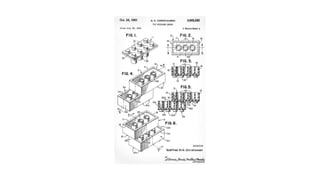
Since containers are a great way of 

package and deliver software …
What if we use containers to
modularise our application?
“Containers […] are
destined to become
analogous to 

objects in object-
oriented software
systems”
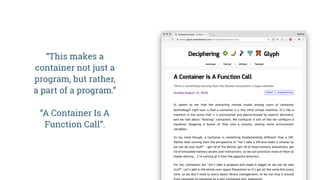
“This makes a
container not just a
program, but rather,
a part of a program.”


“A Container Is A
Function Call”.
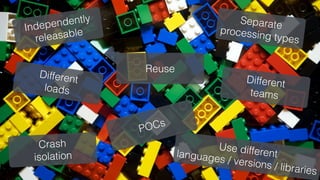
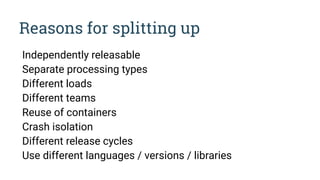
Independently
releasable
Separate
processing types
Different
loads
Different
teams
Reuse
Crash
isolation
Use differentlanguages / versions / libraries
POCs
1. Properties of a module container
Outline
2. Patterns for assembling these
github.com/luebken/container-patterns
“Module-Container”
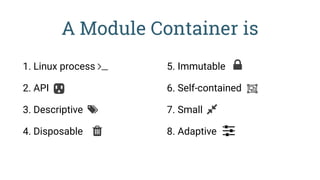
A Module Container is
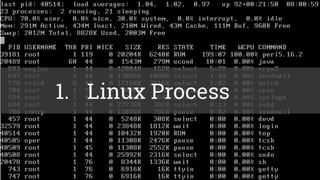
1. Linux process
2. API
3. Descriptive
4. Disposable
5. Immutable
6. Self-contained
7. Small
8. Adaptive
1. Linux Process
1. Linux Process
• React to signals
• Return exit codes
• Use standard streams
• Handle arguments

Examples: module-container.md#1-linux-process
2. API
2. API
• ENV variables
• Available ports
• Volume mounts
• Lifecycle hooks

Examples: module-container.md#2-api
3. Descriptive
3. Descriptive
• Use standard labels (e.g. proposal generic labels)
• url, summary, vcs-url …
• Use custom labels:
• io.openshift.wants
• io.openshift.expose-services


Examples: module-container.md#3-descriptive
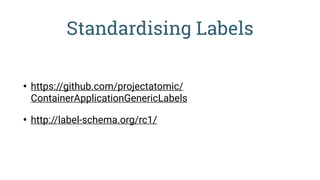
Standardising Labels
• https://github.com/projectatomic/
ContainerApplicationGenericLabels
• http://label-schema.org/rc1/
4. Disposable
4. Disposable
• Don’t rely on a particular instance
• Be aware of shots at your cattle
• Be robust against sudden death


Examples: module-container.md#4-disposable
5. Immutable
5. Immutable
• Don’t change your container after build
• Strive or a dev/prod parity


Examples: module-container.md#5-immutable
6. Self-contained
6. Self-contained
• Add dependencies on build time
• Sensible defaults


Examples: module-container.md#6-self-contained
7. Small
7. Small
• Don’t use large base images
• Use the minimal footprint


Examples: module-container.md#6-small
8. Adaptive
8. Adaptive
• Anticipate the environment & react to change
• Software appliance
• Container reinitiates of config changes
• http://autopilotpattern.io
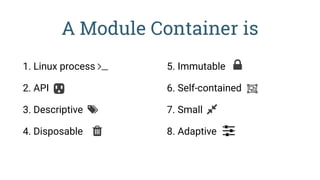
A Module Container is
1. Linux process
2. API
3. Descriptive
4. Disposable
5. Immutable
6. Self-contained
7. Small
8. Adaptive
1. Properties of a module container
Outline
2. Patterns for assembling these
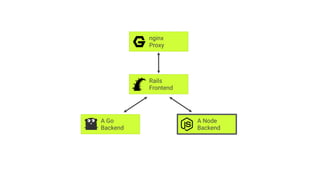
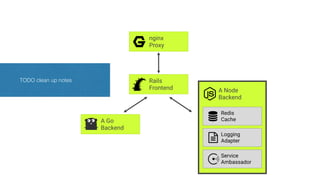
nginx

Proxy
Rails

Frontend
A Go

Backend
A Node

Backend
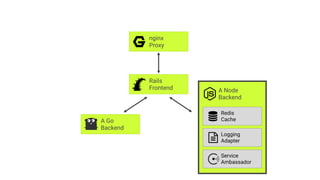
nginx

Proxy
Rails

Frontend
A Go

Backend
A Node

Backend
Redis
Cache
Logging
Adapter
Service
Ambassador
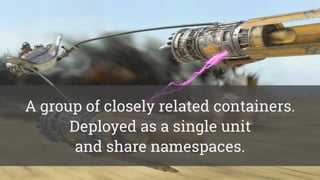
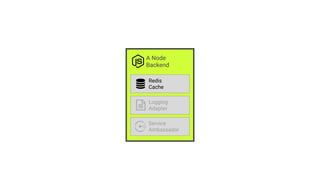
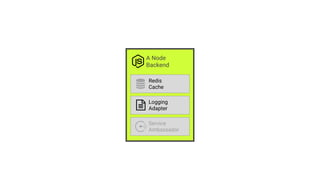
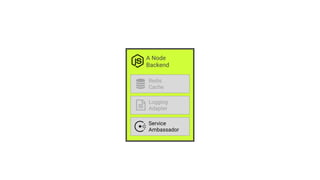
A group of closely related containers.
Deployed as a single unit 

and share namespaces.
A Node

Backend
Redis
Cache
Logging
Adapter
Service
Ambassador
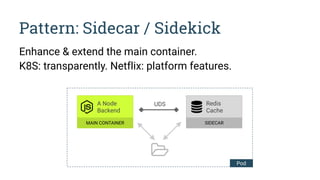
Pattern: Sidecar / Sidekick
Enhance & extend the main container.
K8S: transparently. Netflix: platform features.
UDSA Node

Backend
MAIN CONTAINER
Redis

Cache
SIDECAR
Pod
A Node

Backend
Redis
Cache
Logging
Adapter
Service

Ambassador
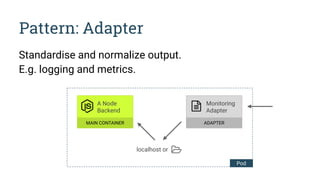
Pattern: Adapter
Standardise and normalize output.
E.g. logging and metrics.
localhost or
A Node

Backend
MAIN CONTAINER
Monitoring
Adapter
ADAPTER
Pod
A Node

Backend
Redis
Cache
Logging
Adapter
Service

Ambassador
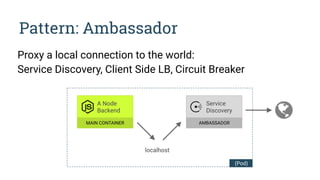
Proxy a local connection to the world:
Service Discovery, Client Side LB, Circuit Breaker
A Node

Backend
MAIN CONTAINER
Service
Discovery
AMBASSADOR
Pattern: Ambassador
localhost
(Pod)
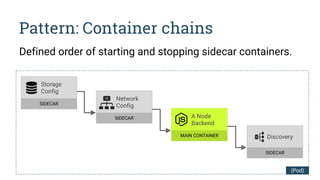
Pattern: Container chains
Defined order of starting and stopping sidecar containers.
A Node

Backend
MAIN CONTAINER
Storage

Config
SIDECAR
Discovery
SIDECAR
Network

Config
SIDECAR
(Pod)
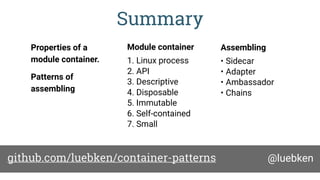
Summary
Module container
1. Linux process
2. API
3. Descriptive
4. Disposable
5. Immutable
6. Self-contained
7. Small
Assembling
• Sidecar
• Adapter
• Ambassador
• Chains
Properties of a
module container.
Patterns of
assembling
github.com/luebken/container-patterns @luebken
Dankeschön.
@luebken
Credits
• https://www.flickr.com/photos/skynoir/8241460998 (Cover image)
• https://www.flickr.com/photos/amlz/8664728590 (Lego)
• https://www.flickr.com/photos/guidedbycthulhu/6810361241 (Socket)
• https://www.flickr.com/photos/seektan/2074853585/ (Label)
• https://www.flickr.com/photos/gullevek/2122873934 (Trash)
• https://www.flickr.com/photos/grantmac/4852826923 (Lock)
• https://www.flickr.com/photos/mhirano/13236048424 (Hand)
Old slides
Other image guidelines
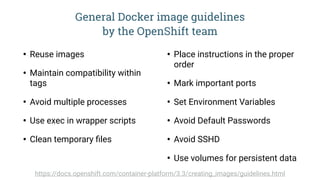
General Docker image guidelines 

by the OpenShift team
• Reuse images
• Maintain compatibility within
tags
• Avoid multiple processes
• Use exec in wrapper scripts
• Clean temporary files
• Place instructions in the proper
order
• Mark important ports
• Set Environment Variables
• Avoid Default Passwords
• Avoid SSHD
• Use volumes for persistent data
https://docs.openshift.com/container-platform/3.3/creating_images/guidelines.html
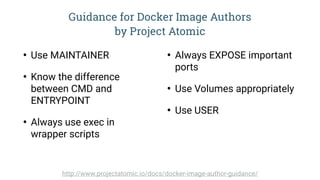
Guidance for Docker Image Authors
by Project Atomic
• Use MAINTAINER
• Know the difference
between CMD and
ENTRYPOINT
• Always use exec in
wrapper scripts
• Always EXPOSE important
ports
• Use Volumes appropriately
• Use USER
http://www.projectatomic.io/docs/docker-image-author-guidance/
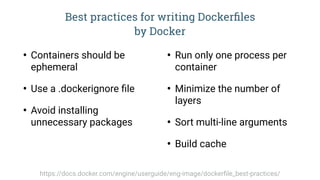
Best practices for writing Dockerfiles
by Docker
• Containers should be
ephemeral
• Use a .dockerignore file
• Avoid installing
unnecessary packages
• Run only one process per
container
• Minimize the number of
layers
• Sort multi-line arguments
• Build cache
https://docs.docker.com/engine/userguide/eng-image/dockerfile_best-practices/
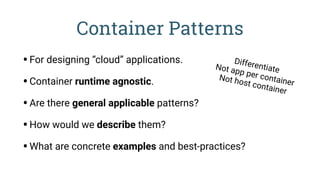
Container Patterns
•For designing “cloud” applications.
•Container runtime agnostic.
•Are there general applicable patterns?
•How would we describe them?
•What are concrete examples and best-practices?
Differentiate
Not app per container
Not host container
Related Work
• 12factor.net apps
• Cloud-native application architectures:

Matt Stine Free Ebook
• Microservices
• Continuous Delivery
Closely Related Work
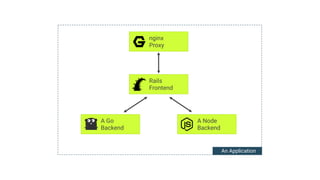
nginx

Proxy
Rails

Frontend
A Go

Backend
A Node

Backend
An Application
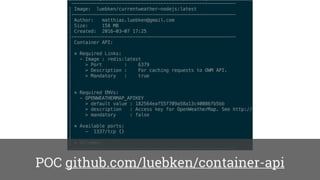
POC github.com/luebken/container-api
nginx

Proxy
Rails

Frontend
A Go

Backend
A Node

Backend
Redis
Cache
Logging
Adapter
Service
Ambassador
TODO clean up notes
Links / References
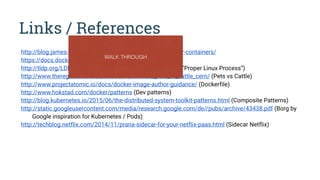
http://blog.james-carr.org/2013/09/04/parameterized-docker-containers/
https://docs.docker.com/articles/dockerfile_best-practices/
http://tldp.org/LDP/abs/html/exitcodes.html (Exit Codes for “Proper Linux Process”)
http://www.theregister.co.uk/2013/03/18/servers_pets_or_cattle_cern/ (Pets vs Cattle)
http://www.projectatomic.io/docs/docker-image-author-guidance/ (Dockerfile)
http://www.hokstad.com/docker/patterns (Dev patterns)
http://blog.kubernetes.io/2015/06/the-distributed-system-toolkit-patterns.html (Composite Patterns)
http://static.googleusercontent.com/media/research.google.com/de//pubs/archive/43438.pdf (Borg by
Google inspiration for Kubernetes / Pods)
http://techblog.netflix.com/2014/11/prana-sidecar-for-your-netflix-paas.html (Sidecar Netflix)
WALK THROUGH
Other / old slides
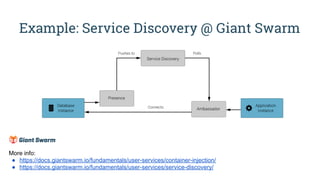
More info:
● https://docs.giantswarm.io/fundamentals/user-services/container-injection/
● https://docs.giantswarm.io/fundamentals/user-services/service-discovery/
Example: Service Discovery @ Giant Swarm
Reasons for splitting up
Independently releasable
Separate processing types
Different loads
Different teams
Reuse of containers
Crash isolation
Different release cycles
Use different languages / versions / libraries
Patterns in a Containerized World (Matthias Luebken Technology Stream)

Patterns in a Containerized World (Matthias Luebken Technology Stream)