JOURNAL CLUB
MODERATOR: DR. POOJA NAIK
SENIOR RESIDENT
KIMS TEACHING HOSPITAL
KOPPAL
STUDENT: DR. T. TEJASWINI
1ST YEAR POST GRADUATE
KIMS TEACHING HOSPITAL
KOPPAL
REDUCED MORTALITY WITH
ANTI PLATELET THERAPY DEESCALATION
AFTER
PERCUTANEOUS CORONARY INTERVENTION IN
ACUTE CORONARY SYNDROMES
Cardiovascular Interventions- American Heart Association..
AUTHORS AND AFFILIATIONS
Tullio Palmerini, Antonio Giulio Bruno, Mauro Gasparini, Giulia
Rizzello, Hyo-Soo Kim, Jeehoon Kang, Kyung-Woo Park, Joo-Yong
Hahn, Young Bin Song, Hyeon-Cheol Gwon ,Eun Ho Choo, Mahn-Won
Park , Chan Joon Kim, Kiyuk Chang, Thomas Cuisset, Nevio Taglieri,
Byeong-KeukKim,Yangsoo Jang, ElenaNardi,Francesco Saia ,Matheusz
Orzalkiewicz , Francesco Chietera , Gabriele Ghetti , Nazzareno Galie
,Gregg W. Stone
Mount Sinai center Gustave L Levy Place New York
AFFILIATIONS
• Division of Cardiology, IRCCS Azienda Ospedaliero-Universitaria di
Bologna, Italy .
• Dipartimento di Scienze Matematiche, Politecnico di Torino, Italy .
• Severance Cardiovascular Hospital and Science Institute, Yonsei
University College of Medicine, Seoul, South Korea.
• Heart Vascular Stroke Institute, Samsung Medical Center,
Sungkyunkwan University School of Medicine, Seoul, South Korea.
• Division of Cardiology, Department of Internal Medicine, Seoul St.
Mary’s Hospital, The Catholic University of South Korea.
• Division of Cardiology, Department of Internal Medicine, Daejeon St.
Mary's Hospital, The Catholic University of South Korea.
• Division of Cardiology, Department of Internal Medicine, Uijeongbu
St. Mary's Hospital, The Catholic University of South Korea.
• Department of Cardiology, CHU Timone, Marseille, France.
• Division of Cardiology, Yonsei University Severance Cardiovascular
Hospital, Seoul, South Korea.
• Department of Cardiology, CHA Bundang Medical Center, CHA
University College of Medicine, Seongnam, South Korea.
• Zena and Michael A. Wiener Cardiovascular Institute, Icahn School of
Medicine at Mount Sinai, New York.
BACKGROUND
In patients with acute coronary syndromes (ACS) undergoing
percutaneous coronary intervention (PCI) the combination of aspirin
plus a potent P2Y12 receptor inhibitor (prasugrel or ticagrelor) for 1
year is superior to aspirin plus clopidogrel for 1 year in reducing
ischemic events.1,2
However, potent dual antiplatelet therapy (DAPT) is associated with a
higher risk of bleeding compared with aspirin plus clopidogrel which
may be associated with an increased risk of mortality.3,4
These issues have prompted research of alternative antiplatelet therapy
regimens in ACS patients undergoing PCI that might decrease the risk
of bleeding without increasing ischemic risk.
Specifically, the concept of antiplatelet therapy de-escalation has been
introduced wherein potent DAPT is used at highest risk of ischemic
period after PCI , followed by a less potent DAPT regimen to complete
1 year of treatment.5-10
AIMS AND OBJECTIVES OF THE STUDY
The objective of the present study was to examine the risk-benefit
profile of antiplatelet therapy de-escalation as compared to standard
potent DAPT in Acute Coronary Syndrome patients at low bleeding risk
undergoing PCI.
The primary objective was to compare the 1yr outcomes between
standard treatment versus de-escalation therapy.
The secondary objective is to compare 1yr outcomes across 3
treatment group
(1) standard therapy with aspirin plus prasugrel or ticagrelor for 1 year;
(2) De escalation therapy with potent DAPT for 1 to 3 months followed
by reduced potency DAPT for up to 1 year;
(3) De escalation therapy with potent DAPT for 1 to 3 months followed
by ticagrelor monotherapy for up to 1 year
METHODS AND METHODOLOGY
• STUDY DESIGN : Meta analysis
• INCLUSION CRITERIA:
1. Enrollment of patients with ACS in whom PCI was performed
2. control treatment consisting of aspirin plus prasugrel or ticagrelor
for 1 year or up to 15 months
3. De escalation therapy consisting of 1-3 month period of potent
DAPT followed by either reduced potency DAPT or ticagrelor
monotherapy for 1 year
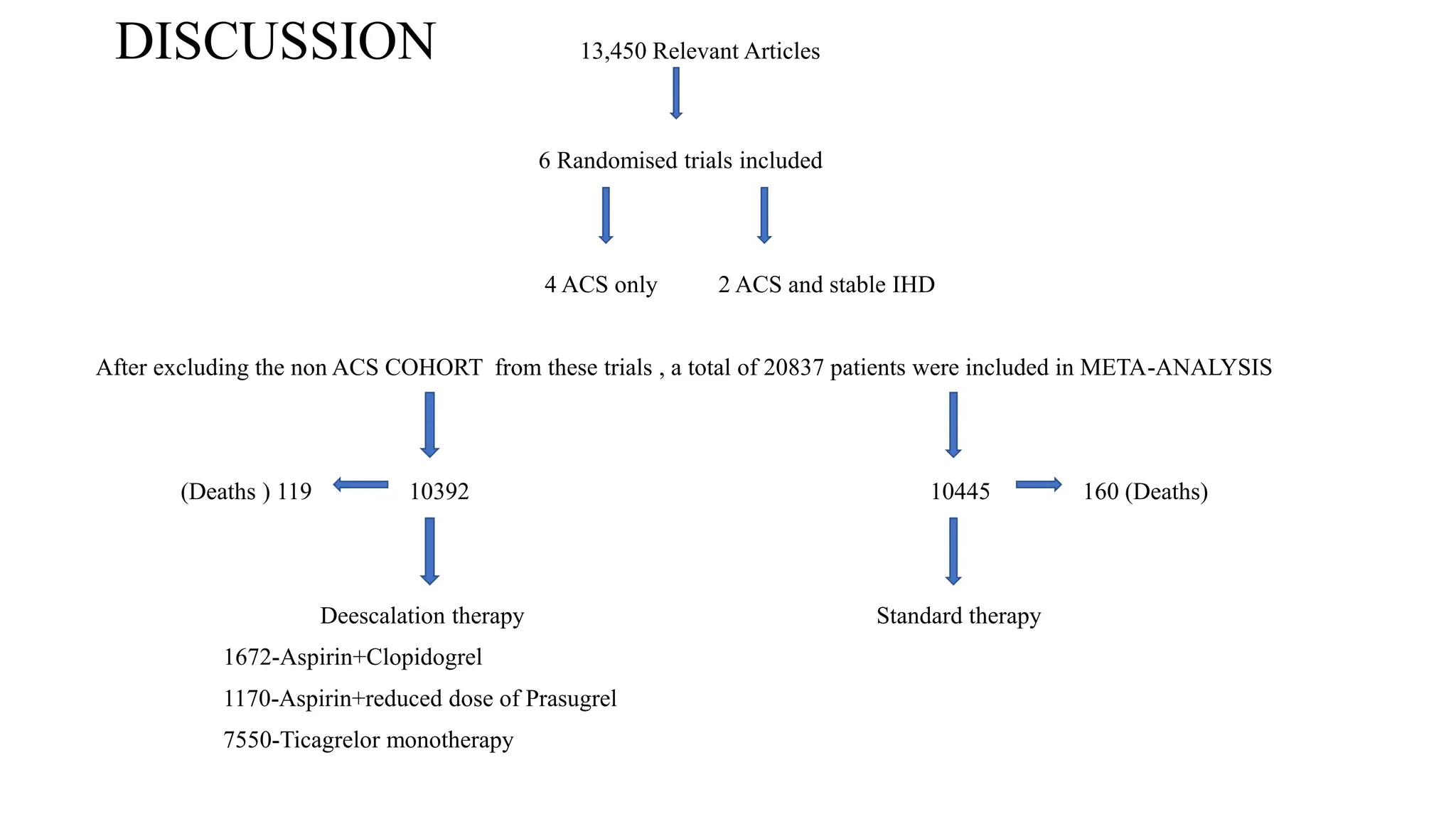
DISCUSSION 13,450 Relevant Articles
6 Randomised trials included
4 ACS only 2 ACS and stable IHD
After excluding the non ACS COHORT from these trials , a total of 20837 patients were included in META-ANALYSIS
(Deaths ) 119 10392 10445 160 (Deaths)
Deescalation therapy Standard therapy
1672-Aspirin+Clopidogrel
1170-Aspirin+reduced dose of Prasugrel
7550-Ticagrelor monotherapy
RESULTS
• A total of 20837 patients were included in the meta-analysis, 10445are on
standard therapy and 10392 patients are treated with de escalation therapy
• 1672 patients are treated with aspirin + clopidogrel
1170 patients are treated with aspirin + reduced dose of prasugrel
7550 patients are treated with ticagrelor monotherapy
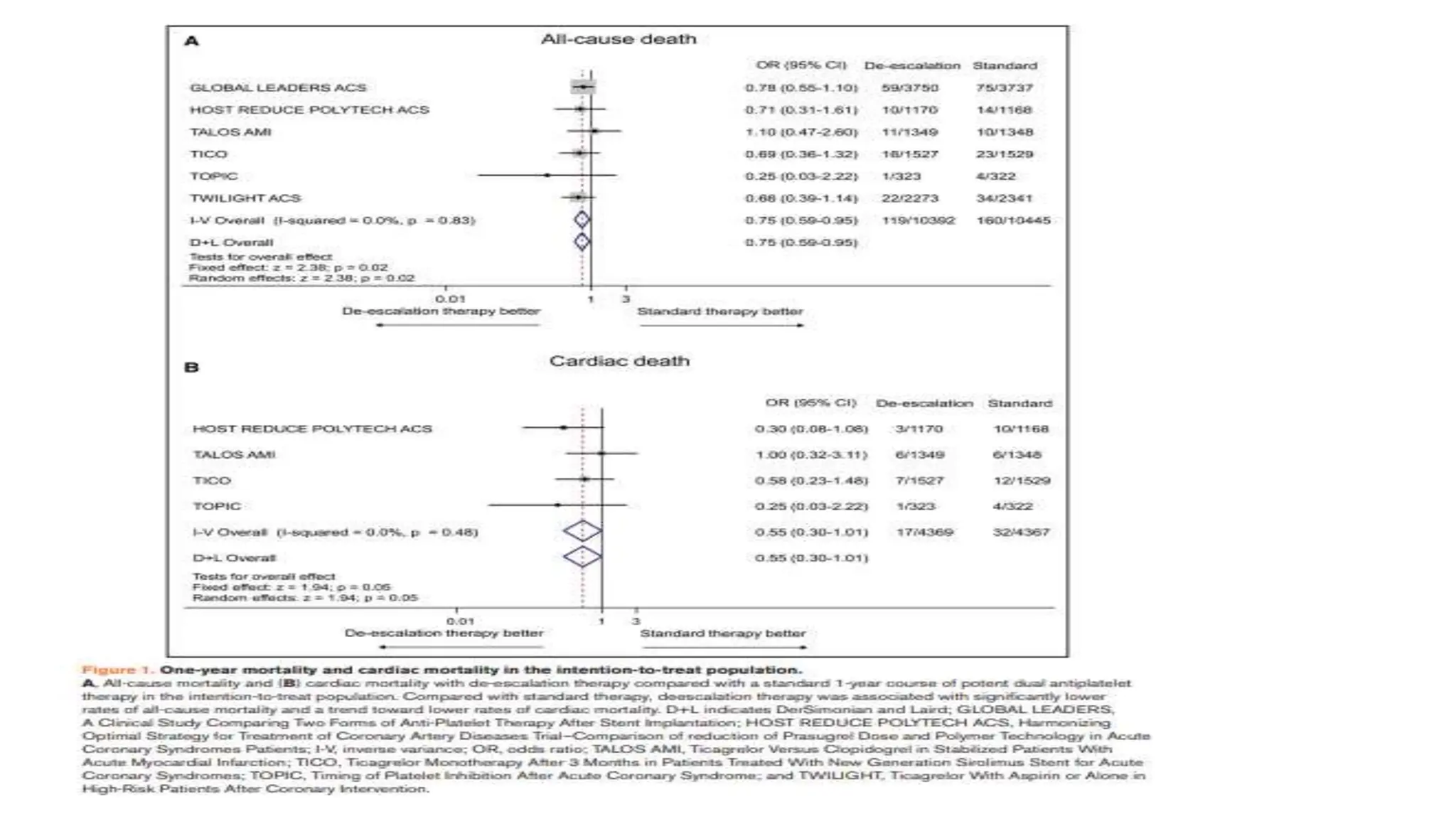
• At 1 year follow up 119 deaths occurred in the de-escalation therapy
compared with 160 deaths in standard therapy.
• De escalation therapy was associated with lower 1 year rate of death but no
statistical difference in rates of cardiovascular mortality
• No significant heterogeneity was apparent in treatment effect in relation to
the type of de-escalation therapy.
CONCLUSIONS
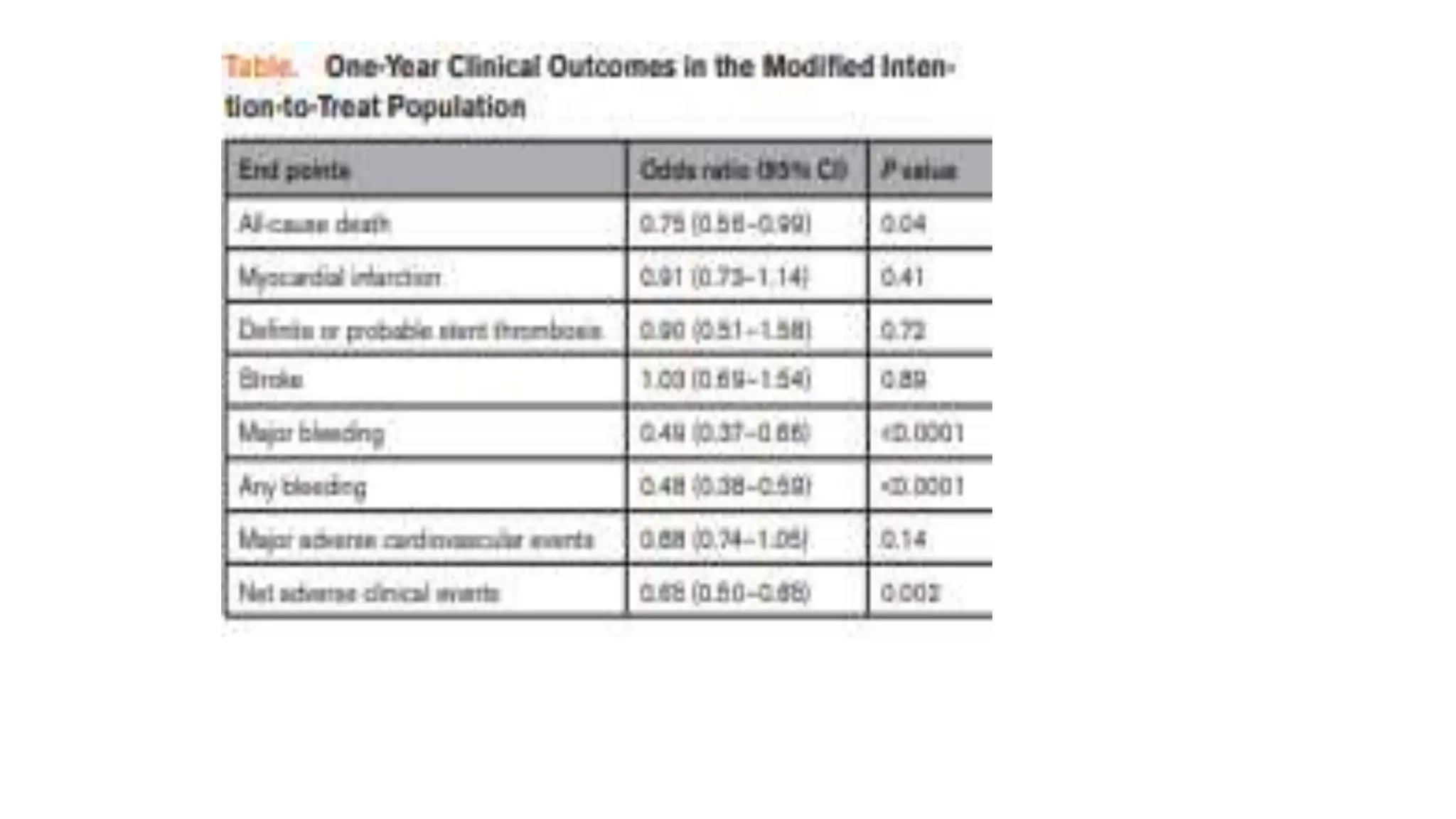
In pairwise meta-analysis of 6 trails and 20,837 randomized patients
with acute coronary syndrome and low risk of bleeding undergoing per
cutaneous intervention, de-escalation therapy after 1 to 3 months of
potent dual antiplatelet therapy was associated with lower rates of all-
cause mortality , major bleeding, and net adverse clinical events but no
significance in cardiac related mortality.
LIMITATIONS OF THE STUDY
• Unable to examine the timing of differences in survival between
groups
• Unable to identify patient subgroups that might particularly benefited
or harmed by de-escalation therapy
• Most trails were unblinded. However primary end point- all cause
mortality is less affected by these issues
• Patients included were not at high risk of bleeding and most had
normal left ventricular ejection fraction
APPLICABILITY OF THE RESULTS IN
OUR SETUP
• Yes
CRITICAL ANALYSIS
• Title
• Sample size
• Methodology
• Result
• Conclusion
REFERENCES
• 1. Wallentin L, Becker RC, Budaj A, Cannon CP, Emanuelsson H, Held C, Horrow J, Husted S,
James S, Katus H, et al. Ticagrelor versus clopidogrel in patients with acute coronary syndromes.
N Engl J Med. 2009;361:1045– 1057. doi: 10.1056/NEJMoa0904327
• 2. Wiviott SD, Braunwald E, McCabe CH, Horvath I, Keltai M, Herrman JP, Van de Werf F,
Downey WE, Scirica BM, Murphy SA, et al. Intensive oral antiplatelet therapy for reduction of
ischaemic events including stent thrombosis in patients with acute coronary syndromes treated with
percutaneous coronary intervention and stenting in the TRITON-TIMI 38 trial: a subanalysis of a
randomised trial. Lancet. 2008;371:1353–1363. doi: 10.1016/S0140-6736(08)60422-5
• 3. Palmerini T, Bacchi Reggiani L, Della Riva D, Romanello M, Feres F, Abizaid A, Gilard M,
Morice MC, Valgimigli M, Hong MK, et al. Stone GW. bleeding-related deaths in relation to the
duration of dual-antiplatelet therapy after coronary stenting. J Am Coll Cardiol. 2017;69:2011–
2022. doi: 10.1016/j.jacc.2017.02.029
• 4. Palmerini T, Benedetto U, Bacchi-Reggiani L, Della Riva D, Biondi-Zoccai G, Feres F, Abizaid
A, Hong MK, Kim BK, Jang Y, et al. Mortality in patients treated with extended duration dual
antiplatelet therapy after drugeluting stent implantation: a pairwise and Bayesian network meta-
analysis of randomised trials. Lancet. 2015;385:2371–2382. doi: 10.1016/ S0140-6736(15)60263-
X
• 5. Baber U, Dangas G, Angiolillo DJ, Cohen DJ, Sharma SK, Nicolas J, Briguori C, Cha JY, Collier T, Dudek D, et al.
Ticagrelor alone vs. ticagrelor plus aspirin following percutaneous coronary intervention in patients with non-ST-segment
elevation acute coronary syndromes: TWILIGHT-ACS. Eur Heart J. 2020;41:3533–3545. doi: 10.1093/eurheartj/ehaa670
• 6. Cuisset T, Deharo P, Quilici J, Johnson TW, Deffarges S, Bassez C, Bonnet G, Fourcade L, Mouret JP, Lambert M, et al.
Benefit of switching dual antiplatelet therapy after acute coronary syndrome: the TOPIC (timing of platelet inhibition after
acute coronary syndrome) randomized study. Eur Heart J. 2017;38:3070–3078. doi: 10.1093/eurheartj/ehx175
• 7. Kim BK, Hong SJ, Cho YH, Yun KH, Kim YH, Suh Y, Cho JY, Her AY, Cho S, Jeon DW. et al. Effect of ticagrelor
monotherapy vs ticagrelor with aspirin on major bleeding and cardiovascular events in patients with acute coronary
syndrome: the TICO randomized clinical trial. JAMA. 2020;323:2407–2416. doi: 10.1001/jama.2020.7580
• 8. Kim CJ, Park MW, Kim MC, Choo EH, Hwang BH, Lee KY, Choi YS, Kim HY, Yoo KD, Jeon DS, et al. Unguided de-
escalation from ticagrelor to clopidogrel in stabilised patients with acute myocardial infarction undergoing percutaneous
coronary intervention (TALOS-AMI): an investigatorinitiated, open-label, multicentre, non-inferiority, randomised trial.
Lancet. 2021;398:1305–1316. doi: 10.1016/S0140-6736(21)01445-8
• 9. Kim HS, Kang J, Hwang D, Han JK, Yang HM, Kang HJ, Koo BK, Rhew JY, Chun KJ, Lim YH, et al. Prasugrel-based
de-escalation of dual antiplatelet therapy after percutaneous coronary intervention in patients with acute coronary syndrome
(HOST-REDUCE-POLYTECHACS): an open-label, multicentre, non-inferiority randomised trial. Lancet. 2020;396:1079–
1089. doi: 10.1016/S0140-6736(20)31791-8
• 10. Tomaniak M, Chichareon P, Onuma Y, Deliargyris EN, Takahashi K, Kogame N, Modolo R, Chang CC, Rademaker-
Havinga T, Storey RF, et al. Benefit and risks of aspirin in addition to ticagrelor in acute coronary syndromes: a post hoc
analysis of the randomized GLOBAL LEADERS trial. JAMA Cardiol. 2019;4:1092–1101. doi:
10.1001/jamacardio.2019.33555.
THANK YOU

DAPT DE-ESCALATION final.pptx

  • 1.
    JOURNAL CLUB MODERATOR: DR.POOJA NAIK SENIOR RESIDENT KIMS TEACHING HOSPITAL KOPPAL STUDENT: DR. T. TEJASWINI 1ST YEAR POST GRADUATE KIMS TEACHING HOSPITAL KOPPAL
  • 2.
    REDUCED MORTALITY WITH ANTIPLATELET THERAPY DEESCALATION AFTER PERCUTANEOUS CORONARY INTERVENTION IN ACUTE CORONARY SYNDROMES Cardiovascular Interventions- American Heart Association..
  • 3.
    AUTHORS AND AFFILIATIONS TullioPalmerini, Antonio Giulio Bruno, Mauro Gasparini, Giulia Rizzello, Hyo-Soo Kim, Jeehoon Kang, Kyung-Woo Park, Joo-Yong Hahn, Young Bin Song, Hyeon-Cheol Gwon ,Eun Ho Choo, Mahn-Won Park , Chan Joon Kim, Kiyuk Chang, Thomas Cuisset, Nevio Taglieri, Byeong-KeukKim,Yangsoo Jang, ElenaNardi,Francesco Saia ,Matheusz Orzalkiewicz , Francesco Chietera , Gabriele Ghetti , Nazzareno Galie ,Gregg W. Stone Mount Sinai center Gustave L Levy Place New York
  • 4.
    AFFILIATIONS • Division ofCardiology, IRCCS Azienda Ospedaliero-Universitaria di Bologna, Italy . • Dipartimento di Scienze Matematiche, Politecnico di Torino, Italy . • Severance Cardiovascular Hospital and Science Institute, Yonsei University College of Medicine, Seoul, South Korea. • Heart Vascular Stroke Institute, Samsung Medical Center, Sungkyunkwan University School of Medicine, Seoul, South Korea. • Division of Cardiology, Department of Internal Medicine, Seoul St. Mary’s Hospital, The Catholic University of South Korea. • Division of Cardiology, Department of Internal Medicine, Daejeon St. Mary's Hospital, The Catholic University of South Korea.
  • 5.
    • Division ofCardiology, Department of Internal Medicine, Uijeongbu St. Mary's Hospital, The Catholic University of South Korea. • Department of Cardiology, CHU Timone, Marseille, France. • Division of Cardiology, Yonsei University Severance Cardiovascular Hospital, Seoul, South Korea. • Department of Cardiology, CHA Bundang Medical Center, CHA University College of Medicine, Seongnam, South Korea. • Zena and Michael A. Wiener Cardiovascular Institute, Icahn School of Medicine at Mount Sinai, New York.
  • 6.
    BACKGROUND In patients withacute coronary syndromes (ACS) undergoing percutaneous coronary intervention (PCI) the combination of aspirin plus a potent P2Y12 receptor inhibitor (prasugrel or ticagrelor) for 1 year is superior to aspirin plus clopidogrel for 1 year in reducing ischemic events.1,2 However, potent dual antiplatelet therapy (DAPT) is associated with a higher risk of bleeding compared with aspirin plus clopidogrel which may be associated with an increased risk of mortality.3,4
  • 7.
    These issues haveprompted research of alternative antiplatelet therapy regimens in ACS patients undergoing PCI that might decrease the risk of bleeding without increasing ischemic risk. Specifically, the concept of antiplatelet therapy de-escalation has been introduced wherein potent DAPT is used at highest risk of ischemic period after PCI , followed by a less potent DAPT regimen to complete 1 year of treatment.5-10
  • 8.
    AIMS AND OBJECTIVESOF THE STUDY The objective of the present study was to examine the risk-benefit profile of antiplatelet therapy de-escalation as compared to standard potent DAPT in Acute Coronary Syndrome patients at low bleeding risk undergoing PCI. The primary objective was to compare the 1yr outcomes between standard treatment versus de-escalation therapy. The secondary objective is to compare 1yr outcomes across 3 treatment group
  • 9.
    (1) standard therapywith aspirin plus prasugrel or ticagrelor for 1 year; (2) De escalation therapy with potent DAPT for 1 to 3 months followed by reduced potency DAPT for up to 1 year; (3) De escalation therapy with potent DAPT for 1 to 3 months followed by ticagrelor monotherapy for up to 1 year
  • 10.
    METHODS AND METHODOLOGY •STUDY DESIGN : Meta analysis • INCLUSION CRITERIA: 1. Enrollment of patients with ACS in whom PCI was performed 2. control treatment consisting of aspirin plus prasugrel or ticagrelor for 1 year or up to 15 months 3. De escalation therapy consisting of 1-3 month period of potent DAPT followed by either reduced potency DAPT or ticagrelor monotherapy for 1 year
  • 11.
    DISCUSSION 13,450 RelevantArticles 6 Randomised trials included 4 ACS only 2 ACS and stable IHD After excluding the non ACS COHORT from these trials , a total of 20837 patients were included in META-ANALYSIS (Deaths ) 119 10392 10445 160 (Deaths) Deescalation therapy Standard therapy 1672-Aspirin+Clopidogrel 1170-Aspirin+reduced dose of Prasugrel 7550-Ticagrelor monotherapy
  • 17.
    RESULTS • A totalof 20837 patients were included in the meta-analysis, 10445are on standard therapy and 10392 patients are treated with de escalation therapy • 1672 patients are treated with aspirin + clopidogrel 1170 patients are treated with aspirin + reduced dose of prasugrel 7550 patients are treated with ticagrelor monotherapy • At 1 year follow up 119 deaths occurred in the de-escalation therapy compared with 160 deaths in standard therapy. • De escalation therapy was associated with lower 1 year rate of death but no statistical difference in rates of cardiovascular mortality • No significant heterogeneity was apparent in treatment effect in relation to the type of de-escalation therapy.
  • 18.
    CONCLUSIONS In pairwise meta-analysisof 6 trails and 20,837 randomized patients with acute coronary syndrome and low risk of bleeding undergoing per cutaneous intervention, de-escalation therapy after 1 to 3 months of potent dual antiplatelet therapy was associated with lower rates of all- cause mortality , major bleeding, and net adverse clinical events but no significance in cardiac related mortality.
  • 19.
    LIMITATIONS OF THESTUDY • Unable to examine the timing of differences in survival between groups • Unable to identify patient subgroups that might particularly benefited or harmed by de-escalation therapy • Most trails were unblinded. However primary end point- all cause mortality is less affected by these issues • Patients included were not at high risk of bleeding and most had normal left ventricular ejection fraction
  • 20.
    APPLICABILITY OF THERESULTS IN OUR SETUP • Yes
  • 21.
    CRITICAL ANALYSIS • Title •Sample size • Methodology • Result • Conclusion
  • 22.
    REFERENCES • 1. WallentinL, Becker RC, Budaj A, Cannon CP, Emanuelsson H, Held C, Horrow J, Husted S, James S, Katus H, et al. Ticagrelor versus clopidogrel in patients with acute coronary syndromes. N Engl J Med. 2009;361:1045– 1057. doi: 10.1056/NEJMoa0904327 • 2. Wiviott SD, Braunwald E, McCabe CH, Horvath I, Keltai M, Herrman JP, Van de Werf F, Downey WE, Scirica BM, Murphy SA, et al. Intensive oral antiplatelet therapy for reduction of ischaemic events including stent thrombosis in patients with acute coronary syndromes treated with percutaneous coronary intervention and stenting in the TRITON-TIMI 38 trial: a subanalysis of a randomised trial. Lancet. 2008;371:1353–1363. doi: 10.1016/S0140-6736(08)60422-5 • 3. Palmerini T, Bacchi Reggiani L, Della Riva D, Romanello M, Feres F, Abizaid A, Gilard M, Morice MC, Valgimigli M, Hong MK, et al. Stone GW. bleeding-related deaths in relation to the duration of dual-antiplatelet therapy after coronary stenting. J Am Coll Cardiol. 2017;69:2011– 2022. doi: 10.1016/j.jacc.2017.02.029 • 4. Palmerini T, Benedetto U, Bacchi-Reggiani L, Della Riva D, Biondi-Zoccai G, Feres F, Abizaid A, Hong MK, Kim BK, Jang Y, et al. Mortality in patients treated with extended duration dual antiplatelet therapy after drugeluting stent implantation: a pairwise and Bayesian network meta- analysis of randomised trials. Lancet. 2015;385:2371–2382. doi: 10.1016/ S0140-6736(15)60263- X
  • 23.
    • 5. BaberU, Dangas G, Angiolillo DJ, Cohen DJ, Sharma SK, Nicolas J, Briguori C, Cha JY, Collier T, Dudek D, et al. Ticagrelor alone vs. ticagrelor plus aspirin following percutaneous coronary intervention in patients with non-ST-segment elevation acute coronary syndromes: TWILIGHT-ACS. Eur Heart J. 2020;41:3533–3545. doi: 10.1093/eurheartj/ehaa670 • 6. Cuisset T, Deharo P, Quilici J, Johnson TW, Deffarges S, Bassez C, Bonnet G, Fourcade L, Mouret JP, Lambert M, et al. Benefit of switching dual antiplatelet therapy after acute coronary syndrome: the TOPIC (timing of platelet inhibition after acute coronary syndrome) randomized study. Eur Heart J. 2017;38:3070–3078. doi: 10.1093/eurheartj/ehx175 • 7. Kim BK, Hong SJ, Cho YH, Yun KH, Kim YH, Suh Y, Cho JY, Her AY, Cho S, Jeon DW. et al. Effect of ticagrelor monotherapy vs ticagrelor with aspirin on major bleeding and cardiovascular events in patients with acute coronary syndrome: the TICO randomized clinical trial. JAMA. 2020;323:2407–2416. doi: 10.1001/jama.2020.7580 • 8. Kim CJ, Park MW, Kim MC, Choo EH, Hwang BH, Lee KY, Choi YS, Kim HY, Yoo KD, Jeon DS, et al. Unguided de- escalation from ticagrelor to clopidogrel in stabilised patients with acute myocardial infarction undergoing percutaneous coronary intervention (TALOS-AMI): an investigatorinitiated, open-label, multicentre, non-inferiority, randomised trial. Lancet. 2021;398:1305–1316. doi: 10.1016/S0140-6736(21)01445-8 • 9. Kim HS, Kang J, Hwang D, Han JK, Yang HM, Kang HJ, Koo BK, Rhew JY, Chun KJ, Lim YH, et al. Prasugrel-based de-escalation of dual antiplatelet therapy after percutaneous coronary intervention in patients with acute coronary syndrome (HOST-REDUCE-POLYTECHACS): an open-label, multicentre, non-inferiority randomised trial. Lancet. 2020;396:1079– 1089. doi: 10.1016/S0140-6736(20)31791-8 • 10. Tomaniak M, Chichareon P, Onuma Y, Deliargyris EN, Takahashi K, Kogame N, Modolo R, Chang CC, Rademaker- Havinga T, Storey RF, et al. Benefit and risks of aspirin in addition to ticagrelor in acute coronary syndromes: a post hoc analysis of the randomized GLOBAL LEADERS trial. JAMA Cardiol. 2019;4:1092–1101. doi: 10.1001/jamacardio.2019.33555.
  • 24.