Impact on Hospitals
Signed into law March 23, 2010. Specific Provisions to be phased in through Jan 1, 2018 Will ensure that all Americans have access to quality, affordable health care and will create the transformation within the health care system necessary to contain costs.
Reform of private health insurance industry and public health insurance programs.  Improve coverage for those with pre-existing conditions.  Expand access to care for 32 million Americans Reduce long term costs of the health care system.
Quality, affordable Care for all Americans Hospital Value-Based Purchasing Program Incentive for Hospitals to implement EMRs
50.7 Million Americans were without healthcare as of September 2010  (US Census Bureau) An additional 25 Million are underinsured 42% of adults 19-64 are underinsured or have no healthcare Beginning in 2014, individuals will be required to maintain minimum essential coverage or pay penalties.  Employers must also offer health care to employees to avoid penalties
Hospitals are endangered Most endangered are rural hospitals, and urban ones in areas with excess hospital beds and a lot of poor, uninsured patients. Federal law requires hospitals to provide care for anyone, whether insured or not. It requires hospitals and ambulance services to provide care to anyone needing emergency healthcare treatment regardless of citizenship, legal status or ability to pay.
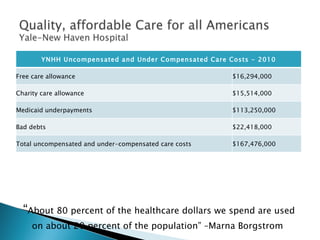
“ About 80 percent of the healthcare dollars we spend are used on about 20 percent of the population” –Marna Borgstrom YNHH Uncompensated and Under Compensated Care Costs - 2010 Free care allowance $16,294,000 Charity care allowance $15,514,000 Medicaid underpayments $113,250,000 Bad debts $22,418,000 Total uncompensated and under-compensated care costs $167,476,000
More insured people means fewer unpaid hospital bills This means less bad debts and uncompensated costs for hospitals. With more people covered, ER ’s could see less OR more crowding The once uninsured will now have a choice for health care and may choose to see a family physician for minor illnesses and injuries. However, Medicaid beneficiaries make up the majority of ER visits. The new health insurance law will increase Medicaid ranks by about 16 million. Many family doctors limit the number of Medicaid patients they take due to low government reimbursements. This could mean ER ’s across the nation could see far more crowding.
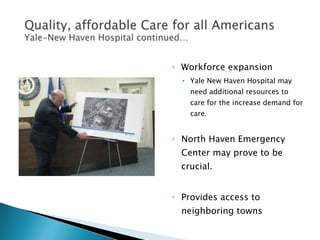
Workforce expansion Yale New Haven Hospital may need additional resources to care for the increase demand for care. North Haven Emergency Center may prove to be crucial. Provides access to neighboring towns
Hospital payments account for the largest share of Medicare spending, Medicare is the largest single payer for hospital services. Every year, as many as 98,000 Americans die from errors in hospital care.  1/3 of Medicare beneficiary discharges will be back in the hospital within a month These medical errors not only contribute to the suffering of patients/families, but lead to increased spending
In FY 2013, Hospital Value-Based Purchasing Program will distribute an estimated $850 M to hospitals based on overall performance  Funds to be taken from what Medicare would have spent on hospital stays No longer payments based on volume of patients, but based on performance of care. This will encourage quality care improvement, meaning better medical practice and fewer complications and readmissions, which in turn will lower hospital expenses.
The Program measures on how closely hospitals follow best clinical practices and how well hospitals enhance patients ’ experiences of care. Examples of the care processes included in the measures: Percent of Heart Attack Patients Given Fibrinolytic Medication Within 30 Minutes Of Arrival Surgery patients who were given the right kind of antibiotic to help prevent infection Patient Experience of Care
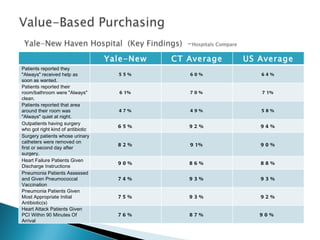
Yale-New Haven CT Average US Average Patients reported they "Always" received help as soon as wanted. 55% 60% 64% Patients reported their room/bathroom were "Always" clean. 61% 70% 71% Patients reported that area around their room was "Always" quiet at night. 47% 49% 58% Outpatients having surgery who got right kind of antibiotic 65% 92% 94% Surgery patients whose urinary catheters were removed on first or second day after surgery. 82% 91% 90% Heart Failure Patients Given Discharge Instructions 90% 86% 88% Pneumonia Patients Assessed and Given Pneumococcal Vaccination 74% 93% 93% Pneumonia Patients Given Most Appropriate Initial Antibiotic(s) 75% 93% 92% Heart Attack Patients Given PCI Within 90 Minutes Of Arrival 76% 87% 90%
HITECH act – authorized incentive payments through Medicare and Medicaid to clinicians and hospitals when they use EHRs to improve care delivery “ meaningful use” objectives exist Original proposal – mandatory broad set of objectives to be met (23 for hospitals, 25 for clinicians) “ too demanding and inflexible” – final regulation – two groups
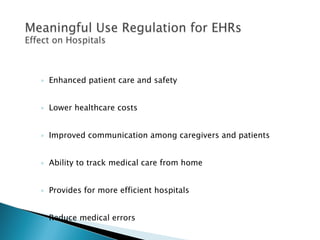
Enhanced patient care and safety Lower healthcare costs Improved communication among caregivers and patients Ability to track medical care from home Provides for more efficient hospitals Reduce medical errors
YNHS has begun a multi-year process to implement EPIC, a state of the art EHR system EPIC will be implemented by 2013 Five-year estimate for building & maintaining EPIC at $250 million Every patient ’s medical record will be available online to each of their healthcare providers
It ’s a better way to serve America’s patients Improve the overall health of the nation It ’s a step in the right direction

Patient protection & affordable care act

  • 1.
  • 2.
    Signed into lawMarch 23, 2010. Specific Provisions to be phased in through Jan 1, 2018 Will ensure that all Americans have access to quality, affordable health care and will create the transformation within the health care system necessary to contain costs.
  • 3.
    Reform of privatehealth insurance industry and public health insurance programs. Improve coverage for those with pre-existing conditions. Expand access to care for 32 million Americans Reduce long term costs of the health care system.
  • 4.
    Quality, affordable Carefor all Americans Hospital Value-Based Purchasing Program Incentive for Hospitals to implement EMRs
  • 5.
    50.7 Million Americanswere without healthcare as of September 2010 (US Census Bureau) An additional 25 Million are underinsured 42% of adults 19-64 are underinsured or have no healthcare Beginning in 2014, individuals will be required to maintain minimum essential coverage or pay penalties. Employers must also offer health care to employees to avoid penalties
  • 6.
    Hospitals are endangeredMost endangered are rural hospitals, and urban ones in areas with excess hospital beds and a lot of poor, uninsured patients. Federal law requires hospitals to provide care for anyone, whether insured or not. It requires hospitals and ambulance services to provide care to anyone needing emergency healthcare treatment regardless of citizenship, legal status or ability to pay.
  • 7.
    “ About 80percent of the healthcare dollars we spend are used on about 20 percent of the population” –Marna Borgstrom YNHH Uncompensated and Under Compensated Care Costs - 2010 Free care allowance $16,294,000 Charity care allowance $15,514,000 Medicaid underpayments $113,250,000 Bad debts $22,418,000 Total uncompensated and under-compensated care costs $167,476,000
  • 8.
    More insured peoplemeans fewer unpaid hospital bills This means less bad debts and uncompensated costs for hospitals. With more people covered, ER ’s could see less OR more crowding The once uninsured will now have a choice for health care and may choose to see a family physician for minor illnesses and injuries. However, Medicaid beneficiaries make up the majority of ER visits. The new health insurance law will increase Medicaid ranks by about 16 million. Many family doctors limit the number of Medicaid patients they take due to low government reimbursements. This could mean ER ’s across the nation could see far more crowding.
  • 9.
    Workforce expansion YaleNew Haven Hospital may need additional resources to care for the increase demand for care. North Haven Emergency Center may prove to be crucial. Provides access to neighboring towns
  • 10.
    Hospital payments accountfor the largest share of Medicare spending, Medicare is the largest single payer for hospital services. Every year, as many as 98,000 Americans die from errors in hospital care.  1/3 of Medicare beneficiary discharges will be back in the hospital within a month These medical errors not only contribute to the suffering of patients/families, but lead to increased spending
  • 11.
    In FY 2013,Hospital Value-Based Purchasing Program will distribute an estimated $850 M to hospitals based on overall performance Funds to be taken from what Medicare would have spent on hospital stays No longer payments based on volume of patients, but based on performance of care. This will encourage quality care improvement, meaning better medical practice and fewer complications and readmissions, which in turn will lower hospital expenses.
  • 12.
    The Program measureson how closely hospitals follow best clinical practices and how well hospitals enhance patients ’ experiences of care. Examples of the care processes included in the measures: Percent of Heart Attack Patients Given Fibrinolytic Medication Within 30 Minutes Of Arrival Surgery patients who were given the right kind of antibiotic to help prevent infection Patient Experience of Care
  • 13.
    Yale-New Haven CTAverage US Average Patients reported they "Always" received help as soon as wanted. 55% 60% 64% Patients reported their room/bathroom were "Always" clean. 61% 70% 71% Patients reported that area around their room was "Always" quiet at night. 47% 49% 58% Outpatients having surgery who got right kind of antibiotic 65% 92% 94% Surgery patients whose urinary catheters were removed on first or second day after surgery. 82% 91% 90% Heart Failure Patients Given Discharge Instructions 90% 86% 88% Pneumonia Patients Assessed and Given Pneumococcal Vaccination 74% 93% 93% Pneumonia Patients Given Most Appropriate Initial Antibiotic(s) 75% 93% 92% Heart Attack Patients Given PCI Within 90 Minutes Of Arrival 76% 87% 90%
  • 14.
    HITECH act –authorized incentive payments through Medicare and Medicaid to clinicians and hospitals when they use EHRs to improve care delivery “ meaningful use” objectives exist Original proposal – mandatory broad set of objectives to be met (23 for hospitals, 25 for clinicians) “ too demanding and inflexible” – final regulation – two groups
  • 15.
    Enhanced patient careand safety Lower healthcare costs Improved communication among caregivers and patients Ability to track medical care from home Provides for more efficient hospitals Reduce medical errors
  • 16.
    YNHS has beguna multi-year process to implement EPIC, a state of the art EHR system EPIC will be implemented by 2013 Five-year estimate for building & maintaining EPIC at $250 million Every patient ’s medical record will be available online to each of their healthcare providers
  • 17.
    It ’s abetter way to serve America’s patients Improve the overall health of the nation It ’s a step in the right direction

Editor's Notes

  • #8 Net revenue(net profits) in 2010 for ynhh was 1.4 billion