People with lived/living experience of a
health issue being involved in decision-
making about research before applying for
research funding.
Research “with” or “by” people with
lived/living experience, instead of “for” or
“about” them
Patient Engagement
3
PARTICIPANTS
• People recruited to study about whom data is
collected (e.g., focus groups, surveys)
• No decision-making power about research topic
or design
PARTNERS
• People with lived/living experience of a health
condition involved in decision-making about
research (e.g., co-researchers, advisory group)
Participants vs. Partners
4
Addresses a key funding gap:
• Engaging early in the research process allows
for more shared decision-making power and
flexibility in research methods & design
• People with lived/living experience need to be
involved prior to receiving funds
• Need funding to engage people
Why the PREPPP Award?
5
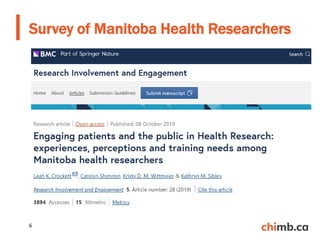
Survey of Manitoba Health Researchers
6
[The type of support that would be most
beneficial to me] “Funding to develop
community partnerships, as once partnerships
are developed, lots of research can be
produced, but takes time to set up and connect
with groups/communities.”
– Manitoba health researcher
Survey of Manitoba Health Researchers
7
• To help identify research priorities that matter
most to patients/caregivers/communities
• To help shape and clarify research questions
• To help ensure the research methods/design
proposed for the study are appropriate,
acceptable and sensitive to the real-world
context of patients/caregivers/communities
• To help ensure research uses outcomes that
have true meaning to those with lived/living
experience
Early Engagement
8
Health researchers who apply for funding and submit
manuscripts are expected to:
• Demonstrate how they have involved patients in
preparing their grant applications;
• Outline what changes were made to their application
as a result of patient engagement;
• Explain how they are focusing on patient-identified
priorities; and
• Outline in detail how they will involve patients in the
design, conduct, interpretation and dissemination of
the research if it is funded.
Expectations by Funders and Publishers
9
• Encourage Manitoban health researchers to
actively involve patients and the public in the
design and grant development phase of
health research by removing financial barriers
to engagement;
• Ensure that patient and public engagement in
health research in Manitoba is being done in
a meaningful and authentic way by CHI
providing in-kind training, advice and
mentorship to all Funding Award winners;
Objectives
10
• Strengthen patient-oriented research grant
applications from Manitoban health
researchers by facilitating research that
focuses on patient-identified priorities and
actively engages patients as partners;
• Bolster Manitoban health researchers ability
to have their research findings published in
academic journals such as CMAJ and BMJ
(which have patient engagement
requirements) and hence shared with a broad
audience;
Objectives
11
• Support opportunities for Manitobans to be
actively involved in informing health research
priorities, outcomes, design and
methodologies;
• Contribute to the science and best practice of
patient engagement in health research by
evaluating all Award winners’ patient
engagement activities.
Objectives
12
• Manitoba researchers, students and community
organizations
• Planning a health research project or program
• Aim to involve patients and/or members of the
public in decision-making about research design
• Research project not yet funded (still in design or
grant development phase)
• Previous applicants welcome to re-apply!
Who is Eligible?
15
Assessment
Criteria
1. Overall quality
2. Appropriateness & level of engagement
3. Evidence of commitment to 2-way relationships,
trauma-informed approaches, and methods for
equity, diversity & inclusion
4. Potential impact of engagement on research, those
involved & broader context
5. Feasibility
6. Alignment with principles of patient-oriented
research & local health priorities
Assessment Criteria
17
• Clarity – application is easy to read, methods are
clearly laid out & logical
• All sections & bullet points in application are
explicitly addressed
• Scope – focused on early engagement, priority-
setting, refining the research question, co-
developing design and grant development
• Originality – demonstrated attempts to consider
methods outside of status quo of traditional health
research, meeting people where they’re at
1. Overall Quality
18
• Planned engagement is (or will be) chosen by
or co-designed with partners
• Methods address explicitly stated needs,
values and expectations of partners
• Partners have significant decision-making
power in research design and grant
development
– Collaboration or patient/public-directed
– Goes beyond consultation
2. Appropriateness
19
• Readiness to Engage Workbook
– Critical reflexive practice questions
– Examine perceptions, values, needs, priorities
– Assess level of decision-making power and
flexibility
2. Resources - Appropriateness
20
http://umanitoba.ca/centre-for-healthcare-
innovation/sites/centre-for-healthcare-
innovation/files/2021-11/readiness-to-
engage-workbook.pdf
• May be able to involve partners at different
levels through different stages of research
– For application, focus on level of decision-
making power in planning the research
– Priority-setting, research questions, design &
grant development
https://medium.com/knowledgenudge/pe-3-
the-levels-of-patient-and-public-involvement-
77026a547f2b
2. Resources – Level of Engagement
21
• Variety of methods for different stages &
levels of engagement
• Focus on identifying & prioritizing, research
design & development of grant proposal
http://umanitoba.ca/centre-for-healthcare-
innovation/sites/centre-for-healthcare-
innovation/files/2021-11/methods-of-patient-
and-public-engagement-guide.pdf
2. Resources – Methods to Engage
22
• Describe how two-way (reciprocal)
relationships will be built and maintained
– Developing trust
– Transparency about research design & grant
processes
– Participation in shared learning
• Discuss the “bigger picture” and how you
envision engagement will impact everyone
involved
3. Commitment to Relationships
23
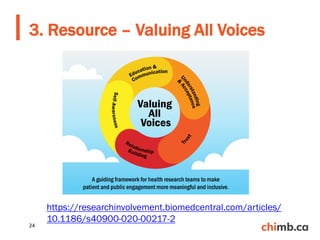
3. Resource – Valuing All Voices
https://researchinvolvement.biomedcentral.com/articles/
10.1186/s40900-020-00217-2
24
• Describe methods for co-creating safety in
engagement
– Discussions of safe spaces
– Guiding principles for working together
• 4-part KnowledgeNudge blog series on
Trauma-Informed Engagement
– https://medium.com/knowledgenudge/trauma
-informed-engagement-part-1-understanding-
trauma-96f35fb00252
3. Trauma-Informed Approaches
25
• Discuss how power imbalances will be
acknowledged & addressed in engagement
• Describe methods to ensure diverse
perspectives are included
• Explicitly address whose voices may not be
heard and who may be missing from the
conversation
https://medium.com/knowledgenudge/pe-7-how-
do-i-find-people-to-involve-in-my-health-research-
4d6f1b163419
3. Equity, Diversity & Inclusion (EDI)
26
• Have a plan for how partners will be involved
in decision-making processes
• Describe potential benefits and harms and
plans to provide supports
• Approaches should provide opportunities for
co-learning, capacity building, and co-benefit
• Consider the bigger picture impact of
engagement on the research team,
organization and field of research
4. Impact of Engagement
27
• Be explicit and flexible in regards to plans for
engagement
– Number of people involved
– Duration and frequency of meetings
– Roles and responsibilities
– How barriers to involvement will be addressed
– Contingencies for changes to timelines, budget
needs, etc.
5. Feasibility
28
• Excel-based budgeting calculator with
printable one-page budget summary
• Provides guidance & suggestions for
important considerations
– Addressing barriers to involvement
– Ensuring supports are accounted for
5. Resource – Budgeting Tool
https://umanitoba.ca/centre-for-healthcare-
innovation/sites/centre-for-healthcare-
innovation/files/2023-06/2020-01-29-chi-pe-
budget-tool-v2-8-3.xlsx
29
• Engages patients as partners;
• Focuses on patient-identified priorities;
• Improves patient outcomes;
• Conducted by multidisciplinary teams in
partnership with relevant stakeholders; AND
• Aims to apply knowledge generated to improve
healthcare systems and practices
6. Alignment with POR Principles
https://cihr-irsc.gc.ca/e/41204.html
30
• Clearly describe how the research
topic/question(s)/priorities were (or will be)
chosen and by whom
• Explicitly link to local priorities identified by:
– Patient/public partners, communities and/or
affected populations
– Local organizations (CancerCare, AFM, Nine
Circles, Mount Carmel, Klinic, SERC, etc.)
– Manitoba’s health system – Shared Health
Clinical Preventative Services Plan
6. Addresses Local Priorities
31
Preparing Your
PREPPP
Application
• Write in lay language (aim for grade 6 reading
level) as patient & public partners will be on
review team
• Avoid medical jargon and acronyms
• Make sure you address all sections of the
application form
Preparing Your Application
33
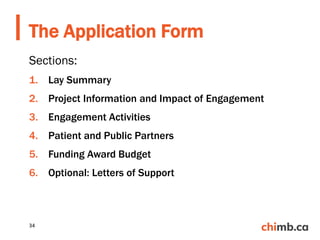
Sections:
1. Lay Summary
2. Project Information and Impact of Engagement
3. Engagement Activities
4. Patient and Public Partners
5. Funding Award Budget
6. Optional: Letters of Support
The Application Form
34
• Ensure your summary addresses the
following aspects:
– Describe how the PREPPP award will aid in
achieving the engagement goals of your project.
– How you will engage people with lived/living
experience and specify how their involvement
will influence decisions related to your project.
– What you hope to achieve through engaging
individuals with lived/living experience.
* Should your application be successful, this summary may be utilized for promotional purposes.
1. Lay Summary (150-word)
35
Describe:
Selection of Research Topics, Questions, Priorities, and/or
Methods: Explain how these were or will be determined, including
the level of decision-making power (level of engagement) granted to
patient and public partners.
Goals and Outcomes: Specify the objectives of engaging patients
and the public in decision-making about the proposed research.
2. Project Information
36
Describe:
Engagement in Research Decisions: Detail the specific research
decisions in which patient and public partners will be involved
For example:
• identifying research topics, questions, priorities, or outcomes;
• developing recruitment methods;
• interpreting data;
• reviewing study materials for accessible and appropriate
language.
2. Project Information
37
3. Engagement Activities
38
Provide a detailed description of planned engagement activities
related to priority-setting, research design, and grant development,
including:
Activity Goals and Objectives: Outline the purpose of each activity.
Details of Activities: Specify the frequency, duration, and number of
patient and public partners involved.
3. Engagement Activities
39
Provide a detailed description of planned engagement
activities related to priority-setting, research design, and
grant development, including:
Support and Facilitation: Describe the supports or facilitation
methods to enhance engagement.
Inclusion of Perspectives: Explain processes to ensure patient
and public partners’ perspectives, concerns, and values are
meaningfully represented in decision-making.
Describe:
Target Population(s): Identify the populations the research team
intends to engage.
Recruitment and Equity Considerations: Describe the recruitment
process and how equity, diversity, and inclusion will be
prioritized.
Addressing Barriers to Engagement: Discuss how barriers such as
accessibility, travel, and childcare needs will be identified and
mitigated.
4. Patient and Public Partners
40
• Summary of costs
• Describe any additional support (funding or in-
kind) that may facilitate engagement beyond
the amount provided by the PREPPP Award
• Emphasis on compensation and addressing
barriers to engagement
5. Funding Award Budget
41
• Do not include costs not directly related to
engagement, including:
• Data collection or honorarium for participants in research
studies
• Borrowing funds to other research projects
• Publication-related costs
• Researcher’s conference fees
5. Funding Award Budget
42
• Not required, will have minimal impact on funding
decisions
• May describe pre-existing relationships or
financial/in-kind supports
8. Optional – Letters of Support
43
• Application form: https://umanitoba.ca/centre-
for-healthcare-innovation/funding-opportunities-
and-awards#preparing-for-research-by-engaging-
public-and-patient-partners-preppp-award
• Resources: https://umanitoba.ca/centre-for-
healthcare-innovation/tools-and-
resources#patient-engagement
• KnowledgeNudge PE Blog Series:
http://bit.ly/PE101Blog
Relevant PE Resources
44
• Shimmin et al. 2017:
– Trauma-Informed Intersectional Analysis & Critical
Reflexive Questions for teams
– http://bit.ly/PEinHealthRes
• Roche et al. 2020:
– The Valuing All Voices Framework for Meaningful
Patient & Public Engagement
– http://bit.ly/Valuing-All-Voices
Relevant Articles
45
• Consultation with CHI’s Patient and Public
Engagement Team
• Attend the PREPPP award orientation
• Complete final report within two months following the
award term
Award Requirements & Conditions
46
• Present at CHI’s monthly Patient and Public Engagement
Lunchtime Learning Series within one year of the final report
submission
• Acknowledge funding & in-kind support in all related posters,
presentations and publications.
Award Requirements & Conditions
47
• Engagement in a systematic review on ER
wait times (Dr. Maya Jeyaraman)
• Community engagement about sugar-
sweetened beverage tax (Dr. Natalie Riediger)
• Engagement around outcomes of thoracic
surgery (Dr. Sadeesh Srinathan)
• Family engagement workshop about chronic
pain in youth (Drs. Kristy Wittmeier & Kirsten
Gerhold)
Previous PREPPP Award Winners
48
• Engaging in scoping review design (Dr. Anna
Chudyk)
• Engaging in clinical trials design (Dr. Dylan
MacKay)
• Blog series – engaging youth & caregivers
around type 2 diabetes (Leanne Dunne)
– Caregiver perspective
– Youth perspective
– Researcher perspective
Previous PREPPP Award Winners
49
CHIPartners@umanitoba.ca
https://umanitoba.ca/centre-for-healthcare-innovation/
@CHImbca CHIManitoba
Centre for Healthcare Innovation
Patient Engagement Lunchtime Learning: PREPPP info session

Patient Engagement Lunchtime Learning: PREPPP info session

  • 3.
    People with lived/livingexperience of a health issue being involved in decision- making about research before applying for research funding. Research “with” or “by” people with lived/living experience, instead of “for” or “about” them Patient Engagement 3
  • 4.
    PARTICIPANTS • People recruitedto study about whom data is collected (e.g., focus groups, surveys) • No decision-making power about research topic or design PARTNERS • People with lived/living experience of a health condition involved in decision-making about research (e.g., co-researchers, advisory group) Participants vs. Partners 4
  • 5.
    Addresses a keyfunding gap: • Engaging early in the research process allows for more shared decision-making power and flexibility in research methods & design • People with lived/living experience need to be involved prior to receiving funds • Need funding to engage people Why the PREPPP Award? 5
  • 6.
    Survey of ManitobaHealth Researchers 6
  • 7.
    [The type ofsupport that would be most beneficial to me] “Funding to develop community partnerships, as once partnerships are developed, lots of research can be produced, but takes time to set up and connect with groups/communities.” – Manitoba health researcher Survey of Manitoba Health Researchers 7
  • 8.
    • To helpidentify research priorities that matter most to patients/caregivers/communities • To help shape and clarify research questions • To help ensure the research methods/design proposed for the study are appropriate, acceptable and sensitive to the real-world context of patients/caregivers/communities • To help ensure research uses outcomes that have true meaning to those with lived/living experience Early Engagement 8
  • 9.
    Health researchers whoapply for funding and submit manuscripts are expected to: • Demonstrate how they have involved patients in preparing their grant applications; • Outline what changes were made to their application as a result of patient engagement; • Explain how they are focusing on patient-identified priorities; and • Outline in detail how they will involve patients in the design, conduct, interpretation and dissemination of the research if it is funded. Expectations by Funders and Publishers 9
  • 10.
    • Encourage Manitobanhealth researchers to actively involve patients and the public in the design and grant development phase of health research by removing financial barriers to engagement; • Ensure that patient and public engagement in health research in Manitoba is being done in a meaningful and authentic way by CHI providing in-kind training, advice and mentorship to all Funding Award winners; Objectives 10
  • 11.
    • Strengthen patient-orientedresearch grant applications from Manitoban health researchers by facilitating research that focuses on patient-identified priorities and actively engages patients as partners; • Bolster Manitoban health researchers ability to have their research findings published in academic journals such as CMAJ and BMJ (which have patient engagement requirements) and hence shared with a broad audience; Objectives 11
  • 12.
    • Support opportunitiesfor Manitobans to be actively involved in informing health research priorities, outcomes, design and methodologies; • Contribute to the science and best practice of patient engagement in health research by evaluating all Award winners’ patient engagement activities. Objectives 12
  • 15.
    • Manitoba researchers,students and community organizations • Planning a health research project or program • Aim to involve patients and/or members of the public in decision-making about research design • Research project not yet funded (still in design or grant development phase) • Previous applicants welcome to re-apply! Who is Eligible? 15
  • 16.
  • 17.
    1. Overall quality 2.Appropriateness & level of engagement 3. Evidence of commitment to 2-way relationships, trauma-informed approaches, and methods for equity, diversity & inclusion 4. Potential impact of engagement on research, those involved & broader context 5. Feasibility 6. Alignment with principles of patient-oriented research & local health priorities Assessment Criteria 17
  • 18.
    • Clarity –application is easy to read, methods are clearly laid out & logical • All sections & bullet points in application are explicitly addressed • Scope – focused on early engagement, priority- setting, refining the research question, co- developing design and grant development • Originality – demonstrated attempts to consider methods outside of status quo of traditional health research, meeting people where they’re at 1. Overall Quality 18
  • 19.
    • Planned engagementis (or will be) chosen by or co-designed with partners • Methods address explicitly stated needs, values and expectations of partners • Partners have significant decision-making power in research design and grant development – Collaboration or patient/public-directed – Goes beyond consultation 2. Appropriateness 19
  • 20.
    • Readiness toEngage Workbook – Critical reflexive practice questions – Examine perceptions, values, needs, priorities – Assess level of decision-making power and flexibility 2. Resources - Appropriateness 20 http://umanitoba.ca/centre-for-healthcare- innovation/sites/centre-for-healthcare- innovation/files/2021-11/readiness-to- engage-workbook.pdf
  • 21.
    • May beable to involve partners at different levels through different stages of research – For application, focus on level of decision- making power in planning the research – Priority-setting, research questions, design & grant development https://medium.com/knowledgenudge/pe-3- the-levels-of-patient-and-public-involvement- 77026a547f2b 2. Resources – Level of Engagement 21
  • 22.
    • Variety ofmethods for different stages & levels of engagement • Focus on identifying & prioritizing, research design & development of grant proposal http://umanitoba.ca/centre-for-healthcare- innovation/sites/centre-for-healthcare- innovation/files/2021-11/methods-of-patient- and-public-engagement-guide.pdf 2. Resources – Methods to Engage 22
  • 23.
    • Describe howtwo-way (reciprocal) relationships will be built and maintained – Developing trust – Transparency about research design & grant processes – Participation in shared learning • Discuss the “bigger picture” and how you envision engagement will impact everyone involved 3. Commitment to Relationships 23
  • 24.
    3. Resource –Valuing All Voices https://researchinvolvement.biomedcentral.com/articles/ 10.1186/s40900-020-00217-2 24
  • 25.
    • Describe methodsfor co-creating safety in engagement – Discussions of safe spaces – Guiding principles for working together • 4-part KnowledgeNudge blog series on Trauma-Informed Engagement – https://medium.com/knowledgenudge/trauma -informed-engagement-part-1-understanding- trauma-96f35fb00252 3. Trauma-Informed Approaches 25
  • 26.
    • Discuss howpower imbalances will be acknowledged & addressed in engagement • Describe methods to ensure diverse perspectives are included • Explicitly address whose voices may not be heard and who may be missing from the conversation https://medium.com/knowledgenudge/pe-7-how- do-i-find-people-to-involve-in-my-health-research- 4d6f1b163419 3. Equity, Diversity & Inclusion (EDI) 26
  • 27.
    • Have aplan for how partners will be involved in decision-making processes • Describe potential benefits and harms and plans to provide supports • Approaches should provide opportunities for co-learning, capacity building, and co-benefit • Consider the bigger picture impact of engagement on the research team, organization and field of research 4. Impact of Engagement 27
  • 28.
    • Be explicitand flexible in regards to plans for engagement – Number of people involved – Duration and frequency of meetings – Roles and responsibilities – How barriers to involvement will be addressed – Contingencies for changes to timelines, budget needs, etc. 5. Feasibility 28
  • 29.
    • Excel-based budgetingcalculator with printable one-page budget summary • Provides guidance & suggestions for important considerations – Addressing barriers to involvement – Ensuring supports are accounted for 5. Resource – Budgeting Tool https://umanitoba.ca/centre-for-healthcare- innovation/sites/centre-for-healthcare- innovation/files/2023-06/2020-01-29-chi-pe- budget-tool-v2-8-3.xlsx 29
  • 30.
    • Engages patientsas partners; • Focuses on patient-identified priorities; • Improves patient outcomes; • Conducted by multidisciplinary teams in partnership with relevant stakeholders; AND • Aims to apply knowledge generated to improve healthcare systems and practices 6. Alignment with POR Principles https://cihr-irsc.gc.ca/e/41204.html 30
  • 31.
    • Clearly describehow the research topic/question(s)/priorities were (or will be) chosen and by whom • Explicitly link to local priorities identified by: – Patient/public partners, communities and/or affected populations – Local organizations (CancerCare, AFM, Nine Circles, Mount Carmel, Klinic, SERC, etc.) – Manitoba’s health system – Shared Health Clinical Preventative Services Plan 6. Addresses Local Priorities 31
  • 32.
  • 33.
    • Write inlay language (aim for grade 6 reading level) as patient & public partners will be on review team • Avoid medical jargon and acronyms • Make sure you address all sections of the application form Preparing Your Application 33
  • 34.
    Sections: 1. Lay Summary 2.Project Information and Impact of Engagement 3. Engagement Activities 4. Patient and Public Partners 5. Funding Award Budget 6. Optional: Letters of Support The Application Form 34
  • 35.
    • Ensure yoursummary addresses the following aspects: – Describe how the PREPPP award will aid in achieving the engagement goals of your project. – How you will engage people with lived/living experience and specify how their involvement will influence decisions related to your project. – What you hope to achieve through engaging individuals with lived/living experience. * Should your application be successful, this summary may be utilized for promotional purposes. 1. Lay Summary (150-word) 35
  • 36.
    Describe: Selection of ResearchTopics, Questions, Priorities, and/or Methods: Explain how these were or will be determined, including the level of decision-making power (level of engagement) granted to patient and public partners. Goals and Outcomes: Specify the objectives of engaging patients and the public in decision-making about the proposed research. 2. Project Information 36
  • 37.
    Describe: Engagement in ResearchDecisions: Detail the specific research decisions in which patient and public partners will be involved For example: • identifying research topics, questions, priorities, or outcomes; • developing recruitment methods; • interpreting data; • reviewing study materials for accessible and appropriate language. 2. Project Information 37
  • 38.
    3. Engagement Activities 38 Providea detailed description of planned engagement activities related to priority-setting, research design, and grant development, including: Activity Goals and Objectives: Outline the purpose of each activity. Details of Activities: Specify the frequency, duration, and number of patient and public partners involved.
  • 39.
    3. Engagement Activities 39 Providea detailed description of planned engagement activities related to priority-setting, research design, and grant development, including: Support and Facilitation: Describe the supports or facilitation methods to enhance engagement. Inclusion of Perspectives: Explain processes to ensure patient and public partners’ perspectives, concerns, and values are meaningfully represented in decision-making.
  • 40.
    Describe: Target Population(s): Identifythe populations the research team intends to engage. Recruitment and Equity Considerations: Describe the recruitment process and how equity, diversity, and inclusion will be prioritized. Addressing Barriers to Engagement: Discuss how barriers such as accessibility, travel, and childcare needs will be identified and mitigated. 4. Patient and Public Partners 40
  • 41.
    • Summary ofcosts • Describe any additional support (funding or in- kind) that may facilitate engagement beyond the amount provided by the PREPPP Award • Emphasis on compensation and addressing barriers to engagement 5. Funding Award Budget 41
  • 42.
    • Do notinclude costs not directly related to engagement, including: • Data collection or honorarium for participants in research studies • Borrowing funds to other research projects • Publication-related costs • Researcher’s conference fees 5. Funding Award Budget 42
  • 43.
    • Not required,will have minimal impact on funding decisions • May describe pre-existing relationships or financial/in-kind supports 8. Optional – Letters of Support 43
  • 44.
    • Application form:https://umanitoba.ca/centre- for-healthcare-innovation/funding-opportunities- and-awards#preparing-for-research-by-engaging- public-and-patient-partners-preppp-award • Resources: https://umanitoba.ca/centre-for- healthcare-innovation/tools-and- resources#patient-engagement • KnowledgeNudge PE Blog Series: http://bit.ly/PE101Blog Relevant PE Resources 44
  • 45.
    • Shimmin etal. 2017: – Trauma-Informed Intersectional Analysis & Critical Reflexive Questions for teams – http://bit.ly/PEinHealthRes • Roche et al. 2020: – The Valuing All Voices Framework for Meaningful Patient & Public Engagement – http://bit.ly/Valuing-All-Voices Relevant Articles 45
  • 46.
    • Consultation withCHI’s Patient and Public Engagement Team • Attend the PREPPP award orientation • Complete final report within two months following the award term Award Requirements & Conditions 46
  • 47.
    • Present atCHI’s monthly Patient and Public Engagement Lunchtime Learning Series within one year of the final report submission • Acknowledge funding & in-kind support in all related posters, presentations and publications. Award Requirements & Conditions 47
  • 48.
    • Engagement ina systematic review on ER wait times (Dr. Maya Jeyaraman) • Community engagement about sugar- sweetened beverage tax (Dr. Natalie Riediger) • Engagement around outcomes of thoracic surgery (Dr. Sadeesh Srinathan) • Family engagement workshop about chronic pain in youth (Drs. Kristy Wittmeier & Kirsten Gerhold) Previous PREPPP Award Winners 48
  • 49.
    • Engaging inscoping review design (Dr. Anna Chudyk) • Engaging in clinical trials design (Dr. Dylan MacKay) • Blog series – engaging youth & caregivers around type 2 diabetes (Leanne Dunne) – Caregiver perspective – Youth perspective – Researcher perspective Previous PREPPP Award Winners 49
  • 50.