PATIENT AND FAMILY
RIGHTS (PFR)
- 6 -
JCI 6
Alfian Nur Rosyid
MD, Pulmonologist, FAPSR
Universitas Airlangga, Surabaya, Indonesia
Overview
 Each patient and his or her family is unique, with their own needs,
strengths, values, and beliefs.
 Health care organizations work to establish trust and open
communication with patients and to understand and protect each
patient’s cultural, psychosocial, and spiritual values.
 Patient care outcomes can be improved when patients
and their families who make decisions on their behalf
Goal
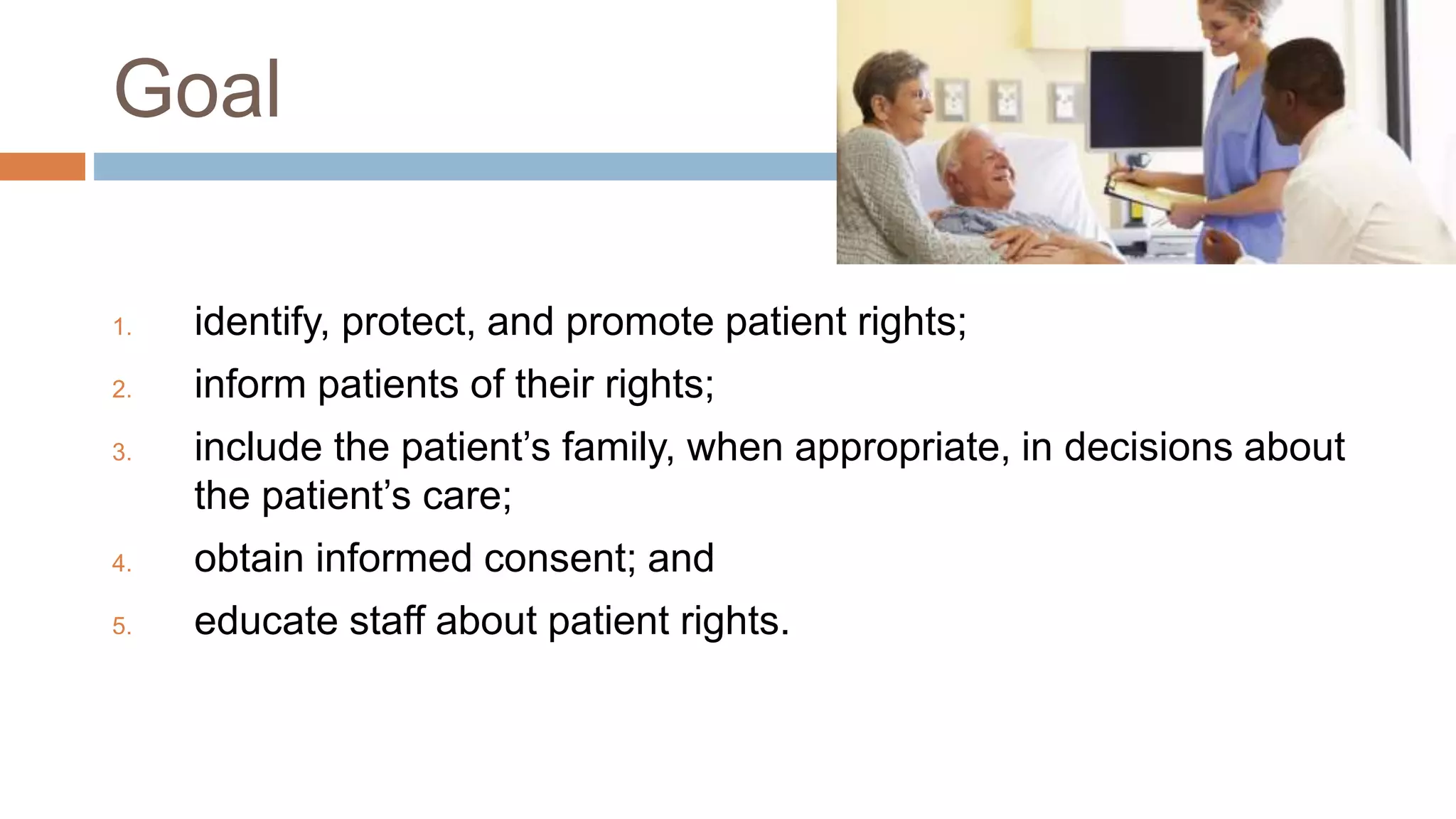
1. identify, protect, and promote patient rights;
2. inform patients of their rights;
3. include the patient’s family, when appropriate, in decisions about
the patient’s care;
4. obtain informed consent; and
5. educate staff about patient rights.
Patient and Family Rights (PFR)
 6 Standar – Total 14 poin
PFR
1(P) 1,2,3(P),4,5 RS mendukung proses penerapan hak pasien selama dirawat
2 1(P), 2 Inform consent saat dirawat dan diberi kesempatan
memutuskan
3(P) - RS memberikan info tentang konflik, beda pendapat dalam
pelayanan pasien
4 - Pasien diberitahu hak kewajiban dg cara dan bahasa mereka
5 1(P),2(P),3,
4
Informed consent saat MRS / Poliklinis
6 1(P) RS memberi info cara donor organ
(P) require the hospital to have a written policy, procedure, program, or other written
document for specific processes.
PFR 1-4
 PFR.1 The hospital is responsible for providing processes that
support patients’ and families’ rights during care. (P)
PFR.1.1 sd PFR 1.5
 PFR.2 Patients are informed about all aspects of their medical care
and treatment and participate in care and treatment decisions.
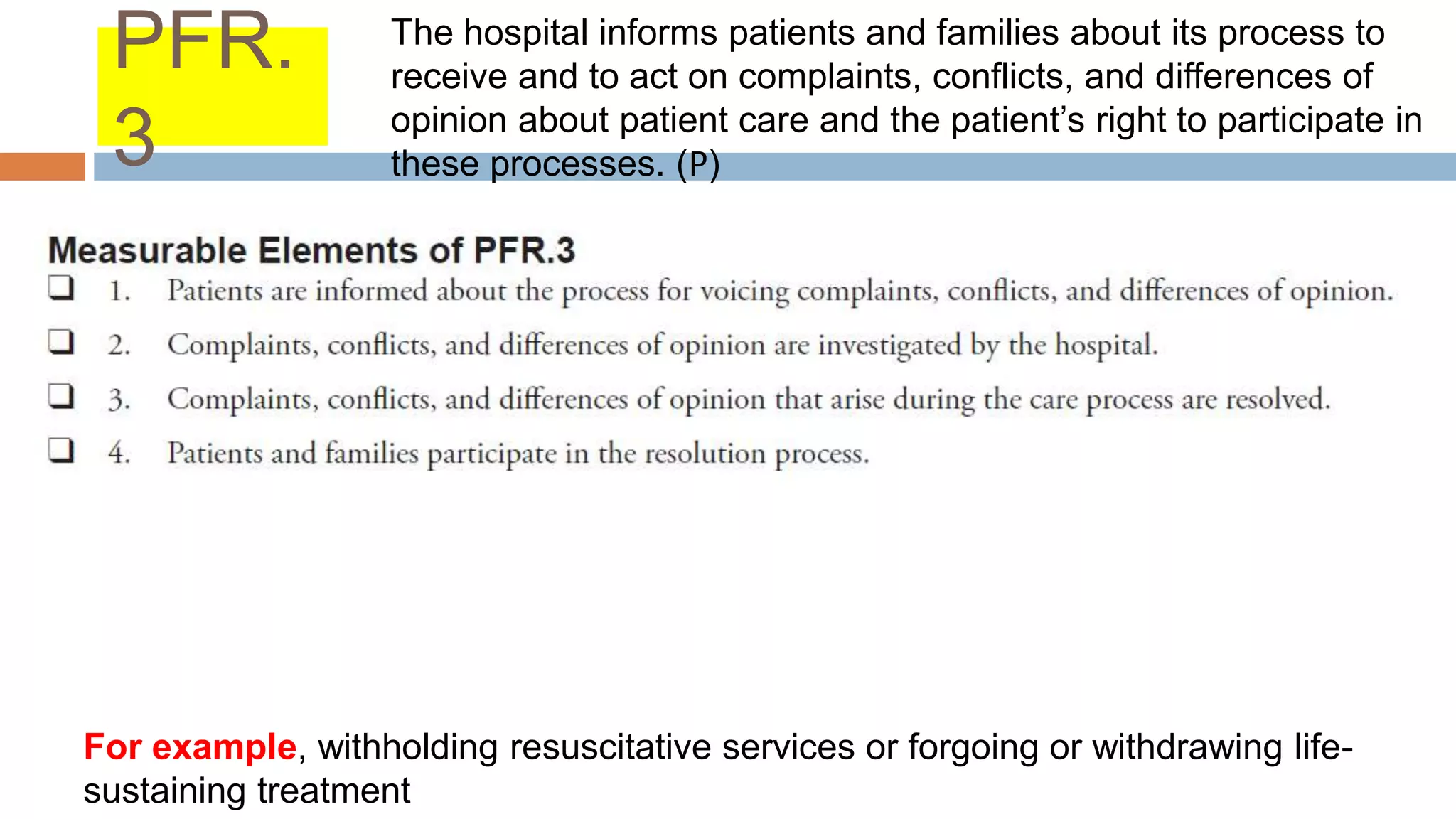
 PFR.3 The hospital informs patients and families about its process
to receive and to act on complaints, conflicts, and differences of
opinion about patient care and the patient’s right to participate in
these processes.
 PFR.4 All patients are informed about their rights and
responsibilities in a manner and language they can understand.
Standar
PFR 5-6
 PFR.5 General consent for treatment, if obtained when a patient is
admitted as an inpatient or is registered for the first time as an
outpatient, is clear in its scope and limits.
Organ and Tissue Donation
 PFR.6 The hospital informs patients and families about how to
choose to donate organs and other tissues.
General Consent
PFR.
1
For example, the patient may not wish to have a diagnosis shared with family, or
the family may not want the patient to know his or her diagnosis.
The hospital is responsible for providing
processes that support patients’ and
families’ rights during care. (P)
PFR.1 The hospital is responsible for providing processes that support
patients’ and families’ rights during care. (P)
 PFR.1.1 The hospital seeks to reduce physical, language, cultural, and
other barriers to access and delivery of services.
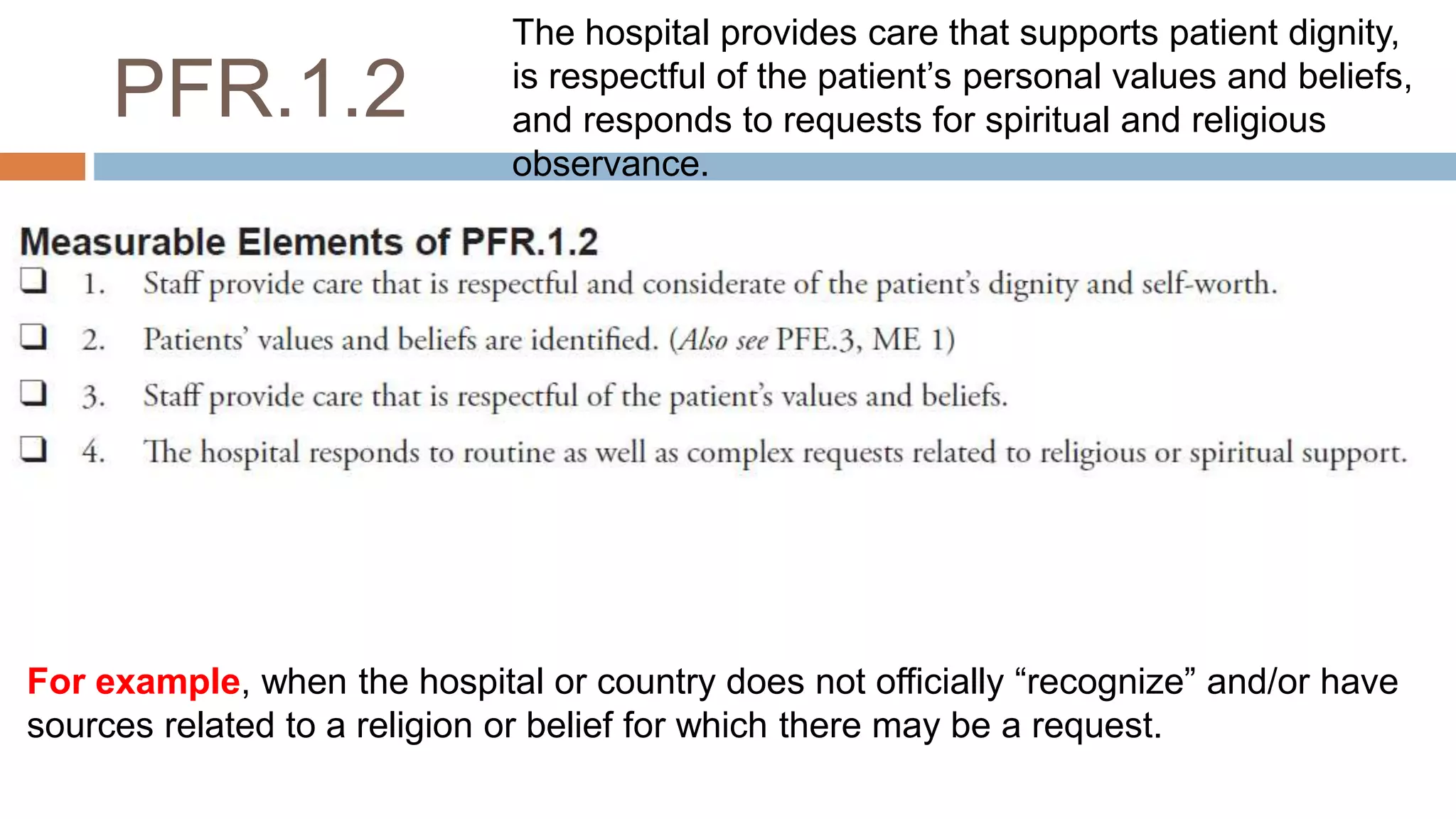
 PFR.1.2 The hospital provides care that supports patient dignity, is
respectful of the patient’s personal values and beliefs, and responds to
requests for spiritual and religious observance.
 PFR.1.3 The patient’s rights to privacy and confidentiality of care and
information are respected. (𝖯)
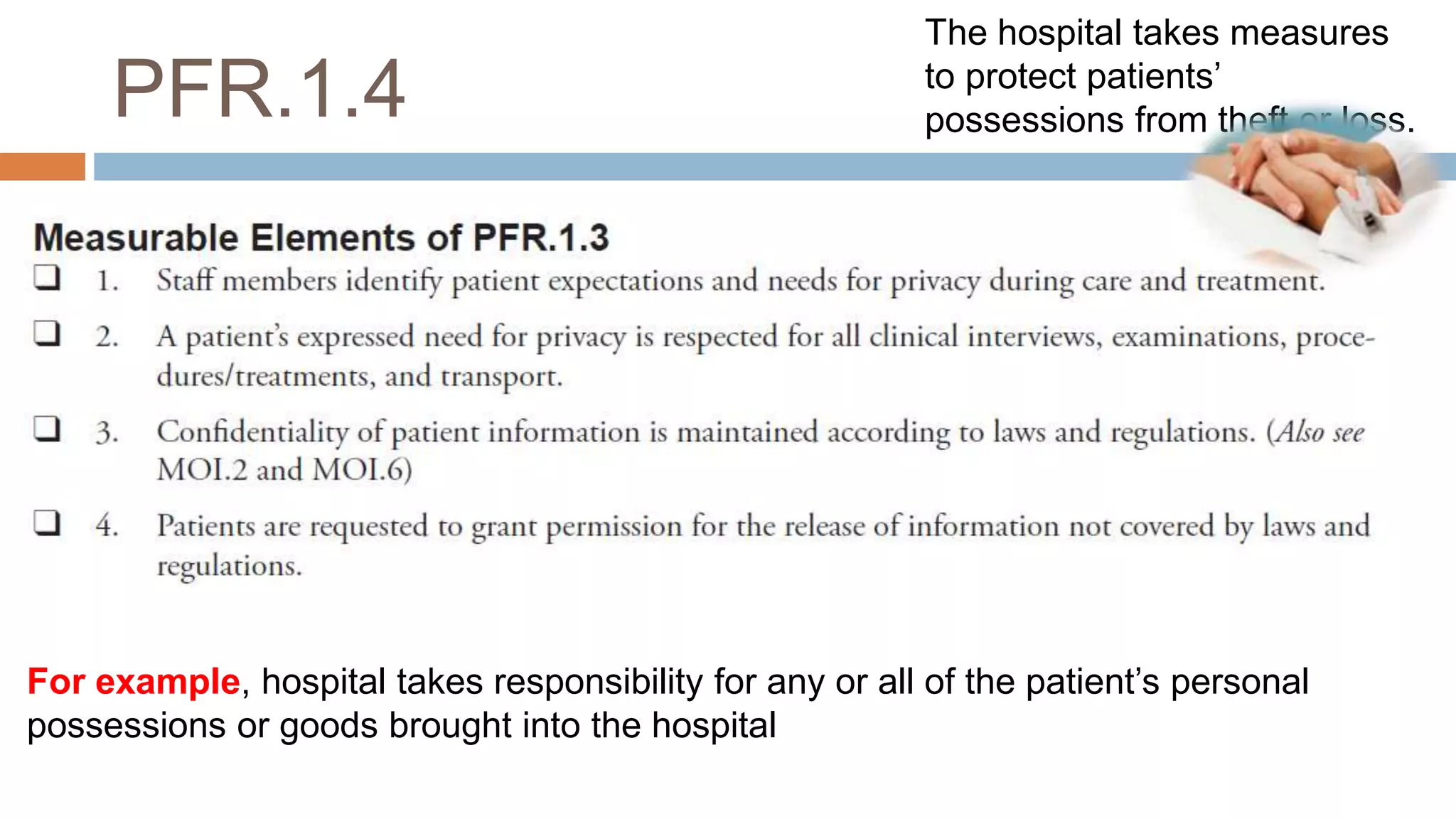
 PFR.1.4 The hospital takes measures to protect patients’ possessions
from theft or loss.
 PFR.1.5 Patients are protected from physical assault, and populations at
risk are identified and protected from additional vulnerabilities.
PFR.1.1
For example, patients may be aged, have disabilities, speak multiple languages or
dialects, be culturally diverse, or present other barriers that make the process of
accessing and receiving care very difficult.
The hospital seeks to reduce physical,
language, cultural, and other barriers to
access and delivery of services.
PFR.1.2
For example, when the hospital or country does not officially “recognize” and/or have
sources related to a religion or belief for which there may be a request.
The hospital provides care that supports patient dignity,
is respectful of the patient’s personal values and beliefs,
and responds to requests for spiritual and religious
observance.
PFR.1.3
For example, Staff respects patient privacy and confidentiality by not posting
confidential information on the patient’s door or at the nursing station and by not
holding patient-related discussions in public places.
The patient’s rights to privacy
and confidentiality of care and
information are respected. (𝖯)
PFR.1.4
For example, hospital takes responsibility for any or all of the patient’s personal
possessions or goods brought into the hospital
The hospital takes measures
to protect patients’
possessions from theft or loss.
PFR.1.5
For example, hospital is responsible for protecting patients from physical assault by
visitors, other patients, and staff; neglected, fire
Patients are protected from physical
assault, and populations at risk are
identified and protected from additional
vulnerabilities.
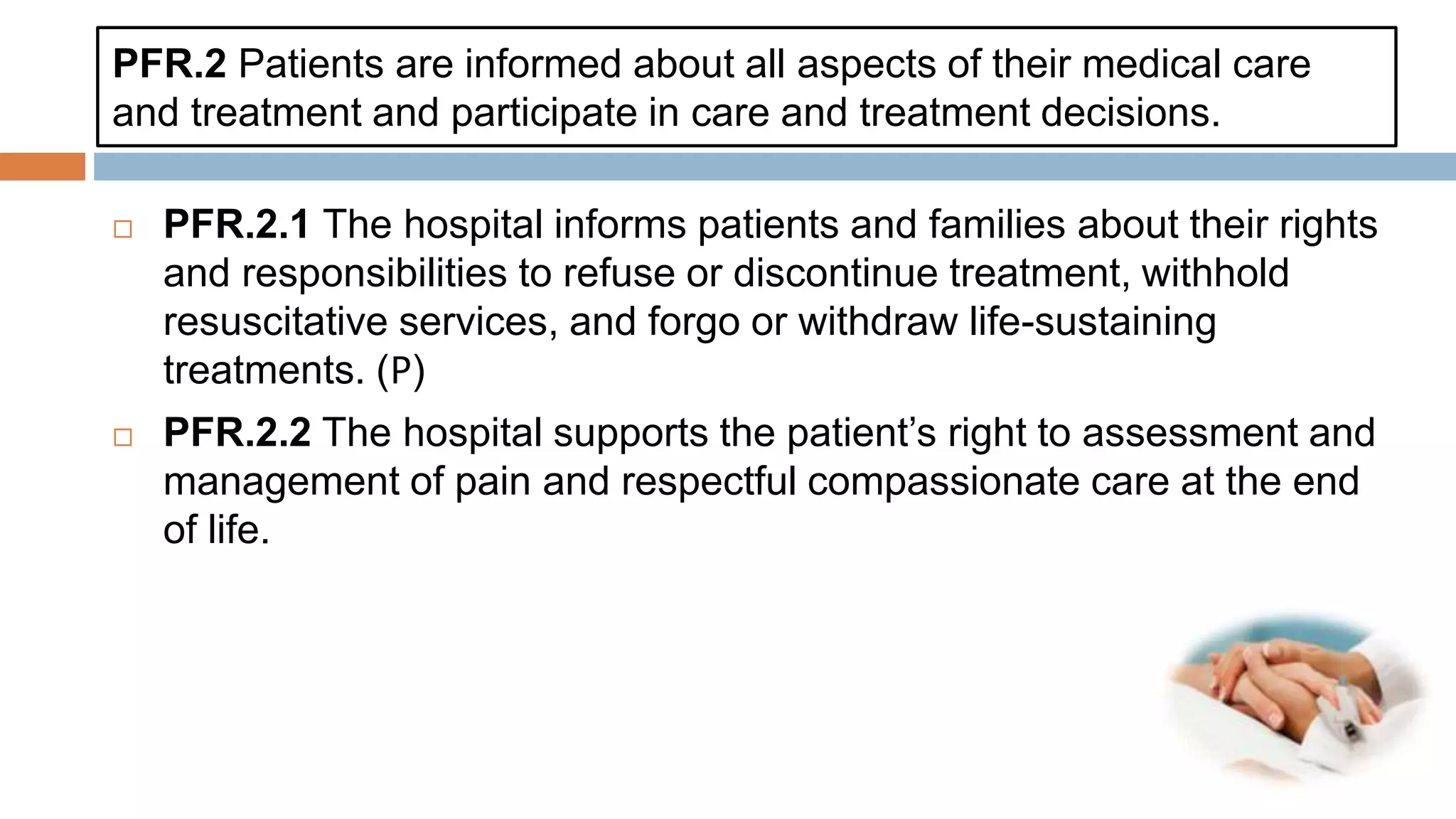
PFR.2 Patients are informed about all aspects of their medical care
and treatment and participate in care and treatment decisions.
 PFR.2.1 The hospital informs patients and families about their rights
and responsibilities to refuse or discontinue treatment, withhold
resuscitative services, and forgo or withdraw life-sustaining
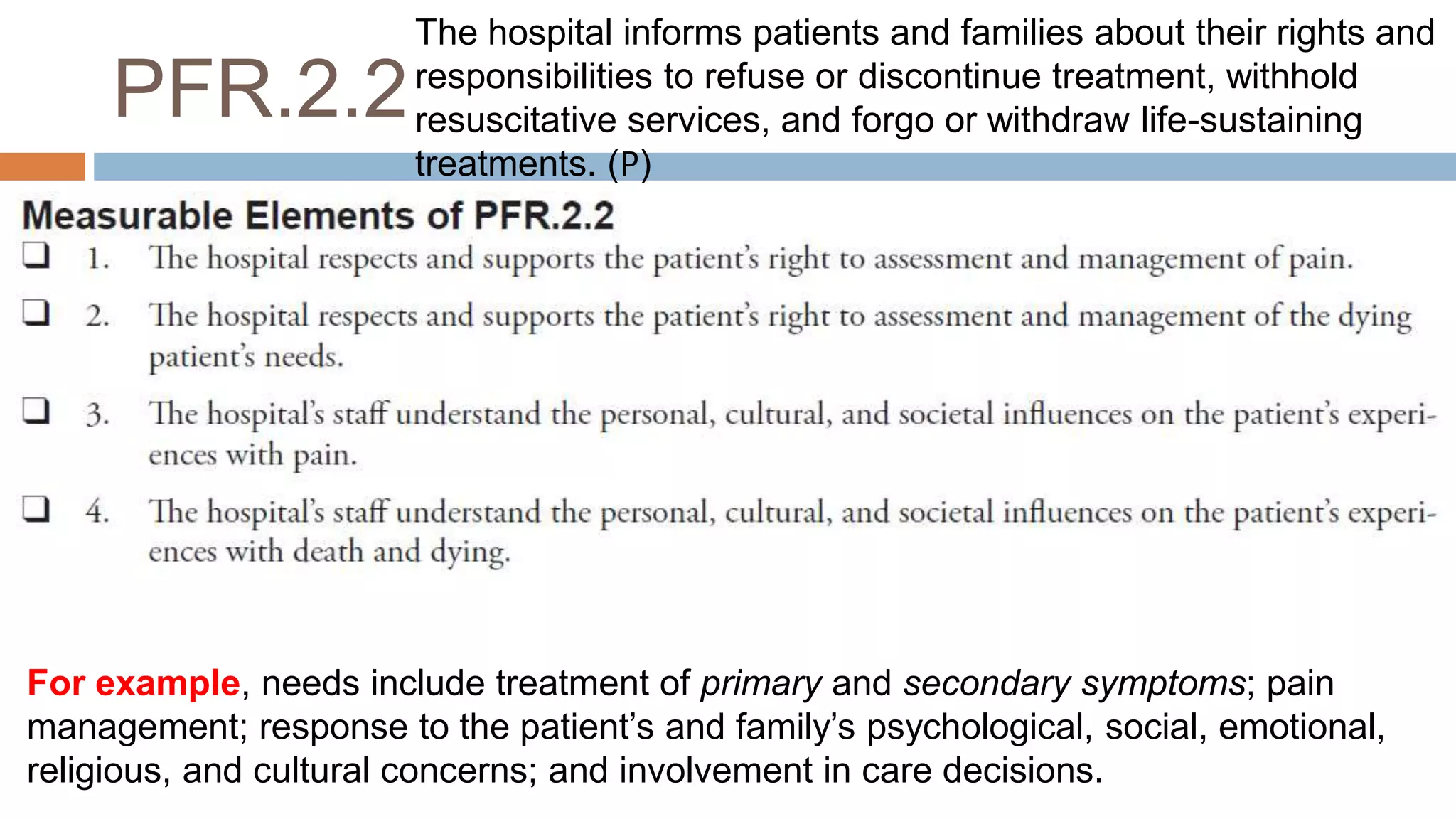
treatments. (𝖯)
 PFR.2.2 The hospital supports the patient’s right to assessment and
management of pain and respectful compassionate care at the end
of life.
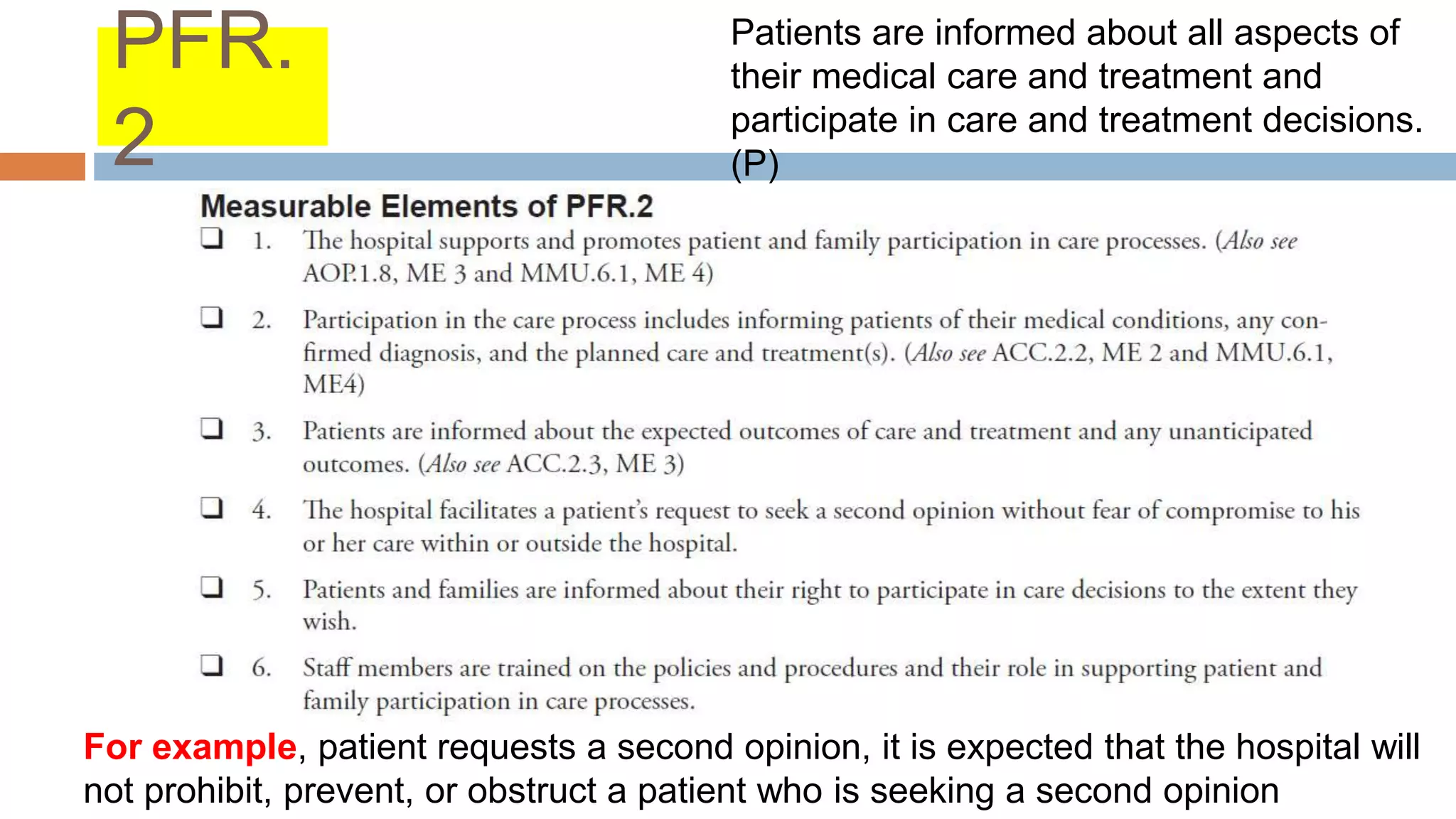
PFR.
2
For example, patient requests a second opinion, it is expected that the hospital will
not prohibit, prevent, or obstruct a patient who is seeking a second opinion
Patients are informed about all aspects of
their medical care and treatment and
participate in care and treatment decisions.
(P)
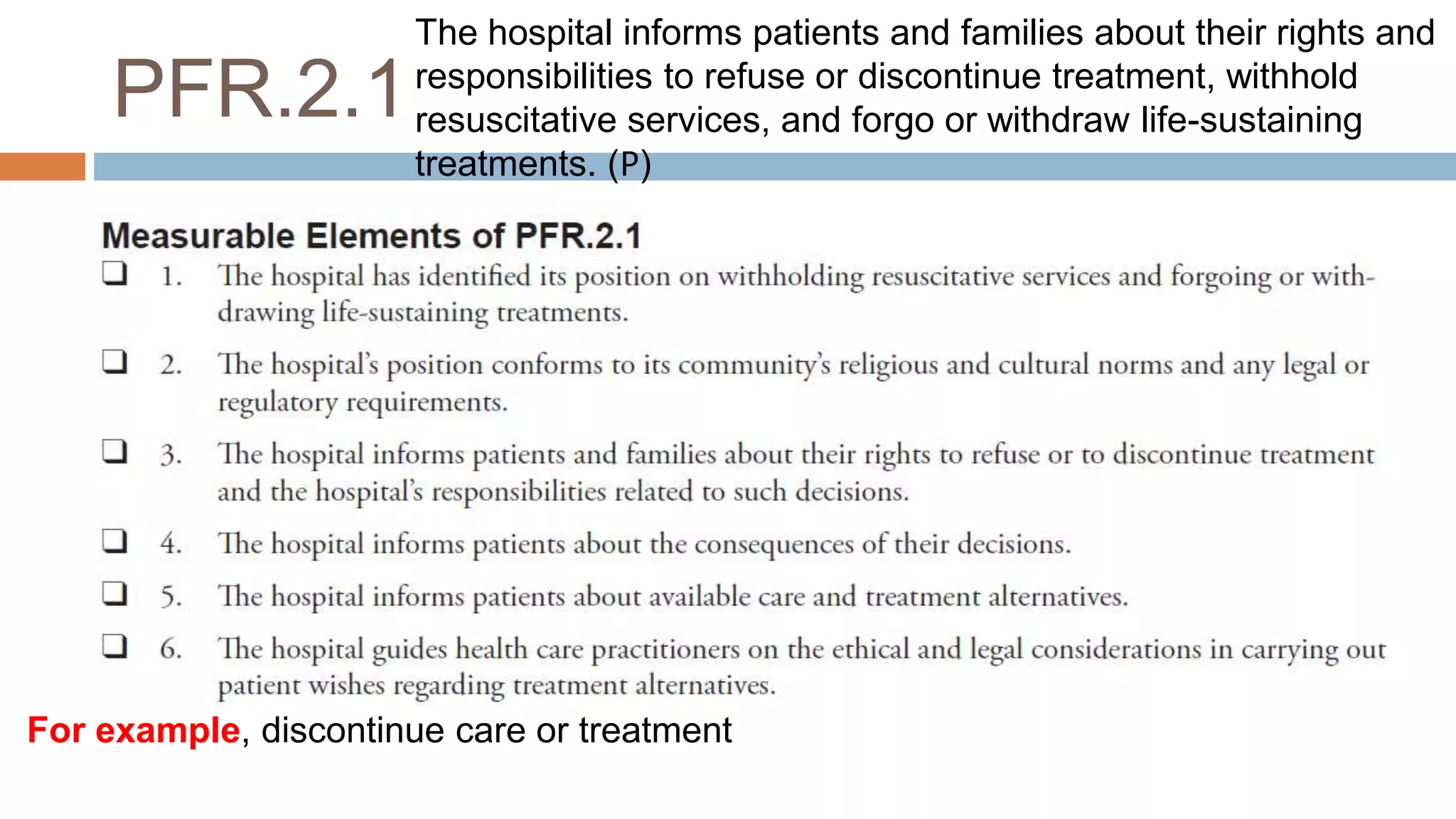
PFR.2.1
For example, discontinue care or treatment
The hospital informs patients and families about their rights and
responsibilities to refuse or discontinue treatment, withhold
resuscitative services, and forgo or withdraw life-sustaining
treatments. (𝖯)
PFR.2.2
For example, needs include treatment of primary and secondary symptoms; pain
management; response to the patient’s and family’s psychological, social, emotional,
religious, and cultural concerns; and involvement in care decisions.
The hospital informs patients and families about their rights and
responsibilities to refuse or discontinue treatment, withhold
resuscitative services, and forgo or withdraw life-sustaining
treatments. (𝖯)
PFR.
3
For example, withholding resuscitative services or forgoing or withdrawing life-
sustaining treatment
The hospital informs patients and families about its process to
receive and to act on complaints, conflicts, and differences of
opinion about patient care and the patient’s right to participate in
these processes. (𝖯)
PFR.
4
For example, hospital prepares a written statement of patient and family rights
and responsibilities that is given to patients. When written communication is not
effective or appropriate, the patient and family are informed of their rights and
responsibilities in a language and manner they can understand
All patients are informed about their rights and
responsibilities in a manner and language
they can understand.
PFR.
5
For example, The hospital defines how a general consent is documented in the
patient’s medical record.
General consent for treatment, if obtained when a
patient is admitted as an inpatient or is registered
for the first time as an outpatient, is clear in its
scope and limits. (𝖯)
PFR.5 General consent for treatment, if obtained when a
patient is admitted as an inpatient or is registered for the
first time as an outpatient, is clear in its scope and limits. (𝖯
) PFR.5.1 Patient informed consent is obtained through a process
defined by the hospital and carried out by trained staff in a manner and
language the patient can understand. (P)
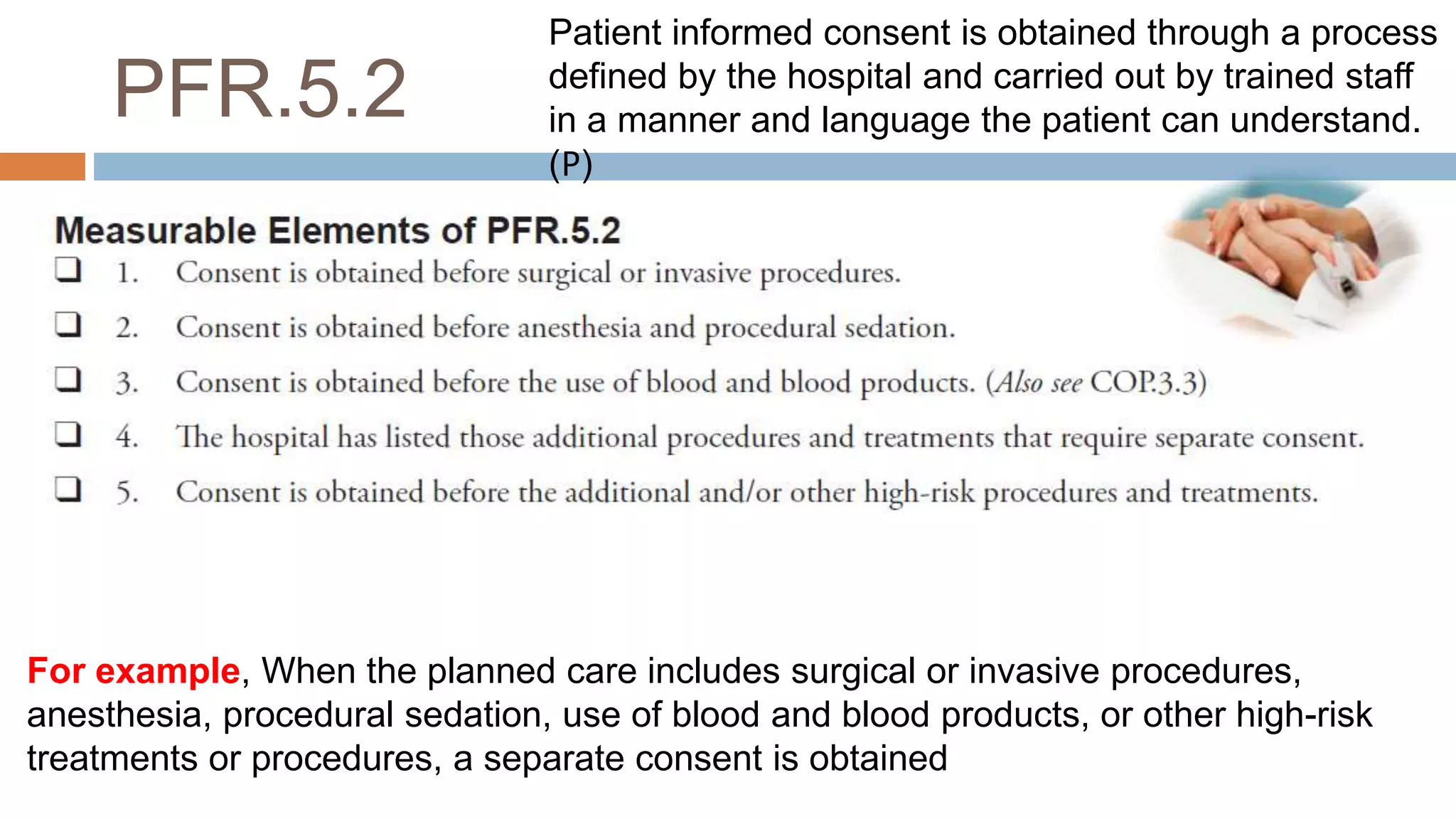
 PFR.5.2 Informed consent is obtained before surgery, anesthesia,
procedural sedation, use of blood and blood products, and other high-
risk treatments and procedures. (𝖯)
 PFR.5.3 Patients and families receive adequate information about the
patient’s condition, proposed treatment(s) or procedure(s), and health
care practitioners so that they can grant consent and make care
decisions.
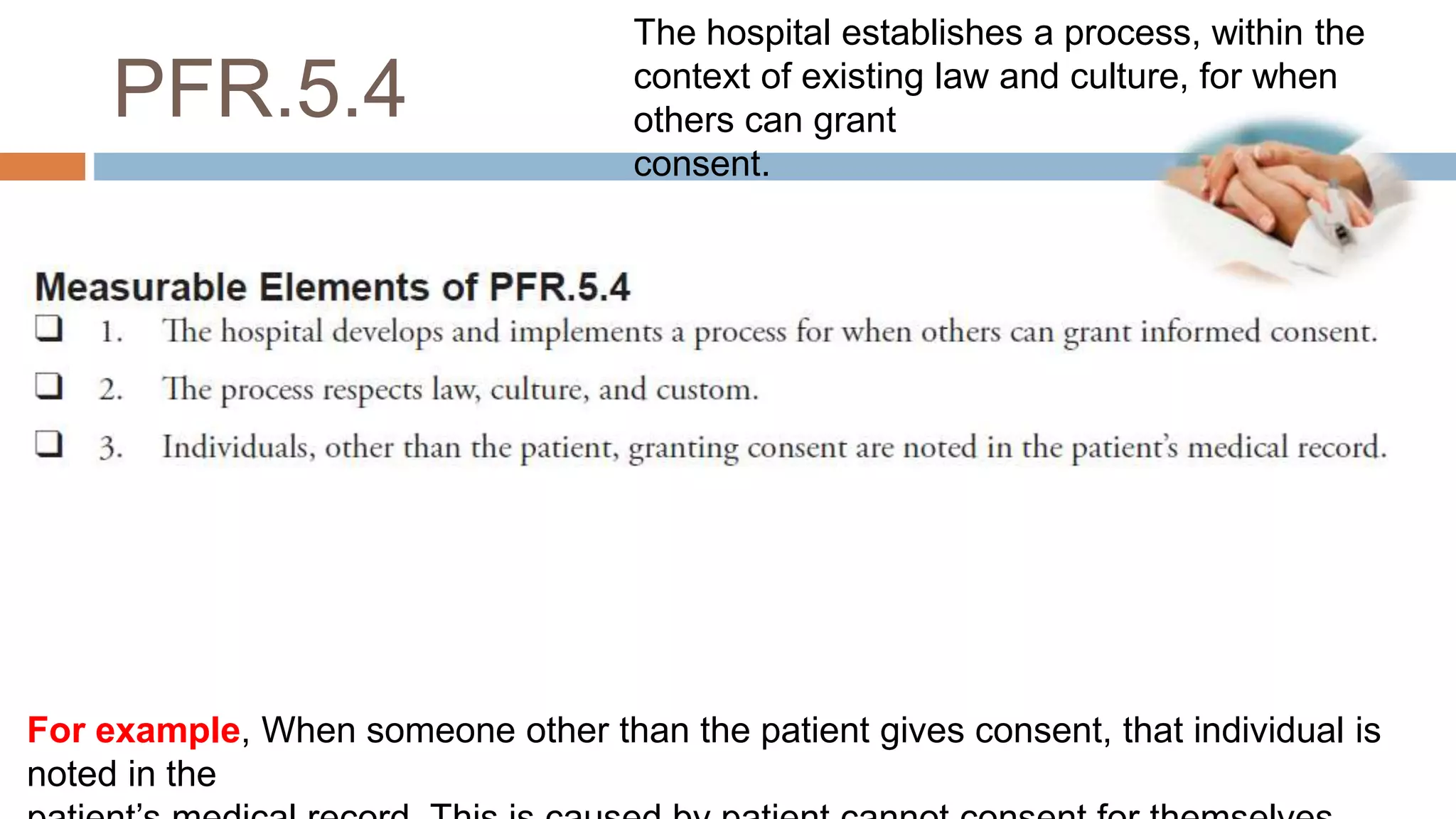
 PFR.5.4 The hospital establishes a process, within the context of
existing law and culture, for when others can grant consent.
PFR.5.1
For example, Patients and families are informed as to which tests, procedures,
treatments require consent and how they can give consent
Patient informed consent is obtained through a process
defined by the hospital and carried out by trained staff
in a manner and language the patient can understand.
(𝖯)
PFR.5.2
For example, When the planned care includes surgical or invasive procedures,
anesthesia, procedural sedation, use of blood and blood products, or other high-risk
treatments or procedures, a separate consent is obtained
Patient informed consent is obtained through a process
defined by the hospital and carried out by trained staff
in a manner and language the patient can understand.
(𝖯)
PFR.5.3
For example, see above
Patients and families receive adequate information about the
patient’s condition, proposed treatment(s) or procedure(s), and
health care practitioners so that they can grant consent and
make care decisions.
following elements are included in the informed consent process and
explained to the patient:
PFR.5.3
For example,
Patients and families receive adequate information about the
patient’s condition, proposed treatment(s) or procedure(s), and
health care practitioners so that they can grant consent and
make care decisions.
PFR.5.4
For example, When someone other than the patient gives consent, that individual is
noted in the
The hospital establishes a process, within the
context of existing law and culture, for when
others can grant
consent.
PFR.
6
For example, see above
The hospital informs patients
and families about how to
choose to donate organs and
other tissues.
Organ and Tissue Donation
PFR.6 The hospital informs patients and families about
how to choose to donate organs and other tissues.
 PFR.6.1 The hospital provides oversight for the process of
organ and tissue procurement. (𝖯)
PFR.6.1
For example, see above
The hospital provides
oversight for the process of
organ and tissue
procurement. (𝖯)
Thank You

Patient and Family Right JCI 6

  • 1.
    PATIENT AND FAMILY RIGHTS(PFR) - 6 - JCI 6 Alfian Nur Rosyid MD, Pulmonologist, FAPSR Universitas Airlangga, Surabaya, Indonesia
  • 2.
    Overview  Each patientand his or her family is unique, with their own needs, strengths, values, and beliefs.  Health care organizations work to establish trust and open communication with patients and to understand and protect each patient’s cultural, psychosocial, and spiritual values.  Patient care outcomes can be improved when patients and their families who make decisions on their behalf
  • 3.
    Goal 1. identify, protect,and promote patient rights; 2. inform patients of their rights; 3. include the patient’s family, when appropriate, in decisions about the patient’s care; 4. obtain informed consent; and 5. educate staff about patient rights.
  • 4.
    Patient and FamilyRights (PFR)  6 Standar – Total 14 poin PFR 1(P) 1,2,3(P),4,5 RS mendukung proses penerapan hak pasien selama dirawat 2 1(P), 2 Inform consent saat dirawat dan diberi kesempatan memutuskan 3(P) - RS memberikan info tentang konflik, beda pendapat dalam pelayanan pasien 4 - Pasien diberitahu hak kewajiban dg cara dan bahasa mereka 5 1(P),2(P),3, 4 Informed consent saat MRS / Poliklinis 6 1(P) RS memberi info cara donor organ (P) require the hospital to have a written policy, procedure, program, or other written document for specific processes.
  • 5.
    PFR 1-4  PFR.1The hospital is responsible for providing processes that support patients’ and families’ rights during care. (P) PFR.1.1 sd PFR 1.5  PFR.2 Patients are informed about all aspects of their medical care and treatment and participate in care and treatment decisions.  PFR.3 The hospital informs patients and families about its process to receive and to act on complaints, conflicts, and differences of opinion about patient care and the patient’s right to participate in these processes.  PFR.4 All patients are informed about their rights and responsibilities in a manner and language they can understand. Standar
  • 6.
    PFR 5-6  PFR.5General consent for treatment, if obtained when a patient is admitted as an inpatient or is registered for the first time as an outpatient, is clear in its scope and limits. Organ and Tissue Donation  PFR.6 The hospital informs patients and families about how to choose to donate organs and other tissues. General Consent
  • 7.
    PFR. 1 For example, thepatient may not wish to have a diagnosis shared with family, or the family may not want the patient to know his or her diagnosis. The hospital is responsible for providing processes that support patients’ and families’ rights during care. (P)
  • 8.
    PFR.1 The hospitalis responsible for providing processes that support patients’ and families’ rights during care. (P)  PFR.1.1 The hospital seeks to reduce physical, language, cultural, and other barriers to access and delivery of services.  PFR.1.2 The hospital provides care that supports patient dignity, is respectful of the patient’s personal values and beliefs, and responds to requests for spiritual and religious observance.  PFR.1.3 The patient’s rights to privacy and confidentiality of care and information are respected. (𝖯)  PFR.1.4 The hospital takes measures to protect patients’ possessions from theft or loss.  PFR.1.5 Patients are protected from physical assault, and populations at risk are identified and protected from additional vulnerabilities.
  • 9.
    PFR.1.1 For example, patientsmay be aged, have disabilities, speak multiple languages or dialects, be culturally diverse, or present other barriers that make the process of accessing and receiving care very difficult. The hospital seeks to reduce physical, language, cultural, and other barriers to access and delivery of services.
  • 10.
    PFR.1.2 For example, whenthe hospital or country does not officially “recognize” and/or have sources related to a religion or belief for which there may be a request. The hospital provides care that supports patient dignity, is respectful of the patient’s personal values and beliefs, and responds to requests for spiritual and religious observance.
  • 11.
    PFR.1.3 For example, Staffrespects patient privacy and confidentiality by not posting confidential information on the patient’s door or at the nursing station and by not holding patient-related discussions in public places. The patient’s rights to privacy and confidentiality of care and information are respected. (𝖯)
  • 12.
    PFR.1.4 For example, hospitaltakes responsibility for any or all of the patient’s personal possessions or goods brought into the hospital The hospital takes measures to protect patients’ possessions from theft or loss.
  • 13.
    PFR.1.5 For example, hospitalis responsible for protecting patients from physical assault by visitors, other patients, and staff; neglected, fire Patients are protected from physical assault, and populations at risk are identified and protected from additional vulnerabilities.
  • 14.
    PFR.2 Patients areinformed about all aspects of their medical care and treatment and participate in care and treatment decisions.  PFR.2.1 The hospital informs patients and families about their rights and responsibilities to refuse or discontinue treatment, withhold resuscitative services, and forgo or withdraw life-sustaining treatments. (𝖯)  PFR.2.2 The hospital supports the patient’s right to assessment and management of pain and respectful compassionate care at the end of life.
  • 15.
    PFR. 2 For example, patientrequests a second opinion, it is expected that the hospital will not prohibit, prevent, or obstruct a patient who is seeking a second opinion Patients are informed about all aspects of their medical care and treatment and participate in care and treatment decisions. (P)
  • 16.
    PFR.2.1 For example, discontinuecare or treatment The hospital informs patients and families about their rights and responsibilities to refuse or discontinue treatment, withhold resuscitative services, and forgo or withdraw life-sustaining treatments. (𝖯)
  • 17.
    PFR.2.2 For example, needsinclude treatment of primary and secondary symptoms; pain management; response to the patient’s and family’s psychological, social, emotional, religious, and cultural concerns; and involvement in care decisions. The hospital informs patients and families about their rights and responsibilities to refuse or discontinue treatment, withhold resuscitative services, and forgo or withdraw life-sustaining treatments. (𝖯)
  • 18.
    PFR. 3 For example, withholdingresuscitative services or forgoing or withdrawing life- sustaining treatment The hospital informs patients and families about its process to receive and to act on complaints, conflicts, and differences of opinion about patient care and the patient’s right to participate in these processes. (𝖯)
  • 19.
    PFR. 4 For example, hospitalprepares a written statement of patient and family rights and responsibilities that is given to patients. When written communication is not effective or appropriate, the patient and family are informed of their rights and responsibilities in a language and manner they can understand All patients are informed about their rights and responsibilities in a manner and language they can understand.
  • 20.
    PFR. 5 For example, Thehospital defines how a general consent is documented in the patient’s medical record. General consent for treatment, if obtained when a patient is admitted as an inpatient or is registered for the first time as an outpatient, is clear in its scope and limits. (𝖯)
  • 21.
    PFR.5 General consentfor treatment, if obtained when a patient is admitted as an inpatient or is registered for the first time as an outpatient, is clear in its scope and limits. (𝖯 ) PFR.5.1 Patient informed consent is obtained through a process defined by the hospital and carried out by trained staff in a manner and language the patient can understand. (P)  PFR.5.2 Informed consent is obtained before surgery, anesthesia, procedural sedation, use of blood and blood products, and other high- risk treatments and procedures. (𝖯)  PFR.5.3 Patients and families receive adequate information about the patient’s condition, proposed treatment(s) or procedure(s), and health care practitioners so that they can grant consent and make care decisions.  PFR.5.4 The hospital establishes a process, within the context of existing law and culture, for when others can grant consent.
  • 22.
    PFR.5.1 For example, Patientsand families are informed as to which tests, procedures, treatments require consent and how they can give consent Patient informed consent is obtained through a process defined by the hospital and carried out by trained staff in a manner and language the patient can understand. (𝖯)
  • 23.
    PFR.5.2 For example, Whenthe planned care includes surgical or invasive procedures, anesthesia, procedural sedation, use of blood and blood products, or other high-risk treatments or procedures, a separate consent is obtained Patient informed consent is obtained through a process defined by the hospital and carried out by trained staff in a manner and language the patient can understand. (𝖯)
  • 24.
    PFR.5.3 For example, seeabove Patients and families receive adequate information about the patient’s condition, proposed treatment(s) or procedure(s), and health care practitioners so that they can grant consent and make care decisions. following elements are included in the informed consent process and explained to the patient:
  • 25.
    PFR.5.3 For example, Patients andfamilies receive adequate information about the patient’s condition, proposed treatment(s) or procedure(s), and health care practitioners so that they can grant consent and make care decisions.
  • 26.
    PFR.5.4 For example, Whensomeone other than the patient gives consent, that individual is noted in the The hospital establishes a process, within the context of existing law and culture, for when others can grant consent.
  • 27.
    PFR. 6 For example, seeabove The hospital informs patients and families about how to choose to donate organs and other tissues. Organ and Tissue Donation
  • 28.
    PFR.6 The hospitalinforms patients and families about how to choose to donate organs and other tissues.  PFR.6.1 The hospital provides oversight for the process of organ and tissue procurement. (𝖯)
  • 29.
    PFR.6.1 For example, seeabove The hospital provides oversight for the process of organ and tissue procurement. (𝖯)
  • 31.

Editor's Notes

  • #10 Terkait bahasa, dialek yg berbeda antara staf dan pasien.
  • #11 RS menyediakan pelayanan agama, kepercayaan yg tidak tersedia di RS tsb
  • #12 Staf merahasiakan kondisi pasien, tdk boleh menulis diagnosis di papan atau membicarakan di lokasi umum
  • #13 RS tanggung jawab atas barang2 pasien tidak boleh hilang atau dicuri
  • #14 Pasien dilindungi dari serangan asing, pasien lain, staf. Tidak boleh bertengkar dengan pasien. Dilindungi keselamatan dari api
  • #16 Tidak menghambat 2nd opini, diberikan kesempatan dg memberikan hasil lab, foto, resume dll
  • #17 Menolak tindakan terapi, DNR
  • #18 Menolak tindakan terapi, DNR
  • #21 Ada lembar hak kewajiban pasien tertulis yg bisa dibaca pasien
  • #23 General consent diletakkan dalam rekam medis
  • #25 RS menjelaskan tindakan dan pasien tanda tangan informed consent
  • #26 RS menyiapkan informed consent yg spesifik tiap tindakan
  • #29 Menolak tindakan terapi, DNR