




Our Mission Statement
“Promoting & encouraging education &
training & improving & advancing
employment prospects for individuals
& thereby contributing to the success
of small & medium employers.”
“By the end of 2015, Pathway will be
recognised as one of the leading
employment & training organisations
in the West Midlands, making a real
difference to people’s lives & to the
success of individuals & organisations
through high-quality learning,
employment opportunities &
capacity building services.”
- Safaraz Ali, Director
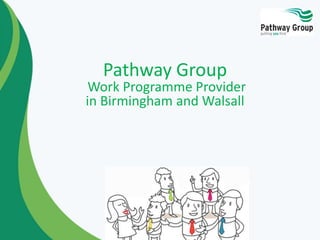
Pathway Group
Work Programme Provider
in Birmingham and Walsall
• Sales First Strategy
• Prioritise the Performance Impacters.
Key Drivers:
• 5 I’s
• Deeper Assessment & Application
• Identify what activities you can complete
at each stage.
• Increased JE’s
• Increased Subsequent JE’s
• Structure, Timetable & Monitoring
Enhanced Customer
Delivery Model
Definition of Insanity:
“To keep doing what you are
currently doing, but expect to
get different results”
No Holding Back!
“There’s a job for
everyone”
No more RED, AMBER, GREEN
Invite Stage
Of our work programme delivery
The Invite Stage is the first contact that is made with the
customer where we invite them to the centre.
The following is done or discussed at the Invite stage:
• Confirm Customers Personal Details e.g.:
National Insurance Number, Address, Date of
Birth, Disability Status (If the customer has a
disability this will be imputed in the Minimum
Standards Tab under the Equality and Diversity
Field), Benefit they are claiming, JCP details,
Gender, Stage on Programme (Summary
Page: Invite) & Telephone contact numbers.
• Advice the customer to bring in their ID & CV
to their first appointment with the advisor.
• Post out the Welcome Pack including the
ESF Leaflet with the appointment letter.
• Minimum Standards Tab: Tick Welcome
Pack Given
Additional changes:
• At the Invite Stage we will now confirm the
customers Email address & gather their job
goals.
Fill (someone) with the urge or ability to do or feel
something, especially to do something creative.
Stimulate Motivate Persuade
Encourage Influence Move
Energize Incite Impel
Pathway to Employment
Listen to the client to find out reasons
why they are not in employment.
You will establish what barriers they may
have. Do they want to work or are they
content being a benefit claimant.
Listen
Can’t Do... Won’t Do...
What are the barriers to work?
Childcare
Single parents face problems with childcare
arrangements, or have been unemployed for many
years due to raising their family.
Identify what skills they posses, & what sort of work
they are able to do & what support that is available
for them for childcare.
As a diverse community we have many clients who have
linguistic barriers.
• What have they done to integrate into society and
learn the national language so they are confident in
seeking employment, securing employment & carrying
out their duties when employed.
• Where can we signpost these clients to improve their
linguistic & written skills?
ESOL
Some clients lack confidence & are unable
to work with others, or take part in group/one to one sessions.
They can advantage of In-fit to help them overcome their
barriers & confidence issues.
Confidence
Better off calculation
& debt management
• Does the client know what other financial
help is available if the are in work?
• Do you they how much better they would be
better off?
• Have we signposted clients to other agencies
for their financial issues?
• How they can eliminate their debt?
MOTIVATION
Mostly all claimants need motivation to return back to work. They
may have lost hope or have no motivation, due to either
socio/economic barriers, their comfort zone, other elements
affecting their financial & personal circumstances, i.e. child
support, maintenance, lack of skills, housing, FEAR of returning
back to employment or being employed.
Most clients may not have the relevant
TOOLS to apply for jobs & how to apply for
jobs & sustaining employment.
What do they need?
CV & Cover/Spec Letters
CV’s
• How good is their cv?
• Is their gaps in employment? Why?
• Does their profile reflect them?
• What are their skills?
• Skills is something you have acquired through training,
education & through previous work experience.
Cover letter/Spec Letter:
• Why is this required?
• Why would you attach this to your cv when applying for a
job?
• Does the client know who the local
employers are?
• Do they know if their are hidden
meaning in job adverts?
• Do they know the companies that
exist in the job search radius?
• Are they aware of seasonal variations
in sectors of employment?
Knowing the local Job Market
• Can the clients use a computer?
• Who do we signpost them to/where can
they learn how to use a computer?
• Do they know how easy it is when
applying for vacancies via the internet?
• Do they have an email account?
• Do they have a UJM account?
• Do they have access to a computer?
IT/Computer Skills
• Do our clients know how to complete an
application form?
• Are they supplying the information required
by the employer on the application form?
• Is the form completed fully?
• Is the writing readable?
• Is the application form completed neatly?
• Is the form clean?
Job Application
• Many clients are unaware that first
impressions matters.
• Many clients unfortunately needs to be
educated how to present themselves
when attending interviews, cold calling
companies & their every day life.
• The impact of cleanliness does ripple
through the family & their behaviour
would either have a positive or negative
impact of who they are constantly
spending time with.
Personal Hygiene & Appearance
• Does the client know what to do before they attend
an interview & during an interview?
• What edge would they have over other applicants?
• How can they be successful in the interview?
Interview Techniques
• How can we make the client more marketable?
• Can we up skill our client?
• Is their any training that can improve their
chances of employment through training?
• Would the client benefit from an
Apprenticeship leading to sustainable
employment & a career?
Training
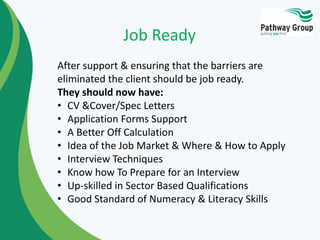
Are the barriers down?
After support & ensuring that the barriers are
eliminated the client should be job ready.
They should now have:
• CV &Cover/Spec Letters
• Application Forms Support
• A Better Off Calculation
• Idea of the Job Market & Where & How to Apply
• Interview Techniques
• Know how To Prepare for an Interview
• Up-skilled in Sector Based Qualifications
• Good Standard of Numeracy & Literacy Skills
Job Ready
RETURN TO WORK:
Clients should be ready for work, and if they start
creating barriers a ‘top and loop’ method should be
exercised and fast tracked through the process again to
ensure client understands they have no barriers to work
and should be able to return back into work.
We are 80% ready to achieve our KPi’s
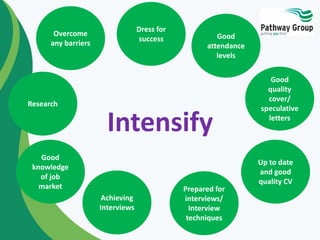
Intensify
Prepared for
interviews/
Interview
techniques
Up to date
and good
quality CV
Good
quality
cover/
speculative
letters
Achieving
Interviews
Good
attendance
levels
Dress for
success
Overcome
any barriers
Research
Good
knowledge
of job
market
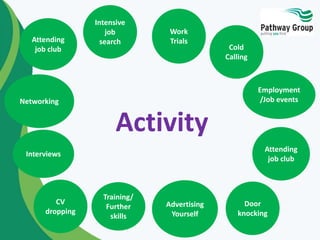
Activity
Advertising
Yourself
Interviews
Intensive
job
searchAttending
job club Cold
Calling
CV
dropping
Door
knocking
Attending
job club
Employment
/Job events
Training/
Further
skills
Work
Trials
Networking
Independence
In work support
• From here on in, the support from
Pathways2work does not stop.
• Clients will be contacted every two weeks by the
tracking team until work is more stable & we can
arrange for monthly calls if the client is happy
with this.
• Clients are contacted between the hours of 4pm
to 8pm.
• Clients will be asked whether the job they are
doing is still the same, the hours & the Line
Manager are all still the same.
• Clients are also asked if they are happy with
the job they are doing & they feel they need
any support.
• Clients need to be aware that from time to
time we may contact the employer & their
line manger to confirm their details.
Independence
Clients need to be told what kind of in
work support we offer such as:
• Travel
• Clothing
• Job Search
• Advice about Courses Available
• Further Training the Clients may need
• Clients need to be made aware that
support is continuous even if they are
employed.
In Work Support
In Work Support
• The most important part of in work support is to
build a relationship with the client . The client needs
to feel at ease with the tracking team when they are
contacted.
• Once a regular relationship is built the clients feel
more at ease.
• Our aim is to make sure even when the client
is jobbed they are still happy and willing to
continue with Pathway2work. But if they fall
out of work & want to return to ourselves for
support, then the client is welcome to, as long
as they are within the two years of attending
Pathway2work.
In Work Support
• Out of Work Customers: Customers
that have had a job entry not achieved
a job outcome no longer in work.
• Top 20
• Inspire Caseload
• Intensify Caseload
• Invigorate Caseload
• Independence: Customers that have
gone into work & require IWS.
Employment Advisor Caseload

Pathway2 work presentation- plan to become a successful work programme provider

  • 1.
    Our Mission Statement “Promoting& encouraging education & training & improving & advancing employment prospects for individuals & thereby contributing to the success of small & medium employers.”
  • 2.
    “By the endof 2015, Pathway will be recognised as one of the leading employment & training organisations in the West Midlands, making a real difference to people’s lives & to the success of individuals & organisations through high-quality learning, employment opportunities & capacity building services.” - Safaraz Ali, Director
  • 3.
    Pathway Group Work ProgrammeProvider in Birmingham and Walsall
  • 4.
    • Sales FirstStrategy • Prioritise the Performance Impacters. Key Drivers:
  • 5.
    • 5 I’s •Deeper Assessment & Application • Identify what activities you can complete at each stage. • Increased JE’s • Increased Subsequent JE’s • Structure, Timetable & Monitoring Enhanced Customer Delivery Model
  • 6.
    Definition of Insanity: “Tokeep doing what you are currently doing, but expect to get different results”
  • 7.
    No Holding Back! “There’sa job for everyone” No more RED, AMBER, GREEN
  • 8.
    Invite Stage Of ourwork programme delivery
  • 9.
    The Invite Stageis the first contact that is made with the customer where we invite them to the centre. The following is done or discussed at the Invite stage:
  • 10.
    • Confirm CustomersPersonal Details e.g.: National Insurance Number, Address, Date of Birth, Disability Status (If the customer has a disability this will be imputed in the Minimum Standards Tab under the Equality and Diversity Field), Benefit they are claiming, JCP details, Gender, Stage on Programme (Summary Page: Invite) & Telephone contact numbers.
  • 11.
    • Advice thecustomer to bring in their ID & CV to their first appointment with the advisor. • Post out the Welcome Pack including the ESF Leaflet with the appointment letter. • Minimum Standards Tab: Tick Welcome Pack Given
  • 12.
    Additional changes: • Atthe Invite Stage we will now confirm the customers Email address & gather their job goals.
  • 13.
    Fill (someone) withthe urge or ability to do or feel something, especially to do something creative. Stimulate Motivate Persuade Encourage Influence Move Energize Incite Impel
  • 14.
  • 15.
    Listen to theclient to find out reasons why they are not in employment. You will establish what barriers they may have. Do they want to work or are they content being a benefit claimant. Listen
  • 16.
  • 17.
    What are thebarriers to work?
  • 18.
    Childcare Single parents faceproblems with childcare arrangements, or have been unemployed for many years due to raising their family. Identify what skills they posses, & what sort of work they are able to do & what support that is available for them for childcare.
  • 19.
    As a diversecommunity we have many clients who have linguistic barriers. • What have they done to integrate into society and learn the national language so they are confident in seeking employment, securing employment & carrying out their duties when employed. • Where can we signpost these clients to improve their linguistic & written skills? ESOL
  • 20.
    Some clients lackconfidence & are unable to work with others, or take part in group/one to one sessions. They can advantage of In-fit to help them overcome their barriers & confidence issues. Confidence
  • 21.
    Better off calculation &debt management • Does the client know what other financial help is available if the are in work? • Do you they how much better they would be better off? • Have we signposted clients to other agencies for their financial issues? • How they can eliminate their debt?
  • 22.
    MOTIVATION Mostly all claimantsneed motivation to return back to work. They may have lost hope or have no motivation, due to either socio/economic barriers, their comfort zone, other elements affecting their financial & personal circumstances, i.e. child support, maintenance, lack of skills, housing, FEAR of returning back to employment or being employed.
  • 23.
    Most clients maynot have the relevant TOOLS to apply for jobs & how to apply for jobs & sustaining employment. What do they need?
  • 24.
  • 25.
    CV’s • How goodis their cv? • Is their gaps in employment? Why? • Does their profile reflect them? • What are their skills? • Skills is something you have acquired through training, education & through previous work experience. Cover letter/Spec Letter: • Why is this required? • Why would you attach this to your cv when applying for a job?
  • 26.
    • Does theclient know who the local employers are? • Do they know if their are hidden meaning in job adverts? • Do they know the companies that exist in the job search radius? • Are they aware of seasonal variations in sectors of employment? Knowing the local Job Market
  • 27.
    • Can theclients use a computer? • Who do we signpost them to/where can they learn how to use a computer? • Do they know how easy it is when applying for vacancies via the internet? • Do they have an email account? • Do they have a UJM account? • Do they have access to a computer? IT/Computer Skills
  • 28.
    • Do ourclients know how to complete an application form? • Are they supplying the information required by the employer on the application form? • Is the form completed fully? • Is the writing readable? • Is the application form completed neatly? • Is the form clean? Job Application
  • 29.
    • Many clientsare unaware that first impressions matters. • Many clients unfortunately needs to be educated how to present themselves when attending interviews, cold calling companies & their every day life. • The impact of cleanliness does ripple through the family & their behaviour would either have a positive or negative impact of who they are constantly spending time with. Personal Hygiene & Appearance
  • 30.
    • Does theclient know what to do before they attend an interview & during an interview? • What edge would they have over other applicants? • How can they be successful in the interview? Interview Techniques
  • 31.
    • How canwe make the client more marketable? • Can we up skill our client? • Is their any training that can improve their chances of employment through training? • Would the client benefit from an Apprenticeship leading to sustainable employment & a career? Training
  • 32.
  • 33.
    After support &ensuring that the barriers are eliminated the client should be job ready. They should now have: • CV &Cover/Spec Letters • Application Forms Support • A Better Off Calculation • Idea of the Job Market & Where & How to Apply • Interview Techniques • Know how To Prepare for an Interview • Up-skilled in Sector Based Qualifications • Good Standard of Numeracy & Literacy Skills Job Ready
  • 34.
    RETURN TO WORK: Clientsshould be ready for work, and if they start creating barriers a ‘top and loop’ method should be exercised and fast tracked through the process again to ensure client understands they have no barriers to work and should be able to return back into work. We are 80% ready to achieve our KPi’s
  • 35.
    Intensify Prepared for interviews/ Interview techniques Up todate and good quality CV Good quality cover/ speculative letters Achieving Interviews Good attendance levels Dress for success Overcome any barriers Research Good knowledge of job market
  • 36.
  • 37.
    Independence In work support •From here on in, the support from Pathways2work does not stop. • Clients will be contacted every two weeks by the tracking team until work is more stable & we can arrange for monthly calls if the client is happy with this. • Clients are contacted between the hours of 4pm to 8pm.
  • 38.
    • Clients willbe asked whether the job they are doing is still the same, the hours & the Line Manager are all still the same. • Clients are also asked if they are happy with the job they are doing & they feel they need any support. • Clients need to be aware that from time to time we may contact the employer & their line manger to confirm their details. Independence
  • 39.
    Clients need tobe told what kind of in work support we offer such as: • Travel • Clothing • Job Search • Advice about Courses Available • Further Training the Clients may need • Clients need to be made aware that support is continuous even if they are employed. In Work Support
  • 40.
    In Work Support •The most important part of in work support is to build a relationship with the client . The client needs to feel at ease with the tracking team when they are contacted. • Once a regular relationship is built the clients feel more at ease.
  • 41.
    • Our aimis to make sure even when the client is jobbed they are still happy and willing to continue with Pathway2work. But if they fall out of work & want to return to ourselves for support, then the client is welcome to, as long as they are within the two years of attending Pathway2work. In Work Support
  • 42.
    • Out ofWork Customers: Customers that have had a job entry not achieved a job outcome no longer in work. • Top 20 • Inspire Caseload • Intensify Caseload • Invigorate Caseload • Independence: Customers that have gone into work & require IWS. Employment Advisor Caseload