XII. PATHOPHYSIOLOGY
Predisposing Factors
• AGE: 29 yrs. old
• GENDER: Female
• RACE: Asian
• FAMILY HISTORY:
Cholecystitis/Cholelithiasis (both sides –
siblings and relatives) and liver cancer (Aunt)
Precipitating Factors
• DIET: Increased cholesterol intake
Abnormal metabolism of cholesterol
and bile salts
Impaired bladder
motility
Small intestine cholecystokinin
(CCK) signals bladder to
secrete bile
Gallbladder contracts
Stone lodged in cystic duct
or/then to common bile duct
Biliary stasis
Gallstone formation
(Cholelithiasis)
Stone descends to cystic duct
Choledolithiasis
Blocks flow of bile Obstruction of cystic duct
Irritates mucosa
Mucosa secretes mucous,
inflammatory enzymes
Inflammation of the gallbladder wall
DIAGNOSTIC TEST:
• Abdominal Ultrasound –
Choledocholithiasis and
cholecystolithiasis
DIAGNOSTIC TEST:
• Abdominal Ultrasound –
Choledocholithiasis and
cholecystolithiasis
• Determine pathology of bladder dysfunction
relative to medical diagnosis identified.
• Assess voiding pattern (frequency and
amount). Compare urine output with fluid
intake.
• Palpate for bladder distension and observe for
overflow.
• Review drug regimen, including prescribed,
over-the-counter (OTC), and street.
• Assess the availability of toileting facilities.
• Instruct to apply hot and cold compress in the
lower part of the abdomen alternatively.
• Encourage adequate fluid intake (2–4 L per
day), avoiding caffeine and use of aspartame,
and limiting intake during late evening and at
bedtime. Recommend use of cranberry
juice/vitamin C.
• Promote continued mobility.
• Cleanse perineal area and keep dry.
• Recommend good handwashing and proper
perineal care
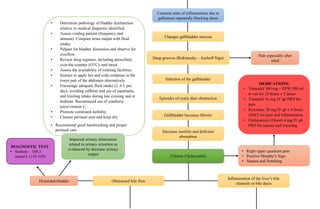
Constant state of inflammation due to
gallstones repeatedly blocking ducts
Deep grooves (Rokitansky – Aschoff Sign)
Changes gallbladder mucosa
Infection of the gallbladder
Episodes of cystic duct obstruction
Gallbladder becomes fibrotic
Decrease motility and deficient
absorption
Chronic Cholecystitis
Obstructed bile flow
• Right upper quadrant pain
• Positive Murphy’s Sign
• Nausea and Vomiting
Distended bladder
Inflammation of the liver’s bile
channels or bile ducts
Pain especially after
meal
DIAGNOSTIC TEST:
• Sodium – 168.3
mmol/L (135-145)
MEDICATIONS:
• Tramadol 300 mg + D5W 500 ml
to run for 24 hours x 2 doses
• Tramadol 5o mg IV q6 PRN for
pain
• Ketorolac 30 mg IV q6 x 4 doses
ANST for pain and inflammation
• Ondansetron (Onzet) 4 mg IV q6
PRN for nausea and vomiting
Impaired urinary elimination
related to urinary retention as
evidenced by decrease urinary
output
• Maintain strict asepsis
technique for dressing
changes and tube handling.
• Ensure that all articles to be
used are sterile.
• Educate patient and SO
about proper cleaning, wound
dressing and aseptic
techniques.
• Frequently monitor
patient’s VS.
• Encourage patient and SO
to immediately report if for an
abnormalities.
• Maintain strict asepsis
technique for dressing
changes and tube handling.
• Place patient in a semi-
fowler’s position.
• Check the T-tube and
incisional drains; make sure
they are free-flowing.
• Maintain T-tube in a closed
collection system.
• Change dressings as often
as necessary.
• Promote the importance
and demonstrate proper way
of wound cleaning.
Extrahepatic obstructive jaundice Intrahepatic obstructive jaundice
Liver Damage
Poor prognosis
DIAGNOSTIC TEST:
• SGPT/ALT – 151.27 U/L
(0.00-40.00)
• Phosphatase, ALK – 563.0
U/I (35-105)
• HDL Cholesterol – 1.08
mmol/L (1.09-2.28)
• Direct Bilirubin – 0.37
mg/dl (<0.30)
• Ultrasound – Mild
Hepatomegaly
If not treated:
Cholecystectomy
If treated:
Post op MEDICATIONS:
• Tramadol 300 mg + D5W 500 ml to run for 24 hours x 2 doses
• Tramadol 5o mg IV q6 PRN for pain
• Ketorolac 30 mg IV q6 x 4 doses ANST for pain and inflammation
• Ondansetron (Onzet) 4 mg IV q6 PRN for nausea and vomiting
• Cefuroxime 150 mg IV q8 for bacterial infections.
• Paracetamol 300 mg IV q4 PRN for fever ≥ 37.8˚C
• Omeprazole 40 mg IV q24 for stomach ulcers
Pre - op MEDICATIONS:
• Cefuroxime 750 mg IVTT (ANST) on call to OR
• Ondasetron (Onzet) 4 mg on call to OR
Impaired skin integrity related to
open cholecystectomy as evidenced
by surgical incision on the RUQ
and T-tube insertion.
Risk for infection related to
invasive surgical procedure
as evidenced by open
cholecystectomy last
February 2, 2023
• Biliary Peritonitis
• Gallbladder ischemia
• Acalculous Cholecystitis
• Porcelain Gallbladder
LEGEND:
PREDISPOSING FACTORS PRECIPITATING FACTORS
PATHOPHYSIOLOGY MECHANISM
DIAGNOSTIC TEST MEDICATIONS
DISEASE
MANIFESTATION
COMPLICATION
NURSING DIAGNOSIS
NURSING INTERVENTION
SURGERY
POOR PROGNOSIS
SIGNS AND SYMPTOMS

PATHO Chronic Cholecystiitis.pptx

  • 1.
    XII. PATHOPHYSIOLOGY Predisposing Factors •AGE: 29 yrs. old • GENDER: Female • RACE: Asian • FAMILY HISTORY: Cholecystitis/Cholelithiasis (both sides – siblings and relatives) and liver cancer (Aunt) Precipitating Factors • DIET: Increased cholesterol intake Abnormal metabolism of cholesterol and bile salts Impaired bladder motility Small intestine cholecystokinin (CCK) signals bladder to secrete bile Gallbladder contracts Stone lodged in cystic duct or/then to common bile duct Biliary stasis Gallstone formation (Cholelithiasis) Stone descends to cystic duct Choledolithiasis Blocks flow of bile Obstruction of cystic duct Irritates mucosa Mucosa secretes mucous, inflammatory enzymes Inflammation of the gallbladder wall DIAGNOSTIC TEST: • Abdominal Ultrasound – Choledocholithiasis and cholecystolithiasis DIAGNOSTIC TEST: • Abdominal Ultrasound – Choledocholithiasis and cholecystolithiasis
  • 2.
    • Determine pathologyof bladder dysfunction relative to medical diagnosis identified. • Assess voiding pattern (frequency and amount). Compare urine output with fluid intake. • Palpate for bladder distension and observe for overflow. • Review drug regimen, including prescribed, over-the-counter (OTC), and street. • Assess the availability of toileting facilities. • Instruct to apply hot and cold compress in the lower part of the abdomen alternatively. • Encourage adequate fluid intake (2–4 L per day), avoiding caffeine and use of aspartame, and limiting intake during late evening and at bedtime. Recommend use of cranberry juice/vitamin C. • Promote continued mobility. • Cleanse perineal area and keep dry. • Recommend good handwashing and proper perineal care Constant state of inflammation due to gallstones repeatedly blocking ducts Deep grooves (Rokitansky – Aschoff Sign) Changes gallbladder mucosa Infection of the gallbladder Episodes of cystic duct obstruction Gallbladder becomes fibrotic Decrease motility and deficient absorption Chronic Cholecystitis Obstructed bile flow • Right upper quadrant pain • Positive Murphy’s Sign • Nausea and Vomiting Distended bladder Inflammation of the liver’s bile channels or bile ducts Pain especially after meal DIAGNOSTIC TEST: • Sodium – 168.3 mmol/L (135-145) MEDICATIONS: • Tramadol 300 mg + D5W 500 ml to run for 24 hours x 2 doses • Tramadol 5o mg IV q6 PRN for pain • Ketorolac 30 mg IV q6 x 4 doses ANST for pain and inflammation • Ondansetron (Onzet) 4 mg IV q6 PRN for nausea and vomiting Impaired urinary elimination related to urinary retention as evidenced by decrease urinary output
  • 3.
    • Maintain strictasepsis technique for dressing changes and tube handling. • Ensure that all articles to be used are sterile. • Educate patient and SO about proper cleaning, wound dressing and aseptic techniques. • Frequently monitor patient’s VS. • Encourage patient and SO to immediately report if for an abnormalities. • Maintain strict asepsis technique for dressing changes and tube handling. • Place patient in a semi- fowler’s position. • Check the T-tube and incisional drains; make sure they are free-flowing. • Maintain T-tube in a closed collection system. • Change dressings as often as necessary. • Promote the importance and demonstrate proper way of wound cleaning. Extrahepatic obstructive jaundice Intrahepatic obstructive jaundice Liver Damage Poor prognosis DIAGNOSTIC TEST: • SGPT/ALT – 151.27 U/L (0.00-40.00) • Phosphatase, ALK – 563.0 U/I (35-105) • HDL Cholesterol – 1.08 mmol/L (1.09-2.28) • Direct Bilirubin – 0.37 mg/dl (<0.30) • Ultrasound – Mild Hepatomegaly If not treated: Cholecystectomy If treated: Post op MEDICATIONS: • Tramadol 300 mg + D5W 500 ml to run for 24 hours x 2 doses • Tramadol 5o mg IV q6 PRN for pain • Ketorolac 30 mg IV q6 x 4 doses ANST for pain and inflammation • Ondansetron (Onzet) 4 mg IV q6 PRN for nausea and vomiting • Cefuroxime 150 mg IV q8 for bacterial infections. • Paracetamol 300 mg IV q4 PRN for fever ≥ 37.8˚C • Omeprazole 40 mg IV q24 for stomach ulcers Pre - op MEDICATIONS: • Cefuroxime 750 mg IVTT (ANST) on call to OR • Ondasetron (Onzet) 4 mg on call to OR Impaired skin integrity related to open cholecystectomy as evidenced by surgical incision on the RUQ and T-tube insertion. Risk for infection related to invasive surgical procedure as evidenced by open cholecystectomy last February 2, 2023 • Biliary Peritonitis • Gallbladder ischemia • Acalculous Cholecystitis • Porcelain Gallbladder
  • 4.
    LEGEND: PREDISPOSING FACTORS PRECIPITATINGFACTORS PATHOPHYSIOLOGY MECHANISM DIAGNOSTIC TEST MEDICATIONS DISEASE MANIFESTATION COMPLICATION NURSING DIAGNOSIS NURSING INTERVENTION SURGERY POOR PROGNOSIS SIGNS AND SYMPTOMS