A Report
On
"A Study on Consumer Buying Behavior for the FMCG products by
Patanjali."
Submitted by:
Romesh Somani
BBA (Marketing and Sales)
Submitted to:
Prof. Sanjay Diddee
(SOCM)
Enrollment number:
RNBGU201600060
ACKNOWLEDGEMENTS
This report would not have been possible without the assistance and participation
of many people. I sincerely appreciate and acknowledge their contribution. But in
particular I would extend our gratitude to RNBGU for providing me such
platforms where I can get chance for enhance my personal skills.
I am very much grateful to our respected Faculty Ms. Sanjay Diddee of RNBGU,
who has enriched my knowledge and gave me a moral support to do this report. I
am also highly thankful to him for showing the right path and encouraging me for
the preparation of this report.
I am very thankful to those entire respondents who give their valuable time and
gave related information for completion of this report.
RomeshSomani
CERTIFICATE OF ORIGINALITY
I hereby declare that this submission is my own work and that, to the best of my
knowledge and belief, it contains no material previously published or written by
another person, nor material or any other educational institution, except where due
acknowledgment is made in the thesis.
I also declare that the intellectual content of this thesis is the productof my own
work, except to the extent that assistance from others in the project's design and
conception or in style, presentation and linguistic expression is acknowledged.
INTRODUCTION
CONSUMER BEHAVIOUR
Consumerbehavior can be defined as the decision- making process and physical
activity involved in acquiring, evaluating, using and disposing of goods and
services.
The study of consumer behavior is the study of how individuals make decisions
to spend their available resources (time, effort, money) on consumption related
item.
FMCG
 Fast Moving Consumer Goods (FMCG)- alternatively known as consumer
packaged goods (CPG).
 These are products that are sold quickly and generally consumed at a regular
basis
 It is relatively low cost.
.  FMCG is probably the most classic case of low margin and high volume
business.
FMCG goods are popularly known as consumer packaged goods. Items in this
category include all consumables (other than groceries/pulses) people buy at
regular intervals. The most common in the list are toilet soaps, detergents,
shampoos, toothpaste, shaving products, shoepolish, packaged foodstuff, and
household accessories and extends to certain electronic goods. These items are
meant for daily of frequent consumption and have a high return
. Rural – setto rise
Rural areas expected to be the major driver for FMCG, as growth continues to be
high in these regions. Rural areas saw a 16 per cent, as against 12 per cent rise in
urban areas. Most companies rushed to capitalise on this, as they quickly went
about increasing direct distribution and providing better infrastructure. Companies
are also working towards creating specific products specially targeted for the rural
market.
The Government of India has also been supporting the rural population with higher
minimum supportprices (MSPs), loan waivers, and disbursements through the
National Rural Employment Guarantee Act (NREGA) programme. These
measures have helped in reducing poverty in rural India and given a boostto rural
purchasing power.
Hence rural demand is set to rise with rising incomes and greater awareness of
brands
Urban trends
With rise in disposableincomes, mid- and high-income consumers in urban areas
have shifted their purchasing trend from essential to premium products. In
response, firms have started enhancing their premium products portfolio. Indian
and multinational FMCG players are leveraging India as a strategic sourcing hub
for cost-competitive productdevelopment and manufacturing to cater to
international markets.
The fast moving consumer goods (FMCG) segment is the fourth largest sector in
the Indian economy. The market size of FMCG in India is estimated to grow from
US$ 30 billion in 2011 to US$ 74 billion in 2018.
“Patanjali“-
A brand set up by PATANJALI AYURVEDA LTD is backed by robust preaching
and promotion of World renowned Guru Swami Ramdevji and an international
authority on Ayurveda and Traditional Herbs. The company is set up with an
objective to provide superior quality of products at fair price and to get their
customers rid off the chronic diseases by providing products which are organic and
natural. This conceptof Herbal and Pure has gained momentum in India and across
the world since people now a days are more centered towards keeping themselves
near to Nature due to their commercialized routines.
PATANJALI AYURVEDA LTD has more than 100 different products in the
catalogue for Skin, Hair, Heart, Eyes and Kidney diseases. Patanjali’s recent tie up
with Future Group to enter into FMCG segment through Big Bazaar Retail stores is
another big advantage towards the availability of Patanjali Products near to their
consumers. The Patanjali Products have rightly been placed at advantage by the
very conceptof “Marketing through Spirituality”
PRODUCTS
Patanjali Ayurved produces productsin the categories of personal care and
food. The company manufactures more than 900 products including 45 types of
cosmetic products and 30 types of food products. Accordingto Patanjali, all the
products manufactured by Patanjali are made from Ayurveda and natural
components Patanjali has also launched beauty and baby products.Patanjali
Ayurvedic manufacturing division has over 300 medicines for treating a range of
ailments and bodyconditions, from common cold to chronic paralysis.
Patanjali launched instant noodles on 15 November 2015. Food Safety and
Standards Authority of India slapped a notice on the company as neither Patanjali
nor Aayush, which are the two brand names under which Patanjali got licenses,
have got any approval for manufacturing instant noodles.
In 2016, Patanjali has announced to enter the textile manufacturing centre. The
company is reported to manufacture not only traditional clothes such
as Kurta Payjama but also popular western clothes such as jeans.
On 5 November 2016, Patanjali announced that it will set up a new manufacturing
plant Patanjali Herbal and Mega Food Park in Ballpark, Assam by
investing ₹1,200 crore(US$190 million) with the manufacturing capacity of
1,000,000 tonnes (2.2×10⁹ lb) of goods per year. The new plant will be the largest
facility of Patanjali in India and will be operational by March 2017. Patanjali
already has around 50 manufacturing units across India.
Company Profile of Patanjali Ayurved
Limited – New Product Pipeline and
Brand Image to Drive Company Growth
Company Profile of Patanjali Ayurved Limited – New
Product Pipeline and Brand Image to Drive Company
Growth
” provides a comprehensive analysis regarding the performance of the company
and its FMCG products in India. The report covers aspects suchas the market size
on the basis of revenue generated from the sale of FMCG’s under various product
categories. The revenues of the company has been segmented based on various
productcategories including nutrition and supplements, groceries, personal care,
home care, ayurvedic medicines and books and media. The revenues of the
company have also been segmented on the basis of regional sales and distribution
channel. The publication also covers the value chain, working model, consumer
profile and pricing analysis of Patanjali products. In addition to this, a comparative
analysis of best selling Patanjali products including honey, toothpaste, face wash,
instant noodles, biscuit and cookies and hair oil with other FMCG companies has
been showcased in order to understand the market share. The financial
performance of the company, balance sheet, P&L statement along with the
expected future performance of the company has also been showcased in the
report. This report will help industry consultants, FMCG manufacturers, dealers,
retail chains, potential entrants into the FMCG segment and other stakeholders to
align their market centric strategies according to the ongoing and expected trends
in the future.
COMPANY PROFILE
PATANJALI YOGPEETH
Patanjali Yogpeeth in Haridwar, Uttarakhand is one of the largest Yoga institutes
in India. Named after the Ancient Yog Guru Patanjali, the Institute is Ramdev's
flagship project & has been set up for treatment, research & development in Yoga
and Ayurveda, as well as the manufacturing of ayurvedic medicines.
It is a center of Yoga and Ayurveda activities in India built on the name of
Maharishi Patanjali who invented Yoga 5000 years ago. The ashram is run under
the guidance of Swami Ramdev Ji Maharaj who has revived Yoga and spreading it
all over the world. Patanjali Yog peeth is open to everybody. Located on the
Haridwar-Delhi highway at Kankhal, very near to Roorkee, Patanjali Yogpeeth
offers treatment for all and has residential accommodation.
At Mahatma Dharamveer's Gurukul in Kisangarh Ghasera where Baba Ramdev
met philanthropist Archarya Balkrishan. With the help of Balkrishan, Baba
Ramdev has established Divya Yog Mandir in 1995. Archarya Karamveer was also
one of the pillars of Divya Yog Mandir. In almost 3 years, Divya Yog Mandir and
Baba Ramdev have galvanized the world into turning ardent practitioners of Yoga.
Baba Ramdev and trust run spearhead, all his activities which include Yoga camps,
manufacturing ayurvedic medicine and treatment of patients with help of Yoga and
Pranayama. Baba Ramdev TV programmes and Yoga camps have proved to be
immensely popular. Swami Ramdev put lots of emphasis on teaching Pranayam as
compared to Yoga. According to Shri Shri Ravi Shankar, a worldrenowed spritial
leader "If an individual can be credited with reviving Yoga in India, it is solely
Baba Ramdev". Millions of people all over the world attend Baba Ramdev's free
Yoga camps (shivir). Ramdev Baba has also conducted Yoga camp at Rashtrapati
Bhavan - the residence of the President of India
Yoga has ability to cure even fatal diseases and Baba Ramdev has proved it many
times. Ramdev Baba has spread Yoga to such an extent that sooner or later,
everyone has to embrace it. Patanjali YogPeeth Trust is the dream project of Baba
Ramdev
It was inaugurated on August 6, 2006. Baba Ramdev's aim was to build the world's
largest center of Ayurveda,
Yoga and Pranayama. Patanjali YogPeeth provides facility for treatment for
diseases, research and a teaching University for Yoga and Ayurveda. This trust is
located 13kms from Haridwar. The estimated costof the project was 10 billion.
During inauguration, Sudarshan Agarwal, Governor of Uttrakhand, said "Patanjali
Yog Peeth will soonbe the ambassadorof Yoga for entire world”.
HERBAL PRODUCTS IN PATANJALI YOGPEETH
Divya Yog Mandir (Trust), started “Brahamkalp Chikitsalaya” at Kripalu Bagh
Ashram, Kankhal in 1995 where patients suffering from various diseases were
cured using Ayurvedic medicines and practices of Yoga. Need was felt to provide
quality Ayurvedic medicines to the patients to seek optimum results as results of
Ayurvedic treatment are directly proportional to the quality of prepared medicines.
Hence a small scale manufacturing unit of Ayurvedic medicines was established in
the campus of Kripalu Bagh Ashram, Kankhal. This was the beginning of Divya
Aushadhi Nirmanshala (Divya Pharmacy), which was totally based on traditional
methods.
Divya Pharmacy has had the exalted vision to bring Ayurveda to society in a
contemporary form and to unravel the mystery behind this haloed and revered,
Indian system of medicine by exploring and selecting indigenous herbs, ancient
Ayurvedic literatures and subjecting the formulations to modern pharmacological,
toxicological safety tests and clinical trials to create new drugs and therapies.
Divya Pharmacy tries that medicines should possibly be available to common man
at the minimum costprice. In the year 2002-03, modernization of the pharmacy has
been done. A new expanded unit of the pharmacy has been established well
equipped with machines based on modern techniques.
PLC controlled herbal extraction plant commissioned in the pharmacy is used for
extracting from the various parts of the medicinal plant like the leaves, The salient
feature of this plant is the production of medicine using latest SCADA technology
under controlled environmental conditions of temperature and pressure.
Quality of the medicines so produced is of the highest level. This unit has the
capacity of extracting from 10,000 kgs. of raw herbs. The desired fluid component
is added to this extract in the process ofmaking the medicines.
For the manufacturing processesin Divya Pharmacy automatic high speed spray
drier unit, for quick liquification a fluid wed processor, tablet compressing device
with the capacity for preparing one lac tablet per hour, high speed auto-coater for
coating the tablets, high speed mixer-grinder, fluid wed driers and cleaning,
crossing & pulverizing units have been established.
In the modern packing section of Divya Pharmacy PLC controlled packing
equipment having the capacity of 300 volts per minute with automatic blister
packing equipment has been installed. A utility center has been set up in this
production unit which has two 500 KVA generators, softeners & cooling towers
including boilers & air compressors having the capacity to produce300 ton steam.
As a result of this Divya Pharmacy has becomethe first medicine manufacturing
unit of Uttarakhand to get ISO-9001 and WHO-GMP certifications. In the
Pharmacy the international standards like Good Manufacturing Practices (GMP),
Good Packaging Practices (GPP), Good Agricultural Practices (GAP) and Good
Harvesting Practices(GHP)are being strictly followed.
PATANJALI AYURVED Ltd. is a company that functions like all other
companies under the regulations of the company law affairs, yet is constantly
striving for nation building more than the profit accumulation.
At level the challenge is no less herculean. Along with PRANAYAM, the wisdom
of our ancient sages, the organic food products and herbal medicines churned out
of this unit, undertake to fight out the dreaded and incurable diseases like
CANCER and AIDS. Claim for having found a lasting cure for many other
relatively more rampant but equally tormenting diseases like Diabetes, Arthritis
and Thyroid is already established with thousands of patients cured with micro
satisfaction.
(Supervisory control and data acquisition) SCADA
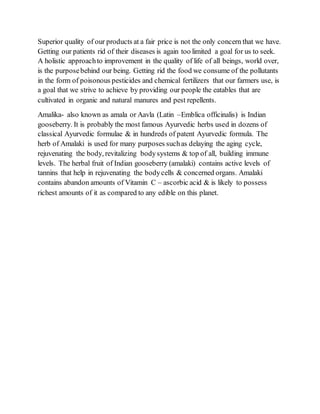
Superior quality of our products at a fair price is not the only concern that we have.
Getting our patients rid of their diseases is again too limited a goal for us to seek.
A holistic approachto improvement in the quality of life of all beings, world over,
is the purposebehind our being. Getting rid the food we consume of the pollutants
in the form of poisonous pesticides and chemical fertilizers that our farmers use, is
a goal that we strive to achieve by providing our people the eatables that are
cultivated in organic and natural manures and pest repellents.
Amalika- also known as amala or Aavla (Latin –Emblica officinalis) is Indian
gooseberry. It is probably the most famous Ayurvedic herbs used in dozens of
classical Ayurvedic formulae & in hundreds of patent Ayurvedic formula. The
herb of Amalaki is used for many purposes suchas delaying the aging cycle,
rejuvenating the body, revitalizing bodysystems & top of all, building immune
levels. The herbal fruit of Indian gooseberry (amalaki) contains active levels of
tannins that help in rejuvenating the bodycells & concerned organs. Amalaki
contains abandon amounts of Vitamin C – ascorbic acid & is likely to possess
richest amounts of it as compared to any edible on this planet.
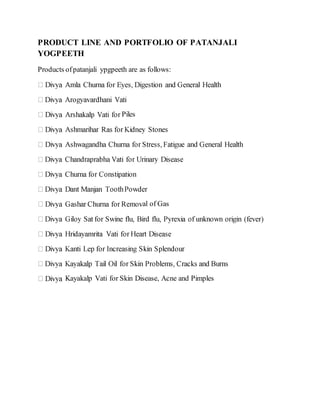
PRODUCT LINE AND PORTFOLIO OF PATANJALI
YOGPEETH
Products ofpatanjali ypgpeeth are as follows:
Piles
al of Gas
Kayakalp Vati for Skin Disease, Acne and Pimples
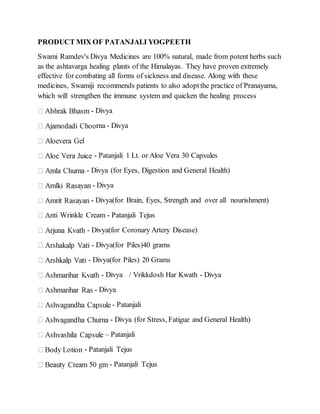
PRODUCT MIX OF PATANJALI YOGPEETH
Swami Ramdev's Divya Medicines are 100% natural, made from potent herbs such
as the ashtavarga healing plants of the Himalayas. They have proven extremely
effective for combating all forms of sickness and disease. Along with these
medicines, Swamiji recommends patients to also adoptthe practice of Pranayama,
which will strengthen the immune system and quicken the healing process
- Divya
rna - Divya
- Patanjali 1 Lt. or Aloe Vera 30 Capsules
- Divya (for Eyes, Digestion and General Health)
- Divya
- Divya(for Brain, Eyes, Strength and over all nourishment)
nti Wrinkle Cream - Patanjali Tejus
- Divya(for Coronary Artery Disease)
- Divya(for Piles)40 grams
- Divya(for Piles) 20 Grams
- Divya / Vrikkdosh Har Kwath - Divya
- Divya
- Patanjali
- Divya (for Stress, Fatigue and General Health)
– Patanjali
- Patanjali Tejus
- Patanjali Tejus
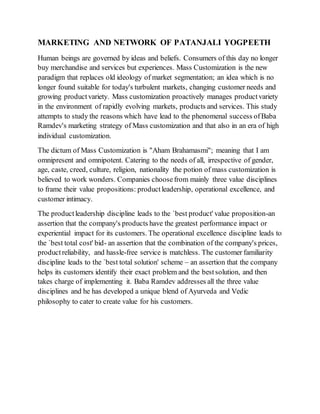
MARKETING AND NETWORK OF PATANJALI YOGPEETH
Human beings are governed by ideas and beliefs. Consumers of this day no longer
buy merchandise and services but experiences. Mass Customization is the new
paradigm that replaces old ideology of market segmentation; an idea which is no
longer found suitable for today's turbulent markets, changing customer needs and
growing productvariety. Mass customization proactively manages productvariety
in the environment of rapidly evolving markets, products and services. This study
attempts to study the reasons which have lead to the phenomenal success ofBaba
Ramdev's marketing strategy of Mass customization and that also in an era of high
individual customization.
The dictum of Mass Customization is "Aham Brahamasmi"; meaning that I am
omnipresent and omnipotent. Catering to the needs of all, irrespective of gender,
age, caste, creed, culture, religion, nationality the potion of mass customization is
believed to work wonders. Companies choosefrom mainly three value disciplines
to frame their value propositions: productleadership, operational excellence, and
customer intimacy.
The productleadership discipline leads to the `best product' value proposition-an
assertion that the company's products have the greatest performance impact or
experiential impact for its customers. The operational excellence discipline leads to
the `best total cost' bid- an assertion that the combination of the company's prices,
productreliability, and hassle-free service is matchless. The customer familiarity
discipline leads to the `best total solution' scheme – an assertion that the company
helps its customers identify their exact problem and the bestsolution, and then
takes charge of implementing it. Baba Ramdev addresses all the three value
disciplines and he has developed a unique blend of Ayurveda and Vedic
philosophy to cater to create value for his customers.
PRODUCT: INTRODUCING THE VALUE DISCIPLINE
The society in which we live today is a brand- obsessed society. Name a productor
service and the brands relating to them are inestimable so many that cannot be
counted on fingers. Thus, creating, developing, implementing and maintaining
successfulbrands are frequently at the heart of marketing strategy. (McEnally,M .
and Chernatony,L. de 1999) Successfulbranding requires a strategic perspective
(de Chernatony 1998) whereby strong brand concepts are presented and
communicated to target segments resulting in favorable brand images which reflect
the brand's identity (Gardner and Levy 1955, Reynolds and Gutman 1984,
Kapferer 1997). This brand of Baba Ramdev has a universal appeal, is sharing and
collaborative, and the customers range hail from all age groups and regions. This
Brand is a result of consistent hard work and carefully and meticulously followed
strategy.
The service that Baba Ramdev is selling is the product. To deliver quality service,
it is essential to understand customers' expectations. To assess the quality of
service, customers compare their expectations with perceptions of the service
providers' performance. Hence it becomes vital for the service providers' to
understand and meet consumers' needs and wants. Customer expectations of
service can be of two types; desired service and adequate service. Desired service
is the service that a customer desires and expects to get. Whereas an adequate
service is one which is the minimal level of service which a customer is willing to
acceptbased on his perception of service acceptability. The service that is being
provided by Baba Ramdev is well orchestrating with the desired service
expectations. Patanjali Yogpeeth, a multi-million rupee venture, Ramdev's dream
project, set as a rival to World Health Organization only on the basis of sound
service that it boasts of providing. Divya Yoga Mandir Trust in Haridwar,
Uttaranchal is armed with all the latest and most sophisticated gadgets sees a
regular stream of devotees who wait to be called by a doctorin the Out Patient
Department (OPD). There are forty doctors in the OPD who deal with 2,000 people
every day. Some days the dispensary sells medicines worth Rs. 3,000 a minute.
And again this can only be possible if the waiting tie is reduced by quality service.
The ambiance of Patanjali Yogpeeth is world class. Constructed in almost 100
acres; it has been designed to have buildings, car parks, and a landscape to rival the
best of Delhi's housing projects. The entire value proposition can be said to be a
hard work and the result of determination of this one man army.
To add to this we know that looking good is everyman's dream. In the era when
cosmetic surgery is the order of the day; getting good looks by just adjusting the
way one inhales and exhales is something everyone would prefer doing. With his
deep-seated credence that we all are a part of beauty conscious world, Swamiji's
unique contribution has been in helping ordinary people solve their problems and
lead a healthy life through the practice of simple breathing exercises. The product
"pranayama" is well suited for all irrespective of class, creed, culture and hence
this success.
COMPLETE PACKAGE FOR VARIOUS DISEASES
Swami Ramdev's Divya Medicines are claimed to be one hundred percent natural,
made from potent herbs available in the Himalayas and no or very little side
effects. They have proven extremely effective for combating all forms of sickness
and disease. Along with these medicines, Swamiji recommends patients to also
adoptthe practice of Pranayama, which will strengthen the immune system and
quicken the healing process. RamdevBaba opines that Pranayama Yoga is the
complete Ancient Indian Therapy, which is a Medical Science in itself that cures
any Physical or Mental medical condition completely, without any side effects.
Swami Ramdev has proved and declared on Indian & International TV Channels,
"Pranayama Yoga is the complete natural cure for all Physical and Mental
Ailments". But if
medicines are required they are also available and these packages of medicines are
available at a very low cost. The medicines can cure all the diseases from a simple
cold to cancer. In a bid to promote Ayurveda, Ramdev's Trust has tied up with 600
qualified Ayurvedic practitioners who are offering treatment to masses for a
variety of diseases, some of them termed incurable by the modern system.
PRICING STRATEGY
Developing an effective pricing strategy remains the most important and difficult
part of the marketing process.Forinstance, a nominal 1 per cent increase in price
realization will boostnet income by 6.40 per cent for Coca-Colaand 28.70 per cent
for Philips. The pricepositioning and the value-delivery mechanisms should be
done with one rule in mind: the performance of the product, orthe value associated
with it should always be higher than the price. Forinstance, a company that has
either a productor a service whose performance or value is medium would do well
to follow a low-cost pricing strategy.
Well in tune with this, Baba Ramdev's potion of Pranayama is cheap. He urges
people not to lose hope or suffer and depend on expensive treatments. Indian
Pranayama Yoga is there to help treat all the ailments completely without costly
medicines, operations or surgery. It is amazing, but it is claimed to be true that this
is the cheapest and the only complete cure to most of the so called incurable
diseases like Diabetes, Cancer, HIV & AIDS too.
PROMOTIONAL STRATEGY
Edwin L. Artzt quoting the chairman and CEO of P& G has likened advertising to
exercising saying that "Think of advertising and promotion as exercise and
recreation. Advertising is exercise. It's something you need and it provides long-
term benefits, but it's awfully easy to either cut or postponebecausethere's no
immediate penalty for not exercising. When you want your brand to be fit, it's got
to exercise regularly." And here's a situation when exercising in itself becomes the
object of promotion.
It is a well established fact that advertising affects consumers. The literature on
advertising has traditionally emphasized the persuasive nature of advertising: its
purposeis to alter
consumers' tastes for established brand names or company reputations (Bagwell,
2007, Dixit and Norman, 1978). But there is a difference in opinion and Stigler and
Becker (1977) and Becker and Murphy (1993) argue that advertising is part of
consumers' preferences in the same way as goods and that there are
complementarities between advertising and goods. Hence, a more-advertised good
is ceteris paribus preferred over a less-advertised good. Whatever be the case, Baba
Ramdev has hit both the opinions as he is advertising and at the same time not
advertising. Baba Ramdev's live yoga classes became a passion. And it all began in
the year 2002 when Sanskar television channel started airing Baba Ramdev's yogic
classes; overnight, Baba Ramdev became a sensation he had hundreds of followers
who morphed into thousands. Then Sanskar channel's rival Astha channel signed
him. In two years time he was a hit and with him also the channel benefited. His
TV shows have the largest TRP. Today, he is one of the biggest draws on Indian
television. He can be seen not only on religious channels like Aastha, but also
news and features channels like India TV and Sahara One. Millions around the
country follow his programmes religiously and use ayurvedic medicines prescribed
by him. There was an eight-month waiting period before one could see Ramdev, he
was being booked that far ahead by television channels for his live yoga classes
each morning. There was an eight-month waiting period before one could see
Ramdev, he was being booked that far ahead by television channels for his live
yoga classes each morning. His yoga sessions were beamed live into 170 countries
(Bijay Simha, 2007)
LITERATURE REVIEW
HYPOTHESIS FORMATION
BRAND IMAGE AND CONSUMER PERCEPTION
Past literature revealed that a successfulbrand image enables consumers to identify
their desired need which ultimately helps a company from its competitors Hsieh et
al., (2004). On the other hand Tarofder and Haque (2007) had given importance on
supplier selection based on their brand image. In fact the findings of Jiang et al.
(2011) revealed that apart from brand image price discount and complementary
products may have positive impact on customer loyalty. Furthermore, Linder and
Seidenstricker (2010) agreed that brand image is one of the company’s core
competencies. Mishra and Datta (2011) revealed that brand name has strong
influence on customer based brand equity. Kotler (2001) defined brand image as a
set of beliefs, ideas and impression that a personholds regarding an object. On the
other hand, Keller (1993) considered brand image as a set of perceptions about a
brand on consumer’s memory. Na et al. (1999) connected brand image with
customer’s perception as they mentioned that image cannot be measured by
attribute measurements alone but must include measurements of consumers'
perceptions of the value and benefits attainable from using the brand. Thus, it
posits:
. Brand image will not be positively associated with consumer perception
. CONSUMER PERCEPTION AND BRAND LOYALTY
Humans unlike machines can have the ability to Perceive. It is a feeling which is
based on the conclusion formed with the given information around and the mindset
of the consumer which is responsible of processing the information. Perception
gives humans the right to make important decisions or can reflect their important
decisions. It all leads to the most important decision of purchasing. Purchasing
means to invest in a brand, for making it a greater brand.
Underlying research will focus on concluding the fact that how much is the impact
of brand perception on brand awareness and brand loyalty of these brands. Several
conclusions can be drawn if consumer perception plays any role and there is a
relation among the consumer perception, brand awareness and brand loyalty of
these brands. The project is intended to fulfill the needs of marketing research
which is quite important for present marketing trend. Total sales turnover of the
brand depends on the consumer purchase decision. If the consumers perceive
positive about the brand, it means he carriers more loyalty and will remain
potential customer, until he keeps on getting the right value for his money. Thus, it
posits:
Consumer perception will not be positively associated with Brand loyalty
RESEARCH BACKGROUND
This survey research has utilized both primary and secondarydata and information
from different sources including Patanjali Ayurveda ltd., text books, magazines,
journals and websites about different variables of the study.
Various studies were consulted for collecting data. A study on Patanjali is also
available of consumer perception toward the brand. These studies include:
1. A study of consumer perception of herbal products in Bhopal:
International Journal of Management Studies ISSN (Print) 2249-0302 ISSN
(Online)2231-2528
AUTHORS: Md. Irshad Ali, Research Scholar, FPM, Indian Institute of Forest
Management, India and Manmohan Yadav, Professor, Indian Institute of Forest
Management, India
The Indian herbal market is flooded with numerous well-known and recognised
herbal brands. Vindhya Herbal is an initiative of Madhya Pradesh government to
provide unadulterated ayurvedic products to the people and for generating gainful
employment for the vulnerable and downtroddensection of the society. The study
is to examine existing state
of Vindhya Herbal in Bhopal, its birthplace. Besides, this study talks about other
parameters like benefits/attributes consumer acquaintances with herbal products,
awareness, preferential, source of knowledge, usage and attitude related to herbal
products.
The research design consisted of an exploratory phase followed by a descriptive
crosssectional, close-ended questionnaire-based survey in Bhopal. As the study has
been conducted in a Hindi belt, the questionnaire was kept bilingual; Hindi and
English. Sampling was done on the basis of two criteria; 1) such regions were
selected where almost major herbal brands are available and 2) Respondents have
used at-least one of the herbal brands.
2. Customer Perception towards Brand: A Study on ‘Patanjali’:
Global Journal of Management and Business Research: E-Marketing, Volume 15
Issue 9 Version 1.0 Year 2015, Type: Double Blind Peer Reviewed International
Research Journal, Publisher: Global Journals Inc. (USA), Online ISSN: 2249-4588
& Print ISSN: 09755853
AUTHOR: Miss Rupali Khanna, Chandigarh University, India
This paper carries out a study on what factors PATANJALI. “Patanjali “- a brand
set up by PATANJALI AYURVEDA LTD is backed by robustpreaching and
promotion of World renowned Guru Swami Ramdevji and an international
authority on Ayurveda and Traditional Herbs. The company is set up with an
objective to provide superior quality of products at fair price and to get their
customers rid off the chronic diseases by providing products which are organic and
natural. This conceptof Herbal and Pure has gained momentum in India and across
the world since people now a days are more centered towards keeping themselves
near to Nature due to their commercialized routines.
This paper carries out a study on what factors PATANJALI. “Patanjali “- a brand
set up by PATANJALI AYURVEDA LTD is backed by robustpreaching and
promotion of World renowned Guru Swami Ramdevji and an international
authority on Ayurveda and Traditional Herbs. The company is set up with an
objective to provide superior quality of products at fair price and to get their
customers rid off the chronic diseases by providing products which are organic and
natural. This conceptof Herbal and Pure has gained momentum in India and across
the world since people now a days are more centered towards keeping themselves
near to Nature due to their commercialized routines. PATANJALI AYURVEDA
LTD has more
than 100 different products in the catalogue for Skin, Hair, Heart, Eyes and Kidney
diseases. Patanjali’s recent tie up with Future Group to enter into FMCG segment
through Big Bazaar Retail stores is another big advantage towards the availability
of Patanjali Products near to their consumers. The Patanjali Products have rightly
been placed at advantage by the very conceptof“Marketing through Spirituality”.
3. Effect of Brand Image on Brand Loyalty and Role of Customer
Satisfaction in it:
World Applied Sciences Journal 26 (10): 1364-1370, 2013, ISSN 1818-4952, ©
IDOSI Publications, 2013, DOI: 10.5829/idosi.wasj.2013.26.10.1343, Published on
Nov 30, 2013
AUTHORS: Rashid Saeed, Rab Nawaz Lodhi, Amna Mehmood, Urooj Ishfaque,
Fareha Dustgeer, Amna Sami, Zahid Mahmood and Moeed Ahmad
The purposeof this study was to check the effect of brand image on brand loyalty
and the moderating role of customer satisfaction in it. Brand attributes and Brand
benefits were studied as dimensions of Brand Image. Quantitative study was
conducted in wireless Telecommunication sector of Pakistan. Sample of 150
students and teachers, from different colleges and universities of Sahiwal, were
selected and surveyed through questionnaires. PearsonCorrelation and Regression
were run to analyze the data. Finding reveals that positive and significant relation
exists between Brand Image and Brand loyalty and Customer Satisfaction also has
a positive moderating effect on this relation. The sample size was too short. This
study can be replicated with a large sample size in similar sectoror context. The
impact of marketing communications and consumers’ knowledge on brand loyalty
can also is studied to enhance the study. Organizations ought to pay special
attention to the building of brand image, achieving customer satisfaction. And
through this they would also be successfulin achieving brand loyalty.
4. The Impact of Brand Image on Consumer Behavior: A Literature
Review:
Open Journal of Business and Management, 2015, 3, 58-62. Published Online,
January 2015 in SciRes.
AUTHOR: Yi Zhang, Department of Marketing, Management School, Jinan
University, Guangzhou, China
The concept“brand image” has drawn significant attention from academics and
practitioners since it was put forward, because it played an important role in
marketing activities. Although brand image was recognized as the driving force of
brand asset and brand performance, few studies have elaborated on the relationship
between brand image and brand equity. Based on the brand image theories, this
study reviewed extant studies about the impact of brand image on consumer from
perspective of customer equity. It also presented the shortcomings of current
research and pointed out the trends for future study.
RATIONALE OF STUDY
Each company makes its own strategies for its products and brand. These strategies
are made keeping in to consideration all the internal (employees, stake holders,
financial conditions) and external (customers, competitors) factors. These
strategies directly help the company to increase the demand for its customer
product which then helps increase the sales. These strategies could be promotional
strategies, pricing strategies distribution strategies etc.
Since nowadays, people are moving towards healthier lifestyle, thus trough this
study I want to know consumers perception towards herbal products and strategies
used by the company to distribute its products on the basis of customers buying
behaviour in Indore region.
OBJECTIVES
The study in hand is conducted keeping in view the following objectives:
• To study the brand perception of ‘PATANJALI’ in minds of Consumers.
• To know the attributes that a customer keeps in mind while buying ‘PATANJALI’
Products.
RESEARCH METHODOLOGY
This research is based on primary data collected through questionnaires from 200
users of Patanjali Products in Jaipure, Dungargarh& Suratgarh. The questionnaire
design is built up to know the type of products peopleuse, the reason for their
buying suchproductand their postbuying satisfaction level from that product.
Secondarysources have been used to collect information about ‘Patanjali’ brands.
Journals, articles, research reports and government documents were reviewed to
get the insight of the previous interventions that the stakeholders and policy
makers have already in place. Also websites of natural products manufacturing
company and online document were investigated to conductthis research.
SUGGESTIONS
1) To make a successfulproduct, Patañjali’s marketing strategy should attract long
term consumers.
2) They can increase their distribution channels.
3) They have to focus backon productefficacy. Rising above the noise of
advertising.
4) They can increase their outlet and stores.

Patanjali report

  • 1.
    A Report On "A Studyon Consumer Buying Behavior for the FMCG products by Patanjali." Submitted by: Romesh Somani BBA (Marketing and Sales) Submitted to: Prof. Sanjay Diddee (SOCM) Enrollment number: RNBGU201600060
  • 2.
    ACKNOWLEDGEMENTS This report wouldnot have been possible without the assistance and participation of many people. I sincerely appreciate and acknowledge their contribution. But in particular I would extend our gratitude to RNBGU for providing me such platforms where I can get chance for enhance my personal skills. I am very much grateful to our respected Faculty Ms. Sanjay Diddee of RNBGU, who has enriched my knowledge and gave me a moral support to do this report. I am also highly thankful to him for showing the right path and encouraging me for the preparation of this report. I am very thankful to those entire respondents who give their valuable time and gave related information for completion of this report. RomeshSomani
  • 3.
    CERTIFICATE OF ORIGINALITY Ihereby declare that this submission is my own work and that, to the best of my knowledge and belief, it contains no material previously published or written by another person, nor material or any other educational institution, except where due acknowledgment is made in the thesis. I also declare that the intellectual content of this thesis is the productof my own work, except to the extent that assistance from others in the project's design and conception or in style, presentation and linguistic expression is acknowledged.
  • 4.
    INTRODUCTION CONSUMER BEHAVIOUR Consumerbehavior canbe defined as the decision- making process and physical activity involved in acquiring, evaluating, using and disposing of goods and services. The study of consumer behavior is the study of how individuals make decisions to spend their available resources (time, effort, money) on consumption related item. FMCG  Fast Moving Consumer Goods (FMCG)- alternatively known as consumer packaged goods (CPG).  These are products that are sold quickly and generally consumed at a regular basis  It is relatively low cost. .  FMCG is probably the most classic case of low margin and high volume business.
  • 5.
    FMCG goods arepopularly known as consumer packaged goods. Items in this category include all consumables (other than groceries/pulses) people buy at regular intervals. The most common in the list are toilet soaps, detergents, shampoos, toothpaste, shaving products, shoepolish, packaged foodstuff, and household accessories and extends to certain electronic goods. These items are meant for daily of frequent consumption and have a high return . Rural – setto rise Rural areas expected to be the major driver for FMCG, as growth continues to be high in these regions. Rural areas saw a 16 per cent, as against 12 per cent rise in urban areas. Most companies rushed to capitalise on this, as they quickly went about increasing direct distribution and providing better infrastructure. Companies are also working towards creating specific products specially targeted for the rural market. The Government of India has also been supporting the rural population with higher minimum supportprices (MSPs), loan waivers, and disbursements through the National Rural Employment Guarantee Act (NREGA) programme. These measures have helped in reducing poverty in rural India and given a boostto rural purchasing power. Hence rural demand is set to rise with rising incomes and greater awareness of brands Urban trends With rise in disposableincomes, mid- and high-income consumers in urban areas have shifted their purchasing trend from essential to premium products. In response, firms have started enhancing their premium products portfolio. Indian and multinational FMCG players are leveraging India as a strategic sourcing hub for cost-competitive productdevelopment and manufacturing to cater to international markets. The fast moving consumer goods (FMCG) segment is the fourth largest sector in the Indian economy. The market size of FMCG in India is estimated to grow from US$ 30 billion in 2011 to US$ 74 billion in 2018.
  • 6.
    “Patanjali“- A brand setup by PATANJALI AYURVEDA LTD is backed by robust preaching and promotion of World renowned Guru Swami Ramdevji and an international authority on Ayurveda and Traditional Herbs. The company is set up with an objective to provide superior quality of products at fair price and to get their customers rid off the chronic diseases by providing products which are organic and natural. This conceptof Herbal and Pure has gained momentum in India and across the world since people now a days are more centered towards keeping themselves near to Nature due to their commercialized routines. PATANJALI AYURVEDA LTD has more than 100 different products in the catalogue for Skin, Hair, Heart, Eyes and Kidney diseases. Patanjali’s recent tie up with Future Group to enter into FMCG segment through Big Bazaar Retail stores is another big advantage towards the availability of Patanjali Products near to their consumers. The Patanjali Products have rightly been placed at advantage by the very conceptof “Marketing through Spirituality”
  • 7.
    PRODUCTS Patanjali Ayurved producesproductsin the categories of personal care and food. The company manufactures more than 900 products including 45 types of cosmetic products and 30 types of food products. Accordingto Patanjali, all the products manufactured by Patanjali are made from Ayurveda and natural components Patanjali has also launched beauty and baby products.Patanjali Ayurvedic manufacturing division has over 300 medicines for treating a range of ailments and bodyconditions, from common cold to chronic paralysis. Patanjali launched instant noodles on 15 November 2015. Food Safety and Standards Authority of India slapped a notice on the company as neither Patanjali nor Aayush, which are the two brand names under which Patanjali got licenses, have got any approval for manufacturing instant noodles. In 2016, Patanjali has announced to enter the textile manufacturing centre. The company is reported to manufacture not only traditional clothes such as Kurta Payjama but also popular western clothes such as jeans. On 5 November 2016, Patanjali announced that it will set up a new manufacturing plant Patanjali Herbal and Mega Food Park in Ballpark, Assam by investing ₹1,200 crore(US$190 million) with the manufacturing capacity of 1,000,000 tonnes (2.2×10⁹ lb) of goods per year. The new plant will be the largest facility of Patanjali in India and will be operational by March 2017. Patanjali already has around 50 manufacturing units across India.
  • 8.
    Company Profile ofPatanjali Ayurved Limited – New Product Pipeline and Brand Image to Drive Company Growth Company Profile of Patanjali Ayurved Limited – New Product Pipeline and Brand Image to Drive Company Growth ” provides a comprehensive analysis regarding the performance of the company and its FMCG products in India. The report covers aspects suchas the market size on the basis of revenue generated from the sale of FMCG’s under various product categories. The revenues of the company has been segmented based on various productcategories including nutrition and supplements, groceries, personal care, home care, ayurvedic medicines and books and media. The revenues of the company have also been segmented on the basis of regional sales and distribution channel. The publication also covers the value chain, working model, consumer profile and pricing analysis of Patanjali products. In addition to this, a comparative analysis of best selling Patanjali products including honey, toothpaste, face wash, instant noodles, biscuit and cookies and hair oil with other FMCG companies has been showcased in order to understand the market share. The financial performance of the company, balance sheet, P&L statement along with the expected future performance of the company has also been showcased in the report. This report will help industry consultants, FMCG manufacturers, dealers, retail chains, potential entrants into the FMCG segment and other stakeholders to align their market centric strategies according to the ongoing and expected trends in the future.
  • 9.
    COMPANY PROFILE PATANJALI YOGPEETH PatanjaliYogpeeth in Haridwar, Uttarakhand is one of the largest Yoga institutes in India. Named after the Ancient Yog Guru Patanjali, the Institute is Ramdev's flagship project & has been set up for treatment, research & development in Yoga and Ayurveda, as well as the manufacturing of ayurvedic medicines. It is a center of Yoga and Ayurveda activities in India built on the name of Maharishi Patanjali who invented Yoga 5000 years ago. The ashram is run under the guidance of Swami Ramdev Ji Maharaj who has revived Yoga and spreading it all over the world. Patanjali Yog peeth is open to everybody. Located on the Haridwar-Delhi highway at Kankhal, very near to Roorkee, Patanjali Yogpeeth offers treatment for all and has residential accommodation. At Mahatma Dharamveer's Gurukul in Kisangarh Ghasera where Baba Ramdev met philanthropist Archarya Balkrishan. With the help of Balkrishan, Baba Ramdev has established Divya Yog Mandir in 1995. Archarya Karamveer was also one of the pillars of Divya Yog Mandir. In almost 3 years, Divya Yog Mandir and Baba Ramdev have galvanized the world into turning ardent practitioners of Yoga. Baba Ramdev and trust run spearhead, all his activities which include Yoga camps, manufacturing ayurvedic medicine and treatment of patients with help of Yoga and Pranayama. Baba Ramdev TV programmes and Yoga camps have proved to be immensely popular. Swami Ramdev put lots of emphasis on teaching Pranayam as compared to Yoga. According to Shri Shri Ravi Shankar, a worldrenowed spritial leader "If an individual can be credited with reviving Yoga in India, it is solely Baba Ramdev". Millions of people all over the world attend Baba Ramdev's free Yoga camps (shivir). Ramdev Baba has also conducted Yoga camp at Rashtrapati Bhavan - the residence of the President of India Yoga has ability to cure even fatal diseases and Baba Ramdev has proved it many times. Ramdev Baba has spread Yoga to such an extent that sooner or later, everyone has to embrace it. Patanjali YogPeeth Trust is the dream project of Baba Ramdev
  • 10.
    It was inauguratedon August 6, 2006. Baba Ramdev's aim was to build the world's largest center of Ayurveda, Yoga and Pranayama. Patanjali YogPeeth provides facility for treatment for diseases, research and a teaching University for Yoga and Ayurveda. This trust is located 13kms from Haridwar. The estimated costof the project was 10 billion. During inauguration, Sudarshan Agarwal, Governor of Uttrakhand, said "Patanjali Yog Peeth will soonbe the ambassadorof Yoga for entire world”.
  • 11.
    HERBAL PRODUCTS INPATANJALI YOGPEETH Divya Yog Mandir (Trust), started “Brahamkalp Chikitsalaya” at Kripalu Bagh Ashram, Kankhal in 1995 where patients suffering from various diseases were cured using Ayurvedic medicines and practices of Yoga. Need was felt to provide quality Ayurvedic medicines to the patients to seek optimum results as results of Ayurvedic treatment are directly proportional to the quality of prepared medicines. Hence a small scale manufacturing unit of Ayurvedic medicines was established in the campus of Kripalu Bagh Ashram, Kankhal. This was the beginning of Divya Aushadhi Nirmanshala (Divya Pharmacy), which was totally based on traditional methods. Divya Pharmacy has had the exalted vision to bring Ayurveda to society in a contemporary form and to unravel the mystery behind this haloed and revered, Indian system of medicine by exploring and selecting indigenous herbs, ancient Ayurvedic literatures and subjecting the formulations to modern pharmacological, toxicological safety tests and clinical trials to create new drugs and therapies. Divya Pharmacy tries that medicines should possibly be available to common man at the minimum costprice. In the year 2002-03, modernization of the pharmacy has been done. A new expanded unit of the pharmacy has been established well equipped with machines based on modern techniques. PLC controlled herbal extraction plant commissioned in the pharmacy is used for extracting from the various parts of the medicinal plant like the leaves, The salient feature of this plant is the production of medicine using latest SCADA technology under controlled environmental conditions of temperature and pressure. Quality of the medicines so produced is of the highest level. This unit has the capacity of extracting from 10,000 kgs. of raw herbs. The desired fluid component is added to this extract in the process ofmaking the medicines. For the manufacturing processesin Divya Pharmacy automatic high speed spray drier unit, for quick liquification a fluid wed processor, tablet compressing device with the capacity for preparing one lac tablet per hour, high speed auto-coater for coating the tablets, high speed mixer-grinder, fluid wed driers and cleaning, crossing & pulverizing units have been established.
  • 12.
    In the modernpacking section of Divya Pharmacy PLC controlled packing equipment having the capacity of 300 volts per minute with automatic blister packing equipment has been installed. A utility center has been set up in this production unit which has two 500 KVA generators, softeners & cooling towers including boilers & air compressors having the capacity to produce300 ton steam. As a result of this Divya Pharmacy has becomethe first medicine manufacturing unit of Uttarakhand to get ISO-9001 and WHO-GMP certifications. In the Pharmacy the international standards like Good Manufacturing Practices (GMP), Good Packaging Practices (GPP), Good Agricultural Practices (GAP) and Good Harvesting Practices(GHP)are being strictly followed. PATANJALI AYURVED Ltd. is a company that functions like all other companies under the regulations of the company law affairs, yet is constantly striving for nation building more than the profit accumulation. At level the challenge is no less herculean. Along with PRANAYAM, the wisdom of our ancient sages, the organic food products and herbal medicines churned out of this unit, undertake to fight out the dreaded and incurable diseases like CANCER and AIDS. Claim for having found a lasting cure for many other relatively more rampant but equally tormenting diseases like Diabetes, Arthritis and Thyroid is already established with thousands of patients cured with micro satisfaction. (Supervisory control and data acquisition) SCADA
  • 13.
    Superior quality ofour products at a fair price is not the only concern that we have. Getting our patients rid of their diseases is again too limited a goal for us to seek. A holistic approachto improvement in the quality of life of all beings, world over, is the purposebehind our being. Getting rid the food we consume of the pollutants in the form of poisonous pesticides and chemical fertilizers that our farmers use, is a goal that we strive to achieve by providing our people the eatables that are cultivated in organic and natural manures and pest repellents. Amalika- also known as amala or Aavla (Latin –Emblica officinalis) is Indian gooseberry. It is probably the most famous Ayurvedic herbs used in dozens of classical Ayurvedic formulae & in hundreds of patent Ayurvedic formula. The herb of Amalaki is used for many purposes suchas delaying the aging cycle, rejuvenating the body, revitalizing bodysystems & top of all, building immune levels. The herbal fruit of Indian gooseberry (amalaki) contains active levels of tannins that help in rejuvenating the bodycells & concerned organs. Amalaki contains abandon amounts of Vitamin C – ascorbic acid & is likely to possess richest amounts of it as compared to any edible on this planet.
  • 14.
    PRODUCT LINE ANDPORTFOLIO OF PATANJALI YOGPEETH Products ofpatanjali ypgpeeth are as follows: Piles al of Gas Kayakalp Vati for Skin Disease, Acne and Pimples
  • 15.
    PRODUCT MIX OFPATANJALI YOGPEETH Swami Ramdev's Divya Medicines are 100% natural, made from potent herbs such as the ashtavarga healing plants of the Himalayas. They have proven extremely effective for combating all forms of sickness and disease. Along with these medicines, Swamiji recommends patients to also adoptthe practice of Pranayama, which will strengthen the immune system and quicken the healing process - Divya rna - Divya - Patanjali 1 Lt. or Aloe Vera 30 Capsules - Divya (for Eyes, Digestion and General Health) - Divya - Divya(for Brain, Eyes, Strength and over all nourishment) nti Wrinkle Cream - Patanjali Tejus - Divya(for Coronary Artery Disease) - Divya(for Piles)40 grams - Divya(for Piles) 20 Grams - Divya / Vrikkdosh Har Kwath - Divya - Divya - Patanjali - Divya (for Stress, Fatigue and General Health) – Patanjali - Patanjali Tejus - Patanjali Tejus
  • 16.
    MARKETING AND NETWORKOF PATANJALI YOGPEETH Human beings are governed by ideas and beliefs. Consumers of this day no longer buy merchandise and services but experiences. Mass Customization is the new paradigm that replaces old ideology of market segmentation; an idea which is no longer found suitable for today's turbulent markets, changing customer needs and growing productvariety. Mass customization proactively manages productvariety in the environment of rapidly evolving markets, products and services. This study attempts to study the reasons which have lead to the phenomenal success ofBaba Ramdev's marketing strategy of Mass customization and that also in an era of high individual customization. The dictum of Mass Customization is "Aham Brahamasmi"; meaning that I am omnipresent and omnipotent. Catering to the needs of all, irrespective of gender, age, caste, creed, culture, religion, nationality the potion of mass customization is believed to work wonders. Companies choosefrom mainly three value disciplines to frame their value propositions: productleadership, operational excellence, and customer intimacy. The productleadership discipline leads to the `best product' value proposition-an assertion that the company's products have the greatest performance impact or experiential impact for its customers. The operational excellence discipline leads to the `best total cost' bid- an assertion that the combination of the company's prices, productreliability, and hassle-free service is matchless. The customer familiarity discipline leads to the `best total solution' scheme – an assertion that the company helps its customers identify their exact problem and the bestsolution, and then takes charge of implementing it. Baba Ramdev addresses all the three value disciplines and he has developed a unique blend of Ayurveda and Vedic philosophy to cater to create value for his customers.
  • 17.
    PRODUCT: INTRODUCING THEVALUE DISCIPLINE The society in which we live today is a brand- obsessed society. Name a productor service and the brands relating to them are inestimable so many that cannot be counted on fingers. Thus, creating, developing, implementing and maintaining successfulbrands are frequently at the heart of marketing strategy. (McEnally,M . and Chernatony,L. de 1999) Successfulbranding requires a strategic perspective (de Chernatony 1998) whereby strong brand concepts are presented and communicated to target segments resulting in favorable brand images which reflect the brand's identity (Gardner and Levy 1955, Reynolds and Gutman 1984, Kapferer 1997). This brand of Baba Ramdev has a universal appeal, is sharing and collaborative, and the customers range hail from all age groups and regions. This Brand is a result of consistent hard work and carefully and meticulously followed strategy. The service that Baba Ramdev is selling is the product. To deliver quality service, it is essential to understand customers' expectations. To assess the quality of service, customers compare their expectations with perceptions of the service providers' performance. Hence it becomes vital for the service providers' to understand and meet consumers' needs and wants. Customer expectations of service can be of two types; desired service and adequate service. Desired service is the service that a customer desires and expects to get. Whereas an adequate service is one which is the minimal level of service which a customer is willing to acceptbased on his perception of service acceptability. The service that is being provided by Baba Ramdev is well orchestrating with the desired service expectations. Patanjali Yogpeeth, a multi-million rupee venture, Ramdev's dream project, set as a rival to World Health Organization only on the basis of sound service that it boasts of providing. Divya Yoga Mandir Trust in Haridwar, Uttaranchal is armed with all the latest and most sophisticated gadgets sees a regular stream of devotees who wait to be called by a doctorin the Out Patient Department (OPD). There are forty doctors in the OPD who deal with 2,000 people every day. Some days the dispensary sells medicines worth Rs. 3,000 a minute. And again this can only be possible if the waiting tie is reduced by quality service.
  • 18.
    The ambiance ofPatanjali Yogpeeth is world class. Constructed in almost 100 acres; it has been designed to have buildings, car parks, and a landscape to rival the best of Delhi's housing projects. The entire value proposition can be said to be a hard work and the result of determination of this one man army. To add to this we know that looking good is everyman's dream. In the era when cosmetic surgery is the order of the day; getting good looks by just adjusting the way one inhales and exhales is something everyone would prefer doing. With his deep-seated credence that we all are a part of beauty conscious world, Swamiji's unique contribution has been in helping ordinary people solve their problems and lead a healthy life through the practice of simple breathing exercises. The product "pranayama" is well suited for all irrespective of class, creed, culture and hence this success.
  • 19.
    COMPLETE PACKAGE FORVARIOUS DISEASES Swami Ramdev's Divya Medicines are claimed to be one hundred percent natural, made from potent herbs available in the Himalayas and no or very little side effects. They have proven extremely effective for combating all forms of sickness and disease. Along with these medicines, Swamiji recommends patients to also adoptthe practice of Pranayama, which will strengthen the immune system and quicken the healing process. RamdevBaba opines that Pranayama Yoga is the complete Ancient Indian Therapy, which is a Medical Science in itself that cures any Physical or Mental medical condition completely, without any side effects. Swami Ramdev has proved and declared on Indian & International TV Channels, "Pranayama Yoga is the complete natural cure for all Physical and Mental Ailments". But if medicines are required they are also available and these packages of medicines are available at a very low cost. The medicines can cure all the diseases from a simple cold to cancer. In a bid to promote Ayurveda, Ramdev's Trust has tied up with 600 qualified Ayurvedic practitioners who are offering treatment to masses for a variety of diseases, some of them termed incurable by the modern system.
  • 20.
    PRICING STRATEGY Developing aneffective pricing strategy remains the most important and difficult part of the marketing process.Forinstance, a nominal 1 per cent increase in price realization will boostnet income by 6.40 per cent for Coca-Colaand 28.70 per cent for Philips. The pricepositioning and the value-delivery mechanisms should be done with one rule in mind: the performance of the product, orthe value associated with it should always be higher than the price. Forinstance, a company that has either a productor a service whose performance or value is medium would do well to follow a low-cost pricing strategy. Well in tune with this, Baba Ramdev's potion of Pranayama is cheap. He urges people not to lose hope or suffer and depend on expensive treatments. Indian Pranayama Yoga is there to help treat all the ailments completely without costly medicines, operations or surgery. It is amazing, but it is claimed to be true that this is the cheapest and the only complete cure to most of the so called incurable diseases like Diabetes, Cancer, HIV & AIDS too.
  • 21.
    PROMOTIONAL STRATEGY Edwin L.Artzt quoting the chairman and CEO of P& G has likened advertising to exercising saying that "Think of advertising and promotion as exercise and recreation. Advertising is exercise. It's something you need and it provides long- term benefits, but it's awfully easy to either cut or postponebecausethere's no immediate penalty for not exercising. When you want your brand to be fit, it's got to exercise regularly." And here's a situation when exercising in itself becomes the object of promotion. It is a well established fact that advertising affects consumers. The literature on advertising has traditionally emphasized the persuasive nature of advertising: its purposeis to alter consumers' tastes for established brand names or company reputations (Bagwell, 2007, Dixit and Norman, 1978). But there is a difference in opinion and Stigler and Becker (1977) and Becker and Murphy (1993) argue that advertising is part of consumers' preferences in the same way as goods and that there are complementarities between advertising and goods. Hence, a more-advertised good is ceteris paribus preferred over a less-advertised good. Whatever be the case, Baba Ramdev has hit both the opinions as he is advertising and at the same time not advertising. Baba Ramdev's live yoga classes became a passion. And it all began in the year 2002 when Sanskar television channel started airing Baba Ramdev's yogic classes; overnight, Baba Ramdev became a sensation he had hundreds of followers who morphed into thousands. Then Sanskar channel's rival Astha channel signed him. In two years time he was a hit and with him also the channel benefited. His TV shows have the largest TRP. Today, he is one of the biggest draws on Indian television. He can be seen not only on religious channels like Aastha, but also news and features channels like India TV and Sahara One. Millions around the country follow his programmes religiously and use ayurvedic medicines prescribed by him. There was an eight-month waiting period before one could see Ramdev, he was being booked that far ahead by television channels for his live yoga classes each morning. There was an eight-month waiting period before one could see Ramdev, he was being booked that far ahead by television channels for his live yoga classes each morning. His yoga sessions were beamed live into 170 countries (Bijay Simha, 2007)
  • 22.
    LITERATURE REVIEW HYPOTHESIS FORMATION BRANDIMAGE AND CONSUMER PERCEPTION Past literature revealed that a successfulbrand image enables consumers to identify their desired need which ultimately helps a company from its competitors Hsieh et al., (2004). On the other hand Tarofder and Haque (2007) had given importance on supplier selection based on their brand image. In fact the findings of Jiang et al. (2011) revealed that apart from brand image price discount and complementary products may have positive impact on customer loyalty. Furthermore, Linder and Seidenstricker (2010) agreed that brand image is one of the company’s core competencies. Mishra and Datta (2011) revealed that brand name has strong influence on customer based brand equity. Kotler (2001) defined brand image as a set of beliefs, ideas and impression that a personholds regarding an object. On the other hand, Keller (1993) considered brand image as a set of perceptions about a brand on consumer’s memory. Na et al. (1999) connected brand image with customer’s perception as they mentioned that image cannot be measured by attribute measurements alone but must include measurements of consumers' perceptions of the value and benefits attainable from using the brand. Thus, it posits: . Brand image will not be positively associated with consumer perception
  • 23.
    . CONSUMER PERCEPTIONAND BRAND LOYALTY Humans unlike machines can have the ability to Perceive. It is a feeling which is based on the conclusion formed with the given information around and the mindset of the consumer which is responsible of processing the information. Perception gives humans the right to make important decisions or can reflect their important decisions. It all leads to the most important decision of purchasing. Purchasing means to invest in a brand, for making it a greater brand. Underlying research will focus on concluding the fact that how much is the impact of brand perception on brand awareness and brand loyalty of these brands. Several conclusions can be drawn if consumer perception plays any role and there is a relation among the consumer perception, brand awareness and brand loyalty of these brands. The project is intended to fulfill the needs of marketing research which is quite important for present marketing trend. Total sales turnover of the brand depends on the consumer purchase decision. If the consumers perceive positive about the brand, it means he carriers more loyalty and will remain potential customer, until he keeps on getting the right value for his money. Thus, it posits: Consumer perception will not be positively associated with Brand loyalty
  • 24.
    RESEARCH BACKGROUND This surveyresearch has utilized both primary and secondarydata and information from different sources including Patanjali Ayurveda ltd., text books, magazines, journals and websites about different variables of the study. Various studies were consulted for collecting data. A study on Patanjali is also available of consumer perception toward the brand. These studies include: 1. A study of consumer perception of herbal products in Bhopal: International Journal of Management Studies ISSN (Print) 2249-0302 ISSN (Online)2231-2528 AUTHORS: Md. Irshad Ali, Research Scholar, FPM, Indian Institute of Forest Management, India and Manmohan Yadav, Professor, Indian Institute of Forest Management, India The Indian herbal market is flooded with numerous well-known and recognised herbal brands. Vindhya Herbal is an initiative of Madhya Pradesh government to provide unadulterated ayurvedic products to the people and for generating gainful employment for the vulnerable and downtroddensection of the society. The study is to examine existing state of Vindhya Herbal in Bhopal, its birthplace. Besides, this study talks about other parameters like benefits/attributes consumer acquaintances with herbal products, awareness, preferential, source of knowledge, usage and attitude related to herbal products. The research design consisted of an exploratory phase followed by a descriptive crosssectional, close-ended questionnaire-based survey in Bhopal. As the study has been conducted in a Hindi belt, the questionnaire was kept bilingual; Hindi and English. Sampling was done on the basis of two criteria; 1) such regions were selected where almost major herbal brands are available and 2) Respondents have used at-least one of the herbal brands.
  • 25.
    2. Customer Perceptiontowards Brand: A Study on ‘Patanjali’: Global Journal of Management and Business Research: E-Marketing, Volume 15 Issue 9 Version 1.0 Year 2015, Type: Double Blind Peer Reviewed International Research Journal, Publisher: Global Journals Inc. (USA), Online ISSN: 2249-4588 & Print ISSN: 09755853 AUTHOR: Miss Rupali Khanna, Chandigarh University, India This paper carries out a study on what factors PATANJALI. “Patanjali “- a brand set up by PATANJALI AYURVEDA LTD is backed by robustpreaching and promotion of World renowned Guru Swami Ramdevji and an international authority on Ayurveda and Traditional Herbs. The company is set up with an objective to provide superior quality of products at fair price and to get their customers rid off the chronic diseases by providing products which are organic and natural. This conceptof Herbal and Pure has gained momentum in India and across the world since people now a days are more centered towards keeping themselves near to Nature due to their commercialized routines. This paper carries out a study on what factors PATANJALI. “Patanjali “- a brand set up by PATANJALI AYURVEDA LTD is backed by robustpreaching and promotion of World renowned Guru Swami Ramdevji and an international authority on Ayurveda and Traditional Herbs. The company is set up with an objective to provide superior quality of products at fair price and to get their customers rid off the chronic diseases by providing products which are organic and natural. This conceptof Herbal and Pure has gained momentum in India and across the world since people now a days are more centered towards keeping themselves near to Nature due to their commercialized routines. PATANJALI AYURVEDA LTD has more than 100 different products in the catalogue for Skin, Hair, Heart, Eyes and Kidney diseases. Patanjali’s recent tie up with Future Group to enter into FMCG segment through Big Bazaar Retail stores is another big advantage towards the availability of Patanjali Products near to their consumers. The Patanjali Products have rightly been placed at advantage by the very conceptof“Marketing through Spirituality”.
  • 26.
    3. Effect ofBrand Image on Brand Loyalty and Role of Customer Satisfaction in it: World Applied Sciences Journal 26 (10): 1364-1370, 2013, ISSN 1818-4952, © IDOSI Publications, 2013, DOI: 10.5829/idosi.wasj.2013.26.10.1343, Published on Nov 30, 2013 AUTHORS: Rashid Saeed, Rab Nawaz Lodhi, Amna Mehmood, Urooj Ishfaque, Fareha Dustgeer, Amna Sami, Zahid Mahmood and Moeed Ahmad The purposeof this study was to check the effect of brand image on brand loyalty and the moderating role of customer satisfaction in it. Brand attributes and Brand benefits were studied as dimensions of Brand Image. Quantitative study was conducted in wireless Telecommunication sector of Pakistan. Sample of 150 students and teachers, from different colleges and universities of Sahiwal, were selected and surveyed through questionnaires. PearsonCorrelation and Regression were run to analyze the data. Finding reveals that positive and significant relation exists between Brand Image and Brand loyalty and Customer Satisfaction also has a positive moderating effect on this relation. The sample size was too short. This study can be replicated with a large sample size in similar sectoror context. The impact of marketing communications and consumers’ knowledge on brand loyalty can also is studied to enhance the study. Organizations ought to pay special attention to the building of brand image, achieving customer satisfaction. And through this they would also be successfulin achieving brand loyalty.
  • 27.
    4. The Impactof Brand Image on Consumer Behavior: A Literature Review: Open Journal of Business and Management, 2015, 3, 58-62. Published Online, January 2015 in SciRes. AUTHOR: Yi Zhang, Department of Marketing, Management School, Jinan University, Guangzhou, China The concept“brand image” has drawn significant attention from academics and practitioners since it was put forward, because it played an important role in marketing activities. Although brand image was recognized as the driving force of brand asset and brand performance, few studies have elaborated on the relationship between brand image and brand equity. Based on the brand image theories, this study reviewed extant studies about the impact of brand image on consumer from perspective of customer equity. It also presented the shortcomings of current research and pointed out the trends for future study.
  • 28.
    RATIONALE OF STUDY Eachcompany makes its own strategies for its products and brand. These strategies are made keeping in to consideration all the internal (employees, stake holders, financial conditions) and external (customers, competitors) factors. These strategies directly help the company to increase the demand for its customer product which then helps increase the sales. These strategies could be promotional strategies, pricing strategies distribution strategies etc. Since nowadays, people are moving towards healthier lifestyle, thus trough this study I want to know consumers perception towards herbal products and strategies used by the company to distribute its products on the basis of customers buying behaviour in Indore region.
  • 29.
    OBJECTIVES The study inhand is conducted keeping in view the following objectives: • To study the brand perception of ‘PATANJALI’ in minds of Consumers. • To know the attributes that a customer keeps in mind while buying ‘PATANJALI’ Products.
  • 30.
    RESEARCH METHODOLOGY This researchis based on primary data collected through questionnaires from 200 users of Patanjali Products in Jaipure, Dungargarh& Suratgarh. The questionnaire design is built up to know the type of products peopleuse, the reason for their buying suchproductand their postbuying satisfaction level from that product. Secondarysources have been used to collect information about ‘Patanjali’ brands. Journals, articles, research reports and government documents were reviewed to get the insight of the previous interventions that the stakeholders and policy makers have already in place. Also websites of natural products manufacturing company and online document were investigated to conductthis research.
  • 31.
    SUGGESTIONS 1) To makea successfulproduct, Patañjali’s marketing strategy should attract long term consumers. 2) They can increase their distribution channels. 3) They have to focus backon productefficacy. Rising above the noise of advertising. 4) They can increase their outlet and stores.