Copyright © 2013 Knowledge Train Limited | PRINCE2® is a registered trade mark of the Cabinet Office
Passing the PRINCE2 Foundation exam 
 
To pass your PRINCE2 Foundation 
exam with flying colours and prove 
your fabulous knowledge of the 
PRINCE2 methodology, your revision 
and exam preparation must be 
approached in the right way. 
 
This ebook contains plenty of tips and 
advice for PRINCE2 students who are 
ready to tackle the Foundation exam 
and achieve a pass. 
 
With a little preparation and 
knowledge of what to expect, you 
should feel confident and hopefully 
pass this important exam, which can 
improve your career prospects, and 
will enable you to go ahead and study 
for PRINCE2 Practitioner. 
 
What does the exam test? 
 
The PRINCE2 Foundation exam tests 
that your knowledge and 
understanding of the method is 
sufficient to be able to work effectively 
with, or as a member of, a project 
management team working within an 
environment supporting PRINCE2. 
 
It is also a pre‐requisite of the 
Practitioner exam. It addresses each 
area of the Foundation syllabus: 
 
 Principles 
 Processes 
 Themes 
 Roles 
 Techniques 
 Management products 
 Overview of PRINCE2 
 Benefits of using PRINCE2 
 
The exam board (APMG  International) 
says that successful candidates should 
understand: 
 
 The characteristics and context of a 
project and the benefits of 
adopting PRINCE2 
 The purpose of the PRINCE2 roles, 
management products and themes 
 The PRINCE2 principles 
 The purpose, objectives and 
context of the PRINCE2 processes 
 
 
What does the exam consist of? 
 
The exam is made up of 75 multiple 
choice questions, which you must 
complete in 1 hour. All the questions 
are contained within a question 
booklet. However 5 of these questions 
are “trial” questions and do not carry a 
mark. The remaining questions carry 
one mark each, so this means that 
there are 70 marks available on the 
whole exam paper. Be aware however, 
that the 5 trial questions are not 
highlighted as such. In fact they look 
like any other question, so you must 
try to answer all 75 questions.  
 
The pass mark is 50% so you need to 
score at least 35 correct answers to 
pass. The exam is closed book, which 
means that you cannot take the 
manual or any other printed or 
electronic materials with you into the 
examination room.  
 
The questions focus on defining 
terminology, explaining the benefits of 
the PRINCE2 methodology, and 
identifying the relationship between 
PRINCE2‐specific roles, products and 
processes. 
 
The questions are always in multiple‐
choice format, so you simply need to 
pick one answer out of the four 
options given. There are no trick 
questions on the exam paper and each 
question only has one correct answer. 
 
The candidate details form 
 
Just prior to the examination starting, 
the exam invigilator will read out the 
instructions and rules for the exam. 
You will be given a candidate details 
form to fill in – in ink – where are can 
fill in your name and address. Your 
name will be printed on your 
certificate and the address you enter is 
the one where the certificate will be 
sent. 
 
The invigilator will provide you with a 
unique candidate number – usually in 
the format P2R/123456. This number 
uniquely identifies you and you must 
write this number onto the candidate 
details form. Once you have completed 
this form, the invigilator will check your 
photo‐ID and collect up the forms.  
 
From then on, everything you write 
must be in pencil – ideally HB, as this is 
the only type which can be scanned 
easily.  
 
The answer sheet 
 
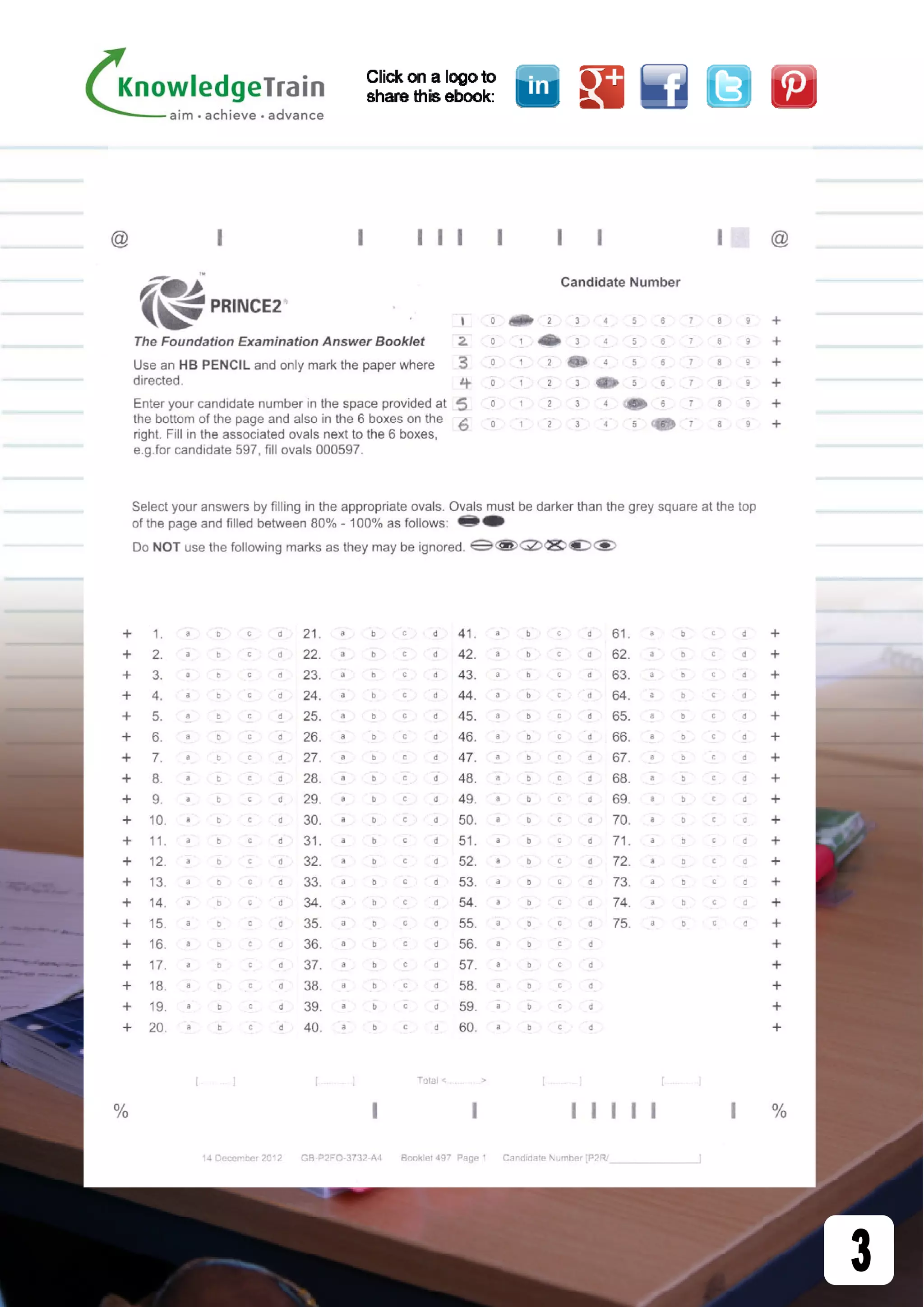
You will then be given an answer sheet 
where you must fill in your candidate 
number at the top – see the picture on 
the next page. When the exam starts, 
you will fill in your answers on this 
sheet.  
 
There are only 2 correct ways to 
complete your answer sheet: either 
completely fill in the oval shape, or 
draw a thick horizontal line through 
the oval. Any other way and you run 
the risk that the machine which scans 
your paper may not read it properly 
and so you could fail. See the example 
on the next page. 


The question booklet 
After filling in your candidate number 
on the answer sheet, the exam is ready 
to start. At this point the invigilator will 
give you the question booklet. This will 
contain all of the 75 questions. You 
must write your candidate number on 
the front cover. This booklet may not 
leave the room, so if you go to the 
toilet during the exam, you must leave 
this booklet in the examination room. 
It must also be handed back to the 
invigilator at the end of the exam along 
with your answer sheet. 
 
Question styles 
 
Many of the questions can be 
answered quickly. For example, 
consider the following: 
 
Q. In which of the following processes 
does the Project Board choose a 
suitable risk response? 
 
a. Controlling a Stage 
b. Managing a Stage Boundary 
c. Directing a Project 
d. Starting Up a Project 
 
If you remember that the Project 
Board only performs one of the seven 
processes then the answer is 
straightforward – it’s Directing a 
Project, option c. 
 
However, some questions require 
more thought, such as this example: 
 
Q. Which of the following tasks form 
part of the product‐based planning 
method? 
 
i. Writing the product descriptions 
ii. Creating a product flow diagram 
iii. Designing the plan 
iv. Creating the product breakdown 
structure 
 
a. (i), (ii) and (iii) 
b. (ii), (iii) and (iv) 
c. (i), (ii) and (iv) 
d. (i), (iii) and (iv) 
 
For the above question, read the 
statements i‐iv, and then decide which 
three form part of the product‐based 
planning method. I suggest that you 
read each of the 4 options and tick the 
ones you are sure form part of the 
technique. If there are only 2 options 
you are sure about, at least you have 
reduced your last decision to a choice 
between the 2 remaining options, so 
pick one of them and then mark your 
answer paper accordingly. 
 
As you can see, it really does help to be 
able to quickly recall your PRINCE2 
knowledge quickly. With such limited 
time and no manual allowed, revision 
must be top of your Foundation exam 
preparation plan. 
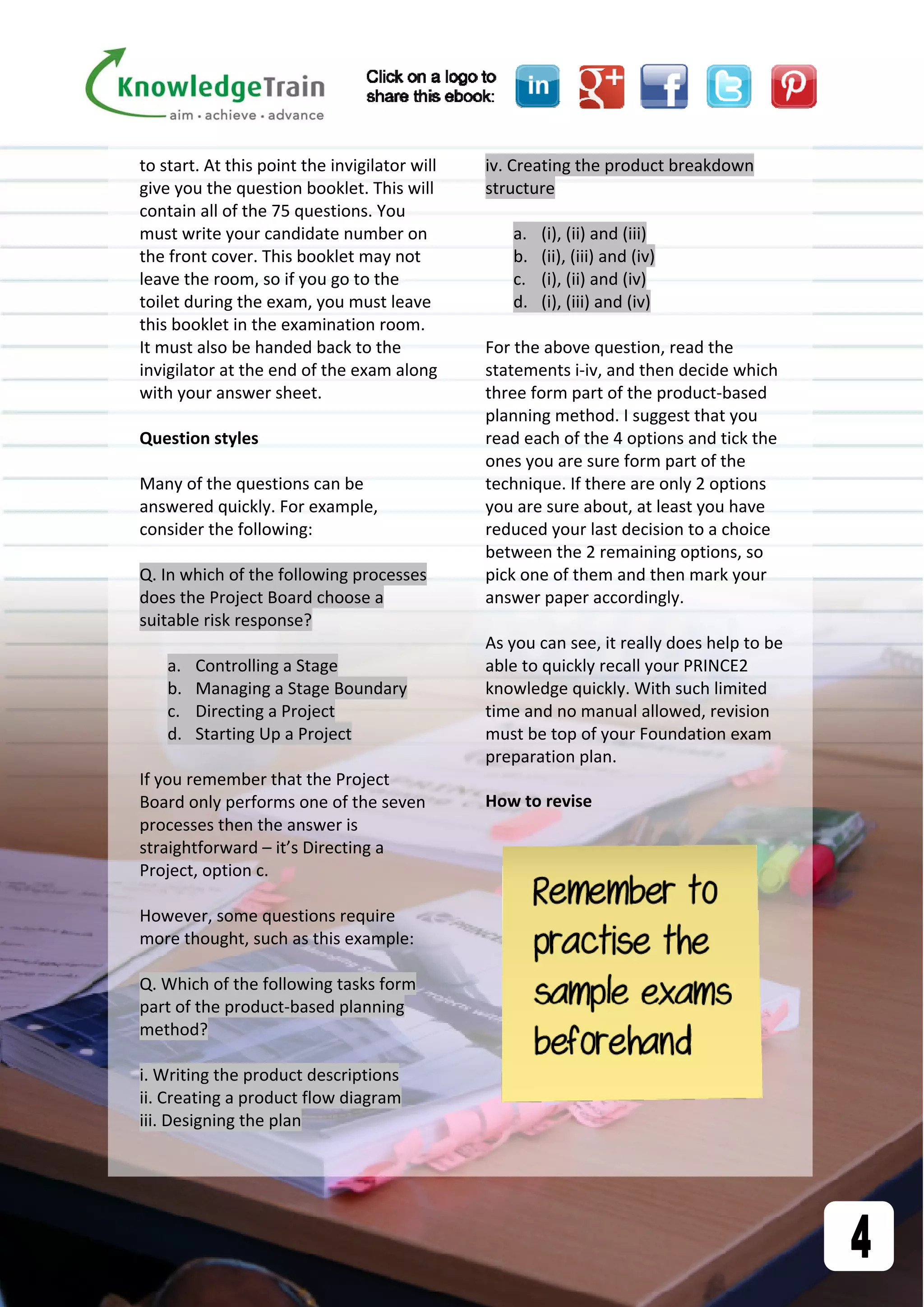
How to revise 
 
The number one revision method is to 
practice those exam questions! As the 
questions are compiled from a limited 
question bank, the more practice 
questions you attempt, the more 
prepared you will be. The PRINCE2 
exam board provides 2 sample 
Foundation exam papers to PRINCE2 
Accredited Training Organizations, so if 
you have studied using an accredited 
training course, these should be 
provided to you. 
Practising the sample papers also helps 
you to refine your technique, and you 
will be able to predict how well you are 
likely to perform in the actual exam. 
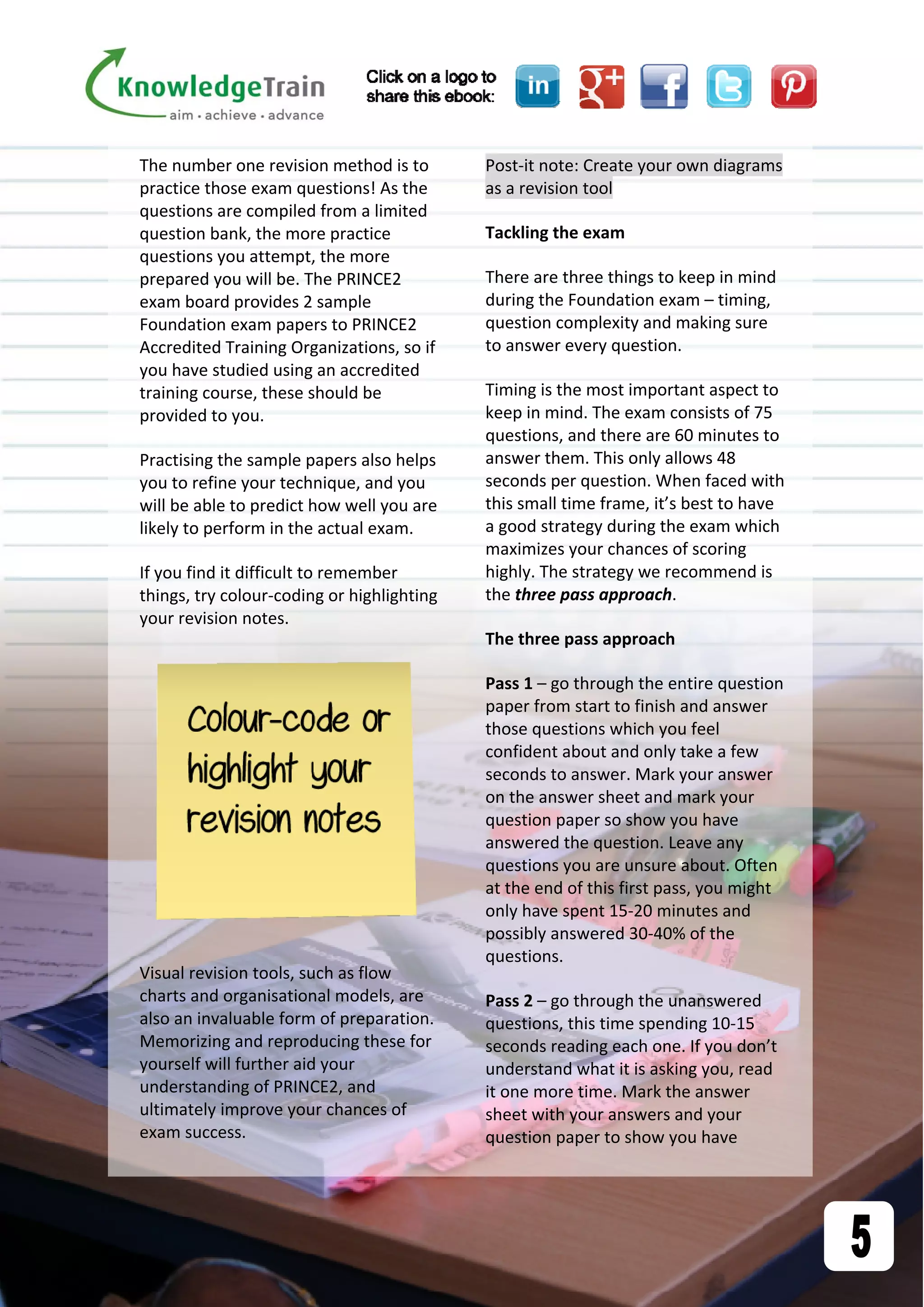
If you find it difficult to remember 
things, try colour‐coding or highlighting 
your revision notes.  
 
Visual revision tools, such as flow 
charts and organisational models, are 
also an invaluable form of preparation. 
Memorizing and reproducing these for 
yourself will further aid your 
understanding of PRINCE2, and 
ultimately improve your chances of 
exam success. 
Post‐it note: Create your own diagrams 
as a revision tool 
Tackling the exam 
There are three things to keep in mind 
during the Foundation exam – timing, 
question complexity and making sure 
to answer every question.  
Timing is the most important aspect to 
keep in mind. The exam consists of 75 
questions, and there are 60 minutes to 
answer them. This only allows 48 
seconds per question. When faced with 
this small time frame, it’s best to have 
a good strategy during the exam which 
maximizes your chances of scoring 
highly. The strategy we recommend is 
the three pass approach. 
The three pass approach  
Pass 1 – go through the entire question 
paper from start to finish and answer 
those questions which you feel 
confident about and only take a few 
seconds to answer. Mark your answer 
on the answer sheet and mark your 
question paper so show you have 
answered the question. Leave any 
questions you are unsure about. Often 
at the end of this first pass, you might 
only have spent 15‐20 minutes and 
possibly answered 30‐40% of the 
questions. 
Pass 2 – go through the unanswered 
questions, this time spending 10‐15 
seconds reading each one. If you don’t 
understand what it is asking you, read 
it one more time. Mark the answer 
sheet with your answers and your 
question paper to show you have 
answered the question. At the end of 
this pass you will only be left with 
those questions which take a long time 
to answer, or you are still not sure 
about.  
Pass 3 – re‐read the remaining 
questions. By a process of elimination, 
discount those options which you think 
are definitely wrong. Cross them out 
on the question booklet. If you do this, 
you can often eliminate 2 options 
straightaway which will leave you with 
2 options left to choose from. Read the 
question and the 2 remaining options 
one more time and if you really cannot 
decide guess.  
Whatever you do, make sure that one 
option has been selected on your 
answer sheet for all 75 questions in the 
question booklet. 
 Apply the three pass approach to 
maximize your chances of gaining 
the required marks 
 Do NOT spend too long on complex 
questions. It’s always better to skip 
these questions and answer them 
at the end 
 Be careful about over‐analyzing 
questions and think carefully 
before changing answers. Your 
initial response is often the correct 
one 
 Only select one option for all 75 
questions and ensure you have 
filled these in on the answer sheet 
Preparing well, knowing what to 
expect and thoroughly understanding 
the PRINCE2 methodology, will all 
greatly improve your chances of 
success. Also, statistics show that high‐
scorers in the Foundation exam will 
have a better chance at getting a high 
score in Practitioner, which is certainly 
something to keep in mind. 
Things to remember 
On the day of the exam, you must 
bring: 
 Photo ID (such as a passport or 
driving licence) – you cannot take 
the exam unless you have proof of 
ID to show the invigilator. 
 Pencils and an eraser – for 
answering those questions! 
 Pen – for filling in the candidate 
details form 
 Water – ensure you have water to 
drink during the exam. Studies 
show that students who drink 
water during exams, on average 
score 4.8% higher marks than 
students who don’t drink water. [1]
 
Other points to remember: 
 If English is not your first language 
or you have certain conditions such 
as dyslexia, you may feel that 
completing the exam in the allotted  
 time will be a challenge. Inform 
your trainer before the exam, and 
they may be able to organise extra 
time for you 
 Tell the invigilator if the exam 
environment is bothering you (such 
as noise or sunlight) or you feel 
unwell. Do this preferably before 
the exam begins 
 If you need to change an answer, 
you should rub out the wrong 
answer as thoroughly as you can in 
order to avoid ambiguity when the 
answer sheet is marked 
 All mobile phones and electronic 
devices must be switched off for 
the duration of the exam 
 If you fail the exam, you can re‐take 
it at a later date, although you will 
need to pay the exam fee again 
 At the end of the exam, the 
invigilator will mark your answers 
and give you a provisional result. 
You will therefore know on the day 
if you have provisionally passed or 
failed. Two weeks later, the exam 
board (APMG) will confirm the 
result 
 If you have passed, you should 
expect to receive the certificate 
about four weeks after receiving 
your results, and your name, 
candidate number, exam date and 
training company will appear on 
APMG’s online successful candidate 
register. You can also opt‐out of 
this if you wish, but it is a good way 
for potential employers to see 
proof of your PRINCE2 qualification 
 
 
Conclusion 
We hope you have found this guide to 
passing the PRINCE2 Foundation exam 
useful. Thorough knowledge of how 
PRINCE2 works and a great exam 
technique will lead to exam success, 
and you should feel reassured that all 
the questions are multiple‐choice. 
Confidence, effective study, and 
practicing sample exams will all boost 
your chances of passing the exam, and 
achieving a qualification recognised in 
industries throughout the world. 
References 
[1] Pawson, C. (2004, April). Bring water 
into exams to improve your grade. 
http://www.uel.ac.uk/news/press‐
releases/2012/04/waterexams.htm 


You might also like these ebooks:
Learn the PRINCE2 PrinciplesPRINCE2 vs the PMBOK Guide
Learn the PRINCE2 Themes Learn the PRINCE2 Processes

Learn the SECRETS to passing your PRINCE2 Foundation exam with flying colours!