By,
MOHAMMED HAROON RASHEED
B.A.LL.B (Hons.), [BSW] & [LLM]
Advocate
Email ID: adv.mdharoon@gmail.com
1(c)2012 MD HAROON RASHEED,ADVOCATE
 The law of partnership is contained in the Indian
Partnership Act, 1932, which came into force on
1st October, 1932
 A contract of partnership is a special contract.
Where the partnership act is silent on any point,
the general principles of the law of contract apply
(Section 3)
 This Act extends to whole of India(except the
state of Jammu & Kashmir)
2(c)2012 MD HAROON RASHEED,ADVOCATE
Section 4 Para 1 of the of the Indian
partnership Act 1932, defines partnership as:
 “ Partnership is the relation between
persons who have agreed to share the profits
of a business carried on by all or any of them
acting for all”.
 Thus, partnership is the name of legal
relationship between or among persons who
have entered into a contract.
3(c)2012 MD HAROON RASHEED,ADVOCATE
 Section 4 of Indian Partnership Act, 1932
provides that:
Persons who have agreed into partnership with
one another are called individually
‘PARTNERS’ and collectively ‘FIRM’ and the
name under which their business is carried on is
called the ‘FIRM NAME’
“Partnership is thus Invisibility which binds
the partners together and firm is the visible
form of those partners who are thus bound
together”.
4(c)2012 MD HAROON RASHEED,ADVOCATE
 Section 11 Companies Act provides that the
maximum no. of persons, a firm can have:
In case of partnership firm carrying on a banking business 10
In case of partnership firm carrying on any other business 20
If the number of partners exceeds the aforesaid
limit, the partnership firm becomes an illegal
association.
5(c)2012 MD HAROON RASHEED,ADVOCATE
Two or more
persons
An agreement
Sharing of profit
Business
Mutual agency
Essential elements of Partnership
6(c)2012 MD HAROON RASHEED,ADVOCATE
 The true test of partnership is the existence of ‘Mutual Agency’
relationship, i.e. the capacity of a partner to bind other partners by
his acts done in firm’s name and be bound by the acts of other
partners.
 Sharing of profit is an essential element of partnership but it is not a
conclusive proof of partnership.
 Sharing of profit is Prima facie evidence.
 Thus partnership can be presumed when
a. There is an agreement to share the profits of business
and
b. The business is carried on by all or by any of them
acting for all.
7(c)2012 MD HAROON RASHEED,ADVOCATE
Mutual agency refers to the relationship of
principal and agent Among partners
Example in case of
firm of A,B and C
When A acts
A- Agent
B and C- Principal
When B acts
B- Agent
A and C- Principal
When C acts
C- Agent
A and B- Principal
8(c)2012 MD HAROON RASHEED,ADVOCATE
 Actual partner
 Sleeping partner
 Nominal partner(does not contribute any capital; but
lends his name and credit to the firm)
 Sub-partner
 Partner in profits only
 Minor as a partner
9(c)2012 MD HAROON RASHEED,ADVOCATE
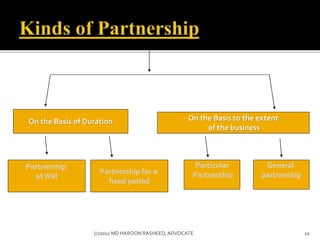
Partnership
at Will
Particular
Partnership
On the Basis of Duration On the Basis to the extent
of the business
Partnership for a
fixed period
General
partnership
10(c)2012 MD HAROON RASHEED,ADVOCATE
 Partnership at will :- According to SECTION-7 of the act, it is a partnership
when:-
1. No fixed period has been agreed upon for the duration of the partnership and
2. There is no provisions made as to the determination of the partnership.
 Partnership for a fixed period :- Where a provision is made by a contract
for the duration of the partnership, the partnership is called ‘partnership for a
fixed period’.
 Particular partnership :- a partnership may be organized for the prosecution
of a single adventure as well as the conduct of a continuous business.
 General partnership :- where a partnership is constituted with respect to the
business in general, it is called a general partnership.
11(c)2012 MD HAROON RASHEED,ADVOCATE
 A partnership is formed by an agreement. This
agreement may be in writing or oral. though the law
does not expressly require that the partnership
agreement should be in writing, it is desirable to have it
in writing in order to avoid any dispute with regard to
the terms of the partnership. The document which
contains the term of a partnership as agreed among the
partners is called “partnership deed”.
 The partnership Deed is to be duly stamped as per the
Indian Stamp Act, and duly signed by all the partners.
 Contd.
12(c)2012 MD HAROON RASHEED,ADVOCATE
A partnership deed may contain any matter relating to the regulation of
partnership but all provisions in the deed should be within the limits of
Indian Partnership Act, 1932. However, A Partnership Deed should
contain the following clause:-
 Nature of business
 Duration of partnership
 Name of the firm
 Capital
 Share of partners in profits and losses
 Bank Account firm
 Books of account
 Powers of partners
 Retirement and expulsion of partners
 Death of partner
 Dissolution of firm
 Settlement of disputes
13(c)2012 MD HAROON RASHEED,ADVOCATE
 Easy to form: Like sole proprietorships, partnership
businesses can be formed easily without any compulsory
legal formalities. It is not necessary to get the firm
registered. A simple agreement or partnership deed, either
oral or in writing, is sufficient to create a partnership.
 Availability of large resources: Since two or more
partners join hands to start a partnership business, it may be
possible to pool together more resources as compared to a
sole proprietorship. The partners can contribute more
capital, more effort and more time for the business.
Contd.
14(c)2012 MD HAROON RASHEED,ADVOCATE
Advantages contd.
• Better decisions: The partners are the owners of the
business. Each of them has equal right to participate in the
management of the business. In case of any conflict, they can
sit together to solve the problem. Since all partners participate
in the decision-making process, there is less scope for reckless
and hasty decisions.
• Flexibility in operations: A partnership firm is a flexible
organization. At any time, the partners can decide to change
the size or nature of the business or area of it’s operation.
There is no need to follow any legal procedure. Only the
consent of all the partners is required.
15(c)2012 MD HAROON RASHEED,ADVOCATE
 Unlimited liability: All the partners are jointly liable for the debt of
the firm. They can share the liability among themselves or any one can be
asked to pay all the debts even from his personal properties depending on
the arrangement made between the partners.
 Uncertain life: The partnership firm has no legal existence separate
from it’s partners. It comes to an end with death, insolvency, incapacity or
the retirement of a partner. Further, any unsatisfied or discontent partner
can also give notice at any time for the dissolution of the partnership.
 No transferability of share : If you are a partner in any firm, you
cannot transfer your share or part of the company to outsiders, without the
consent of other partners. This creates inconvenience for the partner who
wants to leave the firm or sell part of his share to others.
Contd. 16(c)2012 MD HAROON RASHEED,ADVOCATE
 Lack of harmony:
 In a partnership firm every partner has an equal right to
participate in the management. Also, every partner can
place his or her opinion or viewpoint before the
management regarding any matter at any time. Because
of this, sometimes there is a possibility of friction and
discontent among the partners. Difference of opinion
may lead to the end of the partnership and the business.
 Limited capital: Since the total number of partners
cannot exceed 20, the capital to be raised is always
limited. It may not be possible to start a very large
business in partnership form.
17(c)2012 MD HAROON RASHEED,ADVOCATE
 The word implied authority denotes the authority to
bind the firm which arises by implication of law from
the fact of partnership. With the presence of implied
authority, a partner binds the firm with any of his act
done in connection with the business.
 Section 18 lays down that every partners is an agent of
the firm for the purpose of the business of the firm, a
partner is both a principal and an agent.
 Every partner embraces the character both of principal
and agent. But A partner is agent only for the business
of the firm.
18(c)2012 MD HAROON RASHEED,ADVOCATE
 Section 19(1) and 22 defines the scope of implied authority of a
partners .
 Section 19(1) lays down that subjects to provisions of sections
22,the acts of a partner which is done to carry on in the usual
way business of the kind carried on by firm binds the firm.
Acts within implied authority
 Every partner within the scope of his implied authority may bind the
firm by the following acts
1. He may sell goods of the firm, but he cannot sell the immovable property of
the firm without the consent of other partners.
2. He may purchase such goods on the credit of the firm as are necessary for
carrying on the business of the firm.
3. He may engage servants to perform the business of the firm.
4. He can receive payments of the debts due to the firm. But in the case of non
trading a partner cannot issue a post dated cheque.
19(c)2012 MD HAROON RASHEED,ADVOCATE
 Extension and restriction of partners
implied authority
 Section 20 lays down that the implied
authority of any partners may be extended or
restricted by an agreement between all
partners
 Section 21 provides that a partners has
authority in an emergency to do all such acts
for the purpose of protecting the firm from
loss, as would be done by a persons of
ordinary prudence in his own case, under
similar circumstance .
20(c)2012 MD HAROON RASHEED,ADVOCATE
 Effects of admissions by a partners (section 23)
Admissions made by a partners concerning the
affairs of the firms if made in the ordinary course of the
partnership business are evidence against the firm .such
admissions made by partners will bind the firm . An
admissions by a person before he became a partner in
the firm is not evidence against the firm.
 Effects of notice to acting partners (Section 24)
Notice to one partners relating to the
business of the firm ,operating as notice to the firm .
The partners to whom such notice is given must be
acting in the business at that time. so a notice to a
dormant or sleeping partners would not operate as a
notice to the firm.
21(c)2012 MD HAROON RASHEED,ADVOCATE
22(c)2012 MD HAROON RASHEED,ADVOCATE

Partnership act 1932

  • 1.
    By, MOHAMMED HAROON RASHEED B.A.LL.B(Hons.), [BSW] & [LLM] Advocate Email ID: adv.mdharoon@gmail.com 1(c)2012 MD HAROON RASHEED,ADVOCATE
  • 2.
     The lawof partnership is contained in the Indian Partnership Act, 1932, which came into force on 1st October, 1932  A contract of partnership is a special contract. Where the partnership act is silent on any point, the general principles of the law of contract apply (Section 3)  This Act extends to whole of India(except the state of Jammu & Kashmir) 2(c)2012 MD HAROON RASHEED,ADVOCATE
  • 3.
    Section 4 Para1 of the of the Indian partnership Act 1932, defines partnership as:  “ Partnership is the relation between persons who have agreed to share the profits of a business carried on by all or any of them acting for all”.  Thus, partnership is the name of legal relationship between or among persons who have entered into a contract. 3(c)2012 MD HAROON RASHEED,ADVOCATE
  • 4.
     Section 4of Indian Partnership Act, 1932 provides that: Persons who have agreed into partnership with one another are called individually ‘PARTNERS’ and collectively ‘FIRM’ and the name under which their business is carried on is called the ‘FIRM NAME’ “Partnership is thus Invisibility which binds the partners together and firm is the visible form of those partners who are thus bound together”. 4(c)2012 MD HAROON RASHEED,ADVOCATE
  • 5.
     Section 11Companies Act provides that the maximum no. of persons, a firm can have: In case of partnership firm carrying on a banking business 10 In case of partnership firm carrying on any other business 20 If the number of partners exceeds the aforesaid limit, the partnership firm becomes an illegal association. 5(c)2012 MD HAROON RASHEED,ADVOCATE
  • 6.
    Two or more persons Anagreement Sharing of profit Business Mutual agency Essential elements of Partnership 6(c)2012 MD HAROON RASHEED,ADVOCATE
  • 7.
     The truetest of partnership is the existence of ‘Mutual Agency’ relationship, i.e. the capacity of a partner to bind other partners by his acts done in firm’s name and be bound by the acts of other partners.  Sharing of profit is an essential element of partnership but it is not a conclusive proof of partnership.  Sharing of profit is Prima facie evidence.  Thus partnership can be presumed when a. There is an agreement to share the profits of business and b. The business is carried on by all or by any of them acting for all. 7(c)2012 MD HAROON RASHEED,ADVOCATE
  • 8.
    Mutual agency refersto the relationship of principal and agent Among partners Example in case of firm of A,B and C When A acts A- Agent B and C- Principal When B acts B- Agent A and C- Principal When C acts C- Agent A and B- Principal 8(c)2012 MD HAROON RASHEED,ADVOCATE
  • 9.
     Actual partner Sleeping partner  Nominal partner(does not contribute any capital; but lends his name and credit to the firm)  Sub-partner  Partner in profits only  Minor as a partner 9(c)2012 MD HAROON RASHEED,ADVOCATE
  • 10.
    Partnership at Will Particular Partnership On theBasis of Duration On the Basis to the extent of the business Partnership for a fixed period General partnership 10(c)2012 MD HAROON RASHEED,ADVOCATE
  • 11.
     Partnership atwill :- According to SECTION-7 of the act, it is a partnership when:- 1. No fixed period has been agreed upon for the duration of the partnership and 2. There is no provisions made as to the determination of the partnership.  Partnership for a fixed period :- Where a provision is made by a contract for the duration of the partnership, the partnership is called ‘partnership for a fixed period’.  Particular partnership :- a partnership may be organized for the prosecution of a single adventure as well as the conduct of a continuous business.  General partnership :- where a partnership is constituted with respect to the business in general, it is called a general partnership. 11(c)2012 MD HAROON RASHEED,ADVOCATE
  • 12.
     A partnershipis formed by an agreement. This agreement may be in writing or oral. though the law does not expressly require that the partnership agreement should be in writing, it is desirable to have it in writing in order to avoid any dispute with regard to the terms of the partnership. The document which contains the term of a partnership as agreed among the partners is called “partnership deed”.  The partnership Deed is to be duly stamped as per the Indian Stamp Act, and duly signed by all the partners.  Contd. 12(c)2012 MD HAROON RASHEED,ADVOCATE
  • 13.
    A partnership deedmay contain any matter relating to the regulation of partnership but all provisions in the deed should be within the limits of Indian Partnership Act, 1932. However, A Partnership Deed should contain the following clause:-  Nature of business  Duration of partnership  Name of the firm  Capital  Share of partners in profits and losses  Bank Account firm  Books of account  Powers of partners  Retirement and expulsion of partners  Death of partner  Dissolution of firm  Settlement of disputes 13(c)2012 MD HAROON RASHEED,ADVOCATE
  • 14.
     Easy toform: Like sole proprietorships, partnership businesses can be formed easily without any compulsory legal formalities. It is not necessary to get the firm registered. A simple agreement or partnership deed, either oral or in writing, is sufficient to create a partnership.  Availability of large resources: Since two or more partners join hands to start a partnership business, it may be possible to pool together more resources as compared to a sole proprietorship. The partners can contribute more capital, more effort and more time for the business. Contd. 14(c)2012 MD HAROON RASHEED,ADVOCATE
  • 15.
    Advantages contd. • Betterdecisions: The partners are the owners of the business. Each of them has equal right to participate in the management of the business. In case of any conflict, they can sit together to solve the problem. Since all partners participate in the decision-making process, there is less scope for reckless and hasty decisions. • Flexibility in operations: A partnership firm is a flexible organization. At any time, the partners can decide to change the size or nature of the business or area of it’s operation. There is no need to follow any legal procedure. Only the consent of all the partners is required. 15(c)2012 MD HAROON RASHEED,ADVOCATE
  • 16.
     Unlimited liability:All the partners are jointly liable for the debt of the firm. They can share the liability among themselves or any one can be asked to pay all the debts even from his personal properties depending on the arrangement made between the partners.  Uncertain life: The partnership firm has no legal existence separate from it’s partners. It comes to an end with death, insolvency, incapacity or the retirement of a partner. Further, any unsatisfied or discontent partner can also give notice at any time for the dissolution of the partnership.  No transferability of share : If you are a partner in any firm, you cannot transfer your share or part of the company to outsiders, without the consent of other partners. This creates inconvenience for the partner who wants to leave the firm or sell part of his share to others. Contd. 16(c)2012 MD HAROON RASHEED,ADVOCATE
  • 17.
     Lack ofharmony:  In a partnership firm every partner has an equal right to participate in the management. Also, every partner can place his or her opinion or viewpoint before the management regarding any matter at any time. Because of this, sometimes there is a possibility of friction and discontent among the partners. Difference of opinion may lead to the end of the partnership and the business.  Limited capital: Since the total number of partners cannot exceed 20, the capital to be raised is always limited. It may not be possible to start a very large business in partnership form. 17(c)2012 MD HAROON RASHEED,ADVOCATE
  • 18.
     The wordimplied authority denotes the authority to bind the firm which arises by implication of law from the fact of partnership. With the presence of implied authority, a partner binds the firm with any of his act done in connection with the business.  Section 18 lays down that every partners is an agent of the firm for the purpose of the business of the firm, a partner is both a principal and an agent.  Every partner embraces the character both of principal and agent. But A partner is agent only for the business of the firm. 18(c)2012 MD HAROON RASHEED,ADVOCATE
  • 19.
     Section 19(1)and 22 defines the scope of implied authority of a partners .  Section 19(1) lays down that subjects to provisions of sections 22,the acts of a partner which is done to carry on in the usual way business of the kind carried on by firm binds the firm. Acts within implied authority  Every partner within the scope of his implied authority may bind the firm by the following acts 1. He may sell goods of the firm, but he cannot sell the immovable property of the firm without the consent of other partners. 2. He may purchase such goods on the credit of the firm as are necessary for carrying on the business of the firm. 3. He may engage servants to perform the business of the firm. 4. He can receive payments of the debts due to the firm. But in the case of non trading a partner cannot issue a post dated cheque. 19(c)2012 MD HAROON RASHEED,ADVOCATE
  • 20.
     Extension andrestriction of partners implied authority  Section 20 lays down that the implied authority of any partners may be extended or restricted by an agreement between all partners  Section 21 provides that a partners has authority in an emergency to do all such acts for the purpose of protecting the firm from loss, as would be done by a persons of ordinary prudence in his own case, under similar circumstance . 20(c)2012 MD HAROON RASHEED,ADVOCATE
  • 21.
     Effects ofadmissions by a partners (section 23) Admissions made by a partners concerning the affairs of the firms if made in the ordinary course of the partnership business are evidence against the firm .such admissions made by partners will bind the firm . An admissions by a person before he became a partner in the firm is not evidence against the firm.  Effects of notice to acting partners (Section 24) Notice to one partners relating to the business of the firm ,operating as notice to the firm . The partners to whom such notice is given must be acting in the business at that time. so a notice to a dormant or sleeping partners would not operate as a notice to the firm. 21(c)2012 MD HAROON RASHEED,ADVOCATE
  • 22.
    22(c)2012 MD HAROONRASHEED,ADVOCATE