CONFIDENTIAL designator
V0000000
MLOps platform for artificial intelligence/
machine learning (AI/ML) use cases
Overview of Red Hat
OpenShift AI
1
Steven Huels
Sr Director, AI Business Unit
2
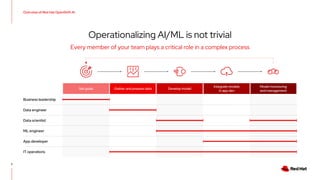
Operationalizing AI/ML is not trivial
Overview of Red Hat OpenShift AI
App developer
IT operations
Data engineer
Data scientist
ML engineer
Business leadership
Set goals Gather and prepare data Develop model
Model monitoring
and management
Integrate models
in app dev
Every member of your team plays a critical role in a complex process
Overview of Red Hat OpenShift AI
3
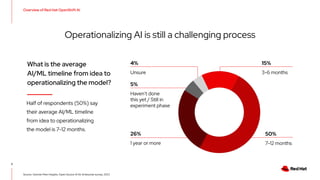
Source: Gartner Peer Insights, Open Source AI for Enterprise survey, 2023
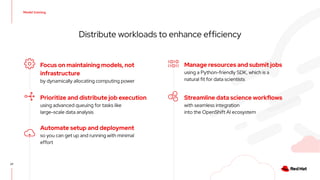
Operationalizing AI is still a challenging process
What is the average
AI/ML timeline from idea to
operationalizing the model?
Half of respondents (50%) say
their average AI/ML timeline
from idea to operationalizing
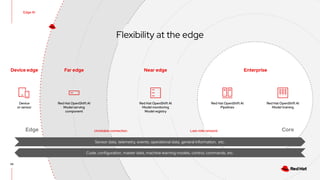
the model is 7-12 months.
50%
7-12 months
15%
3-6 months
4%
Unsure
26%
1 year or more
5%
Haven't done
this yet / Still in
experiment phase
4
4
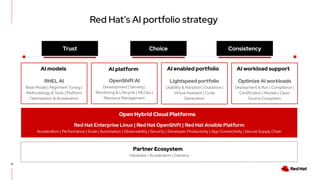
Open Hybrid Cloud Platforms
Red Hat Enterprise Linux | Red Hat OpenShift | Red Hat Ansible Platform
Acceleration | Performance | Scale | Automation | Observability | Security | Developer Productivity | App Connectivity | Secure Supply Chain
Partner Ecosystem
Hardware | Accelerators | Delivery
AI enabled portfolio
Lightspeed portfolio
Usability & Adoption | Guidance |
Virtual Assistant | Code
Generation
AI models
RHEL AI
Base Model | Alignment Tuning |
Methodology & Tools | Platform
Optimization & Acceleration
AI platform
OpenShift AI
Development | Serving |
Monitoring & Lifecycle | MLOps |
Resource Management
AI workload support
Optimize AI workloads
Deployment & Run | Compliance |
Certification | Models | Open
Source Ecosystem
Trust Choice Consistency
Red Hat’s AI portfolio strategy
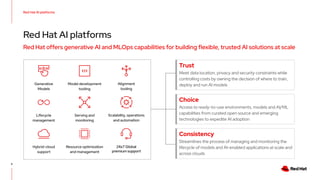
Red Hat offers generative AI and MLOps capabilities for building flexible, trusted AI solutions at scale
Red Hat AI platforms
5
Generative
Models
Serving and
monitoring
Lifecycle
management
Resource optimization
and management
Model development
tooling
Scalability, operations
and automation
Hybrid-cloud
support
24x7 Global
premium support
Trust
Meet data location, privacy and security constraints while
controlling costs by owning the decision of where to train,
deploy and run AI models
Consistency
Streamlines the process of managing and monitoring the
lifecycle of models and AI-enabled applications at scale and
across clouds
Choice
Access to ready-to-use environments, models and AI/ML
capabilities from curated open source and emerging
technologies to expedite AI adoption
Alignment
tooling
6
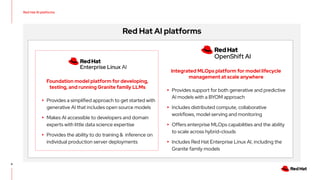
Red Hat AI platforms
Integrated MLOps platform for model lifecycle
management at scale anywhere
▸ Provides support for both generative and predictive
AI models with a BYOM approach
▸ Includes distributed compute, collaborative
workflows, model serving and monitoring
▸ Offers enterprise MLOps capabilities and the ability
to scale across hybrid-clouds
▸ Includes Red Hat Enterprise Linux AI, including the
Granite family models
Foundation model platform for developing,
testing, and running Granite family LLMs
▸ Provides a simplified approach to get started with
generative AI that includes open source models
▸ Makes AI accessible to developers and domain
experts with little data science expertise
▸ Provides the ability to do training & inference on
individual production server deployments
Red Hat AI platforms
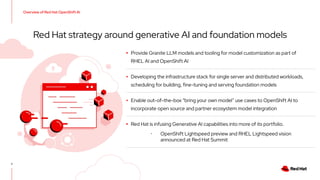
▸ Provide Granite LLM models and tooling for model customization as part of
RHEL AI and OpenShift AI
▸ Developing the infrastructure stack for single server and distributed workloads,
scheduling for building, fine-tuning and serving foundation models
▸ Enable out-of-the-box “bring your own model” use cases to OpenShift AI to
incorporate open source and partner ecosystem model integration
▸ Red Hat is infusing Generative AI capabilities into more of its portfolio.
・ OpenShift Lightspeed preview and RHEL Lightspeed vision
announced at Red Hat Summit
7
Red Hat strategy around generative AI and foundation models
Overview of Red Hat OpenShift AI
8
8
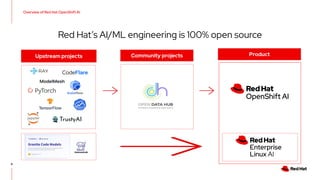
Red Hat’s AI/ML engineering is 100% open source
Upstream projects Product
Community projects
Overview of Red Hat OpenShift AI
CodeFlare
Red Hat OpenShift AI
9
9
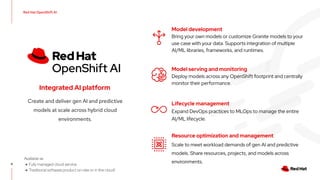
Integrated AI platform
Create and deliver gen AI and predictive
models at scale across hybrid cloud
environments.
Available as
● Fully managed cloud service
● Traditional software product on-site or in the cloud!
Model development
Bring your own models or customize Granite models to your
use case with your data. Supports integration of multiple
AI/ML libraries, frameworks, and runtimes.
Lifecycle management
Expand DevOps practices to MLOps to manage the entire
AI/ML lifecycle.
Model serving and monitoring
Deploy models across any OpenShift footprint and centrally
monitor their performance.
Resource optimization and management
Scale to meet workload demands of gen AI and predictive
models. Share resources, projects, and models across
environments.
10
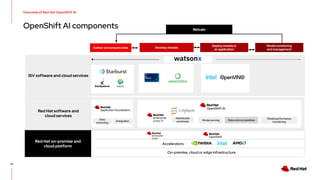
Red Hat software and
cloud services
OpenShift AI components Retrain
Overview of Red Hat OpenShift AI
Model monitoring
and management
Gather and prepare data Develop models
Deploy models in
an application
ISV software and cloud services
Accelerators:
On-premise, cloud or edge infrastructure
Data science pipelines
Red Hat on-premise and
cloud platform
Model serving
Model performance
monitoring
Distributed
workloads
Data
streaming
Integration
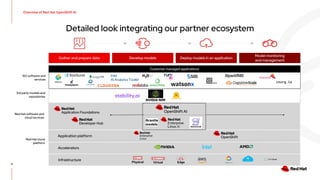
Gather and prepare data Deploy models in an application
Model monitoring
and management
Develop models
11
Detailed look integrating our partner ecosystem
Application platform
Accelerators
Infrastructure
ISV software and
services
Customer managed applications
3rd party models and
repositories
Red Hat software and
cloud services
Red Hat cloud
platform
Overview of Red Hat OpenShift AI
NVIDIA NIM
Granite
models
Physical Virtual Edge
12
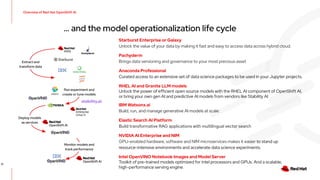
… and the model operationalization life cycle
Starburst Enterprise or Galaxy
Unlock the value of your data by making it fast and easy to access data across hybrid cloud.
Pachyderm
Brings data versioning and governance to your most precious asset
Anaconda Professional
Curated access to an extensive set of data science packages to be used in your Jupyter projects.
RHEL AI and Granite LLM models
Unlock the power of efficient open source models with the RHEL AI component of OpenShift AI,
or bring your own gen AI and predictive AI models from vendors like Stability AI
IBM Watsonx.ai
Build, run, and manage generative AI models at scale.
Elastic Search AI Platform
Build transformative RAG applications with multilingual vector search
NVIDIA AI Enterprise and NIM
GPU-enabled hardware, software and NIM microservices makes it easier to stand up
resource-intensive environments and accelerate data science experiments.
Intel OpenVINO Notebook Images and Model Server
Toolkit of pre-trained models optimized for intel processors and GPUs. And a scalable,
high-performance serving engine.
Extract and
transform data
Run experiment and
create or tune models
Deploy models
as services
Monitor models and
track performance
Overview of Red Hat OpenShift AI
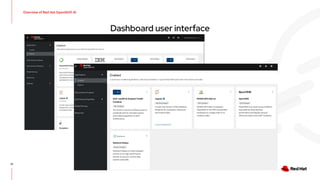
Dashboard user interface
13
Overview of Red Hat OpenShift AI
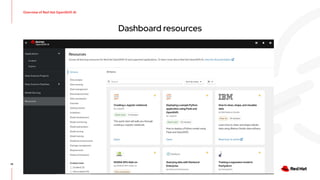
Dashboard resources
14
Overview of Red Hat OpenShift AI
15
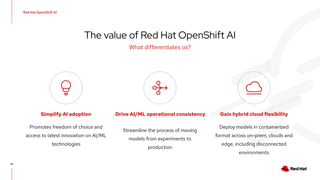
Gain hybrid cloud flexibility
Simplify AI adoption
Streamline the process of moving
models from experiments to
production
Drive AI/ML operational consistency
Deploy models in containerized
format across on-prem, clouds and
edge, including disconnected
environments
Promotes freedom of choice and
access to latest innovation on AI/ML
technologies
What differentiates us?
Red Hat OpenShift AI
The value of Red Hat OpenShift AI
Source: Red Hat Summit presentation - May 2024
“Red Hat’s work with
AGESIC exemplifies
our dedication to
improving the user
experience for both
our and their
customers.”
Steven Huels
Vice President and General
Manager – AI Business Unit,
Red Hat
Government: LATAM
Presentation abstract
AGESIC, Uruguay’s Agency for Electronic Government and Information and
Knowledge Society, is responsible for e-government strategy and implementation.
With Red Hat®, it led Uruguay’s AI strategy and provided a more consistent, hybrid
AI/ML platform to build and host models while delivering innovative applications.
Presentation summary
● With the proliferation of AI, AGESIC knew that infusing it into its operations
would be key to meeting Uruguay’s evolving needs.
● AGESIC optimized its AI infrastructure with Red Hat OpenShift®, which
brought a containerized approach to workload management and automation
of key processes while also bringing development, operations, and systems
security functions together on a centralized platform.
● AGESIC evolved its offerings to include Platform as a Service (PaaS),
enabling other government agencies to develop, run, and manage
applications without the build and maintenance of complex infrastructure.
Products and services
Red Hat OpenShift Red Hat OpenShift AI
17
Source: Red Hat Q&A: Clalit accelerates research and innovation with AI and GPUs. Interview with Eyal Dviri, Innovation Team Leader in the Data Department at
Clalit. May 2024.
Overview
The patient lies at the center of everything Clalit Health Services (Clalit) does. Its 14
hospitals include 8 general hospitals, 2 mental health hospitals, 2 geriatric hospitals, and a
children’s hospital. It also operates community clinics, dental clinics, imaging facilities, and a
lifestyle program. Clalit recently established an advanced AI platform based on Red Hat
OpenShift AI and Red Hat® OpenShift®. We recently interviewed Eyal Dviri, Innovation Team
Leader in the Data Department at Clalit:
What led you to Red Hat OpenShift AI?
“Our central IT department implemented Red Hat OpenShift to provide a modern solution
for a wide range of use cases across the caregiving part of our organization. When they
made it available to us, we adopted it immediately for our research needs. We didn’t think
twice. To address our ML/AI use cases, because we had OpenShift already, we decided to
go with Red Hat OpenShift AI.”
What’s next?
“We have two challenges ahead. The first thing is the increase in demand when people hear
about our OpenShift AI platform. We need to figure out how to use our computing
resources—our GPUs—optimally. The second thing is the pipeline. We need to understand
best practices for deploying AI algorithms from training to production.”
Red Hat OpenShift AI use cases:
● A joint venture with Harvard
University Medical School. Red
Hat OpenShift AI is helping them
process their large quantity of
structured data using an NVIDIA
GPU.
● Using LLM to pinpoint patients
for preventive medication or
closer inspections. We need to
look at doctors’ notes to find
these people; for that, we use
LLMs such as LLaMa.
● Another use case allows us to
develop image-based machine
learning processes.
Customer perspective: Healthcare
18
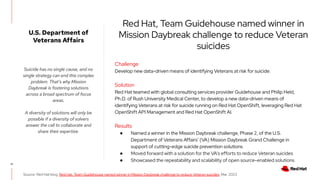
Source: Red Hat blog. Red Hat, Team Guidehouse named winner in Mission Daybreak challenge to reduce Veteran suicides, Mar. 2023.
Challenge
Develop new data-driven means of identifying Veterans at risk for suicide.
Solution
Red Hat teamed with global consulting services provider Guidehouse and Philip Held,
Ph.D. of Rush University Medical Center, to develop a new data-driven means of
identifying Veterans at risk for suicide running on Red Hat OpenShift, leveraging Red Hat
OpenShift API Management and Red Hat OpenShift AI.
Results
● Named a winner in the Mission Daybreak challenge, Phase 2, of the U.S.
Department of Veterans Affairs’ (VA) Mission Daybreak Grand Challenge in
support of cutting-edge suicide prevention solutions
● Moved forward with a solution for the VA’s efforts to reduce Veteran suicides
● Showcased the repeatability and scalability of open source-enabled solutions
Suicide has no single cause, and no
single strategy can end this complex
problem. That’s why Mission
Daybreak is fostering solutions
across a broad spectrum of focus
areas.
A diversity of solutions will only be
possible if a diversity of solvers
answer the call to collaborate and
share their expertise.
Red Hat, Team Guidehouse named winner in
Mission Daybreak challenge to reduce Veteran
suicides
U.S. Department of
Veterans Affairs
19
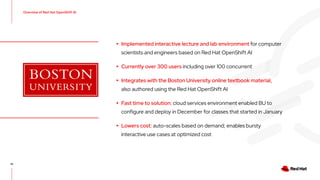
▸ Implemented interactive lecture and lab environment for computer
scientists and engineers based on Red Hat OpenShift AI
▸ Currently over 300 users including over 100 concurrent
▸ Integrates with the Boston University online textbook material,
also authored using the Red Hat OpenShift AI
▸ Fast time to solution: cloud services environment enabled BU to
configure and deploy in December for classes that started in January
▸ Lowers cost: auto-scales based on demand; enables bursty
interactive use cases at optimized cost
Overview of Red Hat OpenShift AI
20
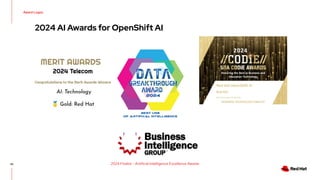
Award Logos
2024 Finalist - Artificial Intelligence Excellence Awards
2024 AI Awards for OpenShift AI
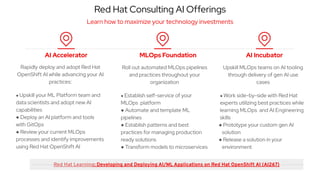
Red Hat Consulting AI Offerings
Learn how to maximize your technology investments
MLOps Foundation
AI Accelerator AI Incubator
Rapidly deploy and adopt Red Hat
OpenShift AI while advancing your AI
practices:
● Upskill your ML Platform team and
data scientists and adopt new AI
capabilities
● Deploy an AI platform and tools
with GitOps
● Review your current MLOps
processes and identify improvements
using Red Hat OpenShift AI
Roll out automated MLOps pipelines
and practices throughout your
organization
● Establish self-service of your
MLOps platform
● Automate and template ML
pipelines
● Establish patterns and best
practices for managing production
ready solutions
● Transform models to microservices
Upskill MLOps teams on AI tooling
through delivery of gen AI use
cases
● Work side-by-side with Red Hat
experts utilizing best practices while
learning MLOps and AI Engineering
skills
● Prototype your custom gen AI
solution
● Release a solution in your
environment
Red Hat Learning: Developing and Deploying AI/ML Applications on Red Hat OpenShift AI (AI267)
22
Learn more ▸
Try it ▸
Overview of Red Hat OpenShift AI
linkedin.com/company/red-hat
youtube.com/user/RedHatVideos
facebook.com/redhatinc
twitter.com/RedHat
Red Hat is the world’s leading provider of enterprise
open source software solutions. Award-winning
support, training, and consulting services make
Red Hat a trusted adviser to the Fortune 500.
Thank you
23
Functionality Details
24
25
Foundation models
25
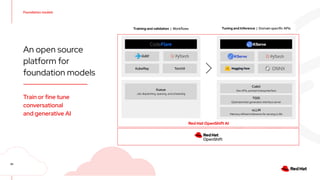
An open source
platform for
foundation models
Train or fine tune
conversational
and generative AI
Kueue
Job dispatching, queuing, and scheduling
TorchX
KubeRay
TGIS
Optimized text generation interface server
Caikit
Dev APIs, prompt tuning interface
Red Hat OpenShift AI
Training and validation | Workflows Tuning and Inference | Domain specific APIs
vLLM
Memory efficient inference for serving LLMs
Model training
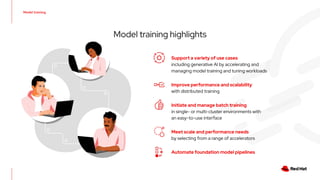
Model training highlights
Support a variety of use cases
including generative AI by accelerating and
managing model training and tuning workloads
Initiate and manage batch training
in single- or multi-cluster environments with
an easy-to-use interface
Automate foundation model pipelines
Improve performance and scalability
with distributed training
Meet scale and performance needs
by selecting from a range of accelerators
Model training
27
Distribute workloads to enhance efficiency
Focus on maintaining models, not
infrastructure
by dynamically allocating computing power
Automate setup and deployment
so you can get up and running with minimal
effort
Manage resources and submit jobs
using a Python-friendly SDK, which is a
natural fit for data scientists
Prioritize and distribute job execution
using advanced queuing for tasks like
large-scale data analysis
Streamline data science workflows
with seamless integration
into the OpenShift AI ecosystem
Model training
28
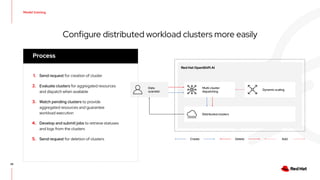
Configure distributed workload clusters more easily
1. Send request for creation of cluster
2. Evaluate clusters for aggregated resources
and dispatch when available
3. Watch pending clusters to provide
aggregated resources and guarantee
workload execution
4. Develop and submit jobs to retrieve statuses
and logs from the clusters
5. Send request for deletion of clusters
Process
Red Hat OpenShift AI
Data
scientist
Multi-cluster
dispatching
Dynamic scaling
Distributed clusters
Create Delete Add
29
Model serving
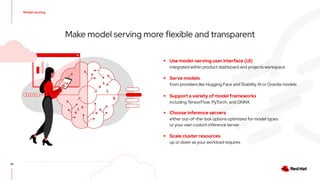
Make model serving more flexible and transparent
▸ Use model-serving user interface (UI)
integrated within product dashboard and projects workspace
▸ Support a variety of model frameworks
including TensorFlow, PyTorch, and ONNX
▸ Choose inference servers
either out-of-the-box options optimized for model types
or your own custom inference server
▸ Serve models
from providers like Hugging Face and Stability AI or Granite models
▸ Scale cluster resources
up or down as your workload requires
Model serving
30
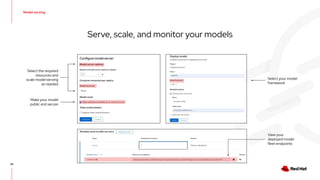
Serve, scale, and monitor your models
Select the required
resources and
scale model serving
as needed
Make your model
public and secure
Select your model
framework
View your
deployed model
fleet endpoints
Model monitoring
31
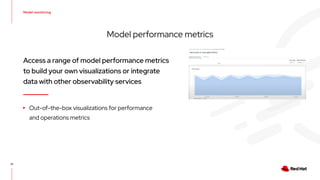
Model performance metrics
Access a range of model performance metrics
to build your own visualizations or integrate
data with other observability services
▸ Out-of-the-box visualizations for performance
and operations metrics
Data Science Pipelines
32
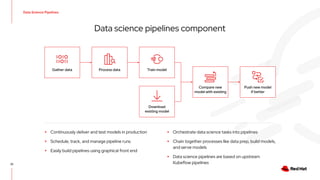
Data science pipelines component
▸ Orchestrate data science tasks into pipelines
▸ Chain together processes like data prep, build models,
and serve models
▸ Data science pipelines are based on upstream
Kubeflow pipelines
▸ Continuously deliver and test models in production
▸ Schedule, track, and manage pipeline runs
▸ Easily build pipelines using graphical front end
Gather data Process data Train model
Download
existing model
Compare new
model with existing
Push new model
if better
Data Science Pipelines
33
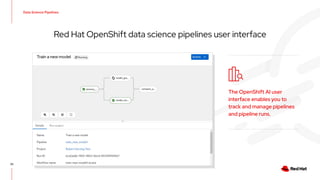
Red Hat OpenShift data science pipelines user interface
The OpenShift AI user
interface enables you to
track and manage pipelines
and pipeline runs.
CONFIDENTIAL designator
z[[
Far edge Near edge Enterprise
Last-mile network
Unreliable connection
Device edge
Edge Core
Code, configuration, master data, machine learning models, control, commands, etc.
Sensor data, telemetry, events, operational data, general information, etc.
Red Hat OpenShift AI
Model monitoring
Model registry
Red Hat OpenShift AI
Model serving
component
Red Hat OpenShift AI
Model training
Device
or sensor
Red Hat OpenShift AI
Pipelines
Edge AI
34
Flexibility at the edge
Edge AI
35
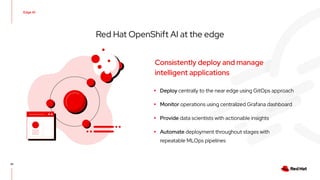
Red Hat OpenShift AI at the edge
▸ Deploy centrally to the near edge using GitOps approach
▸ Monitor operations using centralized Grafana dashboard
▸ Provide data scientists with actionable insights
▸ Automate deployment throughout stages with
repeatable MLOps pipelines
Consistently deploy and manage
intelligent applications
Red Hat Enterprise
Linux AI
36
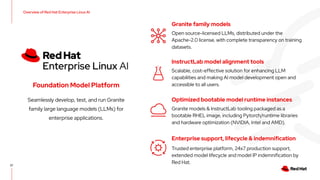
Seamlessly develop, test, and run Granite
family large language models (LLMs) for
enterprise applications.
Foundation Model Platform
37
InstructLab model alignment tools
Scalable, cost-effective solution for enhancing LLM
capabilities and making AI model development open and
accessible to all users.
Optimized bootable model runtime instances
Granite models & InstructLab tooling packaged as a
bootable RHEL image, including Pytorch/runtime libraries
and hardware optimization (NVIDIA, Intel and AMD).
Enterprise support, lifecycle & indemnification
Trusted enterprise platform, 24x7 production support,
extended model lifecycle and model IP indemnification by
Red Hat.
Overview of Red Hat Enterprise Linux AI
Granite family models
Open source-licensed LLMs, distributed under the
Apache-2.0 license, with complete transparency on training
datasets.
Other background
slides
38
Red Hat OpenShift AI
39
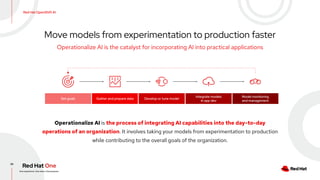
Move models from experimentation to production faster
Operationalize AI is the catalyst for incorporating AI into practical applications
Operationalize AI is the process of integrating AI capabilities into the day-to-day
operations of an organization. It involves taking your models from experimentation to production
while contributing to the overall goals of the organization.
Set goals Gather and prepare data Develop or tune model
Model monitoring
and management
Integrate models
in app dev
40
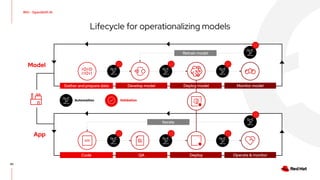
Gather and prepare data Monitor model
Develop model
Model
App
Retrain model
Code Deploy Operate & monitor
QA
Iterate
Automation Validation
Deploy model
RH1 - OpenShift AI
Lifecycle for operationalizing models
Red Hat OpenShift AI
41
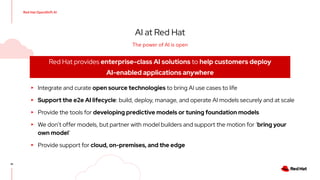
AI at Red Hat
▸ Integrate and curate open source technologies to bring AI use cases to life
▸ Support the e2e AI lifecycle: build, deploy, manage, and operate AI models securely and at scale
▸ Provide the tools for developing predictive models or tuning foundation models
▸ We don’t offer models, but partner with model builders and support the motion for ‘bring your
own model’
▸ Provide support for cloud, on-premises, and the edge
Red Hat provides enterprise-class AI solutions to help customers deploy
AI-enabled applications anywhere
The power of AI is open
42
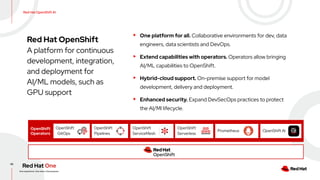
Red Hat OpenShift AI
Red Hat OpenShift
A platform for continuous
development, integration,
and deployment for
AI/ML models, such as
GPU support
OpenShift
Operators
OpenShift
GitOps
OpenShift
Pipelines
OpenShift
Serverless
Prometheus
Operating system
OpenShift
ServiceMesh
▸ One platform for all. Collaborative environments for dev, data
engineers, data scientists and DevOps.
▸ Extend capabilities with operators. Operators allow bringing
AI/ML capabilities to OpenShift.
▸ Hybrid-cloud support. On-premise support for model
development, delivery and deployment.
▸ Enhanced security. Expand DevSecOps practices to protect
the AI/Ml lifecycle.
OpenShift AI
43
Red Hat OpenShift AI provides an integrated platform for building,
training, tuning, deploying and monitoring AI-enabled applications,
predictive and foundation models securely and at scale across
hybrid-cloud environments.
Built on top of Red Hat OpenShift delivers a consistent, streamlined
and automated experience to help organizations rapidly innovate and
deliver AI-enabled apps into production.
Red Hat OpenShift AI
44
Red Hat OpenShift AI
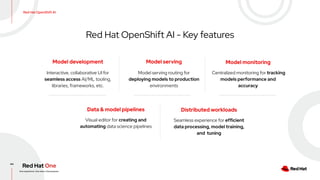
Red Hat OpenShift AI - Key features
Interactive, collaborative UI for
seamless access AI/ML tooling,
libraries, frameworks, etc.
Model development
Model serving routing for
deploying models to production
environments
Model serving
Centralized monitoring for tracking
models performance and
accuracy
Model monitoring
Visual editor for creating and
automating data science pipelines
Data & model pipelines
Seamless experience for efficient
data processing, model training,
and tuning
Distributed workloads
Operating system
45
Red Hat OpenShift AI
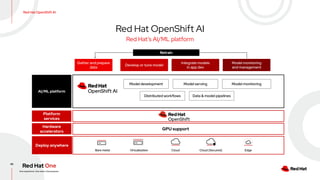
AI/ML platform
Platform
services
Hardware
accelerators
Bare metal Virtualization Edge
Cloud (Secured)
Cloud
Operating system
Operating system
Data & model pipelines
Model serving Model monitoring
Model development
Distributed workflows
GPU support
Deploy anywhere
Gather and prepare
data
Develop or tune model
Model monitoring
and management
Integrate models
in app dev
Retrain
Red Hat’s AI/ML platform
46
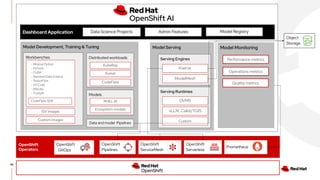
OpenShift
Operators
OpenShift
GitOps
OpenShift
Pipelines
OpenShift
Serverless
Prometheus
Dashboard Application
Model Development, Training & Tuning
Data Science Projects Admin Features
Object
Storage
Model Serving Model Monitoring
Performance metrics
Operations metrics
Quality metrics
Serving Engines
Serving Runtimes
Kserve
ModelMesh
OVMS
vLLM, Caikit/TGIS
Custom
Distributed workloads
KubeRay
CodeFlare
Data and model Pipelines
Workbenches
Custom images
ISV images
- Minimal Python
- PyTorch
- CUDA
- Standard Data Science
- TensorFlow
- VS Code
- RStudio
- TrustyAI
CodeFlare SDK
Operating system
Model Registry
OpenShift
ServiceMesh
Kueue
Models
RHEL AI
Ecosystem models

partners-red-hat-openshift-ai-101-deck.pdf

  • 1.
    CONFIDENTIAL designator V0000000 MLOps platformfor artificial intelligence/ machine learning (AI/ML) use cases Overview of Red Hat OpenShift AI 1 Steven Huels Sr Director, AI Business Unit
  • 2.
    2 Operationalizing AI/ML isnot trivial Overview of Red Hat OpenShift AI App developer IT operations Data engineer Data scientist ML engineer Business leadership Set goals Gather and prepare data Develop model Model monitoring and management Integrate models in app dev Every member of your team plays a critical role in a complex process
  • 3.
    Overview of RedHat OpenShift AI 3 Source: Gartner Peer Insights, Open Source AI for Enterprise survey, 2023 Operationalizing AI is still a challenging process What is the average AI/ML timeline from idea to operationalizing the model? Half of respondents (50%) say their average AI/ML timeline from idea to operationalizing the model is 7-12 months. 50% 7-12 months 15% 3-6 months 4% Unsure 26% 1 year or more 5% Haven't done this yet / Still in experiment phase
  • 4.
    4 4 Open Hybrid CloudPlatforms Red Hat Enterprise Linux | Red Hat OpenShift | Red Hat Ansible Platform Acceleration | Performance | Scale | Automation | Observability | Security | Developer Productivity | App Connectivity | Secure Supply Chain Partner Ecosystem Hardware | Accelerators | Delivery AI enabled portfolio Lightspeed portfolio Usability & Adoption | Guidance | Virtual Assistant | Code Generation AI models RHEL AI Base Model | Alignment Tuning | Methodology & Tools | Platform Optimization & Acceleration AI platform OpenShift AI Development | Serving | Monitoring & Lifecycle | MLOps | Resource Management AI workload support Optimize AI workloads Deployment & Run | Compliance | Certification | Models | Open Source Ecosystem Trust Choice Consistency Red Hat’s AI portfolio strategy
  • 5.
    Red Hat offersgenerative AI and MLOps capabilities for building flexible, trusted AI solutions at scale Red Hat AI platforms Red Hat AI platforms 5 Generative Models Serving and monitoring Lifecycle management Resource optimization and management Model development tooling Scalability, operations and automation Hybrid-cloud support 24x7 Global premium support Trust Meet data location, privacy and security constraints while controlling costs by owning the decision of where to train, deploy and run AI models Consistency Streamlines the process of managing and monitoring the lifecycle of models and AI-enabled applications at scale and across clouds Choice Access to ready-to-use environments, models and AI/ML capabilities from curated open source and emerging technologies to expedite AI adoption Alignment tooling
  • 6.
    6 Red Hat AIplatforms Integrated MLOps platform for model lifecycle management at scale anywhere ▸ Provides support for both generative and predictive AI models with a BYOM approach ▸ Includes distributed compute, collaborative workflows, model serving and monitoring ▸ Offers enterprise MLOps capabilities and the ability to scale across hybrid-clouds ▸ Includes Red Hat Enterprise Linux AI, including the Granite family models Foundation model platform for developing, testing, and running Granite family LLMs ▸ Provides a simplified approach to get started with generative AI that includes open source models ▸ Makes AI accessible to developers and domain experts with little data science expertise ▸ Provides the ability to do training & inference on individual production server deployments Red Hat AI platforms
  • 7.
    ▸ Provide GraniteLLM models and tooling for model customization as part of RHEL AI and OpenShift AI ▸ Developing the infrastructure stack for single server and distributed workloads, scheduling for building, fine-tuning and serving foundation models ▸ Enable out-of-the-box “bring your own model” use cases to OpenShift AI to incorporate open source and partner ecosystem model integration ▸ Red Hat is infusing Generative AI capabilities into more of its portfolio. ・ OpenShift Lightspeed preview and RHEL Lightspeed vision announced at Red Hat Summit 7 Red Hat strategy around generative AI and foundation models Overview of Red Hat OpenShift AI
  • 8.
    8 8 Red Hat’s AI/MLengineering is 100% open source Upstream projects Product Community projects Overview of Red Hat OpenShift AI CodeFlare
  • 9.
    Red Hat OpenShiftAI 9 9 Integrated AI platform Create and deliver gen AI and predictive models at scale across hybrid cloud environments. Available as ● Fully managed cloud service ● Traditional software product on-site or in the cloud! Model development Bring your own models or customize Granite models to your use case with your data. Supports integration of multiple AI/ML libraries, frameworks, and runtimes. Lifecycle management Expand DevOps practices to MLOps to manage the entire AI/ML lifecycle. Model serving and monitoring Deploy models across any OpenShift footprint and centrally monitor their performance. Resource optimization and management Scale to meet workload demands of gen AI and predictive models. Share resources, projects, and models across environments.
  • 10.
    10 Red Hat softwareand cloud services OpenShift AI components Retrain Overview of Red Hat OpenShift AI Model monitoring and management Gather and prepare data Develop models Deploy models in an application ISV software and cloud services Accelerators: On-premise, cloud or edge infrastructure Data science pipelines Red Hat on-premise and cloud platform Model serving Model performance monitoring Distributed workloads Data streaming Integration
  • 11.
    Gather and preparedata Deploy models in an application Model monitoring and management Develop models 11 Detailed look integrating our partner ecosystem Application platform Accelerators Infrastructure ISV software and services Customer managed applications 3rd party models and repositories Red Hat software and cloud services Red Hat cloud platform Overview of Red Hat OpenShift AI NVIDIA NIM Granite models Physical Virtual Edge
  • 12.
    12 … and themodel operationalization life cycle Starburst Enterprise or Galaxy Unlock the value of your data by making it fast and easy to access data across hybrid cloud. Pachyderm Brings data versioning and governance to your most precious asset Anaconda Professional Curated access to an extensive set of data science packages to be used in your Jupyter projects. RHEL AI and Granite LLM models Unlock the power of efficient open source models with the RHEL AI component of OpenShift AI, or bring your own gen AI and predictive AI models from vendors like Stability AI IBM Watsonx.ai Build, run, and manage generative AI models at scale. Elastic Search AI Platform Build transformative RAG applications with multilingual vector search NVIDIA AI Enterprise and NIM GPU-enabled hardware, software and NIM microservices makes it easier to stand up resource-intensive environments and accelerate data science experiments. Intel OpenVINO Notebook Images and Model Server Toolkit of pre-trained models optimized for intel processors and GPUs. And a scalable, high-performance serving engine. Extract and transform data Run experiment and create or tune models Deploy models as services Monitor models and track performance Overview of Red Hat OpenShift AI
  • 13.
    Dashboard user interface 13 Overviewof Red Hat OpenShift AI
  • 14.
  • 15.
    15 Gain hybrid cloudflexibility Simplify AI adoption Streamline the process of moving models from experiments to production Drive AI/ML operational consistency Deploy models in containerized format across on-prem, clouds and edge, including disconnected environments Promotes freedom of choice and access to latest innovation on AI/ML technologies What differentiates us? Red Hat OpenShift AI The value of Red Hat OpenShift AI
  • 16.
    Source: Red HatSummit presentation - May 2024 “Red Hat’s work with AGESIC exemplifies our dedication to improving the user experience for both our and their customers.” Steven Huels Vice President and General Manager – AI Business Unit, Red Hat Government: LATAM Presentation abstract AGESIC, Uruguay’s Agency for Electronic Government and Information and Knowledge Society, is responsible for e-government strategy and implementation. With Red Hat®, it led Uruguay’s AI strategy and provided a more consistent, hybrid AI/ML platform to build and host models while delivering innovative applications. Presentation summary ● With the proliferation of AI, AGESIC knew that infusing it into its operations would be key to meeting Uruguay’s evolving needs. ● AGESIC optimized its AI infrastructure with Red Hat OpenShift®, which brought a containerized approach to workload management and automation of key processes while also bringing development, operations, and systems security functions together on a centralized platform. ● AGESIC evolved its offerings to include Platform as a Service (PaaS), enabling other government agencies to develop, run, and manage applications without the build and maintenance of complex infrastructure. Products and services Red Hat OpenShift Red Hat OpenShift AI
  • 17.
    17 Source: Red HatQ&A: Clalit accelerates research and innovation with AI and GPUs. Interview with Eyal Dviri, Innovation Team Leader in the Data Department at Clalit. May 2024. Overview The patient lies at the center of everything Clalit Health Services (Clalit) does. Its 14 hospitals include 8 general hospitals, 2 mental health hospitals, 2 geriatric hospitals, and a children’s hospital. It also operates community clinics, dental clinics, imaging facilities, and a lifestyle program. Clalit recently established an advanced AI platform based on Red Hat OpenShift AI and Red Hat® OpenShift®. We recently interviewed Eyal Dviri, Innovation Team Leader in the Data Department at Clalit: What led you to Red Hat OpenShift AI? “Our central IT department implemented Red Hat OpenShift to provide a modern solution for a wide range of use cases across the caregiving part of our organization. When they made it available to us, we adopted it immediately for our research needs. We didn’t think twice. To address our ML/AI use cases, because we had OpenShift already, we decided to go with Red Hat OpenShift AI.” What’s next? “We have two challenges ahead. The first thing is the increase in demand when people hear about our OpenShift AI platform. We need to figure out how to use our computing resources—our GPUs—optimally. The second thing is the pipeline. We need to understand best practices for deploying AI algorithms from training to production.” Red Hat OpenShift AI use cases: ● A joint venture with Harvard University Medical School. Red Hat OpenShift AI is helping them process their large quantity of structured data using an NVIDIA GPU. ● Using LLM to pinpoint patients for preventive medication or closer inspections. We need to look at doctors’ notes to find these people; for that, we use LLMs such as LLaMa. ● Another use case allows us to develop image-based machine learning processes. Customer perspective: Healthcare
  • 18.
    18 Source: Red Hatblog. Red Hat, Team Guidehouse named winner in Mission Daybreak challenge to reduce Veteran suicides, Mar. 2023. Challenge Develop new data-driven means of identifying Veterans at risk for suicide. Solution Red Hat teamed with global consulting services provider Guidehouse and Philip Held, Ph.D. of Rush University Medical Center, to develop a new data-driven means of identifying Veterans at risk for suicide running on Red Hat OpenShift, leveraging Red Hat OpenShift API Management and Red Hat OpenShift AI. Results ● Named a winner in the Mission Daybreak challenge, Phase 2, of the U.S. Department of Veterans Affairs’ (VA) Mission Daybreak Grand Challenge in support of cutting-edge suicide prevention solutions ● Moved forward with a solution for the VA’s efforts to reduce Veteran suicides ● Showcased the repeatability and scalability of open source-enabled solutions Suicide has no single cause, and no single strategy can end this complex problem. That’s why Mission Daybreak is fostering solutions across a broad spectrum of focus areas. A diversity of solutions will only be possible if a diversity of solvers answer the call to collaborate and share their expertise. Red Hat, Team Guidehouse named winner in Mission Daybreak challenge to reduce Veteran suicides U.S. Department of Veterans Affairs
  • 19.
    19 ▸ Implemented interactivelecture and lab environment for computer scientists and engineers based on Red Hat OpenShift AI ▸ Currently over 300 users including over 100 concurrent ▸ Integrates with the Boston University online textbook material, also authored using the Red Hat OpenShift AI ▸ Fast time to solution: cloud services environment enabled BU to configure and deploy in December for classes that started in January ▸ Lowers cost: auto-scales based on demand; enables bursty interactive use cases at optimized cost Overview of Red Hat OpenShift AI
  • 20.
    20 Award Logos 2024 Finalist- Artificial Intelligence Excellence Awards 2024 AI Awards for OpenShift AI
  • 21.
    Red Hat ConsultingAI Offerings Learn how to maximize your technology investments MLOps Foundation AI Accelerator AI Incubator Rapidly deploy and adopt Red Hat OpenShift AI while advancing your AI practices: ● Upskill your ML Platform team and data scientists and adopt new AI capabilities ● Deploy an AI platform and tools with GitOps ● Review your current MLOps processes and identify improvements using Red Hat OpenShift AI Roll out automated MLOps pipelines and practices throughout your organization ● Establish self-service of your MLOps platform ● Automate and template ML pipelines ● Establish patterns and best practices for managing production ready solutions ● Transform models to microservices Upskill MLOps teams on AI tooling through delivery of gen AI use cases ● Work side-by-side with Red Hat experts utilizing best practices while learning MLOps and AI Engineering skills ● Prototype your custom gen AI solution ● Release a solution in your environment Red Hat Learning: Developing and Deploying AI/ML Applications on Red Hat OpenShift AI (AI267)
  • 22.
    22 Learn more ▸ Tryit ▸ Overview of Red Hat OpenShift AI
  • 23.
    linkedin.com/company/red-hat youtube.com/user/RedHatVideos facebook.com/redhatinc twitter.com/RedHat Red Hat isthe world’s leading provider of enterprise open source software solutions. Award-winning support, training, and consulting services make Red Hat a trusted adviser to the Fortune 500. Thank you 23
  • 24.
  • 25.
    25 Foundation models 25 An opensource platform for foundation models Train or fine tune conversational and generative AI Kueue Job dispatching, queuing, and scheduling TorchX KubeRay TGIS Optimized text generation interface server Caikit Dev APIs, prompt tuning interface Red Hat OpenShift AI Training and validation | Workflows Tuning and Inference | Domain specific APIs vLLM Memory efficient inference for serving LLMs
  • 26.
    Model training Model traininghighlights Support a variety of use cases including generative AI by accelerating and managing model training and tuning workloads Initiate and manage batch training in single- or multi-cluster environments with an easy-to-use interface Automate foundation model pipelines Improve performance and scalability with distributed training Meet scale and performance needs by selecting from a range of accelerators
  • 27.
    Model training 27 Distribute workloadsto enhance efficiency Focus on maintaining models, not infrastructure by dynamically allocating computing power Automate setup and deployment so you can get up and running with minimal effort Manage resources and submit jobs using a Python-friendly SDK, which is a natural fit for data scientists Prioritize and distribute job execution using advanced queuing for tasks like large-scale data analysis Streamline data science workflows with seamless integration into the OpenShift AI ecosystem
  • 28.
    Model training 28 Configure distributedworkload clusters more easily 1. Send request for creation of cluster 2. Evaluate clusters for aggregated resources and dispatch when available 3. Watch pending clusters to provide aggregated resources and guarantee workload execution 4. Develop and submit jobs to retrieve statuses and logs from the clusters 5. Send request for deletion of clusters Process Red Hat OpenShift AI Data scientist Multi-cluster dispatching Dynamic scaling Distributed clusters Create Delete Add
  • 29.
    29 Model serving Make modelserving more flexible and transparent ▸ Use model-serving user interface (UI) integrated within product dashboard and projects workspace ▸ Support a variety of model frameworks including TensorFlow, PyTorch, and ONNX ▸ Choose inference servers either out-of-the-box options optimized for model types or your own custom inference server ▸ Serve models from providers like Hugging Face and Stability AI or Granite models ▸ Scale cluster resources up or down as your workload requires
  • 30.
    Model serving 30 Serve, scale,and monitor your models Select the required resources and scale model serving as needed Make your model public and secure Select your model framework View your deployed model fleet endpoints
  • 31.
    Model monitoring 31 Model performancemetrics Access a range of model performance metrics to build your own visualizations or integrate data with other observability services ▸ Out-of-the-box visualizations for performance and operations metrics
  • 32.
    Data Science Pipelines 32 Datascience pipelines component ▸ Orchestrate data science tasks into pipelines ▸ Chain together processes like data prep, build models, and serve models ▸ Data science pipelines are based on upstream Kubeflow pipelines ▸ Continuously deliver and test models in production ▸ Schedule, track, and manage pipeline runs ▸ Easily build pipelines using graphical front end Gather data Process data Train model Download existing model Compare new model with existing Push new model if better

  • 33.
    Data Science Pipelines 33 RedHat OpenShift data science pipelines user interface The OpenShift AI user interface enables you to track and manage pipelines and pipeline runs.
  • 34.
    CONFIDENTIAL designator z[[ Far edgeNear edge Enterprise Last-mile network Unreliable connection Device edge Edge Core Code, configuration, master data, machine learning models, control, commands, etc. Sensor data, telemetry, events, operational data, general information, etc. Red Hat OpenShift AI Model monitoring Model registry Red Hat OpenShift AI Model serving component Red Hat OpenShift AI Model training Device or sensor Red Hat OpenShift AI Pipelines Edge AI 34 Flexibility at the edge
  • 35.
    Edge AI 35 Red HatOpenShift AI at the edge ▸ Deploy centrally to the near edge using GitOps approach ▸ Monitor operations using centralized Grafana dashboard ▸ Provide data scientists with actionable insights ▸ Automate deployment throughout stages with repeatable MLOps pipelines Consistently deploy and manage intelligent applications
  • 36.
  • 37.
    Seamlessly develop, test,and run Granite family large language models (LLMs) for enterprise applications. Foundation Model Platform 37 InstructLab model alignment tools Scalable, cost-effective solution for enhancing LLM capabilities and making AI model development open and accessible to all users. Optimized bootable model runtime instances Granite models & InstructLab tooling packaged as a bootable RHEL image, including Pytorch/runtime libraries and hardware optimization (NVIDIA, Intel and AMD). Enterprise support, lifecycle & indemnification Trusted enterprise platform, 24x7 production support, extended model lifecycle and model IP indemnification by Red Hat. Overview of Red Hat Enterprise Linux AI Granite family models Open source-licensed LLMs, distributed under the Apache-2.0 license, with complete transparency on training datasets.
  • 38.
  • 39.
    Red Hat OpenShiftAI 39 Move models from experimentation to production faster Operationalize AI is the catalyst for incorporating AI into practical applications Operationalize AI is the process of integrating AI capabilities into the day-to-day operations of an organization. It involves taking your models from experimentation to production while contributing to the overall goals of the organization. Set goals Gather and prepare data Develop or tune model Model monitoring and management Integrate models in app dev
  • 40.
    40 Gather and preparedata Monitor model Develop model Model App Retrain model Code Deploy Operate & monitor QA Iterate Automation Validation Deploy model RH1 - OpenShift AI Lifecycle for operationalizing models
  • 41.
    Red Hat OpenShiftAI 41 AI at Red Hat ▸ Integrate and curate open source technologies to bring AI use cases to life ▸ Support the e2e AI lifecycle: build, deploy, manage, and operate AI models securely and at scale ▸ Provide the tools for developing predictive models or tuning foundation models ▸ We don’t offer models, but partner with model builders and support the motion for ‘bring your own model’ ▸ Provide support for cloud, on-premises, and the edge Red Hat provides enterprise-class AI solutions to help customers deploy AI-enabled applications anywhere The power of AI is open
  • 42.
    42 Red Hat OpenShiftAI Red Hat OpenShift A platform for continuous development, integration, and deployment for AI/ML models, such as GPU support OpenShift Operators OpenShift GitOps OpenShift Pipelines OpenShift Serverless Prometheus Operating system OpenShift ServiceMesh ▸ One platform for all. Collaborative environments for dev, data engineers, data scientists and DevOps. ▸ Extend capabilities with operators. Operators allow bringing AI/ML capabilities to OpenShift. ▸ Hybrid-cloud support. On-premise support for model development, delivery and deployment. ▸ Enhanced security. Expand DevSecOps practices to protect the AI/Ml lifecycle. OpenShift AI
  • 43.
    43 Red Hat OpenShiftAI provides an integrated platform for building, training, tuning, deploying and monitoring AI-enabled applications, predictive and foundation models securely and at scale across hybrid-cloud environments. Built on top of Red Hat OpenShift delivers a consistent, streamlined and automated experience to help organizations rapidly innovate and deliver AI-enabled apps into production. Red Hat OpenShift AI
  • 44.
    44 Red Hat OpenShiftAI Red Hat OpenShift AI - Key features Interactive, collaborative UI for seamless access AI/ML tooling, libraries, frameworks, etc. Model development Model serving routing for deploying models to production environments Model serving Centralized monitoring for tracking models performance and accuracy Model monitoring Visual editor for creating and automating data science pipelines Data & model pipelines Seamless experience for efficient data processing, model training, and tuning Distributed workloads
  • 45.
    Operating system 45 Red HatOpenShift AI Red Hat OpenShift AI AI/ML platform Platform services Hardware accelerators Bare metal Virtualization Edge Cloud (Secured) Cloud Operating system Operating system Data & model pipelines Model serving Model monitoring Model development Distributed workflows GPU support Deploy anywhere Gather and prepare data Develop or tune model Model monitoring and management Integrate models in app dev Retrain Red Hat’s AI/ML platform
  • 46.
    46 OpenShift Operators OpenShift GitOps OpenShift Pipelines OpenShift Serverless Prometheus Dashboard Application Model Development,Training & Tuning Data Science Projects Admin Features Object Storage Model Serving Model Monitoring Performance metrics Operations metrics Quality metrics Serving Engines Serving Runtimes Kserve ModelMesh OVMS vLLM, Caikit/TGIS Custom Distributed workloads KubeRay CodeFlare Data and model Pipelines Workbenches Custom images ISV images - Minimal Python - PyTorch - CUDA - Standard Data Science - TensorFlow - VS Code - RStudio - TrustyAI CodeFlare SDK Operating system Model Registry OpenShift ServiceMesh Kueue Models RHEL AI Ecosystem models