Partners in
Your Business
Contributors:
Gareth Banks, CHAMP Ventures
Anthony Short, Blackwell Short Lawyers
James Price, JPAbusiness
2	
   jpabusiness.com.au	


  +61	
  2	
  6360	
  0360	
  
Table	
  of	
  Contents	
  
Introduction	
  ...........................................................................................................	
  3	
  
Assessing	
  the	
  risks	
  ...............................................................................................................................................	
  3	
  
Meet	
  our	
  contributors…	
  ....................................................................................................................................	
  4	
  
Chapter	
  1:	
  The	
  role	
  and	
  focus	
  of	
  Private	
  Equity	
  ......................................................	
  5	
  
What	
  is	
  Private	
  Equity?	
  ....................................................................................................................................	
  5	
  
How	
  does	
  it	
  work?	
  ...............................................................................................................................................	
  5	
  
What	
  type	
  of	
  business	
  opportunities	
  does	
  Private	
  Equity	
  look	
  for?	
  ..............................................	
  6	
  
What	
  does	
  Private	
  Equity	
  require?	
  ..............................................................................................................	
  6	
  
As	
  a	
  business	
  owner,	
  how	
  can	
  I	
  benefit	
  from	
  the	
  involvement	
  of	
  private	
  equity?	
  ...................	
  7	
  
As	
  a	
  private	
  equity	
  investor,	
  what	
  affects	
  your	
  appetite	
  to	
  invest?	
  ...............................................	
  8	
  
As	
  a	
  business	
  owner,	
  how	
  do	
  I	
  become	
  'private	
  equity	
  investment	
  ready'?	
  ...............................	
  9	
  
Where	
  to	
  go	
  for	
  more	
  information	
  ..............................................................................................................	
  9	
  
Chapter	
  2:	
  Pros	
  and	
  cons	
  of	
  business	
  structures:	
  Sole	
  Traders,	
  Companies	
  and	
  
Partnerships	
  ........................................................................................................	
  10	
  
Legal	
  business	
  entities	
  –	
  which	
  one	
  is	
  right	
  for	
  you?	
  ........................................................................	
  10	
  
Sole	
  Trader	
  (Proprietor)	
  ...............................................................................................................................	
  11	
  
Company	
  ...............................................................................................................................................................	
  12	
  
Partnership	
  .........................................................................................................................................................	
  14	
  
Chapter	
  3:	
  Pros	
  and	
  cons	
  of	
  business	
  structures:	
  Trusts	
  .......................................	
  16	
  
Trusts	
  .....................................................................................................................................................................	
  16	
  
Partners’	
  Agreement:	
  your	
  ‘blank	
  canvas’	
  ............................................................................................	
  19	
  
Chapter	
  4:	
  Key	
  Business	
  Partners:	
  Banking	
  Partners	
  and	
  Key	
  Staff	
  .......................	
  22	
  
Partners	
  in	
  the	
  banking	
  world	
  ...................................................................................................................	
  22	
  
Key	
  employees	
  –	
  partners	
  in	
  your	
  business	
  ...........................................................................................	
  24	
  
Disclaimer: The information contained in this eBook is general in nature
and should not be taken as personal, professional advice.
jpabusiness.com.au	


  +61	
  2	
  6360	
  0360	
   3	
  
Introduction
Partners in your business can take many forms.
Businesses involving more than one party owning either share capital or a
formal stake in a private business can significantly impact the operations and
performance of the business.
While this is true for both publicly listed and private companies, this eBook
focuses exclusively on private businesses.
Partners in business – whether they be spouses, employees, work
colleagues, private investors, working directors or shareholders – can
significantly benefit the business’ capital base, value, risk profile and
growth path.
Senior people who are ‘invested’ as owners also tend to drive the business to
another level, mitigate succession issues and cement performance
expectations.
The dynamics of partners in your business can be very positive if planned,
structured and managed effectively to ensure a shared vision and
direction.
However there can also be downsides, as control is shared and
expectations relating to risk, reward and exit can present challenges.
Assessing the risks
If you do take on a partner, what are the practical business and legal
issues you both need to consider in order to protect against risks such as
relationship breakdown, or to ensure a smooth process in the event one of
you wants to exit the business? Also, what can a partner offer your business
in terms of opportunities?
This month we’ve asked private equity investor Gareth Banks and
solicitor Anthony Short to share their expertise on the subject of ‘Partners in
Your Business’, with JPAbusiness director James Price focusing on
banking partners and key staff partnerships.
4	
   jpabusiness.com.au	


  +61	
  2	
  6360	
  0360	
  
Meet our contributors…
Gareth Banks
BSc (Mathematics Hons), ACA
Gareth is a director of CHAMP Ventures,
a leading Australian mid-market private
equity firm which is currently investing its
seventh fund of A$475 million. CHAMP
Ventures invests in small- and medium-
sized businesses in Australia across most
sectors of the economy. Gareth joined the
CHAMP team in 2004, after working with
underperforming businesses across
Europe, Asia and Australia. Since January
2011 he has also served on the Australian
Private Equity and Venture Capital
Association Limited (AVCAL) Council.
Anthony Short
BAS (Computing), BBus (Accounting), Bachelor of Laws (Hons)
Anthony is one of the principals at
Blackwell Short Lawyers in Orange,
NSW. Anthony worked for 14 years as
a chartered accountant, including four
years as a partner, advising clients in
structuring their business, asset
protection and estate planning. He has
been in regional legal practice for 10
years and continues to develop a
practice in business transactions,
superannuation, property and taxation.
jpabusiness.com.au	


  +61	
  2	
  6360	
  0360	
   5	
  
Chapter 1: The role and focus of
Private Equity
Comments by Gareth Banks, CHAMP Ventures
What is Private Equity?
Private equity is a partner, enabler,
supporter or contributor to small and
private businesses.
Private equity is much more than just
some capital. You can get capital from
plenty of places, but private equity is
an aligned partner, helping a
business to grow, set strategy and
problem-solve.
How does it work?
The money for private equity investments comes predominantly from industry
superannuation funds, both Australian and overseas, investment houses and
sovereign wealth funds.
There are a range of private equity firms servicing different segments of the
market. Some firms target equity investments of $5 to $20 million, CHAMP
Ventures mainly invests $20 to $60 million, while others target $100 million
plus.
At CHAMP Ventures we receive most of our capital from pension funds. They
invest with us for 10 years, so we tend to invest in companies in the first five
years of that cycle and then sell out our share in the second five years.
6	
   jpabusiness.com.au	


  +61	
  2	
  6360	
  0360	
  
What type of business opportunities does Private Equity
look for?
There are two main styles:
• A traditional management buy-out sees private equity firms partner
with management teams of a business and buy a business or division
from a larger company, or other shareholders. Private equity is usually
an 80-90% shareholder in this style.
• Private equity can be invested as a minority stake to help a founder
diversify their assets or wealth, to help a passive shareholder in the
business exit, or to provide money to help a business expand. In that
instance private equity may be a 30, 40 or 50% shareholder.
What does Private Equity require?
Our basic requirements are:
1. Management to back: As a rule we want proven executives to partner
with, so management is a key requirement. We can help problem solve,
think through strategy and bring complementary skills, but we’re not
going to run the business day to day.
2. A desire to grow and at least a basic strategy for that growth: In
some cases people have thought that through in detail and our role is
to stress test and critique it. In other cases the CEO has a skeleton
vision and wants help working it up. We need to buy into a business,
help grow its earnings and then sell it, or our share, in four or five years’
time – that’s how we make money.
jpabusiness.com.au	


  +61	
  2	
  6360	
  0360	
   7	
  
As a business owner, how can I benefit from the
involvement of private equity?
A lot of our opportunities are coming from providing a solution to an ownership
transition, or management succession.
We can help a business owner who is looking for someone with
complementary skills to help them on that journey.
Here’s a typical scenario:
A business’s founder owns 100%, has many of the key relationships
with customers or suppliers, and he/she is finding it difficult to sell
100% of the business because they’re seen as integral to that business.
We can buy a stake from them, maybe 40 or 50%. They diversify their
wealth and then we’ll be a partner with them for four or five years and
help them recruit a CEO to replace them – maybe the founder can step
up to be the Executive Chairman.
We can help them develop systems and begin to corporatise their
business so it develops from a one-man family business and over a
period of four or five years becomes a small corporate with some
management. It’s then a sellable business.
Another way we can help business owners is if they’re looking for capital to
expand or there is an acquisition they want to make, but they don’t want to put
more of their own money into the business, or over-gear it. Our involvement
will help a business owner achieve these aims.
Having said that, private equity isn’t for everyone.
If they want to hand the business down to their kids, then we’re not the right
partner. We need an exit event over the medium term to realise value added
for risk taken.
8	
   jpabusiness.com.au	


  +61	
  2	
  6360	
  0360	
  
As a private equity investor, what affects your appetite
to invest?
1. People to back – We’re looking for a CEO or management that we
feel comfortable working with and who will run the day-to-day
operations. Often we have to help supplement the finance function,
because it hasn’t kept up with the vision and growth. We help put in
place a more robust finance function and maybe a chief financial officer,
because you can’t grow without the right information.
2. Alignment – All the shareholders and management need to be aligned
on a goal or journey. If you don’t have alignment, your appetite to
invest is gone. You don’t want one shareholder with a 20-year horizon
and one with an 18-month horizon.
3. Growth – It’s good to be in a segment that is growing, but it’s not
essential as long as the business has a plan or sees an opportunity to
grow itself.
4. Point of difference – Do they have a point of difference and can they
defend their position? If they’re one of many players who are all
competing on price, then that’s a harder way to grow a business.
5. Diversification of both customer and supplier – Often we see
businesses where one customer is 60% of the revenue. This isn’t a
deal breaker, but it is viewed a bit negatively.
jpabusiness.com.au	


  +61	
  2	
  6360	
  0360	
   9	
  
As a business owner, how do I become 'private equity
investment ready'?
Often, we come in and businesses are a little ‘green’ and haven’t thought
through all the issues.
It’s useful to talk to someone, such as a business advisor or accountant,
to brainstorm your ideas. I don’t need people to provide pages of
information and glossy charts, but it’s good if they’ve already bounced around
their ideas with someone.
It’s also very useful to talk to founders or CEOs who have partnered with
private equity in the past, to really understand the process.
Business owners also need to understand their sense of scale and which
private equity firms best match their requirements.
While it’s good for me if people have already thought about these things, I
don’t mind if the initial meeting is a bit exploratory. That’s part of the education
process and not every business is right for private equity, or ready.
Sometimes we’ll have a chat, agree a business isn’t ready and then we’ll get a
call from the owner three years later when they are ready.
Where to go for more information
The Australian Private Equity and Venture Capital Association Limited
(AVCAL) website is a good starting point.
AVCAL is a national association representing the private equity and venture
capital industries and the website provides plenty of information about private
equity and venture capital.
http://www.avcal.com.au/looking-for-capital/looking-for-capital
And, of course, you can always talk to your business advisor.
10	
   jpabusiness.com.au	


  +61	
  2	
  6360	
  0360	
  
Chapter 2: Pros and cons of business
structures: Sole Traders, Companies and
Partnerships
Comments by Anthony Short, Blackwell Short Lawyers
Legal business entities – which one is right for you?
You’ve made the decision to take on an investing party, so which legal
business structure is best for you?
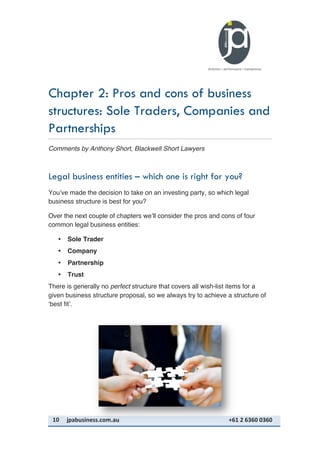
Over the next couple of chapters we’ll consider the pros and cons of four
common legal business entities:
• Sole Trader
• Company
• Partnership
• Trust
There is generally no perfect structure that covers all wish-list items for a
given business structure proposal, so we always try to achieve a structure of
‘best fit’.
jpabusiness.com.au	


  +61	
  2	
  6360	
  0360	
   11	
  
Sole Trader (Proprietor)
This is the simplest form of business entity with an individual as owner and
operator of a business. The sole trader will use their own Tax File Number but
will also have a registered ABN and (likely) GST registration.
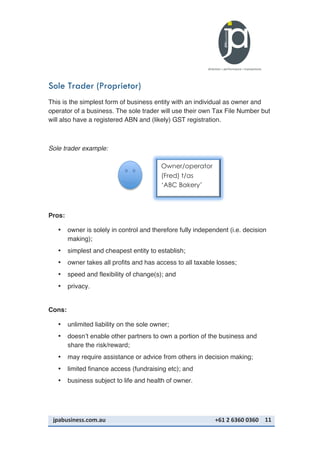
Sole trader example:
Pros:
• owner is solely in control and therefore fully independent (i.e. decision
making);
• simplest and cheapest entity to establish;
• owner takes all profits and has access to all taxable losses;
• speed and flexibility of change(s); and
• privacy.
Cons:
• unlimited liability on the sole owner;
• doesn’t enable other partners to own a portion of the business and
share the risk/reward;
• may require assistance or advice from others in decision making;
• limited finance access (fundraising etc); and
• business subject to life and health of owner.
Owner/operator
(Fred) t/as
‘ABC Bakery’
12	
   jpabusiness.com.au	


  +61	
  2	
  6360	
  0360	
  
Company
A company:
• is a legal association of people that combine for the purpose of
operating and financing business operations;
• is created by being registered with ASIC (federal jurisdiction);
• provides for separation of business owners (shareholders) from the
business operations (company officers and employees); and
• is a legal person with rights to own property, operate a business and
sue and be sued in its own right.
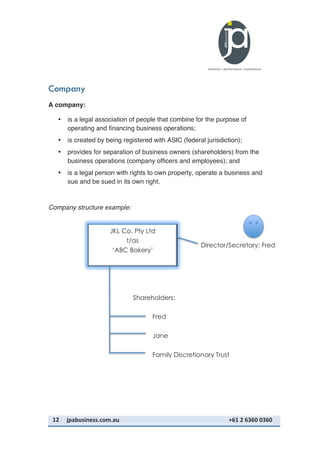
Company structure example:
JKL Co. Pty Ltd
t/as
‘ABC Bakery’
Director/Secretary: Fred
Shareholders:
Fred
Jane
Family Discretionary Trust
jpabusiness.com.au	


  +61	
  2	
  6360	
  0360	
   13	
  
Pros:
• finance raising (recognised structure for both debt and equity funding);
• flexible business expansion prospects;
• written shareholder agreement clarifies exit and governance and
dispute processes;
• separate legal personality;
• asset protection by corporate veil (separation of operation and
ownership);
• limited liability afforded to shareholders;
• unlimited life;
• transfer of ownership by share transfer, allowing for flexibility in
introducing partners to the business; and
• tax benefits afforded to companies.
Cons:
• cost of set-up (though basic cost has reduced in recent times for simple
company structure establishment);
• ongoing costs (reporting and accounting) where complicated
transactions or structure required;
• loss of control (i.e. to a management board, board of directors, etc);
• understanding of company concepts, governance and operations;
• layer of regulation by ASIC and Corporations Act 2001 (Cth);
• limited tax concessions, i.e. Capital Gains Tax in relation to real
estate/assets;
• director (office holder) obligations and liabilities, including severe
personal penalties; and
• insolvent trading risks to directors personally.
14	
   jpabusiness.com.au	


  +61	
  2	
  6360	
  0360	
  
Partnership
The key features of a partnership are:
• comprises two or more people (may be legal entities) that operate a
business with a common view to profit;
• has its own ABN, Tax File Number, GST registration and it will lodge its
own tax return each year;
• equity interest can be equal or different (i.e. one partner may have 40%
interest and another 60%);
• a partnership must lodge a tax return but does not itself pay income tax,
as the profits (or losses) are distributed to the partners in accordance
with their equity interest;
• partners share in profits and losses in accordance with their
partnership equity and any agreements they’ve made; and partners are
joint and severally liable for the debts of a partnership at all times.
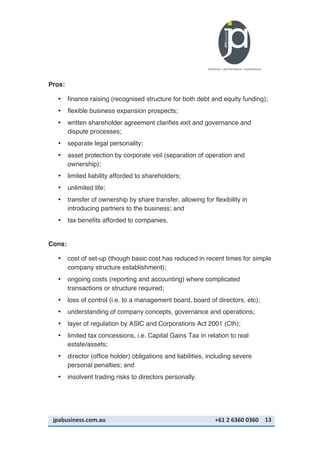
Partnership structure example:
Partnership
t/as
‘ABC Bakery’
Fred – 40% Equity Interest
Jane – 40% Equity Interest
XYZ Discretionary Trust – 20% Equity
Interest
jpabusiness.com.au	


  +61	
  2	
  6360	
  0360	
   15	
  
Pros:
• minimal cost in set-up;
• shared responsibility and obligations;
• contribution of different assets (i.e. skills, resources to the business);
• relatively easy to operate and account for on an ongoing basis;
• written partnership agreement can clarify operations and exit
expectations;
• control, flexibility and privacy may be positive aspects of partnerships;
and
• tax losses are accessible to the partners directly (they are not
quarantined like trusts or company tax losses).
Cons:
• unlimited liability (including joint and several liability, where a liability
caused by one partner shall cause all other partners to be liable);
• transfer and termination of partners and/or partnerships may have
some complications and need to be properly accounted for;
• potential for decision-making conflict and stalemates;
• no permanence i.e. on termination or dissolution; and
• can be limits on number of partners (state jurisdictions apply) so
expansion may be limited.
We strongly advise partners (in a ‘partnership’) and shareholders (in a
‘company’) to have their partnership or shareholder agreement in writing as it
will save time, effort and cost if there is a dispute later. Consult your business
or legal advisor to discuss your options.
We will also cover more on the aspect of agreements between business
partners in the next chapter.
16	
   jpabusiness.com.au	


  +61	
  2	
  6360	
  0360	
  
Chapter 3: Pros and cons of business
structures: Trusts
Comments by Anthony Short, Blackwell Short Lawyers
Trusts
Trusts are a very popular structure for owning and operating businesses,
particularly where there are multiple business partners and significant tangible
assets associated with the private business, along with the going concern
trading business.
Trust popularity for business owners relates to benefits associated with
asset protection and income distribution, among other things.
All types of trusts have the same essential structure, with minor variations in
their rules (i.e. trust deed) to distinguish the trust and allow it to perform
different functions.
The essential structure of a trust is:
• A person (settlor) provides property (trust property) to another person
(trustee) to deal with that trust property in accordance with certain rules
(trust deed) on behalf of and for the benefit of other people
(beneficiaries).
• The trust deed (also known as the trust instrument) may also provide
for other people (appointors) to terminate and appoint trustees. These
people may greatly influence the trust.
jpabusiness.com.au	


  +61	
  2	
  6360	
  0360	
   17	
  
The trust deed can be simple or complex, detailing:
• powers of trustees and appointors;
• describing who the beneficiaries are;
• describing the relationship between each party;
• permitting income to be accumulated in the trust;
• detailing which beneficiaries are entitled to trust property (capital);
• detailing which beneficiaries are entitled to income and tax-benefiting
distributions (streaming);
• detailing what happens at the end of the trust period (maximum 80
years); and
• defining income.
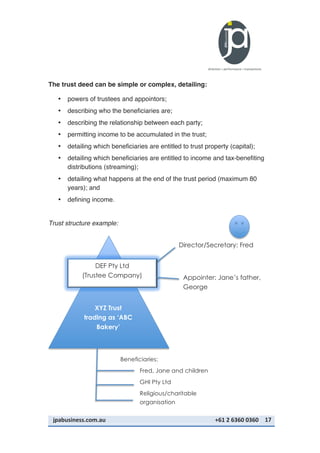
Trust structure example:
XYZ Trust
trading as ‘ABC
Bakery’
	
  
Appointer: Jane’s father,
George
Beneficiaries:
Fred, Jane and children
GHI Pty Ltd
Religious/charitable
organisation
DEF Pty Ltd
(Trustee Company)
Director/Secretary: Fred
18	
   jpabusiness.com.au	


  +61	
  2	
  6360	
  0360	
  
Pros:
• trusts can be flexible and relatively straightforward to operate and
account for;
• flexibility for income and capital distributions subject to the type of trust
(i.e. discretionary trust);
• other tax benefits such as capital gains tax for fixed/hybrid trusts;
• asset protection by separation of business operations by the trustee
from the owners;
• written trust deed provides clarity on operations, exit and other factors;
• opportunity for the addition of other business owners/partners or
stakeholders (i.e. unit trusts); and
• sole discretion (ability to enshrine control) of trustee in certain decisions.
Cons:
• costs in setting up complicated trusts;
• can be tax disadvantages (particularly in relation to unit trust – cost
base (Capital Gains Tax) considerations);
• limited rights and other rights of beneficiaries that may be affected;
• need to ensure a trustworthy trustee and appointor of trustee;
• added ongoing costs of complicated trust structures and transactions;
and
• understanding of trust concepts.
jpabusiness.com.au	


  +61	
  2	
  6360	
  0360	
   19	
  
Partners’ Agreement: your ‘blank canvas’
I heard a horror story on partner relationships the other day.
It related to a Sydney business where two partners had been in business for
many years and over various issues their relationship had severely broken
down, to the extent they built a physical brick wall down the middle of their
premises to divide the area and exclude contact between each other.
Can you image the impact on business value and operations?
Write it down!
If you’re a business owner considering taking on an investing party or
shareholder, some form of written shareholders’ or partners’ agreement
is vital.
Use the agreement to make clear all parties’ investment and partnership
intentions and responsibilities from the outset.
Remember, this is your business, so you can cover whatever you think
important, from business relationships, ethics and cultural issues, to
insurances and taxation to debt obligations, dividend payments, valuation,
disputes and exit provisions; it’s your blank canvas.
The following broad components of a private company’s Shareholders’
Agreement are also relevant to all business partnerships, whatever specific
legal form they may take:
• Define the business intent and operations and limitations of the
company;
• State the decision-making obligations for directors/partners and
shareholders;
• State the procedures if a shareholder/partner wants to sell or transfer
shares/equity, a director wants to retire, a shareholder’s/partner’s
employment is terminated, or in the event of the death or permanent
incapacity of a shareholder/partner;
20	
   jpabusiness.com.au	


  +61	
  2	
  6360	
  0360	
  
• Insurances to be held by shareholders or working partners;
• Power to invoke enduring or specific power of attorney in certain
events;
• Funding options to the company/partnership by shareholders/partners;
• Provisions and any restrictions on external funds raising (debt and
equity);
• Restraints of trade and conflicts of interest;
• Valuation methods/procedures for the shares/equity and/or new
business partners or exiting shareholders/partners;
• Business succession and exit conditions (for example, exiting party to
offer to existing shareholders/partners and then externally or full sale);
• Confidentiality;
• Dispute-resolution procedures;
• Taxation advice (this is very important as the effects of the
shareholders’ or partners’ agreement may have substantial tax
implications);
• General matters such as jurisdiction, notices, non-merger, etc.;
• Each shareholder/partner should seek independent legal advice on the
document;
• Use the document to state any type of relationship or procedure or
limitation on the company/partnership or shareholder/partner actions.
In summary, a good business with multiple partners or shareholders is
one where there is clear, open and regular communication between the
partners on what each others expectations are and how the business is
performing and meeting those expectations.
jpabusiness.com.au	


  +61	
  2	
  6360	
  0360	
   21	
  
Inevitably though, because of the pressures of business and also personal
lives, sometimes there are risks of relationship breakdown or changing
business and personal expectations – that is where a practical,
commercially orientated and legally sound agreement between
business partners provides a robust framework for issue resolution.
It’s a sound ‘relief valve’ if, as a business owner, you ever need to use it.
Where to go for more information
Contact and seek advice from your business or legal advisor or visit:
http://www.blackwellshort.com.au
22	
   jpabusiness.com.au	


  +61	
  2	
  6360	
  0360	
  
Chapter 4: Key Business Partners:
Banking Partners and Key Staff
Comments by James Price, JPAbusiness
Over the past three chapters we’ve talked about partners in your business
and what to consider in terms of risk and opportunity when managing those
partner relationships.
Now it’s time to examine a couple of other key partner relationships:
• your banking or finance partner, and
• your key employees.
Partners in the banking world
We’ve discussed how to manage relationships with your banking partners in a
previous eBook: Managing Your Banking Relationship.
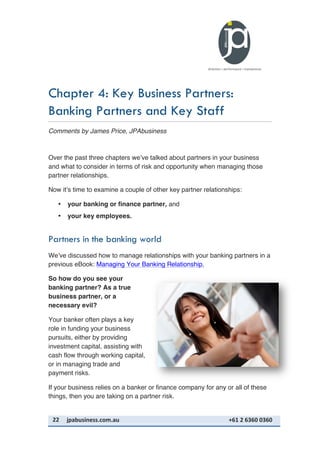
So how do you see your
banking partner? As a true
business partner, or a
necessary evil?
Your banker often plays a key
role in funding your business
pursuits, either by providing
investment capital, assisting with
cash flow through working capital,
or in managing trade and
payment risks.
If your business relies on a banker or finance company for any or all of these
things, then you are taking on a partner risk.
jpabusiness.com.au	


  +61	
  2	
  6360	
  0360	
   23	
  
Should the plug be pulled on any of these finance lines, particularly in a
timeframe which leaves you without other options, it could have a serious
impact on your business’s operations.
Be warned: a banker is not just a simple supplier to your business
In order to advance funds to your business, the bank must first assess a
range of risks associated with your business. Based on that assessment, they
then take a risk in advancing you dollars.
Yes, they take security for that risk, which usually ranks before your equity in
the business, but ultimately their success in lending money is inextricably
linked to your success as a business.
So treating them as anything other than a business partner is not doing the
opportunity justice.
Top tips for partnering with your banker
1. Be transparent, open and truthful with the information you provide
on your business’s performance.
2. Manage expectations regarding changes or potential changes in
your business, so there are no surprises.
3. Have a plan for where you are taking the business and communicate
that plan. Explain why, in a robust financial and commercial sense,
this business is a good investment for your banking partner.
4. Provide the bank with evidence you are attuned to identifying and
managing key business risks, reporting and governance processes.
5. Make sure you develop a relationship with more than one person
within your banking partner’s organisation. Banking is still personal,
despite all the processes and systems. Don’t rely on the bank to
ensure your business and everything about it is known throughout the
bank.
24	
   jpabusiness.com.au	


  +61	
  2	
  6360	
  0360	
  
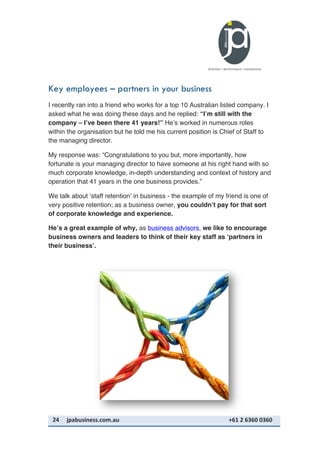
Key employees – partners in your business
I recently ran into a friend who works for a top 10 Australian listed company. I
asked what he was doing these days and he replied: “I’m still with the
company – I’ve been there 41 years!” He’s worked in numerous roles
within the organisation but he told me his current position is Chief of Staff to
the managing director.
My response was: “Congratulations to you but, more importantly, how
fortunate is your managing director to have someone at his right hand with so
much corporate knowledge, in-depth understanding and context of history and
operation that 41 years in the one business provides.”
We talk about ‘staff retention’ in business - the example of my friend is one of
very positive retention; as a business owner, you couldn’t pay for that sort
of corporate knowledge and experience.
He’s a great example of why, as business advisors, we like to encourage
business owners and leaders to think of their key staff as ‘partners in
their business’.
jpabusiness.com.au	


  +61	
  2	
  6360	
  0360	
   25	
  
Key staff critical to driving business value
As we’ve often said in our eBooks, value is won and lost by the people
dynamic because often it’s your people who provide the point of difference a
business offers on a repeated basis.
A key employee who is right for ‘partner status’ is:
• interested in the value of the business and the value both you and
they are creating in it;
• interested in the direction of the business – what plans the
business has and where it is headed; and
• willing to take on risk – they do more and add more value than their
simple remuneration package.
How to reward positive ‘staff partnering’ performance
As a business owner you need to contemplate how, over time, you may wish
to incentivise and reward positive ‘staff partnering’ performance.
We’re not talking about monthly or annual bonuses, here. Key staff partners
should contribute to and share in the long-term value creation and
performance of your business.
For example, if the business performs strongly over a period of three to five
years and a key staff person contributes greatly to that performance and has
taken some risk in delivering the outcome, it’s worthwhile contemplating
rewarding their performance.
Commensurate with the employee’s risk-taking, commitment and contribution,
this should be over and above a market-related, fair remuneration package
and can be realised via a range of mechanisms, such as:
• Employee shares;
• Ordinary equity shares; and/or
• Other classes of shares with various benefits and restrictions.
26	
   jpabusiness.com.au	


  +61	
  2	
  6360	
  0360	
  
Why offer key employees ‘a share’?
1) It can unlock extra potential and desire in an employee to invest their
funds and ingenuity to take your business to the next level;
2) It gives employees more than just a short-term, transactional, one-
dimensional view of their employment arrangements. Instead they have
a long-term outlook on why they’re working the way they are, which is
positive for stability and retention. We all need to feel satisfied we’re
working toward something meaningful; and
3) It assists in managing key employees’ succession within the business.
It means you already have a pool of heavy hitting, critical employees
who are ‘invested in the business’.
Share arrangement structures – get some advice
If you’ve decided you do want to treat your key employees as business
partners by offering ‘a share and a risk’ in your business, it’s a good idea to
get professional business advice regarding the type of incentive and
partner structure.
Similarly, as we’ve discussed earlier in this eBook, upon commencement of
those arrangements you should have in place a Shareholders’ Agreement
which clearly states the company’s and shareholders’ expectations.
A Shareholders’ Agreement can help protect against the risks and ease
concerns that business owners often raise when contemplating these sorts of
arrangements. It allows you, as an owner, to outline the rules by which you
offer a share and a risk in your business, that are fair to both parties.
jpabusiness.com.au	


  +61	
  2	
  6360	
  0360	
   27	
  
How do employee shareholdings affect business value?
Many purchasers, including those in private equity, look positively on
companies with employee shareholders because they know those employees
are more heavily invested, literally and figuratively, in the business.
If you’re concerned an employee could frustrate a sale process, your
Shareholders’ Agreement should be designed to mitigate that risk. For
example, many agreements provide for the right of the majority and founding
shareholders to progress with a sale and/or other material events.
Most people buying businesses need a pool of good staff to continue on in the
business, so the impact on business value is usually positive rather than
negative.

Partners in your business

  • 1.
    Partners in Your Business Contributors: GarethBanks, CHAMP Ventures Anthony Short, Blackwell Short Lawyers James Price, JPAbusiness
  • 2.
    2   jpabusiness.com.au                                                                                                                                                      +61  2  6360  0360   Table  of  Contents   Introduction  ...........................................................................................................  3   Assessing  the  risks  ...............................................................................................................................................  3   Meet  our  contributors…  ....................................................................................................................................  4   Chapter  1:  The  role  and  focus  of  Private  Equity  ......................................................  5   What  is  Private  Equity?  ....................................................................................................................................  5   How  does  it  work?  ...............................................................................................................................................  5   What  type  of  business  opportunities  does  Private  Equity  look  for?  ..............................................  6   What  does  Private  Equity  require?  ..............................................................................................................  6   As  a  business  owner,  how  can  I  benefit  from  the  involvement  of  private  equity?  ...................  7   As  a  private  equity  investor,  what  affects  your  appetite  to  invest?  ...............................................  8   As  a  business  owner,  how  do  I  become  'private  equity  investment  ready'?  ...............................  9   Where  to  go  for  more  information  ..............................................................................................................  9   Chapter  2:  Pros  and  cons  of  business  structures:  Sole  Traders,  Companies  and   Partnerships  ........................................................................................................  10   Legal  business  entities  –  which  one  is  right  for  you?  ........................................................................  10   Sole  Trader  (Proprietor)  ...............................................................................................................................  11   Company  ...............................................................................................................................................................  12   Partnership  .........................................................................................................................................................  14   Chapter  3:  Pros  and  cons  of  business  structures:  Trusts  .......................................  16   Trusts  .....................................................................................................................................................................  16   Partners’  Agreement:  your  ‘blank  canvas’  ............................................................................................  19   Chapter  4:  Key  Business  Partners:  Banking  Partners  and  Key  Staff  .......................  22   Partners  in  the  banking  world  ...................................................................................................................  22   Key  employees  –  partners  in  your  business  ...........................................................................................  24   Disclaimer: The information contained in this eBook is general in nature and should not be taken as personal, professional advice.
  • 3.
    jpabusiness.com.au                                                                                                                                                      +61  2  6360  0360   3   Introduction Partners in your business can take many forms. Businesses involving more than one party owning either share capital or a formal stake in a private business can significantly impact the operations and performance of the business. While this is true for both publicly listed and private companies, this eBook focuses exclusively on private businesses. Partners in business – whether they be spouses, employees, work colleagues, private investors, working directors or shareholders – can significantly benefit the business’ capital base, value, risk profile and growth path. Senior people who are ‘invested’ as owners also tend to drive the business to another level, mitigate succession issues and cement performance expectations. The dynamics of partners in your business can be very positive if planned, structured and managed effectively to ensure a shared vision and direction. However there can also be downsides, as control is shared and expectations relating to risk, reward and exit can present challenges. Assessing the risks If you do take on a partner, what are the practical business and legal issues you both need to consider in order to protect against risks such as relationship breakdown, or to ensure a smooth process in the event one of you wants to exit the business? Also, what can a partner offer your business in terms of opportunities? This month we’ve asked private equity investor Gareth Banks and solicitor Anthony Short to share their expertise on the subject of ‘Partners in Your Business’, with JPAbusiness director James Price focusing on banking partners and key staff partnerships.
  • 4.
    4   jpabusiness.com.au                                                                                                                                                      +61  2  6360  0360   Meet our contributors… Gareth Banks BSc (Mathematics Hons), ACA Gareth is a director of CHAMP Ventures, a leading Australian mid-market private equity firm which is currently investing its seventh fund of A$475 million. CHAMP Ventures invests in small- and medium- sized businesses in Australia across most sectors of the economy. Gareth joined the CHAMP team in 2004, after working with underperforming businesses across Europe, Asia and Australia. Since January 2011 he has also served on the Australian Private Equity and Venture Capital Association Limited (AVCAL) Council. Anthony Short BAS (Computing), BBus (Accounting), Bachelor of Laws (Hons) Anthony is one of the principals at Blackwell Short Lawyers in Orange, NSW. Anthony worked for 14 years as a chartered accountant, including four years as a partner, advising clients in structuring their business, asset protection and estate planning. He has been in regional legal practice for 10 years and continues to develop a practice in business transactions, superannuation, property and taxation.
  • 5.
    jpabusiness.com.au                                                                                                                                                      +61  2  6360  0360   5   Chapter 1: The role and focus of Private Equity Comments by Gareth Banks, CHAMP Ventures What is Private Equity? Private equity is a partner, enabler, supporter or contributor to small and private businesses. Private equity is much more than just some capital. You can get capital from plenty of places, but private equity is an aligned partner, helping a business to grow, set strategy and problem-solve. How does it work? The money for private equity investments comes predominantly from industry superannuation funds, both Australian and overseas, investment houses and sovereign wealth funds. There are a range of private equity firms servicing different segments of the market. Some firms target equity investments of $5 to $20 million, CHAMP Ventures mainly invests $20 to $60 million, while others target $100 million plus. At CHAMP Ventures we receive most of our capital from pension funds. They invest with us for 10 years, so we tend to invest in companies in the first five years of that cycle and then sell out our share in the second five years.
  • 6.
    6   jpabusiness.com.au                                                                                                                                                      +61  2  6360  0360   What type of business opportunities does Private Equity look for? There are two main styles: • A traditional management buy-out sees private equity firms partner with management teams of a business and buy a business or division from a larger company, or other shareholders. Private equity is usually an 80-90% shareholder in this style. • Private equity can be invested as a minority stake to help a founder diversify their assets or wealth, to help a passive shareholder in the business exit, or to provide money to help a business expand. In that instance private equity may be a 30, 40 or 50% shareholder. What does Private Equity require? Our basic requirements are: 1. Management to back: As a rule we want proven executives to partner with, so management is a key requirement. We can help problem solve, think through strategy and bring complementary skills, but we’re not going to run the business day to day. 2. A desire to grow and at least a basic strategy for that growth: In some cases people have thought that through in detail and our role is to stress test and critique it. In other cases the CEO has a skeleton vision and wants help working it up. We need to buy into a business, help grow its earnings and then sell it, or our share, in four or five years’ time – that’s how we make money.
  • 7.
    jpabusiness.com.au                                                                                                                                                      +61  2  6360  0360   7   As a business owner, how can I benefit from the involvement of private equity? A lot of our opportunities are coming from providing a solution to an ownership transition, or management succession. We can help a business owner who is looking for someone with complementary skills to help them on that journey. Here’s a typical scenario: A business’s founder owns 100%, has many of the key relationships with customers or suppliers, and he/she is finding it difficult to sell 100% of the business because they’re seen as integral to that business. We can buy a stake from them, maybe 40 or 50%. They diversify their wealth and then we’ll be a partner with them for four or five years and help them recruit a CEO to replace them – maybe the founder can step up to be the Executive Chairman. We can help them develop systems and begin to corporatise their business so it develops from a one-man family business and over a period of four or five years becomes a small corporate with some management. It’s then a sellable business. Another way we can help business owners is if they’re looking for capital to expand or there is an acquisition they want to make, but they don’t want to put more of their own money into the business, or over-gear it. Our involvement will help a business owner achieve these aims. Having said that, private equity isn’t for everyone. If they want to hand the business down to their kids, then we’re not the right partner. We need an exit event over the medium term to realise value added for risk taken.
  • 8.
    8   jpabusiness.com.au                                                                                                                                                      +61  2  6360  0360   As a private equity investor, what affects your appetite to invest? 1. People to back – We’re looking for a CEO or management that we feel comfortable working with and who will run the day-to-day operations. Often we have to help supplement the finance function, because it hasn’t kept up with the vision and growth. We help put in place a more robust finance function and maybe a chief financial officer, because you can’t grow without the right information. 2. Alignment – All the shareholders and management need to be aligned on a goal or journey. If you don’t have alignment, your appetite to invest is gone. You don’t want one shareholder with a 20-year horizon and one with an 18-month horizon. 3. Growth – It’s good to be in a segment that is growing, but it’s not essential as long as the business has a plan or sees an opportunity to grow itself. 4. Point of difference – Do they have a point of difference and can they defend their position? If they’re one of many players who are all competing on price, then that’s a harder way to grow a business. 5. Diversification of both customer and supplier – Often we see businesses where one customer is 60% of the revenue. This isn’t a deal breaker, but it is viewed a bit negatively.
  • 9.
    jpabusiness.com.au                                                                                                                                                      +61  2  6360  0360   9   As a business owner, how do I become 'private equity investment ready'? Often, we come in and businesses are a little ‘green’ and haven’t thought through all the issues. It’s useful to talk to someone, such as a business advisor or accountant, to brainstorm your ideas. I don’t need people to provide pages of information and glossy charts, but it’s good if they’ve already bounced around their ideas with someone. It’s also very useful to talk to founders or CEOs who have partnered with private equity in the past, to really understand the process. Business owners also need to understand their sense of scale and which private equity firms best match their requirements. While it’s good for me if people have already thought about these things, I don’t mind if the initial meeting is a bit exploratory. That’s part of the education process and not every business is right for private equity, or ready. Sometimes we’ll have a chat, agree a business isn’t ready and then we’ll get a call from the owner three years later when they are ready. Where to go for more information The Australian Private Equity and Venture Capital Association Limited (AVCAL) website is a good starting point. AVCAL is a national association representing the private equity and venture capital industries and the website provides plenty of information about private equity and venture capital. http://www.avcal.com.au/looking-for-capital/looking-for-capital And, of course, you can always talk to your business advisor.
  • 10.
    10   jpabusiness.com.au                                                                                                                                                      +61  2  6360  0360   Chapter 2: Pros and cons of business structures: Sole Traders, Companies and Partnerships Comments by Anthony Short, Blackwell Short Lawyers Legal business entities – which one is right for you? You’ve made the decision to take on an investing party, so which legal business structure is best for you? Over the next couple of chapters we’ll consider the pros and cons of four common legal business entities: • Sole Trader • Company • Partnership • Trust There is generally no perfect structure that covers all wish-list items for a given business structure proposal, so we always try to achieve a structure of ‘best fit’.
  • 11.
    jpabusiness.com.au                                                                                                                                                      +61  2  6360  0360   11   Sole Trader (Proprietor) This is the simplest form of business entity with an individual as owner and operator of a business. The sole trader will use their own Tax File Number but will also have a registered ABN and (likely) GST registration. Sole trader example: Pros: • owner is solely in control and therefore fully independent (i.e. decision making); • simplest and cheapest entity to establish; • owner takes all profits and has access to all taxable losses; • speed and flexibility of change(s); and • privacy. Cons: • unlimited liability on the sole owner; • doesn’t enable other partners to own a portion of the business and share the risk/reward; • may require assistance or advice from others in decision making; • limited finance access (fundraising etc); and • business subject to life and health of owner. Owner/operator (Fred) t/as ‘ABC Bakery’
  • 12.
    12   jpabusiness.com.au                                                                                                                                                      +61  2  6360  0360   Company A company: • is a legal association of people that combine for the purpose of operating and financing business operations; • is created by being registered with ASIC (federal jurisdiction); • provides for separation of business owners (shareholders) from the business operations (company officers and employees); and • is a legal person with rights to own property, operate a business and sue and be sued in its own right. Company structure example: JKL Co. Pty Ltd t/as ‘ABC Bakery’ Director/Secretary: Fred Shareholders: Fred Jane Family Discretionary Trust
  • 13.
    jpabusiness.com.au                                                                                                                                                      +61  2  6360  0360   13   Pros: • finance raising (recognised structure for both debt and equity funding); • flexible business expansion prospects; • written shareholder agreement clarifies exit and governance and dispute processes; • separate legal personality; • asset protection by corporate veil (separation of operation and ownership); • limited liability afforded to shareholders; • unlimited life; • transfer of ownership by share transfer, allowing for flexibility in introducing partners to the business; and • tax benefits afforded to companies. Cons: • cost of set-up (though basic cost has reduced in recent times for simple company structure establishment); • ongoing costs (reporting and accounting) where complicated transactions or structure required; • loss of control (i.e. to a management board, board of directors, etc); • understanding of company concepts, governance and operations; • layer of regulation by ASIC and Corporations Act 2001 (Cth); • limited tax concessions, i.e. Capital Gains Tax in relation to real estate/assets; • director (office holder) obligations and liabilities, including severe personal penalties; and • insolvent trading risks to directors personally.
  • 14.
    14   jpabusiness.com.au                                                                                                                                                      +61  2  6360  0360   Partnership The key features of a partnership are: • comprises two or more people (may be legal entities) that operate a business with a common view to profit; • has its own ABN, Tax File Number, GST registration and it will lodge its own tax return each year; • equity interest can be equal or different (i.e. one partner may have 40% interest and another 60%); • a partnership must lodge a tax return but does not itself pay income tax, as the profits (or losses) are distributed to the partners in accordance with their equity interest; • partners share in profits and losses in accordance with their partnership equity and any agreements they’ve made; and partners are joint and severally liable for the debts of a partnership at all times. Partnership structure example: Partnership t/as ‘ABC Bakery’ Fred – 40% Equity Interest Jane – 40% Equity Interest XYZ Discretionary Trust – 20% Equity Interest
  • 15.
    jpabusiness.com.au                                                                                                                                                      +61  2  6360  0360   15   Pros: • minimal cost in set-up; • shared responsibility and obligations; • contribution of different assets (i.e. skills, resources to the business); • relatively easy to operate and account for on an ongoing basis; • written partnership agreement can clarify operations and exit expectations; • control, flexibility and privacy may be positive aspects of partnerships; and • tax losses are accessible to the partners directly (they are not quarantined like trusts or company tax losses). Cons: • unlimited liability (including joint and several liability, where a liability caused by one partner shall cause all other partners to be liable); • transfer and termination of partners and/or partnerships may have some complications and need to be properly accounted for; • potential for decision-making conflict and stalemates; • no permanence i.e. on termination or dissolution; and • can be limits on number of partners (state jurisdictions apply) so expansion may be limited. We strongly advise partners (in a ‘partnership’) and shareholders (in a ‘company’) to have their partnership or shareholder agreement in writing as it will save time, effort and cost if there is a dispute later. Consult your business or legal advisor to discuss your options. We will also cover more on the aspect of agreements between business partners in the next chapter.
  • 16.
    16   jpabusiness.com.au                                                                                                                                                      +61  2  6360  0360   Chapter 3: Pros and cons of business structures: Trusts Comments by Anthony Short, Blackwell Short Lawyers Trusts Trusts are a very popular structure for owning and operating businesses, particularly where there are multiple business partners and significant tangible assets associated with the private business, along with the going concern trading business. Trust popularity for business owners relates to benefits associated with asset protection and income distribution, among other things. All types of trusts have the same essential structure, with minor variations in their rules (i.e. trust deed) to distinguish the trust and allow it to perform different functions. The essential structure of a trust is: • A person (settlor) provides property (trust property) to another person (trustee) to deal with that trust property in accordance with certain rules (trust deed) on behalf of and for the benefit of other people (beneficiaries). • The trust deed (also known as the trust instrument) may also provide for other people (appointors) to terminate and appoint trustees. These people may greatly influence the trust.
  • 17.
    jpabusiness.com.au                                                                                                                                                      +61  2  6360  0360   17   The trust deed can be simple or complex, detailing: • powers of trustees and appointors; • describing who the beneficiaries are; • describing the relationship between each party; • permitting income to be accumulated in the trust; • detailing which beneficiaries are entitled to trust property (capital); • detailing which beneficiaries are entitled to income and tax-benefiting distributions (streaming); • detailing what happens at the end of the trust period (maximum 80 years); and • defining income. Trust structure example: XYZ Trust trading as ‘ABC Bakery’   Appointer: Jane’s father, George Beneficiaries: Fred, Jane and children GHI Pty Ltd Religious/charitable organisation DEF Pty Ltd (Trustee Company) Director/Secretary: Fred
  • 18.
    18   jpabusiness.com.au                                                                                                                                                      +61  2  6360  0360   Pros: • trusts can be flexible and relatively straightforward to operate and account for; • flexibility for income and capital distributions subject to the type of trust (i.e. discretionary trust); • other tax benefits such as capital gains tax for fixed/hybrid trusts; • asset protection by separation of business operations by the trustee from the owners; • written trust deed provides clarity on operations, exit and other factors; • opportunity for the addition of other business owners/partners or stakeholders (i.e. unit trusts); and • sole discretion (ability to enshrine control) of trustee in certain decisions. Cons: • costs in setting up complicated trusts; • can be tax disadvantages (particularly in relation to unit trust – cost base (Capital Gains Tax) considerations); • limited rights and other rights of beneficiaries that may be affected; • need to ensure a trustworthy trustee and appointor of trustee; • added ongoing costs of complicated trust structures and transactions; and • understanding of trust concepts.
  • 19.
    jpabusiness.com.au                                                                                                                                                      +61  2  6360  0360   19   Partners’ Agreement: your ‘blank canvas’ I heard a horror story on partner relationships the other day. It related to a Sydney business where two partners had been in business for many years and over various issues their relationship had severely broken down, to the extent they built a physical brick wall down the middle of their premises to divide the area and exclude contact between each other. Can you image the impact on business value and operations? Write it down! If you’re a business owner considering taking on an investing party or shareholder, some form of written shareholders’ or partners’ agreement is vital. Use the agreement to make clear all parties’ investment and partnership intentions and responsibilities from the outset. Remember, this is your business, so you can cover whatever you think important, from business relationships, ethics and cultural issues, to insurances and taxation to debt obligations, dividend payments, valuation, disputes and exit provisions; it’s your blank canvas. The following broad components of a private company’s Shareholders’ Agreement are also relevant to all business partnerships, whatever specific legal form they may take: • Define the business intent and operations and limitations of the company; • State the decision-making obligations for directors/partners and shareholders; • State the procedures if a shareholder/partner wants to sell or transfer shares/equity, a director wants to retire, a shareholder’s/partner’s employment is terminated, or in the event of the death or permanent incapacity of a shareholder/partner;
  • 20.
    20   jpabusiness.com.au                                                                                                                                                      +61  2  6360  0360   • Insurances to be held by shareholders or working partners; • Power to invoke enduring or specific power of attorney in certain events; • Funding options to the company/partnership by shareholders/partners; • Provisions and any restrictions on external funds raising (debt and equity); • Restraints of trade and conflicts of interest; • Valuation methods/procedures for the shares/equity and/or new business partners or exiting shareholders/partners; • Business succession and exit conditions (for example, exiting party to offer to existing shareholders/partners and then externally or full sale); • Confidentiality; • Dispute-resolution procedures; • Taxation advice (this is very important as the effects of the shareholders’ or partners’ agreement may have substantial tax implications); • General matters such as jurisdiction, notices, non-merger, etc.; • Each shareholder/partner should seek independent legal advice on the document; • Use the document to state any type of relationship or procedure or limitation on the company/partnership or shareholder/partner actions. In summary, a good business with multiple partners or shareholders is one where there is clear, open and regular communication between the partners on what each others expectations are and how the business is performing and meeting those expectations.
  • 21.
    jpabusiness.com.au                                                                                                                                                      +61  2  6360  0360   21   Inevitably though, because of the pressures of business and also personal lives, sometimes there are risks of relationship breakdown or changing business and personal expectations – that is where a practical, commercially orientated and legally sound agreement between business partners provides a robust framework for issue resolution. It’s a sound ‘relief valve’ if, as a business owner, you ever need to use it. Where to go for more information Contact and seek advice from your business or legal advisor or visit: http://www.blackwellshort.com.au
  • 22.
    22   jpabusiness.com.au                                                                                                                                                      +61  2  6360  0360   Chapter 4: Key Business Partners: Banking Partners and Key Staff Comments by James Price, JPAbusiness Over the past three chapters we’ve talked about partners in your business and what to consider in terms of risk and opportunity when managing those partner relationships. Now it’s time to examine a couple of other key partner relationships: • your banking or finance partner, and • your key employees. Partners in the banking world We’ve discussed how to manage relationships with your banking partners in a previous eBook: Managing Your Banking Relationship. So how do you see your banking partner? As a true business partner, or a necessary evil? Your banker often plays a key role in funding your business pursuits, either by providing investment capital, assisting with cash flow through working capital, or in managing trade and payment risks. If your business relies on a banker or finance company for any or all of these things, then you are taking on a partner risk.
  • 23.
    jpabusiness.com.au                                                                                                                                                      +61  2  6360  0360   23   Should the plug be pulled on any of these finance lines, particularly in a timeframe which leaves you without other options, it could have a serious impact on your business’s operations. Be warned: a banker is not just a simple supplier to your business In order to advance funds to your business, the bank must first assess a range of risks associated with your business. Based on that assessment, they then take a risk in advancing you dollars. Yes, they take security for that risk, which usually ranks before your equity in the business, but ultimately their success in lending money is inextricably linked to your success as a business. So treating them as anything other than a business partner is not doing the opportunity justice. Top tips for partnering with your banker 1. Be transparent, open and truthful with the information you provide on your business’s performance. 2. Manage expectations regarding changes or potential changes in your business, so there are no surprises. 3. Have a plan for where you are taking the business and communicate that plan. Explain why, in a robust financial and commercial sense, this business is a good investment for your banking partner. 4. Provide the bank with evidence you are attuned to identifying and managing key business risks, reporting and governance processes. 5. Make sure you develop a relationship with more than one person within your banking partner’s organisation. Banking is still personal, despite all the processes and systems. Don’t rely on the bank to ensure your business and everything about it is known throughout the bank.
  • 24.
    24   jpabusiness.com.au                                                                                                                                                      +61  2  6360  0360   Key employees – partners in your business I recently ran into a friend who works for a top 10 Australian listed company. I asked what he was doing these days and he replied: “I’m still with the company – I’ve been there 41 years!” He’s worked in numerous roles within the organisation but he told me his current position is Chief of Staff to the managing director. My response was: “Congratulations to you but, more importantly, how fortunate is your managing director to have someone at his right hand with so much corporate knowledge, in-depth understanding and context of history and operation that 41 years in the one business provides.” We talk about ‘staff retention’ in business - the example of my friend is one of very positive retention; as a business owner, you couldn’t pay for that sort of corporate knowledge and experience. He’s a great example of why, as business advisors, we like to encourage business owners and leaders to think of their key staff as ‘partners in their business’.
  • 25.
    jpabusiness.com.au                                                                                                                                                      +61  2  6360  0360   25   Key staff critical to driving business value As we’ve often said in our eBooks, value is won and lost by the people dynamic because often it’s your people who provide the point of difference a business offers on a repeated basis. A key employee who is right for ‘partner status’ is: • interested in the value of the business and the value both you and they are creating in it; • interested in the direction of the business – what plans the business has and where it is headed; and • willing to take on risk – they do more and add more value than their simple remuneration package. How to reward positive ‘staff partnering’ performance As a business owner you need to contemplate how, over time, you may wish to incentivise and reward positive ‘staff partnering’ performance. We’re not talking about monthly or annual bonuses, here. Key staff partners should contribute to and share in the long-term value creation and performance of your business. For example, if the business performs strongly over a period of three to five years and a key staff person contributes greatly to that performance and has taken some risk in delivering the outcome, it’s worthwhile contemplating rewarding their performance. Commensurate with the employee’s risk-taking, commitment and contribution, this should be over and above a market-related, fair remuneration package and can be realised via a range of mechanisms, such as: • Employee shares; • Ordinary equity shares; and/or • Other classes of shares with various benefits and restrictions.
  • 26.
    26   jpabusiness.com.au                                                                                                                                                      +61  2  6360  0360   Why offer key employees ‘a share’? 1) It can unlock extra potential and desire in an employee to invest their funds and ingenuity to take your business to the next level; 2) It gives employees more than just a short-term, transactional, one- dimensional view of their employment arrangements. Instead they have a long-term outlook on why they’re working the way they are, which is positive for stability and retention. We all need to feel satisfied we’re working toward something meaningful; and 3) It assists in managing key employees’ succession within the business. It means you already have a pool of heavy hitting, critical employees who are ‘invested in the business’. Share arrangement structures – get some advice If you’ve decided you do want to treat your key employees as business partners by offering ‘a share and a risk’ in your business, it’s a good idea to get professional business advice regarding the type of incentive and partner structure. Similarly, as we’ve discussed earlier in this eBook, upon commencement of those arrangements you should have in place a Shareholders’ Agreement which clearly states the company’s and shareholders’ expectations. A Shareholders’ Agreement can help protect against the risks and ease concerns that business owners often raise when contemplating these sorts of arrangements. It allows you, as an owner, to outline the rules by which you offer a share and a risk in your business, that are fair to both parties.
  • 27.
    jpabusiness.com.au                                                                                                                                                      +61  2  6360  0360   27   How do employee shareholdings affect business value? Many purchasers, including those in private equity, look positively on companies with employee shareholders because they know those employees are more heavily invested, literally and figuratively, in the business. If you’re concerned an employee could frustrate a sale process, your Shareholders’ Agreement should be designed to mitigate that risk. For example, many agreements provide for the right of the majority and founding shareholders to progress with a sale and/or other material events. Most people buying businesses need a pool of good staff to continue on in the business, so the impact on business value is usually positive rather than negative.