BIBF Presentation (With Video)

Editor's Notes

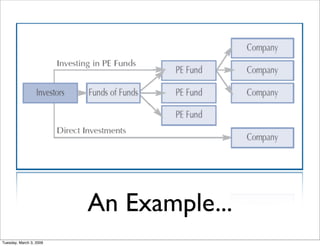
  • #11  The majority of private equity investments are in unquoted companies. Private equity investment is typically a transformational, value-added, active investment strategy. It calls for a specialized skill set which is a key due diligence area for investors' assessment of a manager. The processes of buyout and venture investing call for different application of these skills as they focus on different stages of the life cycle of a company. Private equity has arrived as a major component of the alternative investment (comprising a variety of investment techniques, strategies and asset classes that are complimentary to the stock and bond portfolios traditionally used by investors) universe and is now broadly accepted as an established asset class within many institutional portfolios. Many investors still with little or no existing allocation to private equity are now considering establishing or significantly expanding their private equity programs. investing in securities through a negotiated process.
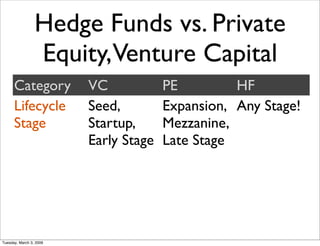
  • #13  Seed stage Financing provided to research, assess and develop an initial concept before a business has reached the start-up phase. Start-up stage Financing for product development and initial marketing. Companies may be in the process of being set up or may have been in business for a short time, but have not sold their products commercially and are not yet generating a profit. Expansion stage Financing for growth and expansion of a company which is breaking even or trading profitably. Capital may be used to finance increased production capacity, market or product development, and/or to provide additional working capital. This stage includes bridge financing and rescue or turnaround investments. Replacement Capital Purchase of shares from another investor or to reduce gearing via the refinancing of debt. Buyout A buyout fund typically targets the acquisition of a significant portion or majority control of businesses which normally entails a change of ownership. Buyout funds usually invest in more mature companies with established business plans to finance expansions, consolidations, turnarounds and sales, or spinouts of divisions or subsidiaries. Financing expansion through multiple acquisitions is often referred to as a \"buy and build\" strategy. Investment styles can vary widely, ranging from growth to value and early to late stage. Furthermore, buyout funds may take either an active or a passive management role.
  • #15  \"Blind pool\" investing When committing to a private equity fund, the commitment is typically to provide cash to the fund on notice from the general partner. Whilst launch documentation will outline the investment strategy and restrictions, investors give a very wide degree of discretion to the manager to select the companies that the investors will have a share in. Unlike some real estate partnerships, there is usually no ability at the launch of a private equity fund to preview portfolio assets before committing, because they have not yet been identified. Also, there is generally no ability to be excused from a particular portfolio investment after the fund is established.
  • #17  The spectrum of investors in private equity has expanded rapidly to include different types of investors with significant long-term commitments to the asset class. The majority of commitments to private equity funds based in respective geographical regions have come from institutions within the same region. This is evolving as investors seek a higher level of geographical diversification in their private equity portfolios.
  • #20  The fundamental reason for investing in private equity is to improve the risk and reward characteristics of an investment portfolio. Investing in private equity offers the investor the opportunity to generate higher absolute returns whilst improving portfolio diversification. Absolute Returns: Excessive volatility and poor investment performance experienced by quoted equity portfolios, many of which have index-tracking strategies or are benchmarked to an index (\"closet trackers\"), have led to a swing in favor of strategies that seek absolute returns. The private equity industry has brought corporate governance to smaller companies and provides an attractive manner of gaining exposure to a growth sector that went out of favor with market investors in the mid 1990s for reasons of liquidity. A much greater depth of information on proposed company investments is available to private equity managers. This helps managers more accurately assess the viability of a company's proposed business plan and to project the post-investment strategy to be pursued and expected future performance. This greater level of disclosure contributes significantly to reducing risk in private equity investment. Equivalent information in the public markets would be considered \"inside information\". By definition, investors in public markets will know less about the companies in which they invest.
  • #21  Stage There is negative correlation between returns from different stages of private equity. Diversification can therefore reduce risk within a private equity portfolio and this should be an important consideration. Geography Geographical diversification can be secured in Europe through the use of country-specific, regional and pan-European funds. Non-European exposure is also widely available, in particular through US funds, but also for example through Global, Israeli, Latin American and Asian funds. Manager Selecting a variety of managers will reduce manager specific risk. Vintage year Timing has an impact on the performance of funds, as opportunities for investment and exit will be impacted by external economic circumstances. For this reason it has become a normal practice to compare the performance of funds against others of the same vintage. There may be marked differences in performance from one vintage year to another. In order to ensure participation in the better years, it is generally perceived to be wiser to invest consistently through vintage years, as opposed to \"timing the market\" by trying to predict which vintage years will produce better performance. Industry In venture investing, most of the focus tends to be on technology based industries. These can be subdivided, for example into healthcare / life sciences, information technology and communications. Buyout funds tend to focus on technology to a lesser extent, providing exposure to such sectors as financial institutions, retail and consumer, transport, engineering and chemicals. Some have a specific sector focus.
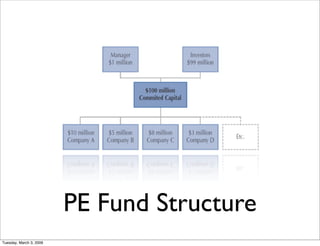
  • #22  An investor is typically required to fund only a small percentage of its total capital commitment at the outset. This initial funding may be followed by subsequent drawdowns (the timing and size of which are generally made known to the investor two or three weeks in advance) as needed to make new investments. Just-in-time drawdowns are used to minimize the amount of time that a fund holds uninvested cash, which is a drag on fund performance when measured as an internal rate of return (\"IRR\"). Investors need to maintain sufficient liquid assets to meet drawdown obligations whenever called. Penalty charges can be incurred for late payment or, in extreme cases, forfeiture of an investor's interest in the fund. In most funds' early years, investors can expect low or negative returns, partly due to the small amount of capital actually invested at the outset combined with the customary establishment costs, management fees and running expenses
  • #23  As portfolio companies mature and exits occur, the fund will begin to distribute proceeds. This will take a few years from the date of first investment and the timing and amounts will be volatile. When drawdowns and distributions are combined to show the net cash flows to investors, this normally results in a \"J-curve\", illustrated in the chart below. As distributions normally commence before the whole commitment has been drawn, it is unusual for an investor ever to have the full amount of its commitment actually managed by the manager. In the illustration below, net drawn commitments peak at around 80%.
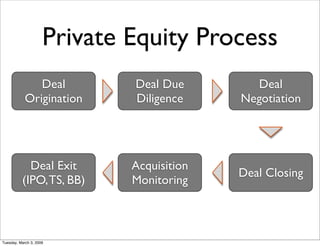
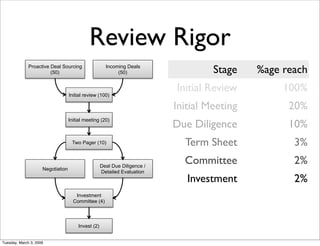
  • #25 Deal Origination or as some call it ‘Deal Sourcing’ is how we get our deals, a potential deal can either come through a company owner approaching us or from an intermediary who will try to bring both parties (Company and Deal Maker) to close the deal. In some cases, we may just approach companies who are expanding fast and wish to grow further. In a year, we come across hundreds of potential deals - but only a few are selected. Due Diligence is what you could call ‘doing your homework’. Before starting detailed negotiations, we try to make sure everything is fair and square. Although Auditors and Consultants are appointed to conduct the Financial, Tax, Legal and Technical Due Diligence - we also work side by side to understand the target company and its industry better. All the information collected at this time, is then used during negotiation. At the Deal Negotiation phase, we set out the terms and conditions (covenants, representations and warranties) and other deal terms that define (or make the deal). Contracts such as Investment Agreement, Share Purchase Agreement, Management Agreement, Advisory Agreement etc are drafted to include all items that put the deal together. Deal Closing is probably the easiest part but also contains an element of risk. It’s the conclusion of the deal, the signing of all Agreements and transferring funds* from the buyer to seller, conducting other administrative functions (usually done by a separate entity) like updating any articles of association etc. * So where do those funds come from? Well, there are two routes - the Fund route or the Private Placement route. And this is where the element of risk can step in. Most private equity firms have a Fund, that calls upon its HNWI to bring up money as committed earlier to fund these acquisitions. However some firms choose to place (sell) a stake in the ownership of the acquired company to certain individuals who might wish to participate only in a specific sector - what we commonly call the private placement. We do through this Special Purpose Vehicles (SPVs) that are nothing but legal entities to hold our stake in the company. Post Acquisition Monitoring requires the Deal Team (those who have worked on putting the deal together) to closely monitor the company, both from an operational and financial point of view against the expansion plan and budgets that were setup earlier by the company. Improvements to business, from Corporate Governance, Financial Reporting, Information Flow to Strategy are made at each level through either the company’s management or its board (where we have a seat). As the company matures (usually after 2 - 4 years) with the presence of the Deal Team, we prepare it for an Exit - either an IPO or a Trade Sale (sale to a larger party, multi-national or conglomerate) or in rare cases a Buy Back by the owners. By this time, the company will have grown quite a bit with still plenty of room to grow further. (There’s a saying, in a deal - always leave something extra for the person buying - it makes everyone happy.) And once we’ve exited the company, we return our investors money with the profit we gained for them after taking our fees for all the effort put in the above process. Then… we just repeat the process, albeit with a greater appetite for investments. (PS: Although this may seem like a linear process - it isn’t exactly so, primarily because we deal with a number of companies and each one is at a different stage in the private equity process.)
  • #35  Long-term investment In general, holding periods between investment and realization can be expected to average three or more years (although this may be shorter when IPO markets are especially healthy). Because the underlying portfolio assets are less liquid, the structure of private equity funds is normally a closed-end structure, meaning that the investor has very limited or no ability to withdraw its investment during the fund's life. Although the investor may receive cash distributions during the fund's life, the timing of these is normally uncertain. \"Liquidity risk\" is one of the principal risk characteristics of the asset class. Private equity should therefore be viewed as a longer-term investment strategy.
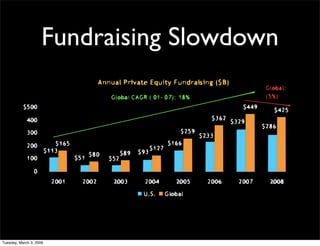
  • #53 Source: Thomson Venture Economics data as of 31, Dec 2008.
  • #58  5%, according to IMF
  • #64  Small Deal Flow: Undeployed Capital, 69 investments worth $3.9 bn in 2007, vs. $500 mn in 2008.
  • #65 19.5 Bn according to Preqin, a private equity data provider.
  • #66 Population: Double Edged Sword (Growth vs. Unemployment)
  • #69 Preservation: What PE firms do now will be remembered far more what is done in good times.
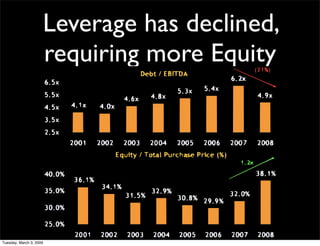
  • #71 Great Opportunities: Governments and others will increasingly see private equity as a solution to problems. The need for private equity is greater than ever. Enhanced recognition that private equity was not a cause of systemic risk - not a cause of the economic decline. Realistic expectations will be set for PE firms. Vintage: reduced prices will likely yield very high returns for private equity capital invested now and over the next 2 - 3 years. Cash, No Debt: many private equity transactions now available do not need new debt, or any debt. Leverage: pressure on banks to lend will result in enhanced credit availability for deals needing leverage - mostly likely by mid or later 2009. Debt will be on terms which ensure more discipline in the investment decision process.
  • #74 Hmm: Private Equity will emerge as the clearly preferred form of alternative investing.