PARTICIPATORY
NOTES
INTRODUCTION
Definition: P-Notes are a type of
Offshore Derivative Instrument (ODI).
Regulation 15A of SEBI Regulations,
1995 defines ODI as an instrument “
which is issued overseas by a foreign
institutional investor (FII) against
securities held by it that are listed or
proposed to be listed on any
recognised stock exchange in India.”
• FII: Foreign Institutional Investor (FII) means an
institution established or incorporated outside
India which proposes to make investment in
securities in India. They are registered as FIIs in
accordance with Section 2 (f) of the SEBI (FII)
Regulations 1995.
HOW IT WORKS
CHARACTERISTICS
• Anonymity: Any entity investing in participatory
notes is not required to register with SEBI, whereas
all FIIs have to compulsorily get registered. It
enables large hedge funds to carry out their
operations without disclosing their identity.
• Ease of Trading: Trading through participatory
notes is easy because participatory notes are like
contract notes transferable by endorsement and
delivery.
• Tax Saving: Some of the entities route their
investment through participatory notes to take
advantage of the tax laws of certain preferred
countries.
• Money Laundering: PNs are becoming a favourite
with a host of Indian money launderers who use
them to first take funds out of country through
hawala and then get it back using PNs.
“Black Monday” crash in May, 2004.
•
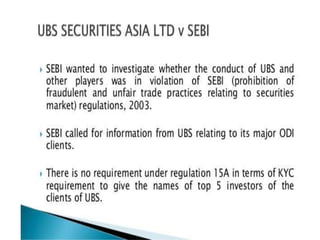
• In May, 2004 Sensex crashed by 842 points. SEBI
unmasked the culprit behind this crash. It was none
other than PNs. UBS, one of the largest sellers of
shares, carried out large scale selling orders on
behalf of unidentified clients. These clients
transacted in Indian stocks through UBS, but hid
behind a maze of investment deals extending all
the way from India to Mauritius. What happened in
2004 was a double whammy
P NOTES CRISIS 2007
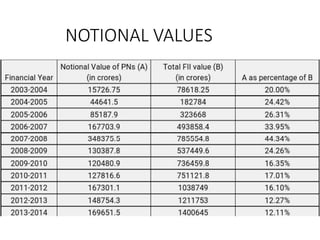
NOTIONAL VALUES
• “The PN system is blatantly
•
• discriminatory and seems to favour
•
• ghost
•
• investors. Any self-respecting
•
• market, if it discriminates at all,
•
• does so against outsiders. But we
•
• have done the unthinkable. We
•
• should recognise and internalise the
•
• fact thatare in search of
•
By
SAIRAJ.

PARTICIPATORY NOTES

  • 1.
  • 2.
    INTRODUCTION Definition: P-Notes area type of Offshore Derivative Instrument (ODI). Regulation 15A of SEBI Regulations, 1995 defines ODI as an instrument “ which is issued overseas by a foreign institutional investor (FII) against securities held by it that are listed or proposed to be listed on any recognised stock exchange in India.”
  • 3.
    • FII: ForeignInstitutional Investor (FII) means an institution established or incorporated outside India which proposes to make investment in securities in India. They are registered as FIIs in accordance with Section 2 (f) of the SEBI (FII) Regulations 1995.
  • 4.
  • 5.
    CHARACTERISTICS • Anonymity: Anyentity investing in participatory notes is not required to register with SEBI, whereas all FIIs have to compulsorily get registered. It enables large hedge funds to carry out their operations without disclosing their identity. • Ease of Trading: Trading through participatory notes is easy because participatory notes are like contract notes transferable by endorsement and delivery.
  • 6.
    • Tax Saving:Some of the entities route their investment through participatory notes to take advantage of the tax laws of certain preferred countries. • Money Laundering: PNs are becoming a favourite with a host of Indian money launderers who use them to first take funds out of country through hawala and then get it back using PNs.
  • 7.
    “Black Monday” crashin May, 2004. • • In May, 2004 Sensex crashed by 842 points. SEBI unmasked the culprit behind this crash. It was none other than PNs. UBS, one of the largest sellers of shares, carried out large scale selling orders on behalf of unidentified clients. These clients transacted in Indian stocks through UBS, but hid behind a maze of investment deals extending all the way from India to Mauritius. What happened in 2004 was a double whammy
  • 9.
  • 11.
  • 14.
    • “The PNsystem is blatantly • • discriminatory and seems to favour • • ghost • • investors. Any self-respecting • • market, if it discriminates at all, • • does so against outsiders. But we • • have done the unthinkable. We • • should recognise and internalise the • • fact thatare in search of •
  • 15.