www.ywood.co.za ‫׀‬ 1
Part 1
Hyper
Personalisation_
Part 3:
www.ywood.co.za ‫׀‬ 2
INTRODUCTION AND CONTEXT_
We are all aware of the significant and rapid advances in technology over the last two decades. The
question that many are struggling to answer is, “what does this mean for my business?“ In the fields of
big data analytics, machine learning and artificial intelligence (AI), there have been advancements that
are drastically changing not only when, where and how customers shop, but also how they engage with
brands. While there is a temptation to focus on the technology, these changes represent a significant
shift in what customers now expect and that is where we should focus our energies.
Yellowwood’s research report How Technology is Changing Customer Expectations identifies four shifts that are
likely to have the largest impact on how organisations should adapt if they aim to remain relevant and meet (or
ideally exceed) customer expectations, given the rapid and disruptive developments in technology.
*Access reference list in the full report
www.ywood.co.za ‫׀‬ 3
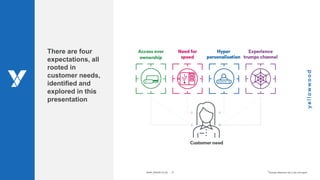
There are four
expectations, all
rooted in
customer needs,
identified and
explored in this
presentation
*Access reference list in the full report
www.ywood.co.za ‫׀‬ 4 *Access reference list in the full report
www.ywood.co.za ‫׀‬ 5
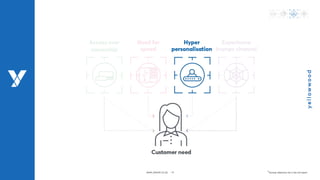
HYPER PERSONALISATION_
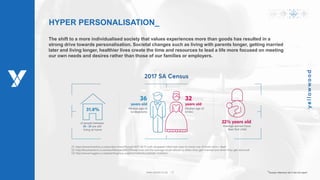
The shift to a more individualised society that values experiences more than goods has resulted in a
strong drive towards personalisation. Societal changes such as living with parents longer, getting married
later and living longer, healthier lives create the time and resources to lead a life more focused on meeting
our own needs and desires rather than those of our families or employers.
*Access reference list in the full report
www.ywood.co.za ‫׀‬ 6
HYPER PERSONALISATION_
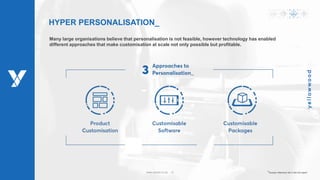
Many large organisations believe that personalisation is not feasible, however technology has enabled
different approaches that make customisation at scale not only possible but profitable.
*Access reference list in the full report
www.ywood.co.za ‫׀‬ 7
HYPER PERSONALISATION_
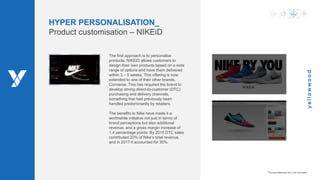
Product customisation – NIKEiD
The first approach is to personalise
products. NIKEiD allows customers to
design their own products based on a wide
range of options and have them delivered
within 3 – 5 weeks. This offering is now
extended to one of their other brands,
Converse. This has required the brand to
develop strong direct-to-customer (DTC)
purchasing and delivery channels,
something that had previously been
handled predominantly by retailers.
The benefits to Nike have made it a
worthwhile initiative not just in terms of
brand perceptions but also additional
revenue, and a gross margin increase of
1.4 percentage points. By 2015 DTC sales
contributed 22% of Nike’s total revenue,
and in 2017 it accounted for 30%.
*Access reference list in the full report
www.ywood.co.za ‫׀‬ 8
HYPER PERSONALISATION_
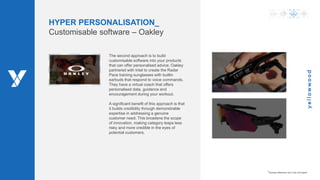
Customisable software – Oakley
The second approach is to build
customisable software into your products
that can offer personalised advice. Oakley
partnered with Intel to create the Radar
Pace training sunglasses with builtin
earbuds that respond to voice commands.
They have a virtual coach that offers
personalised data, guidance and
encouragement during your workout.
A significant benefit of this approach is that
it builds credibility through demonstrable
expertise in addressing a genuine
customer need. This broadens the scope
of innovation, making category leaps less
risky and more credible in the eyes of
potential customers.
*Access reference list in the full report
www.ywood.co.za ‫׀‬ 9
HYPER PERSONALISATION_
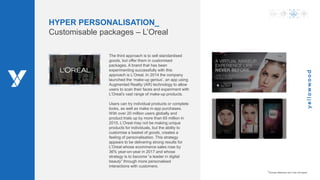
Customisable packages – L’Oreal
The third approach is to sell standardised
goods, but offer them in customised
packages. A brand that has been
experimenting successfully with this
approach is L’Oreal. In 2014 the company
launched the ‘make-up genius’, an app using
Augmented Reality (AR) technology to allow
users to scan their faces and experiment with
L’Oreal’s vast range of make-up products.
Users can try individual products or complete
looks, as well as make in-app purchases.
With over 20 million users globally and
product trials up by more than 65 million in
2015, L’Oreal may not be making unique
products for individuals, but the ability to
customise a basket of goods, creates a
feeling of personalisation. This strategy
appears to be delivering strong results for
L’Oreal whose ecommerce sales rose by
36% year-on-year in 2017 and whose
strategy is to become “a leader in digital
beauty” through more personalised
interactions with customers.
*Access reference list in the full report
www.ywood.co.za ‫׀‬ 10
In applying this expectation to your business there are a few questions to consider:
• How can I engineer a customer-centric strategy in my business to ensure personalisation at scale?
• How can I segment my customers to the individual?
• How can I focus and own a particular kind of customisation in my industry?
HYPER PERSONALISATION_
Questions to consider
*Access reference list in the full report
www.ywood.co.za ‫׀‬ 11
For more information on each of the
expectations and the associated
challenges and recommendations
download the full report via the link below
or visit www.ywood.co.za
Alternatively email us at
info@ywood.co.za
*Access reference list in the full report

Part 3 | Hyper personalisation

  • 1.
    www.ywood.co.za ‫׀‬ 1 Part1 Hyper Personalisation_ Part 3:
  • 2.
    www.ywood.co.za ‫׀‬ 2 INTRODUCTIONAND CONTEXT_ We are all aware of the significant and rapid advances in technology over the last two decades. The question that many are struggling to answer is, “what does this mean for my business?“ In the fields of big data analytics, machine learning and artificial intelligence (AI), there have been advancements that are drastically changing not only when, where and how customers shop, but also how they engage with brands. While there is a temptation to focus on the technology, these changes represent a significant shift in what customers now expect and that is where we should focus our energies. Yellowwood’s research report How Technology is Changing Customer Expectations identifies four shifts that are likely to have the largest impact on how organisations should adapt if they aim to remain relevant and meet (or ideally exceed) customer expectations, given the rapid and disruptive developments in technology. *Access reference list in the full report
  • 3.
    www.ywood.co.za ‫׀‬ 3 Thereare four expectations, all rooted in customer needs, identified and explored in this presentation *Access reference list in the full report
  • 4.
    www.ywood.co.za ‫׀‬ 4*Access reference list in the full report
  • 5.
    www.ywood.co.za ‫׀‬ 5 HYPERPERSONALISATION_ The shift to a more individualised society that values experiences more than goods has resulted in a strong drive towards personalisation. Societal changes such as living with parents longer, getting married later and living longer, healthier lives create the time and resources to lead a life more focused on meeting our own needs and desires rather than those of our families or employers. *Access reference list in the full report
  • 6.
    www.ywood.co.za ‫׀‬ 6 HYPERPERSONALISATION_ Many large organisations believe that personalisation is not feasible, however technology has enabled different approaches that make customisation at scale not only possible but profitable. *Access reference list in the full report
  • 7.
    www.ywood.co.za ‫׀‬ 7 HYPERPERSONALISATION_ Product customisation – NIKEiD The first approach is to personalise products. NIKEiD allows customers to design their own products based on a wide range of options and have them delivered within 3 – 5 weeks. This offering is now extended to one of their other brands, Converse. This has required the brand to develop strong direct-to-customer (DTC) purchasing and delivery channels, something that had previously been handled predominantly by retailers. The benefits to Nike have made it a worthwhile initiative not just in terms of brand perceptions but also additional revenue, and a gross margin increase of 1.4 percentage points. By 2015 DTC sales contributed 22% of Nike’s total revenue, and in 2017 it accounted for 30%. *Access reference list in the full report
  • 8.
    www.ywood.co.za ‫׀‬ 8 HYPERPERSONALISATION_ Customisable software – Oakley The second approach is to build customisable software into your products that can offer personalised advice. Oakley partnered with Intel to create the Radar Pace training sunglasses with builtin earbuds that respond to voice commands. They have a virtual coach that offers personalised data, guidance and encouragement during your workout. A significant benefit of this approach is that it builds credibility through demonstrable expertise in addressing a genuine customer need. This broadens the scope of innovation, making category leaps less risky and more credible in the eyes of potential customers. *Access reference list in the full report
  • 9.
    www.ywood.co.za ‫׀‬ 9 HYPERPERSONALISATION_ Customisable packages – L’Oreal The third approach is to sell standardised goods, but offer them in customised packages. A brand that has been experimenting successfully with this approach is L’Oreal. In 2014 the company launched the ‘make-up genius’, an app using Augmented Reality (AR) technology to allow users to scan their faces and experiment with L’Oreal’s vast range of make-up products. Users can try individual products or complete looks, as well as make in-app purchases. With over 20 million users globally and product trials up by more than 65 million in 2015, L’Oreal may not be making unique products for individuals, but the ability to customise a basket of goods, creates a feeling of personalisation. This strategy appears to be delivering strong results for L’Oreal whose ecommerce sales rose by 36% year-on-year in 2017 and whose strategy is to become “a leader in digital beauty” through more personalised interactions with customers. *Access reference list in the full report
  • 10.
    www.ywood.co.za ‫׀‬ 10 Inapplying this expectation to your business there are a few questions to consider: • How can I engineer a customer-centric strategy in my business to ensure personalisation at scale? • How can I segment my customers to the individual? • How can I focus and own a particular kind of customisation in my industry? HYPER PERSONALISATION_ Questions to consider *Access reference list in the full report
  • 11.
    www.ywood.co.za ‫׀‬ 11 Formore information on each of the expectations and the associated challenges and recommendations download the full report via the link below or visit www.ywood.co.za Alternatively email us at info@ywood.co.za *Access reference list in the full report