Arab Academy forScience, Technology and Maritime Transport
College of International Transport and Logistics
Course Code (EL 211)
Dr. Mohamed Abouelmagd
Introduction to Information Systems
Supply chain management systems
Part (2.2)
2.
Introduction to InformationSystems Dr. Mohamed Abouelmagd
Introduction
• If you manage a small firm that makes a few products or sells a few services, chances, are you will have a
small number of suppliers. You could coordinate your supplier orders and deliveries using a telephone and
fax machine. But if you manage a firm that produces more complex products and services, then you will have
hundreds of suppliers, and your suppliers will each have their own set of suppliers.
• Suddenly, you are in a situation where you will need to coordinate the activities of hundreds or even
thousands of other firms in order to produce your products and services.
• Supply chain management (SCM) systems, are an answer to the problems of supply chain complexity and
scale.
3.
Introduction to InformationSystems Dr. Mohamed Abouelmagd
The Supply Chain
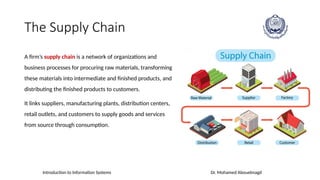
A firm’s supply chain is a network of organizations and
business processes for procuring raw materials, transforming
these materials into intermediate and finished products, and
distributing the finished products to customers.
It links suppliers, manufacturing plants, distribution centers,
retail outlets, and customers to supply goods and services
from source through consumption.
4.
Introduction to InformationSystems Dr. Mohamed Abouelmagd
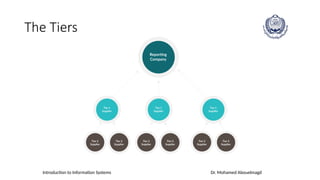
The Tiers
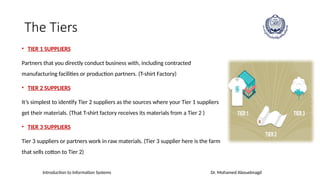
• TIER 1 SUPPLIERS
Partners that you directly conduct business with, including contracted
manufacturing facilities or production partners. (T-shirt Factory)
• TIER 2 SUPPLIERS
It’s simplest to identify Tier 2 suppliers as the sources where your Tier 1 suppliers
get their materials. (That T-shirt factory receives its materials from a Tier 2 )
• TIER 3 SUPPLIERS
Tier 3 suppliers or partners work in raw materials. (Tier 3 supplier here is the farm
that sells cotton to Tier 2)
Introduction to InformationSystems Dr. Mohamed Abouelmagd
Nike’s Supply Chain
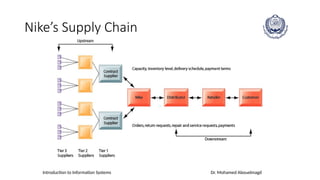
• Nike designs, markets, and sells sneakers, socks, athletic clothing, and
accessories throughout the world.
• Its primary suppliers are contract manufacturers with factories in China,
Thailand, Indonesia, Brazil, and other countries. (Tier-1)
• Nike’s contract suppliers do not manufacture sneakers from scratch. They
obtain components for the sneakers—the laces, eyelets, uppers, and soles—
from other suppliers (Tier-2) and then assemble them into finished sneakers.
Suppliers to these suppliers are the tertiary (Tier-3) suppliers.
Introduction to InformationSystems Dr. Mohamed Abouelmagd
Information Systems and Supply Chain
Management
Inefficiencies in the supply chain, such as parts shortages, underutilized plant capacity, excessive finished goods
inventory, or high transportation costs, are caused by inaccurate or untimely information.
For example, manufacturers may keep too many parts in inventory because they do not know exactly
when they will receive their next shipments from their suppliers.
Suppliers may order too few raw materials because they do not have precise information on demand.
These supply chain inefficiencies waste as much as 25 percent of a company’s operating costs.
9.
Introduction to InformationSystems Dr. Mohamed Abouelmagd
Information Systems and Supply Chain
Management
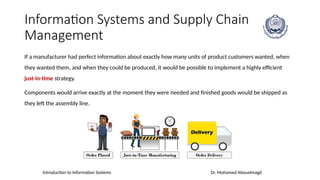
If a manufacturer had perfect information about exactly how many units of product customers wanted, when
they wanted them, and when they could be produced, it would be possible to implement a highly efficient
just-in-time strategy.
Components would arrive exactly at the moment they were needed and finished goods would be shipped as
they left the assembly line.
10.
Introduction to InformationSystems Dr. Mohamed Abouelmagd
The Bullwhip Effect
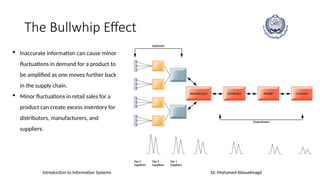
Inaccurate information can cause minor
fluctuations in demand for a product to
be amplified as one moves further back
in the supply chain.
Minor fluctuations in retail sales for a
product can create excess inventory for
distributors, manufacturers, and
suppliers.
11.
Introduction to InformationSystems Dr. Mohamed Abouelmagd
Supply Chain Software
Supply chain software can be classified as either:
• Supply chain planning systems: Systems which enable the firm to generate demand forecasts for a product,
develop sourcing and manufacturing plans for that product, make adjustments to production and distribution
plans, and share that information with relevant supply chain members. One of the most important supply chain
planning functions is demand planning, which determines how much product a business needs to make to
satisfy all of its customers' demands.
• Supply chain execution systems: Systems that manage the physical flow of products through distribution centers
and warehouses to ensure that products are delivered to the right locations in the most efficient manner.
12.
Introduction to InformationSystems Dr. Mohamed Abouelmagd
Global Supply Chains and The Internet
Before the Internet, supply chain coordination was hampered by the
difficulties of making information flow smoothly among disparate internal
supply chain systems.
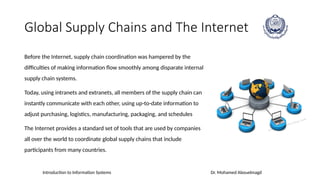
Today, using intranets and extranets, all members of the supply chain can
instantly communicate with each other, using up-to-date information to
adjust purchasing, logistics, manufacturing, packaging, and schedules
The Internet provides a standard set of tools that are used by companies
all over the world to coordinate global supply chains that include
participants from many countries.
13.
Introduction to InformationSystems Dr. Mohamed Abouelmagd
Global Supply Chain Issues
More and more companies are entering international markets, outsourcing manufacturing operations, and
obtaining supplies from other countries as well as selling abroad. Their supply chains extend across multiple
countries and regions. There are additional complexities and challenges to managing a global supply chain.
Global supply chains typically span greater geographic distances and time differences than domestic supply
chains and have participants from a number of different countries.
Performance standards may vary from region to region or from nation to nation. Supply chain management
may need to reflect foreign government regulations and cultural differences.
14.
Introduction to InformationSystems Dr. Mohamed Abouelmagd
Push- Versus Pull-based Supply Chain Models
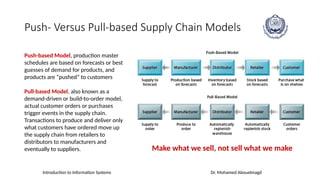
Push-based Model, production master
schedules are based on forecasts or best
guesses of demand for products, and
products are “pushed” to customers
Pull-based Model, also known as a
demand-driven or build-to-order model,
actual customer orders or purchases
trigger events in the supply chain.
Transactions to produce and deliver only
what customers have ordered move up
the supply chain from retailers to
distributors to manufacturers and
eventually to suppliers. Make what we sell, not sell what we make
15.
Introduction to InformationSystems Dr. Mohamed Abouelmagd
The Emerging Internet-driven Supply Chain
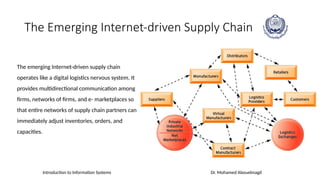
The emerging Internet-driven supply chain
operates like a digital logistics nervous system. It
provides multidirectional communication among
firms, networks of firms, and e- marketplaces so
that entire networks of supply chain partners can
immediately adjust inventories, orders, and
capacities.