Integers
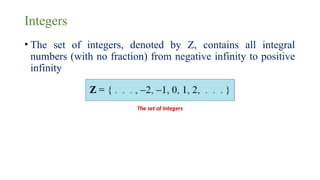
• The setof integers, denoted by Z, contains all integral
numbers (with no fraction) from negative infinity to positive
infinity
The set of integers
3.
Integer Division
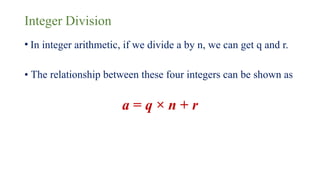
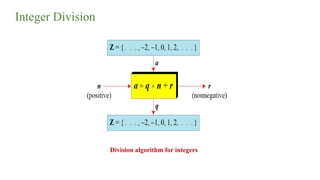
• Ininteger arithmetic, if we divide a by n, we can get q and r.
• The relationship between these four integers can be shown as
a = q × n + r
4.
Integer Division
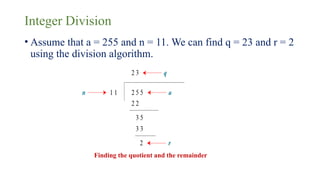
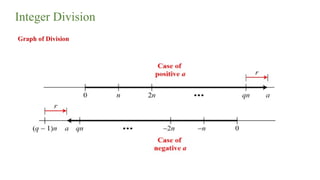
• Assumethat a = 255 and n = 11. We can find q = 23 and r = 2
using the division algorithm.
Finding the quotient and the remainder
Integer Division
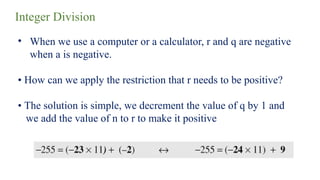
• Whenwe use a computer or a calculator, r and q are negative
when a is negative.
• How can we apply the restriction that r needs to be positive?
• The solution is simple, we decrement the value of q by 1 and
we add the value of n to r to make it positive
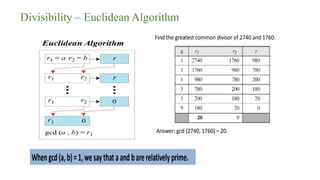
Divisibility – EuclideanAlgorithm
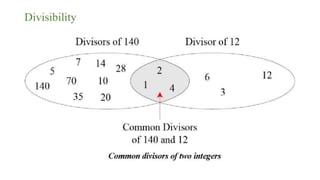
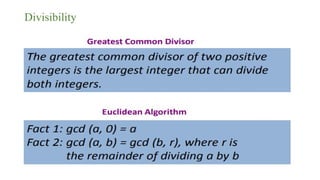
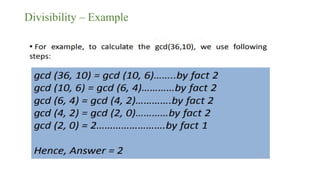
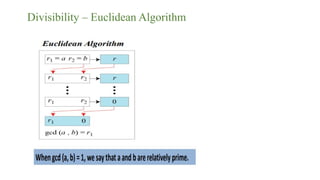
Find the greatest common divisor of 25 and 60.
How to Find the Greatest Common Divisor by Using the Euclidian Algorithm – YouTube
Modular Arithmetic
• Thedivision relationship (a = q × n + r) discussed in the
previous section has two inputs (a and n) and two outputs (q
and r).
• In modular arithmetic, we are interested in only one of the
outputs, the remainder r.
23.
Modulo Operator
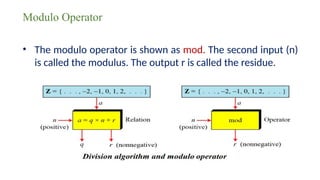
• Themodulo operator is shown as mod. The second input (n)
is called the modulus. The output r is called the residue.
24.
Modulo Operator
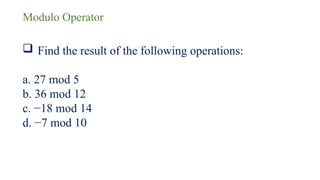
Findthe result of the following operations:
a. 27 mod 5
b. 36 mod 12
c. −18 mod 14
d. −7 mod 10
25.
Modulo Operator
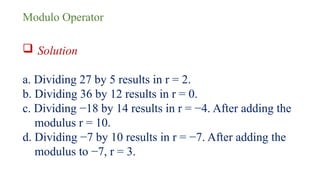
Solution
a.Dividing 27 by 5 results in r = 2.
b. Dividing 36 by 12 results in r = 0.
c. Dividing −18 by 14 results in r = −4. After adding the
modulus r = 10.
d. Dividing −7 by 10 results in r = −7. After adding the
modulus to −7, r = 3.
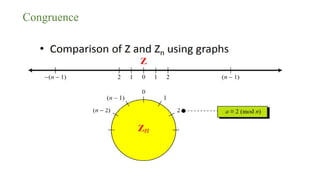
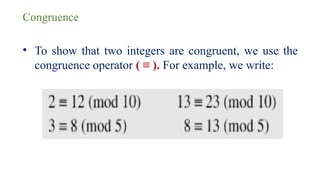
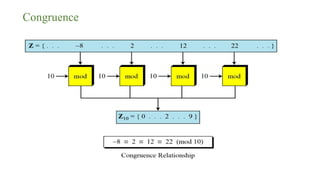
Congruence
Residue Classes
– Aresidue class [a] or [a]n is the set of integers
congruent modulo n.
– It is the set of all integers such that x=a(mod)n
– E.g. for n=5, we have five sets as shown below:
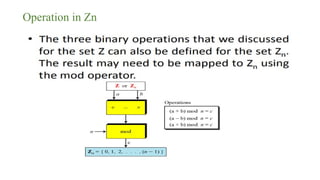
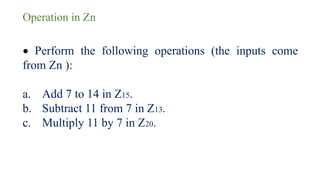
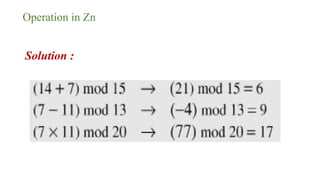
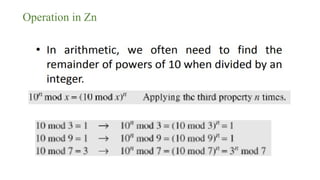
Operation in Zn
•Perform the following operations (the inputs come
from Zn ):
a. Add 7 to 14 in Z15.
b. Subtract 11 from 7 in Z13.
c. Multiply 11 by 7 in Z20.
Operation in Zn
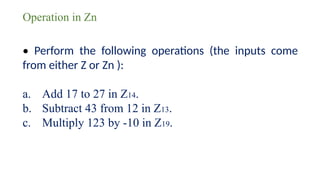
•Perform the following operations (the inputs come
from either Z or Zn ):
a. Add 17 to 27 in Z14.
b. Subtract 43 from 12 in Z13.
c. Multiply 123 by -10 in Z19.
35.
Operation in Zn
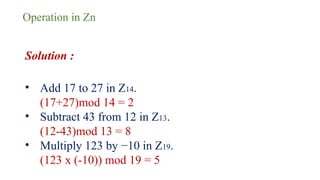
Solution:
• Add 17 to 27 in Z14.
(17+27)mod 14 = 2
• Subtract 43 from 12 in Z13.
(12-43)mod 13 = 8
• Multiply 123 by −10 in Z19.
(123 x (-10)) mod 19 = 5
Operation in Zn
•We have been told in arithmetic that the remainder of
an integer divided by 3 is the same as the remainder of
the sum of its decimal digits. In other words, the
remainder of dividing 6371 by 3 is same as dividing
17 by 3.
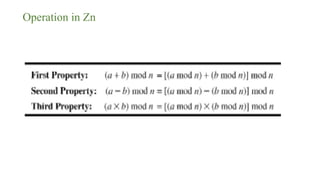
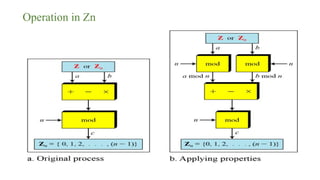
• Prove this claim using the properties of the mod
operator.
40.
Inverses
• When weare working in modular arithmetic, we often
need to find the inverse of a number relative to an
operation.
• We are normally looking for an additive inverse
(relative to an addition operation) or a multiplicative
inverse (relative to a multiplication operation).
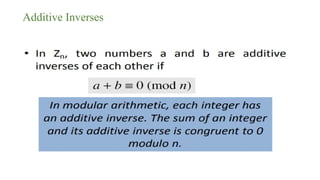
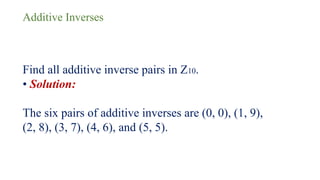
Additive Inverses
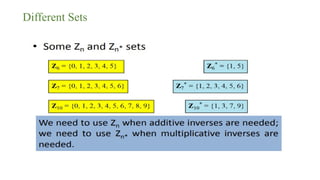
Find alladditive inverse pairs in Z10.
• Solution:
The six pairs of additive inverses are (0, 0), (1, 9),
(2, 8), (3, 7), (4, 6), and (5, 5).
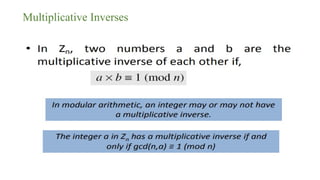
Multiplicative Inverses
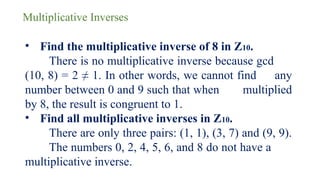
• Findthe multiplicative inverse of 8 in Z10.
There is no multiplicative inverse because gcd
(10, 8) = 2 ≠ 1. In other words, we cannot find any
number between 0 and 9 such that when multiplied
by 8, the result is congruent to 1.
• Find all multiplicative inverses in Z10.
There are only three pairs: (1, 1), (3, 7) and (9, 9).
The numbers 0, 2, 4, 5, 6, and 8 do not have a
multiplicative inverse.
45.
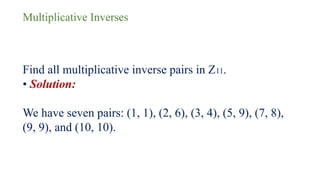
Multiplicative Inverses
Find allmultiplicative inverse pairs in Z11.
• Solution:
We have seven pairs: (1, 1), (2, 6), (3, 4), (5, 9), (7, 8),
(9, 9), and (10, 10).
46.
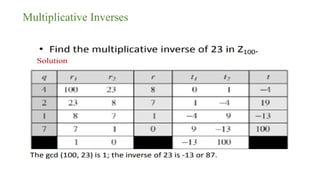
Multiplicative Inverses
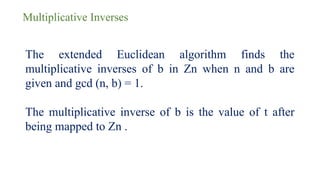
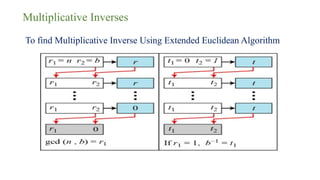
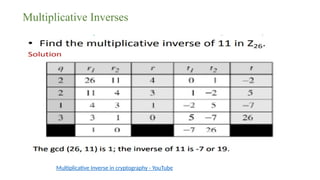
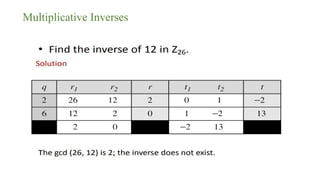
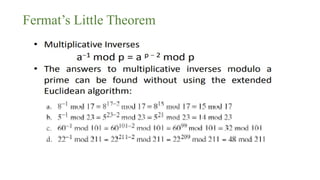
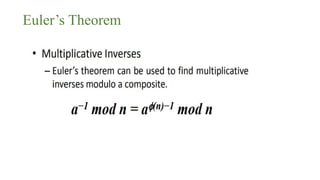
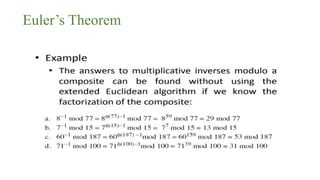
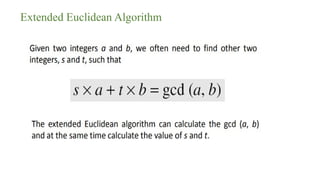
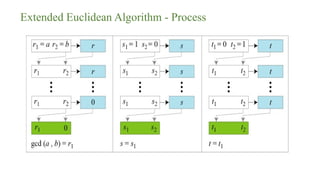
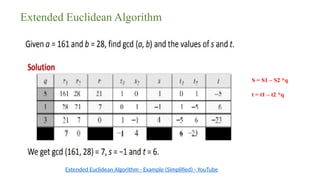
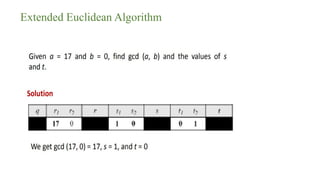
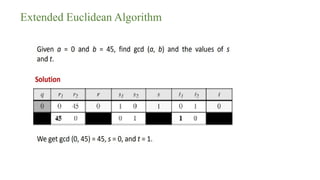
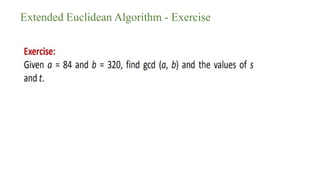
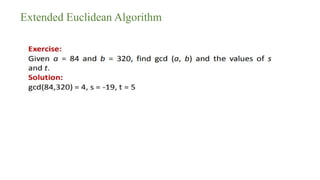
The extendedEuclidean algorithm finds the
multiplicative inverses of b in Zn when n and b are
given and gcd (n, b) = 1.
The multiplicative inverse of b is the value of t after
being mapped to Zn .
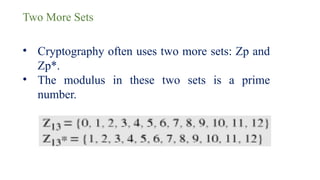
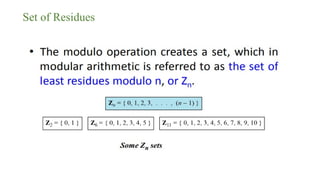
Two More Sets
•Cryptography often uses two more sets: Zp and
Zp*.
• The modulus in these two sets is a prime
number.
53.
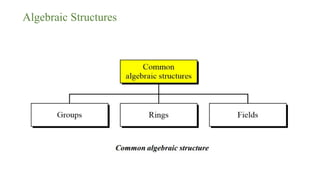
Algebraic Structures
• Cryptographyrequires sets of integers and specific
operations that are defined for those sets.
• The combination of the set and the operations that
are applied to the elements of the set is called an
algebraic structure.
• Three common algebraic structures: groups, rings,
and fields.
Checking for Primeness
Givena number n, how can we determine if n is a
prime?
– The answer is that we need to see if the number is
divisible by all primes less than √n
• Is 97 a prime?
– The floor of √97 = 9. The primes less than 9 are 2, 3,
5, and 7. We need to see if 97 is divisible by any of
these numbers. It is not, so 97 is a prime..
57.
Checking for Primeness
Is301 a prime?
– The floor of √301 = 17. We need to check 2, 3, 5, 7,
11, 13, and 17. The numbers 2, 3, and 5 do not divide
301, but 7 does. Therefore 301 is not a prime
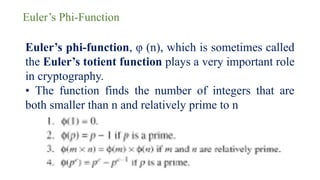
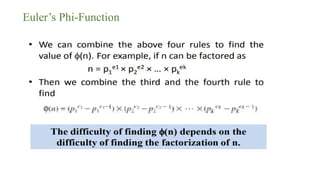
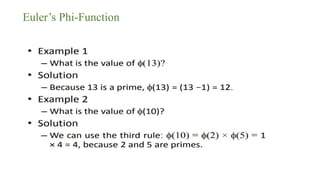
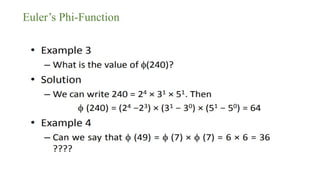
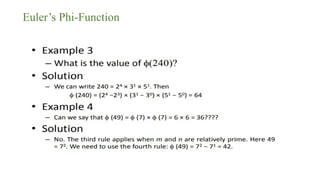
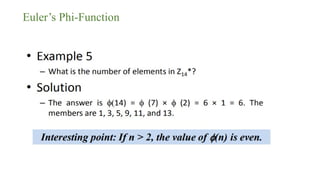
Euler’s Phi-Function
Euler’s phi-function,φ (n), which is sometimes called
the Euler’s totient function plays a very important role
in cryptography.
• The function finds the number of integers that are
both smaller than n and relatively prime to n

![Congruence
Residue Classes
– A residue class [a] or [a]n is the set of integers
congruent modulo n.
– It is the set of all integers such that x=a(mod)n
– E.g. for n=5, we have five sets as shown below:](https://image.slidesharecdn.com/numbertheory-250515174653-4c71bd57/85/Number_Theory_-ITC-_Cryptographys-pptx-29-320.jpg)