
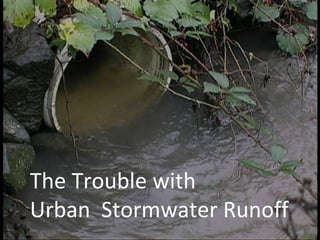

The Trouble with
Urban Stormwater Runoff
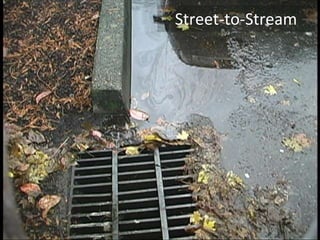
Street-to-Stream
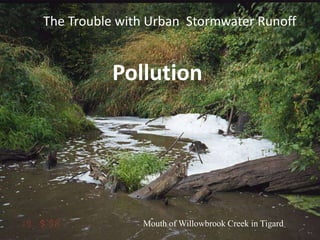
The Trouble with Urban Stormwater Runoff

Pollution

Mouth of Willowbrook Creek in Tigard
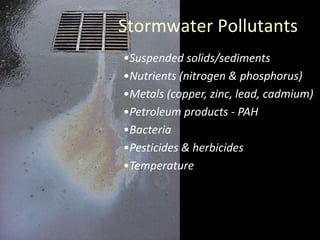
Stormwater Pollutants
•Suspended solids/sediments
•Nutrients (nitrogen & phosphorus)
•Metals (copper, zinc, lead, cadmium)
•Petroleum products - PAH
•Bacteria
•Pesticides & herbicides
•Temperature
The Trouble with Urban Stormwater Runoff

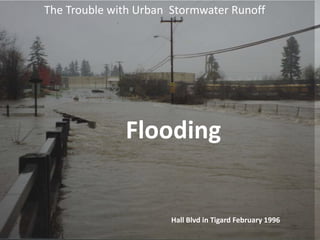
Flooding

Hall Blvd in Tigard February 1996
The Trouble with Urban Stormwater Runoff

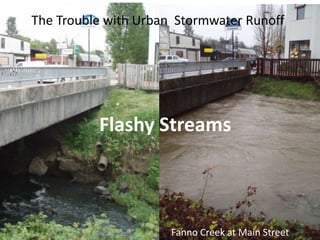
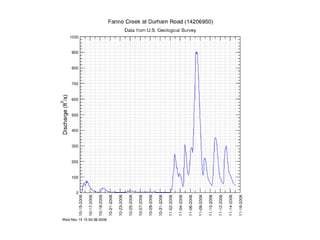
Flashy Streams

Fanno Creek at Main Street
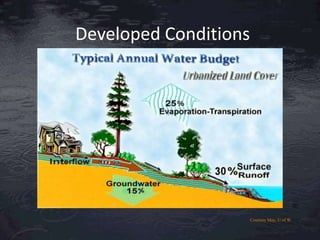
Developed Conditions
Urban runoff
carries pollutants,
causes erosion
and stirs up
contaminated and
oxygen depleting
sediments.
The Trouble with Urban Stormwater Runoff

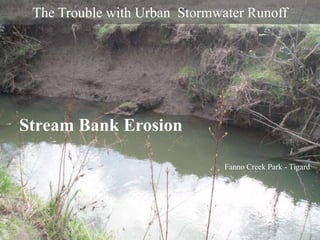
Stream Bank Erosion
Fanno Creek Park - Tigard
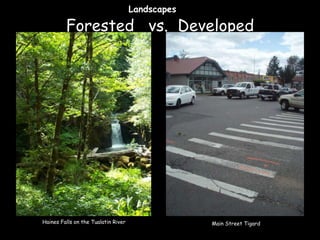
Landscapes

Forested vs. Developed

Haines Falls on the Tualatin River

Main Street Tigard
Developed Conditions

Courtesy May, U of W
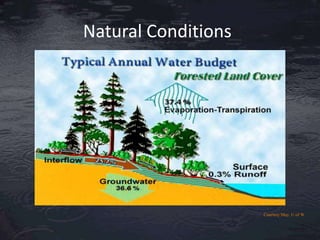
Natural Conditions

Courtesy May, U of W
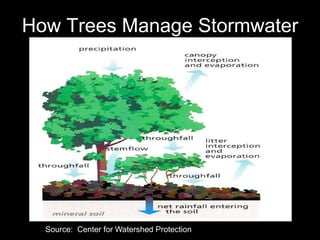
How Trees Manage Stormwater

Source: Center for Watershed Protection
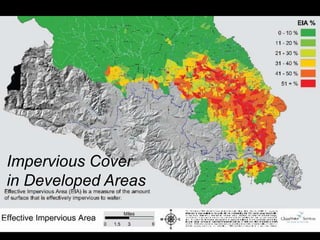
Impervious Cover
in Developed Areas
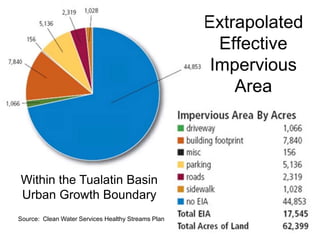
Extrapolated
Effective
Impervious
Area

Within the Tualatin Basin
Urban Growth Boundary
Source: Clean Water Services Healthy Streams Plan
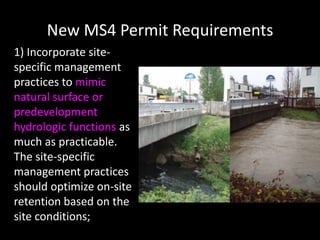
New MS4 Permit Requirements
1) Incorporate sitespecific management
practices to mimic
natural surface or
predevelopment
hydrologic functions as
much as practicable.
The site-specific
management practices
should optimize on-site
retention based on the
site conditions;
New MS4 Permit Requirements
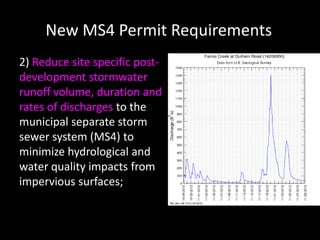
2) Reduce site specific postdevelopment stormwater
runoff volume, duration and
rates of discharges to the
municipal separate storm
sewer system (MS4) to
minimize hydrological and
water quality impacts from
impervious surfaces;
New MS4 Permit Requirements
3) Prioritize and include
implementation of LowImpact Development (LID),
Green Infrastructure (GI) or
equivalent planning, design
and construction
approaches;
Can we use
trees in parking
lots for
stormwater
runoff
reduction?
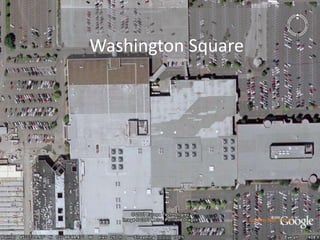
Washington Square

Courtesy May, U of W
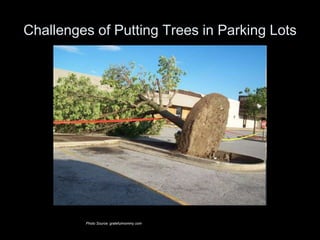
Challenges of Putting Trees in Parking Lots

Photo Source: gratefulmommy.com
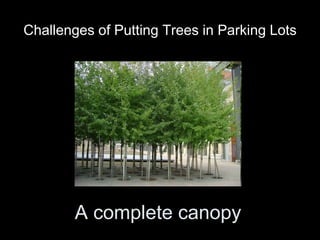
Challenges of Putting Trees in Parking Lots

A complete canopy
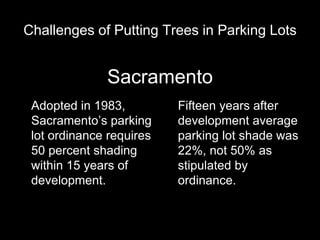
Challenges of Putting Trees in Parking Lots

Sacramento
Adopted in 1983,
Sacramento’s parking
lot ordinance requires
50 percent shading
within 15 years of
development.

Fifteen years after
development average
parking lot shade was
22%, not 50% as
stipulated by
ordinance.
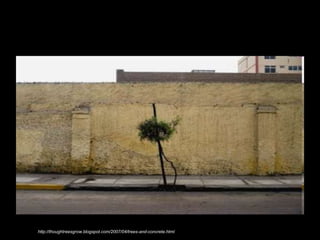
http://thoughtreesgrow.blogspot.com/2007/04/trees-and-concrete.html
Which trees are best for
stormwater management?

Deciduous?
Coniferous?
Broadleaf Evergreen?
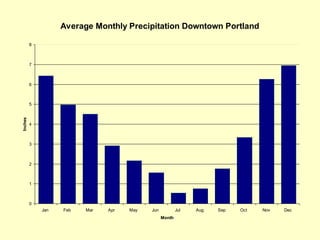
Average Monthly Precipitation Downtown Portland
8

7

6

Inches

5

4

3

2

1

0
Jan

Feb

Mar

Apr

May

Jun

Jul
Month

Aug

Sep

Oct

Nov

Dec
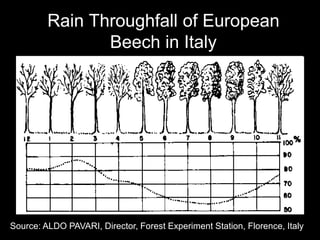
Rain Throughfall of European
Beech in Italy

Source: ALDO PAVARI, Director, Forest Experiment Station, Florence, Italy
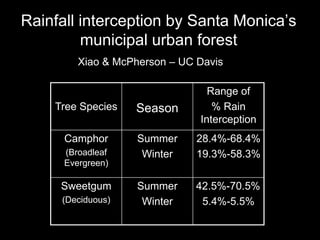
Rainfall interception by Santa Monica’s
municipal urban forest
Xiao & McPherson – UC Davis

Tree Species

Season

Range of
% Rain
Interception

Camphor

Summer
Winter

28.4%-68.4%
19.3%-58.3%

Summer
Winter

42.5%-70.5%
5.4%-5.5%

(Broadleaf
Evergreen)

Sweetgum
(Deciduous)
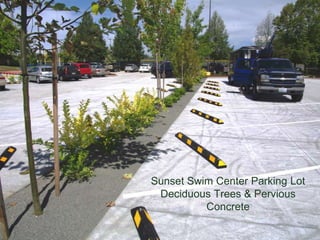
Sunset Swim Center Parking Lot
Deciduous Trees & Pervious
Concrete
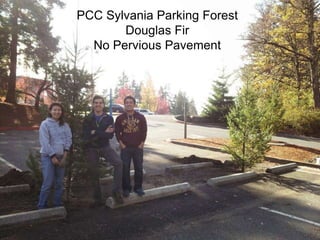
PCC Sylvania Parking Forest
Douglas Fir
No Pervious Pavement
Brian Wegener
503.218.2580
brian@tualatinriverkeepers.org
"This Project has been funded wholly or in part by the United States
Environmental Protection Agency under a federal grant issued under
Section 319(h) of the Clean Water Act. The contents of this document
do not necessarily reflect the views and policies of the Environmental
Protection Agency, nor does mention of trade names or commercial
products constitute endorsement or recommendation for use."
www.parkingforest.org
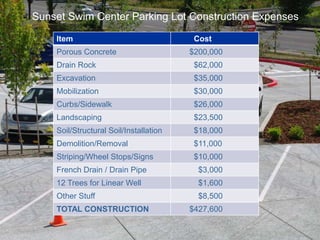
Sunset Swim Center Parking Lot Construction Expenses
Item
Porous Concrete

Cost
$200,000

Drain Rock

$62,000

Excavation

$35,000

Mobilization

$30,000

Curbs/Sidewalk

$26,000

Landscaping

$23,500

Soil/Structural Soil/Installation

$18,000

Demolition/Removal

$11,000

Striping/Wheel Stops/Signs

$10,000

French Drain / Drain Pipe

$3,000

12 Trees for Linear Well

$1,600

Other Stuff

$8,500

TOTAL CONSTRUCTION

$427,600

Parking Forest Stormwater Introduction

Editor's Notes

  • #4 In the urban part of the Tualatin basin we have a separate storm sewer system (unlike muck of Portland). Runoff from streets and parking lots in most cases goes directly to the nearest creek.
  • #10 Sediments containing legacy pollutants are re-suspended in the rapid rise of an urban creek.
  • #15 Trees intercept rain and send it back into the air. Tree roots can help water infiltrate. Fallen leaves can build an organic layer that acts like a sponge.
  • #18 New regulatory requirements from DEQ are pushing changes in stormwater management, with a new emphasis on hydrology as well as chemistry.
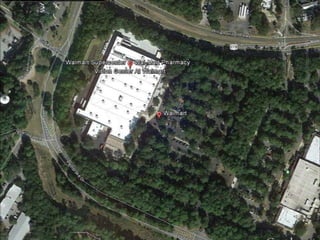
  • #23 Here is another way to build a parking lot (or parking forest) that uses trees to intercept rain before it becomes runoff. This site is at WalMart in Hilton Head South Carolina.
  • #24 Compacted soil makes it hard for roots to penetrate.
  • #26 Sacramento had some challenges in implementing tree canopy goals for parking lots through ordinance. Note that some of the parking lots did achieve their 50% canopy goal.
  • #29 We get the largest portion of our rain when the deciduous trees have dropped their leaves.
  • #32 At Sunset Swim Center we planted deciduous trees, Because of the porous concrete parking lot rainfall interception is less critical.
  • #33 At our smaller demonstration project at PCC Sylvania, where there is no pervious pavement we planted native Douglas fir to maximize rainfall interception.