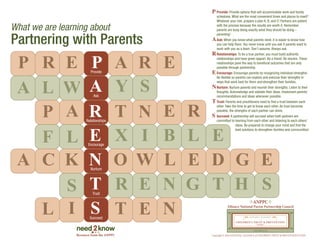
P Provide: Provide options that will accommodate work and family
schedules. What are the most convenient times and places to meet?
Whatever your role, prepare a plan A, B, and C! Partners are patient
with the process because the results are worth it. Remember,
parents are busy doing exactly what they should be doing –
parenting!
AAsk: When you know what parents need, it is easier to know how
you can help them. You never know until you ask if parents want to
work with you as a team. Don’t assume. Always ask.
RRelationships: To be a true partner, you must build authentic
relationships and have great rapport. Be a friend. Be sincere. These
relationships pave the way to beneficial outcomes that are only
possible through partnership.
E Encourage: Encourage parents by recognizing individual strengths!
Be flexible so parents can explore and exercise their strengths in
ways that work best for them and strengthen their families.
NNurture: Nurture parents and nourish their strengths. Listen to their
thoughts. Acknowledge and validate their ideas. Implement parents’
recommendations and ideas whenever possible.
T Trust: Parents and practitioners need to find a trust between each
other. Take the time to get to know each other. As trust becomes
possible, the strengths of each partner can shine.
S Succeed: A partnership will succeed when both partners are
committed to learning from each other and listening to each others'
What we are learning about
Partnering with Parents
ANPPC
Alliance National Parent Partnership Council
www.ctfalliance.org
PP
P
Provide
A
A
E R
L
Ask
R
Y
RR
Relationships
E
S
E E
A W L E D G E
Encourage
NNurture
TTrust
S
A W
B L EF
E N G T H S
Succeed
L
NE
A NT
X IL
OC K
RS
I T
ideas. Be prepared to change your mind and find the
best solutions to strengthen families and communities!
Resource from the ANPPC Copyright © 2016 NATIONAL ALLIANCE of CHILDREN’S TRUST & PREVENTION FUNDS
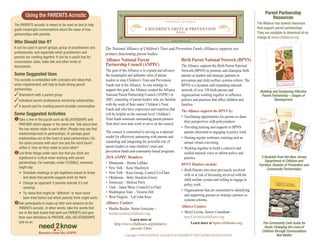
The PARENTS acrostic is meant to be used as tool to help
guide meaningful conversations about the value of true
partnerships with parents.
Who Should Use It?
It can be used in parent groups, group of practitioners and
professionals, and especially when practitioners and
parents are meeting together. It can be a useful tool for
conversation cafes, table talk and other kinds of
discussions.
Some Suggested Uses
The acrostic is embedded with concepts and ideas that,
when implemented, will help to build strong parent
partnerships.
✓Brainstorm with a parent group
✓Individual parent-professional mentoring relationships
✓A launch pad for creating parent-provider conversation
Some Suggested Activities
1Take a line in the puzzle such as RELATIONSHIPS and
PARTNER which appear in the same line. Talk about how
the two words relate to each other. (People may say that
relationships lead to partnerships. Or perhaps good
relationships are at the heart of good partnerships.) Do
the same process with each line and the word found
within it. How do they relate to each other?
2List three things under each line that you think are
significant or critical when working with parent
partnerships. For example, under FLEXIBLE, someone
might say:
• Schedule meetings or get-togethers based on times
and ideas that parents suggest work for them
• Change an approach if parents indicate it's not
working!
• Try ideas that might be "different" or have never
been tried before but which parents think might work.
3Ask participants to make up their own answers to the
PARENTS acrostic. In other words, take the words that
are in the dark boxes that spell out PARENTS and give
their own definitions to PROVIDE, ASK, RELATIONSHIPS
and so on.
www.ctfalliance.org
Using the PARENTS Acrostic
Alliance National Parent
Partnership Council (ANPPC)
The goal of the Alliance is to expand and advance
the meaningful and authentic roles of parent
leaders in state Children’s Trust and Prevention
Funds and in the Alliance. As one strategy to
support this goal, the Alliance created the Alliance
National Parent Partnership Council (ANPPC) in
2007, consisting of parent leaders who are familiar
with the work of their states’Children’s Trust
Funds and who have experience and expertise that
will be helpful on the national level. Children’s
Trust funds nominate outstanding parent partners
from their own state work to serve on the council.
The council is committed to serving as a national
model for effectively partnering with parents and
expanding and integrating the powerful role of
parent leaders in state children’s trust and
prevention funds and community-based programs.
2016 ANPPC Members:
• Minnesota – Donna LaDuke
• New York – Katie MacIntyre
• New York – Kara Georgi, Council Co-Chair
• Oklahoma – Betty Hawkins-Emery
• Tennessee – Melissa Perry
• Utah – Janae Moss, Council Co-Chair
• Washington State – Victoria Hilt
• West Virginia – LaCrisha Rose
Alliance Contact:
• Martha Reeder, Senior Associate –
martha.reeder@ctfalliance.org
Learn more at
http://www.ctfalliance.org/initiative_
parents-3.htm
Birth Parent National Network (BPNN)
The Alliance supports the Birth Parent National
Network (BPNN) to promote and champion birth
parents as leaders and strategic partners in
prevention and child welfare systems reform. The
BPNN is a dynamic and expanding national
network of over 150 birth parents and
organizations working together to influence
policies and practices that affect children and
families.
The Alliance supports the BPNN by:
• Facilitating opportunities for parents to share
their perspectives with policymakers
• Providing training and supports to BPNN
parents interested in engaging in policy work
• Hosting regular webinars, trainings and an
annual virtual convening
• Working together to build a cohesive and
unified national voice to inform policy and
practice
BPNN Members include:
• Birth Parents who were previously involved
with or at risk of becoming involved with the
child welfare system and willing to engage in
policy work
• Organizations that are committed to identifying
and supporting parents as strategic partners in
systems reforms.
Alliance Contact:
• Meryl Levine, Senior Consultant –
meryl.levine@ctfalliance.org
Learn more at bpnn.ctfalliance.org
The Alliance has several resources
that support parent partnerships.
They are available to download at no
charge at www.ctfalliance.org.
Resource from the ANPPC
Copyright © 2016 NATIONAL ALLIANCE of CHILDREN’S TRUST & PREVENTION FUNDS
The National Alliance of Children’s Trust and Prevention Funds (Alliance) supports two
primary functioning parent bodies:
Parent Partnership
Resources
Building and Sustaining Effective
Parent Partnership – Stages of
Development
The Community Café Guide for
Hosts: Changing the Lives of
Children through Conversations
that Matter
3 Booklets from the New Jersey
Department of Children and
Families, Division of Prevention and
Community Partnerships

Parent Acrostic-1

  • 1.
    P Provide: Provideoptions that will accommodate work and family schedules. What are the most convenient times and places to meet? Whatever your role, prepare a plan A, B, and C! Partners are patient with the process because the results are worth it. Remember, parents are busy doing exactly what they should be doing – parenting! AAsk: When you know what parents need, it is easier to know how you can help them. You never know until you ask if parents want to work with you as a team. Don’t assume. Always ask. RRelationships: To be a true partner, you must build authentic relationships and have great rapport. Be a friend. Be sincere. These relationships pave the way to beneficial outcomes that are only possible through partnership. E Encourage: Encourage parents by recognizing individual strengths! Be flexible so parents can explore and exercise their strengths in ways that work best for them and strengthen their families. NNurture: Nurture parents and nourish their strengths. Listen to their thoughts. Acknowledge and validate their ideas. Implement parents’ recommendations and ideas whenever possible. T Trust: Parents and practitioners need to find a trust between each other. Take the time to get to know each other. As trust becomes possible, the strengths of each partner can shine. S Succeed: A partnership will succeed when both partners are committed to learning from each other and listening to each others' What we are learning about Partnering with Parents ANPPC Alliance National Parent Partnership Council www.ctfalliance.org PP P Provide A A E R L Ask R Y RR Relationships E S E E A W L E D G E Encourage NNurture TTrust S A W B L EF E N G T H S Succeed L NE A NT X IL OC K RS I T ideas. Be prepared to change your mind and find the best solutions to strengthen families and communities! Resource from the ANPPC Copyright © 2016 NATIONAL ALLIANCE of CHILDREN’S TRUST & PREVENTION FUNDS
  • 2.
    The PARENTS acrosticis meant to be used as tool to help guide meaningful conversations about the value of true partnerships with parents. Who Should Use It? It can be used in parent groups, group of practitioners and professionals, and especially when practitioners and parents are meeting together. It can be a useful tool for conversation cafes, table talk and other kinds of discussions. Some Suggested Uses The acrostic is embedded with concepts and ideas that, when implemented, will help to build strong parent partnerships. ✓Brainstorm with a parent group ✓Individual parent-professional mentoring relationships ✓A launch pad for creating parent-provider conversation Some Suggested Activities 1Take a line in the puzzle such as RELATIONSHIPS and PARTNER which appear in the same line. Talk about how the two words relate to each other. (People may say that relationships lead to partnerships. Or perhaps good relationships are at the heart of good partnerships.) Do the same process with each line and the word found within it. How do they relate to each other? 2List three things under each line that you think are significant or critical when working with parent partnerships. For example, under FLEXIBLE, someone might say: • Schedule meetings or get-togethers based on times and ideas that parents suggest work for them • Change an approach if parents indicate it's not working! • Try ideas that might be "different" or have never been tried before but which parents think might work. 3Ask participants to make up their own answers to the PARENTS acrostic. In other words, take the words that are in the dark boxes that spell out PARENTS and give their own definitions to PROVIDE, ASK, RELATIONSHIPS and so on. www.ctfalliance.org Using the PARENTS Acrostic Alliance National Parent Partnership Council (ANPPC) The goal of the Alliance is to expand and advance the meaningful and authentic roles of parent leaders in state Children’s Trust and Prevention Funds and in the Alliance. As one strategy to support this goal, the Alliance created the Alliance National Parent Partnership Council (ANPPC) in 2007, consisting of parent leaders who are familiar with the work of their states’Children’s Trust Funds and who have experience and expertise that will be helpful on the national level. Children’s Trust funds nominate outstanding parent partners from their own state work to serve on the council. The council is committed to serving as a national model for effectively partnering with parents and expanding and integrating the powerful role of parent leaders in state children’s trust and prevention funds and community-based programs. 2016 ANPPC Members: • Minnesota – Donna LaDuke • New York – Katie MacIntyre • New York – Kara Georgi, Council Co-Chair • Oklahoma – Betty Hawkins-Emery • Tennessee – Melissa Perry • Utah – Janae Moss, Council Co-Chair • Washington State – Victoria Hilt • West Virginia – LaCrisha Rose Alliance Contact: • Martha Reeder, Senior Associate – martha.reeder@ctfalliance.org Learn more at http://www.ctfalliance.org/initiative_ parents-3.htm Birth Parent National Network (BPNN) The Alliance supports the Birth Parent National Network (BPNN) to promote and champion birth parents as leaders and strategic partners in prevention and child welfare systems reform. The BPNN is a dynamic and expanding national network of over 150 birth parents and organizations working together to influence policies and practices that affect children and families. The Alliance supports the BPNN by: • Facilitating opportunities for parents to share their perspectives with policymakers • Providing training and supports to BPNN parents interested in engaging in policy work • Hosting regular webinars, trainings and an annual virtual convening • Working together to build a cohesive and unified national voice to inform policy and practice BPNN Members include: • Birth Parents who were previously involved with or at risk of becoming involved with the child welfare system and willing to engage in policy work • Organizations that are committed to identifying and supporting parents as strategic partners in systems reforms. Alliance Contact: • Meryl Levine, Senior Consultant – meryl.levine@ctfalliance.org Learn more at bpnn.ctfalliance.org The Alliance has several resources that support parent partnerships. They are available to download at no charge at www.ctfalliance.org. Resource from the ANPPC Copyright © 2016 NATIONAL ALLIANCE of CHILDREN’S TRUST & PREVENTION FUNDS The National Alliance of Children’s Trust and Prevention Funds (Alliance) supports two primary functioning parent bodies: Parent Partnership Resources Building and Sustaining Effective Parent Partnership – Stages of Development The Community Café Guide for Hosts: Changing the Lives of Children through Conversations that Matter 3 Booklets from the New Jersey Department of Children and Families, Division of Prevention and Community Partnerships