Analyzing of
Shubuto
River
Rizky Putra Isna Kumala Sari
An-Sin Liu Rintaro Ishido
Results & Comparison data
Conclusion
Introduction
01
03
05
Methods
02
04 Ideas & Solution
Contents
2
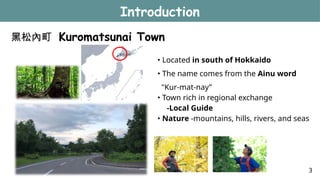
黑松內町 Kuromatsunai Town
Introduction
• Located in south of Hokkaido
• The name comes from the Ainu word
"Kur-mat-nay”
• Town rich in regional exchange
-Local Guide
• Nature -mountains, hills, rivers, and seas
3
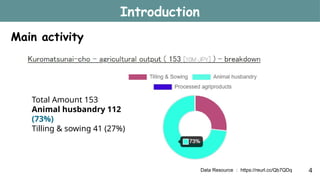
Main activity
Introduction
4
Total Amount 153
Animal husbandry 112
(73%)
Tilling & sowing 41 (27%)
Data Resource : https://reurl.cc/Qb7QDq
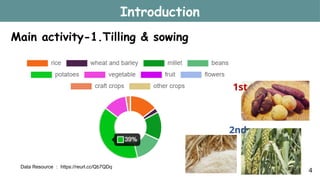
Main activity-1.Tilling & sowing
Introduction
4
1st
2nd
Data Resource : https://reurl.cc/Qb7QDq
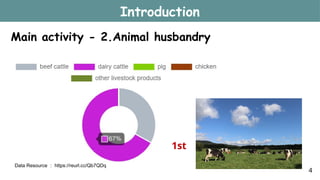
Main activity - 2.Animal husbandry
Introduction
4
1st
Data Resource : https://reurl.cc/Qb7QDq
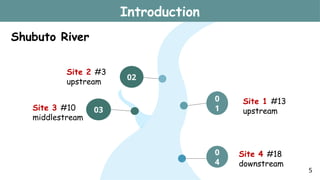
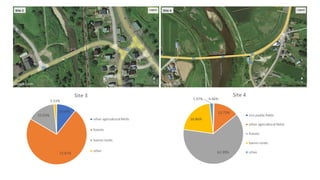
Shubuto River
Site 2 #3
upstream
0
1
02
0
4
03
Site 3 #10
middlestream
Site 4 #18
downstream
Site 1 #13
upstream
Introduction
5
3
6
7
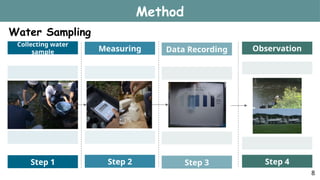
Measuring
Step 2
Data Recording
Step 3
Collecting water
sample
Step 1
Observation
Step 4
Method
Water Sampling
8
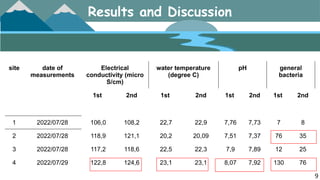
site date of
measurements
Electrical
conductivity (micro
S/cm)
water temperature
(degree C)
pH general
bacteria
1st 2nd 1st 2nd 1st 2nd 1st 2nd
1 2022/07/28 106,0 108,2 22,7 22,9 7,76 7,73 7 8
2 2022/07/28 118,9 121,1 20,2 20,09 7,51 7,37 76 35
3 2022/07/28 117,2 118,6 22,5 22,3 7,9 7,89 12 25
4 2022/07/29 122,8 124,6 23,1 23,1 8,07 7,92 130 76
Results and Discussion
9
Results and Discussion
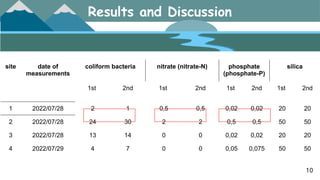
site date of
measurements
coliform bacteria nitrate (nitrate-N) phosphate
(phosphate-P)
silica
1st 2nd 1st 2nd 1st 2nd 1st 2nd
1 2022/07/28 2 1 0,5 0,5 0,02 0,02 20 20
2 2022/07/28 24 30 2 2 0,5 0,5 50 50
3 2022/07/28 13 14 0 0 0,02 0,02 20 20
4 2022/07/29 4 7 0 0 0,05 0,075 50 50
10
Results and Discussion
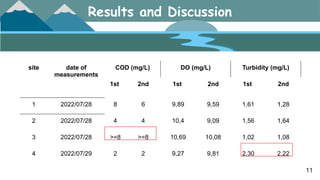
site date of
measurements
COD (mg/L) DO (mg/L) Turbidity (mg/L)
1st 2nd 1st 2nd 1st 2nd
1 2022/07/28 8 6 9,89 9,59 1,61 1,28
2 2022/07/28 4 4 10,4 9,09 1,56 1,64
3 2022/07/28 >=8 >=8 10,69 10,08 1,02 1,08
4 2022/07/29 2 2 9,27 9,81 2,30 2,22
11
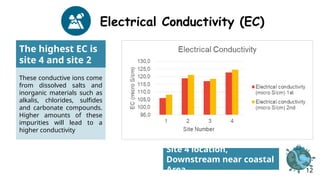
Electrical Conductivity (EC)
The highest EC is
site 4 and site 2
These conductive ions come
from dissolved salts and
inorganic materials such as
alkalis, chlorides, sulfides
and carbonate compounds.
Higher amounts of these
impurities will lead to a
higher conductivity
Site 4 location,
Downstream near coastal
Area 12
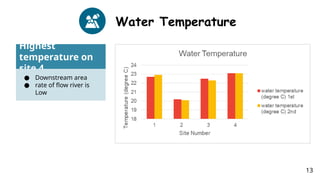
Water Temperature
Highest
temperature on
site 4
● Downstream area
● rate of flow river is
Low
13
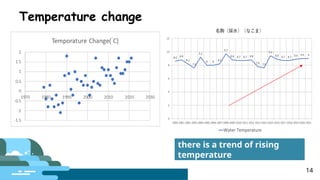
Temperature change
14
there is a trend of rising
temperature
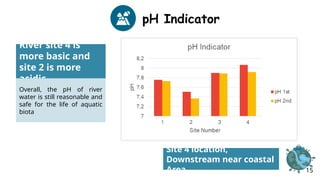
pH Indicator
River site 4 is
more basic and
site 2 is more
acidic
Overall, the pH of river
water is still reasonable and
safe for the life of aquatic
biota
Site 4 location,
Downstream near coastal
Area 15
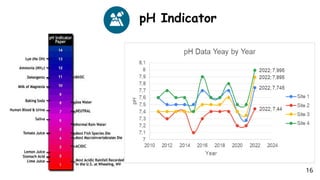
pH Indicator
16
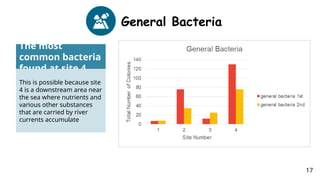
General Bacteria
The most
common bacteria
found at site 4
This is possible because site
4 is a downstream area near
the sea where nutrients and
various other substances
that are carried by river
currents accumulate
17
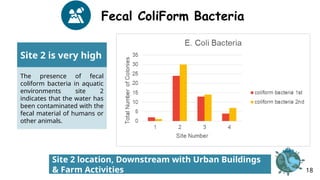
Fecal ColiForm Bacteria
Site 2 is very high
The presence of fecal
coliform bacteria in aquatic
environments site 2
indicates that the water has
been contaminated with the
fecal material of humans or
other animals.
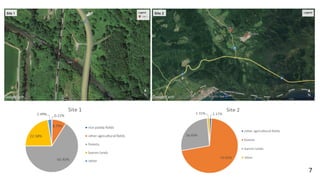
Site 2 location, Downstream with Urban Buildings
& Farm Activities 18
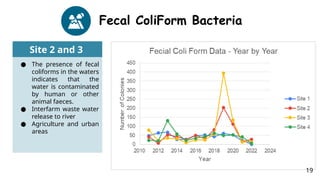
Fecal ColiForm Bacteria
Site 2 and 3
● The presence of fecal
coliforms in the waters
indicates that the
water is contaminated
by human or other
animal faeces.
● Interfarm waste water
release to river
● Agriculture and urban
areas
19
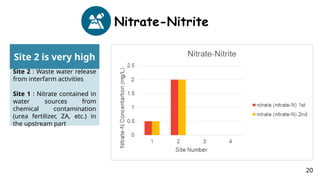
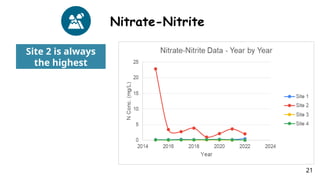
Nitrate-Nitrite
Site 2 is very high
Site 2 : Waste water release
from interfarm activities
Site 1 : Nitrate contained in
water sources from
chemical contamination
(urea fertilizer, ZA, etc.) in
the upstream part
20
Nitrate-Nitrite
Site 2 is always
the highest
21
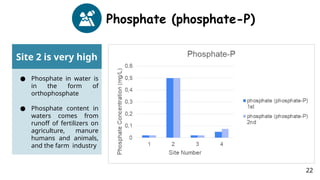
Phosphate (phosphate-P)
Site 2 is very high
● Phosphate in water is
in the form of
orthophosphate
● Phosphate content in
waters comes from
runoff of fertilizers on
agriculture, manure
humans and animals,
and the farm industry
22
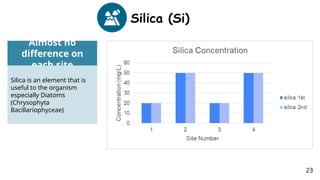
Silica (Si)
Almost no
difference on
each site
Silica is an element that is
useful to the organism
especially Diatoms
(Chrysophyta
Bacillariophyceae)
23
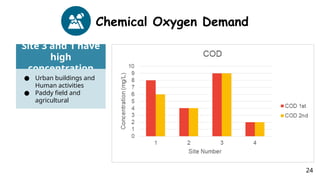
Chemical Oxygen Demand
Site 3 and 1 have
high
concentration
● Urban buildings and
Human activities
● Paddy field and
agricultural
24
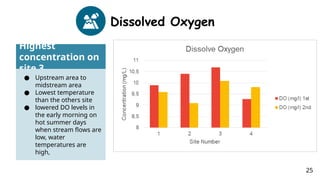
Dissolved Oxygen
Highest
concentration on
site 3
● Upstream area to
midstream area
● Lowest temperature
than the others site
● lowered DO levels in
the early morning on
hot summer days
when stream flows are
low, water
temperatures are
high,
25
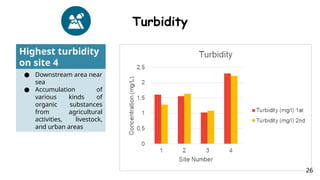
Turbidity
Highest turbidity
on site 4
● Downstream area near
sea
● Accumulation of
various kinds of
organic substances
from agricultural
activities, livestock,
and urban areas
26
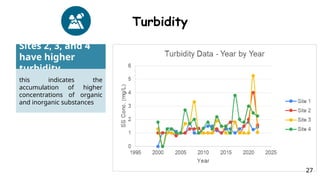
Turbidity
Sites 2, 3, and 4
have higher
turbidity
this indicates the
accumulation of higher
concentrations of organic
and inorganic substances
27
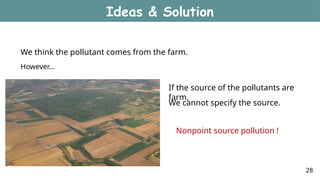
We think the pollutant comes from the farm.
However…
If the source of the pollutants are
farm,
We cannot specify the source.
Ideas & Solution
28
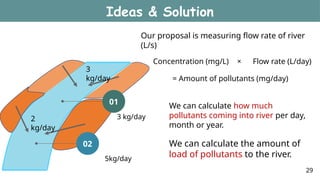
Nonpoint source pollution !
Our proposal is measuring flow rate of river
(L/s)
Concentration (mg/L) × Flow rate (L/day)
= Amount of pollutants (mg/day)
3 kg/day
5kg/day
We can calculate how much
pollutants coming into river per day,
month or year.
3
kg/day
02
01
2
kg/day
We can calculate the amount of
load of pollutants to the river.
Ideas & Solution
29
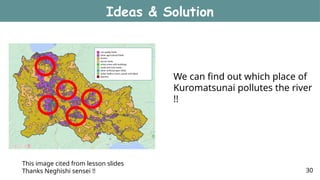
This image cited from lesson slides
Thanks Neghishi sensei !!
We can find out which place of
Kuromatsunai pollutes the river
!!
Ideas & Solution
30
Conclusion
● Kuromatsunai is a town that full of nature scenery including
mountains, hills, rivers, and seas.
● Human Activity is significantly related to environmental
condition.
● Shubuto river water quality is affected by farm and agricultural
activities along the river basin area
● Our proposal to preserve the beautiful river is measuring flow
rate of the river and monitoring the load of pollutants
31
Thank you for your attention
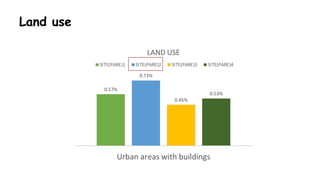
Land use

PARE Team B Analysis Ecosystem in Shubuto River

  • 1.
    Analyzing of Shubuto River Rizky PutraIsna Kumala Sari An-Sin Liu Rintaro Ishido
  • 2.
    Results & Comparisondata Conclusion Introduction 01 03 05 Methods 02 04 Ideas & Solution Contents 2
  • 3.
    黑松內町 Kuromatsunai Town Introduction •Located in south of Hokkaido • The name comes from the Ainu word "Kur-mat-nay” • Town rich in regional exchange -Local Guide • Nature -mountains, hills, rivers, and seas 3
  • 4.
    Main activity Introduction 4 Total Amount153 Animal husbandry 112 (73%) Tilling & sowing 41 (27%) Data Resource : https://reurl.cc/Qb7QDq
  • 5.
    Main activity-1.Tilling &sowing Introduction 4 1st 2nd Data Resource : https://reurl.cc/Qb7QDq
  • 6.
    Main activity -2.Animal husbandry Introduction 4 1st Data Resource : https://reurl.cc/Qb7QDq
  • 7.
    Shubuto River Site 2#3 upstream 0 1 02 0 4 03 Site 3 #10 middlestream Site 4 #18 downstream Site 1 #13 upstream Introduction 5
  • 8.
  • 9.
  • 11.
    Measuring Step 2 Data Recording Step3 Collecting water sample Step 1 Observation Step 4 Method Water Sampling 8
  • 12.
    site date of measurements Electrical conductivity(micro S/cm) water temperature (degree C) pH general bacteria 1st 2nd 1st 2nd 1st 2nd 1st 2nd 1 2022/07/28 106,0 108,2 22,7 22,9 7,76 7,73 7 8 2 2022/07/28 118,9 121,1 20,2 20,09 7,51 7,37 76 35 3 2022/07/28 117,2 118,6 22,5 22,3 7,9 7,89 12 25 4 2022/07/29 122,8 124,6 23,1 23,1 8,07 7,92 130 76 Results and Discussion 9
  • 13.
    Results and Discussion sitedate of measurements coliform bacteria nitrate (nitrate-N) phosphate (phosphate-P) silica 1st 2nd 1st 2nd 1st 2nd 1st 2nd 1 2022/07/28 2 1 0,5 0,5 0,02 0,02 20 20 2 2022/07/28 24 30 2 2 0,5 0,5 50 50 3 2022/07/28 13 14 0 0 0,02 0,02 20 20 4 2022/07/29 4 7 0 0 0,05 0,075 50 50 10
  • 14.
    Results and Discussion sitedate of measurements COD (mg/L) DO (mg/L) Turbidity (mg/L) 1st 2nd 1st 2nd 1st 2nd 1 2022/07/28 8 6 9,89 9,59 1,61 1,28 2 2022/07/28 4 4 10,4 9,09 1,56 1,64 3 2022/07/28 >=8 >=8 10,69 10,08 1,02 1,08 4 2022/07/29 2 2 9,27 9,81 2,30 2,22 11
  • 15.
    Electrical Conductivity (EC) Thehighest EC is site 4 and site 2 These conductive ions come from dissolved salts and inorganic materials such as alkalis, chlorides, sulfides and carbonate compounds. Higher amounts of these impurities will lead to a higher conductivity Site 4 location, Downstream near coastal Area 12
  • 16.
    Water Temperature Highest temperature on site4 ● Downstream area ● rate of flow river is Low 13
  • 17.
    Temperature change 14 there isa trend of rising temperature
  • 18.
    pH Indicator River site4 is more basic and site 2 is more acidic Overall, the pH of river water is still reasonable and safe for the life of aquatic biota Site 4 location, Downstream near coastal Area 15
  • 19.
  • 20.
    General Bacteria The most commonbacteria found at site 4 This is possible because site 4 is a downstream area near the sea where nutrients and various other substances that are carried by river currents accumulate 17
  • 21.
    Fecal ColiForm Bacteria Site2 is very high The presence of fecal coliform bacteria in aquatic environments site 2 indicates that the water has been contaminated with the fecal material of humans or other animals. Site 2 location, Downstream with Urban Buildings & Farm Activities 18
  • 22.
    Fecal ColiForm Bacteria Site2 and 3 ● The presence of fecal coliforms in the waters indicates that the water is contaminated by human or other animal faeces. ● Interfarm waste water release to river ● Agriculture and urban areas 19
  • 23.
    Nitrate-Nitrite Site 2 isvery high Site 2 : Waste water release from interfarm activities Site 1 : Nitrate contained in water sources from chemical contamination (urea fertilizer, ZA, etc.) in the upstream part 20
  • 24.
    Nitrate-Nitrite Site 2 isalways the highest 21
  • 25.
    Phosphate (phosphate-P) Site 2is very high ● Phosphate in water is in the form of orthophosphate ● Phosphate content in waters comes from runoff of fertilizers on agriculture, manure humans and animals, and the farm industry 22
  • 26.
    Silica (Si) Almost no differenceon each site Silica is an element that is useful to the organism especially Diatoms (Chrysophyta Bacillariophyceae) 23
  • 27.
    Chemical Oxygen Demand Site3 and 1 have high concentration ● Urban buildings and Human activities ● Paddy field and agricultural 24
  • 28.
    Dissolved Oxygen Highest concentration on site3 ● Upstream area to midstream area ● Lowest temperature than the others site ● lowered DO levels in the early morning on hot summer days when stream flows are low, water temperatures are high, 25
  • 29.
    Turbidity Highest turbidity on site4 ● Downstream area near sea ● Accumulation of various kinds of organic substances from agricultural activities, livestock, and urban areas 26
  • 30.
    Turbidity Sites 2, 3,and 4 have higher turbidity this indicates the accumulation of higher concentrations of organic and inorganic substances 27
  • 31.
    We think thepollutant comes from the farm. However… If the source of the pollutants are farm, We cannot specify the source. Ideas & Solution 28 Nonpoint source pollution !
  • 32.
    Our proposal ismeasuring flow rate of river (L/s) Concentration (mg/L) × Flow rate (L/day) = Amount of pollutants (mg/day) 3 kg/day 5kg/day We can calculate how much pollutants coming into river per day, month or year. 3 kg/day 02 01 2 kg/day We can calculate the amount of load of pollutants to the river. Ideas & Solution 29
  • 33.
    This image citedfrom lesson slides Thanks Neghishi sensei !! We can find out which place of Kuromatsunai pollutes the river !! Ideas & Solution 30
  • 34.
    Conclusion ● Kuromatsunai isa town that full of nature scenery including mountains, hills, rivers, and seas. ● Human Activity is significantly related to environmental condition. ● Shubuto river water quality is affected by farm and agricultural activities along the river basin area ● Our proposal to preserve the beautiful river is measuring flow rate of the river and monitoring the load of pollutants 31
  • 35.
    Thank you foryour attention
  • 36.

Editor's Notes

  • #1 Today we are going to talk about our fieldwork report:Analyzing of Shubuto River. There are my group members:XXX. Come from XXX (country) XXX university.
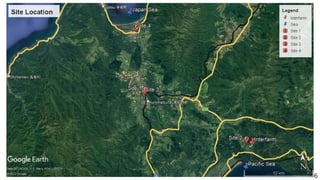
  • #2 These are our contents. In first part, we will do short introduction about Kuromatsunai Town and Shubuto river, including the main activity in town and site location. Second part we will introduce the methods of how we get the water sample. Third part, after we doing the test, we will show the results and compare each site of water data. In fourth part, we will come up with the solution that strengthen the resilience. Final is our conclusion.
  • #3 First, our field place is in Kuromatsunai Town, which is located in south of Hokkaido.The town name comes from the Ainu word "Kur-mat-nay” ,which means small river with women and people. One of the resource of Kuromatsunai town is regional exchange. There are many local guide who are the lover of Kuromatsunai Town and decided to stay there to introduce beauty of mountain. The other resource is that there are mountains, hills, Wetlands, rivers, and the seas in town.
  • #4 There are two main activity in Kuromatsunai town. One in Tillin & sowing. The other is Animal husbandry. In the figure, we can see that Animal husbandry in green color is 73% ratio
  • #5 In tilling and sowing industry, The major plant they grow is potato, which is the ratio in 39 percent. Second place is millet and rice.
  • #6 In animal husbandry, The major animal they feed is potato, which is the ratio in 67 percent. Second place is beef cattle.
  • #27 Chemical oxygen demand (COD) is the amount of dissolved oxygen that must be present in water to oxidize chemical organic materials
  • #28 Dissolved oxygen or DO (Dissolved oxygen) is the amount of dissolved oxygen in water that comes from photosynthesis and absorption of the atmosphere/air Aquatic animals are most vulnerable to lowered DO levels in the early morning on hot summer days when stream flows are low, water temperatures are high, and aquatic plants have not been producing oxygen since sunset.
  • #29 Turbidity is an important indicator of the amount of suspended sediment in water, which can have many negative effects on aquatic life. The suspended sediments that cause turbidity can block light to aquatic plants, smother aquatic organisms, and carry contaminants and pathogens, such as lead, mercury, and bacteria.
  • #34 • Kuromatsunai is a town that full of nature scenery including mountains, hills, Shubuto rivers, and seas.