Theorems about parallelograms
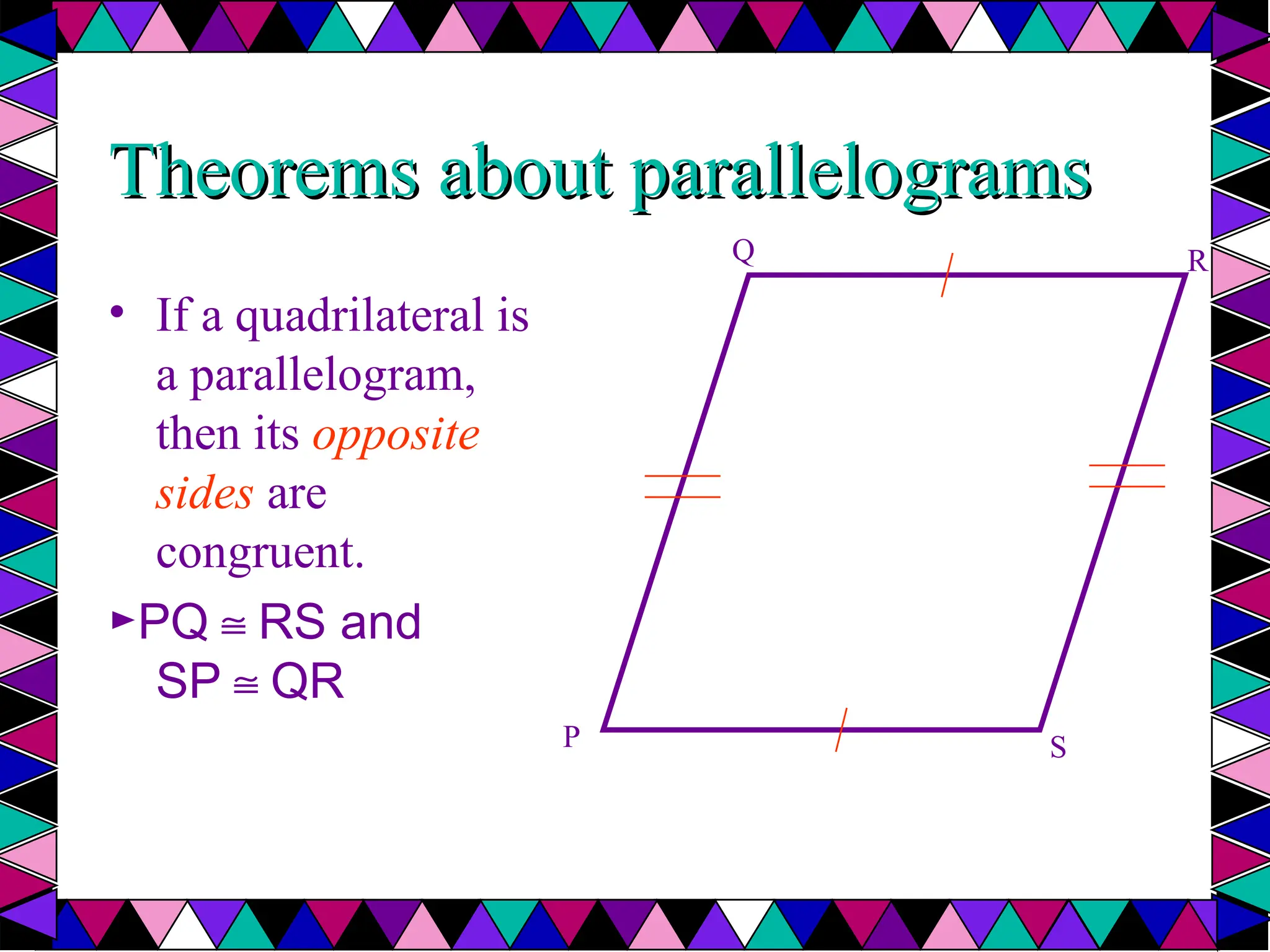
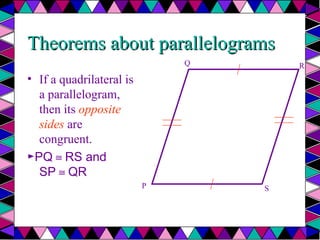
• If a quadrilateral is
a parallelogram,
then its opposite
sides are
congruent.
►PQ RS and
≅
SP QR
≅
P
Q R
S
Theorems about parallelograms
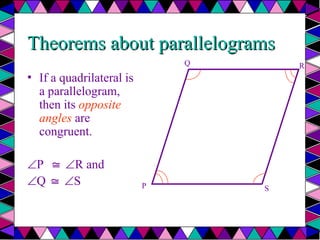
• If a quadrilateral is
a parallelogram,
then its opposite
angles are
congruent.
P ≅ R and
Q ≅ S P
Q R
S
Theorems about parallelograms
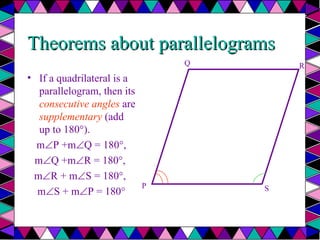
• If a quadrilateral is a
parallelogram, then its
consecutive angles are
supplementary (add
up to 180°).
mP +mQ = 180°,
mQ +mR = 180°,
mR + mS = 180°,
mS + mP = 180°
P
Q R
S
Theorems about parallelograms
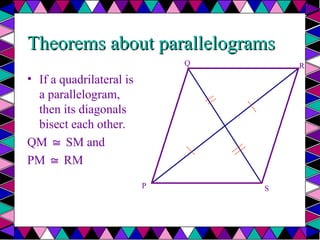
• If a quadrilateral is
a parallelogram,
then its diagonals
bisect each other.
QM SM and
≅
PM RM
≅
P
Q R
S
Ex. 1: Using properties of
Parallelograms
Parallelograms
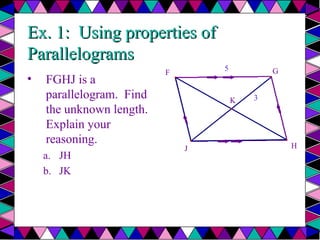
• FGHJ is a
parallelogram. Find
the unknown length.
Explain your
reasoning.
a. JH
b. JK
F G
J H
K
5
3
b.
Ex. 1: Using properties of
Parallelograms
Parallelograms
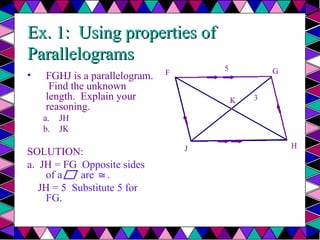
• FGHJ is a parallelogram.
Find the unknown
length. Explain your
reasoning.
a. JH
b. JK
SOLUTION:
a. JH = FG Opposite sides
of a are .
≅
JH = 5 Substitute 5 for
FG.
F G
J H
K
5
3
b.
Ex. 1: Using properties of
Parallelograms
Parallelograms
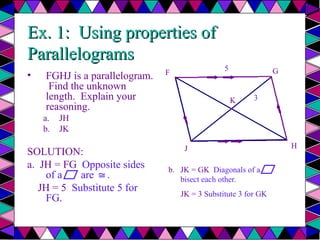
• FGHJ is a parallelogram.
Find the unknown
length. Explain your
reasoning.
a. JH
b. JK
SOLUTION:
a. JH = FG Opposite sides
of a are .
≅
JH = 5 Substitute 5 for
FG.
F G
J H
K
5
3
b.
b. JK = GK Diagonals of a
bisect each other.
JK = 3 Substitute 3 for GK
TRY YOURSELF : 9/29/15
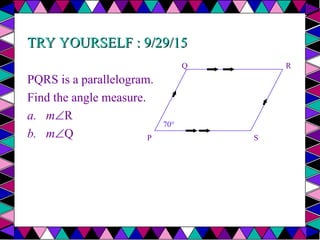
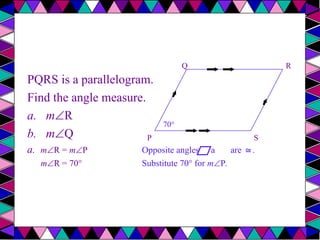
PQRS is a parallelogram.
Find the angle measure.
a. mR
b. mQ P
R
Q
70°
S
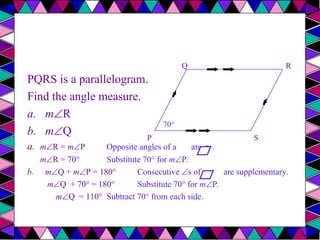
PQRS is a parallelogram.
Find the angle measure.
a. mR
b. mQ
a. mR = mP Opposite angles of a are .
≅
mR = 70° Substitute 70° for mP.
P
R
Q
70°
S
PQRS is a parallelogram.
Find the angle measure.
a. mR
b. mQ
a. mR = mP Opposite angles of a are .
≅
mR = 70° Substitute 70° for mP.
b. mQ + mP = 180° Consecutive s of a are supplementary.
mQ + 70° = 180° Substitute 70° for mP.
mQ = 110° Subtract 70° from each side.
P
R
Q
70°
S
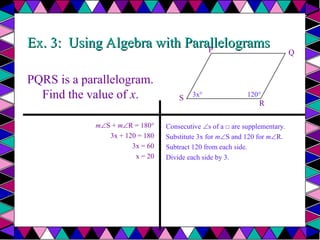
Ex. 3: Using Algebra with Parallelograms
PQRS is a parallelogram.
Find the value of x.
mS + mR = 180°
3x + 120 = 180
3x = 60
x = 20
Consecutive s of a □ are supplementary.
Substitute 3x for mS and 120 for mR.
Subtract 120 from each side.
Divide each side by 3.
S
Q
P
R
3x° 120°
TOTD
TOTD
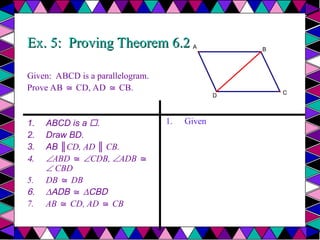
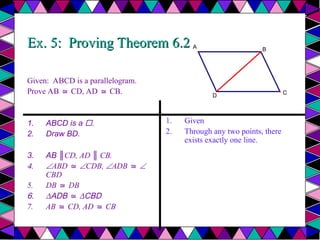
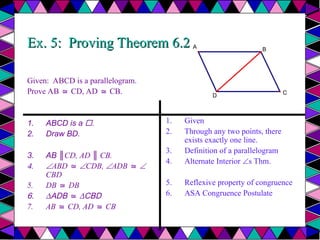
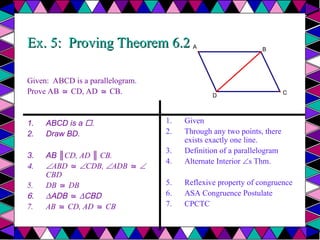
Ex. 5: Proving Theorem 6.2
Given: ABCD is a parallelogram.
Prove AB CD, AD CB.
≅ ≅
1. ABCD is a .
2. Draw BD.
3. AB ║CD, AD ║ CB.
4. ABD ≅ CDB, ADB ≅
 CBD
5. DB DB
≅
6. ∆ADB ≅ ∆CBD
7. AB CD, AD CB
≅ ≅
1. Given
A
D
B
C
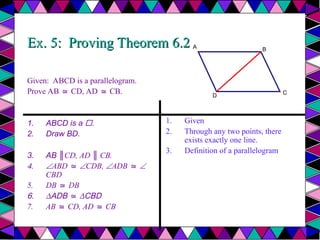
Ex. 5: Proving Theorem 6.2
Given: ABCD is a parallelogram.
Prove AB CD, AD CB.
≅ ≅
1. ABCD is a .
2. Draw BD.
3. AB ║CD, AD ║ CB.
4. ABD ≅ CDB, ADB ≅ 
CBD
5. DB DB
≅
6. ∆ADB ≅ ∆CBD
7. AB CD, AD CB
≅ ≅
1. Given
2. Through any two points, there
exists exactly one line.
A
D
B
C
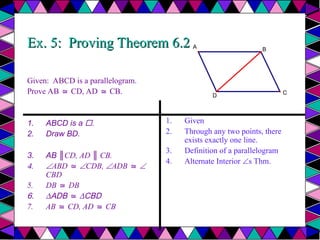
Ex. 5: Proving Theorem 6.2
Given: ABCD is a parallelogram.
Prove AB CD, AD CB.
≅ ≅
1. ABCD is a .
2. Draw BD.
3. AB ║CD, AD ║ CB.
4. ABD ≅ CDB, ADB ≅ 
CBD
5. DB DB
≅
6. ∆ADB ≅ ∆CBD
7. AB CD, AD CB
≅ ≅
1. Given
2. Through any two points, there
exists exactly one line.
3. Definition of a parallelogram
A
D
B
C
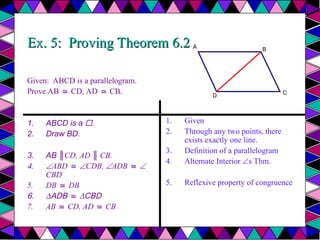
Ex. 5: Proving Theorem 6.2
Given: ABCD is a parallelogram.
Prove AB CD, AD CB.
≅ ≅
1. ABCD is a .
2. Draw BD.
3. AB ║CD, AD ║ CB.
4. ABD ≅ CDB, ADB ≅ 
CBD
5. DB DB
≅
6. ∆ADB ≅ ∆CBD
7. AB CD, AD CB
≅ ≅
1. Given
2. Through any two points, there
exists exactly one line.
3. Definition of a parallelogram
4. Alternate Interior s Thm.
A
D
B
C
Ex. 5: Proving Theorem 6.2
Given: ABCD is a parallelogram.
Prove AB CD, AD CB.
≅ ≅
1. ABCD is a .
2. Draw BD.
3. AB ║CD, AD ║ CB.
4. ABD ≅ CDB, ADB ≅ 
CBD
5. DB DB
≅
6. ∆ADB ≅ ∆CBD
7. AB CD, AD CB
≅ ≅
1. Given
2. Through any two points, there
exists exactly one line.
3. Definition of a parallelogram
4. Alternate Interior s Thm.
5. Reflexive property of congruence
A
D
B
C
Ex. 5: Proving Theorem 6.2
Given: ABCD is a parallelogram.
Prove AB CD, AD CB.
≅ ≅
1. ABCD is a .
2. Draw BD.
3. AB ║CD, AD ║ CB.
4. ABD ≅ CDB, ADB ≅ 
CBD
5. DB DB
≅
6. ∆ADB ≅ ∆CBD
7. AB CD, AD CB
≅ ≅
1. Given
2. Through any two points, there
exists exactly one line.
3. Definition of a parallelogram
4. Alternate Interior s Thm.
5. Reflexive property of congruence
6. ASA Congruence Postulate
A
D
B
C
Ex. 5: Proving Theorem 6.2
Given: ABCD is a parallelogram.
Prove AB CD, AD CB.
≅ ≅
1. ABCD is a .
2. Draw BD.
3. AB ║CD, AD ║ CB.
4. ABD ≅ CDB, ADB ≅ 
CBD
5. DB DB
≅
6. ∆ADB ≅ ∆CBD
7. AB CD, AD CB
≅ ≅
1. Given
2. Through any two points, there
exists exactly one line.
3. Definition of a parallelogram
4. Alternate Interior s Thm.
5. Reflexive property of congruence
6. ASA Congruence Postulate
7. CPCTC
A
D
B
C
Theorem------of------Parallelograms .ppt

  • 1.
    Theorems about parallelograms Theoremsabout parallelograms • If a quadrilateral is a parallelogram, then its opposite sides are congruent. ►PQ RS and ≅ SP QR ≅ P Q R S
  • 2.
    Theorems about parallelograms Theoremsabout parallelograms • If a quadrilateral is a parallelogram, then its opposite angles are congruent. P ≅ R and Q ≅ S P Q R S
  • 3.
    Theorems about parallelograms Theoremsabout parallelograms • If a quadrilateral is a parallelogram, then its consecutive angles are supplementary (add up to 180°). mP +mQ = 180°, mQ +mR = 180°, mR + mS = 180°, mS + mP = 180° P Q R S
  • 4.
    Theorems about parallelograms Theoremsabout parallelograms • If a quadrilateral is a parallelogram, then its diagonals bisect each other. QM SM and ≅ PM RM ≅ P Q R S
  • 5.
    Ex. 1: Usingproperties of Ex. 1: Using properties of Parallelograms Parallelograms • FGHJ is a parallelogram. Find the unknown length. Explain your reasoning. a. JH b. JK F G J H K 5 3 b.
  • 6.
    Ex. 1: Usingproperties of Ex. 1: Using properties of Parallelograms Parallelograms • FGHJ is a parallelogram. Find the unknown length. Explain your reasoning. a. JH b. JK SOLUTION: a. JH = FG Opposite sides of a are . ≅ JH = 5 Substitute 5 for FG. F G J H K 5 3 b.
  • 7.
    Ex. 1: Usingproperties of Ex. 1: Using properties of Parallelograms Parallelograms • FGHJ is a parallelogram. Find the unknown length. Explain your reasoning. a. JH b. JK SOLUTION: a. JH = FG Opposite sides of a are . ≅ JH = 5 Substitute 5 for FG. F G J H K 5 3 b. b. JK = GK Diagonals of a bisect each other. JK = 3 Substitute 3 for GK
  • 8.
    TRY YOURSELF :9/29/15 TRY YOURSELF : 9/29/15 PQRS is a parallelogram. Find the angle measure. a. mR b. mQ P R Q 70° S
  • 9.
    PQRS is aparallelogram. Find the angle measure. a. mR b. mQ a. mR = mP Opposite angles of a are . ≅ mR = 70° Substitute 70° for mP. P R Q 70° S
  • 10.
    PQRS is aparallelogram. Find the angle measure. a. mR b. mQ a. mR = mP Opposite angles of a are . ≅ mR = 70° Substitute 70° for mP. b. mQ + mP = 180° Consecutive s of a are supplementary. mQ + 70° = 180° Substitute 70° for mP. mQ = 110° Subtract 70° from each side. P R Q 70° S
  • 11.
    Ex. 3: UsingAlgebra with Parallelograms Ex. 3: Using Algebra with Parallelograms PQRS is a parallelogram. Find the value of x. mS + mR = 180° 3x + 120 = 180 3x = 60 x = 20 Consecutive s of a □ are supplementary. Substitute 3x for mS and 120 for mR. Subtract 120 from each side. Divide each side by 3. S Q P R 3x° 120°
  • 12.
  • 13.
    Ex. 5: ProvingTheorem 6.2 Ex. 5: Proving Theorem 6.2 Given: ABCD is a parallelogram. Prove AB CD, AD CB. ≅ ≅ 1. ABCD is a . 2. Draw BD. 3. AB ║CD, AD ║ CB. 4. ABD ≅ CDB, ADB ≅  CBD 5. DB DB ≅ 6. ∆ADB ≅ ∆CBD 7. AB CD, AD CB ≅ ≅ 1. Given A D B C
  • 14.
    Ex. 5: ProvingTheorem 6.2 Ex. 5: Proving Theorem 6.2 Given: ABCD is a parallelogram. Prove AB CD, AD CB. ≅ ≅ 1. ABCD is a . 2. Draw BD. 3. AB ║CD, AD ║ CB. 4. ABD ≅ CDB, ADB ≅  CBD 5. DB DB ≅ 6. ∆ADB ≅ ∆CBD 7. AB CD, AD CB ≅ ≅ 1. Given 2. Through any two points, there exists exactly one line. A D B C
  • 15.
    Ex. 5: ProvingTheorem 6.2 Ex. 5: Proving Theorem 6.2 Given: ABCD is a parallelogram. Prove AB CD, AD CB. ≅ ≅ 1. ABCD is a . 2. Draw BD. 3. AB ║CD, AD ║ CB. 4. ABD ≅ CDB, ADB ≅  CBD 5. DB DB ≅ 6. ∆ADB ≅ ∆CBD 7. AB CD, AD CB ≅ ≅ 1. Given 2. Through any two points, there exists exactly one line. 3. Definition of a parallelogram A D B C
  • 16.
    Ex. 5: ProvingTheorem 6.2 Ex. 5: Proving Theorem 6.2 Given: ABCD is a parallelogram. Prove AB CD, AD CB. ≅ ≅ 1. ABCD is a . 2. Draw BD. 3. AB ║CD, AD ║ CB. 4. ABD ≅ CDB, ADB ≅  CBD 5. DB DB ≅ 6. ∆ADB ≅ ∆CBD 7. AB CD, AD CB ≅ ≅ 1. Given 2. Through any two points, there exists exactly one line. 3. Definition of a parallelogram 4. Alternate Interior s Thm. A D B C
  • 17.
    Ex. 5: ProvingTheorem 6.2 Ex. 5: Proving Theorem 6.2 Given: ABCD is a parallelogram. Prove AB CD, AD CB. ≅ ≅ 1. ABCD is a . 2. Draw BD. 3. AB ║CD, AD ║ CB. 4. ABD ≅ CDB, ADB ≅  CBD 5. DB DB ≅ 6. ∆ADB ≅ ∆CBD 7. AB CD, AD CB ≅ ≅ 1. Given 2. Through any two points, there exists exactly one line. 3. Definition of a parallelogram 4. Alternate Interior s Thm. 5. Reflexive property of congruence A D B C
  • 18.
    Ex. 5: ProvingTheorem 6.2 Ex. 5: Proving Theorem 6.2 Given: ABCD is a parallelogram. Prove AB CD, AD CB. ≅ ≅ 1. ABCD is a . 2. Draw BD. 3. AB ║CD, AD ║ CB. 4. ABD ≅ CDB, ADB ≅  CBD 5. DB DB ≅ 6. ∆ADB ≅ ∆CBD 7. AB CD, AD CB ≅ ≅ 1. Given 2. Through any two points, there exists exactly one line. 3. Definition of a parallelogram 4. Alternate Interior s Thm. 5. Reflexive property of congruence 6. ASA Congruence Postulate A D B C
  • 19.
    Ex. 5: ProvingTheorem 6.2 Ex. 5: Proving Theorem 6.2 Given: ABCD is a parallelogram. Prove AB CD, AD CB. ≅ ≅ 1. ABCD is a . 2. Draw BD. 3. AB ║CD, AD ║ CB. 4. ABD ≅ CDB, ADB ≅  CBD 5. DB DB ≅ 6. ∆ADB ≅ ∆CBD 7. AB CD, AD CB ≅ ≅ 1. Given 2. Through any two points, there exists exactly one line. 3. Definition of a parallelogram 4. Alternate Interior s Thm. 5. Reflexive property of congruence 6. ASA Congruence Postulate 7. CPCTC A D B C