Agenda
A QuickReview
Decomposition Techniques
Distribution Schemes
Block-distribution
Row-wise
Column-wise
1D and 2D
Cyclic and Block-cyclic
Basic Communication Operations
One-to-all Broadcast and Reduction
3.
Mapping Schemes
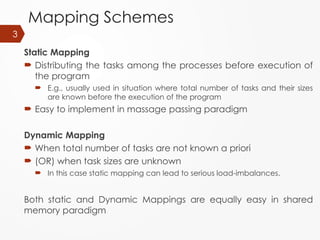
Static Mapping
Distributing the tasks among the processes before execution of
the program
E.g., usually used in situation where total number of tasks and their sizes
are known before the execution of the program
Easy to implement in massage passing paradigm
Dynamic Mapping
When total number of tasks are not known a priori
(OR) when task sizes are unknown
In this case static mapping can lead to serious load-imbalances.
Both static and Dynamic Mappings are equally easy in shared
memory paradigm
3
4.
Schemes for StaticTask-Process Mapping
(Mappings based on Data Partitioning )
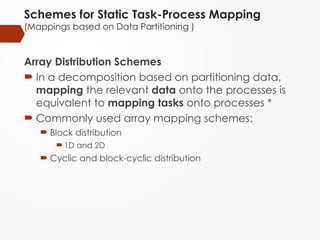
Array Distribution Schemes
In a decomposition based on partitioning data,
mapping the relevant data onto the processes is
equivalent to mapping tasks onto processes *
Commonly used array mapping schemes:
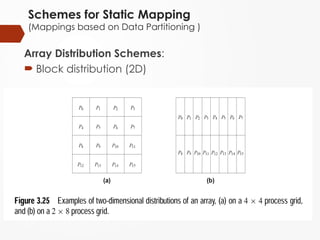
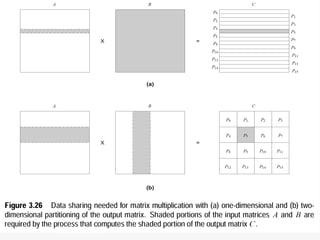
Block distribution
1D and 2D
Cyclic and block-cyclic distribution
5.
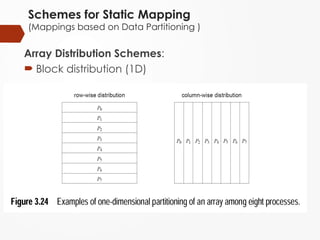
Schemes for StaticMapping
(Mappings based on Data Partitioning )
Array Distribution Schemes:
Block distribution (1D)
6.
Schemes for StaticMapping
(Mappings based on Data Partitioning )
Array Distribution Schemes:
Block distribution (2D)
Schemes for StaticMapping
(Mappings based on Data Partitioning )
Array Distribution Schemes:
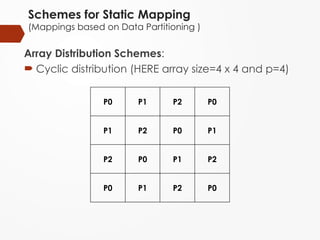
Cyclic distribution (HERE array size=4 x 4 and p=4)
P0 P1 P2 P0
P1 P2 P0 P1
P2 P0 P1 P2
P0 P1 P2 P0
9.
Schemes for StaticMapping
(Mappings based on Data Partitioning )
Array Distribution Schemes:
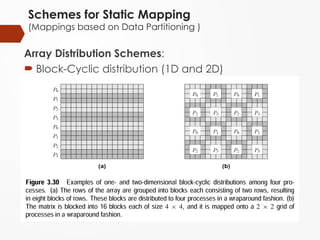
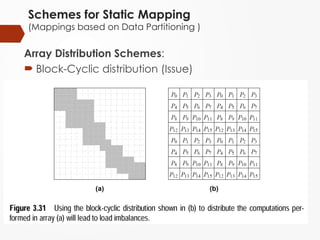
Block-Cyclic distribution (1D and 2D)
10.
Schemes for StaticMapping
(Mappings based on Data Partitioning )
Array Distribution Schemes:
Block-Cyclic distribution (Issue)
11.
Schemes for StaticMapping
(Mappings based on Data Partitioning )
Array Distribution Schemes:
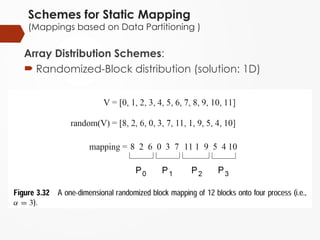
Randomized-Block distribution (solution: 1D)
12.
Schemes for StaticMapping
(Mappings based on Data Partitioning )
Array Distribution Schemes:
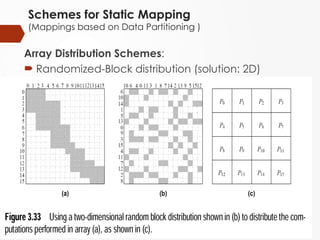
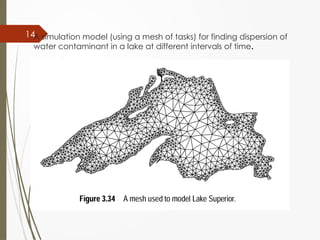
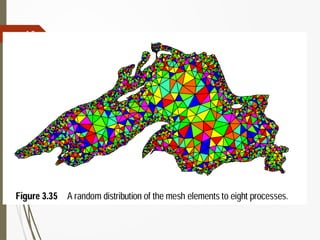
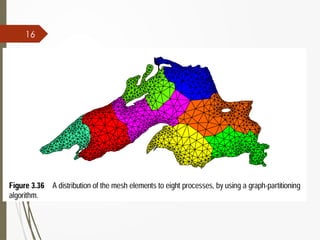
Randomized-Block distribution (solution: 2D)
CS3006 - Fall 2021
References
1. Kumar, V.,Grama, A., Gupta, A., & Karypis, G. (1994). Introduction to parallel computing (Vol. 110). Redwood
City, CA: Benjamin/Cummings.
2. Quinn, M. J. Parallel Programming in C with MPI and OpenMP,(2003).
Editor's Notes
#3 Objective is to minimize amount of interaction and idling.
#4 As tasks and processes are closely related with owner compute rule.
If we know the size of tasks, size of data associated with each task, programming paradigm and characteristics of inter task interactions; then we should go for static mapping
#5 2d array---n/p rows as blocks and n/p column as block
Row major order vs column major order
#7 Data-load balancing and higher level of fine-graining.
#8 Each element of the array is considered as a task and is mapped to all the processes in round robin fashion
Extremely fine-grained distribution
Motive is to reduce the idle time
#9 Difference is that you make large number of small blocks and assign them to the processes in cyclic fashion
#10 2d mapping on 16 processes.
Processes on the diagonals shall always have to computes maximal portions.
P12 shall never have to do any thing
#11 1D-randomized block mapping
1 Randomly permute set V, then assign block of elements to processes as in block distribution.





![Getting Started with Apache Spark: Big Data Made Simple [Free Meetup]](https://cdn.slidesharecdn.com/ss_thumbnails/apachesparkgettingstarted-260203175547-8361bcc3-thumbnail.jpg?width=640&height=640&fit=bounds)


