Parallel & Distributed computing
 Presented By:
Group# 03
Shahab Ahmad M. Aashan
Shoaib Hussain Sheraz Yar
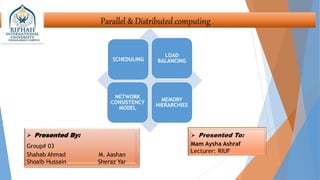
SCHEDULING
LOAD
BALANCING
NETWORK
CONSISTENCY
MODEL
MEMORY
HIERARCHIES
1) SCHEDULING
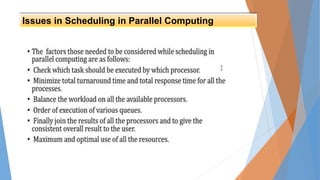
Issues in Scheduling in Parallel Computing
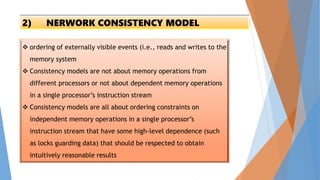
2) NERWORK CONSISTENCY MODEL
 ordering of externally visible events (i.e., reads and writes to the
memory system
 Consistency models are not about memory operations from
different processors or not about dependent memory operations
in a single processor’s instruction stream
 Consistency models are all about ordering constraints on
independent memory operations in a single processor’s
instruction stream that have some high-level dependence (such
as locks guarding data) that should be respected to obtain
intuitively reasonable results
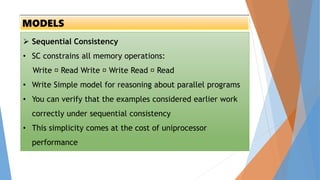
MODELS
 Sequential Consistency
• SC constrains all memory operations:
Write Read Write Write Read Read
• Write Simple model for reasoning about parallel programs
• You can verify that the examples considered earlier work
correctly under sequential consistency
• This simplicity comes at the cost of uniprocessor
performance
Sequential consistency (SC) [Lamport]result of
execution is as if memory operations of each
process are executed in program
orderMEMORYP1 P3 P2 Pn
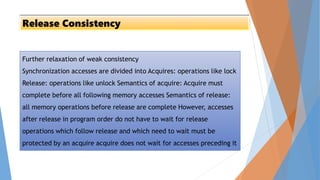
Further relaxation of weak consistency
Synchronization accesses are divided into Acquires: operations like lock
Release: operations like unlock Semantics of acquire: Acquire must
complete before all following memory accesses Semantics of release:
all memory operations before release are complete However, accesses
after release in program order do not have to wait for release
operations which follow release and which need to wait must be
protected by an acquire acquire does not wait for accesses preceding it
Release Consistency
3) LOAD BALANCING
Types of Load Balancing
4) MEMORY HIERARCHIES
Parallel and distributed Computing

Parallel and distributed Computing

  • 2.
    Parallel & Distributedcomputing  Presented By: Group# 03 Shahab Ahmad M. Aashan Shoaib Hussain Sheraz Yar SCHEDULING LOAD BALANCING NETWORK CONSISTENCY MODEL MEMORY HIERARCHIES
  • 3.
  • 5.
    Issues in Schedulingin Parallel Computing
  • 7.
    2) NERWORK CONSISTENCYMODEL  ordering of externally visible events (i.e., reads and writes to the memory system  Consistency models are not about memory operations from different processors or not about dependent memory operations in a single processor’s instruction stream  Consistency models are all about ordering constraints on independent memory operations in a single processor’s instruction stream that have some high-level dependence (such as locks guarding data) that should be respected to obtain intuitively reasonable results
  • 8.
    MODELS  Sequential Consistency •SC constrains all memory operations: Write Read Write Write Read Read • Write Simple model for reasoning about parallel programs • You can verify that the examples considered earlier work correctly under sequential consistency • This simplicity comes at the cost of uniprocessor performance
  • 9.
    Sequential consistency (SC)[Lamport]result of execution is as if memory operations of each process are executed in program orderMEMORYP1 P3 P2 Pn
  • 10.
    Further relaxation ofweak consistency Synchronization accesses are divided into Acquires: operations like lock Release: operations like unlock Semantics of acquire: Acquire must complete before all following memory accesses Semantics of release: all memory operations before release are complete However, accesses after release in program order do not have to wait for release operations which follow release and which need to wait must be protected by an acquire acquire does not wait for accesses preceding it Release Consistency
  • 11.
  • 13.
    Types of LoadBalancing
  • 15.