Download to read offline
![Acceptability of an Online Emotional Therapy
System to Apply Homework Assignments in
Adjustment Disorder: A Case Study
S. Quero1,3, M.A. Pérez-Ara1, C. Botella1,3, R. Herrero1, M. Molés1, S. Andreu-Mateu1& R.M. Baños2,3
1
Universitat Jaume I
2
Universidad de Valencia
3
CIBER de Fisiopatología de la Obesidad y Nutrición (CIBEROBN)
Abstract— Adjustment Disorders (AD) are a very important [1],[2],[3]. Furthermore, AD is an important public mental
public health problem. However, only general treatment health problem in economic terms. Very frequently the
guidelines are available for this problem. Our research team has distress and activity deterioration associated with this problem
developed a Cognitive-Behavioral Treatment (CBT) supported result in a decrease of work performance, causing a high
by Virtual Reality (VR) that has shown its utility in the
treatment of this problem. CBT approach gives a crucial role to
percentage of sick leaves [4].
homework assignments. So far studies that use Information and However, only general treatment guidelines are available
Communication Technologies (ICTs) for psychological for this problem [5], [6], [7], [8]. Our research team has
treatments have been centred on how to use the technologies to developed a Cognitive-Behavioral Treatment (CBT) program
deliver the treatment within the therapeutic context. No study is that utilizes Virtual Reality (VR) [9]. Specifically, we use
available in the literature that uses the ICTs to apply the EMMA’s World, an adaptive display whose content is
homework assignments. TEO is a completely open Online adapted to every patient’s needs with the main objective of
Emotional Therapy system base on Web technology that allows reflecting and evoking emotional responses in them to allow
in a simple and effective way to create personalized therapeutic the emotional processing to occur [10]. In the specific case of
material to present to the patient over the Internet. Therefore,
the aim of the present work is to present preliminary data about
AD, this open VR system canbe used to treat different
the acceptability of TEO system in a case study with AD where stressful events relevant to the particular problem (e.g. the
VR EMMA system within the therapy sessions was joined with breakup of an intimate relationship, the death of a beloved one,
the use of other ICTs to apply homework assignments between work problems, family problems, bullying, etc.). This
sessions in the treatment of AD. treatment protocol has already showed its efficacy in several
preliminary studies with participants diagnosed of stress
I. INTRODUCTION related disorders (including AD) [11], [12], [13]. One way to
enhance the efficiency of AD treatment outcomes could be by
According to the DSM-VI-TR [1], the primary feature of using Information and Communication Technologies (ICTs)
Adjustment Disorders (AD) is the development of clinically to apply homework assignments in order to consolidate
significant emotional or behavioural symptoms in response to learning between therapy sessions. As far as we know, there
an identifiable stressor. Furthermore, symptoms must be are no studies that use ICTs to apply this therapeutic
developed within 3 months after the onset of the stressor. component. Therefore, we considered interesting to develop a
Both the symptoms (e.g., anxiety, depression, disruptive self-applied system which permits the patient to do the
behaviours) and the precipitating events widely vary (e.g., homework assignments at home over the Internet and combine
divorce, loss of job, the diagnosis of a serious disease, family this with the use of VR within the therapy sessions in the
problems, bullying, complicated bereavement, etc.). consulting room.
AD are an important health problem [2]. They are very In order to do this we have designed a Web-based system
prevalent, indicating the available data a percentage of adults called TEO (Emotional Therapy On-Line). TEO is a
suffering from AD in primary care ranging from 5% to 21% completely system open that allows therapists to create and](https://image.slidesharecdn.com/papersoledadquero-111214104442-phpapp01/85/Paper-Soledad-Quero-Acceptability-of-an-Online-Emotional-Therapy-System-to-Apply-Homework-Assignments-in-Adjustment-Disorder-A-Case-Study-1-320.jpg)
![Acceptability of an Online Emotional Therapy
System to Apply Homework Assignments in
Adjustment Disorder: A Case Study
S. Quero1,3, M.A. Pérez-Ara1, C. Botella1,3, R. Herrero1, M. Molés1, S. Andreu-Mateu1& R.M. Baños2,3
1
Universitat Jaume I
2
Universidad de Valencia
3
CIBER de Fisiopatología de la Obesidad y Nutrición (CIBEROBN)
Abstract— Adjustment Disorders (AD) are a very important [1],[2],[3]. Furthermore, AD is an important public mental
public health problem. However, only general treatment health problem in economic terms. Very frequently the
guidelines are available for this problem. Our research team has distress and activity deterioration associated with this problem
developed a Cognitive-Behavioral Treatment (CBT) supported result in a decrease of work performance, causing a high
by Virtual Reality (VR) that has shown its utility in the
treatment of this problem. CBT approach gives a crucial role to
percentage of sick leaves [4].
homework assignments. So far studies that use Information and However, only general treatment guidelines are available
Communication Technologies (ICTs) for psychological for this problem [5], [6], [7], [8]. Our research team has
treatments have been centred on how to use the technologies to developed a Cognitive-Behavioral Treatment (CBT) program
deliver the treatment within the therapeutic context. No study is that utilizes Virtual Reality (VR) [9]. Specifically, we use
available in the literature that uses the ICTs to apply the EMMA’s World, an adaptive display whose content is
homework assignments. TEO is a completely open Online adapted to every patient’s needs with the main objective of
Emotional Therapy system base on Web technology that allows reflecting and evoking emotional responses in them to allow
in a simple and effective way to create personalized therapeutic the emotional processing to occur [10]. In the specific case of
material to present to the patient over the Internet. Therefore,
the aim of the present work is to present preliminary data about
AD, this open VR system canbe used to treat different
the acceptability of TEO system in a case study with AD where stressful events relevant to the particular problem (e.g. the
VR EMMA system within the therapy sessions was joined with breakup of an intimate relationship, the death of a beloved one,
the use of other ICTs to apply homework assignments between work problems, family problems, bullying, etc.). This
sessions in the treatment of AD. treatment protocol has already showed its efficacy in several
preliminary studies with participants diagnosed of stress
I. INTRODUCTION related disorders (including AD) [11], [12], [13]. One way to
enhance the efficiency of AD treatment outcomes could be by
According to the DSM-VI-TR [1], the primary feature of using Information and Communication Technologies (ICTs)
Adjustment Disorders (AD) is the development of clinically to apply homework assignments in order to consolidate
significant emotional or behavioural symptoms in response to learning between therapy sessions. As far as we know, there
an identifiable stressor. Furthermore, symptoms must be are no studies that use ICTs to apply this therapeutic
developed within 3 months after the onset of the stressor. component. Therefore, we considered interesting to develop a
Both the symptoms (e.g., anxiety, depression, disruptive self-applied system which permits the patient to do the
behaviours) and the precipitating events widely vary (e.g., homework assignments at home over the Internet and combine
divorce, loss of job, the diagnosis of a serious disease, family this with the use of VR within the therapy sessions in the
problems, bullying, complicated bereavement, etc.). consulting room.
AD are an important health problem [2]. They are very In order to do this we have designed a Web-based system
prevalent, indicating the available data a percentage of adults called TEO (Emotional Therapy On-Line). TEO is a
suffering from AD in primary care ranging from 5% to 21% completely system open that allows therapists to create and](https://image.slidesharecdn.com/papersoledadquero-111214104442-phpapp01/75/Paper-Soledad-Quero-Acceptability-of-an-Online-Emotional-Therapy-System-to-Apply-Homework-Assignments-in-Adjustment-Disorder-A-Case-Study-1-2048.jpg)
![send personalized therapeutic material to patients via the level of agreement with the same items but referred to TEO
Internet in an easy way (http://www.teo.uji.es). It makes system: the multimedia contents were useful to overcome her
possible to cover all types of needs and optimize therapy by problem, having available at home the symbols and
homework assignments. The system has a database with landscapes of EMMA’s World were useful to process the
media contents: audio, images, videos and texts. The negative event and, other persons with similar problems
therapists can access these materials from the therapist’s should use this system. Also an item was included to assess
platform in order to combine them to create the different how often she implemented the assignments per week. Finally,
therapeutic homework sessions. In addition, TEO assesses 5 additional items were included in order to assess other
several clinical variables (e.g., mood state) before and after relevant questions regarding usability of the system (whether
each session and the therapist can access the reports resulting TEO was easy to use, easy to learn, easy to follow the
from any patient’s activity: assessment, content, assigned instructions, comfortable and attractive).
sessions, completed sessions, dates, etc. The aim of the
present work is to present preliminary data about the Comparison Questionnaire of the two Methods of applying
acceptability of TEO system in a case study with AD. Homework Assignments (Traditional versus TEO System) [16].
This questionnaire assessed the participant’s preferences
(TEO system versus Traditional) after treatment by answering
II. METHODOLOGY 4 questions: “What type of application would you rather
A. Participant use?” “Which one of them was more useful to overcome your
problem?” “Which one was more useful to process the
The participant was a 35 year old woman, divorced and negative event”, and “which one seemed more attractive to
with Colombian Nationality who was living in Spain for the you?”. The response scale was multiple choice with 3
last 2 years. At the moment of the assessment she was doing alternatives: TEO, Traditional or No difference.
her doctorate. She met the DSM-IV-TR criteria [1] for AD
with mixed anxiety and depression mood subtype due to work C. Design
problems. The design was a case study with 2 experimental conditions:
B. Measures 1) Homework assignments using TEO system: 3 sessions
where the homework assignments were applied with TEO
The measures used in the present study were specifically system.
designed for this research. 2) Homework assignments in the traditional way: 3
Homework Assignments Preferences Questionnaire [14]. sessions where homework assignments were applied in the
Before starting the treatment, the patient was given a brief traditional way (reading materials, writing tasks and session
explanation about the two ways of applying the homework audio record).
assignments (using TEO or Traditional). After this
explanation, she answered 4 questions concerning her D. Treatment
preferences with regard to the homework assignments (TEO The participant received a CBT program for AD. The
or Traditional). These questions were: 1) “If you could choose treatment protocol consisted of 6 weekly sessions with the
between the two ways of applying the homework assignments, following main therapeutic components: educational
which one would you choose?”; 2) “Which of these two ways component, elaboration/processing of the stressful event with
do you consider more effective to help you overcome your EMMA’s World (see a full description in [10], [12], [17],
problem?”; 3) “Which of these two ways do you consider [18].), and relapse prevention. A detailed description of the
more aversive?” and; 4), “Which of these two ways would you CBT program can be found in [9].
recommend to a friend in case that he/she had the same
problem?”. Finally, the therapist asked the patient the reasons E. Procedure
of his preferences in each of these aspects according to her After the patient’s request for assistance, a screening
responses in the questionnaire. interview was carried out, where the main relevant data about
Homework Assignments Assessment Questionnaire [15]. her and the problem she was seeking assistance for were
This measure was completed after treatment and includes two collected. After this first interview, the evaluation phase
parts: 1) Traditional method assessment part in which the started, which consisted on 2 one and a half hour-sessions
participant answered 3 items regarding her opinion about this each where the Homework assignments preferences
way of applying homework assignments. The participant questionnaire was applied. At post-treatment the participant
reported her level of agreement with the items on a Likert was evaluated again using the same instruments as in the pre-
scale ranging from 1 (I totally agree) to 5 (I totally disagree): treatment. She also filled in the questionnaires about the
the reading materials were useful to overcome her problem, opinion of the Traditional way to apply the homework
the audio recorded sessions were useful to process the assignments and the opinion of the TEO system to apply them,
negative event and, other persons with similar problems as well as the comparison questionnaire between the two
should use this material. An additional item assessed how modes of applying the homework tasks.
often she implemented the assignments per week. 2) TEO
method assessment part in which the participant reported her](https://image.slidesharecdn.com/papersoledadquero-111214104442-phpapp01/85/Paper-Soledad-Quero-Acceptability-of-an-Online-Emotional-Therapy-System-to-Apply-Homework-Assignments-in-Adjustment-Disorder-A-Case-Study-2-320.jpg)
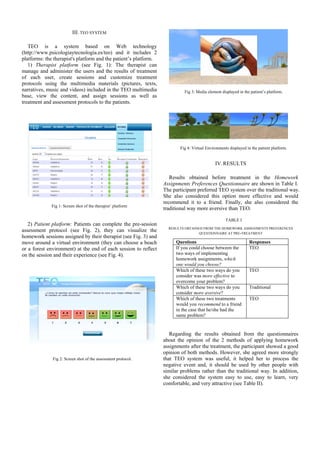
![TABLE II methods she continued to prefer the TEO system over the
RESULTS OBTAINED FROM THE HOMEWORK ASSIGMENTS ASSESSMENT traditional method.
QUESTIONNAIRE AT POST-TREATMENT TEO is the first program developed that permits to apply
Item TEO Traditional
the homework assignments component using a computer and
It is useful to overcome Totally agree (1) Agree (2) in a self-applied way. In addition, TEO offers a great
the problem adaptability and flexibility to adjust the therapeutic homework
It helps to process the Totally agree (1) Agree (2) on every patient’s characteristics and needs, attending to the
negative event specific meaning of his/her problem. Each session will be
Other people with similar Totally agree (1) Agree (2) adapted to the patient’s needs. Furthermore, because it is
problems should use this based on Web it will increase the possibilities for therapy: it
method can be used in blended mode (complementing the therapy), or
Days of the week the 4-5 times per week 4-5 times per in tele-assistance mode (being the own self-administered
homework assignments week therapy). It might also facilitate the patient’s treatment
were implemented
adherence and the therapist’s work in designing homework
Easy to use Normal (3)
assignments.
Easy to learn Agree (2)
Easy to follow the Nor agree neither
Although the results obtained in the present study are
instructions disagree (3) promising, they must be taken carefully since it is only an
Comfortable Very comfortable uncontrolled case study being the external validity of these
(5) results compromised. Therefore, future research is needed in
It is very attractive Totally agree (1) order to withdraw firmer conclusions.
In any case, the advantages and versatility of a system like
TEO opens new possibilities to the clinicians. Firstly, as it has
Finally, the results concerning the Comparison been presented in the present study, it permits the design of
Questionnaire of the two Methods at post-treatment showed personalized homework assignments to practice at home what
that, once the participant implemented both methods, she they have worked in the therapy sessions in a self-applied way
continued to prefer the TEO system, she also continued to using a computer. And secondly, it would also allow the
consider it more useful to process the negative event and more design of entire therapeutic sessions or parts of sessions that
attractive, compared to the traditional method (see Table III). can be self-applied with a consequence of a reduction of the
costs and, as a result, an improvement in the efficiency of the
treatment.
TABLE III
RESULTS OBTAINED FROM THE COMPARISON QUESTIONNAIRE OF THE TWO
METHODS AT POST-TREATMENT
ACKNOWLEDGMENTS
Items Chosen option
I prefer to use it TEO The research presented in this paper was funded in part by
It is more useful to overcome No difference
Ministerio de Ciencia y Tecnología (PSI2010-17563),
the problem
It is more useful to process the TEO
Generalitat Valenciana, Conselleria de Educación Programa
negative event de Investigación de Excelencia PROMETEO (2008/157), and
It is more attractive TEO CIBER. CIBER de Fisiopatología de la Obesidad y Nutrición
is an initiative of ISCIII.
V. CONCLUSIONS
REFERENCES
[1] American Psychiatric Association. Diagnostic and statistical manual of
Results obtained in the present study showed positive mental disorders DSM-IV-TR (4th ed., text revision). Washington, DC,
expectations towards the TEO system. Before treatment, the APA, 2000.
participant preferred the TEO system over the traditional way [2] J.N. Despland, L. Monod & F. Ferrero. Clinical relevance of
to apply homework assignments, considering this new way of adjustment disorder in DSM-III-R and DSM-IV. Comprehensive
Psychiatry., vol. 36, pp. 454-460. 1995.
implementing homework more effective and less aversive. [3] H. Fabrega, J.E. Mezzich & A.C. Mezzich. Adjustment disorder as a
Furthermore, the participant’s opinion after treatment was, marginal or transitional illness category in DSM Archives of General
in general, very positive for both methods. However, she Psychiatry., vol. 44, pp. 567–572.1987.
reported a more positive opinion about TEO than the [4] J.L. Van der klink, R.W. Blonk, A.H. Schene & F.J. van Dijk.
Reducing long term sickness absence by an activating intervention in
traditional method. She also answered positively to the items adjustment disorders. Occupational and Environmental Medicine., vol.
referred to the usability of the system (e.g., easy to use, easy 60, pp. 429-437. 2003.
to learn, comfortable). Finally, when she compared both [5] A. Andrews. Treatment outlines for the management of anxiety status:
The Quality Assurance Project. Australian and New Zealand Journal
of Psychiatry, vol. 19, pp. 138-151. 1995.](https://image.slidesharecdn.com/papersoledadquero-111214104442-phpapp01/85/Paper-Soledad-Quero-Acceptability-of-an-Online-Emotional-Therapy-System-to-Apply-Homework-Assignments-in-Adjustment-Disorder-A-Case-Study-4-320.jpg)
![[6] J.J. Strain & A. Diefenbacher. The adjustment disorders: The
conundrums of the diagnoses. Comprehensive psychiatry, vol. 49, pp.
121-130. 2008.
[7] T.D. Benton & J. Lynch. EMedicine. Adjustment Disorders.
http://www.emedicine.com/Med/topic3348.htm. 2006.
[8] P. Casey. Adjustment Disorder: epidemiology, diagnosis and treatment.
CNS Drugs,vol. 23, pp. 927-938. 2009.
[9] C. Botella, R.M. Baños & V. Guillén. Creciendo en la adversidad. Una
propuesta de tratamiento para los trastornos adaptativos. In C. Vázquez
& G. Hervás (Eds.), Psicología Positiva aplicada. Bilbao: DDB, 2008.
[10] B., Rey, J. Montesa, M. Alcañiz, R. Baños & C. Botella. A Preliminary
Study on the Use of an Adaptive Display for the Treatment of
Emotional Disorders. Psychology Journal, vol. 3, pp. 101 – 112. 2005.
[11] R.M. Baños, V. Guillén, C. Botella, A. García-Palacios, M. Jorquera &
S. Quero. Un programa de tratamiento para los trastornos adaptativos:
un estudio de caso. Apuntes de Psicología., vol. 26, pp. 303-316. 2008.
[12] R. M. Baños, V. Guillen, S. Quero, A. García-Palacios, M. Alcañiz, y
C. Botella. A virtual reality system for the treatment of stress-related
disorders: A preliminary analysis of efficacy compared to a standard
cognitive behavioral program. International Journal of Human
Computer Studies, vol 69(9), pp. 602-613. 2011
[13] S. Andreu-Mateu, C,. Botella, S. Quero, V. Guillén & R.M. Baños. El
tratamiento de los trastornos adaptativos cuando el estresor sigue
estando presente: dos estudios de caso. Psicología Conductual. In press.
[14] LabPsitec. Homework Assignments Preferences Questionnaire. 2010.
[15] LabPsitec. Homework Assignments Assessment Questionnaire .2010.
[16] LabPsitec. Comparison Questionnaire of the two Methods of applying
Homework Assignments (Traditional versus TEO System. 2010
[17] C. Botella, R. Baños, B. Rey, M. Alcañiz, V. Guillén, S. Quero & A.
García-Palacios. (2006) Using an Adaptive Display for the Treatment
of Emotional Disorders: A preliminary analysis of effectiveness in
Work-In-Progress CHI 2006, pp. 586-591.
[18] C. Botella, S. Quero, N. Lasso de la Vega, R.M. Baños, V. Guillén, A.
García-Palacios & D. Castilla. Clinicall Issues in the Application of
Virtual Reality to Treatment of PTSD. In M. Roy (Ed.), Novel
Approaches to the Diagnosis and Treatment of Posttraumatic Stress
Disorder. Amsterdam: IOS Press. 2006](https://image.slidesharecdn.com/papersoledadquero-111214104442-phpapp01/85/Paper-Soledad-Quero-Acceptability-of-an-Online-Emotional-Therapy-System-to-Apply-Homework-Assignments-in-Adjustment-Disorder-A-Case-Study-5-320.jpg)

This document presents a case study evaluating the acceptability of an online emotional therapy system called TEO for applying homework assignments between therapy sessions for a patient diagnosed with adjustment disorder. The case study involved a 35-year old woman who received a cognitive-behavioral therapy program utilizing virtual reality. Questionnaires assessed her preferences and acceptability of using the TEO system versus traditional homework assignments. Preliminary results found the patient found the TEO system useful and easy to use for completing homework assignments at home between therapy sessions.


![PERI-PROSTHETIC FRACTURE NAIL-PLATE CONSTRUCT [NPC].pptx](https://cdn.slidesharecdn.com/ss_thumbnails/drarunkumardrmohamedashrafperiprostheticfrasturenail-plateconstructnpc-260209164459-7e9d15a1-thumbnail.jpg?width=640&height=640&fit=bounds)


![ONFH[AVN HIP] -TRIPLE REGIME -A NOVAL SURGICAL CONCEPT .pptx](https://cdn.slidesharecdn.com/ss_thumbnails/onfhavnhip2026koaconcalicutdrgokuldevdrmashraf-260210064517-213ec005-thumbnail.jpg?width=640&height=640&fit=bounds)


