Environmental Sustainability
                                                 Evaluation of Paper 1: Fall 2012
                                              William Sullivan, Bridgette Moen. Shimon Zimbovsky
 Name:   ~~ .,US~ C.,:,~ USG-Dl


                     Cle~rly articulated· ·                   Thesis s~atem~nt.             PoorJydevelo~~d thesis;


                                                     '•.
Introduction and
thesis               thesis; clear and · . . .                somewhat dear;                orientation to paper
                     comp~lling o~ientation.                  orientation to                weak or lacking.
                    ,to y~Jllr i<ie~s,                        argument stated. ..                         ·
                                                           ·~·-= ~ (1-0 points)


                    de~rly describes how ·•.· S~Iutions ide~tified are      Weak or missing
                    reade.rs q•11 play ar.ole in not all appropriatefor     solutions; lack of detail;
                    ~dd~essing at leastorie . . the challenge atharid;      solutions are unfeasible.
                    ofthe challenges; . /      ... missing some detail~. .   .· ·..• . . ..
                           pro.videsthr~~specifk,, ab?utc()nc~~te, fe~sibJe (1~0 points)
                '· · · ·.• concr.et~,feasible steps steps th~t m1ghtbe     · '; , · ·
                          ·.•thatrnightbetaken. ,·, ·.taken. VA(A.V.(, ;'::•·,; :....·.....
                     . .:.   :.~'·"   .. ,.., . . ~ .••..:;· '0'''"1. ·'·.' ,; •~b1~ ;·.:·>''•;
                                                       .• ·   ('!~ir!isL- .. -·······   ·


Total Points Possible: 20 points
Environmental Sustainability

               -     -


Professor: William Sullivan


Paper# 1


                                          Changes today ·


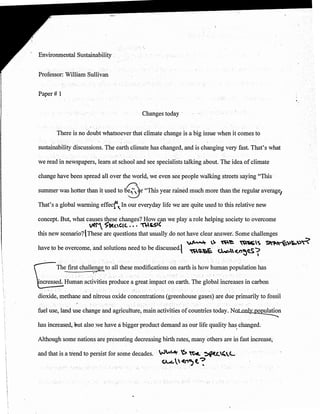
       There is no doubt whatsoever that climate change is a big issue when it comes to

sustainability discussions. The earth climate has changed, and is changing very fast. That's what

we read in newspapers, leam at school and see specialists talking about. The idea of climate

change have been spread all over the world, we even see people walking streets saying "This

summer was hotter than it used to   b~r "This year rained much more thanthe regular average1
That's a global warming effect~ In our everyday life we are quite used to this relative new

concept. But, what causes these changes? How can we playa role helping society to overcome
                    V~l' ~~<.C((. •• • ~;.$(
this new scenario? These are questions that usually. do not have clear answer. Some challenges
                                                            ~~ ~ $~ ~~S - S.~~~--~~
have to be overcome, and solutions need to be discussed.     ~C)..~ ~.(.(~<!.$       f
       The first challen~ to all these modifications on earth is how hmnan population has
           -             _;


dioxide, methane and nitrous oxide concentrations (greenhouse gases) are due primarily to fossil

fuel use, land use change and agriculture, main activities of countries today. N~n

has increased, ~ut also we have a bigger product demand as our life quality has changed.
                                                                                 I


Although some nations are presenting decreasing birth rates, m~my others are iti fast it1crease,

and that is a trend to persist for some decades. IJV.Ur ~ ~ ~"-.L
                                                                t:
                                                   (,...c. ~«j
~IJV I.Ot-JM.t:.J 'C'I-l.
                                                             "t>E~t.e ~1'o~ . •.

                             ~
       Another very important point is that ecosystems usually have a slow response to
                            .;--
environmental changes. Not all changes that we have made in the environment are being felt by +V-t,.

eartl~Secosystem. Someofthese.changes will only have visible impact many years from now.

Oceans are a great example of that slow response. In the pastyears oceans temperature have

increased less than other ecosystems, but twice as much warming is expected for the future. This

slow response is also seen when corrective actions are implemented, the environment take some

time.to show a positive impact of these actions. That fact makes solutions planning very difficult
                                                             ~

                                                            -
to policy makers, as their actions may only have an impact several years from now..            c:P


       The last great challenge that society has been facing is how to measure climate changes,

and how to know their real causes. Scientists are still working on how to properly quantify the

effects and causes of climate changes. Temperature, precipitation, insolation and others

parameters are connected to each other, and the relation of these parameters to pollution and
                                                                                          I


human activities isn't that simple to be drawn by equations and graphs. In some regions we have

many data of climatologic stations, but we still haven't figure out how to interpret all these

information. In the other hand, some regions have very few data, so it is difficult to say how

climate used to be, and if it has changed. How to correlate human activities to climate changes is

also a big issue, we already have an idea of which activities are the most dangerous, but the way

how these activities are connected and depend of each other make this evaluation very complex.


       Finally, although many doubts about climate changes still remain, there a r e =

evidence~   that it is real. We already got used to this new concept, but now we need to get used

to new attitudes in our daily life that can be solutions for many current problems. Transportation

is one main cause of global warming, as many transp01is use fossil fuel. One way of reducing

emissions is using public transportation, because busses and subways can transport many people
J'
                                                                    •.

                                                                         ;J
                                                                                       .·If

                                                                              -:~ ~. ; ,f .   ....   ,,   ,.-      ~-   ...;.
                                                                                                                                 ..   '                 '
                                                                                                      'f ~'      I '"' ,_"   "" ' '       .;.·.:· ,- t :·

 l


with less energy than cars or motorcycles. Another action that may have an important role in this

new scenario isto make policy makers concern to envirorun(mtal changes and work with

scientists to develop ways to minimize anthropogenic impact on environment. However, what

should have the greater impact on climate changes solutions is how we consume. Everything we

buy directly or indirectly produce an enviromnental impact. We should pay attention in what we

consume and how mttch of it, simple as it may sound, we need to stop and think what we really

need. And, most important ·of all, we hav~ to change the consciousness that climate changes are a

bad issue but nothing can be done. Many things   c~;m   be solute on the future with a simple effort.

today.

Paper 1

  • 1.
    Environmental Sustainability Evaluation of Paper 1: Fall 2012 William Sullivan, Bridgette Moen. Shimon Zimbovsky Name: ~~ .,US~ C.,:,~ USG-Dl Cle~rly articulated· · Thesis s~atem~nt. PoorJydevelo~~d thesis; '•. Introduction and thesis thesis; clear and · . . . somewhat dear; orientation to paper comp~lling o~ientation. orientation to weak or lacking. ,to y~Jllr i<ie~s, argument stated. .. · ·~·-= ~ (1-0 points) de~rly describes how ·•.· S~Iutions ide~tified are Weak or missing reade.rs q•11 play ar.ole in not all appropriatefor solutions; lack of detail; ~dd~essing at leastorie . . the challenge atharid; solutions are unfeasible. ofthe challenges; . / ... missing some detail~. . .· ·..• . . .. pro.videsthr~~specifk,, ab?utc()nc~~te, fe~sibJe (1~0 points) '· · · ·.• concr.et~,feasible steps steps th~t m1ghtbe · '; , · · ·.•thatrnightbetaken. ,·, ·.taken. VA(A.V.(, ;'::•·,; :....·..... . .:. :.~'·" .. ,.., . . ~ .••..:;· '0'''"1. ·'·.' ,; •~b1~ ;·.:·>''•; .• · ('!~ir!isL- .. -······· · Total Points Possible: 20 points
  • 2.
    Environmental Sustainability - - Professor: William Sullivan Paper# 1 Changes today · There is no doubt whatsoever that climate change is a big issue when it comes to sustainability discussions. The earth climate has changed, and is changing very fast. That's what we read in newspapers, leam at school and see specialists talking about. The idea of climate change have been spread all over the world, we even see people walking streets saying "This summer was hotter than it used to b~r "This year rained much more thanthe regular average1 That's a global warming effect~ In our everyday life we are quite used to this relative new concept. But, what causes these changes? How can we playa role helping society to overcome V~l' ~~<.C((. •• • ~;.$( this new scenario? These are questions that usually. do not have clear answer. Some challenges ~~ ~ $~ ~~S - S.~~~--~~ have to be overcome, and solutions need to be discussed. ~C)..~ ~.(.(~<!.$ f The first challen~ to all these modifications on earth is how hmnan population has - _; dioxide, methane and nitrous oxide concentrations (greenhouse gases) are due primarily to fossil fuel use, land use change and agriculture, main activities of countries today. N~n has increased, ~ut also we have a bigger product demand as our life quality has changed. I Although some nations are presenting decreasing birth rates, m~my others are iti fast it1crease, and that is a trend to persist for some decades. IJV.Ur ~ ~ ~"-.L t: (,...c. ~«j
  • 3.
    ~IJV I.Ot-JM.t:.J 'C'I-l. "t>E~t.e ~1'o~ . •. ~ Another very important point is that ecosystems usually have a slow response to .;-- environmental changes. Not all changes that we have made in the environment are being felt by +V-t,. eartl~Secosystem. Someofthese.changes will only have visible impact many years from now. Oceans are a great example of that slow response. In the pastyears oceans temperature have increased less than other ecosystems, but twice as much warming is expected for the future. This slow response is also seen when corrective actions are implemented, the environment take some time.to show a positive impact of these actions. That fact makes solutions planning very difficult ~ - to policy makers, as their actions may only have an impact several years from now.. c:P The last great challenge that society has been facing is how to measure climate changes, and how to know their real causes. Scientists are still working on how to properly quantify the effects and causes of climate changes. Temperature, precipitation, insolation and others parameters are connected to each other, and the relation of these parameters to pollution and I human activities isn't that simple to be drawn by equations and graphs. In some regions we have many data of climatologic stations, but we still haven't figure out how to interpret all these information. In the other hand, some regions have very few data, so it is difficult to say how climate used to be, and if it has changed. How to correlate human activities to climate changes is also a big issue, we already have an idea of which activities are the most dangerous, but the way how these activities are connected and depend of each other make this evaluation very complex. Finally, although many doubts about climate changes still remain, there a r e = evidence~ that it is real. We already got used to this new concept, but now we need to get used to new attitudes in our daily life that can be solutions for many current problems. Transportation is one main cause of global warming, as many transp01is use fossil fuel. One way of reducing emissions is using public transportation, because busses and subways can transport many people
  • 4.
    J' •. ;J .·If -:~ ~. ; ,f . .... ,, ,.- ~- ...;. .. ' ' 'f ~' I '"' ,_" "" ' ' .;.·.:· ,- t :· l with less energy than cars or motorcycles. Another action that may have an important role in this new scenario isto make policy makers concern to envirorun(mtal changes and work with scientists to develop ways to minimize anthropogenic impact on environment. However, what should have the greater impact on climate changes solutions is how we consume. Everything we buy directly or indirectly produce an enviromnental impact. We should pay attention in what we consume and how mttch of it, simple as it may sound, we need to stop and think what we really need. And, most important ·of all, we hav~ to change the consciousness that climate changes are a bad issue but nothing can be done. Many things c~;m be solute on the future with a simple effort. today.