Making Connections:
 Engaging English Language Learners &
Striving Readers in Language, Literacy and
              Global Issues


                  Dave Wilton
           Assistant Outreach Director

      www.facingthefuture.org
Copyright © 2010, Facing the Future
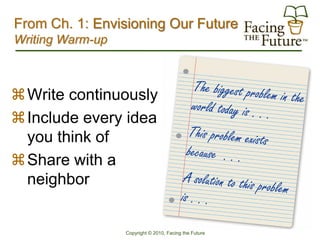
From Ch. 1: Envisioning Our Future
Writing Warm-up


 Write continuously
 Include every idea
  you think of
 Share with a
  neighbor


                  Copyright © 2010, Facing the Future
Agenda

Your Visions
Who is Facing the Future?
Why Use Global Issues & Literacy?
From the Teacher Perspective
From the Student Perspective
Give and Take
Reward for Your Patience

               Copyright © 2010, Facing the Future
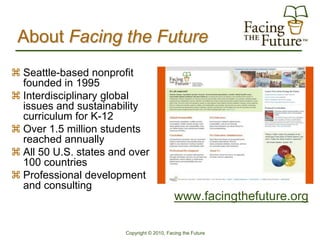
About Facing the Future
 Seattle-based nonprofit
  founded in 1995
 Interdisciplinary global
  issues and sustainability
  curriculum for K-12
 Over 1.5 million students
  reached annually
 All 50 U.S. states and over
  100 countries
 Professional development
  and consulting
                                             www.facingthefuture.org

                        Copyright © 2010, Facing the Future
Copyright © 2010, Facing the Future
Using Math & Real World Data
to Develop Global Competence
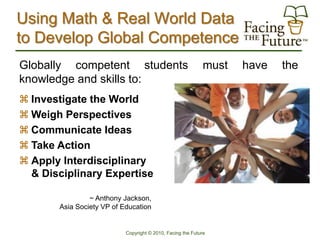
Globally competent students                                  must   have   the
knowledge and skills to:
 Investigate the World                          I’m Curious
 Weigh Perspectives                             I Have an Opinion
 Communicate Ideas                              I Want to Share It
 Take Action                                    I Want to Be Involved
 Apply Interdisciplinary                        I Want Bring My Talents
  & Disciplinary Expertise                        to Bear

                ~ Anthony Jackson,
       Asia Society VP of Education


                           Copyright © 2010, Facing the Future
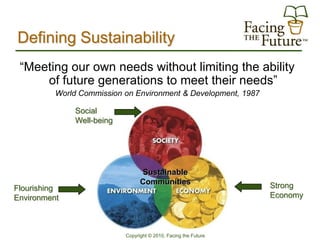
Defining Sustainability
 “Meeting our own needs without limiting the ability
     of future generations to meet their needs”
          World Commission on Environment & Development, 1987

               Social
               Well-being


                                  Sustainable
                                  Communities                     Strong
Flourishing
Environment                                                       Economy


                            Copyright © 2010, Facing the Future
Think, Pair, Share
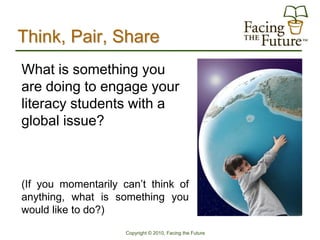
What is something you
are doing to engage your
literacy students with a
global issue?


(If you momentarily can’t think of
anything, what is something you
would like to do?)

                     Copyright © 2010, Facing the Future
Development Rationale

                                      25% of students in
                                       grades 4-12 read below
                                       grade level
                                      21st century literacy
                                       demands
                                      Student engagement
“The emphasis on different types of thinking strategies,
reading strategies, and vocabulary was excellent for [my
students].”
                                        ~ Jill Berge, Literacy Teacher
                                    Rose Hill Junior High, Washington
                      Copyright © 2010, Facing the Future
Why Global Issues & Literacy?
                          Make language learning
                           purposeful
                          Motivate with content-based
                           learning
                          Gain skills and knowledge
                           needed to excel academically
                          Apply skills to current, relevant,
                           and interconnected topics
                          Make meaningful contributions
                           to their communities through
                           service and action

              Copyright © 2010, Facing the Future
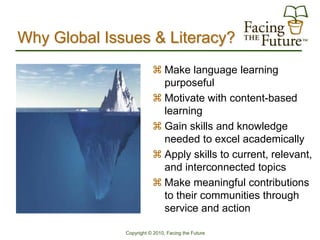
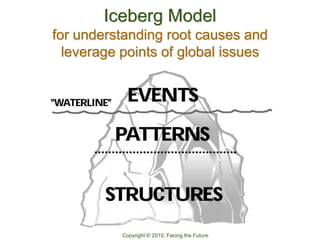
Iceberg Model
for understanding root causes and
  leverage points of global issues


           Copyright © 2010, Facing the Future
Ways to Use This Resource
                        Language acquisition for
                         intermediate English language
                         learners and striving readers
                        Reading comprehension of
                         nonfiction materials in English
                         language arts classes
                        Increasing knowledge of global
                         issues in science and social
                         studies classes
                        Student engagement in the
                         classroom around current,
                         relevant issues
            Copyright © 2010, Facing the Future
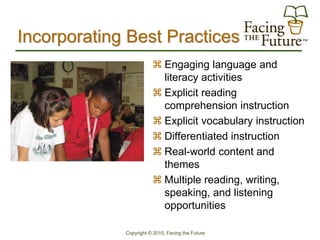
Incorporating Best Practices
                         Engaging language and
                          literacy activities
                         Explicit reading
                          comprehension instruction
                         Explicit vocabulary instruction
                         Differentiated instruction
                         Real-world content and
                          themes
                         Multiple reading, writing,
                          speaking, and listening
                          opportunities

             Copyright © 2010, Facing the Future
Chapter Components
                       Activating Knowledge
                       Vocabulary Development
                       Dialogue
                       Reading
                       Writing
                       Culminating Activity
                       Assessments (formative &
                        summative)
                       Content-Based Themes


           Copyright © 2010, Facing the Future
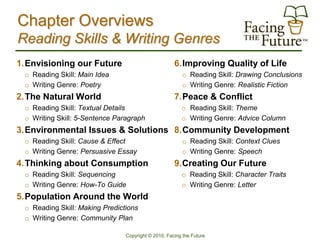
Chapter Overviews
Reading Skills & Writing Genres
1.Envisioning our Future                             6.Improving Quality of Life
 o Reading Skill: Main Idea                             o Reading Skill: Drawing Conclusions
 o Writing Genre: Poetry                                o Writing Genre: Realistic Fiction
2.The Natural World                                  7.Peace & Conflict
 o Reading Skill: Textual Details                       o Reading Skill: Theme
 o Writing Skill: 5-Sentence Paragraph                  o Writing Genre: Advice Column
3.Environmental Issues & Solutions 8.Community Development
 o Reading Skill: Cause & Effect                        o Reading Skill: Context Clues
 o Writing Genre: Persuasive Essay                      o Writing Genre: Speech
4.Thinking about Consumption                         9.Creating Our Future
 o Reading Skill: Sequencing                            o Reading Skill: Character Traits
 o Writing Genre: How-To Guide                          o Writing Genre: Letter
5.Population Around the World
 o Reading Skill: Making Predictions
 o Writing Genre: Community Plan

                                Copyright © 2010, Facing the Future
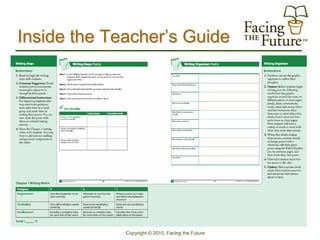
Inside the Teacher’s Guide


             Copyright © 2010, Facing the Future
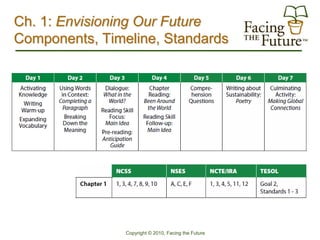
Ch. 1: Envisioning Our Future
Components, Timeline, Standards


                Copyright © 2010, Facing the Future
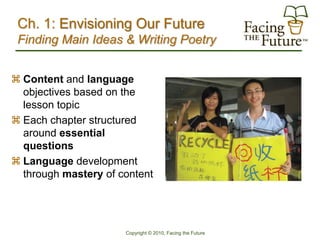
Ch. 1: Envisioning Our Future
 Finding Main Ideas & Writing Poetry


 Content and language
  objectives based on the
  lesson topic
 Each chapter structured
  around essential
  questions
 Language development
  through mastery of content


                      Copyright © 2010, Facing the Future
Ch. 1: Envisioning Our Future
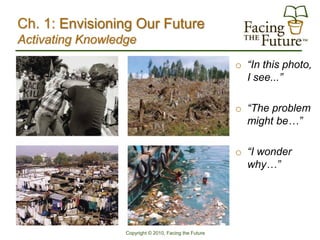
Activating Knowledge
                                                        o “In this photo,
                                                          I see...”

                                                        o “The problem
                                                          might be…”

                                                        o “I wonder
                                                          why…”


                  Copyright © 2010, Facing the Future
Ch. 1: Envisioning Our Future
 Writing Warm-up

 Respond to the following
  questions. Write continuously and
  include every idea you can think
  of. Be ready to share with your
  partner.
o What is the biggest problem in the
  world today?
o Why does this problem exist?
o What do you think is a solution to
  this problem?


                       Copyright © 2010, Facing the Future
Ch. 1: Envisioning Our Future
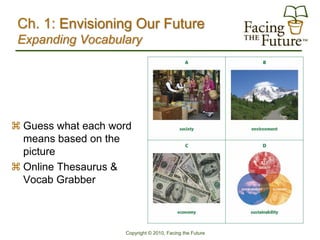
 Expanding Vocabulary


 Guess what each word
  means based on the
  picture
 Online Thesaurus &
  Vocab Grabber


                    Copyright © 2010, Facing the Future
Ch. 1: Envisioning Our Future
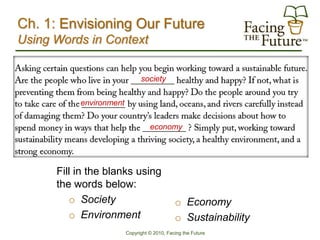
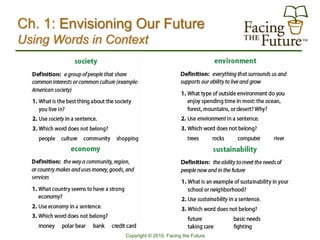
Using Words in Context


                               society


           environment


                                   economy


      Fill in the blanks using
      the words below:
         o Society                            o Economy
         o Environment                        o Sustainability
                         Copyright © 2010, Facing the Future
Ch. 1: Envisioning Our Future
Using Words in Context


                  Copyright © 2010, Facing the Future
Ch. 3: Environmental Issues
Dialogue


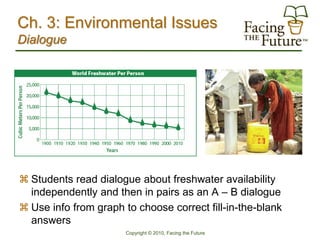
 Students read dialogue about freshwater availability
  independently and then in pairs as an A – B dialogue
 Use info from graph to choose correct fill-in-the-blank
  answers
                       Copyright © 2010, Facing the Future
Ch. 3: Environmental Issues
Dialogue


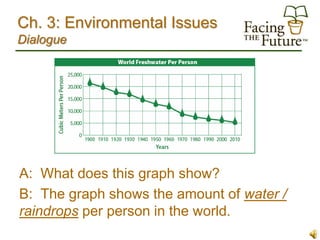
A: What does this graph show?
B: The graph shows the amount of water /
raindrops per person in the world.
Ch. 3: Environmental Issues
Dialogue


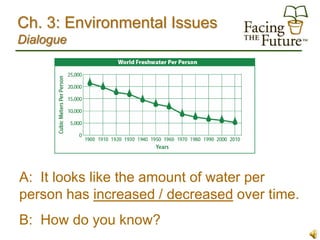
A: It looks like the amount of water per
person has increased / decreased over time.
B: How do you know?
Ch. 3: Environmental Issues
Dialogue


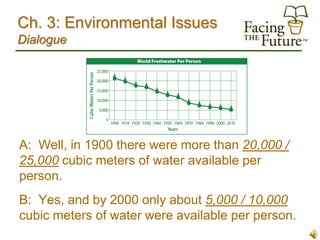
A: Well, in 1900 there were more than 20,000 /
25,000 cubic meters of water available per
person.
B: Yes, and by 2000 only about 5,000 / 10,000
cubic meters of water were available per person.
Ch. 3: Environmental Issues
Dialogue


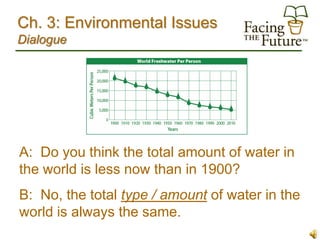
A: Do you think the total amount of water in
the world is less now than in 1900?
B: No, the total type / amount of water in the
world is always the same.
Ch. 3: Environmental Issues
Dialogue


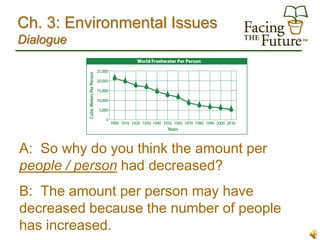
A: So why do you think the amount per
people / person had decreased?
B: The amount per person may have
decreased because the number of people
has increased.
Ch. 3: Environmental Issues
Dialogue


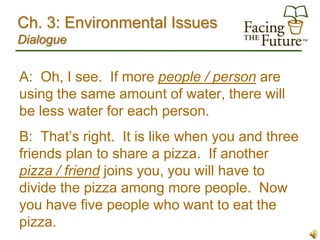
A: Oh, I see. If more people / person are
using the same amount of water, there will
be less water for each person.
B: That’s right. It is like when you and three
friends plan to share a pizza. If another
pizza / friend joins you, you will have to
divide the pizza among more people. Now
you have five people who want to eat the
pizza.
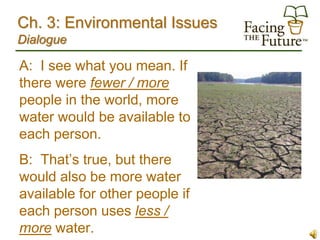
Ch. 3: Environmental Issues
Dialogue

A: I see what you mean. If
there were fewer / more
people in the world, more
water would be available to
each person.
B: That’s true, but there
would also be more water
available for other people if
each person uses less /
more water.
This Audio Interlude
Brought to You by . . .
           The students of David White Espin
           • Teacher at Secondary Bilingual
             Orientation Center, Seattle, WA
           • Co-author of chapter in TESOL
             Classroom Practice Series, Authenticity
             in the Language Classroom and Beyond
           • Pilot-tester and contributor to Making
             Connections


               Copyright © 2010, Facing the Future
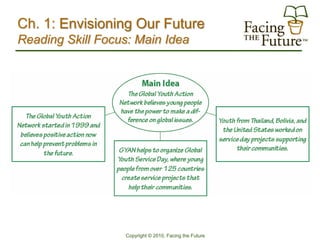
Ch. 1: Envisioning Our Future
Reading Skill Focus: Main Idea


                  Copyright © 2010, Facing the Future
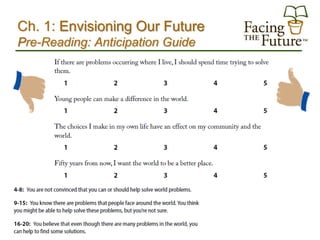
Ch. 1: Envisioning Our Future
Pre-Reading: Anticipation Guide


                  Copyright © 2010, Facing the Future
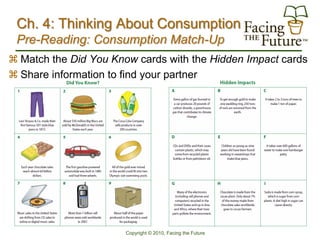
Ch. 4: Thinking About Consumption
 Pre-Reading: Consumption Match-Up
 Match the Did You Know cards with the Hidden Impact cards
 Share information to find your partner


                       Copyright © 2010, Facing the Future
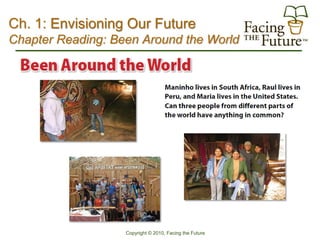
Ch. 1: Envisioning Our Future
Chapter Reading: Been Around the World


                   Copyright © 2010, Facing the Future
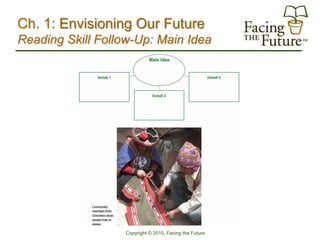
Ch. 1: Envisioning Our Future
Reading Skill Follow-Up: Main Idea


                   Copyright © 2010, Facing the Future
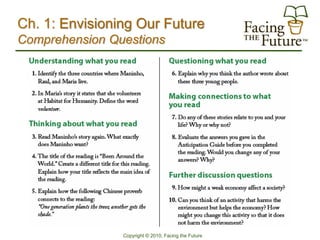
Ch. 1: Envisioning Our Future
Comprehension Questions


                Copyright © 2010, Facing the Future
Ch. 1: Envisioning Our Future
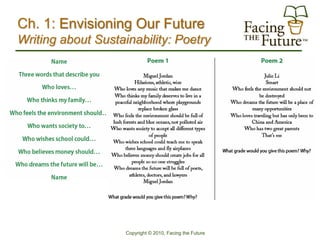
Writing about Sustainability: Poetry


                    Copyright © 2010, Facing the Future
Ch. 1: Envisioning Our Future
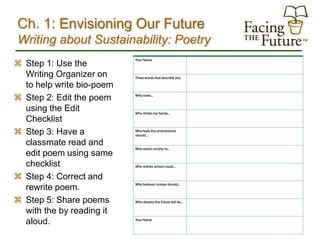
Writing about Sustainability: Poetry
 Step 1: Use the
  Writing Organizer on
  to help write bio-poem
 Step 2: Edit the poem
  using the Edit
  Checklist
 Step 3: Have a
  classmate read and
  edit poem using same
  checklist
 Step 4: Correct and
  rewrite poem.
 Step 5: Share poems
  with the by reading it
  aloud.
Ch. 1: Envisioning Our Future
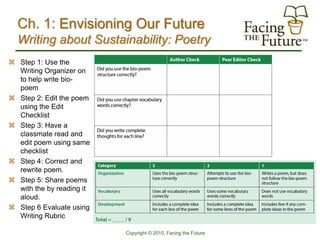
  Writing about Sustainability: Poetry
 Step 1: Use the
  Writing Organizer on
  to help write bio-
  poem
 Step 2: Edit the poem
  using the Edit
  Checklist
 Step 3: Have a
  classmate read and
  edit poem using same
  checklist
 Step 4: Correct and
  rewrite poem.
 Step 5: Share poems
  with the by reading it
  aloud.
 Step 6 Evaluate using
  Writing Rubric

                           Copyright © 2010, Facing the Future
Ch. 1: Envisioning Our Future
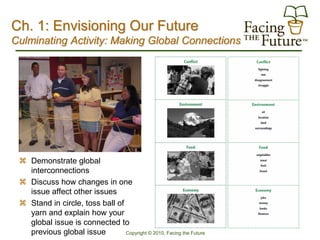
Culminating Activity: Making Global Connections


  Demonstrate global
   interconnections
  Discuss how changes in one
   issue affect other issues
  Stand in circle, toss ball of
   yarn and explain how your
   global issue is connected to
   previous global issue         Copyright © 2010, Facing the Future
Ch. 1: Envisioning Our Future
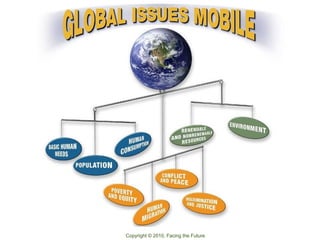
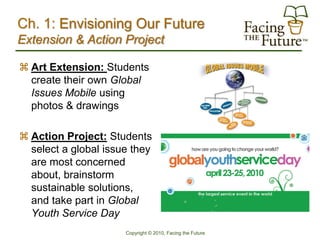
Extension & Action Project

 Art Extension: Students
  create their own Global
  Issues Mobile using
  photos & drawings

 Action Project: Students
  select a global issue they
  are most concerned
  about, brainstorm
  sustainable solutions,
  and take part in Global
  Youth Service Day
                      Copyright © 2010, Facing the Future
Ch. 1: Envisioning Our Future
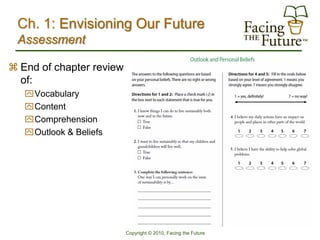
 Assessment

 End of chapter review
  of:
   Vocabulary
   Content
   Comprehension
   Outlook & Beliefs


                          Copyright © 2010, Facing the Future
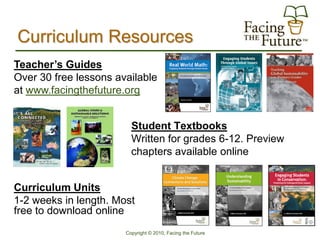
Curriculum Resources
Teacher’s Guides
Over 30 free lessons available
at www.facingthefuture.org


                         Student Textbooks
                         Written for grades 6-12. Preview
                         chapters available online


Curriculum Units
1-2 weeks in length. Most
free to download online
                       Copyright © 2010, Facing the Future
THANK YOU!

           Staying Connected
 Visit www.facingthefuture.org
 Sign up for FTF e-newsletter
 Respond to survey
 Become a Peer Educator
 Contact FTF:
  dave@facingthefuture.org
                      Copyright © 2010, Facing the Future
“We must teach our students that
they can be architects of the future,
      rather than its victims.”
                        ~ Buckminster Fuller

Engaging Students in Language

  • 1.
    Making Connections: EngagingEnglish Language Learners & Striving Readers in Language, Literacy and Global Issues Dave Wilton Assistant Outreach Director www.facingthefuture.org
  • 2.
    Copyright © 2010,Facing the Future
  • 3.
    Copyright © 2010,Facing the Future
  • 4.
    From Ch. 1:Envisioning Our Future Writing Warm-up  Write continuously  Include every idea you think of  Share with a neighbor Copyright © 2010, Facing the Future
  • 5.
    Agenda Your Visions Who isFacing the Future? Why Use Global Issues & Literacy? From the Teacher Perspective From the Student Perspective Give and Take Reward for Your Patience Copyright © 2010, Facing the Future
  • 6.
    About Facing theFuture  Seattle-based nonprofit founded in 1995  Interdisciplinary global issues and sustainability curriculum for K-12  Over 1.5 million students reached annually  All 50 U.S. states and over 100 countries  Professional development and consulting www.facingthefuture.org Copyright © 2010, Facing the Future
  • 7.
    Copyright © 2010,Facing the Future
  • 8.
    Using Math &Real World Data to Develop Global Competence Globally competent students must have the knowledge and skills to:  Investigate the World  I’m Curious  Weigh Perspectives  I Have an Opinion  Communicate Ideas  I Want to Share It  Take Action  I Want to Be Involved  Apply Interdisciplinary  I Want Bring My Talents & Disciplinary Expertise to Bear ~ Anthony Jackson, Asia Society VP of Education Copyright © 2010, Facing the Future
  • 9.
    Defining Sustainability “Meetingour own needs without limiting the ability of future generations to meet their needs” World Commission on Environment & Development, 1987 Social Well-being Sustainable Communities Strong Flourishing Environment Economy Copyright © 2010, Facing the Future
  • 10.
    Think, Pair, Share Whatis something you are doing to engage your literacy students with a global issue? (If you momentarily can’t think of anything, what is something you would like to do?) Copyright © 2010, Facing the Future
  • 11.
    Development Rationale 25% of students in grades 4-12 read below grade level 21st century literacy demands Student engagement “The emphasis on different types of thinking strategies, reading strategies, and vocabulary was excellent for [my students].” ~ Jill Berge, Literacy Teacher Rose Hill Junior High, Washington Copyright © 2010, Facing the Future
  • 12.
    Why Global Issues& Literacy?  Make language learning purposeful  Motivate with content-based learning  Gain skills and knowledge needed to excel academically  Apply skills to current, relevant, and interconnected topics  Make meaningful contributions to their communities through service and action Copyright © 2010, Facing the Future
  • 13.
    Iceberg Model for understandingroot causes and leverage points of global issues Copyright © 2010, Facing the Future
  • 14.
    Ways to UseThis Resource  Language acquisition for intermediate English language learners and striving readers  Reading comprehension of nonfiction materials in English language arts classes  Increasing knowledge of global issues in science and social studies classes  Student engagement in the classroom around current, relevant issues Copyright © 2010, Facing the Future
  • 15.
    Incorporating Best Practices  Engaging language and literacy activities  Explicit reading comprehension instruction  Explicit vocabulary instruction  Differentiated instruction  Real-world content and themes  Multiple reading, writing, speaking, and listening opportunities Copyright © 2010, Facing the Future
  • 16.
    Chapter Components  Activating Knowledge  Vocabulary Development  Dialogue  Reading  Writing  Culminating Activity  Assessments (formative & summative)  Content-Based Themes Copyright © 2010, Facing the Future
  • 17.
    Chapter Overviews Reading Skills& Writing Genres 1.Envisioning our Future 6.Improving Quality of Life o Reading Skill: Main Idea o Reading Skill: Drawing Conclusions o Writing Genre: Poetry o Writing Genre: Realistic Fiction 2.The Natural World 7.Peace & Conflict o Reading Skill: Textual Details o Reading Skill: Theme o Writing Skill: 5-Sentence Paragraph o Writing Genre: Advice Column 3.Environmental Issues & Solutions 8.Community Development o Reading Skill: Cause & Effect o Reading Skill: Context Clues o Writing Genre: Persuasive Essay o Writing Genre: Speech 4.Thinking about Consumption 9.Creating Our Future o Reading Skill: Sequencing o Reading Skill: Character Traits o Writing Genre: How-To Guide o Writing Genre: Letter 5.Population Around the World o Reading Skill: Making Predictions o Writing Genre: Community Plan Copyright © 2010, Facing the Future
  • 18.
    Inside the Teacher’sGuide Copyright © 2010, Facing the Future
  • 19.
    Ch. 1: EnvisioningOur Future Components, Timeline, Standards Copyright © 2010, Facing the Future
  • 20.
    Ch. 1: EnvisioningOur Future Finding Main Ideas & Writing Poetry  Content and language objectives based on the lesson topic  Each chapter structured around essential questions  Language development through mastery of content Copyright © 2010, Facing the Future
  • 21.
    Ch. 1: EnvisioningOur Future Activating Knowledge o “In this photo, I see...” o “The problem might be…” o “I wonder why…” Copyright © 2010, Facing the Future
  • 22.
    Ch. 1: EnvisioningOur Future Writing Warm-up  Respond to the following questions. Write continuously and include every idea you can think of. Be ready to share with your partner. o What is the biggest problem in the world today? o Why does this problem exist? o What do you think is a solution to this problem? Copyright © 2010, Facing the Future
  • 23.
    Ch. 1: EnvisioningOur Future Expanding Vocabulary  Guess what each word means based on the picture  Online Thesaurus & Vocab Grabber Copyright © 2010, Facing the Future
  • 24.
    Ch. 1: EnvisioningOur Future Using Words in Context society environment economy Fill in the blanks using the words below: o Society o Economy o Environment o Sustainability Copyright © 2010, Facing the Future
  • 25.
    Ch. 1: EnvisioningOur Future Using Words in Context Copyright © 2010, Facing the Future
  • 26.
    Ch. 3: EnvironmentalIssues Dialogue  Students read dialogue about freshwater availability independently and then in pairs as an A – B dialogue  Use info from graph to choose correct fill-in-the-blank answers Copyright © 2010, Facing the Future
  • 27.
    Ch. 3: EnvironmentalIssues Dialogue A: What does this graph show? B: The graph shows the amount of water / raindrops per person in the world.
  • 28.
    Ch. 3: EnvironmentalIssues Dialogue A: It looks like the amount of water per person has increased / decreased over time. B: How do you know?
  • 29.
    Ch. 3: EnvironmentalIssues Dialogue A: Well, in 1900 there were more than 20,000 / 25,000 cubic meters of water available per person. B: Yes, and by 2000 only about 5,000 / 10,000 cubic meters of water were available per person.
  • 30.
    Ch. 3: EnvironmentalIssues Dialogue A: Do you think the total amount of water in the world is less now than in 1900? B: No, the total type / amount of water in the world is always the same.
  • 31.
    Ch. 3: EnvironmentalIssues Dialogue A: So why do you think the amount per people / person had decreased? B: The amount per person may have decreased because the number of people has increased.
  • 32.
    Ch. 3: EnvironmentalIssues Dialogue A: Oh, I see. If more people / person are using the same amount of water, there will be less water for each person. B: That’s right. It is like when you and three friends plan to share a pizza. If another pizza / friend joins you, you will have to divide the pizza among more people. Now you have five people who want to eat the pizza.
  • 33.
    Ch. 3: EnvironmentalIssues Dialogue A: I see what you mean. If there were fewer / more people in the world, more water would be available to each person. B: That’s true, but there would also be more water available for other people if each person uses less / more water.
  • 34.
    This Audio Interlude Broughtto You by . . . The students of David White Espin • Teacher at Secondary Bilingual Orientation Center, Seattle, WA • Co-author of chapter in TESOL Classroom Practice Series, Authenticity in the Language Classroom and Beyond • Pilot-tester and contributor to Making Connections Copyright © 2010, Facing the Future
  • 35.
    Ch. 1: EnvisioningOur Future Reading Skill Focus: Main Idea Copyright © 2010, Facing the Future
  • 36.
    Ch. 1: EnvisioningOur Future Pre-Reading: Anticipation Guide Copyright © 2010, Facing the Future
  • 37.
    Ch. 4: ThinkingAbout Consumption Pre-Reading: Consumption Match-Up  Match the Did You Know cards with the Hidden Impact cards  Share information to find your partner Copyright © 2010, Facing the Future
  • 38.
    Ch. 1: EnvisioningOur Future Chapter Reading: Been Around the World Copyright © 2010, Facing the Future
  • 39.
    Ch. 1: EnvisioningOur Future Reading Skill Follow-Up: Main Idea Copyright © 2010, Facing the Future
  • 40.
    Ch. 1: EnvisioningOur Future Comprehension Questions Copyright © 2010, Facing the Future
  • 41.
    Ch. 1: EnvisioningOur Future Writing about Sustainability: Poetry Copyright © 2010, Facing the Future
  • 42.
    Ch. 1: EnvisioningOur Future Writing about Sustainability: Poetry  Step 1: Use the Writing Organizer on to help write bio-poem  Step 2: Edit the poem using the Edit Checklist  Step 3: Have a classmate read and edit poem using same checklist  Step 4: Correct and rewrite poem.  Step 5: Share poems with the by reading it aloud.
  • 43.
    Ch. 1: EnvisioningOur Future Writing about Sustainability: Poetry  Step 1: Use the Writing Organizer on to help write bio- poem  Step 2: Edit the poem using the Edit Checklist  Step 3: Have a classmate read and edit poem using same checklist  Step 4: Correct and rewrite poem.  Step 5: Share poems with the by reading it aloud.  Step 6 Evaluate using Writing Rubric Copyright © 2010, Facing the Future
  • 44.
    Ch. 1: EnvisioningOur Future Culminating Activity: Making Global Connections  Demonstrate global interconnections  Discuss how changes in one issue affect other issues  Stand in circle, toss ball of yarn and explain how your global issue is connected to previous global issue Copyright © 2010, Facing the Future
  • 45.
    Ch. 1: EnvisioningOur Future Extension & Action Project  Art Extension: Students create their own Global Issues Mobile using photos & drawings  Action Project: Students select a global issue they are most concerned about, brainstorm sustainable solutions, and take part in Global Youth Service Day Copyright © 2010, Facing the Future
  • 46.
    Ch. 1: EnvisioningOur Future Assessment  End of chapter review of: Vocabulary Content Comprehension Outlook & Beliefs Copyright © 2010, Facing the Future
  • 47.
    Curriculum Resources Teacher’s Guides Over30 free lessons available at www.facingthefuture.org Student Textbooks Written for grades 6-12. Preview chapters available online Curriculum Units 1-2 weeks in length. Most free to download online Copyright © 2010, Facing the Future
  • 48.
    THANK YOU! Staying Connected  Visit www.facingthefuture.org  Sign up for FTF e-newsletter  Respond to survey  Become a Peer Educator  Contact FTF: dave@facingthefuture.org Copyright © 2010, Facing the Future
  • 49.
    “We must teachour students that they can be architects of the future, rather than its victims.” ~ Buckminster Fuller